The Watchtower, December 1, 1970
Download: PDF — The Watchtower, December 1, 1970
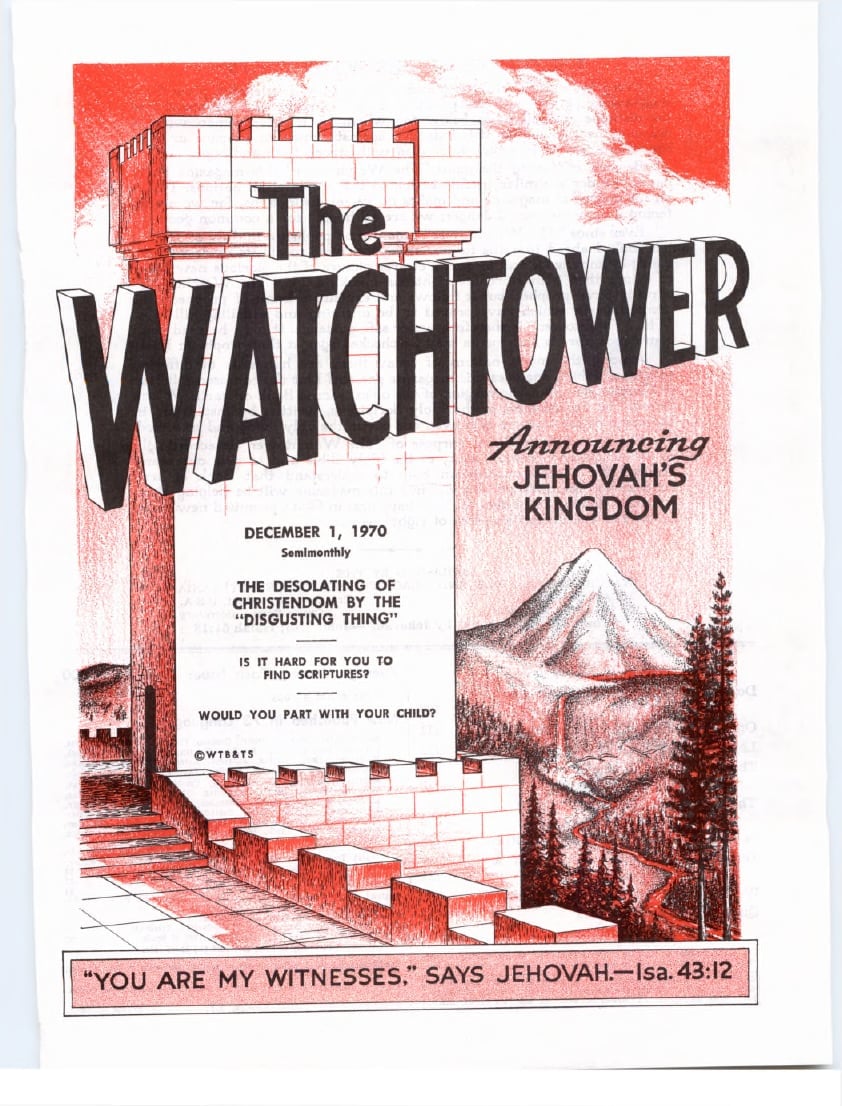
The Watchtower — December 1, 1970
Source: jw.org
Contents
Do You Uphold God’s Name and Reputation?
One Leper Gave Glory to God
Lepers in Bible Lands
The Desolator of Christendom Historically Prefigured
The Desolating of Christendom by the “Disgusting Thing”
Is It Hard for You to Find Scriptures?
Teaching All Nationalities with a View to Baptism
Would You Part with Your Child?
Questions From Readers
Announcements
Do You Uphold God’s Name and Reputation?
Do You Uphold God’s Name and Reputation?
WHAT is the general attitude of people toward God? Do they speak well of him and his name Jehovah? Do they look to him for guidance, and endeavor to obey his laws? Or, have you noted, rather, that people frequently blame God for misfortunes, and that some even curse him for the evils that exist?
It is obvious that the majority of mankind do not uphold God’s name and reputation. They do not have the attitude of the Bible psalmist who said: “O Jehovah our Lord, how majestic your name is in all the earth, you whose dignity is recounted above the heavens!” (Ps. 8:1) Nor do they respond to the invitation: “Let them praise the name of Jehovah, for his name alone is unreachably high. His dignity is above earth and heaven.”—Ps. 148:13.
Why do so many persons not have this high regard for God’s name and reputation? Why are they not inclined to “praise the name of Jehovah,” and honor him for the grand things that he has done? It is vital that you know.
GOD’S NAME PROFANED
The answer lies in events that happened at the outset of human history. At that time there was a rebellion against God by one of his heavenly angelic creatures, who brought God’s name and reputation into question.
This spirit creature used a lowly serpent as a mouthpiece in speaking to the first woman Eve, making it appear as though the serpent were actually doing the talking. He cast doubt on God’s command that prohibited, on penalty of death, eating from the tree of the knowledge of good and bad. He claimed: “You positively will not die. For God knows that in the very day of your eating from it your eyes are bound to be opened and you are bound to be like God, knowing good and bad.”—Gen. 3:1-5; 2:16, 17.
This was a misrepresentation of God, a lie about him. (John 8:44) The angelic opposer, Satan the Devil, in effect accused Jehovah God of withholding from the first human pair something that would be to their benefit. The result was that Eve, and then her husband, were induced willfully to disobey God’s righteous command. Such disobedience was a profaning or defiling of God’s name and reputation.
Ever since that time the spirit son who became Satan has been responsible for sponsoring ideas that misrepresent God and that cause people to question the rightness of his ways. The profanation of God’s name has thus continued through the centuries. Do you know why God has permitted Satan to remain for all these years? Do you appreciate the issue that was raised?
THE ISSUE RAISED
The issue that Satan raised in Eden was not a question of who had the greater might. Satan did not challenge God’s strength, which obviously was superior. In fact, had Satan known Jehovah as a God given to uncontrolled, violent outbursts, he could only have expected immediate, on-the-spot extermination for his course of vilifying God’s name and reputation. Rather, it was a moral issue that Satan raised. It had to do with God’s moral right to exercise universal sovereignty or supreme authority, and to require complete obedience and devotion of all his creatures.
Satan actually set himself up as a ruler who is a rival to Jehovah, challenging God’s rulership. In Job’s day Jehovah brought into the open before all his assembled angelic sons this challenge of Satan. But what occurred there brings to the fore a secondary or subsidiary issue that arises from the primary issue of God’s right to universal sovereignty.
THE RELATED ISSUE
That related issue has to do with the integrity or loyalty of creatures. What occurred in Jehovah’s heavenly courts in the days of the man Job makes clear that man’s integrity toward God was at issue in addition to the matter of rulership. Consider what took place:
“Jehovah went on to say to Satan: ‘Have you set your heart upon my servant Job, that there is no one like him in the earth, a man blameless and upright, fearing God and turning aside from bad?’ At that Satan answered Jehovah and said: ‘Is it for nothing that Job has feared God? Have not you yourself put up a hedge about him and about his house and about everything that he has all around? The work of his hands you have blessed, and his livestock itself has spread abroad in the earth. But, for a change, thrust out your hand, please, and touch everything he has and see whether he will not curse you to your very face.’”—Job 1:6-12.
Yes, Satan made the claim that the loyalty of Job, and, by implication, of all of God’s intelligent creatures, was not wholehearted, not based on true devotion and genuine love. So Satan challenged that he could turn all men away from God, even the one of whom God said “there is no one like him in the earth.”
To settle this matter would require time. It would take time for the truth or falsity of the charges to be demonstrated, for the heart attitude of God’s creatures to be proved, and thus for the issue to be settled beyond any doubt. Therefore Jehovah permitted Satan to remain for a limited time.
AN ISSUE THAT CONTINUES TO OUR DAY
The issue of universal sovereignty and man’s integrity still remained alive when Jesus Christ was on earth. This is seen from Jesus’ confrontation with Satan in the wilderness. The serpentlike tactics employed in his temptation efforts toward God’s Son followed the pattern seen in Eden some four thousand years earlier. Satan’s offer to Jesus of rulership over earthly kingdoms if Jesus would bow down before him and do an act of worship made clear that the issue had not changed. Satan was still holding himself forth as a rival ruler to Jehovah.—Matt. 4:1-10.
This is also true today. The issue is still alive. Therefore, what is your position in connection with it? Are you faithfully upholding God’s name and reputation as Jesus did? Whom do your actions show that you are serving as ruler, Jehovah God or Satan the Devil?
The Bible reveals how that question can be answered when it says: “Do you not know that if you keep presenting yourselves to anyone as slaves to obey him, you are slaves of him because you obey him?” (Rom. 6:16) Yes, the ruler whom we are serving is revealed, not by the claims that we may make with our mouth, but by whom we obey, by whose will we are doing.—Matt. 7:21.
This should cause us to think seriously. Really, whom are we obeying? Are we actually doing the will of God? Do we diligently study the Bible to learn what God’s requirements are, and then do our utmost to obey them? For instance, when we learn that God requires that his servants live morally—not stealing, not getting drunk, not committing fornication or adultery—do we obey these commands? (1 Cor. 6:9, 10; Gal. 5:19-21) Or when God’s Word counsels Christians not to forsake the gathering of themselves together, and to share in preaching about God’s kingdom, how do we respond? (Heb. 10:24, 25; Matt. 24:14) The answers to such questions will indicate whom we are really serving.
SANCTIFICATION OF GOD’S NAME VITAL
We cannot minimize the importance of the issue regarding God’s right to universal sovereignty that Satan raised in Eden. Actually the entire Bible account revolves around it and how God determines to settle it. The settling of the issue will result in the sanctifying of Jehovah’s holy name, cleansing it of all reproach and false charges. In fact, God’s purpose to sanctify his name provides the key for understanding the reason behind his actions and his dealings with his creatures as set forth in the entire Bible.
Thus, we find that the nation of Israel, whose history forms a large part of the Bible record, was selected to be a ‘name people’ for Jehovah. (Deut. 28:9, 10; 2 Chron. 7:14; Isa. 43:1, 3, 7) Jehovah’s law covenant with them laid prime importance on their giving exclusive devotion to Jehovah as God and not taking up his name in a worthless way, “for Jehovah will not leave the one unpunished who takes up his name in a worthless way.” (Ex. 20:1-7) When Israel showed a rebellious attitude in the wilderness, Jehovah dealt mercifully with them and did not abandon them. However, he revealed his primary reason in saying: “I went acting for the sake of my own name that it might not be profaned before the eyes of the nations.”—Ezek. 20:8-10.
Throughout the history of the nation of Israel, Jehovah kept the importance of his sacred name before them. The capital city, Jerusalem, with its Mount Zion was the place Jehovah chose “to place his name there, to have it reside.” (Deut. 12:5, 11; Isa. 18:7; Jer. 3:17) The profaning of Jehovah’s name there would bring certain destruction upon the city and lead to the casting away of the temple itself.—1 Ki. 9:6-8; Jer. 25:29; 7:8-15.
In foretelling his restoration of his name people to Judah and their cleansing, Jehovah again made clear to them his main concern, saying: “And I shall have compassion on my holy name . . . ‘Not for your sakes am I doing it, O house of Israel, but for my holy name, which you have profaned among the nations where you have come in.’ ‘And I shall certainly sanctify my great name, which was being profaned . . . and the nations will have to know that I am Jehovah,’ is the utterance of the Lord Jehovah, ‘when I am sanctified among you before their eyes.’”—Ezek. 36:20-27, 32.
Jehovah God therefore makes clear that his primary purpose is the sanctifying of his own name, thereby cleansing it of all the reproach that has been heaped upon it. God’s Son Jesus Christ instructed his followers to pray about this, telling them: “You must pray, then, this way: ‘Our Father in the heavens, let your name be sanctified.’” (Matt. 6:9) Do you pray this prayer? Is it really your heartfelt desire to see the name of God cleared of the false charges laid against it? What part can you individually have in the sanctifying of God’s name?
Well, since the issue of rightful rulership involves the matter of whether humans will faithfully serve God, you can do God’s will at all times. Failing to do so brings reproach upon Jehovah’s name, and pleases his adversary Satan. Thus true love for God and his name will motivate you always to obey Jehovah, and thereby you are sharing in the sanctifying of his name. And should you at times fall short due to human imperfection, love for Jehovah will move you to go to Him in prayer, telling him you are sorry and asking forgiveness for your shortcomings.
JEHOVAH’S SOVEREIGNTY PARAMOUNT
When matters are viewed in their proper perspective, then, the sanctifying of God’s great name is seen to be the most vital concern of the universe, taking precedence over the salvation of humankind. Actually, since all men are sinners, they are justly worthy of death. It is only by God’s undeserved kindness and mercy that any will gain life, life being a gift from God.—Rom. 5:15; 6:23.
The Bible psalmist expressed the true perspective of matters when he humbly and wonderingly exclaimed: “O Jehovah our Lord, how majestic your name is in all the earth, you whose dignity is recounted above the heavens! . . . When I see your heavens, the works of your fingers, the moon and the stars that you have prepared, what is mortal man that you keep him in mind, and the son of earthling man that you take care of him?” (Ps. 8:1, 3, 4) The sanctification of Jehovah God’s name rightly means more than the life of all mankind.
Since Jehovah could, in full justice, put an end to all sinful mankind, the greatness of his mercy and undeserved kindness is exalted all the more by his saving some of mankind for life. (John 3:36) Yes, Jehovah is patient and long-suffering, forgiving repentant ones “in a large way.” (Isa. 55:6, 7; Ps. 130:3, 4) However, at the same time he will not let the willfully wicked escape the execution of his judgment. Not that Jehovah takes pleasure in the death of the wicked, for he does not, but he will not tolerate forever a situation that reproaches his lofty name.—Ezek. 18:23; Amos 9:2-4; Rom. 2:2-8.
Thus, Jehovah shows a beautiful and perfect balance of justice and mercy. Really, are we not motivated to want to uphold the name and reputation of such a merciful and just God? It is indeed a privilege to serve as witnesses for the great God Jehovah, upholding his rightful sovereignty at every opportunity.
[Picture on page 709]
Satan raised the issue of man’s integrity toward Jehovah’s rulership. Job proved himself loyal to God. Do you?
One Leper Gave Glory to God
One Leper Gave Glory to God
An article specially designed for parents to read with their children
DID your mother fix a good meal for you today? It was kind of her to do that, wasn’t it? Did you thank her? Sometimes we forget to say “Thank you” when others do kind things for us, don’t we? When the Great Teacher was on earth, there were some lepers who forgot to say “Thank you.”
Do you know what a leper is? A leper is a person who has the sickness called leprosy. That sickness can even cause some of a person’s flesh to fall off. When Jesus lived on earth, lepers had to live away from other people. And if a leper saw another person coming, he had to call out to warn that person to stay away. This was done so that other people would not get too close and maybe get the leper’s sickness.
Jesus was very kind to lepers. One day, when he was going to Jerusalem, Jesus had to pass through a small town. When he came near the town, ten lepers came out to see him. They had heard that Jesus had power from God to cure all kinds of sickness.
The lepers did not come close to Jesus. They stood far off. But they believed that Jesus could take away their leprosy. So when they saw the Great Teacher, they called out to him, ‘Jesus, Teacher, help us!’
Do you feel sorry for persons who are sick? Jesus did. He knew how sad it was to be a leper. So he answered them, and said: ‘Go and show yourselves to God’s priests.’
Why did Jesus tell them to do this? It was because of the law that Jehovah had given to his people about lepers. This law said that God’s priest was to look at the flesh of a leper. The priest would tell the leper when all of his sickness had left him. When he was well, he could live with well people again.—Lev. 13:16, 17.
Jesus told the ten lepers to go and see the priest. Would they go, even though they still had their sickness? Yes, they did. Right away they started on their way to the priest. These men must have believed that Jesus would take away their sickness.
And what happened? Well, while they were on their way to the priest, their sickness left them. Their flesh was healed. They were made well! Their belief in Jesus’ power was rewarded. What joy they felt!
But, now, what should they have done to show their appreciation? What would you have done?
One of the healed men came back and began giving glory to Jehovah. The man said good things about God. That was the right thing to do, because the power to heal him came from God. The man also fell down at the feet of the Great Teacher and thanked him. He was grateful for what Jesus had done.
But what about the other nine men? Jesus asked: ‘There were ten lepers who were made well, were there not? Where are the other nine? Did only one turn back to give glory to God?’
Yes, it is true. Only one of the ten gave glory to God, and came back to thank Jesus. And this person was a Samaritan, a man from another country. The other nine men did not thank God and they did not thank Jesus.—Luke 17:11-19.
Which of those men are you like? We both want to be like the Samaritan man, don’t we? So, when someone does something kind for us, what must we remember to do? We ought to express our thanks.
People often forget to say “Thank you.” But it is good to say “Thank you.” It is the right thing to do. And when you do it, Jehovah God and his Son Jesus are pleased.
If you think about it, you will remember that people have done many things for you. Do you remember ever having been sick? You may never have been as sick as those ten lepers. But you may have had a bad cold, or a pain in your stomach. Did your mother or your father take care of you? They may have given you some medicine and done other things for you. Are you glad that they helped you to get better?
It is good to say “Thank you” for what others do for you. The Samaritan man thanked Jesus for making him well, and this made Jesus happy. Do you think your mother or father will be happy if you say “Thank you” when they do things for you? Yes, they will.
At times people do things for us every day or every week. It may be their job to do this. They may even be happy to do it. But we may forget to thank them.
Your schoolteacher may work hard to help you learn many things. This is her work. But she will be pleased if you thank her for helping you to learn.
Sometimes people just do little things for you. Does anyone ever hold a door open for you? Or does anyone ever pass food to you at the dinner table? It is good to say “Thank you” for even these little things.
If we remember to say “Thank you” to people on earth, then we are more likely to remember to say “Thank you” to our Father in heaven. And how many things there are for which to thank Jehovah! He gave us our life, and all the good things that make life pleasant. So we have every reason to give glory to God by saying good things about him each day.
Lepers in Bible Lands
Lepers in Bible Lands
● Some years ago many lepers could be seen alongside a road near Nablus, a town in the Middle East. These would cry out to passers by from a distance. They had no home nor could they live with their relatives. These lepers slept in caves, ruins of old buildings or in cabins that they had built. Food was left for them at a certain spot. And they would come for it only after the donors had gone away. How much such ones need the blessings of God’s kingdom!
The Desolator of Christendom Historically Prefigured
The Desolator of Christendom Historically Prefigured
“Therefore, when you catch sight of the disgusting thing that causes desolation, as spoken of through Daniel the prophet, standing in a holy place, (let the reader use discernment,) then let those in Judea begin fleeing to the mountains.”—Matt. 24:15, 16.
1. (a) At what will the world be amazed shortly just as it was amazed back in 70 C.E.? (b) What will informed persons recognize this as being, according to Isaiah 28:21?
NINETEEN hundred years ago the world was startled when the Middle Eastern city of Jerusalem was desolated by the Roman legions in the year 70 C.E. Even the conqueror of the city, General Titus the son of Emperor Vespasian, marveled at how such a strongly fortified city had fallen to him, saying: “God has been on our side; it is God who brought the Jews down from these strongholds, for what could human hands or instruments do against such towers.”a But soon now the world must again be startled. In the near future, when the strongly entrenched Christendom now sixteen centuries old is desolated, it will amaze even the modern world. Informed persons will recognize it to be the ‘strange deed’ and the ‘unusual work’ of God as foretold by his prophet Isaiah.b Who, then, will be the desolator of Christendom? God’s own prophetic Word indicated who will fulfill the role of desolator. He even had it prefigured.
2. (a) What do we mean by the term Christendom? (b) Because of what she is, what will happen to Christendom, but what about the true Christianity?
2 What, though, do we mean by the term Christendom? Among the definitions given in Webster’s Third New International Dictionary is this one: “The portion of the world in which Christianity prevails or which is governed principally under Christian institutions.” But the religion that Christendom practices in her hundreds of religious sects is far from the Christianity of the Bible. Therefore her religion is a professed Christianity; and so Christendom must be the portion of the world of mankind which is governed under professed Christian institutions. Hence Christendom misrepresents true Christianity. That is why she will duly be desolated and disappear forever. Such a statement may be shocking to many persons in the religious realm, but the coming true of this statement will be even more shocking. But what about the genuine Christianity? Despite any attempts to destroy it along with the sham Christianity, the true Christianity will never disappear. It will thrive and prosper on a transformed peaceful earth and will be a glorious credit to its Founder, Jesus Christ.
3. (a) Does the Bible refer to Christendom by name or by some other kind of reference? (b) What scriptures illustrate the use of the word “type”?
3 It is true that the name Christendom is not to be found in the Sacred Scriptures, the Holy Bible. Also, in the days when the Bible was written there was no such thing as Christendom, for it came into existence first in the fourth century of our Common Era, in the days of Emperor Constantine of the Roman Empire and as a result of his religious action. However, Christendom does have her type in the ancient Biblical world, and she is pictured typically in the Holy Bible. So in her general history and course of conduct Christendom corresponds to her ancient type, just as the impression that is made on paper corresponds with the inked piece of type that is used by the printer. In the Holy Bible, in 1 Corinthians 10:11, we note the use of the word “type”: “Now these things went on befalling them [that is, befalling the Jews] as examples [literally, as types or typically], and they were written for a warning to us upon whom the ends of the systems of things have arrived.” And, according to Hebrews 8:5, Jehovah God said to his prophet Moses at Mount Sinai: “See that you make all things after their pattern [or type] that was shown to you in the mountain.”
4. (a) What apostolic writer uses the word “antitype”? (b)What is the antitype here, and what relation does she bear to the type?
4 Thus modern Christendom had an ancient pattern in an ancient organization to which she corresponds and which she resembles. Christendom follows the example of that ancient pattern and thus she has similar things befall her. That ancient pattern is called the “type.” Because of resembling that ancient pattern, Christendom is called the “antitype.” For that reason Bible prophecies that were fulfilled upon the ancient type have already been fulfilled or will yet be fulfilled upon the modern antitype, namely, upon Christendom. The Christian apostle Peter, when writing his inspired letters in first-century Greek, used the word “antitype.” So, in 1 Peter 3:21 we read: “That which corresponds to this [or, literally, which thing is an antitype] is also now saving you, namely, baptism.” Consequently, the ancient type shows us what its modern antitype will be like; and what befell the ancient type indicates prophetically what must befall its modern antitype, namely, Christendom, in this case.
5. (a) what outstanding features characterize the antitype, Christendom? (b) What was her ancient type, because of what correspondencies?
5 Well, then, what ancient religious organization does Christendom resemble? Christendom professes to be in relationship with God the Creator, whom the inspired Hebrew Scriptures call Jehovah or Yahweh. (Ps. 83:18) She claims to be in a covenant with Jehovah God, namely, in the “new covenant,” and this through the one mediator between God and men, namely, Jesus Christ. As the inspired Hebrew Scriptures foretold the Messiah or Christ, she accepts those Hebrew Scriptures as part of the Bible that she uses in her churches. She claims to be looking for the coming of this Messiah or Christ, his second coming. She claims to be traveling through this world to the “city of the living God, heavenly Jerusalem.” (Heb. 12:22) What ancient religious organization, therefore, does Christendom resemble? Plainly the answer is, Jerusalem and the province of Judea of which Jerusalem was the capital nineteen hundred years ago. Jerusalem and Judea had the inspired Hebrew Scriptures, and they claimed to be in a covenant with Jehovah God through the prophet Moses as mediator. They claimed to be looking for the coming of the Messiah or Christ.
6. What attitude did most first-century Jews adopt toward Jesus Christ, and what was their course due to bring upon them?
6 In the first century of our Common Era only a minority or remnant of the Jews in Judea and other Roman provinces accepted Jesus the descendant of King David and of the patriarch Abraham as the promised Messiah of God. Except for that remnant, Jerusalem and Judea and the rest of the Jews dispersed throughout the earth rejected him. Their rejection of him was symbolized in the impaling of him on an execution stake outside the walls of Jerusalem on Passover day of the year 33 C.E. But the events that followed his impalement added to the many proofs already given that he was indeed the foretold Messiah or Christ, the Son of God. So their rejecting of him was due to bring disastrous consequences upon the unbelieving Jews, just as ancient prophecies by Daniel and others had foretold.—Dan. 9:24-27.
7. When did Jesus give his prophecy on the desolating of Judea and Jerusalem, and what question of the apostles induced this prophecy?
7 Three days before that critical Passover day, or on Nisan 11 of 33 C.E., Jesus Christ himself prophesied of the coming destruction of Jerusalem and its temple and the desolating of Judea within the generation then living. (Matt. 23:37 to 24:2; Mark 13:1, 2; Luke 21:5, 6; 19:41-44) Later that same day four of Jesus’ apostles asked him directly about this, and doubtless the other eight apostles drew near to listen in on Jesus’ reply. According to the apostle Matthew’s account (Mt chapter 24, verse 3) they asked: “Tell us, When will these things be, and what will be the sign of your presence [parousiʹa, Greek] and of the conclusion of the system of things?” They asked him as God’s prophet.
8. In answer, what did Jesus first foretell, and how then did he clarify “all these things”?
8 In answer to this three-point question, Jesus foretold the appearing of false Messiahs or Christs, the breaking out of wars between nations and kingdoms, famines or food shortages, pestilences, and earthquakes. These were to occur between the time of his giving of the prophecy and the coming desolating of Jerusalem and Judea. As to the significance of these events Jesus said: “All these things are a beginning of pangs of distress.” (Matt. 24:3-8) “Do not be terrified. For these things must occur first, but the end does not occur immediately.”—Luke 21:9.
9. (a) While those things were taking place, what work were Christ’s disciples to do? (b) What shows whether Jesus allowed them too little time before the end to do this work?
9 While such world events were taking place, what were Christ’s apostles to do? They were to carry out the work that he laid before them, saying: “This good news of the kingdom will be preached in all the inhabited earth for a witness to all the nations; and then the end will come.” Such preaching work they were to carry on in spite of religious persecution and the increasing of lawlessness and the consequent cooling off of love on the part of the majority of religious people. (Matt. 24:9-14; Mark 13:9-13) “In all the nations the good news has to be preached first.” (Mark 13:10) In this regard Jesus was not allowing his apostles and disciples too little time in which to accomplish such a widespread witness to God’s kingdom. Already in the year 60 or 61 C.E., when the apostle Paul was in a Roman prison for preaching the Kingdom of God, he could write to the Christians in Colossae, Asia Minor, and say: “The hope of that good news which you heard, and which was preached in all creation that is under heaven. Of this good news I Paul became a minister.”—Col. 1:23.
10. This preaching back there enabled whom to hear and to adopt what course of safety?
10 The apostle Paul could say this five or six years before the Jews in Judea and Jerusalem revolted against the Roman Empire, which they did in the year 66 C.E., three and a half years before the desolating of Jerusalem and its temple. This gave an opportunity to bear the good news of God’s Messianic kingdom not only to the Gentile nations but also to the circumcised Jews scattered throughout the earth, before their religious capital, Jerusalem, was destroyed by the Romans in the year 70 C.E. In this way they were enabled to avoid destruction with Jerusalem by avoiding it, not going up to its religious festivals each year. They would not be shocked when “the end” did come upon Jewish Jerusalem.
THE TYPICAL “DISGUSTING THING” IDENTIFIED BY JESUS
11, 12. (a) After the preaching was accomplished, what could come upon Jerusalem? (b) What words of Jesus, in Mark 13:14-20, show whether the “beginning of pangs of distress” was to serve as final notice that Jerusalem’s end was dangerously near?
11 After the foretold preaching of God’s kingdom was accomplished world wide, the “end” could be expected to come upon Jerusalem and its temple. Well, then, after this preaching work and after the occurrence of the things that were to be a “beginning of pangs of distress,” would there be some special indication that “the end” was at last near at hand for Jerusalem and its temple? Yes, and Jesus foretold what that indication would be and what Christians who were in the endangered territory were to do without delay. According to Mark 13:14-20, Jesus went on to say:
12 “However when you catch sight of the disgusting thing that causes desolation standing where it ought not (let the reader use discernment), then let those in Judea begin fleeing to the mountains. Let the man on the housetop not come down, nor go inside to take anything out of his house; and let the man in the field not return to the things behind to pick up his outer garment. Woe to the pregnant women and those suckling a baby in those days! Keep praying that it may not occur in wintertime; for those days will be days of a tribulation such as has not occurred from the beginning of the creation which God created until that time, and will not occur again. In fact, unless Jehovah had cut short the days, no flesh would be saved. But on account of the chosen ones whom he has chosen he has cut short the days.”
13. (a) According to the accounts of Mark and Matthew, what was then to come upon Judea and Jerusalem? (b) According to Luke’s account, whose vengeance was then to be expressed, and whose wrath to be vented?
13 In view of that prophecy, the province of Judea, including its religious capital Jerusalem, was to have a tribulation such as it had not had before and would not have again. In the account of Jesus’ prophecy in Matthew 24:21, 22 it is called a “great tribulation.” According to the account as given in Luke 21:22, 23, Jesus said: “These are days for meting out justice, that all the things written may be fulfilled. . . . For there will be great necessity upon the land and wrath on this people.” Those “days” would be ones of “great tribulation” that is justly due. They would be “days for meting out justice,” or, literally, “days of vengeance,” this being the “vengeance” upon the part of God. It would be God’s “wrath” that would be expressed upon the inhabitants of Judea and Jerusalem. Jesus Christ was here fulfilling the prophecy of Isaiah 61:1, 2 by proclaiming the “day of vengeance on the part of our God.”—See Kingdom Interlinear at Luke 21:22.
14. To avoid destruction with Jerusalem, what were Jewish Christians in Judea and Jerusalem to do, and when?
14 From possibly being destroyed in this “great tribulation” the Jewish Christians in Judea and Jerusalem were to flee with the utmost speed. When? As soon as they saw the situation arise around Jerusalem by which they would understand “that the desolating of her has drawn near.” (Luke 21:20) But who would do this “desolating” of Jerusalem? Evidently those “encamped armies” with which the city would be “surrounded.” Such means of causing desolation Jesus called a “disgusting thing,” according to Mark 13:14, where Jesus is reported as saying: “However, when you catch sight of the disgusting thing that causes desolation standing where it ought not (let the reader use discernment), then let those in Judea begin fleeing to the mountains.”
15, 16. (a) What is the place where the “disgusting thing” ought not to stand? (b) As what kind of a city was Jerusalem then regarded, and did this status save her from destruction?
15 What, though, is the place where the “disgusting thing” ought not to be standing? A disgusting thing has no right to be in a place that is considered holy; and that is what Matthew 24:15, 16 calls the place, saying: “Therefore, when you catch sight of the disgusting thing that causes desolation, as spoken of through Daniel the prophet, standing in a holy place, (let the reader use discernment,) then let those in Judea begin fleeing to the mountains.” That holy place was Jerusalem and its immediate environs.
16 For instance, Matthew 4:5 and Mt 27:53 speak of Jerusalem as being “the holy city.” After the Jews revolted in 66 C.E. and the Roman legions under General Cestius Gallus were routed, the Jews at Jerusalem minted some new silver shekels on which, on one side, were inscribed the words “Jerusalem the Holy.” But the holy status that Jerusalem had enjoyed up until the martyrdom of Jesus Christ just outside her walls did not save her from being desolated in the year 70 C.E. nor even her temple that was specifically considered holy. (Acts 21:28) The agency by which God was going to execute “vengeance” was the “disgusting thing.”
17, 18. (a) This “disgusting thing” was foretold by which prophet, and where in the Hebrew text of the prophecy? (b) Where is that expression also used in the Greek Septuagint Version text?
17 It is important to note that the “disgusting thing that causes desolation” is the one that was spoken of “through Daniel the prophet.” (Matt. 24:15) Doubtless the apostles of Jesus Christ knew what was foretold about “the disgusting thing that is causing desolation” in the Hebrew text of the Bible in Daniel 11:31 and Da 12:11. And since the life accounts of Jesus Christ as given by Matthew and Mark were written in Greek, their reference to “the disgusting thing that is causing desolation” would also include the Greek Septuagint Version’s reading of Daniel 9:27, where the similar Greek expression occurs and where we read:
18 “Now one week shall confirm a covenant for many and in the half of that week My sacrifice and libation shall be taken away. And upon the temple shall be an abomination of the desolations, and at the end of a time, an end shall be put to that desolation.”—The Septuagint Bible, by Charles Thomson; see also Bagster’s.
19. (a) Thus the “disgusting thing” had a connection with what, and so why was it fitting for Jesus to mention it? (b) How, though, did the Hebrew text of Daniel 9:27 read?
19 Daniel’s prophecy here, which was given near the end of the seventy years of desolation of Jerusalem, had to do specifically with the city of Jerusalem and the coming of the Messiah. So it was very fitting that Jesus Christ should refer to this particular prophecy, in Matthew 24:15. Hence Daniel’s prophecy here had something to do with the temple rebuilt at Jerusalem, as is set out in the Greek Septuagint rendering of Daniel’s prophecy. It indicates that the “abomination of the desolations,” or “the disgusting thing that causes desolation,” has something to do with the temple of Jerusalem, at which the Messiah was to present himself. The Hebrew text of Daniel’s prophecy, as given in the Masoretic text, reads somewhat differently. The latter part of Daniel 9:27 reads: “And upon the wing of disgusting things [the wing of abominations, Young] there will be the one causing desolation; and until an extermination, the very thing decided upon will go pouring out also upon the one lying desolate.”
20. Whom, therefore, does this prophecy of Daniel 9:26 indicate the “disgusting thing that is causing desolation” to be?
20 The “one causing desolation” was thus to come “upon the wing of disgusting things [or, abominations].” Such a desolator would accordingly be a “disgusting thing that is causing desolation,” or an “abomination of the desolations.” (LXX) What this “thing” caused was desolation to Jerusalem and its temple. This was prophesied in the latter part of the preceding verse (26) of Daniel’s prophecy, which said: “And the city and the holy place the people of a leader that is coming will bring to their ruin. And the end of it will be by the flood. And until the end there will be war; what is decided upon is desolations.” (Dan. 9:26) This prophecy identifies the “abomination of the desolations,” or “the disgusting thing that causes desolation,” as being the “leader that is coming,” together with the “people” whom he leads.
21. Whom does history show to be the “people” and the “leader” that brought desolation, in agreement with Luke 21:20, 21?
21 Whom does history show to be the “people of a leader that is coming,” the people that did come after Jesus was anointed as “Messiah the leader” in 29 C.E. and that did bring the city of Jerusalem and the holy place of its temple to ruin and desolation? It was the military “people” under the “leader,” General Titus the son of the Roman Emperor Vespasian. This fact harmonizes with Jesus’ words to his inquiring apostles: “When you see Jerusalem surrounded by encamped armies, then know that the desolating of her has drawn near. Then let those in Judea begin fleeing to the mountains.”—Luke 21:20, 21.
22. (a) The “encamped armies” around Jerusalem were those of whom? (b) Thus what things mentioned in Daniel’s prophecy and in Jesus’ prophecy are shown to be the same thing?
22 The “encamped armies” that surrounded Jerusalem in the year 66 C.E. and the “encamped armies” that surrounded her in 70 C.E. were, in both cases, armies of the Sixth World Power, namely, of Rome. Those surrounding her in 66 C.E. were the troops brought down from Syria by General Cestius Gallus. After the surprising retreat of these military “people” under General Gallus, the Christian Jews in Jerusalem and Judea acted on Jesus’ advice and began “fleeing to the mountains,” such converted Jews being among God’s anointed “chosen ones.” The “encamped armies” surrounding Jerusalem in the year 70 C.E. were the four Roman legions under General Titus, the twelfth legion on the west, the fifth and fifteenth on the north and the tenth on the east. These legions were finally supplemented by a fortified wall built by the Romans all around the city to starve out the resistant Jews. Thus the Roman “encamped armies” as mentioned in Luke 21:20 and the “abomination of the desolations” as mentioned in Daniel 9:27 (LXX) and the “disgusting thing that causes desolation” as mentioned in Matthew 24:15 and Mark 13:14 are the same thing.
23. How can it be shown whether the Roman Empire itself was the “disgusting thing” or not?
23 So it can be seen that the Roman Empire as the Sixth World Power was not the “disgusting thing that causes desolation.” The Roman Empire had occupied Judea since the time of General Pompey in 63 B.C.E. (except from 40 to 37 B.C.E.) and it had Roman troops stationed in Jerusalem, down to the time that the Christian apostle Paul was mobbed in Jerusalem about 56 C.E. and till the Jewish revolt in 66 C.E. (Acts 21:31 to 23:31) During the few years that the Jews in Judea enjoyed independence following their revolt there were no Roman soldiers in and around Jerusalem.
24. (a) Thus the role of “disgusting thing” was fulfilled by whom specifically? (b) Did this win God’s favor for the desolator?
24 Of course, in 70 C.E. the “encamped armies” under General Titus were the agents of the Roman Empire and did represent that empire, the Sixth World Power. But those “encamped armies,” because of directly doing the desolating work upon the city that was considered “holy” and with which God’s name and worship had been connected, were the “disgusting thing that causes desolation.” Although they were fulfilling the prophecies of Jehovah’s prophets, this did not gain them any favor with him. They were still pagan armies, carrying the Roman military standards that the soldiers worshiped as gods.
25. What can be said as to whether the armies of Rome today are the modern-day “disgusting thing that causes desolation” or not?
25 Today, in this twentieth century of our Common Era, Rome still stands as a city, but the armies of Rome do not, in whole or in part, constitute the modern-day “abomination of the desolations” or “the disgusting thing that causes desolation.” This is not because Rome has claimed to be “Christian” since the days of Emperor Constantine in the fourth century. The Roman Empire has long ceased to exist. It has been superseded by the Seventh World Power, the Anglo-American dual world power.
26. What question arises in connection with the Seventh World Power, especially in view of the prophecies of Daniel 11:31 and 12:1?
26 Will the armies of this Seventh World Power prove to be the modern-day “disgusting thing that causes desolation,” even though this Seventh World Power professes to be Christian? According to divine prophecy (Daniel 11:31 and Da 12:11), a “disgusting thing that causes desolation” was to play a shocking role in this twentieth century. What is it, and will it prove to be the foretold desolator of religious Christendom? We must look farther to see.
[Footnotes]
Quoted from Chapter 21, page 350, paragraph 2, of Josephus’ The Jewish War, translated by G. A. Williamson, as of 1959, published as The Penguin Classics. Compare this with Book 6, chapter 9, paragraph 1, of Josephus’ Wars of the Jews, as translated by William Whiston, M.A.
Isaiah, chapter 28, verse 21, reads: “For Jehovah will rise up just as at Mount Perazim, he will be agitated just as in the low plain near Gibeon, that he may do his deed—his deed is strange—and that he may work his work—his work is unusual.”—New World Translation.
[Map on page 716]
(For fully formatted text, see publication)
“When you see Jerusalem surrounded by encamped armies . . . then let those in Judea begin fleeing.”—Luke 21:20, 21
MEDITERRANEAN SEA
Pella
Samaria
MOUNT GERIZIM
SAMARIA
PEREA
Jericho
Jerusalem
Bethany
JUDEA
Wilderness of Judah
SALT SEA
Masada
IDUMEA
The Desolating of Christendom by the “Disgusting Thing”
The Desolating of Christendom by the “Disgusting Thing”
1. In view of what does a question of doubt arise as to Christendom’s desolation?
CHRISTENDOM is represented by her hundreds of religious sects. She is listed as having a membership of over nine hundred million church members. How could such a numerous, mighty religious organization ever be desolated, be brought to ruin? And yet it will be!
2. Who was it that suggested such an almost unbelievable thing, and how?
2 Who, though, suggested such an almost unbelievable thing? It is One whose prophecies have not failed in one case till now. It is the Almighty God, Jehovah God, the Author of the Holy Bible. He foretold it by a number of his prophets, even by means of his Son Jesus Christ. Christendom’s destruction had its prophetic picture made nineteen hundred years ago. That picture will shortly prove to be a true prophecy. The reader may wonder, Why so? How?
3. What was the first-century type of modern-day Christendom, and how was her desolation typified?
3 The name Christendom is not found in any prophecies of the Holy Bible. But she had her type back there in Bible times. Her type, the prophetic figure of her, is the unfaithful Jerusalem of the first century of our Common Era. Such Jerusalem was considered holy by the Jews down till its destruction in 70 C.E., and it was the type, the warning example. (1 Cor. 10:6, 11) Christendom is the antitype or the thing that was typed so long ago. Hence, although not directly named in Bible prophecy, she is typed or prophetically pictured. The desolating of unbelieving Jewish Jerusalem in the year 70 C.E. is a type or prophetic picture of the desolating of modern-day Christendom, which is likewise unbelieving as regards the Holy Bible and its Author, Jehovah God.
4. What came to a full conclusion at Jerusalem’s destruction in 70 C.E., and how can that be shown?
4 In the spring of the year 33 C.E. Jesus Christ gave his prophecy on the desolating of the Jewish Jerusalem which showed such unbelief toward him as the Messiah or Christ. He uttered that remarkable prophecy in connection with foretelling the “sign of . . . the conclusion of the system of things.” (Matt. 24:3) The desolating of Jerusalem in 70 C.E. brought an end to a Jewish system of things that has never been restored. The temple that was built for the worship of Jehovah as God has never been rebuilt, and never will be. The priesthood in the family of Aaron the brother of Moses that carried on the religious services at that temple does not exist anymore. No Jew can prove his qualifications as a real member of that priestly family. The national covenant with God, established on the basis of obedience to God’s law as given through the prophet Moses, does. not exist, is not in force anymore. Truly the Jewish system of things with those features came to its full conclusion with the desolating of ancient Jerusalem in 70 C.E.
5, 6. (a) To be true to type, Christendom’s desolation must come within what time period, and Daniel associates that time period with the placing of what? (b) Christendom must be desolated in connection with the end of what system, and why?
5 To be true to type, the desolating of Christendom must come within the time period in which a “system of things” comes to its full conclusion. Inasmuch as the “appointed times of the nations” ended in the year 1914 C.E. the present worldwide “system of things” has been in its “time of the end.” (Luke 21:24) The prophet Daniel associates the “time of the end” with the placing of the “disgusting thing that is causing desolation” when he writes: “Make secret the words and seal up the book, until the time of the end. Many will rove about, and the true knowledge will become abundant. . . . the constant feature has been removed and there has been a placing of the disgusting thing that is causing desolation.”—Dan. 12:4-11; see also 11:40.
6 The present “time of the end” is therefore the period of time in which Christendom will be brought to desolation by the “disgusting thing that is causing desolation.” Christendom, be it remembered, is the dominant part of today’s worldly “system of things,” and so unavoidably she must come to an end with it.
7. (a) Why in this “time of the end” is the “disgusting thing that causes desolation” not the military “people” of the Roman Empire? (b) Daniel 11:31 associates the “disgusting thing” with what power struggle, and what has been the thing that they “put in place”?
7 What, though, is the “disgusting thing” that will soon bring Christendom to complete desolation? It is not the military “people,” the legions of the pagan Roman Empire. That empire has ceased to exist, and Rome today is the center of the most populous and powerful part of Christendom. According to Daniel’s prophecy, Da chapter eleven, verse 31 thirty-one, the “disgusting thing” is something that is put in place during the struggle between the “king of the north” and the “king of the south.” That verse reads: “And they will certainly put in place the disgusting thing that is causing desolation.” In this “time of the end” for both the democratic “king of the south” and the totalitarian “king of the north,” this “disgusting thing” that has been put in place has been the international organization for world peace and security.
8. What did the book Light, Volume Two, of the year 1930, identify the “abomination that maketh desolate” as being?
8 After World War I and down to World War II this peace-preserving organization was known as the League of Nations. In the year 1930 it was plainly called “the abomination that maketh desolate” of Matthew 24:15 in the second volume of the book called “Light,” pages 89 and 103, as published nine years before World War II. But under the title of “League of Nations” this organization did not destroy Christendom.
9. By what was the League of Nations succeeded, when, and as promoted chiefly by whom?
9 Today this peace-and-security organization is known as the United Nations, which in 1945 became the successor to the League of Nations that had failed to prevent World War II, it really being killed by that world conflict. The chief promoter of this international organization for world peace and security was the Seventh World Power, the Anglo-American dual world power.
10. (a) What has that Seventh World Power professed to be religiously, and so what question arises? (b) What reason, then, is there for the Bible to call the international peace organization a “disgusting thing” or “abomination”?
10 For more than two centuries this Seventh World Power has professed to be Christian and has been a stronghold of Christendom. So how could the international peace-and-security organization promoted by it be the “abomination” or “disgusting thing”? Well, the United Nations of today cannot be called a Christian organization, for about half of the 127 member nations of which it is composed do not profess to be Christian. But primarily what causes the Bible to call it “disgusting” or abominable is that it was “put in place” of God’s Messianic kingdom for which Christians are taught to pray. (Matt. 6:9, 10) In fact, in December of 1918 the Federal Council of the Churches of Christ in America publicly came out in favor of the then-proposed League of Nations as being “the political expression of the kingdom of God on earth.”
IDENTIFIED AS A DESOLATOR
11. (a) Whom, then, does this indicate Christendom’s desolator to be? (b) How is Babylon the Great implicated in this, and who actually is she?
11 Well then, is it the ‘desolator’? Do we mean that the membership of the United Nations will shortly lay desolate the religious organization of Christendom? That is almost unbelievable! But this strange event is part of a bigger thing, namely, the destruction of Babylon the Great as pictured in the last book of the Holy Bible, Revelation chapter seventeen. There that old religious harlot, Babylon the Great, is pictured as riding a scarlet-colored wild beast that has seven heads and ten horns. She is an international religious harlot, for the “kings of the earth” commit spiritual fornication with her and the commercial leaders of the earth do business with her. In fact, she is said to be “the great city that has a kingdom over the kings of the earth.” (Rev. 17:1-6, 18) Back in 1930 the publication Light, Volume II, pages 87-93, explained her to be “organized Christian religion” or “organized Christianity” as exemplified in Christendom. But, as now seen, Babylon the Great is actually the world empire of false Babylonish religion, of which Christendom is the most populous and powerful part. So what affects Babylon the Great must also affect Christendom. Necessarily, then, desolation for Babylon the Great must also include desolation for Christendom.
12. What kind of organization is pictured by the scarlet-colored beast that has seven heads and ten horns?
12 What though, is pictured by the scarlet-colored wild beast that has seven heads and ten horns and on which Babylon the Great rides? Like other wild beasts that are used as symbols in Revelation and in Daniel’s prophecy, that disgusting, abominable kind of wild beast stands for a political organization. It is a composite organization, for its seven heads symbolize the seven world powers of human history, namely, ancient Egypt, Assyria, Babylon, Medo-Persia, Greece, Rome and the Anglo-American dual world power. As the angel explained the seven heads to the Christian apostle John: “There are seven kings: five have fallen, one is [namely, imperial Rome], the other [the Anglo-American World Power] has not yet arrived, but when he does arrive he must remain a short while. And the wild beast that was but is not, it is also itself an eighth king, but springs from the seven, and it goes off into destruction.”—Rev. 17:9-11.
13. What did the Watch Tower issue of July 15, 1926, explain the scarlet-colored wild beast to be, and how is it an “eighth king”?
13 Exactly so, the international organization for world peace and security springs from the preceding seven world powers or surviving relics of them, and it is in itself an eighth world power. Long ago The Watch Tower in its issue of July 15, 1926, page 215, explained that under the heading “League Foretold.” At that time the peace-and-security organization still was; it had not ceased to be, as it did during World War II. (Rev. 17:7, 8) After World War II it came out of the abyss as the United Nations, the “eighth king” or world power.
14, 15. (a) What is the case as regards love for Christendom among the member-nations of the United Nations? (b) Into what will any love turn, and who says so, and where?
14 Of the 127 members of the United Nations do the many non-Christian nations love Christendom? No, even though they may love still the various non-Christian religious elements of Babylon the Great. Love of Christendom is not going to deepen or to spread. Rather, hate will supplant any love for her. Why, hate will soon lead to the destruction of the Babylonish world empire of false religion. That destructive hate must therefore strike at Christendom, the hypocritical Christian organization. All political rulers pictured by the ten horns, yes, in fact, the whole political system pictured by the scarlet-colored wild beast will hate her. Who says so?
15 God’s angel, who said to the apostle John: “And the ten horns that you saw mean ten kings, . . . And the ten horns that you saw, and the wild beast, these will hate the harlot and will make her devastated and naked, and will eat up her fleshy parts and will completely burn her with fire. For God put it into their hearts to carry out his thought.” (Rev. 17:12, 16, 17) The fulfillment of this part of the prophecy takes place after the scarlet-colored wild beast ascends out of the abyss, and hence sometime after the year 1945, when it made this ascent out of the abyss.
16. (a) We look forward to see members of the United Nations act together as what toward Christendom? (b) In spite of what fact has Christendom been most forward in riding the United Nations, and why?
16 Necessarily the fulfillment of this prophecy means “great tribulation” for Christendom, the most reprehensible part of Babylon the Great. Such tribulation means utter destruction for her! Excitedly we wait to see how members of the world organization will act together as the “disgusting thing that causes desolation.” Back in the year 70 C.E. in the tribulation upon Jerusalem it was the armed forces of the Sixth World Power (Imperial Rome) that acted as the “disgusting thing that causes desolation.” In the coming “great tribulation” as it affects the antitypical unfaithful Jerusalem (Christendom), it is the members of the Eighth World Power that carry out the work of the “disgusting thing that is causing desolation.” And are these members of the Eighth World Power armed? All of them are armed, more heavily and destructively so than has been the case of the nations in all previous history. Yet, despite this, Christendom has been more forward than all the rest of her partners in Babylon the Great in riding the mightily armed Eighth World Power (The League of Nations and the United Nations), to have a kingdom over it, if possible.
17, 18. (a) What befell Jewish Jerusalem nineteen centuries ago, and why must the antitype of this affect Babylon the Great? (b) Why will fulfillment of Revelation 17:16 mean “great tribulation” for Christendom, and how is her desolator like that of ancient Jewish Jerusalem?
17 Nineteen centuries ago “great tribulation” came upon the ancient Jewish Jerusalem. Likewise, to fulfill that prophetic type, “great tribulation” must come upon her antitype, Christendom. Ancient Jewish Jerusalem was not a type of Babylon the Great but was a type of the most prominent and powerful part of Babylon the Great, namely, Christendom. Hence what affects the most important part will also affect the rest or remaining part of Babylon the Great.
18 So when Revelation 17:16 foretells that the symbolic wild beast and its ten horns turn to hating the religious harlot and “make her devastated and naked” and “eat up her fleshy parts” and “completely burn her with fire,” it means that this treatment will be experienced and shared by Christendom, the antitypical unfaithful Jerusalem. She, like the rest of Babylon the Great, “will never be found again.” (Rev. 18:21) This will be a “great tribulation” for Christendom, a tribulation from which all the rest of Babylon the Great will not be spared in this “time of the end.” In order to be true to the type of nineteen centuries ago, who is it that must have a hand in bringing this “tribulation”? It is the “disgusting thing”!
“GREAT TRIBULATION” ENVELOPS ALL THE SYSTEM OF THINGS
19. (a) Jesus’ prophecy about the “disgusting thing” was given when foretelling the “sign” of what? (b) Is it at the desolation of Babylon the Great (including Christendom) that that “system of things” ends?
19 Jesus’ prophecy concerning the “disgusting thing” he gave when foretelling the “sign of [his] presence and of the conclusion of the system of things.” (Matt. 24:3-15) This present-day “system of things” does not itself end with the desolating of antitypical Jerusalem (Christendom) and of the remainder of Babylon the Great. Christendom and the remainder of Babylon the Great are only a part, the religious part, of this age-old “system of things.” The system includes also the political, military, secular part, including now the Eighth World Power. Thus the “great tribulation” will not be over at the desolating of Babylon the Great (including Christendom). With her the nonreligious elements of this “system of things” have committed fornication in a spiritual sense, sharing with her in her crimes against the faithful people of Jehovah God and against all the rest of his earthly human creatures. In all justice the whole system must end!
20. Is it out of affection for God that the scarlet-colored wild beast destroys Babylon the Great (including Christendom)?
20 The scarlet-colored wild beast and its “ten horns” devastate Babylon the Great (including Christendom), but not because they want to glorify Jehovah God and because they have come to love him now that they have turned to hating the religious harlot. Even though they are used as an instrument in bringing devastation upon Babylon the Great, they gain no reward for this. Why not?
21, 22. (a) Why does not the scarlet-colored wild beast gain a reward for being used as an instrument in devastating Babylon the Great? (b) How does Revelation 17:12-14 describe the final efforts of the “disgusting thing”?
21 It is because they still fight against God’s Messianic kingdom, for they strive to keep their occupancy of the earth by their armed might. Yes, the ten-horned scarlet-colored wild beast is still the thing that Babylon the Great hailed as a substitute for God’s Messianic kingdom. So those who make up the wild beast oppose those who practice the true Christianity and who preach and faithfully stick to God’s Messianic kingdom, in which the Lamb of God, Jesus Christ, serves as King under Him. Accordingly, concerning the final efforts of the “disgusting thing that causes desolation,” we read, in Revelation 17:12-14:
…