The Watchtower, November 15, 1970
Download: PDF — The Watchtower, November 15, 1970
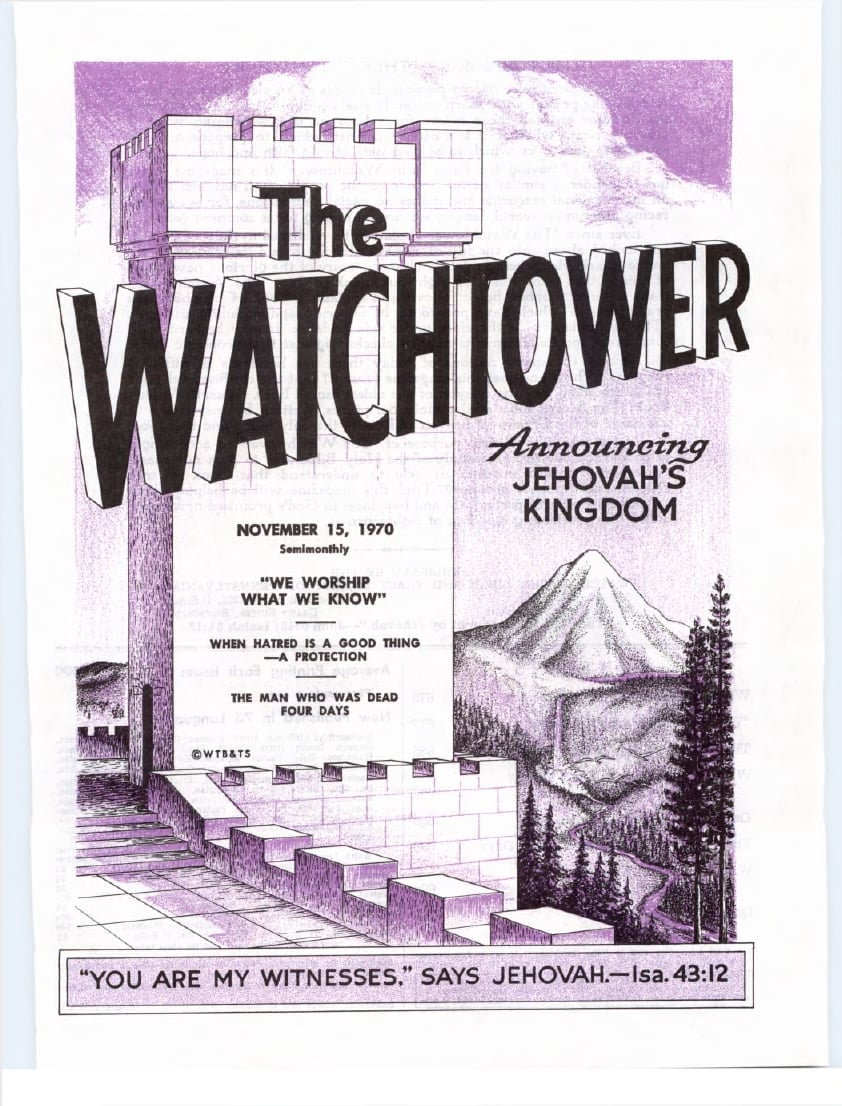
The Watchtower — November 15, 1970
Source: jw.org
Contents
What It Means to Be Kind
“We Worship What We Know”
The Need to Know What We Worship
When Hatred Is a Good Thing—a Protection
Omri, a Powerful Israelite King
The Man Who Was Dead Four Days
Walking in the Way of Jehovah’s Reminders
Questions From Readers
Announcements
What It Means to Be Kind
What It Means to Be Kind
WHAT does it mean to be kind? To be kind means to be truly helpful. Kindness is love in action, for true love is practical. To be kind can mean to have a disposition to sympathy and helpfulness, a sympathetic interest in others’ welfare. The word chrestós, translated “kind” in the Christian Greek Scriptures, is even more forceful, for it means “being helpful toward others.”
Yes, being kind does not mean just being sentimental. Neither does it mean to humor people in their weaknesses. It means being truly helpful to those in need of help. Empathy will help us to see how we can be helpful in both little ways and big ways.
For example, it had been raining torrents in the city of Guayaquil, Ecuador, May of 1969. The streets were muddy and slippery. An elderly missionary hurrying along slipped and fell, landing with his hip on the curbstone. When he tried to get up he was in such pain that he could not do so. He looked around for help, but it was between twenty and thirty minutes before someone showed kindness by inquiring if he could help. This person then notified the missionary’s friends of his predicament.
When they came to the scene they painstakingly lifted him into the back of a station wagon and took him to a clinic, where X rays revealed that he had a T-fracture, one of the worst that the doctors at the clinic had ever seen. How grateful he was that someone had shown him kindness! How grateful his wife and friends were as well! And without a doubt the one who showed kindness also felt happy that he had lent a helping hand.
Why do so few people show themselves kind these days? One reason no doubt is selfishness. People show less and less neighbor love. The crowded condition of large cities of itself is conducive to being indifferent to the needs of others. And so is the fast pace of modern living. People are always in a hurry, and it takes time to be helpful. Others are afraid of getting involved.
Yet the very fact that we have received so much kindness from our Creator, Jehovah God, obligates us to show kindness to others. What a fine example he has set in being kind! Seeing the plight of humankind, he showed “kindness and the love for man” by giving “his only-begotten Son” so that those exercising faith in him might get everlasting life.—Titus 3:4; John 3:16.
Those exercising such faith are said to have “tasted that the Lord [Jesus] is kind.” (1 Pet. 2:3) Jesus’ life certainly was one of showing kindness, being helpful toward others. He showed kindness by feeding the hungry multitudes and by curing their diseases. What a kindness it was for him to raise from the dead the only son of a widow at the city of Nain! (Luke 7:11-17) What a kindness it was for him to restore his friend Lazarus to life and to his mourning sisters! (John 11:1-44) He also showed kindness by ministering to the spiritual needs of the people, ‘teaching them many things.’ And he showed the greatest possible kindness by laying down his human life for us.—Mark 6:34; Matt. 20:28.
Kindness should begin within the family circle. And it means many things there. For example, it means for the husband to dwell with his wife “according to knowledge,” taking into account her vicissitudes. (1 Pet. 3:7) Wives can show kindness by not being critical of their husbands and not bothering them with petty aggravations. Fathers can show kindness by spending time with their children both for instruction and recreation and not irritating them needlessly. (Eph. 6:4) Children can show kindness by expressing appreciation for all that their parents do for them. This can be done not only by words but by being helpful around the home, keeping their own rooms neat, helping mother with the dishes and suchlike chores.
The thoughtful Christian also shows kindness in many little ways at the meeting place of his congregation. He introduces himself to the stranger and makes him feel welcome. He has an encouraging word for old folks who may seem lonely and shows interest in young folks who may feel neglected. He is alert to assist any needing help in getting to and from the local Kingdom Hall.
Today there are many upright persons in the world who are sorely in need of spiritual help. Ever so many are “sighing and groaning over all the detestable things that are being done.” It is being truly kind for Christian witnesses of Jehovah to lend these a helping hand, to bring comfort to these, to minister to their spiritual needs.—Ezek. 9:4; Matt. 5:3, 6.
This Christian ministers do by going from house to house with the good news of God’s kingdom; by making return visits and by conducting Bible studies in the homes of those wanting to understand their Bibles. They kindly offer Bible magazines on street corners and preach incidentally as opportunity affords. And while doing these things they do not neglect showing kindness in other ways, which often results in furthering their ministry.
Thus a storm blew down a large tree in the yard of a couple who had manifested some interest in God’s Word. In vain they sought help from neighbors, friends and relatives to get this fallen tree cleared away. A group of Witnesses, aware of their problem, helpfully called one day with a power saw, and, though finding no one at home, cut up the tree and left a neat pile of kindling wood. When the interested couple came home and learned what the Witnesses had done—when none of their own friends, neighbors and relatives had shown a willingness to help—were they surprised! They concluded that there must be something special about the Witnesses’ religion that they ought to know about. They found out by means of a Bible study in their home, which resulted in both becoming Witnesses.
Being kind means being truly helpful where there is genuine need and especially in what is upbuilding to another. Such kindness results in happiness to others and even greater happiness to the one showing kindness.—Acts 20:35.
“We Worship What We Know”
“We Worship What We Know”
“You worship what you do not know; we worship what we know.”—John 4:22.
1. (a) What are all persons inclined to worship, and how is one who claims to be an exception to this affected? (b) As regards worship, what questions does one wisely put to oneself?
ALL persons are inclined to worship someone or something, even if it is to worship one’s own self. The person who sourly says, “I do not worship anybody or anything!” is really a worshiper of himself. He makes himself a human god, but due to his egotism he is unaware of that fact. He prides himself in the presumptuous idea that he gives worship to nothing whether alive or lifeless. This does not result in any benefit to him; it does not enlarge his freedom; it does not lighten his responsibility. Rather, it does harm to him, possibly to his everlasting destruction. To render any worship with lasting benefit to oneself, it is good to know what one worships, to worship what one knows. We do wisely to ask ourselves, Do I worship what I know? Or, could it be said to me and to my religious or irreligious associates, “You [people] worship what you do not know”? That is to say, You worship you know not what.
2. (a) Many persons, when outside their religious building, are very touchy in what regard? (b) How did the Samaritan woman respond and benefit when told she worshiped what she did not know?
2 This matter of religion is a thing about which most people are very touchy. Not just radicals and communists, but church members of Christendom are ashamed to be thought of as religious, when outside their church building. Many will choke off any discussion with a person of another religion by curtly saying: “I have my own religion!” Others, and they are many, after hearing someone present a religious argument, will say: “Your religion is truth to you, and my religion is truth to me, and so there is no need for me to change my religion.” But each one of that attitude might well ask himself, Would I resent it if someone who knew what he was talking about said to me: “You worship what you do not know”? The woman to whom such a statement was first made by a person of another religion did not resent it. It worked out well for her that she did not do so. She grabbed the opportunity to ask a further question. By this she found out why the one speaking to her was able to say what he said to her.
3. When and where did the Samaritan woman meet the man who made this statement to her?
3 The woman was a Middle Eastern woman, a member of a provincial group known as Samaritans. She came upon this well-informed man seated at a deep well near the city of Sychar one noontime. It was in the year 30 of our Common Era, sometime after the Samaritans had celebrated their Passover feast in nearby Mount Gerizim, where once a Samaritan temple had stood. There is still a small colony of Samaritans at Mount Gerizim today, and at their shrine they have an ancient copy of the Pentateuch (the first five books of the Holy Bible as written by the prophet Moses), which they claim to be the oldest copy in existence today. Also, nearby, is a deep well, which is claimed to be the very well at which the Samaritan woman met this man. To the left of this well a grillwork partition has been erected on which occurs the tetragrammaton, the four Hebrew alphabetic letters that stand for the name of the God of Moses, namely, Jehovah or Yahweh. All this now stands inside a protective building, and tourists visit it.
4, 5. (a) Why was it remarkable that a conversation should be struck up at the well? (b) The man’s remarks led the woman to bring up what religious problem?
4 The man proved to be of a race with whom the Samaritans then had no dealings, and yet he struck up a conversation with this Samaritan woman, which caused her to wonder. This lack of racial prejudice impressed her. Appropriately there at a well that was reputedly dug by the patriarch Jacob, the great-great-grandfather of Moses, the man spoke to her of a new thing, “living water,” after the drinking of which a person would not get thirsty again. He revealed to her facts about her most intimate life. This led her to ask him about a religious problem of that day. She said:
5 “Sir, I perceive you are a prophet. Our forefathers worshiped in this mountain; but you people say that in Jerusalem is the place where persons ought to worship.”—John 4:1-20.
6. What did the man tell her about the worship of her people and the worship of his people, and about future worship?
6 The man’s reply to her question was: “Believe me, woman, The hour is coming when neither in this mountain nor in Jerusalem will you people worship the Father. You worship what you do not know; we worship what we know, because salvation originates with the Jews. Nevertheless, the hour is coming, and it is now, when the true worshipers will worship the Father with spirit and truth, for, indeed, the Father is looking for suchlike ones to worship him. God is a Spirit, and those worshiping him must worship with spirit and truth.”—John 4:21-24.
7, 8. (a) Who did the man at the well prove to be, and how did the woman find that out? (b) To what conclusion concerning this man Jesus did the men of Sychar come, and why correctly so?
7 Who was this man to speak so authoritatively to this Samaritan woman? The woman showed that she had faith in the Messiah, whom those Jews speaking Greek called Christ, and she looked forward to such Messiah or Christ to settle finally all questions of worship. So she said: “I know that Messiah is coming, who is called Christ. Whenever that one arrives, he will declare all things to us openly.” But the question as to the place and manner of worshiping the divine Father had already been declared openly to this Samaritan woman, for the man said to her: “I who am speaking to you am he.” If that woman lived for three years longer, she learned of further facts, undeniable facts, to prove that this man was indeed the Messiah, the long-promised Anointed One of God. But his personal name on earth was Jesus, which means “Salvation of Jehovah.” So he was called Jesus Christ.—John 4:25, 26.
8 This was news indeed! And, inasmuch as the man was now joined by his twelve companions with food for their lunch, the Samaritan woman left her water jar at the well, returned to Sychar and told its’ inhabitants: “Come here, see a man that told me all the things I did. This is not perhaps the Christ, is it?” The Samaritans came out to see and hear. They had the man stay with them for two days. To what conclusion did they come? That this man was the Messianic Savior of not just the Jews who had no dealings back there with the Samaritans, but they said to the woman: “We do not believe any longer on account of your talk; for we have heard for ourselves and we know that this man is for a certainty the savior of the world.” (John 4:28-30, 39-42) Three years later the historical facts were provided to prove that those Samaritans were right: Jesus Christ is the Savior of all mankind. He knew what he was talking about to the Samaritan woman.
“DO I KNOW?” IS THE QUESTION
9. With whom would Jesus, if on earth today, include us—with knowing worshipers or unknowing worshipers, and why is it important to decide concerning this question?
9 Suppose that Jesus Christ were personally on earth today and were saying to a certain religious group: “You worship what you do not know; we worship what we know.” Would he be including us with himself in saying: “We worship what we know”? Or would he be including us with the religious group that did not know what it was worshiping? The answers to these questions are of the highest importance to us today when there is being forced upon us the need to make an intelligent decision regarding whom or what we will worship. A person can fool himself by saying in stubborn pride and reliance upon himself: “I worship no one or nothing! I fear neither God nor man.” But in course of time telltale facts will come to light to show whom or what a person is worshiping.
10. What kind of God do many profess to worship today, whom they claim to be the Bible God?
10 Many claim to worship, not Buddha, nor one of the 330,000,000 gods of the Hindus, nor the Allah of the Mohammedans, nor the God of the modern-day Jews, but another kind of God, a nameless one who has no racial or national connections. He can be worshiped by everyone, with no racial or national ties to stumble him. Many today claim that this nameless God is the God of the Holy Bible.
11, 12. (a) Why would those worshiping as Jesus did be worshiping what they know? (b) Why did the Samaritans not know what they worshiped, and in what way did salvation originate with the Jews?
11 Plainly, then, the question for each one is, Do I worship what I do not know, just as the Samaritans of nineteen centuries ago did? Or, Do I, like the Messiah, worship what I know? If we worship what the Messiah on earth knew, it will mean salvation for us, because the Messiah himself said so. He knew the heavenly Father about whom he spoke to the Samaritan woman. In proof of this he said: “Neither does anyone fully know the Father but the Son and anyone to whom the Son is willing to reveal him.” (Matt. 11:27) “The Father knows me and I know the Father.”—John 10:15.
12 At the time that he said those words, the nation that was worshiping at the temple in Jerusalem was in a solemn contract or covenant with Jehovah God through his mediator, the prophet Moses. God was not in a national covenant with the Samaritans, even though they claimed to hold to the Pentateuch, five Bible books written by Moses. Because they rejected the rest of the inspired Sacred Scriptures, they were not worshiping at the right mountain and they did not properly know Jehovah God who revealed himself through all those inspired writings. Rightly, then, Jesus could say to the Samaritans: “You worship what you do not know.” But speaking for himself and the nation of which he was an earthly part, Jesus could say: “We worship what we know, because salvation originates with the Jews.” (John 4:22) This was true, since Jesus Christ in the days of his flesh was a circumcised Jew, and, even as the Samaritans of Sychar said regarding him, “We know that this man is for a certainty the savior of the world.”—John 4:42.
13. How might racially prejudiced persons react to Jesus’ statement, and what question might they ask?
13 Many racially prejudiced persons of today may stumble at Jesus’ statement: “Salvation originates with the Jews.” They might ask, ‘Does this mean that we must accept Judaism, get circumcised and go to the Jewish synagogue and make pilgrimages to Jerusalem if we desire to worship the true God?’
14. What words of Jesus to the Samaritan woman answer that question?
14 Well, what do we learn from what the Messiah Jesus told the Samaritan woman? Listen: “Believe me, woman, The hour is coming when neither in this mountain [Gerizim] nor in Jerusalem will you people worship the Father. . . . Nevertheless, the hour is coming, and it is now, when the true worshipers will worship the Father with spirit and truth, for, indeed, the Father is looking for suchlike ones to worship him. God is a Spirit, and those worshiping him must worship with spirit and truth.”—John 4:21-24.
15. (a) Jesus’ words indicated that what was about to occur, and how has it occurred down to this day? (b) What is it, then, that counts with the true worshipers?
15 Those words indicated that a radical change was about to take place. Forty years later the city of Jerusalem was destroyed by the Roman legions under General Titus, and its temple for the worship of Jehovah God has not been reestablished there to this day. The city that was built there in the following century by the pagan Romans eventually became a “Christian” city where people of Christendom made pilgrimages. Still later it became a Mohammedan city, where the Moslems worshiped at the mosque that was built on the site of the former Jewish temple. Today that mosque still stands and all Jerusalem is now completely in the hands of the Jews who make up the Republic of Israel. But all this does not matter with the “true worshipers.” They do not have to worship Jehovah God at earthly Jerusalem or any other earthly city that is held to be sacred by various religionists, Vatican City not excluded. A special place on earth does not count with them. What they must without fail do, according to what Jesus told the Samaritan woman, is, worship the heavenly Father with spirit and truth. He is spirit, he is a Spirit, not confined to an earthly location.
16. With what is it that Jesus said the heavenly Father must be worshiped, and why is this necessary?
16 Worshiping the heavenly Father, who is spiritual, is therefore not by means of physical, bodily contact with him. Rather than depending upon the presence and use of visible or material things and geographical locations, the true worshiper must have the right attitude that exercises faith rather than sight and touch; he must have the inclination and urging of pure worship regardless of place or things about him. He must not only show sincerity and wholeheartedness in his worship, but also have the truth. The heavenly Father is looking for those who seek the truth from Him and who worship him according to the truth, not according to the contradictory teachings and traditions of the hundreds of religious denominations of Christendom and other religious systems. Without the truth what kind of idea could any person have of what he worships as God? Ideas of God can vary millions of ways!
17. (a) To worship God with truth requires what of us as regards the truth? (b) How did Jesus’ own nation show that they were not with him in what he knew?
17 The truth about God is progressive, and the true worshiper must show a love for the truth by keeping up with its progress. What of Jesus’ own nation according to the flesh? Could he keep on saying concerning that nation: “We worship what we know”? How could he do so? After hearing him preach for about three years the message, “The kingdom of God has drawn near!” the religious leaders of the nation, followed by most of the people, showed that they differed from him as to ideas of God. They showed that they preferred their religious traditions and precepts of men to what he pointed out to them from the inspired Holy Scriptures. They accused him of blasphemy and violently tried to kill him. At last their Supreme Court at Jerusalem did condemn him to death as a blasphemer of God. They even told the Roman governor Pontius Pilate that, according to their own law, Jesus ought to die for blasphemy. But in order to induce the Roman governor at Jerusalem to exercise his authority and have Jesus put to death they accused him of political sedition. Jesus’ death on an execution stake followed. So they were not with Jesus in worshiping what he knew!
18. Who was rejected by God, Jesus or the Jewish nation, and how has this been shown?
18 Can we go along with that ancient nation in that course of action? Not if we want to worship the same God that Jesus worshiped, the God that he knew. To this day the descendants of that nation have not repudiated that stand that they took toward the Messiah Jesus. They rejected Jesus’ message and also the proofs that he gave that he was the long-promised Messiah, but they were forced to accept the fulfillment of Jesus’ prediction that the “holy city” of Jerusalem and its gorgeous temple would be destroyed, never to be rebuilt by the Jews. True to Jesus’ words, the horrifying destruction of Jerusalem and its temple came within that “generation,” in the year 70 C.E. (Matt. 24:1-34) Thus, although the Jews fanatically tried to have it otherwise, Jerusalem ceased to be the place to worship the only living and true God. Not even a Jewish temple stands there today to recommend it as the city at which to render united worship to a Known God. But the truthfulness of Jesus as the real Messianic prophet of this Known God stands established by inerasable facts of history. So, not Jesus, but the nation that rejected him, was rejected by this Known God.
19. (a) If not with the Jewish nation, with whom, however, must we become partakers in their course back there? (b) By what kind of channel did salvation come to the Gentiles, and when?
19 So the fact that Jesus said, “Salvation originates with the Jews,” does not mean that eternal salvation is by means of that nation today and that we have to become a circumcised proselyte or member of it. We must become partners, not with the nation that rejected the Messiah, but with the Jewish “remnant” of some thousands of natural Jews who accepted the Messiah Jesus, in 33 C.E., and who became his faithful followers. (Rom. 11:1-7) After Jesus was resurrected from the dead and before he ascended to heaven, he gathered together the first members of this Jewish “remnant” of believers. On the day of Pentecost (Sivan 6, 33 C.E.) God used Jesus Christ to pour out from heaven the holy spirit upon those first members of the Jewish “remnant.” Thus they were able to worship God, not only with the “spirit” of genuine worship, but also with the help of God’s holy spirit, and also with the “truth” that was revealed by means of that holy spirit. (Acts 2:1-47) Later, in 36 C.E., this Jewish remnant passed on God’s message of salvation to the Gentiles or non-Jews. (Acts 10:1 to 11:18) So they were a channel by which salvation came to the Gentiles.
20. (a) In the critical time before Jerusalem’s destruction, what did Jewish Christians do, and did this deprive them of a place to worship the Known God? (b) With whom must we take our stand, if we desire salvation from God through Christ?
20 Later at the critical time before Jerusalem’s destruction as foretold by Jesus occurred, the members of that Jewish remnant neither returned to Jerusalem to celebrate any feasts nor stayed in it. Rather, they avoided and fled from Jerusalem and Judea just as Jesus, like a true prophet, had warned them to do. In that way they did not get destroyed with Jerusalem and its temple in the year 70 C.E. (Matt. 24:15-22; Luke 21:20-24) But they were not thereby deprived of a true place to worship the God whom they knew. No, but they kept on worshiping him at his true temple, which is not made by human hands, and which can never be destroyed by human hands. (Heb. 8:1, 2) It is of this Jewish “remnant” that Jesus Christ could continue to say after Pentecost of 33 C.E. his words to the Samaritan woman: “We worship what we know, because salvation originates with the Jews.” (John 4:22) Not with the rejected nation, but with this Jewish “remnant,” as if it were still alive, we must take our stand today if we desire salvation from God through his Messiah, Jesus.
HOW TO KNOW WHAT WE WORSHIP
21. (a) As to worshiping what we know, we need to know to what extent, and why so? (b) How were the Samaritans at fault in this respect?
21 To “worship what we know” means to worship the God whom we know. He is not some imaginary God. If we worship an imaginary God, it can be said to us by Jesus: “You worship what you do not know.” If we accept partial facts even about the true God, but we thereafter refuse to accept the fully revealed truth about him, then what? Then we get only an incomplete understanding of God. In fact, we get a distorted idea of God, and what we worship is really not the true God. We worship what we do not know; we worship someone nonexistent. That was the trouble with those Samaritans of the first century C.E. They accepted the inspired Pentateuch as written by the prophet Moses. But they stubbornly refused to accept the further revelation of Jehovah God as contained in the remaining thirty-four books of the inspired Hebrew Scriptures. So they had, not only an incomplete conception of Jehovah God, but also an incorrect conception of him. That is why they refused to go up to Jerusalem’s temple to worship, but worshiped at Mount Gerizim. They did not accept the up-to-date historical record of God’s activities and truth.
22. How did a like thing become true of the nation of which Jesus was a natural member?
22 The like thing became true of the nation of which Jesus Christ was a natural member. They claimed to accept all the inspired Hebrew Scriptures up to that time, namely, the Law, the Prophets and the Psalms, but, as Jesus Christ pointed out to them, they made the commandments of God null and void by their traditions and precepts of uninspired men. (Matt. 15:1-9; Luke 24:44, 45) Further than that, they refused to discern and acknowledge the fulfillment of the inspired Hebrew prophecies as these were fulfilled in Jesus Christ. So they did not accept him as the Scripturally foretold Messiah. Consistent with this, they did not join up with the Jewish “remnant” of believers who received the holy spirit of God on the day of Pentecost. Further, they did not accept the final part of the Holy Scriptures, namely, the inspired Scriptures that were written in Greek by faithful apostles and disciples of the Messiah Jesus. To those unbelieving Jews divine inspiration and revelation of truth ceased with the books of Malachi and Chronicles so that to them the books from Matthew to Revelation are not an inspired addition to the Hebrew Scriptures.
23, 24. As a result of their course, how does the God of their worship fall short of the better Known God?
23 How has this resulted for this nation whose city of Jerusalem and its temple were destroyed in 70 C.E. and whose priesthood was thus put out of business? It has resulted for them in a misconception of God. They worship a God who has not lived up to his promises and prophecies till now. They worship a God who did not send his promised Messiah in the person of Jesus Christ, “son of David, son of Abraham.” (Matt. 1:1) They worship a God who did not raise up his Messiah from the dead and seat him at his own right hand in heaven as “both Lord and Christ.” (Acts 2:22-36) They worship a God who did not make a “new covenant” with a new “holy nation,” an “Israel of God” that is spiritual, by means of a mediator greater than Moses, namely, by the Messiah Jesus.—Jer. 31:31-34; Deut. 18:15-18; Acts 3:20-24; Heb. 8:7-13; 1 Tim. 2:5, 6.
24 So they worship a God whose Messiah must not come now a second time to establish over all the earth the Messianic kingdom for the blessing of all mankind with a government of endless peace and righteousness. (2 Sam. 7:4-17; Isa. 9:6, 7; Dan. 2:44; 7:13, 14) As a result, the Jewish nation does not worship the true God, although their faithful forefathers did worship him.
25. What did the apostle Paul say regarding the zeal of his nation toward God, and so what do they also today worship?
25 Concerning them, the Christian apostle, who was once himself a persecutor of the Jewish Christian remnant, wrote: “Brothers, the goodwill of my heart and my supplication to God for them are, indeed, for their salvation. For I bear them witness that they have a zeal for God; but not according to accurate knowledge; for, because of not knowing the righteousness of God but seeking to establish their own, they did not subject themselves to the righteousness of God. For Christ [Messiah] is the end of the Law, so that everyone exercising faith may have righteousness.” (Rom. 10:1-4; 1 Tim. 1:12-16; Gal. 1:13, 14) What, then, shall it be said of the once favored nation that rejects the God of the Messiah? Their religious zeal is “not according to accurate knowledge,” but they too are worshiping what they do not know. They do not worship the God of the inspired Christian Greek Scriptures, who is the same as the God of the inspired Hebrew Scriptures.
26, 27. Does “Trinitarian” Christendom worship what she knows, and how do we determine the right answer?
26 Well then, is Christendom as a worshiper of her so-called Triune God worshiping what she knows? Or is she worshiping what she does not know? How can we know? By searching the inspired Hebrew Scriptures and the inspired Christian Greek Scriptures, for both sets of Scriptures belong together as one inspired Book.
27 In neither section of that Book will the searcher find the expression “Triune God” or “Trinity,” nor is there any Scriptural argument therein in favor of such a so-called “God in three Persons,” namely, God the Father, God the Son and God the Holy Ghost. To the very contrary, in answer to the question, “Which commandment is first of all?” Jesus Christ answered: “The first is, ‘Hear, O Israel, Jehovah our God is one Jehovah, and you must love Jehovah your God with your whole heart and with your whole soul and with your whole mind and with your whole strength.’” In that answer Jesus quoted from the Pentateuch at Deuteronomy 6:4, 5. (Mark 12:28-30) But Christendom does not obey this “first” commandment to worship the one God whose name is Jehovah.
28. How varied is Christendom’s idea of God, and is salvation by means of her?
28 How, then, can Christendom worship aright? Though she refuses to admit it, she worships the pagan idea of God, a triad. Her idea of God is as varied as are the hundreds of religious sects into which she is split up. Who can deny that Christendom worships what she does not know? There is no salvation by her!
29. To what knowledge is it God’s will for all sorts of men to come, and so by whom are we led to worship what we know?
29 Salvation to everlasting life in happiness is by worshiping what Jesus and his true followers know to be the true God. One of such followers, the apostle Paul, wrote under inspiration from God and said: “This is fine and acceptable in the sight of our Savior, God, whose will is that all sorts of men should be saved and come to an accurate knowledge of truth. For there is one God, and one mediator between God and men, a man, Christ Jesus, who gave himself a corresponding ransom for all.” (1 Tim. 2:3-6) “Now there is no mediator where only one person is concerned, but God is only one.” (Gal. 3:20) So God is one party to his “new covenant,” and men who are brought into that new covenant make up the other party or other side of the arrangement; and such men can come to an “accurate knowledge of truth” through the “one mediator between God and men.” That mediator was once here on earth as a man, a perfect man, who because of his human perfection and sinlessness was able to give himself as a “corresponding ransom for all.” That Mediator is the Messiah Jesus or Christ Jesus. Since he mediates for the God whom he knows, he leads us to “worship what we know,” God.
[Picture on page 679]
Jesus told a woman at a well in Samaria that she worshiped what she did not know. Do you worship what you do not know? Or do you really worship what you know?
[Picture on page 684]
When people worship as their God a Trinity, which they admit is a “mystery,” can it be said that they ‘worship what they know’?
The Need to Know What We Worship
The Need to Know What We Worship
1, 2. (a) Who is opposed to our worshiping what we know, and what is he therefore designated? (b) What does the apostle Paul call that one, and what happens to those whose minds he blinds?
THIS loving God, whose will is for all sorts of men to be saved through the corresponding ransom of Christ Jesus, desires us to know him, that we may “worship what we know.” (1 Tim. 2:3-6; John 4:22) On the other hand, there is one that seeks to get us to worship false gods, that we may worship what we do not know, to our everlasting destruction.
2 Naturally this latter one is an opposer of the true God and deserves the name Resister or Satan. He worked up a resistance to the good news as preached by the apostle Paul, and concerning him Paul wrote: “If, now, the good news we declare is in fact veiled, it is veiled among those who are perishing, among whom the god of this system of things has blinded the minds of the unbelievers, that the illumination of the glorious good news about the Christ, who is the image of God, might not shine through. . . . For God is he who said: ‘Let the light shine out of darkness,’ and he has shone on our hearts to illuminate them with the glorious knowledge of God by the face of Christ.” (2 Cor. 4:3-6) Those who let their minds be blinded by the “god of this system of things” will perish, worshiping what they know not.
3. (a) Amid worldwide danger, men today have seen the need to organize the world for what? (b) What two political blocs are active on the world scene, and how does Daniel, chapter eleven, picture them?
3 For millenniums now the “god of this system of things” has put before each generation of mankind false things to worship. In this twentieth century he has caused to be set up an object of worldwide worship. No one questions the fact that we are living in a time of world endangerment, when men feel more than ever the need for organizing all the nations for world peace and security. The first world war, of 1914-1918 C.E., alerted men of the World to the danger of mankind’s destroying itself by modern warfare. Two dominant political groups especially became manifest as a result of that war for world domination, namely, the democratic bloc of nations and the dictatorial, totalitarian bloc of nations. Two political ideologies were represented by them, and each bloc feared expansion by violent aggression on the part of the other. The prophecy of God’s Word, the Bible, pictured them under the symbol of two kings, the democratic, liberal bloc of nations as the “king of the south,” and the dictatorial, totalitarian bloc of nations as the “king of the north.” Daniel’s prophecy, Da chapter eleven, tells about these two “kings.”
4. (a) The movements of these two symbolic “kings” affect whom, and particularly at what time? (b) Against whom or what is each one of these “kings”?
4 The movements of these two symbolic “kings” against each other affect all mankind, and no nation or people escapes the effects. This is especially so in what Daniel’s prophecy calls “the time of the end.” (Dan. 11:27-40; 12:4) World history agrees with Bible prophecy that this critical “time of the end” began in the year 1914 C.E., when the “times of the Gentiles” as mentioned by Jesus Christ in his prophecy in Luke 21:20-24 (Authorized Version) came to their end. World War I, which began in that year, marked the beginning of “the end” for those Gentile nations. Those nations have since lined up in blocs behind either the “king of the north” or the “king of the south,” some few nations trying to keep neutral. Both of these “kings” are intent on world domination. But they are not just against each other. Unitedly they are against the Government that has the right to sovereignty over all the earth since the Gentile Times ended in 1914.
5. By whom was the good news of that government proclaimed, as foretold in Matthew 24:14, and since what marked event?
5 That government is the one that Jesus Christ prophesied would be proclaimed, especially since 1914, saying: “This good news of the kingdom will be preached in all the inhabited earth for a witness to all the nations; and then the end will come.” (Matt. 24:14) Was it the dispersed natural Jews with their Zionist hopes of a homeland for the Jews in Palestine who took up preaching the good news of God’s Messianic kingdom? No, but the faithful disciples of Jesus Christ did so. These disciples, anointed with God’s spirit, were the ones who calculated from the Bible’s timetable that the Gentile Times were to end in early autumn of 1914 C.E. The visible proof that the Gentile Times ended at that time came before the notice of all the world from 1914 onward. For them this proof meant that God’s Messianic kingdom had been established in the heavens by the enthronement up there of the Messiah, Jesus.
6, 7. (a) The Kingdom was expected to establish itself in full control over earth when or after what? (b) What did The Watch Tower as of October 15, 1914, say about shortening the days of the great tribulation?
6 However, the Kingdom’s birth did not mean immediate destruction for all earthly nations. The Kingdom would first establish itself in full control over the wreck and ruin of all earthly institutions after the world’s worst time of trouble had run its course. So in the issue of The Watch Tower of October 15, 1914, more than two months after World War I had started, there was published the opening article “View from the Watch Tower.” Under the heading “Shortening of the Days of Trouble” it expressed the view that the world war was the opening phase of a world tribulation that would worsen until its most crucial stage, wrecking the unity of human society. That Watch Tower article said:
7 “That will be the time mentioned by our Savior, saying, ‘Unless those days should be shortened, there should no flesh be saved.’ (Matthew 24:22) The Master tells us, however, that those days of anarchy and general strife—‘every man’s hand against his brother, against his neighbor, and no peace to him that goeth out or to him that cometh in’—shall be shortened. The establishment of the church in glory, the bringing of the elect into control of the world, will shorten those days and inaugurate the reign of the Prince of Peace.”—Page 307.
8. (a) What interesting themes were discussed in the next succeeding issue of The Watch Tower? (b) How was much publicity as to the meaning of the times carried on back there in 1914?
8 In the following issue of The Watch Tower, that of November 1, 1914, came the leading article “Making Ready for the Reign of Righteousness.” It featured subheadings such as “A Counterfeit of Christ’s Kingdom,” “The End of the Gentile Times,” “Evidences of Our Lord’s Parousia [Presence],” “Inauguration of Messiah’s Kingdom Gradual,” “The Battle of Armageddon,” and “Re the Deliverance of the Church.” Much other publicity explained what the times meant, by the worldwide presentation of the Photo-Drama of Creation, and by public lectures and by spreading six volumes of Studies in the Scriptures, but also by distributing free tracts, such as the one featuring “End of the World in 1914.” Under the subheading “Many Tons of Free Literature,” the Annual Report for 1914 said: “The quantities have grown enormously. Many who cannot give all their time in the colporteur work, colporteurs also and pilgrims (indeed, all our readers), have found opportunities for engaging as volunteers in the Lord’s service in the distribution of reading matter, which we provide approximately in thirty languages.”—The Watch Tower, December 15, 1914, page 374.
TAKING AWAY THE CONSTANT SACRIFICE OF PRAISE
9. What was it that God’s “holy people” were offering to him, and what did the “king of the south” and the “king of the north” try to do?
9 Thus from the records it is manifest that the faithful disciples of Jesus Christ were then endeavoring to offer to Jehovah a continual sacrifice of praise, to “shew forth the praises of him who hath called you out of darkness into his marvellous light.” (1 Pet. 2:9, Authorized Version) They had their hearts set on God’s heavenly kingdom by Christ and were advertising it as the rightful government of all mankind. But the democratic “king of the south” and the autocratic “king of the north,” both of whom were part of the counterfeit kingdom of Christ in Christendom, were battling for world domination. As a part of their war program, and with the full backing of the religious clergy of Christendom, they maneuvered their affairs to “scatter the power of the holy people,” to dash the “power of the holy people to pieces.” (Dan. 12:7; Authorized Version) By the end of three and a half years (three and a half symbolic “times”) they succeeded in doing this.
10. How was the work of the “holy people” hampered, and how were many taken away from this priestly work of offering sacrifice?
10 Up to that point of time they were greatly hampering the daily, continual, constant offering of the sacrifice of praise to Jehovah God by war restrictions and pressures. For instance, in Great Britain, those dedicated Christians who were “absolutists” in keeping strict neutrality and who refused to aid either side in the conflict were sentenced to years in prison. Strict Christian neutrals in North America were treated similarly. Many did not see Christian neutrality clearly and undertook noncombatant service, even in uniform. At times these were treated worse by the military forces than were the “absolutists.” They were also taken away from the priestly offering up of the sacrifices of praise to Jehovah God.
11. (a) The publication of what book was seized upon as a means to proceed against offerers of sacrifices of praise? (b) How was the power of the holy people finally dashed to pieces?
11 In July of 1917 the Watch Tower Bible & Tract Society published the religious book The Finished Mystery. This was seized upon by the “king of the south” as something to use against the dedicated “holy people” of Jehovah God. This book and other printed literature that were used in offering “sacrifices of praise” were put under government ban or censorship and were withdrawn from circulation, much to the delight of the religious clergy of Christendom. Finally, in order to “scatter the power of the holy people” or to dash their unified power to pieces, the “king of the south” proceeded against certain officials and other servants of the Watch Tower Society who had had something to do with publishing The Finished Mystery. These were railroaded off to Federal Penitentiary under charges later proved to be false, and sentences of twenty years’ imprisonment. This reduced the “power of the holy people” in this “time of the end” to a very low point.
12. What did such action mean for God’s “holy people” in connection with the fulfillment of Daniel 12:11?
12 What did this signify in the fulfillment of Bible prophecies concerning the “time of the end”? It meant the taking away of the “constant” sacrifice or feature, or “daily sacrifice,” as offered by Jehovah’s holy people. This had been foretold, in Daniel 12:11 which speaks of “the time that the constant feature [the daily sacrifice, Authorized Version] has been removed and there has been a placing of the disgusting thing that is causing desolation.” It was during the spring of 1918 that the scattering or dashing to pieces was accomplished as regards the power of Jehovah’s “holy people” to offer the “constant feature” or “daily sacrifice.”
13. What did those who took away the “constant feature” or “daily sacrifice” present instead thereof, according to Daniel 12:11?
13 But what did those who did this scattering or dashing to pieces present as a substitute for the “daily sacrifice” or “constant feature” that Jehovah’s “holy people” had been continually offering up by preaching “this good news of the kingdom” as a praise to God? Something that did not bring praise to Jehovah God, but what his Word, at Daniel 12:11, calls “the disgusting thing [the abomination, Authorized Version] that is causing desolation.”
PUTTING IN PLACE THE DISGUSTING DESOLATOR
14. What was this “disgusting thing” or abomination, and when was it placed?
14 What was this disgusting, abominable thing, and when was it placed? This was a political measure that was adopted by the worldly nations instead of accepting God’s Messianic kingdom that had been set up in the heavens at the end of the Gentile Times in 1914 C.E. This was the League of Nations, the covenant of which was made part of the Versailles Peace Treaty, and was especially advocated by the “king of the south.” Thus when the Peace Treaty was ratified by the political powers that were involved, on October 13, 1919, the League of Nations went into effect. So this international organization, as instead of God’s Messianic kingdom, was set up to preserve the peace and security of all mankind. When Great Britain ratified the Peace Treaty, the Church of England ratified the anti-Kingdom League of Nations, for the then king of England was the head of that national Church.
15. (a) How did elements in the United States of America react toward the League of Nations? (b) Was that product of international action such a thing as described in Daniel 12:11?
15 The United States Senate refused to ratify the Peace Treaty because it contained the Covenant of the League of Nations, and later it concluded a separate peace treaty with Germany; however, the president of the United States strongly advocated the League of Nations and, back in December of 1918, the Federal Council of Churches of Christ in America did, by special resolution, urge the American president to work at the Peace Conference for setting up the League of Nations, as being “the political expression of the Kingdom of God on earth.” Was the product of such international action disgusting, abominable to the God of the true Messianic kingdom? It could not be anything else but that!
16. (a) How was protest on the part of the disgusted God rendered to the nations? (b) In time, what was the League of Nations identified as being, according to Revelation 17:11?
16 Did this disgusted God make protest to the nations that undertook the League of Nations? Yes, through his “holy people” on earth. In the spring of 1919 he brought to an end the condition in which his “holy people” had their power scattered or dashed to pieces. After the Versailles Peace Treaty was signed on June 28, 1919, but before the League of Nations went into effect on October 13, 1919, God’s liberated, reunited “holy people” celebrated their first international convention at Cedar Point, Ohio, September 1-8, 1919. There in the public lecture of “Hope for Distressed Humanity” it was boldly declared that the League of Nations, despite having the blessing of the clergy of Christendom, would never have Jehovah’s blessing and would therefore fail. Shortly afterward the League was identified in the Watch Tower issue as of January 1, 1921, as being the “image of the wild beast” foretold in Revelation 13:14, 15, set up for worldwide worship. Furthermore, in 1926, in the public lecture in Royal Albert Hall of London, England, it was proclaimed that the League of Nations was the Eighth World Power foretold in Revelation 17:11.
17, 18. (a) Why did there need to be a reviving of the organization for world peace and security, and how did it occur? (b) What was attempted against the sacrificial work of Jehovah’s “holy people” and how was this foretold in Daniel 11:31?
17 In spite of being repeatedly put on notice by Jehovah’s “holy people,” the nations of Christendom continued to idolize that “image of the wild beast” until it went into the abyss of helpless ineffectiveness in World War II of 1939-1945. But Revelation 17:7, 8 foretold that the “image of the wild beast” was to come up out of the abyss of inactivity. It did, on October 24, 1945, when the needed number of political powers had ratified the Peace Treaty. This international organization for world peace and security was given the name United Nations. This was preceded by the worldwide persecution carried on against Jehovah’s “holy people” for the purpose of again removing their sacrifices of praise at God’s spiritual sanctuary, their constantly advertising God’s Messianic kingdom as the one and only hope of the world of mankind. This was an attempt to do again what the armed nations had done during World War I. Daniel 11:31 foretold this:
18 “And there will be arms that will stand up, proceeding from him; and they will actually profane the sanctuary, the fortress, and remove the constant feature. And they will certainly put in place the disgusting thing that is causing desolation.”
19. How are the nations thus worshiping what they do not know, and what is the object of worship for the “holy people”?
19 To this day the peoples and nations hold to this idolatrous “image of the wild beast,” 126 nations being members of the United Nations. Those nations are worshiping what they do not know, their own religious leaders misleading them. But the “holy people” of Jehovah God know what they are worshiping. They do not join the world in worshiping the political “image” of the Devil’s worldwide system of political government. They worship what they know, and that is Jehovah the only living and true God, who forbids image worship. They do not join those of Christendom who claim to be in the covenant for God’s kingdom and yet turn against it in favor of the League of Nations and its successor, the United Nations, “the disgusting thing that is causing desolation.”
20. What contrast does Daniel 11:32 draw between those acting wickedly and the people who know their God?
20 In view of this world situation the next verse (32) of Daniel, chapter 11:32, finds fulfillment: “And those who are acting wickedly against the covenant, he will lead into apostasy by means of smooth words. But as regards the people who are knowing their God, they will prevail and act effectively.”
EXPLOITS OF THE PEOPLE THAT KNOW THEIR GOD
21. How have Jehovah’s Christian witnesses ‘prevailed and acted effectively,’ holding fast to what course of worldwide activity?
21 In Jehovah’s Christian witnesses of today we can observe the divine reward to the “people who are knowing their God.” They are not ashamed to point out from the inspired Holy Bible that the true God’s name is Jehovah and that they are his dedicated, baptized witnesses just the same as Jesus Christ himself was. All these years, from 1919 till now, they have not let themselves be won over by the flattering, smooth words uttered by either “the king of the south” or “the king of the north” and thus turned into the way of apostasy against God’s Messianic kingdom. They have prevailed over smooth-worded flattery of political and religious propaganda and over the heavy pressure of brutal persecution. Valiantly they have unswervingly held fast to the course marked out for them by Jesus Christ, in Matthew 24:14: “This good news of the kingdom will be preached in all the inhabited earth for a witness to all the nations.” In defiance of the worldwide worshiping of the political “image of the wild beast” they persist in worshiping the Bible God, Jehovah, whom they know.
22. What prophecies of Daniel concerning enlightening and imparting understanding have the Christian witnesses of Jehovah fulfilled, and despite Satan’s use of what?
22 Have they dealt valiantly, have they taken action, have they done exploits, have they acted effectively? The answer to this question can be based upon the fulfillment of the prophecy of Daniel 11:33 toward them: “And as regards those having insight among the people, they will impart understanding to the many.” And to this are added the words of Daniel 12:3: “And the ones having insight will shine like the brightness of the expanse; and those who are bringing the many to righteousness, like the stars to time indefinite, even forever.” How necessary this work of enlightenment and of imparting understanding has been during this “time of the end”! How vital this work is Satan the Devil, “the god of this system of things,” well knows. Consequently he has brought the foretold persecution upon the “people who are knowing their God.” By it he tries to knock them out of their God-given work. (Dan. 11:33-35) He has used the worshipers of the idolatrous “image of the wild beast” in this persecution, but he has not prevailed. The anointed remnant of “people who are knowing their God” have been the ones that have prevailed, and this due to having insight.
23. The world’s religious condition will result in “great tribulation” upon whom, and for what purpose do the people need enlightenment and understanding?
23 Today religious conditions are deplorable throughout the earth. As to the Samaritans of Jesus’ day it can be said to them: “You worship what you do not know.” (John 4:22) Their worship of the political “image of the wild beast” and of other false gods will result in their being destroyed in the coming “great tribulation” upon Christendom, upon all the rest of Babylon the Great and upon all her political paramours in this mundane system of things. Such worldwide danger increases the nearer mankind gets to the outbreak of the “great tribulation,” out of which, unless the days of it were cut short, “no flesh would be saved.” (Matt. 24:21, 22) Men need to be enlightened with the truth of God’s Word, the Bible; they need to have understanding of it imparted to them, that they may truthfully know the only God to worship, Jehovah.
24. How extensively have Jehovah’s witnesses acted effectively in the work foretold in Daniel’s prophecy?
24 The anointed remnant of “people who are knowing their God” have lived up to the prophecy that foretold how they would “act effectively.” The record as published over the years proves this. Their work has not been without the effect promised in the infallible Word of God. They have imparted the all-necessary understanding to “the many” till now. This they have done by means of spreading the magazine The Watchtower now published in seventy-three languages, by the circulation from house to house of other Bible literature in 165 languages, yes, by the printing and distributing of a number of Bible versions of which they have the ownership in a number of languages. And not only by putting these Bibles and Bible study aids in the hands of the people, but by personally carrying on free studies in the Bible itself in the homes of the people who are dissatisfied at worshiping what they do not know.
25, 26. (a) In what way has their taking action been effective especially since 1935 C.E.? (b) Where does this “great crowd” of worshipers carry on their worship, and how?
25 Their taking this action has been effective under Jehovah’s blessing. Particularly since the year 1935 C.E. a “great crowd” of persons has been responding in all the nations, tribes, peoples and languages where this imparting of Bible understanding could be carried forward. They have given up worshiping what they do not know at various places considered sacred, religiously holy. They have been helped to worship the only God worthy of being worshiped. They do not go up to Mount Gerizim or to Jerusalem in Israel to worship him. They do not worship him mechanically or ceremonially, but in the real spirit of worship by faith and with the Bible truth they worship him, wherever they are.
26 They worship him at his true sanctuary, his spiritual temple not made with human hands, serving him day and night there in righteousness, pictured by white robes that have been washed in the blood of the Lamb Jesus Christ. In worship to the God whom they know, they cry out in unity: “Salvation we owe to our God, who is seated on the throne, and to the Lamb.”—Rev. 7:9-15.
27. (a) What have these worshipers done with their knowledge, insight and understanding? (b) How long will they also act effectively?
27 These worshipers of what they know have not kept their knowledge, insight and understanding to themselves. In full dedication to God they have joined the anointed “holy people” who “are knowing their God,” and are imparting understanding to still others and spreading spiritual enlightenment to them. Persecution has not stopped them any more than it has stopped the anointed remnant since 1919 C.E. They also will prevail and continue to “act effectively” until the “great tribulation” comes shortly upon their persecutors and these are no more.
28. (a) How long with these worshipers take in knowledge that is vital? (b) In what will they boast, according to Jeremiah 9:24?
28 Thereafter this earth will be a clean place for all those who are “knowing their God” and who are worshiping him with spirit and truth. To endless time they will keep on taking in knowledge of the only true God, Jehovah, and of the one whom he sent, namely, Jesus Christ, for this taking in knowledge of these two means everlasting life in happiness to those who live in harmony with that knowledge. (John 17:3) Forever, in God’s approaching new order, they will do as he has advised, namely, boast in the “having of insight and the having of knowledge of me, that I am Jehovah, the One exercising loving-kindness, justice and righteousness in the earth; for in these things I do take delight.”—Jer. 9:24; 1 Cor. 1:31.
When Hatred Is a Good Thing—a Protection
When Hatred Is a Good Thing—a Protection
A MIDDLE-AGED mother in the supermarket slipped a can of anchovies into her purse without paying for it. At the same time her husband across the street dropped a slug into a parking meter, where it registered as a dime. Their daughter that day got off work early after lying about being sick. What do you think of acts such as these? Do you view them as clever or do you hate them?
These things may seem petty, but are they? Oceans are made of drops of water. A small spark can set a forest afire. Small wrongs often lead to big disasters. Jesus Christ said: “The person faithful in what is least is faithful also in much, and the person unrighteous in what is least is unrighteous also in much.” (Luke 16:10) So wrong acts, even though small, should not be excused but viewed with serious concern, because they are evidence of moral weakness.
People, no doubt, become more aware of the evils of wrongdoing when the act, little or big, is committed against themselves. Then it hurts. The pain becomes real. If the mother with the anchovies returned home to find her television set stolen, if the father caught someone trying to shortchange him, or if the daughter’s fiancé feigned sickness so as to go out with another girl, doubtless these people would find such acts offensive and would raise a cry of protest. The difference, of course, is that they themselves would be the victims.
…