The Watchtower, November 15, 1969
Download: PDF — The Watchtower, November 15, 1969
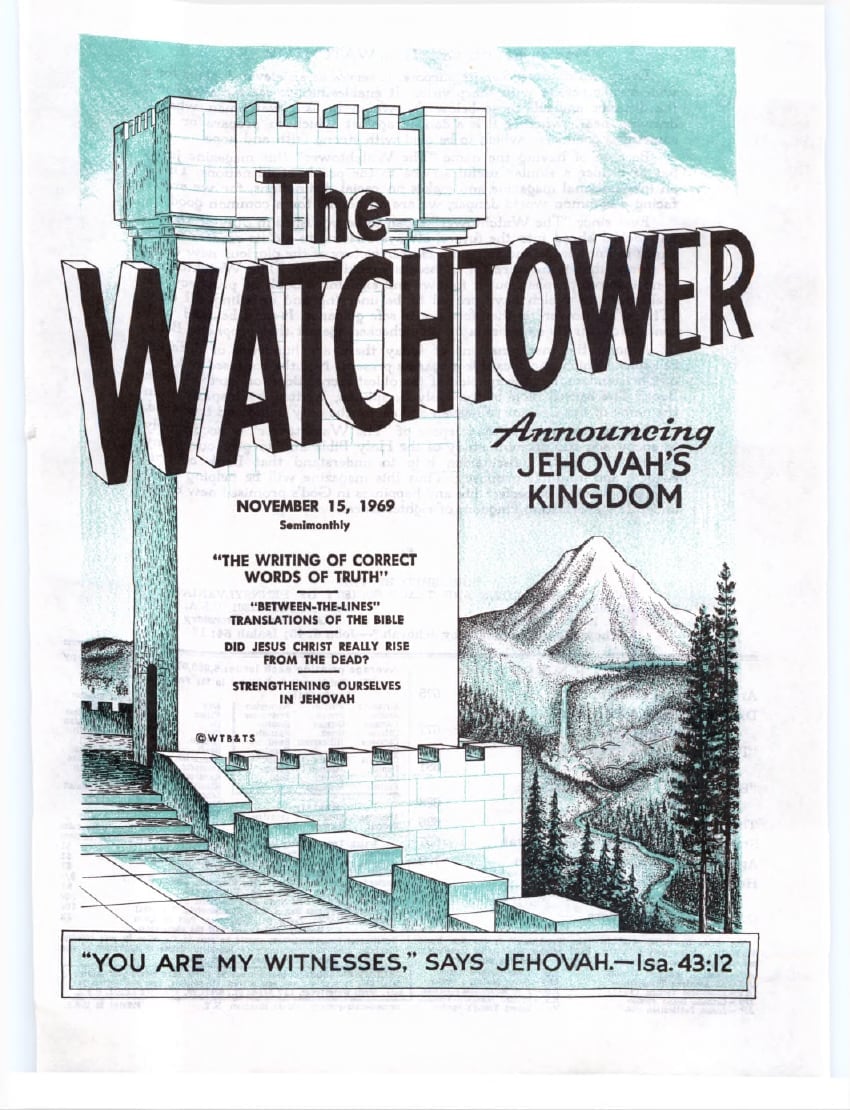
The Watchtower — November 15, 1969
Source: jw.org
Contents
Are You a Good Neighbor?
Did Jesus Christ Really Rise from the Dead?
“The Writing of Correct Words of Truth”
“Between-the-Lines” Translations of the Bible
The Resurrection
Strengthening Ourselves in Jehovah
Appreciating Jehovah’s Protection
Helping Older Ones to Know and Serve Jehovah
Questions From Readers
Announcements
Are You a Good Neighbor?
Are You a Good Neighbor?
‘OF COURSE I’m a good neighbor. I mind my own business and let my next-door neighbor mind his. The less dealings we have with each other the better it works out.’
That may be a very common reaction to the question, Are you a good neighbor? But really, is it not sidestepping the question? Surely one must be displaying some good qualities in order to be a good neighbor, something beyond simply not being inquisitive about the neighbor’s private affairs.
True, there may be certain neighbors that tend to repel rather than attract you—gossipy people, untidy, noisy people, and those who like to put on a big front. Yes, some neighbors may be grumpy and uncommunicative, responding to your cheerful greeting with a cold nod or a grunt. So easy, is it not, to catalog the shortcomings of one’s neighbors?
But stop and think about that. Are you going to look only at their weak points? What about their good qualities? Perhaps you could get to know them better. You do not have to go to extremes, practically living in each other’s home. (Prov. 25:17) But perhaps you could have a friendlier atmosphere. You do not have to get socially involved with them, but you might get to talk to them now and then.
Let us suppose that all the members of your family were incapacitated through sickness, all at one time. Would it not be deeply appreciated if someone nearby, such as a next-door neighbor, were to inquire how things were and offer to do some vital errand for you? Most of us would like that done for us, but what about first doing such friendly acts for your neighbor?
If in your absence sometime burglars attempted to enter your home or fire broke out, would you not be grateful to some near neighbor if he were sufficiently interested in your welfare to call the police or the fire department? Such prompt action could save you much expense and inconvenience. But can you rightly expect such help if you avoid every friendly overture by your neighbors, or if you do not show a similar interest in their welfare? As the wise man wrote at Proverbs 27:10: “Better is a neighbor that is near than a brother that is far away.”
There is no doubt about it. There are practical reasons for cultivating neighborly relations with those who live right around you, unless you have evidence that they are haters of God and of all that is good. However, you will find many neighbors who are not in this category, and who would benefit greatly from conversations with you, perhaps even in time come to share your faith in God and his Word.
There is also another consideration. Is it not important to take into account God’s view of how we should deal with neighbors? What he expects of Christians in this regard is not left to guesswork. It is set down in the Bible in clear terms Let us see what we can learn about the matter in the Scriptures.
Replying to one who inquired, “Which commandment is first of all [foremost in importance]?” Jesus answered: “The first is, ‘Hear, O Israel, Jehovah our God is one Jehovah, and you must love Jehovah your God with your whole heart and with your whole soul and with your whole mind and with your whole strength.’ The second is this, ‘You must love your neighbor as yourself.’ There is no other commandment greater than these.” (Mark 12:28-31) And this requirement to love God and one’s neighbor survived into the Christian system of things, as may be noted from the writings of Jesus’ disciples.—1 John 5:3; Jas. 2:8.
But who is your neighbor? Jesus himself explained this term. He told the story of a man who was beaten, robbed and left for dead by the roadside. Two men passed by, refusing to become involved. Finally, one compassionate person stopped and rendered help. Then Jesus put the searching question to his inquirer: “Who of these three seems to you to have made himself neighbor to the man that fell among the robbers?”—Luke 10:29-37.
You, too, can make yourself neighbor to others in need of whatever help you can give. It may be some fresh fruit or flowers when they are on a sickbed, or the offer to help with household chores or to do some errand for them. It may be fine, encouraging conversation that aids them to get a better outlook on the future. It may even be that their undesirable traits could be corrected as a result of some tactful discussion. If their children are noisy or obstreperous, for example, you could watch for an appropriate occasion to explain how you discipline your children in harmony with Bible principles.
It is true that some neighbors will dislike and shun those who apply Christian principles. There is no need to force friendliness on these. Other neighbors will respond appreciatively, and it may be that as a Christian you can transmit to them the finest benefit of all—knowledge and appreciation of Jehovah God’s purposes.
The role of good neighbor is not filled by one who is withdrawn and uncommunicative. The injunction to Christians is: “Return evil for evil to no one. Provide fine things in the sight of all men.” (Rom. 12:17) As a good neighbor you too can provide comfort where needed, upbuilding conversation where appreciated, and so be a blessing to those who are worthy in your neighborhood.
Did Jesus Christ Really Rise from the Dead?
Did Jesus Christ Really Rise from the Dead?
Many doubt that he did. But do they doubt with good reason?
THE Bible is a book filled with many promises regarding the future. For you to be able to have faith in these promises it is necessary to have faith that its historical features are true—that the things it tells about actually happened.
But in view of the unusual nature of some of the things it records many have doubted that they actually did occur. Among such things is the resurrection of Jesus Christ from the dead. Can you have faith that this miracle actually took place? If you can, then it will strengthen your faith in other miracles recorded in the Bible as well as in its promises regarding the future, such as that pain and death will someday be no more.—Rev. 21:4.
Typical of those who deny that Jesus Christ actually did rise from the dead is Marcello Craveri, an Italian doctor of philosophy. In his book The Life of Jesus (1967) he says: “It is obvious that the whole story of the Resurrection and the apparitions belong to the category of miracle inventions.” According to him, “ancient and modern students of Christianity agree” that the resurrection of Jesus Christ from the dead did not really take place.
Does this dogmatic statement mean that there actually is proof that Jesus Christ did not rise from the dead? Are ancient and modern students of Christianity really in agreement that the resurrection of Jesus belongs to the category of miracle inventions? Not at all! Consider the evidence.
RESURRECTION COMPATIBLE WITH SCIENCE
A common objection to Christ’s resurrection is that since modern man does not see persons rise from the dead, no one has ever risen from the dead. But is this a sound objection? Is it impossible for one who acknowledges the existence of a Supreme Being to believe that Christ’s resurrection took place? Is such a miraculous event really unscientific?
Observe what the noted scientist Victor Hess, the discoverer of the cosmic ray, once stated: “I must confess that in all my years of research in physics and geophysics I have never found one instance in which a scientific discovery was in conflict with religious faith. It is sometimes said that the ‘necessity’ of the ‘laws’ of nature is incompatible with . . . miracles. This is not so . . . Many of our physical laws are, in fact, merely statistical statements. They hold for the average of a great number of cases. They have no meaning for an individual case. Modern scientists are fully aware of these limitations in their description of physical processes. Must a scientist doubt the reality of miracles? As a scientist I answer emphatically: No. I can see no reason why Almighty God, Who created us and all things around us, should not suspend or change—if He finds it wise to do so—the natural, average course of events.”—The Faith of Great Scientists, edited by W. Howey, page 10.
So the mere fact that men on earth today have not seen God raise people from the dead does not at all argue that in times past he did not see fit to raise his Son, Jesus Christ, from the dead. And why did God see fit to do so? For one thing, to reward Jesus for his faithfulness to death. And, too, because only a resurrected Jesus could bring to fruition God’s purposes for which Jesus had come to earth and had died a sacrificial death.—Phil. 2:5-11.
It is not as though Jesus was the first and only one to be raised from the dead by the power of God. The Bible tells us that Jehovah’s prophets Elijah and Elisha each raised a person from the dead. (1 Ki. 17:17-24; 2 Ki. 4:32-37; 8:5; 13:20, 21) And the Christian Greek Scriptures (“New Testament”) also tell of other resurrections, performed by both Jesus and his apostles.—Matt. 11:5; Luke 7:11-16; 8:41-56; John 11:1-46; Acts 9:40; 20:9-12.
JESUS FORETOLD HIS RESURRECTION
We have seen that the resurrection of Jesus Christ is within the realm of possibility. We cannot deny God the privilege of making exceptions or changing the natural course of events, and he has done so time and again. Let us, then, consider the evidence for Jesus Christ’s having been raised from the dead.
To begin with, Jesus himself repeatedly foretold that he would be raised from the dead. Early in his ministry he referred to it, saying: “Break down this temple, and in three days I will raise it up.” “He was talking about the temple of his body.” (John 2:19-21) He also said that as Jonah was in the belly of a huge fish for three days he would be in the heart of the earth for three days. And subsequently on at least five different occasions he told his disciples that he would rise from the dead. (Matt. 12:39, 40; 16:21; 17:1-9, 22, 23; 20:18, 19; 26:31, 32) How can we understand all these plain statements if Jesus was not actually raised from the dead? Was he or were his disciples dupes or perpetrating a fraud?
Adding still more weight to the authenticity of Christ’s resurrection is the fact that, although he had so plainly forewarned his disciples of his martyr’s death, they were greatly distressed when it took place. (Luke 24:21) And although he had repeatedly foretold that he would be raised from the dead, they did not expect it. Had they expected it, would his women disciples have gone to his tomb on the third day further to embalm his body with spices?—Luke 24:1.
THE HISTORICAL RECORD
All four Gospel accounts tell of the fulfillment of Jesus’ words that he would be raised on the third day. The apostle Matthew reports that first an angel appeared and announced Christ’s resurrection to women two of whom Matthew named, that Jesus later appeared to these and that still later Jesus appeared to his disciples in Galilee.—Matt. 28:1-20; Mark 16:1-8.
The physician Luke additionally tells of the resurrected Jesus comforting two of his disciples on the way to Emmaus, of another appearance to his disciples in Jerusalem and of his disciples seeing him borne up into heaven out of their sight.—Luke 24:1-53.
The apostle John gives us still more details about Jesus’ appearances after his resurrection. He tells of Jesus’ encounter with Mary Magdalene, of his appearing twice to his apostles and that at the second time Thomas was present and was convinced. This might be said to underscore the genuineness of Jesus’ resurrection, as well as the firm conviction of the Bible writers that Jesus really did rise from the dead. It was as if Thomas were to speak for all sincere doubters of Christ’s resurrection in the years to come. (John 20:1-29) John also tells of Jesus’ appearance at the sea of Galilee, on which occasion he asked Peter three times whether he loved him or not.—John 21:1-24.
Additionally, the book of Acts tells us that Jesus “was taken up, after he had given commandment through holy spirit to the apostles whom he chose. To these also by many positive proofs he showed himself alive after he had suffered, being seen by them throughout forty days.” How much more emphatic, how much more convincing could the record be—“by many positive proofs he showed himself alive after he had suffered”? All of this emphasis carries added weight when we note that it is made by an educated physician who would be the first to question the raising of one from the dead.—Acts 1:1-9.a
CHRIST’S RESURRECTION IMPARTS POWER
The change that came over Jesus’ little band of followers might be said in some respects to be the most powerful of all testimony to Jesus’ resurrection. It transformed frightened and puzzled men into bold and fearless evangelizers, ready to lay down their lives for their beliefs!
Such conviction and power are not born of hallucinations nor are they begotten by chicanery. That change was due to the fact that Jesus really did rise from the dead, as well as being due to God’s outpoured spirit, which came through Jesus, enabling the apostle Peter to preach: “Jesus the Nazarene . . . you fastened to a stake by the hand of lawless men and did away with. But God resurrected him by loosing the pangs of death, because it was not possible for him to be held fast by it.” And again Peter said on that occasion: “This Jesus God resurrected, of which fact we are all witnesses.”—Acts 2:22-33.
Peter might be said here to have set the pattern for his future preaching. Thus when a crowd of people gathered in amazement at his healing a man who had been crippled from birth, Peter told them that this miracle had been performed by the power of Jesus, whom they had killed. “But God raised him up from the dead, of which fact we are witnesses.” There was no doubt in his mind. Jesus’ resurrection was a fact; he and others were witnesses of it. (Acts 3:12-15) And when before the Jewish supreme court, to testify by what power they had performed this miracle, Peter again testified to Jesus’ really having risen from the dead, saying: “Let it be known to all of you and to all the people of Israel, that in the name of Jesus Christ the Nazarene, whom you impaled but whom God raised up from the dead, by this one does this man stand here sound in front of you.” Yes, this very miracle testified to the fact that Jesus had risen from the dead.—Acts 4:10.
Shortly thereafter when the apostles were again apprehended and brought before the Sanhedrin, Peter again stressed Jesus’ resurrection: “The God of our forefathers raised up Jesus, whom you slew . . . God exalted this one as Chief Agent and Savior to his right hand . . . And we are witnesses of these matters.”—Acts 5:30-32.
When the apostle Peter preached about Jesus to Cornelius and his household, Peer stressed the same truth: “God raised this One up on the third day and granted him to become manifest, not to all the people, but to witnesses appointed beforehand by God, to us, who ate and drank with him after his rising from the dead.” Again it might be asked, Did Peter and his fellow apostles eat and drink with a hallucination? Or was Peter an outright impostor?—Acts 10:38-42.
The apostle Paul followed the example of Peter in his stressing the resurrection of Jesus in his public ministry, as can be seen from Acts 13:30-37; 17:31. How firm was his conviction that Jesus was indeed raised from the dead is apparent from his words at 1 Corinthians 15:3-8: “For I handed on to you, among the first things, that which I also received, that Christ died for our sins according to the Scriptures; and that he was buried, yes, that he has been raised up the third day according to the Scriptures; and that he appeared to Cephas, then to the twelve. After that he appeared to upward of five hundred brothers at one time, the most of whom remain to the present, but some have fallen asleep in death. After that he appeared to James, then to all the apostles; but last of all he appeared also to me as if to one born prematurely.”
That all this evidence is irrefutable is recognized not only by Christian ministers with faith in God’s Word but also by others. For example, there is Dr. J. N. D. Anderson, dean of the faculty of law at the University of London and director of its Institute of Advanced Legal Studies. This world-recognized legal authority once noted, as reported in the London Observer:
“To consider the accounts of the six ‘New Testament’ writers as fabrication would really be an impossible position. Think of the number of witnesses, over 500. Think of the character of the witnesses, men and women who gave the world the highest ethical teaching it has ever known, and who even on the testimony of their enemies lived it out in their lives. Think of the psychological absurdity of picturing a little band of defeated cowards cowering in an Upper Room one day and a few days later transformed into a company that no persecution could silence! . . . It seems to me almost meaningless to talk about legends when you are dealing with eyewitnesses themselves.”
Yes, if by the mouths of two or three reliable witnesses a matter is established as a fact, how well established is the fact that Jesus Christ really did rise from the dead! Men who fabricate falsehoods are devoid of such a ring of truth as that evinced by the apostles Peter and Paul in preaching Christ’s resurrection.
In view of all the foregoing, do you have good reason for exercising faith that Jesus Christ really did rise from the dead? You most certainly do. The conclusion is inescapable. It should truly be strengthening to your faith to find one of the most unusual and most strongly disputed events mentioned in the Bible to be factual. Because Jesus was raised from the dead you can come to God in prayer, asking forgiveness for your sins, and you can pray in faith for God’s kingdom to come. And what can that mean to you? Everlasting life in a Paradise earth when there will be no more sorrow, pain or death.—Matt. 6:10; 1 John 2:1; Rev. 21:4.
[Footnotes]
Note also that when choosing a successor to Judas, Peter stipulated that it had to be one who had been “a witness with us of his resurrection.”—Acts 1:20-22.
“The Writing of Correct Words of Truth”
“The Writing of Correct Words of Truth”
“The congregator sought to find the delightful words and the writing of correct words of truth.”—Eccl. 12:10.
1. When is a story of benefit and of real value to us?
WHO does not enjoy listening to a good story or reading one? If the story is presented in words that are skillfully chosen and expressed with a nicety of meaning, it adds to the delight that one experiences as the story unfolds. If it is a true-life story, it really becomes beneficial to us, when it is told without twisting things or without any exaggeration but with “words of truth” in a correct and impartial way. Thereby we are learning the truth that will endure and prevail and that will have real value for us.
2. In what usage does the storyteller himself delight, and what should be the case when we present a written message that means eternal life to those receiving it?
2 As for the storyteller himself, he too finds pleasure in presenting the story with words that even delight him in using them. Because he loves the truth and he desires to upbuild those who get absorbed in his story, he conscientiously tries to tell it correctly with “words of truth.” Such “words of truth” are the correct things for him to tell. Since this is the case with a mere story, how much more should it be the case when, by means of writing, we present a message that means eternal life to those receiving the message!
3. Why can Solomon be called such a sincere storyteller as that?
3 The wisest king of ancient times, Solomon of Jerusalem, was just such a sincere storyteller and message bearer. Have you ever read his scores of proverbs as contained in the Bible book of Proverbs? Or his beautiful love story as told in the Bible book of The Song of Solomon? Or his wisdom expressed in the Bible book of Ecclesiastes, written for people who want to know the purpose of life that in most cases seems to be so vain, frustrating? If you have read these Bible books, then you can appreciate the excellent choice of words that Solomon made to fit excellent ideas. How beautiful or true to life his proverbs are! How good his counsel!
4. Despite his being inspired, what did Solomon have to be and do, and where does he refer to this?
4 True, he was inspired by God’s spirit when writing his part of the Holy Bible. And yet he had to have a love for the truth, he had to exert himself, his mind, to express the truth in a winsome way with words of correct meaning. Things did not come to him automatically, of their own accord. He had to seek to find the truthful things to say or write and also seek the proper language in which to say them. The personal effort that was required on his part he writes about toward the close of his inspired book of Ecclesiastes. He says with reference to his own self: “The congregator sought to find the delightful words and the writing of correct words of truth.”—Eccl. 12:10.
5. (a) What did Solomon call himself, and what responsibility did this lay upon him? (b) In what way was he an example for us?
5 Notice that Solomon calls himself “the congregator,” and not a mere “preacher.” A “congregator” of whom was Solomon? It was of God’s own congregation, the congregation of Solomon’s own people, God’s ancient chosen nation. This made the responsibility of Solomon all the greater, for this congregation in particular deserved to have the truth told and written to them. To live up to what he called himself, Qoheleth in the Hebrew, or “congregator” in English, he tried to gather his people together into a unity; he as King had to speak, write and teach in such a way as to keep them united as worshipers of the one living and true God, whom Solomon called Jehovah. Solomon knew the importance of words, the hidden power of words. Therefore, in behalf of what he spoke, wrote and taught, he endeavored to think up the “delightful words,” the “correct words.” Solomon succeeded magnificently, and in this he set an example for us.
6, 7. (a) Of what importance are words to thinking, and from where did man get thinking ability? (b) That this is no mere tradition made out of imagination, what written record do we have in the Bible?
6 Could you even think without words? No! The lower creatures, animals, birds, fishes, insects, do not think; they act by instinct and respond to sounds and sights and feelings. Thinking must be done in language. Language must be expressed in words that are grammatically connected together to frame an idea, a mental conception. Human creatures can think. Where did they get this thinking ability? Not from some brainless, mindless living cell, chemically created, that developed itself and ascended the ladder of life to become a man or woman. It must have come to human creatures from outside. It must have come from a thinker, one who is acquainted with thinking, who knows how it works, who has created a brain. Thinking ability must have come from outside. It is a gift! From what or from whom? Only from the Creator, from God. This fact is not a mere human tradition manufactured out of imagination. There is a record of it in written words, which, translated into modern English, read:
7 “And God went on to say: ‘Let us make man in our image, according to our likeness, and let them have in subjection the fish of the sea and the flying creatures of the heavens and the domestic animals and all the earth and every moving animal that is moving upon the earth.’ And God proceeded to create the man in his image, in God’s image he created him; male and female he created them. Further, God blessed them and God said to them: ‘Be fruitful and become many and fill the earth and subdue it, and have in subjection the fish of the sea and the flying creatures of the heavens and every living creature that is moving upon the earth.’”—Gen. 1:26-28.
8. (a) How do we know whether, when making that statement regarding man’s creation, He was talking to himself or not? (b) How did God thus show himself to be the creator of speech, language, grammar?
8 This record presents God as a Thinker, as a Talker, and the Creator of human creatures with brains in their skulls. Before God talked, saying: “Let us make man in our image, according to our likeness,” God thought. In order to think he brought words containing ideas to mind. Before he made any intelligent creature, he was thinking, and he needed the companionship of no other living person. He did not talk to himself, even though he thought with idea-bearing words. When, according to Genesis 1:26, he said: “Let us make,” he was not talking to himself in expression of his personal decision. He was talking to at least someone else. According to the rest of the Bible, this other person was his first creation, a heavenly creation, his first spirit son, made directly by God without any agency. God purposed to commune with that Son. So God created him with thinking ability and with its proper accompaniment, the ability to speak. At once that Son could speak, could frame words and put them together in a grammatical way. Thus God created speech, he created language, and, since language requires grammar, He created grammar.
9. How did God then use this Son, thereby showing himself further to be the creator of language and the greatest Grammarian?
9 What language God spoke with this first son of His we do not know. (Rev. 3:14; Col. 1:15-18) Then by the agency of this Son God created other spirit creatures, cherubic creatures, seraphic creatures, angels. God formed their original language for them, according to the capabilities of these speaking creatures. He created all their vocal powers, to speak their language with the appropriate grammatical style. He invented their grammar for them. God is the greatest Grammarian. These spirit creatures understood when God talked to them, and they could answer in an understandable way to him.—Ps. 103:20.
10. (a) What language does the Academy of Languages not list, and why not? (b) If the apostle Paul had been able to speak those languages, what would he have had to have besides in order to be no mere sound maker?
10 That list of languages that has been compiled by the modern Academy of Languages does not include any angelic language, for men have never heard it and do not know what it is like. The Academy may laugh at such a thing. But that first-century man of rich spiritual experience, the Christian apostle Paul, speaks of angelic language, when he writes: “If I speak in the tongues of men and of angels but do not have love, I have become a sounding piece of brass or a clashing cymbal.” (1 Cor. 13:1) Paul could speak in a number of languages or tongues, at least in Hebrew and Greek of the first century of our Common Era. He did not speak in any tongue of angels, and doubtless could not, because angels have vocal capacities that are beyond the range of man. But even if Paul had been able to speak in the tongue of angels and yet did not have Godlike love as a motive for speaking and doing, he would be like a resonant piece of brass or a clashing cymbal. Just like Satan the Devil and his spirit demons, who speak in the tongue of angels, but who have no love but have murderous hate.
11. (a) In what language did God’s angel speak with Abraham, making what promise after his attempted sacrifice of Isaac? (b) In what languages was the Bible written, and by whose offspring?
11 Consequently, when God sent his angels to talk with men, they talked in the human language of the one or ones to whom they spoke, not in the language that angels speak among themselves in heaven. We have records to indicate that they talked with men to whom they materialized or appeared in visions, in Hebrew, Aramaic and first-century Greek, the languages in which the Holy Bible was written. For example, God, by means of his angel, said to Abraham the Hebrew right after he showed his willingness to offer up his son Isaac as a religious sacrifice: “I shall surely bless you and I shall surely multiply your seed like the stars . . . And by means of your seed all nations of the earth will certainly bless themselves due to the fact that you have listened to my voice.” (Gen. 22:17, 18) Abraham understood what was said from heaven, and he rejoiced in the hope that, one day, all nations of the earth would be blessed through his offspring. It is interesting to note that all the books of the Holy Bible were written by members of Abraham’s offspring, for people of all nations to read and understand to their lasting benefit.
12. In what language did an angel speak to Daniel, and what did he say in explanation of a Kingdom vision?
12 Centuries later Abraham’s greatly multiplied offspring included the prophet Daniel. In the city of Babylon on the Euphrates River, an angel appeared to Daniel in “visions during the night” and spoke to him in Aramaic. In explanation of the visions given to Daniel, the Aramaic-speaking angel said: “And the kingdom and the rulership and the grandeur of the kingdoms under all the heavens were given to the people who are the holy ones of the Supreme One. Their kingdom is an indefinitely lasting kingdom, and all the rulerships will serve and obey even them.” (Dan. 7:1-4, 23, 27) Daniel wrote these visions down in Aramaic.
13. What Kingdom announcement, and in what language, did John hear loud voices in heaven make?
13 In the last listed book of the Holy Bible, in the revelation that was given to the Christian apostle John about the year 96 C.E., he heard loud voices in heaven, saying: “The kingdom of the world has become the kingdom of our Lord and of his Christ, and he will rule as king forever and ever.” (Rev. 11:15) John wrote this down in the common Greek of the first century.
INVENTION OF MANY HUMAN LANGUAGES
14, 15. (a) What question arises today, since we are all the descendants of those who spoke the one original language? (b) What message of peace, and in what language, did God’s angel give to the Flood survivors?
14 Today there are many more languages than the Hebrew, Aramaic and common Greek in which God’s Word, the Holy Bible, was written. One of the important things that adds to the reasons for our not having worldwide peace today is the fact that we have so many languages, so that we cannot directly understand one another. Why is it that, since we all descended from the first man and woman whom God created in the Garden of Eden, we do not today all speak the same language as those first two humans did? The prophet Noah and his seven fellow passengers, who survived the global deluge of forty-three centuries ago, all spoke the same language in the ark in which they were preserved alive. It was the same language as that of the first human pair, only enlarged throughout the 1,656 years from the first man’s creation down to the Deluge. Following that Deluge after Noah and his fellow survivors came out of the ark upon Mount Ararat in southwest Asia, God spoke to them by means of his angel. He caused a symbol of peace, the rainbow, to appear, and gave them a message of peace. In their one language he said:
15 “Be fruitful and become many and fill the earth. . . . My rainbow I do give in the cloud, and it must serve as a sign of the covenant between me and the earth. And it shall occur that when I bring a cloud over the earth, then the rainbow will certainly appear in the cloud. And I shall certainly remember my covenant which is between me and you and every living soul among all flesh; and no more will the waters become a deluge to bring all flesh to ruin.”—Gen. 9:1, 13-15.
16. For about how long did mankind continue to have one language, and by whom was the decision made to have language groups, and why?
16 For over two generations, or around a hundred and eighty years, after the Deluge, the language of Noah and his descendants continued to be one. The “writing of correct words of truth” as found in the inspired Bible says: “Now all the earth continued to be of one language and of one set of words.” (Eccl. 12:10; Gen. 11:1) Well, then, did men at that point of time decide to do something academic or collegiate and start speaking different languages? No! Why should they hit upon the idea of doing this? Rather, it was God who then decided to invent new human languages. He foreknew the divisive power of a confusion of languages among men. He saw good to break them up into language groups and thereby make it difficult for them to understand one another and to get along together.
17. On what project were men working in the plains of Shinar, and how did God give that project a great setback?
17 At that particular time those descendants of Noah who had moved down into the plains of Shinar in Mesopotamia were united in a bad work, contrary to God’s will as stated to Noah and his sons after the Deluge. Speaking the one commonly understood language, these rebellious people decided to build a city there as a center of religious worship, with a skyscraping tower, and thus to make a celebrated name for themselves. In order to give this project a great setback, Almighty God decided to break up their unity of action by inventing and implanting different languages in them, wiping out all memory of their previous common language. Suddenly, while working harmoniously together on their God-defying building project, the various ones began speaking different languages and fell into a confusion that forced them to break relations with one another and to separate. Apparently only one language group remained at the incomplete city and its religious tower, under Nimrod.
18. (a) What shows that this was nothing of human invention, but was a divine miracle? (b) Why was the language miracle on the day of Pentecost among Christ’s disciples still more remarkable?
18 How could such a thing happen, instantaneously, if it was not from God Almighty? He gave to each group a different language with its own grammar and set of words, so that immediately they started speaking the new language perfectly. It was not of human invention, and by this miraculous feat God showed that he was the Master Grammarian, the greatest Grammarian down till today. This was no forerunner of the festival day of Pentecost of the year 33 C.E., when God’s holy spirit was poured out upon the one hundred and twenty disciples of Jesus Christ in Jerusalem and they suddenly began speaking in many languages that they had never studied and learned. However, that ancient event on the plains of Shinar illustrated, exemplified, what Almighty God could do later, on the day of Pentecost at Jerusalem. And, what was more remarkable, those disciples of Jesus Christ, though suddenly gifted with the power to speak new languages, did not forget their original language, the Hebrew. So they did not fall into confusion and separate. God’s one spirit upon them kept them united in preaching His kingdom.—Acts 2:1-21.
19. (a) What is the meaning of the name given to the city, and from it what was carried away besides new languages? (b) Whose language was not changed, and why?
19 Because of the confusion of languages that arose away back there on the plains of Shinar the city whose building program was terribly set back was called Babel. Quite fittingly so, for this name means “Confusion.” The Greek-speaking people called it Babylonia. (Gen. 11:2-9) This happened in the days of Nimrod, the great-grandson of Noah. Nimrod came to be called “a mighty hunter in opposition to Jehovah,” and Genesis 10:8-10 calls this mighty hunter the first king of Babel, for “the beginning of his kingdom came to be Babel.” From this city the various language groups that left off building the city carried the false Babylonish religion to the various parts of the earth to which they were scattered. The human family had now become a polyglot race or many-tongued race. The prophet Noah and his God-fearing son Shem did not take part in building the city and tower of Babel. Hence their language was not changed. They continued to speak to each other the same original language.—Gen. 9:26-29.
20. (a) What new profession arose, and who made use of it during a famine in ancient Egypt? (b) In the case of whom was there inspired translation or interpretation?
20 Because of the confusion of languages that God started at Babel, a new profession arose, that of interpreter or translator. So it came about that, on one occasion, a descendant of Shem, namely, Joseph the great-grandson of Abraham, used an interpreter. Jealous brothers of his had sold him as a slave into Egypt, but, thirteen years later, God caused Joseph to become the prime minister and food administrator of Egypt because of a foretold world famine. When, during the actual famine, his brothers came down to Egypt to buy food supplies, they did not recognize Joseph. Among other things that concealed his identity, Joseph did not speak to them in Hebrew, and so used an Egyptian-Hebrew interpreter. As Genesis 42:23 says: “There was an interpreter between them.” That was in the eighteenth century before our Common Era. Since then interpreters have multiplied. Such interpreters were not inspired. Only in the case of the Christian congregation, to whom the miraculous gift of speaking in foreign languages was given in the days of Christ’s apostles, was the miraculous gift of interpreting languages also given.—1 Cor. 14:13-28.
TRANSLATION OF THE BIBLE
21. (a) For an accurate translation, the choosing of what would be necessary, and what would an absolutely perfect translation require? (b) When were the Hebrew-Aramaic Scriptures translated, and what was this first translation called?
21 For an accurate translation to be made or a true interpretation to be given, there must be the use of correct words in the one language that correspond with those in the language that is being interpreted or translated. In the days of the Christian apostles the interpretations that were made by those Christians gifted with the miraculous power of interpretation or translation would be perfect, absolutely correct, for the interpretation would be inspired. (1 Cor. 12:4-11, 27-30) The most important writings to be interpreted are the Sacred Scriptures, the Holy Bible. By the time of the fifth century before our Common Era the God-inspired writings in Hebrew and Aramaic were completed in the form of thirty-nine books, as now reckoned. After the common Greek became the international language in the following century, a translation of those Sacred Scriptures from Hebrew into Greek was begun by Greek-speaking Jews in Alexandria in Egypt. It became known as the Greek Septuagint Version, or LXX, because of the tradition that some seventy Jewish translators were originally connected with it. Septuaginta means “Seventy.”
22. (a) Was this first translation inspired, and was such a translation contrary to God’s will and spirit? (b) When writing the inspired Greek Scriptures, how did Christ’s disciples make quotations from the Hebrew Scriptures, and why?
22 The Greek Septuagint Version of the Hebrew Scriptures was not inspired by God’s spirit, but was not contrary to God’s spirit. It was God’s will that his inspired Word should be translated into as many languages of the world as possible before his kingdom by Jesus Christ takes over complete control of all the earth. In writing the inspired Greek Scriptures, in twenty-seven books, four of Christ’s apostles and four of his other disciples quoted hundreds of times from the inspired Hebrew Scriptures. Sometimes they quoted directly from the Greek Septuagint Version; at other times they made their own direct translations from the Hebrew Scriptures. This was done to show that those Hebrew Scriptures were really God’s “words of truth” and that they were undergoing fulfillment in connection with the Christian congregation and its work of preaching God’s kingdom.
23. (a) How did Jesus Christ indicate indirectly that the Bible would have to be translated into many languages? (b) When did his disciples catch the import of this, and how did they work at it?
23 When Jesus Christ, the Son of God, spoke to his disciples after his resurrection from the dead and some days before his ascension to heaven, he indicated that the Sacred Scriptures, the Holy Bible, would have to be translated into many languages. He said: “All authority has been given me in heaven and on the earth. Go therefore and make disciples of people of all the nations, baptizing them in the name of the Father and of the Son and of the holy spirit, teaching them to observe all the things I have commanded you.” (Matt. 28:18-20) He had also prophesied earlier: “This good news of the kingdom will be preached in all the inhabited earth for a witness to all the nations; and then the end will come.” (Matt. 24:14) After the outpouring of God’s holy spirit upon them on the day of Pentecost of 33 C.E., Christ’s disciples caught the import of those words and began translating and writing down translations of the Holy Scriptures in the languages of the nations among whom they were preaching God’s kingdom and making disciples. Reportedly, the apostle Matthew wrote his Gospel first in Hebrew and then put it in Greek.
24. (a) Knowing the Bible to be a literary masterpiece, what did conscientious translators endeavor to do? (b) What has been the progress of Bible translation, and what society today ranks among the leading societies printing and distributing Bibles?
24 Shortly translations of the Sacred Scriptures were made in the ancient languages then prevalent, such as Latin, Syriac, Ethiopic, Arabic, Persian, and so forth. The translators knew that the Holy Bible is a literary masterpiece, and conscientiously they strove to render it in different languages by the use of “delightful words” and “correct words of truth” that faithfully carried the thought of the inspired Scriptures. In spite of tremendous opposition on the part of the dominant religious body of Christendom the translation of the Holy Bible into the languages of the common people has gone forward till now. Today there are translations of the Holy Bible available in 1,337 or more languages, either in whole or in part. Societies have been formed for the printing and distribution of the inspired Scriptures. Today one of the leading Bible printing and publishing societies is the Watch Tower Bible & Tract Society of Pennsylvania, with its branches in ninety-four lands and island groups.
[Picture on page 685]
The workers on the God-defying Tower of Babel suddenly began speaking different languages and fell into disrupting confusion
“Between-the-Lines” Translations of the Bible
“Between-the-Lines” Translations of the Bible
1. What kind of two-language manuscripts have been written by scribes, and of what value are they?
MANUSCRIPTS have been written by scribes with the inspired Greek Scriptures on the one side of the page and the Latin Vulgate translation alongside on the opposite side of the same page. This allowed for a comparing of the two language texts. Had the Latin translation of the whole Bible as made by the Catholic translator Jerome been made with the “correct words of truth”? Well, let those who know Latin and Greek compare the two texts and see for themselves.
2. (a) Sanctes Pagninus produced a translation of what sacred volume, and where did Servetus issue an edition of this? (b) The Antwerp Polyglot Bible was worked on by what Spaniard, under whose patronage, and printed by whom?
2 In the year 1528 an Italian monk named Sanctes Pagninus published in Lyons, France, a work on which he had labored for thirty years. Its Latin title, translated into English, is “A New Translation of the Old and the New Testament.” The translation was, of course, into Latin. Later an edition of this was published in Lyons, in 1542, by Servetus. However, in the meantime, along came the Spanish priest and Orientalist named Arias Montanus. King Philip II of Spain called him to labor at a projected Polyglot Bible, which the king was causing to be made at the suggestion of the famous printer, Plantin. Finally, in 1569-1572, this Bible was printed in Antwerp. Its Latin title, translated into English, is “The Sacred Bible in Hebrew, Chaldaic, Greek and Latin, of Philip II, King, Catholic in Piety and Study, toward the Sacrosanct Church’s Use,” printed by Plantin, in eight (8) volumes, folio size. Because of the place where printed it is generally called the “Antwerp Polyglot.” Sometimes it is called the “Royal Bible,” because of the patronage of King Philip II; and sometimes, the “Plantinian Bible,” after the printer.a
3. (a) The Antwerp Polyglot contained the Latin Bible translation of what Italian monk? (b) How was the Latin translation of this monk used to make an interlinear Bible translation, and what dates do the Society’s copies show?
3 In this Antwerp Polyglot the Spanish priest Arias Montanus incorporated a correction of the Latin translation of the Bible by Sanctes Pagninus. Years later, Arias Montanus died, in 1598. In the year 1599 and the years 1610-1613 editions of the Latin text of the Bible by Pagninus appeared, which editions gave an interlinear and word-for-word translation of the Hebrew with the Hebrew vowel points and with the Latin translation appearing above the Hebrew text. This Hebrew-Latin Bible was long considered the most convenient Hebrew Bible for those beginning to learn Hebrew. The Watch Tower Bible & Tract Society of Pennsylvania possesses original copies of the interlinear translation printed by the Plantinian printshop, and the eleven volumes bear the dates of 1610, 1611, 1612, 1613 and 1615. Volume I, containing the Bible books Genesis and Exodus bears the Latin title, which, translated into English, is “Hebrew Bible with Interlinear Latin Interpretation of Sanctes Pagninus of Lucca.”
4. How was the Latin translation of the Spaniard Arias Montanus used in this Bible version?
4 The tenth volume, which begins with the Gospel of Matthew, bears the title that, translated into English, reads: “Greek New Testament with the Common Latin Interpretation Inserted in the Lines of the Greek Context, which interpretation, indeed, . . . expressing the sense, evidently, rather than the words, is placed alongside in the margin of the book, and another of the Blessed Arias Montanus the Spaniard, . . . ” In this volume the Latin translation appears above the Greek text, word for word.
5. (a) Thus so far back we have what type of Bible version appearing? (b) Later, how did the British prelate, Dr. Brian Walton, make use of this foreign interlinear material?
5 Thus at the close of the sixteenth century and beginning of the seventeenth century we have this interlinear and word-for-word translation of the Bible appearing. The foregoing interlinear material was incorporated in the Polyglot Bible, which was published in 1654-1657 by the noted British prelate, Dr. Brian Walton. Original copies of this massive work, in eight large volumes, are possessed by the Watch Tower Bible and Tract Society of Pennsylvania. The heading above the interlinear section for the Hebrew textb and the heading above that for the Greek textc mention the Italian monk Pagninus and the Spanish priest Arias Montanus to show the origin of the material.
6. (a) In 1864 Benjamin Wilson of Geneva, Illinois, brought out what volume, and what does its name mean? (b) In 1902 to whom were the copyright and plates of this volume presented, and when were copies of this printed on the presses thereof?
6 Two hundred years later comes forth something more practical for Bible students in general. In the year 1857 Benjamin Wilson, a newspaper editor in Geneva, Illinois, U.S.A., published the first section of his interlinear translation of the inspired Greek Scriptures. The final section was issued in 1863. It was issued as one bound volume in 1864 and was called “The Emphatic Diaglott.” The name “Diaglott” means, literally, “through tongue,” but is understood to signify “interlinear.” In 1902 the copyright and plates of the Diaglott were bought from the Fowler & Wells Company of New York city and were presented as a gift to the Watch Tower Bible & Tract Society, Charles Taze Russell being then president of the Society. In the year 1927 this Society began issuing the Diaglott as printed on its own presses, and continues publishing it till now.
7. In that volume what appears in the left-hand column of each page, and what in the right-hand column?
7 In the broad left-hand column of each page the Diaglott presents the Greek text, using the recension made by the German Dr. J. J. Griesbach in 1775-1777, and under each Greek word is presented its English equivalent. In the slim right-hand column of each page is presented a modern English translation as made by Benjamin Wilson.
8. (a) Through the Diaglott C. T. Russell learned what Bible truth, and so what full title did he give to his magazine? (b) What earlier foreign translation had a similar feature?
8 It was through The Emphatic Diaglott that the Society’s first president, C. T. Russell, learned that the inspired Greek Scriptures speak of the second “presence” of Christ, for the Diaglott translated the Greek word “parousía” correctly as “presence,” and not as “coming” like the King James Version Bible. Accordingly when C. T. Russell began publishing the new Bible magazine in July of 1879, he called it Zion’s Watch Tower and Herald of Christ’s Presence. Today, ninety years later, this magazine is entitled “The Watchtower Announcing Jehovah’s Kingdom,” and is published in seventy-two languages. Apparently, in first naming the magazine in 1879 Editor Russell was unaware that in 1862, or a year before The Emphatic Diaglott was completed, Dr. Robert Young had published in Edinburgh, Scotland, the Bible translation called “Young’s Literal Translation of the Holy Bible” and that this translation also translated the Greek word “parousía” as “presence” and not as “coming.” He also produced the Young’s Analytical Concordance to the Bible, which, on page 188, column 1, shows parousía to mean “a being alongside,” or “presence.” The Watch Tower issue of April, 1883, recommended this Concordance to Bible students.
9. (a) What interlinear translations did Samuel Bagster and Sons, Limited, bring out in 1877 and 1960? (b) In 1896 what interlinear translation of Scriptures was published in Chicago, Illinois?
9 After The Emphatic Diaglott there came other interlinear translations of the Sacred Scriptures. In the year 1877 there was published in London, England, by Samuel Bagster and Sons, Limited, what was called “The Englishman’s Greek New Testament,” giving an interlinear word-for-word translation under the Greek text of Stephanus of 1550, along with the King James Authorized Version of 1611 in the outer column of each page. Later, in 1960, this same publishing company brought out The Interlinear Greek-English New Testament. This presented in the right-hand column of each page the Greek text as compiled by the German scholar Eberhard Nestle as of 1898 with a word-for-word translation underneath as made by Dr. Alfred Marshall. Alongside, in the left-hand column of each page, was printed the King James or Authorized Version translation.d As for an interlinear translation of the Hebrew Scriptures, there was published in Chicago, Illinois, U.S.A., in 1896, The Interlinear Literal Translation of the Hebrew Old Testament. Only volume one has appeared, containing Genesis and Exodus, the interlinear translation being done by George Ricker Berry, Ph.D.e
A NEW INTERLINEAR TRANSLATION
10. (a) What new interlinear translation was released at the “Peace on Earth” International Assemblies of Jehovah’s Witnesses in 1969, and what are its features? (b) With it what will we be able to do regarding any translation of the Greek Scriptures?
10 And now, in this year 1969 at the “Peace on Earth” International Assemblies of Jehovah’s Witnesses, there is released to the reading public The Kingdom Interlinear Translation of the Greek Scriptures. This is a clothbound book of 1,184 pages. The Greek text that it uses is that prepared and published by Westcott and Hort in 1881. Underneath this is printed a literal word-for-word translation. In the right-hand column alongside on each page is presented the modern-day translation as found in the New World Translation of the Holy Scriptures in a revised edition. However, in the interlinear literal translation of the Greek the English words are not taken bodily or directly from the New World Translation and placed under the appropriate Greek word. No! But under each Greek word is placed its basic meaning, according to its grammatical construction, whether this agrees literally with the New World Translation or not. What we as Bible students should want is what the original Greek text says. Only by getting this basic meaning can we determine whether the New World Translation or any other Bible translation is right or not.
11. For example, what does the interlinear reading show regarding words such as “army officer,” “military commanders” and “assembly”?
11 For example, in Matthew 8:5 the New World Translation uses the expression “army officer” but in the interlinear translation under the Greek word you read “centurion,” because that is what the Greek text literally calls this army man. In Mark 6:21 the words “military commanders” are found, but under the Greek word you read “chiliarchs,” meaning a commander of a thousand soldiers, for that is what the Greek word literally calls this army officer. In Acts 19:41 the New World Translation has the word “assembly,” but the interlinear reading says “ecclesia,” like the Greek. In this particular verse it does not mean a “church” or “congregation,” as the word does elsewhere. Thus we learn more specific details.
12. What features of the New World Translation of the Christian Greek Scriptures are preserved in The Kingdom Interlinear Translation, and for what vital reasons?
12 The Kingdom Interlinear Translation contains and preserves for us both the Foreword and the Appendix as found in the New World Translation of the Christian Greek Scriptures, as published in the year 1950. These two features are very vital, because The Kingdom Interlinear Translation contains footnotes that refer the reader to such Foreword and Appendix and also to an Explanation of the Symbols Used in the Marginal References. For instance, those footnotes will refer you to the Foreword in order that you may learn why, in the New World Translation, the divine name Jehovah appears in its translation of the Greek Scriptures.
13. What Hebrew phrase does the Westcott and Hort Greek text contain, and how does The Kingdom Interlinear Translation render this in its interlinear reading and in the modern-day translation, and with what footnotes?
13 Of course, the Westcott and Hort text does not contain God’s name Jehovah or Yahweh by itself. But in Revelation 19:1, 3, 4, 6 the Greek text does contain the word Hallelouiá and beneath this Greek word each time the interlinear translation renders it literally “Hallelujah.” This is really a Hebrew phrase and it means “Praise YOU Jah,” this word “Jah” being an abbreviation for Jehovah. Hence the New World Translation in the right-hand column renders it, “Praise Jah, YOU people!” In other places where the New World Translation uses the divine name Jehovah, the interlinear literal translation puts “God,” or “Lord,” or “the Lord,” under the corresponding words in the Westcott and Hort Greek text. But the footnotes show where Hebrew translations of the inspired Greek Scriptures use God’s name Jehovah in those places. The footnotes also show where even The Emphatic Diaglott uses the name Jehovah in a number of places in its modern-day translation, but not in the interlinear.
14. How does The Kingdom Interlinear Translation deal with the “soul” question?
14 The English word “soul” is much misunderstood, most religious people thinking the Bible’s use of the word makes it mean that man has an immortal, invisible soul inside him that departs from the human body at death. With The Kingdom Interlinear Translation you can find out that this is not true, for the interlinear reading shows “soul” under wherever the Greek word psy·kheʹ occurs. In 1 Corinthians 2:14 and 1Co 15:44, 46 and elsewhere you will find in the interlinear the adjective form “soulical,” for the Greek word above is psy·khy·kosʹ, which the New World Translation renders as “physical,” not “psychic.” Matthew 10:28 speaks of the soul or psyche as being destroyed, and Revelation 16:3 speaks of the soul or psyche as dying. The human soul is not immortal.
15. (a) What does The Kingdom Interlinear Translation show concerning the indefinite articles “a” and “an”? (b) What about the definite article “the”?
15 The Kingdom Interlinear Translation plainly shows that the common Greek in which Jesus’ disciples wrote the inspired Greek Scriptures did not contain the indefinite articles “a” and “an.” How so? Because nowhere in the interlinear English translation will you find those indefinite articles. This is very important, for these indefinite articles can make a difference in meaning. For instance, there can be a difference between “God” and “a god,” can there not? Especially so in cases where the Greek uses the definite article “the” before the title “God.” In such cases, the interlinear will read “the God” (or “the god”). But in cases where the Greek expression “the God” refers to the one whom Trinitarians call “God the Father,” the interlinear readings of the translations produced by Samuel Bagster and Sons, Limited, omit the definite article “the” even though the Greek definite article is there in the text. The Emphatic Diaglott does not hesitate to put the word “the” under the Greek definite article when it occurs before the title “God.”
16. How does The Emphatic Diaglott deal with John 1:1, 2, both in its interlinear reading and in its main reading?
16 In this connection, let us take those controversial verses of John 1:1, 2, which the clergymen of Christendom resort to in order to prove their doctrine of a Trinity or One God in Three Persons, as God the Father, God the Son and God the Holy Spirit. In these verses the Greek term Logos means “Word.” So the Diaglott’s interlinear wording reads: “In a beginning was the Word, and the Word was with the God, and a god was the Word. This was in a beginning with the God.” However, in its modern-language reading it drops the article “the” before “God” and puts the title “GOD” in all capital letters. Also, it drops the article “a” from before “beginning” and from before “god” and puts “the” before “beginning” and puts “god” with an initial “G,” thus, “God.” This way the modern-language rendering reads: “In the Beginning was the LOGOS, and the LOGOS was with GOD, and the LOGOS was God. This was in the Beginning with GOD.” So, only the kind of type used shows the difference between “the God” and “a god.”
17. How does the King James Version deal with John 1:1, 2?
17 Other Bible translations drop all use of the indefinite article “a” and insert the definite article before the word “beginning” and drop the definite article “the” before God. For example, the King James or Authorized Version reads: “In the beginning was the Word, and the Word was with God, and the Word was God. The same was in the beginning with God.”—John 1:1, 2.
18. (a) How does The Kingdom Interlinear Translation render John 1:1, 2 both in the word-for-word reading and in the main reading? (b) How do other modern translations also fail to show support here for the Trinity?
…