The Watchtower, November 1, 1969
Download: PDF — The Watchtower, November 1, 1969
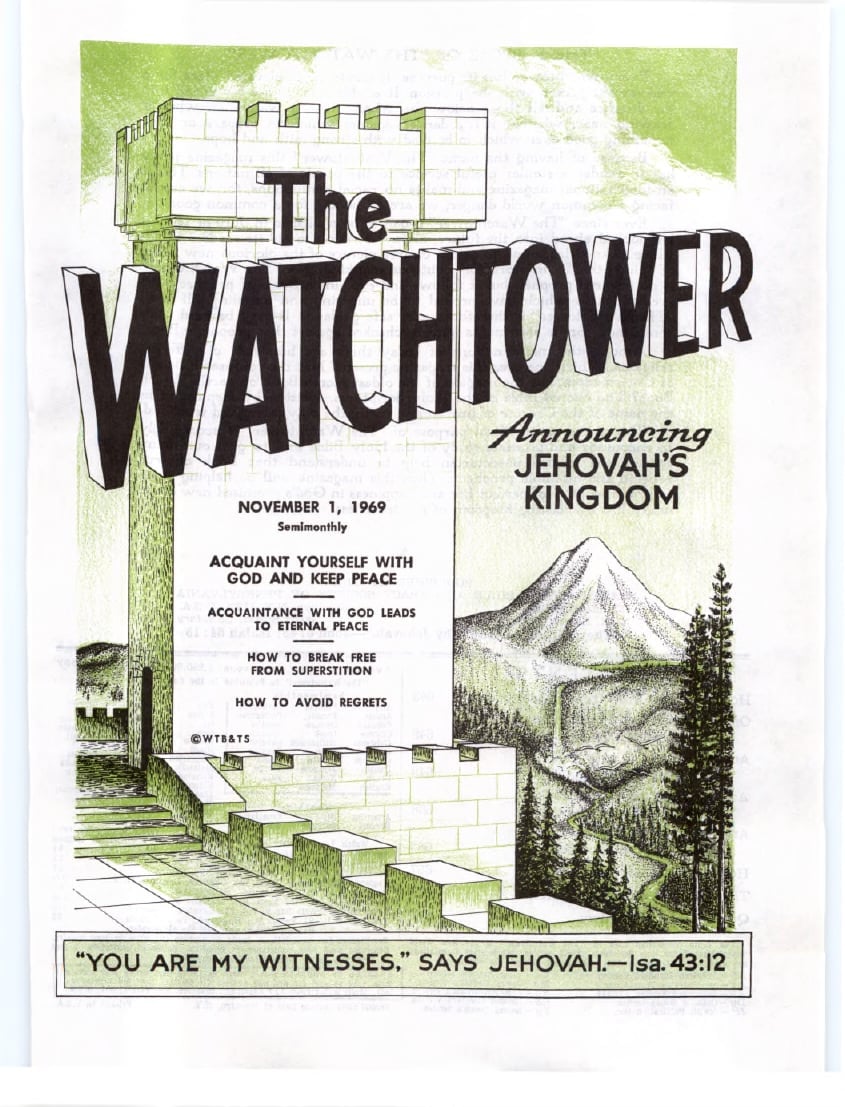
The Watchtower — November 1, 1969
Source: jw.org
Contents
How to Break Free from Superstition
Offering Sacrifices Through God’s Effectual Priesthood
Acquaint Yourself with God and Keep Peace
Acquaintance with God Leads to Eternal Peace
Are You Gratefully Receiving What Jehovah Provides?
How to Avoid Regrets
They Stopped Going to Church
Questions From Readers
Announcements
How to Break Free from Superstition
How to Break Free from Superstition
THE smile of gratitude quickly disappeared from the traveling woman’s face as she stared at the food offered her.
“Eat,” urged the hostess, “the food is not spoiled.”
“No, no,” protested the traveler, “this is catfish. If I eat it, I will be accused of murdering my own children!”
Illogical? Persons who are unshackled by slavery to superstition probably would say so. Yet, to many individuals, eating this food is considered a serious offense.
Nevertheless, many persons have broken free from such taboos. They no longer fear the dead, rely on “medicines,” or allow dreams and omens to regulate their lives. They are now happy, contented people. How did they break free from superstition?
TRUTH ABOUT THE DEAD FREES
It is the truth that has made possible this break from superstition, particularly the truth concerning the condition of the dead. As Jesus Christ said: “You will know the truth, and the truth will set you free.”—John 8:32.
Well, what is the truth about the dead? Can they communicate with or harm the living? Why did the woman say that eating catfish would be comparable to inflicting death on her children?
Catfish in the streams near this African woman’s village are regarded by many as reincarnated spirits of dead humans. So villagers explain regarding the taboo: “It is our law. We don’t eat it. If a woman eats, she will either be barren or her children will die. If a man eats, he will not have children.” Some even believe that death for the eater will ensue.
A young African named Samuel observed this taboo, and abstained from catfish. But then he began to study the Bible. He noted that the Bible teaches that the dead are unconscious. For instance, in one place the Bible says: “The living are conscious that they will die; but as for the dead, they are conscious of nothing at all.”—Eccl. 9:5.
Samuel also was shown in the Bible that at death man’s “spirit goes out, he goes back to his ground; in that day his thoughts do perish.” (Ps. 146:4) From this Samuel could see that the spirit, or life force, is not an independent intellect that continues after death. Rather, death completely terminates life: As the Bible also observes: “If [God] sets his heart upon anyone, if that one’s spirit and breath he gathers to himself, all flesh will expire together, and earthling man himself will return to the very dust.”—Job 34:14, 15.
Thus, when he learned the Bible truth that the spirit in man is not a personality that survives the death of the body, Samuel could see the error in believing that catfish possess the reincarnated spirits of departed humans. He, therefore, realized how absurd it is to believe that a dead fish could interfere with his procreative powers. So Samuel started eating catfish.
However, because he did not marry for some years, his tribesmen were sure that catfish had spoiled his mating powers. When he finally did marry, they were equally sure that he would have no children, or that any offspring he did have would die. What was the outcome?
Well, Samuel’s first child did not die, nor did his second, nor his third, and the fourth is on the way! But what about Samuel’s sister, who has abstained from catfish all her life? She protested to Samuel about breaking this taboo. But he replied: “If there is any truth in the taboo then why are all my children living, but your children are dead?”
It was true. This sister had suffered the loss of her three children. Superstitious observance of the taboo had not preserved them!
Once freed by Bible truth, Samuel determined never again to be enslaved by superstitions. So when his father died, he refused to put a gift in the coffin for the deceased to carry into the spirit world. Nor did he share in having a ‘meal with the dead.’ Neither did he participate in the feast to ‘cross over,’ which celebrates the supposed joining of the deceased with other spirits. For Samuel’s fearless stand in support of Bible truth, has he been harmed by some vindictive spirit? No, not in the least.
Perhaps you are one who holds to superstitious beliefs in connection with the dead. Do you, for instance, wonder if your little brother is really your dead uncle come back to life? Do you reassure yourself by noticing the shape of the little fellow’s ear, concluding that uncle’s ear was shaped just like that? Or do you superstitiously refrain from naming your children after a living relative because you believe this relative, after his death, will be born again as a baby and only that baby should carry his name?
Allow Bible truth to set you free from such superstitious beliefs! Trust in the Bible, “just as it truthfully is, as the word of God.” (1 Thess. 2:13) The truth is that future life is gained, not by reincarnation, but through the resurrection power invested in Jesus Christ, who declares: “I am the resurrection and the life.”—John 11:25.
Following his own resurrection from the dead Jesus remembered every detail of his previous human life. So did the resurrected Lazarus, who continued to be a disciple of Jesus after coming forth from the grave. (John 11:38-44; 12:1, 9-11) How about you? Can you remember a past existence? If you really lived before, you should be able to do so. Actually, reincarnation is a myth based on fallible human reasoning. God’s Word of truth exposes it as such.
BASIS FOR SUPERSTITIOUS FEARS
This does not mean that people’s superstitious fears are completely without basis. For example, Samuel recalls the experience of a young African boy of nine. One day while walking in the forest he heard his name called. He turned, saw no one, and continued walking. Just then a stone thrown from behind landed in front of him. The boy arrived at home in fear, but his father explained that this was the work of his mother, who had just died.
Thereafter the presence of a dead body in his town always filled the youth’s heart with a sickening dread. However, later in life he reasoned carefully on the Bible passage at Job 7:9, 10: “The cloud certainly comes to its end and goes away; so he that is going down to Sheol [the grave] will not come up. He will not return any more to his house, and his place will not acknowledge him any more.” Now the man realized that it could not have been his mother who had called his name and thrown the stone when he was a youth. She was dead, unconscious, and she could not return to do these things. Who, then, was responsible for them?
The Bible reveals the source of many supernatural phenomena to be wicked invisible spirit creature—and not departed spirits of humans. Satan the Devil is the chief of these wicked angelic creatures, and Jesus called him “the father of the lie.” (John 8:44) Satan and his wicked spirits deliberately have endeavored to deceive people into believing that humans survive death and enter into a spirit world. They have even impersonated the voices of deceased persons in an effort to perpetuate the lie that man does not cease to exist at death.
THROWING OFF THE YOKE OF “MEDICINE”
It is also commonly believed in some places that natural objects, including trees, rocks, rivers, mountains, and particularly images, are possessed of indwelling souls capable of influencing lives for good or for bad. Therefore, for protection against bad and fickle powers, a “medicine” is concocted of objects representative of powerful qualities. A stone, for instance, or bones, claws and beaks are considered useful. Such “medicines” may be stuffed into horns or made up into small packages.
One such “medicine” is known as “Gyeefa,” worn only by grown men. It is suspended from the neck in a skin pouch. Gyeefa has “soldiers” that report to him. These “soldiers” are finger rings worn by growing boys like Peter.
To prevent the “medicine” from harming him, Peter had to observe the “law of the medicine.” This law included a ban on roast cassava. Also, if Peter were on a journey and saw driver ants approaching him or he heard the call of the dudu bird on his right side, then he would be obliged to turn around and return to the starting point of his journey. And finally, no one was to be permitted to “talk over” Peter. Thus if Peter were sitting in a rice kitchen, no one dare go to the kitchen’s top and talk from a position above Peter. One can easily imagine the difficulties that observing such burdensome regulations would entail.
When Peter was twelve he was sent to Lower Buchanan in West Africa for schooling. The fine opportunity for beneficial mental development turned out to be a time of distress and foreboding for Peter. Why so? Because the master of the house lived on the second floor, above Peter. And Peter dare not tell him not to “talk over” him! For most of his time there Peter lived outside the house, and finally the fear of the “medicine” made him leave.
Years later, while studying the Bible with one of Jehovah’s witnesses, Peter was impressed with the fact that God condemned “anyone who employs divination, a practicer of magic or anyone who looks for omens or a sorcerer.” (Deut. 18:10) Peter realized that the “law of the medicine” regarding driver ants and dudu birds was nothing more than paying attention to omens. Too, how could Gyeefa with its odd assortment of lifeless objects protect him, a living man. He was trusting in magic power. And what sort of judgment would come to him from the true God for trusting in Gyeefa, a false idol?
Truth’s power and the fear of Jehovah God led Peter to challenge the “law of the medicine.” He started eating roast cassava. When driver ants came in his direction, he walked right through them and never changed course. That was fifteen years ago, and has harm come to Peter for altogether disregarding the Gyeefa superstitions? Not at all, as he continues to ‘walk in security with Jehovah as his confidence.’—Prov. 3:23-26.
Then there was John, who wore under his outer clothing a “medicine” in the form of a small gown to which sacrifices were made at every new moon. Failure to do so was supposed to bring on sickness or loss of sanity. If John should argue with someone, the mere striking of his chest was supposed to start the “medicine” working against his antagonist. Then one day John read in the Bible: “‘But to whom can you people liken me so that I should be made his equal?’ says the Holy One.”—Isa. 40:25.
John was troubled. Had the “medicine” taken the place of God in his life? Was he really relying on the true God? Was he praying? How, in fact, could he pray to the true God and expect to be heard? The Almighty is a God exacting exclusive devotion and does not share glory with any rival. After learning to ‘trust in Jehovah with his whole heart’ John wrapped up his expensive “medicine,” valued at $100, and threw it into the ocean.—Ex. 20:5; Isa. 42:8; Prov. 3:5.
It was ten years ago that John replaced the expensive gown with the “breastplate of righteousness” of which the Bible speaks. And during all these years the drowned “medicine” has been unable to deprive John of good health and soundness of mind.—Eph. 6:14.
NO LONGER DECEIVED BY DREAMS
But someone may ask: How can a person believe that a deceased relative is really dead when the deceased apparently talks to one in dreams?
For instance, a young woman dreamed frequently of her deceased grandmother. While she was alive the grandmother had been very fond of this granddaughter. Now, the grandmother would appear in dreams and prescribe medicine when her granddaughter was sick. On one occasion she even appeared and apparently changed the diapers of the granddaughter’s baby! Would not this convince one that grandmother was really alive in a spirit world?
Of course, this is what the “father of the lie,” Satan the Devil, desires individuals to believe. He wants to keep people enslaved to superstition and fear, making them believe that the deceased can really communicate with and do things either for or against the living. He and his agents are masters of deception. As the Bible explains: “Satan himself keeps transforming himself into an angel of light. It is therefore nothing great if his ministers also keep transforming themselves into ministers of righteousness.”—2 Cor. 11:14, 15.
In time, however, the granddaughter decided to put her faith in the Bible and diligently sought to understand it. Consequently, after turning to Jehovah, she no longer had such dreams of her grandmother. No longer did she think of her grandmother as a household spirit, but merely desired to see her again in the resurrection. Through faith in the truth, this young woman ‘opposed the Devil, and he fled from her.’—Jas. 4:7.
‘OLD WIVES’ TALES’ AND OMENS
In many places people are often enslaved by what amount to ‘old wives’ tales.’ For example, one grannie gave her daughter a piece of stone taken from a place where lightning had struck. “Put it in baby’s bath water,” she advised; “it will make him strong!” Grannie also disclosed that a piece of cork in the water will make baby agile, ‘ready to walk in nine months.’
Daughter dutifully followed this advice with her first four children before learning that the Bible condemned superstition. Therefore, her last six children were bathed without the stone and cork. Could she observe any difference in the development of her children? Not at all. All ten of them walked after nine months and all are healthy and strong. Superstitious persons like to pass on their superstitions to others. Be wise. Learn to distinguish between truth and superstitious ‘old wives’ tales.’ Heed the Bible, which says: “Turn down the false stories which violate what is holy and which old women tell.”—1 Tim. 4:7.
Perhaps you are superstitious only about little things, and still feel that you are acceptable to God as a Christian. You may not fear the dead or carry “medicine,” but if you are on a journey and happen to stub your right toe, do you accept this as an omen of good luck? Or if a branch of a tree breaks off right before your eyes, do you take this as an omen of ill for your family? Once you have established that mentality, any little thing that does not go right will appear to confirm your superstition. However, branches break and troubles come as normal occurrences in life. The Bible explains that “time and unforeseen occurrence befall” everyone.—Eccl. 9:11.
You will be wise to keep reminding yourself that the true God does not communicate with humans through omens. In fact, he condemns “anyone who looks for omens.” (Deut. 18:10) Therefore pay no attention to them! What a wonderful mental relief you will experience!
BREAK FREE BY TURNING TO JEHOVAH
Remember, such little superstitions on your part will not be overlooked by Jehovah, who is “searching the heart, examining the kidneys, even to give to each one according to his ways, according to the fruitage of his dealings.” (Jer. 17:10) Superstition alienates one from the true God, Jehovah. It prevents one from drawing close to Him, because superstition is based on falsehood and ignorance.
A person dares not deceive himself with false reasonings. For “God is light and there is no darkness at all in union with him.” This means that the break from superstitious practices must be complete and final. Otherwise, “If we make the statement: ‘We are having a sharing with him,’ and yet we go on walking in the darkness, we are lying and are not practicing the truth.”—1 John 1:5, 6.
Jehovah’s spirit or active force is needed to activate the mind to reject ignorance and foolish fears, and thus break free from superstition. Make room for God’s spirit to enter your mind by absorbing liberating Bible truth through reading, study and discussion of God’s Word. Call on the name of Jehovah for security and spiritual strength, for “the name of Jehovah is a strong tower. Into it the righteous runs and is given protection.” Make the break for wondrous mental freedom, for “where the spirit of Jehovah is, there is freedom.”—Prov. 18:10; 2 Cor. 3:17.
Offering Sacrifices Through God’s Effectual Priesthood
Offering Sacrifices Through God’s Effectual Priesthood
What were some of the pre-Christian ways by which man could approach Jehovah God and commune with him?
There were angels who ministered in a great variety of ways to the needs of man, and by means of them men had contact with God. The patriarchs themselves served as a priesthood or way of approach to Jehovah God for their households, as did, for example, Abraham and Job. (Job 1:5) And with the establishment of the nation of Israel, the Aaronic priesthood, and in particular the high priest, served as a way of approach to God and a means of communication with Him.—Heb. 5:4.a
What qualifications does Jesus Christ have to serve as God’s effectual high priest today?
First of all, because of his perfection and faithfulness to death, he was uniquely able to provide an actual sin-atoning sacrifice by laying down his body and his perfect human life, on the torture stake. He was raised from the dead a glorious spirit creature and ascended to heaven, there to present the value of his sacrifice to Jehovah God. He is alive evermore to serve as a sacrificial priest to all who exercise faith in his ransom sacrifice, and he will restore all obedient humankind to perfection during his Kingdom rule.—Heb. 9:11-14.
What are the requirements or duties of the priesthood today as foreshadowed by the Aaronic priesthood?
Christ’s underpriests today are the remaining ones of his anointed footstep followers. Just as the typical priests saw to it that the animal sacrifices met with Jehovah’s requirements, so Christ’s priesthood of today and their helpers must see to it that each one is offering up a sacrifice of praise commensurate with one’s ability. They are to make clear God’s requirements as to what kinds of sacrifices are acceptable to Him.—Mal. 1:7-9.
Even as the priests and Levites had much work to do in connection with the sacrificial offerings of the people, so today the responsible servants in the congregations have much work to do in the way of drawing up schedules, preparing programs, arranging meetings, organizing effective arrangements for field service, seeing that all matters relating to the Kingdom Hall are taken care of, and that there are sufficient literature and territory available for use by the publishers.—1 Thess. 5:12, 13.
Further, as it was the duty of the priests back there to sound the trumpet for assembling the people and to prepare for battle, so the remnant today and their helpers must sound a distinct call to all to gather to Jehovah’s organization and to engage in spiritual warfare against Jehovah’s enemies.—2 Cor. 10:3-6; Eph. 6:10-18.
Then again, even as the lips of the Aaronic priests kept knowledge, and the law is what the people sought at their mouth, so today the remnant of Christ’s body are obligated to keep on ministering to their fellow worshipers their spiritual food at the proper time.—Matt. 24:45-47.
What obligation do the words at Hebrews 13:15 place upon the anointed remnant and their helpers?
‘To offer the sacrifice of praise, that is, the fruit of their lips which make public declaration to Jehovah’s name.’ One way of doing this is by speaking up at congregational meetings, as counseled at Hebrews 10:23-25. This requires thoughtful and thorough advance preparation. Among other ways this can be done is by going from house to house with the good news of God’s kingdom in printed form, by making return visits where interest in Bible truth is found, and by conducting Bible studies in the homes of those who want to learn more about Jehovah God and his will and purposes for humankind.
Zealous servants of Jehovah will also be alert not to overlook any opportunities to witness incidentally wherever possible. Taking advantage of such opportunities not only brings much joy to the Kingdom publisher himself but time and again has resulted in helping persons get on the road to everlasting life in God’s new system of things.
All of the anointed spiritual priesthood and their “other sheep” helpers will therefore want to be diligent during November by offering sacrifices of praise, glorifying Jehovah’s name.
[Footnotes]
For details see The Watchtower, June 1 and 15, 1968.
Acquaint Yourself with God and Keep Peace
Acquaint Yourself with God and Keep Peace
“Acquaint yourself, please, with him, and keep peace; thereby good things will come to you.”—Job 22:21.
1. How did it come about that Eliphaz the Temanite said to Job the words of our text above?
WHEN the man Eliphaz the Temanite told his friend Job to acquaint himself with Jehovah God, Job was to all appearances not at peace with God or was not keeping peace with him. Evidently good things were not coming to Job. From the height of prosperity he had been plummeted into the depths of abject poverty. He had lost his vast properties, had been bereaved of his ten beautiful children, and had then fallen victim to a loathsome disease that covered him with ulcers from head to foot. His despairing wife had foolishly told him to curse God and die. Hearing of his unparalleled calamity, three acquaintances of Job, one of whom was this Eliphaz from the south, came to comfort him. After seven days of silent scrutiny of Job and then hearing him call down evil upon the day of his birth, the three would-be comforters proceeded to attack Job’s integrity toward God. (Job 1:1 to 4:1) It was during the course of the argument that followed that Eliphaz said to Job: “Acquaint yourself, please, with him, and keep peace; thereby good things will come to you.”—Job 22:21, NW; AT; AS.
2. As suggested in the words of Eliphaz, what does the modern world fail to recognize as necessary to the having of peace among themselves?
2 The words of Eliphaz, though spoken under a misunderstanding of Job’s case and misdirected toward Job, were good in themselves. This twentieth-century world fails to recognize that men cannot have peace among themselves and enjoy prosperity until, first, they get acquainted with God and become familiar with his will and come into peaceful relationship with him in his way. But how can men of earth get acquainted with a God who is an invisible spirit Being? As one college student recently said: “How can I experience God?” This at a time when student unrest has spread around the earth.
3. (a) How can we acquaint ourselves with God? (b) How did God bring a nation into acquaintanceship with him, and how were some men thereof favored?
3 By getting acquainted with the Holy Bible a person can get acquainted with God, its Author, for the Bible tells us of men who made God a part of their daily experience. It tells us of ancient men, Enoch and Noah, who were said to walk with God. (Gen. 5:22; 6:9) Do you know that this God brought a whole nation into acquaintanceship with him, and that individual men of this nation had miraculous visions in which they saw God? Do you know that men of this nation ate and drank with God on earth? The writer of the book of Job and of the first five books of the Holy Bible tells us of a divine contract with this nation of which he was the mediator between God and man. This man was the prophet Moses. This contract or covenant was made at a mountain in the Sinai Peninsula, which is part of Arabia. It was in the spring of the year 1513 B.C.E., and God had brought the people of Moses there after having delivered them out of Egypt, by which he made his name Jehovah known to them as their forefathers had never appreciated it.—Ex. 6:3.
4. How did more than seventy men of Israel come to eat and drink together with God on earth?
4 After the making of the covenant with Jehovah God over animal victims of sacrifice, Moses and his brother and two of his nephews and seventy other men of the nation went up into Mount Sinai. Exodus 24:9-11 tells us: “Moses and Aaron, Nadab and Abihu and seventy of the older men of Israel proceeded to go up, and they got to see the God of Israel. And under his feet there was what seemed like a work of sapphire flagstones and like the very heavens for purity. And he did not put out his hand against the distinguished men of the sons of Israel, but they got a vision of the true God and ate and drank.”
5. Did those favored men see God’s shape, and why was it fitting for them to be “under his feet”?
5 Actually those seventy-four men saw no shape or form of God. What they saw in vision was an awe-inspiring display of the glory of the “God of Israel.” Under the glorious manifestation of Him, or, as we would say, “under his feet,” those favored men saw something “like a work of sapphire flagstones and like the very heavens for purity,” or like the clear, blue sky without a cloud. Those men were on earth and below his “feet” in nice harmony with God’s own saying: “The heavens are my throne, and the earth is my foot stool.” How, then, could any man-made temple or church building contain such a dazzlingly glorious God as this? It really could not do so.—Isa. 66:1; Acts 7:48, 49.
6. Were those seventy-four men in danger at this vision of God, and what kind of meal did they eat with him?
6 A human creature is really in a dangerous position when he has a vision of the only living and true God. Human flesh and blood are so frail and perishable when brought near to any display of the glory of God’s person. Man can go only so far, and no farther, in beholding the glorious manifestation of the invisible God. Not without good cause does Exodus 24:11 say with regard to those seventy-four men in the mountain of Sinai: “And he [that is, God] did not put out his hand against the distinguished men of the sons of Israel, but they got a vision of the true God and ate and drank.” Certainly they did not eat and drink in any overfamiliar, irreverential way; they did so as at a sacrificial meal. What they ate was possibly the part of the animal sacrifices that was assigned to the sacrificers to eat from the communion sacrifices that had been offered to God at the base of Mount Sinai. Wine, used as drink offerings to God, was likely what they drank. In this way those reverential men had a communion meal with God. As they were considered worthy persons, God did not kill them.—Ex. 24:1-11.
7. How did Moses come to look upon the place of close association with God?
7 Afterward, when the prophet Moses was alone with God in the mountain, he neither ate nor drank, even for forty days and nights. He looked upon the place of close association with God as a holy area. Some months earlier, when Moses was sent down to Egypt to deliver his people, God’s angel appeared to him in the midst of a burning bush near the foot of Mount Sinai and told him: “Draw your sandals from off your feet, because the place where you are standing is holy ground.”—Ex. 3:1-5.
WHAT MOSES SAW OF GOD
8. How did God’s words spoken in rebuke to Aaron and Miriam show Moses’ favored position with God, and why was this fitting?
8 As the mediator between Jehovah God and his chosen people, did Moses see God more directly than anybody else in the whole nation? Was it possible to see Him more directly? How favored Moses was in this regard God pointed out to Moses’ brother Aaron and his sister Miriam, when these complained against Moses. God said: “Hear my words, please. If there came to be a prophet of yours for Jehovah, it would be in a vision I would make myself known to him. In a dream I would speak to him. Not so my servant Moses! He is being entrusted with all my house. Mouth to mouth I speak to him, thus showing him, and not by riddles; and the appearance of Jehovah is what he beholds. Why, then, did you not fear to speak against my servant, against Moses?” (Num. 12:1-8) All of this was very fitting with respect to Moses, for he was a prophetic figure of the Son of God, Jesus Christ, the promised prophet who was to be greater than Moses.—Deut. 18:15-18; Acts 3:19-23; 7:37, 38.
9, 10. (a) Speaking “mouth to mouth” suggests what regarding the speakers, and raises what question regarding Moses? (b) What promise did Moses get from God after Israel committed idolatry at Mt. Sinai?
9 On one occasion especially Moses did see an “appearance of Jehovah.” In that case did he see God’s form directly? Persons speaking “mouth to mouth,” suggests their speaking face to face, but did Moses actually see God’s face there on Mount Sinai? At the time it was still the year 1513 B.C.E. The nation, despite having the Ten Commandments, had become guilty of committing idolatry. The situation was critical. So Moses saw it necessary to make a special plea to God in Mount Sinai. From Jehovah God he won the promise that Jehovah’s presence would go with him until Moses brought his people to the Promised Land. Moses says:
10 “And Jehovah went on to say to Moses: ‘This thing, too, of which you have spoken, I shall do, because you have found favor in my eyes and I know you by name.’
11, 12. What did Moses ask to be allowed to see, but what was God’s reply?
11 “At this he [that is, Moses] said: ‘Cause me to see, please, your glory.’
12 “But he said: ‘I myself shall cause all my goodness to pass before your face, and I will declare the name of Jehovah before you; and I will favor the one whom I may favor, and I will show mercy to the one to whom I may show mercy.’ And he added: ‘You are not able to see my face, because no man may see me and yet live.’ And Jehovah said further: ‘Here is a place with me, and you must station yourself upon the rock. And it has to occur that while my glory is passing by I must place you in a hole in the rock, and I must put my palm over you as a screen until I have passed by. After that I must take my palm away, and you will indeed see my back. But my face may not be seen.’”—Ex. 33:17-23.
13. Was this manifestation to be by a materialization of God, and why did special precautions need to be taken toward Moses?
13 This was to be no materialization by the invisible God in human form, in the way that the gods of Grecian mythology were said to have appeared to men. (Acts 14:11-13) That was to be a manifestation of divine glory to the degree that would be not too much for a human person to see and experience without being blinded, killed and dissolved to nothing. Mercifully Jehovah promised to take special precautions toward Moses. The next day the promised manifestation came, such as no man aside from Moses had ever seen. According to the divine instructions, Moses presented himself in Mount Sinai with two stone tablets upon which God was to inscribe the Ten Commandments. What happened now?
14, 15. What did God do as he went passing by Moses, and what did Moses do?
14 “And Jehovah proceeded to come down in the cloud and station himself with him there and declare the name of Jehovah. And Jehovah went passing by before his face and declaring: ‘Jehovah, Jehovah, a God merciful and gracious, slow to anger and abundant in loving-kindness and truth, preserving loving-kindness for thousands, pardoning error and transgression and sin, but by no means will he give exemption from punishment, bringing punishment for the error of fathers upon sons and upon grandsons, upon the third generation and upon the fourth generation.’
15 “Moses at once hurried to bow low to the earth and prostrate himself.”—Ex. 34:1-8.
16. How did what Moses saw affect his countenance, and how did he by this experience get better acquainted with God?
16 Moses does not tell us that he saw God’s form directly. All he saw was the afterglow of God’s passing manifestation. And yet Moses’ own face was emitting rays of light when he came down from the mountain and appeared to the people. (Ex. 34:29, 30) How much better, too, Moses became acquainted with Jehovah God! What a wondrous declaration of the personality of God to Moses! What so-called god is to be compared with Jehovah?
17. What kind of God does Jehovah describe himself to be, and what deserves to be associated with such a personality?
17 He assures us that he is a God of love, and yet also of justice, with the power of self-control when he is dealing with sinful mankind. And in thus dealing with imperfect mankind, he keeps his loving treatment of them in perfect balance with a just treatment, thus displaying an amazing wisdom under all changing circumstances and conditions. What a matchless God! A God of perfect love, perfect justice, perfect power and perfect wisdom. Such an adorable personality deserved to be associated with a brilliance of glory that was too bright for weak human eyes to behold or a frail human body to encounter.
18. (a) Against what was Moses insulated as the Divine Presence passed by? (b) As a result of this, how can we acquaint ourselves better with this God Jehovah?
18 Small wonder that special precaution had to be taken to give Moses enough insulation against being hurt or even being destroyed when Jehovah’s glory passed by and He declared His peerless name as Moses was listening within the hole in a rock. Never could Moses, or any other man, have seen God’s face and have lived! A mere man would have died before the “face” or full manifestation of God’s glory reached him. Moses was impelled to bow down and prostrate himself in worship as the glorious Divine Presence passed by. How ridiculous, then, for a Russian astronaut to say there is no God because he did not meet Him when his spacecraft was orbiting in outer space about the earth! But we today, by believing and accepting Moses’ vision of the divine glory, acquaint ourselves better with this marvelous God Jehovah.
ISAIAH SEES GOD IN VISION
19, 20. (a) Where did the prophet Isaiah have his vision of God, and after what profanation of the temple? (b) When did Isaiah have this vision, and what features of it does he describe?
19 Moses did not remain alone among men in having a vision of Jehovah God, and thus getting better acquainted with Him. Seven hundred and thirty-six years passed and the scene changed from Mount Sinai in Arabia to the hills of ancient Jerusalem. There was a glorious temple on the city’s Mount Moriah. But a terrible calamity had shocked the nation. The prosperous king, Uzziah or Azariah, had presumed to force his way into the first holy compartment of the temple to offer incense there like a priest and had been struck with leprosy, from which eventually he died like an outcast. During his loathsome affliction his faithful son Jotham had to serve as king on Jerusalem’s throne. In the year of Uzziah’s miserable death (777 B.C.E.) and likely after he died, the prophet Isaiah had a vision of God. It was different from the vision given to Moses. Isaiah himself tells us:
20 “In the year that King Uzziah died I, however, got to see Jehovah, sitting on a throne lofty and lifted up, and his skirts were filling the temple. Seraphs were standing above him. Each one had six wings. With two he kept his face covered, and with two he kept his feet covered, and with two he would fly about. And this one called to that one and said: ‘Holy, holy, holy is Jehovah of armies. The fullness of all the earth is his glory.’ And the pivots of the thresholds began to quiver at the voice of the one calling, and the house itself gradually filled with smoke.”—Isa. 6:1-4; 2 Chron. 26:1-23.
21. How does the vision show Jehovah to be the King of his people?
21 No description is given of the Divine Person, since God cannot be likened to a creature man. The skirts of his majestic garment filled the temple. His temple is a palace, and he is the invisible heavenly king of his people. So his throne does not rest upon the ground, but, besides being lofty, is lifted up.
22. How did the seraphs show respect for the presence of God and the holiness of the location?
22 The seraphs, whose appearance is like flashing fire, do not sit in Jehovah’s presence, but, while attending upon him, they stand, always in readiness. The prophet Isaiah was then looking with unveiled face at the vision of God, but those heavenly seraphs did not presume to look but covered their faces with their upper wings. As if on a holy location, the seraphs covered their feet with their lower wings, in due respect for the heavenly King, “Jehovah of armies.” With their middle set of wings the seraphs flew as heavenly creatures.
23. How did the seraphs emphasize the holiness of Jehovah and prophesy concerning his glory?
23 In this temple vision it was these seraphs that declared God’s holiness and glory. To emphasize the supreme holiness of “Jehovah of armies,” they said the word “holy” three times, making such a threefold declaration back and forth to one another. God’s glory not only filled the house or temple but was also to become the “fullness of all the earth.” Already we can see the glory of Jehovah God in all his masterly works of creation, both living things and lifeless things. But the time approaches when all the inhabitants of earth will join us in discerning Jehovah’s glory in the things that he has created, and they will no longer make this earth an unholy place, profaning it, defiling it. Not in vain has it been predicted: “The earth will be filled with the knowing of the glory of Jehovah as the waters themselves cover over the sea.” (Hab. 2:14) The chant that the seraphs gave voice to in Jehovah’s temple was prophetic.
24. Why, according to what he exclaimed, did Isaiah have reason to fear at seeing the vision?
24 At this vision of Jehovah enthroned in his temple the prophet Isaiah became frightened. At the voices of the seraphs calling to one another the pivots of the temple threshold bed to quiver, and so why should not Isaiah tremble, he being a living creature with sensitive religious feelings? Although he was already a prophet of Jehovah God, he felt unclean at seeing such a holy tableau. He even feared for his life! “Woe to me!” he cried out. “For I am as good as brought to silence [in death], because a man unclean in lips I am, and in among a people unclean in lips I am dwelling; for my eyes have seen the King, Jehovah of armies, himself!”—Isa. 6:5.
25. How, by the seraph’s aid, did Isaiah come to live to tell the story?
25 How did Isaiah come to live to tell the story? In this way: From the temple now filled with miraculous smoke one of those winged seraphs came to his aid. “At that,” Isaiah tells us, “one of the seraphs flew to me, and in his hand there was a glowing coal that he had taken with tongs off the altar. And he proceeded to touch my mouth and to say: ‘Look! This has touched your lips, and your error has departed and your sin itself is atoned for.’”
26. (a) For what did Isaiah, now cleansed, get to volunteer? (b) In what way did Isaiah truly prefigure the Messiah and furnish a lesson for us?
26 Isaiah now felt clean in the Divine Presence, even clean enough to volunteer for Jehovah’s further prophetic service. “And,” says he, “I began to hear the voice of Jehovah saying: ‘Whom shall I send, and who will go for us?’ And I proceeded to say: ‘Here I am! Send me.’ And he went on to say: ‘Go, and you must say to this people.’” Forthwith Isaiah was sent on a prophetic errand that foreshadowed the work of the coming Messiah, more than eight hundred years in the future. Never did Isaiah forget that temple vision of Jehovah’s glory. As a correct prefigurement of the Messiah, Isaiah proved true to his commission received from Jehovah. (Isa. 6:6-13; Matt. 13:10-15) But what about us? Do we, on becoming better acquainted with Jehovah God, readily offer ourselves for His service, as Isaiah did? Yes, fuller acquaintance with God impels us to say to him: “Here I am! Send me.”
THE PROPHET EZEKIEL’S VISIONS
27. When did the prophet Ezekiel begin to have visions of God?
27 Before the Messiah or Anointed One came, still another man had miraculous visions of the living and true God. This was the prophet Ezekiel, in the century following that of Isaiah. The ruin that Isaiah had foretold to come upon his own people was just six years away when Ezekiel had his first awe-inspiring vision. He was then an exile in pagan Babylonia. He says that it was “while I was in the midst of the exiled people by the river Chebar, that the heavens were opened and I began to see visions of God.” He dates it as occurring on Tammuz 5 of the year, Jewish calendar, that is, “in the fourth month, on the fifth day of the month,” and “in the fifth year of the exile of King Jehoiachin,” or in the year 613 before our Common Era.—Ezek. 1:1-4.
28. In his first vision, what thing in motion did Ezekiel see, and what was it that propelled it?
28 At that time the Creator of heaven and earth was on the march toward executing his judicial decision against his unfaithful people in the kingdom of Judah with its capital at Jerusalem. Accordingly what Ezekiel saw was like something on the move. It was like a chariot so gigantic as to make him feel like an ant. It had no gasoline engine or electric or atomic motor to propel it, but it moved swiftly, rolling over everything in its way. It had no visible steering gear and no brakes, and yet it could change the direction of its movement from straight forward to sideways, instantaneously, without slowing down in order to overcome the momentum of the chariot. What made this colossal chariot go? It was evidently the active force, the spirit, of the One who rode on the chariot.
29. What was peculiar about the wheels of this celestial chariot?
29 This was not a two-wheeled chariot. It was one of four wheels. As for the wheels themselves, they were of strange construction. Evidently they could see where they were going, for the rims were filled with eyes, all around. Moreover, inside each wheel that revolved forward there was another wheel that cut across at right angles, vertically, enabling the chariot to move sideways without its wheels turning as when wheeling around a corner. Note how Ezekiel describes the locomotion of this chariot:
30. How does Ezekiel describe the movement of the chariot wheels?
30 “As for the appearance of the wheels and their structure, it was like the glow of chrysolite; and the four of them had one likeness. And their appearance and their structure were just as when a wheel proved to be in the midst of a wheel. When they went they would go on their four respective sides. They would not turn another way when they went. And as for their rims, they had such height that they caused fearfulness; and their rims were full of eyes all around the four of them.”—Ezek. 1:16-18.
31. Who accompanied the chariot like runners?
31 In ancient times the royal chariots would have runners to run before and beside them, to impart grandeur to the chariot rider. (1 Ki. 1:5; 18:44-46) There were four cherubs that accompanied the celestial chariot that the prophet Ezekiel saw in vision. Those cherubs corresponded with runners. At first Ezekiel calls them “living creatures.” They were certainly not human creatures, although they had some features like those of a man. (Ezek. 1:5, 15; 10:9-13) The prophet Ezekiel helps us to visualize how the sight of the four living creatures and the chariot then burst in upon him with an almost indescribable glory:
32. According to Ezekiel’s description, how did the cherubs look?
32 “And I began to see, and, look! there was a tempestuous wind coming from the north, a great cloud mass and quivering fire, and it had a brightness all around, and out of the midst of it there was something like the look of electrum, out of the midst of the fire. And out of the midst of it there was the likeness of four living creatures, and this was how they looked: they had the likeness of earthling man. And each one had four faces, and each one of them four wings. And their feet were straight feet, and the sole of their feet was like the sole of the foot of a calf; and they were gleaming as with the glow of burnished copper. And there were the hands of a man under their wings on their four sides, and the four of them had their faces and their wings. Their wings were joining one to the other. They would not turn when they went; they would go each one straight forward.”
33. What faces did the cherubic living creatures have?
33 The prophet Moses gave no description of the cherubs that appeared at the entrance of the garden of Eden over thirty-four centuries previous when the sinful Adam and Eve were driven out. (Gen. 3:24) But the prophet Ezekiel gives us the above description of the cherubic living creatures and adds the following: “And as for the likeness of their faces, the four of them had a man’s face with a lion’s face to the right, and the four of them had a bull’s face on the left; the four of them also had an eagle’s face. That is the way their faces were. And their wings were spreading out upward. Each one had two joining to each other, and two were covering their bodies.”—Ezek. 1:4-11.
34. How did the wheels harmonize with the cherubs in movement?
34 How did the wheels of the celestial chariot harmonize with the movement of the runner-like cherubs? The prophet Ezekiel tells us: “And when the living creatures went, the wheels would go beside them, and when the living creatures were lifted up from the earth, the wheels would be lifted up. Wherever the spirit inclined to go, they would go, the spirit inclining to go there; and the wheels themselves would be lifted up close alongside them, for the spirit of the living creature was in the wheels. When they went, these would go; and when they stood still, these would stand still; and when they were lifted up from the earth, the wheels would be lifted up close alongside them, for the spirit of the living creature was in the wheels.”—Ezek. 1:19-21.
35, 36. (a) What do the features of the cherubs symbolize? (b) What did Ezekiel see just above the cherubs and wheels, and what did he hear?
35 Creatures according to the description of those cherubic living creatures do not, of course, exist in the heavens, in the invisible spirit realm. For this reason the various features of their seemingly grotesque appearance were symbolic of good qualities such as are outstanding in man, lion, bull, eagle, and other winged creatures. Interesting as these qualities are, here for the moment we are interested more in what was above the four cherubic living creatures and above the wheels alongside them. What did the prophet Ezekiel see up there? He tells us:
36 “And over the heads of the living creatures there was the likeness of an expanse like the sparkle of awesome ice, stretched out over their heads up above. And under the expanse their wings were straight, one to the other. Each one had two wings covering on this side and each one had two covering on that side their bodies. And I got to hear the sound of their wings, a sound like that of vast waters, like the sound of the Almighty One, when they went, the sound of a tumult, like the sound of an encampment. When they stood still, they would let their wings down.”—Ezek. 1:22-24.
37. As what part of a chariot does that “expanse” serve, and what dominated above all the other sound effects?
37 Ah, that “expanse”! It was the platform of that celestial chariot. Like translucent ice it seemed, but awesome it was. The One riding on the chariot was thus pictured as moving ahead to the execution of his judicial decision on a firm platform, like congealed water. Underneath this awe-inspiring platform the sound of the movement of the chariot of the Almighty One was like that of tumultuous waters, or like an encampment of soldiers clamoring to move into action in order to execute the enemies of the Almighty One. But there was a voice that dominated over all these sound effects below the icelike platform or “expanse.” The prophet Ezekiel hears it coming forth from above the awesome expanse. It came from the Almighty One riding on this chariot platform. What appearance did he take on? Ezekiel tells us:
THE RIDER ON THE CELESTIAL CHARIOT
38. How does Ezekiel describe the chariot rider and the light effects about him?
38 “And there came to be a voice above the expanse that was over their head. (When they stood still, they would let their wings down.) And above the expanse that was over their head there was something in appearance like sapphire stone, the likeness of a throne. And upon the likeness of the throne there was a likeness of someone in appearance like an earthling man upon it, up above. And I got to see something like the glow of electrum, like the appearance of fire all around inside thereof, from the appearance of his hips and upward; and from the appearance of his hips and downward I saw something like the appearance of fire, and he had a brightness all around. There was something like the appearance of the bow that occurs in a cloud mass on the day of a pouring rain. That is how the appearance was of the brightness round about. It was the appearance of the likeness of the glory of Jehovah. When I got to see it, then I fell upon my face, and I began to hear the voice of one speaking.”—Ezek. 1:25-28.
39. (a) All together those light effects are summed up in what word? (b) How much detail is given about the chariot rider, and what did his throne resemble?
39 The glow like that of electrum (the metallic mixture of gold and silver), the fire completely surrounding and outlining the chariot rider, with a brightness all around, and the semicircular bow with all the variety of colors of the rainbow—all this is summed up in the one word of description, “glory.” The “glory of Jehovah”! There was an appearance of a form that suggested that of a man, with an “appearance of his hips.” But nothing of the features of face and form is given with any detail. The throne upon which this Almighty One, Jehovah, sits, is as a sapphire stone expertly cut and faceted, its deep blue suggesting the heavens, where Jehovah really thrones. From this sapphire-like throne Jehovah spoke to his prophet Ezekiel.
40. The following year Ezekiel had a vision of the celestial chariot as being where?
40 The following year the prophet Ezekiel had another vision of Jehovah’s celestial chariot with the wheels beside which were the cherubic living creatures, this time, however, before the temple built by King Solomon in Jerusalem. “And I continued to see,” says Ezekiel, “and, look! upon the expanse that was over the head of the cherubs there was something like sapphire stone, like the appearance of the likeness of a throne, appearing above them. . . . And the cherubs were standing to the right of the house when the man entered, and the cloud was filling the inner courtyard. And the glory of Jehovah began to rise up from the cherubs by the threshold of the house, and the house gradually became filled with the cloud, and the courtyard itself was full of the brightness of the glory of Jehovah. And the very sound of the wings of the cherubs made itself heard to the outer courtyard, like the sound of God Almighty when he speaks.”—Ezek. 10:1-5; 8:1.
41. (a) From where had the chariot rolled, and what did its new location suggest? (b) How was it as if Ezekiel himself were destroying Jerusalem?
41 Thus Jehovah’s celestial chariot had wheeled itself from the Babylonian river Chebar, where Ezekiel first had a vision of it, and had rolled westward to Jerusalem and its temple. This betokened that the fiery execution of Jehovah’s judicial decision upon unfaithful Jerusalem and its polluted temple was getting closer. The city, along with its temple, was to be destroyed. (Ezek. 10:6-22) In a figurative way, Ezekiel was himself destroying the unfaithful city of Jerusalem. How? It was by receiving the commission from Jehovah to be a prophet and by then declaring the message of impending destruction. Twenty years after Ezekiel saw Jehovah’s chariot at the river Chebar, or fourteen years after the actual destruction of Jerusalem, Ezekiel was caused to think back on his destructive mission. In the twenty-fifth year of his exile in Babylon he was given a vision of a new temple of Jehovah, in all its completeness. An angel, taking on the appearance of a man, conducted Ezekiel on a sight-seeing tour of it.
42. Fourteen years after Jerusalem’s destruction, what vision of God did Ezekiel have in connection with the new temple?
42 “Then he made me go to the gate, the gate that is facing toward the east,” says Ezekiel. “And, look! the glory of the God of Israel was coming from the direction of the east, and his voice was like the voice of vast waters; and the earth itself shone because of his glory. And it was like the appearance of the vision that I had seen, like the vision that I saw when I came to bring the city to ruin; and there were appearances like the appearance that I saw by the river Chebar, and I went falling upon my face. And the glory of Jehovah itself came into the house by way of the gate the front of which was toward the east.”—Ezek. 43:1-4; 40:1-4.
43. What does the effect of the vision upon Ezekiel indicate as to God’s glory?
43 So glorious was the vision of the Almighty God Jehovah that it was enough to make frail man of flesh fall upon his face, prostrating himself. The glory of Jehovah God is nothing to look at profanely, impudently, defiantly. Ezekiel’s miraculous visions of the “glory of Jehovah” were awesome enough to make a man quail and feel obliged to worship. But Ezekiel survived those extraordinary experiences according to God’s purpose for him.
44. In view of Ezekiel’s vision, why does it now behoove men to acquaint themselves with God and come to peace with him?
44 Glorious is Jehovah God as he rides along victoriously on his celestial chariot, attended by his cherubic living creatures. He is similarly riding today to the execution of his judgments. It now behooves men to acquaint themselves with this God and make peace and keep peace with him.
Acquaintance with God Leads to Eternal Peace
Acquaintance with God Leads to Eternal Peace
1. When did Daniel have his vision of Jehovah, and what did he see at the start of the vision?
AROUND sixty years after Ezekiel had his first vision of the glorious Charioteer Jehovah, a fellow exile of Ezekiel in Babylonia had a vision of God as the Sovereign of the universe. It was at night when the vision came. The account in Daniel 7:1-3 reads: “In the first year of Belshazzar the king of Babylon, Daniel himself beheld a dream and visions of his head upon his bed. At that time he wrote down the dream itself. The complete account of the matters he told. Daniel was speaking up and saying: ‘I happened to be beholding in my visions during the night, and, see there! the four winds of the heavens were stirring up the vast sea. And four huge beasts were coming up out of the sea, each one being different from the others.’”—Dan. 7:1-7.
2. What do the four beasts symbolize, and for what are the symbolic beasts to be judged by the Supreme Judge?
2 The vision was prophetic. According to what Daniel was told by an interpreter in the vision, the four huge beasts pictured four world powers that would follow one another on the world stage of politics. Their political domination of all the earth would carry forward from the days of Belshazzar’s grandfather Nebuchadnezzar, who had destroyed Jerusalem in 607 B.C.E. It would continue down to the time for God to set up his promised kingdom and destroy the beastly political governments of the earth. These world powers would be judged according to their record, especially according to their dealings with the faithful people of Jehovah God. He is the Supreme Judge, he being Sovereign of all the universe. In Daniel’s vision His time came to pass judgment on those beastly political world powers and to execute his judicial sentence. Then He made his appearance as Supreme Judge. How did he appear in the vision to Daniel? Daniel tells us:
3. In the vision how did the Supreme Judge appear to Daniel?
3 “I kept on beholding until there were thrones placed [one being for Jehovah God and the other being, likely, for his Messiah or Christ] and the Ancient of Days sat down. His clothing was white just like snow, and the hair of his head was like clean wool. His throne was flames of fire; its wheels were a burning fire. There was a stream of fire flowing and going out from before him. There were a thousand thousands that kept ministering to him, and ten thousand times ten thousand that kept standing right before him. The Court took its seat, and there were books that were opened.”—Dan. 7:9, 10.
4. Those to be judged are represented by what today, and what is indicated by the color of the Judge’s hair and clothing?
4 Here Jehovah God, “the Ancient of Days,” is envisioned in a court scene, coming to judgment, to judge, not specifically Judah and Jerusalem as in the case of Ezekiel’s vision of the celestial chariot, but the political world powers of the whole earth. In the present day these would be the seventh world power and the relics of the preceding six world powers. The world powers pictured by the four symbolic huge beasts out of the sea must be brought to judgment. The wisdom of this Supreme Court Judge is highlighted in his head of hair as being “like clean wool.” This feature agrees fully with the fact that he is called “the Ancient of Days” and the wisdom of all past eternity is His. The prophet Moses said to him, in Psalm 90:2: “Even from time indefinite to time indefinite you are God.” The brilliance of his righteousness in handing down judicial decisions is pictured in the fact that “his clothing was white just like snow” this clothing, too, not catching fire although the “throne was flames of fire.” His throne is a wheeled throne, it not resting upon a chariot platform as in the vision of Ezekiel, But the throne wheels themselves “were a burning fire.” This was indeed a glorious vision of Jehovah God.
5. The fiery quality of the Judge’s throne and its wheels, with a flow of fire in front, suggests what?
5 The fiery quality of the throne and of its wheels suggests that fiery judgment is approaching. A warning of this is provided in the fact that “there was a stream of fire flowing and going out from before him.” Scripturally supporting this feature of the vision is Psalm 97:1-3: “Jehovah himself has become king! . . . righteousness and judgment are the established place of his throne. Before him a very fire goes, and it consumes his adversaries all around.”
6. What does the great number of court attendants indicate, and what question arises therefore as to earthly nations?
6 The Ancient of Days as Judge Supreme also has plenty of court attendants, their number running up into the tens of millions. The great number of these attendants indicates the many, many matters that the Supreme Judge has to do with throughout heaven as well as earth. Only he who has such all-excelling wisdom could handle them all justly, without conflicting decisions. Since he has such a vast number of angelic court attendants, what can all the political powers of earth do, even in a United Nations organization of them all, to resist the full execution of his court decisions? Their destruction in the near future is certain! O yes! There was a small but aggressive horn that came up out of the head of the fourth symbolic beast. But what can it do? Nothing, according to what Daniel now says:
7. What is seen to happen to both the horn and the beast bearing it and to the other beasts?
7 “I kept on beholding at that time because of the sound of the grandiose words that the horn was speaking; I kept on beholding until the beast was killed and its body was destroyed and it was given to the burning fire. But as for the rest of the beasts, their rulerships were taken away, and there was a lengthening in life given to them for a time and a season.”—Dan. 7:11, 12.
8. When will the “time and a season” for any political relics end, and what will destruction of the political elements of this system mean?
…