The Watchtower, January 1, 1969
Download: PDF — The Watchtower, January 1, 1969
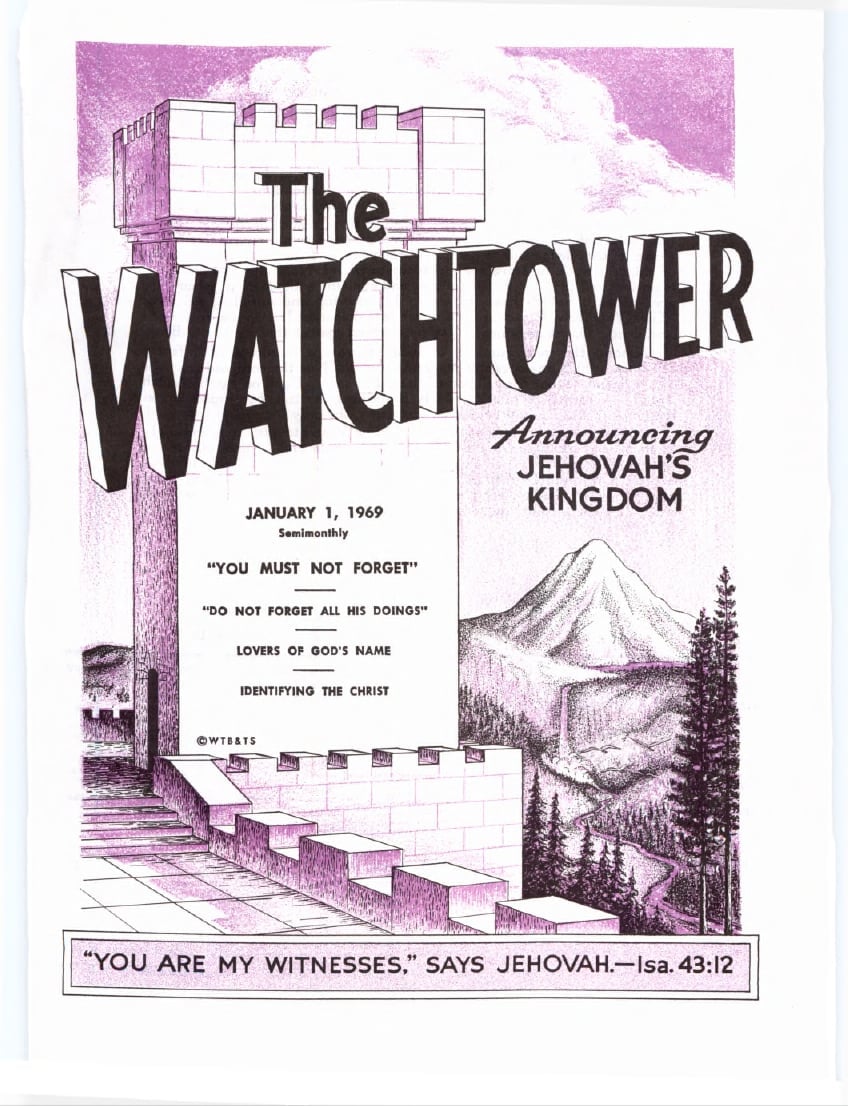
The Watchtower — January 1, 1969
Source: jw.org
Contents
How The Watchtower Influences Lives
“You Must Not Forget”
“Do Not Forget All His Doings”
Lovers of God’s Name
Zeal Distinguished Early Christians
Buy Out the Time During Wicked Days
Identifying the Christ
Do You Remember?
Questions From Readers
Announcements
How The Watchtower Influences Lives
How The Watchtower Influences Lives
THE WATCHTOWER began to be published in July 1879 as a religious monthly. Its first edition consisted of 6,000 copies, most of which were sent to people who were not subscribers but were thought to be interested in Bible truth. In 1892 it began to be issued twice a month on a contribution of one dollar, which subscription rate has remained unchanged these seventy-seven years. In the eighty-nine and a half years since it was first published The Watchtower’s circulation has increased to nine hundred and twenty-five times its original circulation, so that today more than 5,550,000 copies of each issue are printed in 72 languages.
Why is The Watchtower published? To influence the lives of its readers for good by shedding light on what the Bible has to say about the Creator’s name, purposes and will for his creatures upon earth. It has truly served as a beacon light, a watchtower. (Isa. 21:8) As the official journal of Jehovah’s witnesses it has contributed greatly to these Christians’ being described as “people of conscience, of integrity, of will power—people whose lives reflect what they believe to an unusually large degree.”—Albuquerque, New Mexico, Tribune, July 25, 1968.
Time and again The Watchtower gives counsel from the Bible regarding family life, including counsel for youths. How even youths benefit from this can be seen from a letter received from one of them:
“I was required to write some papers on the subject of my choice in my English class. I used the opportunity to write about family unity. I brought out what I had previously read in The Watchtower and showed how each family member could go to God’s Word and receive instruction on right conduct. . . . When the teacher read the report, she told the whole class that I had written something different . . . She said it was unusual for me to know about family matters and that she was going to make a copy of it to put in the church bulletin.” Unusual for a youth to know about family unity? Not if he reads The Watchtower, which points to what the Bible has to say on the subject.—Col. 3:18-21.
And no matter how old a person might be, he can be influenced for good by what he reads in The Watchtower. Thus a few years ago on an island in the Bahamas a seventy-three-year-old man, though having lived with a woman without benefit of legal marriage for thirty years, determined to get married because of what he learned from the Watchtower articles on marriage. Many tried to discourage him, and his bride was hesitant because of fear of ridicule. But in a few months the two were married in the midst of astonished onlookers who had come for the wedding and the marriage talk. Yes, The Watchtower influenced this man, though seventy-three years old, to bring his life in line with such Bible principles as those stated at Hebrews 13:4.
The spiritual food in The Watchtower has enabled thousands upon thousands of the Christian witnesses of Jehovah to withstand the bitter persecution of the Nazis during Hitler’s time and to endure the harassment of the Communists. It has enabled them to stand firm despite the strong opposition of religious dictators. And it has served to give people of all kinds hope, although they may be living in the most depressing circumstances. Thus some years after World War II the Watch Tower Society received a letter from a field representative of American Friends of Russian Freedom:
“I had the pleasure of meeting Mrs. K———. She lives in one of the hundreds of refugee camps which are still to be found throughout Germany. The surroundings in these camps are dreary enough to daunt even the most redoubtable soul, especially after years of substandard food, clothing and housing, and years of vain hope for a better life through emigration or employment. . . . But as soon as I entered her tiny room I saw how this woman differed from most of the people I had met. The room was tidy, and she was clean and neat, and good humored and hospitable. When I remarked on seeing a copy of the Russian edition of The Watchtower on her table, she replied that it had been her strongest support in recent months, and that through it she has been able to find new joy in life, and new hope. She also seeks to interest others in the camp in its message.” Yes, she had something that influenced her to have joy and hope in spite of dreary circumstances that caused others to lose hope and to sink into despondency.
The Watchtower also helps people to understand and embrace the basic doctrines of the Bible. Thus a woman in Mexico who had subscribed for it but did not appreciate its contents gave her copies to her neighbor lady. When the Witness who had obtained the subscription learned about this, he called on that neighbor lady who, by now, had obtained eight copies. He reported:
“The magazines had done a good job. From only eight issues the family learned the basic truths of God’s Word and had become free from lies, idols and certain superstitions. The final result is that two of these persons are now baptized and two more have begun to share the good news of God’s kingdom with others.” Nor is that all. The family that appreciated The Watchtower told the woman from whom they got their copies in the first place: “You gave us the truth, and we want to give it to you.” They were able to start a regular Bible study with her, and now she is coming to the meetings where The Watchtower is studied.
Yes, that is exactly what The Watchtower does, it influences for good the lives of people who read it; it strengthens their faith in the Bible as the Word of God; it discusses Bible prophecies and their fulfillment; it gives counsel on Christian conduct; it offers exposition on Christian doctrine and it admonishes all Christian ministers of Jehovah as to their commission to preach first this good news of God’s kingdom. We trust that it will also influence your life for good!
“You Must Not Forget”
“You Must Not Forget”
“And it must occur that when Jehovah your God has given you rest from your enemies . . . You must not forget.”—Deut. 25:19
1. What grave incident was Israel called upon to remember?
THERE was a very grave incident that occurred to the twelve tribes of Israel after they left Egypt in 1513 B.C.E. It was an action unprovoked and very unfriendly as well as unnecessary on the part of the people of Amalek. That is why the prophet Moses said to Israel: “There should be a remembering of what Amalek did to you in the way when you were coming out of Egypt, how he met you in the way and proceeded to strike in the rear of you all those straggling after you, while you were exhausted and weary; and he did not fear God. And it must occur that when Jehovah your God has given you rest from all your enemies round about in the land that Jehovah your God is giving you as an inheritance to take possession of it, you should wipe out the mention of Amalek from under the heavens. You must not forget.”—Deut. 25:17-19.
2. Who were the Amalekites, and so why was there little wonder that they hated the people of Israel?
2 Who were these Amalekites that went striking down those exhausted and weary ones? Who were these people that did not fear God? Amalek was a grandson of Esau. No wonder! Esau was the one who sold his birthright to his brother Jacob. So the offspring of Amalek were determined to perpetuate the hatred Esau had for his brother Jacob, even more than three centuries later. So they launched this unprovoked attack on the offspring of Jacob. Because of this dastardly action Jehovah God decreed that they should be wiped out, which meant ultimate extinction of the Amalekites.
3, 4. (a) What did God’s prophet Samuel tell King Saul of Israel to do to Amalek? (b) What did King Saul actually do? (c) Who else had dealings with the Amalekites, and when finally was Jehovah’s word toward them fulfilled?
3 During the period of the judges of the nation of Israel the Amalekites continued to be adversaries of Israel and they shared with other nations in assaulting Israel. (Judg. 3:12, 13; 6:1-3, 33; 7:12; 10:12) About four centuries after the Israelites left Egypt, Samuel the prophet of God said to King Saul: “This is what Jehovah of armies has said, ‘I must call to account what Amalek did to Israel when he set himself against him in the way while he was coming up out of Egypt. Now go, and you must strike down Amalek and devote him to destruction with all that he has, and you must not have compassion upon him, and you must put them to death, man as well as woman, child as well as suckling, bull as well as sheep, camel as well as ass.’” (1 Sam. 15:2, 3) Jehovah did not forget!
4 King Saul struck the Amalekites down “from Havilah as far as Shur.” However, Saul overstepped Jehovah’s orders and he spared King Agag. The account says that “Saul and the people had compassion upon Agag.” Nevertheless, God was not to be mocked, for “Samuel went hacking Agag to pieces before Jehovah in Gilgal.” (1 Sam. 15:2-33) But this was not the complete wiping out of the Amalekites. During King David’s time raids were made against the Amalekites. It was not until centuries later, during the reign of Hezekiah, that “some of the sons of Simeon” struck down the remnant of the Amalekites. (1 Chron. 4:42, 43) Finally in he fifth century B.C.E. Haman the Agagite and his family were wiped out because of attempting the extermination of the Jew Mordecai and his people. In this way the command, “You must not forget” what the Amalekites did to the sons and daughters of Jacob, came to complete fulfillment.
LISTEN
5. (a) Was it only the command regarding the Amalekites that the Israelites were not to forget? (b) Can anyone today neglect the commands of Jehovah and still have his blessing?
5 That Bible account is only one instance pointing up this important matter of not forgetting what God has said. There were many more important things that the children of Israel were not to forget, especially that they were Jehovah’s nation, his inheritance. (Ps. 33:12) Eventually they forgot and the entire nation of Israel was cast off from God’s favor. In view of what happened to the Israelites centuries ago, is it not more important for people today not to forget the judicial decisions and teachings of God if they want to “inherit the earth”? (Matt. 5:5) Moses said: “Listen to the regulations and the judicial decisions that I am teaching you to do, in order that you may live and may indeed go in and take possession of the land that Jehovah the God of your forefathers is giving you. You must not add to the word that I am commanding you, neither must you take away from it, so as to keep the commandments of Jehovah your God that I am commanding you.” (Deut. 4:1, 2) No one, neither you nor the clergy of Christendom, has any right to tamper with the Word of God, to reject portions of it, or add to it, thinking that one has greater wisdom and knowledge than the Author of the Bible himself. If the Israelites wanted to live as individuals and as a nation, it was necessary for them to keep the commandments of Jehovah their God. Christians today are no different. When God speaks, Christians should listen! Most people, though, would like to forget God, ignore his sayings and teachings and live according to their own desires.
6. How do we know that Jehovah is very much interested in humankind?
6 Regardless of what men think, the great God of the universe is still very much interested in his creation. In fact, ‘God loved humankind so much that he gave his only-begotten Son to save them (not destroy them) and to have them enjoy everlasting life.’ (John 3:16) When God’s Son Jesus Christ came to the earth, he studied the Holy Scriptures. He quoted scriptures to prove his teachings. As to his speaking he said: “I do not speak of my own originality.” (John 14:10) He read, believed and spoke from God’s Word. Jehovah tried to impress this very thing upon the Israelites long before he sent his Son into the world. But not all of them listened. That is why God said: “Only watch out for yourself and take good care of your soul, that you may not forget the things that your eyes have seen and that they may not depart from your heart all the days of your life; and you must make them known to your sons and to your grandsons.”—Deut. 4:9.
7. (a) How can one care for his life and the lives of his sons? (b) How did the Israelites take steps to preserve their lives while in Egypt?
7 If one is going to take good care of his soul it means he is going to take good care of his life. Your soul is you. None of us should forget the things our eyes have seen, and we should listen to the things Jehovah says in his written Word. By doing so we take good care of our lives. Our hearing and not forgetting, and never letting God’s sayings depart from our hearts all the days of our lives, makes it possible for us to help our sons and grandsons. They, too, need to know what God said and did. What had God done? This: Israel had become a numerous people. After Joseph’s death they became slaves in Egypt. By Jehovah’s power he liberated them from Pharaoh’s oppression. However, before freedom came, God’s plagues fell, one after another, upon Egypt. Then, before the tenth plague came, Moses told all the children of Israel to prepare for their deliverance and their march out of Egypt. To gain this God-given freedom did not require much preparation on the part of the Israelites, but it did require faith. Each Israelite family was to kill a lamb, take its blood and sprinkle it on the doorposts and lintels of its home and then roast the lamb and stay inside the home and eat it. These instructions would not be difficult to follow, would they? For this act of faith, just doing what Jehovah said they should do, the angel of Jehovah passed over the children of Israel, but God’s angel brought death to all of the Egyptian firstborn, both of man and of beast. What a night of wailing and howling that was for the Egyptians! But what a night of rejoicing in the homes of the Israelites! They all were alive and soon began their trek to and through the Red Sea, following Moses, who led them out of the land of Egypt and on toward the promised land. Do you think this event was worth remembering and making known to their sons and their grandsons for generation after generation?
8. How were the sons and grandsons for generations to come to know about Jehovah’s deliverance of Israel from Egypt, giving rise to what timely personal question?
8 About this day of liberation with all its excitement parents were to tell their children and their grandchildren for generations to come. ‘Do not forget the things that your eyes have seen,’ God said. About this great event they must tell year after year, on Passover day and at other times as well. Their release from slavery was not a myth. It was not just a story with which to entertain children. It was Jehovah’s doing! It was a reality! It was true history! Men and women lived it and, in order for them to watch out for themselves and take good care of their souls, they must not forget to tell these truths to their sons and grandsons. How many historical Bible events do you repeat to your sons?
9. Because Israel quickly forgot God’s doings, what came to be the lot of the people soon after leaving Egypt?
9 But how quickly people forget! Not long afterward, while in the wilderness of Paran, Moses sent twelve spies into the promised land to look things over. Ten spies returned frightened and they urged: Return to Egypt. There they could get garlic and watermelons again. (Num. 11:5) Two of the twelve spies, Joshua and Caleb, were pleased with what they had seen, and they advised the people: “Let us go up directly” into the land flowing with milk and honey. (Num. 13:27-30) The people, however, listened to the ten fearful spies, forgetting the wonderful deliverance God performed in their behalf in Egypt. For lack of faith they spent forty long years in the wilderness until that older generation died off. The children of the new generation, who had heard of the deliverance of their parents or grandparents, were now ready to move under Jehovah’s direction into the land of promise.
10. In spite of Israel’s forgetfulness, how did Jehovah deal with them, and why?
10 While many of the families of Israel quickly forgot the salvation that Jehovah brought to them, God was not one to forget. “For Jehovah your God is a merciful God. He will not desert you or bring you to ruin or forget the covenant of your forefathers that he swore to them.” (Deut. 4:31) Centuries before that Jehovah had said to Abraham, Isaac and Jacob that he would give them this land and that through Abraham’s seed all the families of the earth would be blessed. That new generation had faith, and Jehovah gave them numerous successes. But again God warned them not to forget.
11. What blessings were going to be showered on Israel because of God’s promise, and what problems would this present?
11 Jehovah God led Israel onward to the land that the Bible describes as being like the garden of Eden. They were going to have houses in which to live and that they had not built. They were going to be drinking fresh water from cisterns that they had not hewn out. They were going to eat grapes from vineyards and olives from trees that they had never planted. How would this prosperity and luxury affect them? Would this new generation receiving all these things in the promised land forget Jehovah too? Would they become satisfied and forget God?
12. How did Jehovah warn Israel about the dangers of the land of promise and its good things?
12 Listen to the warning that Jehovah gave to the children of Israel: “And it must occur that when Jehovah your God will bring you into the land that he swore to your forefathers Abraham, Isaac and Jacob to give you, great and good-looking cities that you did not build, and houses full of all good things and that you did not fill, and cisterns hewn out that you did not hew out, vineyards and olive trees that you did not plant, and you shall have eaten and become satisfied, watch out for yourself that you may not forget Jehovah, who brought you out of the land of Egypt, out of the house of slaves.” (Deut. 6:10-12) How many people are forgetful like that today? They become prosperous, have everything they want materially, but lose all their spirituality and interest in Jehovah their God!
MANKIND FORGETS
13. What do many persons even now forget about God’s provisions?
13 Jehovah knew mankind could forget. That is why he gave the warning. But how many heeded Jehovah’s warnings? Many persons never think that it is Jehovah God who makes the sun to shine upon the good and the bad, that he makes it rain upon the just and the unjust; that God gave us the air we breathe, provided the vegetation we eat; that he made the land and the sea, the mountains and valleys with freshwater streams. These things were all here when you came to be upon the earth, but how often have you thanked the Creator for them? We have a great variety of food, of shelter in houses of stone, wood and other materials taken from the earth. We have clothing of cotton, wool and silk. There is no end to the things Jehovah supplies. He gave it all to mankind. Have you eaten and become satisfied too? Then watch out for yourselves that you may not forget Jehovah.
14, 15. Give the primary meaning of the word “forget,” and outline the questions that arise concerning the forgetfulness of people today.
14 Someone may say, ‘Well, we may forget momentarily,’ but is that the primary meaning of “forget”? According to Webster’s Dictionary the first meaning of “forget” is: “To lose the remembrance of; to let go from the memory; to be unable to think of or recall; . . . to lose the power or use of; to cease from doing.” This is the meaning of “forget” used in the scriptures cited, that is, completely letting go out of mind or memory the things that were so clearly established there previously.
15 How many people do you think have forgotten God today, are unable to remember him, who he is, what he has done? How many people do you think really worship the great God of the universe, the Giver of every good and perfect present? How many people do you think really believe that God loved mankind so much that he sent his only-begotten Son into the world that man might gain life everlasting? Do you think that the majority of Christendom’s population have forgotten God and his laws and what he has instructed Christians to do? Have you yourself forgotten?
16. (a) Give another, less serious, meaning for the word “forget”. (b) What is the relation between the quoted New York Times article and forgetfulness?
16 Of course, there is a second meaning to the word “forget,” namely, “To omit or disregard unintentionally; to neglect,” to fail to take, bring, speak of or notice. This kind of forgetting we find happening at home every day. The wife may ask her husband, ‘When you come home from work tonight would you please bring a loaf of bread with you?’ He forgets. He does not do this intentionally, because when he gets home he either has to go to the store for it or do without bread at the evening meal. Little things in life like this we forget to do sometimes, but we can correct them and do. But what have you done about true religion? Is it in your case very much like what appeared on the front page of the New York Times Sunday paper for September 15, 1968? The four-column headline read: “Public Apathy Creating Crisis in Church of England.” The report was written by a Mr. Edward B. Fiske and the article started this way: “LONDON—The church is like a pub. You go into a town, and it’s there, and maybe you go in and maybe you don’t. Personally, I don’t. The speaker was James Cavenaugh.” A little farther along in the article Mr. Fiske said: “Church attendance has dropped to the point where only eight out of every 100 baptized persons worship on Easter.” Would you say that 92 percent of the people of that land have forgotten God? How about the rest of Christendom? Are their religious centers crowded? You know the answer is No, and it is because the people have forgotten God! They have let go from their memories the things they have known about God, if they ever heard or read about Him during their lives. In fact, many have been taught that God is dead, and almost all others have been taught that what is written in the Holy Scriptures, the Bible, is but a myth. They have no incentive or help from the clergy or from their elders to remember. So they forget God.
17. (a) To whom or what has the worship of many turned? (b) What questions need answering in view of man’s perverted worship?
17 Religion, some form of worship, is something that everyone in the world is involved in in one way or another. The natural tendency of man is to worship something. People whom we call “heathen” or “pagan” have gods that they worship. Some people worship money, movie stars, politicians, rulers, even themselves. It may be an image or something illusive, nirvana, for instance. But let us take a second look at Christendom, while we are on the subject, and seriously ask: What has Christendom’s religion done for mankind? Has it made the nations and its people better morally, spiritually? Has it made them peaceful? Do they love one another more now than fifty years ago or five hundred years ago? Has Christendom brought “glory . . . to God, and upon earth peace among men of good will”? (Luke 2:14) Why not? Because mankind and its religious priests and clergy have forgotten God, discarded his Word and rejected Jehovah’s kingdom by his Son Christ Jesus. Jesus said it plainly: “This people honors me with their lips, yet their heart is far removed from me. It is in vain that they keep worshiping me, because they teach commands of men as doctrines.” (Matt. 15:8, 9) The false religions are not teaching you God’s Word but they are teaching you their own doctrine. Listen to God, for he is saying to you now: “Get out of her, my people, if you do not want to share with her in her sins.” (Rev. 18:4) Christendom and the whole world empire of false religion are doomed!
[Picture on page 5]
Moses reminded Israel that they were not to forget how Amalek defied God by assaulting his people
“Do Not Forget All His Doings”
“Do Not Forget All His Doings”
1. Psalm 103:3-5 tells us what about Jehovah God’s mercy?
TURN to the Word of God and be like faithful King David, a true worshiper of Jehovah God. He said: “Bless Jehovah, O my soul, and do not forget all his doings.” (Ps. 103:2) David, a man after God’s own heart, did not want to forget anything that Jehovah had done for him. What were some of the things Jehovah did for him? He said Jehovah was the one “who is forgiving all your error, who is healing all your maladies, who is reclaiming your life from the very pit, who is crowning you with loving-kindness and mercies, who is satisfying your lifetime with what is good.” (Ps. 103:3-5) David fully appreciated that “with error I was brought forth with birth pains, and in sin my mother conceived me.” (Ps. 51:5) He knew he made mistakes, but he went to God in prayer and asked for forgiveness. He had full confidence that Jehovah would forgive him, because he turned from the wrong course and took the right one. David would not forget the one who was forgiving all his error.
2, 3. (a) While we may get advice on how to care for our health, how is it that our illnesses are healed? (b) What blessings with regard to health do we look forward to, and how was this confirmed by Jesus?
2 David could not forget the God who is healing all of man’s maladies. Man is truly marvelously and wonderfully made. David recognized this. He appreciated that he could see, hear, speak, feel and smell. He wanted to use these faculties wisely. He was concerned with the healthy condition of his heart and kidneys. (Ps. 26:2; 7:9) When he got ill David would know that this condition was inherited along with the sin of Adam. But how is recovery effected? We say: “Take care of yourself.” David would do likewise in sickness, very likely go to bed, keep warm, drink some helpful fruit juices. Maybe he received some good advice from doctors of his time. Now what advice do most doctors give to those who have maladies today? “Go to bed.” “Rest more.” “Take a vacation.” “Get more exercise.” “Breathe more deeply.” But what does the healing? Why this wonderful body of ours. Jehovah God made it so that it restores itself. The body does the healing. (Ps. 30:2; 103:5) If David did not forget, then we should not forget the one “who is healing all your maladies.” What a grand day it will be when even death will have no hold on mankind. For when the new heavens and new earth are fully established, God’s Word says, “he will wipe out every tear from their eyes, and death will be no more, neither will mourning nor outcry nor pain be any more. The former things have passed away.”—Rev. 21:4.
3 Neither could David forget the one “who is reclaiming your life from the very pit.” David knew that the life-span of man was seventy years and, because of special mightiness, maybe eighty. (Ps. 90:10) Then death would come and one’s soul would go down into the pit. However, David, like Job, had faith in the resurrection of the dead, for Job believed God would set a time limit and remember him. (Job 14:13) Jesus Christ confirmed this hope and said: “Do not marvel at this, because the hour is coming in which all those in the memorial tombs will hear his voice and come out.” (John 5:28, 29) David with such faith could not forget God, who would reclaim him from the pit. Could you?
4. In what ways was David an example of a person not forgetting Jehovah’s doings?
4 Nor could David forget the God “who is crowning you with loving-kindness and mercies.” David had an interesting life. He was a good shepherd boy who took care of his father’s sheep. When a lad he was anointed to be king of Israel by the prophet Samuel. He stayed humble and never tried to usurp the throne of King Saul. David knew that God had anointed Saul, and even though David was persecuted by Saul he waited upon Jehovah to make a change. The kingdom of Israel grew under King David’s reign and Jehovah allowed him to plan and gather material together for the building of the great temple of his son Solomon. David had his moments of sorrow and regret. He made mistakes, but he trusted in the loving-kindness and mercy of Jehovah his God. Is your life crowned with God’s loving-kindness and mercies too? Do you, like David, “not forget all his doings”?
5. How has Jehovah provided help for mankind so that those who love him will not forget
5 We can be sure of it—Jehovah God will not forget! Even though we might forget, he will not do so. To help ourselves not to forget we must review, keep reading, keep listening to God’s Holy Word. This is so essential to right living! All Christians who have come to an accurate knowledge of the truth and have dedicated their lives to the doing of God’s will and who have been baptized in water must continue to study the Bible. In time, having studied his written judicial decisions, they will be able to discern between right and wrong. The Bible clearly states the right principles and the right way for man to go. But even Christians who have served him well for many years can forget God if they stop studying God’s Word. Some persons deliberately want to forget God, and this is marked in their conscience as with a branding iron.—1 Tim. 4:2.
6. How does Psalm 50:16-18 have application in our day, and why have Christendom’s religions been of no help to the people?
6 The writer of the fiftieth psalm says: “But to the wicked one God will have to say: ‘What right do you have to enumerate my regulations, and that you may bear my covenant in your mouth? Why, you—you have hated discipline, and you keep throwing my words behind you. Whenever you saw a thief, you were even pleased with him; and your sharing was with adulterers.’” (Ps. 50:16-18) Many people claim to be Christian, but do they have any right to represent Jehovah God? If they are in the new covenant with God, why do they hate God’s discipline and throw God’s words behind them? Millions upon millions of people and their hypocritical clergy in Christendom’s religious organizations today have actually thrown the words of God behind them. They have shown they are through with God’s Word but still call themselves Christians. They know, as well as anyone else, that one should not steal, that married people should not commit adultery nor single ones engage in fornication. But, they are well described by the words of the psalmist, ‘When they see a thief they are pleased with him.’ In their hearts they would like to be able to get away with such stealing themselves. Have you noticed that all false religious organizations wink at persons who are sharing with adulterers? These are not reprimanded or disfellowshiped from their religious organization. They continue to be “good” members in fine standing in the church organizations of Christendom. How many times have you read in your newspapers about a person’s third, fourth and fifth marriage while their former mates are still living? For such persons marriage becomes legalized adultery. In many Catholic-controlled countries people cannot get divorces on any grounds and so the adulterers just live with their mistresses and continue in good standing in their immoral religious systems. They certainly have thrown God’s Word behind them. No wonder the world empire of false religion is called “Babylon the Great, the mother of the harlots and of the disgusting things of the earth.” (Rev. 17:5) Do you want to belong to such a religious system?
7, 8. What do forgetters of God overlook regarding God’s view of immorality and immoral persons?
7 The psalmist goes on to say to forgetters of God: “Your mouth you have let loose to what is bad, and your tongue you keep attached to deception.” (Ps. 50:19) Lying is common. Most people look upon lying as something that does not do any harm. Here is where the breakdown in morals begins. The immorality of the religious, political and commercial system of things is appalling. Good morals are practically nil. The majority of the people in Christendom today, and probably the majority of people in other religious persuasions, think that God does not see what is going on and is not interested anyway. Jehovah expresses himself through his written Word, and someday he will speak very forcefully by actions. Jehovah goes on to say in this fiftieth psalm: “You imagined that I would positively become like you. I am going to reprove you, and I will set things in order before your eyes. Understand this, please, you forgetters of God, that I may not tear you to pieces without there being any deliverer.”—Ps. 50:21, 22.
8 You can say that “there is no God,” if you wish, and that “God is dead.” The evolutionist says, “I proved there is no God,” but that will not change matters. Jehovah speaks boldly through his Word to the immoral ones and all “forgetters of God,” and warns that he will tear them to pieces. Despite all their howling when the war of Armageddon in the great day of God the Almighty strikes, there will be no deliverer. Then Jehovah will surely set things in order for the blessing of those who love righteousness.
OFFERING THANKSGIVING
9. How does the psalmist describe one who does not forget God?
9 Maybe you are one of those who really love God and who are practicing his sayings and have not forgotten God’s Word. To such the psalmist says: “The one offering thanksgiving as his sacrifice is the one that glorifies me; and as for the one keeping a set way, I will cause him to see salvation by God.” (Ps. 50:23) Are you keeping a set way, along with thousands of persons who are offering thanksgiving to Jehovah daily? Keep on glorifying Jehovah by preaching from house to house and encouraging people who love righteousness to study his Word. “Keeping a set way,” the righteous way, will cause an even greater crowd of people to sing God’s praises day and night and to see salvation.
10, 11. Of what benefit to others can a person be if he does not forget God?
10 The best way to keep from forgetting God is to keep thinking about him. Get acquainted with what he wants done and then do it. Jehovah says through the psalmist: “Do give ear, O my people, to my law; incline your ear to the sayings of my mouth.” (Ps. 78:1) Is there any value in doing this? Are there benefits? Is there something to be gained? Is it rewarding to incline your ears and to listen to what God has to say and then do it? It certainly is! Not only will you personally profit by inclining your ears to the sayings of Jehovah’s mouth, but another good purpose is this: “In order that the generation to come, the sons that were to be born, might know them, that they might rise up and relate them to their sons, and that they might set their confidence in God himself and not forget the practices of God but observe his own commandments.”—Ps. 78:6, 7.
11 How many people in Christendom today really want their children to “set their confidence in God himself”? Before you can instill such confidence in your children, you must learn about Jehovah and “not forget the practices of God.” How can your children know anything about God unless you yourself observe God’s commandments and teach them to your children?
12. Whose responsibility is it to teach children God’s commandments, and why?
12 Humankind is the creation of Jehovah God. He knows better how we should conduct our lives and live them than anyone else does. Educators and scientists think they know better how to teach and conduct the lives of children. Parents who believe the Word of God and observe God’s commandments, however, are the ones that have the responsibility. It cannot be given to the State. The Israelites were instructed to teach their children the things that they saw and heard and to inculcate in the minds of their children the principles of truth and righteousness. The State is not doing this, and every year fewer people teach their children what the Bible counsels. Every person who professes to be a true Christian should say: “With your orders I will concern myself, and I will look to your paths. For your statutes I shall show a fondness. I shall not forget your word.” (Ps. 119:15, 16) How pointed and direct this advice! Have you concerned yourself as to what Jehovah’s statutes are? Do you want to know the orders of God and his regulations for proper living? Even in the normal processes of life most people recognize order and law and get acquainted with the rules of the land, but far more important are the laws that Jehovah has had written. These pertain to our living, and our children’s living, forever. We must show a fondness for His statutes, and we must not forget his Word, the Holy Bible. Teach them to your children.
13. How do Jehovah’s witnesses show they are interested in what Jehovah has to say?
13 Jehovah’s witnesses are very much interested in what Jehovah God has to say. They study the Bible in five meetings each week. That does not mean that they will remember every scripture and be able to quote the whole Bible verse by verse, but by reading the Bible regularly they will get the overall picture of what Jehovah’s way of life is for mankind, what his principles of truth and righteousness are; and they appreciate the way that they should conduct their lives in relationship to others, their children and neighbors, and especially in relationship to God.
14. Why is it important to know what Jehovah’s will is for man?
14 It is very important for Christians to know what Jehovah’s will is, because each one has to make the decision as to whether he is going to take the right course or the wrong course. Jehovah does not force one to do something. Really one’s life, or whatever life one will have in the future, is dependent on one’s own course of action. Hence one dare not forget the law of God. One must know right from wrong. Through speaking the truth one feels confident that Jehovah will find pleasure in the voluntary offerings of one’s mouth. At all times one must be very much interested in having Jehovah God teach one his own judicial decisions, that is, Jehovah’s judicial decisions. A person does not want to be the judge as to what is right and what is wrong. God makes the judicial decisions. We must get in line with them for our own welfare. It pays to do what is right. A Christian wants Jehovah God to state what is the right way, the correct course to take. The Christian must make the decision. No one else can, because the Christian knows that he personally is responsible to God, the Giver of life.
15. How was it that Adam and Eve followed a course of rebellion in Eden?
15 In the garden of Eden Adam and Eve had their lives at stake. Jehovah said to the man: “From every tree of the garden you may eat to satisfaction. But as for the tree of the knowledge of good and bad you must not eat from it, for in the day you eat from it you will positively die.” (Gen. 2:16, 17) God was not making it difficult for the first man that he created and put in the paradise of Eden to keep on living. Of all of the trees in the garden—and there may have been thousands of them—he could freely eat, but there was just one he should not eat from, at least for the present. After God created Adam he created a helpmate, Eve. He saw that it was not good for the man to continue by himself. When Adam saw Eve after she was created from his rib, Adam exclaimed: “This is at last bone of my bones and flesh of my flesh. This one will be called Woman, because from man this one was taken.” (Gen. 2:23) Adam informed Eve of what God had told him directly about not eating of the tree of the knowledge of good and bad. But one day Satan by the form of the serpent began to say to the woman: “‘Is it really so that God said you must not eat from every tree of the garden?’ At this the woman said to the serpent: ‘Of the fruit of the trees of the garden we may eat. But as for eating of the fruit of the tree that is in the middle of the garden, God has said, “You must not eat from it, no, you must not touch it that you do not die.’” At this the serpent said to the woman: ‘You positively will not die. For God knows that in the very day of your eating from it your eyes are bound to be opened and you are bound to be like God, knowing good and bad.’”—Gen. 3:1-5.
LIFE DEPENDENT UPON DECISION
16, 17. What course of action did Adam and Eve choose when it came to listening to God’s command, and with what result?
16 We know what happened in the garden of Eden. The record is in the third chapter of the book of Genesis. Eve ate of the fruit of the tree because she wanted to be the one who would decide what was good and what was bad. She wanted to be like God, making judicial decisions, deciding what is good and bad. She chose to act contrary to Jehovah’s already established statute. She did not want to listen to Jehovah’s law, and God did not step in and stop her from taking and eating the fruit of that tree, because when Jehovah created Adam and Eve he created them both as free moral agents. Their lives depended on their own decisions. They could do with their lives as they pleased and reap whatever they sowed. Jehovah gave them sound counsel, good advice on how to carry on their lives in harmony with His will, but he did not force them to do his will. They could go contrary to it if they chose to do so. He did tell them not to eat of one particular tree; but if they wanted to be disobedient to his law, then, as he told Adam, they would be choosing death.
17 So it was up to Adam and Eve to make the vital decision. As free moral agents, they did with their lives as they pleased. They brought death upon themselves as well as upon the entire human family.—Rom. 5:12.
18. Because all men are free moral agents, what choice also lies before them?
18 But that act on Adam’s part did not change man’s freedom to make decisions for himself. As far as every person on earth is concerned, each one is still a free moral agent and may still do with his life what he pleases to do. He can find out what God’s law is and live by it, or he can live contrary to it. It is surely much wiser for an individual to listen to and follow the Word of the all-wise God and to live by it, than to go contrary to it. Why not be like the psalmist who said: “I shall not forget your word.”
19. How does Christendom justify wrong conduct, but what has God provided for man to help him walk uprightly?
19 Adam and Eve both quickly forgot God’s law in the garden of Eden after Satan began talking. They brushed aside God’s command to “not eat” and they ate of the forbidden fruit. Will you do the same with God’s laws today? You are just as free to make your decisions as Adam and Eve were in the garden of Eden. The question is: Will you make your decisions without consulting God’s law? Millions of people do. For the result, look at the immorality world wide. Maybe you say: “You can’t blame them.” But these people still support Christendom, which no longer teaches God’s law on adultery, fornication and homosexuality, and has no objection to loose conduct. Christendom may try to justify itself by saying: “These laws of God are not applicable today.” That is just what Satan said to Eve. So people today have thrown the Ten Commandments and all the other laws of God behind them. They want freedom, they want to go places, but no signposts. Whether they like it or not the signposts are up! God’s laws stand and are there to help mankind. Will you follow the laws and live by them? You can if you wish. Your life is at stake.
20. (a) What is happening to today’s world, leading to what? (b) Therefore, how will the Christian’s course be different?
20 Earthly governments make laws so that there might be some order among the people. But look what happens when the schoolchildren rebel, the parents rebel, the labor people rebel, and the nationalities rebel. All the unrest in the world today shouts out: “We do not like the law.” What will this worldwide disorder of things come to? It will come to the situation that the Bible calls Armageddon. (Rev. 16:16) That is why true Christians today who pay attention to God’s law and do not forget it can rejoice. By what they see they know these are the “last days” of this wicked system of things. So, having read the Holy Scriptures, they say to fellow Christians: “But as these things start to occur, raise yourselves erect and lift your heads up, because your deliverance is getting near.” (Luke 21:28) They know there must and will be a change in world affairs, and they have been praying to God: “Let your kingdom come. Let your will take place, as in heaven, also upon earth.” They believe that prayer, and that is why Jehovah’s witnesses keep on preaching that the kingdom of the heavens is at hand. Listen and do not forget.
21. How can the advice of Proverbs 3:1, 2 be helpful to a Christian now and in the future?
21 While you still have your life at stake take the advice of Proverbs 3:1, 2: “My son, my law do not forget, and my commandments may your heart observe, because length of days and years of life and peace will be added to you.” If Adam had listened to the law of God and lived by it, his life would have continued to this very day. In fact, he would be nearly six thousand years old, according to Bible chronology. When God’s Kingdom rule is established without a rival and the resurrection of the dead takes place and the one-thousand-year reign ends, will the life of each man still depend on his individual decision? Yes, at the end of the millennial reign of Christ Jesus man’s life or soul will still be at stake, because Revelation 20:7-10 shows that Satan will be loosed out of his prison and he will go out to mislead the nations. So each individual can either go with Satan the Devil or follow God’s laws. Everlasting life will come by one’s being obedient to God’s laws for directing mankind at the end of the thousand years. Those who choose Satan’s side will die with the Devil when he is cast into the lake of fire, the second death. So if one wants to ‘lengthen his days and have years of life and peace added to him,’ then it is better for him to listen and do what God says. Jehovah is the Giver of life, and he knows how to extend your life. If you put your trust in Jehovah and believe him and you do not forget his laws, “length of days and years of life” will be yours.
22. (a) Why was God’s Word written, and therefore what is our responsibility? (b) Of what personal benefit can God’s Word be to us?
22 Listen to the wise man: “Acquire wisdom, acquire understanding. Do not forget, and do not turn aside from the sayings of my mouth.” (Prov. 4:5) Sometimes people think that after spending a few years reading the Bible they know everything God has to say. But that is not true. The older we get the more knowledge we acquire and the more wisdom we gain. So we have better understanding. God wrote his Word, the Bible, for a very definite purpose, “for our instruction.” (Rom. 15:4) Therefore, we should keep on reading it and truly studying it. With more knowledge true Christians can appreciate the principles of truth and righteousness. A Christian having instruction can endure and face the difficulties, persecutions and hardships while walking in his integrity. God’s Word strengthens him to be a publisher of the Kingdom, maybe a missionary or a pioneer, or circuit servant or district servant somewhere in Jehovah’s visible organization. God is not unmindful of what faithful Christians are doing. Paul appreciated this and so he wrote: “For God is not unrighteous so as to forget your work and the love you showed for his name, in that you have ministered to the holy ones and continue ministering. But we desire each one of you to show the same industriousness so as to have the full assurance of the hope down to the end, in order that you may not become sluggish, but be imitators of those who through faith and patience inherit the promises.”—Heb. 6:10-12.
[Picture on page 13]
Do you help your children to remember what God has done?
Lovers of God’s Name
Lovers of God’s Name
1. To what extent have Jehovah’s witnesses shared the good news from God’s Word with others during the past year?
JEHOVAH appreciates the great love Christians show for his name. “God is not unrighteous so as to forget your work,” and true Christians are happy to be called Jehovah’s Christian witnesses, declaring his name in 200 lands, even to the ends of the earth. The service year of 1968 proves they are not sluggish but truly industrious, because 1,221,504 publishers spent 208,666,762 hours preaching the good news of God’s established kingdom. How many members of Christendom’s denominations go from house to house as do Jehovah’s witnesses, to aid people in their private study of the Bible? Very, very few! But Jehovah’s Christian witnesses conducted 977,503 home Bible studies every week for twelve months during 1968. What a joy this has been for these ministers! They are imitators of those who through faith and patience inherit the promises, showing their faith by their works. Look at Abraham, look at Isaac and Jacob. Consider Moses, David, Gideon. These men worked industriously at God’s work, and God has remembered them and we find a good report about them in the eleventh chapter of Hebrews.
2. (a) Why should twentieth-century Christians show even greater faith than did the faithful men of ancient times? (b) How can true Christians follow the advice of Luke 21:28?
2 If those ancient men had such faith and “did not get the fulfillment of the promises,” Christians today should show a greater faith. (Heb. 11:13) Why? Because we are at the threshold of what those faithful men of ancient time were looking for. We can recognize the physical facts marking the end of this system of things. Read Luke the twenty-first chapter. Look! Check history since 1914! There were two world wars, distress of nations, the pestilences, famines and earthquakes. All these things Jesus foretold would happen and a lot more; and when these things are seen by Christians, Jesus said, “raise yourselves erect and lift your heads up, because your deliverance is getting near.” (Luke 21:28) A person with head lifted up, standing erect, is a person looking ahead. He is not sluggish. He appreciates it is time to be on the move and that there is still something more to do. Christians today are not downhearted because of the terrible things occurring in the earth. This all proves God’s Word is true! Flee—Be on the move! There is work to do, namely, the preaching of the good news of God’s kingdom everywhere, discipling as many people as Jehovah’s witnesses can from all nations and baptizing them. These new disciples will be quite anxious to make a public declaration to Jehovah’s name, too, and use their lips to praise his name. They, along with all true Christians, will do just as Paul says: “Through him let us always offer to God a sacrifice of praise, that is, the fruit of lips which make public declaration to his name. Moreover, do not forget the doing of good and the sharing of things with others, for with such sacrifices God is well pleased.”—Heb. 13:15, 16.
3, 4. Why are Jehovah’s witnesses not silent about their beliefs, and what invitation is extended to others?
3 Christians have to be talkers and teachers. They have the truth. They may not be silent! They may “not forget the doing of good and the sharing of things with others,” the things that they have learned from God’s Word. Jehovah’s witnesses have something wonderful to share. They have the life-giving good news of God’s kingdom to share, and when they do this “God is well pleased.” Are you doing that? If you are a Christian, you should be sharing with others the things you know. If you are not a Christian, would you like to be one? If yes, then get better acquainted with the Word of God and Jehovah’s witnesses. Meet with them at their Kingdom Hall. Jehovah’s Christian witnesses will certainly be happy to help you.
4 Millions of people are studying with Jehovah’s witnesses. Why not you? James, a slave of God and of the Lord Jesus Christ, made a very fine observation about people. He said: “Know this, my beloved brothers. Every man must be swift about hearing, slow about speaking, slow about wrath; for man’s wrath does not work out God’s righteousness.”—Jas. 1:19, 20.
5. Contrast the view of many in the world today with the counsel of the disciple James.
5 The world is full of wrath today, arguments no end, and faultfinding. But there are not many persons listening to the Word of God. In fact, most people who do listen to the Word of God and who take it seriously and who try to live by its teachings are considered a little bit “off” in the head. The general feeling of most people is, ‘Get everything out of life you can. Do not get serious. Just keep eating, drinking, being merry, for tomorrow you may die.’ James, a man of God, says there is more to life than that. He writes: “Become doers of the word, and not hearers only, deceiving yourselves with false reasoning. For if anyone is a hearer of the word, and not a doer, this one is like a man looking at his natural face in a mirror. For he looks at himself, and off he goes and immediately forgets what sort of man he is. But he who peers into the perfect law that belongs to freedom and who persists in it, this man, because he has become, not a forgetful hearer, but a doer of the work, will be happy in his doing it.”—Jas. 1:22-25.
PEERING INTO THE MIRROR OF GOD’S WORD
6. Why is a forgetful hearer of God’s Word like a person looking into a mirror?
6 How many times have you looked into a mirror? Quite often during the day? A check is made to see that the hair is combed just right, teeth are sparkling, clothes are attractive and well arranged. But after this a person turns away from the mirror and forgets what he looks like. That is the way it is with most people who are just hearers of the Word of God and not doers. James is trying to impress upon the minds of those reading his letter that to be a Christian the man must peer into the perfect law that belongs to freedom and persist in it. If he does that, then what will he see?
7. What question might we ask of ourselves after looking into the mirror of God’s Word?
7 Have you ever peered into the Word of God so as to see yourself? Have you seen how bad you look when your mirror is the Holy Scriptures? Are there some changes you think you should make? If the apostle Paul looked at you in the Bible mirror, would he say: “Put away the old personality which conforms to your former course of conduct and which is being corrupted according to his deceptive desires; but . . . be made new in the force actuating your mind, and . . . put on the new personality which was created according to God’s will in true righteousness and loyalty”? (Eph. 4:22-24) Looking into the mirror of the Word of God, you will see what kind of personality you have, whether it conforms to God’s righteous ways or not. Do you see a thief, an adulterer, a fornicator, a glutton, a drunkard? Just what do you see?
8. Who did the apostle Paul say would not inherit God’s Kingdom, and so what is necessary if one has been a practicer of such things?
8 The apostle Paul saw many kinds of people in the various congregations. He knew what some of them were before the truth changed them, and that is why he said: “What! Do you not know that unrighteous persons will not inherit God’s kingdom? Do not be misled. Neither fornicator, nor idolaters, nor adulterers, nor men kept for unnatural purposes, nor men who lie with men, nor thieves, nor greedy persons, nor drunkards, nor revilers, nor extortioners will inherit God’s kingdom. And yet that is what some of you were.” The people here described saw what they were like sometime earlier in their lives. When they looked into God’s mirror, they knew a change had to take place. What they saw with their honest hearts they did not like. They did something about it, and, because they did, Paul said: “But you have been washed clean, but you have been sanctified, but you have been declared righteous in the name of our Lord Jesus Christ and with the spirit of our God.” (1 Cor. 6:9-11) They certainly had had a filthy personality. They turned to the Word of God and saw themselves for what they really were. They accepted Christ Jesus as their Redeemer and were washed clean and sanctified by the Word of God. They studied God’s Word and really peered into it. They saw themselves as they never did before. A change was necessary. As a result they “put on the new personality which was created according to God’s will in true righteousness and loyalty.”—Eph. 4:24.
9, 10. Besides peering into the Word of God, what else should a person desiring God’s approval do?
9 Have you really peered into the Word of God so as to see your real self, not the outside veneer? Remember, your life is still at stake and you can change it from a bad course to a good one. As you peer into the Word of God you will see that there is another way to live, the right way, the way that is in harmony with God’s laws and commandments and statutes. Why not let that new force in God’s Word actuate your mind? That new force comes from study, from really peering into the Word of God. Then, while looking, why not let God’s Word be the force actuating your mind? If you do, you will “put on the new personality which was created according to God’s will in true righteousness and loyalty.” This new personality will become more interesting as the old personality disappears, the one that used to conform itself to your former course of conduct. God knows how he wants you to live, and if you persist in peering into his perfect law you can change; something will happen.
10 Do you want to make that change? If you want it to happen, if you want to change, then persist in the study of God’s Word, the real mirror that will reflect your true image. Eventually you will see a new personality created and it will be according to the will of God in true righteousness. It will take time, but if you will be, “not a forgetful hearer, but a doer of the work, [you] will be happy” in your doing it.
11. What blessing did Paul know would be his if he put on a new personality?
11 The apostle Paul was a real fighter. He was willing to put on a new personality and did. In God’s Word he saw something wonderful that he could possess and he worked hard to get it. He believed what Jesus said: “I am going my way to prepare a place for you. Also, if I go my way and prepare a place for you, I am coming again and will receive you home to myself, that where I am you also may be.” (John 14:2, 3) Jesus through John informed his faithful followers that there would be a heavenly place for 144,000 called ones and they would be joined with him as his bride, and that they would rule as kings and priests with him for a thousand years.
12. What things did Paul have to forget in order to get the prize for which he was working?
12 Paul ran for this high calling, but to do so he had to put on a new personality. It had to be according to God’s will, and so he had to keep on peering into God’s Word. He was not just a hearer but a doer of the word of God. He said: “Brothers, I do not yet consider myself as having laid hold on it; but there is one thing about it: Forgetting the things behind and stretching forward to the things ahead, I am pursuing down toward the goal for the prize of the upward call of God by means of Christ Jesus.” (Phil. 3:13, 14) Paul was seeking everlasting life, a crown of glory; and he knew that just as long as he had his life at stake, he had to control that life of his so as to be in full harmony with the will of God. While he did not then have this everlasting life with Christ Jesus, there was one thing he was going to do: Forget the things that were behind, that old personality and the way he lived. He had had a bad personality. He said of himself that of all the sinners he was the worst. He persecuted Christians. He was standing nearby when Stephen the Christian was stoned to death, and he was proud of it at that time. Paul had a lot to live down, a lot of forgetting of the things behind to do. But when he peered into the perfect Word of God, he saw himself as he really was. He repented. He changed his course of action. He became a Christian, worthy of our study. If he could make the change in his personality and become a Christian, why cannot we?
…