The Watchtower, July 1, 1968
Download: PDF — The Watchtower, July 1, 1968
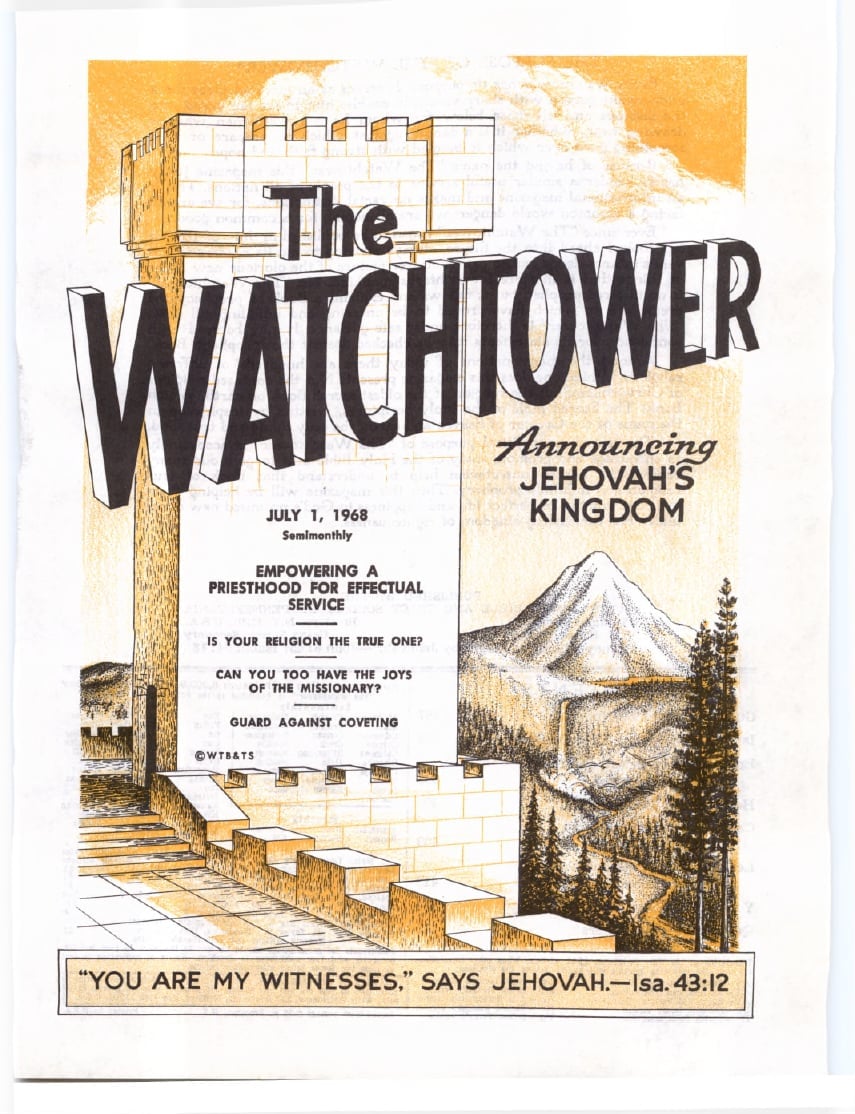
The Watchtower — July 1, 1968
Source: jw.org
Contents
Guard Against Coveting
Is Your Religion the True One?
Part 1—Empowering a Priesthood for Effectual Service
Part 2—Empowering a Priesthood for Effectual Service
He Made the Bones Too
Can You Too Have the Joys of the Missionary?
Letting All Men See Jehovah’s Victory Processions
Youths Who Love God
Questions From Readers
Announcements
Guard Against Coveting
Guard Against Coveting
DO YOU want to live long and enjoy a life of happiness? Then one of the things you must do is to guard against coveting the possessions of other people.
There are many things that it is lawful for you to desire to possess, such as a mate, an automobile, or a home. But you should never desire these things if they belong to another; you may not covet another’s possessions. Thus it is also right to seek to improve, to seek advancement, but not by forcing someone else out of his position.—1 Tim. 3:1.
To covet has been defined as “to long inordinately for something which belongs to another; as to covet a neighbor’s piece of property because of its fine view.” Covetousness is a form of greed that is especially reprehensible in that a covetous person not only wants things for himself, but he sets his heart on things that rightfully belong to another. Covetousness is bound to breed trouble. Not without good reason did Jesus Christ warn: “Guard against every sort of covetousness.”—Luke 12:15.
The Bible not only warns against covetousness but also contains examples showing the harm that results from coveting. In the time of Joshua, the successor to Moses, Achan, together with his entire family, came to a bitter end because of his coveting some of the riches of the city of Jericho that were devoted to Jehovah God. (Josh. 7:16-26) Centuries later, wicked King Ahab sealed his doom by reason of his coveting the vineyard belonging to Naboth. Naboth had refused to sell it and so Ahab’s wife Jezebel procured it for him by having Naboth falsely accused and slain.—1 Ki. 21:4-16.
Fully aware of how deeply ingrained in the heart of fallen man covetousness is and the harm it can cause, the Creator, Jehovah God, forbade it in the tenth of the Ten Commandments: “Neither must you desire your fellow man’s wife. Neither must you selfishly crave your fellow man’s house, his field or . . . anything that belongs to your fellow man.” (Deut. 5:21) It might be said that this very commandment of itself stamps the Decalogue or Ten Commandments as containing far more than human wisdom. How so? For what human lawmakers would ever have thought of making such a law which, though entirely unenforceable by man, forbids wrong thinking and gets at the root of so many of mankind’s problems? It makes each man his own moral policeman, as it were, putting him on guard against this basic selfish tendency.
How ingrained coveting is in human nature, that is, fallen, sinful human nature, can be seen from the fact that a child seems to be instinctively covetous. Any desirable thing he sees he immediately wants to grasp. He must be trained, disciplined, so as to appreciate that there is such a thing as private ownership. He must be taught to respect the rights and possessions of others.—Prov. 22:15.
The apostle Paul warned that ‘covetousness is idolatry.’ In what way can it be said that coveting another’s possessions makes one an idolater? In that he makes an idol of himself. He is like those whose “god is their belly.” He makes his selfish cravings the uppermost thing in his life.—Col. 3:5; Phil. 3:19.
In these days it appears that covetousness has run wild in such lands as the United States, as can be seen by the looting associated with the rioting that took place right after Dr. King’s assassination. Thus it is reported that in Washington, D.C., the riots there were marked by an “eerie carnival atmosphere” as jolly looters “dashed in and out of shattered shopwindows carrying their booty away in plain sight of the law.” One of the looters said, “Man, we’re getting what we want.” It is not as though these looters were needy persons, for a check of Detroit looters last year showed that, of 115 arrested by the police, 105 had good jobs and late-model autos. Nor could the looting be termed solely a racial protest, because among the looters were white persons, and stores owned by Negroes were also looted by Negroes.
Since the inclination of the heart of man is toward covetousness from his youth up, how can we guard against it? First of all, by reminding ourselves continually that all covetousness is displeasing to our Maker, Jehovah God, and incurs his wrath. Fearing to displease him will help us to avoid what is bad.—Gen. 8:21; Prov. 8:13.
Secondly, we will be helped to guard against covetousness by taking to heart the Scriptural counsel: “You must love your neighbor as yourself,” and, “Just as you want men to do to you, do the same way to them.” You would not want another to covet your marriage partner, or any of your possessions, would you? Then do not covet his or hers. Coveting leads to trouble with your fellowman, even as noted by the disciple James: “From what source are there wars and from what source are there fights among you? . . . You desire, and yet you do not have. You go on murdering and coveting.” Yes, coveting makes you the enemy of the one whose possessions you covet, and for this enmity some have paid dearly.—Mark 12:31; Luke 6:31; Jas. 4:1, 2.
Further, learning the lesson of contentment will help us to guard against coveting. Wisely the Bible counsels that godly devotion along with contentment is great gain, and that, having food and shelter, we should be content with these things. Appreciation of the simple fact that with added possessions go added burdens and greater fear of loss can do much to help us to be content.—Eccl. 5:11, 12; 1 Tim. 6:6-8.
The apostle Paul set a good example for all Christians in this matter. He wrote that at no time had he coveted others’ possessions. Instead, he sacrificed himself for his fellowmen. No doubt one reason he was able to do this was that he had learned to be content in whatever state he found himself. Happy are all those who seek to imitate him in this!—Phil. 4:12; 1 Thess. 2:5-12.
Is Your Religion the True One?
Is Your Religion the True One?
There is a way to tell. Do you know how?
“HOW am I to know for sure that my religion is the true one?” you may ask. “There are hundreds of different religions, and each one claims to be true. I don’t have time to study every religion.”
Is that the way you feel? It is understandable that you may. However, since the many different religions teach conflicting doctrines, it is obvious that not all of them can be true.
The Bible, too, indicates this, for it speaks of “one faith,” and encourages: “Keep testing whether you are in the faith, keep proving what you yourselves are.” (Eph. 4:5; 2 Cor. 13:5) The Bible also warns about being misled by false ministers, who “keep transforming themselves into ministers of righteousness.” (2 Cor. 11:14, 15) Jesus Christ himself said that many persons would be misled into taking the broad road to destruction, and so warned: “Be on the watch for the false prophets.”—Matt. 7:13-15.
It is natural that you should desire not to be misled. But how can you avoid it? How can you know for sure that your religion is the true one? It can be done by finding out whether its teachings are supported by God’s Word, which Jesus said is the truth. (John 17:17) Also by determining the kind of fruitage the religion produces. Fine, wholesome fruitage is an indication that the religion is the true one, whereas bad fruitage is an indication that it is false.—Matt. 7:16-23.
So the test is a relatively easy one to make. If a religion is not in accord with what the Bible teaches, then it is not in harmony with truth. It is not the true religion. (Rom. 3:4) You have nothing to fear in examining your beliefs by the standard of God’s Word, for if you have the true religion you can only be reassured. And if what you believe is not in keeping with the Bible, then you should welcome the truth, because it leads to eternal life.—John 17:3.
MAKING THE TEST
Following are a few questions that should help you to see whether your religion adheres to the Bible. Answer the inquiries as you read them. Then ponder what the Bible has to say. If yours is the true religion it will be in harmony with the Bible. Since the King James Version is perhaps the Bible most commonly used in English-speaking countries, all references will be from it in making this doctrinal test, though you will find the same truth in any other Bible translation.
First, does your religion teach the “Trinity” doctrine, which claims that Almighty God and Jesus Christ and the holy spirit are three persons combined to make one God? Does it say that the Son, Jesus Christ, is coeternal and coequal with the Father, Jehovah God?
Now consider what the Bible says on this matter: “There is one God, and one mediator between God and men, the man Christ Jesus.” (1 Tim. 2:5) Thus, God is one person, and Jesus is no part of God but is the mediator between God and man. Jesus, too, said: “Hear, O Israel; the Lord our God is one Lord.” (Mark 12:29) And of himself Jesus said: “I am the Son of God.” (John 10:36; see also Luke 1:32.) So rather than Jesus’ being God or a part of God, the Bible speaks of him as the Son of God.
Are Jehovah God and Christ Jesus coeternal, as the “Trinity” doctrine claims? Of Jehovah the Bible says: “From everlasting to everlasting, thou art God.” Also, it calls him “the high and lofty One that inhabiteth eternity.” (Ps. 90:2; Isa. 57:15) Hence he was not born, was not created; he had no beginning. But note that the Bible calls Jesus Christ “the firstborn of every creature,” and “the beginning of the creation of God.”—Col. 1:15; Rev. 3:14.
And what about their being coequal? Those who teach the “Trinity” believe that they are. But Jesus said: “My Father is greater than I.” (John 14:28) And the Bible, at Mark 13:32, says that the Father has knowledge of important information of which the angels and the Son are ignorant. Obviously, then, Jesus and the Father are not equal. How does your religion compare with what these scriptures teach? It should agree with them if yours is the true religion.
Make the test on another fundamental teaching. Does your religion teach that the soul is immortal, which means it cannot die? Note what the Bible says: “None can keep alive his own soul.” (Ps. 22:29) “He hath poured out his soul unto death.” (Isa. 53:12) “Every living soul died.” (Rev. 16:3) “The soul that sinneth, it shall die.” (Ezek. 18:4, 20) The Bible answer is obvious. It teaches that souls are mortal, that they can and do die. Does your religion teach that? It should if it is the true one.
Try another question. Does your religion teach that only the wicked go to hell, that hell is a place of fire and that none are resurrected from hell? The Bible says that Jesus Christ was in hell three days and was resurrected from there. In a prophecy concerning him, it explains: “Thou wilt not leave my soul in hell [sheol]; neither wilt thou suffer thine Holy One to see corruption.” (Ps. 16:10; Acts 2:31) Also, Jonah was a man that was as in hell and got out alive. When swallowed by a big fish, Jonah said: “Out of the belly of hell [sheol] cried I.” (Jonah 2:2) Where was Jonah? In the fish’s belly, and there was no fire there!
What, then, is hell? Let us see from the Bible. At Genesis 37:35 Jacob, one of Jesus’ forefathers, when mourning for his son Joseph, whom he thought to be dead, lamented: “I will go down into the grave [sheol] unto my son mourning.” Here the American Standard Version leaves the Hebrew word sheol untranslated; the King James Version renders it “grave,” but the Catholic Douay Version renders it “hell.” Obviously sheol, or hell, is mankind’s common grave. And note that the Bible says: “Death and hell delivered up the dead which were in them.” (Rev. 20:13) Yes, all those in hell are to be resurrected! Does your religion teach this? Since the Bible does, so will the true religion.
Now for another question. Does your religion teach that the dead are conscious? The inspired Scriptures say: “For the living know that they shall die: but the dead know not any thing.” (Eccl. 9:5) “The dead praise not the LORD, neither any that go down into silence.” (Ps. 115:17) So, according to the Bible, the dead are not conscious. However, they have the grand prospect of being raised from unconsciousness by means of a resurrection from the dead.—John 5:28, 29; Acts 24:15.
You can also very easily make the test in connection with other teachings. For example, does your religion teach that Christians are still under the Mosaic law, and that the observance of a weekly sabbath day is therefore binding upon them? (Rom. 6:14; Col. 2:16, 17) Does your religion permit any praying or bowing before images in worship? (Lev. 26:1; 1 Cor. 10:14) Does it allow the eating of blood? (Lev. 17:12-14; Acts 15:28, 29) Does it have a clergy class upon which it bestows titles such as “Father” and “Reverend”? (Matt. 23:9; Job 32:21, 22) The scriptures here cited show that the true religion does not teach or practice any of these things.
It is important that you make such a test. If you are not certain what your religion teaches, then, by all means, find out. Then examine its teachings in the light of God’s Word. See if these are supported by the Bible. If they are not, reject that religion. Locate the religion whose teachings are in harmony with the Bible. Yes, heed the Bible admonition: “Prove all things; hold fast that which is good.”—1 Thess. 5:21.
EXAMINING THE FRUITAGE
The true religion can also be identified by the fruitage it bears. Jesus Christ explained that there is one outstanding feature by which it can be recognized, saying: “By this all will know that you are my disciples, if you have love among yourselves.” (John 13:35) Does your religion produce this fruitage of love? Does it inspire its people genuinely to love one another, regardless of the race or nationality to which they belong?—1 John 4:20.
Is it not obvious that, instead of bearing the fruitage of love, the major religions of the world have condoned and even encouraged their members to hate and war against persons of another race or nationality? During wartime millions of persons belonging to the same religion have slaughtered one another on the battlefields, with each side supported by their respective clergy who are also of the same religion! Religions that produce such unloving fruitage are not pursuing the way of love and of true religion. By the fruitage they bear you can identify them to be false.—1 John 3:10-12.
Examine further. Whether the religion that you have been taught is the true one can also be determined by its attitude toward the world. Jesus Christ showed the proper position of true worshipers when he said: “They are no part of the world, just as I am no part of the world.” (John 17:16) And his disciple James wrote: “Do you not know that the friendship with the world is enmity with God?”—Jas. 4:4.
The true religion, therefore, obeys these Scriptural instructions and keeps separate from the world. Does your religion do so? Or is it an integral part of the world and its politics? Does it, for example, encourage participation in political elections? If you really desire God’s blessing, you cannot afford to maintain connections with a religion that disobeys Christ’s instructions on these matters.
Continue to examine. Whether the religion that you have been taught is the true one or not can also be determined by its attitude toward God’s name, Jehovah. (Ps. 83:18; Isa. 12:4, 5) Jesus Christ set the proper example in this connection by publicizing God’s name, explaining in prayer to his Father: “I have made your name manifest to the men you gave me out of the world.” (John 17:6) Does your religion bear this fruitage? Is it particularly noted for its making known God’s name and purposes? The true religion is.
Examine yet further. The true religion can also be identified by its imitating Jesus’ example of giving an important place to God’s Word. It firmly believes that “all Scripture is inspired of God and beneficial for teaching, for reproving, for setting things straight.” (2 Tim. 3:16) Therefore, it is particularly noted for its activity of teaching others God’s Word. Is yours? Does your religion provide free home Bible instruction at the convenience of interested persons? The true religion does.
Continue the examination, for there is yet another outstanding feature of the true religion. That is its preaching of the message of God’s kingdom. Jesus Christ also set the example in bearing this fruitage. The Bible explains: “He went journeying from city to city and from village to village, preaching and declaring the good news of the kingdom of God.” (Luke 8:1) He also instructed his disciples. (Matt. 10:12-14) And when giving the commission for Christians living in these “last days,” Jesus said: “This good news of the kingdom will be preached in all the inhabited earth for a witness to all the nations; and then the end will come.”—Matt. 24:14.
How does your religion measure up? Does it take the Kingdom message to the homes of the people, performing the ministry in the way Jesus and his apostles did? Can its ministers say, as did the apostle Paul: “I did not hold back from telling you any of the things that were profitable nor from teaching you publicly and from house to house”? (Acts 20:20) The ministers of the true religion can, for this is the principal way they perform their ministry.
THE TRUE RELIGION
So there is a way to identify the true religion. First, it can be recognized by its teachings. The true religion does not teach the “Trinity” doctrine; it does not say that man has an immortal soul; nor does it teach that humans will suffer everlasting torment in a hellfire after death. Rather, it teaches that the Father, Jehovah God, is greater than the Son; it says that the dead are unconscious, and it explains that they are resting in their graves until the resurrection. Really, does not the Scriptural truth on just these matters help greatly to identify the true religion?
How helpful, too, is the examination of fruitage! We have seen that the true religion bears the fruitage of love, and that those who practice it refuse to slaughter fellow believers during wartime, regardless of their race or nationality. They keep completely free from worldly politics. They regularly speak about God, and frequently use his name Jehovah. They are outstandingly noted for conducting Bible studies free of charge in the homes of interested persons. And the ministers of the true religion call regularly from house to house preaching about God’s kingdom.
Are you familiar with the religion that fits this description? Is it your religion? If it is not, then it is vitally important that you search to find the true religion.
This will require some personal study on your part. But it is not difficult. God has provided his Word, the Bible, which outlines what is true religion. Study the Bible. Prove what is false and reject it. Prove what is true and hold it fast. After learning what God’s will is, do it. The apostle John revealed how important it is for you to do this, writing: “The world is passing away and so is its desire, but he that does the will of God remains forever.”—1 John 2:17.
Part 1—Empowering a Priesthood for Effectual Service
Part 1—Empowering a Priesthood for Effectual Service
“The priests of Jehovah you will be called; the ministers of our God you will be said to be.”—Isa. 61:6.
1. Why have many priesthoods noted in history failed the people?
HISTORY, ancient and modern, records the formation of numerous priesthoods that have claimed ability and authority to bring men nearer to God and obtain for them divine blessings. Because those priesthoods were not called by God, were not ordained by him but rather by men, and were formed, for the most part, of selfish position seekers, they have produced no good results. In fact, candid persons will admit that humankind today is drifting farther and farther from the Creator, Jehovah God, and is seemingly doomed to self-destruction in thermonuclear war. In this extremity, how vital for honest-hearted people to learn of God’s merciful provision of a priesthood to which he has granted all the necessary qualifications for an effectual ministry!
2. What vital reason is there for giving careful attention to directions of the Greater Moses today?
2 After Moses had been called to the heights of Sinai and there instructed by Jehovah’s angel, he was in position to reveal God’s will to the nation of Israel. Likewise, Christ Jesus, having entered the very presence of his Father in heaven, was in position to reveal the mystery of Jehovah’s will to his faithful followers on earth, with the help of God’s holy spirit poured out upon them, so that they might have intellectual capacity to grasp the wonderful things revealed. (Heb. 9:24; 1 John 5:20) Let us follow along, then, with Bible open at the eighth chapter of Le the Bible book of Leviticus, and seek to understand what the Greater Moses, Christ Jesus, has to tell us about the installation of a heavenly priesthood foreshadowed by that typical priesthood installed on Nisan 1-7, 1512 B.C.E.
3. What vital truth is pointed to by Leviticus 8:1?
3 Jehovah proceeded to speak to Moses. (Le 8 Vs. 1) “And Jehovah proceeded to speak to Moses, saying:” The Source and the channel of every good thing that comes to creatures are here identified. Said Paul the apostle to others who, in association with him, had been “sanctified in union with Christ Jesus, called to be holy ones”: “There is actually to us one God the Father, out of whom all things are, and we for him; and there is one Lord, Jesus Christ, through whom all things are, and we through him.” We may be sure that an understanding of God’s arrangement for empowering an everlasting priesthood will prove to be most beneficial to us.—1 Cor. 1:2; 8:6.
4. The assembly of the other nonpriestly tribes has what significance for us?
4 The assembly congregated at the entrance. (Le 8 Vs. 3) “And make all the assembly congregate at the entrance of the tent of meeting.” The assembly of all those nonpriestly tribes points to a multitude out of all nations that must in due time be assembled and instructed as to the opportunities and requirements for life. Such gathered ones correspond to “the twelve tribes of Israel” over whom the heavenly priesthood under Christ Jesus is destined to rule. (Matt. 19:28) In modern fulfillment we have observed, particularly from and after the year 1935, the assembly of a great crowd of Jehovah’s earthly “sheep” who are vitally interested in his provision for their eventual reconciliation with him.
5. What relationship between Christ Jesus and his Father in heaven is indicated by Moses’ words at verse 5?
5 This is the thing that Jehovah has given command to do. (Le 8 Vs. 5) “Moses now said to the assembly: ‘This is the thing that Jehovah has given command to do.’” Pointing to Jehovah as the originator of this marvelous provision of a life-giving priesthood on behalf of obedient humans, Christ Jesus displays complete subservience to his Father. As he expressed the matter during his earthly ministry: “I do nothing of my own initiative; but just as the Father taught me I speak these things.” How essential, then, for us to pay close attention to the things spoken and done on authority of the Sovereign God himself!—John 8:28.
6. What is represented by (a) the washing of Aaron, and (b) by the washing of his sons?
6 Moses washes Aaron and his sons with water. (Le 8 Vs. 6) “So Moses brought Aaron and his sons near and washed them with water.” Since Aaron was selected to be the high priest, he represents none other than Christ Jesus. So the washing here could in no wise refer to any cleansing of the one who was “loyal, guileless, undefiled.” Rather, the washed Aaron points to that sinless One who, according to the apostle Paul, “offered himself without blemish to God.” (Heb. 7:26; 9:14) As to the sons of Aaron, their washing by Moses tells of a real cleansing process that is performed upon ones who have been selected and called to be members of the heavenly priesthood. So it cannot refer to the baptism of Christ’s underpriests, particularly since baptism does not refer to the matter of cleansing. Paul, writing under inspiration, tells us what this washing is: “Christ also loved the congregation [of his underpriests] and delivered up himself for it, that he might sanctify it, cleansing it with the bath of water by means of the word, that he might present the congregation to himself in its splendor, not having a spot or a wrinkle or any of such things, but that it should be holy and without blemish.” (Eph. 5:25-27) By the application of his teaching to their minds and hearts, and with the operation of God’s holy spirit, these are made spiritual sons of God, “a certain first fruits of his creatures.”—Jas. 1:18.
7. (a) The linen robe placed upon Aaron pictures what? (b) And the sash?
7 Linen robe and sash put upon Aaron. (Le 8 Vs. 7) “After that he put the robe upon him and girded him with the sash and clothed him with the sleeveless coat and put the ephod upon him and girded him with the girdle of the ephod and bound it closely to him with it.” At Revelation 19:8 we learn that “the fine linen stands for the righteous acts of the holy ones.” Christ, the High Priest, has certainly been identified by the long series of righteous acts he has performed from the time when he willingly agreed to lay aside heavenly glory and become a man right up to the present time, righteous acts that are so because of being in full harmony with Jehovah’s progressively revealed purposes. The sash can also be understood in the light of what Isaiah the prophet wrote: “And righteousness must prove to be the belt of his hips, and faithfulness the belt of his loins.” This well describes Jehovah’s chief servant, Christ Jesus, who always delights to acknowledge his submission to the Father.—Isa. 11:5.
8. (a) The blue sleeveless coat has what application? (b) And what about its ornamental fringe?
8 The sleeveless coat, with blue its predominating color, and having a handsome fringe of embroidered pomegranates alternating with gold bells, was truly a garment of beauty. As blue was to serve as a sign to the Israelites that they must “remember all the commandments of Jehovah and do them,” the glorious heavenly High Priest sets the right example for all in highly prizing Jehovah’s reminders. How appropriate to his lips are the words of the psalmist: “Your reminders are wonderful. That is why my soul has observed them.” While on earth he had continually referred to the reminders of God’s written Word. (Num. 15:37-41; Ps. 119:129) The pomegranates speak of the fruitfulness and productivity that mark the service of this faithful priest of the “true tent,” while the golden bells suggest joyful proclamation. Since the “sound from him must be heard when he goes into the sanctuary before Jehovah and when he comes out,” this would indicate that joyful proclamation is due, not only when his resurrection and ascension to heaven take place, but also when he appears again to his faithful followers at the time of his second presence.—Ex. 28:35.
9. What do we understand from (a) the two parts of the ephod, and (b) the engraved jewels at the shoulders?
9 Atop the sleeveless coat is next placed the ephod, one part hanging down in front and the other hanging down behind. Today the great King-Priest who is like ancient Melchizedek bears upon his shoulders the God-given responsibility to administer the benefits of two covenants that promised marvelous blessings to obedient humans. One of these was given to faithful Abraham in the long distant past (at his back), while the other is of much later date, the covenant that God made with Christ Jesus himself for a kingdom, which covenant he mentioned to his close followers on the occasion of that special evening meal he inaugurated for them just before his sacrificial death. (Gen. 12:1-3; Luke 22:28-30) That the two portions were fastened at the shoulder by jewels engraved with the names of the twelve tribes is telling us in symbol how Jesus Christ joins with him in his administration spiritual Israelites who will “rule as kings with him for the thousand years.”—Rev. 20:6.
10. What is pictured by Aaron’s bearing the breastpiece and its contents over his heart?
10 The breastpiece of judgment with the Urim and Thummim. (Le 8 Vs. 8) “Next he placed the breastpiece upon him and put in the breastpiece the Urim and the Thummim.” This reminds us that “the Father judges no one at all, but he has committed all the judging to the Son.” Also, bearing the symbolic breastpiece, Christ Jesus bears responsibility before Jehovah constantly for the purity and loyalty of the spiritual Israelites. In this and in all matters he has at heart and is guided by the sound principles of justice and truth that he has learned from the Father. Said he in the days of his flesh on earth: “Just as I hear, I judge; and the judgment that I render is righteous, because I seek, not my own will, but the will of him that sent me.”—John 5:22, 30; Ex. 28:29, 30.
11. How has Christ Jesus given the right example to his underpriests, as pictured by the turban and its golden plate?
11 The turban with its golden plate. (Le 8 Vs. 9) “Then he placed the turban upon his head and placed upon the turban at the forefront of it the shining plate of gold, the holy sign of dedication, just as Jehovah had commanded Moses.” This head covering and the words HOLY TO JEHOVAH engraved on the plate carried at the forehead express the clear recognition of the headship principle taught by the Lord Jesus to his disciples and transmitted to us by them: “But I want you to know that the head of every man is the Christ; in turn the head of a woman is the man; in turn the head of the Christ is God.” More than that, this beautiful badge tells of the frank and open confession of the heavenly High Priest that he is owned by his God and Creator, and he will never render himself in service to anyone else. His body of underpriests must follow his lead, for they too must have “the name of his Father written on their foreheads.”—1 Cor. 11:3; Rev. 14:1.
12. What vital truths are represented by the anointing of the tent, the altar and the basin?
12 Moses anoints with oil the tent, the altar, the basin. (Le 8 Vss. 10, 11) “Moses now took the anointing oil and anointed the tabernacle and all that was in it and sanctified them. After that he spattered some of it seven times upon the altar and anointed the altar and all its utensils and the basin and its stand so as to sanctify them.” Since the anointing oil stands for the invisible active force of Jehovah, the anointing with it of all the provisions of that symbolic tent, both inside and outside the tent, helps us to understand that Jehovah’s active force is what approves and imbues his propitiatory system under Christ Jesus, with all of its manifestation both in heaven and on earth. It is God’s spirit that directed the offering of the perfect sacrifice for sin, and that provided the written Word and its power for cleansing those who approach him.
13. How does Aaron’s anointing apply in fulfillmen, and how does it in the fulfullment affect Christ’s body of priests?
13 The anointing of Aaron. (Le 8 Vs. 12) “Finally he poured some of the anointing oil upon Aaron’s head and anointed him so as to sanctify him.” That we have the proper understanding of the oil and its significance we can note from the words of the apostle Peter: “You know the subject that was talked about throughout the whole of Judea, starting from Galilee after the baptism that John preached, namely, Jesus who was from Nazareth, how God anointed him with holy spirit and power.” (Acts 10:37, 38) And that this anointing extends through him to his priesthood members we are assured by Paul: “But he who guarantees that you and we belong to Christ and he who has anointed us is God. He has also put his seal upon us and has given us the token of what is to come, that is, the spirit, in our hearts.”—2 Cor. 1:21, 22.
14. The appropriate timing of the clothing of Aaron’s sons has what significance?
14 Aaron’s sons clothed with robes of installation. (Le 8 Vs. 13) “Moses then brought Aaron’s sons near and clothed them with robes and girded them with sashes and wrapped the headgear upon them, just as Jehovah had commanded Moses.” This takes place after the investiture of Aaron and after he had been anointed with oil. So, in later fulfillment, the anointing of Jesus at Jordan in the fall of 29 C.E. preceded by more than three and a half years the anointing with holy spirit of his disciples at Pentecost of 33 C.E. They too must follow their High Priest in performing righteous acts of devotion in obedience to the revelation of Jehovah’s will for them.
BULL OF THE SIN OFFERING
15. What does the bull of the sin offering picture, and what is the significance of Aaron and his sons’ laying their hands on its head?
15 Aaron and sons lay hands on the bull’s head. (Le 8 Vs. 14) “Then he led up the bull of the sin offering and Aaron and his sons laid their hands upon the head of the bull of the sin offering.” Their action shows that they are directly involved in this proffered victim. Christ Jesus, for his part, gladly agrees to ‘carry the sin of many people, and to interpose for the transgressors,’ while his anointed followers readily confess that he constitutes the sacrifice for their sins upon whom they load all of their guilt. The bull, then, stands for the “man Christ Jesus, who gave himself a corresponding ransom for all.” (1 Tim. 2:5, 6) The prospective members of the heavenly priesthood must rest their hope of life and acceptance with Jehovah squarely upon their faith in that precious offering.
16. In the realities, what is to be understood by the blood’s being applied to the altar and not to the washbasin?
16 Blood of bull applied to the altar. (Le 8 Vs. 15) “And Moses proceeded to slaughter it and take the blood and put it with his finger upon the horns of the altar round about and purify the altar from sin, but the rest of the blood he poured at the base of the altar, that he might sanctify it to make atonement upon it.” Since those things visible outside the tent refer to things visible here upon earth, it is of special significance that the blood is applied, not to the copper basin, but to the altar. The cleansing ‘bath of water of the word’ needs no sin-atoning benefits applied to it, for “the sayings of Jehovah are pure sayings.” (Ps. 12:6) However, the symbolic altar on which Jesus was offered is clean and pure and to God just like the copper altar after the sacrificial blood was applied to it. The horns of the altar, particularly, speak of its power for acceptance with God, which power derives from the merit of Christ’s sacrifice for sins. On the basis of Christ’s sacrifice on God’s symbolic altar all the gifts and vows of those who seek favor and reconciliation with Jehovah must now be presented.—Heb. 13:10-12.
17. The smoking of the fat and the inward parts on the altar has what application in the reality
17 Intestinal fat, liver, kidneys smoked on altar. (Le 8 Vs. 16) “After that he took all the fat that was upon the intestines, and the appendage of the liver and the two kidneys and their fat and Moses made them smoke upon the altar.” The sizzling, smoking fat here accurately represents the burning zeal with which Christ Jesus performed the will of Jehovah upon earth, seeing that it was amid fiery persecution and reproach that he had to maintain integrity. Speaking prophetically for Christ Jesus, the psalmist declares: “For sheer zeal for your house has eaten me up, and the very reproaches of those reproaching you have fallen upon me.” (Ps. 69:9; Rom. 15:3) The vital inward organs of the offering here represent the inmost feelings and longings of the High Priest, the pure motive with which he rendered all in worship to his Father.
18. The portions burned outside the camp have what significance, and how does the apostle Paul confirm this?
18 Remainder of bull burned outside the camp. (Le 8 Vs. 17) “And he had the bull and its skin and its flesh and its dung burned with fire outside the camp, just as Jehovah had commanded Moses.” As the fat and inward parts refer to that which is not seen, the true inclinations and inmost desires of the creature, so the outward parts, the flesh and bone, that cover the vital organs seem to point to the outward man, in Jesus’ case the fleshly body upon which the enemy wreaked their fierce hatred. To aid us in discerning the reality of this part of the shadow picture, we have to read the words of the apostle Paul: “For the bodies of those animals whose blood is taken into the holy place by the high priest for sin are burned up outside the camp. Hence Jesus also, that he might sanctify the people with his own blood, suffered outside the gate. Let us, then, go forth to him outside the camp, bearing the reproach he bore.” (Heb. 13:11-13) At the installation of the Aaronic priesthood the blood of the sacrificed bull was not taken into the Most Holy, because such procedure could only be done one day of each year, the day of atonement, Tishri 10. But we do know that at the installing of the priests the bull here did represent the “one sacrifice for sins forever.”
19. In what way did endurance of persecution specially qualify Jesus Christ?
19 Jesus’ faithful course under trial and persecution to the death perfected or qualified him to be the High Priest who would enter heaven itself with the value of his own sacrificed, perfect human life. Thus the apostle Paul could write: “Although he was a Son, he learned obedience [under the most crucial test] from the things he suffered; and after he had been made perfect [in obedience] he became responsible for everlasting salvation to all those obeying him.” (Heb. 5:8, 9) His body of underpriests must also display the same courage and endurance under enemy reproach even until death.
THE RAM OF THE BURNT OFFERING
20. What does the ram of the burnt offering signify, and why the imposition of hands upon its head?
20 The ram of the burnt offering presented. (Le 8 Vs. 18) “He now brought the ram of the burnt offering near, and Aaron and his sons then laid their hands upon the head of the ram.” Again the imposition of hands by Aaron and his sons points to the fact that this ram involves all the members of the heavenly priesthood, and since it is a burnt offering “for a restful odor” unto Jehovah, it is expressing the prayer of the Greater Aaron to Jehovah that he would now apply the benefits of his ransom sacrifice to the members of his body of underpriests so that they might be in position to function acceptably on behalf of still others who would be drawing near to God. Jesus’ anointed followers lean entirely upon the merit of his offering of himself for their sins so as to become usable and acceptable to Jehovah.
21. That ram’s blood being applied to the altar has what meaning for us?
21 Application of the blood of the ram. (Le 8 Vs. 19) “After that Moses slaughtered it and sprinkled the blood round about upon the altar.” Again we note the blood being applied to the altar, pointing to the cleanness and purity of God’s altar by means of which the atoning merit of Jesus’ shed blood comes to his underpriests. Thereby the way is opened for multitudes of honesthearted persons from all nations and languages to assemble themselves unto an organization of priests through which, during the Millennium, Jehovah is pleased to receive them for instruction and cleansing under direction of the great High Priest in the heavens.
22. The disposition of the entire ram of the burnt offering has what application to Christ Jesus and to his underpriests?
22 The entire ram smoked upon the altar. (Le 8 Vss. 20, 21) “And he cut up the ram into its pieces, and Moses proceeded to make the head and the pieces and the suet smoke. And the intestines and the shanks he washed with water, and Moses then made the entire ram smoke upon the altar. It was a burnt offering for a restful odor. It was an offering made by fire to Jehovah, just as Jehovah had commanded Moses.” The completeness of Jesus’ sacrifice of himself, his physical and mental powers, his inmost thoughts and desires, his walking in a pure course, is noted by the shadow representation here. His anointed followers must follow the path he trod, throw themselves wholeheartedly into the service of the “true tent.” They can never permit any other concern of life to overshadow their devotion to the interests of God’s pure worship. As did their Leader, so must they think, not of themselves alone, but of the multitude of others who urgently need help to make a successful approach to Jehovah.
THE RAM OF THE INSTALLATION
23. How does the presentation of the ram of installation apply in the reality?
23 The ram of installation presented. (Le 8 Vs. 22) “Then he brought the second ram, the ram of the installation, near, and Aaron and his sons laid their hands upon the ram’s head.” Again we have to appreciate that this offering is something of prime concern to the entire priesthood under Christ, for Aaron and his sons again laid their hands upon this third animal offering. The blood of Jesus having first been offered for the sins of humankind, and then special request having been made for the benefits of that sacrifice to begin accruing to his anointed followers, the third step is to constitute the actual installation of this body of priests, charging them with duties and responsibilities relating to pure worship. Here, too, emphasis is placed upon the perfect offering from which stems the empowering of this priesthood to serve effectually at the “true tent” of God’s worship.
24. How has Christ Jesus fulfilled the picture of Aaron having his right ear, thumb and great toe smeared with blood?
24 Blood applied to Aaron’s right ear, thumb, toe. (Le 8 Vs. 23) “After that Moses slaughtered it and took some of its blood and put it upon the lobe of Aaron’s right ear and upon the thumb of his right hand and upon the big toe of his right foot.” During his sacrificial ministry of three and a half years on earth, the greater High Priest, Christ Jesus, provided the perfect example for his underpriests. His ear was continually attuned to the directions of Jehovah as expressed in the written Word; he gave these his primary attention. His physical and mental abilities and equipment were expended fully in doing the work assigned him; he gave of his best. And never did his feet stray from the narrow path of integrity-keeping; prophetically his very steps had been plotted out for him, and thus it could be said that “all the things written in the law of Moses and in the Prophets and Psalms about me” were truly fulfilled.—Luke 24:44.
25. How does the application of the blood to Aaron’s sons apply to the Christian priesthood?
25 Blood applied to Aaron’s sons. (Le 8 Vs. 24) “Next Moses brought Aaron’s sons near and put some of the blood upon the lobe of their right ear and upon the thumb of their right hand and upon the big toe of their right foot; but Moses sprinkled the rest of the blood round about upon the altar.” Jesus’ anointed followers are committed to a course identical with that of their High Priest. They too must give their best attention to the directives of God’s Word as made plain to them by holy spirit. They must apply the best of their physical and mental powers to the work of carrying out the things heard, and they must ever walk in a right way before Jehovah, constantly ‘making straight paths for their feet.’ (Heb. 12:13) They must grasp God’s service, as it were with right hand, and apply their best powers to their priestly duties.
26. Why is information about the heavenly priesthood under Christ of special comfort to life seekers today?
26 How comforting and thrilling it is to know that Jehovah’s exalted King-Priest after the manner of Melchizedek is reigning and has an organization of priestly servants to serve with him during the Millennium as an acceptable approach for multitudes as they bring their gifts and offer their vows to the Sovereign Ruler of all the universe, with strong hope of being eventually brought into full harmony with him!
[Picture on page 400]
Moses put some of the blood of the ram of installation upon the lobe of Aaron’s right ear and upon the thumb of his right hand and upon the big toe of his right foot
Part 2—Empowering a Priesthood for Effectual Service
Part 2—Empowering a Priesthood for Effectual Service
1. Why is information about the heavenly priesthood vital today, and what is meant by their installation?
THE present welfare and future prospects of a great crowd of persons out of every nation, tribe, people and tongue are, in God’s purpose, tied in with a divinely approved priesthood composed of a glorious heavenly High Priest and his underpriests. It should give us strong confidence to learn that the shadow pictures of the law given through Moses point clearly to that priesthood and show that their “being adequately qualified issues from God,” in harmony with the inspired words of the apostle Paul to that effect. (2 Cor. 3:5) Since the empowering of this priesthood is referred to by Jehovah himself as ‘a filling of their hands with power,’ it is of special interest to us to note the next step in this series of shadow pictures enacted under the direction of Moses for our instruction and encouragement.—Lev. 8:33; Heb. 10:1.
2. What is pictured by the waving to and fro before Jehovah of choice portions of the ram of installation?
2 Wave offering of ram of installation. (Lev. 8:25-27) “Then he took the fat and the fat tail and all the fat that was upon the intestines, and the appendage of the liver and the two kidneys and their fat and the right leg. And out of the basket of unfermented cakes that was before Jehovah he took one unfermented ring-shaped cake and one ring-shaped cake of oiled bread and one wafer. He then placed them upon the fatty pieces and the right leg. After that he put all of them upon the palms of Aaron and the palms of his sons and began to wave them to and fro as a wave offering before Jehovah.” The rich, fatty portions of this ram together with its liver, kidneys and right leg, as well as baked offerings, are loaded upon the hands of high priest Aaron and his sons, and by them waved to and fro before Jehovah. The waving denotes continuous action as distinct from a single act. Jesus’ anointed followers have the privilege of sharing with their High Priest in a continuous course of devotion to the service of Jehovah, a service that is marked by zeal for Jehovah’s name and by a giving of the best of their mental and physical efforts. And there must be joy in such a privilege, for the apostle Peter bids them to “go on rejoicing forasmuch as you are sharers in the sufferings of the Christ [for the sake of Jehovah’s name], that you may rejoice and be overjoyed also during the revelation of his glory.”—1 Pet. 4:13.
3. In the reality, how do the baked goods included in the wave offering relate to the ministry of Christ and his underpriests?
3 Members of this priesthood share with their High Priest a ministry that calls for purity from sin and false religion (the unfermented cake), fruitful service marked by the fruits of the holy spirit (the oiled cake), and by workmanship of the finest quality (the wafer). The ministry of the High Priest himself exemplified all these excellent qualities, and he stands ready at all times to aid his underpriests as they strive to follow his steps closely. Such continuous offering of devoted practical works of faith are fitly accompanied by prayer to the builder of the “true tent,” in harmony with the words of the psalmist: “May my prayer be prepared as incense before you, the raising up of my palms as the evening grain offering.”—Ps. 141:2; 1 Cor. 5:8.
4. The smoking of the wave offering on the altar has what significance?
4 Wave offering smoked upon the altar. (Le 8 Vs. 28) “Then Moses took them off their palms and made them smoke upon the altar on top of the burnt offering. They were an installation sacrifice for a restful odor. It was an offering made by fire to Jehovah.” The wave offering is completed by Moses’ taking the portions from the hands of Aaron and his sons and burning them upon the altar on top of the burnt offering. From this it becomes evident that the faithful continuing ministry of Christ’s priesthood must lead all its members to spend themselves and their humanity in its entirety for the interest of the “true tent” of God’s own building. This offering, too, is spoken of as a restful odor, indicating that it now pleases Jehovah to accept the services of this body of priests sponsored by his own beloved Son, and to receive their offerings with pleasure.
5. Moses’ waving of the breast of this second ram points to what in the reality?
5 Wave offering of the breast by Moses. (Le 8 Vs. 29) “And Moses proceeded to take the breast and to wave it to and fro as a wave offering before Jehovah. From the installation ram it became the portion for Moses, just as Jehovah had commanded Moses.” The breast of the installation ram, doubtless including the heart, since it is not otherwise mentioned, was waved to and fro by Moses and then taken to himself as his portion of the offering. Moses here appears to act as the special representative of Jehovah, and in accepting the breast he foreshadows Jehovah’s own acceptance of Jesus Christ and of the priests under Christ on the basis of his Son’s own perfect offering, an offering rendered up with gladness in response to the Father’s invitation: “My son, do give your heart to me, and may those eyes of yours take pleasure in my own ways.” (Prov. 23:26) Jesus’ underpriests must also give wholehearted devotion to the worship at the “true tent” and sing its Builder’s praises with heartfelt joy.
6. The spattering of oil mixed with blood has what application to the Christian priesthood?
6 Sanctification with oil and blood. (Le 8 Vs. 30) “After that Moses took some of the anointing oil and some of the blood that was upon the altar and spattered it upon Aaron and his garments and upon his sons and the garments of his sons with him. Thus he sanctified Aaron and his garments and his sons and the garments of his sons with him.” The spattering of the mixture of blood from the altar and oil upon Aaron and his sons and their garments served to sanctify them. This seems to speak of a more effectual priesthood whose identification and authority from God would be marked by a spirit-filled ministry and whose acceptance with God is founded upon strong faith in the precious sacrifice of Christ Jesus. Both persons and garments being spattered suggests that the members of this priesthood, individually and collectively, inwardly and outwardly, must be identified as depending fully upon the merit of Christ’s atoning blood and bringing forth the rich fruitage of Jehovah’s holy spirit.
7, 8. Complete disposition of all that is left of the ram of installation indicates what as to the real installation?
7 Aaron and his sons boil and eat the flesh. (Le 8 Vs. 31) “Then Moses said to Aaron and his sons: ‘Boil the flesh at the entrance of the tent of meeting, and there is where you will eat it and the bread that is in the installation basket, just as I was given the command, saying, “Aaron and his sons will eat it.”’” The shadow here tells of the complete disposition of the installation sacrifice. So, too, it is Jehovah’s will that the empowering of the priesthood under Christ should proceed to its thorough completion. Also, here we have indication of Jehovah’s ample provision for the spiritual sustenance of this body of priests under Christ. They are also promised sufficient material necessities for each day as they go on discharging their priestly duties, for the apostle Paul declares: “Do you not know that the men performing sacred duties eat the things of the temple, and those constantly attending at the altar have a portion for themselves with the altar? In this way, too, the Lord ordained for those proclaiming the good news to live by means of the good news.” As they busily preach and teach the good news, God puts it into the hearts of appreciative hearers to share with them material necessities of life.—1 Cor. 9:13, 14; Eph. 3:16; Gal. 6:6.
8 Leftovers of installation sacrifice burned. (Le 8 Vs. 32) “And what is left over of the flesh and the bread you will burn with fire.” Whether by eating on the part of the priests or by burning, that installation sacrifice was to be completely consumed. In the reality Christ Jesus applies the merit of his sacrifice to its fullest extent toward those who are formed into a holy priesthood so that they may be fully acceptable to God and fully empowered to extend effectual help to others who seek to approach the Source of life.
9. What is the application of the “obligatory watch” (a) to Christ Jesus, and (b) to his anointed followers?
9 Keeping the obligatory watch seven days. (Le 8 Vss. 33-35) “And you must not go out from the entrance of the tent of meeting for seven days, until the day of fulfilling the days of your installation, because it will take seven days to fill your hand with power. Just as it has been done this day, Jehovah has commanded to be done so as to make atonement for you. And you will stay at the entrance of the tent of meeting day and night for seven days, and you must keep the obligatory watch of Jehovah, that you may not die; for so I have been commanded.” The exemplary High Priest of God fulfilled his period of duty of three and a half years here on earth, and then was raised a spirit creature and exalted to the highest position in the universe under the Creator. His underpriests must also faithfully complete the term of their earthly ministry, devoting themselves wholly to the interests of the “true tent,” so that they may also in due course be raised to life as spirit creatures. While still on earth this priesthood has been given an effective “ministry of reconciliation” on behalf of other life seekers. When its members complete their faithful ministry in the flesh by participation in “the first resurrection,” then truly their hands are filled with power to serve God’s purpose effectually to bless multitudes upon this earth during the Millennium.
A HEAVENLY PRIESTHOOD IN ACTION
10. Why are blessings from Jehovah available even now through the ministry of Christ’s body of priests?
10 Thus blessings for men and women of all nations and tribes and peoples and tongues who now turn in repentance to the “true tent” of God’s building do not have to wait until the last members of that body of priests finish their earthly ministry in order to gain benefits. No, for the blood of Jesus’ perfect offering has been applied in behalf of these last members, and by God’s holy spirit they have been given a new birth as his spirit-begotten sons and have been qualified to do what they could not otherwise do as mere imperfect human creatures. Jehovah gives clear indication of this fact by the signal of his approval on the Aaronic priesthood that was made to appear before all Israel. Let us take note of how this came about as we give consideration to the ninth chapter of Leviticus.
11. What is pictured by Aaron and his sons now officiating without the immediate aid of Moses, and what is the meaning of the sin offering and the burnt offering?
11 Sin offering and burnt offering for Aaron’s priesthood. (Lev. 9:2, 7-14) “Then he said to Aaron: ‘Take for yourself a young calf for a sin offering and a ram for a burnt offering, sound ones, and present them before Jehovah.’ Then Moses said to Aaron: ‘Go near to the altar and render up your sin offering and your burnt offering, and make atonement in your own behalf and in behalf of your house; and render up the offering of the people and make atonement in their behalf, just as Jehovah has commanded.’ Aaron immediately went near to the altar and slaughtered the calf of the sin offering that was for him. Then Aaron’s sons presented the blood to him and he dipped his finger in the blood and put it upon the horns of the altar, and the rest of the blood he poured at the base of the altar. And he made the fat and the kidneys and the appendage of the liver from the sin offering smoke upon the altar, just as Jehovah had commanded Moses. And he burned the flesh and the skin with fire outside the camp. Then he slaughtered the burnt offering and Aaron’s sons handed him the blood and he sprinkled it round about upon the altar. And they handed him the burnt offering in its pieces and the head, and he proceeded to make them smoke upon the altar. Further, he washed the intestines and the shanks and made them smoke upon the burnt offering on the altar.” During the installation of the priesthood Moses had acted as representative of and in the place of God. Aaron and his sons are now officiating without the immediate aid of Moses, for they have been fully installed. Likewise, Jesus Christ was fully installed in his heavenly high priesthood in 33 C.E. by God himself. Later the spirit was poured out upon his followers at Pentecost, and they humbly submitted to its directive power, and thus they began to be installed by God but through Jesus Christ and so undertook their ministry. As he promised them, the holy spirit teaches them all the things that are necessary so that they may go ahead and fulfill the responsibilities with which their High Priest has charged them. But he also promised them that he, their High Priest, would be with them always to the conclusion of the system of things. (Matt. 28:18-20) Again the sin offering shows that this holy priesthood makes every approach to the presence of the Creator with and upon the basis of the one precious sacrifice for sins. Their constant recognition of this is what renders their ministrations effectual. The symbolic burnt offering serves as confirmation of the fact that Jehovah has accepted the sacrifice of his beloved Son and is pleased to apply its merits to the whole household of priests for whom Christ makes special intercession.
12. In fulfillment, when and how did Jehovah demonstrate his acceptance of the services of Christ’s underpriests?
12 That Jehovah did approve of having the benefits from the “one sacrifice for sins” released unto the body of priests under Christ was testified to by the pouring out of his holy spirit upon them at Pentecost, 33 C.E. From then on they have ‘declared abroad the excellencies of Jehovah,’ thereby offering a spiritual sacrifice with which the Most High is well pleased, for this was the very purpose of his sanctifying and qualifying them for priestly duty.—1 Pet. 2:5, 9.
13. The sin offering and burnt offering for the entire people have what meaning in fulfillment, and why is the timing of these important?
13 Sin offering and burnt offering for the people. (Le 9 Vss. 15, 16) “He now went to presenting the offering of the people and took the goat of the sin offering that was for the people and slaughtered it and made an offering for sin with it as with the first. Then he presented the burnt offering and handled it according to the regular procedure.” It should be noted that the offering for the nonpriestly tribes of Israel followed after completion of the offering for the tribe of Levi, the tribe of high priest Aaron. Thus also the merit of the sacrifice of Christ Jesus is applied on behalf of members of the holy spiritual priesthood and brings benefits to them before benefits begin to flow to others of humankind. Indeed, the facts show that, from the outpouring of God’s spirit on that Pentecostal day of 33 C.E. to the time of the calling of the final members making up the full predetermined number of 144,000 of Christ’s body of priests, a period of some nineteen centuries has elapsed. From the year 1935 evidences have piled up showing that benefits are now being made available for an unnumbered crowd of nonpriestly worshipers of the true God. And after Armageddon has brought to its end the present wicked system of things and after Satan has been bound and abyssed, the flow of unhampered blessings for repentant humans will constitute strong evidence that the royal priesthood under Christ is ministering effectually.
…