The Watchtower, May 1, 1968
Download: PDF — The Watchtower, May 1, 1968
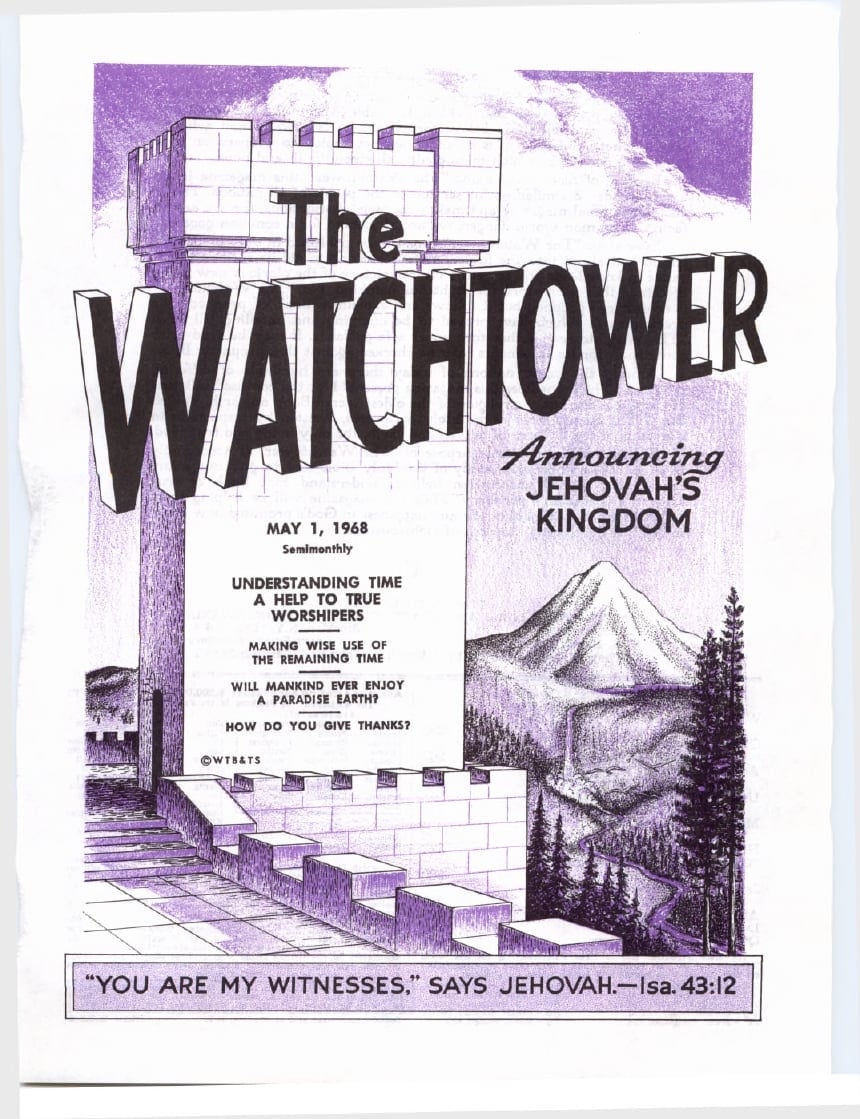
The Watchtower — May 1, 1968
Source: jw.org
Contents
Will Mankind Ever Enjoy a Paradise Earth?
Gilead School Graduates 101 Assistant Markers
Advocate Christ’s Blood for Mankind’s Salvation
Understanding Time a Help to True Worshipers
Making Wise Use of the Remaining Time
How Do You Give Thanks?
“Good News for All Nations” District Assembly
Jehovah’s Undeserved Kindness Proves Sufficient
Atheists in Churches
Do You Remember?
Questions From Readers
Announcements
Will Mankind Ever Enjoy a Paradise Earth?
Will Mankind Ever Enjoy a Paradise Earth?
Is it God’s purpose for mankind to enjoy eternal life in an earthly paradise? Does earth have space enough to accommodate all?
WHEN you envision a paradise, what do you see? Does your mind’s eye visualize a gorgeous garden or park? Do you see multicolored flowers, shrubs, well-kept lawns, fountains and calm, clear pools? Do you also envision cascading waterfalls, rushing streams, lush green meadows fenced by towering trees, and tangy air filled with the fragrance of deep woods and the songs of birds? Would you desire to live in such a paradise, free from the worries and threats of this present system of things?
How many persons yearn for such surroundings! Really, how refreshing is the beauty and tranquillity of a garden or park like this! But to enjoy it to the fullest, one needs ideal health. Will mankind ever live in an earthly paradise, and have the health and vigor to enjoy it to the full?
If the ushering in of a paradise earth were dependent upon the efforts of men, it would never come. For with each passing year, more and more people are forced to live in ugly city slums. Others must struggle to scratch out an existence from land that is eroded and devitalized by misuse. And instead of enjoying ideal health, people grow old and sick despite the attempts of medical science to implant within them new organs, or in some other way restore health. How obvious it is that the real answer to mankind’s needs is not within the power of men!
This does not mean, however, that mankind will never enjoy a paradise earth. For although man is incapable of bringing it about, Almighty God is able to usher in the very conditions for which every normal person yearns. But is this what God purposes to do? Was this his original purpose when he created man?
God’s Word the Bible reveals that Jehovah God originally created a beautiful garden or park, and that he placed the first human pair in this earthly paradise. (Gen. 2:7-9, 15-18) What a delightful home! How happy the couple could be in these surroundings, and what a delight it would be to raise their children there! But was it God’s purpose that Adam and Eve bring forth children in this beautiful paradise, called the garden of Eden?
Yes, for God’s inspired Word says: “Further, God blessed them and God said to them: ‘Be fruitful and become many and fill the earth and subdue it, and have in subjection the fish of the sea and the flying creatures of the heavens and every living creature that is moving upon the earth.’”—Gen. 1:28.
From this it is clear that it was God’s purpose for Adam and Eve to reproduce, and, as their family grew, to subdue or cultivate the earth, even beyond the boundaries of their Edenic paradise. Although Adam and Eve did produce children, they did not bring forth children in perfection in the paradise of Eden as God purposed. Nor did they and their offspring “subdue” the earth, bringing it to a state of paradisaic beauty earth wide. And neither did they exercise proper dominion over the lower animals as God purposed. Instead, they turned to sin. However, Jehovah declares: “My word that goes forth from my mouth . . . will not return to me without results, but it will certainly do that in which I have delighted, and it will have certain success in that for which I have sent it.” (Isa. 55:11) So we can be confident that God’s purpose for earth to be made a paradise will yet be fulfilled.
This will require that the wicked be rooted out of the earth, and that is exactly what God promises that he will do in the near future. But “the righteous themselves will possess the earth, and they will reside forever upon it.” (Ps. 37:29; Prov. 2:21, 22) So there will be survivors—persons who are devoted to Jehovah God and who exercise faith in the ransom sacrifice of his Son Jesus Christ. Also, God will resurrect the dead. In his righteous new system they will have the opportunity to prove themselves worthy of God’s favor and receive eternal life.—Acts 24:15; John 5:28, 29.
CAN EARTH ACCOMMODATE THEM ALL?
However, someone might say: “Why, if the billions of dead were resurrected, there would not be room for them all! People would starve because the earth could not produce food enough to feed everyone.” Is this true? How many people have lived upon the earth? How great a population is the earth capable of supporting? According to Bible chronology the first human pair were created by God less than 6,000 years ago. It took time for the human family to grow. Interestingly, the well-known scientist Sir Julian Huxley commented: “At the dawn of civilization, say 5,000 years ago, the population of the world cannot have numbered much more than 20 million.”a Even in the time when Christ walked the earth, it is estimated, the world population was only about 250 million, although The World Book Encyclopedia (1966) gives the low estimate of 133 million. It is agreed that the world population was comparatively small in early times.
In this connection, Dr. Albert L. Elder, as president of the American Chemical Society, made some interesting observations. In an address given before the 138th national meeting of that society in September 1960, he said: “It took over 5000 years of human history up to about 1820 to reach a world population of 1.1 billion. Within the following century, population doubled. Now, it stands at about 2.8 billion and could reach 3 billion early in the 1960’s. Thus, in less than 50 years there has been an increase in population equivalent to that which occurred during the first 50 centuries.”
On the basis of such information, it is calculated that the number of persons who have ever lived on earth is not very great. For example, in May of 1966 a speaker at the 76th annual Florida State Pharmaceutical Association convention observed: “It is now estimated that 25 per cent of all the people who have ever lived are alive today.”b
With the present world population being about 3.5 thousand million, this estimate would mean that there has been a total population throughout all human history of only some 14 thousand million people. But even if a more liberal estimate is made, and the 14 thousand million is doubled, still it is not an overwhelming number. The earth has over 57 million square miles of land area, and even with the huge population of 24 thousand million people, there would be more than an acre and a half of land for each person.
A principal reason why there is the problem today of producing sufficient food is that vast land areas are unsuitable for cultivation. In fact, only 7.7 percent of earth’s land area is said to be under cultivation presently, and the yield of much of this land is very poor. But consider how abundantly the earth could produce under ideal conditions and with God’s blessing. (Deut. 28:12; Ps. 67:6) How easily it could support a much larger population, including the resurrected dead, even though these should number as many as ten or twenty thousand million or more!
Discussing the earth’s potential to support a much larger population, Newsweek magazine of July 23, 1962, said: “Dr. James Bonner of Caltech estimates that the world can support 50 billion people—seventeen times its present population—while another Caltech scientist, Harrison Brown, says he ‘can even visualize the means for supporting 100 billion.’”
Without a doubt, the earth is capable of comfortably supporting all those whom Jehovah God mercifully resurrects into a restored earthly paradise. But when will this resurrection of the dead take place? How will the earth be brought to a state of paradisaic beauty?
PARADISE EARTH SOON TO BE ENJOYED
Bible prophecies unmistakably identify these as “the last days” of this system of things. (2 Tim. 3:1-5; Matt. 24:3-14) Soon now, at the “war of the great day of God the Almighty,” commonly called Armageddon, “the wicked . . . will be cut off from the very earth.” (Rev. 16:14, 16; Prov. 2:22) With the entire world of such persons removed, the meek, upright ones will remain on earth and indeed delight themselves in the abundance of peace. The Bible explains: “Furthermore, the world is passing away and so is its desire, but he that does the will of God remains forever.”—1 John 2:17.
These Armageddon survivors who do the will of God have a glorious future before them. To them the words of the inspired Bible psalm apply: “The righteous themselves will possess the earth, and they will reside forever upon it.” (Ps. 37:29) Theirs will be the glorious privilege of beautifying the earth, preparing it so that it will resemble earth wide a gorgeous garden or park. Into this earthly paradise they will also have the privilege of eventually welcoming thousands of millions of resurrected dead, including the evildoer who died alongside Jesus, and to whom he promised: “You will be with me in Paradise.”—Luke 23:43.
What a marvelous future is soon to be enjoyed by mankind! The sure promise concerning all who inhabit the paradise earth is: “God himself will be with them. And he will wipe out every tear from their eyes, and death will be no more, neither will mourning nor outcry nor pain be any more. The former things have passed away.” (Rev. 21:3, 4) To survive Armageddon and to enjoy these blessings, it is vital that you now learn what God’s will is and do it.
[Footnotes]
Reader’s Digest, February 1959, page 17.
Jacksonville Journal, May 18, 1966.
Gilead School Graduates 101 Assistant Markers
Gilead School Graduates 101 Assistant Markers
THE graduation day for the 101 students of the forty-fifth class of the missionary school of Gilead was March 10, 1968, a day they will never forget. Addressing them, as well as an audience of about 2,000 friends and relatives of the students, the vice-president of the Watch Tower Society identified the students as assistant markers.
Drawing upon the prophecy in the ninth chapter of Ezekiel, which foretold a marking of the foreheads of persons who are “sighing and groaning over all the detestable things that are being done,” F. W. Franz said that the students are marked ones who would be going out to help in marking others. The mark placed on the forehead is not merely an intellectual appreciation of God’s Word of truth, he observed. It is a mark of identification as a Christian. It is evidence of a Christian personality. The vice-president of the Society was only one of several who addressed the forty-fifth class of Gilead that day.
The president of the Watch Tower Society, N. H. Knorr, concluded the several talks of admonition to the students by urging them not to forget the vow they made to do God’s will. “There have been persons who have left God’s organization completely,” he said, “who eventually forgot what they used to believe. They forgot God.”
“Now that school is over,” he said, “it is not the end but the beginning.” He concluded by saying: “You have a marvelous privilege. You must not forget what you have learned and your vow to do God’s will.”
With the conclusion of President Knorr’s admonition to the class, they filed up onto the stage and individually received an envelope from him that contained, in most cases, a diploma. In order to receive a diploma certain scholastic standards had to be met. The envelope also contained a picture of the forty-fifth class and a little money to help with personal expenses. As the last of the graduates headed for their seats, a thunderous applause of congratulation went up from the audience.
A representative of the graduate body then presented to the Society’s president a letter of appreciation, which he read for all to hear. In it the graduates thanked the Society for the fine training that had been given them during the past five months. They stated that they now had an appreciation and concept of Jehovah’s organization that was far beyond their expectations. They also felt that the Bible had now taken on new dimensions for them. With the reading of this statement of appreciation the program for the day did not end. More was to come in the afternoon.
For the enjoyment of all present a number of graduates put on some splendid musical presentations. Among them were lively songs in Spanish by a group of graduates who had studied that language in the school.
Sandwiched among these musical presentations was a thought-provoking skit depicting how several students had handled a demonstration in the classroom showing how the entire book of First Corinthians is beneficial. After a discussion they decided to dramatize a hypothetical scene in the Corinthian congregation of the first century. This showed how Paul’s letter, among other things, handled the matter of divisions in the congregation, how it counseled action against an immoral member of the congregation, and how it gave counsel to those who had unbelieving mates. Skillfully they put across the main point, that principles in the Bible are beneficial to us all.
The highlight of the afternoon’s program was an impressive enactment in costume of scenes from the life of the daughter of a judge in ancient Israel, Judge Jephthah. It was an emotionally moving and faith-inspiring drama, a thoroughly delightful presentation.
With the conclusion of the drama the entire class came up on the stage and sang a touching farewell song. Then the Society’s president, in his closing remarks, admonished them to “continue in this fine work.” His final prayer brought this splendid graduation program of the forty-fifth class of Gilead to an end.
Advocate Christ’s Blood for Mankind’s Salvation
Advocate Christ’s Blood for Mankind’s Salvation
AMONG the things included in the preaching and teaching commission of Jehovah’s Christian witnesses is the advocating of Christ’s blood for the salvation of mankind. As the apostle Paul expressed it: “How much more will the blood of the Christ . . . cleanse our consciences.”—Heb. 9:14.a
The need for Christian witnesses to advocate Christ’s blood for mankind’s salvation is great indeed, for there is little faith in the world today in the saving power of Christ’s blood. In fact, it is of the utmost urgency that Christians do so, for Armageddon is drawing on apace, and only those who put faith in Christ’s blood can hope to be spared from destruction at that time.
Making known the truth about God’s law regarding the sanctity of blood is also part of the commission of the Christian witnesses of Jehovah, for respect for that law is also essential for salvation. Yet many today, and the medical profession in particular, choose to ignore God’s law in this regard. How unwise their course of action is can be seen from the results of their blood transfusions, many thousands of persons dying each year because of transfusion mishaps, while many, many more are made ill because of having diseased blood transfused into them.
By adhering to Bible principles Christians are protected from such risks. They know that the Bible is scientifically correct when it states that the life is in the blood, for the whole body is kept alive by the blood. (Lev. 17:11) Most fittingly, therefore, when the life of man is taken, God’s Word speaks of it as shedding his blood, as in the case of Abel. Babylon the Great, the world empire of false religion, is also spoken of as being “drunk” with the blood of God’s holy ones.—Gen. 4:10; Rev. 17:6; 18:24.
Jehovah God’s prohibition on the use of blood goes back to the very beginning of this post-Flood world. When Noah and his family came out of the ark, Jehovah for the first time authorized man to eat the flesh of animals, which, of course, involved taking their lives. With that privilege, however, He stated a limitation: the blood was never to be eaten. On that occasion Jehovah also forbade the taking of the life of a fellow human creature; if anyone did, his own life was to be taken. (Gen. 9:3-6) These laws applied to the entire human race.
That the prohibition on the use of blood applies also to Christians today is further made clear from the words of the early Christian governing body at Jerusalem, as found at Acts 15:19, 20, 28, 29. Plainly they commanded Christians: “Abstain . . . from what is strangle and from blood.” And that this rule was binding on Gentile as well as Jewish believers is clear from the words of the disciples at Jerusalem, at Acts 21:25, where they tell of giving this prohibition to Gentile believers. And let it be noted that those Christians were commanded to abstain from blood. That includes any use of it whatever. God’s law forbids the use of blood for any other purpose than atonement for sins: “It is the blood that makes atonement by the soul [life] in it.”—Lev. 17:11.
The blood of bulls and goats, however, cleansed from sins only in a figurative way. Christ’s blood and only his blood can and does in actuality cleanse from sin those exercising faith in it. He came from heaven to “bear witness to the truth,” and “to give his soul a ransom in exchange for many,” as “the Lamb of God that takes away the sin of the world.” Yes, as he himself said, his blood was “poured out in behalf of many for forgiveness of sins.” His apostles repeatedly testified to the same fact. Truly, there is an abundance of Scriptural testimony as to the value of Christ’s blood for mankind’s salvation! With the utmost confidence, therefore, the Christian witnesses of Jehovah advocate this truth in their ministerial activities—John 18:37; Matt. 20:28; John 1:29; Matt. 26:28; Rom. 5:9; 1 Pet. 1:18, 19; 1 John 1:7.
Clearly, then, regarding the Bible’s teaching on blood Jehovah’s Christian witnesses have a twofold obligation. On the one hand, they are to make known to all that Jehovah forbids the misuse of blood, whether of man or of animals, however well intentioned, and by whomever it may be. And, on the other hand, they are to make clear that salvation can come only through faith in Christ’s shed blood. Making known these truths is an important part of their preaching and teaching commission.—Matt. 28:19, 20.
[Footnotes]
For details see The Watchtower, December 1, 1967.
Understanding Time a Help to True Worshipers
Understanding Time a Help to True Worshipers
1. Why is an understanding of time helpful in our daily lives?
IN OUR daily lives we are often confronted with the need to know what time it is. Is it time to get up in the morning? time to go to work? time to eat? time to get ready to attend a meeting? time to go to bed? Over and over again each day most of us have some need to measure time in order to move from one feature of our daily activity into another. It is as the Bible states at Ecclesiastes chapter 3, verse 1: “For everything there is an appointed time, even a time for every affair under the heavens.” If we did not make a point of being aware of time, our lives could become disorganized very quickly. We might easily waste too much time and not spend enough time engaged in productive activity, activity that sustains our physical and spiritual lives.
2. In connection with Jehovah’s purposes, how is an understanding of time an encouragement?
2 Aside from the need to regulate our lives properly, an understanding of matters involving time can be a source of great encouragement to Christians, since many of God’s purposes toward earth and man involve a time factor. In connection with some of the events foretold in the Bible, Jehovah has revealed the time factor involved as a help to true worshipers. That such kind of revelation inspires true worshipers Jesus noted when he exclaimed: “I publicly praise you, Father, Lord of heaven and earth, because you have hidden these things from the wise and intellectual ones and have revealed them to babes.”—Matt. 11:25.
ENCOURAGED BY UNDERSTANDING
3. What noteworthy features were involved in the time period concerning the desolating of Judah and Jerusalem?
3 One example of encouragement derived from understanding the time feature concerning prophecy had to do with the time when Judah and Jerusalem lay desolate for seventy years. Due to the apostasy of the Jews they were held captive by Babylon, the world power of that time. Under the inspiration of God’s holy spirit the prophet Jeremiah had foretold this seventy-year period. Concerning Judah and Jerusalem, as well as other nearby nations, Jeremiah prophesied: “All this land must become a devastated place, an object of astonishment, and these nations will have to serve the king of Babylon seventy years.” (Jer. 25:11) But in addition to this desolation Jehovah’s word through Jeremiah foretold something else, a restoration would take place after the time period expired: “For this is what Jehovah has said, ‘In accord with the fulfilling of seventy years at Babylon I shall turn my attention to you people, and I will establish toward you my good word in bringing you back to this place.’”—Jer. 29:10.
4, 5. How did a knowledge of this time feature encourage the Jews?
4 True to Jehovah’s Word, Babylonian captivity came. The land of Judah lay desolate. The years passed. Eventually, sixty-eight years later, the combined armies of the Medes and Persians captured overconfident Babylon, entering the city whose gates had been carelessly left open. Almost without a fight Babylon was overthrown. Thus, the Jews inside the city were spared the devastation of a long siege. One of those Jews who had been in this long Babylonian captivity was Daniel, a faithful worshiper of God. Now he came under the rule of the Medo-Persian Empire’s king over Babylon, Darius the Mede.—Dan. 5:31.
5 Daniel knew of Jeremiah’s prophecy. He also had an understanding of time, being able to measure and calculate it correctly. With what result? At Da chapter 9, verses 1 and 2, of the book of Daniel we read: “In the first year of Darius the son of Ahasuerus of the seed of the Medes, who had been made king over the kingdom of the Chaldeans; in the first year of his reigning I myself, Daniel, discerned by the books the number of the years concerning which the word of Jehovah had occurred to Jeremiah the prophet, for fulfilling the devastations of Jerusalem, namely, seventy years.” What an encouragement that must have been to Daniel and to the other Jewish captives, to be able to discern that their time of captivity was almost over and that the foretold time of release and restoration was near!
6, 7. How did understanding “the appointed times of the nations” help true worshipers?
6 Another such example of discerning a time of fulfillment regarding Jehovah’s purposes and the encouragement derived involves that time period Jesus mentioned in connection with “the conclusion of the system of things.” As recorded at Luke chapter 21, verse 24, Jesus said: “And Jerusalem will be trampled on by the nations, until the appointed times of the nations are fulfilled.” By having an understanding of what these “appointed times of the nations” were, and by being able to measure and calculate the length of time involved, God’s servants on earth would be able to discern when God’s kingdom was to be established in heaven. That marvelous event would coincide with the ending of the “appointed times of the nations,” and the beginning of the “time of the end.”—Dan. 11:27, 40; Matt. 24:3; 2 Tim. 3:1.
7 That period of time proved to be 2,520 years. It began with the downfall of Jerusalem in the year 607 B.C.E. It concluded in the year 1914, and God’s people on earth were able to calculate the date even before it came, although the details of just what would occur were not clear. But by being able to appreciate Jehovah’s use of time features, his worshipers on earth realized that the “last days” foretold in God’s Word had indeed begun. And the fact that the “time of the end” had commenced meant that the kingdom of God had been established in the heavens under Christ. All of this proved to be a great encouragement during those critical years, particularly when true worshipers were undergoing persecution. And how encouraging this is to true worshipers today, for we know that, by the autumn of 1967 C.E., fifty-three years had gone by since the “last days” began, since the “appointed times of the nations” ended! That means the end of this wicked system of things will come very shortly. As Jesus said, the end would occur in the same generation that saw the beginning of the “last days” in 1914.—Matt. 24:34.
THE RIGHT TIME
8. In what other way does an understanding of time prove valuable?
8 An understanding of time proves valuable in another way too. Christians need to know, not only what to do, but when to do it. God’s servants surely want to do the right thing at the right time. One can take a course of action at the right time, but have it be to no avail if it is a wrong course of action. Also, it may even prove fruitless to take a certain course of action that normally could be considered right, if it is taken at the wrong time. No one could object to the correctness of a person’s sleeping an average of about eight hours a day. But what if that eight hours came when he should have been working? Then, of course, it would not be correct. Setting aside time for family relaxation, recreation, can be upbuilding. But if it always fell on the evening they should be at a Christian meeting, then it would not be correct.
9. Although the time was right, what wrong course did Israel take?
9 When the nation of Israel was led out of Egypt, Jehovah told his people they would possess the land of Canaan, a land flowing with milk and honey. (Ex. 3:15-17) But after spying out the land, the people, with only a few exceptions, refused to go in because they were afraid of the inhabitants. They murmured and wanted to go back to Egypt. It was the right time to go into the Promised Land, particularly since they had the evidence that God was with them. But the Israelites did the wrong thing. They did not want to go in. For this, Jehovah decreed that the rebellious generation would wander for a time period of forty years in the wilderness, until, except for a few, they would die. It would be the new generation that would go into the Promised Land.—Num. 13:31-33; 14:1-4, 28-34.
10. Why were the prayers of King Saul not answered?
10 An example of taking what normally would be considered a right action, but at the wrong time, occurred with King Saul when he became fearful of the Philistines. First Samuel chapter 28, verse 6, shows that Saul did what on other occasions would have been considered a right thing, for it says: “Saul would inquire of Jehovah.” But, his inquiring of Jehovah was at the wrong time! It came after he had broken God’s commands and after Jehovah had withdrawn his spirit from Saul. (1 Sam. 16:14) He should have done such inquiring in prayer long before his heart had turned hard so as to violate God’s clearly expressed commands. Because his turning to God in prayer was at the wrong time, when it was far too late, it was of no avail. As verse 6 of 1 Samuel chapter 28 adds: “Jehovah never answered him, either by dreams or by the Urim or by the prophets.”
11. How do true worshipers please Jehovah?
11 So as God’s servants, true worshipers, today study his Word of truth and understand what their heavenly Father wants them to do and when he wants them to do it, their compliance with that expressed will enables them to please Jehovah and receive his blessing. It means keeping in step with Jehovah’s progressively revealed will and his progressing visible organization, cooperating with it in its activity in the remaining years before the end of this system of things comes.
CHARACTERISTICS OF TIME
12. (a) What are some things we can know about time? (b) What is it that we cannot know?
12 Since an understanding of time helps Christians in several ways, let us find out some of the things we can know about it. Several important considerations are the following: (1) How it moves; (2) how to measure it; (3) how to calculate it. But is there anything about time we do not know and cannot know? Yes, we do not know where time began and where it is going throughout eternity. Only Jehovah possesses such knowledge at present, so we should not concern ourselves about it. It would be like the ant trying to understand man’s beginning and God’s purpose in putting humans on earth. Such knowledge is far beyond the comprehension of that small insect.
13. Which way does time move?
13 Of the things we can know about time, one is how it moves. It moves only in one direction, forward. It is like traffic on a one-way street. It moves relentlessly in that one direction and no creature can reverse the process. That is why we cannot recover the past, for we can never go backward in time so as to eliminate the present as though it had never occurred. No, time proceeds forward, and we always live in the present, not in the past. We know there is a future one minute from now or one year from now and that we will always progress from present to future, but we can never go backward.
14, 15. What measurements of time did Jehovah provide?
14 Another characteristic of time is its apparent rate of flow, that is, how fast it moves from the present to the future. This rate of flow can be measured. Indeed, Jehovah knew that man would need a knowledge of how to measure time, especially since his purposes include a time factor. So he provided man with the ability to do this, to measure time, an ability beyond the lower animal creation. Jehovah also provided the means by which man could accurately measure time. Genesis 1:14 states: “And God went on to say: ‘Let luminaries come to be in the expanse of the heavens to make a division between the day and the night; and they must serve as signs and for seasons and for days and years.’” So Jehovah made it possible for man to keep track of time, for each time the earth completes a cycle around the sun, one solar year passes. During that time we go through the cycle of the seasons. And each time the earth completes one revolution on its own axis, one day passes.
15 The Bible, at Deuteronomy 5:13, 14, tells of another measurement of time: “You are to render service, and you must do all your work six days. But the seventh day is a sabbath to Jehovah your God.” This established the weekly cycle made up of seven days, which cycle we still use today. However, even before that time, Noah is spoken of as using a cycle of seven days, as well as a month of thirty days.—Gen. 7:4, 11, 24; 8:4.
16. What are three uses of the word day in the Bible?
16 To understand the division of time called the day as used in the Bible, the context of the material must be determined. This is due to the fact that there are different meanings that apply to the word day (yom in Hebrew, hēmeʹra in Greek), as it is used in the Holy Scriptures. One usage of the word is at Genesis 1:5, where it states: “And God began calling the light Day.” The day here referred to is the daylight period itself of about twelve hours. John 20:19 refers to a second use of the word day, this time meaning a twenty-four-hour period: “Therefore, when it was late on that day, the first of the week.” A third use of the word day has to do with a period of time contemporaneous with some outstanding person. We have an example at Isaiah 1:1, which reads: “The vision of Isaiah the son of Amoz that he visioned concerning Judah and Jerusalem in the days of Uzziah, Jotham, Ahaz and Hezekiah, kings of Judah.”
17. How else is the word day used in the Bible?
17 The word day can refer to a longer period of time. At 2 Peter 3:8 we are told: “One day is with Jehovah as a thousand years and a thousand years as one day.” An even longer period of time than that can be embraced by the word, for Exodus 20:11 declares: “For in six days Jehovah made the heavens and the earth, the sea and everything that is in them, and he proceeded to rest on the seventh day.” This refers to the creative periods of time, each of which, judging by the seventh, appears to be 7,000 years long. However, there is an even longer period of time that can be attached to the meaning of the Bible word day, one that includes all of the creative days together. Genesis 2:4 states: “This is a history of the heavens and the earth in the time of their being created, in the day that Jehovah God made earth and heaven.” So the word as used in this sense apparently covers a time period far longer than each creative day.
CALCULATING TIME PERIODS
18, 19. What aids help us to calculate time?
18 After man had the knowledge of how to divide time into periods, the need for calculating it over long spans was seen, so calendars were introduced. One such calendar was the Jewish, another the Julian, introduced by Julius Caesar in the year 46 B.C.E. Still another was the Gregorian, introduced in 1582 C.E. by Pope Gregory XIII. This calendar was more accurate than the Julian and is the one now used in most countries.
19 To calculate long periods of time, certain dates called “absolute dates” are very valuable. These are dates that have been proved reliable by secular history, actual dates of events that are also recorded in the Bible. Starting from one of these specific dates we can, by using the reliable internal chronology of the Bible itself, ascertain when many other Bible events occurred.
20. How are Hebrew Scripture dates calculated?
20 For calculating Hebrew Scripture dates, the absolute date of October 5 to 6 in the year 539 B.C.E. is essential. This was the year that the Medes and Persians overthrew Babylon and it was definitely established in secular history when a record was found of King Nabonidus, the father and coregent of King Belshazzar. This remarkable clay document established that Babylon fell on October 5 to 6, in the year 539 B.C.E. according to the Gregorian calendar. From this date all the other dates in the Hebrew Scriptures can be calculated.
21. (a) How do we know Jerusalem fell in 607 B.C.E.? (b) What problem arises with the “appointed times of the nations”?
21 One of the more important calculations of a long period of time involves the previously mentioned “appointed times of the nations.” According to Ezekiel’s prophecy (Ezek. 21:25-27), it began when the typical kingdom of God ruling in Jerusalem was overthrown by Babylon. When did that occur? Well, secular historians agree that Babylon itself fell in 539 B.C.E. at the beginning of our month of October. Two years later, in 537 B.C.E., the Jews were repatriated to Jerusalem, ending their seventy-year period of Jerusalem’s desolation. Counting backward in time seventy years from 537 B.C.E. we arrive at the date 607 B.C.E. Thus, Jerusalem was left desolate at the beginning of October 607 B.C.E. The “appointed times of the nations” began. They ended with the establishment of God’s heavenly kingdom and the beginning of the “last days.” This time period, as many Bible students already know, was 2,520 years long, as indicated at Daniel 4:16, 17, 31, 32 and Revelation 11:2, 3; and Ezekiel 4:6. But how is this calculated? If we simply add 1,914 years to 607 years, we are confronted with 2,521 years, not 2,520 years.
22. How much time was there between October 607 B.C.E. and the end of 1 B.C.E.?
22 One way to calculate it correctly is as follows: Beginning with the year 607 B.C.E., on October 1, we count three more months until the end of the year. That brings us to January 1, 606 B.C.E. (the year numbers before the Common Era becoming smaller as they get closer to the time of Christ). Adding the full 606 years brings us to the end of the year 1 B.C.E., and we so far have a total of 606 years and three months.
23. How much time was there from the beginning of the Common Era to October of 1914? What total does this give for our calculation?
23 What comes next? What comes after the year 1 B.C.E.? Is it the year zero? No, for the ancient peoples, including the Greeks and Romans, had no conception of a zero. If you studied Roman numerals in school, did you learn a symbol for zero? No, because they did not use one. The zero was invented by the Hindus about 150 years after the Common Era began and was introduced by the Arabs into Europe some centuries later. So the year after 1 B.C.E. was, not zero, but 1 C.E., the first year of the Common Era. From the beginning of that year to the end of 1913 C.E. we have 1,913 full years. From January 1 to October 1 of 1914 gives us nine more months. Adding the 1,913 years and nine months to the 606 years and three months before the Common Era gives us the 2,520-year period from October 1, 607 B.C.E., to October 1, 1914 C.E. This is the period of the “times of the nations” of which Jesus spoke. That this calculation is correct is clearly corroborated by the many visible events that Jesus foretold and that have come to pass since 1914. Hence, although such calculation may be somewhat difficult, it is vital for Christians to know, as it helps to determine the time when God’s kingdom was established in the heavens and when this present wicked system of things entered its “time of the end.”
24. How are the dates for the ministry of Jesus calculated?
24 For calculating the dates for the various events of Jesus’ earthly ministry, the absolute date of August 19, in the year 14 of the Common Era, is vital. On that date Augustus Caesar died and was succeeded by Tiberius Caesar as emperor of Rome. Now note what Luke chapter 3 states: “In the fifteenth year of the reign of Tiberius Caesar . . . God’s declaration came to John the son of Zechariah in the wilderness. So he came into all the country around the Jordan, preaching baptism in symbol of repentance for forgiveness of sins.” The fifteenth year of Tiberius Caesar ended in late August in the year 29 C.E. John, six months older than Jesus, began his preaching that spring. Six months later, or in the autumn of the year 29 C.E., Jesus was baptized and began his ministry.
25. Why can we rely on the time features contained in God’s Word?
25 A fact of great importance to Christians is that the Bible is the only record that accurately lists all the periods of time back to the creation of man, and even beyond. No other document does this. That is why Christians can have such confidence in all matters of Bible prophecy that contain time features. Jehovah is the Great Timekeeper. He has a set time for every purpose. When he promises a new system of things we can rejoice in the fact that for a certainty, exactly on time, such prophecies will be fulfilled. Thus true worshipers today do not have the anxiety of worldlings, for they know that their God, Jehovah, is guiding them in paths of righteousness, and that he tells them in advance what to expect and when to expect it. As Amos 3:7 states: “The Lord Jehovah will not do a thing unless he has revealed his confidential matter to his servants the prophets.”
Making Wise Use of the Remaining Time
Making Wise Use of the Remaining Time
1. What false belief do many have today?
MANY in this world, particularly scientists, educators and political leaders, accept the view that man has been on earth millions of years. They believe that he has arrived at his present state of development by the process of evolution, and that this process will continue into the indefinite future. Because of this they feel that man has unlimited opportunities and time to make a success of his plans. But the Christian is not fooled by this Satanic doctrine. God’s chief adversary would like all persons to believe that there is no set time for anything, even God’s purposes. But the Christian, having full confidence in God and his Word, knows that man does not have an indefinite future in this system of things. He realizes where we stand in the stream of time, and that God’s judgments against this system of things are soon to be executed.
2, 3. (a) What can be said of many of the dates secular historians give? (b) What is the safest guide in these matters?
2 With accurate knowledge of Jehovah and his purposes, the Christian rejects the speculations of men. This includes the speculations of historians who do not believe the Bible, but who attach fantastic dates to events in man’s history. Concerning the unreliability of such dates the book The Secret of the Hittites, by C. W. Ceram, in the chapter entitled “The Science of Historical Dating,” states:
“Anyone approaching the study of ancient history for the first time must be impressed by the positive way modern historians date events which took place thousands of years ago. In the course of further study this wonder will, if anything, increase. For as we examine the sources of ancient history we see how scanty, inaccurate, or downright false, the records were even at the time they were first written. And poor as they originally were, they are poorer still as they have come down to us: half destroyed by the tooth of time or by the carelessness and rough usage of men.
“As a matter of fact, the more we pursue our studies, the less are we impressed by the dates which initially filled us with respect. We begin to recognize the framework of chronological history for what it is—a purely hypothetical structure, and one which threatens to come apart at every joint. Crooked and tottering, it gives us a picture of a strangely arbitrary history, while at the same time our instinct tells us that the ancient civilizations must have had some sort of reasonable and organic growth. When we reach this point in our studies we begin to be doubtful of every single date!
“To give an example of the untrustworthiness of chronology: investigators toiling for a century have had to shift the date for the unification of Egypt by King Menes, who established the first Egyptian dynasty, from 5867 B.C. to 2900 B.C. And even this latter date, which is considered the real beginning of Egyptian history, has not yet been determined with complete certainty. . . .
“But as we go even deeper into the subject, our respect for the achievements of historical detective work returns. We learn that the scholars have been careful to distinguish between ‘assured’ and ‘assumed’ dates. And we discover that the chronological framework of ancient history rests upon at least a few firm points. Certain key dates, around which other dates are mustered, can be determined almost without error. They are ‘assured.’”
3 Hence, outside the Bible’s timetable, most dates set by historians are unreliable. Only a few “assured,” or absolute, dates, such as 539 B.C.E., can be accepted as certain. Christians, confident in Jehovah’s Word, know that the internal evidence of the Bible is the safest guide in these matters. This helps us to determine with great accuracy where we stand in the stream of time, particularly in regard to the seventh period of time, or “day,” mentioned in Genesis.—Gen. 2:2, 3.
THE SEVENTH DAY
4. When were Adam and Eve created?
4 According to reliable Bible chronology Adam was created in the year 4026 B.C.E., likely in the autumn of the year, at the end of the sixth day of creation. Then God brought the animals to man to name. Yet, of Adam, Genesis states these words of Jehovah: “It is not good for the man to continue by himself.” (Gen. 2:18) Adam would realize this lonely condition very quickly, perhaps in just a few days or a few weeks. He would realize he needed another earthling with whom he could communicate, share his experiences, and his life. Nor would his naming the animals take an unduly long time. The basic animal kinds could have been relatively quickly named, for when such basic kinds were taken into the ark in Noah’s day, it did not involve millions of beasts, but perhaps only a few hundred basic kinds. Thus, Adam’s naming of the animals and his realizing that he needed a counterpart would have occupied only a brief time after his creation. Since it was also Jehovah’s purpose for man to multiply and fill the earth, it is logical that he would create Eve soon after Adam, perhaps just a few weeks or months later in the same year, 4026 B.C.E. After her creation, God’s rest day, the seventh period, immediately followed.
5. How can we calculate where we stand in the stream of time?
5 Therefore, God’s seventh day and the time man has been on earth apparently run parallel. To calculate where man is in the stream of time relative to God’s seventh day of 7,000 years, we need to determine how long a time has elapsed from the year of Adam and Eve’s creation in 4026 B.C.E. From the autumn of that year to the autumn of 1 B.C.E., there would be 4,025 years. From the autumn of 1 B.C.E. to the autumn of 1 C.E. is one year (there was no zero year). From the autumn of 1 C.E. to the autumn of 1967 is a total of 1,966 years. Adding 4,025 and 1 and 1,966, we get 5,992 years from the autumn of 4026 B.C.E. to the autumn of 1967. Thus, eight years remain to account for a full 6,000 years of the seventh day. Eight years from the autumn of 1967 would bring us to the autumn of 1975, fully 6,000 years into God’s seventh day, his rest day.
6, 7. (a) To what can the 1,000-year reign of Christ be likened? Why? (b) What fills Jehovah’s servants with anticipation now?
6 After 6,000 years of misery, toil, trouble, sickness and death under Satan’s rule, mankind is indeed in dire need of relief, a rest. The seventh day of the Jewish week, the sabbath, would well picture the final 1,000-year reign of God’s kingdom under Christ when mankind would be uplifted from 6,000 years of sin and death. (Rev. 20:6) Hence, when Christians note from God’s timetable the approaching end of 6,000 years of human history, it fills them with anticipation. Particularly is this true because the great sign of the “last days” has been in the course of fulfillment since the beginning of the “time of the end” in 1914. And, as Jesus said, “this generation will by no means pass away until all these things occur.” (Matt. 24:34) Some of the generation that discerned the beginning of the time of the end in 1914 will still be alive on earth to witness the end of this present wicked system of things at the battle of Armageddon.—Rev. 16:14, 16.
7 The immediate future is certain to be filled with climactic events, for this old system is nearing its complete end. Within a few years at most the final parts of Bible prophecy relative to these “last days” will undergo fulfillment, resulting in the liberation of surviving mankind into Christ’s glorious 1,000-year reign. What difficult days, but, at the same time, what grand days are just ahead!
8. Can anyone say with certainty when the battle of Armageddon will come?
8 Does this mean that the year 1975 will bring the battle of Armageddon? No one can say with certainty what any particular year will bring. Jesus said: “Concerning that day or the hour nobody knows.” (Mark 13:32) Sufficient is it for God’s servants to know for a certainty that, for this system under Satan, time is running out rapidly. How foolish a person would be not to be awake and alert to the limited time remaining, to the earthshaking events soon to take place, and to the need to work out one’s salvation!
THE VALUE OF TIME
9. What is one way the value of time can be determined?
9 Knowing about God’s timetable, where we are in the stream of time, is one thing; using the time available is another. If an understanding of time is valuable, using it wisely is even more so. Time is considered so valuable that some say “time is money.” It is precious, valuable, a prized commodity. One way to determine the value of time is the way the value of merchandise is often calculated—by the supply and demand. For instance, during the days of the pony express in the United States, it used to cost several dollars to send a letter that now costs about six cents. Why the difference? Because in the old days there were very few pony express riders. The supply was very limited, but the demand for their service was great, so they were valuable. But today the supply of mail carriers is much greater, therefore not as costly.
10, 11. Why is time so precious in this system of things?
10 By the standard of supply and demand, then, how should time be valued? Is the supply of time for humans in this system limited? Yes. Is the demand for more time, and for an extended lifetime, great? By all means! For imperfect humans subject to death the supply of time is very limited, but the demand for it is great. So time is extremely valuable. At best, man’s life-span is about seventy or eighty years. A few live a bit longer. But it is much, much less in many places where disease, malnutrition or violence cut it short. Even for the healthy, as they get older their strength will ebb, so that they cannot do as much in a given amount of time as they used to do. Eventually, the day will come when they can do nothing at all, because death will have claimed them as victims. That is why Ecclesiastes 12:1 counsels: “Remember, now, your grand Creator in the days of your young manhood, before the calamitous days proceed to come, or the years have arrived when you will say: ‘I have no delight in them.’”
11 In any way that we view the matter, whether young or old, our time is precious. Particularly is this true for worshipers of Jehovah. How often we hear those busy in the ministry proclaiming the good news of God’s kingdom say: “Why, there just isn’t enough time in a day!” Yes, there is a great demand for time everywhere. It is even more valuable than money, for money lost can be replaced, but time lost cannot be replaced. It is gone forever.
12. Particularly in view of what is time valuable?
12 The apostle Paul put a high value on time. When he wrote to the Christians at Ephesus he stated: “So keep strict watch that how you walk is not as unwise but as wise persons, buying out the opportune time for yourselves, because the days are wicked.” (Eph. 5:15, 16) Paul told the Ephesians to put the more important things first in their lives, even if it cost something, even if it cost time from other pursuits. Now, if such was true in Paul’s day, how much more so is it true in our day! By measuring and calculating time, we know we are living in the final years of this system of things. It is crumbling before our very eyes in one orgy of violence and crime after another. Minute by minute, day by day, year by year it moves without fail toward its catastrophic end. There is no going backward for this system. How true, then, in our day, what Paul stated at 1 Corinthians 7:29: “Moreover, this I say, brothers, the time left is reduced.” It is especially reduced in our day, as we are near the end of 6,000 years of human history.
13. What is Satan’s condition relative to time?
13 Satan the Devil also knows that the time left is very reduced. Revelation 12:12 states: “The Devil has come down to you, having great anger, knowing he has a short period of time.” Satan the Devil has a real problem where time is concerned. He has very little left. What he would not give to have more time to work out his debased purposes! But he does not, and so is furious. You can be certain that he will use that remaining time to his best advantage in opposing God and his servants on earth. “And the dragon grew wrathful at the woman, and went off to wage war with the remaining ones of her seed, who observe the commandments of God and have the work of bearing witness to Jesus.”—Rev. 12:17.
USE IT WISELY
14. How can we wisely use time today?
14 Ours are “critical times hard to deal with,” for they are the “last days.” (2 Tim. 3:1) “Wicked men and impostors will advance from bad to worse, misleading and being misled.” (2 Tim. 3:13) Surely, Christians want to use their remaining time in this system of things wisely, for the right purpose, so they are not overcome by these bad times so “hard to deal with” due to Satan’s schemes and assaults. But how can we do this? One way is by not wasting time on unprofitable pursuits. This we will do if, to the best of our ability and circumstances, we follow the lead of Jehovah through his visible organization on earth today. Through his visible arrangement we receive counsel on how best to use our time. Meetings are provided for receiving uplift spiritually. There is also wholesome, stimulating activity in preaching the truths we learn to others.—Matt. 24:45-47.
15. Why is a schedule of Christian activity a protection?
15 True, much of our time is consumed in preparing, going to meetings and out in the ministry. In fact, it seems as though such a schedule leaves little time for other pursuits. But do you think such is an accident? Does Jehovah not know what is best for his people in these very dark and critical days? Aside from the primary purpose of educating us in Jehovah’s purposes and requirements so we can carry out his will, the consuming of our time at meetings and in the ministry means that God’s servants are doing the right thing and will not be in another place doing the wrong thing! The more time they spend working with Jehovah’s visible organization, the less time they will have left to get into difficulty. Yes, the arrangements Jehovah has provided now are certainly a source of great protection. “The name of Jehovah is a strong tower. Into it the righteous runs and is given protection.”—Prov. 18:10.
16, 17. What is the proper view of rest and recreation?
16 Making wise use of the remaining time does not mean we will get no rest or recreation. Such is proper, but the kind we choose and the time we devote to it should be balanced with our Christian obligations. True, we would all like more time to enjoy such things as Jehovah’s creation and other forms of recreation, and to a degree we can do that now. But the real enjoyment will come in Jehovah’s new system where there will be real and everlasting enjoyment of all the things Jehovah has provided and will yet provide. But when a ship is sinking, one’s thoughts should be more on survival than recreation or rest. This old system is sinking into disbelief, immorality and degradation. Soon it will sink completely out of sight when it is given its deathblow by Jehovah’s chief heavenly executioner Christ Jesus. That is why the primary consideration of God-fearing persons now is doing the will of Jehovah and working for survival.
17 Those who have already separated themselves from this dying old system can be likened to those who have successfully abandoned a sinking ship and are in a lifeboat. Their thoughts should be concentrated on reaching a safe shore regardless of the effort required. Jehovah’s servants have come to a place of survival, a place where they can learn of everlasting life in a righteous new system. But there are others who also want survival. They, too, need to know of Jehovah’s will and promises. They need to be aided, even though it means sacrificing one’s own time and effort from personal pursuits. Such giving of oneself is the best way to make wise use of the remaining time.
18. How can time be used even more wisely?
18 To use our time even more wisely, we need to become proficient in our lifesaving work. We want to do more than just occupy our time with the ministry. We want to make the best use of that time we spend, and we can do that if we put our heart into what we do and endeavor to improve the quality of our service to Jehovah. At 1 Corinthians 9:26 Paul said: “The way I am directing my blows is so as not to be striking the air.” Paul was not going to waste time and energy in accomplishing little or nothing. He would learn to direct his efforts skillfully to use in the best way the time he spent. We can do the same. If we do, we will be productive in the ministry, diligently working to find, feed and tenderly care for interested persons with whom we come in contact.
19. How is time used wisely regardless of which feature of the Christian’s daily activity he is performing?
19 No matter what feature of our daily activity we are performing, whether it is going to Christian meetings, teaching others about God’s purposes in their homes, or in our work in offices, factories, farms or homes, we will make wise use of our time if we perform that activity in a manner that will honor Jehovah. Even though we may not be in a position to be a full-time preacher, we will want to conduct ourselves as Christians, working hard to do as Paul counseled: “You should put away the old personality which conforms to your former course of conduct and which is being corrupted according to his deceptive desires; but . . . you should be made new in the force actuating your mind, and should put on the new personality which was created according to God’s will in true righteousness and loyalty.”—Eph. 4:22-24.
ADVANCING IN TRUE WORSHIP
20, 21. What should individuals who have not used their time wisely in the past do?
20 Some, after considering the many things they could be doing to make wise use of time, will recognize that they have not honored God well in the past. Certainly before coming to an accurate knowledge of God and his Word, they did not honor Jehovah. Perhaps there was even a dishonoring. But do not waste more time dwelling on the past that is squandered. There is nothing you can do to bring it back. What you can do is to learn from the experience and determine not to repeat it.
21 At times individuals let their unwise past hinder them. They worry over it to the point where it interferes with the wise use of their time now and in the future. That is not appreciating to the full that Jehovah is a loving and forgiving God, and that what really counts is what we are doing today and will do tomorrow. Jehovah is merciful and forgiving if we are truly repentant and work hard to obey his commandments. “‘Come, now, you people, and let us set matters straight between us,’ says Jehovah. ‘Though the sins of you people should prove to be as scarlet, they will be made white just like snow; though they should be red like crimson cloth, they will become even like wool. If you people show willingness and do listen, the good of the land you will eat.’” (Isa. 1:18, 19) Accept that loving-kindness, then strive to gain Jehovah’s approval by advancing in true worship.
22. (a) Even to whom does Jehovah’s mercy extend? (b) What appreciation should this build?
22 The love and mercy of God extend even toward those who had once been cut off from the Christian congregation. Such ones, after coming back into Jehovah’s favor and demonstrating their faith and loyalty, now have the prospect of being used in positions of responsibility in the Christian congregation. Is that not a wonderful expression of Jehovah’s love? If he exercises such forgiveness toward those once cut off, do you not think he will do the same for those who have not, but who have been previously unwise in the use of their time? Such marvelous attributes of Jehovah should make us love Him even more, should make us reaffirm our desire to make wise use of our time by advancing in true worship now and forever, giving the best we have. As Exodus 23:19 says: “The best of the first ripe fruits of your ground you are to bring to the house of Jehovah your God.”
23. What should the Christian’s outlook be?
23 Therefore, learn how to improve your worship to God, not only in quantity, but, even more important, in quality. Stretch forward to the things ahead, forgetting the bad things behind. Pursue the goal of everlasting life, when we will have endless time to enjoy what Jehovah provides for obedient mankind. Look forward to and work toward a progressively enriched and happy life of service to Jehovah. Making wise use of this present time to honor God in all we do, we will then be among those doing as Psalm 115:18 says: “We ourselves will bless Jah from now on and to time indefinite.” For those who make such wise use of their time now, Psalm 37:34 holds out the promise: “Hope in Jehovah and keep his way, and he will exalt you to take possession of the earth. When the wicked ones are cut off, you will see it.” With time running out for the wicked, it is truly time to be molded by God’s words of truth so we can bless Jehovah daily and thus be preserved to bless him to time indefinite.
…