The Watchtower, September 1, 1967
Download: PDF — The Watchtower, September 1, 1967
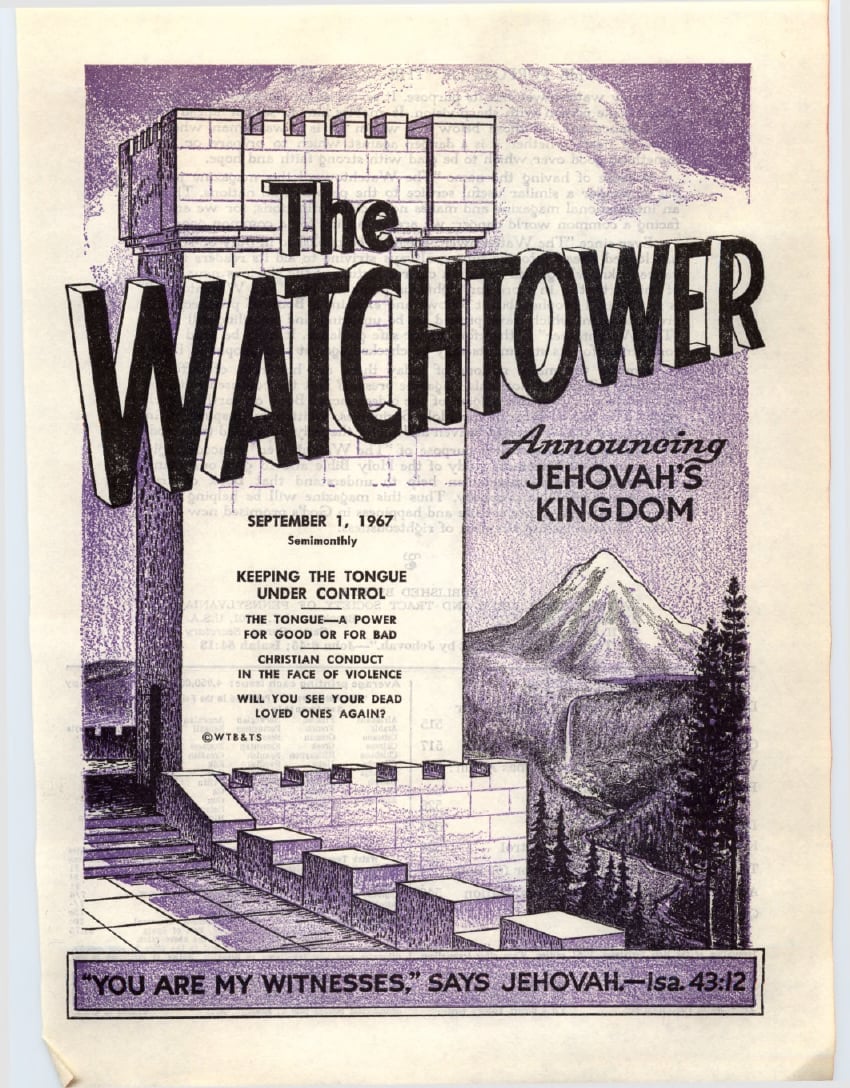
The Watchtower — September 1, 1967
Source: jw.org
Contents
Do You Meet the Challenge of Doing Your Best?
Christian Conduct in the Face of Violence
Will You See Your Dead Loved Ones Again?
Preserving Our Possession of Christian Peace
Do You Remember?
Keeping the Tongue Under Control
The Tongue—A Power for Good or for Bad
Appreciation for Jehovah’s Organization
Questions From Readers
Announcements
Do You Meet the Challenge of Doing Your Best?
Do You Meet the Challenge of Doing Your Best?
IN A competition or race it is quite natural for one to do his best. The artist who seeks to win a prize for his painting at an exhibition will most likely do his best, as will also a musician who is trying to win recognition or a prize at a music festival. The athlete, anxious to win the prize, is also most likely to exert his best powers.—1 Cor. 9:24.
But what about the many others? Unfortunately, more and more workers in office and factory, mothers and housewives in homes, and students in school are less and less concerned with giving their best. The trend is to be content with merely putting in time, giving only as much as is needed to get by.
Failing to do one’s best might be said to be a part of the moral sickness that afflicts the modern generation. Due to the foretold “increasing of lawlessness” and moral breakdown, there is today a marked lack of conscientiousness, a lack of the sense of accountability to God; there is less and less willingness to put forth the effort to do one’s best.—Matt. 24:12.
But life and the possession of physical and mental faculties are a trust from the Creator. Each one has the obligation to do his best in whatever he is given to do. As wise King Solomon counseled: “All that your hand finds to do, do with your very power, for there is no work nor devising nor knowledge nor wisdom in Sheol [the grave], the place to which you are going.” And the apostle Paul counseled: “Whatever you are doing, work at it whole-souled.” The obligation to work ‘with one’s very power,’ “whole-souled,” might be said to be threefold: Doing all that one has to do as well as it can be done; doing as much as one can do in view of his skills, energy and time; and doing it from the right motive.—Eccl. 9:10; Col. 3:23.
For you to do your best you must keep your mind on your work, concentrate on the work at hand. Taking an interest in your work and trying to find pleasure in it will also help. Not to be overlooked are such practical considerations as keeping physically fit by getting enough sleep, eating right, both in kind and in quantity, and avoiding all excesses and dissipation.
Since the Bible contains fine admonition for doing one’s best, it is to be expected that one who regularly reads the Bible would be aided in doing his best. Among the men in American public life who made a regular habit of reading the Bible and who were also concerned with doing their best was the president of a previous century, Abraham Lincoln. He once stated: “If I were to try to read, much less answer, all the attacks made on me, this shop might as well be closed for any other business. I do the very best I know how —the best I can; and I mean to keep doing so until the end.” Incidentally, here is one benefit that comes from doing one’s best: it helps one to weather unfair attacks.
Among other rewards that come from doing one’s best is self-respect. There is an inner satisfaction from knowing that you have not yielded to the temptation to do careless or indifferent work, just because you could have gotten away with it; but that you have disciplined yourself and have done the very best you were able to do. Whether you did your very best in a certain task or assignment others may never know; but you do, and, if you did, yours is the satisfaction of knowing that you are measuring up to what you know you should require of yourself. The Bible shows that the apostle Paul took satisfaction in doing his best, in measuring up to high but difficult standards, such as preaching where no one else had preached before and not accepting financial support from certain Christians.—1 Cor. 9:18; 2 Cor. 10:15-17.
Then, again, there is the satisfaction that comes from viewing the results, if you have done your best. These certainly will be much better if you have done all you could as well as you could do it. Doing so, you may well be rewarded with a sense of pride in your achievement, which is normal and proper. The man skillful in his work stations himself before kings.—Prov. 22:29.
Doing your best is also the course of practical wisdom in that it makes it less likely that you will receive censure from those for whom you are working or obligated to please. More than that, it may well lead to advancement, as in the case of Joseph the son of the patriarch Jacob. The Bible tells us that God was with him both while Joseph was a household slave and while in prison, but he certainly must also have done his best, to be advanced each time above all his fellows.—Gen. 39:1-23.
Another Scriptural example showing the wisdom of our doing our best is found in faithful King Hezekiah. Thus we read concerning him: “In every work . . . it was with all his heart that he acted, and he proved successful.” Yes, he acted with all his heart and Jehovah blessed him.—2 Chron. 31:21.
For a Christian minister the greatest aid to his doing his best may well be his knowing that it pleases Jehovah God and will be rewarded by Him. And that this involves not just his ministry but whatever he may be doing is apparent from the words of the apostle Paul: “Whether you are eating or drinking or doing anything else, do all things for God’s glory.” God’s glory certainly deserves the best. And as Paul wrote the Christian slaves at Colossae: “Be obedient in everything to those who are your masters in a fleshly sense, not with acts of eye-service, as men pleasers, but with sincerity of heart, with fear of Jehovah . . . for you know that it is from Jehovah you will receive the due reward.”—1 Cor. 10:31; Col. 3:22-24.
Yes, there are many reasons for one’s trying to do his best. It brings with it self-respect, satisfaction with one’s work and the prospect of success and advancement. For the dedicated Christian minister it also means the reward of God’s approval.
Christian Conduct in the Face of Violence
Christian Conduct in the Face of Violence
Violence rapidly increases. What course should you take?
THROUGHOUT the world violence of all kinds is on the increase. On an international scale its growth caused United Nations Secretary-General U Thant to say that he feared “we are witnessing the initial phases of World War III.”a
On a national scale violent internal upheavals have toppled many governments in recent years. In some lands opposing factions threaten to engulf the entire nation in bloodshed.
Also, in almost every nation on earth, violence in the form of crime and rioting rapidly mounts. Of the United States, one report stated: “Crime is increasing four or five times as fast as our total population in this country. If there isn’t a change, inevitably it will lead to anarchy.”b And a late report shows that in the first three months of 1967 major crimes skyrocketed 20 percent above the same period the previous year, more than fifteen times the rate of population increase!
Why so much violence throughout the world? Will it continue to increase in the years ahead? What will be the ultimate outcome of it all? And in view of such violence, what course should the Christian follow?
WHY SO MUCH VIOLENCE?
The basic cause of violence is that mankind in general has rejected guidance by God. Man was not created to govern his affairs successfully without God. As long as he followed the standards God gave him, he would be assured of peace and happiness. But sadly for all, our first parents rejected God as their Guide. Instead, wanting independence from God, they rebelled and went their own way. The Almighty God allowed men ample time to pursue their course so that, among other reasons, time would demonstrate that the ways of man apart from God’s rule could never bring peace and happiness.—Gen. 3:17-19.
History has proved this to be the case. Men and nations not ruled by God have adopted their own brands of governments, ideologies and philosophies. Not being guided by the same divine laws and principles, conflict inevitably resulted within human ranks. What has been demonstrated over and over again since man’s rebellion is the truth of these inspired words of Jeremiah: “I well know, O Jehovah, that to earthling man his way does not belong. It does not belong to man who is walking even to direct his step.” (Jer. 10:23) Jeremiah also wrote: “Look! They have rejected the very word of Jehovah, and what wisdom do they have?” (Jer. 8:9) Rejecting God’s wisdom and choosing to lean on their own, mankind lost peace.
Over the centuries there has been no improvement in man’s relations with his fellowmen. Why not? Because when men left off being submissive to God they could go in only one direction—downward. The longer man stayed away from God, the worse his condition would become. This would happen just as surely as one could predict the course of a rock thrown from a cliff—downward, in harmony with the law of gravity. Departing from God’s laws could result only in a downward trend toward chaos.
In addition to the progressive worsening of man’s affairs or to the long time he has been outside of God’s guidance, there is another factor that has greatly increased violence in our time. The Bible, at Revelation 12:12, states: “Woe for the earth and for the sea, because the Devil has come down to you, having great anger, knowing he has a short period of time.”
Satan the Devil and his demons, spirit creatures who also rebelled against God, are the chief instigators of violence. From the invisible spirit realm they prod willing humans on earth to bring grief to mankind. What is the scope of their influence? The Bible, at 1 John 5:19, says: “The whole world is lying in the power of the wicked one.” In our century, as the physical facts compared with Bible prophecies verify, Satan and his demons have been cast out of the heavenly realm down to the vicinity of the earth. (Rev. 12:7-9) These invisible forces add to man’s debasement by egging people on to more violence. Why? They know that God’s time for executing all the wicked, including wicked spirit forces, nears. Knowing they will without fail be executed for their gross wickedness, they do their utmost to ruin mankind. “Your adversary, the Devil, walks about like a roaring lion, seeking to devour someone.”—1 Pet. 5:8.
Thus, due to man’s long estrangement from God and the influence of wicked spirit forces, the human family grows more calloused in its behavior. How accurately the Bible foretold the very condition we see today when it said: “Know this, that in the last days critical times hard to deal with will be here. For men will be lovers of themselves, lovers of money, self-assuming, haughty, blasphemers, disobedient to parents, unthankful, disloyal, having no natural affection, not open to any agreement, slanderers, without self-control, fierce, without love of goodness, betrayers, headstrong, puffed up with pride, lovers of pleasures rather than lovers of God.”—2 Tim. 3:1-4.
WHAT DOES THE FUTURE HOLD?
Is the violence we now experience going to decrease or increase in the days ahead? Bible prophecy guarantees: “Wicked men . . . will advance from bad to worse.” (2 Tim. 3:13) Also, it says: “The inspired utterance says definitely that in later periods of time some will fall away from the faith, paying attention to misleading inspired utterances and teachings of demons.” (1 Tim. 4:1) And Jesus Christ foretold: “Because of the increasing of lawlessness the love of the greater number will cool off.”—Matt. 24:12.
Violence will thus continue to grow for a little while longer, until these “last days” come to their completion. Then God will bring all violence, and those responsible for it, to their finish.
Without a doubt, “the world is passing away and so is its desire.” (1 John 2:17) In one orgy of violence after another, it speeds to its near end at God’s own hand. Yet, God’s Word also promises that “he that does the will of God remains forever.” Thus, the comforting promise of surviving the end of this violence-filled system is held out to honest-hearted persons everywhere who do God’s will.
CHRISTIAN CONDUCT
However, what is God’s will in connection with the many situations that arise that could lead to violence? Should the Christian share in the violent overthrow of governments that are oppressive? Should he march on city halls, demonstrating for various rights or grievances? If some rough him up, or insult him, should he give them a taste of their own medicine and show them they cannot get away with it?
God’s inspired Word states: “A slave of the Lord does not need to fight, but needs to be gentle toward all, qualified to teach, keeping himself restrained under evil.” (2 Tim. 2:24) The wisdom of this counsel can be seen in whatever circumstance one applies it.
For example, by applying this counsel you, as a Christian, would not work to overthrow a government violently, even if it is oppressive. Many who have done so often find themselves under a worse form of government than the one they overthrew. And in the process, they may lose their lives for a cause that God does not sanction. Jesus told his followers to pray for God’s kingdom, not to fight to overthrow present governments. (Matt. 6:9, 10; John 18:36) He knew that in due time God himself would bring a permanent end to all oppressive governments. Thus, the Christian “does not need to fight,” but needs to wait patiently for Jehovah to bring his own remedy, the only satisfactory one that will benefit all mankind.
Within any nation there is prejudice and discrimination. When recourse through the legal systems of the land fails to bring justice, should you resort to such things as picketing and rioting in the streets? If you, as a Christian, did that, then you would become lawless. Christianity is a law-abiding arrangement, not a license for lawlessness. Lawlessness will never bring justice, but instead brings more oppression and discrimination. The practical wisdom of God tells us: “Let anger alone and leave rage; do not show yourself heated up only to do evil. For evildoers themselves will be cut off.” (Ps. 37:8, 9) And the apostle Paul wrote: “Put them all away from you, wrath, anger, injuriousness, abusive speech.” (Col. 3:8) The Christian waits upon Jehovah for justice, appreciating that, not he, but Jehovah will correct the wrongs of a wicked system of things.
When riots or demonstrations do erupt within one’s community, the Christian does well to exercise great care, not exposing himself to violence. Whenever possible, he retires to a safe place until the violence subsides. This course reflects godly wisdom: “He who meddles in a quarrel not his own is like one who takes a passing dog by the ears.” Thus the Christian does not participate in riots or demonstrations or try to get close to them even out of curiosity.—Prov. 26:17, RS.
But what should you do if someone jostles you, or insults you, or roughs you up? Should you give back in kind? The Bible warns: “A word causing pain makes anger to come up.” (Prov. 15:1) A response in kind will far more likely provoke more anger, perhaps enraging the offender to resort to physical violence, especially today when so many persons are controlled by the demons or under the influence of drugs. No, instead of heating up the situation, the Christian does one of several things. “An answer, when mild, turns away rage,” so he uses a mild reply. And if that does not overcome the situation, then God’s Word counsels: “Before the quarrel has burst forth, take your leave.”—Prov. 17:14.
The Christian also takes steps to avoid being overcome by the violence of the criminal element. In dangerous areas he takes the precaution of not walking alone on dark streets whenever he can avoid it. Even when calling on persons to talk to them about God’s purposes, the Christian does well to take a companion with him in localities where crime is rampant. This does not mean that the Christian seeks to escape harm at all costs. Indeed, he is willing to undergo persecution, even death, where his worship to God is involved. But he will not jeopardize his life for any reason not in harmony with his integrity to God.
NEUTRALITY
The Christian does not search out one side or the other in national and international disputes that lead to violence and bloodshed. As a slave of God, he remains neutral concerning this world’s conflicts, thus avoiding the bloodguilt associated with them. Jesus said of his followers: “They are no part of the world, just as I am no part of the world.” (John 17:16) So the Christian does not participate in the world’s violent struggles. He knows that in due time God will bring all wrong to an end, and that without hurting innocent persons in the process.
By avoiding worldly entanglements the Christian today does just what the first-century Christians did. Note what Justin Martyr wrote in the second century: “We who were filled with war, and mutual slaughter, and every wickedness, have each through the whole earth changed our warlike weapons,—our swords into ploughshares, and our spears into implements of tillage,—and we cultivate piety, righteousness, philanthropy, faith, and hope, which we have from the Father Himself through him who was crucified.”—The Ante-Nicene Fathers, Vol. I, p. 254.
While many authorities among the nations do not appreciate the neutral course of Christians, there are those that do.
For example, internal strife in one African country caused police and army forces to mount roadblocks. The checking at these points was very rigorous and time consuming. But in almost every instance, the soldiers and police let Jehovah’s witnesses through with a minimum inspection after positive identification. Often the authorities remarked: “We trust you people.” Or they were heard to say: “Never mind, we know Jehovah’s witnesses.” When some of these Christians were traveling to an assembly of ministers, they were told at the checkpoint: “Some of your people have gone to the assembly already; go ahead!” The law-enforcement officers, being familiar with the neutral position of Jehovah’s witnesses, treated them with respect, knowing they were not responsible for the country’s disorders.
However, even when authorities persecute Christians, the individual Christian maintains his neutral stand. His right course of conduct has been outlined by Jehovah God in his Word. The Christian does not compromise it for any reason. Thus, he avoids responsibility for this world’s violence and avoids the adverse judgment God will bring against it.
Very shortly now God will bring to an end this violence-racked system of things. He will replace it with his new system of things, where “righteousness is to dwell.” (2 Pet. 3:13) Christians who have maintained right conduct in the face of violence will reap marvelous benefits then, benefits of life, health, peace and happiness. They will forever enjoy living in a new order without violence. “The meek ones themselves will possess the earth, and they will indeed find their exquisite delight in the abundance of peace.”—Ps. 37:11.
[Footnotes]
a The New York Times, May 12, 1967, p. 1.
b U.S. News & World Report, October 17, 1966, p. 86.
Will You See Your Dead Loved Ones Again?
Will You See Your Dead Loved Ones Again?
ALL of us have lost in death persons whom we loved and who loved us. Most of us greatly desire to see them again, but on contemplating the coming back, we might shake our heads and say: “Well, from a selfish standpoint, I would like to see them back, but when I think of all the trouble they would have to endure and then die again, I would say, ‘No, let them rest.’” From a strictly human way of reasoning we would be right; yet, we would be very much wrong because we would be overlooking what the One who conceived the idea of resurrection tells us about the purposes, conditions and circumstances of the resurrection.
Some of those whom we have loved tried to live Christian lives; others did not. Some not professing any religion at all have, nonetheless, been honest and decent and have displayed some fine qualities. All have been imperfect and have, to a greater or lesser extent, exhibited bad qualities. In connection with the resurrection, the disturbing thought arises that there may be categories or different locations in which the dead are, such as purgatory, hellfire, limbo, nirvana, a world of shades or disembodied spirits, as taught by various religions of earth. If such were the case, our chances of seeing our loved ones on earth would be small. But these ideas are entirely unscriptural. We can see what the Creator of all living souls purposes for the dead by considering what He has to say about it in the twentieth chapter of Re the Bible book of Revelation or Apocalypse.
It is true that Revelation’s description does tell us that there are some who will receive a heavenly resurrection, being called “the first resurrection,” and that they will be priests of God and of Christ. This number, however, is extremely small compared to the billions who have lived on earth. It is only 144,000, a “little flock” indeed. These, being priests in heaven, will, of necessity, see those who are resurrected to live on earth, for they will be ministering to them to assist them.—Luke 12:32; Rev. 20:4, 6; 14:1.
Students of the Bible know that, when the Bible was written, it was not divided into chapters and verses. This was a later man-made division for convenience in Bible study. So chapters in the Bible do not necessarily confine themselves to one subject or one phase of a subject. The apostle John, in the Revelation, completes the account of the things that are to take place at this time of the end and the defeat of all of God’s enemies, including Satan, who is hurled into the abyss of deathlike inactivity and at the end of the thousand years comes back for a short time and is then annihilated forever. Thus disposing of the destiny of God’s enemies, John now turns back to the beginning of the thousand-year reign of Christ and the accomplishments to take place during that time. He has already informed us that there will be a “great crowd” of unspecified number out of all nations who will, by taking a righteous stand now, survive destruction of this system of things. (Rev. 7:9, 14-17) With wickedness gone and the righteous rule of Christ dominating the earth, these will be on hand to welcome the resurrected ones.
JUDGMENT BEFORE THE “GREAT WHITE THRONE”
All who have read the Bible realize that there will be a judgment day for the dead. Here, at Revelation 20:11-15, we find just what it is. In the Re 20 eleventh verse John writes: “And I saw a great white throne and the one seated on it. From before him the earth and the heaven fled away, and no place was found for them.” The “great white throne” is the throne of Jehovah God himself, the “Judge of all.” (Heb. 12:23) It is pure, just, established on righteousness. (Ps. 89:14) When God sits to judge those then living and the dead, the old symbolic earth with the “wild beast” and the “false prophet” who dominated it under Satan’s control will be in the “lake of fire and sulphur,” from which there is no return. The Devil and his invisible demons will also have been put out of the way, namely, in the abyss. After the thousand years are ended, he and his demons will be hurled into the “lake of fire and sulphur” to join the “wild beast” and the “false prophet.”
Jesus Christ is the one appointed to do the judging according to the judgments of his Father, Jehovah God. (Acts 17:31; 10:42; Rom. 14:9-12) Included in this judgment work are the associate kings and priests who have a share in the first resurrection, for the power of judging as associates of Jesus Christ is given to those 144,000. (Rev. 20:4, 6) The ones to be judged are the ones John mentions in passing at Re 20 verse 5: “The rest of the dead did not come to life until the thousand years were ended.” Concerning these there is some very comforting information: “And I saw the dead, the great and the small, standing before the throne, and scrolls were opened. But another scroll was opened; it is the scroll of life. And the dead were judged out of those things written in the scrolls according to their deeds. And the sea gave up those dead in it, and death and Hades gave up those dead in them, and they were judged individually according to their deeds. And death and Hades were hurled into the lake of fire. This means the second death, the lake of fire. Furthermore, whoever was not found written in the book of life was hurled into the lake of fire.”—Rev. 20:11-15.
NO PARTIALITY
What is so comforting about this? Well, first you will notice that John saw “the great and the small”—they are all standing before the throne, in the one place, on the earth. Some have made great names for themselves during their life on earth, others have been insignificant, but there is no partiality in the judgment. Another thing you will notice is that they are standing there for judgment, and it includes all those who are in Hades (the equivalent of the Hebrew Sheol), which is the common grave of dead mankind in the earth, as well as those who may have died in the sea and so not been buried in the earth and whose bodies may have been eaten by the fishes of the sea. All these dead ones are remembered, as if being in memorial tombs from which they will come forth when Christ calls them.—John 5:22-29.
The “great crowd” of unspecified number who have survived the destruction of this old system of things will be there to welcome the resurrected ones, but all, including this “great crowd,” will have to stand before the throne of judgment. Why? Because none of them are yet perfect. The “great crowd” have been following Jehovah’s principles in order to make over their minds and personalities. Those resurrected will not experience a resurrection of the aforetime human body, for God gives the ones resurrected to earth a fleshly body to suit his purpose, but it is the personality that is resurrected, the soul—you. Now, we know that the personalities we have are imperfect, because we have inherited death from our first human father, sinful Adam, so that we all have been born sinful. (Rom. 5:12) Even the “great crowd,” if left to themselves and not relieved of this condemnation to death, would all die off in time and need a burial.
From this standpoint those before the throne will still be in death or under a liability of death as inherited from sinful Adam, and they will need to be brought out of this condition. How will they get rid of this death-dealing state? By the priestly work of the great King, Jesus Christ. Christ is a priest, like Melchizedek of ancient Salem. (Ps. 110:1-4; Heb. 5:5, 6, 10; 6:20 to 7:17) He is Jehovah’s High Priest, and the 144,000 are underpriests, which fact is why it is said that “they will be priests of God and of the Christ, and will rule as kings with him for the thousand years.”—Rev. 20:6.
The procedure of Jehovah’s High Priest now corresponds with that of Israel’s high priest Aaron on the annual Day of Atonement. We remember that he entered into the Most Holy of the sacred tabernacle to present to God, not only the blood of the bull for the priestly tribe, but afterward the blood of the sacrificial goat that was shed for all the other twelve tribes of Israel.—Lev. 16:15; Heb. 13:11, 12.
JUDGED ON WHAT BASIS?
What are the scrolls that will be opened during that thousand years? They are not the record of the past earthly life of the ones being judged. There would be no sense in bringing forth this record, for, since no one is righteous in his own works, it would only condemn him. It is this imperfection that they are trying to get rid of. The “scrolls” are the law books of Jehovah, publications setting forth his will for all people on earth during Christ’s millennial reign. Under the full rule of the Kingdom arrangement there will be many new additions and many things to be done, requiring these books of instruction that will come from Jehovah through his Kingdom government under Christ. Depending on the way that those facing judgment obey what is written in these scrolls, according to these deeds, they will be judged.
With the government in the hands of Jesus Christ, and assisted by his 144,000 subordinate kings and priests, people will be able successfully to make over their personalities and to practice complete righteousness. (Isa. 26:9) While those resurrected will likely not be brought back all at the same time, they will be received from the dead as the educational and judgment program progresses and as those living are able to equip themselves to care for the greater numbers of those coming back from the graves.
TRAINING FOR ALL RESURRECTED EASILY POSSIBLE
A question has arisen about the possibility of all the dead coming back for judgment without overwhelming those on earth who will represent the heavenly Kingdom in controlling, assisting and educating them. As to the number of persons who have lived on earth, a fairly liberal estimate of twenty billion (twenty thousand million) has been made. If this figure is divided by one thousand, it gives twenty million a year or nearly 55,000 a day. This is a great number of persons for whom food, living quarters, clothing and employment would have to be provided. But let us view the problem in the light of Jehovah’s past dealings with his people.
Among Jehovah’s witnesses, whose work is to preach and teach the good news of the Kingdom, it is a big task to study the Bible with a person, help him to apply Bible principles to his life to bring it around to God’s way, train him in the ministry and assist him to become a mature Christian, able, in turn, to help someone else. In their work, the Witnesses have seen annual increases in number, from 2 percent to 20 percent or more. A 10-percent increase has been considered normal, giving a ratio of one new person to ten who are able to aid him during an entire year. This has been successfully done so that a firm, solid organization has existed, a very small percentage dropping out or falling away. The number preaching nearly doubled in the ten-year period 1955-1965.
Let us, therefore, not as making a prophecy, but merely for the purpose of illustrating the point, start our calculation with the figure of a million Armageddon survivors. With even this small start, and with only, say, a 3-percent increase each year (a ratio of one resurrected for each thirty-three living on earth), the number of persons living would double about every twenty-four years. If twenty billion (twenty thousand million) are resurrected, it could be done in less than four hundred years. Ample time would thereby be allowed and ample help would be available for the training and disciplining of all, bringing the obedient ones to the point where they, in turn, could train others without any disturbance to the progress of that new order of things. With earth’s production and resources brought up to their potentiality and properly distributed and used for mankind’s benefit, there would be no food problem, as present-day economists envision.
DEATH AND HADES OUT OF EXISTENCE
The time will come, of course, when the resurrection will stop. Hades and the sea will have given up the last of the dead people in them. Likewise Adamic death, the death that resulted to all mankind from Adam’s original sin, will cease; it will be the “last enemy” to be brought to nothing. This will be true when there will be no one having any trace of the inherited effects of Adam’s sin. They will have first exercised faith in Jesus Christ’s sacrifice and will have had its cleansing merit applied to them with the forgiveness of their confessed sins, and, furthermore, they will have practiced works in harmony with their faith, in obedience to the scrolls written. Only when mental and physical imperfection and weakness have been worked out of them and they stand in the human perfection that the innocent Adam and Eve originally had in the garden of Eden, only when the last trace of sin, which is the sting that brings forth death, is destroyed, will they be able to obey all of God’s law perfectly, including the things written in the scrolls.—1 Cor. 15:56.
At that point will be fulfilled Revelation’s prophecy that death and Hades are to be “hurled into the lake of fire.” The lake of fire pictures complete annihilation, “the second death,” not a place of conscious torment, for how could death and Hades be tormented? When Hades, the grave of mankind, is emptied and when death inherited from Adam has no more existence among mankind and cannot therefore have any hold or influence on them, death and Hades will be no more—completely annihilated.—Rev. 21:4.
Long ago in the Gehenna or rubbish dump outside the wall of ancient Jerusalem the city trash, including the bodies of criminals who had first been put to death, used to be destroyed by fire and sulphur. (Matt. 10:28; Mark 9:43-48) As if pitched into Gehenna, Adamic death and Hades or Sheol (“hell”) will be destroyed forever. This will occur before Satan is loosed from the abyss at the end of the thousand years.
NAMES IN JEHOVAH’S SCROLL OF LIFE
Jehovah’s scroll of life is different from the Lamb’s scroll of life, in which the names of the 144,000 are written as being worthy to enjoy immortal life forever with the Lamb of God in heaven. (Rev. 3:5; 13:8; 21:27) Jehovah’s scroll of life will have in it the names of those deserving of everlasting life in a paradise earth. Righteous Abel is the first one to have his name in the scroll and many others have been added, but anytime during the thousand-year reign one may get his name blotted out of the scroll by willful disobedience. (Matt. 23:35; Heb. 11:4) At the end of the thousand years, with all living mankind perfected and having the complete ability to obey God’s law perfectly, they will be put through their final and decisive test. If anyone lets the Devil mislead him because he lets a bad heart condition develop in him, even as Adam did in Eden, he will be hurled into the lake of fire, which means everlasting wiping out of existence, endless destruction. He will have committed the sin against the holy spirit of God, the sin that incurs destruction, and his name will not be “found written in the book of life.” (Rev. 20:15) Those, however, who hold on to their integrity through the final test will show that it is an integrity of the unbreakable type, qualifying them to have their names written indelibly, as it were, into Jehovah’s scroll of life, being declared righteous, justified to everlasting life, with certainty of living forever.—Matt. 12:31, 32; 1 John 5:16, 17; Rom. 8:33.
The words of Jesus will then be completely fulfilled. Viewing all those to be resurrected, both those to heaven and those to the earth, he said: “All those in the memorial tombs will hear his voice and come out, those who did good things to a resurrection of life, those who practiced vile things to a resurrection of judgment.” Here Jesus was speaking from the standpoint of the end of his thousand-year rule and looking back to the judgment, first of the 144,000 and then of the rest of mankind. The resurrection of all, by the thousand years’ end, has turned out to be one of life or one of judgment to destruction, according to their practice of either good or vile things.—John 5:28, 29.
Christ’s 144,000 faithful footstep followers who eventually reign as kings and priests with him receive the full merit of Christ’s sacrifice during their earthly life course and they are fully judged by the time of their death. They “did good things.” They are resurrected to the heavens and their resurrection has turned out to be a “resurrection of life.” For the “great crowd” of Armageddon survivors and those dead in Hades and the sea, the final determination of their future will be made by their obedience to the things written in the scrolls during the thousand years and by their successfully passing the test at its end. Then, at that time, they will also be those who “did good things,” theirs proving to be a “resurrection of life.” All those who will at that time have been destroyed will be those who “practiced vile things,” their resurrection proving to be a “resurrection of judgment,” that is, adverse judgment, condemnation.
RANSOM TRIUMPHS OVER SIN AND DEATH
So, then, it is a marvelous thing to anticipate with the joyful realization that all the evil that has been brought on through the sin of Adam and under which all mankind was subjected, not of its own will, will be absolutely removed so that it will not have brought permanent damage. (Rom. 8:20) In God’s judgment of mankind, each one will be judged, not according to the condemnation he received from Adam, but individually, according to his deeds. (Rev. 20:13) The ransom sacrifice of Christ and his priestly services prove stronger, therefore, than the sin of Adam. All have inherited sin and death from Adam and many have died, but in the final result it will be found that no one will be deprived of life because of what Adam did. If anyone does not live in God’s righteous new order, it will be because he does not want righteousness. Of his own choice he follows unrighteousness and comes to be in the annihilated, nonexistent condition of the “lake of fire and sulphur.”—1 John 3:8.
Should we, then, look forward to seeing our dead loved ones? From the proper, Bible-based viewpoint we can gladly say, “Yes,” in every respect. Since such loving-kindness and mercy are extended by God to mankind, does this mean it makes no difference how we live today, because the above-described judgment is coming in the very near future? No, it does not. If we follow that reasoning we will find ourselves to be willful sinners against God and fighting against him at the time that he annihilates all his earthly enemies along with the “wild beast” and “false prophet” at Armageddon. Moreover, the greater the effort that we make now to conform our lives to God’s eternal principles and to make over our personalities to be in harmony with his Word of truth, the more rapid will be our progress in the righteous new order and the greater our opportunity to help others. This will include our loved ones who will come back and whom we can assist to make progress on the pathway to life. Let us, then, equip ourselves in full, helping as many as possible now to be of that “great crowd” who survive Armageddon and then having the indescribable joy of being part of God’s reception organization who will welcome back from the dead our loved ones and others. We will have a share in being educators, aiding them to walk upward on the road to everlasting life and also sharing in the beautifying of the earth as a paradise, to the praise of the eternal King, Jehovah God.
Preserving Our Possession of Christian Peace
Preserving Our Possession of Christian Peace
TRULY pleasant is the very sound of the word “peace”! It suggests freedom from fear, calmness and tranquillity. There is very little peace in the world today, but, true to Jehovah’s promise, his people do have peace. “My people must dwell in a peaceful abiding place,” he foretold.—Isa. 32:18.a
This is as it should be. Peace should pervade every Christian personality, every Christian home, every Christian congregation, for is not Jehovah the “God of peace,” and his Son the “Prince of Peace”? And are not Christ’s followers sent forth as peace messengers?—Phil. 4:9; Isa. 9:6; Eph. 6:14, 15.
This peace that we as Jehovah’s Christian witnesses are to preserve as our possession is a unique peace. It is a peace “that excels all thought.” It is not dependent upon environment, nor is it peace at the price of compromise. It is always based on righteousness and can be acquired only by getting to be at peace with Jehovah God through dedication and baptism and then by living in harmony with God’s righteous principles, so as to have God’s goodwill.—Phil. 4:7; Luke 2:14.
To preserve our possession of peace we must be on guard against the many peace disturbers, chief of which are all the works of the flesh. (Gal. 5:19-21) Materialism also is a great peace disturber, for we simply cannot serve God and Riches at the same time. (Matt. 6:24; 1 Tim. 6:9, 10) On the other hand, God’s Word assures us that “abundant peace belongs to those loving your law.” If we love God’s law we will be reading his Word regularly, as well as the literature based upon it.—Ps. 119:165.
In particular will our cultivating the rest of the fruits of God’s spirit aid us to preserve our possession of Christian peace. Certainly love will make for peace, for it does not seek its own interests but bears and endures all things. And do not joy, long-suffering, kindness, goodness and mildness make for peaceful relations?
How practical is faith to preserving our peace! It helps us to please God and rely upon him to supply all our needs as we keep on seeking first his kingdom and his righteousness. Controlling our spirit in times of stress will also go far in preserving our Christian possession of peace.—Heb. 11:6; Matt. 6:33.
Yes, let us at all times seek to preserve our possession of Christian peace by being on guard against peace disturbers, by meditating on God’s law and by cultivating all the fruits of God’s holy spirit!
[Footnotes]
a For details see The Watchtower, August 15, 1966.
Do You Remember?
Do You Remember?
Have you read the recent issues of The Watchtower carefully? If so, you should recognize these important points.
● When did the 400 years of affliction upon Abraham’s seed begin? (Gen. 15:13)
The beginning of that affliction was when Ishmael, son of the Egyptian Hagar, mocked Isaac in the year 1913 B.C.E. Four hundred years later, in 1513 B.C.E., God delivered the Israelites from Egyptian bondage.—P. 260.a
● What does a person’s “moving ahead” mean in Jehovah’s organization?
It is not a matter of getting ahead of others but means to move with the organization, to fit in, to fill in the needs, to be able to take on increased responsibilities.—Pp. 335, 336.
● Why was a man in ancient Israel who had first married exempt from military service for a year?
It was done out of consideration for his wife and that he might have an opportunity to have and to see an offspring.—P. 376.
● What are some of the ways a person can develop self-control?
Pray to Jehovah for his spirit. Work to gain balance by means of daily Bible reading and study. Apply the Bible’s principles and counsel to life’s problems. Be willing to accept discipline.—Pp. 395, 396.
● Why is the battle of Har–Magedon called “the great evening meal of God”?
The ones slaughtered at the battle of Har–Magedon will be left as food for the carrioneating birds of the heavens. This victory will also be a feast for those of humankind who survive, as they will greatly rejoice at the end of wickedness.—P. 408.
● How long is the great antitypical day of atonement?
It began in the fall of 29 C.E., when Jesus presented himself to do God’s will in taking up a sacrificial course. It ended in 33 C.E., when Jesus brought the value of his lifeblood into heaven itself.—P. 430.
● What was foreshadowed when the high priest of Israel offered the firstfruits of the barley harvest on Nisan 16 and the two fermented loaves fifty days later on Pentecost?
The barley firstfruits pictured Jesus Christ as the firstfruits or firstborn from the dead, and the loaves symbolically represented the entire body of 144,000 spirit-begotten members of Christ’s body as being waved or presented by Christ Jesus before Jehovah as holy unto him.—Pp. 439, 440.
● From what old, God-given, pre-Israelite ordinance did the right come for inflicting the death penalty upon those shedding human blood illegally?
From the words spoken by Jehovah to Noah, as recorded at Genesis 9:4-6: “Anyone shedding man’s blood, by man will his own blood be shed.”—P. 496.
● What was prophetically typified by the cities of refuge?
The grand provision of salvation that God through Jesus Christ brought into operation for the eternal benefit of men of all kinds, to relieve and save them from the penalty of bloodguilt.—P. 498.
[Footnotes]
a All references are to The Watchtower for 1967.
Keeping the Tongue Under Control
Keeping the Tongue Under Control
“Do not you people speak very haughtily so much, let nothing go forth unrestrained from your mouth, for a God of knowledge Jehovah is, and by him deeds are rightly estimated.”—1 Sam. 2:3.
1. How valuable is the tongue?
THE tongue is one of the most useful tools man possesses and a truly great gift from Jehovah God. Should not man’s highest expression, then, be in honoring Jehovah and attributing greatness to him? The Bible overflows with instances where faithful servants of God used their tongues in this manner, and such accounts are preserved so that we can read them and then use our tongues to repeat those expressions of thankful recognition of God’s goodness.
2. (a) How does Jehovah show he is pleased with words spoken to him and about him? (b) What especially pleases him?
2 Has there ever been a more joyful sound than a baby’s first words? And then, as the baby gradually matures, the parents tingle with excitement as words with meaning are spoken. How much more reasonable it is to assume that the heavenly Father is pleased to hear his earthly children express in words their appreciation of the gift of life from him! Prayers uttered to him by his children are music to his ears, because they are the means of communicating to him our hearts’ desires and yearnings. Even our speaking together with others concerning him brings reward: “At that time those in fear of Jehovah spoke with one another, each one with his companion, and Jehovah kept paying attention and listening. And a book of remembrance began to be written up before him for those in fear of Jehovah and for those thinking upon his name.” (Mal. 3:16) Just consider: for those thinking upon his name Jehovah makes an indelible record! But the use of the tongue to magnify that name, especially now when it is widely unknown, is a rare honor. Our exalting that name by declaring it abroad brings protection to us as name bearers. Our failing to do so may be disastrous. “The name of Jehovah is a strong tower. Into it the righteous runs and is given protection.”—Prov. 18:10.
3. What should be the earnest desire of every person? Will this someday be realized?
3 How every living person should want to let his God know how much he appreciates the gift of life, happiness, Jehovah’s love and Jehovah’s treasured counsel contained in the Bible! Eventually all who merit eternal life will give honor to the Supreme One of the universe and to Jesus, his glorious Son. “And every creature that is in heaven and on earth and underneath the earth and on the sea, and all the things in them, I heard saying: ‘To the one sitting on the throne and to the Lamb be the blessing and the honor and the glory and the might forever and ever.’” “All you peoples, clap your hands. Shout in triumph to God with the sound of a joyful cry.”—Rev. 5:13; Ps. 47:1.
4. (a) In what way is the present generation especially blessed? (b) Why is the Bible of particular value today?
4 Man is in a unique position today. The entire Bible, the written Word of God, has been preserved for man’s use and edification. That Word is available to practically every man today in his own language. Paul, the most prolific Bible writer in our Common Era, says why: “For all the things that were written aforetime were written for our instruction, that through our endurance and through the comfort from the Scriptures we might have hope.” (Rom. 15:4) Why of particular value today? The same Bible writer says that they are “for a warning to us upon whom the ends of the systems of things have arrived.” While it is true that Paul wrote to the early congregations at Rome and Corinth, he also wrote for this day, as is indicated by the Bible translator Dr. Richard Weymouth, who records Paul’s words as follows: “It was recorded by way of admonition to us who live in the last days of the world.” Also, The Emphatic Diaglott by Benjamin Wilson, with an interlinear word-for-word English translation, says: “These things occurred to them typically, and were written for our Admonition, on whom the ends of the ages have come.”—1 Cor. 10:11.
5. Show how these “last days” are important.
5 We have now arrived at the time of the world’s history when “the ends of the ages have come.” This is the time that God’s prophets envisioned. (Heb. 11:10; John 8:56; Dan. 12:8, 9) It is the time for which Jesus instructed us to pray. It is the time for the old “systems of things” to vacate and give way to God’s glorious new order of things in store for righteous mankind. It is the time for peoples and nations to acknowledge the Eternal One, who says: “Give in, you people, and know that I am God. I will be exalted among the nations.” (Ps. 46:10; 2:10-12; Luke 11:2) It is time for the stranglehold that Satan, the prince or ruler of the world, has held over mankind to be broken. How can this unholy power be broken? Can man destroy the demonic influence that is so all-prevailing? It is God’s war against his ancient enemy, the Devil. He will completely humiliate the Devil by means of his executive Son-King, Jesus Christ.—John 12:31; 14:30.
6. (a) How can we be successful in combatting the evil forces of Satan? (b) What example did Jesus set? (c) What aids have been provided?
6 But man today has the privilege and duty to wage a war against the Devil and his demonic forces. And man can do so successfully by taking advantage of the weapons provided for a spiritual warfare, since “the weapons of our warfare are not fleshly, but powerful by God for overturning strongly entrenched things.” (2 Cor. 10:4) The man Jesus set us the example. He was able to withstand the Devil by drawing from the written Word of God, saying, “It is written.” (Luke 4:1-13) He used no literal sword, no earthly weapon. He used his tongue, his properly educated, properly controlled tongue, to put the adversary to flight. We must do likewise, relying on the Word of God, “the sword of the spirit,” to make our defense. But there are other weapons or aids to assist us in the fight “with princedoms and powers, with those who have mastery of the world in these dark days, with malign influences in an order higher than ours.” The apostle Paul identifies our equipment as the girdle of truth, the breastplate of righteousness, the sandals of the good news of peace, the shield of faith, the helmet of salvation, and the sword of the spirit, along with prayer. In our own strength, we are no match for the invisible forces of evil. But with the divinely provided aids we can succeed.—Eph. 6:11-18, Knox.
7. Explain the connection the “sword of the spirit” has with our tongues.
7 So equipment is available. God’s Word, the Bible, “is alive and exerts power and is sharper than any two-edged sword and pierces even to the dividing of soul and spirit, and of joints and their marrow, and is able to discern thoughts and intentions of the heart.” Our using this “sword” consistently in the “fine fight of the faith” will result in our getting “a firm hold on the everlasting life” and in our being safeguarded by Jehovah now. So let us learn how to use this “sword,” so as to be “always ready to make a defense before everyone that demands of you a reason for the hope in you, but doing so together with a mild temper and deep respect.” That means using our tongue, a properly controlled tongue.—Heb. 4:12; 1 Tim. 6:12; 1 Pet. 3:15; Ps. 31:23.
8-10. (a) How did the shepherd lad David set us a good example? (b) Is there any excuse for losing one’s temper?
8 What control the shepherd lad David had! He had only five smooth stones and his sling as contrasted with the weighty coat of mail and fifteen-pound spearhead of the nine-foot-tall Goliath. But with unerring skill, with complete control, although running as he threw the stone, he vanquished his foe, by hitting the mark. The smooth stones were undoubtedly beautiful, but in his shepherd’s bag they would be valueless unless he knew how to use them effectively. The Bible would be just as useless to us if we did not learn how to use it. More needs to be done with it than merely having it on our bookshelf to admire as a beautiful book, written in beautiful language and style. The words and righteous principles enunciated therein must be made ours and applied. They must be firmly embedded in our hearts and minds, ready to be spoken by us when the occasion arises.
MAKING USE OF KNOWLEDGE
9 The control of the tongue means more than having knowledge; there must be a proper use of the knowledge, as noted above at 1 Peter 3:15, “doing so together with a mild temper.” The Bible shows that God’s servants have been directed to speak for him, sometimes words of denunciation. There are rare instances in which they lost their temper, and, when they did, they suffered for it. The members of the congregation at Philippi were hard put to it to cope with the conditions prevalent there. Consider the instruction they received about the proper use of their tongues: “Keep doing all things free from murmurings and arguments, that you may come to be blameless and innocent, children of God without a blemish in among a crooked and twisted generation, among whom you are shining as illuminators in the world, keeping a tight grip on the word of life.”—Phil. 2:14-16.
10 Jesus, too, was one who had occasion to use hard words when talking to that “crooked and twisted generation,” to the stiff-necked and rebellious people of his day. Yet of him it was said: “Never has another man spoken like this.” (John 7:46) This statement could not likely apply to one who spoke carelessly, thoughtlessly, purposelessly. It would apply to one who had his tongue under control, one who chose his words, one who had something worth while to say and knew how to say it. Do your words elicit such comments from others? Do you think before you speak? A motto that has decorated many a business executive’s desk reads something like this: ‘Don’t open your mouth before putting your mind in gear.’
11. (a) What occasioned the expression, “Never has another man spoken like this”? (b) What made Jesus outspoken?
11 Who so described Jesus’ words? His flesh-and-blood relatives or neighbors? It was men sent to arrest him. It was officers sent by the Jewish priests who were irked because Jesus ignored their threats and continued boldly to declare his Father’s word. It was when they returned empty-handed and were asked: “Why is it you did not bring him in?” that they replied: “Never has another man spoken like this.” They were so impressed with his manner of teaching, grace or charm having poured through his lips, that they forgot their mission. They were so stricken with the quality of his message, with his complete mastery over his tongue, that their religious employers charged them with having been led astray, and reminded them that “not one of the rulers or of the Pharisees has put faith in him.” (John 7:45-48) Jesus was not an outstanding orator, for he had not been trained in the rabbinical schools. But Matthew reports that, after Jesus had given his sermon on the mount, “the crowds were astounded at his teaching; for he taught them like an authority, not like their own scribes.”—Matt. 7:28, 29, Mo.
12, 13. (a) Why was Jesus’ speech so effective? (b) Why was he confident?
12 The Pharisees heard with annoyance when Jesus used his tongue as his Father purposed, but his disciples heard with happy ears and were richly blessed. Jesus never lost control of his tongue. He maintained self-control even when he angrily upbraided the false religious leaders. He was never vulgar, lewd or immodest in his speech. Never did a rotten saying proceed from his mouth.—Matt. 13:15, 16; John 8:43-45, RS; Matthew 23; Eph. 4:26, 29.
13 Jesus did not speak to win popularity with the leaders. He spoke the truth with boldness and thus furnished a proper example for his disciples. He had supreme control of his tongue and a firm conviction that his Father would support him in his proper use of his tongue, as he confessed: “I do nothing of my own initiative; but just as the Father taught me I speak these things. And he that sent me is with me; he did not abandon me to myself, because I always do the things pleasing to him.”—John 8:28, 29; Acts 4:31.
14-16. (a) Is our imperfection any bar to having our tongue under control? (b) Do we really have any excuse for not bringing our tongues under control?
14 What an example for us to follow! We do well to follow his steps closely to ensure Jehovah’s approval. But do you argue that it is asking too much that we should, as did Jesus, a perfect man, have control of our tongues, when the Bible says: “With error I was brought forth with birth pains, and in sin my mother conceived me,” and that God would not expect sinful man to have such perfect control? True, we may not achieve perfect control now, but we should not listen to the subtle suggestion of the Devil that we may as well give up without trying. He knows we are imperfect, and will use every means to cause us to sin with our lips. His knowledge that Jesus was perfect did not deter him from tempting Jesus. Having expressly come down to earth from his heavenly position to settle once and for all time the Devil’s challenge, Jesus may have been inclined to ‘blow his top’ and ‘tell off’ the Devil. Did he? Calmly and dispassionately he used the Bible to answer by saying: “It is written,” and thus he squelched the Devil’s attempt to overcome him.—Ps. 51:5; Luke 4:1-13; Deut. 8:3; 6:13, 16; 1 Pet. 2:21.
15 Or one may think he is too old to change. When one realizes that long-held practices are wrong, it would be foolhardy to dismiss the responsibility that new enlightening information may bring by saying, “I’m too old to change.” One is never too old to change his ways. If he continues to pursue a course in conflict with God’s Word, the Bible, he would be displeasing to God. So when one’s manner of speech is seen to be repugnant to one’s Creator, one must make a decision. Will one face the facts even though it may involve a radical change? It calls for initiative, courage and humility to bring one’s life into harmony with the righteous principles of the Bible, but it is rewarding, as it will cause God to look favorably upon one. And it is vitally important to make such a change if one expects to live in God’s new system of things.
16 Not being perfect is all the more reason why we must diligently apply ourselves to the job of bringing our tongues into subjection so they will not do the bidding of the Devil but will bring honor to God and to ourselves. And we do not have to be ‘skilled in speech’ to provide that bulwark against the Devil’s attack. Paul is an excellent example of one who successfully contended against the tendencies that the ‘fallen flesh’ has to be influenced by the old system of things: “Therefore, the way I am running is not uncertainly; the way I am directing my blows is so as not to be striking the air; but I browbeat my body and lead it as a slave.” And he was not concerned as to what his neighbors thought of his determined upright course of action: “Just as we have been proved by God as fit to be entrusted with the good news, so we speak, as pleasing, not men, but God, who makes proof of our hearts.”—2 Cor. 11:6; 1 Cor. 9:26, 27; 1 Thess. 2:4.
17. What determines the type of speech we will utter, according to Jesus’ words?
17 It is readily seen that the tongue, in order to be an obedient servant of the trained mind, must be captured and enslaved. The tongue reflects the mind and the heart. Jesus knew this, as he told the Pharisees: “You brood of snakes! how can you, bad as you are, utter anything good? For the mouth says only what the heart is full of. A good man, out of the good he has accumulated, brings out things that are good, and a bad man, out of what he has accumulated that is bad, brings out things that are bad. But I tell you, for every careless word that men utter they will have to answer on the Day of Judgment. For it is by your words that you will be acquitted, or by your words that you will be condemned.”—Matt. 12:34-37, AT.
…