The Watchtower, May 1, 1967
Download: PDF — The Watchtower, May 1, 1967
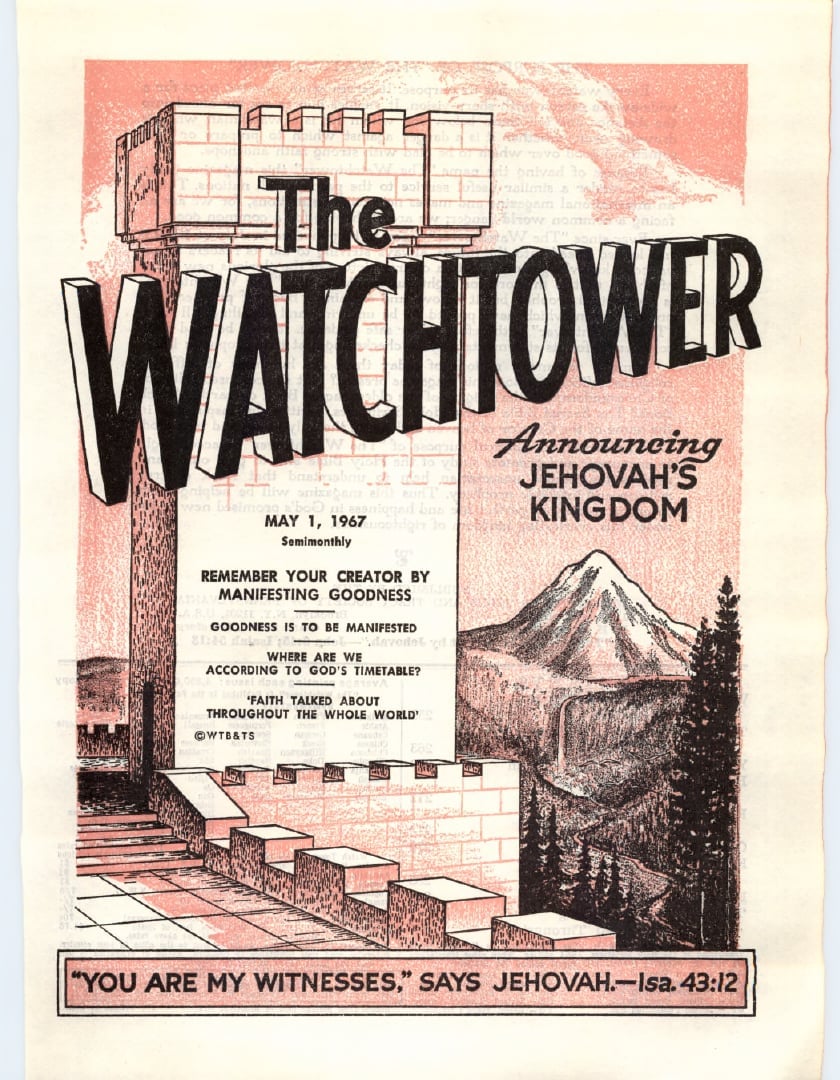
The Watchtower — May 1, 1967
Source: jw.org
Contents
Where Are We According to God’s Timetable?
‘Faith Talked About Throughout the Whole World’
You Are Invited to Come Again
Happy Missionaries Urged to Appreciate Life
Remember Your Creator by Manifesting Goodness
Goodness Is to Be Manifested
Keep Christian Balance Under Responsibilities
Do You Remember?
‘Blessing Jehovah Among the Congregated Throngs’
Announcements
Where Are We According to God’s Timetable?
Where Are We According to God’s Timetable?
FROM reading God’s Word the Bible one cannot but conclude that God knows what the future holds. For the frightful events of our time were all foretold by him centuries ago and are appearing on the world scene precisely on schedule according to his “timetable.” Not that God Almighty is responsible for all that has happened on earth down through the ages. He himself testifies that men “have acted ruinously on their own part,” that “the defect is their own.” (Deut. 32:5) Rather, in his infinite wisdom he has been able to predetermine what course nations would take, and for our guidance and encouragement has caused a record of these prophetic events to be written down in his Word the Bible.
Therefore, knowledge of this “timetable” is of intense interest to man, for it provides him with priceless information that marks his location in the stream of time. It also reveals what events are about to break forth on the world scene. So with this information close at hand we can chart a course in life that will lead to a happy conclusion.
For example, the Bible “timetable” indicates that we are at the threshold of a new era, that this earth is in store for a number of dramatic changes in this very generation—changes that will affect your life and that of every other person for all time to come. It shows we are facing the day for the expression of God’s wrath against all wickedness in the battle at what the Bible calls “Armageddon.” Following that war will be the glorious thousand-year reign of Jesus Christ. (Rev. 16:16; 20:4-6) Exercising faith in these promises, a great crowd of mankind have arranged their lives in harmony with God’s Word in hope of becoming recipients of the blessings that are to come.
But how can we be confident that these promises are sure of fulfillment? The answer is simple: Because these are the promises of a God who cannot lie. (Heb. 6:18) They are scheduled events in the “timetable” of God.—Matt. 24:34, 35.
For instance, in the book of Ecclesiastes (3:1, 8) the Creator assures us: “For everything there is an appointed time, even a time for every affair under the heavens: . . . a time for war and a time for peace.” Without doubt, then, there is a precise time for the war of Armageddon to be fought and also a set time for the peaceful thousand-year reign of Christ to begin.
A close study of the Bible helps us to appreciate that world events can be anticipated and understood in advance by those who are acquainted with Bible prophecies. For example, from a study of the Hebrew Scriptures Jesus Christ knew that he was destined to suffer, die and be resurrected to life. So he told his disciples in advance that “he must go to Jerusalem and suffer many things from the older men and chief priests and scribes, and be killed, and on the third day be raised up.” (Matt. 16:21-23) The reason for such prophecies was given by Jesus in these words: “So now I have told you before it occurs, in order that, when it does occur, you may believe.” (John 14:25-29) This is the advantage of knowing prophecy and seeing its fulfillment. We gain faith and strength in witnessing the fulfillment of God’s promises and can look ahead with confidence to seeing other promises fulfilled. Therefore, those who do not believe forfeit the value of God’s “timetable” for themselves.
PROPHECIES FOR ENCOURAGEMENT
God’s promises and prophecies are for our encouragement. For example, long before the Hebrews were enslaved in Egypt, God told Abram: “You may know for sure that your seed will become an alien resident in a land not theirs, and they will have to serve them, and these will certainly afflict them for four hundred years.” (Gen. 15:13) The beginning of that affliction was when Ishmael, son of the Egyptian Hagar, mocked Isaac in the year 1913 B.C.E. Subtracting 400 years from 1913 brings us to 1513 B.C.E., the precise year when God delivered the Israelites from Egyptian bondage. Knowledge of this prophecy to Abram could have served as a source of great encouragement to those enslaved and afflicted Jews, for it also told of deliverance.—Gen. 50:24, 25.
Another example where knowledge of a recorded prophecy served as an encouragement can be found in the prophecy of Jeremiah. Jehovah caused his prophet Jeremiah to write that the Jews would be held captive in Babylon while their land was desolate for seventy years. (Jer. 29:10) The prophet Daniel, while in Babylon, took encouragement from these prophetic words and looked for the releasing of his people and their return to Jerusalem, which took place in 537 B.C.E., precisely seventy years after Judah had been left uninhabited when the last Jews fled to Egypt not long after Jerusalem’s desolation. This again emphasizes the accurateness of God’s “timetable.”
At the beginning of the first century of our Common Era faithful Jews were looking for the Messiah because of recorded prophecies. The prophet Daniel was told “that from the going forth of the commandment to restore and to build Jerusalem unto the anointed one [Messiah], the prince, shall be seven weeks, and threescore and two weeks.” (Dan. 9:24, 25, AS) In other words, sixty-nine weeks of years or 483 years (for these are symbolic weeks) would pass. (Ezek. 4:6) It was in 455 B.C.E. that King Artaxerxes decreed that the city of Jerusalem and its wall be rebuilt. (Neh. 2:1-8) Counting from 455 B.C.E., the 483 years would end 29 C.E. In 29 C.E. Jesus of Nazareth was anointed with holy spirit, at which time he became Jesus Christ or Jesus the Messiah, the anointed one. In that year Andrew the brother of Simon Peter declared: “‘We have found the Messiah’ (which means, when translated, Christ).” (John 1:41) This was precisely as foretold by the prophet Daniel centuries before.
Since prophecies and promises of God were an encouragement for men throughout all ages, we who live at the conclusion of this system of things would be wise to turn to the same sources for our encouragement.—Rom. 15:4.
END OF THE GENTILE TIMES
Ours is a most critical generation. Bible chronology and prophecies agree on this fact. We who live today stand at the threshold of Armageddon, God’s war in which the wicked will be wiped off the earth. This also means we stand at the threshold of the incomparable peaceful, righteous rule of Christ that is to follow. But how can we be sure? Because of prophecies and God’s unerring “timetable.”—2 Tim. 3:1-5; Matt. 24:21; 2 Pet. 3:13.
Consider the time factor that Jesus gave. He said: “Jerusalem will be trampled on by the nations, until the appointed times of the nations are fulfilled.” (Luke 21:24) After this, as he said, “nation will rise against nation and kingdom against kingdom, and there will be food shortages and earthquakes in one place after another. All these things are a beginning of pangs of distress.” (Matt. 24:7, 8) The “appointed times of the nations,” mentioned by Jesus, indicated a period in which there would be no representative government of Jehovah in the hands of the royal line of King David to interfere with the Gentile domination of the earth. So when did those “times” begin, and for how long a period would they extend?
Those Gentile Times began to count in 607 B.C.E., when Jerusalem, the capital of God’s representative government on earth, was destroyed by the king of Babylon. They were to run for seven symbolic times, as shown by Daniel chapter 4. There in Daniel is found a prophecy concerning the kingdom of God (Dan. 4:34), a prophecy that pointed to the time when the one chosen by God would be given the right to rule (Dan. 4:17, 25, 32) after a period of “seven times” had elapsed. The Bible indicates that each of those “times” would be 360 years in length, and that the seven would, therefore, be 2,520 years in duration.a That time period ended in the autumn of 1914 of our Common Era. This fact is significant because, according to the prophecies of God’s “timetable,” the earth was to witness a marked change after 1914. Well, did it?
EVIDENCE MARKING THE END
For over thirty-five years in advance Jehovah’s witnesses proclaimed that 1914 would be a marked year. As early as 1877 their publications warned that 1914 would see Gentile rule interrupted by the kingdom of God. They firmly believed that Jesus’ prophecy of the conclusion of the system of things would come true, that following the end of the Gentile Times God’s Messianic kingdom would come into full power and the Gentile powers on earth be ousted.
But nothing in the early part of 1914 indicated that world upheaval was at hand. The nations were at peace. The world’s scene was a scoffer’s dream, and scoff many did. It was not until late June of 1914 that the world began to feel the jitters of world instability. But by October 1, 1914, it was obvious that Jesus’ prophecy was fulfilled and that the “appointed times of the nations” had ended. Historians and statesmen speak of 1914 C.E. as being a “dividing line in history,” “the day when the world went mad,” a “turning point,” when ‘the world began its march toward disaster.’ This is precisely what God’s “timetable” said 1914, the year marking the end of the Gentile Times, would be.
World War I did not settle the world’s problems. It merely sowed the seeds that plunged the world into another and even greater war within the same generation, namely, World War II. Shortly thereafter came smaller wars and revolutions. As Jesus foretold, the end of the Gentile Times would mark “a beginning of pangs of distress” for the earth, and so it has been.
Since 1914, the earth has also experienced unprecedented famine. Food shortages have affected more than twice as many people as were affected in the 900 years before. Pestilences have increased in the earth and go on increasing. Mental and nervous disorders, heart diseases and cancer are reaching the proportions of a global calamity. And earthquakes, too, are bringing increased woe. The yearly toll in lives lost from earthquakes since 1914 has been ten times what it was before that year.
These events emphasize the preciseness of God’s “timetable.” They make us witnesses of fulfilled prophecies. They tell us what Satan the Devil already knows, namely, that we stand at the threshold of Armageddon, that his wicked rule is about to end, that ‘God’s kingdom come’ will soon be a reality for the earth.—Rev. 12:12.
THE END OF 6,000 YEARS
In examining these Scriptural facts, something else also captures our attention. According to Bible chronology, we are already over fifty-two years into the wicked system of things’ “time of the end.” That time began in the autumn of 1914 C.E., at the termination of the “appointed times of the nations,” and it is already far advanced. Jesus said that “this generation” that saw the beginning of this time period in 1914 would also see its end. The generation that was old enough to view those events with understanding in 1914 is no longer young. It no longer has many years to run. Already many of its members have died. But Jesus showed that there would still be members of “this generation” alive at the time of the passing away of this wicked system of things in both heaven and earth. (Luke 21:32, 33) How much longer will it be, then, before God takes action to destroy the wicked and usher in the blessings of his Kingdom rule?
Interestingly, the autumn of the year 1975 marks the end of 6,000 years of human experience. This is ascertainable from reliable chronology preserved in the Bible itself. What will that year mean for humankind? Will it be the time when God executes the wicked and starts off the thousand-year reign of his Son Jesus Christ? It very well could, but we will have to wait to see. Yet of this we can be certain: the generation that Jesus said would witness those events is nearing its close. The time is close at hand. On God’s “timetable” we are in the closing days of a wicked system of things that will soon be gone forever. A glorious new order is immediately before us. This is, therefore, good reason for Christians everywhere to rejoice. Yes, they rejoice because fulfillment of their prayers for the kingdom of God is now at hand.—Luke 21:28.
Therefore, keep in mind the admonition of the Lord Jesus when speaking of our day: “Keep awake, then, all the time making supplication that you may succeed in escaping all these things that are destined to occur, and in standing before the Son of man.” (Luke 21:36) The prophecy is sure; the time is short.
[Footnotes]
See the book “Babylon the Great Has Fallen!” God’s Kingdom Rules!, pages 174-181.
‘Faith Talked About Throughout the Whole World’
‘Faith Talked About Throughout the Whole World’
—Displayed at “God’s Sons of Liberty” Assemblies
THE faith-displaying course of devoted servants of Jehovah in this day, as in the past, is truly a fit subject for upbuilding consideration. It moves other servants of God to inquire into how such strength of faith can be acquired. It leads them to examine their own attitudes and ways of thinking in order to root out any that raise obstacles to the growth of faith. As they apply the lessons learned, followers of Christ today are in effect saying what first-century disciples said to the Master: “Give us more faith.”—Luke 17:5.
Things learned and experiences reported at the 1966-67 series of “God’s Sons of Liberty” International Assemblies provide much food for thought along this line. Jehovah’s witnesses from the northern hemisphere had opportunity to visit Mexico, Central and South America and the islands of the Caribbean and see firsthand the background against which a vast campaign of Bible education is being pushed in those southern lands. They were thrilled by what they saw and heard, and felt they could react as did the apostle Paul when he informed the congregation of Christians in Rome: “Your faith is talked about throughout the whole world.”—Rom. 1:8.
ATTENDING ASSEMBLIES
For example, have you ever hesitated about attending some circuit or district assembly of Jehovah’s witnesses organized for your benefit, because of some seemingly insurmountable obstacles? Jesus taught that faith can surmount obstacles. (Matt. 17:20) And that has proved to be true of many of Jehovah’s witnesses in Latin America. One schoolteacher living some 200 miles distant from Montevideo, Uruguay, wanted to get to the assembly, but her opposed husband even made it difficult for her to attend local meetings. Was she discouraged? Did her faith waver? No, for she went ahead with preparations, confident that, if it was the Lord’s will, she would get there. The unexpected happened. A government department handling her retirement application called her to the capital for discussion at the very time when the assembly would be in session. So she was one of the happy participants.
A group of Witnesses from the coast of Honduras started out by train for the assembly in Tegucigalpa. They could not get through because high waters had rendered a rail bridge impassable. Did they give up? No! They went home and tried again next day and got through and finally arrived one day after the assembly had started. Obstacles could not extinguish their zeal for attendance at the spiritual feast prepared for them.
Jehovah’s witnesses from Manaus, in the Amazon basin, traveled four days on that mighty river to reach Belém on the coast, and then five days by bus to get to the Brazilian assembly in São Paulo. The prospect and the hazards of a twenty-day return trip could not shake their determination to attend.
Thirty-seven delegates from Nuevo Paraíso, Colombia, were undeterred by the hazardous trip in a large motor-powered canoe. As it turned out, the boat did capsize and they lost all their spare clothing and money. However, they turned up at the assembly in Barranquilla undaunted, happy to be alive to partake of the spiritual bounty of the Lord’s table.
Many Witnesses had to be resourceful in order to make the trip to the assembly site. One Uruguayan Witness began taking in washing early in July so that when January arrived she would have enough funds for the journey. Another with several children and an opposed husband made and sold ice cream to earn her travel expenses.
FAITH TO REACH OUT
How do you view the possibility of taking on enlarged privileges and responsibilities in Kingdom service? Those who have faith to reach out and grasp such opportunities are truly blessed by Jehovah, as experiences told at the “God’s Sons of Liberty” assemblies show. One Witness in a fishing town in Peru was informed that he could not qualify to be a special pioneer minister until he learned to read and write. That did it. He began studying right away, made excellent progress in but a few months, and now has his assignment as a special pioneer minister in his hometown. From his district two hundred persons came to the assembly in Lima.
How signally blessed was one Uruguayan Witness who, despite frail health, reached out for pioneer ministerial privileges! She has been instrumental in bringing some ninety persons into the organization of Jehovah’s witnesses, eighty of them already baptized. How rewarding it was for her to see a good proportion of these mount the platform at the Montevideo assembly in testimony to her zealous and diligent ministry!
Northern visitors at all these assemblies also met and talked with missionaries who years ago had the faith to reach out for service privileges. They accepted the invitation to train at the Watchtower Bible School of Gilead and were sent off to foreign assignments. But did they have the faith to stick with their assignments? They certainly did. Think of it! Eight graduates from Gilead’s first class back in 1943 are still faithfully serving in Mexico and others are to be found in various Central and South American lands. Surely their faith is like Abraham’s!
FAITHFUL CONDUCT IMPRESSES
“Fine testimony from people on the outside” of the Christian congregation is, in fact, testimony to the faith of God’s servants. (1 Tim. 3:7) Let us never overlook the effect that good conduct has on persons who observe Jehovah’s witnesses under varying conditions. They really take note and talk about it, as convention delegates learned during the Central and South American tour of assemblies. A waiter in a Panama restaurant approached some Witnesses and asked: “Who are you people? You all seem so happy, and there is no discrimination among you—how can it be?” When told that the Witnesses were the same people who distribute the book From Paradise Lost to Paradise Regained, which he already had, he declared he was going to get it out and start studying it.
The supervisor of a bus company in San Juan, Puerto Rico, after dealing with the assembly organization, said to his staff: “We must cooperate to the greatest extent with these people; they are the most organized people we have dealt with.” And a hotel manager in Mexico City declared: “You Witnesses are welcome here anytime. How many rooms do you want?” Another hotel manager, this time in Kingston, Jamaica, said: “Although I am not one of Jehovah’s witnesses, if I could employ only Witnesses here I would be happy. For with such a staff we could run a trouble-free hotel.”
A Government official in Ecuador said of the assembly organization: “They have every last detail planned out with mathematical precision. There is not much that we can do for them that they have not already done for themselves.” And an airline manager stated: “You people did a magnificent job of organization. Wish we had men like you in our firm.” A hotel manager in one South American city, remarking on the efficiency of the Witnesses, observed: “If you people were running the country I would not mind paying taxes, for I know I would get my money’s worth.”
The auditorium personnel at the Palacio Peñarol, Montevideo, Uruguay, were deeply impressed. At first they were smoking, but as they got to associating with and cooperating with the Witness workers it was noticeable that none of them smoked any longer, and they would address each Witness as Hermano or “Brother.” One of them declared: “This is the first time the Palacio has a clean smell, free of tobacco smoke and other odors.” Another said: “This is the first time the Palacio management has turned over the entire building, including rooms and private offices, to anyone, and they seem unconcerned about how the property will be handled.”
Time and again conventioners heard at these assemblies that Indians and the poorer natives in remote districts of all those southern lands were impressed, above all, by the willingness of missionaries and other Witnesses to come into their humble homes and even eat with them. They quickly gain confidence in teachers of this kind, teachers of the Bible who are prepared to put its fine principles into operation in their own lives.
HAVING DONE ALL, TRUST JEHOVAH
It often happens that servants of God have done their very best to carry out his will and yet reach the point where they must trust in Jehovah for the outcome, because it may be beyond their power to achieve. They need faith in God to meet such situations. For example, think of the position of the Watch Tower convention servant at Managua, Nicaragua, when he learned that the leaseholder who had rented the auditorium to him had lost his lease, and the contract with him was no longer valid. The opening of the assembly was just days away, with delegates on their way from all over Nicaragua, not to speak of the many foreign delegates. But everything finally worked out well. The owner of the auditorium consented to negotiate a last-minute contract.
Normally, January 1 marks the start of Ecuador’s rainy season, and with it come hordes of crickets and mosquitoes. In previous years the crickets had to be swept up by the bushel in the downtown areas, while mosquitoes made life unbearable to everyone. This year, sure enough, the rains did come on January 1, the very day that four planeloads of Witness delegates arrived from Panama. However, a successful assembly was held in Guayaquil’s Covered Coliseum. And what of the crickets? They arrived in their thousands one hour after the closing session, penetrating every corner of the Coliseum. As someone remarked, referring to the locustlike thoroughness of the Witness organization: “The locusts moved out and the crickets moved in.”
Witnesses in Santiago, Chile, had had their eyes on the huge Velodrome in the grounds of the National Stadium ever since the idea of an international assembly in their city became known. But the Velodrome was still unfinished, and even the cyclist association for whose use it was being built had tried and failed to get the use of it as late as the month of December. Nevertheless, by patient, continuing discussion with one group of officials after another, this new structure was finally opened to Jehovah’s witnesses, and the “God’s Sons of Liberty” Assembly was the first event to take place in it. Cycling fans were urged by a news reporter to attend the Witnesses’ assembly in order to get their first glimpse of the completed Velodrome.
In Uruguay it seemed that a strike that tied up all buses and taxies would have a grave effect on attendance at the assembly. However, this obstacle, too, was surmounted. How? Many of the incoming delegates simply walked to their accommodations, some many blocks. Many types of transportation were pressed into use, including a fire department bus and a huge dump truck. But the visitors got to their hotels and rooms, and they also managed to be at the Palacio Peñarol for the unforgettable sessions of the assembly.
ASSEMBLIES IN THE HEADLINES
Without exception the 1966-67 series of assemblies produced the greatest amount of favorable public attention ever given to the activities of Jehovah’s people in Central and South America. But not without a great deal of hard work and faith in Jehovah as to the outcome was this result achieved. Newspapers in Jamaica gave an unprecedented 730 column inches to reports on the activities of the Witnesses at Kingston’s National Stadium. One entire page of a leading paper was filled with pictures of cafeteria activity, and carried favorable comment on the cleanliness observed among the Witnesses.
In Guatemala the Government-owned radio station provided three hours of free time for interviews and other reports on the assembly, while Guatemalan papers published 400 column inches, including eighteen photographs relating to the Witnesses’ gathering. In San Juan, Puerto Rico, five banners announcing the public lecture were strung across the streets at strategic points. In Brazil an excellent job was done of bringing the assembly to the attention of the press, with the result that the final count in column inches amounted to 4,263.
The illustrated Flash magazine of Santiago, Chile, featured the baptism on its cover, with the four succeeding pages of pictures and explanatory text under the heading: “Swimpool of National Stadium Converted into Baptismal Font.” Quite different in motive was the article published by the Communist daily in the same city, El Siglo (The Century), under the headline: “Jehovah’s Witnesses Convert National Stadium into Temple of Anticommunism.” Other local papers, however, explained truthfully that the Witnesses are entirely neutral as to political questions and are exclusively devoted to preaching and teaching the Bible’s message for our day.
Puerto Rico’s illustrated magazine Bohemia, in its issue of February 26, 1967, carried a six-page story of the assembly, including twelve pictures, drawing attention to the baptism and the Bible dramas. The article concluded: “With the sincerity that flows from the words of Jehovah’s [witnesses], countless boricuas [Puerto Ricans] are deeply convinced that they will make it to the era of ‘Mankind’s Millennium Under God’s Kingdom.’”
All of Costa Rica’s national newspapers published items on the assembly in San José, in all, over seventy column inches. Here, too, an interview in Spanish with F. W. Franz, vice-president of the Watch Tower Society, was broadcast over a nationwide network. So by radio, television and printed page, news about the faith of Jehovah’s people was spread and talked about in many parts of this western hemisphere.
MISSIONARIES TELL THEIR STORY
Visiting Witnesses to Mexico and other lands to the south will never forget hearing firsthand accounts by genuine missionaries of their tribulations and joys in foreign assignments. Special English sessions at each assembly furnished the opportunity to get to know these missionaries who, many years ago, left homes, families, conveniences and luxuries, to serve in areas where the need for Kingdom preaching was particularly great. Also, at each branch home of the Watch Tower Society the president and directors of the Watch Tower Society enjoyed a special get-together with these missionaries, including a fine meal. How wonderful it was to talk with faithful ministers who have been diligent in their missionary assignments for periods up to twenty years or more!
One missionary recounted how three interested families in a small Peruvian town got together and started having meetings in a home. Soon they had an attendance of thirty. A Witness offered his garage and obtained some chairs so as to care for the growing attendance. From this same town came thirty-two delegates to the “God’s Sons of Liberty” Assembly. Another missionary, assigned to Colombia two years ago, told that in all that time he could recall only one door being slammed in his face.
Those missionaries have been privileged to witness marvelous growth of the Kingdom interests. As one remarked in connection with the ministry in Colombia: “In the matter of assembly places we have progressed all the way from backyards to stadiums.” And those faithful missionaries look at their assignment as “home.” They tell how once in a while relatives will write and urge them to come home to the comforts of a more modern land. But the view they have adopted is that the simplicity of life in a foreign assignment permits them to give far greater care to the interests of the Kingdom, unhampered by distractions. Besides, when they do go back north for a brief vacation, they are eager to get back to these lovable people who have become their children in the faith. They feel like fish out of water being anywhere other than in their assignments.
On a number of occasions visiting delegates heard President N. H. Knorr of the Watch Tower Society bid them, when back home, tell fellow Witnesses what a large and satisfying field there is in these lands of the south for those with the true missionary spirit. There are still many places to which whole families could move and serve where the need is greater. Young married couples and single boys and girls should inquire how they can qualify for Gilead training and be equipped for a lifetime career as missionaries. The spirit of Isaiah is needed, the “Here I am! Send me” attitude. (Isa. 6:8) Just imagine! The crying need of the vast field in those southern lands is for at least a thousand more missionaries right now!
ASSEMBLY HIGHLIGHTS
The faith of a multitude of new Witnesses was displayed at the baptism sessions of the “God’s Sons of Liberty” assemblies. Not lightly, but after sober consideration and many months of Bible study, did those groups of every age bracket, from the teen years up to the seventies, step forward and declare themselves ready to submit to immersion in water as a public testimony of their dedication of their lives to God. In all, a grand total of 6,131 persons were baptized during the entire assembly tour.
The Bible dramas presented on the program at each assembly were hailed by the Witnesses as a most effective means of impressing the fine principles of the Bible on young and old. After seeing the vivid counsel portrayed in “Look to the Bible as Our Guide in Life,” one Ecuadorian parent, who had saved for months so as to bring his family to the assembly, declared: “It was worth every sucre I spent for my children to see that one demonstration. None of us will forget the counsel given in such a striking way.” Another delegate commented: “Never has the Bible had such force. Now, when I read the Bible, I’m going to try to see the things I’m reading, to remember them.”
The public lecture on the theme “Mankind’s Millennium Under God’s Kingdom” drew unprecedented crowds, with a total of more than 175,000 persons hearing it at the twenty-one assemblies. It was very evident that people are interested in the future that God’s Word envisions for the earth and obedient men upon it. The peak number attending some of the assemblies was several times the total number of Witnesses in the country.
Such figures speak eloquently about the increase of active Witnesses in all these lands in the past twenty years. They also reveal something of the magnitude of the field in which there is still need for those who have the faith to reach out for greater privileges of Kingdom service. Multitudes in those lands are anxious to learn how to study the Bible and to serve God acceptably. They need teachers who will show them how. Considering the whole of the western hemisphere south of the continental United States together, it is noted that there is but one Witness for each 1,600 of population. How urgent the need for qualified missionaries and others who can plan their affairs so as to spend a greater share of their time, in the few years remaining for this system of things, in spreading the good news to waiting multitudes!
The faith of missionaries already active in this and other parts of the world field is talked about throughout the whole world, wherever Jehovah’s witnesses are located. They have truly spearheaded a grand work of enlightening peoples of many nations. Do you, too, have such faith, and will it move you to volunteer your services?
[Chart on page 268]
Witnesses Witnesses Peak Number
active in active in Assembly Baptized
Location of Assembly 1947 Jan. ‘67 Attendance
Mexico City, Mexico 4,125 33,257 36,556 1,082
Guatemala City, 75 1,446 2,950 102
Guatemala
San Salvador, 80 1,026 4,989 105
El Salvador
Belize, 38 370 755 10
British Honduras
Tegucigalpa, Honduras 45 837 1,422 60
Managua, Nicaragua 36 824 1,654 71
San José, Costa Rica 449 2,677 2,974 73
Panama City, Panama 175 1,413 2,110 60
Barranquilla, Colombia 29 4,203 5,777 179
Kingston, Jamaica 1,185 5,162 9,458 189
Guayaquil, Ecuador 14 1,616 2,723 172
Lima, Peru 22 2,484 6,925 265
Santiago, Chile 137 3,888 7,693 441
La Paz, Bolivia 16 562 1,150 66
Asunción, Paraguay 34 535 489 37
Buenos Aires, Argentina 679 12,331 15,238 692
(including Córdoba)
Montevideo, Uruguay 175 2,264 3,958 212
São Paulo, Brazil 648 38,109 46,151 1,723
Caracas, Venezuela 29 4,171 10,463 195
San Juan, Puerto Rico 87 3,488 8,604 225
Santo Domingo, Dom. Rep. 59 2,312 5,154 172
8,137 122,945 177,193 6,131
You Are Invited to Come Again
You Are Invited to Come Again
EACH year Jehovah’s witnesses and their friends gather in congregation groups around the earth to celebrate the “Lord’s supper” on Nisan 14, according to the ancient Jewish calendar. This year that memorial supper was held on the night of March 25. Perhaps you were present.
Yearly, large numbers of readers of The Watchtower do attend the Memorial. In 1966, 1,971,107 persons met together around the world on that sacred occasion. The report for this year has not yet been completed, but we have every reason to believe that again the attendance was large. Yet something concerns us: This past year we observed that about a million who attended the Memorial never came to any of the other meetings of the congregation. These other meetings are just as important in the life of a Christian. The Bible is just as pointed in counseling us to attend these meetings as it is in instructing that the “Lord’s supper” be held. (Heb. 10:23-25) Why, then, do so many attend one meeting but not the others?
A surprising number of people apparently believe that a single attendance is all that is required of them as Christians and to gain salvation. Thus these miss one of the key points highlighted at the Lord’s evening meal, namely, the need for Christians to meet together regularly.
That need was emphasized by what happened immediately after the first celebration of the Lord’s evening meal in the year 33 of our Common Era. Think what the apostles would have missed had they left the upper room and Jerusalem that night with the thought of not assembling together again until the following year. They would have missed the resurrection of Jesus Christ, meeting with him in Galilee, seeing him ascend to heaven, the outpouring of the holy spirit at Pentecost, the miracle of the tongues. But those who were regularly meeting together for worship did not miss out.
After Jesus’ resurrection, for fear of the Jews the disciples of Christ met together behind locked doors. This they did despite the danger to themselves, because they appreciated the vital need and importance of meeting together. On one such occasion the resurrected Jesus paid them an unexpected visit, showing thereby that he approved of what they were doing. Jesus entered through a locked door, much to the disciples’ amazement. The apostle Thomas missed this meeting. Since he was not present, the brothers began to tell him what he had missed, namely, “We have seen the Lord!” Thomas responded with disbelief: ‘I don’t believe it!’ “Unless I see in his hands the print of the nails and stick my finger into the print of the nails and stick my hand into his side, I will certainly not believe.” Obviously, Thomas’ faith was weak.
Eight days later Jesus’ disciples were again at a meeting. This time Thomas was with them. The Bible account says: “Jesus came, although the doors were locked, and he stood in their midst and said: ‘May you have peace.’ Next he said to Thomas: ‘Put your finger here, and see my hands, and take your hand and stick it into my side, and stop being unbelieving but become believing.’” (John 20:24-27) Thomas’ faith was restored. That is what meetings are for, to restore faith, to keep us believing. We can still count on Christ’s restorative powers to help us out of our unbelief, for he gave us this promise: “Where there are two or three gathered together in my name, there I am in their midst.” (Matt. 18:20) He is in our midst if we meet together in his name.
PURPOSE OF MEETINGS
Regularly attending and participating in meetings is an outward act of faith. It is an essential part of declaring publicly our faith that Christ is Lord. The apostle Paul says this must be done: “If you publicly declare that ‘word in your own mouth,’ that Jesus is Lord, and exercise faith in your heart that God raised him up from the dead, you will be saved. For with the heart one exercises faith for righteousness, but with the mouth one makes public declaration for salvation.” (Rom. 10:9, 10) Thomas indeed gave public declaration when he beheld the risen Christ. He cried out: “My Lord and my God!” But Jesus said to Thomas: “Because you have seen me have you believed? Happy are those who do not see and yet believe.” (John 20:28, 29) Yes, happy are those who today, in faith, make public declaration of this fact that Jesus is Christ the Lord.
Meetings are like water holes where thirsty souls gather to drink. Christians assemble regularly to replenish themselves spiritually and to receive instruction. At meetings Jesus taught his disciples many things. At one meeting after his resurrection he gave them the order: “Do not withdraw from Jerusalem, but keep waiting for what the Father has promised . . . you will be baptized in holy spirit not many days after this.” (Acts 1:4, 5) At a meeting Jesus instructed them as to their service work: “You will be witnesses of me . . . to the most distant part of the earth.” (Acts 1:8) Failure to attend those meetings would have meant missing out on precious privileges.
After Jesus ascended to heaven his disciples continued to assemble together regularly. They met in an upper chamber where they persisted in prayer. At a meeting Matthias was selected to fill the spot vacated by Judas Iscariot. The holy spirit was also poured out on a congregation of 120 while they were together at a meeting.—Acts 1:12-14, 24-26; 2:1-4, 46, 47; 4:31.
So the idea of going home Memorial night and not showing up among Christian brothers until the next Memorial is certainly not in keeping with what Christ and the apostles did, is it?
MISLEADING CONCEPTS
Beware of the dangerous concept that says all that is required to gain God’s approval and life is an appearance at the Lord’s evening meal once a year. This, of course, is not true. One meeting cannot supply us all our spiritual needs any more than one meal can supply all our physical needs. Jesus made this plain, saying: “Man must live, not on bread alone, but on every utterance coming forth through Jehovah’s mouth.” (Matt. 4:4) Everlasting life requires the regular taking in of the knowledge of God and Christ. (John 17:3) Meetings keep us in touch with that constant flow.
Some people say, ‘We have our Bible and in the privacy of our own homes we can study it without having to go to meetings.’ This sounds fine, but is it the whole truth? How often weeks pass by without persons even once opening the Bible or seriously meditating on its message! It is a rare person indeed who today sets aside time to study the Bible privately and does so regularly.
While private home Bible study is most commendable and should not be discouraged or neglected, it is misleading to think that it will supply all our spiritual needs, even if we do adhere to a strict schedule. There are needs that can be supplied only in the association with others. For example, the text at John 5:37 perplexed a Bible student for years. At a meeting one day it was read and commented on. An understanding of it flashed through the mind. Jesus was not addressing his words to all men, but only to those near him. ‘They had not heard God’s voice or seen his figure.’ This flash of light came at a meeting, which calls to mind the proverb: “By iron, iron itself is sharpened. So one man sharpens the face of another.” (Prov. 27:17) This underscores the importance of meetings.
MEETINGS AN OBLIGATION
The apostle Paul gave us still another reason why we should want to meet regularly with our Christian brothers, saying: “Do not you people be owing anybody a single thing, except to love one another.” (Rom. 13:8) We owe love to our brothers, which debt we must pay. At meetings we can best do this. Stressing this point, Paul says: “Consider one another to incite to love and fine works, not forsaking the gathering of ourselves together, as some have the custom, but encouraging one another, and all the more so as you behold the day drawing near.”—Heb. 10:24, 25.
Our love should compel us to meet with our Christian brothers regularly, if at all possible. What love would that be if a husband and a wife voluntarily stayed away from each other weeks, months and years at a time? Christ’s love is manifest in these words: “I am with you all the days.” (Matt. 28:20) Our love must reflect the same desire, that is, to be where the brothers are met together.
Memorial reminds us not to be selfish, not to think solely of ourselves, but to minister to the needs of one another. (Matt. 20:28) If Christ were hungry, thirsty, a stranger, naked, sick, depressed or in prison, would you not care for him? Of course you would! This a person can do by ministering to the needs of even the least of these his brothers, which Christ counts as done to himself. Being at meetings, if at all possible, places one in a position to care for the needs of others, thus proving whether one is a “sheep” or a “goat.”—Matt. 25:34-46.
Whatever our position in life, there is need to continue to cultivate the same longing for the brothers that Paul had, the same concern for them, when he said: “I am longing to see you, that I may impart some spiritual gift to you in order for you to be made firm; or, rather, that there may be an interchange of encouragement among you, by each one through the other’s faith, both yours and mine.” (Rom. 1:11, 12) This fine attitude will prevent you from withdrawing to yourself, from becoming cool or indifferent toward those who need your love. This Christian attitude will transform you into what all men should be and what all who gain divine approval will eventually be, namely, active witnesses to the glory of God in one grand assembly.
So, do not wait another year to attend a meeting. Do not wait another week. You are invited to come to the Kingdom Hall again this week.
Happy Missionaries Urged to Appreciate Life
Happy Missionaries Urged to Appreciate Life
“ARE you students or alumni happy?” That is what F. W. Franz, vice-president of the Watch Tower Society, asked the graduating 43rd Class of the Watchtower Bible School of Gilead, gathered on March 12 in New York city. “I don’t mean happy because you are graduating, but happy in general. Well, you ought to be happy because we have entered the fifth decade of a remarkable time.”
What time? Franz showed that it was the blessed time mentioned at Daniel 12:12; being due to ‘true knowledge having become abundant because of many roving about’ in God’s Word. (Dan. 12:4) As a result, today Jehovah’s witnesses are experiencing a knowledge explosion. In conclusion Franz told the students: “Happy are you for having roved through the Bible and partaken of this abundant knowledge! Happy will you be as you lovingly and zealously share it with others!”
An example of the happiness that lay in store for them was brought out by another speaker, Max Larson. He told of one town 500 miles from Santiago, Chile, where a convention was to be held. There were a zealous group of missionaries and a congregation of thirty-six Witnesses in that town. How many came to the convention? All thirty-six? Even more; 100 came to that assembly of Jehovah’s witnesses 500 miles away!
To these happy missionaries with such happy prospects N. H. Knorr, president of the Watch Tower Society, spoke on appreciating life and the part maturity plays in holding on to that life. He began: “How do we think about life? How much time do we allow ourselves to meditate on the subject of life? How did we get to be? After we are here . . . what are we going to do with life? From where did you get this life? Your life, in fact, began with God, for when we go back far enough we come to Adam, and the Bible tells us that Adam was the son of God. (Luke 3:38) God is the Source of life. (Ps. 36:9) You have enjoyed life up until now, but you can enjoy it still more in the future. Life is so important, for without it we cannot have anything nor can we do anything for others. As it says at Ecclesiastes 9:5, 10, in death there is no consciousness, no work or wisdom. With life we can show others the way to life.”
Among other things, Knorr further observed: “If we appreciate life we will give God credit for the fact that we are alive. With life we can work, we can make others happy. To hold on to life we must keep on taking in knowledge of God and of his Son, for this means everlasting life. (John 17:3) Even Jesus Christ had to keep on taking in knowledge. And that is why maturing is so important. Maturity helps us to hold on to life, to enhance our life, to keep it forever. And let us keep humble, never thinking we know it all. We don’t. There is so much for us to learn. . . .
“We are happy for you. All of us are backing you up, but more than all else, God is with you. He is interested in you and backing you up. He gave you life in the first place. May you always press on, seeking maturity, because as you gain maturity you will have a stronger hold on life, everlasting life.” After these remarks he handed out the diplomas to those that had earned them, the great majority. The 103 students had come from twelve countries and were being sent to twenty-nine different lands. They were rather young folks, their average age being twenty-six years, and had been dedicated Christian ministers for an average of eleven years.
The highlights of the afternoon’s program, which was provided by the students themselves, also served to heighten appreciation of life. Very touching as well as inspiring was the graphic portrayal of a Witness who had spent two years in prison, living on crusts of bread, and who held on to her hope of life in God’s new order by calling to mind choice passages from the book of Philippians. An hour-long Bible drama in costume that dealt with God’s ancient merciful provision for the unintentional manslayer in the cities of refuge, and which provision was shown to have its counterpart in our day, pointed to the same moral. Most forcefully it made its point that life depends upon obedience to God and that life is worth more than any material possessions one might have.
Yes, without doubt the graduation program underscored not only the happiness of the missionaries but also appreciation of life. It was greatly enjoyed by the some 2,000 guests, friends and relatives, some of whom had come from as far west as Hawaii and as far east as London, England.
Remember Your Creator by Manifesting Goodness
Remember Your Creator by Manifesting Goodness
“Remember, now your grand Creator.”—Eccl. 12:1.
1, 2. (a) From what is Ecclesiastes 12:1 quoted? (b) What is the Bible? (c) Is everyone familiar with the Bible? (d) Is it of concern to you?
DO YOU recognize that the quotation above is from the holy book of the Christian religion? Are you familiar with that book? In some parts of the earth where The Watchtower is read persons do not profess to be Christians and are not familiar with it. It may be that you live where the Christian religion is claimed by many people, but still have not been particularly concerned about this religious book called the Bible. Or perhaps you know and love the Bible. Wherever you may live or whatever is your religious understanding, the subject that we want to discuss, that of remembering your grand Creator by manifesting goodness, is one with which you are concerned. The Scripture text above is religious counsel to all who have physical, mental and spiritual powers sufficient to enable them to remember their Creator, who is grand indeed.
2 The Watchtower recognizes that in all parts of the earth there are persons who feel that they are not religious, or, though religious, are not Christians. Nevertheless, there are expressions made in the Holy Scriptures that embrace you, whoever you are, of whatever religion you are, wherever you live upon earth, whether you are particularly religious or not. You are included because
THE HOLY BIBLE ADVISES EVERYONE TO PRAISE THE CREATOR, JEHOVAH GOD
3. Who should give heed to Bible counsel?
3 Many statements in the Bible show that persons of all ages, both men and women, of all nationalities, of all races and of all stations in life are included in its wholesome, upbuilding counsel. Can you find yourself in the text of Scripture that we here quote? You are there:
4. (a) As expressed in Psalm 148, what and who are to praise the Creator? (b) Who is the Creator?
4 “Praise Jah, you people!” The name Jah is an abbreviated form of the name Jehovah. Jehovah is the personal name of God, the Creator. “Praise Jehovah from the heavens, praise him in the heights. Praise him, all you his angels. Praise him, all you his army. Praise him, you sun and moon. Praise him, all you stars of light. Praise him, you heavens of the heavens, and you waters that are above the heavens. Let them praise the name of Jehovah; for he himself commanded, and they were created. . . . [Praise Jehovah] you kings of the earth and all you national groups, you princes and all you judges of the earth, you young men and also you virgins, you old men together with boys. Let them praise the name of Jehovah, for his name alone is unreachably high. . . . Praise Jah, you people!”—Ps. 148:1-5, 11-14.
5. Are you excluded or included?
5 So the Bible does here include you when it includes all mankind in its invitation and counsel to praise Jehovah, the Creator!
JEHOVAH THE CREATOR IS THE SOURCE OF SPIRIT AND LIGHT
6. Explain how Jehovah is the source of (a) holy spirit, (b) light, (c) the light of truth.
6 Jehovah the Creator has power. His power operates through his spirit or active force. One of the Bible references to this is found in the very first verses of the Holy Scriptures: “In the beginning God created the heavens and the earth. Now the earth proved to be formless and waste and there was darkness upon the surface of the watery deep; and God’s active force was moving to and fro over the surface of the waters. And God proceeded to say: ‘Let light come to be.’ Then there came to be light. After that God saw that the light was good, and God brought about a division between the light and the darkness.” Inasmuch as his spirit is from him, he is its source and also he is the source of physical light, as stated at Genesis 1:1-4. Also, the light of understanding and comprehension is from Jehovah God. This is pointed out most interestingly in 2 Corinthians 4:6: “For God is he who said: ‘Let the light shine out of darkness,’ and he has shone on our hearts to illuminate them with the glorious knowledge of God by the face of Christ.” God the Creator is the source of the light of illumination of truth.
7. By what means are Christians enlightened?
7 Through God’s spirit Christians receive the light of understanding of the truth of his Word. “For it is to us God has revealed them through his spirit . . . no one has come to know the things of God, except the spirit of God. Now we received . . . the spirit which is from God, that we might know the things that have been kindly given us by God.” (1 Cor. 2:10-12) In the first four 1 Co chapters 1-4 of this Bible book much is said about the operation of God’s spirit on persons who are Christians. These and other Scripture passages show that Jehovah God is the source of spirit and the source of light.
RESULTS ARE PRODUCED BY SPIRIT AND LIGHT
8. (a) Why should we remember Jehovah? (b) How may we do so? (c) In what do God’s spirit and light result?
8 In providing his Bible Jehovah has given to mankind his written Word and he also makes the understanding of it possible. His Word calls upon all persons to praise him and shows that as the grand Creator he is worthy of such praise. How could we forget him? He has made all we have and has enabled us to have life itself. Then should we remember him? Yes. How? One way that we can remember him is by manifesting qualities that he approves and that bring praise to him. Even as the operation of God’s laws concerning growth and production gives rise to fruit or fruitage, so the result of the operation of the light and spirit from Jehovah God upon the hearts and minds of those who love him is spoken of in his Word as fruitage. Notice two of these references.
9. (a) What kind of fruit is goodness? (b) Does God’s spirit produce bad fruits? (c) What follows in regard to a person’s fruitage?
9 “The fruitage of the spirit is love, joy, peace, long-suffering, kindness, goodness, faith, mildness, self-control.” (Gal. 5:22, 23) In this fifth chapter of Galatians strong contrast is made between things that are good and things that are not good. The spirit of the Creator does not produce things that are bad. God’s creation was found by him to be good, not bad. (Gen. 1:12, 18, 25, 31) He is good, not bad. (Ps. 25:7, 8) This means that persons who would be in harmony with Jehovah God must produce good things, the things that are shown to be the fruitage of God’s spirit.
10. Explain how it is that the fruitage of Jehovah’s spirit may be produced in men and women.
10 In what way are they the fruitage of God’s spirit when they are produced in men and women? In that persons who love righteousness do those good things because they have his spirit and wish to be in harmony with God. Their love for Jehovah and for the high standards of his Word the Bible impels them to conform to his requirements, and in this way they are led by God’s Word and spirit.
11. As to Galatians 5:22, what particularly claims our interest now?
11 You will notice that in the quotation from Galatians 5:22, 23 one of the specific things mentioned as being part of the fruitage of the spirit is “goodness.” It is particularly the manifestation of this quality of goodness that claims our interest here.
12. As to the light of truth from Jehovah, what result is to be found?
12 As to the fruitage of the light: “The fruitage of the light consists of every sort of goodness and righteousness and truth. Keep on making sure of what is acceptable to the Lord; and quit sharing with them in the unfruitful works that belong to the darkness, but, rather, even be reproving them, for the things that take place in secret by them it is shameful even to relate.” “Therefore do not become partakers with them; for you were once darkness, but you are now light in connection with the Lord. Go on walking as children of light.” (Eph. 5:9-12, 7, 8) Our interest centers again upon “goodness” as fruitage of the light of truth, as well as of the spirit of God.
13. (a) What follows as to persons who have received of God’s truth and spirit? (b) What wonderful opportunity do you have?
13 Inasmuch as the fruitage of goodness is the result of God’s spirit and truth, this goodness must be apparent in those who have his spirit and truth and would praise Jehovah the Creator. If this goodness is not apparent, the Creator is not remembered but is disregarded, forgotten or pushed into the background. The very fact of your existence as a member of humankind brings to you the opportunity to praise and worship the Creator, Jehovah, who reveals himself in his Holy Word, the Bible. What a wonderful and blessed opportunity is afforded, not only to have life, but to make this life worth while by remembering your Creator, manifesting goodness, winning his goodwill and with this the assurance of everlasting life! The Creator’s purpose is for those who receive his approval to have everlasting life in his righteous new system of things.
14, 15. (a) In contrasting and comparing good with bad, how do some persons reason? (b) What is the correct reasoning on the matter as to benefits desired? (c) as to time involved?
14 In our respective languages, whatever they may be, we contrast good with bad. The Bible makes the same contrast. But someone may say in effect, “I do not see value in doing what is good. I see those who do bad prospering. I do not see those who do bad punished. I see those who do good suffering and I see that those who do bad take advantage of those who try to do good. Therefore, why should I do good?” People do reason along this line and sometimes they become quite bitter of heart. Jehovah God is aware of this and his Word recognizes it. Being blessed for producing the fruit of goodness is not a matter of being benefited or favored by other men. The blessing and favor to be sought are those from God himself and this in his own due time. Time must pass. If there were no time allowed for us to manifest goodness, how could we manifest this desirable quality? So at a time when you may see that good conduct is not popular and perhaps not materially profitable, that is the very time for you to manifest goodness and thereby demonstrate that, regardless of what other persons do or do not do, you love and remember your grand Creator. How helpful this scripture is:
15 “Because sentence against a bad work has not been executed speedily, that is why the heart of the sons of men has become fully set in them to do bad. Although a sinner may be doing bad a hundred times and continuing a long time as he pleases, yet I am also aware that it will turn out well with those fearing the true God, because they were in fear of him. But it will not turn out well at all with the wicked one, neither will he prolong his days that are like a shadow, because he is not in fear of God.”—Eccl. 8:11-13.
16. In view of what the Bible teaches, what must we conclude?
16 So the delay of the execution of sentence against the bad work should not discourage us from doing good.
17. How are we assisted to produce good fruit by having in mind the time in which we are living?
17 Also have in mind the time in which we are living. These days are difficult times of violence, lawlessness, selfishness, and days when the works spoken of in 2 Timothy 3:1-3 are manifest. “But know this, that in the last days critical times hard to deal with will be here. For men will be . . . without love of goodness.” So if you see that men are without love of goodness this is no reason for you to exercise badness but is more impelling reason for you to produce the fruit of goodness.
18. Both Christians and non-Christians may be informed as to what?
18 In the further consideration of this subject you will be assisted by viewing it from the standpoint of what an individual Christian should do as set out in the Bible. Whether you profess to be Christian or do not profess to be Christian, you can see what the Bible designates as the real Christian course.
THERE ARE SO MANY GOOD THINGS TO DO
19. What definitions show that there are many good things to do?
19 There are many things that are right and good in conduct that individual Christians must do day by day. These things result in the fruit of goodness. Goodness, basically, is that which is fitting. “It is good to make melody to our God . . . praise is fitting.” (Ps. 147:1) Goodness is that which is fitting and suitable for the servants of the Creator by God’s standards. Things that are good work to a good end, a proper, suitable end. God’s Word shows a Christian what things are good and of what goodness consists. Deuteronomy 12:28 states: “Do what is good and right in the eyes of Jehovah.” Webster’s Third New International Dictionary (English language) defines “good” in English as basically meaning “uniting, fitting, becoming, appropriate,” and “goodness” as “moral excellence”; but in the Bible Greek, “capable; serviceable; of good morals.” In Bible Hebrew, “good (in every variety of meaning), pleasant, useful, efficient, beautiful, right, morally good.” Certainly there are many things for Christians to do that meet these definitions.—Jas. 3:17, 18.
…