The Watchtower, December 1, 1966
Download: PDF — The Watchtower, December 1, 1966
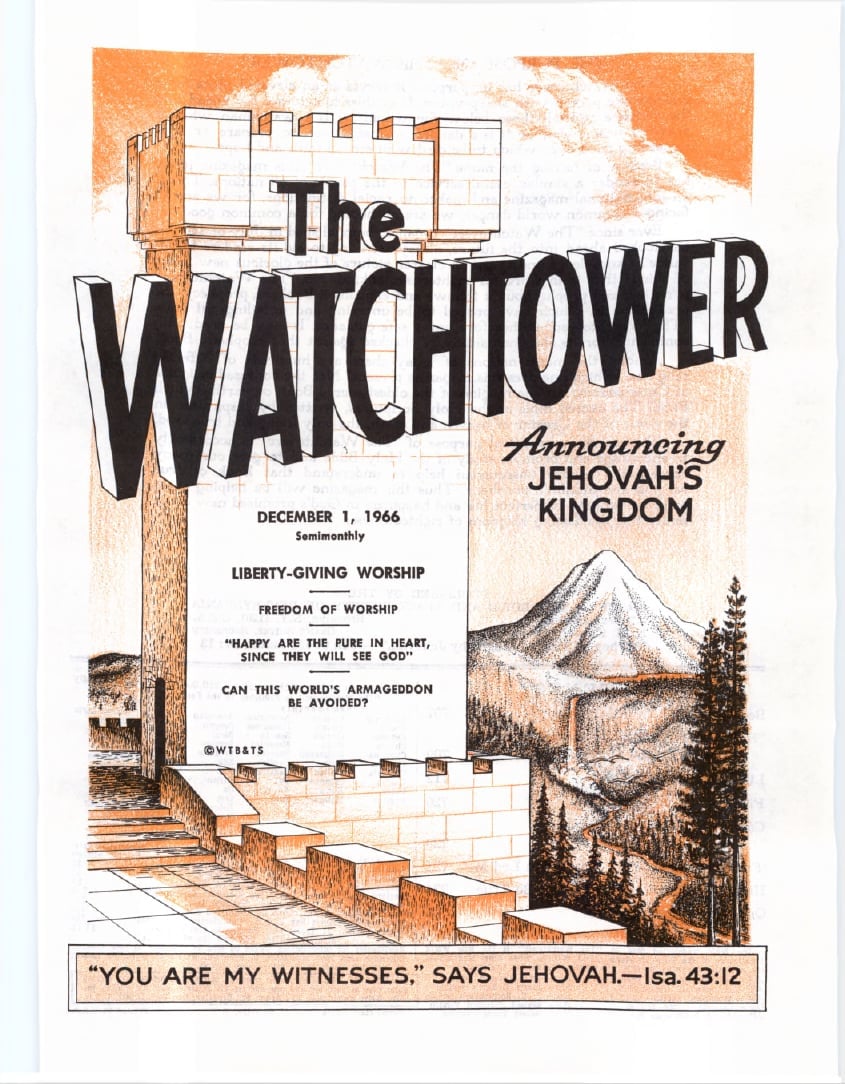
The Watchtower — December 1, 1966
Source: jw.org
Contents
Be Dependable in All Things
“Happy Are the Pure in Heart, Since They Will See God”
Liberty-giving Worship
Freedom of Worship
Can This World’s Armageddon Be Avoided?
‘For the Sake of Your Name You Led Me’
Helping Others to Find God to Be True
Questions From Readers
Announcements
Be Dependable in All Things
Be Dependable in All Things
WHEN someone has an appointment with you, would you rather have him come on time or be late? If you give a person a job to do, would you rather have him fulfill it, or ignore it unless you stand over him? When you purchase a machine, do you want one that runs, or one that is constantly malfunctioning?
Almost everybody will recognize the desirability of the former in each instance. We like people to be on time for work. We want them to fulfill work obligations. And we want machines that work.
In each case the desired quality is dependability. There is little doubt that almost everyone wants dependability in other persons, and in things they may be using. But what is often more difficult is for the person himself to be that way.
If you want people to be dependable, are you? If you want them to be on time for appointments, are you? If you want others to be dependable when they work for you, are you careful to be dependable when working for others? Yes, dependability works both ways. If it is good for the other fellow to be that way, it surely must be good for each one, individually, to be that way also. Your desire for dependability in others is shared equally by their desire for you to be dependable when dealing with them.
But wanting dependability in others, and being that way oneself, are two different things. It is relatively easy to want dependability from others, but not as easy to be dependable oneself. Why? For one thing, not everybody is dependable, and that sets a bad example for others. In fact, more and more the trend in the world is away from dependability and toward getting as much for as little effort as possible. This is hardly conducive to encouraging dependability in the majority of people.
For another thing, dependability comes hard because it is not a trait that we inherit from our parents; it must be taught, cultivated and practiced before it becomes habitual. We can see the lack of it in young children. Can you expect your child to be dependable in keeping his clothes clean, in brushing his teeth, or in putting things away, or even in being honest, unless you take the time to teach him those things? No, because the truth of the matter is just as the Bible says at Proverbs 22:15: “Foolishness is tied up with the heart of a boy; the rod of discipline is what will remove it far from him.”
But if dependability is hard to come by, and the trend is away from it, what is the motive for wanting to be dependable ourselves? The motive is that it is right, regardless of what anyone else may choose to do, and that it benefits others and ourselves as well. It is like the matter of morality. It is right to be moral, regardless of the fact that others may be immoral. And being moral benefits others and the one who practices it, physically as well as mentally. It is the same with being dependable.
This is particularly so from the viewpoint of the one who fears God and wants to please him, for God wants his faithful creatures to imitate what is right, not what is wrong. And being dependable is a godly trait. It is right. It also brings benefits to others and ourselves as well. These are motives enough.
God’s Son, Jesus Christ, showed that dependability was right, and that it should be practiced even in small things, since being dependable when doing small things is the road to learning how to be dependable when doing big things. Jesus said: “The person faithful in what is least is faithful also in much, and the person unrighteous in what is least is unrighteous also in much.” (Luke 16:10) In one illustration Jesus commended the worker who was dependable in what was assigned him and showed that it proved him worthy of greater responsibilities. He said: “Happy is that slave if his master on arriving finds him doing so. Truly I say to you, He will appoint him over all his belongings.” (Matt. 24:46, 47) The reward for dependability in a lesser task was the trusting of one with greater responsibility.
The logic of this is evident, for who would trust a person with a big job if he was undependable in a small one? If a man could not get along with his fellow workers in a department, would it be logical for the company to make him personnel director for the entire firm? If a man were unable to be a cashier because he could not add or subtract correctly, would he be asked to be the head bookkeeper of a company? No, only when dependability is demonstrated on the lesser task is someone ready for one that is greater.
Being dependable brings many benefits. It means you will work better, keeping your employer satisfied; it will enable you to keep the arrangements you make with others, and on time, making you a more desirable associate; and in the family circle, being dependable as a husband or wife will make for a happier family relationship.
Think, too, of other benefits it can bring you individually. For instance, a person who has learned to be dependable in putting things where they belong can depend upon their being there when he looks for them. He will not have to spend much time and undergo aggravation searching for them. Also, if one cultivates the habit of allowing enough time to keep appointments, he saves himself trouble and irritation, because the perpetual latecomer is usually rushing and is often upset because he is late.
The dependable person is happier in his work. The one who is not dependable must always be worried about whether his employer will find out about his bad work habits. He must be making excuses for poor work. He is usually on the defensive, for he knows he should do better, but does not. That is no way to achieve satisfaction in one’s work. But when one cultivates the habit of being dependable at work, he knows that he has done what is required, what is right, and can enjoy peace of mind.
Yes, in just about everything we can do in life there will be an improvement if we are dependable. Our work, family life, associations, yes, even our own self-respect will benefit. So be dependable in all things!
“Happy Are the Pure in Heart, Since They Will See God”
“Happy Are the Pure in Heart, Since They Will See God”
What does it mean to be pure in heart? How can one see God?
IN THE educational film “Unseen Enemies” the producers highlighted, among other things, the importance of pure water. They graphically portrayed the terrible suffering that impure water and insects cause by spreading such disfiguring diseases as leprosy, elephantiasis, yaws, and so forth. In fact, cleanliness and purity of water are so essential to the health of man that one medical historian stated that man’s conquest of many of the infectious diseases was more due to his progress in sanitation than his progress in medicine.
Appreciating the importance of purity in food and drugs, modern governments have pure food and drug laws and departments concerned with enforcing such laws. All such makes for the physical well-being of the people. Because of the importance of cleanliness, someone long ago coined the expression, “Cleanliness is next to godliness.”
Important as are purity of water and of food, there is a purity that is far more vital. God’s Word, the Bible, therefore stresses purity of heart or spiritual cleanliness. When the inspired Scriptures say, “Let us cleanse ourselves of every defilement of flesh,” they are urging us to stay morally clean. Thus also when we read, “Let us approach with true hearts in the full assurance of faith, having had our hearts sprinkled from a wicked conscience,” it refers to sprinkling by the cleansing blood of Christ.—2 Cor. 7:1; Heb. 10:22; 13:4.
Yes, the Christian Greek Scriptures link godly devotion with spiritual cleanliness, with cleanness of mind and heart, with having also a clean conscience. They command us to hold “the sacred secret of the faith with a clean conscience.” For Christians to be pleasing to God they must engage in the “worship that is clean and undefiled from the standpoint of our God and Father,” to which end they must keep themselves “without spot from the world.”—1 Tim. 3:9; Jas. 1:27.
Why, Jesus Christ attached so much importance to this kind of purity that he said, as his sixth felicity or beatitude, “Happy are the pure in heart, since they will see God.” Of all the desirable things that Jesus held out in his Sermon on the Mount, this might very well be said to represent the greatest happiness, the very acme of bliss, being able to see Jehovah God, the Creator, the Sovereign Ruler of the universe, himself!—Matt. 5:8.
The apostle Paul appreciated this relationship between being pure in heart and seeing God, for he wrote, “Pursue peace with all people, and the sanctification [or holiness] without which no man will see the Lord,” the glorified Jesus Christ. Seeing him would assure one of also seeing Jehovah God, for since his resurrection Jesus Christ is in his Father’s express image as well as being in his presence.—Heb. 12:14; 1:3.
On the other hand, the apostle John shows that the hope or prospect of seeing God as he actually is serves as a spur, an incentive to being pure in heart: “Beloved ones, now we are children of God, but as yet it has not been made manifest what we shall be. We do know that whenever he [Jehovah God] is made manifest we shall be like him, because we shall see him just as he is. And everyone who has this hope set upon him purifies himself just as that one is pure.”—1 John 3:2, 3.
WHAT PURITY OF HEART INCLUDES
What does it mean to be pure in heart? Above all else it means to have pure motives. It means having a heart that is free from malice, free from bitterness or resentment, free from such defiling uncleannesses that at times may lodge in the heart as “wicked reasonings, murders, adulteries, fornications, thieveries, false testimonies, blasphemies. These are the things defiling a man; but to take a meal with unwashed hands does not defile a man.”—Matt. 15:19, 20.
To be pure in heart also means to be sincere, to be free from hypocrisy, having all of one’s affections focused or set in one direction, on one thing, on gaining God’s approval. The apostle Paul was concerned lest the Christians at Corinth have their minds corrupted “away from the sincerity and the chastity that are due the Christ.” He counseled slaves, and therefore all in the employ of others, to serve, “not with acts of eyeservice, as men pleasers, but with sincerity of heart, with fear of Jehovah.”—2 Cor. 11:3; Col. 3:22.
In a similar vein the Christian disciple James gave counsel to those Christians who were trying to be friends of Jehovah God and at the same time friends of the world: “Draw close to God, and he will draw close to you. Cleanse your hands, you sinners, and purify your hearts, you indecisive ones,” literally, you “two-souled” or two-minded ones. Jesus had a like thought in his head, no doubt, when he said: “If, then, your eye is simple [sincere, in focus, all one way], your whole body will be bright.” And the words of the apostle Paul to Timothy seem to combine the two thoughts of the heart’s being pure as to virtue and its being pure as to sincerity and singleness of purpose: “Really the objective of this mandate is love out of a clean heart and out of a good conscience and out of faith without hypocrisy.”—Jas. 4:8; Matt. 6:22; 1 Tim. 1:5.
Nor may we overlook the fact that to be pure in heart also means having full trust, full faith in the Creator, Jehovah God, for Christians are warned: “Beware, brothers, for fear there should ever develop in any one of you a wicked heart lacking faith by drawing away from the living God; but keep on exhorting one another each day, as long as it may be called ‘Today,’ for fear any one of you should become hardened by the deceptive power of sin.” In other words, Jehovah God does not view anyone as being pure in heart even though he may be sincere and morally clean unless he also has faith in the one true God Jehovah.—Heb. 3:12, 13.
SOME WILL LITERALLY SEE GOD
Then will everyone who exerts himself to be pure in heart in these several ways see Jehovah God? Not necessarily. At least not literally, for “God is a Spirit,” and a spirit cannot be seen by human eyes, even as Jesus pointed out to the Jewish religious leader Nicodemus, a Pharisee: “What has been born from the flesh is flesh, and what has been born from the spirit is spirit. The wind blows where it wants to, and you hear the sound of it, but you do not know where it comes from and where it is going.”—John 4:24; 3:6, 8.
The apostle John, therefore, wrote, at the beginning of his Gospel: “No man has seen God at any time; the only-begotten god [Jesus Christ] who is in the bosom position with the Father is the one that has explained him.” In fact, it would be impossible for any human to see God and survive, because, as Jehovah himself told Moses when Moses asked to see God’s face: “No man may see me and yet live.”—John 1:18; Ex. 33:20.
But there are and will be some, a comparatively small number with pure hearts, that will literally see God. Who are they? They are the ones the apostle John saw standing upon heavenly Mount Zion, the 144,000 redeemed from the earth, who will share heavenly glory with their Lord Jesus Christ.—Rev. 14:1; 20:4.
Why will it be possible for these to see God? Because they will have spirit bodies, having been raised from the dead “changed,” for “flesh and blood cannot inherit God’s kingdom, neither does corruption inherit incorruption.” (1 Cor. 15:50, 51) These will have a share in what the Scriptures term “the first resurrection,” concerning which we further read: “It is sown a physical body, it is raised up a spiritual body. . . . For this which is corruptible must put on incorruption, and this which is mortal must put on immortality.” Sharing heavenly glory with Jesus Christ as incorruptible, immortal spirits, these will indeed be able to see Jehovah God literally and yet live.—Rev. 20:6; 1 Cor. 15:44, 53.
SEEING GOD FIGURATIVELY
However, while the promise of Matthew 5:8 about the pure in heart seeing God has its primary and literal application to those belonging to the anointed Christian congregation against whom the gates of Haʹdes will not prevail, there might be said to be a principle stated in Jesus’ words that has a wider application. Thus, for example, after Jehovah God had given Job a lesson on how great Jehovah is compared with puny and tiny man, Job exclaimed: “I have heard about you, but now my own eye does see you.” Not with his literal eye but with his eye of understanding, his eye of faith and appreciation, Job could now look at God’s work and God’s dealings with him and see God as he had not been able to see him before.—Job 42:5; Matt. 16:18.
Thus even to those pure in heart whose eternal destiny is life on earth God reveals himself in both his written Word and his book of the visible creation. Because of having pure hearts of faith these, like the prophet Moses, are able to continue “steadfast as seeing the One who is invisible.” And soon, in the coming system of things, these will see more evidence all about them that God exists and that he is indeed the kind of God the Bible shows him to be, infinite in wisdom and power, perfect in justice and the very personification of love.—Heb. 11:27.
However, we should not conclude that the happiness of the pure in heart is limited to seeing God, either literally or figuratively. Jesus does not say that; he merely implies that that is its chief reward. But there are other blessings that come to the pure in heart even now. Being pure in heart gives one peace of mind and a clear conscience. It makes for contentment. It also works for peaceful relations with Jehovah God and with one’s neighbors, be they the people living next door, one’s fellow employees or one’s fellow worshipers in the Christian congregation. And surely all this is added reason for striving to be among those who are “pure in heart.”
Liberty-giving Worship
Liberty-giving Worship
“For such freedom Christ set us free.”—Gal. 5:1.
1. What did the sight-seeing Russian ambassador see up above on the Washington Railroad Station?
THE freedom of the city was being extended to the Russian ambassador, no travel restrictions being placed upon him. This being his first presence in Washington, D.C., he was taking a leisurely sight-seeing tour, visiting places of interest. As he approached the Union Terminal Railroad Station, which looks down the length of Delaware Avenue to the National Capitol, he glanced up. There, up above the central arch of the front portico, he saw engraved the words: “THE TRUTH SHALL MAKE YOU FREE.”—JOHN 8:32.
2, 3. (a) What could the Russian ambassador have thought at the sight of those words? (b) The words seen by the ambassador were from what book, and copies of this book had been shipped into Russia by what Society in 1946?
2 Whether the Soviet ambassador thought those words were taken from some American political document or educational document, we will not say. Whether he agreed with those words, we will not say.
3 He could have thought of how his people tried to free themselves from slavery to a false religious system during their Bolshevik revolution of the year 1917. Yet, by such violent action against the clergy of the Russian State Church, those revolutionists did not get the truth that makes men free. Understandably not, for those words at which the Russian ambassador gazed were quoted from a book thousands of copies of which the Soviet Union had authorized to be shipped into the country in 1946, shortly after World War II, and for the first time in many decades. The facts on this were given out in the annual report of the American Bible Society made at its New York city Bible House, to the effect that a shipment had been made containing 5,000 New Testaments and 100,000 copies of the Gospels in Russian and 500 copies of the New Testament in the ancient Greek, these Greek Testaments to be distributed among theological students. An acknowledgment of this gift had been made by Archbishop Alexi of the Russian Orthodox Church of Moscow.a
4, 5. (a) The words quoted were from whom? (b) Why might the ambassador and also educators and scientists agree with the words?
4 So the words on the portico of the Washington Railroad Station were quoted from the Gospel of the Christian apostle John, chapter eight and Joh 8 verse thirty-two. They were the words of the appointed founder of Christianity, Jesus Christ. The Russian ambassador might have agreed with the words quoted, for they were taken by themselves, apart from their connection with Jesus Christ.
5 Educators will agree that knowledge of the truth in its abstract sense frees one from the bondage of ignorance and superstition and deception. College and university students are out on their campuses fighting for intellectual and academic freedom to pursue their quest for knowledge unhindered by church traditions and the control of clergymen. The secular scientists are trying to learn more and more about the creation, its laws, its forces, its order and arrangements and features, the age of our universe and how far into boundless space it extends itself. All the truth gained in these realms of knowledge sets man free at least to some extent, as these worldly truth seekers claim.
6. Knowledge of such secular truth brings with it what danger, and so what has actually resulted to its possessors?
6 We are not afraid of the truth. Along with others, we highly value the truths gathered in these various fields and the freedom of mind that they bring. We are glad that they have been shared with us. However, knowledge of such secular truth brings a danger. Such secular truth may be put to a wrong use and be used to lead its possessors into a new bondage. Today, in this twentieth century, scientists abound as never before, and most political governments of the day are aiding in the endeavor to produce more scientists for the good of the country. Admittedly the scientists have learned truths about the things of creation, but it has made them free in only a relative sense, liberating them from slavery to many false theories or slavery to ignorance of certain facts. Yet, along with that, there has come an enslavement of scientists and their followers, an enslavement to science itself, making it an idol to be worshiped like the sacred cow of the Hindus of India.
7. Feeling their power, what do scientists try to do, and what threat does this pose as warned of by a scientific writer?
7 Feeling their power, the scientists try to subject others to a slavery to the scientific group, subjecting even the political governments to a dependence upon secular science. The scientists would make themselves a priesthood of this new idolatry, a thing that is warned against in the book issued in 1965 entitled “The New Priesthood,” by the distinguished scientist Ralph E. Lapp, author also of the book Man and Space. This “new priesthood,” namely, “the scientific elite,” presents a threat to democracy, for the scientists have a specialized knowledge that “gives them truly formidable authority in the councils of political power.” So the question arises, Does democracy face a takeover by the scientific technologists of today?
8. What other professional group tries to set itself up as a priesthood, and how has it influenced a disregard of Christian conscience?
8 Not only that question worries liberty-loving people, but now, too, the medical doctors try to set themselves up as a priesthood of public health and compel all citizens to submit to its medical opinions and yield to its medical treatment against the will and desire of the patient, under force, and contrary to the patient’s constitutional rights and privileges. Exceptionally is this so today when medical doctors appeal to judges of the law and influence them to rule that Jehovah’s witnesses must have their minor children contaminated with a blood transfusion contrary to God’s law on the sanctity of blood. Yes, this medical priesthood prevails upon judges to override the conscientious religious belief even of adult witnesses of Jehovah and by arbitrary judicial ruling force a gross violation of God’s sacred law on these Christian adults who are entitled to equal freedom of religion with Roman Catholics and Christian Scientists.b The medical priesthood would now persuade the lawmaking body of the nation, the Parliament or the Congress, to pass a law requiring patients who adhere to God’s law on the sacredness of blood to submit to a blood transfusion if the doctor or the hospital thinks it necessary.
9. (a) To what type of political government have some men long looked for freedom? (b) What government of this type was set up more recently in North America, and under what Declaration?
9 As long as two thousand years ago men looked to democracy to give them freedom. Political democracy was born in ancient pagan Greece before the days of Jesus Christ, but it was democracy for only the free citizens of the land, as a large section of the population was made up of slaves. More recently, in the year 1775 of our Common Era the thirteen British colonies in North America began a revolution to establish themselves as an independent democratic nation. The following year, on July 4, a Declaration of Independence was signed at Philadelphia, Pennsylvania. In the second paragraph it says these words: “We hold these truths to be self-evident, that all men are created equal; that they are endowed by their Creator with certain unalienable rights; that among these are life, liberty, and the pursuit of happiness. That to secure these rights, governments are instituted among men, deriving their just powers from the consent of the governed, . . . ”
10. (a) How was the main composer of that Declaration at disagreement privately with those words in paragraph two? (b) When was abolition of slavery announced as applying in America?
10 The composing of this Declaration was assigned to Thomas Jefferson of the colony of Virginia, and the language of the Declaration is practically all Jefferson’s. In the light of this man’s home life, the question arises, Who was Jefferson that he should be writing a declaration about the unalienable right of liberty that was to be enjoyed or pursued by all men who are created equal? Why, Jefferson himself was then a slave owner! In fact, eighty-seven years passed by before the American president, on January 1, 1863, announced an abolishing of slavery in certain parts of the United States of America.—The Encyclopedia Americana, Volume 8, pages 561, 562; Volume 10, page 271.
11. What has been said and published recently as to the success of the French Revolution in giving democratic freedom?
11 The American Revolution was followed by the French Revolution at the end of the eighteenth century. Now, after more than a century and a half of republican government in France, there appears an article in the New York Times Magazine, as written by a Frenchman, Jean-François Revel, under date of November 7, 1965. On page 29, as headlines to Revel’s article, appear the words: “The French Revolution Has Been Lost: Eyeing France today, a Frenchman says democracy there is only skin-deep and usually has been.” Then Revel’s article proceeds to state the facts in proof of it.c
12, 13. (a) What did the Bolshevik leader think was necessary for the success of the Communist revolution in Russia? (b) After much work to remove this obstacle to success, what question arises?
12 In the year 1917, amid the horror of World War I, there broke out the Russian revolution by which the Communist Bolsheviki came to political power under their leader Vladimir Ilich Lenin. This man had no faith in God, especially the God taught by the Russian Orthodox Church. Believing that the religion of Christendom was the opium of the people, Lenin said: “Our revolution will never succeed until the myth of God is removed from the mind of man.” Apparently the Russian Communist revolution has broken down belief in God in the minds of the majority of people in both Russia and satellite countries. The attitude of the younger generation of Communists is expressed in the answer of a twenty-year-old boy who was interviewed by a bureau chief of the magazine Newsweek, as reported in the magazine’s issue of April 16, 1956, page 54. After answering the question, “Is it difficult for you to adjust academically?” he was asked, “And the Bible?” At this he laughed and answered: “Nobody but Jehovah’s Witnesses read the Bible.”
13 However, after all such removal of God from the minds of the people, can the Russian revolutionists boast of success?
14. After an examination into democratic and republican governments, what must we conclude as to the freedom gained, and what question do we ask on Jesus’ statement about freedom?
14 After an examination into “people’s republics” and popular democratic governments of men from the days of ancient Greece, honest hearts have to admit one thing: republican, popular or democratic government has failed to bring liberty in its most vital aspects. This is true even of the most enlightened and most progressive countries, having the highest educational standards and social provisions and using the most fully the services of scientists and doctors of law, philosophy, medicine and theology. The modern enlightenment and worldly progress of the nations have set men free to an extent that falls far short of the freedom of which Jesus Christ spoke. This explains why dissatisfaction, unrest and turbulence are increasing on earth today. What, then, is the truth that Jesus Christ said would make us free?
THE TRUTH THAT SETS FREE
15, 16. (a) What did the station building designers omit about Jesus’ words, and this in agreement with what dislike? (b) Why is there such a dislike, as shown in John 8:28-32?
15 Jesus’ words as engraved above the entrance of the Washington Railroad Station were carved there without their context. The station building designers ignored the context of Jesus’ words. Men in general do not like to accept the context of those words. Why? Because Jesus limits the application of his words to those who become his disciples, and these followers of his must fulfill a certain proviso or condition. Take note of this as we read John, chapter eight, verses twenty-eight through thirty-two:
16 “Therefore Jesus said: ‘When once you have lifted up the Son of man [upon a stake of execution to die], then you will know that I am he [the promised Messiah or Christ], and that I do nothing of my own initiative; but just as the Father taught me I speak these things. And he that sent me is with me; he did not abandon me to myself, because I always do the things pleasing to him.’ As he was speaking these things, many put faith in him. And so Jesus went on to say to the Jews that had believed him: ‘If you remain in my word, you are really my disciples, and you will know the truth, and the truth will set you free.’”
17. To whom were Jesus’ words not said, and upon what did one’s gaining of the freedom mentioned depend?
17 Take note! The freedom that the truth brings about is dependent upon a big IF. Jesus said: “If you remain in my word.” If they did this, they would prove themselves to be real disciples of Jesus; then, as he said to his listeners, “you are really my disciples.” In that case they would know the truth and the truth would set them free. These words were not said to the pagan physical scientists or to the pagan philosophers and educators of that day. The words were said to people at Jerusalem who “put faith in him,” who “believed him.” They had faith, they believed that God his heavenly Father had sent him to earth to perform a Messianic work in behalf of the kingdom of God, with blessings for all mankind. Having begun to believe and put faith in him, they had to decide whether they would remain in his words, in his teaching, and learn all the rest of the truth. If they did so, then his promise to them would be fulfilled, that they would know the truth and be set free by the truth.
18. What is this truth here spoken of, and why can we not expect to get it from scientists and educators today?
18 The truth that does this is not truth in general, such as is learned by worldly people. It is the truth that comes from a certain source and through a certain channel of instruction. The source is the One who sent Jesus Christ to earth as a Teacher, and that one is the heavenly Father, Jehovah God. Concerning him, Jesus said: “Just as the Father taught me I speak these things.” (John 8:28) God’s channel of instruction is, therefore, his Son Jesus Christ. That is why it is necessary to remain in the word or teaching of Jesus in order to know the truth and be set free by such truth. So we cannot expect today to get this freedom-giving truth from or through the physical scientists and worldly educators and philosophers of this twentieth century. Because we have not got it from them and cannot get it from them, the whole world of mankind has not won real freedom through them. The real freedom is something that they can never give us. What is it?
19, 20. (a) Why were the pride and religious feelings of his listeners hurt by Jesus’ words about knowing the truth and being set free? (b) Who did Jesus say was a slave needing to be freed?
19 What this freedom is came to light in the further conversation that Jesus Christ had with his listeners. By birth they were descendants from a free man, the patriarch Abraham, who was the friend of God and whom God brought out of Mesopotamia and into the Promised Land of Palestine. (Gen. 12:1-3; 15:1-7; 2 Chron. 20:7; Jas. 2:23) When Abraham’s descendants sojourned in Egypt and the Egyptians oppressed them, Jehovah God freed them from Egyptian bondage and brought them into the Promised Land. Through God’s prophets they got the inspired Hebrew Scriptures, from the first book thereof, Genesis, to the last and thirty-ninth book thereof, Malachi; and these set forth the only true worship of God at that time. So when Jesus spoke to them about knowing the truth by remaining in his word and being set free by the truth, it hurt their pride and religious feelings. Hence we read:
20 “They replied to him: ‘We are Abraham’s offspring and never have we been slaves to anybody. How is it you say, “You will become free”?’ Jesus answered them: ‘Most truly I say to you, Every doer of sin is a slave of sin. Moreover, the slave does not remain in the household forever; the son remains forever. Therefore if the Son sets you free, you will be actually free. I know that you are Abraham’s offspring; but you are seeking to kill me, because my word makes no progress among you. What things I have seen with my Father I speak.’”—John 8:33-38.
21. From what things was the freedom to be, and how did Jewish listeners to Jesus show that they were slaves?
21 Ah, here it comes to light that the freedom of which Jesus spoke was the freedom from sin. This meant also the freedom from death, for “the wages sin pays is death.” (Rom. 6:23) Those listeners of Jesus might pride themselves on being natural descendants of Abraham; but if any of them were not wanting Jesus’ word to make further progress in them and if they wanted to kill him by lifting him up on a stake of execution to die, they were not free offspring of Abraham. They were not sons of the heavenly Father, Jehovah God. They were certainly the slaves of sin to a very low degree, and they indeed needed to be set free.
22. (a) What did Jesus’ listeners need to remember about Abraham’s children? (b) So now what danger was there with regard to the Jews?
22 Those Jews who were proud of their descent from Abraham needed to remember that Abraham had two sons, first one by a slave girl, Hagar, and then one by a free woman, his wife Sarah. Later the slave girl’s son Ishmael, was dismissed from Abraham’s household; but the free woman’s son, Isaac, remained in Abraham’s household and became his heir and also heir of the promise that Jehovah God made to Abraham. Likewise, the Jewish descendants of Abraham were but slaves toward God, not sons. Jesus was a Son of God and was free. There was, therefore, the danger that the slavelike Jews would not remain in God’s household forever but would be dismissed, cast off like Ishmael. Jesus as a free and faithful Son of God would properly be retained and would remain in God’s household forever. So he could set the Jews free.
23. Only by what course could those Jews be set free?
23 Only by accepting the word of truth through Jesus and letting it make progress among them could they be set free and become free sons of God and abide forever in God’s household, enjoying everlasting life. They need to have the Son of God free them by his truth and the sacrifice of himself as a ransom for them.
THE SLAVERY OF ALL MANKIND
24. Why does our dying state prove that we are sinners, and by what means only can we be freed for life?
24 Who today can prove that he is not a slave of sin and receiving in himself the wages that sin pays, namely, death? Lenin has had those wages paid to him in full; he is dead, which proves that he was a slave of sin. Too bad for him if God and resurrection of the dead were only a myth! All mankind born from the sinful first man (Adam) have been born sinners. That is why they have been under the condemnation of death. We have all needed to be freed from sin and its penalty of death. The Son of God and his truth are the only means by which we can be set free and gain eternal life as free children of the Most High God.—Rom. 5:12-18.
25. How did Paul describe his own physical and spiritual state in Romans 7:19-25?
25 The Christian apostle Paul described his own physical and spiritual state when he wrote these words to the early Christian congregation in Rome: “The good that I wish I do not do, but the bad that I do not wish is what I practice. If, now, what I do not wish is what I do, the one working it out is no longer I, but the sin dwelling in me. I find, then, this law in my case: that when I wish to do what is right, what is bad is present with me. I really delight in the law of God according to the man I am within, but I behold in my members another law warring against the law of my mind and leading me captive to sin’s law that is in my members. Miserable man that I am! Who will rescue me from the body undergoing this death? Thanks to God through Jesus Christ our Lord! So, then, with my mind I myself am a slave to God’s law, but with my flesh to sin’s law.”—Rom. 7:19-25.
26. In the case of whom else must that state as described be true just as fully, if not more so?
26 Now, if that was true of the Christian apostle Paul, who had seen the resurrected Jesus Christ and who had received so abundantly the gifts of God’s holy spirit, it is just as fully true in the case of each and every one of us, if not more so!
27. (a) To what form of worship did the Jews become enslaved? (b) What kind of woman, therefore, was their capital city Jerusalem like?
27 Along with that enslavement to inborn sin and its penalty of death, the world of mankind has become enslaved to a system of false religious worship. The Jews had been liberated from ancient Egypt and had been given the sacred pronouncements of God in the thirty-nine books of the inspired Hebrew Scriptures. Yet they became slaves to a system of deceptive, hypocritical religious worship, which the Holy Bible calls Judaism. (Rom. 3:1, 2; Gal. 1:11-16) Just like the one-time Jewish Pharisee Paul, all the Jews needed to be delivered from that enslaving system of Judaism. Only the truth through Jesus Christ could do this, as it did in the case of Paul. Furthermore, God’s own Law given to the Jews through the prophet Moses condemned those Jews to death as sinners unable to keep God’s perfect Law. For this reason they could be cursed by God. Hence the Law served as a yoke on them, that they could not carry by themselves. It proved them to be slaves of sin and deserving of death. The addition of Judaism made the slavery worse! As a result their capital city Jerusalem was not a mother of free children, but was like a slave woman, in bondage with her children. What was the worship to give them liberty?
28. (a) What, then, was the worship that would give them liberty? (b) Like the son of what woman did those accepting that worship become, and what did Paul show they now needed to do?
28 It was the worship of the one living and true God Jehovah through his Son Jesus Christ. Some Jews accepted and remained in the truth that came through Jesus Christ, letting it make progress among them. Those were the ones who learned the truth that set them free. These gained the pure, true worship that gives liberty! These were no longer children of a slave woman, but were children of a free woman, God’s free spiritual organization. They were like Isaac the son of the free woman Sarah, Abraham’s wife. The thing now to do was to remain free, fighting to keep freedom. Hence the apostle Paul wrote to fellow Christians who were acquainted with Judaism: “Wherefore, brothers, we are children, not of a servant girl, but of the free woman. For such freedom Christ set us free. Therefore stand fast, and do not let yourselves be confined again in a yoke of slavery.”—Gal. 4:31; 5:1.
29. (a) In spite of what privileges had the Jews come into a religious slavery? (b) Why more so did the Gentiles need to be set free, and when did the Son of God begin to set them free?
29 Those words were specially fitting for natural, circumcised Jews who had been brought out of Judaism into the liberty-giving worship of true Christianity. The Jews had come into a religious slavery in spite of their having the Law of Jehovah God and being in a national covenant with him. How much more was it true that all the non-Jews, the uncircumcised Gentiles, who did not have God’s law, were in a religious slavery! So if the Jews needed liberation, how much more so did the Gentiles need to be set free? Why so? Because the Gentiles were in bondage to a larger religious organization, namely, Babylon the Great, which is the worldwide empire of false religion. Such Gentiles, in slavery to false gods, really to demons, needed to be turned away from such idolatry to serve the living God, Jehovah, the Father of the Lord Jesus Christ. It was first three and a half years after his resurrection from the dead that the Son of God began to set such Gentiles free. That was when he sent his apostle Peter to the Mediterranean seaport of Caesarea to convert the household of the Italian centurion Cornelius.—Acts 10:1 to 11:18.
30. (a) So what do those freed Gentiles now need to do? (b) Why does this slavery include the people of Christendom?
30 Thus for freedom from the international religious harlot, Babylon the Great, Christ set the Gentiles free. Therefore, these also need to stand fast in the liberty-giving worship and not let themselves become confined again in a yoke of religious slavery. This slavery includes the churchgoing people of Christendom. Christendom was established in the fourth century, in the days of the Roman Emperor Constantine the Great, and she took in the territories of present-day Portugal and Spain. While still holding the pagan office of Pontifex Maximus, Emperor Constantine called together the council of Nicaea in Asia Minor; and, after the bishops had wrangled for weeks, he decided in favor of what is Christendom’s most important religious doctrine. This is the trinity, the belief that there are God the Father and God the Son and God the Holy Ghost and yet there are not three Gods but only one God in three Persons. In this doctrine Christendom apes the pagans or heathen.
CHRISTENDOM AN UNFREE PART OF THIS WORLD
31. How did Christendom not really gain but thus come into bondage, as shown by M’Clintock and Strong’s Cyclopædia?
31 Christendom may have thought that she gained something by submitting to the domination of the Roman Pontifex and by accepting the support of the political state. Yet she came into bondage that led to continual difficulties between Church and State, down till today. Says M’Clintock and Strong’s Cyclopædia, Volume 2:
Numerous, however, in various points of view, as were the advantages accruing to it from this change, it soon began to suffer from being brought into close contact with the fostering influence of secular power. The simplicity of the Gospel was corrupted; pompous rites and ceremonies were introduced; worldly honors and emoluments were conferred on the teachers of Christianity; and the kingdom of Christ in a great measure converted into a kingdom of this world.—Page 488.
32. (a) In view of what Jesus told Pilate, why is Christendom no part of Christ’s kingdom? (b) Who can set churchgoing people free from Christendom?
32 However, Jesus Christ plainly said to Governor Pontius Pilate, who was a representative of the Roman Pontifex Maximus Tiberius Caesar, this: “My kingdom is no part of this world. If my kingdom were part of this world, my attendants would have fought that I should not be delivered up to the Jews. But, as it is, my kingdom is not from this source.” (John 18:36) Therefore, Christendom, which has refused Christian liberty and independence in favor of religious union with the State and dependence on the State, is no part of Christ’s kingdom. Consequently, the churchgoing people of Christendom, with its confusion of divisive religious sects, need to be freed from bondage to Christendom. Christendom is the most prominent and powerful part of Babylon the Great. Not modern-day science or worldly education, but only Christ’s truth can free them!
[Footnotes]
See the article “Bible Society Ships Gospels to Russia,” as published in the New York Times under date of March 21, 1947.
See The Encyclopedia Americana, Volume 17 of 1929 edition, under the heading “LIBERTY, Religious,” and its comments on page 349 regarding “the right of absolute equality of all religions before the law.”
Confirmatory of this is the later article appearing in the New York Times Magazine under date of May 29, 1966, under the title “France is No Longer a Democracy.” as written by François Mitterand. With regard to government stability, Mitterand says: “We see it as part and parcel of a democratic framework, with the powers of decision in the hands of the people. This is not the case today: now the voters are merely called upon once every seven years to vote on whether or not they want to keep their leader.”—Page 56.
Freedom of Worship
Freedom of Worship
1. (a) What did Jesus say regarding his disciples in relation to this world? (b) What does being no part of this world mean for Christians?
JESUS CHRIST said that, not only his kingdom was no part of this world, but also his disciples were no part of it either. In a final prayer with his apostles, Jesus said to God: “I have given your word to them, but the world has hated them, because they are no part of the world, just as I am no part of the world.” (John 17:14, 16) Jesus had previously told his disciples: “If you were part of the world, the world would be fond of what is its own. Now because you are no part of the world, but I have chosen you out of the world, on this account the world hates you.” (John 15:19) The fact that true disciples of Jesus are no part of this world means more than that they keep absolutely neutral toward the squabbles, controversies and conflicts of the nations of this world. It means their being free and independent of this world, hence in no slavery to it. The pure worship of God into which they have been brought through the truth has given them liberty from this oppressive, corrupt world.
2. Does such Christian liberty mean freedom from subjection to the superior authorities, and how far does this matter go?
2 Bear in mind, however, one point: Their having this liberty because of the truth and the true worship of God does not mean that they are free from rendering any subjection to the political “superior authorities” of this world. No! Jesus said: “Pay back, therefore, Caesar’s things to Caesar, but God’s things to God.” (Matt. 22:21) And the apostle Paul said, in Romans 13:1-5: “Let every soul be in subjection to the superior authorities, for there is no authority except by God; the existing authorities stand placed in their relative positions by God. . . . There is therefore compelling reason for you people to be in subjection, not only on account of that wrath but also on account of your conscience.” Christian subjection to the superior authorities can thus be only a relative subjection. Subjection to the superior authorities cannot go so far as to violate Christian conscience and violate God’s truth as found in the Holy Bible.
3. (a) Does freedom from this world mean also for Christians freedom from persecution? (b) When were Christians denied freedom of worship in the Roman Empire?
3 Likewise, the fact that true Christians are no part of this world and have been set free from it does not mean that they will enjoy freedom of worship in this world. Because of Jewish religious opposition, Jesus Christ was put to death by the Roman Governor Pontius Pilate, but on the false charge of sedition. The apostle Paul was also accused of sedition and was imprisoned. These charges being political in the cases of Jesus and Paul, the Roman government did not proceed against them because of their religion. There was thus no depriving of them of the freedom of religion and of worship. At the time that Christianity was established in the years 29-33 C.E., there was freedom of worship in the Roman Empire. It was first after Rome was burned by the great fire of the year 64 C.E. that freedom of worship was denied to Christians. Faithful Christians refused to compromise and worship the Roman State or the Roman Emperor.
4, 5. (a) In lands where there was a state religion, how was refusal to render the religious rites viewed by the authorities? (b) Also, how was the right to teach other doctrines viewed, and why did rulers and clergy fear religious dissent?
4 Says The Encyclopedia Americana, Volume 17 of the 1929 edition, page 346, under the heading “LIBERTY, Religious”:
5 “It is hardly more than a century ago that it was finally conceded by the governing power that religion is not a state but a purely personal affair. Even at the present time this is not conceded in all countries. From time immemorial the state has had its religion as by law established, the idea being that the safety and welfare of the state depended upon the proper performance of the state religion. To protest and refuse to perform these religious rites was to become a disorderly and possibly a revolutionary element within the state. Thus the issue was joined, those in control of the government insisting that the public order and safety required all to worship according to the established religion and in no other way and in opposition to these an increasing number demanding as a divine right the freedom to worship according to the dictates of their own conscience. Something more than that is involved—and this is the most serious part of the trouble; the right of a person not only to worship but to teach, propagate the doctrines he believes true, so that others may be led to worship in his way. This, under the old system of state religion, plainly amounted to nothing less than a right to form a party within the state at variance with the state religion and the state government. . . . Thus the political rulers dreaded the revolutionary possibilities of religious dissent; and the ecclesiastical authorities feared that the freedom to teach heretical doctrines would lead the souls of men to perdition.”
6. Against whom has Portugal adopted such an attitude, and in one recent case what have her police done to these?
6 In those words The Encyclopedia Americana described the very attitude that the unitary corporative Republic of Portugal has adopted toward the Christian witnesses of Jehovah, even till this year 1966. What Portugal has been doing to Jehovah’s witnesses in her land and in Angola is common knowledge throughout the world. And so we are here free to comment publicly about Portugal’s conduct in this regard, even as others have already done. The Portuguese police, in one of recent cases, have arrested and brought into court forty-nine native witnesses of Jehovah. They have faced an accusation by the Magistrate of the Public Ministry. The bail allowed to them pending their trial and sentence was set at thousands of Portuguese escudos apiece. As you now listen to the accusation leveled against them, call to mind the Americana article just read on religious liberty. Here is what the accusation says:
7-12. What charges did the Portuguese Magistrate of the Public Ministry level against the arrested witnesses of Jehovah?
7 “All the accused are material authors of the crime against the internal security of the state, of instigation to collective disobedience, foreseen and punishable under Article 174 of the Penal Code, with the additional punishment outlined in Article 175 of the same Code, since the judicial proceedings accordingly show the following:
8 “The accused are ‘members’ of the sect named ‘Jehovah’s Witnesses,’ directed by the Watch Tower Bible & Tract Society, with head offices in New York, which they obey even to the smallest detail.
9 “They internationally develop various activities that expressly preach collective disobedience to the national laws of public order and to the legitimate orders of the authorities; the Fatherland, all the constituted powers and principally the Army, are, besides, false religions, the greatest creations of the kingdom of Satan that it is necessary to destroy; they consider themselves ambassadors of the Theocratic Kingdom and, as such, affirm that they should not obey the regulations of the authorities, participate in elections or collaborate in the public administration.
10 “The saluting of the National Flag is an act of idolatry and the soldier that fights for the Fatherland is an enemy of God, because he fights for Satan.
11 “They constitute a political movement, coming from various countries, with aims of disobedience, agitation and subversion of the popular masses and especially the youth of popular age.
12 “The Watch Tower Bible & Tract Society prohibits all the followers of the religious sect Jehovah’s Witnesses to fulfill military service. . . . ”
CASES REFUTING THE ACCUSATION
13. (a) Why would such Portuguese accusers, if back in the early centuries, have persecuted Christianity? (b) What in the Portuguese accusation would it be illegal for the Watch Tower Society to do?
13 In the face of such an accusation, it is not an exaggeration to say that if the Portuguese accusers of Jehovah’s witnesses were back in the early centuries of the true Christian church, they would have been among the persecutors of apostolic Christianity. Why so? Because the worldly histories of those times plainly report that the martyred Christians of the first and second centuries were banned, driven underground into catacombs, and imprisoned and executed with cruel tortures under the same accusations that the Portuguese authorities level against Jehovah’s witnesses of today. The Portuguese charges against them are nothing new, just as valid authentic history shows. And as for the accused Watch Tower Bible & Tract Society, which was founded by Pastor Charles Taze Russell under the laws of the State of Pennsylvania in 1884, it would be doing something illegal in the land of America, where it was founded, if it interfered with and obstructed the military and defense operations of the domestic national government, not to speak of its encouraging such tactics by Jehovah’s witnesses in foreign lands like Portugal.
14, 15. (a) How was the then president and other representatives of the Watch Tower Society treated by the government in 1918? (b) What did the Americana say about this case and the religious issue?
14 Pastor Russell, the first president of the Watch Tower Bible & Tract Society, died October 31, 1916. The next year the United States of America got involved in World War I. Then the succeeding president and other prominent officials and representatives of the Watch Tower Society were accused in 1918 of interfering with war activities and being a threat to national security. They were imprisoned in the Federal penitentiary without benefit of appeal or admission to bail. The above-mentioned article of The Encyclopedia Americana (page 349) says as to this famous case:
15 “The practice of persecuting persons for dissent and heresy gradually went out of fashion. More and more frequently the courts ruled that it was not the business of law to prohibit a person from exercising his religious faith so long as it did not, as Blackstone put it, ‘threaten ruin or disturbance of the state.’ In the noted trial (1918) of the followers of Pastor Russell the court made it plain that religious freedom never could be stretched to confer the right to commit crime.”
16. (a) What did the Americana article fail to report about these eight accused representatives of the Watch Tower Society? (b) If the president, Judge Rutherford, had been a felon, what would the U.S. Supreme Court never have permitted?
16 This Americana article fails to report that these imprisoned associates of Pastor Russell were kept in prison for nine months and then released on bail in March of 1919 after an appeal of their case was granted. In the following year (1920) all eight were exonerated of all the false charges under which they had been railroaded into prison. They were legally proved to be no felons, no criminals threatening the peace, security and good order of the State.a And in the year 1940 the once imprisoned president of the Watch Tower Society, known as Judge Rutherford, who was a member of the legal Bar of the State of New York, was admitted to the Supreme Court of the United States in Washington, D.C., on April 25, 1940. Such a thing the Supreme Court would never have permitted if Judge Rutherford had been a felon.
17, 18. (a) On that occasion, what did the Supreme Court allow to Judge Rutherford and his associate? (b) In the close of his address, what did he say to the Court regarding conscience and being witnesses of Jehovah?
17 The Court even allowed to him and Professor Gardner of Harvard University an extension of time, to argue for an hour and a half in behalf of the famous Flag Salute case that involved the youthful son and daughter of a Pennsylvania family who refused to salute the American flag in the public school. In the close of his address to the Supreme Court, Judge Rutherford said:
18 “This is a matter that is sacred to every American who loves God and his Word. The members of this Court respect Jehovah God and I assume that they are desirous of serving Him, because in no other way can anyone gain life. The Commonwealth of Pennsylvania can grant life to no one. The United States of America can grant life to no one, because Jehovah God is the fountain of life. ‘Salvation belongeth to Jehovah.’ The respondents in this case conscientiously relied upon the Bible. Their conscience is not to be controlled or interfered with by any human power, as stated by the Commonwealth of Pennsylvania in its own Constitution. Therefore the decision of the trial court and of the Court of Appeals should be affirmed and thus make the members of this Court witnesses to the name, majesty, and supremacy of ‘the Most High, whose name alone is Jehovah.’”b
19. How did the Supreme Court handle this flag-salute case in 1940 and then in 1943?
19 In the midwar year of 1940 the Supreme Court rendered an adverse judgment by a vote of eight to one. But several years later the Court reconsidered its decision and on the national Flag Day, June 14, 1943, the Court reversed itself. It handed down a decision recognizing Christian conscience even when it considers the saluting of the flag of any country to be an act of idolatry and so a violation of God’s Supreme Law.—1 John 5:21; Ex. 20:1-5.c
GOD’S LAW CALLS FOR FIRST OBEDIENCE
20, 21. (a) What counsel does Psalm 2:10, 11 offer for kings and judges to follow today? (b) Why do the Witnesses not need the Watch Tower Society to tell them what to do in this regard, and the example of what apostle do they follow?
20 In the Second Psalm 2, verses ten and eleven, we read: “Now therefore be wise, O ye kings: Be instructed, ye judges of the earth. Serve Jehovah with fear, and rejoice with trembling.”—AS.
21 That Second Psalm 2 is being fulfilled in our day, since 1914. So it is high time for kings, presidents, dictators, rulers and judges of the earth to recognize that the Law of the Most High God is supreme, and that followers of his Son Jesus Christ must recognize God’s Law as supreme and obey it when there is a clash between the Law of God and the laws of men. The Christian witnesses of Jehovah in Portugal and everywhere else do not need the Watch Tower Bible & Tract Society to tell them this; they have read it for themselves in the Portuguese Bible and in copies of the Bible in all the other languages in which it is published. And they need no priest of Christendom to interpret it for them. The apostle Peter, whom the Roman Catholic Church claims as its first pope, was the one who said to the Supreme Court in Jerusalem: “We must obey God as ruler rather than men.” (Acts 5:29) And in this regard Jehovah’s witnesses everywhere follow the example of Peter.
22, 23. (a) What does the Britannica say regarding the aforementioned English jurist Blackstone? (b) What did Blackstone say as to the “law of nature . . . dictated by God himself” and human laws?
…