The Watchtower, November 15, 1966
Download: PDF — The Watchtower, November 15, 1966
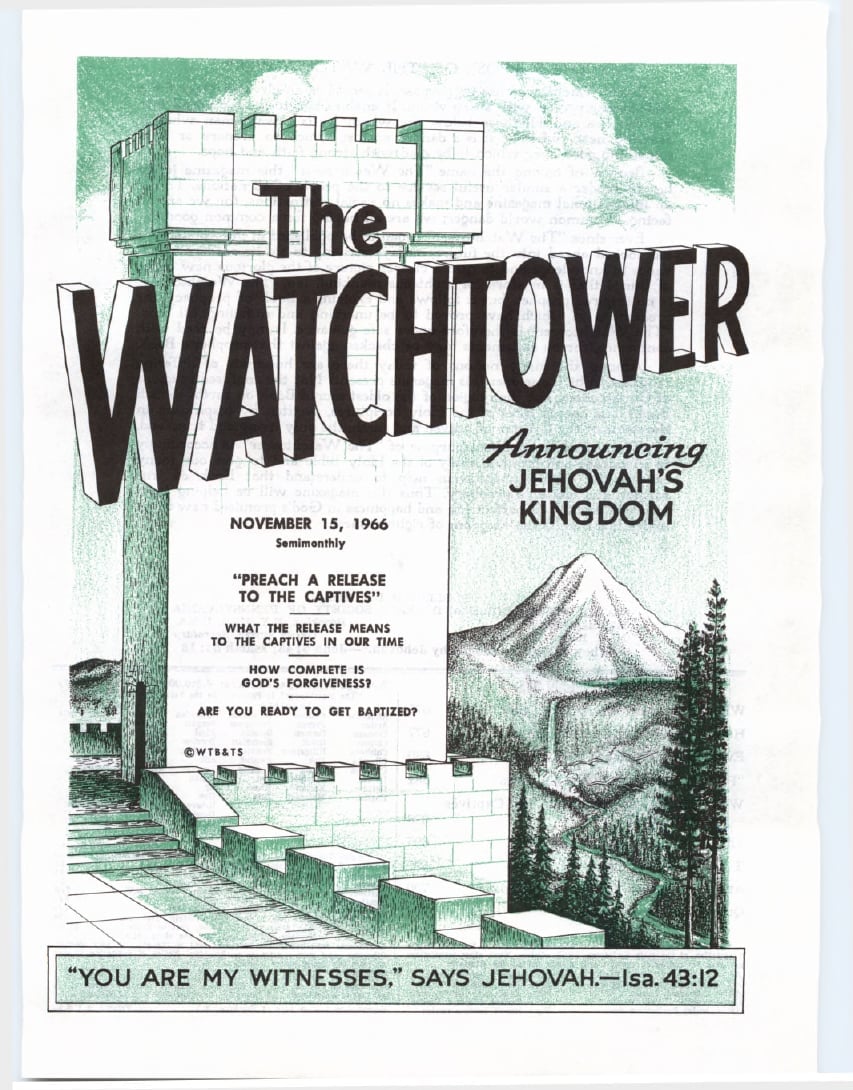
The Watchtower — November 15, 1966
Source: jw.org
Contents
What You Don’t Know Can Hurt You
How Complete Is God’s Forgiveness?
Evening and Morning Twilight
“Preach a Release to the Captives”
What the Release Means to the Captives in Our Time
The Doom of False Religion
‘I Have My Religion’
Are You Ready to Get Baptized?
Questions from Readers
Announcements
What You Don’t Know Can Hurt You
What You Don’t Know Can Hurt You
“WHAT I don’t know cannot hurt me.” “I’m just going to mind my own business and let others mind their own.” “At least, they cannot blame me for something I did not know.” These are but a few of the expressions heard from persons who do not wish to become involved with others, who do not want to take on any responsibility for their neighbors or fellow creatures. Some actually believe that by isolating themselves and insulating themselves against undue contact with others they will be able to live a quiet, carefree life.
How wise are such attitudes? And can those who adopt them do so and at the same time claim God’s favor as followers of his Son, Christ Jesus?
“Blissful ignorance” certainly sounds attractive. And it is according to the rules of human justice that crimes of ignorance are viewed with greater leniency than those committed willfully. So, on the surface of things, it might seem to be quite plausible to think that what you do not know cannot hurt you.
But why not go to God’s Word, the Bible, for authoritative counsel on the subject? Suppose we consider Lot, the nephew of Abraham. This faithful worshiper of God could have closed his eyes and ears to all that was going on around him in Sodom and the adjacent cities, deluding himself into thinking that everything was all right, that the less he knew about matters the less would be his responsibility. But is that how this God-approved man viewed matters? The Bible answers: “That righteous man by what he saw and heard while dwelling among them from day to day was tormenting his righteous soul by reason of their lawless deeds.”—2 Pet. 2:8.
To disclaim any responsibility for the safety and welfare of our neighbors and fellow creatures might seem to relieve us of a heavy load. This is what some have in mind when they determine to “mind their own business.” But surely it is wise to stop and ponder this question: Wherein does my attitude differ from that expressed by bloodguilty Cain when he said to God: “Am I my brother’s guardian?” (Gen. 4:9) This lack of regard for others accounts for the heartless manner in which people in the large cities can stand by and see a fellow citizen done to death without bothering to summon aid.
It is absolutely true that what people do not know can prove to be very hurtful to them, yes, even fatal. If you lived in an upper apartment, and you were unaware that a great fire raged in the lower apartments, you would, in fact, be in grave danger. In the same way, a blind man walking along in the general direction of a deep pit is also in great peril. In either case a warning word is what is needed. But who is going to give the word of warning if each one is determined strictly to “mind his own business”? Is not the endangered person going to get hurt by what he does not know?
That there are some who do not wish to pay attention to warning information was made clear by the apostle Peter when he wrote: “For, according to their wish, this fact escapes their notice, that there were heavens in ancient times and an earth standing compactly out of water and in the midst of water by the word of God; and by those means the world of that time suffered destruction when it was deluged with water.” (2 Pet. 3:5, 6) None of those who turned down the advance warning, who took the attitude that what they did not know would not hurt them, survived that world’s watery end.
The Scriptures show that one who insulates himself from the needs of his fellowmen is headed for trouble. Under inspiration the wise man declared: “One isolating himself will seek his own selfish longing; against all practical wisdom he will break forth.” (Prov. 18:1) Practical wisdom would tell him that he himself urgently needed upbuilding association of others. Isolationist tactics do not excuse from responsibility, nor do they protect from calamity.
Really, then, there is nothing to be gained by hiding one’s head in the sand like the proverbial ostrich. Responsibility will attach to us, even though we are ignorant, if we have turned down opportunities to gain knowledge. Just think of the terrible situation of those Israelites who refused to hear the word of warning from God, and of whom he, in turn, declared: “‘Just as he called and they did not listen, so they would call [in their day of calamity] and I would not listen,’ Jehovah of armies has said”!—Zech. 7:13.
Those who refuse to take in vital knowledge, who take the view that what they do not know will never hurt them, may well be jeopardizing their lives. Why? For the reason stated by Christ Jesus, when in prayer to his Father in heaven: “This means everlasting life, their taking in knowledge of you, the only true God, and of the One whom you sent forth, Jesus Christ.” (John 17:3) How important, then, to lay up sound knowledge, for knowledge brings wisdom, and wisdom, in turn, provides defense against calamity.—Eccl. 7:12.
The proclamation of the Kingdom message by Christ Jesus and his followers nineteen hundred years ago brought great responsibility upon all within hearing, whether they listened or not. Now, in our day, that responsibility has been intensified both by the spread of knowledge and the critical time in which we live. Apropos, then, are the words of the apostle Paul: “God has overlooked the times of such ignorance, yet now he is telling mankind that they should all everywhere repent. Because he has set a day in which he purposes to judge the inhabited earth in righteousness by a man whom he has appointed.”—Acts 17:30, 31.
Ignorance of God’s purposes in this day when he is having the knowledge proclaimed to the ends of the earth will be no excuse in his great court of justice. Truly, what you don’t know CAN hurt you.
How Complete Is God’s Forgiveness?
How Complete Is God’s Forgiveness?
On what basis does God forgive? Are indulgences required?
HONESTY with ourselves requires us to admit that we are sinners, that we commit sins, that we make mistakes, that we often miss the mark. As a Hebrew poet or psalmist of old once expressed it: “We have sinned just the same as our forefathers.” To which the Christian apostle Paul adds his testimony: “All have sinned and fall short of the glory of God.”—Ps. 106:6; Rom. 3:23.
The fact that we are sinners should and does give us concern. Why? Because it plagues us with a guilty conscience, and what is more, sin makes men the enemies of God, even as it did our first parents, bringing forth God’s displeasure, which resulted in death to them and to their offspring: “That is why, just as through one man sin entered into the world and death through sin, and thus death spread to all men because they had all sinned.” Yes, “the wages sin pays is death.”—Rom. 5:12; 6:23.
Lovingly Jehovah God has provided a means by which we can become his friends, by having our sins forgiven us. Thus we are told: “When we were enemies, we became reconciled to God through the death of his Son.” (Rom. 5:10) However, this reconciliation does not come automatically to us. It comes only to those who exercise faith: “He that exercises faith in the Son has everlasting life.”—John 3:36.
What does it mean to “exercise faith”? It means more than simply saying “I believe.” It means doing something about it; it means becoming active, for “faith without works is dead,” it being alone. (Jas. 2:26) As the apostle Peter exhorted the conscience-stricken Jews who had been involved in the death of the Son of God: “Repent,” feel truly sorry for your sins, “and turn around so as to get your sins blotted out.” To turn around means to change the direction in which one is going—in this instance, from following a course of selfishness and sin to following a course of righteousness. While we cannot do so perfectly, yet we can and must oppose sinful tendencies in our flesh and keep striving to do better. “Do not let sin continue to rule as king in your mortal bodies that you should obey their desires.”—Acts 3:19; Rom. 6:12.
By pleading for forgiveness on the basis of Christ’s sacrifice we can have freedom from a consciousness of guilt, even as we read: “If anyone does commit a sin, we have a helper with the Father, Jesus Christ, a righteous one. And he is a propitiatory sacrifice for our sins, yet not for ours only but also for the whole world’s.” But we must follow a consistent course of action: “If we are walking in the light as he himself is in the light, . . . the blood of Jesus his Son cleanses us.”—1 John 2:1, 2; 1:7.
INDULGENCES NEEDED?
But what does this forgiveness include? All punishment for sin, or is there punishment to be undergone? According to the Roman Catholic Church, for the sins that a believer himself commits he must undergo temporal punishment, that is, punishment limited in time: “There still remains the temporal punishment required by Divine justice.” She further claims that “that requirement must be fulfilled either in this present life or in the world to come, i.e., in Purgatory.”a And here is where the teaching of indulgences comes in, for indulgences are granted to reduce the temporal punishment one is supposed to suffer in purgatory after death.
Regarding indulgences, the Council of Trent (December 3, 4, 1563), among other things, stated: “The holy synod teaches and ordains that the use of indulgences, as most salutary to Christians and as approved by the authority of the Councils, shall be retained in the Church; and it further pronounces anathema [curses] against those who either declare that indulgences are useless or who deny that the Church has power to grant them.”
The Roman Catholic Church also teaches that there are two kinds of indulgences: plenary, that is, full and complete indulgences, and partial indulgences. By plenary indulgences she means that all future punishment for sins is wiped out so that, if one died right after having received plenary indulgence, he would go straight to heaven; which, however, modern theologians are wont to qualify with a few “ifs,” giving one to understand that such a thing is rarely likely.
Partial indulgence is for a certain number of days. As for what will gain one such indulgences, there are almost an endless number of things. For example, wearing certain religious articles that have been blessed results in granting indulgences for so many days. Kissing the pope’s ring gives one a 300-day indulgence; but kissing an ordinary bishop’s ring, only 50 days. Ascending the “holy stairs” in Rome on one’s knees—which steps are supposed to be the ones Jesus walked at the time of his trial and judgment—“whilst meditating on the passion [suffering] of our Lord Jesus Christ,” merits more than 3,000 days’ indulgence for each step.
Indulgences are also granted for reading the Bible. Thus the preface of The New Testament, Catholic Confraternity edition, has the note: “Pope Leo XIII granted to the faithful who shall read for at least a quarter of an hour the books of the Sacred Scripture with the veneration due to the Divine Word and as spiritual reading, an indulgence of 300 days.—Preces et Pia Opera, 645.”
A CONFUSED PICTURE
That the use of indulgences in the Middle Ages was made to serve selfish ends history clearly shows. This was, in fact, one of the chief causes of the Reformation; Pope Leo X was seeking to collect money by the sale of indulgences for the completion of St. Peter’s cathedral in Rome, and the most notorious agent of this indulgence traffic was John Tetzel. All of this caused the priest and monk Martin Luther to break with Rome. Thus The Catholic Encyclopedia tells that “indulgences were employed by mercenary ecclesiastics as a means of pecuniary gain.”
There was much learned discussion of the value of indulgences at the Vatican II Council, no small amount of it being adverse. However, in spite of all this, Pope Paul VI saw fit to put more emphasis on indulgences than ever before by announcing that 1966 would be a Jubilee Year, which usually comes only every twenty-five years. During the Jubilee Year in times past, any Catholic who traveled to Rome to visit one of its four major Roman Catholic basilicas, or elaborate cathedrals, and worshiped there gained plenary indulgence. However, for this year the pope decreed that Roman Catholics can obtain plenary indulgence at home, simply by attending one of the certain cathedrals he specified in their dioceses where special instructions were to be given on the accomplishments of the Vatican II Council.—Time, Dec. 31, 1965.
But, when one considers the nature of the discussion held at Vatican II Council meetings on the value of indulgences, one wonders whether Pope Paul VI is out of step with his prelates or not. For example: There was Maximos IV Saigh of Antioch, who pointed out that in the Roman Catholic Church during the first eleven centuries “there was no trace of indulgences, and even today the Eastern Church ignores them. In the Middle Ages, abuse of indulgences made grave scandals for Christianity. Even in our day it seems to us that the practice of indulgences too often favors in the faithful a sort of pious bookkeeping in which one forgets what is essential, namely, the sacred and personal effort of penance.” Another prelate at the Council pointed out that indulgences tended to widen the gulf between Roman Catholics and other churches in Christendom, that they were theologically unsound and not Biblical enough.
According to reports, these remarks were greatly applauded by the some 2,000 bishops assembled. The original idea of the group of the Council dealing with the subject had been merely to abolish the time feature, so many days, years, and so forth, for this, that and the other thing. But with such strong objections to the very idea of indulgences, nothing was done about them at the Vatican II sessions. In fact, to carry out the ideas of some would have made them liable to the curses inveighed by the Council of Trent upon all who questioned the value of indulgences!
GOD’S WORD ON THE SUBJECT
Can indulgences in fact release one from “temporal punishment”? What is the position of God’s Word on the subject? When Jesus Christ, the Son of God, was on earth he at times freely forgave the sins of some. Did he on those occasions have anything to say about indulgences? No, he did not. (Luke 7:48, 49) Nor did any of his early followers. Thus the apostle Paul writes: “By means of him we have the release by ransom through the blood of that one [Jesus Christ], yes, the forgiveness of our trespasses, according to the riches of his undeserved kindness.” Making it even stronger or more explicit are the words of the apostle John: “The blood of Jesus his Son cleanses us from all sin.” “If we confess our sins, he is faithful and righteous so as to forgive us our sins and to cleanse us from all unrighteousness.” If Jehovah God, on the basis of Christ’s sacrifice, forgives all our sins, there can be no temporal punishment before or after death for them.—Eph. 1:7; 1 John 1:7, 9.
Besides, how could persons be punished after dying, when, according to the Scriptures: “The living are conscious that they will die; but as for the dead, they are conscious of nothing at all.” Yes, “in that day” that a man dies, “his thoughts do perish.” The Bible tells us of Lazarus, a friend of Jesus who was raised by Jesus after he had been in the grave for four days. Had he been alive somewhere we may be sure he would have told about his remarkable experience!—Eccl. 9:5; Ps. 146:4; John 11:38-44.
The erroneous teaching of suffering for sins after death and of which suffering indulgences are supposed to be able to relieve one is based on a false premise, namely, that man has a soul that is separate and distinct from his body, and that it is immortal, leaving the body at death. But neither scientists nor surgeons have ever found such a soul in man, nor has anyone else found any evidence of such a thing. Man’s consciousness depends upon his organism; seriously harm it, as in an accident, and his consciousness suffers. The Bible teaching is in support of this scientific fact, for it tells us that, upon creation, man “came to be a living soul.” As for man as a soul being immortal, God’s Word plainly negates such a teaching, stating: “The soul that is sinning—it itself will die.” The hope for the dead lies, not in a supposedly immortal soul, but in a resurrection, which the Bible assures us will include “both the righteous and the unrighteous.”—Gen. 2:7; Ezek. 18:4, 20; Acts 24:15.
More than that, not only does the Bible have nothing to say about indulgences and an immortal soul, but it likewise has nothing to say about such a place as purgatory. It tells of God’s creating heaven and earth but never mentions a purgatory, the word not occurring in the Bible from Genesis through Revelation.
SUPPOSED OBJECTIONS CONSIDERED
Those who teach such doctrines as indulgences, immortality of the human soul and purgatory claim that these teachings are supported by Jesus’ words at Luke 12:47, 48, about those knowing his Father’s will and not doing it being beaten with many strokes. However, no illustration can properly be used or interpreted to contradict plain statements of the Bible, but must be construed in harmony with them. Jesus was here stating a principle and a prophecy to be fulfilled at his second coming while his professed disciples were still alive in the flesh on earth.
Another text used to support the indulgence structure is 1 Corinthians 3:15, which reads: “If anyone’s work is burned up, he will suffer loss, but he himself will be saved; yet, if so, it will be as through fire.” Clearly, here literal fire is not meant, for Christians do not build with literal “gold, silver, precious stones,” or with “wood materials, hay, stubble,” as mentioned in 1 Co 3 verse 12. More than that, it speaks of the person being saved as through fire because his works are burned. He built carelessly or unwisely in this life; in this life his works are destroyed and it is in this life, therefore, that he will be saved, as through fire of testing.
God’s Word shows Him to be reasonable, just, loving and righteous. He has made provision for the forgiveness of sins that are not willful by the ransom sacrifice of his Son, Jesus Christ. Since that sacrifice cleanses us from all sin and consciousness of guilt, it leaves nothing to be paid for by temporal punishment, and which punishment might be or is supposed to be obviated by indulgences. Especially is there nothing left to be paid after death, since in death man is wholly unconscious, without any thoughts until the resurrection, if that be his lot. Yes, God’s forgiveness is complete.
[Footnotes]
The Catholic Encyclopedia, Vol. 7, p. 783.
Evening and Morning Twilight
Evening and Morning Twilight
◆ Between sunset and the actual darkness there is a short period of evening twilight when the stars begin to be seen. This time was called nesheph by the ancient Hebrews and evidently is the time meant by the expression “between the two evenings” found at Exodus 12:6. (Prov. 7:9) Similarly, at the end of the night’s darkness there is a morning twilight leading to the dawn and this was expressed by the same Hebrew word. Thus, the writer at Psalm 119:147 says: “I have been up early in the morning twilight.”
“Preach a Release to the Captives”
“Preach a Release to the Captives”
“He sent me forth to preach a release to the captives and a recovery of sight to the blind, to send the crushed ones away with a release, to preach Jehovah’s acceptable year.”—Luke 4:18, 19.
1. For the people today it is a case of either release or what, and what warning example was furnished us nineteen centuries ago?
TODAY it is a question of early release or inescapable destruction! Either there is a release for the people or else they will be destroyed with what is holding them captive and crushing them! The matter is that pressing! The situation today facing us all is not without a warning example earlier in history. It faced a group of thirteen men nineteen centuries ago. They took the situation courageously in hand and put forth strong efforts to bring about a release of their people before the horrible destruction came. A number of thoughtful persons gave an obedient ear to the preaching of a release and accepted the help offered and gained a timely release from the organization holding them captive and crushing them. They were not among the more than a million of their own people who died in a few months of siege and the tens of thousands of others who were led off into exile and slavery to pagan masters. All this was prophetic and its lesson should come home to us today. By way of similarities of events, history is about to repeat itself today, only on a worldwide scale. For people now it is a case of either release or destruction!
2. As regards religion, what national situation faced Jesus and his apostles, and was his nation a free people?
2 Look at the national situation that faced Jesus Christ and his twelve apostles nineteen hundred years ago. He had to start out single-handedly, except, of course, that God was with him. He came to his own people. They were deeply religious. They were jealously attached to their religion, which was absolutely different from the Hinduism, the Buddhism, the Persian Zoroastrianism, the Greek and Roman religions, and the Gothic and Druid religions that flourished over large areas of the earth. Such Gentile religions were marked by idolatry. Because of this difference of religion Jesus’ people should have been a free people, at least religiously. They had thirty-nine sacred books, and these were grouped under three headings, namely, the Law or Torah, the Prophets and the Psalms. These they had received from God the Creator. Why should they not have been a free people? But they were not!
3. What was it that put Jesus’ people in a slave state?
3 It was not the Law, the Prophets and the Psalms that put these people in a slave state, religiously speaking. It was not the Roman Empire that enslaved them religiously, although it had taken over their country in the year 63 Before Our Common Era. It was the great body of traditions and rules of men that were later brought together in written form in the Jewish Talmud.
4. Who put them in this system of bondage, and how, and with what resultant action toward God’s prophets?
4 Even though these traditions, rules and precepts of uninspired men contradicted and nullified the Law and the Prophets and the Psalms, the religious leaders put these in the place of the inspired written Word of God; and the people trustfully submitted to this. This put the common people into a system of bondage, a bondage to religious leaders who had more regard for what men of previous times had taught and practiced than for God’s plainly written Law and arrangement. This bondage blinded them. It made them blindly follow their blind religious leaders and oppose inspired men whom God himself sent to them. As the naked facts of history show, it made them oppose, to the death, their greatest Prophet, who gave all evidences of being the very Son of God.
5. How did the people react to the protection offered to them by Jesus, and what, therefore, happened to their city?
5 For instance, take the ancient walled city of Jerusalem back in the year 33 of our Common Era, which was the nineteenth year of the reign of Tiberius Caesar of Rome. Three days before the Jewish Passover that year, Jesus Christ denounced the religious enslavement of the common people and then said to their holy city: “Jerusalem, Jerusalem, the killer of the prophets and stoner of those sent forth to her,—how often I wanted to gather your children together, the way a hen gathers her chicks together under her wings! But you people did not want it. Look! Your house is abandoned to you. For I say to you, You will by no means see me from henceforth until you say, ‘Blessed is he that comes in Jehovah’s name!’” (Matt. 23:1-4, 15, 37-39) But the people who followed their tradition-keeping religious leaders did not want the protection that Jesus Christ offered to them, as a hen protects her chicks under her wings. The Jerusalem of that day never did say to Jesus: “Blessed is he that comes in Jehovah’s name!” So, in 70 C.E., that Jewish city was horribly destroyed.
6. With a reference to Abraham’s household, how did the apostle Paul illustrate the slavery of his people, and how long did Jerusalem continue in this slavery?
6 The apostles of Jesus Christ also saw the religious captivity of the people. About twenty years before Jerusalem was destroyed by the Roman armies, the apostle Paul wrote to some disciples in Galatia who were being misled into captivity to religious traditions: “Abraham acquired two sons, one by the servant girl and one by the free woman . . . Now this [servant girl] Hagar . . . corresponds with the Jerusalem today, for she is in slavery with her children. Wherefore, brothers, we are children, not of a servant girl [Hagar], but of the free woman. For such freedom Christ set us free. Therefore stand fast, and do not let yourselves be confined again in a yoke of slavery.” (Gal. 4:21-25, 31; 5:1) Those words meant that for seventeen years after Jesus Christ died outside her gates, Jerusalem had continued in her religious slavery. She continued in it till she was destroyed in the year 70 C.E. and the tens of thousands of her religiously enslaved children were dragged away into slavery to the pagan Romans.
RELEASE PREACHED AND OFFERED
7. In Jesus’ day was it a case of either a release of the people or their destruction, and what does subsequent Jewish history show on this?
7 Well, then, when Jesus Christ presented himself to his people nineteen hundred years ago, did they need a release? Was it a case of either a release or destruction? For refusing the religious release, did they suffer a bodily destruction? Yes, 1,100,000 of them, according to the Jewish historian Flavius Josephus. Their having a priesthood, their having a magnificent temple and altar and holy city, their having the Law, the Prophets and the Psalms in the original Hebrew and Aramaic did not save them. They had rejected the release that had been offered to them in God’s way. No release came by their own rebellion against Rome in 66 C.E. and their heroic efforts to free themselves from Roman domination. God had indeed abandoned their “house,” their holy temple in Jerusalem. He did not protect it from destruction in 70 C.E.
8. (a) In Jerusalem’s case, how much time was involved for bad results of wrongdoing to appear? (b) In what capacity did Jesus return to Nazareth, and fittingly what did he do on the sabbath day there?
8 It takes time for a wrong course of action to produce its bad results. That is the way it was with Jerusalem and her temple. At least forty years were involved. At the Passover time in the spring of 30 C.E. Jesus Christ cleansed the temple of bankers and businessmen who were turning the temple into a “house of merchandise.” (John 2:13-17) Some months later he visited his hometown of Nazareth. The year preceding he had left Nazareth as a carpenter. Now he returned as a preacher of God’s kingdom. The Jewish sabbath came, and, as his custom was, he went into the synagogue, not just to listen but to present his message of release. He stood up to read part of the Holy Bible to the Jewish worshipers there. “So the scroll of the prophet Isaiah was handed him, and he opened the scroll and found the place where it was written: ‘Jehovah’s spirit is upon me, because he anointed me to declare good news to the poor, he sent me forth to preach a release to the captives and a recovery of sight to the blind, to send the crushed ones away with a release, to preach Jehovah’s acceptable year.’”—Luke 4:16-19.
9. Where was the prophecy that Jesus read found, and, in its first application, whose release from captivity did it indicate?
9 That was the prophecy of Isaiah 61:1, 2, written at least 732 years Before Our Common Era. So it was written at least 125 years before the Babylonian armies destroyed Jerusalem and dragged most of the surviving Jews off into captivity in Babylon, the capital of false religion. There they were crushed under oppression and their God Jehovah was made fun of. Just as the prophet Isaiah had foretold: “‘The very ones ruling over them keep howling,’ is the utterance of Jehovah, ‘and constantly, all day long, my name was being treated with disrespect.’” (Isa. 52:5) Babylon had no thought of releasing the captive Jews. It became necessary to overthrow religious Babylon in order to bring about the release of the captive Jews. That was why the prophet Isaiah, when foretelling the downfall of Babylon, said that people would ask this question about her overthrown royal dynasty: “Is this the man that was agitating the earth, that was making kingdoms rock, that made the productive land like the wilderness and that overthrew its very cities, that did not open the way homeward even for his prisoners?” (Isa. 14:16, 17) However, Isaiah’s prophecy about an anointed preacher indicated that a release would come for the Jewish prisoners. Without fail, release did come—in 537 B.C.E.
10. How was the question about the anointed preacher foretold by Isaiah settled in the Nazareth synagogue?
10 Who was the anointed preacher to whom Isaiah referred? The prophetic words as recorded in the Hebrew Bible read: “The spirit of the Lord Jehovah is upon me, for the reason that Jehovah has anointed me to tell good news to the meek ones. He has sent me to bind up the brokenhearted, to proclaim liberty to those taken captive and the wide opening of the eyes even to the prisoners; to proclaim the year of good will on the part of Jehovah and the day of vengeance on the part of our God; to comfort all the mourning ones.” (Isa. 61:1, 2) The question about this anointed preacher was settled by Jesus Christ there in the synagogue of Nazareth. After he finished reading Isaiah’s prophecy, he handed the scroll back to the attendant and sat down and said to all those in the synagogue: “Today this scripture that you just heard is fulfilled.” (Luke 4:20, 21) That meant that Jesus was the anointed preacher.
11. (a) In what way had Jesus there spoken correctly? (b) Why did he go looking outside Nazareth for Jews wanting release from captivity?
11 Jesus had spoken correctly. The year preceding he had been baptized by John the Baptist and, as he came up out of the Jordan River, God poured down the holy spirit upon the baptized Jesus. The Lord Jehovah anointed him with holy spirit. Thus he became the one anointed to preach the release to the captives and the recovery of sight to those blinded by the deep gloom of their religious prison. (Matt. 3:13-17) But Jesus said to those Nazarenes in the synagogue: “Truly I tell you that no prophet is accepted in his home territory.” Jesus was right; for, when he finished his sermon, they tried to kill him, even though he was actually the Anointed One, the Messiah, the Christ. But their way was not the way for Jesus Christ to die. So with God’s help he got out of their hands, and went preaching elsewhere. (Luke 4:22-30) He looked outside his home territory for Jews who wanted release from captivity.
12. Was Isaiah’s prophecy about the anointed preacher finished in Jesus, and what did happenings on the following Pentecost show?
12 Was Isaiah’s prophecy about the anointed preacher finished in Jesus Christ? No! The preaching of a release was not over when Jesus Christ died on Passover day of 33 C.E. His death still left the capital city of Jerusalem “in slavery with her children.” (Gal. 4:25) But Jesus had gathered twelve men about him, to be with him most of the time. After his resurrection and before his ascension back to heaven, he said to his faithful apostles: “You will receive power when the holy spirit arrives upon you, and you will be witnesses of me both in Jerusalem and in all Judea and Samaria and to the most distant part of the earth.” Ten days later the holy spirit did arrive upon them, on the day of the festival of Pentecost, there at Jerusalem. (Acts 1:1-9; 2:1-21) Thus the Lord Jehovah began anointing with spirit the baptized followers of Jesus Christ. (2 Cor. 1:21; 1 John 2:20, 27) In that way Isaiah’s prophecy became applicable to them also, and the obligation came upon them to “preach a release to the captives.”
13. On the day of Pentecost, how did the apostle Peter show the people’s urgent need of a release?
13 Those Jews and proselytes who gathered by the thousands to hear Peter and the rest of the apostles preach under the impulse of holy spirit that day of Pentecost may not have fully appreciated how important and timely this release from religious captivity was. But Peter appreciated it, and he told the inquiring people: “Get saved from this crooked generation.” Also, in his preceding talk to them he quoted Joel’s prophecy about the pouring out of Jehovah’s spirit in the last days and continued on quoting the rest of Joel’s prophecy, saying: “And I [Jehovah] will give portents in heaven above and signs on earth below, blood and fire and smoke mist; the sun will be turned into darkness and the moon into blood before the great and illustrious day of Jehovah arrives. And everyone who calls on the name of Jehovah will be saved.” (Acts 2:16-21, 40; Joel 2:28-32) That meant that the outpouring of holy spirit and the preaching of release were forerunners of an unusual time of trouble with destruction for the “crooked generation” and all those who did not call on the name of Jehovah.
WHAT MUST FOLLOW THE ANOINTING WITH SPIRIT
14, 15. After the anointing with spirit, what was to follow upon the nation, and how did Gabriel foretell this to Daniel?
14 Trouble was brewing for earthly Jerusalem, who was “in slavery with her children.” Another prophetic statement with regard to the anointing indicated this. In that prophecy the angel Gabriel told the prophet Daniel the exact year of the anointing of Jesus with holy spirit to make him “Messiah the Leader,” and also the anointing of his followers. After that there was trouble to follow, for the angel Gabriel said, in part:
15 “There are seventy weeks that have been determined upon your people and upon your holy city, in order to terminate the transgression, . . . and to anoint the Holy of Holies. . . . Messiah will be cut off, with nothing for himself. And the city and the holy place the people of a leader that is coming will bring to their ruin. And the end of it will be by the flood. And until the end there will be war; what is decided upon is desolations.”
16. What was the “Holy of Holies” that was to be anointed, and when and how did this take place?
16 In these words from Daniel 9:24-26, the Holy of Holies that was to be anointed is God’s spiritual temple or sanctuary. It is composed of Jesus Christ and his 144,000 faithful followers who become “living stones” of the spiritual temple. By his spirit God inhabits this temple of living stones. (1 Pet. 2:5; Eph. 2:20-22; 1 Cor. 3:16, 17) So this anointed temple is different from the “holy place” that was to be brought to ruin by the people of the coming leader. The doomed “holy place” was the house of worship, the temple of literal, inanimate stones, that Jesus said had been abandoned by God to the unbelieving Jews. (Matt. 23:38) It was not anointed with God’s holy spirit; but at the beginning of the seventieth week in the year 29 C.E., Jesus was baptized with holy spirit. Shortly after the middle of the seventieth week his faithful apostles and other disciples were anointed with spirit at Jerusalem on the day of Pentecost; and at the end of the seventieth week the first Gentile or non-Jewish believers were anointed with holy spirit,a at Caesarea, about fifty miles northwest of Jerusalem.
17. (a) What, as decided upon by God, came upon the “city and the holy place,” but what about the “Holy of Holies”? (b) So regarding what day was Peter warning the Jews on the day of Pentecost?
17 This anointed “Holy of Holies” survived when the “holy city” and “the holy place” were brought to ruin thirty-four years after the end of the seventieth week. Just as the angel Gabriel had told Daniel, until the end of Jerusalem and her temple there was war, and the Roman leader that came with his legions, namely, Titus, brought upon the “city and the holy place” what was decided upon by Jehovah God, namely, “desolations.” That was certainly a “day of Jehovah” with reference to Jerusalem and her children. And in connection with that day there was plenty of “blood and fire and smoke mist,” the sun not brightening the gloom of the city by day, and the moon suggesting shed blood, not peaceful, silvery moonlight by night. These things came after Jehovah God had been pouring out his holy spirit upon all sorts of flesh in fulfillment of Joel’s prophecy, the prophecy that the apostle Peter quoted to the thousands of Jews and proselytes at Jerusalem on the day of Pentecost of 33 C.E. Peter was particularly warning those circumcised Jews and proselytes of the “great and illustrious day of Jehovah” that was due to arrive in the year 70 C.E.
18. How did Jesus’ prophecy over Jerusalem on his ride to that city indicate there was an urgency about accepting a release?
18 Was there, then, any urgency about their accepting the release that was being preached by Jesus’ disciples to the religious captives, and was there any urgency about their calling upon the name of Jehovah through Jesus Christ in order to be saved? Indeed there was! Only two months before Pentecost, when Jesus was on his kingly ride to Jerusalem, he stopped and wept over the city, saying: “If you, even you, had discerned in this day the things having to do with peace—but now they have been hid from your eyes. Because the days will come upon you when your enemies will build around you a fortification with pointed stakes and will encircle you and distress you from every side, and they will dash you and your children within you to the ground, and they will not leave a stone upon a stone in you, because you did not discern the time of your being inspected.”—Luke 19:41-44.
19, 20. (a) While sight-seeing in Jerusalem’s temple, what prophecy did Jesus make about it? (b) In answer to his apostles, what prophecy did Jesus give concerning Jerusalem, and what day was Jesus thus preaching?
19 Two days later, after Jesus had told the Jews that their temple, their house of worship, had been abandoned to them, he did some sight-seeing in the temple and said to his apostles: “Do you not behold all these things? Truly I say to you, By no means will a stone be left here upon a stone and not be thrown down.” (Matt. 23:38; 24:1, 2) When was this to be? His apostles asked him later on.
20 Then he gave his prophecy on the end of the system of things, in which he said: “When you see Jerusalem surrounded by encamped armies, then know that the desolating of her has drawn near. Then let those in Judea begin fleeing to the mountains, and let those in the midst of her withdraw, and let those in the country places not enter into her; because these are days for meting out justice, that all the things written may be fulfilled. Woe to the pregnant women and the ones suckling a baby in those days! For there will be great necessity upon the land and wrath on this people; and they will fall by the edge of the sword and be led captive into all the nations; and Jerusalem will be trampled on by the nations, until the appointed times of the nations are fulfilled.” (Luke 21:20-24) Jesus was then preaching the day of vengeance of our God.
21. On his way to Calvary, how did Jesus predict trouble for Jerusalem and her daughters?
21 Three days later Jesus was marching to Calvary followed by Simon the Cyrenian carrying the torture stake for him. “But there was following him a great multitude of the people and of women who kept beating themselves in grief and bewailing him. Jesus turned to the women and said: ‘Daughters of Jerusalem, stop weeping for me. On the contrary, weep for yourselves and for your children; because, look! days are coming in which people will say, “Happy are the barren women, and the wombs that did not give birth and the breasts that did not nurse!” Then they will start to say to the mountains, “Fall over us!” and to the hills, “Cover us over!” Because if they do these things when the tree is moist, what will occur when it is withered?’”—Luke 23:26-31.
22. How was the symbolic tree still moist, and how would it become withered?
22 There was still some moisture of life in the tree of the Jewish nation because of the existence of a believing remnant in the midst of it. But the taking out of this Christianized remnant would leave a spiritually dead tree, a withered national organization. O how it would bring God’s wrath upon the Jews then!
23. Some years later, what did Paul say about the conduct of the Jews and about what was to come upon them, and did this come?
23 About seventeen years after Jesus warned about the withered tree, the apostle Paul, a converted Jew, wrote to the Christian congregation that was under persecution in Thessalonica, Macedonia, and said: “You became imitators, brothers, of the congregations of God that are in Judea in union with Christ Jesus, because you also began suffering at the hands of your own countrymen the same things as they also are suffering at the hands of the Jews, who killed even the Lord Jesus and the prophets and persecuted us. Furthermore, they are not pleasing God, but are against the interests of all men, as they try to hinder us from speaking to people of the nations that these might be saved, with the result that they always fill up the measure of their sins. But his wrath has at length come upon them.” (1 Thess. 2:14-16) How true, for twenty years later the “great and illustrious day of Jehovah” arrived upon them, and his wrath was poured out upon them at the hands of the Roman armies!
24. When the Christianized Jews fled, what began to be withheld from those in Judea and Jerusalem, and did that betoken anything?
24 Following Jesus’ counsel, the Jewish Christians fled from Jerusalem and the Province of Judea, leaving the unbelieving Jews to their foretold terrible end. Then the outpouring of Jehovah’s holy spirit upon Jews in Jerusalem and Judea ceased. This withholding of his spirit was very ominous, betokening trouble ahead!
25. How did the rejection of the release as preached by Jesus’ followers turn out to mean destruction for the Jews?
25 The unbelieving Jews rejected the preaching of a release as delivered by Christ’s followers anointed with holy spirit. They chose to remain captives to the tradition-bound system of Judaism. Their very own religious table became a trap of destruction for them. (Ps. 69:22; Rom. 11:9) Rejecting Jesus Christ as the “Lamb of God that takes away the sin of the world,” they continued holding their annual Passover at Jerusalem. Instead of fleeing with the Christians from Jerusalem and Judea, they flocked into Jerusalem by the hundreds of thousands in the spring of 70 C.E. Then the Roman legions under General Titus returned and bottled them up at Jerusalem, building a five-mile fortified enclosure about the doomed city. After a cruel siege Jerusalem fell to General Titus on September 8, 70 C.E. According to the historian Flavius Josephus, there was a death toll of 1,100,000, and 97,000 miserable survivors were carried off into slavery. For at least 1,100,000 the refusal of release by Jesus Christ had meant terrible destruction.
[Footnotes]
See The Watchtower, as of December 1, 1946, page 363, under the heading “Good Results of Seventy Weeks.”
[Picture on page 686]
“By no means will a stone be left here upon a stone and not be thrown down.”
What the Release Means to the Captives in Our Time
What the Release Means to the Captives in Our Time
1. What does the Jewish experience in the first century illustrate, and so does a release mean merely getting out of a system of captivity?
THE disaster that befell the Jewish nation in our first century was a historical illustration, on a small scale, of what it results in if the release as preached by Jehovah’s anointed ones is not accepted. The release is not just a getting out of a system of captivity, the restoring of the light of freedom to the eyes blinded by the religious darkness of a prison system. Release also includes an escaping from destruction with the prisonlike system of religious captivity. Such a destruction is approaching men of this generation, on a worldwide scale.
2. So Peter’s warning them to get saved from that crooked generation meant more than just a release from what?
2 Nineteen centuries ago it was the Jews and circumcised proselytes whom Peter warned to get saved from that crooked Jewish generation. He was warning them of what befeLl their nation in 70 C.E. He was preaching to them more than just a release from the enslaving system of traditional Judaism.—Acts 2:40.
3. (a) About three and a half years later Peter issued the call to Gentiles to come out of what, and how was his action in keeping with Jesus’ parting command? (b) After Jerusalem’s destruction, why did preaching of a release have to go on?
3 Not quite three and a half years later Peter was sent to preach the message of release to the uncircumcised Gentiles, who were not in bondage to traditional Judaism. (Acts 10:1-48; 11:8) To the Gentiles who believed from then on it was a case of release from the pagan system of religion. It was a case of release from the worldwide empire of false Babylonish religion. The call to those Gentiles was to come out of Babylon the Great, which meant coming out of that world empire of false religion. That is why the resurrected Jesus Christ told his disciples: “Go therefore and make disciples of people of all the nations, baptizing them in the name of the Father and of the Son and of the holy spirit, teaching them to observe all the things I have commanded you. And, look! I am with you all the days until the conclusion of the system of things.” (Matt. 28:19, 20) So the fact that earthly Jerusalem was destroyed in 70 C.E. was no sign to indicate that the preaching of a release to the captives was to cease. Babylon the Great still remained after Jerusalem was destroyed by the Roman armies.
4. Years later, what vision of Babylon the Great did John see, and why is there a pressing need for release from her now?
4 Twenty-six years after Jerusalem was thus destroyed, the apostle John had a miraculous vision and saw Babylon the Great still sitting oppressively on many symbolic waters, namely, peoples, crowds, nations and tongues, all around the globe. (Rev. 17:15) Babylon the Great still continues to sit heavily upon the backs of the people. There is now a pressing need of release from her in all her religious ramifications. Ancient Babylon did not escape destruction after she herself had destroyed earthly Jerusalem in the year 607 B.C.E. Are we to expect that Babylon the Great will escape destruction after the destruction of Jerusalem by Babylonish Romans in 70 C.E.? Not according to Bible prophecy.
5. (a) Jerusalem’s destruction marked what day? (b) How did the revelation to John show whether that was the final fulfillment of Joel’s prophecy, and out of what must people now be called?
5 Destruction of Jerusalem and her temple in that year marked a “great and illustrious day of Jehovah,” which the first-century Christians could appreciate. But it was not the complete fulfillment of Joel’s prophecy. (Joel 2:30-32) After Jerusalem and her temple had lain in ruins already for twenty-six years, the apostle John was told of a still future day of Jehovah, “the great day of God the Almighty.” It was a day to be marked by war at a place called in the Hebrew tongue Har–Magedon, or Armageddon. Hence the call that John heard was not a call to get out of earthly Jerusalem, for that city was then out of existence and the Romans did not build a new city there until along in the second century. The call that John heard must now be heard by all the world of mankind, a call to get out of Babylon the Great. (Rev. 16:14-16; 18:1-4) Failure to heed this call will result disastrously!
6. Why should the people of Christendom today not think they are enjoying Christian freedom, and do they need to heed the call?
6 In course of time there came the death of the apostle John and all the other apostles of Jesus Christ and their faithful close associates like Timothy and Titus. Then the Christians began to compromise with regard to the freedom for which Christ had set them free. For selfish, materialistic, social advantages they let themselves come into bondage to Babylon the Great. The setting up of Christendom during the reign of Roman Emperor Constantine the Great was merely a fusing of the popular kind of Christianity of that time with the paganism of Babylon the Great, of which Constantine was Pontifex Maximus till he died in 337 C.E. So the people of Christendom today should not think that they are enjoying Christian freedom, “the glorious freedom of the children of God.” (Rom. 8:21) They are in bondage to their religious clergymen and to their ecclesiastical religious systems. They are in slavery to Babylon the Great with her confusion of sectarian religions, a thousand or more of these claiming to be Christian. So the call from heaven to get out of Babylon the Great includes getting out of Christendom.
THE MODERN FLIGHT FROM BABYLON THE GREAT
7. In 1919, who made a move to get out of Babylon the Great, and for what reason?
7 In the spring of 1919, just some months after the close of World War I, a comparatively small group of dedicated Christians made a courageous move to get out of Babylon the Great. In the year 1931 they became known internationally as Jehovah’s witnesses. During World War I they had come into a captivity to Babylon the Great and her political lovers, especially so in Christendom.
8. How did Revelation 11:2-12 foretell their moving out of Babylon the Great, and what are they now determined to do?
8 The last book of the Bible, in Revelation 11:2-12, tells us of God’s anointed witnesses, his two symbolic olive trees. It says that they would be killed by the beastly system of world politics; but after a short period of time, like three and a half days, God’s spirit of life would enter into these anointed witnesses and they would come to life and would be elevated heaven-high in God’s service on earth. This reviving of God’s anointed witnesses occurred in the spring of 1919. It was then that these anointed witnesses themselves responded to the heavenly call to get out of Babylon the Great. With God’s help, by means of his reigning King Jesus Christ, they got out of Babylon the Great. With God’s assistance they are determined to stay out and stay free from her till she is no more.—Zech. 4:11-14; 2:7.
9. Why was there a need for the anointed remnant to preach a release to the captives from and after 1919, and did they do so?
9 Those who got free in 1919 were a small anointed remnant of dedicated, baptized Christians, who are Jews inwardly, spiritual Israelites. But still more were needed to fill up the Biblical number of 144,000 spiritual Israelites who are to stand with the Lamb Jesus Christ on the heavenly Mount Zion and to rule with him from the “heavenly Jerusalem” for the blessing of all nations. (Rev. 7:1-8; 14:1-5; Heb. 12:22) Therefore, more captives in Babylon the Great needed to hear the message of release and make their escape from her and become part of the free spiritual “Israel of God,” the Christian Israel. (Gal. 6:16) So the anointed remnant that had been liberated in 1919 realized that they had been anointed with God’s holy spirit to “preach a release to the captives,” and they went preaching from house to house as well as publicly.
10. What response was there to this preaching of a release, and what did this produce?
10 Thousands responded to the good news of release, of liberty, from Babylon the Great, and these dedicated themselves to God and got baptized as Jesus Christ had commanded. Afterward their Christian lives showed that they had been begotten by God the Father to be his spiritual children, joint heirs of the heavenly Jesus Christ.—John 3:3, 5; 2 Cor. 1:12; 1 John 2:20, 27; Rom. 8:16, 17.
11. What did this action by God regarding these released ones mean, and what prophecy was thus having a modern fulfillment?
11 Do you know fully what this meant? It meant more than that Jehovah God was begetting spiritual children for a heavenly inheritance! It meant also that he was anointing these newly released ones, he was pouring out his spirit upon these dedicated, baptized believers who were of all sorts of flesh. In this way there was a modern fulfillment of the prophecy of Joel 2:28-32, from which the apostle Peter quoted on the day of Pentecost in 33 C.E., when the holy spirit was poured out upon the congregation of Christ’s disciples for the first time.
12. What activity was predicted to follow the outpouring of spirit on all sorts of flesh, and did it follow?
12 According to Joel’s prophecy, not only was the spirit to be poured out, but there was to be a prophesying by the anointed ones, both male and female, young and old. Well, then, if the spirit had been poured out, did the foretold prophesying occur? Yes, not only publicly but, more than ever before, from house to house. The dedicated believers had been anointed with holy spirit to prophesy and preach. How, then, could they keep from preaching the message of the “conclusion of the system of things,” namely, “this good news of the kingdom,” in all the inhabited earth for a witness to all the nations before this system of things ends?—Matt. 24:14.
13. (a) In fulfillment of Joel 2:28-32, what more is to be expected than outpouring of spirit and prophesying? (b) According to what we have already observed since 1919, for what are we now due?
13 Have we observed this modern-day fulfillment of the outpouring of God’s spirit upon all sorts of flesh in fulfillment of Joel’s prophecy (Joe 2:28, 29)? Since we have, then something more is to be expected. As illustrated in the prophetic pattern of nineteen centuries ago, in the days of Christ’s apostles, from Pentecost of 33 C.E. to the summer of 70 C.E., the fulfillment of Joel 2:28-32 meant more than the pouring out of God’s spirit upon all sorts of flesh. It also meant that Jehovah would “give portents in the heavens and on the earth, blood and fire and columns of smoke. The sun itself will be turned into darkness, and the moon into blood, before the coming of the great and fear-inspiring day of Jehovah. And it must occur that everyone who calls on the name of Jehovah will get away safe; for in Mount Zion and in Jerusalem there will prove to be the escaped ones, just as Jehovah has said, and in among the survivors, whom Jehovah is calling.” Since in these modern times we have convincingly observed the outpouring of God’s spirit upon dedicated, baptized Christians, we are due for the coming of the “great and fear-inspiring day of Jehovah.” Where will the place of survival be found?
14. Where will the place of survival be found?
14 As illustrated nineteen centuries ago, in apostolic times, the place of the survivors was not in the earthly Mount Zion and in earthly Jerusalem occupied by the unbelieving Jews. It was in the heavenly Mount Zion and in the “heavenly Jerusalem.”
15. In connection with what gathering has there been an outpouring of spirit since 1919, and of what event should this be the forerunner?
15 Let us, then, not miss the sobering significance of things that have happened within the past fifty years. We have had a gathering of the chosen, called, anointed ones since 1919 into a unified organization throughout the earth. This gathering work under angelic direction continued on into the transition years of 1931-1935. Those who were added to the released remnant after 1919 were also anointed with God’s poured-out spirit to prophesy. According to the historic pattern of our first century, this outpouring of spirit is a close forerunner of the “great and fear-inspiring day of Jehovah” with its portents in the heavens and blood, fire and columns of smoke on the earth. That is the day of Jehovah God for executing his vengeance upon all who have not called upon His name and who have not escaped from the worldly system of bondage to the side of God’s kingdom, which reigns since 1914 in the “heavenly Jerusalem” on the heavenly Mount Zion.
16. (a) In what “year” are we still living, and why does it now behoove us to continue preaching a release? (b) Who is taking the lead in this work today?
16 According to Isaiah’s prophecy (Isa 61:1, 2) we are still living in the “year of good will on the part of Jehovah,” but this symbolic “year” is bound to reach its end, giving way to the “day of vengeance on the part of our God.” Before the “year” of divine goodwill runs out it behooves us to intensify our preaching of a release to people still captive, because “the day of vengeance on the part of our God” is now much nearer, yes, nearer than when there was an outpouring of God’s spirit from 1919 forward. Some thousands of the anointed remnant are still with us; and they are carrying out the purpose of their anointing. How? By taking the lead in the work that God has assigned, “to proclaim liberty to those taken captive and the wide opening of the eyes even to the prisoners” in Babylon the Great.
17, 18. (a) Why is there now every good reason for getting out of Babylon the Great? (b) What did John hear the voice from heaven say?
17 For Babylon of ancient times there was also a “day of Jehovah,” and it was “cruel both with fury and with burning anger.” (Isa. 13:1, 9) Likewise, for modern Babylon the Great there is a “day of vengeance,” yes, “the great day of God the Almighty.” There is now every good reason for getting out of Babylon the Great, for listen to what the apostle John heard the voice from heaven say:
18 “Get out of her, my people, if you do not want to share with her in her sins, and if you do not want to receive part of her plagues. For her sins have massed together clear up to heaven, and God has called her acts of injustice to mind. . . . That is why in one day her plagues will come, death and mourning and famine, and she will be completely burned with fire, because Jehovah God, who judged her, is strong.”—Rev. 18:4-8.
19. (a) Why does that make it urgent for the anointed remnant to keep preaching a release to captives, and especially to what kind of captives now? (b) On what occasion back in 1923 was attention turned to such captives?
19 Take note! Destruction is coming upon Babylon the Great as “in one day.” This makes it very urgent that the anointed remnant preach without ceasing a “release to the captives.” For some decades now the anointed remnant has had in mind religious “captives” who are not of this anointed remnant with its heavenly hope. This fact is shown by an event of the year 1923. On August 18-26 an assembly of many thousands of dedicated, baptized Bible students was held in Los Angeles, California, U.S.A. On Saturday afternoon, August 25, the then president of the Watch Tower Bible & Tract Society spoke to thousands of the anointed remnant on Jesus’ parable of the “Sheep and Goats.” He explained the “sheep” to be those who do kind favors to the anointed remnant of Christ’s spiritual brothers. As a reward, members of this “sheep” class were to be preserved alive through the coming battle of Armageddon and ushered into God’s new order of things afterward. At the close of this talk the speaker read and moved the adoption of a Resolution, and, except for some strangers, this was unanimously adopted by a standing vote. In the last three paragraphs of this it was said:
…