The Watchtower, September 1, 1966
Download: PDF — The Watchtower, September 1, 1966
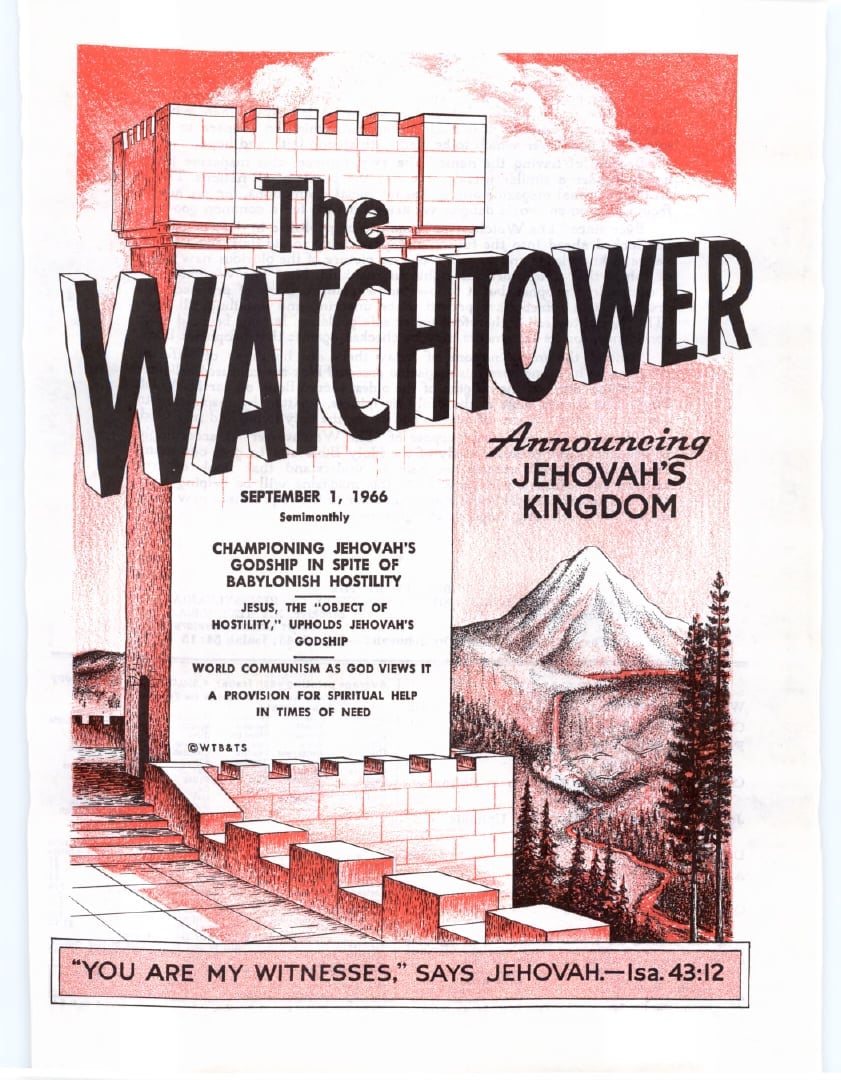
The Watchtower — September 1, 1966
Source: jw.org
Contents
World Communism as God Views It
Christianity—a Way of Life
Fearlessly Spreading Truth Though It Plagues Men
Championing Jehovah’s Godship in Spite of Babylonish Hostility
Jesus, the “Object of Hostility,” Upholds Jehovah’s Godship
Do You Remember?
A Provision for Spiritual Help in Times of Need
Questions From Readers
Announcements
World Communism as God Views It
World Communism as God Views It
SINCE the revolution of the ungodly Bolsheviki or Communists in 1917 a black cloud has loomed up and has spread over a great portion of the earth. Radical governments have taken over powerful nations at the cost of wholesale bloodshed, smaller nations have been swallowed up, and a communications barrier has been set up by “iron” and “bamboo” curtains. Fear and tension have mounted in the more stable countries of the world and, while these world governments have never really served God, the Communist governments are more open and frank in outwardly being ungodly, atheistic and against all religion. Restlessness, hate and violence have been stirred up by this ungodly movement in all sections of the world, even parts formerly isolated and tranquil. When the men in the Kremlin speak, the world trembles for fear that a nuclear war may begin.
THE FIRST REVOLUTIONARY GOVERNMENT
Where did this kind of thing get its start? Well, we have to go back to the days following the Flood, when Noah as the patriarchal head gave mankind God’s command and instructed them to spread out and fill the earth. Through fear and selfishness they refused to do this and put themselves under the headship of a violent man, a restless lover of excitement, a revolutionary and militaristic man. He did not want to accept God as ruler but innovated something new and revolutionary in the earth. He established the first political kingdom on earth. “The beginning of his kingdom came to be Babel.” As the first king mentioned in the Bible, this human originator of revolutionary government and king of Babel or Babylon was none other than “Nimrod a mighty hunter in opposition to Jehovah.” (Gen. 10:8-12) His violent, revolutionary political movement ran ahead of God’s promised Messianic kingdom, the kingdom of the “seed,” of the first prophecy. (Gen. 3:15) This political ideology alienated Nimrod and his followers from Jehovah God. The alienated masses became restless and violent and are described in the Bible as a symbolic sea: “But the wicked are like the sea that is being tossed, when it is unable to calm down, the waters of which keep tossing up seaweed and mire.”—Isa. 57:20.
According to Revelation 13:1, it was the “sea” out of which the seven-headed wild beast, symbolizing Satan’s visible political rule, ascended. Nimrod was Satan’s chief visible agent in beginning his political system of rule. It is this sea stirred up by the four winds of the heavens that is the source of four huge beasts, picturing a series of world powers, as seen in a night vision by the prophet Daniel. (Dan. 7:1-3) Restless, dissatisfied people make good breeding ground for modern ideologies such as Nazism, radicalism and Russian-type Communism.
In the eleventh chapter of Da Daniel’s prophecy totalitarian, dictatorial rule is represented by the “king of the north,” and of him it is said: “And the king will actually do according to his own will, and he will exalt himself and magnify himself above every god; and against the God of gods he will speak marvelous things.” (Dan. 11:36) The prophecy shows also that this totalitarian king of the north worships, not the god of his forefathers or other nations, but, “to the god of fortresses, in his position he will give glory.” (Dan. 11:37, 38) It is true that he does rely on and boasts in scientific and military might in both his cold and his hot wars against the more conservative, stable governments of earth.a
A PLAGUE ON COMMUNISM AND RADICALISM
What does God say his position toward world Communism is? In a vision to the apostle John God revealed his view of world affairs and movements and the results thereof by showing him seven angels pouring out from the heavens toward the earth seven plagues. We are concerned here with the second plague. John reports: “And the second one poured out his bowl into the sea. And it became blood as of a dead man, and every living soul died, yes, the things in the sea.”—Rev. 16:3.
God describes Communism and radical elements as, from his standpoint, the blood of a dead man, something that one would certainly not want to touch or even to gaze on. And God’s Christian servants, Jehovah’s witnesses, have taken exactly that position. They have discerned God’s view as expressed in the second plague poured out by one of the seven angels having the bowls of God’s anger. They have shunned Communism and radical, revolutionary movements as dead and death-causing. Like Moses and Aaron when they appeared before Pharaoh announcing the plagues to come upon Egypt, they have boldly taken part in announcing this plague on world Communism.
Even before the time for pouring out the plagues, as far back as September 1879, the third month of its publication, the magazine Zion’s Watch Tower, now The Watchtower, in an article on “The Day of the Lord—Revelation 6:17,” said the following:
Very many Scriptures seem to teach that the kingdoms of earth will be overthrown by a rising of the people: goaded to desperation from lack of employment and seeking relief from the oppression of bloodthirsty governments. Such a rising and overturning, Socialists, Communists, and Nihilists of today would gladly bring about if they could. Now the Scripture recognizes wrong and oppression as existing in the nations and foretells this as the way in which they will be overthrown, . . . Yet it does not recognize this Communism as right but the contrary rather instructing believers to “obey the powers that be” as long as they last, saying to us—“Be patient, therefore, brethren, unto the coming of the Lord.”
. . . When we with a few others declared these things only a short time since, and called attention to the fact that trouble was taught to be occasioned by a rising of the people and the overthrow of governments—Communism—we were laughed at; there was truly little sign then of Communism; but today every civilized nation is in dread, and Nihilism, Communism and Socialism, are household words, . . .
In this time of divine judgment since 1919 and up until now, during which time the seven plagues are being poured out, Jehovah’s witnesses maintain the same position toward worldly Communism. On December 11, 1921, President J. F. Rutherford of the Watch Tower Society addressed 7,000 listeners in the old Hippodrome of New York City on the subject, “Millions Now Living Will Never Die.” In talking about the nations in distress and the remedies proposed, he said:
“Financiers are fearful of losing their holdings. Labor is fearful that it will not be able to exist. Statesmen, politicians, and rulers fear radicalism or Bolshevism. In fact, every one whose mind is not stayed upon the Lord is in a state of fear and distress. (Isaiah 26:3) . . .
“What is really feared by the ruling factors is radicalism or Bolshevism. Bible Students, who are Christians, are unalterably opposed to any unrighteousness practiced by any one class upon another. They are neither radical nor speaking for the opposite alliance. They must believe that the nation that will be blessed must recognize Jehovah as God and Messiah as the Lord and King.”—The Golden Age, as of January 4, 1922, page 214.
On February 15, 1924, the 64-page booklet entitled “A Desirable Government” was issued and 741,449 copies were sent out from the Watch Tower Society’s headquarters in Brooklyn in nine months. Under the subheading “Government Failure—A Malady,” this booklet said:
“There is not a government on earth today that satisfies any reasonable proportion of the world. Many of the nations are ruled by dictators. The whole world is practically bankrupt. Leading men of the world have advanced various schemes or methods for governmental reform. But these all have proven abortive.”—Page 5, paragraph 2.
See also page 23, referring to the “great revolution in Russia, Germany, Austria, and other European countries.”
Page 54 speaks of further trouble “similar to what Russia has already undergone.”
Later, representing again the position of Jehovah’s witnesses, then widely known as International Bible Students, the Society’s president wrote, on pages 244, 245 of the publication entitled “Government,” printed in 1928:
These struggles have resulted in many revolutions, great suffering, and much bloodshed. Out of these struggles have developed the various theories or forms of government called radical, including communism, socialism, the soviet and bolshevism. . . .
. . . The soviet government has not been a success and never can be, and is far from being satisfactory to the people who have tried it. As in all other forms of government where the people are supposed to have a voice, the demagogues and party men dominate the various councils; and therefore the government has presented no advantages over any other government. In fact, bolshevism has resulted in great suffering of the people, and it is feared by many of the other nations and governments of the earth.
Every form of government man has tried, whether that is monarchy, aristocracy, democracy, republic or social, has been unsatisfactory.
CHRISTIANS WARN COMMUNIST RUSSIA
Worldly Communism has always been bitterly opposed to Jehovah’s witnesses and in its campaign against God has violently persecuted them. The Watch Tower Society, which now has ninety-five branches throughout the earth, has never been able to establish a branch office in Russia. When Communism took over other countries, existing branches of the Watch Tower Society were closed down and Jehovah’s witnesses have ever since been persecuted and driven underground. In China the Society’s branch office was closed after Communism got control and its branch manager and another missionary from Britain, both graduates of the Watchtower Bible School of Gilead, Jehovah’s witnesses’ missionary school located in Brooklyn, New York, were arrested and imprisoned for seven and five years respectively.
During 1956 and 1957 Jehovah’s witnesses held district assemblies around the world. On Saturday night at each of these 199 assemblies they adopted a resolution addressed to the then Premier N. A. Bulganin of the U.S.S.R. It protested against the persecution upon the thousands of Jehovah’s witnesses found behind the Iron Curtain and particularly in Russia and Siberia. It petitioned for the Russian government to rectify conditions, that Jehovah’s witnesses might freely, aboveground, carry on their worship of their God for the salvation of all the sheeplike people. It advised the Soviet government against keeping itself in the ranks of those persecutors foretold in Matthew 10:16; 24:9.
A total of 462,936 voted. From each of those assemblies a copy of the adopted and signed resolution was sent to Premier Bulganin and to any local Russian ambassador. Copies were supplied to the public press, which gave wide publicity to the courageous resolution. The result? Persecution of Jehovah’s witnesses was intensified.b
This widely published stand of Jehovah’s witnesses has hardened world Communism more and more against them and the Communists have shown themselves to be in the ranks of the symbolic goats of Jesus’ parable of the sheep and goats. Jesus explained that these would be manifest at the time of the end of this world or system of things and that the goats would be cut off from all existence. (Matt. 25:31-46) This parable, as explained by President Rutherford at a Los Angeles (California) convention, was published shortly afterward in The Watch Tower, in its issue of October 15, 1923.
AN ENVIRONMENT NO ONE CAN LIVE IN
So God views world Communism as the blood of a man who has been violently killed and which blood has congealed, caked. By taking a position against God’s kingdom Communism is death-dealing, for God’s kingdom is the only government that will give life to the people. By bringing about world revolution by violent means and by crafty subversiveness and by keeping the world in an unsettled state, to weaken by subversion the long-established system of things and to take advantage of this to overthrow the democratic, parliamentarian, capitalistic elements of human society, Communist leaders have caused wholesale death. Communism has promised much to the dissatisfied masses but in fact it has exploited them. God shows that he is against the revolutionary Communistic element when, after likening such restless, ungodly ones to the troubled sea, he adds: “‘There is no peace,’ my God has said, ‘for the wicked ones.’”—Isa. 57:21.
For many years Jehovah’s witnesses have worked hard to help people to see that Communism is not the thing to seek as a cure for the injustices and inequalities in the world. Referring to conditions on our earth under God’s new government over mankind, the booklet entitled “A Desirable Government” (1924) quoted Revelation 21:1 (AV) as follows:
“And I saw a new heaven [invisible ruling power] and a new earth [new order of things on the earth]: for the first heaven and the first earth [the old order] were passed away; and there was no more sea [restless, anarchistic humanity]. . . . ”—Note also on page 38 the statement: “Under that government wars, famines, pestilences, revolutions and anarchy will forever cease.”
Since that time much more has been published by Jehovah’s witnesses, telling of the Bible promise of life on a paradise earth, resurrection and blessings under Christ’s Kingdom rule.
Jehovah’s witnesses carry on an intelligent, organized, Bible-directed work with a message that will help life seekers to get out of the “sea” of peoples alienated from God. Being unclean and thickened like blood, it is an element in which no one can keep living, just as “every living soul died, yes, the things in the sea,” in Revelation’s vision. (Re 16:3) Persons who want to live in God’s new order in which there will be a new heavens and a new earth and in which the symbolic “sea” will be no more will, like God, view Communism and all the radicals, revolutionaries, anarchists and pushers for world domination by ungodly Communism as dead. The fact that people are learning this greatly plagues the Communist leaders but they are unable to stop the plague and they continue to harden themselves, making their destruction more sure.c
[Footnotes]
For a full discussion of the Communist “king of the north” as prophesied in Daniel, chapter 11, see the 384-page book “Your Will Be Done on Earth,” published by the Watchtower Bible and Tract Society (1958).
See pages 35, 338-344, 491 (column 5) of Religion in the Soviet Union, edition of 1961, by journalist Walter Kolarz, author of a number of books.
The remaining five plagues of Revelation, chapter 16, will be discussed in succeeding issues of The Watchtower. Also see “Babylon the Great Has Fallen!” God’s Kingdom Rules!, 704 pages, published by Watchtower Bible and Tract Society, Brooklyn, New York.
Christianity—a Way of Life
Christianity—a Way of Life
MILLIONS of people know at least a small amount about Jesus’ teachings. However, being acquainted with the basics of Christian doctrine does not mean that one is a Christian, because Christianity is a way of life, not just a set of teachings.
The apostle Peter highlighted this point. He encouraged fellow Christians to maintain their conduct, their way of life, fine so that other persons might see their works and glorify God.—1 Pet. 2:12.
In our day, also, true Christians strive to demonstrate in their daily conduct that Christianity is a way of life. Recently a traveling minister of Jehovah’s witnesses in Kansas concluded a three-day circuit assembly for the Witnesses in that area. Before leaving town he stopped in at a hotel.
When the hotel manager, to whom the Witness was speaking, realized that the minister was connected with the assembly, he stated: “I’ve been in the hotel business for some time. I’ve attended many conventions of different kinds, and had large groups in the hotel before. But I’ve never experienced anything to compare with the past three days. I had practically every room in this hotel filled with your people, even had some of them in rooms which I don’t normally use. I know that some were in rooms which were certainly not up to the standards they normally enjoy, but I didn’t hear of a complaint of any kind, a harsh word, or any rowdiness, even though there were many young people here. I want you to pass the word along to your hospitality committee or your public relations people that they have done a fine job.”
The minister realized that the manager thought the Witnesses who stayed in his hotel were specially selected or had been briefed before they checked into the hotel. So he explained that that was not the case—that his guests were typical Witnesses who behaved in the way he described because they followed Bible principles.
Then, obviously moved by emotions, the manager said: “You know, several of your people actually came to me personally and invited me to attend your Sunday meeting. In all the years I’ve been in this town, that’s the first time anyone ever invited me to their services, or indicated that they cared about me. I really appreciated that, even though I couldn’t come. Why, you know, they even left some Bible literature in the lobby for the other guests and never asked a contribution.” After mentioning the neatness of the rooms, he concluded: “You people have something that most people have lost.”
Fearlessly Spreading Truth Though It Plagues Men
Fearlessly Spreading Truth Though It Plagues Men
TODAY Jehovah’s people are spreading the truth about God’s kingdom throughout the earth. This is good news and should be welcomed by all, but is it? No, it is not. Why not? Because with it is being preached the truth of God’s judgments soon to be executed upon the wicked. Such a message actually plagues men.
The fact is that God’s servants sent to make known his will have ever had this twofold work to do, even as illustrated by God’s commission to Jeremiah. He was told both to tear down and destroy and to plant and build. (Jer. 1:9, 10) Yes, and as recorded by Isaiah, God’s servants today have not only a message of comfort and freedom but also one of warning about “the day of vengeance on the part of our God.”—Isa. 61:1, 2.
Since wicked men are plagued by the truth, it takes courage, fearlessness, to spread it. This plaguing by means of the truth was foreshadowed by the plagues that came upon ancient Egypt in the days of Moses, and concerning which Jehovah years later said to the Israelites by means of his servant Joshua: “I sent Moses and Aaron, and I went plaguing Egypt with what I did in its midst; and afterward I brought you out.”—Josh. 24:5.a
That those plagues are pictorial is to be seen from the fact that all the things written aforetime “were written for our instruction.” (Rom. 15:4) Besides, do we not read that Moses pictures Jesus Christ? (Acts 3:19-26) This being so, it is reasonable to conclude that Pharaoh pictures Satan the Devil, and his nation Egypt, Satan’s organization. And as the plagues back there served to make known Jehovah’s name and power, so today it is the plaguing messages, delivered by God’s servants, that tell about Jehovah’s name and power.—Ex. 9:15, 16.
Yes, back there Jehovah, by Moses, had requested that his people Israel be allowed to go into the wilderness to offer sacrifices to Jehovah, and Pharaoh had arrogantly and contemptuously sneered: “Who is Jehovah?” (Ex. 5:2) But by the time Pharaoh had experienced the plagues of the waters of the Nile being changed to blood, of swarms of frogs, gnats and gadflies, the plagues of pestilence upon the animals and boils upon man and beast, crops ruined by hail and locusts, a darkness so dense that no one stirred for three days and nights and then the death of Egypt’s firstborn, Pharaoh was willing to let the Hebrews go; in fact, he urged them to go. That those plagues served Jehovah’s purpose to make his name known is also seen by the fact that centuries later pagan priests called attention to them.—Ex. 7:1–12:51; 1 Sam. 6:6.
And let it be noted that those were bona fide miracles, not mere coincidences, or they would not have driven home to Pharaoh their lesson. Further proof of their genuineness is seen in the fact that time and again reference is made to them in the Hebrew Scriptures as well as in the Christian Greek Scriptures.—Psalms 78 and 105; Jer. 32:20; Acts 7:36.
These plagues, though not to be confused with those mentioned at Revelation chapter 16, nevertheless do have basic similarities in that they both represent judgment messages that God has his people deliver. These messages show how Satan’s organization appears in the eyes of God and they serve to plague those of Satan’s organization. By means of such publications as The Watchtower, Awake! and “Babylon the Great Has Fallen!” God’s Kingdom Rules!, modern “Egypt,” Satan’s visible organization and especially “Babylon the Great,” is shown to be covered with bloodguilt, to be grossly immoral, unclean spiritually as well, having nothing in common with God’s Word and people, a spiritually diseased organization, barren of all spiritual food, one in total darkness as to the light of God’s kingdom and any hope for mankind, and as not having any firstborn alive among them, those truly dedicated to Jehovah God.
It takes courage to speak out fearlessly regarding these matters. It takes unselfish love and strong faith to keep persevering in telling such truths, going over the territory time and again, even as Moses and Aaron fearlessly and repeatedly appeared before Pharaoh and his court, some dozen times in fact. But why should we not be fearless? Is not He that is for us greater than all that are against us? (Rom. 8:31) Furthermore, since our motives are pure, we can be as bold as the young lion, knowing that Jehovah will give us strength and protection.—Prov. 28:1.
[Footnotes]
For details see The Watchtower, June 15, July 1, 1966.
Championing Jehovah’s Godship in Spite of Babylonish Hostility
Championing Jehovah’s Godship in Spite of Babylonish Hostility
“Jehovah went on to say to Satan: ‘Have you set your heart upon my servant Job, that there is no one like him in the earth?’”—Job 1:8.
1, 2. (a) Is there a challenge that has existed, and what does it involve? (b) What evidences will be featured in this study, and why?
FROM Adam’s time to our day a challenge has existed as to who rightfully exercises Sovereign Godship universally, over heaven and earth. If the Almighty God, Jehovah, does so, then can he choose reliable witnesses on earth to champion His Sovereign Godship with integrity? Also, will such chosen witnesses be able to uphold His Sovereign Godship with endurance against taunting hostility? Remember, it is written: “‘You are my witnesses,’ is the utterance of Jehovah, ‘and I am God.’”—Isa. 43:12.
2 In the days of Nimrod, some time after the Flood, Satan began to generate a powerhouse of apostasy stemming from the ancient city of Babylon. From there Babylonish false religious thinking developed and spread to the four corners of the earth. With respect to this Babylonish development the Bible records the dramatic history of Job of the seventeenth and sixteenth centuries B.C.E. with its remarkable heavenly and earthly tableaux. Therein are preserved for us scintillating evidences of Babylonish false religious thinking that has stirred men to manifest hostility against the true worshipers of Jehovah God. From this ancient source, Satan has generated a flow of cunning apostasy to perpetuate an agelong controversy between those guided by Babylonish false religious wisdom and those guided by pure wisdom that flows down from the true God Jehovah. (Jas. 3:17) Our attention will now be focused on these flashes of Babylonish religious activities employed by Satan down through the corridor of history to taunt Jehovah God by keeping in question whether there is a Sovereign God affecting the affairs of men or not.
THE BOOK OF JOB
3. Can it be said that the book of Job is reliable, and why?
3 Now that the “day of vengeance on the part of our God” (Isa. 61:2) nears for the grand settling of this issue of Sovereign Godship, modern higher critics of the Bible continually attempt to discredit the Job account in an effort to blind men as to its application and progressive fulfillments. ‘Moses was not the inspired writer,’ say they, ‘nor was Job a historic person,’ but, they assert, ‘the book of Job is merely a beautiful poem of wisdom literature composed between 600-400 B.C.E.’a The higher critics ignore the abundant internal evidences involving nomadic society of great wealth that could only match the period of the patriarchs of the seventeenth century B.C.E. and not that of the fifth century B.C.E., where urban life of national states with their regimentations would make unlikely a Job of such wealth and pastoral operations as the Scriptures describe. The antiquity and reliableness of the book of Job are well established.b Job, as part of the Sacred Scriptures, serves well as a sound basis for the study of the challenge respecting Godship in these last days.
THE ANCIENT JOB
4. Who was Job? What was his relationship to Abraham, and what course like Abraham did he follow?
4 Now let us turn to the contents of the book of Job to observe how it clearly sets out the issue of Godship through events in the life of Job as a supporter of Jehovah. Job, a very wealthy man blessed with seven sons and three daughters, lived as a descendant of Uz to the east of the land promised to Job’s distant granduncle Abraham. (Gen. 22:20, 21; Job 1:1) Being a servant of the same God, Jehovah, as Abraham worshiped, Job came to prominence some time before his distant cousin Moses became Jehovah’s prophet to the Israelites during their Egyptian captivity in the sixteenth century B.C.E. Properly, then, Jehovah could refer to his witness Job as “the greatest of all the Orientals” or “sons of the East,” saying also, “there is no one like him in the earth,” that is, then contemporaneously living. (Job 1:3; 2:3) Long before Job’s time his forerelative Abraham had made an exodus out of the religiously Babylonized territory of Ur of the Chaldeans. (Gen. 11:28, 31) Behind him Abraham had left the pagan idolatry and apostate religious rituals of Babylon that had saturated Abraham’s hometown of Ur. (Gen. 15:7) In fact, in later times, the terms Chaldeans and Babylonians became interchangeable. (Ezek. 23:15) Not only had Abraham refused to become Babylonized religiously in his youth but he also had rejected the spell of its thinking and spirit. In order not to share in Babylon’s sins and resultant plagues, Abraham had wisely come out of Babylon’s influence to settle in Canaan, the land of promise, under the direction of Jehovah, the true God. (Rev. 18:4) Though Job, too, lived in the East where Babylonish religion dominated, he, like his distant granduncle Abraham, also refused to become Babylonized as to religious thinking. In integrity he held his heart fast in support of the Sovereign Godship of the true God, Jehovah.
TESTING BY SATAN PERMITTED
5. Prove that the word “Satan” particularizes an individual, and whom.
5 Our view now shifts to the opening tableau of the book of Job where there is an unfolding of the majestic court scene in heaven. Angels are drawn up before the true God Jehovah. Strikingly the issue of Godship is dramatized by letting the one entitled “Satan” also be present. It is worthy of note that at Job 1:6 and thereafter Jehovah’s great resister or adversary, also man’s greatest enemy, is identified as a personality and by title at that. The Hebrew verb satán means “to resist,” and is first used by Moses at Numbers 22:22, 32.c But at Job 1:6 the Hebrew uses the noun satán with the definite article ha affixed to it, thus reading has-satan or The Satan in English.d The definite article, therefore, particularizes Satan as a person and makes impossible the view held by many that Satan is abstract evil, resistance or opposition. In this manner Satan is established in the Bible as a definite personality, with the word “Satan” as one of the proper titles to be used in identifying him.—See also Zechariah 3:1, 2.
6. What divine ability does Jehovah possess, and how is this seen?
6 Jehovah, the tester of his jewellike servants, can read the hearts of angels and men. “I, Jehovah, am searching the heart . . . to give to each one according to his ways, according to the fruitage of his dealings.” (Jer. 17:10) “Jehovah is making an estimate of hearts.” (Prov. 21:2) In view of this divine ability we find Jehovah reading the inmost thoughts of Satan’s heart. “Jehovah went on to say to Satan: ‘Have you set your heart upon my servant Job, that there is no one like him in the earth, a man [1] blameless and [2] upright, [3] fearing God and [4] turning aside from bad?’” (Job 1:8) Here is also indicated that Jehovah was accurately reading Job’s heart, because all four of the above commendable points mentioned by Jehovah as found in Job are fruits stemming from the treasury of a clean, pure heart. “A good man brings forth good out of the good treasure of his heart, but a wicked man brings forth what is wicked out of his wicked treasure; for out of the heart’s abundance his mouth speaks.”—Luke 6:45.
7. (a) What does Satan falsely charge as to Job? (b) What does this indirect evidence indicate?
7 This prologue scene in heaven continues. Satan next charges that Job worships Jehovah for what he selfishly gets out of it, namely, wealth, and not because of his integrity of heart nor because of his love for God. “Satan answered Jehovah and said: ‘Is it for nothing that Job has feared God? Have not you yourself put up a hedge about him and about his house and about everything that he has all around?e The work of his hands you have blessed, and his livestock itself has spread abroad in the earth. But, for a change, thrust out your hand, please, and touch everything he has and see whether he will not curse you to your very face.’ Accordingly Jehovah said to Satan: ‘Look! Everything that he has is in your hand. Only against him himself do not thrust out your hand!’ So Satan went out away from the person of Jehovah.”—Job 1:9-12.
UNDER SATAN’S HAND
8. (a) Explain the figurative uses in the Bible of the words arm and hand. (b) What power is granted Satan by permission?
8 The human hand as well as the arm is commonly used as a Biblical figure of speech to convey certain meanings. The arm figures the ability to generate, develop or amass strength or power. For example, in man’s arm there resides the ability to generate great power, strength or force to hurl an object such as a ball. But it is the hand that pictures applied strength or power. It is the hand that applies the power generated by the arm to certain specific points. In pitching a ball it is the hand that determines how the strength produced by the arm will bring about the curve or path or spin of the ball. Jehovah’s arm of generated strength is described at Isaiah 51:9-11, whereas his hand of arrangements of applied power is referred to at 1 Peter 5:6. Now as to Job, Satan proposes that Jehovah reapply his hand of power toward Job in the form of persecution. Jehovah agrees only for the time being to shift his hand to permit Job to come under the resisting hand of Satan’s applied power for bringing about calamities.
9. (a) How does Satan begin to apply his hand? (b) What Babylonish evidences are here indicated?
9 The second tableau opens with a scene of earthly happenings. Satan of the realm of the invisible next brings about tremendous adversities upon Job. Satan’s hand of applied power is now at work. For some time Satan had Babylonishly trained bands of agents on earth to become available for deeds of hostility. First, Job’s wealth begins to be slashed by Satan’s dupes, the Sabaean marauders, stealing Job’s large herd of cattle. Incidentally, the Sabaeans were apostate worshipers of heavenly bodies, the sun, moon and stars, deriving such from the Babylonians.f (Isa. 47:1, 13) Job himself was openly opposed to such worship of the sun and moon. (Job 31:26, 27) Job’s riches continue to be obliterated by destructive fire coming from the atmosphere to destroy Job’s great flocks of sheep. (Eph. 2:2) Finally, his wealth is wiped out by the three bands of Chaldeans robbing Job of his large number of camels. Note that Chaldeans, who were a Babylonish, religiously controlled people, were also agents used by Satan to make war upon Jehovah’s true witness Job. There being “three” bands is early evidence that Babylonish religionists were emphatically anti-Jehovah, three being a numerical symbol of emphasis.—Job 1:13-17.
10, 11. (a) How does Job react to Satan’s further blows? (b) What are the sources of persecution, and why are such permitted?
10 Not enough—Satan’s adverse hand continues. Job’s ten children must be killed by a great storm wind generated by Satan’s arm and then put to death by Satan’s hand of applied power. (Heb. 2:14) What news of destituting blows! (Job 1:18-20) Though he did not know why all this adversity came upon him, Job’s heart held fast in loyal support of Jehovah’s Godship. In his being brought very low Job said: “Jehovah himself has given, and Jehovah himself has taken away. Let the name of Jehovah continue to be blessed.”—Job 1:21, 22.
11 Here is demonstrated for all time that the source of persecution and adversities upon Jehovah’s faithful witnesses never comes from the direct hand of Jehovah. Rather, it always comes from the permitted hand of Satan and his associate resisters, demonic and especially those religiously, Babylonized humans. Jewels, when put to the test, show their quality. So it is with the tested hearts of Jehovah’s faithful witnesses. (Jas. 1:2, 3) Jehovah knows how to supply spiritual encouragement and food necessary to build up the heart. Jehovah knows how to give the right heart training that provides one with the endurance to withstand supernatural satanic pressures as were withstood by Job.—1 Cor. 10:13.
TRUE TO JEHOVAH’S SOVEREIGN GODSHIP
12. What further calamity is brought upon Job, and why?
12 Satan having failed to prove Job materialistic in his devotion and service to Jehovah, the third tableau shifts us back to heaven again where Satan next charges: “‘Skin in behalf of skin, and everything that a man has he will give in behalf of his soul.g For a change, thrust out your hand, please, and touch as far as his bone and his flesh and see whether he will not curse you to your very face.’ Accordingly Jehovah said to Satan: ‘There he is in your hand! Only watch out for his soul itself!’” (Job 2:4-6) Once again with his hand or means of applied power Satan produces, this time, suffering as an instrument to bring about torment to Job personally. “So Satan went out away from the person of Jehovah and struck Job with a malignant boil from the sole of his foot to the crown of his head. And he proceeded to take for himself a fragment of earthenware with which to scrape himself; and he was sitting in among the ashes.” (Job 2:7, 8) Thus the fourth tableau now sets in, the scene on earth of a prolonged ordeal in which Satan seeks to prove his challenge of Jehovah’s Godship by testing Jehovah’s worshiper Job to the limit.
13. How did Job’s trials affect Job’s wife? Explain.
13 The scene of trials continues. Job and his wife had no spiritual television arrangement such as we now have in the completed, inspired, Scriptural account of Job, to see with ‘eyes of the heart’ what was back of Job’s afflictions. (Eph. 1:18) While there were many things Job could not understand as to his testing, yet his faith was strong to hold true to champion Jehovah’s Godship all along. Another blow—the faith of Job’s nearest and dearest, his wife, weakens. She says to him: “‘Are you yet holding fast your integrity? Curse God and die!’h But [Job] said to her: ‘As one of the senseless women speaks, you speak also. Shall we accept merely what is good from the true God and not accept also what is bad?’ In all this Job did not sin with his lips.”—Job 2:9, 10.
THREE COMPANIONS BABYLONIZED
14. (a) Whom was Satan next to use to test Job? (b) What Babylonish background do Job’s three companions appear to have?
14 By the seventeenth century B.C.E. Babylonish religious thinking had influenced all the peoples in and about Palestine. Evidences now scintillate to indicate that the so-called friends of Job had become addicted to Babylonish apostasy. Such false friends were now ready for Satan’s special pressures against Job. To make Job’s sufferings jab deep into his heart, Satan maneuvered these three Babylonized agents to employ philosophical wisdom to wear down Job mentally in his loyalty to Jehovah. The fact that there were three of such pretended comforters emphasizes Satan’s all-out attempt in this subtle fashion. The first false one was Eliphaz, the Temanite, indicating he was a descendant of Abraham through his apostate grandson Esau. (Gen. 36:2, 10, 11) The Temanites became famous for their apostate wisdom since they had not held fast to the true religion of Abraham. (Jer. 49:7) Bildad, the Shuhite, was the second false companion, being also a descendant of Abraham through Abraham’s sixth son, Shuah, by his second wife, Keturah. (Gen. 25:2) Bildad, too, had become an apostate from the true religion of Abraham. His name Bildad means either “Son of Contention,” or, “Bel has loved,” which latter meaning could indicate the strong Babylonish background of his parental training, since Bel was the title of Marduk, the chief god of the Babylonians. (Jer. 50:2)i The third of this trio of trying “comforters” was Zophar, the Naamathite, betrayed by his speeches also to be an apostate from the true religion of Abraham. The Septuagint refers to him as “Sophar king of the Minaeans,” an Arabian people, the Arabs being generally considered as descendants of Abraham.
15. What do the seven days of silence seem to indicate, and why?
15 When the three “companions” arrived they opened their ‘program of comfort’ with a period of silence for seven days and seven nights sitting in the presence of Job. (Job 2:13) While it is true the descendants of Abraham, at the time of Jacob’s burial, conducted mourning rites with heavy wailing for seven days (Gen. 50:10), yet there is no evidence of a custom of seven days of silence amongst the Israelites. So the seven days of silence seem to correspond with a Babylonish practice of imploring the invisible powers of Satan and the demons for suggestions as to what conditions indicated.j At least by the end of seven days these three manifested themselves as part of Satan’s plot to weaken Job’s support of Jehovah’s Sovereign Godship.
TITLES THAT INVOLVE GODSHIP
16. Trace the uses of the Hebrew words for God (a) as to the pagans, (b) as to the true worshipers of Jehovah.
16 Let us now examine further evidences that Job’s three false comforters were uttering Babylonized wisdom with the sibboleth of apostasy rather than consoling Job by means of pure wisdom with the shibboleth of the true religion. (Judg. 12:6) In other words, their Babylonized wisdom sounded attractive and very similar to the divine wisdom but it did not quite have the ring of its genuineness. Since the basic issue is Sovereign Godship, it is noted that all three claimed to be monotheists or believers in one deity. These three deflected descendants of Abraham used the terms “Almighty” (shaddái) and “God” (el; or, elóah, the singular, or elohím, the plural form of excellence), as did their forefather Abraham and as did Job. (Gen. 17:1; Job 4:17; 6:4; 8:3; 11:7) But now comes the test! From the time that idolatry started in the days of Enosh men began to call their idols god (el or elohim). The Targum of Palestine comments on Genesis 4:26 as follows: “That was the generation in whose days they began to err, and to make themselves idols, and surnamed their idols by the name of the word of the Lord.”k After the deluge of Noah’s day the Babylonized pagans did the same by referring to their apostate gods also by the plural form of excellence, elohim, god. (Note this as to the god Dagon at Judges 16:23, 24; and the god Chemosh and the god Milcom at 1 Kings 11:33 and the god Baal-zebub at 2 Kings 1:2, 3, 16.) Observe that in Noah’s history recording the days of Enoch, after idolatry had become practiced, the true worshipers frequently put a definite article ha before el or elohim to indicate “the true God” Jehovah as distinct from the false gods who were also being referred to as el or elohim but not as ha-el or ha-elohim.l—Gen. 5:22; 2 Ki. 1:6, 9.
17, 18. Contrast the difference in the way the words for God and Jehovah were used by (a) Abraham and Job, (b) the three companions. How does this affect the issue of Godship?
17 Abraham followed this practice from Enoch’s time by also referring to Jehovah by the delicate, differentiating form of ha-elohim (as at Genesis 17:18; 20:6, 17 and Ge 22:9). For discriminating students of the Sacred Scriptures the New World Translation preserves all the uses of ha-el and ha-elohim in the Hebrew texts by translating such accurately as “the [true] God.” Job in his speeches follows Abraham’s practice by also championing Jehovah’s Godship as apart from the pagan gods by occasionally using ha-el and ha-elohim. (See Job 2:10; 13:8; 21:14; 31:28.) But in the speeches of Bildad and Zophar, they follow the practice of the Babylonish religionists by just using the general form, el or elohim for God. Even Eliphaz, the claimant of orthodoxy (Job 15:10), only once uses ha-el, “the true God,” at Job 22:17 and then only sort of disparagingly with reference to those who hold to Jehovah as the true God.—Job 22:15.
18 Following another Babylonish practice of hiding the personal name of the Deity, the three false comforters do not use the divine name, Jehovah, once in any of their many speeches, whereas Job uses the name Jehovah five times. (Job 1:21; 12:9; 28:28) In the account of Abraham their forefather the name Jehovah is used some seventy times from Genesis chapters 12 to 24 inclusive. Then, too, Job is the only one to devotedly refer to Jehovah as the “Holy One.”—Job 6:10.
A SPIRITISTIC EXPERIENCE
19. Explain what is demonstrated by Eliphaz’s spiritistic experience.
19 Another characteristic evidence of Babylonish religion is that of communicating with the spirits or demons. Such spirits or demons were unable to materialize like the faithful angels did in communicating with Abraham. (Gen. 18:1-8) This meant that the demons had to resort indirectly to divination and oracles. “In inspirational or natural divination the agent is professedly under the immediate influence of some spirit or god who enables the diviner to see the future and to utter oracles embodying what he sees. . . . It can be proved that among the ancient Babylonians and Egyptians the view prevailed that not only oracles but also omens of all kinds are given to men by the gods and express the minds of these gods.”a Note that in Eliphaz’s first speech he appeals to one of his Babylonish-like, spiritistic experiences to support his argument. (Job 4:15-17) Never did Abraham or Job have such demonistic experiences to deny the Godship of Jehovah who guided them directly.
MAN, THE MORTAL—RESURRECTION HOPE
20. Show how Job had accurate knowledge as to what man is. How does Job express his hope for the future?
20 Job in his counterarguments uses the expression “mortal man” (Hebrew, enósh) many times. He understood man to be a living soul. He rejected the Babylonish view that man has an immortal soul. Job believed that man is mortal and, when man dies, he is dead. (Job 7:1, 17; 9:2; 10:4, 5; 13:9; 14:1, 2; 28:13) Job further shows that upon death man has expired. (Job 10:18; 14:10; 27:5; 29:18) His having the right view on this basic matter made it possible for Job to allude to his hope of a resurrection, the coming to life again of himself as an individual on earth. (Job 14:13, 14) It is noticeable that his three false companions were silent on the matter of resurrection.
BABYLONISH PHILOSOPHY
21. Present some of the hostile sentiments expressed by the three false companions against Job.
21 The trio of “companions” with religious variations present the Babylonish materialistic philosophy that only the wise prosper and the guilty suffer adversity. (Job 4:7, 8) Lyingly they claim that Jehovah ‘has no faith in his servants.’ (Job 4:18) An orthodoxy appeal is made by them to heed traditions of previous generations. (Job 8:8, 9) They advocate to keep religion simple and not to go too deeply into knowing things of God. (Job 11:7) It is complained that Job (one of Jehovah’s witnesses) conceitedly claims to know more than the religious sages of the past. (Job 15:9, 10) As to Job’s unwavering stand of integrity for the true Godship, his “companions” resent by contrast their being represented as standing unclean. (Job 18:3) Say they: ‘Job, you take your religion too seriously in trying to maintain a righteous stand before God.’ (Job 22:2-4) From outward appearance Job must be a “badman” and so God must judge him adversely. (Job 22:5-10) Bluntly, finally, it is claimed by these Babylonized wisemen that it is impossible for Job, who calls himself a “mortal man” (Job 7:1, 17), to obtain a righteous, clean standing before God.—Job 25:4.
JOB LOOKS INWARD
22. How was Job forced to look upon himself, and what did he say?
22 So by these three lengthy rounds of arguments of materialistic philosophy this unholy trio force Job to defend himself personally and to look inward upon himself to keep declaring his own soul righteous rather than extolling the rightness of the true God in conducting this case as to His Sovereign Godship. Deep down in Job’s heart this jabbing, testing process occurred, with questions and answers flowing from him. “If I have sinned, what can I accomplish against you, the Observer of mankind? Why is it that you have set me as your target, so that I should become a burden to you?” (Job 7:20) “I myself well know that my redeemer is alive.” (Job 19:25) “O that I had someone listening to me, that according to my signature the Almighty himself would answer me!” (Job 31:35) Yes, by means of this long duel under the permitted hand of Satan through his earthly dupes, Job was tested to the very core of his heart, yet his heart proved to be true, clean, full of hope and trusting in God.
ELIHU’S ASSESSMENT
23. (a) What was Elihu’s assessment of the lengthy religious controversy? (b) How did Jehovah step in, and what was Job’s reaction?
23 Finally the neutral watcher, Elihu, spoke up and presented the right assessment as to the true and false schools of wisdom that had concluded their arguments. “Against Job his anger blazed over his declaring his own soul righteous rather than God. Also, against his three companions his anger blazed over the fact that they had not found an answer but they proceeded to pronounce God wicked.” (Job 32:2, 3) So on the issue of Godship the three false comforters proved to have utterly failed, whereas Job had become sidetracked upon himself although never failing in his integrity to the true God. Then the drama ends with the tremendous display of wisdom from the true God by his speaking out of the windstorm. There Jehovah demonstrated his overwhelming Godship by referring to creation’s marvels and to natural things pertaining to the earth far too wonderful to be grasped by the mind of mortal man. (Job, chapters 38-41) To this amazing shower of heavenly wisdom, Job’s clean heart quickly responds: “I have come to know that you are able to do all things, and there is no idea that is unattainable for you. That is why I make a retraction, and I do repent in dust and ashes.”—Job 42:2, 6.
24, 25. (a) What was Jehovah’s judgment as to the two sides of the Godship controversy? (b) How does the Job drama conclude? (c) What question arises, and how will it be dealt with?
24 Then Jehovah confirms Elihu’s reprimand of the three false companions by saying: “My anger has grown hot against you [Eliphaz] and your two companions, for you men have not spoken concerning me what is truthful as has my servant Job. And now take for yourselves seven bulls and seven rams and go to my servant Job, and you men must offer up a burnt sacrifice in your own behalf; and Job my servant will himself pray for you. His face only I shall accept so as not to commit disgraceful folly with you, for you have not spoken concerning me what is truthful, as has my servant Job.” (Job 42:7, 8) Thus the apostate religion of these Babylonized wise men became exposed by Jehovah himself, twice declaring them as ‘not truthful.’ Their so-called wisdom turned out to be foolishness. Satan miserably lost the contest resulting from his challenge. The three “companions” had to make a climb-down, reform themselves and submit their lives to the priesthood services of Job by accepting the true religion. As to Job personally, “Jehovah himself turned back the captive condition of Job” and blessed him with twice the material wealth he had lost at the beginning. As to his family, he came to have seven sons and three beautiful daughters even in the old age of himself and that of his aged wife.—Job 42:10-15.
25 Surely Jehovah proved to be the true God who can choose reliable witnesses to champion his Sovereign Godship on earth. Job was thus the vindicated champion of his day. Does this drama have prophetic fulfillment or application of interest for men of true wisdom in later times? Evidences in the affirmative will be presented in the succeeding articles.
[Footnotes]
Harper’s Bible Dictionary, p. 337.
For details as to Moses’ writership and other proofs of authenticity see “All Scripture Is Inspired of God and Beneficial,” 1963, pp. 95, 96.
See also 1 Samuel 29:4; 2 Samuel 19:22; 1 Kings 11:14, 23, 25; Psalm 109:6.
See Job 1:6, NW first edition ftn. “b.”
All this is indirect evidence of Jehovah’s protective powers and fatherly interest in safeguarding his true servants.
Harper’s Bible Dictionary, p, 631.
In other words, deep down in Job’s heart, Satan claims, there is still a measure of selfishness.
Note, though weak in faith, she neither denounced Job nor forsook him.
International Standard Bible Encyclopaedia, Vol. 1, p. 473.
Book of Job, by Emily Hambler, p. 12.
Qualified to Be Ministers, p. 270.
See NW, 1961, Appendix, pp. 1450-1452.
International Standard Bible Encyclopaedia, Vol. 2, p. 860.
Jesus, the “Object of Hostility,” Upholds Jehovah’s Godship
Jesus, the “Object of Hostility,” Upholds Jehovah’s Godship
“Consider closely the one who has endured such contrary talk by sinners against their own interests.”—Heb. 12:3.
1. Why can Jesus be described in a preliminary way as the Greater Job?
THE name Job means “object of hostility.”a How accurately Job in his experiences of testing proved to be an object of hostility received from Satan and from his Babylonized religious companions! Now all this affair comes out to be a detailed prophetic drama with a preliminary fulfillment centering around the Greater Job, Jesus Christ. But before one can examine the many instructive evidences of this, it becomes necessary to make a brief historic survey of religious conditions that generated in Palestine and in the neighboring pagan world during the five centuries that preceded Jesus’ day. In all those five hundred years Satan was producing subtle religious forces and confusing doctrines that would put the promised “seed” to the severest test whenever he would make his appearance on the earth. (Gen. 3:15) As shall be seen, the perfect man Jesus was more than ready and able to be the Greater Job or “object of hostility.” So that the issue of Jehovah’s Sovereign Godship might be rightly vindicated, Jesus endured hostile contrary talk by sinners.—Heb. 12:3.
RELIGIOUS STAGE BEING SET FOR JESUS
2, 3. (a) How did there become two Jewish centers—one in Palestine and one in Babylon? (b) In what way was the Jewish religion spread abroad, and around what was it centered?
2 From Biblical and secular history it is evident that only a minority of the Jews exiled in Babylon between 607 and 537 B.C.E. returned to Jerusalem in and after 537 B.C.E. to share in restoring true worship there and to rebuild the temple under Zerubbabel’s leadership. (Ezra 2:1, 2) Some years later Nehemiah aided by rebuilding the wall of Jerusalem (Neh. 7:1), and Ezra shared by staffing the restored temple with priests for full daily services. (Ezra 7:1-7) Ezra also led in the great work of making available for circulation many reliable copies of the sacred Hebrew Scriptures. The majority of the exiled Jews, however, chose to remain in Babylonia, where they were well fixed materially though dispersed in many communities of the country.b Those Jews remaining in Babylon perpetuated a form of the true religion of Abraham, Moses and the Prophets that might be termed “Hebraism.”
3 Onward from the fifth century B.C.E. many Jews from Babylonia and Palestine became businessmen involved in trading and commerce. With their families and relatives they settled in compact sections of large Gentile cities throughout Mesopotamia, Egypt, Greece, Rome, eventually all around the Mediterranean. This meant that Jewish quarters developed then, as today, in almost every part of the civilized world. These Jews brought with them their Hebraic religion, the habit of meeting for prayer and study without temple ritual or sacrifices. A plain assembly hall was the center of their religious life. At first this center was known as the Beth ha-Keneset (house of prayer) or the Beth ha-Midrash (house of study).c Later, due to Greek influence, such buildings came to be called by the Greek word synagogues.d
4. How extensive a Jewish world stage was being set for Jesus’ ministry?
4 In this way the Jews were taking their religion by “export” into the expanding Gentile world. In time these Jewish “colonies” outside Palestine vastly outnumbered in population the homeland Jews and became known as the Jews of the dispersion (diaspora), that is, the Jews “scattered about.” (Jas. 1:1) For centuries, the Jews were outstanding in conducting what amounted to a great missionary movement taking their religion to the Gentiles. “The synagogues attracted hundreds of thousands of converts,” writes Josephus, to make proselytes of them.e (Matt. 23:15) Once in three years pilgrimages were made by the Jewish and proselyte males to Jerusalem to attend the festivals.f Josephus reports that no less than 2,700,000 males gathered there for a passover.g Of this the Grecianized Jew, Philo, writes by calling Jerusalem the capital “not of one nation but of all nations.”h For these reasons we can appreciate the extent of the world stage that was being set for Jesus to serve as an “object of hostility.”
FLESHLY INFLUENCES OF HELLENISM
5, 6. (a) What was Hellenism? (b) How was it “exported” to Palestine? (c) To what fleshly influences were the Jews subjected, and was their religion affected?
5 Next, let us examine how all this pre-Christian religion of the Jews became contaminated by Oriental, Babylonish religious thinking, this being effected either directly through the Babylonish captivity of the Jews or more subtly through the Orientalized Greeks. The Greeks were anciently referred to as Hellenes, so their culture and way of religious life became called Hellenism. The many ancient Greek philosophers in fact were “prophets” of Hellenism, and their differing schools of thought amounted to various sects of pagan Hellenism. Hellenism in its many sects featured things of a pagan appeal to the “desire of the flesh” (1 John 2:16), such as art, music, the dance, physical culture, games, sensual ways of living, search for happiness in the flesh, materialism, immortality of the human soul and the worship of a pantheon or multitude of gods. When the Grecianized Alexander the Great conquered the then-ancient world, “instead of uprooting the population of the subject countries as Eastern conquerors had done, the Greeks took their own country to them.”i So, like the Jews, the Greeks exported their Hellenistic culture throughout the nations. For example, under this policy of Alexander and his successors a chain of ten Greek cities known as the Decapolis (ten cities) was built right in the midst of Judea. (Matt. 4:25; Mark 5:20; 7:31) This was done to break down Jewish solidarity. It brought about an atmosphere or worldly spirit that was temptingly charged with subtle Hellenistic influences. (1 Cor. 2:12) To the Jewish youths these cities were a showplace that featured athletic games, an appeal to the aesthetic senses, elegance, refinement and beauty of form.j So Greek manners, Greek words, Greek ideas were flooded into Palestine.
6 But all these Hellenistic forms of culture and religion had already become mingled with Oriental or Babylonish ways when Alexander had overrun all the Persian Empire.k “When [Hellenism] was mingled with Oriental ideas, it degenerated into an altogether bastard growth of sensuality and rationalism.”l Of both the Jews in Palestine and those in the dispersion it is observed that “gradually but surely the Jews began to assimilate the religious ideas of the people about them, and to look on the Scriptures under the influence of those ideas.”a So this meant that the earlier Hebraism now became further apostatized as the religion of Judaism with all its growing accretions of traditions and non-Biblical regulations. (Gal. 1:13; Mark 7:13) Next, let us evaluate the evidences showing that Judaism became Babylonized, then divided into sects by the time of Jesus.
JEWS ACCEPT BABYLONISH THINKING
7. By what term did the Babylonians come to refer to their god?
7 First note that in the matter of godship in Babylon, Marduk (Merodach) is referred to as “the senior of the gods, the most ancient,” the chief god of Babylon. (Jer. 50:2)b Marduk’s ancient background stems back to Nimrod. “Nimrod . . . the most admissible correspondence is with Marduk, chief god of Babylon, probably its historic founder, just as Asshur, the god of Assyria, appears . . . as the founder of the Assyr[ian] empire.”c Long before Isaiah’s time of the eighth century B.C.E. (Isa. 46:1), the custom had developed in Babylon of calling their great pagan god Marduk (Merodach) merely by the general title “Lord” or Baal as had the ancient pagan Canaanites. (Judg. 2:11-13) “Marduk . . . is the city-god of Babylon where his temple was called E-sagila . . . His proper name in the later periods was gradually displaced by the appellative Belu ‘lord,’ so that finally he was commonly spoken of as [by the title] Bel.”d—Jer. 51:44.
8. Were the Jews influenced by the above Babylonian practice of calling their god by a title?
8 It is a well-known fact that the Jews followed a similar custom after their Babylonian captivity by no longer referring to their God Jehovah by his proper personal name but by merely calling him by the title “Lord” (Adonai) exclusively. Actually, the Jewish sopherim in the Babylonized centuries before Jesus made 134 changes in the Hebrew Sacred text from Jehovah (יהוה) to Lord (אדני) to further this apostate or sibboleth custom.e Thus it is seen how slyly the Jews under Judaism were induced by Satan to hide the very name of their true God by following this sibboleth of a Babylonian practice to refer to one’s God merely by title. The warm, personal relationship was now being lost by no longer calling him Jehovah but substituting therefor an abstract title, Lord.
9, 10. (a) In what reverent way is it observed that the true worshipers of Jehovah used the term Lord when referring to Him? (b) What is noticed in the way Nebuchadnezzar acknowledged Jehovah’s Sovereign Godship?
…