The Watchtower, March 1, 1966
Download: PDF — The Watchtower, March 1, 1966
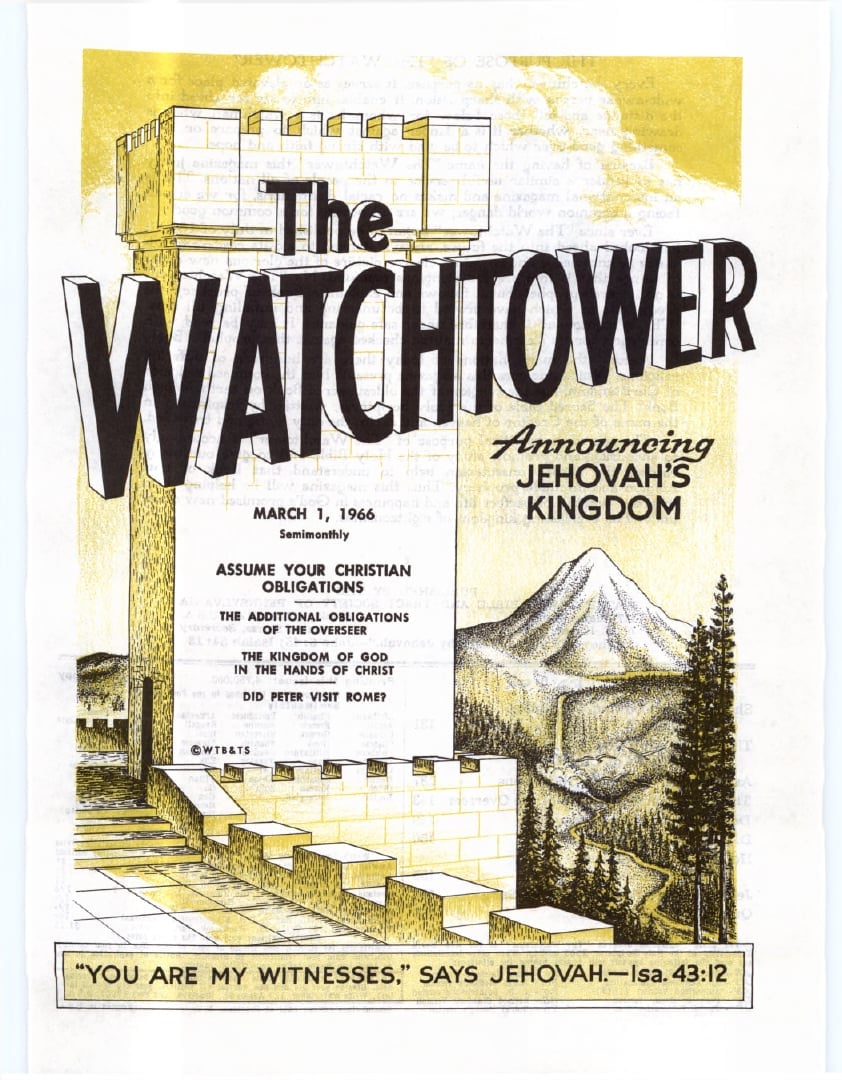
The Watchtower — March 1, 1966
Source: jw.org
Contents
Should Falsehood and Corruption Be Exposed?
The Kingdom of God in the Hands of Christ
Assume Your Christian Obligations
The Additional Obligations of the Overseer
Do You Read Your Yearbook?
Did Peter Visit Rome?
Holding Fast as Slaves of Our Repurchaser
Jehovah Is My Strength and My Song
Questions From Readers
Announcements
Should Falsehood and Corruption Be Exposed?
Should Falsehood and Corruption Be Exposed?
THE line between right and wrong has become so indistinct to many persons that it is almost imperceptible. Policemen take payoffs for overlooking traffic violations; citizens pad expenses on income-tax returns; married persons are unfaithful to their mates and youths cheat on school examinations. Once almost everyone would have viewed such behavior as shocking, obviously wrong and deserving of censure. But now, while not being fully approved, it is generally accepted as natural—the way of life. “They all do it,” people are frequently heard to say.
What is more, it is considered uncharitable and unkind to expose the lie or publicize the wrong of another. People feel that it may not be the best policy to deceive and be untruthful, but to make known deception and uncover falsehood is regarded as being even worse. To do so often opens one to greater censure than is received by the person who commits the wrong.
This apathetic acceptance of corruption and falsehood is also noted in religious matters, especially now when ecumenical efforts are seeking to unite the many different religions. The teachings and practices of a religious organization may admittedly be false, misrepresenting true Christianity, yet to expose them as such is viewed as unchristian. You, no doubt, have noted this to be so.
Well, then, how do you feel about the matter? What if someone spoke out publicly against certain religious leaders, saying to them: “You are from your father the Devil, and you wish to do the desires of your father. . . . When he speaks the lie, he speaks according to his own disposition, because he is a liar and the father of the lie.” Would you think such language unbecoming to a Christian? Even though it were true, would you consider it wrong to undermine the reputation of respected religious leaders in that way?
What if a person used even stronger condemnatory language, saying: “Woe to you, theologians and clergymen, hypocrites! because you shut up the kingdom of the heavens before men; for you yourselves do not go in, neither do you permit those on their way in to go in. . . . Fools and blind ones! . . . Woe to you, theologians and clergymen, hypocrites! because you resemble whitewashed graves, which outwardly indeed appear beautiful but inside are full of dead men’s bones and of every sort of uncleanness. In that way you also, outwardly indeed, appear righteous to men, but inside you are full of hypocrisy and lawlessness. . . . Serpents, offspring of vipers, how are you to flee from the judgment?”
Would such language immediately cause you to label the speaker an intolerant bigot? Many people may consider such speech entirely improper and unchristian. Yet these are the words of our Lord Jesus Christ, spoken to the respected religious leaders of his day! The only change in this direct quotation from the Bible is the substitution of the terms “theologians and clergymen” for “scribes and Pharisees.” And this is most appropriate, for those men were the clergy of the first century among the Jews, even wearing distinctive garb to draw attention to their office, as many clergymen do today.—See John 8:44 and Matthew 23:1-36.
But why did Jesus speak in this way about those men? It was because they had misrepresented God and his teachings. Their false religious traditions and practices had misdirected people from the pathway of righteousness that leads to the kingdom of God. On an earlier occasion Jesus had said to certain religious leaders:
“You have made the word of God invalid because of your tradition. You hypocrites, Isaiah aptly prophesied about you, when he said: ‘This people honors me with their lips, yet their heart is far removed from me. It is in vain that they keep worshiping me, because they teach commands of men as doctrines.’” And so Jesus said to his disciples: “Let them be. Blind guides is what they are. If, then, a blind man guides a blind man, both will fall into a pit.”—Matt. 15:6-14.
So, then, when religious leaders and organizations of Christendom misrepresent God’s Word by teaching traditions of men, is it wrong to expose their false doctrines? When they claim to be following Christ and yet mix in worldly politics, is it a bad thing to publicize that their actions are unchristian and condemned by God? Should the truth be suppressed because it exposes falsehood and corruption? Never! Jesus never hesitated to speak the truth, even though he was killed at the instigation of the angered religious leaders for doing so.—John 17:14; Jas. 4:4.
Therefore, how will you respond when pointed statements are made about false religious teachings and corrupt practices? Will you immediately condemn the person or organization making the exposé? Do you feel it is all right to teach lies and misrepresent God’s Word, but wrong to expose the error? Contrary to what some may think, it is not unkind and unloving to lay bare falsehood and corruption.
Remember the example of Jesus Christ. He was the most loving and kind person to walk the earth. He was tender and compassionate, even with sinful harlots and tax collectors. Lovingly he forgave them their transgressions and helped them on the way to life. Rather than advertise their sins, he covered them over. Yet, at the same time, in some of the strongest language recorded in the Bible, Jesus exposed the stubborn, haughty religious leaders. This was really a loving service, for the false teachings and practices of those religionists were leading their followers to the pit of destruction. The people needed to know the truth if they were to gain God’s approval.—Matt. 23:15.
Therefore, it is right and proper to speak out strongly against falsehood and corruption. A person or organization that, in imitation of Jesus Christ, has the courage to do so deserves attention and respect.
The Kingdom of God in the Hands of Christ
The Kingdom of God in the Hands of Christ
Whose kingdom it it—God’s or Christ’s? Why is Christ made its king?
“Let your kingdom come. Let your will take place, as in heaven, also upon earth.”—Matt. 6:10.
When Jesus taught his disciples to pray in this manner he was teaching them to pray for God’s kingdom, the kingdom of their “Father in the heavens.” (Matt. 6:9) While in the Bible book of Matthew this kingdom is repeatedly spoken of as “the kingdom of the heavens,” throughout the books of Mark and Luke it is regularly called “the kingdom of God.” Yet, when Jesus was born on earth, it was foretold of him that ‘he would rule as king forever, and that there would be no end of his kingdom.’ (Luke 1:33) Jesus personally referred to the Kingdom as his when he told Governor Pilate: “My kingdom is no part of this world. . . . my kingdom is not from this source.” (John 18:36) You may ask, Can the Kingdom be both God’s and Christ’s at the same time?
Evidently so, since at Ephesians 5:5 the apostle, speaking of unworthy persons, stated that they would have no “inheritance in the kingdom of the Christ and of God.” How is this so?
It does not mean that Christ is God and therefore coequal with his Father. The Bible records Jesus’ own statement that “the Father is greater than I am.” (John 14:28) In fact, the more closely we look into the matter the more evident it becomes that Christ, even though king, occupies a position subordinate to his Father, Jehovah God.
JEHOVAH THE SOVEREIGN RULER
Following Jesus’ death, the same apostles whom he had taught to pray, later addressed his Father in this way: “Sovereign Lord, you are the One who made the heaven and the earth.”—Acts 4:24, NW; Mo; RS.
As they acknowledged, Jehovah is the Universal Sovereign. What does this mean? “Sovereign” means much more than merely the ruler or head of a government. It means the one who is the source of all right to rule, the one in whom all authority justly resides. Jehovah legitimately holds this position over all others by virtue of his Godship and because he is the Creator of all that exists. The psalmist sang of him: “Jehovah himself has firmly established his throne in the very heavens; and over everything his own kingship has held domination.” (Ps. 103:19) Unlike those heads of earthly governments today whose executive power is balanced by and limited through a separate legislature and a separate judiciary, Jehovah is not limited in his authority. For that reason the prophet wrote of him: “Jehovah is our Judge, Jehovah is our Statute-giver, Jehovah is our King; he himself will save us.”—Isa. 33:22.
Without stepping down or in any way diminishing his own position as the Sovereign Ruler, Jehovah can, nevertheless, delegate authority and grant power to others, appointing them to carry out his will. Because he always remains King over all such ones, it can be said to him: “Your kingship is a kingship for all times indefinite, and your dominion is throughout all successive generations.”—Ps. 145:13.
An example of such kingship authorized by Jehovah is found in the case of the nation of Israel. Beginning more than a thousand years before the birth of Christ, Jehovah delegated authority to men to serve as kings in that nation, among them Saul, David, Solomon and others. It was said of them that they sat on “Jehovah’s throne.” (1 Chron. 29:23) Why? Because they served as anointed deputy kings, representing Jehovah on earth. So, while we read of the ‘kingdom of David’ as though it was his kingdom, we find David himself in prayer acknowledging Jehovah as the great Sovereign Ruler, saying: “Yours, O Jehovah, are the greatness and the mightiness and the beauty and the excellency and the dignity; for everything in the heavens and in the earth is yours. Yours is the kingdom, O Jehovah, the One also lifting yourself up as head over all.”—1 Chron. 29:11.
THE SON RECEIVES KINGSHIP
The kingship by men of the nation of Israel served its purpose and that was, chiefly, to foreshadow the kingship of the one whom God would make the King of an everlasting kingdom. Following the overthrow of the last king to sit on Jehovah’s throne in Jerusalem, the prophet Daniel was given a vision describing the future appointment of God’s own Son to serve as King. As you read it in Daniel 7:13, 14, note how clearly Jehovah’s position as Sovereign stands out when he, as the Ancient of Days, grants rulership to his Son. The account states:
“I kept on beholding in the visions of the night, and, see there! with the clouds of the heavens someone like a son of man happened to be coming; and to the Ancient of Days he gained access, and they brought him up close even before that One. And to him there were given rulership and dignity and kingdom, that the peoples, national groups and languages should all serve even him. His rulership is an indefinitely lasting rulership that will not pass away, and his kingdom one that will not be brought to ruin.”
A comparison of this text with Matthew 26:63, 64 leaves no doubt that the “son of man” in Daniel’s vision is Christ Jesus. Note how clearly the respective positions of Jehovah and of his Son Christ Jesus are set forth in that vision. The prophetic picture shows Christ Jesus ‘gaining access’ to Jehovah’s presence and then Jehovah, as the Sovereign and therefore the Source of all right to rule, giving his Son “rulership and dignity and kingdom.” Coequality? There is not the slightest sign of it here!
THE KING’S AUTHORITY
What, then, is this kingdom that Christ receives from his Father? Is he merely a “puppet ruler,” much like many kings today who have no real power of control themselves? Or is he an “absolute monarch,” that is, one who is not answerable to others and whose rulership is not subject to limitation?
That Christ is no “puppet ruler” can be seen from his own words, after his resurrection and just prior to ascending to Jehovah’s heavenly courts, when he told his disciples: “All authority has been given me in heaven and on the earth.” (Matt. 28:18) For that reason the command is given in Daniel’s vision that “the peoples, national groups and languages should all serve even him.” Christ, therefore, derives none of his power from the “consent of the governed,” as in a democracy or earthly limited monarchy, but derives it directly from the true Source of Authority, Jehovah God. He obtained this authority by making request to his Father, in fulfillment of God’s invitation expressed at Psalm 2:8, 9: “Ask of me, that I may give nations as your inheritance and the ends of the earth as your own possession. You will break them with an iron scepter, as though a potter’s vessel you will dash them to pieces.”
In one of his parables Jesus pictured himself as a “certain man of noble birth [who] traveled to a distant land [that is, to heaven] to secure kingly power for himself and to return.” (Luke 19:12) He showed that his kingship would be rejected by the majority of earth’s inhabitants, however, when he added: “But his citizens hated him and sent out a body of ambassadors after him, to say, ‘We do not want this man to become king over us.’” (Lu 19 Vs. 14) Because of just such opposition to his divinely invested authority, the King Christ Jesus will be obliged to dash earthly governments to pieces in the coming war of Armageddon.—Dan. 2:44; Rev. 16:14-16.
But Jesus said that all authority was given to him, not only on the earth, but also “in heaven.” (Matt. 28:18) What does this mean? Does it make him the Absolute Monarch of all the universe?
Christ’s authority in the heavens is shown in the statement at Philippians 2:10 that “in the name of Jesus every knee should bend of those in heaven and those on earth and those under the ground.” As with all of earth’s inhabitants, so, too, the millions of God’s angelic sons are all subject to Christ’s rule. (See also Hebrews 1:4-6, 13, 14.) Yet One in the heavens is excepted, and this places the only limitation on Christ’s kingship. For this reason the next verse 11 of Philippians chapter two adds: “And every tongue should openly acknowledge that Jesus Christ is Lord to the glory of God the Father.”—Phil. 2:11.
Yes, though all others in God’s universe are subject to the Son’s rule, Christ Jesus himself remains subject to his Father and God, the sole Absolute Monarch. As the apostle Paul explains: “God ‘subjected all things under his [Christ’s] feet.’ But when he says that ‘all things have been subjected,’ it is evident that it is with the exception of the one who subjected all things to him. But when all things will have been subjected to him, then the Son himself will also subject himself to the One who subjected all things to him, that God may be all things to everyone.”—1 Cor. 15:27, 28.
Throughout all time and space Jehovah God will continue to be the sole and legitimate Sovereign Ruler. What good purpose, then, is there in his having his Son represent him and serve as the anointed Executor of God’s will? Certainly it is not to relieve Jehovah of responsibility or to reduce in any way his work. How could that be, when he continues to be the very Source of all his Son’s power? (Isa. 40:28; Heb. 1:8) Evidently, then, this arrangement is an expression of Jehovah’s wonderful love whereby he extends this grand privilege to his Son. His Son has been trained at his Father’s right hand; he has been tested to the limit, perfected for the position; he has the ability and the wisdom required for the task. Now his Father lovingly exalts him to a position that allows this Son to use these assets to the widest possible extent and for the greatest good of all. He displays absolute confidence in him, knowing that his Son’s proven attitude is: “To do your will, O my God, I have delighted, and your law is within my inward parts.”—Ps. 40:8; see also Hebrews 5:7-9; 10:5-7.
At the same time this arrangement vindicates Jehovah’s position as the true Sovereign, which was challenged by Satan from the time of the historic rebellion in Eden forward. How false the Opposer’s claim that he could achieve and legitimately maintain the position of a rival sovereign by inciting men to act independently of God and by even creating disaffection among some of God’s heavenly sons! What a crushing defeat that one experienced when God’s Son on earth rejected his every temptation and endured all of Satan’s insidious efforts to crack his integrity, dying loyal to his Father’s sovereignty! Though Satan has set himself up as the “ruler of this world,” by his integrity-keeping course Christ Jesus “conquered the world” and has proved its ruler to be worthy only of destruction.—Job 1:6-11; Rev. 12:3, 4; John 12:31; 16:33.
THE KING GRANTS PRIVILEGES TO OTHERS
The King Christ Jesus is not selfish with regard to his kingly position but follows his Father’s loving example. He shares with others the privilege of his kingly power. On the night of his death as a man, he said to some of these: “You are the ones that have stuck with me in my trials; and I make a covenant with you, just as my Father has made a covenant with me, for a kingdom, that you may eat and drink at my table in my kingdom, and sit on thrones to judge the twelve tribes of Israel.” (Luke 22:28-30) Those who are brought by Jesus into that covenant for the kingdom and who will make up his royal joint heirs are pictured in their heavenly position at Revelation chapter 14. Their number is there set at 144,000, all of them “bought from among mankind as a first fruits to God and to the Lamb.”—Re 14 Vss. 1, 3, 4.
It was such ones together with their Head, Christ Jesus, that the prophetic vision of Daniel referred to as “holy ones,” saying: “The Ancient of Days came and judgment itself was given in favor of the holy ones of the Supreme One, and the definite time arrived that the holy ones took possession of the kingdom itself. And the kingdom and the rulership and the grandeur of the kingdoms under all the heavens were given to the people who are the holy ones of the Supreme One. Their kingdom is an indefinitely lasting kingdom, and all the rulerships will serve and obey even them.” (Dan. 7:22, 27) What a privilege is theirs for having upheld and stood fast for Jehovah’s sovereignty!
Even on the earth, transformed into a paradise by the King and inhabited by men and women who love righteousness and who uphold Jehovah’s sovereignty, there will be those who will exercise authority from him. The prophet long ago foretold: “Look! A king will reign for righteousness itself; and as respects princes, they will rule as princes for justice itself.” (Isa. 32:1) Showing where such princes rule, Psalm 45:16 says: “In place of your forefathers there will come to be your sons, whom you will appoint as princes in all the earth.” Whether from the resurrected forefathers of Jesus, such as Noah, Abraham, David and others, or from among faithful men of more recent times, all these will faithfully represent the King. They all ‘bow their knee to him’ in recognition of his Father’s sovereignty, by virtue of which Christ rules.
For all of God’s angels, for all of Christ’s 144,000 joint heirs of the Kingdom, for all the earthly “princes” and for all others of his earthly subjects, Christ Jesus will serve for all time to come as their Model and Example of obedience to his Father’s will. He will be their divinely given standard as to the proper exercise of authority received from the great Sovereign of the universe, Jehovah God. What a wise and loving arrangement!
Assume Your Christian Obligations
Assume Your Christian Obligations
“He that says he remains in union with him is under obligation himself also to go on walking just as that one walked.”—1 John 2:6.
1. (a) What questions arise when speaking of Christian obligations? (b) What is an obligation, and how can it be said that Christians are under obligation to God?
CHRISTIAN obligations! Can there be talk of Christian obligations? Are not a Christian’s worship and service voluntary? True, the Christian’s worship is voluntary. His coming to God, dedicating his life to God and his rendering acceptable service is voluntary, resulting from the free exercise of his free will, even as were the sacrifices of the ancient Israelites. (2 Chron. 29:31; Ps. 110:3; Rev. 22:17) Still the Christian has an obligation to do God’s will. How so? According to Webster’s Unabridged Dictionary, an obligation is “that which a person is bound to do or forbear; any duty imposed by law, promise, contract, oath, or vow . . . state of being indebted for an act of favor or kindness.” Are Christians under obligations? Definitely! First of all, all men, including non-Christians, are indebted to God for the favor or kindness of life they have received. Note what is stated in Revelation 4:11: “You are worthy, Jehovah, even our God, to receive the glory and the honor and the power, because you created all things, and because of your will they existed and were created.” The Creator’s worthiness to receive glory and honor because of creating us gives all men the obligation to render such glory.
2, 3. (a) In what further ways are Christians under obligations? (b) What scriptures prove this?
2 But Christians are even more indebted. How so? By accepting the ransom from death to everlasting life, which God provided through Christ Jesus—a very valuable favor. (1 Pet. 1:18, 19; 1 Cor. 7:23) Now Jehovah could hold us under obligation on this basis alone; but, instead, with his demonstration of love he appeals to us on the basis of love. “The love is in this respect, not that we have loved God, but that he loved us and sent forth his Son as a propitiatory sacrifice for our sins. Beloved ones, if this is how God loved us, then we are ourselves under obligation to love one another.” (1 John 4:10, 11) By having had our debt of sin forgiven by God, we are under obligation to forgive those who sin against us. (Matt. 18:32-35) By reason of this we are indebted to our neighbor; we owe him love.—Rom. 13:8.
3 Further, an obligation can be ‘any duty imposed by law,’ or a command, and Christians, for example, are under command to love. (John 15:9-11; 13:34, 35; Matt. 22:37) In addition to our obligations by reason of our indebtedness to God, and by reason of his commands, we have had duties imposed on us by reason of our vow of dedication to God on the basis of his provision through Christ Jesus. “He that says he remains in union with him is under obligation himself also to go on walking just as that one walked.” (1 John 2:6) “Pay to the Most High your vows.”—Ps. 50:14; 61:8; Luke 9:23.
4, 5. (a) In what way have Christians become obligated to others? (b) How did the apostle Paul show that he was under obligation?
4 Having received the benefits of Christ’s ransom sacrifice, we are also obligated to help others get such benefits. “By this we have come to know love, because that one surrendered his soul for us; and we are under obligation to surrender our souls for our brothers.” (1 John 3:16) Yes, in looking after the interests of our brothers and preaching the good news to others we may even bring our freedom and our very lives in danger, but this we are now obligated to do. Further, we received the good news because someone else put forth the effort to preach to us, likely spending many hours in calling back and studying with us. Now we are under obligation to make our contribution to advance the Kingdom work by preaching, by aiding financially and by showing hospitality. “For it was in behalf of his name that they went forth, not taking anything from the people of the nations. We, therefore, are under obligation to receive such persons hospitably, that we may become fellow workers in the truth.”—3 John 7, 8.
5 The apostle Paul said that he was under obligation to preach to those of the nations. “Both to the Greeks and to Barbarians . . . I am a debtor: so there is eagerness on my part to declare the good news also to you there in Rome.” (Rom. 1:14, 15) And speaking of those of the nations who had received the truth from the disciples in Jerusalem, Paul wrote: “Yet they were debtors to them; for if the nations have shared in their spiritual things, they also owe it to minister publicly to these with things for the physical body.” (Rom. 15:27) So Paul knew he was under obligation to preach. He did not sit comfortably back and say he would preach only if and when he felt like it, that his preaching was, after all, only voluntary. His awareness of his obligation moved him to fight against the tendency of the flesh to want to take it easy. He knew that, in order to win life, he had to exert himself vigorously. (Luke 13:24) He showed his sense of obligation when he wrote: “If, now, I am declaring the good news, it is no reason for me to boast, for necessity is laid upon me. Really, woe is me if I did not declare the good news!”—1 Cor. 9:16.
6. (a) In what way have some Christians become discouraged in their service to God because of a wrong understanding of 1 Corinthians 9:17? (b) What arguments show it is proper for the Christian to compel himself to do what is right?
6 But some may argue, “Is not the Bible against obligatory service? Does not Paul also say in this 1 Co chapter 9 that he would get his reward only if his service was willing, meaning entirely free from any sense of obligation? And, therefore, if one does not feel the urge and desire to preach, is it not in vain to compel himself to do it simply because he knows it is right? Should not the desire come from the heart?” Yes, the desire should come from the heart, but we know that the human heart is often selfish and deceptive. (Jer. 17:9, 10) It often takes much study of God’s Word, many prayers and vigorous exertion on the part of the mind and the will to overcome the selfish tendencies of the flesh. (Rom. 7:18-25) Some Christian witnesses have heard the above-mentioned argument and become discouraged and depressed with their service, some even stopping because they did not feel a natural urge or desire to preach. They feel, if they must discipline themselves to do what is right, it will be in vain. But this is not true. We are obligated to discipline ourselves to avoid the wrong. “So, then, brothers, we are under obligation, not to the flesh to live in accord with the flesh.” (Rom. 8:12) And we must discipline ourselves to do the right by using our power of reason.—Rom. 12:1.
7. What was it that Paul spoke of performing willingly, and what reward was he speaking of in 1 Corinthians 9:17? What was he under obligation to do?
7 But what did the apostle Paul mean at 1 Corinthians 9:17, when he wrote: “If I perform this willingly [of my own choice, New English Bible], I have a reward.” What was this ‘willing’ performance he was talking about, and what was the “reward”? Was the performance the preaching, and the “reward” everlasting life? Let us examine the context a little. Paul acknowledges in his letter to the Romans (1:14) that he was a debtor to the Greeks, so he was obligated to preach the good news to the Greek-speaking Corinthians, and this he confirms when he says: “Woe is me if I did not declare the good news!” (1 Cor. 9:16) In the ninth chapter of 1 Co this letter Paul is defending his apostleship against his critics by ‘boasting’ that he preached at his own expense; he did not make use of his right to receive financial help in connection with this. (1 Cor. 9:15) So the performance that he did willingly, of his own choice, was, not the preaching itself, but the doing of the preaching at his own expense. The “reward” that he mentions is simply his right to boast of something that he did of his own choice, without obligation. The preaching he was obligated to do; it was not of his own choice, and for doing it he could claim no “reward” in the way of right to boast. (Luke 17:10) Thus he writes: “What, then, is my reward? That while declaring the good news I may furnish the good news without cost, to the end that I may not abuse my authority in the good news.”—1 Cor. 9:18.
PRINCIPLES FOR ASSUMING OBLIGATIONS
8. To whom is the Christian’s primary obligation, and what is involved?
8 So it is Scripturally established that Christians are under many obligations, which include preaching the good news. These are proper burdens that the Christian must bear. (Matt. 11:30; Gal. 5:6) To assume all our Christian obligations we need to know exactly what they are, and in what order they must be cared for. Success in our performance requires the following of certain basic principles. First, our primary obligation is to Jehovah. “Fear the true God and keep his commandments. For this is the whole obligation of man.” (Eccl. 12:13; Matt. 22:37) All of God’s commandments constitute obligations for the Christian, and include preaching, maintaining our integrity and following Godly principles at all times. (Gal. 5:22, 23) These primary obligations fall equally on all dedicated Christians regardless of their place in God’s organization.
9, 10. (a) Is one freed from some Christian obligations because of having taken on others? Explain. (b) How should the Christian view additional obligations from God?
9 Next, all Christian obligations must be cared for. One is not free from some Christian obligations by reason of having taken on others. Jesus clearly showed this principle when he said to the Pharisees who were under the Mosaic law, which was in force at that time: “You give the tenth of the mint and the rue and of every other vegetable, but you pass by the justice and the love of God! These things you were under obligation to do, but those other things not to omit.” (Luke 11:42; Matt. 23:23) Note that the fulfilling of the obligation to give the tenth of the mint and other things did not free these from performing the “weightier matters” of the law, and the reverse was also true.
10 A third principle is that dedication to God obligates the Christian to do God’s will as revealed; additional obligations from God must be assumed as they come. God can extend obligations in scope, increase their detail or add new obligations as he wills. The Christian has the obligation to prove to himself the “good and acceptable and perfect will of God.” (Rom. 12:2) Increased knowledge and understanding can make us aware of additional obligations.—Phil. 1:9, 10; 3:15, 16.
11, 12. (a) How can there arise a ‘conflict of interests’ for the Christian in assuming his obligations, and what Bible principles must he keep in mind? (b) How can the Christian make room for the increasing obligations?
11 A fourth principle is that there must be no conflict of interests. Since the whole obligation of man is to keep God’s commandments, the Christian is not free to take on other obligations that conflict with or work contrary to the primary obligations to God. Being slaves purchased with the precious blood of Christ, none of us could allow ourselves to become slaves to another master. “No man serving as a soldier involves himself in the commercial businesses of life, in order that he may gain the approval of the one who enrolled him as a soldier.” (2 Tim. 2:4; Matt. 6:24) A Christian does well to consider this when selecting secular work or taking on business or other obligations.
12 A fifth principle is that, since obligations can be increased and since we cannot cut out some Christian obligations to make room for others, it is necessary to find a proper balance, to “make sure of the more important things.” (Phil. 1:9, 10) It means we will free ourselves from things we are not obligated to do to make room for the growing Kingdom interests. (Eph. 5:15, 16) So with these five principles in mind let us see just what the Christian obligations include.
PRIMARY CHRISTIAN OBLIGATIONS
13. (a) Outline in detail some of the primary obligations falling on all Christians. (b) What scriptures support this?
13 First, the primary obligation that rests upon all Christians is to be well-qualified ministers of God, to uphold Jehovah’s name and purpose in action and word. Since this involves carrying out specific commands that God states at specific times, it includes now, in this “time of the end,” the preaching of this good news of the Kingdom throughout all the earth for a witness to all nations. (Matt. 24:14) “Ascribe to Jehovah the glory belonging to his name.” (Ps. 96:2-4, 8, 10; Rev. 14:6, 7) It means going from house to house, using God’s Word properly in our teaching, keeping proper record so that we can be sure to give a witness to the occupants of every house, and can properly follow up where interest is shown. It means preparing sermons, making return visits, conducting Bible studies, as well as training others to become proficient in this work. “Do your utmost to present yourself approved to God, a workman with nothing to be ashamed of, handling the word of the truth aright. . . . be gentle toward all, qualified to teach.” (2 Tim. 2:15, 24) The primary obligation on all Christians includes personal study of God’s Word and also attending and participating in all congregation meetings, including assemblies. (Heb. 10:24, 25; 2 Pet. 1:19-21; 3:2, 18) In other words, everything necessary to save ourselves and those who listen to us.—2 Tim. 3:14-17; Rom. 15:4; 1 Tim. 4:16.
14, 15. (a) Aside from obligations to preach, what other obligations does a Christian have? (b) What position do these obligations occupy in relation to the obligation to preach?
14 To be worthy of the primary obligation a Christian must also include every aspect of his personal and family life, of his relationship to his marriage partner, children, parents, Christian brothers, congregation overseers, worldly employer or employees, neighbors, relatives, business associates as well as this world’s governmental authority. (Eph. 5:2, 28; 6:1, 4-9; Col. 3:22–4:1; Rom. 12:17; 1 Tim. 5:8; Rom. 13:1-7) Therefore, if you are a husband and father, included is your obligation to care well for the material and spiritual needs of your family. If you are a married woman, you have the wifely and Christian obligation to be a helper to your husband and to care for your children. Your becoming a Christian witness dedicated to Jehovah with obligations to preach and attend meetings should not result in the neglect of your family obligations, rather, in better care of them. How so? Because the caring for your family obligations has now become more than a mere human and social obligation. Such has become a Christian obligation, a part of keeping God’s commandments. But neither should the caring for family obligations result in the neglect of obligations to preach and participate in congregation meetings.
15 Performing of family and congregation obligations does not free or excuse you from the obligations of being honest and dependable with your employer, employees, business associates, government officials or others. In addition to being legal obligations, such are even more compelling as Christian obligations. The Christian is obligated to lead a life of moral cleanness and uprightness. His actions and speech must be exemplary. “Therefore, whether you are eating or drinking or doing anything else, do all things for God’s glory.”—1 Cor. 10:31; Col. 3:17; Titus 2:1-10.
16. (a) What wrong attitude could some have as to their obligations? (b) Why is the Christian obligated to assume all additional obligations from God?
16 Not only are there many obligations now resting on Christians, but since we are living in the “time of the end” when the New World society is being built up, obligations are sure to be increased. One cannot say, “When I got baptized we did not have all these obligations with sermons, teaching, training program, hour goals, and such things, so they are not binding on me. I am only obligated to do what I agreed to do when I was baptized.” Of such one we could ask, “What did you agree to? Was it just to preach the good news with a card or phonograph, or perhaps a sermon? Not at all! Your dedication was to do Jehovah’s will as that is revealed through Christ Jesus, the holy spirit and the Bible.” So by our dedication vow we are bound to perform whatever additional obligations Jehovah places upon us. And when we consider our indebtedness to God, there is an even more compelling reason for us to assume additional obligations. Remember, ‘we are under obligation to go on walking as that one walked.’—1 John 2:6; Luke 24:48.
17. How did Jehovah increase the obligations of the Israelites as they were entering the Promised Land, and in what fields especially?
17 That Jehovah can expand our obligations in scope, increase specific detail or add new obligations can be seen in his dealing with the nation of Israel. They received a basic set of laws and obligations at Mount Sinai, recorded in the books of Exodus, Leviticus and Numbers. But when they were ready to enter the Promised Land, they got increased obligations, some wider in scope, others greater in detail and also some entirely new obligations. This can be seen from a comparison of the law from Sinai with the book of Deuteronomy, which name means “Second Law.” For example, though teaching and its importance were mentioned in the law from Sinai, yet in the book of Deuteronomy the responsibility of teaching—when, how and why—was spelled out in detail. Not only the importance of showing love, but the many ways in which love was to be demonstrated in practice, and the many actions that are regulated by the motive of love are shown in detail in Deuteronomy. Increased obligations were specified relating to their social life, family life, religious festivals, strictness for pure worship and many warnings against false worship. Instructions were given in detail as to identifying and clearing out of apostates. So here Jehovah demonstrated that he could and did increase his righteous requirements or obligations on his people.
18-20. How has an increase in the Christian obligations within the New World society been observed (a) in the field of knowledge and teaching? (b) in our ministry? (c) in developing love and spirituality? (d) in strictness for pure worship?
18 Today in the Christian New World society we observe also that Jehovah in his wisdom and care for his people has gradually increased our obligations as he has prepared us for living in his new order. Take the matter of knowledge and teaching. Over the years the number of meetings held weekly by the congregation has increased and these have become more specific in their purpose, requiring more preparation and greater personal participation, and thus greater personal benefit. There are also the circuit and district assemblies, as well as national and international assemblies, all of which are a part of the pattern of our meetings for increased knowledge and specific training. As for our ministry, also here we have experienced more specific instruction giving greater personal responsibility. Personal teaching from house to house, on back-calls and Bible studies, magazine distribution, proper coverage of territory with the house-to-house record, use of sermons and the training program, all place greater obligations on us individually. Also in this field our obligations will continue to grow. Time alone can place additional obligations. “You ought to be teachers in view of the time.”—Heb. 5:12.
19 This growth has not been one-sided, not a sort of organizational and efficiency growth at the expense of love and spirituality. No, for at the same time we have been taught with greater emphasis and detail the need of prayer and how to keep close to God, how to show love for God, our families and our fellow Christians. There has been good counsel on showing more love in preaching as well as in assisting others in the congregation according to the needs of each individual.
20 At the same time, in the counsel from the pages of this magazine there has been a note of increased strictness with regard to pure worship, the placing of additional obligations on each one individually, strict counsel on morals, honesty, neutrality and such requirements as showing respect for the sanctity of blood. Congregations have been kept clean from growth of apostasy by the application of such sanctions as probation or disfellowshiping when necessary. But even this strictness has been balanced with mercy and love.
21, 22. (a) How should a Christian view the increase of obligations? (b) How can one take on these obligations so as not to be overburdened?
21 If we were to view all these obligations from a purely human standpoint, we might feel overwhelmed, but there is no need for this. Jehovah knows our needs and abilities, and he is leading his people as a careful, loving shepherd, well aware of our limitations. But we must assume each obligation as it comes and in that way the increase will not be too great a burden. If we fall behind, then the accumulated burden of unassumed obligations can become too great to be borne. So know that your primary obligations are to preach the good news of God’s kingdom and to lead exemplary Christian lives. Then determine if your place in the congregation gives additional obligations, and what they are. Next, make a practical schedule to spend some time on each and stick to it. None can be pushed aside. Follow Jesus’ example, for we are under obligation “to go on walking just as that one walked.”—1 John 2:6.
22 But how does one reach out for additional obligations? What do these involve, and how can they be cared for? This will be taken up for consideration in the following article.
[Picture on page 140]
Preaching the Good News
[Picture on page 141]
Caring for Family Needs
The Additional Obligations of the Overseer
The Additional Obligations of the Overseer
“Shepherd the flock of God in your care, . . . eagerly; . . . becoming examples to the flock.”—1 Pet. 5:2, 3.
1. (a) For what additional obligations has God made provision? (b) What causes some Christians to reach out for these additional obligations?
IN THE previous article it was established that there are obligations resting on all Christians. All are obligated to God by reason of their indebtedness to God, by reason of their dedication vow and by reason of God’s commands or laws in the Christian system of things. In addition to the primary obligations that rest upon all Christians, God has made provision for Christians to reach out and take on additional obligations as congregation, circuit or district overseers, full-time pioneer ministers, missionaries or members of one of the Watch Tower Society’s Bethel homes. What is it that causes some to reach for additional obligations? It is a desire to do more. “If any man is reaching out for an office of overseer, he is desirous of a fine work.” (1 Tim. 3:1) This desire is voluntary but comes from a feeling of obligation to God. The depth of one’s love and devotion, the degree of appreciation and thankfulness to God, according to the full awareness of one’s indebtedness to God, all move one to see to what extent he is obligated to utilize his time and abilities to the greatest possible extent in Jehovah’s service.—Col. 1:9-11.
2, 3. (a) What scriptures indicate that the Christian should want to increase his service? (b) How did Jesus show that others should take on the obligations of shepherding?
2 Our dedication obligates us to seek the right kind of work. God’s undeserved kindness obligates the mature Christian to take on more good works. “By this undeserved kindness, indeed, you have been saved through faith; . . . it is God’s gift. . . . For we are a product of his work and were created in union with Christ Jesus for good works, which God prepared in advance for us to walk in them.” (Eph. 2:8-10; Col. 1:28, 29) And “to be made mighty” and to be “filled with all the fullness that God gives” implies a growing to greater capacity and taking on of greater responsibility. (Eph. 3:16, 19) Even as the “gifts in men” were to help the congregation to become a “full-grown man,” attaining to the measure of growth that belongs to the fullness of the Christ, so such gifts are to help the individual Christian to increase his capacity for service and take on individually more obligations.—Eph 4:8, 11-13.
3 Christ is the example; he was a good shepherd and never shied away from additional obligations. He trained his apostles to take on the obligations as shepherds and showed what was required. “Whoever wants to become great among you must be your minister.” (Matt. 20:25, 26) He commanded them to be shepherds: “Shepherd my little sheep.” (John 21:15-17) Not only the apostles but others would have to take on the obligations of shepherds if they were to make disciples of people of all the nations. (Matt. 28:19, 20; Acts 14:21-23; 20:18, 28) Therefore, the Christian who has the abilities and the qualifications is under obligation to reach out for additional privileges of service, and his love for God should motivate him to take on these obligations willingly.—1 Pet. 5:2.
4. (a) What qualifications should one have to become an overseer? (b) What are some obligations of an overseer according to the Scriptures?
4 What is required of an overseer? What obligations does he take on? How does he make himself available for this right kind of work? One must have the necessary spiritual qualifications as well as certain natural abilities. One must have had some experience in serving Jehovah and the opportunity to experience how Jehovah deals with those who apply his Word, and he must have developed a certain confidence in Jehovah. And one must be willing. The overseers have the obligation to “shepherd the flock of God . . . becoming examples to the flock.” (1 Pet. 5:2, 3) Each one must pay attention to his teaching. (1 Tim. 4:6, 11-16; Titus 1:9) He must be a preacher of the Word. (2 Tim. 4:2) And he must train others to be preachers. (2 Tim. 2:2) As a shepherd he must be able to feed spiritually and to lead and direct. In addition to initiating right works he has the obligation to inspect and correct things. As a shepherd he must protect the sheep from harm, and this involves reproving those who do wrong, and cleaning out wrongdoers where necessary. (1 Tim. 5:20, 21) The instruction booklet that is provided for all dedicated Christian witnesses and that explains the function of the congregation, states in this regard: “The congregation servant’s duties are numerous, but they can be summed up by saying he has the over-all supervision of the congregation and he should set the proper example himself in zeal and leadership.”
5, 6. (a) Outline the obligations of the overseer in the congregation today. (b) How is it possible for the overseer to care for all such?
5 So his obligations could be outlined as follows: He is first of all bound by the primary obligation resting on all Christians as outlined in the previous article. He must be a preacher of the good news and must take proper care of his wife and family spiritually and materially, and he must conduct himself in everything in an upright, honest and morally clean way. In addition he must take the lead in training and teaching others in the preaching work; he has the obligation to organize and administer the congregation needs in preaching, arranging for the training of others, arranging for proper coverage of territory by preaching, following through on all witness-work campaigns. He will arrange for the five different well-prepared meetings for the instruction of the entire congregation in Biblical teaching and practical counsel in preaching, seeing to it that all who share in the instructing are well prepared, qualified to teach.
6 His obligation as a shepherd means to look after the spiritual needs of the congregation as a whole and as individuals, visiting the different ones and giving help and counsel according to their individual needs. He will be alert to help persons avoid falling into wrongdoing by giving warning counsel at the proper time. (Gal. 6:1) All this involves many details, maintaining oversight of the work of his many assistants, seeing to it that proper record is kept of activity by members of the congregation, that sufficient supplies of literature, magazines and material to advertise public talks are on hand to meet the needs, that all speakers are arranged for in advance, that the coverage of territory in house-to-house preaching is properly organized, and that the Kingdom Hall is maintained presentable and adequate for a place of instruction. The overseer has many obligations and he can perform them properly only by having the full cooperation and support of all in the congregation.
7. What obligations have become even more compelling for the overseer, and how did Jesus show this?
7 These obligations are very important because the lives of many people can be involved in his properly caring for their spiritual needs. But even so, as important as they are, the performing of these does not free the overseer from the primary obligation of preaching, from caring for his family obligations and leading a clean life. (Luke 11:42) Why, because of his position of overseer, his caring for these primary obligations becomes even more compelling, because he is the example or pattern that others will copy. “Everyone to whom much was given, much will be demanded of him; and the one whom people put in charge of much, they will demand more than usual of him.”—Luke 12:48.
8. What attitude will the overseer always show in his dealings with others?
8 Yet, in spite of the many important obligations that rest on the overseer, he will never become heady or high-minded. He will keep in mind he is only a slave of Jehovah, doing what he ought to do. (Luke 17:10) He will remember that the flock or congregation is not his but Jehovah’s and is under the care or the Fine Shepherd, Christ Jesus. (1 Pet. 5:3, 4) He will remain humble and modest and apply the methods Jehovah uses in dealing with His “sheep”: “Like a shepherd he [Jehovah] will shepherd his own drove. With his arm he will collect together the lambs; and in his bosom he will carry them. Those giving suck he will conduct with care.”—Isa. 40:11.
9. (a) What are other obligations resting on some in the congregation? (b) What principle must each ministerial assistant keep in mind?
9 As for the assistant congregation servant, Bible study servant and other ministerial assistants, these all have the primary obligations mentioned in the previous article. (1 Tim. 3:8-13) Additionally, they must take the lead in teaching others from house to house, on back-calls and on Bible studies. And, in accord with the special assignment each one has received, he will care for all the details involved, whether it be the organizing and supervising of territory coverage, seeing to it that sufficient supplies of Bible literature and magazines are on hand, keeping proper records of service activity or accounts or conducting one or another of the instruction meetings. Each servant will be diligent to learn his job well and be faithful in its performance. “What is looked for in stewards is for a man to be found faithful.”—1 Cor. 4:2.
10. What obligations have traveling overseers taken on, and yet what must they keep in mind?
10 Then there are the traveling circuit and district overseers. These have also all the primary obligations of Christians, and they must take the lead in teaching others in all features of witnessing. These men have the responsibility of inspecting the congregation organizations and of instructing all those holding positions of responsibility in all their duties. In addition, they have obligations in connection with the organization and program of the semiannual circuit assemblies and other larger assemblies that are arranged. Yet, important and far-reaching as these are, they do not free these overseers from the primary obligations to preach, to study and, if married, to care for their wives, as well as leading clean, moral lives.
11. (a) What obligations have full-time ministers and missionaries taken on? (b) What Bible principle must these keep in mind, and who else should be guided by such?
11 Then there are the full-time pioneer and special pioneer ministers and missionaries. These too have all the primary obligations of preaching the good news and leading exemplary Christian lives. They have also taken on additional obligations of preaching a certain number of hours each month. And they have obligated themselves to adjust their lives and personal tastes in some respects to the particular needs of the territory; especially do missionaries have this obligation. The Bible principle here is: “I have made myself the slave to all, that I may gain the most persons. . . . I have become all things to people of all sorts, that I might by all means save some. But I do all things for the sake of the good news, that I may become a sharer of it with others.” (1 Cor. 9:19-23) Yes, the way people live, their habits and their way of thinking place definite obligations on the ministers who would help them; they must adapt themselves to such, be patient and be willing to endure many inconveniences without complaint as they help these persons get on the way of life. Those serving where the need is greater, as well as those thinking of doing this, would do well to keep this missionary principle of 1 Corinthians 9:19 in mind.
12. What obligations do those have who serve at one of the Society’s Bethel homes, offices or printeries?
12 Those serving at one of the Society’s branch offices and Bethel homes, from where literature and magazines are sent out to the congregations, are also under the primary Christian obligations. In addition, by applying for and accepting service at the Bethel home, such have taken on the obligation of cooperating with the entire arrangement in the home, of being trustworthy and dependable and of taking proper care of the assigned work. These persons have the obligation of striving for better quality work and increasing production. Conscientious care of the equipment and materials entrusted to these is an obligation. Those assigned to care for correspondence have the obligation to be diligent, prompt and to give good counsel based on the Bible, and to do this with the urgent desire to help, showing love, kindness and helpfulness.
QUALIFYING TO MEET THE OBLIGATIONS OF AN OVERSEER
13. (a) What Scriptural qualifications are needed by the overseer? (b) What Scriptural principle applies in determining when one should be recommended, and how might one prepare himself for such service?
13 If one is an overseer, or is reaching out for the fine work of an overseer, it is good to know exactly which qualifications are needed. Primarily, there are the Scriptural qualifications as outlined at 1 Timothy 3:1-10 and Titus 1:1-9. He must possess the fruits of the spirit. (Gal. 5:22, 23) He must be a mature, well-balanced Christian, well grounded in the Scriptures and present truth. These qualifications he must have before being appointed as an overseer. “Also, let these be tested as to fitness first, then let them serve as ministers, as they are free from accusation.” (1 Tim. 3:10; Ex. 18:21) There are also certain natural qualifications or abilities needed in caring for the obligations, and these can be developed with effort, study and training. By knowing what these are the one taking on the obligation of an overseer can know how to prepare himself, and know in what way he should strive for advancement.
14, 15. (a) What skills should especially be developed by an overseer so that he can properly care for his assignment? (b) Why are these so important?
14 Some of these qualifications might be put in the category of skills. For example, the overseer must be skilled in the art of teaching. (1 Tim. 3:2; 4:13, 16; 2 Tim. 2:2, 15, 24; 4:2; Titus 1:9) He must be able to teach sound doctrine from the Bible, to explain prophecy clearly and to give counsel on living according to Bible principles. He must be able to teach so that his listeners understand and are filled with a desire to apply the knowledge. The overseer must also be skilled in teaching others how to teach, skilled in teaching his assistants in their duties, skilled in planning the instruction meetings so that a variety of effective teaching methods is used, talks, discussions, question and answer, and demonstrations or live scenes. By making use of the book Qualified to Be Ministers and observing the teaching methods used in the Society’s literature and at assemblies the overseer will have many ideas to use.
15 He needs skill in comprehending or grasping the ideas in what he reads and hears, seeing the main points and their relationship, so that he can explain such to others. He needs skill in speaking so that he can formulate his ideas and express them clearly and coherently. (Eph. 3:18-21) Another skill is the art of listening. It is very important for the overseer to learn to be a good listener, to hear what is actually being said, not merely what he thinks is being said. Only in this way can he really help persons in need of spiritual advice. Only by being a good listener can he really apply needed counsel given to him. He must learn to remember oral instructions accurately. He needs some skill in writing, being able to formulate properly questions to the Society, and to make reports on certain situations. He must learn to write completely, clearly and comprehensively, avoiding ambiguity.
16. For what knowledge should the overseer strive?
16 Another category of qualifications could be called knowledge, knowledge of Bible teachings, prophecy and Biblical history, as well as Bible principles. Yes, a grasp of that entire body of teaching that we know as “the truth.” “Keep holding the pattern of healthful words which you heard from me.” (2 Tim. 1:13) Then there is a knowledge of the organization of Jehovah’s witnesses, its history and function and its operating policy. In addition, there is knowledge of a special nature, pertaining to the congregation, keeping records, accounting, and a knowledge of the practical things pertaining to the care of the Kingdom Hall. All this knowledge can be learned.
17. (a) What habits should the overseer form? (b) How can his habits affect others?
17 Habits are also a field of qualifications in which the overseer can make advancement. He will want to develop useful and upbuilding habits. It is good to take stock of oneself once in a while. Those habits that are not upbuilding should be broken, because habits can develop into a pattern of thinking. Avoid associations that spoil useful habits. (1 Cor. 15:33) Form good study habits, the habit of regular meeting attendance and regularly sharing in preaching. Form the useful habit of getting started in good time with your assignments, whether a short student talk, service meeting assignment or hour talk. Good habits of speech in everyday life, of dress and posture will be good for the overseer, because others will be inclined to imitate him. And the same applies to his habits of eating, drinking and relaxation; let these be moderate. 1 Tim. 3:3; Titus 2:2.
18. What attitudes should be developed by the overseer, and what especially is important?
18 A fourth field of qualifications is attitude. This should be positive, a willingness to do with your might what you can do, and the attitude should be cheerful. “Always rejoice in the Lord. Once more I will say, Rejoice!” (Phil. 4:4; 1 Thess. 5:16) Do all you can to be helpful and considerate of others. Be willing to admit your own mistakes and learn from them. Show respect for God’s visible organization, be cooperative and be quick to obey theocratic instructions and be willing to accept counsel.
…