The Watchtower, October 1, 1965
Download: PDF — The Watchtower, October 1, 1965
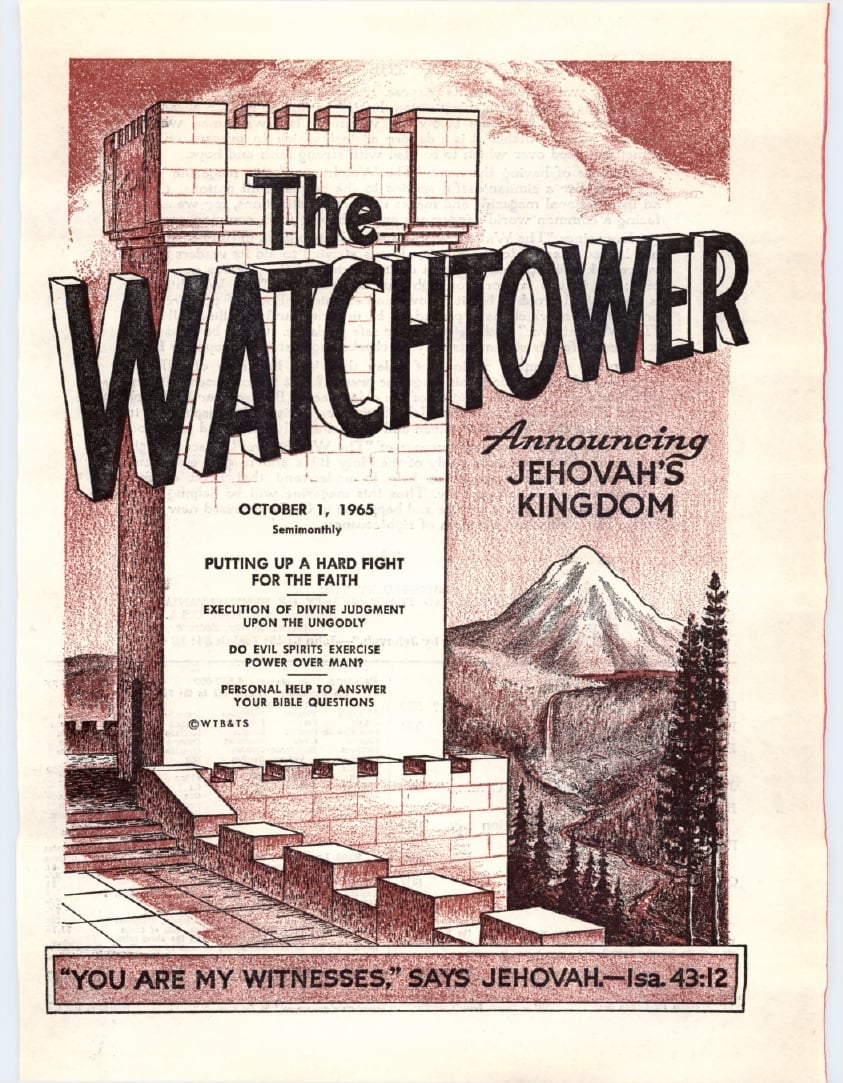
The Watchtower — October 1, 1965
Source: jw.org
Contents
Do Evil Spirits Exercise Power over Man?
Putting Up a Hard Fight for the Faith
Execution of Divine Judgment upon the Ungodly
Jerusalem Rebuilt for Messiah’s Coming
Help Men Get Saved from This Crooked Generation
Personal Help to Answer Your Bible Questions
Questions From Readers
Announcements
Do Evil Spirits Exercise Power over Man?
Do Evil Spirits Exercise Power over Man?
MILLIONS of persons in the Orient greatly fear evil spirits. This fear deeply affects their lives in many ways. For instance, to protect themselves from the power of evil spirits large numbers of Orientals employ various objects in unusual ways.
Consider, for example, the long bamboo pole used during the Vietnamese New Year. This pole is set up in front of each house. Items are hung on top of the pole, including a small basket containing betel nuts. Certain instruments are added that jingle in the breeze. Above the basket, a small square of bamboo represents roughly the barrier that is intended to stop evil spirits, preventing them from entering the home.
In Malaya evil spirits are also feared, especially in the home at the time of pregnancy and childbirth. During pregnancy, for instance, a Malay woman will wear an iron nail in her hair or carry a sharp instrument such as a knife, in the belief that evil spirits will flee at the sight of metal objects.
In Thailand you will see in the front of most homes a small house. This is a house for evil spirits. Since many believe that evil spirits can harm humans, the small spirit houses are put up to protect the occupants of the real house. They expect that the evil spirits will be fooled by the small house and enter it rather than the real house. Further, to appease the spirits, people often put food in the small houses. Since ants eat the food, it may appear that the food has been taken away mysteriously.
Moreover, the fierce-looking statues at the temple entrances in Thailand are for the purpose of frightening away evil spirits; and the sharp points on the roof are said by some to cause them to flee after they sit down.
Not all Thai people, however, take evil spirits seriously; in fact, the more sophisticated ones may deny that they believe in them. No doubt many Thai people have wondered at such things as: How could evil spirits with immaterial bodies have any need for food or ever be harmed or frightened by metal or other objects? How can invisible creatures with intelligence ever be frightened by lifeless statues? How could they be so easily fooled as to think that some doll-sized house is a real house and go inside it rather than the real one? Yet even those who may feel somewhat ashamed to admit they believe in evil spirits may keep a small house for demons in their front yard.
So the questions arise: Are there evil spirits? Do they exercise an evil, misleading influence over men? Is it necessary to protect oneself by means of objects or spirit houses or by appeasing demons with food and drink?
THE BIBLE’S TEACHING ABOUT SPIRITS
There is a sacred Book that answers these questions. This is the oldest book on earth, an Oriental book, documents of which go back nearly 6,000 years, tens of centuries before Buddhist, Taoist and other such writings were begun. This oldest of all sacred books is the Holy Bible. To find answers to our questions we must go to these Holy Scriptures.
Original religion as taught by the Holy Bible does indeed speak of good and evil spirits, but it definitely does not teach that humans need objects such as nails or spirit houses to protect themselves or that they need to offer food to appease demons. The Bible does not teach the kind of fear of evil spirits that is common throughout the Orient.
The Spirit that is the main subject of the Bible is good, for He is the God of the Bible, whose name is Jehovah. He is the Author of the Holy Bible and also man’s Creator. As such, “God is a Spirit,” invisible to human eyes.—John 4:24; Ps. 83:18.
How can one believe in Jehovah, man’s Creator, without seeing him? We can believe in the Creator’s existence because we can see his creation, the flowers, the birds, the animals and earth’s other marvels such as oceans and mountains, so that Jehovah’s “invisible qualities are clearly seen from the world’s creation onward, because they are perceived by the things made, even his eternal power and Godship.” And as we ponder not only on earth’s marvels but on the unimaginable immensity of a universe in which the earth is a mere speck, we can better appreciate that there must be a Creator. Most important, we have his own Book, the Holy Bible, that tells us about man’s Creator and that convinces one of God’s creatorship. As Creator and God, Jehovah is the Great and Good Spirit.—Rom. 1:20.
How, then, could evil spirits come into existence? Did Jehovah, Creator of the heavens and earth, make evil spirits? No, because the Bible assures us of his eternal righteousness by saying: “Perfect is his activity, for all his ways are justice. A God of faithfulness, with whom there is no injustice; righteous and upright is he. They have acted ruinously on their own part.” (Deut. 32:4, 5) Just as men have turned bad and acted ruinously on their own part, so can invisible spirit creatures, originally created perfect, go bad. And that is just what happened to some of the holy angels. They turned themselves into demons or devils.
THE FIRST DEMON, SATAN THE DEVIL
When did a holy angelic creature first turn himself into an evil spirit? This was after the creation of the first man, Adam, and his wife, Eve. Jehovah had placed them in “a garden in Eden, toward the east.” It was a perfect Paradise, and it was God’s purpose to have mankind fill the earth, making Paradise earth-wide. But the Bible shows that one of God’s spirit sons, an angel “in Eden, the garden of God,” determined to turn the worship of the first man and woman away from their Creator, Jehovah, to himself. Through a serpent, this angelic spirit lied to Eve, and induced her and her husband to disobey Jehovah God, bringing the penalty of death for them and their future offspring. This spirit creature that brought sin and rebellion into the universe came to be known as the Serpent, the Devil or Satan. The Devil has been placed under sentence of death, but God has permitted him to continue for a time.—Gen. 2:8; compare Ezek. 28:13.
The Holy Bible also shows that other spirit creatures later turned disobedient to Jehovah God, thus becoming demons. When was that? At least in the 120 years before the global flood of Noah’s day. The Bible record at Genesis 6:1-5 explains how spirit sons of God materialized as men to enjoy human passions by marrying the daughters of men. This was disobedience to God. It brought bad results, including freakish hybrids called Nephilim who were born as a result of such marriages. By taking this wrong course, those spirit sons of God turned themselves into demons and put themselves on the side of the Devil, who is the “ruler of the demons.”—Matt. 9:34; Jude 6; 2 Pet. 2:4.
These self-demonized angels are under sentence of destruction, along with Satan the Devil. (Matt. 25:41) However, the sentence was not executed upon them at the time of the global Flood. For the sons of God dematerialized to escape the Flood and returned to the spirit realm. But they were not allowed to become again part of God’s organization of holy angels; instead they have lived in a debased condition of spiritual darkness till now.
The Bible further shows that following the birth of God’s heavenly kingdom by his Son, Jesus Christ, the Devil and his angels were hurled down to the vicinity of the earth: “So down the great dragon was hurled, the original serpent, the one called Devil and Satan, who is misleading the entire inhabited earth; he was hurled down to the earth, and his angels were hurled down with him.” (Rev. 12:9) Down here at the earth, these demonic angels are no more permitted to materialize in the flesh as they did before the global Flood. Yet they can exercise power over men, so much so that the Bible says that Satan, along with the demons, is “misleading the entire inhabited earth.”
HOW EVIL SPIRITS EXERCISE POWER OVER MEN
That evil spirits do exercise misleading power over men, the Bible assures us by saying: “The whole world is lying in the power of the wicked one,” Satan the Devil. (1 John 5:19) But how do these wicked spirits exercise power over men, to mislead them?
Again it is the Holy Bible that identifies the many ways that evil spirits deceive and mislead men. They do this by means of spiritistic practices condemned by Jehovah God because they are of demonic origin and not from God. Jehovah warns his people against these practices, as the Bible shows: “There should not be found in you . . . anyone who employs divination, a practicer of magic or anyone who looks for omens or a sorcerer, or one who binds others with a spell or anyone who consults a spirit medium or a professional foreteller of events or anyone who inquires of the dead. For everybody doing these things is something detestable to Jehovah.”—Deut. 18:10-12.
Among those practices condemned by the God of the Bible is that of consulting persons such as fortune-tellers and spirit mediums who foretell events. For instance, the man in charge of Chinese and Vietnamese temples is often a spirit medium. People request him to get in touch with the god of the temple. A séance is held in the temple, the medium invoking the god by offering joss sticks. Then he goes into a trance, perhaps jiggling. People ask favors and questions about the future and receive answers through the voice of the spirit medium. When spirit mediums thus inquire of some god or of the dead, they are actually contacting evil spirits, demons. All such activity is condemned by the Bible as something detestable to God, because it is demonism.
Also condemned by the Bible are magical practices, which include the many magical feats performed by yogis and others, such as levitation, being buried alive for many hours, walking on fiery coals, eating glass, nails, and so forth. What is called black magic is also the work of demons. Thus the Bible condemns sorcerers, those who bind others with a spell, such as by using some of the victim’s hair or blood as a “contact,” in order to cast a spell on one, or by modeling in clay or wax the effigy of a person whom the sorcerer or witch doctor wishes to injure or destroy, then sticking pins into it. Such black magic is the work of evil spirits.
Then there is divination, common throughout the world. Divination is the obtaining of knowledge of the unknown or of the future by means of omens and supernatural, demon power. There are hundreds of methods of divination, such as the use of divining rods, examining the length of a split bamboo pole, the direction in which the blood of a killed animal flows, the bones of fowl, the entrails of animals, the flight of certain birds, by crystal gazing, the use of playing cards, examining the lines of one’s hand, called palmistry, going into a self-induced trance and by the common means of using dreams as omens. All such divination and looking for omens is not taught by the Bible but is warned against and is exposed by the Bible as the deceptive teachings and work of evil spirits to mislead men.—1 Tim. 4:1.
DIVINATION BY ASTROLOGY
One of the most common means of trying to foretell the future is divination by astrology. Astrology is divination by stars and planets, a practice that has had tremendous influence on the people of the Orient. Those who practice divination by astrology believe certain days and months are propitious for marriage, business, politics and even burial. For example, the body of the last king of Laos was held for about a year until a favorable time for burial was reached. In 1952, in Burma, the government resigned for five minutes because of an astrological prediction. In 1959, the swearing in of Nepal’s first elected government was postponed for two days because some believed the appointed day was astrologically inauspicious. In 1962, Indian astrologers predicted great disasters or the end of the world between the third and fifth of February. It was estimated that the astral crisis caused India to lose, in money alone, 35 crore rupees—about $70,000,000! In Sikkim, on the advice of astrologers the marriage of the maharajah’s son to New York post-debutante Hope Cooke was put off until 1963.
The Bible makes clear that all such methods of divination, whether by astrology or other means, are opposed by Jehovah God and shown to be futile and disastrous to those who depend on them. This is illustrated by what happened to those who originated astrology, the ancient Babylonians. Yes, it was in ancient Babylon that astrology began, as well as the practice of magic and sorcery. But did astrology save Babylon? Almost two hundred years before Babylon fell to the Medes and Persians, the Holy Bible gave the answer, showing that the astrologers would be useless, unable to save Babylon: “Stand still, now, with your spells and with the abundance of your sorceries, in which you have toiled from your youth; that perhaps you might be able to benefit, that perhaps you might strike people with awe. You have grown weary with the multitude of your counselors. Let them stand up, now, and save you, the worshipers of the heavens, the lookers at the stars, those giving out knowledge at the new moons concerning the things that will come upon you. Look! They have become like stubble. A fire itself will certainly burn them up. They will not deliver their soul from the power of the flame.”—Isa. 47:12-14.
How utterly useless Babylon’s own astrologers were when Babylon was threatened by the Medes and Persians! A few hours before Babylon’s fall to Cyrus the Persian in 539 B.C.E., Jehovah God caused a mysterious handwriting to appear on the wall of the king’s palace. The king called on all his wise men and astrologers to interpret it. But “they were not competent enough to read the writing itself or to make known to the king the interpretation.” It was not the worshipers of the heavens but a worshiper of the Creator of the heavens who interpreted the writing to mean “God has numbered the days of your kingdom and has finished it.” Babylon fell, its astrologers failing to save the king, the kingdom or even themselves. Here we see astrology convicted of ignorance and impotence in the very place where it originated and where it was practiced the most. Astrology not only fails those who rely on it, but it is one of the ways evil spirits mislead mankind.—Dan. 5:1-31.
OPPOSE EVIL SPIRITS THE BIBLE’S WAY
How, then, can one protect himself from the misleading influence of evil spirits? First of all, break free from all those practices condemned by the Bible as detestable to God—divination whether by astrology or any other way, looking for omens such as dreams, and consulting foretellers of events such as spirit mediums. Have nothing to do with sorcerers or those who practice the magical arts and spells. Keep free from all these forms of demonism.
Though evil spirits do exercise misleading power over most of mankind, those who worship Jehovah God are not among those “lying the power of the wicked one.” The Bible counsels: “Oppose the Devil, and he will flee from you.” (Jas. 4:7) Oppose the Devil by putting on the spiritual suit of armor that God provides to fight against the demons: “Put on the complete suit of armor from God that you may be able to stand firm against the machinations of the Devil.” This requires faith in Jehovah God, knowledge of him and of his purpose to destroy the Devil and the demons and to make possible everlasting life on a Paradise earth through his heavenly kingdom. God also provides “the sword of the spirit, that is, God’s word,” the Holy Bible, to help you to fight successfully against wicked spirit forces.—Eph. 6:11-18.
So break free from the misleading power of demons. Use the Bible to help you and to help others to break free of demonistic practices. Do not be among those in bondage to the fear of evil spirits, senselessly trying to protect themselves by using nails, spirit houses, astrology, charms, and so forth. But acquire the spiritual weapons God provides for opposing the Devil and the demons. Come into the glorious freedom of those who know the Bible’s truth by means of God’s Son, and this “truth will set you free.”—John 8:32.
Putting Up a Hard Fight for the Faith
Putting Up a Hard Fight for the Faith
“I found it necessary to write you to exhort you to put up a hard fight for the faith that was once for all time delivered to the holy ones.”—Jude 3.
1, 2. (a) Wherein lies the danger in the belief “Once saved, always saved”? (b) Where do we find warning against this belief?
FEW popular expressions are more deceptive and dangerous than the one widely heard throughout Christendom: “Once saved, always saved.” Believing such a saying can lead to disaster, the loss of the Bible-taught hope of everlasting life in a righteous new order under the kingdom of Almighty God.
2 To warn us against such dangerous beliefs as “once saved, always saved,” and to encourage us to put up a hard fight for the true faith, a disciple of the Lord Jesus Christ wrote a short letter of urgent importance today. It is the sixty-fifth book of the Holy Bible, written about the sixty-fifth year of the first century C.E. It is called The Letter of Jude, and though there are only twenty-five verses in the letter, our heeding its inspired counsel may well make the difference between gaining or losing the salvation held forth to all true followers of the Son of God.
3. Who was Jude, and why does he call himself “a slave of Jesus Christ”?
3 Whom did Jehovah God use to give us this timely warning? The letter answers: “Jude, a slave of Jesus Christ, but a brother of James, to the called ones who are loved in relationship with God the Father and preserved for Jesus Christ: May mercy and peace and love be increased to you.” (Jude 1, 2) The inspired writer Jude was, in fact, a half brother of Jesus Christ. (Matt. 13:55) However, Jude does not seek to glorify himself by reason of being related to the Son of God in a fleshly way; he realized that Jesus’ true followers would henceforth not know him according to the flesh. (2 Cor. 5:16, 17) So he humbly calls himself “a slave of Jesus Christ.” Thus he put the proper emphasis on his spiritual relationship to Jesus Christ first. Since Jude was not an apostle of the Lord Jesus Christ, he simply calls himself “a slave”; in fact, he did not believe on Jesus Christ as the Son of God until after Jesus’ resurrection. (John 7:5; Acts 1:14) Then he put faith in Jesus and, after putting faith in him, Jude realized that, like a slave, he had been bought with a price—the precious blood of the Son of God. From then on Jude, as well as any other person bought with the ransoming blood of Jesus Christ, could not become a slave to men.—1 Cor. 7:22, 23.
4. (a) To whom is The Letter of Jude specifically directed, but why is it timely for all life seekers? (b) What does God require of those who hope in his salvation?
4 As a slave of Christ, Jude wanted to write on what was most advantageous for his fellow slaves to help them to be obedient to their Master. Hence he wrote a general letter, one directed not to any specific Christian congregation. Yet it is emphatically clear as to whom it is directed: “To the called ones,” that is, to those called to God’s heavenly kingdom to rule with Jesus Christ as kings and priests. (1 Thess. 2:12) These spirit-anointed Christians are “loved in relationship with God the Father and preserved for Jesus Christ”; hence it is the Father’s good pleasure to give them the kingdom of the heavens if they keep themselves in a saved condition. Though this inspired letter is directed to the “congregation of God” or those whose number is limited according to the Scriptures to 144,000 from among mankind, yet it is timely in its warning for all persons who hope for salvation under God’s kingdom, those who hope to live eternally on a paradise earth. They, too, must remain in a saved condition, having the same degree of devotion, the same degree of faithfulness and producing the same Kingdom fruitage as the anointed Christians. Yes, all those who would enjoy God’s salvation must put up a hard fight for the true faith.
5. What is Jude’s prayer, and how has it been answered upon Jehovah’s witnesses today?
5 The prayer of Jude is that God’s “mercy and peace and love” would be multiplied toward Christ’s true followers, of whom a remnant are yet on earth today. Certainly this has been the case with this spiritual remnant of Christ’s followers who have been granted God’s mercy, by his liberating them from Babylon the Great, the world empire of false religion, in 1919, then filling these liberated Christians with peace so all can work unitedly in advancing the interests of God’s kingdom. Out of God’s love they have been cleansed from Babylonish paganism and set forth as his clean witnesses. It is because Jehovah God has increased his mercy, peace and love upon his liberated Christian witnesses that a “great crowd” of “other sheep” have flocked to their side. (Rev. 7:9-17; John 10:16) These persons have seen the divine blessings showered upon the remnant of these “called ones,” the remnant of spiritual Israel, so they have become part of the “one flock” of Kingdom witnesses. Since the New World society of Jehovah’s witnesses is one peaceful flock, guided by the Fine Shepherd, they rejoice in God’s love and mercy, as Jude’s prayer has been abundantly answered upon them. Jude’s prayer is that God’s mercy, peace and love would be increased toward us, not be decreased and finally cease. Could such a terrible thing happen? It could happen to individuals; and to put us on guard against that possibility, Jude sounds a warning to show that it could happen if we fail to keep ourselves in God’s love:
SPECIAL REASON FOR PUTTING UP A HARD FIGHT
6. What exhortation is given individual Christians, and why?
6 “Beloved ones, though I was making every effort to write you about the salvation we hold in common, I found it necessary to write you to exhort you to put up a hard fight for the faith that was once for all time delivered to the holy ones. My reason is that certain men have slipped in who have long ago been appointed by the Scriptures to this judgment, ungodly men, turning the undeserved kindness of our God into an excuse for loose conduct and proving false to our only Owner and Lord, Jesus Christ.”—Jude 3, 4.
7. From writing on what subject did Jude change, and why?
7 Jude obviously had not intended to write about putting up a hard fight for the true faith. He had hoped to write in a general way about “the salvation we hold in common”; however, by means of God’s holy spirit, he discerned that there was something of pressing importance, of greater urgency than a doctrinal discussion on the salvation held in common by the 144,000 called to the heavenly kingdom. In Jude’s day, nineteen centuries ago, the Fine Shepherd, Jesus Christ, was not gathering the “great crowd” of Revelation 7:9-17, and so Jude was not writing about the salvation shared equally today by all those of the “great crowd.” Even though they are not included directly in Jude’s intended discussion, they do hold in common the precious hope of salvation under the Kingdom; they hope for life everlasting in the new order as much as the remnant of the “little flock” look forward to heavenly glory. This hope, to live on a paradise earth, will be brought about by the Kingdom of Jesus Christ, who reigns with his “called ones.” Hence Jesus Christ died, not only for the “called ones,” but for the whole world of mankind, including this “great crowd” of sheeplike persons of today. (1 John 2:1, 2) Those “sheep” with an earthly hope must also “put up a hard fight for the faith” until the prize is won, for Satan the Devil would like to cheat them of such a precious prize.
8. So what belief does Jude clearly expose, and what had Jesus Christ earlier said about individual salvation?
8 By writing on the subject of putting up a hard fight for the faith Jude spotlighted the falsehood of the belief “once saved, always saved.” Our being now in a saved condition is no reason for any Christian to think that he cannot be moved from or drawn out of God’s love and thereby lose out on the salvation God extends to obedient mankind. Jesus Christ had made it clear, and Jude knew it, too, that “he that has endured to the end is the one that will be saved.” (Matt. 24:13) Jesus was speaking of personal salvation here, not a class salvation. No uncertainty exists about the salvation of the class called to the heavenly kingdom, but the question is: Individually, whether we are of the “little flock” or of the “great crowd,” will we endure to the end? The “end” Jesus mentioned is not necessarily a specific year, or even the battle of Armageddon, but the idea is to endure to the finish of one’s earthly course or of the long test. Not to endure means to prove disloyal. So either until one dies in faithfulness or to the end of this wicked system of things, one must continue to put up a hard fight for the faith. How?
9. What does it mean to put up a hard fight for the faith?
9 Putting up a hard fight for the faith means not only to endure to the end in holding fast with our minds the things God teaches us; it also means to resist temptations toward corruption by any who would turn the undeserved kindness of our God into an excuse for loose conduct. We must realize that the Devil’s tactic throughout the history of God’s people has been to try to introduce among them persons who would serve his cunning design and who would try to corrupt others. Hence a fight is forced upon all who have declared themselves for the true faith. This fight tests our integrity and our love for God.
10. What does Jude say ungodly men would do, and how had this been foretold?
10 Explaining why we must put up a hard fight for the faith, Jude said that certain ones have slipped into God’s organization, pretending to be Christians. They are actually “ungodly men,” who turn God’s mercy into an excuse for loose conduct About ten years before Jude wrote this warning, the apostle Paul had foretold that persons with wicked motives would worm their way in among God’s people. (Acts 20:29, 30) Jesus, too, had foretold this enemy movement to try to corrupt Jehovah’s name people. (Matt. 13:24-43) The Devil draws his agents from the world of mankind that have “come to be past all moral sense.”—Eph. 4:17-19.
11. In view of Jude’s warning, what must be our attitude, and why?
11 Since the Devil would like to introduce morally bankrupt persons with evil designs in among the New World society of Jehovah’s witnesses, all need to watch, especially the overseers of congregations. “Because the days are wicked” and because many love wickedness, never can we relax our guard. The Christian congregation must be alert to strain out and debar enemy agents from gaining any foothold. Though we know wicked men cannot corrupt the organization as a whole, they may do injury to a congregation, causing God’s spirit to be retarded in that congregation, until the wicked ones are rooted out. Not only may the congregation fail to prosper but individuals in it may be drawn aside and corrupted into immoral relations with those of the opposite sex. This must be guarded against so that God’s organization may remain clean and pure, undefiled.
“EYES FULL OF ADULTERY”
12. What warning does Jude give regarding ungodly men who would try to sneak into God’s organization, and what is the Devil’s motive in trying to introduce such men?
12 Hence Jude warns those who would try to corrupt God’s people that they “have long ago been appointed by the Scriptures to this judgment” of everlasting destruction. What is wrong with these persons? Their motive. They think that, since God is merciful, they can use his mercy as an excuse for immoral conduct to gratify sexual desires. (1 Cor. 6:9, 10) They try to persuade unstable believers to indulge in loose relations, causing others to believe that it will not hurt to indulge one’s passions just once in a while, since God readily forgives us if we confess this sin. So these persons have the motive of sexual gratification, and, as in the case of Cain, sin is crouching at their doorstep; they do not have pure eyes. Peter describes them: “They have eyes full of adultery and unable to desist from sin, and they entice unsteady souls. They have a heart trained in covetousness.” (2 Pet. 2:14) The Devil uses these persons with “eyes full of adultery” to try to corrupt the pure-eyed, purehearted people of God and to try to tempt them into pleasurable sin.
13. In what way are these ungodly men unlike Moses, and so what is the Christian’s obligation?
13 Unlike Moses, these persons of evil design think they can go in for “the temporary enjoyment of sin,” and still gain salvation. (Heb. 11:25) They think they can indulge their passions and then go through a form of repentance and stay among God’s people till the next time they lust for indulgence in sin, until they can again persuade others by impure advances into immorality. Thus they are guilty of turning the undeserved kindness of our God into an excuse for loose conduct. It is against such immoral persons that Christians must put up a hard fight, resisting them, not only for harm done to individuals, but for the harm that comes to any congregation that would allow them a free hand in trying to corrupt and degrade those of the opposite sex.
14. Why is Christendom’s moral condition no excuse for yielding to immoral persons?
14 The fact that Christendom has gone the way of loose morals and that its schools and church systems teem with people practicing immoral conduct is no excuse for a true Christian to indulge his passions. Jude makes it clear that, if any yield to sin, they would be “proving false to our only Owner and Lord, Jesus Christ.” Since we must be true to the faith once delivered to the holy ones, we should steadfastly refuse to yield to ungodly persons, resisting any form of corruption in these wicked days.
SOMETHING OF WHICH TO BE REMINDED
15. How does Jude illustrate that one can lose out despite being in a saved condition, and what deliverance had the Israelites shared in common?
15 To stress the point that our salvation is not yet sealed up and delivered to us beyond loss or failure after believing, Jude shows that, despite one’s being in a saved condition, an individual can lose out. How? By not putting up a hard fight, by giving in to the temptations of ungodly persons. The doom of these persons, he warns, has been foretold. How? By the historical record of the Bible! Many are the examples in God’s Holy Word showing how Jehovah dealt with ungodly persons in the past; these examples show what God will do in like cases today. Hence, before they sneak in and try to entice others into immorality, they are warned what their doom will be! Jude writes: “I desire to remind you, despite your knowing all things once for all time, that Jehovah, although he saved a people out of the land of Egypt, afterwards destroyed those not showing faith.” (Jude 5) Yes, what a marvelous deliverance the Israelites had in 1513 B.C.E.! With a strong hand Jehovah delivered them, saving their firstborn from death when the tenth plague came upon Egypt. Not only were the Israelites delivered at the time of this blow upon the firstborn, but later also, at the Red Sea. In this deliverance a “mixed company” of non-Israelites also shared.—Ex. 12:38.
16, 17. (a) What lesson do Christians learn from the example of the Israelites and the “mixed company”? (b) How did the apostle Paul sound the same warning, and what should be our response?
16 What is prefigured here? Since Egypt is a symbol of this system of things (Rev. 11:8; 2 Cor. 4:4), it pictures that today those whom Jehovah saves from this system of things are not to run to Egypt and sinful bondage. Their initial deliverance from this wicked system of things does not mean that they are unalterably saved to everlasting life in God’s new order, beyond all possibility of failure. Not if the Israelites with the “mixed company” are a true illustration! Jehovah, who was their Savior, destroyed a million or more Israelites in the wilderness. (Ex. 12:37; Num. 14:26-38) Why? They yielded to the deceptive power of sin. Sin is deceptive; it creeps up and pounces on its victims without mercy, as it did with the Israelites. Warning us that an initial deliverance from antitypical Egypt and its Babylonish paganism is no final proof of salvation, Paul, an apostle of Jesus Christ, declared: “On most of them [Israelites in the wilderness] God did not express his approval, for they were laid low in the wilderness. Now these things became our examples, for us not to be persons desiring injurious things, even as they desired them. Neither become idolaters, as some of them did; just as it is written: ‘The people sat down to eat and drink [sacrifices offered to Baal of Peor], and they got up to have a good time [with the Canaanite women who invited them to such sacrifices].’ Neither let us practice fornication, as some of them committed fornication, only to fall, twenty-three thousand of them in one day. Neither let us put Jehovah to the test, as some of them put him to the test, only to perish by the serpents. Neither be murmurers, just as some of them murmured, only to perish by the destroyer. Now these things went on befalling them as examples, and they were written for a warning to us upon whom the ends of the systems of things have arrived.”—1 Cor. 10:5-11.
17 Paul here was writing to Christians, and he draws his illustration from typical natural Israel. With the Israelites was a “mixed company” of people friendly to Israel; so in the antitype today the warning refers to both the remnant of anointed Christians and the “great crowd” of “other sheep.” Hence all must be on guard against those who would entice anyone bought with the blood of Jesus Christ into immoral conduct, with resultant bondage to sin. Anyone can be affected no matter how long he has been in the way of salvation. Never become careless, proud, self-reliant, but always examine yourself in the light of his Word so as not to be overreached by the deceptive power of sin.
ANGELS NOT EXEMPT FROM FALLING TO DESTRUCTION
18. In what other way does Jude illustrate the need to put up a hard fight for the Christian faith?
18 Jude then goes on to another illustration showing the need to put up a hard fight for the Christian faith: “And the angels that did not keep their original position but forsook their own proper dwelling place he has reserved with eternal bonds under dense darkness for the judgment of the great day. So too Sodom and Gomorrah and the cities about them, after they in the same manner as the foregoing ones had committed fornication excessively and gone out after flesh for unnatural use, are placed before us as a warning example by undergoing the judicial punishment of everlasting fire.”—Jude 6, 7.
19, 20. (a) What was the sin of the angels to which Jude referred, and in what punishment did this result? (b) What lesson is there for us in the example of the angels who sinned?
19 The disciple Jude now compares these ungodly persons who would try to corrupt others in God’s organization to the fallen angels in Noah’s day. These materialized as perfect-looking humans, no doubt; thus their appearance must have been strikingly attractive. But had they come to earth to bring men back to God? No, their motive was wrong! They had eyes full of passionate desires. They had their eyes on the beautiful-looking daughters of men. Impressive in appearance, these materialized angels made enticing advances to good-looking girls. Regardless of whether they considered that they had a right to these women or not, they apparently took whomever they wished and as many women as they wanted as wives, perhaps more wives than Lamech, who had earlier taken two to himself. (Gen. 4:19) Their beautiful appearance helped them sneak in and infiltrate the human race to corrupt it. So today Jude shows that some whose outward appearance may even be handsome would slip in. They want to get familiar especially with those of the opposite sex, so they can corrupt and degrade them by impure sex relations. At the time of the Flood those angels dematerialized, but they could not return to God’s holy organization. God caused them to be “reserved with eternal bonds under dense darkness for the judgment of the great day.” They now are in a state of spiritual darkness, having no light from God. By their wrong motive they turned themselves into demons. (Gen. 6:1-5) What a lesson there is here for us!
20 We learn here that even angels that behold God’s face can fall into sin and come under judgment to destruction. God never intended angels to be amphibious, that is, to live partly in heaven as spirits and partly on earth as humans, to cohabit with women. But those angels left their assigned dwelling place. Well, now, if angels are not exempt from falling to destruction, imperfect humans should not think their salvation is yet secured with no possibility of losing it. Only by putting up a hard fight for the faith can we remain in that saved condition. We do not want to be like those angels that fell from such a high estate. So resist those humans who would go beyond their God-given boundary and seek to defile flesh.
21. (a) Especially for what sin were Sodom and Gomorrah destroyed? (b) How does the destruction of those cities stand as a warning and at the same time an encouragement to godly persons?
21 In addition to the sinner angels, Jude mentions as a warning a destruction God brought about more than 450 years after the Flood, when God punished the towns of Sodom and Gomorrah with fiery destruction. The town’s inhabitants “committed fornication excessively” and went after flesh for unnatural use. They not only committed fornication with women, but they lusted for the flesh of men, possibly also the flesh of brute beasts. (Lev. 18:22-25) The Bible tells us how Jehovah sent two angels to Sodom to inspect its moral condition and to rescue Lot from the destruction overhanging the city. Lot hospitably took the angels into his home, but the ungodly inhabitants of Sodom, a mob made up of youths as well as older men, demanded the two angels for improper sex relations. Even after the angels smote the mob with blindness, the passion-obsessed Sodomites tried to get their hands on the angels. The next morning Jehovah God drenched Sodom and Gomorrah with fire and sulphur. Lot and his daughters escaped the destruction that came upon the Sodomites. That destruction is placed “before us as a warning example.” For whom? Peter answers: “By reducing the cities Sodom and Gomorrah to ashes he [God] condemned them, setting a pattern for ungodly persons of things to come; and he delivered righteous Lot, who was greatly distressed by the indulgence of the law-defying people in loose conduct— . . . Jehovah knows how to deliver people of godly devotion out of trial, but to reserve unrighteous people for the day of judgment to be cut off, especially, however, those who go on after flesh with the desire to defile it.”—2 Pet. 2:6-10.
22. (a) So what warning should we take to heart? (b) How does God deliver the righteous out of trial?
22 So let all who would defile flesh in God’s organization beware! They are under doom of everlasting destruction. Let all true worshipers take to heart the warning, not considering even momentarily the enticement from such doomed persons. Resist them. “Put up a hard fight for the faith.” We can be certain that God knows how to deliver persons of godly devotion out of trial. God does not necessarily take us out of trialsome circumstances, for he lets them furnish a test upon us. The way God delivers the righteous out of trial is by cutting off the ungodly persons in his own due time. He takes those who provoke trial off the scene of action.
23. In what must we never tire, with the hope of what reward?
23 We do not know how much longer the wicked will keep bringing trials upon us, but we must never grow weary in preaching “this good news of the kingdom,” all the while resisting ungodly persons. Then we will attain to blessed deliverance when God cuts off the ungodly, and we will be left in a cleansed new order. Until then we must never relax our guard, always putting up a hard fight for the faith.
[Picture on page 589]
Sodom and Gomorrah, a Warning Example
Execution of Divine Judgment upon the Ungodly
Execution of Divine Judgment upon the Ungodly
“Look! Jehovah came with his holy myriads, to execute judgment against all, and to convict all the ungodly concerning all their ungodly deeds that they did in an ungodly way, and concerning all the shocking things that ungodly sinners spoke against him.”—Jude 14, 15.
1, 2. Upon what thought do many persons not like to reflect, and in this regard what did a congressman say of a human court?
MANY men do not like to be reminded that there is a Supreme Court of the universe, a Court of judgment higher than the highest human court. They do not like to face the fact that, regardless of who they are, they must respect the Supreme Judge over all, Jehovah, the Almighty God, “the Judge of all the earth.” (Gen. 18:25) Many persons may not like to reflect that, if they do ungodly things, this Judge of the very universe is watching, just as the Bible declares: “If you see any oppression of the one of little means and the violent taking away of judgment and of righteousness in a jurisdictional district, do not be amazed over the affair, for one that is higher than the high one is watching, and there are those who are high above them.”—Eccl. 5:8.
2 Yes, men in general are not eager to be reminded that a Judge higher than human high ones is over us all, no matter how high a judicial or political position one may have in this system of things. In this regard it is interesting to note the statement of an American congressman as reported in the New York Times of November 13, 1963. In America there is a separation of Church and State, and the chief justice of the United States Supreme Court rejected a proposal to inscribe “In God We Trust” above the bench of that secular court, before which Jehovah’s witnesses have won tens of cases. In a reaction to the court’s decision, Congressman R. T. Ashmore, sponsor of the bill to provide the religious inscription, commented on the rejection, saying: “The tone of the Chief Justice’s letter is most indicative that the Supreme Court would be made painfully aware of the fact that there is an Authority higher than that of the Supreme Court of these United States.” But men do not need an inscription above their heads to be reminded that God is the Supreme Judge.
3. What is the attitude of ungodly men, and with what consequences?
3 If any men are not eager to be reminded of the respect they owe “the Judge of all the earth,” then it is understandable that the ungodly especially do not like to hear of the respect men must render to the Supreme Judge. For selfish reasons such persons ignore, scorn and defy the Judge’s righteous judicial decisions. But woe to these! For execution of divine judgment upon all the ungodly is at hand.
4. What warning counsel is stressed in The Letter of Jude?
4 This fact is stressed in the inspired letter that Jude, a disciple of Jesus Christ, wrote to warn Christians to put up a hard fight for the true faith, especially by resisting corruption from ungodly men. Jude warned that some of the ungodly would even slip into God’s organization, in an endeavor to defile flesh. But in the first seven verses of his letter, Jude set down an inspired warning that the doom of such ungodly persons has long ago been foretold by Jehovah God’s adverse sentence upon the unfaithful, rebellious Israelites, upon the angels that forsook their original place in heaven and upon the unspeakably corrupt inhabitants of Sodom and Gomorrah who perished in flaming destruction. The penalty such ones paid for contempt of the highest court in the universe serves as a warning to all who are not now showing respect to the Supreme Judge.
LORDSHIP DISREGARDED, GLORIOUS ONES ABUSED
5. (a) What did Jude say in verse eight? (b) In what sense are the persons he speaks of “indulging in dreams,” and with what result?
5 In the face of this divine warning, Jude states, some would ignore it by living in a dream world of sensuality, thinking they could defile flesh in God’s organization with impunity. Jude writes: “These men too, indulging in dreams, are defiling the flesh and disregarding lordship and speaking abusively of glorious ones.” (Jude 8) Such ungodly dreamers imagine they can ignore Bible teachings as to how God deals with the wicked. They have no regard for the command of the Supreme Judge stated at 1 Corinthians 6:18 to “flee from fornication.” Rather, they seek ways to further opportunities for fornication and think they can get away with it. But such thinking is all a dream! It is fatally unrealistic. Their dreams of sensual enjoyment will be shattered by a sharp awakening, as they come face to face with an adverse sentence from the Supreme Judge. The Judge they have failed to respect will show them they are in no dream world in which they can let passions run riot; they will come out of their stupor to find the Judge executing the foretold judgment upon them.
6. What accounts for their ungodly conduct and further shows such persons deserve the foretold judgment?
6 That these immoral dreamers deserve such judgment is further indicated by the fact that they disregard lordship and speak abusively of glorious ones. They have no regard for the Universal Sovereign, Jehovah God, and for his beloved Son, the “King of kings and Lord of lords.” (Rev. 19:16) Because of their disregarding the highest lordship in the universe, it is to be expected that they would also speak abusively of glorious ones.
7. (a) Who are the “glorious ones”? (b) How do the persons Jude warned of show they do not respect glories from Jehovah?
7 Who are these “glorious ones”? They must be those who receive glory from Jehovah God and his Lord of lords, Jesus Christ. According to Isaiah 60:1, 2, Jehovah’s “own glory” would be conferred upon the remnant of spiritual Israel, the anointed Christians. Because “the very glory of Jehovah” has shone upon them, they have risen to shine with the light of the Kingdom good news in all the inhabited earth. (Matt. 24:14) Because of the effulgent glory God has given them through his Son, they are to be respected. Jesus Christ indicated this when he said concerning his anointed followers: “I have given them the glory that you have given me.” (John 17:22) Certainly those of the anointed remnant who serve as overseers have an additional glory or honor conferred upon them, and those ones deserve “double honor.” (1 Tim. 5:17) Now that many of the “great crowd” of “other sheep” are serving as overseers, representing the remnant or “faithful and discreet slave” class, such presiding ones receive glory from God by virtue of the office they occupy as representatives of the anointed remnant; they are to be treated with due regard. (Matt. 24:45-47) Properly God’s people cooperate with and respect the anointed remnant and all the overseers appointed by “the faithful and discreet slave” over the congregations of Jehovah’s witnesses. But the flesh-defiling dreamers, despising Jehovah’s lordship, do not respect glories from Jehovah. They talk abusively of those clothed with such glories, especially those whom the great Judge Jehovah has honored with special positions of responsibility. Like Diotrephes, of whom the apostle John wrote, they chatter about “glorious ones” with wicked words.—3 John 9, 10.
8, 9. (a) Why does Jude contrast the men of whom he warns with the mental attitude of Michael? (b) What was the Devil’s purpose in disputing over the body of Moses, and how did Michael show power as well as mildness?
8 Jude next contrasts the attitude of these disrespectful dreamers with the mental attitude of Jesus Christ, in his prehuman existence as Michael. “But when Michael the archangel had a difference with the Devil and was disputing about Moses’ body, he did not dare to bring a judgment against him in abusive terms, but said: ‘May Jehovah rebuke you.’ Yet these men are speaking abusively of all the things they really do not know; but all the things that they do understand naturally like the unreasoning animals, in these things they go on corrupting themselves.”—Jude 9, 10.
9 In speaking abusively of God’s servants, such dreamers take liberties that even God’s own Son did not take when he disputed with the Devil over the body of Moses. Moses died at Pisgah of Mount Nebo and the Devil wanted Moses’ body. The Devil knew the human inclination to worship relics and no doubt wanted to start a new religious cult around the body of Moses, to corrupt God’s people. When resisting the Devil, Michael did not resort to abusive speech, even though the Devil certainly had no glory from God. He did not run ahead of God’s appointed time. Rather, he showed respect for the Great Judge and accorded Him the right to rebuke Satan. Humbly he said: “May Jehovah rebuke you.” Though Michael’s statement was mild, he showed power by prevailing over the Devil, keeping control over Moses’ body, burying it, as the Bible indicates.—Deut. 34:5, 6.
10. How are the warned-against men so unlike Michael and the holy angels, and so their course of action reveals what?
10 Yet ungodly men who would defile flesh in God’s organization, and who are so inferior to Michael, dare to speak abusively of “glorious ones.” Michael and the holy angels do not speak abusively, and so the apostle Peter makes a contrast: “Daring, self-willed, they do not tremble at glorious ones but speak abusively, whereas angels, although they are greater in strength and power, do not bring against them an accusation in abusive terms, not doing so out of respect for Jehovah.” (2 Pet. 2:10, 11) By acting so disrespectfully such persons show they have lost their power of reasoning and that they have succumbed to animalistic passions. They become like unreasoning animals, made to be caught and destroyed without any resurrection from the dead. That kind of destruction will catch up with all such ungodly men.—2 Pet. 2:12, 13.
LIKE CAIN, BALAAM AND KORAH
11. How does Jude next liken the ungodly dreamers to men prominent in ancient times?
11 Jude then likens such flesh-defiling dreamers to prominent men of the human family who failed to respect the Supreme Judge: “Too bad for them, because they have gone in the path of Cain, and have rushed into the erroneous course of Balaam for reward, and have perished in the rebellious talk of Korah!”—Jude 11.
12. (a) What path did Cain take, and with what result? (b) Why are the foretold ungodly men like Cain, and how must we treat all such?
12 Cain, an elder brother of the human family, saw God’s approval put on the right worship of Abel. Instead of imitating Abel in right worship and with pure motive, Cain hated his brother and murdered him. Cain disregarded a divine warning that he was heading for trouble. (Gen. 4:6, 7) This defiant action showed Cain’s disrespect for the Supreme Judge. Just as Cain’s motive was all wrong, so with those who seek to turn God’s undeserved kindness into an excuse for loose conduct. By leading others in a way that can only result in eternal destruction, they are like Cain in being guilty of murder. (1 John 3:12) Jehovah cursed Cain, and at the time of the Flood his offspring were wiped out. Woe to those who go in Cain’s path! Do not yield to them. Resist them!
13. (a) Whom did the Devil use to corrupt the Israelites in Moses’ day, and how? (b) What happened to Balaam, so what about those who would act like him?
13 Another prominent bad man of ancient times was Balaam, whom the Devil used to corrupt the Israelites when they were in the wilderness. Balaam’s home was in Pethor, a town that has been identified by inscriptions as lying in the Upper Euphrates region.a Balaam was a prophet in that land and one who recognized Jehovah, the God of Israel. But what a different prophet he was from Moses! Moses loved God’s people; Balaam had no respect for them and for the glory God had conferred upon them. When Balak, king of Moab, sent to Mesopotamia to hire Balaam to come down and curse Jehovah’s people by means of Babylonian magic, Balaam did not give a decisive No. He finally yielded to renewed offers of reward. So he went to curse Israel. In doing this he rushed into a course that plunged him into error. Three times he tried to curse Israel, but Jehovah always turned the curse into a blessing, making it clear that “there is no unlucky spell against Jacob, nor any divination against Israel.” Balaam’s heart was not in that blessing. Having failed to curse Israel, he went about corrupting God’s people by suggesting to Balak that, if Israel could be seduced into false religion and into indulgence in animal passions, fornicating with Moabite women, then God would curse even his own people. The evil counsel was followed. Because of the Israelites’ loose conduct, 24,000 of them were killed by a plague at Shittim on the plains of Moab. (Num. 25:1-9; Rev. 2:14) Balaam, who was willing to curse or corrupt Israel for personal gain, finally met a violent death at the hands of those he intended to curse. (Num. 31:8) Woe to those like Balaam! Woe to those who would corrupt any of God’s people by fornication and indulgence in animalistic passions!—Num. 22:1-24:25; Deut. 23:3-5.
14. Who was Korah, and why does he stand as a warning example?
14 Korah is another typical bad man whose catastrophic end stands as a warning example. He was a Levite and had a fine privilege of service; yet he was not satisfied. He wanted more glory. Korah challenged Jehovah’s appointments, rebelling against Moses and high priest Aaron and also drawing into the rebellion prominent members of the tribe of Reuben. Though Korah and these Reubenites had been saved out of Egypt, they never entered the Promised Land. They perished violently. The earth opened up and some were buried alive, while others were destroyed by fire. This was an act of Jehovah God’s judgment. (Num. 16:1-35; 26:10) Woe to those who rebel at God’s theocratic arrangements!
15. What warning does Jude thus give Christians, obliging us to do what?
15 So Jude gives Christians a warning that among them there will be men like Cain, Balaam and Korah. The men they foreshadowed will not escape the foretold destruction. “Too bad for them.” Here, then, is a warning to us today that likeminded men will try to infiltrate God’s organization. They must be resisted by our putting up a hard fight for the faith.
DECEPTIVE-APPEARING FLESH DEFILERS
16. How does Jude describe the deceptiveness of the would-be flesh defilers?
16 To alert Christians further, Jude says concerning these animalistic men: “These are the rocks hidden below water in your love feasts while they feast with you, shepherds that feed themselves without fear; waterless clouds carried this way and that by winds; trees in autumn time, but fruitless, having died twice, having been uprooted; wild waves of the sea that foam up their own causes for shame; stars with no set course, for which the blackness of darkness stands reserved forever.”—Jude 12, 13.
17. What pretense and motive makes these agents of the Devil like jagged rocks, and so what could result unless guarded against?
17 These agents of the Devil who would sneak into God’s pure organization make a showy pretense of love for the brothers; hence they are like jagged rocks hidden beneath the water that cause shipwreck. Unless we “put up a hard fight for the faith” to keep a good conscience, such ones could lead unstable individuals to “shipwreck concerning their faith.” (1 Tim. 1:19) Those would-be flesh defilers attended the love feasts in Jude’s day with unclean motives. Those feasts, not described in apostolic accounts, have been discontinued in their ancient form. Today God’s people come together for spiritual feasts, such as at circuit, district, national or international assemblies. Yet even at assemblies the Devil tries to infiltrate some of his flesh-defiling agents, to catch unstable souls off guard, and lead them, through immorality, to shipwreck. Hence the need to be watchful.
18. Why are these men described with reference to (a) shepherds? (b) clouds? (c) trees? (d) waves? (e) stars?
18 What apt expressions Jude uses to describe these deceptive-appearing ungodly men! They are like shepherds who are interested only in gratifying their own sensual appetites and not in caring for the flock. They are like clouds deceptive in appearance. The farmer believes they will drop down much-needed rain. But these clouds prove to be waterless and are driven away by winds before they can drop down the needed moisture. They are valueless for increasing productivity of the crops. Such men are like fruitless trees, for they are devoid of the fruitage of God’s holy spirit. They do not bear fruit to the glory of God and must be dealt with like unproductive trees in Palestine, which were uprooted, destroyed forever, as hopeless cases. Being without God’s holy spirit, such men are as wild as sea waves that stir up mire and dirt. Such men do not set a steady course by using the Bible as a compass, and so they are like wandering stars that have no set course. No bright-shining place is reserved for them in God’s kingdom, for Jude says their end is “the blackness of darkness” forever.
19, 20. (a) How did Enoch foretell the end of ungodly men? (b) What must we inescapably conclude from Enoch’s prophecy, and how does God convict the ungodly of ungodly practices?
19 It is concerning such unfaithful men, all who fail to pay respect to the Supreme Judge, that Enoch long ago prophesied: “Yes, the seventh man in line from Adam, Enoch, prophesied also regarding them, when he said: ‘Look! Jehovah came with his holy myriads, to execute judgment against all, and to convict all the ungodly concerning all their ungodly deeds that they did in an ungodly way, and concerning all the shocking things that ungodly sinners spoke against him.’”Jude 14, 15.
20 That prophecy concerning divine judgment against those who speak disrespectfully of the Supreme Judge was spoken first by Enoch, seventh in line of human progression, counting from Adam. Enoch was privileged to prophesy concerning divine execution of judgment upon all the ungodly. Just how Enoch’s prophecy was carried for centuries outside the Hebrew Scriptures the Bible does not say. However, it did not appear in the Bible until Jehovah God inspired Jude to put it in. Enoch’s prophecy shows there is just one possible judgment for such ungodly persons at the destruction of Babylon the Great and the war of Armageddon: everlasting destruction, being cut off by God’s holy myriads, the Chief Holy One in charge of the executional work being the Lord Jesus Christ. (Rev. 18:1-24; 19:11-16) The day of execution of judgment draws near, and Jehovah permits ungodly persons to manifest themselves. Thus he convicts them of ungodly practices against his name and kingdom.
MURMURERS AND COMPLAINERS
21. How do these men Jude warns of speak, and so what is their motive?
21 These ungodly men speak “shocking things.” And little wonder, as Jude goes on to write: “These men are murmurers, complainers about their lot in life, proceeding according to their own desires, and their mouths speak swelling things, while they are admiring personalities for the sake of their own benefit.” (Jude 16) Having no real godly devotion, they murmur against God’s whole organization. They are not content with their lot in life; and if they cannot have their own way, they complain, using abusive and disrespectful speech. Like Korah, they pursue prominence. They like to express their own views in arrogant speech, arrogating to themselves a great deal of importance. They single out persons and show admiration for them, trying to cultivate people in the hope of gain from them. Their objective is self-aggrandizement. They really fail to respect the Judge and so come under sentence of destruction.
…