The Watchtower, July 15, 1965
Download: PDF — The Watchtower, July 15, 1965
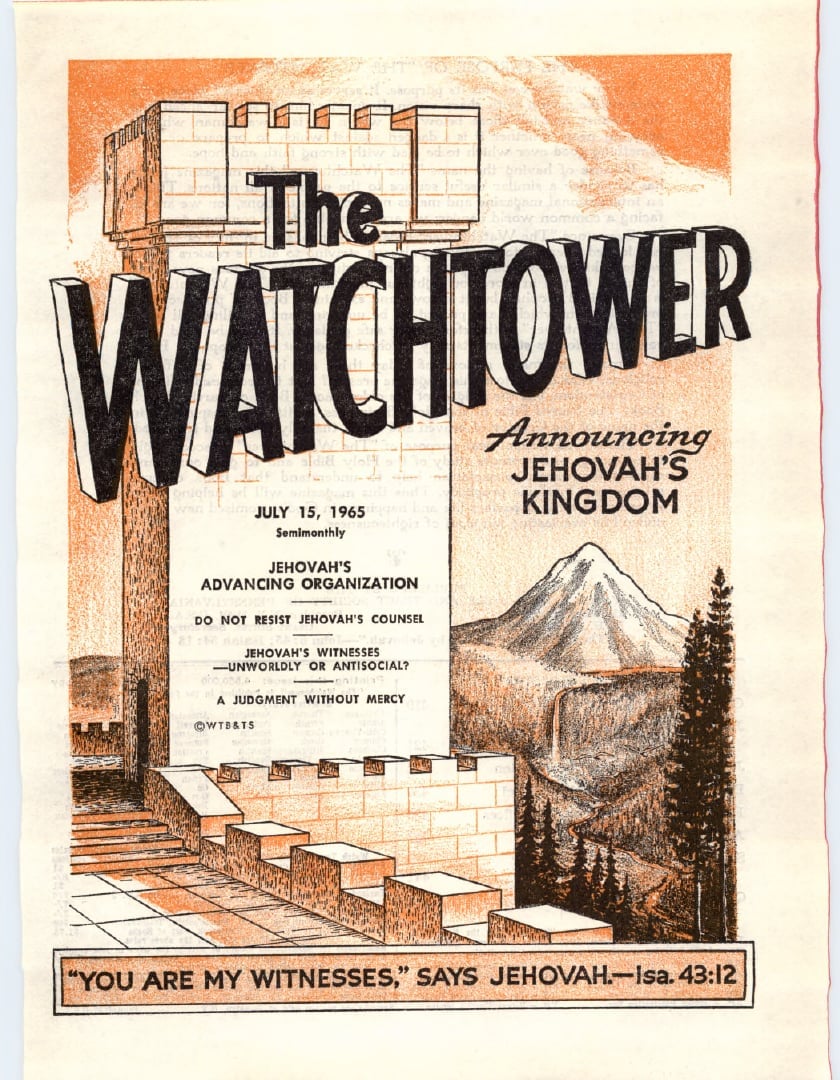
The Watchtower — July 15, 1965
Source: jw.org
Contents
Can You Defend Your Faith?
Jehovah’s Witnesses—Unworldly or Antisocial?
Jehovah’s Advancing Organization
Do Not Resist Jehovah’s Counsel
False Religion and Human Sacrifices
A Judgment Without Mercy
Serving Jehovah Brings Happy Contentment
Questions From Readers
Announcements
Can You Defend Your Faith?
Can You Defend Your Faith?
DO YOU have a religion that you love and cherish? If so, you ought to be happy to discuss it and to share it with others. That is the way an unselfish person feels when he has something good that will benefit his fellowman.
If yours is the true faith, then it is one firmly based on God’s Word of truth the Bible. Its teachings can be defended by the Bible. This poses the question: Can you use the Bible to defend your faith? It is vital that you be able to do so, for an apostle of Jesus Christ, Simon Peter, once wrote: “Sanctify the Christ as Lord in your hearts, always ready to make a defense before everyone that demands of you a reason for the hope in you.” (1 Pet. 3:15) Yes, true Christians should be able to use the Bible to give a defense of the beliefs that they hold dear. Can you?
Some time ago a Catholic lady who cherished her faith desired more knowledge so that she could share it with others and defend it when questions were raised. Regarding her efforts in this connection, she writes:
“Several years ago my husband and I attended a night class to learn more about our religion. We went twice a week for two years, while it was in session. Since I believed that ours was the one true way to worship God, I wanted to be better equipped to share my faith with nonbelievers. The head of the Catholic Information Center in Milwaukee, Father Mehok, conducted the class. We studied from a question-and-answer book which did quote some scriptures. We also read an occasional paragraph or two from the Bible.
“One day one of Jehovah’s witnesses made a call at my home. In a brief span of time many scriptures were called to my attention that were new to me and seemed to contradict my religion. Realizing I had learned much about the Catholic religion but little about the Bible, I decided to again attend a Bible class, this time at a different Catholic congregation in Milwaukee. A few minutes of time was allotted after each session to answer previously submitted questions. I submitted several questions; however, no answer was given from the Bible.
“Next I went to Our Lady of Sorrows parish, Milwaukee. Father Brown conducted this class. During one of the discussions he said that we could read the Bible if we wanted, but that we would find it ‘dull reading.’ However, he did emphasize the importance of Catholics memorizing their prayers. One of the reasons he gave was that one could do as he did—pray and plan the day’s schedule at the same time. I asked him of what value such praying was. All he said in answer was that he knew he had made a mistake the minute he said it.
“Another question I asked him was if Jesus knew the time of the world’s end when he said: ‘Concerning that day and hour nobody knows, neither the angels of the heavens nor the Son, but only the Father.’ (Matt. 24:36) He answered that Jesus did know, but that he denied knowing because he did not think that the people needed to know.
“Sensing that I might be embarrassing him by asking these questions in class, I suggested a private interview. At this meeting I again brought up Matthew 24:36 and asked him why he as much as said that Jesus was a liar. He would not use the Bible but stuck to his original statement, claiming that Jesus was God and therefore knew everything. Because he wouldn’t use the Bible, I decided to see another priest.
“I again contacted the head of the Catholic Information Center. I wrote and said that I had several questions I would like to type up and send to him. I told him that I would give him plenty of time to look up the answers and that when he was ready I would like him to visit me at my home. I also mentioned that I would have one of Jehovah’s witnesses there so that we could show this Witness that the Catholic religion was the true religion. He wrote back and refused to come, suggesting that I was mentally unbalanced.
“Then I decided as a last resort to write the Pope in Rome and ask him. So a cablegram night-letter was sent. Among the questions asked was if the Pope could recommend a priest in the Milwaukee area who was sufficiently familiar with the Bible to be able to answer my Bible questions. The cable cost $16.45, and it seemed to me that it would be worth every penny. No reply!
“I had treasured my religion and I had wanted to remain a Catholic. I tried very hard to find answers to defend my faith. Finding this impossible, I began a systematic study with one of Jehovah’s witnesses. Soon after, I began attending congregation meetings. With the abundance of Scriptural proof that was given, it wasn’t difficult to realize that this was indeed the Truth. Now I am happily engaging in the field ministry and am telling my Catholic friends about God’s kingdom.”
Have you ever tried to defend your faith by showing that it was supported by the Scriptures? If someone asked you why you believe the way you do, could you open the Bible to appropriate texts and say, “This is the basis for my faith. It is what the Bible teaches on the matter”? Remember, the apostle Peter said: Be “always ready to make a defense before everyone that demands of you a reason for the hope in you.”—1 Pet. 3:15.
Merely possessing a faith is not sufficient. You must be prepared to defend it. This requires investigation—asking questions, and obtaining answers from God’s Word of truth the Bible. “Keep testing whether you are in the faith, keep proving what you yourselves are,” the apostle Paul encouraged. It is vital that you make this test, examining whether your beliefs are supported by the Scriptures. It is the only way to be sure that you have the true faith.—2 Cor. 13:5.
Jehovah’s Witnesses—Unworldly or Antisocial?
Jehovah’s Witnesses—Unworldly or Antisocial?
REVOLUTIONS, assassinations, riots—these rock the globe. But among the rebellious, will one find Jehovah’s witnesses? Do they join in this antisocial behavior and prove to be a threat to their fellowman, his welfare and security?
If they indulged in activities that resulted in destruction of human life or disrupting law and order, it certainly would be antisocial. But Jehovah’s witnesses are not trying to revolutionize this system of things and depose its rulers or crush and replace its governments. Testifying to the peace-loving nature of these Christian witnesses of Jehovah are these words of a resolution they adopted some time ago:
“Figuratively speaking, we have beaten our swords into plowshares and our spears into pruning shears and, although of so many nationalities, we will not lift up sword against one another because we are Christian brothers and members of the one family of God, neither will we learn to war against one another any more, but we will walk in God’s paths in peace.” This peace-loving attitude characterizes their dealings with the whole human race.
But because Jehovah’s witnesses are in certain respects different from their neighbors, they are often misunderstood. This is not because they are trying to be nonconformists but simply because they are trying to follow the pattern of conduct of the first-century Christians.
WERE EARLY CHRISTIANS ANTISOCIAL?
The early Christians were not worldly; that is, they were not part of this world; they did not indulge in some of the popular pursuits and pleasures. As a result, one history book says: “Early Christianity was little understood and was regarded with little favor by those who ruled the pagan world. Pagan writers referred to . . . Christians as ‘misguided creatures’ . . . creatures guilty of ‘hatred of the human race.’”—On the Road to Civilization, A World History by Heckel and Sigman, 1937, p. 237.
Why were those charges made against the early Christians? Because they were, as Jesus Christ said, “no part of the world,” they were unworldly. They did not join in with their neighbors in celebrating the holidays of ancient Rome. While the people gaily decorated their houses on such days, the Christians did not. For them to have joined their neighbors in observing holidays dedicated to the gods of Rome would have violated their loyalty to the true God. Their nonparticipation in the celebrations caused many people, including rulers, mistakenly to think of them as antisocial.—John 17:16.
The ancient Romans found great pleasure in attending morally degrading theatrical shows, bloody gladiatorial fights and savage battles among wild beasts in the arenas, and the ruthless chariot races of the circus. But Christians avoided such degrading entertainment. They did not share popular enthusiasm for violent sports that were contrary to Christian teachings of neighbor love and peace, much rather the Scriptural command against murder. This made them unpopular.
Regarding the unworldly position of the early Christians toward the entertainments of ancient Rome, Tertullian, a Christian writer of the second and third centuries C.E., wrote: “Among us nothing is ever said, or seen, or heard, which has anything in common with the madness of the circus, the immodesty of the theater, the atrocities of the arena, the useless exercises of the wrestling-ground. Why do you take offense at us because we differ from you in regard to your pleasures?”
Despite the fact that the early Christians did not join with worldly people in holiday celebrations and entertainment, they were not antisocial. They were not enemies of the State. On the contrary, they were a valuable asset to every community in which they lived. The more Christians there were in a city the safer were the rulers, and the fewer the problems confronting those who ruled. When those Christians strived to help others in the community live morally decent and peaceful lives, they performed a service of inestimable value to the public welfare and the common good. Note the argument Tertullian presented to the Roman authorities in defense of the Christians:
“Whence they who beset Caesar between the two laurel groves? Whence they who practiced wrestling, that they might acquire skill to strangle him? Whence they who in full armour broke into the palace? . . . If I mistake not, they were Romans; that is, they were not Christians. . . . Banded together as we are, ever so ready to sacrifice our lives, what single case of revenge for injury are you able to point to? . . . Yet you choose to call us enemies of the human race, rather than of human error. . . . I will confess, however, without hesitation, that there are some who in a sense may complain of Christians that they are a sterile race: as, for instance, pimps, and panderers, and bath-suppliers; assassins, and poisoners, and sorcerers; soothsayers, too, diviners, and astrologers. But it is a noble fruit of Christians, that they have no fruits for such as these. And yet, whatever loss your interests suffer from the religion we profess, the protection you have from us makes amply up for it.”—Apology, translated by Alexander Roberts, in The Ante-Nicene Christian Fathers, Vol. III.
No, those early Christians, though viewed as antisocial, were not against the common good. Actually, they were simply not worldly persons, but they were not antisocial. They were viewed as misguided, but, actually, they were guided by the highest principles, the commandments of Jesus Christ and his apostles.
THE BIBLE’S TEACHINGS GUIDE THEM
So it is with Jehovah’s witnesses today; they follow the course Jesus Christ commanded his followers to take. This does not make them antisocial. For instance, in reply to a question about paying taxes, Jesus Christ said: “Pay back, therefore, Caesar’s things to Caesar, but God’s things to God.” (Matt. 22:21) Since money is coined by Caesar or the government, a Christian should pay this back to Caesar in return for the many services the government provides. This willingness to pay all taxes makes Jehovah’s witnesses an asset to the community, not antisocial.
Wherever they live, Jehovah’s witnesses follow the Bible’s teachings about being in subjection to the rulers of whatever society they live in. The Bible command to Christians is: “Let every soul be in subjection to the superior authorities.” (Rom. 13:1) The Holy Scriptures urge them “to be in subjection and be obedient to governments and authorities as rulers.” (Titus 3:1) Surely they are not being antisocial by obeying this Bible command. Instead, even in times of widespread unrest, they refuse to join in uprisings against the government or to encourage civil disobedience.
Nor does the fact that Jehovah’s witnesses put God first in their lives make them antisocial. If a ruler requires one of Jehovah’s witnesses to do something that violates a law of God, the Witness is faced with a conflict of authorities and can do nothing else than obey the One that is superior. This is what the early Christians did when the rulers of ancient Rome demanded that they burn incense to Caesar. The course they took was expressed by Jesus Christ: “It is Jehovah your God you must worship, and it is to him alone you must render sacred service.” (Matt. 4:10) So Jehovah’s witnesses today do as Peter and the other apostles of Jesus Christ did when they were faced with a conflict of authorities. They “obey God as ruler rather than men.” (Acts 5:29) This high regard for the law of God on their part sets a wholesome example for others in the community.
UNWORLDLY, BUT WORKING GOOD TOWARD ALL
Rather than being antisocial, Jehovah’s witnesses are unworldly; and this is because Jesus Christ himself said of his followers: “If you were part of the world, the world would be fond of what is its own. Now because you are no part of the world, but I have chosen you out of the world, on this account the world hates you.”—John 15:19.
What does it mean to be “no part of the world”? It means that Jehovah’s witnesses are no part of human society that is not dedicated to God and the doing of his will; it means they stay separate from that society’s politics, wars, riots, false religion, debauchery, immorality and other inordinate pleasures. Yet because they shun these things that are so common among the world of mankind that shows little regard for God and his laws, they are not antisocial or haters of mankind; rather, they try to do good to every man.
So Jehovah’s witnesses obey the Bible command: “Really, then, as long as we have time favorable for it, let us work what is good toward all.” (Gal. 6:10) These Christian witnesses gladly assist others, as Jesus Christ did. He went about doing good and assisting others. In his parable of the Good Samaritan, he told of a man who was beaten, robbed and left half-dead. A priest and a Levite passed by, offering no help. But a certain Samaritan came by and helped bind up the man’s wounds and even took him to an inn and paid his bill. Jesus Christ said: “Go your way and be doing the same yourself.” (Luke 10:29-37) So Jehovah’s witnesses try to do good to all. If they withheld good from others, they would not be acting like God.
Jehovah God loved the world of mankind so much that he gave his only-begotten Son that those showing faith might gain everlasting life; so when Jehovah’s witnesses aid others to avail themselves of that provision, they are not haters of mankind! Rather, they are reflecting the same kind of love that God showed.—John 3:16.
However, because they are unworldly, being “no part of the world,” Jehovah’s witnesses, like the early Christians, are often misunderstood; but the truth is that they are not antisocial. Their obedience to Bible teachings makes them better people, unworldly, yet working good toward all men. Rather than being antisocial, they follow the Bible’s counsel to “go on leading a calm and quiet life with full godly devotion and seriousness.” (1 Tim. 2:2) People everywhere can depend on Jehovah’s witnesses to follow this peace-loving course, for the common good of mankind.
Jehovah’s Advancing Organization
Jehovah’s Advancing Organization
“The path of the righteous ones is like the bright light that is getting lighter and lighter until the day is firmly established.”—Prov. 4:18.
1. What was God’s first organization?
LONG before the material heavens and earth were created, Jehovah God formed a mighty organization. It was a heavenly organization made up of creatures who are a form of life that is entirely different from anything with which we are acquainted. Their bodies reflect the glory of their Creator by being in his form. His Word tells us: “God is a Spirit.” (John 4:24) And regarding these heavenly creatures it states that he makes “his angels spirits.” (Ps. 104:4) Being like him, they are able to dwell where he is.
2. Why are spirit creatures invisible to us, and how do we know they exist?
2 As spirits these heavenly creatures are made of a substance that is different from anything we know to exist in the material universe. For this reason they are unseen by us. None of the radiant forms of energy in the universe that we can detect by our senses or by instruments are able to reveal their presence to us. They have none of the properties of matter that would make it possible for us to detect them. They are a higher form of life that is very foreign to us. Notwithstanding the fact that we cannot see spirit creatures, we know they exist because they have made frequent contacts with man. In his written Word, their Creator tells us about them and these contacts.
3. What was the reaction of the spirit creatures to the creation of the earth?
3 Speaking to Job regarding the creation of the earth, Jehovah God reveals how his spirit creatures rejoiced when he formed the earth in the beginning: “Where did you happen to be when I founded the earth? . . . When the morning stars joyfully cried out together, and all the sons of God began shouting in applause?” (Job 38:4, 7) These glorious spirit creatures who were created in the morning of creation were like morning stars. They were the first living things God brought into existence. When they saw that their Creator was preparing to bring forth more living creations, they were elated.
4, 5. (a) How have spirit creatures been seen by man? (b) Explain how we can know that there is a heavenly organization and what the duties of cherubs are.
4 By means of materializations and visions, God caused faithful men in times past to see spirit creatures and to write down what they saw. Daniel and John were such men. Under inspiration Daniel saw in vision the spirit multitudes Jehovah created. He saw them gathered about their Creator ready to serve him. Since Jehovah is a God of order, he would necessarily have these heavenly creatures organized. He would have them form a mighty organization that is devoted to doing his will. Daniel tells us what he saw: “There were a thousand thousands that kept ministering to him, and ten thousand times ten thousand that kept standing right before him.” (Dan. 7:10) A similar vision of the heavenly hosts was recorded by John, an apostle of Jesus Christ. “I saw, and I heard a voice of many angels around the throne and the living creatures and the older persons, and the number of them was myriads of myriads and thousands of thousands.” (Rev. 5:11) By means of these visions we see that God’s spirit creatures form a heavenly organization.
5 In both visions the spirit creatures are seen gathered around the throne of the Creator, Jehovah. This indicates that they are organized servants of God and are ready to serve him. Some are ministering to him, indicating orderly work assignments. God’s Word informs us that he has placed these creatures in various positions of responsibility. Some are cherubs who are special consorts of his throne. They uphold his majesty and supremacy wherever they are assigned to work. The first mention of them in the Bible is at Genesis 3:24, where it states that cherubs were stationed at the entrance to the garden of Eden to uphold Jehovah’s sovereignty by preventing disobedient mankind from reentering the garden.
6. (a) What are seraphs? (b) How large is the symbolic angelic military force?
6 Another group of spirit creatures are called seraphs. They have the duty of keeping uncleanness from Jehovah’s organization and to declare his glory. They are mentioned in a vision that was given to the prophet Isaiah and that was recorded by him at Isaiah 6:1-3. Myriads of other spirit creatures are used as messengers and for other services. These many heavenly creatures are mentioned in the book of Revelation as being part of a great military force that will be used by God to destroy his enemies at the coming battle of Armageddon. The angelic force, if pictured at Revelation 9:16, is numbered as two myriads of myriads, which is 200 million. That is a sizable organization.
HEAVENLY ORGANIZATION ADVANCES
7, 8. Explain how God’s heavenly organization advanced. Give an example of advancement by them.
7 From its very beginning God’s heavenly organization has continued to advance. It has kept advancing to greater understanding of Jehovah’s purposes and to greater privileges of service. Although the many heavenly creatures in it are perfect, God did not give them, at the time of their creation, all the knowledge there is to be had, any more than he gave such knowledge to the first man and woman. There is always more they can learn.
8 As God caused events to unfold on earth, the angels grew in understanding of his purposes. For example, the identity of the Seed promised at Genesis 3:15 was unknown to them when the promise was made. They did not learn the identity of this Promised One until many centuries later. This is shown by Peter, who wrote: “It was revealed to them [the prophets] that, not to themselves, but to you, they were ministering the things that have now been announced to you through those who have declared the good news to you with holy spirit sent forth from heaven. Into these very things angels are desiring to peer.” (1 Pet. 1:12) Learning the identity of the promised Seed was an advancement in knowledge for them.
9. How are the spirits who were disobedient in “pits of dense darkness”?
9 Those spirit creatures that fell away from God’s heavenly organization in the days of Noah and became demons ceased to advance with it. They do not have the light of understanding that the loyal spirit creatures have. They have been in darkness to the truths he has revealed to his heavenly organization since that day. It is even possible that they have retrogressed in what truths they once had. The Bible speaks of them as being in “pits of dense darkness.” (2 Pet. 2:4) There is no prospect for them to get out of those “pits.” While they continue in darkness, God’s heavenly organization continues to progress.
EARTHLY ORGANIZATION
10. What did God establish when he created man?
10 With the first human pair God established an earthly organization that he purposed to encompass the earth in due time as man multiplied in numbers. Like His heavenly organization, it would worship and serve his interests. The disobedience of that first pair, as well as the majority of their descendants, has not thwarted God’s purposes.
11. (a) How has God’s earthly organization been represented? (b) Explain how it advanced in Noah’s day and what this required of those in it.
11 Jehovah’s earthly organization has been represented throughout the ages by men of integrity who manifested deep loyalty to him. Wherever they resided, they represented his earthly organization. At times this association of loyal worshipers was very limited in number, consisting of as few as one to eight persons, as in the days of Abel, Enoch and Noah. Although there were only eight persons in it right before the flood of Noah’s days, it was an advancing organization. It advanced in knowledge of Jehovah’s purposes when it was informed about the Flood and the preservation of human and animal life. Its members were given work that was different from what they had been doing before. They had a work assignment of constructing an ark for the preservation of their own lives and of the lives of the creatures they were to bring into the ark. Every member of that organization advanced with it to this new form of work. None became disgruntled about this change in work and held back from it. That organization was even informed in advance when the Flood would begin and how long the downpour of waters would last. All eight members had to stay close to the organization and advance with it in order to be preserved with it in the ark.
12. Of what did God’s earthly organization consist in Moses’ day, and how did it advance?
12 Later, when Jehovah made a covenant with the people of Israel whom he liberated from Egyptian slavery, his earthly organization became a nation. He was its King. While in the wilderness, it kept advancing in knowledge as Jehovah instructed it through Moses. As changes were made in the way God was to be worshiped, it progressed by adopting those changes. The construction of the tabernacle, the installation of a family of priests and the inaugurating of animal sacrifices were changes in their manner of worship from what it was in Egypt. Later more changes came when Jerusalem became the place God chose for his altar and still later when Solomon’s temple was built there.
13. What difficult change did the Jews have to make in the first century in order to progress with God’s organization?
13 In the first century John the Baptist brought a new message, that the kingdom of the heavens was at hand. This heralded the beginning of something that would cause a great change in God’s earthly organization. Jesus Christ laid the groundwork for it by his ministry and ransom sacrifice. Advancing from the Jewish system of things under the Mosaic Law to a new system of things under a new covenant proved to be a change that the majority of the Jews refused to make. So they were left behind by God’s advancing organization as it moved forward into the Christian era.
14, 15. (a) What did Pentecost signify for God’s organization? (b) To what new things did the organization advance, and what change in particular was difficult for Jews to make?
14 At Pentecost of the year 33 C.E. God’s earthly organization became clearly identified as being Christian and separate from the old Jewish system of things. It had left behind the system of things under the Mosaic Law. Christ’s sacrifice had brought that old arrangement to an end by fulfilling the purpose of the Law. During the centuries before this it was leading the Israelites to Christ, as Paul, an apostle of Jesus Christ, observed: “Consequently the Law has become our tutor leading to Christ, that we might be declared righteous due to faith. But now that the faith has arrived, we are no longer under a tutor.” (Gal. 3:24, 25) The organization had progressed to something new and better that Jehovah had prepared for it.
15 The 120 disciples of Jesus Christ who were gathered in an upper room on the festival day of Pentecost advanced that day with Jehovah’s organization to a new arrangement of things with new hopes and a new provision for covering sins. By grasping the privilege now given them to be a Christian organization of ministers who proclaim God’s purposes and teach his truths, as Christ did, they advanced to greater privileges of service. By their zealous preaching thousands of people came into the earthly organization of God. As the preaching of Christianity spread from Palestine to other lands, the number of non-Jews that began to associate with the organization increased by leaps and bounds. They embraced with enthusiasm the new truths that Jehovah had revealed through it. Now people who were no part of God’s organization when it was under the Mosaic Law were being received into it under the Christian arrangement. To accept them required a great adjustment in thinking for the Jewish Christians. Under the old Mosaic Law covenant, the Jews kept separate from Gentiles, not even eating with them.—Acts 10:28.
16. How were Christians tested in the love of God? Give an example.
16 As Jehovah revealed through the apostles new truths and new ways of doing things, those in the organization were put to a test. Did they have enough love for Jehovah to be willing to make the necessary changes in their thinking so as to accept this new knowledge? Some did not and so fell away from the organization. Those who really loved God adjusted their thinking and made progress. The matter of circumcision was a test on some of the Jewish Christians, causing them to create a disturbance among the Christians in Antioch. A meeting of the governing body in Jerusalem settled the matter by declaring that circumcision was not a Christian requirement. This was an important change of view for the Jewish Christians who had been taught under the old Jewish system of things to regard circumcision as vitally important. This change indicated an advancement on the part of God’s organization. Those who were willing to make this change in thinking advanced to further enlightenment.—Acts 15:1, 2, 28, 29.
JEHOVAH’S ORGANIZATION TODAY
17. (a) Why does God’s organization today not share any responsibility for the wrongs done by worldly governments? (b) What are some of its good fruits?
17 As in the first century, so in this twentieth century, Jehovah has an earthly organization. It can be identified by its fruits. Unlike the many religious organizations that are part of the world that is alienated from God and that profess to be his organization, it has not allied itself with the political governments of the world. It, therefore, shares none of the responsibility for the unchristian things done by those governments. Obeying Jesus’ words, it has kept itself separate from the world. Thereby it has been able to produce good fruit to the honor of Jehovah’s name. It is doing this in a number of ways. It is turning the trust of multitudes to God’s kingdom. It is transforming their lives for good by bringing them into harmony with the righteous principles of God’s Word. It is instructing them in the Christian ministry, encouraging all to follow Jesus’ example of proclaiming the good news of God’s kingdom. It is happy to bear the name of Jehovah God, just as his organization did in the days of Moses.
18. Explain how Proverbs 4:18 fits God’s organization.
18 With the passing of the years in this twentieth century, Jehovah’s organization has advanced in knowledge and understanding of the Scriptures and of its responsibilities before God. As with God’s organization in the past, so today, it fulfills the words written at Proverbs 4:18: “The path of the righteous ones is like the bright light that is getting lighter and lighter until the day is firmly established.” It keeps advancing to greater enlightenment. Those who were with it at the turn of the century and who are still with it today have seen this advancement.
19, 20. Cite examples showing how God’s organization has been advancing in modern times.
19 As we look back over the years, we can clearly see how God’s organization in modern times has progressed in understanding. For example, it learned that Christ’s second presence was to be in the spirit, and not in the flesh as many professed Christians believe. His rule would be from the heavens. This was a new revelation of great importance to God’s people who had been anxiously awaiting his second presence toward the end of the nineteenth century. The truth that 1914 marked the end of the “times of the nations” that started in 607 B.C., and the beginning of the “time of the end” for the nations and hence the beginning of his presence, was new knowledge over which God’s people could rejoice. But they had to adjust their thinking from the view they previously held. Continued advancement brought them the understanding that both Jehovah and his enemy, Satan, have an invisible organization. Jehovah’s heavenly organization is likened to a woman called “Jerusalem above.” (Gal. 4:26) Satan too has a heavenly as well as an earthly organization, but they are opposed to righteousness. Today these things are fundamental to the knowledge of God’s people, but a number of years ago they were new concepts that required changes in view to which some persons had difficulty in making the adjustment.
20 It was in 1938 that The Watchtower published an article on organization that showed how God’s organization should be theocratic. It should be governed by God through the “faithful and discreet slave,” the united remnant of his anointed kingdom heirs. (Matt. 24:45-47) Up until then the congregations of his people were organized democratically, with the congregations electing those in authority over them. The “elective elders” resulting from this arrangement were a cause of discontent and disunity because of the self-importance and high-mindedness of many such. They ignored what Jesus said: “Whoever exalts himself will be humbled.” (Matt. 23:12) With the restoration in 1938 of the theocratic arrangement that existed in the Christian organization of the first century, the elective officers of congregations were brought down from their exalted positions. With the discontinuance of the election system in the congregations, the organization began to have greater peace, harmony, unity and productivity.
21. How did some persons react to the discontinuing of the “elective elder” system?
21 The discontinuance of the “elective elder” system was a major change in the operation of God’s organization in the twentieth century. It proved to be a severe test to those in the organization. Some persons permitted it to become a great issue over which they became heated up. Refusing to progress with the organization, they turned away from it. But the majority adjusted themselves to the change and moved forward to greater enlightenment and greater privileges of service. The ones who left the organization not only ceased to progress but lost much of the enlightenment they had gained while they were in it.
22. (a) How are servants in the organization selected now? (b) Has the organization benefited from this change?
22 Through the “faithful and discreet slave” class Jehovah now appoints the overseers and ministerial servants in his earthly organization. Operating in a theocratic manner, it enjoys unity and is productive in Jehovah’s service to an extent that far exceeds what it accomplished during the days of the elective elders. God does not inspire anyone to select the servants in the congregation as he did Samuel in the selection of Saul as king of Israel. By reason of his placing his holy spirit upon the responsible Christians who form the “faithful and discreet slave” class, it can be said that their appointments of servants come from him. Thus, as in the first-century organization, the governing body of God’s earthly organization, which represents the “faithful and discreet slave” class, makes all appointments of servants. This was an important change in the progressive advancement of God’s organization. Those persons who advanced with the organization when this theocratic arrangement was instituted in 1938 have, since then, seen how it has been very beneficial. It has been a major factor in the phenomenal expansion of the organization. But the change for many was not easy.
23. (a) Why are changes difficult to accept, and why are they necessary? (b) Why is it unwise to resist changes?
23 Disposing of the elective elders is an example of how changes may at first cause some persons to become upset. Throughout the history of God’s advancing organization on earth, there has been a tendency on the part of some in it to resist change, preferring to cling to old ways and old views. But change is necessary because God gives his people understanding of his Word and purposes just a little at a time. Growing in a knowledge of the truth requires a person to be progressive, not static. Although a person may not at first appreciate the need for a change, as time passes he will begin to see how it benefits the organization. So, instead of opposing a change in Scriptural understanding, organizational procedure or organizational structure, it is better to adjust oneself to it, remembering that, whatever change is made by God’s organization, the change is for the good of those in it. To resist this advancement is to resist Jehovah’s spirit that operates on the organization, causing it to advance. Paul spoke of persons who, like some of the elective elders, resisted the holy spirit in his day. “Now in the way that Jannes and Jambres resisted Moses, so these also go on resisting the truth.”—2 Tim. 3:8.
24. What guidance do all in God’s organization need, and why?
24 All in Jehovah’s organization need his guidance of their steps along the way that leads to the fulfillment of his purposes. “I well know, O Jehovah, that to earthling man his way does not belong. It does not belong to man who is walking even to direct his step.” (Jer. 10:23) We need God’s Word and organization. By staying close to his organization as it advances in knowledge and by progressing with it, we will be living when it advances to a new era and expands to fill the earth with people who love and obey the great Ruler of the universe.
Do Not Resist Jehovah’s Counsel
Do Not Resist Jehovah’s Counsel
“Listen to counsel and accept discipline, in order that you may become wise in your future.”—Prov. 19:20.
1, 2. (a) Why can adults be viewed as children in God’s eyes? (b) Why is Jehovah able to give us wise counsel?
HOW old are you? Are you in your teens, your twenties? Are you middle-aged or are you approaching a century of living? No matter how many years you have lived, you are still a child in the eyes of the eternal God. From Jehovah’s viewpoint of 1,000 years being as one day a man of 100 years has lived only two hours and twenty-four minutes. (2 Pet 3:8) Can he become so wise in this short period of time that he does not need counsel from his eternal Father? Is he so astute that he can pass judgment on that counsel and resist or reject what he does not like?
2 As children need counsel from a wise human father, so we must recognize our need for counsel from Jehovah our heavenly Father. He has a much better understanding of life and its problems than we do. Has he not lived much longer than we have? Has he not seen generation after generation from the time of Adam do foolish things that were against their best interests? Being our Creator, he knows our hearts. He knows how our bent of thinking can get wrong. He knows our weaknesses and the foolish mistakes we are prone to make. He knows to what a course of action can lead and forewarns us of it. Since he knows these things, is he not in the best position to give us wise counsel that is good for us physically, emotionally and spiritually? It is with good reason that his written Word says: “Listen to counsel and accept discipline, in order that you may become wise in your future.” (Prov. 19:20) Jehovah’s counsel is the very best counsel to which we could listen.
3. Why is man not able to direct his own steps wisely?
3 Like children, we are not able to direct wisely our own steps on the road of life. We are too emotionally wrapped up in our daily living and in our desires, to see the path of life objectively. Counsel from our heavenly Father is needed to point out the way that is for our best interests. As was mentioned in the previous article, Jeremiah pointed out our need for this divine direction, saying: “I well know, O Jehovah, that to earthling man his way does not belong. It does not belong to man who is walking even to direct his step.” (Jer. 10:23) Our way through life does not belong to us to direct as we please, as if we possessed absolute freedom. Jehovah has given us a relative freedom within the bounds of his just laws and Scriptural principles. By going beyond those bounds we do injury to ourselves and to our relationship with him. By staying within those bounds and by permitting Jehovah to direct our steps through his Word and advancing organization, we will be ‘wise in our future.’ The future will bring great blessings to us.
4, 5. When is Jehovah’s counsel especially important to us? Give an example of one who turned to Jehovah at such a time of need.
4 In times of distress Jehovah shows us what is the correct decision to make if we turn to him for counsel. He points out the right thing to do, just as a loving father does for his inexperienced and immature children. Our heavenly Father is a source of strength for us at such times. When we do not know what we ought to do, his counsel directs us. “For you have become a stronghold to the lowly one, a stronghold to the poor one in the distress that he has, a refuge from the rainstorm, a shade from the heat.”—Isa. 25:4.
5 King Jehoshaphat of Jerusalem turned to Jehovah as a stronghold when he was in distress. While threatened by an overwhelming enemy force he turned to Jehovah and said: “O our God, will you not execute judgment upon them? For in us there is no power before this large crowd that is coming against us; and we ourselves do not know what we ought to do, but our eyes are toward you.” (2 Chron. 20:12) So in our distresses today our eyes should be toward our heavenly Father and our ears toward his counsel.
6, 7. (a) To whom was the need for heeding Jehovah’s counsel stressed, and what were they told? (b) What would happen if they resisted his counsel, and how is that a warning to us?
6 The need for heeding Jehovah’s counsel and not resisting it was stressed to the nation of Israel in the days of Moses. When they were gathered about the base of Mount Sinai, Jehovah said to them: “If you will strictly obey my voice and will indeed keep my covenant, then you will certainly become my special property out of all other peoples.” (Ex. 19:5) By obeying his voice, which would mean to heed his counsel and follow his instructions, they would enjoy a special relationship with Jehovah God. They would be a blessed people, benefiting from his loving generosity.
7 Later, when the Israelites were at the threshold of the Promised Land, Moses warned them of what would happen if they resisted Jehovah’s counsel by not listening to God’s voice. “It must occur that if you will not listen to the voice of Jehovah your God by taking care to do all his commandments and his statutes that I am commanding you today, all these maledictions must also come upon you and overtake you: Jehovah will strike you with madness and loss of sight and bewilderment of heart. And you will indeed become one who gropes about at midday, just as a blind man gropes about in the gloom, and you will not make your ways successful.” (Deut. 28:15, 28, 29) They were warned that they would lose spiritual sight and would not know which way to go that would be best for them. The same thing can happen today to anyone in Jehovah’s organization who turns a deaf ear to Jehovah’s counsel. He too will have “bewilderment of heart” and will grope about for the way he should walk and will not find it. It is imperative for all who come into Jehovah’s organization to be constantly aware of their need for his guiding instructions so they may continue to walk in the way that leads to a future that brings them the gift of eternal life.
MEANS BY WHICH COUNSEL IS GIVEN
8. (a) What is one means by which Jehovah gives counsel? (b) Why can we say that the counsel given to the Israelites was not intended for them alone?
8 Long ago God inspired faithful men to write his counsel down in the Scriptures. This written Word of his contains his Fatherly counsel to us his children. Although some of his instructions are directed to the nation of Israel, they are for our benefit too. “For all the things that were written aforetime were written for our instruction,” says Paul, an apostle of Jesus Christ. (Rom. 15:4) To the nation of Israel God gave practical counsel on worship by telling them that they should give him exclusive devotion and that they should not become defiled by the worship of idols or by pagan religious practices. Following the same counsel will preserve our relationship with Jehovah God so that it is not ruptured and we become an object of his anger.
9, 10. What are some of the ways we can benefit from the counsel given to the nation of Israel?
9 With regard to personal conduct, he gave instructions that were for the best interests of the Israelites as well as for us today. He warned them against murdering their fellowman, against stealing, against immorality, against bearing false witness and many other things. The wisdom of our heeding these instructions given to Israel is evident. We do not have to be under the law covenant of Israel to see that there is benefit to us and to the community in which we live by our obeying these personal injunctions on conduct.
10 God’s Word also instructs us through the personal counsel that was given to individuals mentioned in the Bible. The counsel, “To obey is better than a sacrifice,” that was given to King Saul is counsel that can benefit us. (1 Sam. 15:22) No matter what personal sacrifices we may make in order to serve Jehovah in the Christian ministry, if we do not obey him our sacrifices mean nothing. Disregarding his counsel on morality nullifies such good works as the “sacrifice of praise, that is, the fruit of lips which make public declaration to his name.” (Heb. 13:15) Thus the personal counsel given to King Saul can benefit us by making us conscious of how very important obedience to God is. We cannot rationalize disobedience by any kind of sacrifice.
11, 12. Give examples of counsel directed to early Christians that is good for us today. Explain why it is good.
11 The counsel that was given to the Christian Timothy about the love of money and about the danger in that love is certainly beneficial for us today who are living in a money-loving world. He was told: “The love of money is a root of all sorts of injurious things, and by reaching out for this love some have been led astray from the faith and have stabbed themselves all over with many pains.” (1 Tim. 6:10) Resisting this counsel in God’s Word will bring the pains and loss of faith of which it warns.
12 Good counsel was given to the Ephesians about the proper relationship of husband and wife as well as that of children and parents. By our following this counsel to the Christians of the first century, we can avoid many of the marital storms that wreck marriages in this twentieth century. It points out the way to achieve peace and unity in the marriage relationship. Counsel such as this is what God gave to peoples of ancient times, causing it to be written down in his Word for the benefit of peoples living in other time periods. By going to his Word, we can thus receive wise counsel from our heavenly Father.
13. What is another means by which Jehovah gives counsel?
13 Jehovah also gives us counsel through his earthly organization. With his holy spirit operating upon the governing body of that organization, its counsel is in harmony with his will. Through the publications of the Watch Tower Society good counsel is given on personal conduct, marriage, worship, the keeping of integrity to God, our relationship with worldly political authorities and on many other things. Through the congregation meetings, Jehovah’s organization gives us counsel on our service to God, our mental attitude toward our ministry, on spiritual maturity, and so forth. Then at times the congregation service committee may find it necessary to counsel us about something. Through these means Jehovah’s organization gives counsel that will keep us spiritually healthy and keep our feet in the footsteps of Jesus Christ. It keeps us in harmony with Jehovah. Whether it comes from the Bible or from Jehovah’s organization, it is coming from him and is for our best interests.
HOW JEHOVAH’S COUNSEL IS RESISTED
14, 15. (a) How are some persons today like Korah, Dathan and Abiram in resisting Jehovah’s counsel? (b) What is the really important thing?
14 When Korah, Dathan and Abiram spoke against Moses, they resisted Jehovah’s arrangement of things. The same can be said of persons today who have become part of Jehovah’s earthly organization, but after a time begin speaking against it. Some become disgruntled because the organization does not adopt their ideas or the way they think it should function. Others get upset over changes in viewpoint, in terminology and in the way the ministry is carried on by Jehovah’s organization. Instead of advancing with the organization by accepting changes, they brood over them. In some instances they permit this resistance to become too great a test for them, and they fall away, going back to the world that is alienated from God.
15 Some persons want to dispute over trifling things such as the privileges God might or might not give to the resurrected dead in his new order or what condition Satan is in while in the abyss, and so on. Such things are not important to us at this time. What is important is our gaining Jehovah’s approval and being among those who will see life in his new order. When that time comes we will be able to see what Jehovah will do about things concerning which we now do not clearly understand. It is better to wait to see what happens then rather than to dispute about guesswork.
16. Why should it not be surprising that some persons today turn from Jehovah’s organization?
16 That there are persons today who turn from Jehovah’s organization and, in some instances, fight against it should not be surprising. This also happened in the first century while some of the apostles were still living. Regarding such persons who resisted Jehovah’s counsel and spirit then, the apostle Paul said: “If any man teaches other doctrine and does not assent to healthful words, those of our Lord Jesus Christ, nor to the teaching that accords with godly devotion, he is puffed up with pride, not understanding anything, but being mentally diseased over questionings and debates about words. From these things spring envy, strife, abusive speeches, wicked suspicions, violent disputes about trifles on the part of men corrupted in mind and despoiled of the truth.”—1 Tim. 6:3-5.
17. (a) What sort of persons does Jehovah want in his new era, and what will they not do? (b) What point does John make about those who go out from us?
17 The sort of persons that Jehovah wants in his new order are those who love him and who strive to obey him. These will not resist the counsel he gives through his Word and organization. They will not endanger their spirituality by trying to retard the advancement of his organization. Speaking about those who become disgruntled at counsel they receive and who turn from the organization or who turn from it because of advancing changes it makes, the apostle John says: “They went out from us, but they were not of our sort; for if they had been of our sort, they would have remained with us. But they went out that it might be shown up that not all are of our sort.” (1 John 2:19) If they had been real lovers of Jehovah, they would have stayed close to his organization, permitting nothing to separate them from it.
18. (a) Why is it wrong to argue against Jehovah’s counsel? (b) What, instead, should a person do?
18 Another way Jehovah can be resisted is to argue against his counsel. A person may make a mistake or do something that is out of harmony with Jehovah’s Word. When it is brought to his attention and he strives to justify himself instead of admitting the obvious wrong, he is resisting Jehovah’s counsel. He is not humbling himself and acknowledging that he erred. He should confess his wrongdoing, especially when confronted with it by a judicial committee of the congregation that is investigating his conduct. We are told at James 5:16: “Openly confess your sins to one another.” When sins are confessed, a person is not justifying what he did. To do so would be resisting what Jehovah has said is right and wrong.
19, 20. How can a person resist Jehovah’s counsel without openly opposing it? Give examples of how this can be done.
19 A person might not come right out and openly argue against Jehovah’s counsel, but he might resist it in another way, and that is by refusing to act on it. God counsels us on our daily living, for example, telling us to show love by being long-suffering, by not behaving indecently, by not looking out for our own interests, by not keeping account of injury. Do we heed that counsel? Or do we ignore it and thus resist it? His organization counsels us on the disciplining of our children, on our personal Bible study and on our doing secular work that is not compatible with being a pursuer of peace. Do we heed this counsel by applying it in our daily living? That was the reason why it was given. It does not benefit us if we ignore it.
20 At times the organization will give counsel on avoiding wrong associations, on not marrying persons who are undedicated to God, on repeatedly coming late to congregational meetings, on regularity in the Christian ministry, and so on. Ignoring such counsel by not acting on it is just as much a resistance of Jehovah’s counsel as is arguing against it. That is what King Jeroboam did.
21, 22. (a) Explain how Jeroboam resisted Jehovah’s counsel. (b) What was the attitude of the kingdoms of Israel and Judah toward Jehovah’s counsel, and how did Jehovah react to it?
21 Counsel was given to Jeroboam before the nation of Israel was split into northern and southern kingdoms. Because he resisted that counsel by not acting on it, he lost out on Jehovah’s blessing. Jehovah told him: “It must occur that, if you obey all that I shall command you, and you do walk in my ways and actually do what is right in my eyes by keeping my statutes and my commandments, just as David my servant did, I will also prove to be with you, and I will build you a lasting house.” (1 Ki. 11:38) Instead of being blessed, he was rejected by God because he did the opposite of what God told him. Most of the people in those two Israelite kingdoms proved to be like King Jeroboam. They refused to act upon Jehovah’s counsel. “For they had behaved rebelliously against the sayings of God; and the counsel of the Most High they had disrespected.”—Ps. 107:11.
22 How can Jehovah have love for persons who resist his counsel by arguing against it or by refusing to act upon it? He takes delight in those who strive to do what he instructs them. They are the ones he blesses, but stiffnecked persons like the Israelites who closed their ears to his counsel cut themselves off from his help when they need it. “You keep neglecting all my counsel, and my reproof you have not accepted, I also, for my part, shall laugh at your own disaster, I shall mock when what you dread comes. At that time they will keep calling me, but I shall not answer; they will keep looking for me, but they will not find me, for the reason that they hated knowledge and the fear of Jehovah they did not choose. They did not consent to my counsel; they disrespected all my reproof.”—Prov. 1:25, 26, 28-30.
ACCEPT JEHOVAH’S COUNSEL
23. Why do Jehovah and his organization give us counsel?
23 Whether Jehovah’s counsel comes through his written Word or through his organization, it is for your own good. He is interested in your welfare and your eternal future. His righteous new order is for you, and his counsel is given to help you to stay on the path that leads to it. His earthly organization is just as interested in your welfare. It wants you to keep integrity to Jehovah God and to win his approval. It wants you to live a happy, peaceful and productive life now as well as after God’s war of Armageddon. It wants you to receive the gift of eternal life. So all the counsel it gives you is with that end in view.
24, 25. What attitude should we take toward Jehovah’s counsel, and what position should we take toward congregational action taken against a friend?
24 Be receptive to Jehovah’s counsel and loyally uphold it. When it urges you to seek right associations, be diligent to do as it says. Encourage your spiritual brothers and sisters to heed that counsel. If right associations were vital to the spiritual health of the Israelites, are they not to you? When you ignore this counsel you are hurting yourself.
25 At times action must be taken by a judicial committee of a congregation against a person in the congregation. Although that person may be a close friend or a relative, do not resist Jehovah’s arrangement by taking sides with that one against the organization. The action is necessary, and it is taken for the good of all the congregation. Such unpleasant happenings test your love for Jehovah and his organization. You fail to show love and loyalty to Jehovah’s organization when you side with persons against whom it is obliged to act.—1 Cor. 5:9-13.
26. Why is it best always to follow Jehovah’s directions?
26 What may seem wise in your own eyes is not better than what Jehovah says. “Do not become wise in your own eyes. Fear Jehovah and turn away from bad.” (Prov. 3:7) Realize that selfish interests and friendships can blind you to what is right in Jehovah’s eyes. No matter what you conclude from your own reasoning, follow Jehovah’s directions.
27. What attitude toward Jehovah’s counsel should be cultivated?
27 Do not look for loopholes in his counsel and his laws. When you do that, you are manifesting the attitude of worldly people who do not want to obey laws but want to circumvent them for selfish reasons. This is not the attitude to have toward the wise counsel and just laws of God. If you are one who has dedicated himself to God, you will seek to obey him and not seek ways to get around his counsel and his laws. You will not seek for loopholes through which you can squirm to avoid some penalizing sanctions from his organization. If you want Jehovah’s blessing and his promised gifts, you must have a keen desire to do what is right in his eyes.
28. Explain what some of the advantages are from heeding Jehovah’s counsel.
28 By heeding Jehovah’s counsel in all you do every day, you can avoid life-shattering troubles. You will not be tortured by a guilty conscience but will have peace of mind. You will not suffer ruptured relations with Jehovah and his organization but will know that your relationship with God and his organization is good. You will be able to look forward confidently to preservation through the coming battle of Armageddon when Jehovah will execute his adverse judgment upon the wicked. If you should be faced with death, you will have the confident hope of a resurrection because you have followed Jehovah’s directions.
29. What are we urged to do?
29 Recognize Jehovah’s counsel as the finest to be had. Accept it by applying it to your daily living. Do not resist it by arguing against it, by refusing to heed it and by speaking against God’s organization. Do not follow the footsteps of the Israelites who suffered national disaster because they failed to listen to Jehovah’s counsel. Follow, instead, the footsteps of Jesus Christ, who delighted to do Jehovah’s will. As wise children and grandchildren of the heavenly Father, listen to his voice and heed his good counsel every day of your life. “My son, my law do not forget, and my commandments may your heart observe, because length of days and years of life and peace will be added to you.”—Prov. 3:1, 2.
[Picture on page 432]
“To obey is better than a sacrifice”
False Religion and Human Sacrifices
False Religion and Human Sacrifices
◆ An explorer who has made at least seven expeditions to South American jungles recently told of a tribe that burns their victims. Then they pulverize the bones and spread the remains on a banana leaf and eat it. “They’re not really cannibals,” he explains. “It’s a religious rite. They practice it on their own peoples, too.” (New York Daily News, March 27, 1965) This has been true throughout history: False religion has slaughtered tens of thousands of victims in human sacrifices. The Aztec Indians, for example, practiced human sacrifice on a large scale. In his book Daily Life of the Aztecs, Jacques Soustelle tells how the Aztecs considered human sacrifice a sacred duty toward the sun as a god. Describing how black-robed, long-haired Aztec priests perform their gory religious functions, he writes: “In the most usual form of the rite the victim was stretched out on his back on a slightly convex stone with his arms and legs held by four priests, while a fifth ripped him open with a flint knife and tore out his heart.” This, however, was just one of a variety of forms of human sacrifice. As to other types, he writes:
…