The Watchtower, January 1, 1965
Download: PDF — The Watchtower, January 1, 1965
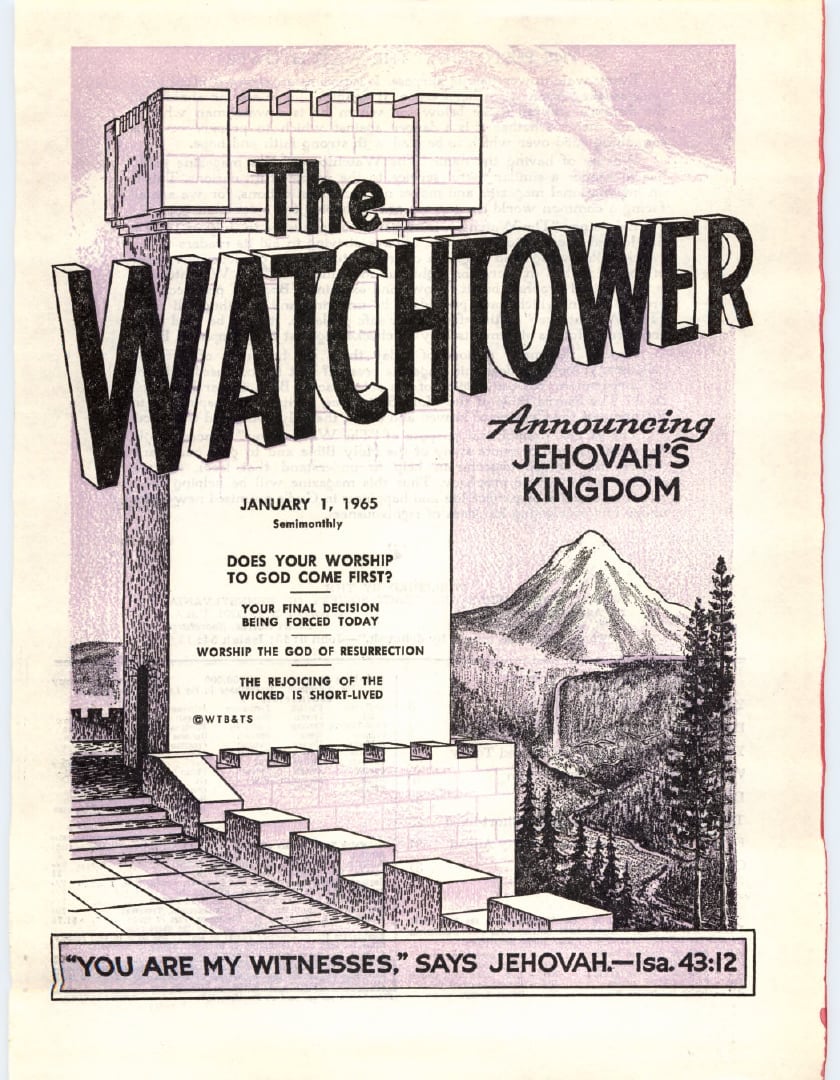
The Watchtower — January 1, 1965
Source: jw.org
Contents
You Need the Bible
Does Your Worship to God Come First?
Your Final Decision Being Forced Today
Worship the God of Resurrection
Do You Remember?
The Rejoicing of the Wicked Is Short-lived
Fortify Yourselves for the Activity Ahead
Questions From Readers
Announcements
You Need the Bible
You Need the Bible
“It does not belong to man who is walking even to direct his step.” Those inspired words of the Holy Bible, found at Jeremiah 10:23, stress the fact that man needs the Bible. He needs it because man was not made to direct his steps without divine guidance. Just as it would be foolish for a purchaser of a complex electronic computer to try to operate it without instructions from its maker, so it would be foolishly walking in darkness for man to try to deal with life’s activities without counsel from man’s Maker.
You need the Bible, then, because you are confronted with problems that require reliable guidance. You are certain to be faced with moral issues that call for right decisions. Wrong decisions spell tragedy and heartache. The Bible can direct you in the right way by educating your conscience and moral sense.
So many decisions need to be made, too, regarding personal activities. The Bible contains principles to guide you in the selection of recreation, in determining whether you should join this club or that organization, and in deciding what kind of people to associate with and what kind to avoid. What are you to think about the new fads, philosophies and theories of the day? The Bible provides sound guidance for you in these matters, setting forth righteous principles, making clear in this vast sphere of personal activities what is right and what is wrong.
You need the Bible also in directing family affairs, concerning which there is so much nonsense masquerading in the garb of wisdom. From it the husband can learn his Scriptural role, the wife hers, for a successful marriage. What about the conflicting theories for rearing children in a delinquent world? You need the Bible, for its counsel about family affairs is clear-cut—and it is right.
Guidance in the realm of business affairs is also vital. Whether employer, employee or in business for yourself, you need reliable principles to guide you if you are to avoid sorrow and attain success.
With the Bible, you have a Light, and by using it, you do not walk in darkness. The psalmist wrote: “Your word is a lamp to my foot, and a light to my roadway.” (Ps. 119:105) You need this Lamp. Without it, you will be traveling in darkness and may plunge into the abyss of tragedy.
So why walk in darkness? Use God’s Light to illuminate your steps on the roadway of life. Then you will have God’s enriching blessing and avoid the pain and sorrow that befall those walking in darkness.—Prov. 10:22.
Does Your Worship to God Come First?
Does Your Worship to God Come First?
1. With what are people of all nations faced, leading to what kind of thinking?
THE peoples of all nations are flooded with nationalistic propaganda through their own newspapers, magazines, radio and television. Hemmed in by boundaries and censorship, the peoples’ thinking is confined to their own nation, to worshiping it, to idolizing it. This controlled thinking affects almost everyone’s mind.
2. What are some of the dangers of nationalism, as borne out by The Encyclopedia Americana?
2 The Encyclopedia Americana says: “Nationalism is a state of mind which can be, and often is, induced by governmental and private propaganda. It can be the creature of ambitious leaders who wish to form certain patterns of opinion which they expect to use, for their own purposes perhaps, or for ends they consider to be in the public interest.”a Under the heading “Irrationality” it states: “The ability of governmental and civic leaders to spread the ferment of nationalism among the masses is greatly facilitated by its highly irrational character. The extreme patriot is largely impervious to rational argument. Even in free countries, he may never hear the truth, especially if he reads only tendentious newspapers or tunes in his radio to biased, chauvinistic [blind, enthusiastic] commentators. Moreover, it is difficult to see how adults can consider the international problems facing their nation with any degree of objectivity if as young children their minds were formed by history books that were one-sided and biased.”b
3. (a) What timely question are we now asked? (b) Of what value is the Bible on matters of worship?
3 Analyzing these comments by worldly observers, ask yourself the question: Does nationalism take first place in my life and all my time and thinking or does my worship to God come first? Remember, the Bible is a book to be studied too. In it you learn about God and what your worship of him should be, and it sets out the history of man from man’s very creation. It even describes the conditions that exist in the earth today, and tells us about new heavens and a new earth that we are awaiting according to His promise, and in which righteousness is to dwell. (2 Pet. 3:13) If the Bible does that, then why not think, too, on what its author, Jehovah, says about man and what our relation to him should be?
4. Outline the questions now needing an answer.
4 Think carefully now! Does the nation in which you live give you all the things you possess? Did your government give you the sun, stars and moon above? Did your nation create the snowcapped mountains, the wooded slopes, the fertile valleys, the rushing streams? Did it bring forth the green grass, the fresh air, the babbling rooks? When you stand on a hilltop and look over the landscape, are the things you see, the blossoms of fruit trees, the waving grain, things that the government gave you? Is it your national government that created the vegetation and the cattle on a thousand hills? The rulers in government may have had something to do with the management of the productive land, but who created the heavens and the earth? Who made it possible for there to be people? Did not God make man with reproductive powers? Surely the State has no control of these!
5. How does the Bible at Acts 17:24-27 reveal the work of God with regard to our earth?
5 Read what God said in his book the Bible through the apostle Paul to the Athenians: “The God that made the world and all the things in it, being, as this One is, Lord of heaven and earth, does not dwell in handmade temples, neither is he attended to by human hands as if he needed anything, because he himself gives to all persons life and breath and all things. And he made out of one man every nation of men, to dwell upon the entire surface of the earth, and he decreed the appointed seasons and the set limits of the dwelling of men, for them to seek God, if they might grope for him and really find him, although, in fact, he is not far off from each one of us.”—Acts 17:24-27.
6. How did Jesus answer the hypocritical Pharisees who tried to scheme against him?
6 God gave us “life and breath and all things. And he made out of one man every nation of men.” Nationalism did not do that, nor did Caesar. The Jewish Pharisees, proud religionists of Jesus’ day, tried to catch Jesus in his speech by having him say something against Roman nationalism. Jesus Christ had the reputation of speaking the truth freely, but it was always God’s Word he spoke. So the Pharisees said: “‘You teach the way of God in line with truth: Is it lawful to pay head tax to Caesar or not? Shall we pay, or shall we not pay?’ Detecting their hypocrisy, he said to them: ‘Why do you put me to the test? Bring me a denarius to look at.’ They brought one. And he said to them: ‘Whose image and inscription is this?’ They said to him: ‘Caesar’s.’ Jesus then said: ‘Pay back Caesar’s things to Caesar, but God’s things to God.’”—Mark 12:14-17.
7, 8. (a) While Jesus was not against orderly government, what did he also realize? (b) Since Jehovah God is indeed the great First Cause, what question should we again ask ourselves?
7 Jesus was not against orderly government, nor the paying of taxes. But rulers must recognize, too, that there are certain things that belong to God. Not everything is Caesar’s! Remember, it was Jehovah who created man to dwell upon the earth. Jehovah the Almighty God said: “Let us make man in our image, according to our likeness, and let them have in subjection the fish of the sea and the flying creatures of the heavens and the domestic animals and all the earth and every moving animal that is moving upon the earth.” And God went on to say to newly created man and woman: “Here I have given to you all vegetation bearing seed which is on the surface of the whole earth and every tree on which there is the fruit of a tree bearing seed. To you let it serve as food.”—Gen. 1:26, 29.
8 It was Jehovah God who provided all these things for humankind. They were all here in plenty before any nations were formed, before nationalism was heard of. So again we ask, Does your worship to God come first? It should!
9. How did Roman nationalism influence the Jews of Jesus’ day?
9 Nineteen hundred years ago the nationalistic Jews were under Roman rule and definitely rejected their God, Jehovah, as well as his Son, Jesus Christ. This is what happened after the Jews turned Jesus, their prisoner, over to Pilate. Pilate brought Jesus outside before the crowd and said to the Jews: “See! Your king!” “However, they shouted: ‘Take him away! Take him away! Impale him!’ Pilate said to them: ‘Shall I impale your king?’ The chief priests answered: ‘We have no king but Caesar.’”—(John 19:13-15) These Jews showed their extremely nationalistic spirit. They had rejected and forgotten their God and despised his truth-speaking Son.
10. (a) In spite of this how has God’s love been shown? (b) What treatment can followers of Christ expect?
10 This action, however, did not make Jehovah lessen his love for mankind. “For God loved the world [of mankind] so much that he gave his only-begotten Son, in order that everyone exercising faith in him might not be destroyed but have everlasting life.” (John 3:16) No ruler of any nation, not even Caesar, has been able to give anyone everlasting life. The message of Jesus during his three and a half years of ministry was one of life for all mankind through God’s kingdom, but the nationalistic ones among the Jews were not listening. They wanted nothing to do with God’s kingdom. Those individuals who listened and believed took up Jesus’ message and preached the good news of God’s kingdom under very adverse circumstances. Finally, governments opposed them. Jesus had warned them well in advance as to what would happen if they became followers of him. He had told them: “People will lay their hands upon you and persecute you, delivering you up to the synagogues and prisons, you being haled before kings and governors for the sake of my name. It will turn out to you for a witness.”—Luke 21:12, 13.
11. What are the words of one Jew who put worship of God ahead of nationalism?
11 Neither the Jews nor the Romans appreciated the message of good news that was being delivered by Christians. However, the apostle Paul, though a Jew by birth, put Christianity and his worship to God ahead of nationalism. He put his life in Jehovah God’s hands. So he could say: “Therefore I take pleasure in weaknesses, in insults, in cases of need, in persecutions and difficulties, for Christ. For when I am weak, then I am powerful.” (2 Cor. 12:10) Paul had a work to do and he did it! He knew that his eternal life was not dependent upon his service to any nation or its ruler. His everlasting life would come from Jehovah God through His arrangements. Paul believed Jesus when this one said: “I am the way and the truth and the life.”—John 14:6.
UNAFRAID OF DEATH
12. How are the Scriptures a comfort to those who may face death for not bowing to the State?
12 Over the centuries many Christians have been killed for not bowing to the State. Paul was, it is believed, beheaded in Rome. Christians have not been afraid to die, because they know God is the Giver of life and they are well acquainted with Jesus’ words: “Do not become fearful of those who kill the body but cannot kill the soul; but rather be in fear of him that can destroy both soul and body in Gehenna.”—Matt. 10:28.
13. (a) Why is good government needed? (b) How do Peter and the apostles show that this does not mean it must be worshiped?
13 Government is a necessary and good thing when it serves the people, but when it is oppressive, the people suffer. Good government is needed, especially today when there are over 3,200,000,000 people in the world. But must the government be worshiped by the people? Must it be superior to all other loyalties of the people? If man’s laws conflict with God’s laws, then what? The apostles had to answer that question to the Sanhedrin. “Peter and the other apostles said: ‘We must obey God as ruler rather than men.’” Because of their devotion to Jehovah God the rulers “flogged them, and ordered them to stop speaking.” After that what did these do? “Every day in the temple and from house to house they continued without letup teaching and declaring the good news about the Christ, Jesus.” (Acts 5:29, 40-42) So even though government is necessary, it cannot stop, and has no right to stop, persons from telling the truth, which is good news for all peoples.
14-16. (a) Show how nationalistic feelings begin. (b) What has been the end result over the centuries?
14 But how does nationalism begin? Certain groups of people, usually of the same family head, live closely together and have a deep sense of belonging to one another. They form the same habits and have the same way of life. Their loyalty is to the group and they want everyone in the group to contribute to the welfare of one another. There is certainly nothing wrong in people loving one another and wanting to enjoy one another’s association and being interested in the well-being of one another. This is a God-given commandment, loving your neighbor as yourself.
15 However, as these groups get larger, often certain individuals talk up national patriotism. Now their national group is told it is superior to all other groups, and the leader tries to show their group’s superiority over other groups by aggression and conquest. Ignoring the thinking ability of some who want to live as the Bible directs, the dictator of a group will try to force all the people to rally around him, to do obeisance to a man-made ensign, flag, image or a symbol of the group’s way of life. When that happens their nationalistic spirit is being pushed too far. God-fearing men know that Jehovah “made out of one man every nation of men” and so will not go along in the worship of the State through its emblems. Then the minority suffers for not going along with the majority. Jesus and the apostles were in the minority but were right.
16 Some of the other factors that bring about nationalism are language, race, religion, territory and political way of life, besides economic factors. When we examine true world history we can see that many national groups have been formed from very small groups. In fact, all the human family since the great deluge have come from Noah and his three sons, Shem, Ham and Japheth. The Bible plainly says that “these three were Noah’s sons, and from these was all the earth’s population spread abroad.” (Gen. 9:19) First there were family groups, then tribes, later the living together in cities. Thus came Nimrod’s kingdom. (Gen. 10:9, 10) Over the centuries great nations have expanded across territories in conquest of other nations. We have thus had world empires, Egypt, Assyria, Babylon, Medo-Persia, Greece and Rome. Since then, in recent years, we have seen many nations push forward into prominence. You remember Mussolini of Italy, who wanted to be a conqueror of parts of Africa. He allied himself with Hitler of Germany, who tried to take over all of Europe, Asia and Africa. He really wanted to be the ruler of the world. What a butcher he turned out to be! Following the failure of his schemes to conquer the nations, there have been many national groups seeking independence, and they have shown intense patriotism and loyalty to certain leaders.
17. Show how nationalism has developed since World War II.
17 “Strife” has been the newspaper’s headline, especially since 1914, to this very day. Aggressive nationalists are demanding certain rights and territory for certain groups of people. So new governments are formed. In the past four years in Africa alone some twenty-four new countries have been set up. And since World War II this continent has produced some thirty-six new states.c The Encyclopedia Americana makes this statement: “Since World War II, nationalism has continued to play a major role throughout the world. The Hitlerian techniques were developed still further by Joseph Stalin, who proved himself an apt pupil of fascist nationalism.”d However, in discussing nationalism the Americana says: “In early times, man’s supreme loyalty was centered on his religion. Today this place has been taken by the nation.”e
18, 19. (a) Define nationalism. (b) When nationalism is carried too far, what are the results?
18 Time magazine of December 7, 1962, page 20, said: “The feudal lords of the Middle Ages gave their allegiance to king, not country, and French barons fighting on the side of invading English kings were considered faithful vassals, not collaborators. Writes historian Carlton Hayes: ‘Nationality has always existed. Patriotism has long existed, either as applied to a locality or as extended to an empire. But the fusion of patriotism with nationality and the predominance of national patriotism over all other human loyalties—which is nationalism—is modern, very modern.’
19 “Nationalists came to learn that their creed contained bad seeds as well as good. The nation demanded supreme loyalty from its citizens, insisted on its superiority over other nationalities, fostered pride in the national character and destiny. Carried too far, these convictions played a part in World War I and, in a perversion of nationalism, loosed the Nazi terror on the world, piling the earth with corpses.”
20. How does nationalism become a supreme loyalty?
20 In his book Nationalism: A Religion, Roman Catholic author Carlton Hayes also makes this statement, on page ten: “There are degrees of nationalism as of any emotion. Our loyalty to nationality and national state may be conditioned by other loyalties—to family, to church, to humanity, to internationalism—and hence restricted in corresponding degree. On the other hand, nationalism may be a paramount, a supreme loyalty, commanding all others. This usually occurs when national emotion is fused with religious emotion, and nationalism itself becomes a religion or a substitute for religion.”
CHRISTIANITY AND NATIONALISM
21, 22. (a) Are nationalism and Christianity compatible? (b) What has Christendom done to force a mixing of the two, and with what result?
21 Nevertheless, let this be known: Christianity and nationalism do not mix. Christ Jesus never mixed them. But what about the Catholic and Protestant religions of Christendom? They go all out for nationalism and support each country in which they have adherents. The clergy of all these religions even campaign for political leaders and some run for political office themselves. In time of war the clergy take the lead in encouraging the young men of their nation to engage in murder against their own denominational members in another country, even though the Bible, which they claim as a basis for their religious belief, says you should not kill.
22 What have the clergy of these religious organizations become? What have they made of their parishioners? James, a footstep follower of Jesus Christ, said this: “Adulteresses, do you not know that the friendship with the world is enmity with God? Whoever, therefore, wants to be a friend of the world is constituting himself an enemy of God.” (Jas. 4:4) You must know where their loyalties are. Can they not understand that either one is faithful to one master, while hating the other, or vice versa? Jesus forcefully said: “No one can slave for two masters; for either he will hate the one and love the other, or he will stick to the one and despise the other. You cannot slave for God and for Riches.” (Matt. 6:24) Are you a Christian? If so, what comes first in your life? You have a right to choose for yourself. But do you have a right to condemn and punish another Christian who chooses his Creator as his Master rather than the State?
23. Like Jesus and his disciples, what is the Christian’s attitude when it comes to doing Jehovah’s will?
23 A Christian dedicated to the doing of Jehovah’s will is going to do what Jehovah teaches him to do. Jehovah has revealed himself and his will through his written Word, the Holy Bible. The more one becomes acquainted with the written Word the better one understands what to do. Jesus took his stand—so did the apostles and the early Christians—not against Rome, but for Jehovah, their chosen Master. He was their God. Other persons, the majority, chose Caesar. That was their privilege, but why persecute the minority, the believers and worshipers of God?
24. Define the term ‘love of neighbor’ when it involves loyalty to God.
24 There comes a time in everyone’s life when he has to decide where to keep his loyalties. To be loyal to Jehovah does not mean one is unfriendly to his neighbor, not even to the nation in which he was born. Jesus taught that we should love both our Father in heaven and our neighbor. (Luke 10:27) But that does not mean that we have to do what our neighbor does. Jesus advised in his Sermon on the Mountain: “You heard that it was said, ‘You must love your neighbor and hate your enemy.’ However, I say to you: Continue to love your enemies and to pray for those persecuting you; that you may prove yourselves sons of your Father who is in the heavens, since he makes his sun rise upon wicked people and good and makes it rain upon righteous people and unrighteous.” (Matt. 5:43-45) So you can love your neighbor, even your enemy, but that does not mean you have to do the wicked things he does.
HISTORIC EXAMPLE
25, 26. To what time in history will we now go for a fitting example of loyalty to God or the State, and who are the individuals involved?
25 For a moment let us move farther back into history to 617 B.C.E. In that year Nebuchadnezzar, the king of Babylon, took many Israelites captive to Babylon. Nebuchadnezzar chose certain ones of the children of Israel, of the royal seed, to get special training in his court. The best ones were selected, the ones with good appearance, those having insight into all wisdom, and being acquainted with knowledge and good discernment. These were to stand in the palace of the king. Instructions were given to teach these young folks the writing and the tongue of the Chaldeans. In order that they might receive good food, “the king appointed a daily allowance from the delicacies of the king and from his drinking wine, even to nourish them for three years, that at the end of these they might stand before the king.”—Dan. 1:1-5.
26 Among the specially selected children there were four boys, probably ranging in age from fourteen to eighteen years. They were of the tribe of Judah. Their names were Daniel, Hananiah, Mishael and Azariah. Each of their names had an interesting meaning: Daniel meaning “God Is Judge”; Hananiah, “Jah Has Favored”; Mishael, “Who Is What God Is?” Azariah, “Jah Is Keeper.” Changing their names very evidently had something to do with the desire of Nebuchadnezzar to draw them away from their God and to get them to think the Chaldean way rather than the Hebrew way. Daniel’s name was changed to Belteshazzar, which means “Prince of Bel,” or “The Lord’s Leader.” Hananiah’s name was changed to Shadrach, the meaning of which is obscure, but some say it means “The Servant of Aku” (the moon god). Mishael was called Meshach. The meaning of Meshach is not known, but some tradition has it that it is possibly the name of a Babylonian deity. Azariah’s name was changed to Abednego, meaning “Servant of Nego [or Mercury].” Thus they were to be servants of gods other than Jehovah. Did the changing of their names change them?
27, 28. (a) Did the giving of pagan names to these individuals change their attitude about worship of God? (b) How did they show that, even in the matter of eating, they would not violate the law of their God, and what was the result?
27 These young men were not flattered at the change of their names or by the special attention they were getting from the king. They were devoted to the Almighty God Jehovah. Even though they were in captivity in Babylon, they wanted to live by God’s law as written in his Word. “Daniel determined in his heart that he would not pollute himself with the delicacies of the king and with his drinking wine.” (Dan. 1:8) He, along with his three companions, kept requesting just vegetables to eat and water to drink. Daniel had quite an argument with the court official providing the food, but he finally convinced him to bring that kind of simple food for ten days. Daniel and these young lads with him were likely recalling to mind the words of Deuteronomy 6:4-7: “Listen, O Israel: Jehovah our God is one Jehovah. And you must love Jehovah your God with all your heart and all your soul and all your vital force. And these words that I am commanding you today must prove to be on your heart; and you must inculcate them in your son and speak of them when you sit in your house and when you walk on the road and when you lie down and when you get up.”
28 They knew the Ten Commandments and Jehovah’s ordinances concerning eating. They had inculcated in their minds Moses’ words: “And now, O Israel, listen to the regulations and the judicial decisions that I am teaching you to do, in order that you may live.” (Deut. 4:1) They had an abhorrence of unclean and forbidden food. Refusing to eat meat and drink wine very likely offered to idols, they ate vegetables and “at the end of ten days their countenances appeared better and fatter in flesh than all the children who were eating the delicacies of the king.” (Dan. 1:15) This, of course, pleased the court official who was looking after Daniel, Hananiah, Mishael and Azariah. It pleased Jehovah, too, because, “as for these children, the four of them, to them the true God gave knowledge and insight in all writing and wisdom; and Daniel himself had understanding in all sorts of visions and dreams.”—Dan. 1:17.
29, 30. Did position in government and gifts change them and their loyalty to Jehovah God?
29 During their three-year training course they learned the Chaldean language and the other things taught, but they never forgot their God and the things they had learned in Judea concerning Jehovah’s laws. Even when being brought in to stand before the king, they were not overawed. Daniel, by God’s help, interpreted dreams, received many gifts from the king and was made ruler over the jurisdictional district of Babylon and was made the chief prefect over the wise men of Babylon; but even this did not turn his head. His loyalty to Jehovah still held first place.
30 Daniel, being now in such a high position, “made a request of the king, and he appointed over the administration of the jurisdictional district of Babylon Shadrach, Meshach and Abednego, but Daniel was in the court of the king.” (Dan. 2:49) These four Jewish men stayed close to one another and together in their worship. Still they took care of their assigned duties, for they were slaves in Babylon. However, these four lads with great knowledge and responsibility were not going to become nationalists and be worshipers of the State and forget their love for God. They refused to render more to the State than was the State’s and nothing to God. Certainly they were not going to render anything to the State that was God’s.
31. What test would these four Hebrews one day have to face, giving rise to what questions?
31 All servants of Jehovah God will face tests sometime or another. Jesus said to the Christian witnesses of Jehovah that they too would face opposition and persecution for Christ’s sake. So it was with these four Hebrew children; someday they had to face the issue as to their loyalty and devotion. Would their loyalty prove to be to their God or to the State? Would they worship the nation and renounce their God? Would they bow to the State if it became a life-or-death matter? The Bible account in Daniel, chapter three, gives us the answer.
FACING THE ISSUE
32. Outline how an issue was shaping up in Babylon.
32 King Nebuchadnezzar had a great image of gold made. Its height was sixty cubits (ninety feet) and its breadth was six cubits (nine feet). It was built on the plains of Dura in the jurisdictional district of Babylon, a place approximately six miles south of Babylon. “Nebuchadnezzar himself as king sent to assemble the satraps, the prefects and the governors, the counselors, the treasurers, the judges, the police magistrates and all the administrators of the jurisdictional districts to come to the inauguration of the image that Nebuchadnezzar the king had set up.” (Dan. 3:1, 2) This command of course would include Shadrach, Meshach and Abednego, who were appointed as administrators over the jurisdictional district of Babylon.
33. (a) What was the Devil’s aim now with regard to the three Hebrew children, and how did the king word his command to worship? (b) What interesting observation appears in the footnote, from the booklet Our Flag?
33 This was a deliberate attempt on the part of Satan the Devil, Babylon’s real god, to get these three Hebrews to bow down to the State, the State’s image, be it a monument, standard or flag.f The golden image was representative of the empire of Babylon. All the appointed rulers of the countries that Nebuchadnezzar had conquered were to be there at the same time and bow down to this image. The nationalism of Babylon was being forced upon the Judeans, Assyrians, Egyptians and all whom Nebuchadnezzar had conquered. They came together. “And the herald was crying out loudly: ‘To you it is being said, O peoples, national groups and languages, that at the time that you hear the sound of the horn, the pipe, the zither, the triangular harp, the stringed instrument, the bagpipe and all sorts of musical instruments you fall down and worship the image of gold that Nebuchadnezzar the king has set up. And whoever does not fall down and worship will at the same moment be thrown into the burning fiery furnace.”’ (Dan. 3:4-6) The command was, Bow to the image, worship the State! Nationalism! All the peoples, the rulers large and small, must now worship what Jesus called Caesar, or his image, Nationalism!
34, 35. How did the three Hebrews face up to the issue now raised, and what command of their God did they have in mind?
34 But look! There are three men standing! They are not bowing down! Can you imagine it! These three men had gone along with all the others to the plain of Dura at the command of the king, but they were not bowing down. Why? They went as far as they could. They assembled with the others, but now the test came. They made the right decision. The three Judeans, Shadrach, Meshach and Abednego, called to mind the words of Jehovah spoken to Moses:
35 “I am Jehovah your God, who have brought you out of the land of Egypt, out of the house of slaves. You must not have any other gods against my face. You must not make for yourself a carved image or a form like anything that is in the heavens above or that is on the earth underneath or that is in the waters under the earth. You must not bow down to them nor be induced to serve them, because I Jehovah your God am a God exacting exclusive devotion, bringing punishment for the error of fathers upon sons, upon the third generation and upon the fourth generation, in the case of those who hate me; but exercising loving-kindness toward the thousandth generation in the case of those who love me and keep my commandments. You must not take up the name of Jehovah your God in a worthless way, for Jehovah will not leave the one unpunished who takes up his name in a worthless way.”—Ex. 20:1-7.
36. In whom was their confidence?
36 That was understandable to these three Hebrews. They gave their God exclusive devotion. They would not bow down and worship a man-made image or standard. They loved their life and believed that their God would save them. But if they were not kept alive, then there was no reason to fear death, because they believed in a resurrection of the dead. When Nebuchadnezzar heard what happened, he went into a rage and fury and ordered an investigation.
37. What next occurred when these men were brought before the king?
37 These three Hebrews were brought before Nebuchadnezzar, and he said to them: “Is it really so, O Shadrach, Meshach and Abednego, that you are not serving my own gods, and the image of gold that I have set up you are not worshiping?” (Dan. 3:14) It was disturbing to the king to have these fine servants of his step out of line and not do this little thing, ‘just bow down, that is all.’ So Nebuchadnezzar said he would give them another opportunity. His words were: “Now if you are ready so that when you hear the sound of the horn, the pipe, the zither, the triangular harp, the stringed instrument, and the bagpipe and all sorts of musical instruments, you fall down and worship the image that I have made, all right. But if you do not worship, at that same moment you will be thrown into the burning fiery furnace. And who is that god that can rescue you out of my hands?”—Dan. 3:15.
38. Was there any hesitation by the three Hebrews when offered another opportunity to bow down, and what were their words in reply to the king?
38 It did not take these three Hebrews even a moment to decide. Their minds had been made up. From the time they were young men, from the time that they were being fed in the king’s private school for nobles, they knew whom they would serve. If they would not break Jehovah’s laws on eating food, would they now break his law on image worship? So without hesitation “Shadrach, Meshach and Abednego answered, and they were saying to the king: ‘O Nebuchadnezzar, we are under no necessity in this regard to say back a word to you. If it is to be, our God whom we are serving is able to rescue us. Out of the burning fiery furnace and out of your hand, O king, he will rescue us. But if not, let it become known to you, O king, that your gods are not the ones we are serving, and the image of gold that you have set up we will not worship.’”—Dan. 3:16-18.
39. Who else gave a similar reply in defense of pure worship of God?
39 Faith! Loyalty! Where have we since heard such a powerful decision? Remember when Satan tried to get Jesus to “do an act of worship” to him? Jesus was not slow in his answer either. “Then Jesus said to him: ‘Go away, Satan! For it is written, “It is Jehovah your God you must worship, and it is to him alone you must render sacred service.”’”—Matt. 4:8-10.
DELIVERANCE TO THE FAITHFUL
40-42. Describe now the tense drama that unfolds before Nebuchadnezzar and the final outcome of the fiery furnace episode.
40 Nebuchadnezzar knew full well whom these three Hebrews worshiped. But would they break under pressure when bound and ready to be thrown into the furnace? Would they then bow to the State and become nationalistic? Would they try to serve two masters? Would they render to the State things that did not belong to the State?
41 These three men ‘did not become fearful of those who kill the body but cannot kill the soul.’ Rather, they were like true Christians today who really appreciate the fine example of the three Hebrews who were “in fear of him that can destroy both soul and body in Gehenna.” (Matt. 10:28) They watched Nebuchadnezzar filled with fury and with his very expression changed toward them. The king commanded, ‘Throw them into the fiery furnace, now made seven times as hot.’ They were thrown into the furnace heated so hot that when the men who were commanded to throw the three Hebrews into the furnace did so they themselves were killed by the intense flames.
42 Then Nebuchadnezzar saw a frightening thing. He rose up in a hurry and said: “Was it not three able-bodied men that we threw bound into the midst of the fire?” Those with him said: “Yes, O king.” But Nebuchadnezzar in his excitement said: “Look! I am beholding four able-bodied men walking about free in the midst of the fire, and there is no hurt to them, and the appearance of the fourth one is resembling a son of the gods.” Then Nebuchadnezzar called out to the three men in the fire and told them to step out and come to him. Shadrach, Meshach and Abednego stepped out from the midst of the fire. It was truly amazing. The fire had had no power over their bodies, not even a hair on their heads had been singed. Even their mantles had not been affected and the smell of fire itself had not come upon them! These men had gone through some experience and proved their faithfulness.—Dan. 3:24-27.
43. What, then, were Nebuchadnezzar’s next words, vindicating Jehovah’s power of deliverance?
43 The experience shook Nebuchadnezzar, for he said: “Blessed be the God of Shadrach, Meshach and Abednego, who sent his angel and rescued his servants that trusted in him and that changed the very word of the king and gave over their bodies, because they would not serve and would not worship any god at all except their own God. And from me an order is being put through, that any people, national group or language that says anything wrong against the God of Shadrach, Meshach and Abednego should be dismembered, and its house should be turned into a public privy; forasmuch as there does not exist another god that is able to deliver like this one.” (Dan. 3:28, 29) Do you today likewise believe that there “does not exist another god that is able to deliver like this one”?
[Footnotes]
The Encyclopedia Americana, Volume 19, page 755, 1956 edition.
Ibid., page 756.
Foreign Letter, December 24, 1963 (Awake!, May 22, 1964, page 29).
The Encyclopedia Americana, Volume 19, page 755.
Ibid., page 756.
In the booklet Our Flag, published by the Office of Armed Forces information & Education, Department of Defense, on page one it says this: “The story of the origin of our National flag parallels the story of the origin of our country. As our country received its birthright from the peoples of many lands who were gathered on these shores to found a new nation, so did the pattern of the Stars and Stripes rise from several origins back in the mists of antiquity to become emblazoned on the standards of our infant Republic.
“The star is a symbol of the heavens and the divine goal to which man has aspired from time immemorial; the stripe is symbolic of the rays of light emanating from the sun. Both themes have long been represented on the standards of nations from the banners of the astral worshippers of ancient Egypt and Babylon to the 12-starred flag of the Spanish Conquistadors under Cortez. Continuing in favor, they spread to the striped standards of Holland and the West India Company in the 17th century and to the present patterns of stars and stripes on the flags of several nations of Europe, Asia, and the Americas.”
On page 23 it states: “The Secretary of Defense, Washington, 28 December 1959, OUR FLAG (DOD Pam 5-6a)—This official Department of Defense Publication is for the use of personnel in the military Services. [Signed] Thomas S. Gates. Published by the Office of Armed Forces Information and Education, Department of Defense, Washington 25, D.C.”
[Picture on page 5]
“Your gods are not the ones we are serving, and the image of gold that you have set up we will not worship.”—Dan. 3:18.
Your Final Decision Being Forced Today
Your Final Decision Being Forced Today
1. What observations are made on nationalism by Arnold Toynbee?
NATIONALISM today shows its authority too and can be very cruel to Christian worshipers of the true God Jehovah. The historian Arnold J. Toynbee, on page sixty-nine of his book Christianity Among the Religions of the World, said: “The collective power of Athens was worshipped by the Athenians in the form of the goddess Athena. . . . In the renaissance of Hellenism in the modern Western World in the fifteenth and sixteenth centuries, this Greek idolatrous attitude towards one’s own country, one’s own fatherland, was imported from the Ancient Greek past back into our modern Western life. Only, unlike the Greeks, we have flinched from openly admitting that we are practicing this form of idolatry; and consequently we are even more at the mercy of this idolatrous type of Nationalism than the Greeks were at the mercy of their more frankly avowed idolatrous worship of their local states.”
2, 3. (a) How were Jehovah’s witnesses in Germany treated for refusing to hell Hitler, and how is this borne out in the book entitled “My Story”? (b) How, as in the case of the three Hebrews, were these Christians offered a second chance to “bow down,” and with what results?
2 Some persons may say, ‘Well, that is not so bad.’ But are not these persons rather shortsighted? Just go back thirty years to the days of Hitler’s Germany. Remember how he demanded that everyone worship the State? Anyone who would not heil Hitler with his arm raised to the swastika was sent off to a concentration camp, there to die. He had his own fiery furnaces, his gas chambers, his starvation program. In the book entitled “My Story,” written by Gemma La Guardia Gluck, she says this, in chapter eight: “Now I shall describe briefly the Bible Students [Jehovah’s witnesses] in the camp. They belonged to a religious sect that believes in the words of the Bible as literal truth. I did not know of the existence of this sect before I came to Ravensbruck. . . . Most of the Bible Students in Ravensbruck were simple, honest wives and mothers, a very hardworking lot. In this camp they were generally employed as servants, doing the heaviest labor. They told me they had been among the first prisoners at Ravensbruck and have been used for all kinds of construction jobs when the Nazis began to build the camp. I admired these women for their strength of character. They had a stanch will and faith. They had been in prison for eight, ten, or twelve years, right from the beginning of Hitler’s regime in 1933, when members of their sect refused to answer or acknowledge the official Nazi greeting, ‘Heil Hitler.’ Bible Students insisted on the right to remain neutral in political matters and not to be forced to salute a power that had been created by man, not God. ‘Render unto Caesar the things that are Caesar’s and to God the things that are His’ was their credo. The authoritarian Nazi regime could not stand for such disobedience, and thousands of Bible Students were arrested and sent to the camps. At one point the Gestapo had announced that any Bible Student who renounced his beliefs and signed a statement to that effect would be given his freedom and be persecuted no longer. It is difficult to believe, but it is true, that not one of them signed such a statement. They preferred to go on suffering and patiently waiting for the day of liberation.”
3 Gemma La Guardia Gluck, the elder sister of the late Fiorello La Guardia, former mayor of New York City, wrote her story in 1961, telling what she and others lived through in the concentration camps of Hitler. She thus adds to the testimony that the Christian witnesses of Jehovah in Germany, some of whom are still living today, were offered a second chance to change their minds and bow down, just as the three Hebrew friends of Daniel were. All they had to do was sign a statement and heil Hitler and they would be free from further persecution. Like the three Hebrew men, they refused “to bow.” They obeyed God as ruler rather than men. They were not fearful of those who could kill the body but cannot kill the soul.
FEARLESSNESS TOWARD MEN
4, 5. What experience in present-day East Germany shows the fearlessness of God’s people in the face of a strong nationalistic spirit?
4 True, the days of Hitler are gone. But how about the nationalistic spirit engendered worldwide? East Germany, now under communistic influence, has its strong nationalistic spirit opposed to the right worship of Jehovah God. Recently a young schoolgirl, a witness of Jehovah, had done very well in her examinations at school in East Germany. She was assigned to write on the subject “Why Is the Worker’s Class the Only One Entitled to Lead the Nation?”
5 Believing that God’s kingdom, for which she prayed, was the one to rule all nations, she could not think of any reasons to support a nationalistic answer. So she wrote an article showing that God’s kingdom is the only hope for mankind and that Christ Jesus is its righteous Ruler, and that the laboring class through its dictators was not meant to take Jehovah God’s place in government. After her paper was read, she was immediately called before three persons who strongly disagreed with her article and ridiculed her faith in God and told her that she would have to expect a very low grade unless she did the paper over. She explained that this was what she believed and she was not going to compromise. They asked the question. She gave her honest answer from God’s Word. Before school ended, the board finally mentioned that she distinguished herself in honesty.
6. How does Revelation 14:7 help a servant of God in his worship of Jehovah?
6 It takes courage for a young Christian to stand for Bible principle. The three Hebrews also took that stand. They trained their minds from childhood by studying the truth. Setting the right example in true worship must be done before all mankind, since every nation and tribe and tongue must “fear God and give him glory, because the hour of the judgment by him has arrived, and so worship the One who made the heaven and the earth and sea and fountains of waters.” (Rev. 14:7) This is the day for decision. What will you do?
7. What modern-day example of faith is now brought to our attention?
7 Behind the Iron Curtain the disseminating of Bible truths in printed form or by word of mouth by Jehovah’s witnesses is forbidden. Over the years thousands of Jehovah’s witnesses have been imprisoned for talking about the Bible. Recently three of Jehovah’s witnesses who had received life terms in prison for preaching the good news of God’s kingdom were released by the Communists from prison after fifteen years of confinement. One of the three is seventy-four years old. He had been imprisoned for nine years under the Hitler regime and for fifteen years under Communist rule. Think of it! This man spent twenty-four years of his life, nearly a third of his lifetime, in prison because he dared to preach the Bible. He refused to heil Hitler and his Nazism or nationalism. He refused to deny his God for the Communists. Truly there are still those who say, “Your gods are not the ones we are serving”!—Dan. 3:18.
8. How did Catholic Spain treat two young servants of Jehovah God, and for what reason?
8 “On June 10, 1964, there were two young girls, Jehovah’s witnesses, who had traveled from their village to the capital city of Madrid, Spain, to do some shopping. As opportunity afforded they talked about the good news of God’s kingdom to persons that they would meet. Did not Jesus say: “Go therefore and make disciples of people of all the nations”? (Matt. 28:19) After having talked to quite a few people and having bought the things they needed, they started home on the bus. Police agents got on the bus and ordered them off and told them to go with them to the police headquarters. These two young girls were interrogated from eight o’clock in the evening of June 10 until eleven o’clock on the morning of June 11; fifteen hours. Is this Catholic state afraid some persons in Spain will find out what the Catholic Bible used by these girls says about God’s kingdom? The father of the girls is an overseer in a congregation of Jehovah’s witnesses in a small town outside of Madrid. So they were taught the truth and were not afraid to tell it out. What satisfaction the father must have had to see his girls fearlessly standing on God’s side even though arrested and fined; and for what reason? “Because of belonging to the sect of Jehovah’s witnesses and making trips to the capital to carry on proselyting activities for the Jehovah’s witnesses sect.”
9. Have the dictatorial, nationalistic methods of Spain stopped God’s people from worshiping him, and how is that shown?
9 The dictatorial, nationalistic country of Spain says, ‘You may not worship your God, you may not express your views about God’s Word in this country!’ But arrests and fines and a jail record will not stop genuine Christians. Their worship of Jehovah comes first. In 1950, in Spain, there were only 93 persons talking to those that had ears to hear, and today, in 1965, there are 3,502 witnesses of Jehovah still preaching, including these two young girls. Persecution has not dampened the zeal of Jehovah’s servants in Spain, has it? And persecution has not dampened it in other countries either. What are you doing to bring the message of salvation to those of mankind in your community?
10. What other example of opposition by the Spanish government is cited?
10 These experiences are not isolated cases. Much information has been published in the Watchtower and Awake! magazines about the persecution of Jehovah’s witnesses in Spain and Portugal, both strongly Catholic dictatorial countries. But to give you another incident, on April 2, 1964, police agents forced their way into a home in Spain. There they took Bibles and Bible literature and the keys of the house and arrested a twenty-seven-year-old minister of Jehovah’s witnesses. He had been arrested previously, in June 1963, and on that occasion spent thirty days in jail for “proselytism,” preaching from the Bible. While the police were making their search another young minister called at the house. He was seventeen years old, and he also was arrested. Both were thrown into prison, held twenty days and then released. Such harassment has not stopped the preaching of the good news of God’s kingdom in Spain. Young men and women and the older folks who are witnesses of Jehovah in Spain will continue preaching. While the Catholic clergy tell the people to give all to Caesar, Jehovah’s witnesses will continue to give Caesar only what is his, but God’s things to God.
11. How have the servants of Jehovah in Cuba been treated because of loyalty first to Almighty God?
11 In Cuba nationalism is sung from the house-tops through television, radio and the press. Loyalty to the nation comes first, say its rulers. So to be a Christian there takes courage. Two of Jehovah’s witnesses were going from house to house preaching God’s kingdom as taught in the Bible. For doing this they were sentenced to four months in jail. Two circuit servants, traveling ministers, spent a month in jail for preaching God’s kingdom. In another part of Cuba six congregation servants were taken to jail, some for three months, some for four months. So it goes if one freely speaks the truth about God and what he has done and will do. Jehovah’s witnesses were all told to stop what they were doing and get in line with the State’s teaching on communism. But how can a Christian do that when God’s Word says: “This good news of the kingdom will be preached in all the inhabited earth for a witness to all the nations; and then the end will come”? (Matt. 24:14) Whom would you obey?
12, 13. (a) Why have some political parties in Africa persecuted Jehovah’s witnesses, and to what extent has this persecution gone? (b) What spirit do world rulers have?
12 In Africa much violence has been brought to bear against Jehovah’s witnesses because political parties are trying to force them to sign up with their nationalistic groups. If a witness of Jehovah refuses to buy a political card from a certain political group, then his house is stoned or broken up and often the occupants are brutally beaten. It takes real faith to stand for Jehovah God and his kingdom against such political violence. An overseer and several Kingdom publishers in Africa were so badly beaten that they had to go to the hospital. Their crops were burned too. In another place Jehovah’s witnesses had their houses, Kingdom Halls and grain storage places all burned to the ground. They were driven from the community and some who were caught were severely beaten by the political party. The cause for such persecution is that Jehovah’s witnesses refuse to engage in politics and worship the State. On the other hand, the false religious organizations, all of which belong to the world empire of false religion, Babylon the Great, do not hesitate for a minute to ride along with the nationalistic trend and “fall down and worship the image of gold. “
13 Rulers today do not like this information to be publicized, but really the world of mankind is no better off than it was in the days of Nebuchadnezzar, king of ancient Babylon. They have the same spirit and say: ‘If you do not bow down and worship the nationalistic image I have made and do as directed you will be thrown into the burning, fiery furnaces by the mob.’
14. Why must true Christians endure these hardships, and what wise decision should be made now?
14 These hardships true Christians endure. These few examples show what is going on in all parts of the world today, and they should be a warning to us. The Christian witness of Jehovah cannot compromise. In Communist countries they must preach underground. This means that for Jehovah’s witnesses to meet as a congregation of God they have to do it secretly. Most people say, ‘Jehovah’s witnesses are foolish to go to such extremes. They just bring trouble on themselves.’ But it is not that they want to be persecuted. It is a clear matter of whom do you worship—the State, “Caesar,” or God, Jehovah? You will have to make the decision someday if you want everlasting life under God’s kingdom. Better it is to do it now than to put it off. “Before there comes upon you the day of Jehovah’s anger, seek Jehovah, all you meek ones of the earth.” (Zeph. 2:2, 3) May your decision be to serve Him now.
Worship the God of Resurrection
Worship the God of Resurrection
1. What is it necessary to believe, and how did the mother of Samuel show she had such belief?
IT IS necessary to learn what the Christian knows, that men can kill only the body, but they cannot kill the soul. (Matt. 10:28) In Jehovah God’s written Word he has promised a resurrection of the dead, and today the same Holy Scriptures that the Hebrews in Nebuchadnezzar’s day believed we still have and they are still true. The three Hebrew friends of Daniel knew what their ancestors taught them. For example, Hannah the mother of the prophet Samuel said: “There is no one holy like Jehovah, for there is no one but you; and there is no rock like our God. Jehovah is a Killer and a Preserver of life, a Bringer down to Sheol, and He brings up.”—1 Sam. 2:1, 2, 6.
2, 3. What faith in future life was had by faithful men of ancient times?
2 Believers in God’s Word know that God can bring up from Sheol, the common grave of dead mankind. That is something man cannot do. There will be a resurrection of the dead, the three Hebrews believed. So to die as martyrs in the fiery furnace meant to them to die and be kept in secret, asleep, for a time indefinite to them, but after that a resurrection. They knew of Job’s hard experience and likely recalled his words: “O that in Sheol [the grave] you would conceal me, that you would keep me secret until your anger turns back, that you would set a time limit for me and remember me!” (Job 14:13) Job was not afraid to go into the grave or Sheol, because he knew there would be a resurrection from it in God’s promised due time. Jehovah said to Abraham that through him and his seed all nations of the earth would be blessed. How could that be without the resurrection of the peoples of all nations? Abraham, Job and the three Hebrews knew, as do honest students of the Bible today, that the grave is where mankind in general goes and that those there are in an unconscious state. David, in support of this, wrote: “In death there is no mention of you; in Sheol who will laud you?” (Ps. 6:5) The psalmist said: “Hear this, all you peoples. Give ear, . . . Sheol rather than a lofty abode is for each one.” “From the hand of Sheol I shall redeem them; from death I shall recover them.” (Ps. 49:1, 14; Hos. 13:14) A thousand years later the apostle Peter knew that David was still in the grave, resting as in sleep, awaiting the resurrection. Read Acts 2:29, 34, 35 and Hebrews 11:35.
3 David was sure his God Jehovah would redeem him from the grave. Jehovah made provision for this through his Son Christ Jesus, who gave himself a ransom for all. (1 Tim. 2:5, 6) In due time David along with billions of others, including the three Hebrews and Daniel, will stand up and live in the new system of things after the battle of Armageddon. The last words of Daniel’s prophetic book are: “And as for you yourself, go toward the end; and you will rest, but you will stand up for your lot at the end of the days.” (Dan. 12:13) Daniel and the three Hebrews knew that, while one is living, this is good advice: “All that your hand finds to do, do with your very power, for there is no work nor devising nor knowledge nor wisdom in Sheol, the place to which you are going.” (Eccl. 9:10) They knew the condition of the dead, just as Christians today do. They read Isaiah’s prophecy, and it gave them hope when the three Hebrews were cast into the fiery furnace and when their friend Daniel was thrown to the lions. They read Jehovah’s words: “For here I am creating new heavens and a new earth; and the former things will not be called to mind, neither will they come up into the heart.” (Isa. 65:17) This would be the day for which Christians pray in saying, “Your kingdom come,” when the earth will be brought to a Paradise condition and there will be the resurrection of the dead.
4. How did Jesus give definite assurance regarding a resurrection?
4 Now Christians are definitely assured of the resurrection because of Jesus’ own words. He said: “Do not marvel at this, because the hour is coming in which all those in the memorial tombs will hear his voice and come out, those who did good things to a resurrection of life, those who practiced vile things to a resurrection of judgment.” (John 5:28, 29) When these three faithful Hebrews are resurrected in the new system of things, with new heavens and new earth, they will undoubtedly do good things during the reign of Christ Jesus. Then, because of their continued faith and loyalty to Jehovah their God, they will get the fulfillment of God’s promise.—Heb. 11:34, 39, 40.
5, 6. (a) How far-reaching will the resurrection be according to Acts 24:15? (b) How long might a resurrected person be permitted to continue living in sin, and with what final result?
5 Just how far-reaching is this resurrection Jesus spoke of when he said: “All those in the memorial tombs will hear his voice and come out”? It certainly must be far-reaching, because the apostle Paul stated: “I have hope toward God, which hope these men themselves also entertain, that there is going to be a resurrection of both the righteous and the unrighteous.” (Acts 24:15) However, does that mean that even those practicing vile things after their resurrection are going to keep on living in this new system of things? It appears from the Scriptures that those who do not want to change and do good things after being resurrected on earth will be cut off before too many years pass. Certainly they will be given the opportunity to know the truth through others’ teaching them God’s will.
…