The Watchtower, August 1, 1964
Download: PDF — The Watchtower, August 1, 1964
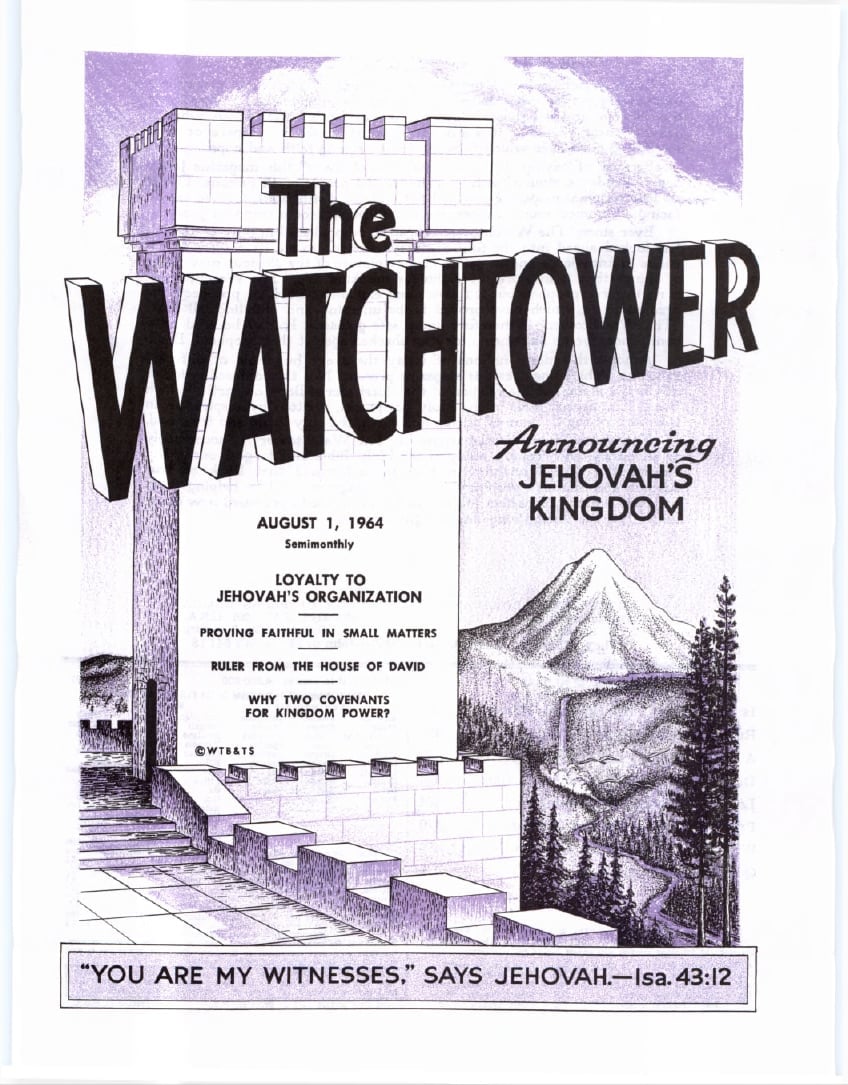
The Watchtower — August 1, 1964
Source: jw.org
Contents
Is Your Child Using His Time Wisely?
Ruler from the House of David
A Nation Holds a Land in Trust for God
Daily Walking and Talking with God
Loyalty to Jehovah’s Organization
Proving Faithful in Small Matters
Why Two Covenants for Kingdom Power?
Questions From Readers
Announcements
Is Your Child Using His Time Wisely?
Is Your Child Using His Time Wisely?
‘WHAT an “ungodly” thing for children to do!’ What? Were they stealing something, or reveling in some kind of vandalism? No! They were going from house to house talking to people about the Bible. But surely no one would say that using time for that is “ungodly”? Well, perhaps you would not say so, but then you would have to disagree with Raymond Wilcox, vicar of the Church of England, Bentley, Walsall, Staffordshire, England.
His objection to “Bible-quoting children” of Jehovah’s witnesses as being “ungodly” because they join with their parents in house-to-house religious activity was published in The Sunday Express, London, April 26, 1964. The vicar of Garrett’s Green, Birmingham, England, Peter Hayward, was quoted in the same article as having similar views.
Speaking of the twelve-year-old who called at his door, Hayward complained: “She recited passages from the Bible like a lesson at school. It was quite obvious that she did not understand what she was saying.” Had he questioned the youngster instead of becoming irritated, he might have been surprised at her answers. In the Theocratic Ministry School operated in all congregations of Jehovah’s witnesses, youths are taught to do research on a wide variety of subjects. From the platform boys give sermons that they have prepared themselves. Girls do similar research and give sermons to another person while the rest of the congregation watch and listen. So, when this young lady spoke to the vicar, why did he not commend her for being able to recite passages from the Scriptures? Does the Church of England not approve of children doing this?
The memorizing and reciting of Scripture in public by children is not new. Matthew chapter 21 tells us that after Jesus cast the money changers out of the temple “the boys . . . were crying out in the temple,” quoting from Psalm 118 and saying, “Save, we pray, the Son of David!” The only ones who objected to this were the chief priests and scribes, whom Jesus condemned. Rebuking these religious leaders and showing the propriety of children using their time and mouths to praise God, Jesus explained: “Did you never read this, ‘Out of the mouth of babes and sucklings you have furnished praise’?” But apparently these spokesmen of the Church of England do not view this matter in the way Jesus Christ did.—Matt. 21:15, 16.
Taking the view that religious house-to-house activity is not a wise use of time, and appearing to be concerned about the safety of the children doing so, Wilcox is quoted as saying: “Not only is it an ungodly thing to do but the children are in danger.” Had he checked into this by looking along the street, he no doubt would have seen adult Witnesses just a few doors away. In fact, The Sunday Express interviewed a minister of Jehovah’s witnesses about this and was informed: “The children have strict instructions not to enter a house without a grown-up member of the organisation and there is always an adult a few doors away they can call on if there is any trouble.” When we consider the ungodly use of time by many youths and recall the shameful acts of vandalism, such as caused when 600 youths, with too much time on their hands, descended on Clacton-on-Sea, Essex, England, during the Easter holidays this year, is it not strange that clergymen should want to discourage children from using their time for religious activities? No wonder that church attendance is at such a low ebb in England.
Children, with their simplicity of speech and their sincerity, have moved adults to action. There is the case of a man of great prominence who acted on the words of a child with much benefit. He was Naaman, army chief of the king of Syria, and a leper. It appears that there was a captive from the land of Israel, “a little girl, and she came to be before Naaman’s wife. In time she said to her mistress: ‘If only my Lord were before the prophet that is in Samaria! In that case he would recover him from his leprosy.’” Naaman was recovered, thanks to being humble enough to act on the words of a little girl.—2 Ki. 5:2, 3.
A child’s message can also be a warning or a judgment message from God. Such a message was delivered by the young boy Samuel to the priest Eli. God told Samuel: “Look! I am doing something in Israel which if anyone hears about, both his ears will tingle.” What would modern clergymen think of a child being used to deliver such an ear-tingling message? Eli responded, “It is Jehovah. What is good in his eyes let him do.” (1 Sam. 3:11-18) To the message brought to him by a child, Vicar Hayward is quoted as saying: “She was trying to tell me that the time was near when God will destroy all wicked people on earth. What a terrible thing to teach a child!” Yet it was no one less than Jesus Christ who taught that the wicked would be destroyed. After relating how the Flood destroyed the wicked people in Noah’s day, and how “it rained fire and sulphur from heaven” on the wicked people of ancient Sodom, he added: “The same way it will be on that day when the Son of man is to be revealed.”—Luke 17:26-30.
All the evidence from Bible prophecy indicates that this is the time about which Jesus spoke. It behooves parents and children, therefore, to use their time in a way that will merit favor from God and not destruction. It would be well to follow the advice of the apostle Paul, who counseled: “So keep strict watch that how you walk is not as unwise but as wise persons, buying out the opportune time for yourselves, because the days are wicked.” (Eph. 5:15-17) Even though the churches condemn children who show love for their neighbors by going from house to house disseminating information from the Bible, God approves of what they are doing. His written word, at Psalm 148:7, 12, 13, encourages us: “Praise Jehovah . . . you young men and also you virgins, you old men together with boys. Let them praise the name of Jehovah.” If you are doing this and aiding your family to do the same thing, you can feel assured that your child is using his time wisely.
Ruler from the House of David
Ruler from the House of David
How can he be identified? What will he do?
AFTER every meal many Jews utter a prayer that expresses their hope for the great Ruler who was foretold to come from the house of King David. Part of this prayer, as published in the Daily Prayer Book by Joseph Hertz, says: “O make us worthy of the days of the Messiah, and the life of the world to come. “The coming of the Messiah has been a Jewish hope for thousands of years. Long before the Hebrews were released from slavery in Egypt, their forefather Jacob spoke of his coming, referring to him as Shiloh.
In the blessing Jacob gave his son Judah, he foretold that the Messiah (Mashíahh, in Hebrew, and Meshíhha, Aramaic) would come from Judah’s line of descent.” The sceptre shall not depart from Judah, nor a lawgiver from between his feet; until Shiloh come, and unto him shall the gathering of the people be.” (Gen. 49:10, Leeser translation) A paraphrase of this prophecy in the Targum of Palestine refers to Shiloh as “the King Meshiha. . . , whose is the kingdom, and to whom all the kingdoms of the earth shall be obedient.” Moses also foretold his coming.
At the time the nation of Israel was on the threshold of the Promised Land, God spoke to Moses about the coming Messiah, saying: “A prophet will I raise up unto them from among their brethren, like unto thee; and I will put my words in his mouth; and he shall speak unto them all that I may command him. And it shall come to pass, that if there be a man who will not hearken to my words which he shall speak in my name, I myself will require it of him.” (Deut. 18:18, 19, Leeser) With these two highly respected persons in Jewish history being inspired by God to speak about the Messiah, the Jewish people have had a firm basis for hoping in him.
Although there is conflict in Jewish views about the Messiah, the belief of those who trust Jacob, Moses and other Hebrew prophets is that a Messiah is promised by God. On this point The Jewish Encyclopedia states: “In the rabbinical apocalyptic literature the conception of an earthly Messiah is the prevailing one, and from the end of the first century of the common era it is also the one officially accepted by Judaism.” It then makes reference to “‘The Prayer for the Coming of the Messiah,’ . . . in which the Messiah is called ‘descendant of David.’”
In the Daily Prayer Book by Hertz, on page 254, the coming of the Messiah is mentioned as the Jewish hope: “The salvation of the individual Israelite is indissolubly linked with the salvation of Israel; and through Israel, with the triumph of righteousness in the coming of the Messianic Kingdom. . . . To the overwhelming majority of the House of Israel in every generation, the Messianic Hope has meant the belief in the coming of a Messiah (lit. ‘The Anointed One’)—an exalted Personality, upon whom shall rest the spirit of the Lord. He will restore the glories of Israel in Israel’s ancient land. In his days, the peoples will unite in acknowledging the unity of God, and there will be cessation of warfare and the spread of freedom and righteousness over all the earth.”
STILL EXPECTED
That there are Jewish prayers for the Messiah to come makes it evident that there are Hebrews today who still look for him and his kingdom. This is also revealed by the custom of throwing open a door of the house during the observance of the Passover. The Jewish religious leader Bernstein, in his book What the Jews Believe, on page 62, says that this is done “for the return of Elijah, the prophet, to bring word of the coming of the Messiah.” He goes on to say on page 69: “The Orthodox still believe in the coming of a personal Messiah, and pray each day for his advent.”
If this Ruler from the house of David is yet to come, how is he to be identified? How is he to be distinguished from a false Messiah? Obviously, his identity would have to be established by some reliable means, and since God inspired his prophets to foretell the Messiah’s coming, he must have provided some means for identifying him.
Some persons might contend that they can be certain of the Messiah’s identity by his establishing the promised kingdom of justice, truth and peace, and with love governing the affairs of mankind. But waiting until that happens in order to identify him is dangerous, because it would be waiting until it is too late for a person to prove himself worthy of being admitted into the Messiah’s kingdom.
Just being fleshly descendants of Jacob does not guarantee God’s approval and his blessing of life under the rule of the Messiah. More is required. This is shown by God’s dealings with ancient Israel, to whom he repeatedly stressed the need for obedience. He also expected them to exercise faith in him, as their forefather Abraham had. Only by obedience and faith could they expect his blessing. God does not change; he still expects faith and obedience.—Deut. 28:1-68.
God always gave the Hebrews of long ago time to repent before bringing about great changes that affected their lives. He did this before the Babylonian captivity, warning the inhabitants of Judea for forty years by means of his prophet Jeremiah. This gave them ample time in which to repent of their disobedience to God and to escape the disaster of Jerusalem’s destruction. Certainly he can be expected to do the same thing before the Messiah’s kingdom makes itself felt in the world, bringing monumental changes. He would give the people opportunity to repent and to make themselves acceptable to him before those changes are made.
As God sent his prophet Jeremiah to instruct and to guide the people to preservation before the destruction of Jerusalem and the Babylonian captivity, so he can be expected to send the greater One, the Prophet like Moses, his Messiah, in advance of the great change to be brought by the Messianic kingdom, that the people might be given opportunity to prepare for it. The fact that God inspired prophecies to be written that give information for identifying the Messiah shows that he comes before obvious changes are brought about by his kingdom. God would not have given those identifying prophecies if we could wait until the blessings of the Messiah’s kingdom rule made his identity obvious.
IDENTIFYING THE MESSIAH
Jacob was inspired to foretell that the Messiah would be of the tribe of Judah. His coming must, therefore, be at a time when that tribe is identifiable. The prophet Isaiah said that he would be a “shoot out of the stem of Jesse.” (Isa. 11:1, Leeser) Since Jesse was the father of David, Isaiah was foretelling that the Messiah would come from David’s house, his line of descent. Jeremiah also foretold this. “Behold, days are coming, saith the LORD, when I will raise up unto David a righteous sprout, and he shall reign as king, and prosper, and he shall execute justice and righteousness on the earth.” (Jer. 23:5, Leeser) These prophecies could not be used today to identify the Messiah because the genealogical records that are necessary for linking him with the tribe of Judah and the house of David are nonexistent. They were destroyed with the temple in the year 70 C.E.
Regarding the destruction of the temple and the archives, the book History of the Jewish People by Max Margolis and Alexander Marx says on pages 202, 203: “Titus hastened to inspect the Temple. But soon the sacred edifice was the prey of the flames which the Romans kept alive. . . . So Titus had the quarter occupied by his soldiers burned down: the council house, the hall of archives, the whole of the lower city down to the Pool of Siloam.” The Bible Cyclopædia by M’Clintock and Strong states: “But there can be little doubt that the registers of the Jewish tribes and families perished at the destruction of Jerusalem, and not before.”
God would not have caused prophecies to be written that foretell that the Messiah would come from the tribe of Judah and from the house of David if the Messiah was to come at a time when they would be unavailable for identifying him. Such would be the case if his coming were to be after 70 C.E., because the genealogical records ceased to exist then. Without them, there is no way for determining the tribe to which a Hebrew belongs or from what house he has descended. Since God preserved those records when the temple was destroyed the first time, before the Babylonian captivity, he could have preserved them again in 70 C.E. if he had regarded them as being necessary after that day. By letting them be destroyed, God showed that they had fulfilled their purpose, which primarily was to help identify the Messiah. But there are other prophecies that help in confirming his identity.
The prophet Micah was inspired to name the very town where the Ruler from the house of David would be born. “But thou, Beth-lechem Ephratah, the least though thou be among the thousands of Judah, yet out of thee shall he come forth unto me that is to be ruler in Israel, whose origin is from olden times, from most ancient days.” (Mic. 5:1, Leeser) Bethlehem today is not a Hebrew town but one controlled by Arabs. The fulfillment of this identifying prophecy would have to be at a time when Bethlehem was part of Judah and inhabited by Hebrews. This could not be in the future because Judah as a tribe no longer exists and, therefore, Bethlehem could not be “among the thousands of Judah.”
The coming of the Messiah was foretold by the prophet Daniel when he said: “I looked in the nightly visions, and, behold, with the clouds of heaven came one like a son of man, and he attained as far as the Ancient of days, and they brought him near before him. And there were given him dominion, and dignity, and government, and all people, nations, and languages had to serve him: his dominion is an everlasting dominion, which shall not pass away, and his kingdom is one which shall never be destroyed.” (Dan. 7:13, 14, Leeser) Daniel’s prophecy pertains to when the Messiah, glorified and exalted, enters in upon his kingdom and brings all the earth under his rule.
However, at Genesis 3:15 and Isaiah 53:3-5, it is foretold that the Messiah would be “despised and shunned by men,” “wounded,” “smitten” and “bruised,” which would not be the case when, with kingdom power, he smashes the political nations, as foretold in the second Psalm. So it is clear that the Messiah must have more than one coming. The first would be to prepare the people for the time when his kingdom would be set up and the second would be when his kingdom is established.
Isaiah foretold that the Messiah’s bruises would bring healing to the people. “Yet he was wounded for our transgressions, he was bruised for our iniquities: the chastisement for our peace was upon him; and through his bruises was healing granted to us.” (Isa. 53:5, Leeser) His being bruised would be healing to us because he would become like the trespass offering of “a ram without blemish” that the high priest of Israel offered on the altar for Hebrews who committed a “sin through ignorance, against the holy things of the LORD.” (Lev. 5:15, Leeser) Pointing this out, Isaiah goes on to say: “But the LORD was pleased to crush him through disease: when now his soul hath brought the trespass-offering, then shall he see his seed, live many days, and the pleasure of the LORD shall prosper in his hand.” (Isa. 53:10, Leeser) The Messiah cannot be expected to be bruised as a trespass offering when he comes in the glory and majesty of his kingdom, the time Daniel foresaw. No, but his bruising would have to be at the time when he is “despised and shunned by men,” a time when the tribe of Judah would still be existing.
PROPHECIES FULFILLED
The many prophecies that identify the Messiah were fulfilled at a time when the Hebrews had their genealogical records and knew who belonged to David’s house and who belonged to the various tribes. They were all fulfilled by a Hebrew in the first century. He was of the tribe of Judah, as Jacob foretold, and he was a descendant of King David, as Isaiah and Jeremiah foretold. Although he was reared in Nazareth, he was born in Bethlehem, as Micah foretold. A registration order from Caesar Augustus compelled the Hebrews to register in their native cities, and this caused the parents of this Hebrew to be in Bethlehem at the time he was born.—Luke 2:1-4.
As foretold by the prophet Zechariah, this humble Hebrew, who was called Jehoshua in Hebrew and Jesus in Greek, rode into Jerusalem on an ass, as kings before him had done, but he was shunned by the leaders of the people. (Zech. 9:9; Matt. 21:1-17) As foretold by Isaiah, he was wounded “for our transgressions” and “through his bruises was healing granted to us.” This was possible because his life, as Isaiah foretold, “brought the trespass-offering.” (Isa. 53:5, 10, Leeser) It was a perfect sin-atoning sacrifice that was foreshadowed by the bullock and the Lord’s goat offered by Aaron for the sins of the people on atonement day.—Lev. 16:17, 18.
As foretold by Isaiah, he was “despised and shunned” by the Hebrews. (Isa. 53:3, Leeser) They “esteemed him not” because they mistakenly expected the Messiah to come in power and glory in the first century and deliver them from the yoke of Rome. This is confirmed by the Daily Prayer Book, which says on pages 145 and 146: “The rebuilding of Jerusalem as the City of Righteousness would usher in the Messianic era. . . . In that New Jerusalem, the Messianic King would establish his throne. Throughout the days of the Second Temple, this feeling prevailed, and it grew in intensity during the tyranny of the Herods, the Roman puppet-kings of Judea.” The Hebrews failed to see that the humble coming of the Messiah in the first century, which they rejected, was preparatory to the more glorious coming due in the time future to their day.
As foretold at Psalm 69:22 in the Leeser translation (verse 21 in others), he was given vinegar to drink by his enemies. As foretold at Psalm 22:19 in the Leeser translation (verse 18 in others), lots were cast for his garments. As foretold at Isaiah 53:9, he was buried with the rich by being placed in a rich man’s empty tomb. He and his earthly mother could have no control over these things that happened to him in fulfillment of the prophecies.
As foretold by Deuteronomy 18:18, he was a prophet like Moses, and as such he foretold the siege and destruction of Jerusalem. This took place more than thirty-five years later when the Romans burned the temple in 70 C.E. With the destruction of Jerusalem, Jesus Christ was proved a true prophet through whom God spoke. (Luke 21:20-24) He was not God in the flesh, as some persons have mistakenly claimed, for he said: “I am ascending to my Father and your Father and to my God and your God.” (John 20:17) Nevertheless, he was the foretold Messiah.
Jesus fulfilled more than a hundred prophecies that were given to identify the Messiah. The chance that one man would fulfill them by accident is infinitesimally small. The fact that Jesus fulfilled them at a time when the genealogical records were in existence that proved his ancestry is further evidence identifying him as the promised Ruler from the house of David.
The kingdom of Messiah was not established by God in the first century because God’s appointed time for this had not then come. People had to be instructed and shown the need for repentance because of their disobedience to God, just as in Jeremiah’s day. Unlike Jeremiah’s preparatory work, which took forty years and was limited mainly to Judea, the preparatory work for the Messiah’s kingdom was to be done earth-wide. That takes time. When the work is finished, the Messiah will then institute the revolutionary changes that will affect all mankind. As foretold at Psalm 2:9, he will smash the political governments man has made “like a potter’s vessel,” and he will bless people of all nations with a rule of justice, righteousness and peace, as foretold at Isaiah 9:5, 6 in the Leeser translation (verses 6 and 7 in others).
It is during the second presence of the Messiah, when ruling from his glorious heavenly throne, that he will do what Hebrews mistakenly expected him to do in the first century. So the King Messiah is yet to bring to an end wicked rulers, oppression, injustice, wars and human suffering. To benefit from the changes he will bring, you must exercise faith in him and permit yourself to be guided by the preparatory work for his kingdom rule that he began more than 1900 years ago, at which time he fulfilled the prophecies that identify the Messiah. Your exercising faith in this Ruler from the house of David and in his God means eternal life under the righteous rule of his kingdom.—John 3:16.
Said a man who was trained at the feet of the famous Jewish Law teacher Gamaliel in the first century C.E.: “So we are declaring to you the good news about the promise made to the forefathers, that God has entirely fulfilled it to us their children in that he resurrected Jesus; even as it is written in the second psalm, ‘You are my son, I have become your Father this day.’”—Acts 13:32, 33.
A Nation Holds a Land in Trust for God
A Nation Holds a Land in Trust for God
JEHOVAH God is the Creator of the heavens and the earth. He owns the earth and everything on it. Creatures living on the earth have ownership rights or rights of possession with relation to one another, and these must be respected. But it must be remembered that God is the real owner and in relation to him no creatures have ownership right.—Ps. 24:1.
A nation also has to recognize this fact and use the land unselfishly for its people. Whether it promotes the worship of the true God and holds to his principles or it defiles the land, ruining it, determines whether the nation can continue living on it or not. Nations that are atheistic or nations that are influenced by the false religious doctrines stemming from ancient Babylon, which defame the Creator and Owner of the earth, cannot exist long on the earth. While nations are permitted, by God’s allowance, to occupy the earth, yet none of them has really been granted land as his representative.
However, there was once a nation that was given a land grant by God. Not a grant of ownership, but a grant of land to be held in trust, with accountability to him for its continuance. It was the only nation ever having a divinely ordained body of laws. In these times when new nations are forming and governments are undergoing sweeping changes, a study of this nation and its outcome will help us, wherever we may live on earth, to know the course we must take if we desire to live on the land in security, freedom and happiness.
God had bought this people, which he considered as his firstborn son, Israel, from the furnace of slavery in Egypt. He was also their King. Under Moses he brought them to Mount Horeb to organize a nation. He proclaimed by means of an angel the matchless Ten Commandments. Not to the non-Jewish nations of the world, but only to the delivered nation of Israel could Jehovah give the following first two commandments of the Ten: “I am Jehovah your God, who have brought you out of the land of Egypt, out of the house of slaves. You must not have any other gods against my face.
“You must not make for yourself a carved image or a form like anything that is in the heavens above or that is on the earth underneath or that is in the waters under the earth. You must not bow down to them nor be induced to serve them, because I Jehovah your God am a God exacting exclusive devotion . . . ”—Ex. 20:2-6.
In regard to the land that he had promised to Abraham and his descendants, not to any Gentile nation, his fifth commandment said: “Honor your father and your mother in order that your days may prove long upon the ground that Jehovah your God is giving you.” (Ex. 20:12) And a sign to the Israelites, and to no other nation, was the commandment directing the observance of a weekly, seventh-day sabbath or cessation of all work, for the benefit of man and beast.—Ex. 20:8-11; 31:13.
LAND TO BE TREATED AS GOD DIRECTED
This was not the only sabbath law. God required a number of sabbaths to be kept for the very ground that he gave the Israelites. He commanded: “When you eventually come into the land that I am giving you, . . . Six years you should sow your field with seed, . . . But in the seventh year there should occur a sabbath of complete rest for the land, a sabbath to Jehovah. . . .
“And you must count . . . forty-nine years . . . And you must sanctify the fiftieth year and proclaim liberty in the land to all its inhabitants. It will become a Jubilee for you, and you must return each one to his possession and you should return each man to his family.”—Lev. 25:1-13.
This land given to the Israelites was a sacred trust and they must be faithful to that trust, recognizing the divine wisdom in providing for these sabbath years. It was good for the ground of the Promised Land to lie fallow or unworked regularly according to this schedule. Also, it tested the faith of the Israelites in Jehovah’s promise to provide such abundant crops during each sixth year that they would have enough food on hand to last over until the harvest of the eighth year. And in the forty-eighth year he would bless them with such good crops that they would have enough food to last through the sabbatical forty-ninth year and the fiftieth or Jubilee year down to the harvest of the fifty-first year. It was within God’s right to tell his tenant farmers when to work the land and when not to work it.—Lev. 25:20-22.
The fact that they held this land only in trust was emphasized in God’s law concerning the sale of a family estate of land: “So the land should not be sold in perpetuity, because the land is mine. For you are alien residents and settlers from my standpoint.” (Lev. 25:23) In the fiftieth or Jubilee year any Israelites who had lost their estates through debt were to have these lands restored to them and liberty was to be granted to those who had lost personal freedom and independence through debt or hardship. What a fine opportunity to show obedience to God and respect for the trust he had given them and to display brotherly love to their fellow Israelites! The count for these sabbath and Jubilee years would begin the very year they entered the land.—Lev. 25:1, 2.
Jehovah strictly told the Israelites that if they obeyed these laws they would dwell in security, but if they betrayed this sacred trust, then Jehovah would remove his protection and their enemies would take their land and scatter them among the nations. God would cause the land to lie desolate in order to pay off the sabbaths that the Israelites had failed to observe.—Lev. 25:18, 19; 26:27-39.
But even then God would not completely forget them. He expresses his love for Abraham and his great mercy when he tells them that if they would be humbled in heart at that time he would remember his covenant with their ancestors and restore them to the land.—Lev. 26:40-45.
Before bringing the Israelites into a covenant of law with him, Jehovah said by means of Moses as mediator of the covenant: “And now if you will strictly obey my voice and will indeed keep my covenant, then you will certainly become my special property out of all other peoples, because the whole earth belongs to me. And you yourselves will become to me a kingdom of priests and a holy nation. . . . ”—Ex. 19:5, 6.
HELP PROVIDED BY GOD
If they kept this covenant, then they would become like Melchizedek, who was both a king and a priest of Jehovah at Salem. But for the time being, Jehovah was the real and only King over their nation. To help them keep covenant, Jehovah gave Moses a pattern for a house of worship. It was set up on Nisan 1, 1512 B.C.E., at the base of Mount Horeb or Sinai. Its chief article of furniture was the gold-covered “ark of the testimony,” containing the stone tablets inscribed with the Ten Commandments. It was placed in the Most Holy compartment of this house, the Tabernacle. Jehovah expressed his approval by causing the cloud of his glory to reside over the tent and fill the Tabernacle.—Ex. 40:1-35.
Then Moses, at God’s command, anointed his brother Aaron as high priest and, by a ceremony that lasted seven days, installed the priesthood into office. Aaron thereby became the Anointed One or Messiah, or, as the Greek Septuagint Bible calls him, Christós, the Anointed of Jehovah, but only in a priestly sense. Aaron’s sons were underpriests and all other qualified male Levites were servants of the priesthood. God manifested his acceptance of this newly installed priesthood on the eighth day, the first day of their service as priests. He caused his glory to appear to all the people and fire came out and began consuming the burnt offering on the altar.—Lev. 8:1-30; 9:1-24.
This priesthood was not like that of Melchizedek, who was both king and priest. God was the invisible King, and so kept priesthood and kingship separate in Israel. But he foretold through Moses that the time would come when the Israelites would lose faith and would ask to have a visible human king.—Deut. 17:14-18.
Separation of priesthood and kingship continued after they got a human king and was a very serious matter. Centuries later, King Uzziah of Jerusalem ambitiously tried to add priestly duties to his kingdom powers and was smitten with leprosy, which barred him from the temple and obligated his son Jotham to take the throne as king.—2 Chron. 26:16-23.
TYPES OF GREATER THINGS
The offering up of incense, including that offered on the golden incense altar in the Tabernacle every morning and evening, was a duty assigned exclusively to the Aaronic priesthood. Also, they offered a male sheep as a burnt offering, the “constant burnt offering,” on the altar in the courtyard constantly, day after day.—Ex. 30:7, 8; Luke 1:8-11; Ex. 29:38-42.
On Nisan 14 the passover was celebrated. The next day, Nisan 15, was a sabbath, no matter on what day of the week it fell. On the following day, Nisan 16, the high priest must wave a sheaf of barley at the Tabernacle. (Lev. 23:5-11) After that they could eat new barley. So it was not by accident, on Nisan 16, 33 C.E., that Jesus Christ rose from the dead.—1 Cor. 15:20.
Then seven sabbaths or weeks were counted, starting the day of Nisan 16, and on the fiftieth day wheat firstfruits were offered. (Lev. 23:15-21) This came to be called Pentecost, because of the Greek word for fiftieth day being pentekosté, as in Acts 2:1. It was at Jerusalem, on that day of 33 C.E., which day happened to be our Sunday, or the first day of the Jewish week, that the holy spirit was poured out upon the first Christians, Christ’s followers.—Acts 2:1-36.
GREAT KING-PRIEST TO BRING PERMANENT BENEFITS
Aaron was not the Pontifex Maximus (“Greatest Bridge Maker”), for the city of Rome with its college of pontiffs was to be founded more than 750 years later. No, he was the chief cohén (priest) of Jehovah God in Israel. Before this the privilege of offering sacrifices to Jehovah had been enjoyed by the patriarchal heads of the people of Israel, such as Abraham, Isaac and Jacob.
The superiority of the priest to come was shown in the fact that Melchizedek blessed Abraham after he had returned from defeating the king of Babylonia and his allies. Abraham being the father of the Israelites, Levi, his great-grandson, was still in his loins when he was blessed by Melchizedek; thus Levi and Aaron his descendant were blessed. Aaron’s priesthood was therefore inferior to that of Melchizedek, for the rule is that the one who blesses is superior to the one being blessed. The coming Priest according to the manner of Melchizedek would also be greater than the Levitical priesthood of Aaron. He would be the Seed of God’s “woman.”—Heb. 7:4-17.
High Priest Aaron died at the age of 123 years in Mount Hor and was succeeded by his son Eleazar. (Num. 20:22-29) Because of man’s being born imperfect, sinful and subject to death, Israel’s priesthood was handed down in the family of Aaron from father to son. This was necessary until Jehovah should raise up his great royal Priest or Cohén like Melchizedek, and the “kingdom of priests” would be introduced. (Ex. 19:6) This one would have the power of everlasting life because of his sinlessness and perfection and would have no need of successors. He would be a far better priest than Aaron, able to offer a sacrifice that would result in eternal life to faithful men.
TRUST KEPT THROUGH LOVE FOR GOD
Aaron’s brother Moses died on Mount Pisgah, from which he could look westward across the Jordan River and survey the whole land “flowing with milk and honey.” (Deut. 34:1-8) In the second last month before the end of the forty-year journey through the wilderness, Moses gave farewell speeches, encouraging Israel to keep on serving and worshiping Jehovah as God. Moses under inspiration here uttered the greatest commandment of Israel’s covenant with their God:
“Listen, O Israel: Jehovah our God [Elohím] is one Jehovah. And you must love Jehovah your God with all your heart and all your soul and all your vital force. . . . Jehovah your God [Elohím] you should fear, and him you should serve . . . You must not walk after other gods, any gods of the peoples who are all around you, . . . for fear the anger of Jehovah your God may blaze against you and he must annihilate you from off the surface of the ground.”—Deut. 6:4-15.
Proving that this same principle and command applies to Christians, Jesus Christ, the Leader of Christianity, when asked, “Which commandment is first of all?” stated: “The first is, ‘Hear, O Israel, Jehovah our God [Theós] is one Jehovah, and you must love Jehovah your God [Theós] with your whole heart and with your whole soul and with your whole mind and with your whole strength.’ The second is this, ‘You must love your neighbor as yourself.’ There is no other commandment greater than these.”—Mark 12:28-31.
JESUS CHRIST NOT JEHOVAH GOD
Let it be noticed that Jesus Christ did not interpret Moses’ words and quote Moses as saying, ‘Hear, O Israel, Jehovah our Gods [Theoí] is three.’ He did not say that there were three Jehovahs and that he himself was one of such three Jehovahs. Jesus simply said: “Jehovah our God [Theós] is one Jehovah.” Jehovah is the whole Theós, the whole Elohím, the whole God. Jehovah is not sharing worship with two other Gods in a Babylonish triad.
So in quoting Moses and saying: “You must love Jehovah your God with your whole heart,” Jesus was not meaning himself; he was not saying that he himself was Jehovah and the one to be thus loved. He was referring to his own God and Father. Right after this discussion Jesus proved that he himself was not Jehovah, for Mark 12:35-37 tells us: “Jesus began to say . . . ‘How is it that the scribes say that the Christ is David’s son? By the holy spirit David himself said, “Jehovah said to my Lord: ‘Sit at my right hand until I put your enemies beneath your feet.’” David himself calls him “Lord,” but how does it come that he is his son?’” Jesus thus proved that he was David’s “Lord” whom Jehovah addressed, because Jesus was David’s son and was to be made “Lord” over David.
We must be very careful, therefore, that we do not fall victim to false Babylonish religious ideas and teachings, which would cause us to ‘twist the Scriptures’ to our own destruction. Jehovah is only one God, one Person, not three. For that reason he demands that his obedient creatures give exclusive devotion, with the whole heart, soul, mind and strength, to but one Person, namely, to the only One whose name is Jehovah.—Ps. 83:18; Isa. 42:8.
Think of the things that God did in showing his love to the Israelites. He humbled the mighty First World Power, Egypt. He freed Israel and organized them into a nation. During the forty years in the wilderness he led and preserved the nation, providing food and drink for them. Not even their clothes wore out. He provided them a house of worship with a priesthood so that they might be able to continue in their sacred covenant with him. Now he cared for them by appointing Moses’ faithful minister, the military commander Joshua the son of Nun, to lead them across the Jordan River into the land of milk and honey.
If the Israelites continued to love and worship Jehovah and keep his commandments in the land it would mean life to them, with happiness, well-being and security, and they could be assured of continuing in the land as a nation, carrying out their sacred trust as God’s tenant farmers of the land. On the other hand, if they failed to keep the trust by maintaining true worship of Jehovah it would lead to moral degradation and decay, even to the ruining and desolating of the land on which they were graciously granted occupancy. What would the Israelites do? How they would get a king before the coming of the great King-Priest like Melchizedek, and how Jehovah’s words were fulfilled toward them, we shall see. Also, we shall see that God today has a people who are putting the love and worship of the one God Jehovah above all other things, giving him exclusive devotion. Has Jehovah organized them? What is the land that Jehovah grants them on this earth, and will they remain? How can you enjoy a share in such delightful land? These things will be considered in succeeding issues of The Watchtower.
Said Moses to the Israelites just before they entered the land that God was entrusting to them: “Jehovah your God is bringing you into a good land, a land of torrent valleys of water, springs and watery deeps issuing forth in the valley plain and in the mountainous region, a land of wheat and barley and vines and figs and pomegranates, a land of oil olives and honey, a land in which you will not eat bread with scarcity, in which you will lack nothing, a land the stones of which are iron and out of the mountains of which you will mine copper.”—Deut. 8:7-9.
Daily Walking and Talking with God
Daily Walking and Talking with God
HOW can mere human creatures, who are but specks on this earth, be said to walk with God? And yet the fact is that God himself commands us to do that very thing: “He has told you, O earthling man, what is good. And what is Jehovah asking back from you but to exercise justice and to love kindness and to be modest in walking with your God?”—Mic. 6:8.a
Why does Jehovah God command us to walk with him, and how is such a thing possible? He commands it for the sake of his sovereignty, as his right; he commands it so that there may be peace, order and harmony in the universe, and he commands it for our own well-being. We might be said to walk with God when we are governed by his righteous principles, when we make his goal of the vindication of his name our goal and when we at all times conduct ourselves as seeing Him that is invisible.—Heb. 11:27.
Opposing our walking with God are three powerful foes. Who or what are they? Satan the Devil, this wicked world of mankind and sin in our own flesh. We must continually be on guard against these if we would walk with our God. Of course, in our own strength and wisdom we could not make progress against such opposition and so God has provided us with three aids, his Word, his visible organization and his holy spirit. These give us knowledge and understanding as to just how to walk with God, they point out the pitfalls facing us and they strengthen our faith and hope, giving us courage. With their help we can walk with God, even as did the faithful men of pre-Christian times and as did Jesus Christ and his early disciples.—Ps. 119:105; Zech. 4:6; Matt. 24:45-47.
Of course, before we could even begin to walk with God we would have to meet him by appointment. (Amos 3:3) That means dedicating ourselves to do his will and being baptized in symbol of that dedication. Once having made such a vow, we are under obligation to carry it out.—Eccl. 5:4-6.
As we keep on walking with God we must “exercise justice.” We must be careful to be honest, upright, impartial in all our dealings with others, whether it is a matter of time, money, energy or personal influence. We must be careful not to presume upon or take advantage of others because of our personal influence or because of their generosity or weaknesses. At the same time in regard to what others do we must “love kindness,” that is, be merciful and ready to forgive. Yes, strict with ourselves, but lenient with others.
Modesty is also required of us as we walk with God. Certainly in view of the One with whom we are walking modesty is most becoming to us. It is also the course of wisdom, for it will guard us against the snare of sinning presumptuously.—Ps. 19:13; Prov. 11:2.
We also want to talk with God as we walk with him; this we do in prayer. Not, however, that we are to think of prayer as two-way conversation. No, God speaks to us through his Word, while in prayer we speak to him, in praise, thanksgiving and petitions. And we want to talk with God not only at regular times, such as before and after each meal and upon rising and before retiring, but also incidentally as opportunity affords. We want to be alert in looking to him for wisdom and strength in every time of need and be ever ready to express our gratitude as we receive of his undeserved kindness. By talking with God we show our faith that he exists and in his goodness.—Ps. 103:2; Heb. 11:6.
According to Philippians 4:6, “in everything by prayer and supplication” we are to let our “petitions be made known to God.” Does that mean that we may make such things as unemployment, illness and family troubles subjects of prayer? Yes, we most certainly may; not that we ask God to perform miracles, but, rather, that we may ask God for wisdom and strength so that we can do what is best under the circumstances and so that we can endure. Also, in our prayers let us strive for freshness and variety so that they do not become stereotyped, with little thought and feeling, just words.
Note further that we are to be walking and talking with God daily. Every day we are recipients of God’s blessings and so every day we should be alert to buy out the opportune time for preaching God’s Word. In fact, “whether you are eating or drinking or doing anything else, do all things for God’s glory.” The same applies to our talking with God, for we are commanded to “pray incessantly.”—1 Cor. 10:31; 1 Thess. 5:17; Eph. 5:15, 16.
Happy are those who exercise justice, who love kindness and who are modest as they keep daily walking and talking with God!
[Footnotes]
For details see The Watchtower, February 15, 1963.
Loyalty to Jehovah’s Organization
Loyalty to Jehovah’s Organization
“Incline, O Jehovah, your ear. Answer me, for I am afflicted and poor. O do guard my soul, for I am loyal.”—Ps. 86:1, 2.
1. How does one demonstrate loyalty to God?
LOYALTY means to be faithful, to stick close in unswerving obedience, with devotion so strong that it will act as a powerful adhesive, holding one tight and secure in all kinds of divisive troubles. Loyalty to God is shown by his people when they lovingly stick to him and his organization both when it is easy and when it is difficult, yes, as the old expression puts it, “through thick and thin.”
2, 3. For what is Abraham remembered by Bible writers, and why was he loyal to Jehovah?
2 One can use the faithful man Abraham to illustrate loyalty to God and his organization. In 1943 B.C.E. Jehovah made an important covenant with Abraham. (Gen. 12:4, 7) Abraham was seventy-five years old then, and for the next one hundred years he proved faithful in all kinds of tests. He stuck close to Jehovah; in fact, so close that in the Bible he came to be called “Jehovah’s friend.” (Jas. 2:23) After a hundred years of faithful service Abraham died, one hundred and seventy-five years old (1843 B.C.E), and the Bible, at Genesis 25:8, reports: “Then Abraham expired and died in a good old age, old and satisfied, and was gathered to his people.” Abraham was most contented to remain loyal to his God to the last day. He was outstanding enough to be remembered two thousand years later, when he is mentioned twice in Hebrews chapter 11 for faithfulness to God.
3 Then ponder over the point brought out in that same chapter about Abraham and Isaac and Jacob: “Hence God is not ashamed of them, to be called upon as their God.” (Heb. 11:16) Think of the loyalty practiced by these men to receive such recognition from the Sovereign Ruler of the universe.
4. Why can we say that Jehovah’s witnesses of today are like Abraham?
4 And so it has been with many modern-day witnesses of Jehovah from many parts of the earth. These Witnesses are well known the world over for their sticking close to Bible principles. They will not budge from observing God’s Bible principles, even if it means death to them by their enemies. Persecution from Caesar or close friends, loss of family members, or the enticing lure of materialism is met by the same strong guard, faith based on God’s Word. Records of all kinds from everywhere never fail to magnify this point, that these Witnesses are faithful to their God.
5. Who is responsible for teaching loyalty to Jehovah’s witnesses, and how is it done?
5 Where does this spirit of devotion come from? Who takes the lead in setting the example of unswerving obedience? From where do the Witnesses get their food producing courage? Here we are wise to let the Bible bring to us Jesus’ answer to these questions. “Who really is the faithful and discreet slave whom his master appointed over his domestics, to give them their food at the proper time? Happy is that slave if his master on arriving finds him doing so. Truly I say to you, He will appoint him over all his belongings.” (Matt. 24:45-47) Surely it is not going to be difficult to find this faithful, happy, responsible “slave” in modern times.
6, 7. Where does the “faithful and discreet slave” get his instruction and example?
6 At the start this “slave” was influenced by Christ Jesus and displayed the same qualities, one of such being the attitude that David mentions, at Psalm 40:8: “To do your will, O my God, I have delighted.” Dependable? Yes! As the Teacher, “Jesus Christ is the same yesterday and today, and forever.” (Heb. 13:8) This “slave” trained those under his care to meet opposition from powerful Jewish authorities, who commanded the Christian apostles “nowhere to make any utterance or to teach upon the basis of the name of Jesus,” with this direct response: “We must obey God as ruler rather than men.” (Acts 4:18; 5:29) The “domestics” of the spiritual household of the Lord Jesus Christ were well fed, and congregations of faithful domestics were busy feeding others. “Therefore, indeed, the congregations continued to be made firm in the faith and to increase in number from day to day.”—Acts 16:5.
7 There was only one place recognized by Christ Jesus. One could leave that place, but could one find another faithful “slave” giving out life-giving food under the direction of Christ Jesus? No! Peter answered such a question with the words: “Lord, whom shall we go away to? You have sayings of everlasting life.”—John 6:68.
8. (a) Just how does this “faithful and discreet slave” build up the faith of God’s people? (b) How energetic is this slave in caring for his responsibilities?
8 When we come down to our day, we find that same strong unshakable faith of the early Christians in the New World society of Jehovah’s witnesses. We also see these increasing in numbers. They are a happy people. Setting the example for these people are the anointed Christians still on earth who, working together under the direction of Christ Jesus, make up the composite “faithful and discreet slave.” Reflect for a minute on their organization today. Their upholding Bible principles worldwide because of preaching the “good news” has brought these Christians into courts thousands of times, where they say as did their early brothers: “We must obey God as ruler rather than men.” Preaching “this good news of the kingdom” is their responsibility, and so they go and preach to families everywhere in the earth, now in 194 countries and islands of the sea. Overseers in congregations receive special training to equip themselves to build up the faith of the members of the congregations. Missionaries are trained and sent to the four corners of the globe. Each congregation is assisted by a mature visiting minister every few months to teach individuals in the congregation how to be better ministers. Conventions are arranged for regular feeding on God’s Word and for enjoyment of associating with many others. Five meetings with a faith-building program have been arranged for in each congregation. Books and tracts on many subjects have been printed and distributed in over 162 languages. The Bible has been published in a number of languages in the most convenient form possible to aid the household to use it readily every day.—Matt. 24:14.
9. (a) Why is the Watchtower magazine such an outstanding example of loyalty? (b) What are the results?
9 For over eighty years the “faithful and discreet slave” has published the Watchtower magazine, now in 66 languages and with over 4,250,000 copies printed each issue. This magazine’s loyalty to God’s Word has inspired its subscribers to look forward to its regular visit as a rich spiritual meal. Its first issue, July 1879 (Vol. 1, No. 1, page 1), stated: “It is in bondage to no man, no party, and to no creed, but the Bible,” and it still sticks to the Bible. Like Abraham, this “slave” class has been satisfied with many years of service to God. (Gen. 25:8) Associate with it and worship God indeed!
10. Will this organization get so large that we will lose needed personal attention, and why the answer?
10 While this New World society of Jehovah’s witnesses is a fast-growing organization, having even gained 86,345 new baptized ministers in the one year 1959 (1960 Yearbook of Jehovah’s Witnesses, page 34), individuals are not lost in the crowd. Careful attention is given to individuals through a regular home Bible study. Personal assistance further acquaints them with the theocratic organization and teaches them how to enjoy the actual house-to-house ministry. Overseers in each congregation go out of their way to get acquainted with each one in the congregation. Jehovah through his Word says it should be this way: “Pay constant attention to yourself and to your teaching,” and, “these things commit to faithful men, who, in turn, will be adequately qualified to teach others.” (1 Tim. 4:16; 2 Tim. 2:2) The same effective organization arrangement in operation in Paul’s time is found flourishing today in the congregation of Jehovah’s witnesses. (Eph. 4:11, 12) We see thousands of new ones seeking out this organization and old ones sticking to it.
11. What fact affects our view of this organization, and what two established points are we concerned with in our study now?
11 How, then, will we view the organization? Can we be independent and feel that God will deal with us or use us separate from his organization? If we are to be loyal to it we must recognize it as God’s organization, one that he has arranged for to do a work, to get something done, and to keep at it until Jehovah says it is finished. If Jehovah built the organization, then he is the One who has arranged the different positions of responsibility in it. He left no doubt about it, as stated in Acts 20:28: “Pay attention to yourselves and to all the flock, among which the holy spirit has appointed you overseers, to shepherd the congregation of God, which he purchased with the blood of his own Son.” Ephesians 4:11, 12 tells us more about this organization’s work. The Bible books, 1 Timothy, 2 Timothy and Titus, deal primarily with overseers and their duties in the congregation. This means, then, that we have two things under view here. One is the position of responsibility arranged by Jehovah. The other is the imperfect human creature that has the privilege of serving in that position.
12. (a) Give an example of individuals coming face to face with these facts. (b) How does Jehovah view these matters?
12 It is easy to forget the position and see only the individual. Aaron and Miriam made this mistake. They looked at Moses their brother and forgot who put Moses in his position of responsibility. They felt that they were able to do as well as Moses. It was not hard to find something wrong with Moses. He was imperfect. Did you notice how Jehovah viewed the matter, though? Of Moses, Jehovah said: “He is being entrusted with all my house.” Of Aaron and Miriam, it is said: “And Jehovah’s anger got to be hot against them.” (Num. 12:7, 9) Into this the Bible record comes with advice from Jehovah: “Those honoring me I shall honor, and those despising me will be of little account.” (1 Sam. 2:30) All overseers in the congregations today have faults. You will not have to look hard to find them; no overseers are perfect. (Rom. 5:12) They receive encouraging counsel just like the rest of us, to assist them on to greater maturity. More is demanded of them, and so sometimes their faults may be magnified. (Luke 12:48) They are under close scrutiny at all times.
13. Can we always determine the right course to take? How?
13 Meek and loyal ones will work close together because they realize that God has his organization working to get things done. Those who are meek like sheep will heed the advice of the apostle Paul: “Remember those who are taking the lead among you, who have spoken the word of God to you, and as you contemplate how their conduct turns out imitate their faith. Be obedient to those who are taking the lead among you and be submissive, for they are keeping watch over your souls as those who will render an account; that they may do this with joy and not with sighing, for this would be damaging to you.” (Heb. 13:7, 17) Because of love these loyal, meek, sheeplike ones focus their attention on the big things pertaining to God’s work. Shortsighted persons may not see these big things, but continued study soon brings more maturity and the vision with which to look up and ahead. This is what Paul earnestly emphasized at Philippians 1:9, 10, saying: “This is what I continue praying, that your love may abound yet more and more with accurate knowledge and full discernment; that you may make sure of the more important things, so that you may be flawless and not be stumbling others up to the day of Christ.”
14. (a) Why do you say overseers are appointed by God’s spirit? (b) Will that one individual care for all the duties in a congregation? Then what is his responsibility?
14 Overseers are appointed by God, for Acts 20:28 says the holy spirit sets these individuals in the place or position of responsibility as overseers. When God makes clear through his Word what the work is and the duties involved, the “faithful and discreet slave” through the theocratic organization can find the individual measuring up to the Scriptural requirements and can appoint him to care for the particular work. Only dedicated brothers are appointed after prayerful consideration has been given. The work is the essential thing, and the one appointed must be productive and accomplish God’s purpose. The flock must be cared for in the way that God purposed it to be done. The overseer in this special position is to do the work, which is described very simply, “Shepherd the congregation of God.” (Acts 20:28) Then there are assistant ministerial servants assigned to this overseer, and these too have the duty of helping to care for all the work that is involved in shepherding the congregation. (Eph. 4:11, 12) There are so many details to care for when it comes to shepherding God’s congregation today. The five meetings held by congregations each week must be prepared, with various ones in the congregation participating. That means study and the rehearsing of parts of the program so it will be instructive and upbuilding. The house-to-house ministry work requires a systematic way of visiting all the families in the community, and that means mapping the congregation’s territory. Subscription records for the Watchtower and Awake! magazines must be reliable to ensure prompt service. There is the need to visit the sick and weak ones in the congregation. The Kingdom Hall, whether owned or rented, requires cleaning and upkeep. One person, the congregation overseer, could never do everything; so others willingly assist in these details, having in mind that the assignment comes from God and is a part of the shepherding work. Jehovah expects the organization, his congregation, to get it done.
15. (a) What are some of the assignments made by the congregation overseer? (b) Should we view these as less important because of being assigned by the overseer?
15 In every congregation of Jehovah’s witnesses there is a training provision to assist all members to greater maturity. More mature ones are assigned by the overseer to help others wanting assistance in study, in preparing house-to-house sermons, or in some part of the preaching activity. This too is a part of the shepherding work that is really arranged by Jehovah. And think of how wonderful it is for anyone to be used to help in this or to be recognized by God as one worthy of shepherding and to receive training. In this same vein one would never look down on the privilege of taking oversight of a small Bible book study group that meets in a home to receive field ministry instructions and to visit the families in that locality. No, Jesus said: “Where there are two or three gathered together in my name, there I am in their midst.” (Matt. 18:20) There should be the same willing, eager, and loving care for all our assignments that God through his Word exhorts overseers to use in shepherding the flock. Listen to what Peter says: “Shepherd the flock of God in your care, not under compulsion, but willingly; neither for love of dishonest gain, but eagerly; neither as lording it over those who are God’s inheritance, but becoming examples to the flock.” (1 Pet. 5:2, 3) The responsibility, care, willingness, eagerness and love are not weakened because we have been assigned by the congregation overseer to care for some of the details of shepherding the flock. Nor did they diminish in Jesus’ case when he trained and sent out the seventy disciples to preach.—Luke 10:1-24.
…