The Watchtower, February 15, 1964
Download: PDF — The Watchtower, February 15, 1964
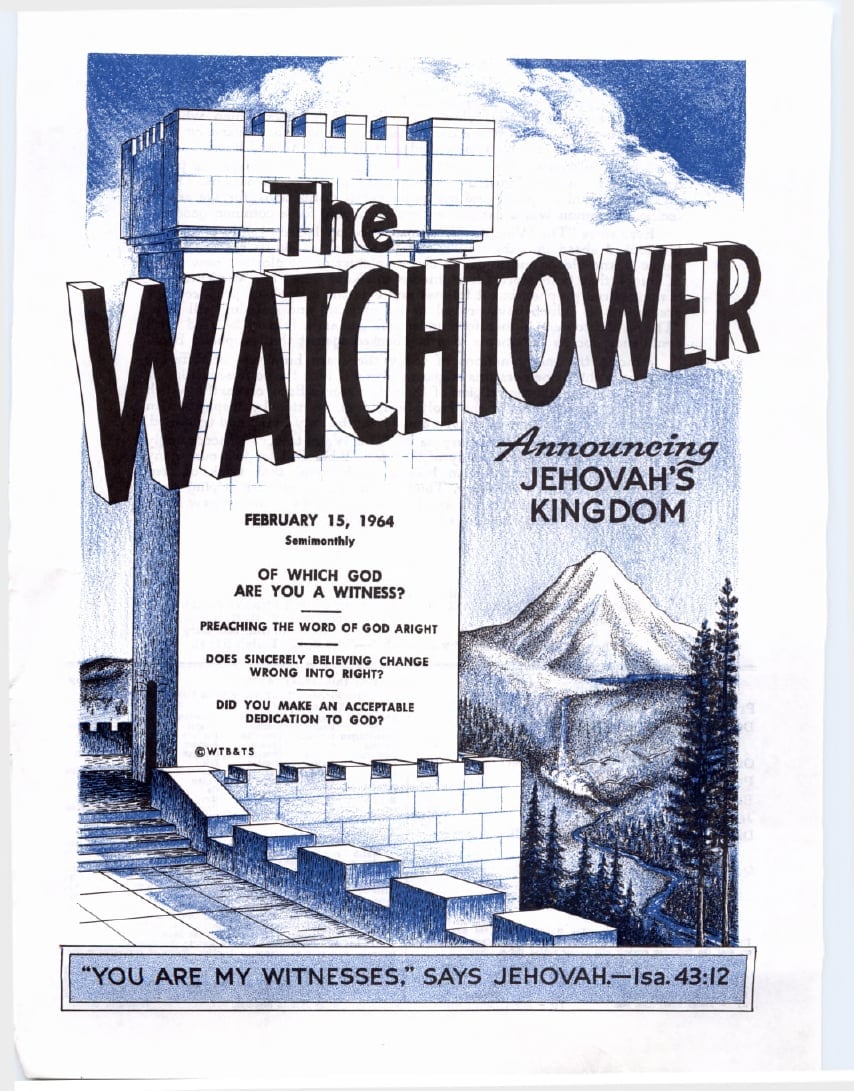
The Watchtower — February 15, 1964
Source: jw.org
Contents
Preaching the Word of God Aright
Does Sincerely Believing Change Wrong into Right?
Of Which God Are You a Witness?
Part Two
Bringing Children into the Study
Jerusalem—The Famous City
Did You Make an Acceptable Dedication to God?
Questions From Readers
Announcements
Preaching the Word of God Aright
Preaching the Word of God Aright
PREACHING has been one of the chief means used to spread Christianity from its inception down to the present time. However, there is more than one kind of preaching. Not a few preachers in Christendom carry on in an extremely emotional manner, shouting and gesticulating and appealing to the feelings and even the prejudices of their listeners. But these can find no support in the Scriptures for their style of preaching. Such preaching is not the kind referred to by the apostle Paul when he counseled Timothy: “Do your utmost to present yourself approved to God, a workman with nothing to be ashamed of, handling the word of the truth aright.”—2 Tim. 2:15.
But neither are the many preachers of Christendom who go to the opposite extreme, who preach the Word of God, if at all, in a desultory, aimless manner, that is, merely passing from one subject to another without order or rational connection, preaching the Word of God aright. They are not doing their utmost to be approved by God. That much Bible preaching today comes justly under this charge is apparent from a report that appeared in the Chicago, Illinois, Tribune, October 4, 1963:
“Preach Word of God, Ritter Tells Council. Duty Often Unfulfilled, Cardinal Asserts. Vatican City, Oct. 3.—Cardinal Joseph Ritter of St. Louis told the Vatican Ecumenical council today that the Roman Catholic Church needs more preaching of the word of God. Speaking for the first time at a meeting of the council, the American cardinal told the 2,262 prelates gathered in St. Peter’s basilica that the duty of preaching is fulfilled only in a desultory fashion if at all.” Among other things, he stated that this preaching of the Word of God was “an indispensable condition for the success of all other reforms that the council may make.” It is indeed noteworthy that a cardinal should make the preaching of the Word of God so basic as to say that the success of all other reforms that the Vatican II council might institute would depend upon it.
Since Bible preaching is admittedly so basic, it may well be asked, Why should the situation in the Roman Catholic Church be such that one of her princes can complain that “the duty of preaching [the Word of God] is fulfilled only in a desultory fashion if at all”? Could this be due to a lack of appreciation of the importance of the Bible itself?
That the preaching of the Word of God should be anything but desultory, let alone neglected, is made clear by the Word of God itself. Thus when Jesus, right after his resurrection, met two perplexed and dejected disciples of his on the road to Emmaus, Jesus preached to them with telling effect: “He said to them: ‘O senseless ones and slow in heart to believe on all the things the prophets spoke!’ . . . And commencing at Moses and all the Prophets he interpreted to them things pertaining to himself in all the Scriptures.” And with what result? They afterward said: “Were not our hearts burning as he was speaking to us on the road, as he was fully opening up the Scriptures to us?”—Luke 24:13-32.
Later that same day Jesus gave similar testimony to the eleven apostles and others assembled with them: “These are my words which I spoke to you while I was yet with you, that all the things written in the law of Moses and in the Prophets and Psalms about me must be fulfilled.” For them also, by his preaching, “he opened up their minds fully to grasp the meaning of the Scriptures, and he said to them: ‘In this way it is written that the Christ would suffer and rise from among the dead on the third day,’” and so forth. Clearly Jesus neither neglected the Scriptures nor did he use them aimlessly, but, rather, with telling effect.—Luke 24:44-46.
The apostle Paul claimed to imitate Christ, and among the many ways in which he did this was by preaching the Scriptures in a logical, coherent and rational manner, with telling effect; as can be seen in chapter after chapter of the book of Acts. Typical is the record regarding Paul’s preaching at Thessalonica: “There was a synagogue of the Jews. So according to Paul’s custom he went inside to them, and for three sabbaths he reasoned with them from the Scriptures, explaining and proving by references that it was necessary for the Christ to suffer and to rise from the dead, and saying: ‘This is the Christ, this Jesus whom I am publishing to you.’ As a result some of them became believers and associated themselves with Paul and Silas, and a great multitude of the Greeks who worshiped God and not a few of the principal women did so.”—Acts 17:1-4.
The Scriptural record gives like testimony regarding the disciple Apollos and his ministry in Achaia: “When he got there, he greatly helped those who had believed on account of God’s undeserved kindness; for with intensity he thoroughly proved the Jews to be wrong publicly, while he demonstrated by the Scriptures that Jesus was the Christ.” Nothing aimless, desultory, about his preaching, was there?—Acts 18:27, 28.
To what extent the Vatican II council will go along with Cardinal Ritter as to the importance of preaching the Word of God and the right manner of doing it remains to be seen. He may well be a voice in the wilderness in this matter, even as was one of his predecessors, Cardinal Kendrick, at the first Vatican council, at which he took a strong stand against the pope’s infallibility.
Be that as it may, the fact remains that for preaching to produce Christians it must be based upon the Word of God. More than that, such preaching must neither be an extremely emotional appeal nor be done in an aimless, desultory manner, but it must be preaching that appeals to the reason by presenting facts and arguments logically and coherently. The Christian witnesses of Jehovah as well as the publications used by them are committed to that kind of preaching, and it is proving effective, as the facts show.
Does Sincerely Believing Change Wrong into Right?
Does Sincerely Believing Change Wrong into Right?
Is sincerity sufficient to cover mistaken beliefs? What does the Bible say?
A YOUNG child often does not know the difference between right and wrong. He may take a bottle from the medicine cabinet and consume its contents, thinking it is candy. But it may be poison. The child believes he is getting what he wants, but he is wrong, with tragic consequences.
There are persons in mental institutions who believe all kinds of fanciful things that are not true. They have deluded themselves to the point where they sincerely believe their daydreams. Some have even imagined themselves to be great world leaders like Napoleon. But does their believing such make it so? No, it does not change what is wrong into what is right.
EITHER RIGHT OR WRONG
It is not only children or those of unbalanced mentality who sincerely believe what is not true. Especially in the field of religion do millions of average persons sincerely believe things that are not according to the facts.
The truth will not allow for all the different shades of religious doctrine in the world. For example, either there is life after death or there is not. Either the earth will last forever or it will not. Either God will bring wickedness to an end or he will not. With these and many other beliefs there is a right and a wrong. There cannot be two sets of truth when each conflicts with the other. One or the other is true, but not both. It is like a person being alive or dead. He is one or the other, but he cannot be both. When a belief is not correct but is wrong, then it cannot be right at the same time. The most sincere belief and practice of that belief will not change it from being wrong into being right. Nor will it become acceptable to God as truth, since he does not take pleasure in falsehood.
In some lands particular animals are considered sacred and cannot be eaten, although many in those same lands die of malnutrition each year. This belief may be sincere, but does that make it right or acceptable to God? How can we know? By going to God’s own written communication to mankind, the Holy Bible, which tells us: “Although asserting they were wise, they became foolish and turned the glory of the incorruptible God into something like the image of corruptible man and of birds and four-footed creatures and creeping things. Therefore God, in keeping with the desires of their hearts, gave them up to uncleanness, that their bodies might be dishonored among them, even those who exchanged the truth of God for the lie and venerated and rendered sacred service to the creation rather than the One who created.” (Rom. 1:22-25) From this it becomes clear that God does not at all approve of those who engage in worshiping what he has created, such as animals, even though their belief and practice may be sincere.
In other countries images, or idols, are worshiped. Food and drink are placed in front of these images as offerings. Here, too, people in these same countries go hungry while this food and drink decays before these inanimate objects. Has God expressed himself on this kind of worship? Yes, he has. He long ago declared: “You must not make for yourself a carved image or a form like anything that is in the heavens above or that is on the earth underneath or that is in the waters under the earth. You must not bow down to them nor be induced to serve them, because I Jehovah your God am a God exacting exclusive devotion.”—Ex. 20:4, 5.
How God regards these idols and those who worship them he himself tells us at Psalm 115:4-8: “Their idols are silver and gold, the work of the hands of earthling man. A mouth they have, but they cannot speak; eyes they have, but they cannot see; ears they have, but they cannot hear. A nose they have, but they cannot smell. Hands are theirs, but they cannot feel. Feet are theirs, but they cannot walk; they utter no sound with their throat. Those making them will become just like them, all those who are trusting in them.” Again God’s view is clear. Idols are powerless to aid man. Those who make and trust in them are compared to the lifeless idols themselves. Although this type of worship may be very sincere, it is not in harmony with God’s clearly expressed will.
“PAGANS” ONLY?
No doubt you have been able to identify some of these practices as coming from so-called “pagan” lands. Many feel that such worship would never be practiced in the “more enlightened” Western civilizations. But let us analyze just one belief prominent in the realm of Christendom to see if this is so.
Most of the religions in the Western world sincerely believe that after death wicked men will be tortured forever in a hell of fire. It is believed that actual physical pain of unbelievable intensity will be the lot of those who go to such a place. Yet, what would you think of a father who put the hand of his child into a hot fire and caused severe burns? You would agree that a parent would have to be unreasonable and cruel to do that. Or if a person took an animal, a dog for instance, and slowly roasted it over hot coals while yet alive, it would be considered an outrageous, senseless and horribly revolting act.
Yet we are asked to believe that God, who is Love, will do much worse to humans!
Is this belief according to the facts? God’s attitude toward such a belief can be seen when something of a similar nature was perpetrated in the nation of ancient Israel. At that time the Israelites actually made their children pass through fire in child sacrifice to the false god called Molech. Note what Almighty God said of this practice: “They built the high places of Baal that are in the valley of the son of Hinnom, in order to make their sons and their daughters pass through the fire to Molech, a thing that I did not command them, neither did it come up into my heart to do this detestable thing.” (Jer. 32:35) No, God did not even meditate doing such a thing. How, then, can he be accused of doing worse, torturing persons in hellfire throughout eternity?
The fate of willfully wicked ones is clear: “Jehovah is guarding all those loving him, but all the wicked ones he will annihilate.” (Ps. 145:20) Annihilation, not eternal torture, is the lot of those who are willfully wicked.
Those who believe and teach a fiery hell of torture dishonor God. They teach as coming from God a doctrine that he rejects as a lie. It also is responsible for turning many reasoning persons away from God, as they feel they cannot put faith in a God who would do to humans what we would not do to a dumb dog.
If God accepts sincere, although wrong, worship, then why did the practice of offering child sacrifices to Molech disappear from the world scene? The Israelites were not blessed for this erroneous worship. Their sincerity was not accepted. Molech was not the true and living God. The belief and service of this false god was violently rejected by God.
It might also come as a shock to many in Christendom who believe the doctrine of eternal torture to learn that in many pagan lands the identical belief is promoted! A burning hell of fire for the wicked is one of the main doctrines and beliefs of millions of persons living in pagan lands!
GOD’S WORD IS TRUTH
This brief analysis of just a few beliefs of “pagan” and “Christian” religions should show the thinking person that sincerity in believing a doctrine does not change what is wrong into what is right. It does not make it acceptable to God. He cannot condone what is wrong. He cannot bless what is falsehood. He is a God of truth. “It is impossible for God to lie,” states Hebrews 6:18; so surely he would not approve lies even when sincerely taught in his name.
God wants us to show sincerity in worship, true. But it is sincerity in true worship that he wants, not sincerity in false worship.
To aid those who are truly sincere in wanting to worship in truth, God has provided an infallible guide, his Word, the Bible. By this revelation of his mind humans can ascertain who he is, what his purposes are, and what the accurate knowledge of the truth is. As Jesus Christ said in prayer to his heavenly Father: “Your word is truth.” (John 17:17) Those who want to live in God’s righteous new order, wherein man will live amid paradise conditions in perfect health and happiness forever, need to study God’s Word to determine what the truth is. Jesus also stated: “This means everlasting life, their taking in knowledge of you, the only true God, and of the one whom you sent forth, Jesus Christ.”—John 17:3.
No doubt you are sincere in your beliefs. But remember, sincerity in itself will not change a wrong belief into a right one nor make it acceptable to God. God wants you to use his written Word to determine what is right. In this way he puts you to the test to see if you deserve his blessings. If you are apathetic, trusting in others to do all your religious thinking for you, then you cannot expect God’s favor.
No, do not be as the young child, consuming what you do not know to your own hurt, for “there exists a way that is upright before a man, but the ways of death are the end of it afterward.” (Prov. 16:25) Rather than choosing such a course, “trust in Jehovah with all your heart and do not lean upon your own understanding. In all your ways take notice of him, and he himself will make your paths straight.”—Prov. 3:5, 6.
Of Which God Are You a Witness?
Of Which God Are You a Witness?
“‘So you are my witnesses,’ is the utterance of Jehovah, ‘and I am God.’”—Isa. 43:12.
1. (a) What should a real God be able to do? (b) What attitude does the atheist have toward God, as evidenced in an Associated Press dispatch?
ANY God that is a real God ought to show proof that he is a God. He ought to have at least two or three witnesses that he is a God, or even the only God that there is. The atheist today recoils at the very suggestion that there is a god and proudly exclaims: “I am the witness of no god!” An Associated Press dispatch dated Seattle, May 6 of last year, reported: “Major Gherman S. Titov, the Soviet astronaut, proclaimed his disbelief in God today. He said he saw ‘no God or angels’ during his seventeen orbits of the earth. ‘Up to our first orbital flight by Yuri Gagarin no God helped build our rocket,’ he said. ‘The rocket was made by our people. I don’t believe in God. I believe in man, his strength, his possibilities and his reason.’ Major Titov expounded on his materialistic faith after he and his wife had spent nearly two hours touring the United States science exhibit at the Seattle World’s Fair.”—N.Y. Times, May 7, 1962.
2, 3. (a) What can be said of belief in God in ancient times? (b) What are we told about gods in the Hindu philosophy?
2 The atheist of today, whether he be a Communist or be of another political faith, thinks that in this modern nuclear, space age it has become old-fashioned to believe in an invisible god. In ancient times belief in one God or in many gods was part of the everyday life of the people in general. There might even have been an exchange of gods. Says a widely read writer of the seventh century before our Common Era: “Has a nation exchanged gods, even for those that are no gods?” “But where are your gods that you have made for yourself? Let them rise up if they can save you in the time of your calamity. For as the number of your cities your gods have become, O Judah.” (Jer. 2:11, 28) Later, in the first century of our Common Era there was a prominent Roman named Petronius Arbiter, who was a favorite of Emperor Nero and an absolute authority on questions of taste in connection with the science of luxurious living. In his work entitled “Satires,” chapter 17, Petronius referred to the Roman state religion and said: “Our country is so peopled with divinities that you can find a god more easily than a man.” Of course, the Roman emperor was addressed as a divinity.
3 It was with correctness that another writer who was of that same first century, but who is widely read today, said: “There are those who are called ‘gods,’ whether in heaven or on earth, just as there are many ‘gods’ and many ‘lords.’” (1 Cor. 8:5) Since the time of that writer the gods of the peoples have increased in number. Says The Encyclopedia Americana, Volume 14 (edition of 1929), page 196b, on the development of Hindu philosophy in India:
The result was that a whole pantheon of gods was created. Imagination was let loose and had a riotous play. Gods and goddesses by the galore peopled the firmament, although however only a handful found deification in the sense that they became objects of worship. New worlds were created, and Indra was made the ruler of 330,000,000 divinities. The trinity of Hinduism came into being in Brahma, the creator, Vishnu, the preserver, and Siva, the destroyer.
According to The Americana Annual 1963, page 321, India of today has a population of 439,235,082, of which 84.99 percent are Hindus. This would mean that there was one god to about every one Hindu and a half.
4. What facts do we have about gods in Japan, Russia and Christendom?
4 Up until 1946 the Japanese emperor was held to be divine, on the religious teaching that the imperial line descended unbroken from the time that Jimmu, great-grandson of Amaterasu, the sun goddess, set up the Japanese throne in 660 B.C. It was only sensible that on December 31, 1945, Emperor Hirohito honestly proclaimed that he was not a god. It was only since 1953, the year of the Russian dictator Stalin’s death, that the cult of Stalin was partially destroyed throughout the Communist world. But what about Christendom? She, of course, worships her own Holy Trinity of Father, Son and Holy Ghost. But what else?
5, 6. (a) How is the pope of the Roman Catholic Church viewed, as outlined in the Ecclesiastical Dictionary? (b) What other comments are made about this church leader?
5 From a standard Roman Catholic authority, the Ecclesiastical Dictionary,a by Lucius Ferraris, an eighteenth-century canonist of the Franciscan Order of monks, we quote part of what it says under the word papa:
“The pope is of such dignity and highness that he is not simply a man but, as it were, God, and the vicar of God. . . . Hence the pope is crowned with a triple crown, as king of heaven, of earth and of hell. . . . The pope is, as it were, God on earth, the only prince of the faithful of Christ, the greatest king of all kings, possessing the plenitude of power, to whom the government of the earthly and heavenly kingdom is entrusted. . . . The pope is of so great authority and power that he can modify, declare or interpret the divine law. . . . The pope can sometimes counteract the divine law by limiting, explaining,” etcetera.
6 Pope Nicholas I, of A.D. 858-867, who is surnamed The Great “because of the stupendous work he performed for the establishing of the papacy of Rome as a secular and sovereign power, supreme to all others,”b said the following: “The Emperor Constantine conferred the appellation of God on the pope; who, therefore, being God, cannot be judged by man.” The later Pope Innocent III, of A.D. 1198-1216, said: “The pope holds the place of the true God.” The Roman Catholic canon law, in its gloss, denominates the pope as “our Lord God.” It is not without meaning, then, that at the installation of a new pope, in the part of the ceremony that is called The Adoration, the singing of what is called the Te Deum (meaning, We Praise Thee, O God) is performed.c
CHALLENGE TO THE “GODS”
7. With what challenge, then, are we now faced, and what questions on the matter call for an answer?
7 Today every worshiper who claims to have a god is challenged to act as witness for his god. In fact, all the gods, that is to say, all those who are called “gods” and who are worshiped as gods are challenged to produce their witnesses to prove that they are gods or are the one living and true God. Today, therefore, the question is hurled into the face of each worshiper, Of which God are you a witness? As a witness, what can you say and what evidence can you bring forward to prove that your god, the one whom you describe as the object of your worship, is a reality, a true, living, historical, active god deserving of worship? What do you know of your god? Can you prove satisfactorily even to your own self that he is God or a god? Or are you ashamed to be a witness of your God?
8. (a) Why is it futile to worship and serve a false god? (b) By what two means should it be possible to prove who the true God is?
8 Every reasonable person will agree that there is no use in worshiping and serving a false god. No lasting good is gained from worshiping a god that does not exist. A worshiper is only deceiving himself or letting himself be deceived by other religionists, and in the end there is only disappointment. We should not want to go by emotion and religious sentimentality. We should act like sensible persons in the matter of religion as well as in the secular matters. It does us no good to hide from ourselves the evidence concerning a God that is a true, living, powerful reality. If gods, our own or those of others, are false, then we should want to know it. If, among all the numberless gods worshiped today, there is the one living and true God, then we should call for the evidence and seriously consider it. By his very own evidence and by the evidence produced by his witnesses on earth the true God should be able to prove before the court of the universe that he is the God, the divine Being, worthy of the worship of everybody.
9. Why is the present time appropriate for the true God to demonstrate his Godship?
9 The present time affords the grandest opportunity for the true God to demonstrate his Godship. Despite scientific advances, the world of mankind finds itself in its most deplorable state, afflicted not only with bodily and mental ills, with increasing hunger due to the increasing world population, but also with mounting disturbances, political, racial and religious, topped by what mathematically seems certain, namely, a third world war, in a nuclear, space age. The straightening out of the world situation is beyond mere human power and ingenuity; it calls for action by an intelligent superhuman power. So, then, now as never before is the time for religious worshipers to look to their gods. If the prophet Jeremiah of twenty-six centuries ago were here, he would repeat his challenge to the distressed people: “Where are your gods that you have made for yourself? Let them rise up if they can save you in the time of your calamity. For as the number of your cities your gods have become.”—Jer. 2:28.
10. What can be asked of all those claiming Godship?
10 No, when all the popular religions are combined together there is no shortage of gods, but what can all those gods, either singly or in combination, do about the worsening world situation? How do they explain it? What forecast, what prediction, what prophecy do they make as to how it will turn out? What prophecy do they make as regards the future of mankind? What proof can they give us by what they did in the past that they can make their prophecy of the future come true, that thus we can believe that they are truthful and reliable and able to live up to their promise? Let them tell in advance what will happen and then make it come true, or else let them admit that they are false gods the worship of whom brings no good.
11. (a) Is there any God who has the right to challenge all other gods, and why? (b) Does he have many adherents on earth?
11 Today there is one God who hurls that challenge to all others who are called gods and who are worshiped as gods. What right does he have to challenge all others? He has the right because in the first century of our Common Era and even earlier he foretold the very world situation of today and explained its meaning and its causes, and he also foretold its outcome and the marvelous future ahead of mankind afterward. Of all those worshiped today as gods, he is the only One that has done this remarkable thing. Naturally, by his challenge, he would stir up resentment and antagonism on the part of the worshipers of all the other so-called gods. Thus it comes about that today, even as in the past, he is the God of a persecuted minority of people, a small group indeed in comparison with the whole number of religious worshipers. No, this minority is not the natural Jews, who number 12,792,800 today throughout the earth. It is a far smaller group, who now bear the name of their God. They have inherited the faith of God’s true, chosen people of nineteen centuries ago or of the first century C.E. For this reason they are called by the same names that applied away back there.
12, 13. How does this God comfort those worshiping him, and what name does he have?
12 Before hurling his challenge at the gods of all other religious groups, their God speaks prophetically by his prophet Isaiah and comforts the persecuted minority, and in doing so their God reveals his own name. In Isaiah 43:1-4 we read his words:
13 “And now this is what Jehovah has said, your Creator, O Jacob, and your Former, O Israel: ‘Do not be afraid, for I have repurchased you. I have called you by your name. You are mine. In case you should pass through the waters, I will be with you; and through the rivers, they will not flood over you. In case you should walk through the fire, you will not be scorched, neither will the flame itself singe you. For I am Jehovah your God, the Holy One of Israel your Savior. I have given Egypt as a ransom for you, Ethiopia and Seba in place of you. Owing to the fact that you have been precious in my eyes, you have been considered honorable, and I myself have loved you. And I shall give men in place of you, and national groups in place of your soul.’”
14. To whom did Isaiah 43:1-4 first apply, and how so?
14 This statement has no application today to the Republic of Israel that was established in the so-called Holy Land in 1948, even though they do trace their natural descent from the Hebrew patriarch Jacob of thirty-seven centuries ago. In the days of the prophet Isaiah those words of Jehovah God did apply in a literal sense to the natural descendants of Jacob, and the words were fulfilled upon them in the subsequent sixth century B.C.E. How? Well, a surviving remnant of those natural descendants of Jacob, or Israelites, were delivered from their long captivity in the land of Babylon. Jehovah their God had repurchased them, and the way by which he did this had political aftereffects upon Egypt, Ethiopia and Seba at the hands of the new Persian Empire established by Cyrus the Great. Then Jehovah as their Savior brought the faithful remnant of his people back to their homeland in the land of Palestine, although he had to bring them through fire and water, as it were, or through rivers and across fiery desert.
15. (a) What change did Jesus show took place in his day, and how was it forcefully illustrated? (b) To whom after that did Isaiah’s prophetic words apply, and why to them?
15 However, in the first century C.E., Jehovah’s great prophet, Jesus Christ, pointed out that Jehovah, who had been their God up till then, was rejecting Jacob’s natural descendants, the Israelites, because of their disobedience to him and their rejecting of his prophets. This rejection of those natural Israelites was forcefully expressed by letting their sacred city Jerusalem be destroyed in the year 70 and by letting the survivors be scattered to the ends of the earth. At the same time Jesus Christ made it clear that the application of Isaiah’s prophetic words had been transferred to his own faithful followers in order to have a higher, fuller and spiritual fulfillment. In one expression of this transfer Jesus Christ said to the faithless, disobedient Israelites or Jews: “The kingdom of God will be taken from you and be given to a nation producing its fruits.” (Matt. 21:43) The faithful dedicated followers of Jesus Christ are the ones who make up that new nation to which the kingdom of God is given. They bring forth its fruitage in the kind of spiritual lives that they live and in their preaching worldwide the good news of God’s kingdom with its blessings for all families of the earth.
16. In the relationship of God with his people, who created whom, proving what?
16 As it was with that ancient nation of Jacob or Israel before Jehovah God rejected them, so it is with this new nation to whom he gives the kingdom of God, that they may reign with Jesus Christ in the heavens as blessers of all mankind left on earth. They did not create Jehovah in their minds as their God, but he created them as a spiritual nation, a spiritual Israel or Jacob. They did not form him, neither did they form imaginary statues of him, but Jehovah God formed them as a spiritual nation with Jesus Christ as the King of kings. Consequently, Jehovah is no false god, no man-made god, but, as God and Creator, he made them.
A REGATHERING NEEDED
17. Why was a regathering of believers in the true God needed, but what interruption prevented it for a time?
17 After the death of Jesus Christ and his twelve apostles, his faithful followers were scattered by persecution and religious oppressors. In the latter half of the nineteenth century there was an effort by a faithful remnant of Christ’s dedicated, baptized followers to unite together from all parts of the earth. But in 1914 along came World War I, and the religious clergy of Christendom took advantage of the patriotic, nationalistic passions, ambitions and emergency arrangements of wartime to oppress and scatter, if not exterminate, these Christians who worshiped Jehovah as the only living and true God. But thousands of years previously, he had promised to regather his worshipers and use them in a special way for his glory. In the same chapter of Isaiah he went on to say:
18. Had this true God made any statement about regathering those of his who were scattered?
18 “Do not be afraid, for I am with you. From the sunrising I shall bring your seed, and from the sunset I shall collect you together. I shall say to the north, ‘Give up’ and to the south, ‘Do not keep back. Bring my sons from far off, and my daughters from the extremity of the earth, everyone that is called by my name and that I have created for my own glory, that I have formed, yes, that I have made.’”—Isa. 43:5-7.
19. How did Jesus show he knew of this regathering that was to take place?
19 Jesus Christ foretold this same regathering in his prophecy on the end of this worldly system of things. He applied it, not to the regathering of Zionist Jews to Palestine and the establishment of the Republic of Israel, but to the faithful remnant of his own dedicated followers. He said: “The powers of the heavens will be shaken. And then the sign of the Son of man will appear in heaven, and then all the tribes of the earth will beat themselves in lamentation, and they will see the Son of man coming on the clouds of heaven with power and great glory. And he will send forth his angels with a great trumpet sound, and they will gather his chosen ones together from the four winds, from one extremity of the heavens to their other extremity.”—Matt. 24:3, 29-31.
20. In what way did Jehovah prove to be a God of his promise as regards regathering those of his nation?
20 Thus in the eighth century B.C.E. by his prophet Isaiah Jehovah God foretold the regathering of his Christian worshipers and he emphasized it by the prophecy of his own Son Jesus Christ nineteen hundred years ago. Did Jehovah God fulfill the prophecy? Did he prove that he is a God of true prophecy? Has he proved that he is the faithful, almighty God who sticks to his promise and who can make good his word of promise? Yes! Contrary to the expectation of the religious clergy of Christendom, and much to their vexation and irritation, Jehovah delivered his faithful remnant of worshipers from Babylonish captivity and regathered them in a worldwide unity, stronger and more extensive than ever before. Even the most prominent ones of the remnant who had been imprisoned during World War I were freed from prison and were exonerated of all the false charges that had been used to railroad them to prison.
21. What appreciation of Jehovah now came to those regathered, and to what realization did they come?
21 By means of his written Word upon which the light of fulfilled prophecy was shining Jehovah led the remnant to appreciate more the importance and preciousness of his name. They came to appreciate that they were a people, not for the name of Jesus, but for the name of Jehovah, even as the Christian disciple James pointed out long ago when applying Jehovah’s prophecy in Amos 9:11, 12. (Acts 15:13-19)d From the unfolding meaning of the Holy Scriptures they became more and more impressed with the fact that they must serve as the Christian witnesses of Jehovah. By means of his holy spirit he had created them for His glory, for he had begotten them to be his spiritual children and had anointed them with his spirit to preach and to be the joint heirs of Jesus Christ in his heavenly kingdom. Jehovah had formed them as a spiritual nation by bringing them into His new covenant through the Mediator Jesus Christ. Jehovah had made them his visible organization on earth, a theocratic organization. Now, by his delivering them in 1919 and reorganizing them for his further service, he had proved that he was a living God to them.
22, 23. (a) What failure on their part did Jehovah call to their attention? (b) What were some of the charges laid against them, and what would they have to face?
22 Before this they had not appreciated so fully and clearly that he was their God. With regard to this fact they had been spiritually blind and deaf, like Christendom, which worships what it calls a “triune God,” a trinity of three coequal, coeternal persons all said to be contained in one God. Their slowness to see and hear was to a large extent due to the influence of Christendom, with which they had so long been associated and which had oppressed them and held them captive. They had failed to act as the “servant of Jehovah.” In the preceding chapter of Isaiah (Isa 42:18-25) Jehovah had called attention to this and to the painful consequences of it, saying to them:
23 “Hear, you deaf ones; and look forth to see, you blind ones. Who is blind, if not my servant, and who is deaf as my messenger whom I send? Who is blind as the one rewarded, or blind as the servant of Jehovah? It was a case of seeing many things, but you did not keep watching. It was a case of opening the ears, but you did not keep listening. Jehovah himself for the sake of his righteousness has taken a delight in that he should magnify the law and make it majestic. But it is a people plundered and pillaged, all of them being trapped in the holes, and in the houses of detention they have been kept hidden. They have come to be for plunder without a deliverer, for pillage without anyone to say: ‘Bring back!’ Who among you people will give ear to this? Who will pay attention and listen for later times? Who has given Jacob for mere pillage, and Israel to the plunderers? Is it not Jehovah, the One against whom we have sinned, and in whose ways they did not want to walk and to whose law they did not listen? So [Jehovah] kept pouring out upon [Jacob] rage, his anger, and the strength of war. And it kept consuming [Jacob] all around, but he took no note; and it kept blazing up against him, but he would lay nothing to heart.”
THE CALL FOR WITNESSES
24. (a) How might some view the plundering of Jehovah’s people? (b) What, then, was necessary?
24 Due to letting his people be plundered and pillaged because of their failing to see and to hear and to obey their God, Jehovah allowed it to appear that their God was no God at all, or was a weakling God and so the gods of their persecutors, plunderers and pillagers were stronger than Jehovah. Now the time had come to reverse the wrong impression that had been allowed to grow. The time had now come for the dispute over the true Godship to be settled and every false god to be silenced. Let a judicial court be held! Let witnesses be called, and let all the universe attend the hearing, particularly all the nations of earth! Rather than call for a unification of all the gods and for a combining of their worship in one all-inclusive religion, Jehovah challenges all those who are worshiped as gods by the nations, to prove themselves gods.
25, 26. What did Jehovah then do for his people, and how did he speak of this prophetically?
25 That his dedicated people may serve as his representatives in this universal court, Jehovah opens up their eyes and their ears in a spiritual way by having them brought forth from their captivity in the Babylonish religious organization in the year 1919, in which year they held the epoch-making first general convention of the international Christian Bible students after World War I. Having now his own free representatives, Jehovah God calls for all the nations of earth to appear in court. His once blind and deaf people must face all the worldly nations on the controversy of Godship.
26 Prophetically issuing the order for the calling of this court together in this twentieth century, Jehovah went on to say by means of his prophet Isaiah of twenty-seven hundred years ago: “Bring forth a people blind though eyes themselves exist, and the ones deaf though they have ears. Let the nations all be collected together at one place, and let national groups be gathered together. Who is there among them that can tell this? Or can they cause us to hear even the first things? Let them furnish their witnesses, that they may be declared righteous, or let them hear and say, ‘It is the truth!’”—Isa. 43:8, 9.
[Footnotes]
Lucius Ferraris is the author of what is called “Prompta Bibliotheca canonica, juridica, moralis, theologica, necnon ascetica, polemica, rubricistica, historica,” a veritable encyclopedia of religious knowledge.
See M’Clintock and Strong’s Cyclopædia, Volume 7, page 63b.
See pages 310, 311, 316 of the book The Time is at Hand, by C. T. Russell, and copyrighted in 1889.
See The Watch Tower as of January 15, 1928, pages 19-25.
[Picture on page 105]
Indra, one of “those who are called ‘gods’”
Part Two
Part Two
1. To whom are the challenging words of Jehovah addressed?
WHOM does Jehovah mean when he says concerning all the nations and national groups: “Who is there among them that can tell this? Or can they cause us to hear even the first things? Let them furnish their witnesses, that they may be declared righteous”? By those challenging words Jehovah means the gods of all those nations and national groups. These gods are the ones that are called upon to furnish witnesses who by their testimony can prove that their gods are gods of prophecy and are righteous gods, the right gods to be worshiped, gods who can clear themselves of the charge of being false gods. Let such gods plead their case in court against Jehovah.
2. While there has been plenty of time for Jehovah’s words to be proved true, what pointed questions are asked of all other gods, including Christendom’s trinitarian god?
2 Jehovah’s written Word, the Holy Bible, was completed by the end of the first century C.E. In the more than eighteen centuries since then there has been plenty of time for Jehovah’s prophecies written in his Word over his own name to be fulfilled. But what about the gods of all the worldly nations, including the trinitarian god of Christendom? Was there or is there among all the nations of this world any god that “can tell this,” that is, tell what Jehovah has told in his written Word? Or can those gods of the nations “cause us to hear even the first things,” that is, things in advance? Did those gods make predictions in the past that later on came true in the past? Did those gods make predictions concerning the present time of perplexity? Do the events and conditions of the world since A.D. 1914 prove that those gods spoke the truth and that they are truthful gods of prophecy who have the power to make their prophecy come true?
3. What are these gods called on to do?
3 Let these gods bring forth their witnesses from all the many nations whose total population today numbers over three thousand millions. Surely among so many people the gods should find the required two or three witnesses to prove them to be true gods. Let these witnesses hear what their gods have to say in their sacred religious books in order that such witnesses may point to and say regarding the prophecy of their gods: ‘“It is the truth!” Our gods have proved true!’
4, 5. (a) How many of the gods of the nations are able to produce witnesses to their godship? (b) What does Jehovah now say?
4 Where, though, in the midst of the world trouble do those gods have witnesses who are thus testifying, “It is the truth!” concerning their gods? Which of those gods has foretold for any length of time in advance this present anguish of nations with perplexity and then provided an explanation of it and foretold its outcome? Not one of those gods can furnish the required number of witnesses to this effect! Not one of such gods can be declared righteous by proofs submitted by witnesses on earth. But there is one God who has done these things by which to prove his Godship. To his representatives in court he now speaks:
5 “‘You are my witnesses,’ is the utterance of Jehovah, ‘even my servant whom I have chosen, in order that you may know and have faith in me, and that you may understand that I am the same One. Before me there was no God formed, and after me there continued to be none. I—I am Jehovah, and besides me there is no savior. I myself have told forth and have saved and have caused it to be heard, when there was among you no strange god. So you are my witnesses,’ is the utterance of Jehovah, ‘and I am God.’”—Isa. 43:10-12.
6. Who are these serving the true God as his witnesses and how are they made witnesses?
6 Plain common sense has to agree in all honesty that persons who thus serve in this spiritual court trial are Jehovah’s witnesses. A person does not prove that he is one of Jehovah’s witnesses by just adopting the name and advertising himself as such. Back in the year 1931 dedicated Christian Bible students, being gathered together in international assembly in Columbus, Ohio, embraced that name by formal resolution, after which Christian congregations around the earth adopted that same resolution in order to be publicly identified by that designation. Today there are upward of 22,761 congregations in 194 lands who are known as Jehovah’s witnesses. Their adopting the resolution concerning the name did not in itself make them his witnesses. It is Jehovah himself who makes his own witnesses and they have to meet his conditions before he chooses them.
7. How is proof given that one is a witness of the true God?
7 Witnesses have to be wholly dedicated to Jehovah God through Jesus Christ as the Mediator of the new covenant, that they may become members of spiritual Israel. This puts them under the obligation to be Jehovah’s witnesses, because his name is called upon them and they bear his name. However, they must prove that they actually are such by bearing witness to his name, in this way proving their faith by their works. Did any persons of our day make such a proof prior to the year 1931?
8, 9. (a) What may those in doubt about this do? (b) Why is the charge that Jehovah’s witnesses have arbitrarily interpreted Isaiah 43:10 and applied it to themselves a false one?
8 Let any person in doubt examine the history of Jehovah’s witnesses from the year 1919, and particularly from 1926, down to July 26, 1931, when this designation was embraced, and he will find that these dedicated, baptized Christians met Jehovah’s requirements for being His witnesses. In a book entitled “Religion in the Soviet Union,” the well-known journalist and writer on political affairs, Walter Kolarz, tells on pages 338-344 about the campaign of Communist Russia to destroy Jehovah’s witnesses, but he opens up saying:
The name ‘Jehovah’s Witnesses’ has been in use since 1931. The members of the sect trace it back to various arbitrarily interpreted Bible passages, especially to Isaiah (43.10) ‘Ye are my witnesses, saith the Lord, and my servant whom I have chosen. . . .’ This is changed into ‘Ye are my witnesses, says Jehovah.’ Jesus himself was ‘Jehovah’s Chief Witness’. Until 1931 members of the sect were known by various other names such as ‘Bible Students’ or ‘Russellites’ . . .
9 However, in this regard Jehovah’s witnesses are not guilty of what Kolarz calls “various arbitrarily interpreted Bible passages,” and they did not change the expression “the Lord” into the name “Jehovah.” They merely used such modern translations as the American Standard Version, Robert Young’s Literal Translation of the Holy Bible, and so forth, instead of the antiquated three-hundred-year-old Authorized or King James Version of the Bible published away back in 1611. Such modern translations do not mistranslate God’s name.
WITNESSES FOR MESSIAH
10. For whom else are genuine Christians to act as witnesses?
10 It is true that genuine Christians, such as Jehovah’s witnesses of today are, must be witnesses of Jesus Christ. Just before ascending to heaven Jesus said to his disciples: “You are to be witnesses of these things” (Luke 24:48), and, “You will be witnesses of me both in Jerusalem and in all Judea and Samaria and to the most distant part of the earth.” (Acts 1:8) And in the last book of the Bible it speaks of the true Christians as those “who observe the commandments of God and have the work of bearing witness to Jesus.” (Rev. 12:17; 1:9; 19:10; 20:4) So, even since 1931, Jehovah’s witnesses have continued to bear witness to Jesus, and this they do because they “observe the commandments of God.”
11, 12. (a) Why must Jehovah’s witnesses testify in behalf of both Jehovah and Jesus? (b) With what was Jesus anointed, and by whom?
11 However, in the last book of the Bible, its writer the apostle John says concerning himself as a Christian: “John, who bare witness of the word of God, and of the testimony of Jesus Christ.” (Rev. 1:1, 2, American Standard Version) A true Christian has to bear witness of both God and of his Christ or Messiah. Let no one forget or hide the fact that the title Christ or Messiah means “Anointed One.” For there to be an anointed one there has to be an anointer or anointing one. So, in order to bear full witness concerning Jesus Christ, we also have to bear witness to the One who anointed Jesus and made him the Christ or Messiah. We have to bear witness to the Anointer as well as the Anointed One. Well, then who anointed Jesus, and with what—oil, or what? Jesus himself tells us who anointed him. When, in the Jewish synagogue, the book of Isaiah was handed to him, he turned to chapter sixty-one, verses one and two, and read them in the Hebrew, as follows:
12 “The Spirit of the Lord Jehovah is upon me; because Jehovah hath anointed me to preach good tidings unto the meek; he hath sent me . . . ; to proclaim the year of Jehovah’s favor.” (Isa. 61:1, 2, AS) After reading those words in the Hebrew text, in which the Hebrew name of God occurs (יהוה), he opened up his sermon to the Jews, saying: “To-day hath this scripture been fulfilled in your ears.” (Luke 4:16-21, AS) Thus Jesus publicly said that the Lord Jehovah had anointed him with holy spirit. Jesus on earth did not anoint himself with holy spirit from heaven. Three and a half years later he baptized his disciples with holy spirit from heaven, but Jesus did not baptize himself with spirit. The Lord Jehovah did that; and Jesus said that the Lord Jehovah was the One who sent him to preach and to “proclaim the year of Jehovah’s favor.” So Jesus and Jehovah are not the same individual. Jehovah is the Sender; Jesus is the Sent One. Jehovah is the Anointer; Jesus is the Anointed One or Messiah.
13. Of whom was Jesus a witness, and what proof did he give of this?
13 Jesus was all the time bearing witness of his Anointer, who is the Lord Jehovah. Jesus was born under the obligation to be a witness of Jehovah, for, by the Jewish virgin girl Mary, Jesus was born into the very nation to whom God by his prophet Isaiah said: “Ye are my witnesses, saith Jehovah, and my servant whom I have chosen.” (Isa. 43:10, AS) On trial for his life before the Roman Governor Pontius Pilate, Jesus said: “To this end have I been born, and to this end am I come into the world, that I should bear witness unto the truth.” (John 18:37, AS) Bear witness to whose truth? In his last prayer with his apostles Jesus said to God in heaven: “Sanctify them in the truth: thy word is truth.” (John 17:17, AS) It was the truth of the Lord Jehovah.
14. What did John say about Jesus as a witness?
14 There was every reason why the apostle John, in the last book of the Bible, should call Jesus Christ “the faithful witness, the firstborn of the dead, and the ruler of the kings of the earth. . . . and he made us to be a kingdom, to be priests unto his God and Father.” (Rev. 1:5, 6, AS) And the apostle John quoted Jesus as saying to him: “These things saith the Amen, the faithful and true witness, the beginning of the creation of God.”—Rev. 3:14, AS; AV.
15. What further evidence have we to show that Jesus was obliged to be a witness of Jehovah?
15 Of whom was Jesus Christ “the faithful and true witness”? By his birth into the nation to whom the words of Isaiah 43:10-12 were directed, Jesus Christ was obliged to be a witness of Jehovah. He lived up to this obligation, for all the written record as to what he said and as to all the Hebrew scriptures that he quoted proves that he was Jehovah’s witness. If the question were today directed to Jesus Christ, Of which God are you a witness? he would reply: Of Jehovah! He was and still is in heaven the “faithful and true witness” of “his God and Father.”—Rev. 1:5, 6, AS.
16. To whom else besides Jewish Christians are the words of Isaiah 43:10-12 addressed?
16 In this respect all his disciples must copy him, whether they be natural-born Jews or Gentiles. (1 Cor. 11:1) Gentile Christians as well as Jewish Christians must be Jehovah’s witnesses, for at the conference of the apostles and elders in Jerusalem it was to the Gentile Christians that the disciple James applied the prophecy of Amos 9:11, 12 and said: “Symeon hath rehearsed how first God visited the Gentiles, to take out of them a people for his name. And to this agree the words of the prophets; as it is written.” (Acts 15:14, 15, AS) Hence God’s name Jehovah is called upon the Gentile Christians as well as the natural-born Jewish Christians, and for this reason Isaiah 43:10-12 is directed to Gentile Christians who belong to spiritual Israel as well as to Jews who are converted to discipleship of Jesus Christ.
17. If Christendom were to live up to its claim, what would all of her people be?
17 This is no case of tracing the designation Jehovah’s witnesses “back to various arbitrarily interpreted Bible passages,” as Kolarz says. God’s holy spirit by the disciple James shows that there must be such persons as Jehovah’s witnesses and also shows who they are. If Christendom were living up to its claim of being Christian, then everyone in Christendom who professes to be a Christian would be one of Jehovah’s witnesses. There is no escaping it.
NO GOD FORMED BEFORE OR AFTER
18. How does Christendom’s clergy claim that they are Jehovah’s witnesses, and what interpretation do they place on Isaiah 43:10?
18 Clergymen of Christendom cannot defend themselves by saying that they are Jehovah’s witnesses by being witnesses of Jesus because, as they say, Jehovah is the Old Testament name for Jesus and so Jesus is Jehovah and they (the clergy) merely use Jesus instead of the name Jehovah. They point to Isaiah 43:10 in which Jehovah says not only “Ye are my witnesses” but also these words (in the King James Version): “Before me there was no God formed,a neither shall there be after me.” And also to Isa 43 verse 11, which reads (in the same King James Version): “I, even I, am the LORD; and besides me there is no saviour.” This, the clergy say, proves that Jehovah and Jesus are one and the same God, because here the Lord Jehovah says: “Besides me there is no saviour,” and the New Testament says that Jesus is our Savior.
19. What do the clergy of Christendom overlook by this interpretation?
19 In arguing this way those clergymen do not point to the later prophecy of Obadiah, verse 21 (AV; AS; RS), which reads: “And saviours shall come up on mount Zion to judge the mount of Esau; and the kingdom shall be the LORD’S.” Please, note here that there are other saviors besides the Lord Jehovah. Those clergymen also do not point to the following scriptures that speak of other saviors: “And the LORD gave Israel a saviour, so that they went out from under the hand of the Syrians.” (2 Ki. 13:5, AV) “According to thy manifold mercies thou gavest them saviours, who saved them out of the hand of their enemies.” (Neh. 9:27, AV) “And it shall be for a sign and for a witness unto the LORD of hosts . . . and he shall send them a saviour, and a great one, and he shall deliver them.” (Isa. 19:20, AV) So Jehovah can raise up others to act as saviors.
20. Explain how Jesus is a savior for mankind.
20 In harmony with this fact the Holy Scriptures testify that Jesus Christ was only an agent of Jehovah God for the salvation of mankind. In Acts 5:30-32 (AV) the Christian apostles said to the Jewish Sanhedrin: “The God of our fathers raised up Jesus, whom ye slew and hanged on a tree. Him hath God exalted with his right hand to be a Prince and a Saviour, for to give repentance to Israel, and forgiveness of sins. And we are his witnesses of these things.” In Acts 13:23 (AV) the apostle Paul says: “Of this man’s [David’s] seed hath God according to his promise raised unto Israel a Saviour, Jesus.” In 1 John 4:14 (AS) the apostle writes: “And we have beheld and bear witness that the Father hath sent the Son to be the Saviour of the world.” For anybody to argue that Jesus Christ is the one and only Savior would be, in the face of all these Bible texts, to deny that God, the Father of Jesus Christ, is a Savior. But God the Father is the only Source of salvation in that he sent his only-begotten Son to this earth to become the man Jesus Christ and to die as a ransom sacrifice; and God the Father raised up his Son from the dead and thus also saved his own Son.—Heb. 5:5-8.
21, 22. What argument is next used by the clergy in explaining Isaiah 43:10, and by their doing so what happens?
21 Nevertheless, not wholly satisfied with the foregoing, the clergy of Christendom refer back to Isaiah 43:10, where Jehovah, in addressing his witnesses, says: “Before me there was no God [El] formed, neither shall there be after me.” (AV) Then they point to Isaiah 9:6 (AV), which calls Jesus Christ “The mighty God [El], The everlasting Father, The Prince of Peace,” and they say that, since there was no God formed before Jehovah and there was to be no God after Jehovah, this proves that Jehovah and Jesus are one and the same God and that Jehovah is Jesus. They say that this also proves that the New World Translation of the Holy Scriptures is wrong in translating John 1:1 as follows: “In the beginning the Word was, and the Word was with God, and the Word was a god,” that is, a god in addition to Jehovah.
22 By using such an argument the trinitarian clergymen lift Jehovah’s words in Isaiah 43:10 out of their context and show that they do not understand what Jehovah by his prophet is talking about.
23, 24. Just what does Jehovah tell Israel in this 43rd chapter of Isaiah, and how are we to understand Isa 43 verses ten and eleven?
23 In the first verse of the forty-third chapter Isa 43:1 Jehovah tells Isaiah’s people that He is the Creator of the nation of Jacob, He is the Former of the nation of Israel. Jehovah created and formed that nation. The nation of Israel did not create and form Jehovah as their God. The other nations, the Gentile nations, had created their gods and had formed images to represent their gods, but this was not the case with the nation of Israel and their God Jehovah. Because of this vital fact Jehovah challenges the many gods of the nations and tells such gods to furnish their witnesses to testify with proof that they are really gods who foreknow the future and who foretell the future. But the nation of Israel could tell many actual historical facts about their God in proof that he is a real living God, although he permits no material idol image to be made to represent him. Hence Jehovah tells the Israelites that they are his witnesses and are his servant whom he has chosen. Why?
24 Jehovah explains, saying: “In order that you [people] may know and have faith in me, and that you may understand that I am the same One. Before me there was no God formed, and after me there continued to be none. I—I am Jehovah, and besides me there is no savior.” (Isa. 43:10, 11, New World Translation) Jehovah the God of his chosen people is not like the created, formed gods of the Gentile nations. In Isaiah 43:10 Jehovah did not say: ‘I did not form a God before me, and I did not form a God after me.’ No, but he said: “Before me there was no God formed,” that is, by others. So he is talking about other persons forming their gods.
25-27. What now does Jehovah say about godship of the gods of metal, stone and wood?
25 That Jehovah is here talking about the non-Jewish nations creating their own gods and forming metallic, stone or wooden idol images of them is very plain from the context before and after Isaiah 43:10. After telling in the rest of chapter forty-three how he will deliver his people from Babylon, where they will be exiled for sinning and transgressing against him, Jehovah goes on to say in the very next chapter:
…