The Watchtower, February 1, 1964
Download: PDF — The Watchtower, February 1, 1964
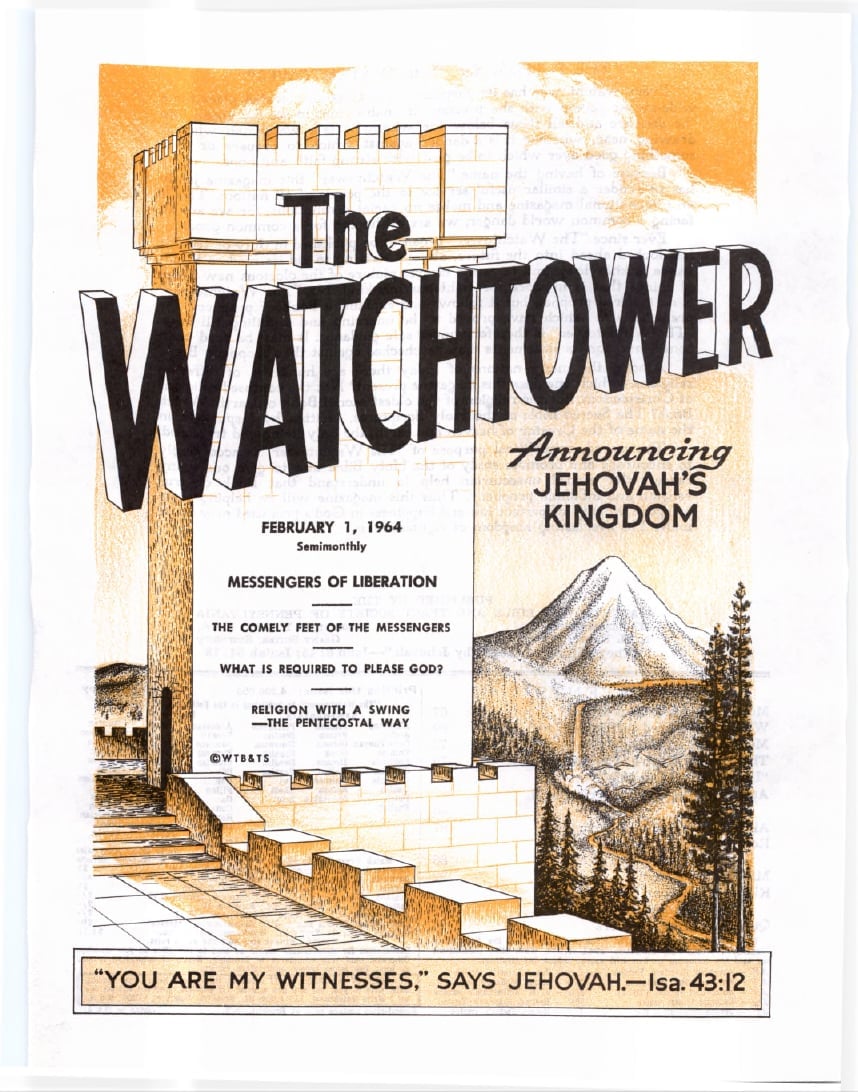
The Watchtower — February 1, 1964
Source: jw.org
Contents
More Is needed than Bibles
What Is Required to Please God?
Messengers of Liberation
The Comely Feet of the Messengers
“Unyielding Courage”
Applying the General Priesthood Principle
Aided by “Watchtower” Articles
Religion with a Swing—The Pentecostal Way
Missing the Mark
Kidney Operation Without Blood Transfusion
Questions From Readers
Announcements
More Is needed than Bibles
More Is needed than Bibles
THE Bible continues to be printed and distributed by the millions of copies year after year, and that in ever more tongues. It now appears, in whole or in part, in upward of twelve hundred languages, 1,202 to be exact.
In the United States as well as in many other lands around the world, a Bible week is annually observed by Protestants, usually beginning with the second Sunday in Advent. (Incidentally, “Advent” refers to a preparatory period, four weeks before Christmas.) There is even a Roman Catholic Bible week in certain lands, such as in the United States, where it falls in February, it being celebrated in connection with Catholic Press month.
Commendable as are the printing and distributing of the Bible—although it must be admitted that not all of it is being done out of purely religious or even out of philanthropic motives—more is needed. It is not enough for people to have the Bible in their homes, nor even that they read it from time to time. They must understand what they read and know what to do about it. True, parts of the Bible, such as its historical portions and its moral precepts, are quite clear for all to comprehend who approach it objectively. But there is also much that cannot be understood without assistance; and, not understanding it, many stop reading the Bible, while others charge it with contradicting itself. In particular is there need for help to understand the fulfillment of Bible prophecies, and especially those that relate to our day.
In fact, Bible prophecies cannot be understood by anyone until God’s due time. Thus Daniel, who was used by God to record many prophecies, said regarding some of them, “I heard, but I could not understand.” Why not? Because it was not God’s due time, for which reason God told him: “Go, Daniel, because the words are made secret and sealed up until the time of the end.” At that time “the ones having insight will understand.” And why? Because of those prophecies being fulfilled. In the same way, it was only after Jesus Christ had fulfilled certain prophecies that his apostle Matthew was able to call attention to certain events and show how they fulfilled this prophecy and that.—Dan. 12:8-10; Matt. 2:22, 23; 3:3; 8:17; 21:4, 5; 27:9, 10.
Equally important to understanding the Bible is God’s holy spirit. Only upon receiving the holy spirit at Pentecost were the Christian apostle Peter and his associates able to preach with understanding and show the fulfillment of prophecies, and so it has been since. As the apostle Paul shows, “God has revealed [these things] through his spirit.”—1 Cor. 2:9, 10; Acts 2:2-36.
Another requirement for understanding the Bible is a right heart condition, a sincere desire to learn, a ‘consciousness of one’s spiritual need.’ That is why Jesus spoke in parables or illustrations, to separate the casual and curious listener from the sincere inquirer. The latter would heed Jesus’ words: “Let him that has ears listen,” that is, remain to hear more.—Matt. 5:3; 13:9-16.
In particular is help needed from God’s dedicated servants to understand the Bible. This is strikingly borne out by the experience recorded at Acts 8:26-39. A sincere inquirer, an Ethiopian official, was reading the prophecy of Isaiah but could not understand it until Philip, the evangelist, made it clear to him. If reading the Bible were all that were needed to understand it and to be impelled to act upon it, then each individual member of the Christian congregation would be complete in himself, like a whole human body, but not so. The apostle Paul likens the entire Christian congregation to a human body and the individual members to the various parts or organs of a body, such as the hands, feet and head. All of these have the greatest need for one another, for which reason it has well been said of them: “All the organs of the body are constantly in debt to one another.” Yes, as the apostle shows: “The eye cannot say to the hand: ‘I have no need of you’; or, again, the head cannot say to the feet: ‘I have no need of you.’” If Bibles were all that were needed, then the illustration of Paul would be pointless.—1 Cor. 12:21.
The very fact that Jesus Christ gave his congregation “some as apostles, some as prophets, some as evangelizers, some as shepherds and teachers,” shows that more is needed than Bibles. As the inspired writer goes on to show, God provided these men for “the training of the holy ones, for ministerial work, for the building up of the body of the Christ, until we all attain to the oneness in the faith and in the accurate knowledge of the Son of God, to a full-grown man, to the measure of growth that belongs to the fullness of the Christ.”—Eph. 4:11-13.
Just as human instruments, dedicated to Jehovah God to do his will and upon whom he has placed his spirit, were needed in the early days of Christianity, so there is need for such today. By means of a figure of speech Jesus foretold that there would be human instruments. This is found in his great prophecy regarding the end of the system of things, where we now find ourselves: “Who really is the faithful and discreet slave whom his master appointed over his domestics, to give them their [spiritual] food at the proper time? Happy is that slave if his master on arriving finds him doing so. Truly I say to you, He will appoint him over all his belongings.” This “slave,” the facts show, is to be found among the Christian witnesses of the New World society.—Matt. 24:45-47.
Yes, more is needed than printing and distributing Bibles. They must be read, understood and acted upon. The Bible, and Bible prophecies in particular, cannot be understood until God’s due time, and then only by sincere inquirers with the help of God’s holy spirit and his dedicated earthly instruments. That is why this magazine is published and why the witnesses of Jehovah stand ready to instruct personally every sincere seeker for truth, and that “without money and without price.” Having ‘received free, they give free.’—Isa. 55:1; Matt. 10:8.
What Is Required to Please God?
What Is Required to Please God?
What does God ask of you? How can you be sure?
MANY people lead what would be called a “good” life. They do not steal, commit immorality, kill or indulge in any other antisocial behavior. They see the need for religion and attend a church of their choice.
It is commonly believed that leading this kind of life is what God asks of humans. Since this opinion is so widespread, it would be pertinent to ask: Is this actually what is required to please God?
You might be quick to answer, Yes. But before doing so, it would be well for you to consider another, more fundamental, question: Do you really know what is required to please God?
You should be careful not to let another do your thinking for you in this matter. It is your responsibility. To let another, even a clergyman, answer this for you is exceedingly dangerous. Why? Because many now recognize that not even the churches are equipping their members to understand God’s purposes and requirements. Said Look magazine of September 24, 1963, of the churches in America: “They too have failed to supply moral leadership, and because their responsibility is the greatest, their failure is the worst. Harvard Divinity School’s Dean Miller says, ‘The church simply does not have a cutting edge. It has taken the culture of our time and absorbed it. It’s ghastly that the church is run not to serve the reality of human beings, but to conserve institutions.’ Yale’s Chaplain Coffin agrees: ‘We churchmen are gifted at changing wine into water—watering down religion.’”
With such admissions, you would do well not to take for granted that you have learned what pleases God just because you have attended a church regularly.
SOURCE OF ANSWERS
How can you determine what God requires of you to please him? Where can you go for your answers? How can you be sure that you are doing what God wants?
God’s own written Word counsels: “Trust in Jehovah with all your heart and do not lean upon your own understanding.” (Prov. 3:5) Yes, God wants man to trust him. Since he does, it is only reasonable to conclude that he must have made some provision for man to find out about him and what he requires so that man would not have to grope in darkness. If a child asked his father: ‘Daddy, what must I do to please you?’ would you think it logical if the father brushed the child aside without an answer and told him nothing as to what he required? No, the loving father would be careful to explain to the child what was required of him. If the child ignored this instruction, then he could be punished. If he fulfilled it, then he could be rewarded by a kind word, affectionate embrace, or at times even some material gift.
Would not God, who created man and who gave him his faculty of reason, be even more careful to show man how to please his Maker? Surely the loving Creator would not abandon man after having created him and given him such an inquisitive mind. He would most certainly provide what man would need to guide his steps in a manner that would be pleasing to his heavenly Father.
Has God provided this assistance? Yes. A God-fearing man of ancient times showed us where to go for this guidance, when he said: “All Scripture is inspired of God and beneficial for teaching, for reproving, for setting things straight, for disciplining in righteousness, that the man of God may be fully competent, completely equipped for every good work.” By his spirit God has inspired men to record his purposes and requirements so that all who want to please God can learn of him and know for a certainty what he requires from man.—2 Tim. 3:16, 17.
HOW USED?
What part does God’s Word, the Bible, play in your life? Possessing the Bible is fine, but how you use it is another matter. It is like having a well full of refreshing, life-sustaining water. To benefit from the well you must draw out its contents. It is similar with the Bible. Having one does not mean it will be refreshing and beneficial to you. As with the well, you must go to the Bible and draw from it the refreshing and life-sustaining waters of truth it contains.
It takes effort and regularity to get the truths contained in the Bible. So does getting water from a well. That water will not automatically leap out of the well into your glass. In addition, you need to drink that water regularly, day by day, as one drink would not be sufficient. Likewise, you must put effort into a study of God’s Word and do so with regularity.
Do not be discouraged by the fact that most people today, including churchgoers, do not regularly study the Bible. In order to please God, we must take in these waters of truth. If we turn away from what God has to say, then we will displease him. Proverbs 28:9 states: “He that is turning his ear away from hearing the law—even his prayer is something detestable.” One who turns away from the instructions contained in God’s Word disgusts God even if he prays! It is like a child refusing to listen to his father’s counsel and then continually expecting favors from him.
If you knew where buried treasure was that could be yours for the taking, would you not diligently dig for it? The Bible is a storehouse of spiritual treasure. It will equip its reader to know God. Proverbs 2:1-5 says: “My son, if you will receive my sayings and treasure up my own commandments with yourself, so as to pay attention to wisdom with your ear, that you may incline your heart to discernment; if, moreover, you call out for understanding itself and you give forth your voice for discernment itself, if you keep seeking for it as for silver, and as for hid treasures you keep searching for it, in that case you will understand the fear of Jehovah, and you will find the very knowledge of God.”
Yes, you can determine what course of action pleases God, but you must use his Word to do that. Today, hundreds of thousands of persons throughout the world are systematically studying the Bible with Christian ministers trained to render this assistance. How happy they are to take in this life-giving knowledge!
LIVING UP TO IT
Should we be content to fill our minds with knowledge and let it remain there? No, we need to put into practice the things we learn about God’s will. “The regulations and the judicial decisions and the law and the commandment that he wrote for you, you should take care to do always.” (2 Ki. 17:37) Not doing this brings God’s displeasure. When ancient Israel was taken captive by the Second World Power, Assyria, the reason God allowed it was this: “They had not listened to the voice of Jehovah their God, but kept overstepping his covenant, even all that Moses the servant of Jehovah had commanded. They neither listened nor performed.”—2 Ki. 18:12.
Jesus Christ showed the importance of living up to God’s requirements when he declared: “Not everyone saying to me, ‘Lord, Lord,’ will enter into the kingdom of the heavens, but the one doing the will of my Father who is in the heavens will.” (Matt. 7:21) The Bible writer James verified this principle of doing, as well as hearing, by saying: “Faith without works is dead.”—Jas. 2:26.
God’s will for those who would please him was summed up by Jesus in answer to a question as to which was the greatest commandment in the Law. He stated: “‘You must love Jehovah your God with your whole heart and with your whole soul and with your whole mind.’ This is the greatest and first commandment. The second, like it, is this, ‘You must love your neighbor as yourself.’” (Matt. 22:37-39) Loving God means we will give him first place in our lives, learning of him and willingly obeying all his commands. As we learn of his grand purpose for man, we will not want to be selfish and keep this vital information to ourselves, but we will want to pass it on to our neighbors, our fellowmen on earth. That will be showing the greatest love for our neighbor. In that way he, too, will have the opportunity of knowing and serving God and pleasing him.
This love for God and man means we will cultivate Christian qualities so as to put on a new Christian personality, taking care to associate with those who do the same, for the mutual upbuilding of our faith in God. God will bless this sincere effort and will produce in us the fruitage of his holy spirit. What will result? “The fruitage of the spirit is love, joy, peace, long-suffering, kindness, goodness, faith, mildness, self-control.”—Gal. 5:22, 23.
Shortly God will shower down material blessings on those who please him by granting them everlasting life and perfect health in his restored Paradise. “The fear of Jehovah is a well of life.” “Hope in Jehovah and keep his way, and he will exalt you to take possession of the earth. When the wicked ones are cut off, you will see it.” What a grand prospect for God pleasers!—Prov. 14:27; Ps. 37:34.
Life in that righteous new order is indeed the only worthwhile goal to work toward. But it will not be attained by the mere doing of good as we see fit, but by building faith in God through a study of his Word and then by doing what God considers good. “Without faith it is impossible to please him well, for he that approaches God must believe that he is and that he becomes the rewarder of those earnestly seeking him.” (Heb. 11:6) Yes, eternal life will be the happy lot of those who have faith in God and who “are observing his commandments and are doing the things that are pleasing in his eyes.”—1 John 3:22.
Messengers of Liberation
Messengers of Liberation
“Stand upright and hold your heads high, because your liberation is near.”—Luke 21:28, New English Bible.
1. What differing views of liberation may people have, but what is the greatest liberation that is needed?
WHO does not enjoy being free? Who that feels any bondage or slavery does not want to be liberated? There is worldwide room for liberation today. One person might think this statement too broad and sweeping, because there is, in the political field, what is called the “free world” as against the Communist bloc of nations. Another person might think of the liberation that this Communist bloc advocates for all “imperialist” nations, which amounts to merely replacing one human government that is branded as undesirable with another human government no more perfect and all-wise than the one replaced. The messengers of such a liberation would be messengers of revolution, foreign agents of a radical government, political subverters and agitators, whereas the messengers of the “free world” would be looked upon as “imperialist spies.” Still another person might think one race among mankind needs to be liberated from domination by another race. However, that the need for liberation is worldwide can be appreciated from the statement, made nineteen centuries ago but still true today: “The whole world is lying in the power of the wicked one.” (1 John 5:19) We shall never have a righteous, peaceful, healthful world till we are liberated from that wicked one.
2. How can we be sure complete deliverance is near?
2 Complete deliverance from that wicked world-enslaver is on its way here. Because, since the year 1914, we have more and more evidence that it is near, we can act on the encouraging words of the great Prophet: “When all this begins to happen, stand upright and hold your heads high, because your liberation is near. . . . Look at the fig-tree, or any other tree. As soon as it buds, you can see for yourselves that summer is near. In the same way when you see all this happening, you may be sure that the kingdom of God is near.”—Luke 21:28-31, New English Bible.
3. (a) When will complete deliverance from Satan come? (b) What liberation is taking place now?
3 That kingdom will put out of power and control the wicked one whose unseen influence and pressure all the world of mankind feels, namely, Satan the Devil. The despoiling of him of his worldwide power will take place immediately after the universal battle of Har–Magedon has taken place, which battle will result in the wrecking of his visible political system of rule. That will mean deliverance for all those God-fearing people who pray the prayer, “Your kingdom come!” and who seek first the kingdom of God and his righteousness, as Jesus Christ taught them to do. (Matt. 6:9, 10, 33) However, there is a present liberation for them; it begins before the oncoming battle of Har–Magedon. It is a very important liberation because it concerns their everlasting future. It is a religious liberation, one that takes place even while the political governments, including dictatorships and totalitarian governments, are still standing. Such a liberation means a lot now!
4. (a) Who may feel they do not need a liberation? (b) What similar attitude did some of Abraham’s descendants have in Jesus’ day?
4 People living in lands where the Constitution or the National Bill of Rights guarantees them “freedom of religion” may not feel that they need such a liberation. They are free to practice no religion at all, to be atheists, if they choose. But a person needs to be careful today that he is not like the people at Jerusalem nineteen hundred years ago, that is, in the autumn of the year 32. At the temple Jesus Christ had been teaching these people who were descendants of the Hebrew patriarch Abraham, and he went on to say: “If you remain in my word, you are really my disciples, and you will know the truth, and the truth will set you free.” Thinking proudly of their nationality, they answered: “We are Abraham’s offspring and never have we been slaves to anybody. How is it you say, ‘You will become free’?”—John 8:31-33.
5, 6. (a) How did Jesus’ reply to their statement show that the descendants of Abraham were in need of liberation? (b) Now what was their answer, but whom did Jesus point out their father really was?
5 Jesus’ reply could either offend them or open their eyes to their real situation. He said: “Most truly I say to you, Every doer of sin is a slave of sin. Moreover, the slave does not remain in the household [of the patriarch Abraham] forever; the son remains forever. Therefore if the Son [Jesus Christ] sets you free, you will be actually free. I know that you are Abraham’s offspring [according to natural descent]; but you are seeking to kill me, because my word makes no progress among you. . . . Abraham did not do this. You do the works of your father.” At this statement they laid claim to a descent higher than that from the man Abraham. They said to Jesus: “We were not born from fornication [by an unnamed father]; we have one Father, God.”—John 8:34-41.
6 But had they loved God, they would have loved his Son and listened to the Son’s word; but they did not do so. Hence Jesus said: “You are from your father the Devil, and you wish to do the desires of your father. That one was a manslayer when he began, and he did not stand fast in the truth, because truth is not in him. When he speaks the lie, he speaks according to his own disposition, because he is a liar and the father of the lie. . . . This is why you do not listen, because you are not from God.”—John 8:42-47.
7. (a) What is our conclusion, then, regarding these descendants of Abraham? (b) Show why it is appropriate to refer to Satan as a “god.”
7 Slaves of sin! Children of Satan the Devil, the first murderer and liar! O what kind of religious people to be, while at the same time thinking themselves to be children of God through his earthly friend, Abraham the Hebrew patriarch! What religious deception to be under! What a need for liberation! It was not without great religious meaning that Satan the Devil was called a god, “the god of this system of things.” He tries to hide the true God from all mankind. To this end he “has blinded the minds of the unbelievers, that the illumination of the glorious good news about the Christ, who is the image of God, might not shine through.” (2 Cor. 4:4) So the Bible account that tells about expelling the wicked one and his demon angels from heaven says: “Down the great dragon was hurled, the original serpent, the one called Devil and Satan, who is misleading the entire inhabited earth.” (Rev. 12:7-9) He being the “god of this system of things,” he has his worshipers. He has his religion, and he misleads practically all the inhabitants of the earth by his religion, the false religion of a false god.
8. After the Flood, where did false religion again get its start, and how extensive was it to become?
8 Bible history reveals that after the great Flood Satan the Devil renewed his false religion in the earth at Babylon. This city was built on the banks of the Euphrates River. From this city, after the confusion of languages there, false religion spread to all parts of the inhabited earth. In the seventh century before Christ the city became the Third World Power in Bible history. It overturned the kingdom of the Jews and carried off the survivors to Babylon, where they remained unwilling captives for seventy years. Liberation came for them at the hands of the conqueror, King Cyrus, the Persian, in 537 B.C., and a remnant of more than forty-two thousand Jews returned at once to their homeland to rebuild the temple of Jehovah God and the holy city. By the time of Jesus’ coming they had fallen under the power of the Roman Empire, but they were still allowed to practice their religion, Judaism. But now man-made religious traditions had taken on more importance than the written Word of God, the Holy Scriptures.
9. Show how Jesus’ words “every doer of sin is a slave of sin” were true in the case of the Jewish people in his day and that they needed liberation.
9 Along with being bound by unscriptural, antibiblical religious traditions, the Jewish people were under the power of oppressive religious rulers, who were of their father the Devil. The religious ceremonies at the temple in Jerusalem did not really remove their sins or actually free them from the slavery of sin. As a result of sin, death, which is the penalty for sin, was reigning over them. (Rom. 6:23; 5:12-17) Jesus Christ told them the straight facts when he said they were slaves and needing liberation.
10. Explain why Paul likened the Jewish people to children of Hagar, but Christians to children of Sarah.
10 They liked to think that they were Abraham’s children by his wife Sarah, the free woman, but the Christian apostle Paul, a converted Jew, said that they were like children of the Egyptian woman, Hagar, the slave girl of Sarah, and thus were slaves. Said Paul: “These things stand as a symbolic drama; for these women mean two covenants, the one from Mount Sinai, which brings forth children for slavery, and which is Hagar. Now this Hagar means Sinai, a mountain in Arabia [where the Ten Commandments of the law covenant were given], and she corresponds with the Jerusalem today, for she is in slavery with her children. But the Jerusalem above is free, and she is our mother. Wherefore, brothers, we [Christians] are children, not of a servant girl, but of the free woman. For such freedom Christ set us free. Therefore stand fast, and do not let yourselves be confined again in a yoke of slavery.”
11. (a) What kind of letter is the one written to the Galatians? (b) Who are the only free people today?
11 By those words in his letter to the Galatians (4:24-26, 31; 5:1), Paul indicates that his letter is one of liberation, not only from Babylonish paganism, but also from Judaism with its religious traditions and oppressive leaders. Today, as in Paul’s day, the only free people are those whom Jesus Christ has set free from Satan the Devil, from sin and from death, the penalty for sin. They are the children of “heavenly Jerusalem,” the “Jerusalem above.” She is their mother, and she pictures God’s holy heavenly organization, who, in turn, was pictured by Abraham’s wife, Sarah, the free woman.
SHAKE YOURSELF FREE, JERUSALEM
12, 13. What question do we now face, and what solution is offered?
12 In his letter to the Romans (10:15) the apostle Paul quotes from Isaiah’s prophecy (Isa 52:7). When Paul says: “The Jerusalem above is free, and she is our mother,” how could he still be in harmony with the second verse of chapter fifty-two of Isaiah’s prophecy, which reads: “Shake yourself free from the dust, rise up, take a seat, O Jerusalem. Loosen for yourself the bands on your neck, O captive daughter of Zion”? It was because the heavenly Zion, the Jerusalem above, is represented by her children on earth. These are the dedicated, baptized, spirit-begotten Christians on earth, the spiritual brothers of Jesus and the spiritual sons of God.
13 Zion is pictured as sharing in the conditions and experiences of her spiritual children on earth. Just as Isaiah 63:8, 9 says regarding Jehovah’s people: “He went on to say: ‘Surely they are my people, sons that will not prove false.’ So it was to them that he came to be a Savior. During all their distress it was distressing to him.” Now Jesus Christ is the Chief One in heavenly Zion, the Jerusalem above. He said in his parable recorded in Matthew 25:31-46: “To the extent that you did it to one of the least of these my brothers, you did it to me.” Thus when the children of Zion or the Jerusalem above are held captive, she is said to be in captivity.
14. (a) Though freed from Babylonian captivity in 537 B.C., what bondage continued on Israel in succeeding centuries? (b) Therefore, what were John the Baptist, Jesus and his apostles able to do?
14 The ancient city of Zion or Jerusalem literally went into captivity to Babylon on the Euphrates River when she and her temple were destroyed in 607 B.C. and her citizens or children were dragged away into captivity in Babylon’s territory. She was delivered from that in 537 B.C. when her citizens were released and went back and rebuilt her and her temple of worship. But in the succeeding centuries her people were brought into a religious bondage that corresponded in respects with the Babylonian captivity. For that reason John the Baptist, Jesus Christ and his apostles fulfilled a number of Bible prophecies that are related to the Babylonian captivity and the liberation of the exiled Jews from it. They were indeed messengers of liberation, but of a liberation greater than that from ancient Babylon, which has long since perished.
15. What grand liberation took place at Pentecost?
15 Most certainly Jesus Christ had to set his own apostles and other associated disciples free, and by continuing in his word they remained actually free. This included a freedom most precious, religious freedom to worship the one living and true God, Jehovah. On the day of Pentecost of A.D. 33 Jesus Christ, at God’s right hand in heaven, poured out holy spirit upon his waiting disciples in Jerusalem and they became spiritual children of God’s heavenly organization, the heavenly Zion, Jerusalem above. Then indeed they became her free children and they preached the good news of God’s kingdom, exercising their God-given religious freedom to do so.
16. (a) What practical application of Joel 2:28-32 did Peter make, and what response was there to his message of liberation? (b) What fearless expression of their religious freedom did the apostles later make?
16 The apostle Peter quoted the prophecy of Joel (2:28-32), which speaks about the “escaped ones” and the “survivors” in Mount Zion and in Jerusalem. Then, in making a practical application of his message of liberation, Peter told the thousands of listening Jews: “Repent, and let each one of you be baptized in the name of Jesus Christ for forgiveness of your sins, and you will receive the free gift of the holy spirit. . . . Get saved from this crooked generation.” Three thousand responded to that message of liberation on that day of Pentecost. (Acts 2:14-42) Later, in fearless expression of their religious freedom, Peter and the other apostles said to the Jewish high priest and religious elders of the Jewish Supreme Court in Jerusalem: “We must obey God as ruler rather than men. . . . And we are witnesses of these matters, and so is the holy spirit, which God has given to those obeying him as ruler.”—Acts 5:27-32.
17. (a) According to Bible prophecy, what lay ahead for the free spiritual children? (b) To whom would this bondage be, when would it occur, and who would be revealed at such time?
17 However, according to the prophetic experience of the ancient Jews with Babylon and according to the Bible prophecies, Zion, the Jerusalem above, as pictured by those on earth who professed to be her spiritual children, was not to remain free. Her children were foreseen as undergoing a captivity to a Greater Babylon, a system of religious bondage, not at ancient Babylon, but throughout the world. During the days of the twelve faithful apostles, down to the end of the first century, the children of the heavenly Zion, Jerusalem above, continued free, at which time the last books of the Holy Bible were written by the aged apostle John. Then, just as the apostle Paul had foretold, “the thing that acts as a restraint” got out of the way, and the falling away or apostasy from the freedom-giving Christian faith took place. So the majority of those who professed to have the Christian belief went captive to the great Babylonish system of religion. The “man of lawlessness” toward God, the “son of destruction,” got revealed, came out into the open in the form of the religious clergy of Christendom.—2 Thess. 2:3-8.
18. What course of events now followed?
18 Christendom dates particularly from the days of the Roman Emperor Constantine the Great in the fourth century.a Evidently the true children on earth of the heavenly Zion (Jerusalem above) had to go underground because of overwhelming religious persecution. As in Jesus’ parable of the Wheat and the Weeds (Tares), the few wheatlike sons of Zion and the imitation weedlike sons were left to grow together in the same field, the world of mankind. (Matt. 13:30) The clergy of Christendom, who claimed to represent the heavenly Zion, were Babylonized and became part of the Greater Babylon. Then, truly, the heavenly Zion as represented in her true children on earth went into captivity to the Greater Babylon.
19. (a) What questions of interest now face us? (b) When were efforts to obtain liberation begun, but what did 1914 bring?
19 Was Zion’s captivity to the Greater Babylon to continue till the battle of Har–Magedon foretold in the Bible’s last book, in Revelation 16:13-16? Were no messengers of liberation to come to her with the good news before Har–Magedon is reached? According to Revelation 9:13-15 there was to be an untying, a liberating, of those “bound at the great river Euphrates,” where ancient Babylon used to sit. In the last three decades of the past century there was an earnest effort by truly dedicated, baptized Christian worshipers of Jehovah God to liberate themselves from Christendom, which is the dominant part of the religious Greater Babylon. But in 1914 came World War I; and Christendom, the main participant in the war, used this as a means to bring the devoted Christian children of heavenly Zion into bondage, like that of the Israelites in ancient Babylon during Jerusalem’s seventy-year desolation.
20. (a) Fulfillment of Bible prophecy led to what occurrences in and after 1914? (b) What question is posed, with what answer?
20 However, Bible prophecy and its time schedule, together with the world events of 1914, proved that God’s woman, the heavenly Zion, had given birth to the promised kingdom of the Messiah or Christ, and that then the enthroned Jesus Christ had begun ruling in the midst of his enemies, to subdue them completely in due time. (Rev. 12:1-5; Ps. 110:1-6; Heb. 1:13; 10:12, 13) The battle of Har–Magedon faced him in the future at Almighty God’s appointed time, particularly after the invisible war in heaven was halted with the hurling of Satan the Devil and his demons out of their heavenly position and down to the earth. In the meantime was the victorious King Jesus Christ, who was foreshadowed by ancient Babylon’s conqueror, Cyrus the Great, going to wait until Har–Magedon to liberate the Christian witnesses of Jehovah from their captivity in the Greater Babylon of today? Not according to Bible prophecy!
21. What prophecy was due to be fulfilled in 1914, but what problems were there then to face?
21 In 1914 Jehovah God the Almighty took his great power and began ruling as king toward the earth by setting up his promised Messianic kingdom. So “the kingdom of the world has become the kingdom of our Lord and of his Christ.” (Rev. 11:15-18) The time had therefore come for Christ’s prophecy to be fulfilled: “This good news of the kingdom will be preached in all the inhabited earth for a witness to all the nations; and then the end will come,” that is, at Har–Magedon. (Matt. 24:14) But if the witnesses of Jehovah the King were in Babylonish captivity, how could they announce the promised rule of God’s kingdom as having begun? How would things match or harmonize with Jehovah God the Almighty ruling as King and yet with his witnesses on earth being in captivity to the enemy, the Greater Babylon? How could these captive Christian witnesses really picture the freedom of God’s heavenly “woman” and say: “The Jerusalem above is free, and she is our mother”? (Gal. 4:26) Under captive conditions they could not do so.
22. After his ouster from heaven, how did Satan the Devil show his opposition to the Kingdom?
22 Revelation 12:7-17 revealed in advance that after Satan was hurled down to our earth by the war in heaven he persecuted God’s woman who had brought forth the Messianic kingdom and, in wrath at her, he “went off to wage war with the remaining ones of her seed, who observe the commandments of God and have the work of bearing witness to Jesus.” The realization of these events calls for certain other things to be true also. What things? Satan the Devil is the “god of this system of things” and hence is also the god of the Greater Babylon, which belongs to this system of things. In this Greater Babylon he held the “remaining ones of [Zion’s] seed” captive through to the end of World War I in 1918. After being ousted from his heavenly position, Satan the Devil persecuted God’s “woman” Zion by persecuting the remaining ones on earth of her seed. He did this by waging war upon them.
23. The fact that Satan waged war against the remaining ones of Christ’s seed is evidence of what?
23 From this what do we see? By reason of his being ousted from heaven Satan had lost control of the remaining ones of her seed; and his worshiper, religious Babylon the Great, had also lost such control. If he and she still had them captive, why would it be necessary for him to “wage war” upon them? Waging war upon them was necessary because they had been liberated and were now free to “observe the commandments of God and have the work of bearing witness to Jesus.” The Devil’s waging war upon them was an attempt to bring them back again into captivity to the Greater Babylon.
24. When were God’s people liberated from Great Babylon, and to what big fact does this testify?
24 We must proceed by the facts of the case. When do the facts prove that the Christian witnesses were liberated from captivity in the Devil-worshiping Greater Babylon? In the spring of 1919, for from then on they fearlessly undertook the preaching of God’s Messianic kingdom in all the inhabited earth for a witness to all the nations, thus observing God’s commandments for this time and discharging the work of bearing witness to the enthroned Messiah, Jesus. Their liberation was to be ascribed to no one else but Jehovah through his Messianic King, Jesus Christ, the Greater Cyrus. What did this mean? To what big fact did this evidence testify? To this fact: Not only had Great Babylon’s god Satan the Devil been hurled down from heaven, but Great Babylon herself had fallen.
25. (a) Why did this not mean Great Babylon had been destroyed, and what example is given to help us to understand what her fall meant? (b) Will Great Babylon’s final destruction take centuries from now to be accomplished?
25 Great Babylon’s fall by 1919 did not mean that she had been destroyed. Not at all! She still exists today and still runs her kingdom over the kings of the earth. Nevertheless, Jehovah’s Christian witnesses have been liberated from her. We can better understand this matter when we look back to ancient history. There we observe that, when ancient Babylon fell before the Persian Cyrus the Great in 539 B.C., she was not destroyed or wiped out of existence. She continued existing for centuries afterward, even into the days of the Christian apostle Peter, who visited the declining city and wrote at least one letter, if not two, from that city. (1 Pet. 5:13) But today nothing is left of the city of Babylon itself but dismal ruins that began to be dug up in 1899. In like manner, religious Great Babylon fell by 1919 and her utter destruction lies ahead in the future. But we do not expect to wait centuries for her destruction. Things are going to happen fast now for Great Babylon, and we expect to see her destruction in our generation! What a joy that will be for all messengers of liberation!
[Footnotes]
Says page 268 of Volume 2 of M’Clintock and Strong’s Cyclopædia (1891 Edition): “Christendom, the kingdom of Christ in its diffusion among men on the earth. . . . The conversion of Constantine established the first Christian state. . . . Thus the territory of Christianity at present comprises three out of the five large divisions of the world, with a considerable part of the two others. . . . Thus the time seems near when the extent of Christendom will coincide with the extent of the earth. The following estimate of the Christian population of the world is based upon the latest (1889) works on political and ecclesiastical statistics: Total Population: 1,447,548,000; Roman Catholics: 201,000,000; Protestant: 106,000,000; Christian: 393,225,000.” But today, in 1964, the world population is 3,060,800,000 [The World Almanac, 1963, pages 259, 719], and the so-called Christian population is 904,332,500.
[Picture on page 73]
“The truth will set you free.”
The Comely Feet of the Messengers
The Comely Feet of the Messengers
1. Since when have the messengers of liberation gone forth particularly, and what parallel situation does Paul write about that applied in his day?
FROM the year 1919 onward messengers of liberation have been sent out. This runs parallel with the situation in the days of the Christian apostles, when the apostle Paul said: “‘Everyone who calls on the name of Jehovah will be saved.’ However, how will they call on him in whom they have not put faith? How, in turn, will they put faith in him of whom they have not heard? How, in turn, will they hear without someone to preach? How, in turn, will they preach unless they have been sent forth? Just as it is written: ‘How comely are the feet of those who declare good news of good things!’”—Rom. 10:13-15, quoting from Joel 2:32 and Isaiah 52:7.
2. To what three time periods does the prophecy of liberation in Isaiah, chapter 52, apply?
2 Under inspiration the apostle Paul quoted from the prophecy of Isaiah, chapter fifty-two, which tells us of the messengers who carry the news of liberation to Zion or Jerusalem. This prophecy first applied to the literal, earthly city of Zion or Jerusalem in the sixth century before Christ; but Paul’s quoting from the prophecy proves that it has a larger, fuller realization upon the Greater Zion, heavenly Zion, the Jerusalem above. The application of the prophecy in this way was not exhausted in the days of Christ’s apostles but reaches its fullness and finality in our day.
3. What liberating command was Isaiah inspired to speak?
3 As if we were back in the sixth century B.C. we hear Isaiah’s prophecy quoted and directed to the literal earthly city: “Wake up, wake up, put on your strength, O Zion! Put on your beautiful garments, O Jerusalem, the holy city! For no more will there come again into you the uncircumcised and unclean one. Shake yourself free from the dust, rise up, take a seat, O Jerusalem. Loosen for yourself the bands on your neck, O captive daughter of Zion.”
4. From when do these words apply to Israel in the type, and why then and not before?
4 In 537 B.C. the literal city of Zion or Jerusalem lay in the ruins to which the Babylonian army had reduced her. But the city was represented by her surviving citizens and other Israelites over whom she had ruled up till 607 B.C. So the above-quoted words of Isaiah 52:1, 2 applied to such children of hers and foretold what they would do at God’s command. Those words did not apply to Zion or Jerusalem before ancient Babylon fell in 539 B.C. to Cyrus the Persian. The captive Israelites or Jews were not commanded to make a break for freedom and liberate themselves before Babylon fell. They were to wait until after Babylon fell and until after Babylon’s conqueror, Cyrus the Great, published his decree of liberation, freeing the captive Jews at Babylon to go back to their home country and rebuild the temple at Jerusalem for Jehovah’s worship. First then were they authorized to get out of Babylon; and their desolated homeland would be well-rested-up to receive them back.
5, 6. When did Cyrus issue the decree of liberation for the Israelites, and why was this a convenient time to give that decree?
5 Jehovah God had decreed that their land should rest without inhabitants for seventy years. Its seventieth year of sabbath-keeping began in the early autumn of 538 B.C., about the time of the Jewish Day of Atonement. Cyrus’ decree of liberation was published in the first year of his reign. Babylon fell before him in 539 B.C., and Bible chronologers figure that his first regnal year began in the spring of the year following, on Nisan 1, 538 B.C., which would be six months before the seventieth year of sabbath-keeping of the land of Judah began. If Cyrus had issued his decree early in 538 B.C. as his first regnal year, the exiled Jews could have made the journey back to their land before its seventieth year of sabbath-keeping began, which would have been contrary to Jehovah’s prophecy. Or they might have had to journey through the rainy winter months of the year, which would be from October through March. This would not be too good.
6 By the calculation above, Cyrus’ first regnal year would end on March 5 of 537 B.C., or toward the end of the rainy season. Doubtless he considerately issued his decree near the end of the rainy season, shortly before March 5 of 537 B.C., and in that way the exiled Israelites could make arrangements to travel in the convenient dry season from April through September. They evidently made the four-month-long journey from Babylon during the dry months, for by October they were back and settled in their beloved homeland, before the first day of their seventh lunar month.—Ezra 3:1.
7. What did this liberation of Zion mean, and of what did she become the symbol?
7 By the rebuilding of Jerusalem from 537 B.C. forward, the “captive daughter of Zion” shook herself free from the dust of desolation, waking up from her seventy-year-long stupor and loosing the bands that Babylon had put on her neck. She put on her strength and donned herself in beautiful garments, especially those of holiness, to become a holy city with Jehovah’s temple of worship. She no longer sat on the ground in slavery, but took her seat among cities that were authorized to exist. Jerusalem became what Jesus Christ called her, “the city of the great King.” (Matt. 5:35) She became a symbol of heavenly Zion, the Jerusalem above.
8. (a) Though God’s kingdom was born in 1914, what was the condition of its earthly subjects at that time? (b) What was the attitude of Great Babylon toward the book The Finished Mystery?
8 When the Gentile Times ended in the early autumn of the year 1914, God’s “woman,” the heavenly Zion or Jerusalem above, gave birth to the Messianic kingdom by means of which Jehovah God would express his own royalty and his sovereignty over the earth. But on earth the spiritual “remnant of her seed” had to pass through the first world war. Because of not then properly understanding a Christian’s strict neutrality toward political conflicts of earth and not understanding the matter of relative subjection to the earthly “higher powers,” the remnant was brought into bondage to Great Babylon. In July of 1917, by means of the Watch Tower Bible & Tract Society, the remnant published what was called “the seventh volume of the Studies in the Scriptures,” namely, the book entitled “The Finished Mystery.” This contained an explanation of the Bible books of Revelation and of Ezekiel, and it had much to say against Babylon the Great. Thousands engaged in distributing this book down into the year 1918. This did not please Great Babylon, and she had this Seventh Volume banned, not only in Canada, but also, by March, 1918, in the United States of America.
9, 10. (a) Though the work continued without The Finished Mystery, what further action against God’s people brought Great Babylon much joy? (b) Why was her joy short-lived? (c) What did God’s liberated people first do?
9 The preaching work continued on after that with other Bible literature, but Zion’s children on earth came into a state of captivity to Great Babylon, especially when leading officials and other associates of the Watch Tower Society were imprisoned in July of 1918. The symbolic “two witnesses,” as foretold in Revelation 11:3-10, were killed. Great Babylon was overjoyed, and she celebrated. But her jubilation was to be short-lived. Revelation 11:3-13 foretold that those “two witnesses” would be revived and would ascend to worldwide prominence, with fright to their enemies. This began taking place in the spring of the first postwar year, 1919.
10 To the dismay of Great Babylon and all other enemies the remnant on earth of Zion’s spiritual children suddenly came forth into freedom. They saw that work was yet ahead of them on earth. Eagerly they arose to the joy of the service of God’s kingdom to which God’s woman Zion had given birth in the heavens. On September 1-8 they held a general convention at Cedar Point, Ohio, at which six thousand of them were present; and seven thousand attended the public lecture on Sunday on the subject “The Hope of Distressed Humanity.”
11. To aid the liberators, what additional publication became available, and what were all encouraged to do?
11 The publication of an additional magazine, now known as Awake!, called forth enthusiastic applause from the conventioners. The organization of the congregations that had circulated the message against Babylon the Great in the Seventh Volume down into 1918 was to be revived. In the Watch Tower issue of September 15, 1919, the article “Announcing the Kingdom” was published, using as its caption texts Revelation 15:2 and Isaiah 52:7. In telling of the work of announcing the “golden age” under God’s kingdom, this article went on to tell how to proceed in order to pass on to others the glad tidings by means of the new magazine, namely, The Golden Age, which is now known as Awake!: “The organization that handled the Seventh Volume work proved a wonderful success. Seven thousand of the friends were engaged in that special work. We are asking the classes everywhere to revive that organization and put it in proper form. Let us remember that in unity, in the spirit of Christ, is there strength; that if we have our hearts in a right condition, closely united together in love, God will manifest his strength in our behalf.” (Page 281, paragraph 3) This was addressed to more than 17,961 who had attended the Memorial or Lord’s Supper that year.a
12. How did the earthly remaining ones of Zion’s seed show that they had awakened, giving sure proof of whose fall?
12 Truly the heavenly Zion, being represented by the ones remaining on earth of her seed, here began to “wake up” from her sorrow and stupefied condition and do as told, “put on your strength.” She shook herself “free from the dust,” not permitting Great Babylon or the rest of the Devil’s visible organization to walk over her. She loosed for herself the bands on her neck, no longer letting Great Babylon lead her around like a captive slave. Rising from the dust of deadness and weak supineness, she took a seat on a chair or throne. She was determined to be a “holy city,” through which the unclean religionists and persons with uncircumcised hearts would no more pass as triumphant invaders. She put off the dusty slave garments and put on her beautiful garments suitable for the organization to which the King of Eternity, Jehovah God, was wedded. This was sure proof that Great Babylon had fallen.
“YOUR GOD HAS BECOME KING”
13. (a) To whom was credit due for this liberation? (b) How does Isaiah describe the attitude of Jehovah toward liberating his people?
13 The remnant of Zion’s spiritual children on earth did not buy this liberation with money or by compromise with the enemy. It was Almighty God by his Greater Cyrus, the King Jesus Christ, who brought about that liberation, for God and Christ had gained the victory over Great Babylon. As God considered the situation of his people before liberating them, he said, prophetically: “‘And now, what interest do I have here?’ is the utterance of Jehovah. ‘For my people were taken for nothing. The very ones ruling over them kept howling,’ is the utterance of Jehovah, ‘and constantly, all day long, my name was being treated with disrespect. For that reason my people will know my name, even for that reason in that day, because I am the One that is speaking. Look! It is I.’”—Isa. 52:5, 6.
14. How was the depth of appreciation of the liberated remnant of Zion’s seed shown?
14 As in the case of ancient Israel so when Great Babylon had the spiritual remnant of Zion’s seed in the dust under her feet, she howled at them and treated the name of their God with disrespect. In effect, Great Babylon howled disdainfully at them: “Where is your God Jehovah?” But in 1919, in their behalf, Jehovah added to his name the glory of Liberator by delivering them from their religious oppressor. From then on they learned to know him and his unique name as never before. Their acquaintance with him went to such a depth of appreciation that in the year 1931, by resolutions adopted around the world, the remnant of Zion’s seed embraced the designation “Jehovah’s witnesses.” Jehovah had declared that this would occur “in that day.” Since 1919 this is the day that this has occurred, because He is the one that has spoken it.
15, 16. What next do we consider in Isaiah’s prophecy on liberation, and why is this of importance?
15 Now, in Isaiah’s prophecy, Isa chapter fifty-two, our attention is shifted from the mistreatment of his people in Babylon to the desolate condition of Zion or Jerusalem on her once-holy mountain. In the distance ahead someone is approaching on the mountains. It is a messenger to desolated Zion. Describing him, Isaiah, with prophetic forevision, exclaims: “How comely upon the mountains are the feet of the one bringing good news, the one publishing peace, the one bringing good news of something better, the one publishing salvation, the one saying to Zion: ‘Your God has become king!’” (Isa. 52:7) It is God’s messenger bearing the news of liberation.
16 The good news, the peace published, the good news of something better, the salvation published, the telling of God’s rule as king, all this was for desolate Zion. How comely the feet of that messenger must have appeared to Zion! The announcement that her God had become king meant nothing less than that Babylon the slaveowner had fallen and her Israelite captives had been given their religious liberty by Cyrus the Great, in 537 B.C.
17. At what other times were the messengers of liberation greatly appreciated?
17 Centuries afterward, in apostolic days, the feet of the Christian messengers who were sent to the remaining ones of Zion’s spiritual children looked just as comely. (Rom. 10:15) But messengers with such comely feet began to be sent again, particularly from the year 1919 forward. How comely they looked to the remnant of Zion’s seed in that year! It was because the remnant loved the kingdom of Jehovah their God, and they longed to be free to announce it. They longed for God’s visible organization to be rebuilt for announcing his kingdom worldwide.
18. Outline some of the good things that the message of liberation contained in modern times.
18 The good news to them corresponded with the good news to ancient Zion long ago. The good news included the information that Great Babylon had fallen; also, that the Greater Cyrus, Jesus Christ, reigning since the end of the Gentile Times in 1914, had conquered her and had issued his decree for liberating the remaining ones of Zion’s seed who had been held captive by Great Babylon but who had now come under a new victorious rulership. The good news announced that something better on earth was in store; that God’s visible organization on earth was to be rebuilt and put in better condition for his service, and that the temple class, the symbolic “living stones,” were to be erected for the worship of the only living and true God in a purer way than they had previously carried on. The good news announced that Great Babylon’s fall was proof that she was no longer Mistress, at least not over them, but that their God, Zion’s God, was their reigning King. He had become King, even over territory over which Great Babylon had held sway, and now his kingdom must be preached in all the inhabited earth as a message of liberation to still others.
JOY
19. Explain how the joy of the watchmen of Zion reflects the joy of all of Zion’s exiled children.
19 Zion is joyful at receiving back her exiled children and becoming again a city teeming with worshipers of her God Jehovah, after having lain desolate for seventy years. Her own joy is reflected by that of her watchmen, those who are on the lookout for her spiritual interests. Who is it that brings the exiles back, sustaining them along the way? It is Jehovah. It is so evidently His doing that it is as if Zion’s watchmen see Jehovah face to face, with eyes looking to eyes, when the exiles returning from Babylon under his invisible leadership approach the city to within eyeshot of her watchmen. “Listen!” says Isaiah’s prophecy (Isa 52:8) to desolated Zion, “Your own watchmen have raised their voice. In unison they keep crying out joyfully; for it will be face to face that they will see when Jehovah gathers back Zion [by gathering back her exiles].”
20, 21. Since liberation was plainly from Jehovah, what became more and more prominent to those liberated, and so what action did they take in 1931?
20 The bringing back of the “remaining ones of her seed” to God’s free “woman” Zion from 1919 onward was plainly Jehovah’s work by his enthroned Son, Jesus Christ, the Greater Cyrus. The governing body of the Christian witnesses of Jehovah were clear-sighted and far-sighted enough to see this fact. Unitedly these spiritual watchmen rejoiced and cried out joyfully at seeing the increasing procession of exiles returning from captivity in Great Babylon. Because they saw Jehovah’s part in the liberation, with their eyes of spiritual discernment looking to his compassionate eyes, Jehovah took on more and more prominence in the visible organization of his liberated people. His name properly took on more importance than that of Jesus his Son. He was to be honored above his Son Jesus Christ. It was His universal sovereignty that was to be vindicated, cleared of all reproach; in fact, his universal sovereignty was the paramount issue before all the living universe.
21 So it was that, in 1931, when Jehovah had brought back practically all the exiled remnant of her seed to Zion, they embraced the name of Jehovah’s witnesses, to distinguish themselves from all those who were merely Christian in name.—Isa. 43:10-12, 21; 44:8.
22. What divine command of Jehovah recorded by Isaiah now became the responsibility of God’s liberated people?
22 Because of Jehovah’s bringing her exiles back, Zion and her surroundings took on a different appearance. She came to be as in a paradise. There was the highest reason for everything about her to rejoice, to take on a beauteous, glad appearance. The divine command, in Isaiah 52:9, 10, is for all his comforted people, all his redeemed organization, to show appreciation for what their God has done: “Become cheerful, cry out joyfully in unison, you devastated places of Jerusalem, for Jehovah has comforted his people; he has repurchased Jerusalem [so that she is again his property]. Jehovah has bared his holy arm before the eyes of all the nations; and all the ends of the earth must see the salvation of our God.”
23. How have Jehovah’s people proved they are liberated from captivity to Great Babylon?
23 Jehovah bared his almighty holy arm before Great Babylon and all the nations by liberating his contrite, brokenhearted remnant in 1919 and thus comforting them. The faithful remnant made known this salvation of His people from Great Babylon by thereafter going to the very ends of the earth to serve as his Christian witnesses and to preach the good news of his Messianic Kingdom now reigning in the heavens since 1914. Had they continued as captives to Great Babylon they could not have done this. So in this current year of 1964 the Kingdom message is being preached in 194 lands under the supervision of this comforted, repurchased remnant of Zion’s seed. Their free action in preaching God’s kingdom everywhere is visible, audible proof that Jehovah has liberated them. In this practical way “all the ends of the earth” have seen God’s salvation of his people. He uses them as his messengers of liberation.
…