The Watchtower, January 15, 1964
Download: PDF — The Watchtower, January 15, 1964
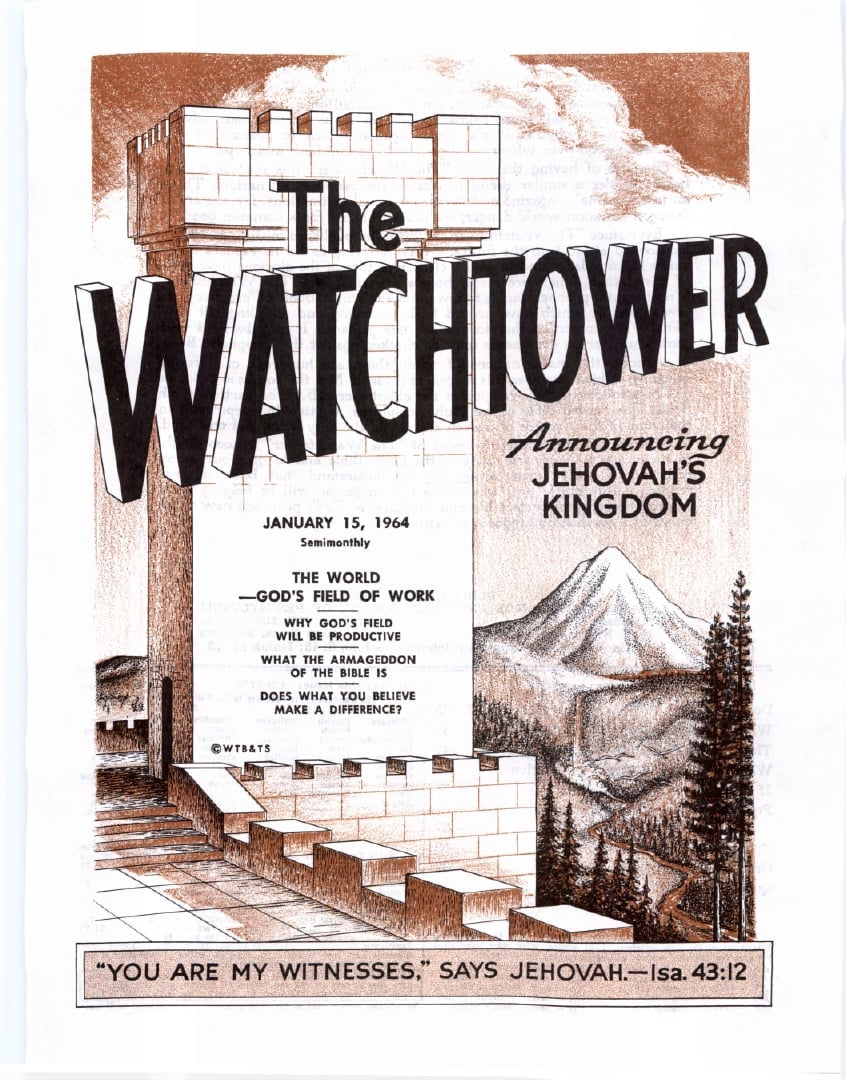
The Watchtower — January 15, 1964
Source: jw.org
Contents
Does What You Believe Make a Difference?
What the Armageddon of the Bible Is
The World—God’s Field of Work
Why God’s Field Will Be Productive
If Jesus Came Back
Persevering Despite Opposition Brings Rejoicing
Ephesus—the Great City of Asia
Graduation of Gilead’s 38th Class
Questions From Readers
Announcements
Does What You Believe Make a Difference?
Does What You Believe Make a Difference?
THERE are many things you could believe that really would not make any difference to your welfare. For example, you might believe that one color is more pleasing to the eye than another, and it would not affect your life to any degree. It would be a matter of personal taste.
However, what if you believed you could jump out of a high-flying airplane without a parachute to slow your descent? Ah, you say, that would make a difference, because believing such an absurd thing would affect your life, actually placing it in jeopardy. So you are careful to believe what is true where your life is concerned. You would be tolerant of the beliefs of others, but you would not make them your own if you felt your welfare was endangered by such beliefs.
Are you just as careful regarding your beliefs about your own relationship to God? How careful are you to ascertain with correctness what God requires of you? Do you have a sound basis for your beliefs about your place in God’s purposes? True, many say that what you believe along these lines does not matter, so long as you have some belief. But ask yourself this question: While what you believe may not matter to others, does it matter to God?
You acknowledge that it is dangerous for a person to entertain erroneous beliefs about “natural” laws, such as defying gravity by jumping out of an airplane without a parachute. These “natural” laws are really laws fixed by God. Should this not cause you to consider that it also would be dangerous to entertain erroneous beliefs regarding others of God’s laws for humans? If wrong views regarding “natural” laws can endanger one’s life, then surely wrong views regarding others of God’s laws for human creatures can be even more dangerous, since this could affect our eternal welfare.
Down through the centuries people have believed fantastic things about God and his purposes. They have conjured up myriads of gods and related beliefs. Yet the average person today would have difficulty naming even a few of the ancient gods and what they stood for. They have vanished with time because such existed in the imagination only, not in fact. The false gods of today that do not exist in actuality will likewise pass away in time. Only the Almighty God Jehovah and his purposes have remained consistent, unchangeable, reliable.
Recently an erroneous religious belief made a difference to a hospital patient. This patient had been in a deep coma for days. He was given the best of care. Then a staphylococcus infection developed on his chest and abdomen. Nobody could understand where the germs came from. Everything was thoroughly sanitary, and no other patient had such an infection. One day a skin specialist noticed the mother of the stricken man sprinkling something on his stomach. It was discovered that the mother had been regularly sprinkling “holy water” on her son, believing that this would help him get well. A doctor took a sample of this water and found it loaded with germs! When the sprinkling of “holy water” ended, so did the infection. (Life, Sept. 27, 1963) While the mother was no doubt sincere, still the practice had no force for good. It was not God’s way. It amounted to nothing more than superstition, and in this case it resulted in harm where good was intended.
Where our relationship to God is concerned, what we believe makes a big difference. In the days of Noah, more than 4,000 years ago, the overwhelming majority of mankind believed they could reject God’s ways and do as they pleased. The result was that “the badness of man was abundant in the earth and every inclination of the thoughts of his heart was only bad all the time. . . . And the earth came to be ruined in the sight of the true God and the earth became filled with violence.” (Gen. 6:5, 11) When God, through the righteously disposed man, Noah, warned that generation of their impending doom by means of a global flood, they did not believe it. What a difference this made in their lives! Because they refused to believe God and act on his word, they lost their lives in that great deluge. Noah and his family survived the end of that world because they believed God and acted on his word. It meant a great difference in their lives, for they were saved from that world disaster. It also made a great difference to the entire human family on earth today, for we are all the descendants of Noah and his family. The disbelievers were cut off in the Flood and had no further offspring.
Bible prophecy clearly indicates that we, too, live in a time of judgment and are near the end of this bad system of things. Jesus marked our time as the one that would see God cleanse wickedness from the earth as He did in Noah’s day. (Matt. 24:37-39) Whether you believe and act on this knowledge or not will make a tremendous difference. What difference? “I have put life and death before you, the blessing and the malediction,” is the way Jehovah stated it through his servant Moses. (Deut. 30:19) The difference is between everlasting life and everlasting death!
It is true that the majority of earth’s inhabitants do not believe that such a choice faces them, but neither did the people of Noah’s day. Those who scoff in disbelief forget something. As the apostle Peter stated: “According to their wish, this fact escapes their notice, . . . the world of that time suffered destruction when it was deluged with water.” (2 Pet. 3:5, 6) Just as surely as that ancient world ended by an act of God, so the present one will.
Do not be misled. What you believe regarding God and his purposes will make a great difference in your life. If you desire God’s blessings you will want to study his Word, the Bible, to ascertain his requirements for you. Then you will want to live your life in harmony with God’s expressed will, for “the world is passing away and so is its desire, but he that does the will of God remains forever.” (1 John 2:17) What a difference it will make for you to believe God’s ways!
What the Armageddon of the Bible Is
What the Armageddon of the Bible Is
DANGER lies in meaningless “wolf calls,” namely, warnings that have no basis in fact. If cries of “Fire! Fire!” are made without there being a fire, the frightful possibility remains that people will not respond when a true alarm is sounded. When warning signs and signals are obscured, muffled or misrepresented, the effect is often calamitous. “For truly,” said Paul, an apostle of Jesus Christ, “if the trumpet sounds an indistinct call, who will get ready for battle?” (1 Cor. 14:8) Such is the hidden danger behind the misuse of the word “Armageddon,” also known as “Har–Magedon.”
It is no secret that world statesmen, clergy and the public press use the word “Armageddon,” but it is just as obvious that few people know its Biblical meaning. The word itself has come to mean many things to many people, thus diminishing and obscuring its true significance. For example, the Akron Beacon Journal, October 9, 1961, under the editorial heading “The Armageddon Bomb” said: “It is possible that Russia is building up to the test of an ‘Armageddon’ or ‘Doomsday’ bomb, of a hundred megatons—equal to a hundred million tons of TNT.” The implication here is that “Armageddon” has to do with a man-made “doomsday” precipitated by the use of nuclear weapons. Nothing could be farther from the truth, yet it is surprising how many hold to this view, or slight variations of it.
For instance, after a speech on the retaliation doctrine by Russia’s Marshal Malinovsky, the New York Times, June 1, 1960, said that it had become supremely urgent to define the vertical borders of territorial air. “We cannot afford to drift toward Armageddon simply because nobody bothers to face the obvious problem,” the paper said. On October 30, 1961, Francis Cardinal Spellman of the Roman Catholic Church, according to the New York Herald Tribune, called “for prayers to spare the world from ‘thermonuclear Armageddon.’”
The Armageddon that these men fear, however, is not the Armageddon of the Bible. They fear extinction wrought by man.
In a similar vein, referring to the gigantic struggles between nations of men as Armageddon, various writers frequently use the term. For example, in the July 1962 issue of Readers Digest appeared an article entitled “Prelude to Armageddon.” It was a short story about approaching a point of no return from World War I. The Saturday Evening Post, April 20, 1963, featured a major excerpt from a novel by Leon Uris called “Armageddon.” This is a powerful story of the American occupation of Germany following World War II.
As confusing as are such opinions about Armageddon, there are still other opinions to add to the confusion. The Newport Daily News, September 21, 1960, for example, under the subheading “Road to Armageddon” stated: “The gathering of leaders of many nations of the world for the General Assembly of the United Nations sets the stage for Armageddon, the conflict between good and evil.”
From such reports one might be led to believe that Armageddon was being fought by member nations in the conference rooms of the United Nations and that these political powers are waging an ideological war against the forces of evil in the world for the good of all mankind. But the idea ignores the fact that the battle against evil has been going on since the appearance of “evil” in Eden. All these opinions tend to do one thing, namely, confuse men as to the true meaning and significance of the Armageddon mentioned in the Bible.
BEHIND THE WORD “ARMAGEDDON”
The word “Armageddon” is not an invention of the political rulers and kings of the earth. Knowingly or unknowingly, they have borrowed the word from God’s Word, the Bible. Even in the Bible it appears but once, and this is in the passage found at Revelation 16:13, 14, 16: “And I saw three unclean inspired expressions . . . They are, in fact, expressions inspired by demons and perform signs, and they go forth to the kings of the entire inhabited earth, to gather them together to the war of the great day of God the Almighty. . . . And they gathered them together to the place that is called in Hebrew Har–Magedon,” or, according to other translations, “Armageddon.”
What is this “Har–Magedon” or “Armageddon”? From the Scripture text just cited it is clear that the word refers to the symbolic place of an all-out battle in which the political rulers of the earth, under the inducement of invisible demon forces, are gathered together to fight, not against one another in a nuclear war, but against God the Almighty and his Messianic king, Christ Jesus. And because of its association with this symbolic place, the war itself has come to be called Armageddon.
But how can political kings and rulers wage a war against an invisible God? An understanding of the name “Armageddon” will help us to answer these questions. The name is of Hebrew origin and seems to mean “Mountain of Megiddo,” referring to the Hebrew fortress city of Megiddo. It thus becomes clear that it is closely associated with the territory of God’s people who were, in ancient times, the Hebrews. It was at Megiddo or nearby that decisive battles were fought. Here is where Joshua defeated the king of Megiddo. Here Judge Barak gained a victory over Canaanite King Jabin, and in this battle Heaven is said to have fought for the victory of God’s people. Here is where King Josiah was mortally wounded. So at Megiddo kings of the earth gathered for their showdown battles. They fought against the soldiers of Israel, but this was no more than an indirect way of challenging the sovereignty of Jehovah, Israel’s God.—Josh. 12:21; Judg. 4:12-24; 5:19-21; 2 Ki. 23:29, 30.
ATTACK BY GOG OF MAGOG
Further enlightenment on this matter is found in Ezekiel’s prophecy regarding the attack of Gog of Magog. Addressing himself to Satan the Devil, under the symbol of Gog, Jehovah points to the time and the place of the attack and says: “In the final part of the years you will come to the land of people brought back from the sword, collected together out of many peoples, onto the mountains of Israel, . . . even a land that has been brought forth from the peoples, where they have dwelt in security, all of them. And you will be bound to come up. Like a storm you will come in. Like clouds to cover the land you will become, you and all your bands and many peoples with you.”—Ezek. 38:8, 9.
Thus we see that, under the influence of Satan or Gog, the political rulers of the earth, unable to attack the invisible Messianic kingdom of God to show that they refuse to recognize and surrender to it, vent their anger on the only part of the Kingdom’s realm that they can touch, that is, the place, “the land” or the holy estate of spiritual Israel, God’s anointed witnesses here on earth. Ever since the time of Abel Jehovah’s witnesses have been objects of the hatred of men and nations, but this attack is something more than the persecution they have experienced until now. It is a final, all-out attempt to destroy them. When it comes these witnesses will not all be located at any specific geographical location on earth. Neither does the name “Armageddon” appear on any geographical map. It does not refer literally to the neighborhood of Megiddo, now in the territory of the Republic of Israel, but it refers symbolically to the place within the realm of the experiences of Jehovah’s witnesses on earth where the final war is to be fought.
Notice how Ezekiel’s prophecy describes the destruction of God’s wicked enemies that takes place: “And I will . . . bring you in upon the mountains of Israel. . . . On the mountains of Israel you will fall, you and all your bands and the peoples that will be with you. To birds of prey, birds of every sort of wing, and the wild beasts of the field I will give you for food.”—Ezek. 39:2-4.
There is a striking similarity between this and the apostle John’s vision of the battle of Har–Magedon: “I saw also an angel standing in the sun, and he cried out with a loud voice and said to all the birds that fly in midheaven: ‘Come here, be gathered together to the great evening meal of God, that you may eat the fleshy parts of kings and the fleshy parts of military commanders and the fleshy parts of strong men . . . of freemen as well as of slaves and of small ones and great.’ . . . And all the birds were filled from the fleshy parts of them.”—Rev. 19:17-21.
THOSE INVOLVED IN THE FIGHT
Did you notice who are the ones who are reduced to mere carcasses for the birds of prey to feed on? They are the “kings,” “military commanders” and “strong men,” ‘freemen as well as slaves and small ones and great.’ This narrows the destruction of Har–Magedon down to the political kings and rulers of the inhabited earth and those who support them.
So it is vital for every person on the face of the earth to be alert, if he does not want to be numbered among those who will go down in destruction in “the war of the great day of God the Almighty.” One’s responding to the propaganda that teaches one to put confidence in the kingdoms of men instead of the kingdom of God means that one is being guided by “expressions inspired by demons.” One who heeds the urgings of human leaders who encourage one to be active in the affairs of the world, a part of it, so showing that one is on friendly terms with it, is actually being alienated from Christ and becomes an enemy of God. In unmistakable terms Jesus said of his followers: “They are no part of the world.” And the disciple James wrote under inspiration: “Whoever . . . wants to be a friend of the world is constituting himself an enemy of God.”—Rev. 16:13, 14; John 17:14; Jas. 4:4.
For those who thus align themselves against Jehovah God and his kingdom there is no hope for survival. While God may well cause the nations to turn against one another, resulting in much slaughter with their own weapons, as he did with the armies of Ammon, Moab and Mount Seir when they came up against his people in ancient times, he also has at his disposal all the forces of nature. These, too, he will unleash against his foes. And his appointed executioner Jesus Christ, with the angelic forces of heaven, will himself pursue the battle until the entire visible political organization under the control of Satan the Devil, “the god of this system of things,” with all its military and civilian supporters, is completely destroyed from the face of the earth.—2 Chron. 20:1-30; Judg. 5:19-21; Job 38:22, 23; 2 Cor. 4:4.
But does not Armageddon also include the destruction of the false religious element here on earth? No, it does not. As a reading of Revelation chapters 17-19 shows, this is something that will have already been taken care of in the period immediately before Har–Magedon begins. The kings of the earth, symbolized by the “ten horns” of the wild beast of Revelation chapter 17, will turn on the harlotrous system of Babylonish religion and “these will hate the harlot and will make her devastated and naked, and will eat up her fleshy parts and will completely burn her with fire.” (Rev. 17:16) This takes place before the kings make their Armageddon war against the representatives of God’s kingdom on earth. In fact, their pursuit thereafter on to Har–Magedon is nothing more than a demonized attack against anything that stands in the way of their selfish aims to perpetuate themselves in national governments, political systems and international alliances. So, having rid themselves of the religious harlot, they are lured on to the attack against the Messianic kingdom of God, which they refuse to recognize as the rightful government over earth. The Kingdom preaching of Jehovah’s witnesses becomes the object of their wrath. This attack means war, “the war of the great day of God the Almighty,” Har–Magedon.
What about Satan and his demons? Will they be killed or abyssed at the battle of Har–Magedon? No, this is something that comes after the battle of Har–Magedon is over. Then it is that the Angel of angels, Christ Jesus, comes “down out of heaven with the key of the abyss and a great chain in his hand” to seize Satan and his demons and hurl them into a state of oblivion. Having witnessed first the destruction of the worldwide empire of false religion, then Har–Magedon from its start to its finish, they will be severely vexed through the humiliation of seeing that the apparently defenseless worshipers of Jehovah whom their human puppets sought to wipe out are the only ones left remaining in the earth.—Rev. 20:1-3.
It is among these worshipers of Jehovah that all lovers of righteousness want to be, and it is for this reason that we must understand what Armageddon really is and avoid the “inspired expressions” that endeavor to align men with the enemies of God at that universal war. False conceptions with regard to man’s immediate future can lead only to disaster. Watch for the outworking of God’s prophecies regarding the Armageddon of the Bible and work in harmony with his will for survival into a new order where “righteousness is to dwell.”—2 Pet. 3:13.
The World—God’s Field of Work
The World—God’s Field of Work
“The field is the world.”—Matt. 13:38.
1. (a) Of what is the entire human family a part? (b) Whose field of cultivation is it, and why is it good to give consideration to it at this time?
DID you know that you are part of a field that is under cultivation? Whether you believe it or not, you are, just as certainly as you are part of the human family. This cultivation is not part of a selfish scheme in order to exploit you in some such sort of way as the imperial powers of this earth have made selfish gain out of the people whom they have subjected and governed as colonies. The cultivation that we will here examine is for our highest good for all time to come. It is God’s cultivation, which he sent his beloved Son to undertake and accomplish, sending him with the pure motive of love. The Son as a fellow worker with God described this work of cultivation by means of a parable.
2. (a) What illustration of Jesus is it now timely to consider? (b) Show the wisdom of the householder in not letting his slaves immediately pluck the weeds in his field of wheat.
2 In this parabolic illustration the Son, Jesus Christ, likened himself to a householder of nineteen hundred years ago who sowed good seed in his field. By night an enemy sneaked onto the field and oversowed it with weeds. When the seeds began to grow, the presence of the weeds was discovered. The householder would not let his slaves at once remove the weeds for fear that while doing so they might also uproot much of the wheat and thus cause a loss. He waited till harvest, at which time the difference between the weeds and the wheat would be unmistakably plain. Then he sent the slaves out to pluck out the weed stalks by hand, leaving the wheat undisturbed in the field. The weeds were bound in bundles to be burned, so that the work of the enemy came to nothing. After that the householder had his slaves gather the pure wheat into his storehouses, free from all poisonous weeds.—Matt. 13:24-30.
3, 4. To the disciples’ inquiry what explanation of this illustration did Jesus give?
3 Not even the disciples of Jesus Christ understood the prophetic meaning of this illustration, and so they asked him privately for an explanation. We quote his explanation as it is translated into English in the Authorized or King James Version of the Bible, now more than 350 years old, which calls the weeds “tares”:
4 “He that soweth the good seed is the Son of man; the field is the world; the good seed are the children of the kingdom; but the tares are the children of the wicked one; the enemy that sowed them is the devil; the harvest is the end of the world; and the reapers are the angels. As therefore the tares are gathered and burned in the fire; so shall it be in the end of this world. The Son of man shall send forth his angels, and they shall gather out of his kingdom all things that offend, and them which do iniquity; and shall cast them into a furnace of fire: there shall be wailing and gnashing of teeth. Then shall the righteous shine forth as the sun in the kingdom of their Father.”—Matt. 13:37-43, AV.
5. What are the difficulties encountered when reading this illustration from the Authorized Version?
5 According to the way that the Authorized or King James Bible translates the parable “the field is the world” and “the harvest is the end of the world” and “so shall it be in the end of this world.” From this translation a person who does not know the original Greek of the Christian Scriptures of the Bible would understand that at the harvesttime the “field,” which is “the world,” is to come to an end, evidently by fire, because fire is mentioned as an agency of destruction. From this the reader of the Bible authorized by King James in 1611 might understand that the earth underneath our feet is to be destroyed by a worldwide fire, and so have a fiery end, like those tares or weeds.
6, 7. However, what did Jesus say was destroyed, and what continued to remain?
6 However, in the illustration Jesus did not say that the householder burned up his field and ruined himself as a farmer, either before or after the genuine wheat was gathered into his storehouses. It was only the tares or weeds that were burned, and this only after they had been plucked out of the field.
7 Hence the field, which pictures “the world,” remained for the householder’s further service, although some changes took place in that field. The “world,” pictured by the field, remains, but in a cleansed condition. The “harvest,” which comes at the end of the growing season, does not therefore picture the end of that “field” symbolizing the world. According to the Authorized Bible Version of King James of England there seem to be contradictions in Jesus’ explanation of his illustration. But Jesus did not contradict himself in the original language of the Bible. The difficulty was created by King James’ Bible translators.
8. What now helps us to understand this parable of Jesus?
8 The problem is easily solved when we go back to the original language by means of various Bible helps and find out that the two worlds are not one and the same thing. In the original Greek text of the Bible the word for the “world” symbolized by the “field” is kósmos, but the word for “world” the end of which comes at harvesttime is aión. Never in the Christian Greek Scriptures do we read of the end, conclusion or consummation of the kósmos; but the end, conclusion or consummation is what befalls the aión. We read, in so many words, of only the end of the aión.
9, 10. Cite how different Bible translations render Matthew 13:38, 39.
9 The difference between kósmos and aión is shown in some of our modern Bible translations that translate kósmos and aión as being different.a For example, the New English Bible of 1961 reads: “The field is the world; . . . The harvest is the end of time. . . . so at the end of time the Son of Man will send out his angels.”—Matt. 13:38-41.
10 The Revised Standard Version of 1952 translates the same portions as follows: “The field is the world, . . . the harvest is the close of the age, . . . so will it be at the close of the age. The Son of man will send his angels.” Alexander Campbell’s translation, made in 1835, reads: “The field is the world: . . . The harvest is the conclusion of this state; . . . so shall it be at the conclusion of this state. The Son of Man will send his angels.” In agreement with this last-quoted translation the New World Translation of the Holy Scriptures, of 1961, reads: “The field is the world; . . . The harvest is a conclusion of a system of things, . . . so it will be in the conclusion of the system of things. The Son of man will send forth his angels.”
11. Why has the King James Version Bible caused confusion in the use of the English word “world”?
11 There is no contradiction put into Jesus’ original words by such modern translations. By their more accurate renderings they do not leave the English reader to imagine that the inspired Christian writers used only one Greek word for our English word “world” in the King James Version Bible. Even in the inspired Hebrew Scriptures of the Bible there are five distinct Hebrew wordsb that the King James Version Bible translates by the one English word “world.” In the inspired Christian Greek Scriptures there are four distinct Greek wordsc that the King James Version renders into English as “world.” Any sensible person can see that the result of this would be religious confusion of mind. With justice to the Bible, let us clear up some of this confusion.
“THREE WORLDS”
12, 13. On what Bible translation was the book Three Worlds based?
12 Eighty-seven years ago (or, in 1877) there was published in Rochester, New York, under the joint authorship of N. H. Barbour and C. T. Russell, a book of 197 pages the title page of which read as follows:
THREE WORLDS, and The Harvest of this World.—A Brief Review of the Bible Plan of Redemption, Which Spans Three Worlds: “The World That Was,” “The World That Now Is,” and “The World to Come;” with the Evidences That We Are Now in the “Time of Harvest,” Or, Closing Work of the Gospel Age.
13 The wording of that title page was based on the King James Bible translation, in which we read, in 2 Peter 3:6, 7: “The world that then was, being overflowed with water, perished: but the heavens and the earth, which are now, by the same word are kept in store, reserved unto fire against the day of judgment and perdition of ungodly men.” In 2Pe 3 verse six the Greek word translated “world” is kósmos, and the apostle Peter does not use that word again in the remaining twelve verses of his letter, even when speaking about the “heavens and the earth, which are now,” and the “new heavens and a new earth, wherein dwelleth righteousness.”—2 Pet. 3:13.
14. How does the Authorized Version translate the Greek word aión at Galatians 1:4 and Matthew 12:32?
14 However, in Galatians 1:4 (AV), we read: “Who [that is, our Lord Jesus Christ] gave himself for our sins, that he might deliver us from this present evil world.” Here the word translated “world” is that other Greek word, aión. Also, in Matthew 12:32 (AV) Jesus says: “Whosoever speaketh a word against the Son of man, it shall be forgiven him: but whosoever speaketh against the Holy Ghost, it shall not be forgiven him, neither in this world, neither in the world to come.” There again, the word translated “world” is that other Greek word aión.
15. Why did C. T. Russell evidently choose the title “The Divine Plan of the Ages” for his book published in 1886?
15 So, in the Scripture verses to which the title page of the book Three Worlds refers, only one kósmos is referred to and two aiónes are referred to, rather than three cosmoses. For that reason, doubtless, the book that was later (in 1886) brought out by the aforementioned C. T. Russell, by himself alone, was entitled, not The Divine Plan of the Worlds, but “The Divine Plan of the Ages,” and its chapter four was entitled “The Epochs and Dispensations Marked in the Development of the Divine Plan.” It spoke of the “Three Great Epochs of the World’s History” and “Their Distinctive Features” and “Subdivisions of Three Great Epochs.” (Page 65) So this book, which showed consideration for the original Greek, chose to speak of Ages or Epochs, with their respective features and dispensations, rather than to speak of “worlds.” This avoided confusion of ideas.
16. Define the word aión.
16 Today also we desire to do away with any mental confusion as regards God’s Word, the Holy Bible. The quotations that we made a little previous to this (page 42, paragraphs 8, 9, 10) revealed to us that modern Bible translators consider the Greek word aiónd to mean “time,” “age,” “state,” or “system of things.” The word does not mean mere time (there is another Greek word for that), but means rather a duration or period of time, short or long, in an unbroken continuance. Hence, as one exhaustive Greek-English Lexicon defines aión, it means “space of time clearly defined and marked out, epoch, age,” and it came to mean also “lifetime, life,” or “age, generation.” Now, we know that an age or epoch can begin and it can end or it can even go on forever, according to the will of God. So an age could be endless, though having a beginning.
17. What two examples are cited to show the time meaning of the word aión?
17 As having regard for time we find the word aión used in Mark 3:29, where Jesus Christ said to his critics: “Whoever blasphemes against the holy spirit has no forgiveness forever [literally, to (for) the age], but is guilty of everlasting [aionian, agelong, perpetual, eternal] sin.” That would mean no forgiveness now or in any time to come, because of a sin that can never be wiped out. Later, when Jesus cursed the fig tree that gave the appearance of bearing fruit but that had produced none, what did he say to that tree? According to Matthew 21:19 he said: “Let no fruit come from you any more forever [literally, to (for) the age].” The next day when he and his disciples passed by they found the fig tree to be withered. (Mark 11:12-14, 10-22) That fig tree did not remain fruitless for only a period of time; but, because of what Jesus said to it, it remained fruitless for all time. As fruit trees were taxed over in the Near East at that time, the withered fig tree was without doubt chopped down to become untaxable. So the time of its fruitlessness was endless, truly forever. Thus an age can be endless.
18. How was this same word used by the angel announcing the birth of Jesus to Mary?
18 As a further illustration of this, the angel Gabriel said to Mary the Jewish virgin: “You will conceive in your womb and give birth to a son, and you are to call his name Jesus. This one will be great and will be called Son of the Most High; and Jehovah God will give him the throne of David his father, and he will rule as king over the house of Jacob forever [literally, to (for) the ages], and there will be no end of his kingdom.” (Luke 1:26-33) The fact that there would be no end to his kingdom meant that he would reign over the house or nation of Jacob forever, for all time.
STATE; SYSTEM OF THINGS
19, 20. (a) To what else may the word aión refer? (b) Therefore, explain the true meaning of Galatians 1:4 with the aid of the New World Translation.
19 An age, an epoch, a particular space of time, may be marked by certain features that exist during its continuance, or be marked by a certain current of affairs, or a consistent state of things, or a particular system of things. Hence when these end, the age or epoch ends. The Greek word aión may thus come to have reference more to the state or system of things that exists than to the matter of time. For example, in Galatians 1:4, according to the King James Version Bible, the apostle Paul writes: “Who gave himself for our sins, that he might deliver us from this present evil world, according to the will of God and our Father.” Instead of the expression “this present evil world,” the Revised Standard Version Bible says “the present evil age.” However, the apostle Paul and the Galatian Christians to whom he wrote continued living in that age, and we today are still living in it. It was therefore not just the age or particular space of time from which Jesus Christ delivered Christians by the sacrifice of himself; it must have been, rather, from the state or system of things existing during this time period that he delivered Christians who follow him.
20 For this reason the New World Translation of the Holy Scriptures renders Galatians 1:4 more factually by translating it this way: “He gave himself for our sins that he might deliver us from the present wicked system of things according to the will of our God and Father.” Although they still live during this age or period of time that began after the flood of Noah’s day, the true, dedicated followers of Jesus Christ are no part of the system of things that prevails during this age, because they have been delivered from the wicked system by the sin-removing sacrifice of Jesus Christ. They no longer lie under the power of the present wicked system of things, but are spiritually free to do God’s will.
21. What rule, then, does the New World Translation follow, and how is this shown at Luke 20:34, 35?
21 Accordingly, where the distinguishing features rather than the time are the more prominent thought in a particular Bible verse, the New World Translation renders the Greek aión as “system of things,” which imparts more exact meaning to the English translation. For example, when talking about what opportunities the dead people will have in the resurrection to life on earth under God’s kingdom. Jesus used the word aión and said: “The children of this system of things marry and are given in marriage, but those who have been counted worthy of gaining that system of things and the resurrection from the dead neither marry nor are given in marriage.” (Luke 20:34, 35) So in this present time there is “this system of things” according to which men and women can marry, but after this there is “that system of things” in the future time when the resurrection of the human dead will occur. So, then, this system of things will end, but there will be a next system of things, a new system of things, that will follow it.
22. How is it shown that aión refers to the “distinguishing features rather than the time” in Romans 12:2; 1 Timothy 6:17; 2 Timothy 4:9, 10?
22 To the Christians at Rome the apostle Paul wrote: “Quit being fashioned after this system of things [rather than this age or time period], but be transformed by making your mind over, that you may prove to yourselves the good and acceptable and perfect will of God.” (Rom. 12:2) In harmony with this advice Paul wrote the Christian overseer Timothy and said: “Give orders to those who are rich in the present system of things not to be high-minded, and to rest their hope, not on uncertain riches, but on God, who furnishes us all things richly for our enjoyment.” A Christian by the name of Demas did not follow this advice, and, in his last inspired letter, Paul was obliged to write to Timothy this information: “Do your utmost to come to me shortly. For Demas has forsaken me because he loved the present system of things [not the present age, but its system of things], and he has gone to Thessalonica.” He thus abandoned Paul as a prisoner in Rome.—1 Tim. 6:17; 2 Tim. 4:9, 10.
23, 24. (a) In what sense is aión used at Hebrews 11:3? (b) What has Jehovah therefore done for the good of his servants?
23 Another Bible verse where, not the space of time itself, but the distinguishing features of a time period are evidently meant is Hebrews 11:3. Hence the New World Translation puts the verse into English this way: “By faith we perceive that the systems of things were put in order by God’s word, so that what is beheld came to be out of things that do not appear.”—See John Parkhurst’s A Greek and English Lexicon of the New Testament, under Aión, page 17, column 2, under section VII. (London edition of 1845)
24 It was not a case where God lined up one time period after another, one age after another, but he had in mind the visible distinguishing features that would exist by his permission or his arrangement. Hence he had systems of things in mind. He did not leave his servants on earth in total ignorance of these systems of things and the order in which they would come. By his spoken word and in his written Word he gave clues concerning these successive systems of things, each one of which was adjusted to his purpose. But to perceive those systems of things we need not just to hear what God says or to read the Holy Bible; we need also to exercise faith and believe in them, and then shape our personal lives in harmony with them. That is what men of faith, from Abel onward, did. So the things that do not appear to faithless men, these men of faith foresaw or even saw ‘come to be.’ They won God’s approval.—Heb. 11:2, 6.
25-27. (a) Who is in control of the present wicked “system of things,” and what proof have we for saying this? (b) Against whom, therefore, does the Christian have to fight?
25 This present system of things is what the apostle Paul calls it, “wicked.” This is because those who control it visibly and invisibly are likewise wicked. It has selfish people who are “wiser” oftentimes in a materialistic way than the “sons of the light” are. (Luke 16:8;1 Cor. 3:19) It has its writers and debaters with their worldlywise arguments, and also princes or rulers who do not know God’s wisdom as expressed in his sacred secret. (1 Cor. 1:20; 2:6-8) But behind these visible figures stands an invisible intelligence who blinds them religiously and who tries to tempt and destroy true Christians who are not part of the present system.
26 With regard to that blinding influence Paul wrote: “If, now, the good news we declare is in fact veiled, it is veiled among those who are perishing, among whom the god of this system of things has blinded the minds of the unbelievers, that the illumination of the glorious good news about the Christ, who is the image of God, might not shine through.” (2 Cor. 4:3, 4) Jehovah God, who sent the good news, is the God of his people on earth during this age or period of time, but he is not the God of this system of things. Satan the Devil is its god. He has demon angels associated with him in the invisible realm, and against these the Christians who do not conform themselves to this system have to fight.
27 Just as Paul writes, “We have a fight, not against blood and flesh, but against the governments, against the authorities, against the world rulers [cosmocrats] of this darkness, against the wicked spirit forces in the heavenly places.” To fight these we have to put on the full suit of armor from God.—Eph. 6:11-13.
28. What wise counsel does Paul give about keeping separate from the wicked “system of things,” and what awaits those keeping separate?
28 Satan the Devil is the disobedient spirit who wields invisible authority superior to that of the men who disobey God. We cannot conduct ourselves according to the system that now visibly exists but must live for the one to come by God’s undeserved kindness. To enlarge our appreciation of this, the apostle Paul writes: “You at one time walked according to the system of things [aión] of this world [kósmos], according to the ruler of the authority of the air, the spirit that now operates in the sons of disobedience. But God, who is rich in mercy, for his great love with which he loved us, made us alive together with the Christ, even when we were dead in trespasses—by undeserved kindness you have been saved—and he raised us up together and seated us together in the heavenly places in union with Christ Jesus, that in the coming systems of things there might be demonstrated the surpassing riches of his undeserved kindness in his graciousness toward us in union with Christ Jesus.”—Eph. 2:2, 4-7.
29. (a) To what do we then refer when we speak of a Nev World society? (b) Who makes this new system of things, and through whom is it made?
29 By faith, therefore, we look forward to the incoming of a new system of things; and when we use the long-time common expression “the new world” and talk about ourselves as a New World society of Jehovah’s witnesses, we really have reference to this coming new system of things, this new order of things, according to the Scriptural statement of matters in the original Greek. That new order is one of those systems that God makes by means of his only-begotten Son Jesus Christ, by whom also he spoke to mankind nineteen centuries ago. When Jesus spoke, it was the crowning point of God’s delivering his message of salvation to mankind, as Hebrews 1:1, 2 points it up by saying: “God, who long ago spoke on many occasions and in many ways to our forefathers by means of the prophets, has at the end of these days spoken to us by means of a Son, whom he appointed heir of all things, and through whom he made the systems of things.”
30. (a) How does the Bible translation by Alexander Campbell accurately show what the disciples meant when asking Jesus about his presence and a certain destruction? (b) What phraseology does the New World Translation use?
30 It was not concerning the destruction of our earthly globe that the apostles of the Son of God asked him after he had told them about the coming destruction of the temple in the holy city of Jerusalem. The New Testament translation by Alexander Campbelle (of 1835) keeps us from wrongly thinking about the destruction of our earth by rendering Matthew 24:3 in this way: “As he sat upon the Mount of Olives, his disciples addressed him privately, saying, Tell us, when will this happen; and what will be the sign of your coming, and of the conclusion of this state?” And Jesus’ words calling for missionary activity in Matthew 28:19, 20, Mr. Campbell renders this way: “Go, convert all the nations, immersing them into the name of the Father, and of the Son, and of the Holy Spirit, teaching them to observe all the things which I have commanded you; and behold! I am with you always, even to the conclusion of this state.” In place of the expression “the conclusion of this state,” the New World Translation uses “the conclusion of the system of things.” We now live in the time of that “conclusion.” This is the harvesttime spoken of by Jesus in Matthew 13:39.
31, 32. What blessings await those coming away from the present system of things?
31 We are not only in the conclusion of the old but also at the threshold of the new. It is worth leaving everything of the present period of time to gain life in the coming system of things. Jesus told his apostles who had left all to follow him: “No one has left house or brothers or sisters or mother or father or children or fields for my sake and for the sake of the good news who will not get a hundredfold now in this period of time [this kairós], houses and brothers and sisters and mothers and children and fields, with persecutions, and in the coming system of things [aión] everlasting life.” (Mark 10:29, 30; Luke 18:29, 30) That life will be in association with Jesus Christ, who will then have a position and name above all other creatures. In that regard the apostle Paul says of Jesus:
32 God “raised him up from the dead and seated him at his right hand in the heavenly places, far above every government and authority and power and lordship and every name named, not only in this system of things, but also in that to come.”—Eph. 1:19-21.
33. To whom can we give glory for this coming system of things?
33 For the providing of this wonderful coming new system of things under Christ, we have Jehovah God to thank, for he has made this his eternal purpose. We can join the apostle Paul in ascribing glory to this wonderful, loving God, in these words: “Now to the one who can, according to his power which is operating in us, do more than superabundantly beyond all the things we ask or conceive, to him be the glory by means of the congregation and by means of Christ Jesus to all generations forever and ever [literally, of the age of the ages]. Amen.”—Eph. 3:11, 20, 21.
[Footnotes]
Even the Latin Vulgate shows the difference between the two Greek words by rendering kósmos as mundus and aión as saeculum. But, in spite of this, the English Douay Version Bible, which is a translation of the Latin Vulgate, renders both words as “world.”
The five Hebrew words are erets, hhedel, hheled, olam and tebel.
The four Greek words are aión, ge, kósmos and oikouménē.
The Greek word aión is generally understood to be derived from aeí, meaning “forever; ever.” However, page 202 of the book New Testament Synonyms, by Archbishop R. C. Trench (1901), says: “We must reject the etymology of aion which Aristotle (De Caelo 1. 9) propounds: the derived name was taken from the word aei. It is more probably connected with áo, áemi, to breathe. Like kosmos it has a primary and physical and then, superinduced on this, a secondary and ethical, sense, in its primary, it signifies time, short or long, in its unbroken duration; oftentimes in classical Greek the duration of a human life . . . but essentially time as the condition under which all created things exist, and the measure of their existence; . . . Thus signifying time, it comes presently to signify all which exists in the world under conditions of time; . . . and then, more ethically, the course and current of this world’s affairs.”
Alexander Campbell is known as the founder of the religious denomination known as the Disciples of Christ or “Campbellites.”
[Picture on page 44]
Fruitless Forever (Aión)
[Picture on page 45]
Not Fashioned After This System of Things (Aión)
Why God’s Field Will Be Productive
Why God’s Field Will Be Productive
1. What other Greek word now comes in for discussion, and how frequently is it used in the Christian Greek Scriptures?
WITH now a more correct appreciation of the word aión used by the inspired writers of the Christian Greek Scriptures, we can better distinguish between that word and the other Greek word that we have under study, namely, kósmos. This word is used 187 times by the inspired writers, mainly by the apostle John, and in every case the King James Version translates it as “world” except in one case, namely, in 1 Peter 3:3, where kósmos is translated “adorning.” The same thing is true with the New World Translation: 186 times it renders kósmos by the English word “world,” and once, in 1 Peter 3:3, “adornment.” Hence the word cosmetic (kosmétikos).
2. Why is the expression “new kósmos” never used in the inspired Scriptures?
2 It is interesting to note that the inspired writers speak of new heavens and a new earth and New Jerusalem, but they never use the expression new kósmos. The reason for this dawns upon us when we discern that in the Bible the word kósmos implicates or revolves around the human family, the race of mankind, the people, and we are not going to have a new human family here upon this earth. Mankind is redeemed. God’s Son Jesus Christ died as a perfect human sacrifice in order to buy back for mankind what the perfect Adam in Eden lost for us by sin.—2 Pet. 3:13; Rev. 3:12; 21:1, 2.
3. How is kósmos now defined?
3 As Peter’s use of the word, in 1 Peter 3:3, shows, the simplest meaning of kósmos is “arrangement,” also “adornment, beauty, ornament,” because something well arranged has a beauty to it. In agreement with this, in the Christian Greek Scriptures, kósmos many times means the arrangement as it is connected with mankind as a whole. So, at times, the inspired writers use kósmos to mean that framework of surroundings, that arrangement of things, into which man is born and in which he exists and to which he has to give a relative consideration and respect. This framework of things that surround and affect mankind has been built up here on earth. Now note some uses of the word kósmos in this second sense.
4-6. What is the meaning of kósmos in John 16:21; 1 Corinthians 14:10, 11 and 1 John 3:17?
4 Jesus Christ, just before entering into his terrible sufferings, said to his faithful apostles: “A woman, when she is giving birth, has grief, because her hour has arrived; but when she has brought forth the young child, she remembers the tribulation no more because of the joy that a man has been born into the world [kósmos].” (John 16:21) This does not mean primarily that the man was born into the human family but means the framework of human conditions in which the newborn child will exist from then on.
5 The apostle Paul, when advising Christians at their meetings not to use speech that is not understandable to those listening, said: “It may be that there are so many kinds of speech sounds in the world, and yet no kind is without meaning. If, then, I do not understand the force of the speech sound, I shall be a foreigner to the one speaking, and the one speaking will be a foreigner to me.” (1 Cor. 14:10, 11) So, within this framework or arrangement of things and circumstances that surrounds mankind, especially now with 2,796 languages and dialects, there are many kinds of speech sounds besides other kinds of sound, say, by musical instruments. But they are all common to human experience.
6 In giving an illustration of a lack of Christian love, the apostle John wrote: “But whoever has this world’s means for supporting life and beholds his brother having need and yet shuts the door of his tender compassions upon him, in what way does the love of God remain in him?” (1 John 3:17) To show practical love the Christian, if he has the means for supporting life as provided or made possible by this world in which he and his brother live, should share them with his needy brother.
7. Whom did Jesus say was the ruler of this external framework of things, and how is this fact supported in Luke 4:5-8?
7 Jesus Christ exposed who the unseen individual who rules this external framework of things affecting all mankind is, when he said shortly before he was betrayed into the hands of his foes: “Now there is a judging of this world; now the ruler of this world will be cast out. I shall not speak much with you any more, for the ruler of the world is coming. And he has no hold on me. . . . the ruler of this world has been judged.” (John 12:31; 14:30; 16:11) The unseen ruler of this world had no hold on Jesus at the close of his earthly work even as he got no hold on Jesus when he was preparing to begin his ministry as the Messiah or Christ. At that time Jesus was finishing a fast of forty days in the wilderness. “So he brought him up and showed him all the kingdoms of the inhabited earth in an instant of time; and the Devil said to him: ‘I will give you all this authority and the glory of them, because it has been delivered to me, and to whomever I wish I give it. You, therefore, if you do an act of worship before me, it will all be yours.’” Thus Satan the Devil declared himself to be the invisible “ruler of this world,” but Jesus refused to bargain with him.—Luke 4:5-8.
8. How was Jesus able to conquer the world as a man?
8 Jesus as a perfect man in the flesh overcame this world, before he got out of it. Concerning his last passover supper with his apostles, we read: “Now, because he knew before the festival of the passover that his hour had come for him to move out of this world to the Father,” Jesus proceeded to wash their feet. (John 13:1-5) Farther along in the night he said to them: “I came out from the Father and have come into the world. Further, I am leaving the world and am going my way to the Father. . . . In the world you will have tribulation, but take courage! I have conquered the world.” (John 16:28, 33) In himself he illustrated what he had told them earlier: “He that is fond of his soul destroys it, but he that hates his soul in this world will safeguard it for everlasting life.” (John 12:25) By sacrificing his human life or soul Jesus proved worthy of immortal life with his heavenly Father.
9. What is a second definition of kósmos, and how is this shown at Luke 12:29, 30?
9 Other Bible verses could be commented on to illustrate the use of kósmos to mean the external framework surrounding all mankind into which he has come by birth under the present circumstances. (Matt. 16:26; 24:21; John 18:36; Rom. 5:12) But we pass on to the use of it in another sense, a Christian use that suggested an idea that must have been very strange to the pagans or heathens. That novel use of kósmos is the making of it to mean the mass of mankind as apart from the Christian congregation and in opposition to it. Such meaning is seen in Jesus’ telling his disciples not to worry about their material needs and then adding: “For all these are the things the nations of the world are eagerly pursuing, but your Father knows you need these things.”—Luke 12:29, 30.
10. Illustrate with suitable Bible texts this second definition of the word kósmos.
10 Contrasting that world and his disciples, Jesus said: “The spirit of the truth, which the world cannot receive, because it neither beholds it nor knows it. You know it, because it remains with you and is in you. A little longer and the world will behold me no more, but you will behold me.” (John 14:17, 19) He forewarned them of the world’s hatred, saying: “If the world hates you, you know that it has hated me before it hated you. If you were part of the world, the world would be fond of what is its own. Now because you are no part of the world, but I have chosen you out of the world, on this account the world hates you.” (John 15:18, 19; 7:7; 1 John 3:13) In his final prayer with his apostles he said to God: “I make request, not concerning the world, but concerning those you have given me; because they are yours. I have given your word to them, but the world has hated them, because they are no part of the world, just as I am no part of the world.”—John 17:9, 14.
11. How do Paul, James and John show kósmos to have the meaning given it in paragraph nine?
11 Because the world was estranged from God and hostile to His people, the apostle Paul wrote: “God was by means of Christ reconciling a world to himself, not reckoning to them their trespasses, and he committed the word of the reconciliation to us. We are therefore ambassadors substituting for Christ, as though God were making entreaty through us. As substitutes for Christ we beg: ‘Become reconciled to God.’” (2 Cor. 5:19, 20; 7:10) The disciple James also gives us this warning against people alienated from God: “The form of worship that is clean and undefiled from the standpoint of our God and Father is this: to look after orphans and widows in their tribulation, and to keep oneself without spot from the world.” “Adulteresses, do you not know that the friendship with the world is enmity with God? Whoever, therefore, wants to be a friend of the world is constituting himself an enemy of God.” (Jas. 1:27; 4:4) The reason for this the apostle John makes clear to us by saying: “We know we originate with God, but the whole world is lying in the power of the wicked one.” (1 John 5:19) We should not love it.—1 John 2:15-17.
THE FIELD FOR GOD’S WORK
12. Give the third definition of kósmos, and how does John 1:9, 10, 29 point up this definition?
12 A third use of the Greek word kósmos is that which means just the people themselves, the entire body of them as one family, all the human kind on earth, all human creatures, apart from their moral condition or course of life, but just as people, God’s creatures. From this standpoint John 1:9, 10 says: “The true light that gives light to every sort of man was about to come into the world. He was in the world, and the world came into existence through him, but the world did not know him.” From this standpoint, too, John the Baptist could point to Jesus Christ and cry out: “See, the Lamb of God that takes away the sin of the world!”—John 1:29; 1 John 2:2.
13. (a) Having this definition in mind reading John 3:16, 17, explain how the Samaritans of Sychar felt about Jesus. (b) Of which world would Jesus and then his disciples be the light?
13 Having reference to the people living within the present arrangement, Jesus said to Nicodemus a Jewish ruler: “God loved the world so much that he gave his only-begotten Son, in order that everyone exercising faith in him might not be destroyed but have everlasting life. For God sent forth his Son into the world, not for him to judge the world, but for the world to be saved through him.”(John 3:16, 17) This was the way that the Samaritans of the city of Sychar looked at the matter, for, after Jesus had confessed to the Samaritan woman that he was the Messiah or Christ and after those Samaritans themselves had heard him talk, they said: “We know that this man is for a certainty the savior of the world.” He was the savior, not of the Jews only, but also of the Samaritans and other races. (John 4:42) In keeping with that fact Jesus publicly said before the Jews: “I am the light of the world. He that follows me will by no means walk in darkness, but will possess the light of life.” “As long as I am in the world, I am the world’s light.” (John 8:12; 9:5) In turn, his disciples must be the light of the world.—Matt. 5:14-16; Phil. 2:15.
14. What did Peter write about Jesus as the sacrificial lamb?
14 Regarding Jesus’ sacrifice of himself as a lamb the apostle Peter wrote: “You were delivered . . . with precious blood, like that of an unblemished and spotless lamb, even Christ’s. True, he was foreknown before the founding [Greek, katabolé] of the world, but he was made manifest at the end of the times for the sake of you.”—1 Pet. 1:18-20.
15, 16. (a) When, particularly, did the “founding of the world” take place? (b) How did Jesus show this to be the case?
15 Jesus was made manifest as the Messiah or Christ in the years 29-33 (A.D.), “at the end of the times,” not at the “founding of the world.” For that reason the “founding of the world” took place earlier. When? When Adam and Eve were driven out of the paradise garden of Eden, condemned to death, or, more particularly, when Adam and Eve produced children who could be rescued from the condemnation to death that they had inherited from Adam. (Rom. 5:12, 13) As far as the Bible shows, Abel was the first one of such world of mankind worthy of redemption.
16 That the founding of the world (kósmos) must be reckoned as having taken place then, Jesus indicated when he said to the Jewish leaders who were bent on killing him: “You are witnesses of the deeds of your forefathers and yet you give consent to them, because these killed the prophets but you are building their tombs. On this account the wisdom of God also said, ‘I will send forth to them prophets and apostles, and they will kill and persecute some of them, so that the blood of all the prophets spilled from the founding of the world may be required from this generation, from the blood of Abel down to the blood of Zechariah, who was slain between the altar and the house [temple].’” (Luke 11:48-51) Jesus thus shows that the spilling of the blood of all the prophets from the founding of the world began with Abel. Consequently Abel lived at the “founding of the world.” From this world of mankind Jesus Christ could take away the inherited sin by the sacrifice of himself as the Lamb of God.—Gen. 4:2-11, 25; Matt. 23:35; Heb. 11:4; 12:24.
…