The Watchtower, June 15, 1949
Download: PDF — The Watchtower, June 15, 1949
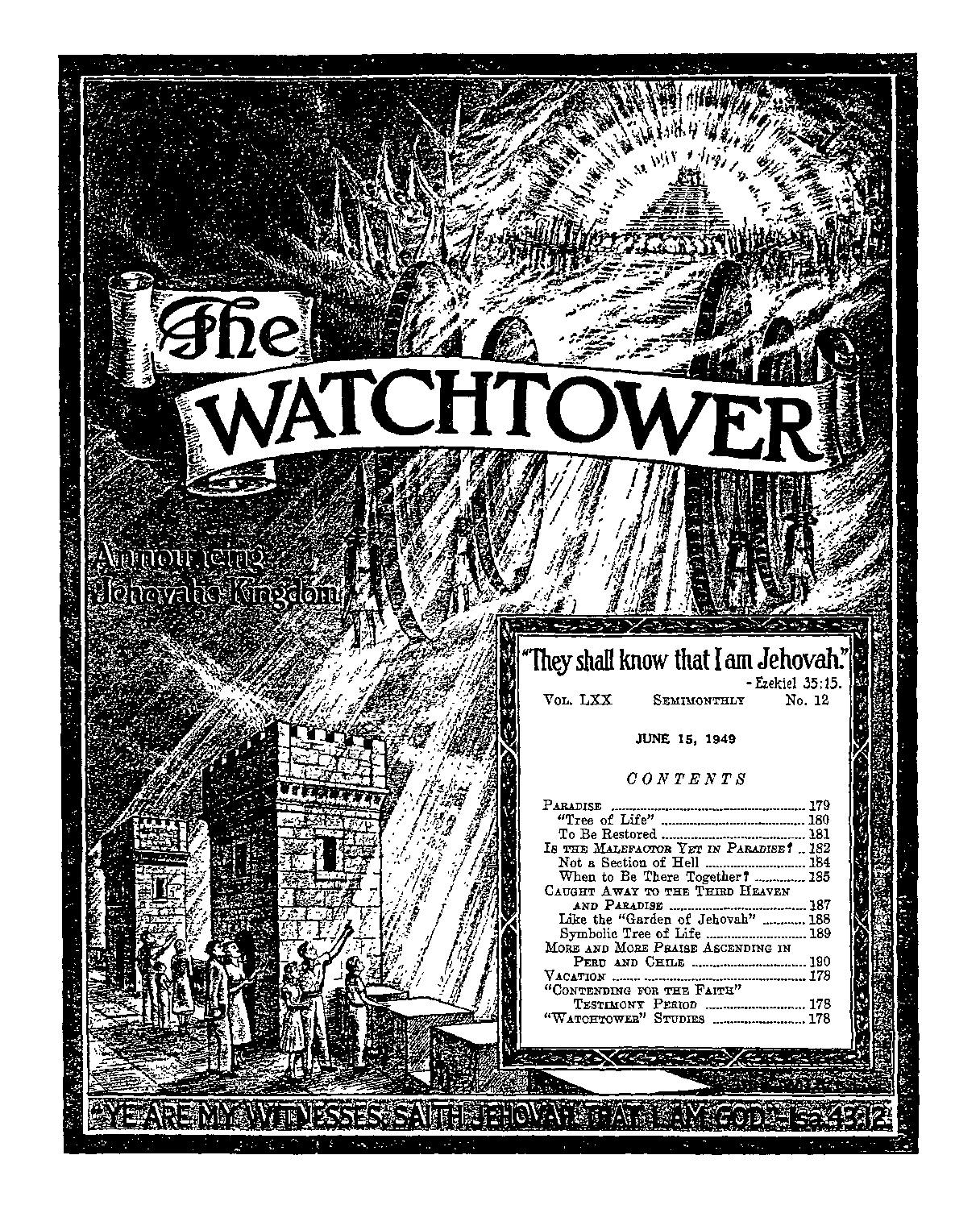
^HeWATCHTOWER-
Published Semimonthly By
WATCH TOWER BIBLE & TRACT SOCIETY 117 Adams Street - - Brooklyn 1, N.Y., U.S A.
Officers
N. H. Knorr, President Grant Suiter, Secretary
“And all thy children shall be taught of Jehovah; and great shall be the peace of thy children.” - Isaiah 54:13.
THE BIBLE CLEARLY TEACHES
THAT JEHOVAH is the only true God, from everlasting to everlasting, and Is the Maker of heaven and earth and Giver of life to his creatures; that the Word or Logos was the beginning of his creation and his active agent In creating all other things; and that the creature Lucifer rebelled against Jehovah and raised the Issue of His universal sovereignty;
THAT GOD created the earth for man, made perfect man for the earth and placed him upon it; that man yielded to unfaithful Lucifer, or Satan, and willfully disobeyed God's law and was sentenced to death; that by reason of Adam's wrong act all men are born sinners and without the right to life;
THAT THE LOGOS was made human as the man Jesus and suffered death in order to produce the ransom or redemptive price for obedient men; that God raised up Christ Jesus divine and exalted him to heaven above every other creature and clothed him with all power and authority as head of God’s new capital organization;
THAT GOD’S CAPITAL ORGANIZATION is a Theocracy called Zion, and that Christ Jesus is the Chief Officer thereof and is the rightful King of the new world; that the faithful anointed followers of Christ Jesus are Zion’s children, members of Jehovah’s organization, and are His witnesses whose duty and privilege It is to testify to Jehovah’s supremacy and declare his purposes toward mankind as expressed in the Bible;
THAT THE OLD WORLD, or Satan's uninterrupted rule, ended A.D. 1914, and Christ Jesus has been placed by Jehovah upon the throne, has ousted Satan from heaven, and now proceeds to vindicate His name and establish the “new earth”;
THAT THE RELIEF and blessings of the peoples can come only by Jehovah's kingdom under Christ, which has begun; that His next great act is to destroy Satan’s organization and establish righteousness completely in the earth; and that under the Kingdom the people of good-will surviving Armageddon will carry out the divine mandate to "fill the earth” with righteous offspring, and that the human dead in the graves will be raised to opportunities of life on earth.
ITS MISSION
THIS journal is published for the purpose of enabling the people to know Jehovah God and his purposes as expressed In the Bible. It publishes Bible Instruction specifically designed to aid Jehovah’s witnesses and all people of good-wllL It arranges systematic Bible study for Its readers and the Society supplies other literature to aid in such studies. It publishes suitable material for radio broadcasting and for other means of public instruction in the Scriptures.
It adheres strictly to the Bible as authority for its utterances. It is entirely free and separate from all religion, parties, sects oh other worldly organizations. It is wholly and without reservation for the kingdom of Jehovah God under Christ his beloved King. It is not dogmatic, but Invites careful and critical examination of its contents in the light of the Scriptures. It does not indulge in controversy, and its columns are not open to personalities.
Notice to Subscribers: Remittances ■bonld be sent to office in your country in compliance with regulations to guarantee safe delivery ot money. Remittances are accepted at Brooklyn from countries where no office is located, by international money order only. Subscription rates in different countries are stated below in local currency. Notice of expiration (with renewal blank) is sent at least two issues before subscription expires. Change of address when sent to our office may be expected effective within one month. Send your old as well as new address.
Please address the Watch Tower Society in every case.
Offices Yearly Subscription Rate
America (V.S.), 117 Adams St., Brooklyn 1, N.Y.
Australia, 11 Beresford Rd., Strathfield, N.S.W.
British West Indies, 21 Taylor St., Woodbrook, Port of Spain, Trinidad $1.25 Burma, 39 Signal Pagoda Road, Rangoon Rs. 3/8
Canada, 40 Irwin Ave., Toronto 5, Ontario
England, 34 Craven Terrace, London, W. 2
India, 167 Love Lane, Bombay 27 Ra 3/8
Jamaica, 151 King St., Kingston
Newfoundland, Post Box 521, St John’s
New Zealand, G. P.O. Box 30, Wellington, C. 1
Nigeria, West Africa, P.O. Box 695, Lagos
Philippine Republic, 104 Roosevelt Road,
San Francisco del Monte, Quezon City 2 pesos
South Africa, 623 Boston House, Cape Town
T. Hawaii, 1228 Pensacola St, Honolulu 14
Translations of this journal appear in many languages.
ALL SINCERE STUDENTS OF THE BIBLE who by reason of Infirmity, poverty or adversity are unable to pay the subscription price may have The Watchtower free upon written application to the publishers, made once each year, stating the reason for so requesting It. We are glad to thus aid the needy, but the written application once each year Is required by the postal regulations.
Printed in the United States of America
Entered as second-class matter at the post office at Brooklyn, N. Y„ under the Act of March S, 1879.
VACATION
So that the companies and pioneers might be prepared to carry on the field activities with the aid of Society publications, it is suggested that orders for literature be placed with the Society well in advance of August 1,1949. This information is given now because the Bethel home and the factory will be closed from August 6 to the 21st, inclusive, so that the members of the Bethel home will have the opportunity of getting a change from their regular work. No correspondence will be handled during these two weeks as far as the Brooklyn office is concerned; so individuals ordering supplies should have their orders in to 117 Adams Street, Brooklyn, New York, no later than the 1st of August. It would be better to get them in much sooner and not wait until the last-minute rush. Companies and pioneers should send in their regular monthly report cards, and individuals whose subscriptions for this magazine expire should also send their subscriptions in immediately, regardless of the closing-down period, because they will be given immediate attention on the reopening of the offices of the Society on the 22nd of August.
“CONTENDING FOR THE FAITH” TESTIMONY PERIOD
The best way to contend and put up a defense for something is to advance it. That is what Jehovah’s witnesses are doing with the faith of God’s kingdom during June. Appropriately this month has been termed “Contending for the Faith” Testimony Period, and the aggressive weapons to be specially used from house to house and on all suitable occasions are the three latest bound books published by the Watchtower Society together with the booklet The Kingdom Hope of All Mankind. This combination is now offered the people as a special combination on a contribution of $1.00, American money. The worsening world situation, with the hosts of atheism, disbelief and immorality steadily making greater inroads, calls for our unceasing and courageous contention for the faith once for all delivered to the saints. We who have it should help others get it and become able to contend for it and put the enemy to flight. Watchtower readers, will you join us in this during June! Communicate now with us if you need instructions and references to be able to be at the side of other faithful warriors contending shoulder to shoulder. A report! Yes, we are interested to have you submit one showing the good fight you have put up.
“WATCHTOWER” STUDIES
Week of July 24: “Paradise,”
fl 1-17 inclusive, The Watchtower June 15, 1949.
Week of July 31: “Is the Malefactor Yet in Paradise!” fl 1-18 inclusive, The Watchtower June 15, 1949.
Week of August 7: “Is the Malefactor Yet in Paradise!” fl 19, 20, also “Caught Away to the Third Heaven and Paradise”, fl 1-16 inclusive, The Watchtower June 15, 1949.
ffieWffCHTOWER
ANNOUNCING JEHOVAH’S KINGDOM
Vol. LXX June 15, 1949 No. 12
PARADISE
'And, the Lord God had planted a paradise of pleasure from the beginning: wherein he placed man whom he had formed.”—Gen, 2:8, Douay.
JEHOVAH God created the first paradise for I perfect man and woman, planting it upon our J earth. After six thousand years of human history and with mankind now numbering about two and a half billion persons the earth is no paradise. All the facts testify that paradise has disappeared and that all mankind together will not be able to restore it to earth. The electronic age, or, more pointedly said, the “atomic-bomb age”, promises to help the ‘destroyers of the earth’ to produce even greater devastation on the surface of our globe. If anyone is to restore paradise to earth, it must be Jehovah God alone. Despite the awful prospects that the atomic age has conjured up before man’s eyes, it is no idle talk for us to speak about the restoration of paradise, because the Producer of the original has promised to recreate it here, on the same earth, to flourish here forever. Hundreds of thousands of informed men and women now living look forward to inhabiting this paradise earth forever.
2 Great confusion exists in the minds of men, whether Jews or professing Christians or Mohammedans, etc., as to what paradise is. They are familiar with the name, but due to their mental confusion they entertain false hopes concerning it. Now that we are at the portals of a paradise recreated by Almighty God’s power, it is well for honest persons to disabuse their minds of deceptive hopes and to fill their hearts with the sure, superior hopes based on the inspired truth. The name is understood by some scholars to be drawn from the ancient Persian language; by others, from the Armenian language. We first find it in Bible literature in the oldest translation of the Holy Scriptures, namely, in the Greek Septuagint Version, which began to be made in the third century before our common era. The Greek Septuagint (LXX) was a translation of the inspired Hebrew Scriptures. It was from the Septuagint that the name parddeisos was picked up by the writers of the Christian Greek Scriptures, the apostles and disciples of Jesus Christ. In their inspired writings it occurs three times, and in the Greek Septuagint it occurs twenty-six times, or twenty-nine times in all.
1 Why Is restoration of paradise no matter of Idle talk?
2 , 3. How was the name derhed, and what does It really mean? A study of all these occurrences of the name proves very interesting and enlightening, leading to the forming of correct hopes.
s Turning now to the account of creation, in the Roman Catholic translation known as the Douay Version, we read: “And the Lord God had planted a paradise of pleasure from the beginning: wherein he placed man whom he had formed.” (Gen. 2:8) This Douay Version was made, not from the original Hebrew Scriptures, but from a Latin translation of them known as the Latin Vulgate. In every case where it occurs in the Greek Septuagint, except two,* the Latin Vulgate renders the word “paradise”. The plain meaning of the word is garden, and it translates the Hebrew word (gan) which means just that.f In support of this, the version of 1948 by the Roman Catholic Confraternity of religious doctrine translates Genesis 2:8 from the original Hebrew as follows: “The Loud God planted a garden in Eden, to the east, and he put there the man he had formed.” The Hebrew word (gan) in itself means an enclosed place, that is, a place hedged or walled about to keep out persons or things that had no right there. The account in Genesis shows that the paradise was no mere orchard, but a large park, in which man lived as well as every kind of animal lived and roamed. It was in truth a garden of Eden, for the Hebrew word Eden means “pleasure; delight”. For a description of the place we quote from the Roman Catholic Douay Version:
* “And the Lord God had planted a paradise of pleasure from the beginning: wherein he placed man whom he had formed. And the Lord God brought forth of the ground all manner of trees, fair to behold, and pleasant to cat of: the tree of life also in the midst of paradise: and the tree of knowledge of good and evil And a river went out of the place of pleasure to water paradise, which from thence is divided into four heads. The name of the one is
•Isaiah 51:3 and Joel 2:3. There the Vulgate renders it hortv.3, or “garden”.
t The Authorized Version Bible renders the Hebrew word gan as “garden” all 41 times of its occurrence, and the related word gannah as “garden” all 11 tunes of its occurrence.
4, 5. From the Genesis description ot It. what was the place?
Phison: that is it which compasseth all the land of Hevilath, where gold groweth. And the gold of that land is very good: there is found bdellium, and the onyx stone. And the name of the second river is Gehon: the same is it that compasseth all the land of Ethiopia. And the name of the third river is Tigris: the same passeth along by the Assyrians. And the fourth river is Euphrates. And the Lord God took man, and put him into the paradise of pleasure, to dress it, and to keep it. . . . And the Lord God having formed out of the ground all the beasts of the earth, and all the fowls of the air, brought them to Adam to see what he would call them: for whatsoever Adam called any living creature the same is its name. And Adam called all the beasts by their names, and all the fowls of the air, and all the cattle of the field: but for Adam there was not found a helper like himself.”—Gen. 2: 8-20, Douay.
5 From the foregoing account it is evident that man’s original paradise home was quite an extensive park. This must have been so, for a river took its rise in the place and before it passed beyond the limits of the place it branched into four streams, two of which were such streams as the Tigris and the Euphrates river. The exact location is not known, but the mention of these two rivers by Moses locates the place somewhere in the Near East, where all archaeological discoveries of recent times prove that mankind had its cradle. The river which divided into four branches watered the paradise, for the length of the river’s course through it. But the watering of the place was not altogether dependent on the river. Though as yet there had been no rain upon the earth, a mist rose from the earth’s surface and this helped to furnish the vegetation with moisture. We read: “The Lord God had sent no rain on the earth and there was no man to till the soil; but a mist rose from the earth and watered all the surface of the ground.” (Gen. 2: 5, 6, Cath. Conf rat.) The presence of many animals in the park is indicated by their being brought under Adam’s observation to be named, and the place was spacious and varied enough to provide the peculiar haunts and suitable conditions for each kind of living creature. The climate was pleasant and adapted to human life at all times and in all months of the year, for the man and his wife were able to live with comfort in the nakedness in which Jehovah God created them. Judged from the ancient method of reckoning time, Adam was created in what we call the fall or autumn of the year.
“TREE OF LIFE’’
0 The Creator provided everything for the enjoyment of all the sense perceptions with which the man was endowed. The man was not deathless or immortal but his life had to be sustained by the proper 6, 7. What trees did God plant? How would the first class benefit man? food, and his loving Maker provided for this human need. Not all the needs of man were for material food. There must be a gratification of all his other senses in order to keep him in a balanced state. There must be food for the mind, too, and for all these needs man’s heavenly Father made due provision. Thus man’s life would be a pleasure and he would have every reason to love and thank his Creator and God. We read that Jehovah God made all kinds of trees to grow in that part of Eden, trees “fair to behold, and pleasant to eat of: the tree of life also in the midst of paradise: and the tree of knowledge of good and evil”. (Gen. 2:9, Douay) As to man’s partaking of the products of these several kinds of trees Fere mentioned, God’s will was different.
’ The rest of the inspired Bible writers do not treat the paradise of Eden as an allegory or symbolical representation of a heavenly state. Hence we take the Genesis account given us by the prophet Moses as literal also. There were evidently three main kinds of tree, (1) those “fair to behold, and pleasant to eat of”; (2) “the tree of life also in the midst of paradise”; and (3) “the tree of knowledge of good and evil”. The trees of the first class were pleasant to eat of and were, of course, for nourishing man’s body and keeping it alive in perfect health. As long as man stayed obedient and fulfilled his Maker’s purpose in putting him on earth he would be allowed to eat of those good-looking, fruit-bearing trees and thus remain perfectly well and in perpetual youth. By the expression “the tree of life” we should not understand that first class of trees to be meant. True, that first class did keep the perfect man alive with their fruits, but just for that they could not be called the "tree of life”. Thousands of years later trees outside of Eden are spoken of as being for the life of man, and yet they could not for that reason be called the “tree of life”. When besieging a condemned enemy city the Israelites were told: “Thou shalt not cut down the trees that may be eaten of, neither shalt thou spoil the country round about with axes: for it is a tree, and not a man, neither can it increase the number of them that fight against thee. But if there be any trees that are not fruitful, but wild, and fit for other uses, cut them down.”—Deut. 20:19, 20, Douay; Moffatt; Rotherham; also Lev. 19:23-25.
8 Up until the time that Adam, now turned sinner, was driven out of the paradise of Eden neither he nor his wife had tasted of the “tree of life”, which is definitely said to have been located “in the midst of paradise”. God the Planter knew that this special land of tree was in that location, even though man did not know. Disclosing now the presence of that tree in the heart of the extensive park, Jehovah God explained that the very purpose in driving man out
8, 9 Why did God drive the man now a sinner out of Eden? of Eden was that he might not eat of the “tree of life” and live on forever. Listen to the account showing this:
9 “And he said: Behold Adam is become as one of us, knowing good and evil: now, therefore, lest perhaps he put forth his hand, and take also of the tree of life, and eat, and live for ever. And the Lord God sent him out of the paradise of pleasure, to till the earth from which he was taken. And he cast out Adam; and placed before the paradise of pleasure Cherubims, and a flaming sword, turning every way, to keep the way of the tree of life.”—Gen. 3:22-24, Douay.
10 There is no record that Jehovah God mentioned the tree of life to man before He drove man out of paradise and stationed these heavenly creatures, the cherubim, in front of the place, to prevent man, under the guidance of Satan the Devil, to re-enter and locate the tree of life and eat and live evermore. Yet God did call man’s attention directly to the third kind of tree, for we read: "And he commanded him, saying: Of every tree of paradise thou shalt eat: but of the tree of knowledge of good and-evil, thou shalt not eat. For in what day soever thou shalt eat of it, thou shalt die the death.” (Gen. 2:16,17, Douay) The designation of this tree shows it was not necessary for man to indulge in sin or wickedness in order to know what evil is. He did not have to enter into an experience of sin in order to appreciate what it and its effects are. Experience was not necessary to be his teacher in regard to evil. Almighty God could teach him without his having to engage in what is wrong. God could impart the knowledge of what sin is in a pure way that would not degrade, and he could do it by letting man and woman eat of this tree in due time. Until God lifted the forbidding command from this tree man was not to eat of it. To do so before then would be evil; it would be sin, and it would bring the penalty of death upon the disobedient eater.
11 The chief attractiveness of that tree was not its fruit for the physical body to satisfy the fleshly appetite, but was its food for the mind, the intelligence it would impart. The principal appeal of that tree was therefore to the mind. It was not necessarily one lone tree, but may have been a grove. The Hebrew word here used may, in the singular number, mean a wood or a single tree. For instance, at Genesis 3: 8, it must mean, not a single tree, but a grove or wood: “And when they heard the voice of the Lord God walking in paradise at the afternoon air, Adam and his wife hid themselves from the face of the Lord God, amidst the trees [or, wood] of paradise.” (Douay) True to its name, the tree imparted knowledge even though Adam and Eve did partake of it 10 What is indicated by the tree o£ the knowledge o£ good and evil? 11. How did man come to know evil? disobediently, hence sinfully. They immediately became aware of evil and, worst of all, that it was in themselves. Hence God said: "Behold Adam is become as one of us, knowing good and evil.” God added to man’s knowledge of evil by condemning him and informing him of all the evil that was to come upon him and his wife. Adam set out to gain knowledge of evil in a sinful way, in a way contrary to God’s command, and so God did not want him longer in paradise nor did he want him to eat at all of the “tree of life” in the midst of that garden. Out he drove the man and his wife, and in addition to what enclosure or barrier there may have been about the place God caused cherubim to render themselves visible, to show man that the place was guarded. He also caused a miraculous flaming sword to move in every direction to kill any would-be intruder. This arrangement continued at most until the great flood.
12 Since man and woman had eaten of the forbidden fruit, the penalty of their sin descended upon them: “Thou shalt die the death.” God told man he would finally return to the earth out of which he had been taken. The earth would become his grave, for he was nothing more than dust. God would be at disagreement with himself if he let the death sentence fall unon Adam and at the same time let him find his way to the midst of paradise and eat of the “tree of life” there. So he now prevented Adam’s ever locating the tree or grove of life, eating and living forever. This particular tree was spoken of separately from the trees that were fair to look on and pleasant to eat of. So the name of this tree argues that it was not its fruit itself that provided a living forever. The mere eating of the tree was a symbol, and it meant eternal life. The privilege of eating of it, a person’s being permitted to approach and take its fruit, meant or symbolized that the eater must have or must be favored with the right to live forever. Adam and Eve with the death sentence resting upon them as sinners did not deserve to have any such right bestowed upon them; for which reason God cut them off from all access to the tree of life. The death sentence meant one thing, the eating of the tree of life meant the opposite thing. The two could not be blended, for no sinner deserves the right to live forever anywhere. As all of Adam’s offspring were born in sin, hence under the condemnation of death, all approach to the tree of life in the midst of that Edenic paradise was cut off from them, too.—Rom. 5:12; Ps. 51: 5.
TO BE RESTORED
1S The extending of the paradise all around our globe was checked by man’s fall into sin. Why can we say this? Because it was God’s original purpose that paradise should be spread over all the earth.
12. Why was it not right for sinner man to eat of the tree of life? 13, 14. what was God's purpose as to paradise? How Is this shown? He planted the beginning of it over there in Eden. He put the man in it to take care of it: “the Lord God took the man and placed him in the garden of Eden to till it and to keep it.” (Gen. 2:15, Cath. Conf rat.; Rotherham; Moffatt) Had God made it world-wide, Adam alone could not have given it the proper attention each year. But Adam and Eve were not just to cultivate and guard the local paradise that was their first home; they were to extend it gradually to the four corners of the earth. That God envisioned a global paradise, and not just a miniature one over there in Eden, is proved by the divine mandate given to the perfect man and his wife. Here it is: “Then God blessed them and said to them, 'Be fruitful and multiply; fill the earth and subdue it. Have dominion over the fish of the sea, the birds of the air, the cattle and all the animals that crawl on the earth? God also said, 'See, I give you every seedbearing plant on the earth and every tree which has seed-bearing fruit to be your food.’ ”—Gen. 1:28, 29, Cath. Confrat.
11 Adam and Eve were to fill the earth with perfect, righteous offspring and with them to subdue the earth. Subduing the earth outside the bounds of their Edenic home meant bringing it to a paradisaic state. This was to provide for all their perfect children a home the equal of their original Edenic park. “For thus saith the Lord that created the heavens, God himself that formed the earth, and made it, the very maker thereof: he did not create it in vain: he formed it to be inhabited. I am the Lord, and there is no other.” (Isa. 45:18, Douay) All the animals of the earth would peacefully enjoy the paradise with humankind and would be under their dominion.
15 A careful study of the Bible discloses that Jehovah’s purpose was that all our earth be a paradise by seven thousand years from the creation of Adam and Eve; that is to say, by the close of God’s great seventh creative-day, which is His rest day or sabbath. (Gen. 2:1-3) His original purpose concerning our earth will be accomplished by that time. His purpose, though seemingly halted in its progress for six thousand years, will not be defeated. The thousand-year kingdom of his Messiah, the King Jesus Christ, will make up for all the six thousand years of interruption. By the time that Jehovah’s great sabbath-day ends the Kingdom will have an earth-wide garden of Eden filled with perfect men
15. 16. By when will all earth be made a paradise? How? and women. This restoration of paradise to earth was included among all the other things meant or suggested in his declaration of purpose to Eve’s deceiver, that old Serpent Satan the Devil. “Then the Lord God said to the serpent: ' . . . I will put enmity between you and the woman, between your seed and her seed; he shall crush your head, and you shall lie in wait for his heel.”—Gen. 3:14,15, Cath. Confrat.
lsThe Serpent’s causing of man’s fall into sin resulted in the loss to mankind of a perfect earthly home and made it necessary for the heel of the Seed of God’s woman to be bruised. Jesus Christ, the Seed of God’s woman, was the very one that spoke of the restoration of paradise to earth. His crushing of the Serpent’s head carries with it as one of its results the transforming of the earth into a beautiful global park after the battle of Armageddon. If God destroyed this earth because of man’s sin, he would frustrate his own original purpose. At Armageddon what he will destroy will be all those who “destroy the earth”, and then by the kingdom of his Seed he will make all earth the glorious perfected home for men of good-will who accept the gift of eternal life. —Rev. 11:18.
17 Though barred to mankind’s re-entry, the first earthly paradise continued on during the “world that then was”, “the world of the ungodly.” When that world was overflowed by water, the garden of Eden was wiped out. (2 Pet. 2:5; 3:5,6) During this “present evil world” with its “heavens and the earth which are now” there has been no such Edenic spot on earth. This is not because paradise has been transferred to beneath the earth to serve there as a residence of the righteous dead people before they are to be admitted to heaven. Not at all! But the Scriptures gladden us with the assurance that in the “world to come” with its “new heavens and a new earth” paradise will be replanted, not eastward in Eden, but over all earth’s surface. It will be a delightful feature of the “new earth”. (2 Pet. 3:7-13) An unnumbered multitude of persons of good-will today are proclaiming the kingdom of God with his Seed Jesus Christ as King. For their faith and righteous service these will be carried alive through the end of this “present evil world” at Armageddon and will have a part after that in making all the earth Eden’s garden, a park of perfect delight.—Rev. 7: 9-17.
17. When did paradise vanish? In what world will It be replanted*
IS THE MALEFACTOR YET IN PARADISE?
THE Seed of God’s woman, Jesus Christ himself, spoke of the restoration of the garden of Eden. When was this? It was when he was hanging
1, 2. Under what circumstances did Jesus speak of restoring paradise? upon the torture stake at Calvary outside the gates of Jerusalem. He was thus being put to death on the charge that he claimed to be Christ the King and that in making himself a king he was speaking as the enemy of Caesar, the emperor of the Roman empire. Over his head was posted the false charge for which he was being done to death, “This is the king of the Jews.” Also the Roman soldiers who nailed him to the tree and hoisted him mockecj him with the words: “If thou be the king of the Jews, save thyself.” The malefactors who were impaled on each side of Jesus saw and heard all this. (Luke 23:1-38) What now occurred we quote as translated from the Latin Vulgate by the Douay Version:
2 “And one of those robbers who were hanged, blasphemed him, saying: If thou be Christ, save thyself and us. But the other answering, rebuked him, saying: Neither dost thou fear God, seeing thou art under the same condemnation ? And we indeed justly, for we receive the due reward of our deeds; but this man hath done no evil. And he said to Jesus: Lord, remember me when thou shalt come into thy kingdom. And Jesus said to him: Amen I say to thee, this day thou shalt be with me in paradise.”—Luke 23: 39-43, Douay.
3 What Jesus said to the friendly malefactor is translated identical with the above in the Catholic Confraternity’s translation of 1941. The Roman Catholic commentators are forced to admit here that paradise could not mean the heaven of God’s presence. They know that the third day after he died and was buried Jesus said to Mary Magdalene on his resurrection morning: “Do not touch me, for I am not yet ascended to my Father. But go to my brethren, and say to them: I ascend to my Father and to your Father, to my God and your God.” So Jesus, had not yet ascended to heaven. Accordingly the paradise Jesus mentioned on the tree could not be heaven. The friendly malefactor was not resurrected the third day and could not now be up in heaven. The Catholic commentators know, too, that Jesus told the Jewish ruler Nicodemus: “Unless a man be born again,, he cannot see the kingdom of God. . . . Amen, amen I say to thee, unless a man be born again of water and the Holy Ghost, he cannot enter into the kingdom of God.” (John 20:17 and 3: 3, 5, Douay) They know that the thief was not born again of water and of the holy spirit there on the tree, nor baptized. The holy spirit was not poured out upon Peter and the rest of Jesus’ disciples until fifty-three days later, on the day of Pentecost, and then first his disciples were born again, from above, by water and spirit. (John 7: 39) Hence they know the friendly malefactor could not have entered the kingdom of God in heaven on the day he died alongside Jesus. What, then, do they say “paradise” here means?
‘ In its footnote on Jesus’ words to the malefactor the Douay Version Bible (Murphy edition) says: “In paradise. That is, in the happy state of rest, joy, 3 Why could not and did not the malefactor go to heaven then* 4-6. where do Catholics say he went, and why wrongfully so say? and peace everlasting. Christ was pleased, by a special privilege, ... to introduce him immediately after death into the happy society of the saints, whose limbo, that is, the place of their confinement, was now made a paradise by our Lord’s going thither.”
8 The footnote on Luke 23: 43 in the Catholic Confraternity translation says: “Paradise: that is, the abode of the just souls under the old dispensation, who were waiting in limbo for the coming of the Messias to lead them to heaven.” Giving an official definition of what limbo means to Roman Catholics The National Catholic Almanac of 1948 (published at Paterson, N.J.), in the section under the heading “Catholic Ready Reference”, says the following (page 243): “Limbo—The place where the souls of the just were detained until the ascent of Christ into heaven; a place of rest and natural happiness in which unbaptized infants and others who die in original, but not actual sin, are detained.”
6 According to the Catholic view Abraham, Isaac, Jacob, Moses, Elijah, and all the other prophets of before Christ were there in ‘limbo”, the “limbo of the fathers” or the “bosom of Abraham”, as they call it. But the word limbo as meaning a subterranean department on the limb, edge or border of hell does not once occur even in the Latin translation of the Bible. Limbo was introduced into religious theology at a late date, about the time of Thomas Aquinas in the thirteenth century. The teaching is absolutely contrary to the inspired Bible, and neither Jesus nor the friendly malefactor went to such a place the day they died.
' Some Protestant theologians teach parallel with the Roman Catholic teaching. They, too, translate the Greek text of the Bible to say the malefactor and Jesus went to paradise the same day they died. They know these two could not have gone to heaven, but that, instead, the apostle Peter applies to Jesus the words of Psalm 16:10: “For thou wilt not leave my soul to Sheol; neither wilt thou suffer thy holy one to see corruption." (Am. Stan. Ver.) On the day of Pentecost the apostle Peter applied this verse to the resurrected Jesus and said: “For David saith concerning him,. .. Because thou wilt not leave my soul unto Hades, neither wilt thou give thy Holy One to see corruption. . . . Brethren, I may say unto you freely of the patriarch David, ... he foreseeing this spake of the resurrection of the Christ, that neither was he left unto Hades, nor did his flesh see corruption. This Jesus did God raise up.” (Acts 2:25-32, Am. Stan. Ver.) Scripturally, then, Jesus, together with the malefactor, must have gone to Sheol, Hades, or “hell”, on the day they died.
8 This compels these religious teachers to conclude
7. Where does Peter show Jesus and the malefactor went together* 8, 9. So where do they say paradise Is, with what parable In mind? that paradise is in hell, Sheol, or Hades. That way, if Jesus and the malefactor were in Hades, they could at the same time be in paradise. They know that the Scriptures speak of the faithful persons of old as going to hell, Sheol, or Hades, and not to heaven, for Jesus told Nicodemus: “Yet no one has ascended to heaven, except the One who descended from heaven—the Son of Man.” (John 3:13, Spencer, Cath.) Not willing to say that Abraham and all the other faithful ones before Christ are in hell torments, they claim that paradise is a section of hell and that Abraham and the others are in that paradise and at the same time in hell, Sheol or Hades. They claim this is proved by Jesus’ parable of the rich man in hell and the poor man Lazarus in Abraham’s bosom. —Luke 16:19-31.
* After describing the rich man and the beggar Lazarus, this parable says: “And it came to pass, that the beggar died, and was carried by the angels into Abraham’s bosom. And the rich man .also died: and he was buried in hell.* And lifting up his eyes when he was in torments, he saw Abraham afar off, and Lazarus in his bosom: and he cried, and said: Father Abraham, have mercy on me, and send Lazarus, that he may dip the tip of his finger in water, to cool my tongue: for 1 am tormented in this flame. And Abraham said to him: Son, remember that thou didst receive good things in thy lifetime, and likewise Lazarus evil things, but now he is comforted; and thou art tormented. And besides all this, between us and you, there is fixed a great chaos: so that they who would pass from hence to you, cannot, nor from thence come hither.”—Luke 16:22-26, Douay.
10 Seizing upon this parable as a way of explanation, one religious commentatort puts a footnote on verse 23, “And in hell [Greek, Hades] he lift up his eyes.” Ills footnote reads: “Summary: (1) Hades before the ascension of Christ. The passages in
* Buried in hell. This translates the original reading of the famous Greek Sinaitic manuscript of the fourth century, and also the reading of the Latin Vulgate text. It shows that ‘'hell” means the earthly grave of humankind.
t The Scofield Reference Bible, edition of 1945, at its lower margin of pages 1098, 1099. The footnote of the Scofield Bible edition follows the teaching of some ancient rabbinical schools of Palestine concerning paradise. To these it was a region of the world of the dead, of Sheol, in the heart of the earth. Gehenna was on one side, with its flames and torments. Paradise on the other side was the intermediate home of the blessed. The patriarchs Abraham, Isaac, and Jacob were there, ready to receive their faithful descendants into their bosoms. The highest place of honor at the feast of the blessed souls was Abraham’s bosom, on which the new “heir of immortality” reclined as the favored and honored guest.—See Josephus’ Martyrdom of the Maccabees, chapter 13.
Dr. John Lightfoot, D.D., and others have shown that the Jews in their Gemara of the Jewish Talmud have a parable much to the same effect as that of the rich man and Lazarus. But this does not make the teaching the same, for Jesus was not following the traditions of the Jewish religious fathers.—Matt. 15:1-9. 10. Wherefore what does one religious commentator say about hell? which the word occurs make it clear that hades was formerly in two divisions, the abodes respectively of the saved and of the lost. The former was called ‘paradise’ and ‘Abraham’s bosom.’ Both designations were Talmudic, but adopted by Christ in Luke 16: 22; 23:43. The blessed dead were with Abraham, they were conscious and were ‘comforted’ (Luke 16: 25). The believing malefactor was to be, that day, with Christ in ‘paradise/ The lost were separated from the saved by a ‘great gulf fixed’ (Luke 16: 26). The representative man of the lost who are now in hades is the rich man of Luke 16:19-31. He was alive, conscious, in the full exercise of his faculties, memory, etc., and in torment.”
NOT A SECTION OF HELL
11 Why do the religious clergy of Christendom get into difficulty with Jesus’ words to the malefactor and His parable of the rich man and Lazarus'? Because thev believe that the human soul is immortal and that hell, Sheol or Hades is a place for detaining or for torturing the conscious immortal souls of certain humans. The clergy could easily be helped out of their difficulty and could discern the true teaching of Jesus’ words and parable. How? If they would accept the Bible teaching that the human soul is the human creature himself and that the human soul is mortal; and that hell, Sheol or Hades means the “unseen place” and applies to the common grave of mankind, gravedom. There is no conscious life, pleasant or painful, in the Bible hell, Sheol or Hades. All there are dead, unconscious, inactive. God’s Word is simple and plain enough when it says : “The Lord God formed man of the slime of the earth: and breathed into his face the breath of life, and man became a living soul.” “The soul that sinneth, the same shall die.” “The living know that they shall die, but the dead know nothing more, neither have they a reward any more: for the memory of them is forgotten. Whatsoever rhy hand is able to do, do it earnestly: for neither work, nor reason, nor wisdom, nor knowledge shall be in hell, whither thou art hastening.” {Douay Version of Genesis 2:7; Ezechiel 18: 4, 20; Ecclesiastes 9: 5,10)* Paradise was never transferred to an underground hell, except in the minds of the religious clergy by their wresting of the Holy Scriptures.
11 To be harmonious with the rest of the Scriptures, here is what Jesus’ parable of the rich man and Lazarus teaches, in brief: Some who have richly enjoyed the favor and mercies of God, as the Jewish religious leaders once did, die to those privileges because of their unfaithfulness and in this life come
* See the article “When Immortality Came to Light” in the issue of November 15, 1948. of The Watchtower.
11. How could the clergy be helped out of difficulty on this?
12. What, In brief, does the parable of rich man and Lazarus teach? into fiery torments. On the other hand, other persons who were for a time denied such special favors and mercies, like the non-Jews who were associated with Gentile “dogs”, die to their former spiritually diseased and beggarly condition. In this life they come into God’s favor through the gospel borne to them by God’s angels or messengers. The ancient patriarch Abraham is now dead, in hell, Sheol or Hades, and awaiting the earthly resurrection. But the One typified by him, Jehovah God, the Greater Abraham, lives and in him all the families of the earth are to be blessed. Abraham’s bosom, therefore, pictures the position of favor with Jehovah God in harmony with His gospel promise to the ancient patriarch. (Gen. 12:3; 22:18; 25: 7-10) God’s judgment fixes a great gulf or broad area of separation between the two classes. Thus those who died to their past spiritual advantages and privileges cannot gain God’s favors again, even though they now send up a lot of formal religious prayers without real heart conversion. They refuse to accept the truth of the inspired writings of Moses and the prophets and now, too, of the disciples of Jesus Christ. This understanding of Jesus’ parable makes his words sensible. It harmonizes them with the fundamental teachings of the Scriptures on hell, paradise, and the human soul, and agrees with the history of the Jew’s and the Gentiles.*
WHEN TO BE THERE TOGETHER?
13 Jesus and the friendly malefactor did not go to paradise on the day they died. They both went to hell, Sheol or Hades, and there they were both lifeless, unconscious, dead. The malefactor is still there, but on the third day Jesus was resurrected from hell, Sheol or Hades. Psalm 16:10, as quoted by the apostle Peter, did not say respecting the dead Jesus, ‘Thou wilt not leave my soul in paradise.’ It said: “Thou wilt not leave my soul in hell.” It is manifest, then, that Jesus did not tell the malefactor that he would be with Jesus that day in paradise or Eden’s garden. The misreading of the Greek text and consequently the improper punctuation of Jesus’ words by the translators have made Jesus appear to say they would be there. A correct rendering of Jesus’ words is given us by the noted Dr. Wm. Cureton in his English translation of an old Syriac Version of the gospels.! At Luke 23: 42, 43 it reads: “And he said to Jesus, My Lord, remember me when thou
* See the article “Poor Man Comforted” in the 64-page booklet entitled “Refugees”; also the book The New World, page 358 T 2 to page 360 f 1 inclusive.
t 'Remains of a Very Antient Recension of the Four Gospels in Syriac by William Cureton, D.D., F.R.S., published in London, England, in 1858 and dedicated to “His Royal Highness The Prince Consort, K.G.,” Prince Albert, husband of Queen Victoria of Great Britain.
13, 14. What translations show they did not go to paradise that day? comest in thy kingdom. Jesus said to him, Verily I say to thee to-day that with me thou shalt be in the Eden’s garden.”
14 In agreement with this is the rendering by J. B. Rotherham in his The Emphasised Bible published in London in 1903. At Luke 23: 42, 43 the main text reads: “And he went on to say—Jesus! remember me whensoever thou shalt come into thy kingdom. And he said unto him—Verily I say unto thee this day: With me shalt thou be in Paradise.” In further agreement is the rendering by Geo. M. Lamsa in his The Four Gospels According to the Eastern Version translated from the Aramaic, published in 1933. It says the malefactor “said to Jesus, Remember me, my Lord, when you come in your kingdom. Jesus said to him, Truly I say to you today, You will be with me in Paradise”.—See also The Modern New Testament from Aramaic by Lamsa.
13 The above three renderings do not wrest the Scriptures. They correctly show that Jesus did not say he and the malefactor would be in paradise that same day. Rather, on that dark tragic day, when everything appeared contrary to Jesus’ coming into a kingdom, he confidently declared to the malefactor: “You will be with me in Paradise,” or, “in the Eden’s garden.” It is very significant that in all of Jesus’ teaching to his disciples prior to his impalement on the tree he never taught them about paradise or set the hope of it before them. Always the kingdom of God or the kingdom of heaven was what he instilled into their minds. It was this heavenly kingdom which he promised them and on which he fixed their hopes. But here, when speaking to the dying malefactor, is the first and only time that Jesus on earth is reported as mentioning paradise. Why? Because paradise, Eden’s garden, was the only hope that Jesus could set before this criminal who had never followed in Jesus’ footsteps or learned the mysteries of the kingdom of heaven. He had not taken up his torture stake and followed in Jesus’ footsteps as His disciple. He was there dying on a torture stake, as he said, “indeed justly; for we receive the due reward of our deeds.” (Luke 23:41) He died before the day of Pentecost and its outpouring of the holy spirit, and hence he could never be born of water and spirit and so see and enter the kingdom of God. Properly, then, Jesus did not promise him that.
16 Jesus set before the dying malefactor an earthly hope, which means the restoration of paradise, Eden’s garden. By all that this friendly criminal saw and heard he discerned that the issue concerning Jesus was whether he was the Messiah or Christ and would have a kingdom. Realizing Jesus’ innocence, he felt that Jesus might some day come into a kingdom by a resurrection from the dead and that he 15, 16. (a) To what does "to day**- dpply4 Why .did Jesus hold out paradise, not to his disciples, but to this dying malefactor? himself, a malefactor though he was, would have a part in the “resurrection of the just and unjust”. He knew nothing of a heavenly kingdom for Jesus. Even Jesus’ disciples, on the day of his ascension to heaven, thought his kingdom would be earthly, saying: “Lord, wilt thou at this time restore again the kingdom to Israeli” (Acts 1:6) So the malefactor was not asking Jesus to take him to heaven. From the prophecies he could know that Messiah’s kingdom would restore paradise to earth and that by a resurrection of the dead those in hell, Sheol or Hades would be enabled to enter into this restored garden of Eden. Jesus knew* what was in the malefactor’s mind. Jesus knew, too, that he was the Messiah or the Christ and that he would be raised the third day from the dead, ascend to God’s right hand and receive the promised kingdom in God’s due time, and then restore paradise to earth. So Jesus said to the malefactor: “You will be with me in Paradise.”—Acts 24:15.
17 This assured the malefactor, not that he would be in Paradise that day, but that he would have a resurrection from the dead when Jesus was King and had re-established paradise on earth. This meant that the malefactor would not have a spiritual, heavenly resurrection. No; but he would come back from death to life on the paradise earth under Jesus’ heavenly kingdom. This life in the earthly paradise could be made eternal, in human perfection, if he proved himself to be a loyal subject of the King Jesus Christ, accepting forgiveness of all his sins through the ransom sacrifice which Jesus effected on the torture stake that dark day at Calvary.
18 Abraham, Isaac and Jacob and all the faithful prophets of old will also be there in Paradise, as “princes in all the earth”, and hence will be resurrected long in advance of that malefactor. (Ps. 45:16; Heb. 11:39,40) That was the day to which Abraham looked forward and which Jesus meant when he said to the Jews: “Abraham your father rejoiced that he might see my day: he saw it, and was glad.” (John 8: 56, Douay) Abraham did not see that day in any underground paradise in a section of hell by having Jesus die and come down there with the malefactor and then have Jesus lie in Abraham’s bosom. But Abraham, to whom Jehovah gave the promise, “In thy seed shall all the nations of the earth be blessed,” looked forward in faith in harmony with that divine promise. While alive, he saw by faith that Seed, Christ Jesus, reigning and blessing all the families and nations. (Gen. 12:1-3; 22:18; Gal.
17. What resurrection will the malefactor have? When, and to what? 18. How did Abraham see the day of Jesus Christ and rejoice? 3:16) One of the ways all families and nations will be blessed by Abraham’s Seed will be by a Paradise restored on earth under the Kingdom.
18 Its restoration will come after the battle of Armageddon and during the thousand-year rule from heaven by Abraham’s Seed, Jesus Christ the King. He is Abraham’s Seed through King David, the son of Jesse, and thus Christ Jesus is the “rod” or royal shoot of Jesse. Clearly foreshadowing that paradise will be restored to earth when he reigns as mankind’s rightful ruler for a thousand years, Isaiah 11:1-10 says: “A shoot will spring from the stem of Jesse, and a sprout from his roots will bear fruit. And the spirit of the LORD [Jehovah] will rest upon him, . . . He will smite the ruthless with the rod of his mouth, and with the breath of his lips will he slay the wicked. Righteousness will be the girdle round his loins, and faithfulness the girdle round his waist. Then the wolf will lodge with the lamb, and the leopard will lie down with the kid; the calf and the young lion will graze together, and a little child will lead them. The cow and the bear will be friends, their young ones will lie down together; and the lion will eat straw like the ox. The suckling child will play on the hole of the asp, and the weaned child will put his hand on the viper’s den. They will do no harm or destruction on all my holy mountain; for the land will have become full of the knowledge of the LORD, as the waters cover the sea. It shall come to pass on that day that the root of Jesse, who will be standing as a signal to the peoples—to him will the nations resort, and his resting-place will be glorious.” —An Amer. Trans.
20 That will be a real garden of Eden, a park of pleasure, to which the dead in the general resurrection of mankind will be raised. It will be a glorious feature of the “new earth” under the protection and blessing of the “new heavens”, the heavenly kingdom of Jesus Christ. During all the time it is being restored Satan the Devil and all his invisible demon organization will be bound and shut up in the “abyss” and be unable to interfere. No global flood will ever wipe out that restored paradise. Not even Satan’s uprising at the end of Christ’s thousand-year rule will destroy that lovely plantation or fill it with deceived sinners. Satan and his demons and all whom these then deceive into sin will be destroyed eternally. (Rev. 20:1-10) But the earthly paradise will remain for all time, the blessed home of all those of mankind whom Christ’s kingdom raises to human perfection and who loyally maintain their integrity to Jehovah God and his beloved King.
19. During whose reign will paradise be restored, as Isaiah shows? 20. When will dead men get to enjoy paradise, In spite ot Satan?
As for God, his way is perfect: the word of Jehovah is tried; he is a shield unto all them that take refuge in him.—Psalm 18: 30, A.S.V.
CAUGHT AWAY TO THE THIRD HEAVEN AND PARADISE
IS THERE a heavenly paradise, that is, a paradise up in the invisible regions called heaven where spirit persons live? This question arises because of the way the disciples of Jesus Christ use the word. The word occurs just three times in the inspired writings of his disciples: once in recording Jesus’ words to the friendly malefactor on the torture stake at Calvary; once when the apostle Paul tells of his rapturous experience; and once when the glorified Jesus delivers the Revelation to the apostle John. We have seen, in a preceding article, that the paradise first mentioned in the Bible was decidedly earthly, being the garden of Eden in which the perfect Adam and Eve were placed by their Creator. They forfeited this Edenic home because of willfully sinning against the Creator, and it vanished with the world-wide flood of Noah’s time. It is to the restoration of this paradise that Jesus referred in his consoling -words to the dying malefactor.
2 According to some religionists of Christendom paradise is a transferable thing and has changed its place since the death and resurrection of Jesus Christ. In the foregoing article (1J10) a quotation was made of the comment in a certain Bible edition on the word hell or Hades as found in Jesus’ parable of the rich man and Lazarus the beggar. * In the second paragraph of that comment it stated that hell or Hades was in two divisions, one division of which was the abode of the unsaved, the other of which was paradise, this being where Jesus and the malefactor went on the day they died. Arguing that this ‘abode of the saved’ has been transferred from hell or Hades the last paragraph of the said comment reads:
“(2) Hades since the ascension of Christ. So far as the unsaved dead are concerned, no change of their place or condition is revealed in Scripture. At the judgment of the great white throne, hades will give them up, they will be judged, and will pass into the lake of fire (Rev. 20:13,14). But a change has taken place which affects paradise. Paul was ‘caught up to the third heaven . . . into paradise’ (2 Cor. 12:1-4). Paradise, therefore, is now in the immediate presence of God. It is believed that Eph. 4: 8-10 indicates the time of the change. ‘When he ascended up on high he led a multitude of captives.’ It is immediately added that He had previously ‘descended first into the lower parts of the earth,’ that is, the paradise division of hades. . . . ”*
3 From our preceding articles it is easily apparent how grossly wrong this religious comment is in its teaching. It is due to the false notion that hell, Sheol
• The Scofield Reference Bible, edition of 1945, at its lower margin of pages 1098, 1099.
1. What question now arises concerning paradise, and why so?
2. Where do some religionists say it now is. and why so?
3, 4. How does Paul come to speak of paradise as If he went there’ or Hades is the abode of the living and not of the dead, and that human souls are separate and distinct from the physical body and are immortal and at death go either to heaven or to hell. On this basis the religious clergy argue that the souls of saved believers were in a heavenly paradise in the apostle Paul’s day. However, Paul was not arguing to that effect in what he said, nor was Jesus in his Revelation to the apostle John. First, let us look at Paul’s words, at ~2 Corinthians 12:1-4: “If I must boast— it is not indeed expedient to do so—but I will come to visions and revelations of the Lord. I know a man in Christ who fourteen years ago—whether in the body I do not know, or out of the body I do not know, God knows—such a one was caught up to the third heaven. And I know such a man—whether in the body or out of the body I do not know, God knows—that he was caught up into paradise and heard secret words that man may not repeat.”—Cath. Conf rat.; Douay.
* The man of fourteen years previous is the apostle Paul himself, exactly where we cannot tell; his letter was written to the Corinthians about A.D. 55, No one can say Paul was literally caught up to the third heaven. He himself did not say he was literally caught up there. He could not have been, because “flesh and blood cannot inherit the kingdom of God” and no man can see God and live. (1 Cor. 15: 50; Ex. 33:20) But the rapture he experienced was so realistic that it was almost as if he were snatched up there. But God well knows how Paul’s rapture was accomplished, if Paul did not.
5 What was the “third heaven” to which he was caught up? In the Bible a third time or three times is used to denote intensity of operation or purpose. (Ezek. 21: 27; John 21:17; Acts 10:16) Here rising up to heaven to the third degree denotes the superlative height of Paul’s exaltation in his rapture. The “heaven” designated as the “third” cannot be mistaken to mean the heavens in which the birds are said to fly or those heavens in which the sun, moon and stars are said to shine. (Gen. 1:14,15, 20) It is higher than the heaven into which the prophet Elijah went, concerning which we read: “Behold, there appeared a chariot of fire, and horses of fire, and parted them both asunder; and Elijah went up by a whirlwind into heaven.” (2 Ki. 2:11) He did not go into the invisible heavens of God’s presence, because centuries later Jesus said: “No man hath ascended up to heaven, but he that came down from heaven,” himself. (John 3:13) But Paul, to whom visions and revelations were given, was in his ecstasy or rapture fourteen years previous caught away as into the very presence of God and given an extremely high degree of inspiration. It was evidently beyond anything his 5. What does its being the "third” heaven denote?
Christian brethren had experienced in times of inspired revelation and vision, up to the time that Paul wrote.
6 Thus it was what we might call a vertical rapture, instead of a horizontal rapture down the stream of time to see things due to come to pass in the future. It is true that the apostle Peter speaks of the heavens and earth that were before the Flood, and of the heavens and earth which are now, and of "new heavens and a new earth”. But when Paul speaks of the "third heaven” he is not discussing what Peter discusses, and hence Paul is not speaking of the heaven as “third” with respect to the two heavens and two earths in which the Devil and his wicked organization have held control. (2 Pet. 3: 5-13) Paul is speaking of the third heaven, the most exalted heaven in the realm of God, “third” with relation to other things of God’s creation. “Great is our God above all gods. . . . the heaven and heaven of heavens cannot contain him.” (2 Chron. 2:5, 6; 6:18) Paul was caught up so high by the uplifting intensity with which God’s powers of inspiration carried him out of himself. What Paul saw and heard while in this most intense and exalted state of inspiration he was not permitted to tell in so many words. But it could serve as a background against which he would say many other things. It could be the true basis upon which he would build many points of doctrine. The nearest approach to Paul’s being caught up to the “third heaven” was probably when John had the Revelation and saw a door standing open in heaven and, looking through it, he saw the heavenly throne and a glorious symbol of the one seated thereon. —Rev. 4:1-11.
LIKE THE “GARDEN OF JEHOVAH”
7 Parallel with this, Paul says: “And I know that this man was caught up into Paradise—whether in the body or out of the body I do not know, God knows—and he heard things that cannot be told, which man may not utter.” (2 Cor. 12: 3, 4, Rev. Stan. Ver.) Because this is a parallel statement, is the paradise Paul saw in his rapture identical with the “third heaven”? He does not say they are the same. Since he was not caught up and carried along horizontally with the stream of time into the future, but was given exalted visual powers, in a vertical direction, as it were, what he saw was not the earthly paradise restored. It was not a paradise transferred from hell, Sheol or Hades up to heaven. At Paul’s time no souls of the faithful ones could have been there, for the resurrection of the dead had not yet taken place. Enoch was not there, even though Ecclesiasticus 44:16 (Douay) does say: “Henoch pleased God, and was translated into paradise, that 6 With relation to what was this heaven the “third”?
…