The Watchtower, March 1, 1949
Download: PDF — The Watchtower, March 1, 1949
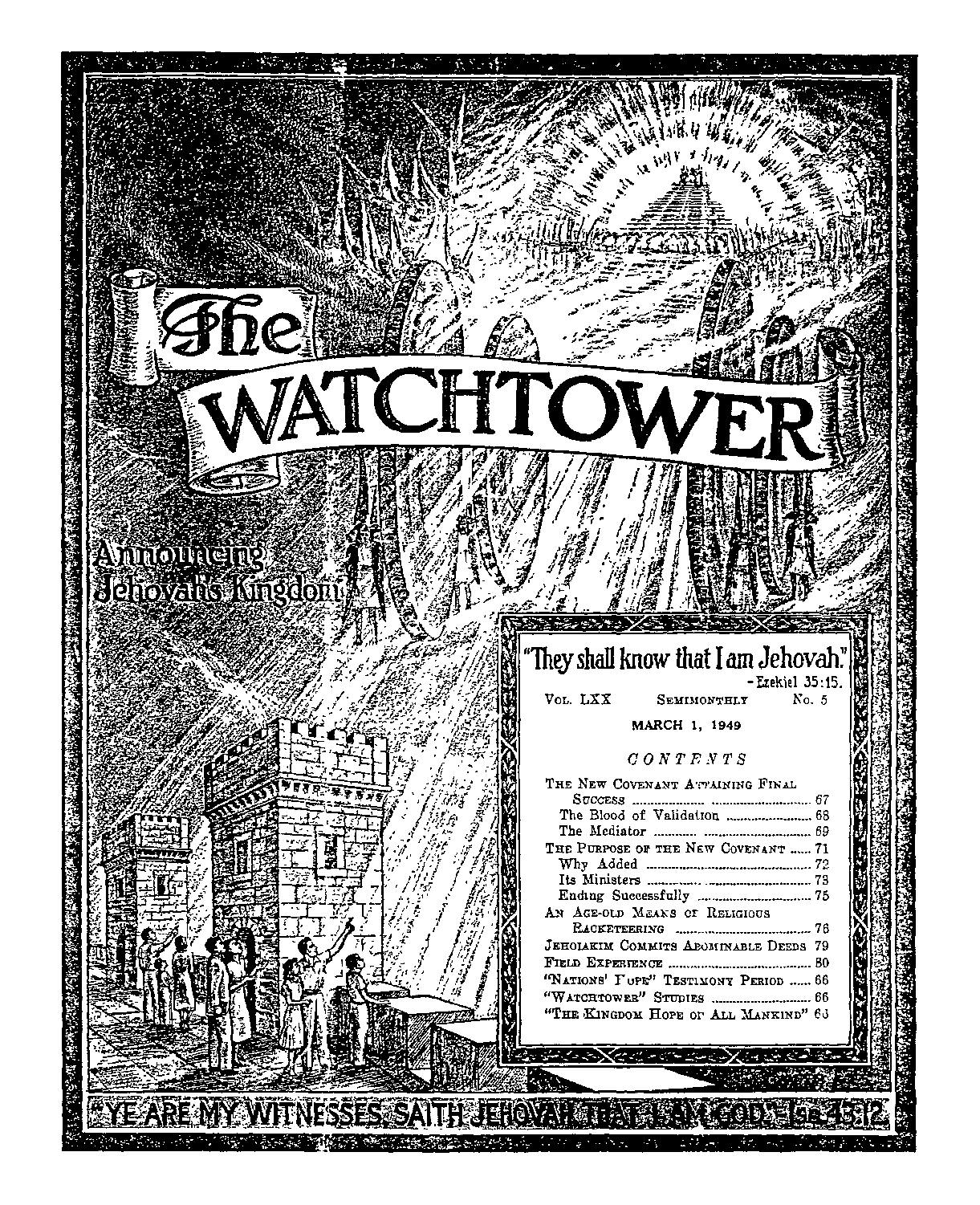
Published Semimonthly Bt
WATCH TOWER BIBLE & TRACT SOCIETY 117 Adams Street - - Brooklyn 1, N.Y., U.S A.
0 rricebs
N. H. Knorr, President Grant Suiter, Secretary
"And all thy children shall be taught of Jehovah; and great shall be the peace of thy children.” - Iiaiah 54:13.
THE BIBLE CLEARLY TEACHES
THAT JEHOVAH Is the only true God, from everlasting to everlasting, and Is the Maker of heaven and earth and Giver of life to his creatures; that the Word or Logos was the beginning of his creation and his active agent In creating all other things; and that the creature Lucifer rebelled against Jehovah and raised the issue of His universal sovereignty;
THAT GOD created the earth for man, made perfect man for the earth and placed him upon It; that man yielded to unfaithful Lucifer, or Satan, and willfully disobeyed God's law and was sentenced to death; that by reason of Adam’s wrong act all men are born sinners and without the right to life;
THAT THE LOGOS was made human as the man Jesus and suffered death In order to produce the ransom or redemptive price for obedient men; that God raised up Christ Jesus divine and exalted him to heaven above every other creature and clothed him with all power and authority as head of God’s new capital organization;
THAT GOD’S CAPITAL ORGANIZATION Is a Theocracy called Zion, and that Christ Jesus is the Chief Officer thereof and is the rightful King of the new world; that the faithful anointed followers of Christ Jesus are Zion’s children, members of Jehovah's organization, and are His witnesses whose duty and privilege It Is to testify to Jehovah’s supremacy and declare his purposes toward mankind as expressed in the Bible;
THAT THE OLD WORLD, or Satan's uninterrupted rule, ended A.D. 1914, and Christ Jesus has been placed by Jehovah upon the throne, has ousted Satan from heaven, and now proceeds to vindicate His name and establish the “new earth”;
THAT THE RELIEF and blessings of the peoples can come only by Jehovah’s kingdom under Christ, which has begun; that Ills next great act Is to destroy Satan’s organization and establish righteousness completely in the earth ; and that under the Kingdom the people of good-will surviving Armageddon will carry out the divine mandate to “fill the earth” with righteous offspring, and that the human dead In the graves will be raised to opportunities of life on earth.
ITS MISSION
THIS Journal is published for the purpose of enabling the people to know Jehovah God and his purposes as expressed in the Bible. It publishes Bible Instruction specifically designed to aid Jehovah's witnesses and all people of good-will. It arranges systematic Bible study for its readers and the Society supplies other literature to aid In such studies. It publishes suitable material for radio broadcasting and for other means of public instruction In the Scriptures.
It adheres strictly to the Bible as authority for its utterances. It is entirely free and separate from all religion, parties, sects or other worldly organizations. It Is wholly and without reservation for the kingdom of Jehovah God under Christ his beloved King. It is not dogmatic, but Invites careful and critical examination of its contents In the light of the Scriptures. It does not indulge in controversy, and Its columns are not open to personalities.
Notice to Subscribers: Remittances should be tent to office in your country in compliance with regulations to guarantee sate delivery ct money. Remittances are accepted at Brooklyn from countries where no office is located, by International money order only. Subscription rates in different countries are stated below in local currency. Notice of erpiiation (with renewal blank) is sent at least two issues before subscription expires. Change of address when sent to our office may be expected effective within one month. Send your old as well as new address.
Please address the Watch Tower Society In every case.
Offices Yearly Subscription Rate
America (U.S.), 117 Adams St.. Brooklyn 1, N.Y.
Austialia, 11 Beresford Rd., Strathfield, N.S.W.
British West Indies, 21 Taylor St., Woodbrook, Port of Spain. Trinidad $1.25 Burma, 39 Signal Pagoda Road, Rangoon Bs. 3/8
Canada, 40 Irwin Ave., Toronto 5, Ontario
England, 34 Craven Terrace, London, W. 2
India, 107 Love Lane, Bombay 27 Bs. 3/3
Jamaica, 151 King St., Kingston
Newfoundland, Post Box 521, St. John's
New Zealand, G. P.O. Box 30, Wellington, C. 1
A'fpcria, West Africa, P.O. Box 695, Lagos
Philippine Republic, 104 Roosevelt Road,
San Francisco del Monte, Quezon City 2 pesos
South Africa, 623 Boston House, Cape Town
T, Hawaii, 1223 Pensacola St, .Honolulu 14
Translations of this journal appear In many languages.
ALL SINCERE STUDENTS OF THE BIBLE who by reason of infirmity, poverty or adversity are unable to pay the subscription price may haie The il'atc/iioioer tree upon written application to the publishers, made once each year, stating the reason for so requesting It. We are fllad to thus aid the needy, but the written application once each years required by the postal regulations.
Printed in the United States of America
Entered as second-class matter at the post office at Brooklyn, N. T , uudei the Act of March S, HRS.
“NATIONS’ HOPE” TESTIMONY PERIOD
How will the nations be able to set their hope now on the great King whom God has raised up to rule the new world unless they learn about him ? This is the question that will make each already informed person realize his responsibility during the month of April of taking part in the “Nations’ Hope” Testimony Period throughout that month. April brings to a close the four-month campaign for taking 500,000 subscriptions for the Watchtower Society’s magazines in the 22 languages in which they are published. Hence the special offer continues in force, namely, a year’s subscription each for The Watchtower and Awake! together with the premium gift of the latest bound book and booklet, to each taker, at the subscription rate of both for $2.00. All lovers of their fellow man want the God of hope to fill as many others as possible with the joy and peace of believing in the Kingdom hope, and therefore we again remind all Watchtower readers of our readiness to help any that desire to have a hand in this hope-inspiring educational work. Let us hear from all such before this campaign ends, and also let every participant turn in his report at the close of the Testimony Period.
“WATCHTOWER” STUDIES
Week of April 3: “The New Covenant Attaining Final Success," fl 1-14 inclusive, The Watchtower March 1, 1949.
Week of April 10: “The New Covenant Attaining Final Success,” 15-18 inclusive, also “The Purpose of the New Covenant,”
fl 1-9 inclusive, The Watchtower March 1, 1949,
Week of April 17: “The Purpose of the New Covenant,” fl 10-26 inclusive, The Watchtower March 1, 1949.
“THE KINGDOM HOPE OF ALL MANKIND”
For 4,000 years human kingdoms have tried in vain to realize the hopes of man. But with the passing of each, the hope that men had pinned to it collapsed, and today the world flounders hopelessly in the accumulated failures of 4,000 years. Now in a final desperate effort to salvage hope the nations pool their power in a United Nations organization. But as hope in it fades, the nations realize that many failures added together do not sum up to success. With driving logic the widely delivered public lecture entitled “The Kingdom Hope of All Mankind” pressed these points home, and thence struck a theme that proves the situation is not hopeless. Nor was it hopeless as far back as Adam’s day, for it was then that Jehovah God first revealed the kingdom hope for all mankind. He has never lost sight of it since, and has made provision for hopeful men to keep it in view. That hope is the promised kingdom of Christ. It will be realized by this generation. All this hopefulness shone brightly through the public lecture, and because of the need for hope now it has been preserved in print in the 32-page booklet, The Kingdom Hope of All Mankind, Its novel cover captures the theme to depict that the message of salvation for good-will persons must be sent out to all nations and tongues and all are entwined in this one kingdom hope. Your personal copy of the booklet is now available on the contribution of 5c.
ANNOUNCING JEHOVAH’S KINGDOM
Vol. LXX March 1, 1949 No. 5
THE NEW COVENANT ATTAINING FINAL SUCCESS
"Behold, days are coming, saith the Lord, when I will make with the house of Israel, and with the house of Judah, a new covenant”—Jer. 31:31, Leeser.
TEHOVAH produces a nation of perfect rulers for I the righteous new world that he has promised to J create. His wonderful arrangement for bringing forth these desirable rulers he foretold long ago, calling it his “new covenant”. “Behold, the days come, saith Jehovah, that I will make a new covenant with the house of Israel, and with the house of Judah: not according to the covenant that I made with their fathers in the day that I took them by the hand to bring them out of the land of Egypt; which my covenant they brake, although I was a husband unto them, saith Jehovah. But this is the covenant that I will make with the house of Israel after those days, saith Jehovah: I will put my law in their inward parts, and in their heart will I write it; and I will be their God, and they shall be my people. And they shall teach no more every man his neighbor, and every man his brother, saying, Know Jehovah: for they shall all know me, from the least of them unto the greatest of them, saith Jehovah: for I will forgive their iniquity, and tlieir sin will I remember no more.” (Jer. 31: 31-34, Am. Sian. Ver.) It fills us with a tingling sensation to think of the satisfactory, righteous rulers that could be produced for the new world by means of this divine arrangement. It gives us an even greater sensation of delight to realize that this new covenant is now attaining its final success and that the new world of righteous rule is at hand.
2 In the first century of our Common Era the thoughts of all ordinary men were far from a new covenant between Jehovah God and the people of his choice. Even in Palestine, which was then lying under the yoke of the Roman Empire, the people in the Jewish system of religion were satisfied with the fifteen-hundred-year-old covenant of Jehovah with their nation, the covenant which he made with them at Mount Sinai, using the prophet Moses as mediator between God and man. Those Jewish religionists were very zealous for the Law covenant mediated by Moses. They were strongly opposed to setting it aside; why, the very thought of such a thing seemed to them to be sacrilegious, despite Jehovah God’s promise. But then, on the very night of their annual passover celebration, in the year 33 (A.D.), a man of the tribe of Judah, attending the passover supper in an upper room in Jerusalem, called attention to Jehovah’s prophecy through Jeremiah concerning the promised new covenant. By what authority did he do so ? How was he to know that this new arrangement was about to be made and inaugurated in fulfillment of Jeremiah’s glorious words? It was the prophet Moses, with full credentials from Jehovah God, that announced and mediated the first covenant with the Ten Commandments as its fundamental law. Was, now, this man of Judah who announced the new covenant a second Moses, a prophet greater than Moses and with a better covenant? Let us see.
5 At Sinai, or Mount Horeb, the Lord God told Moses that He would produce a prophet like Moses, and Moses disclosed this divine promise to the Israelites, saying: “And the Lord said unto me, They have well spoken that which they have spoken. I will raise them up a prophet from among their brethren, like unto thee, and will put my words in his mouth; and he shall speak unto them all that I shall command him. And it shall come to pass, that whosoever will not hearken unto my words which he shall speak in my name, I will require it of him.” (Dent. 18:18,19, Hebrew Publishing Company) Moses who here spoke was of the priestly tribe of Levi. Yet Jehovah who spoke by Moses did not say that the Prophet to come like Moses must be of the tribe of Levi to be like Moses. He would simply be one of the Israelites, “from among their brethren.” A man from the tribe of Judah would, therefore, not be debarred from being the Prophet like Moses. It would not be tribal membership that would make him like Moses. It would be the work he would do, the way in which he would speak, that would make him like Moses and that would fulfill the prophecies concerning him. So did that man of Judah who spoke that passover night of A.D. 33 do a work like that of Moses? Honest investigators, free from religious prejudice, will say Yes.
1. By what means does Jehovah produce a nation of world rulers? —
2. Who announced the making of the new covenant, and on what date? 3. Like whom was the promised Prophet to be, and in what way?
‘The man of Judah here concerned was Jesus, who was called the Nazarene, but who was actually born at Bethlehem-judah, the birthplace of King David. How he introduced the subject of the new covenant and did so with authority we read in the following account: “And the day of unleavened bread came, on which the passover must be sacrificed. . . . And they went, and found as he had said unto them: and they made ready the passover. And when the hour was come, he sat down, and the apostles with him. And he said unto them, With desire I have desired to eat this passover with you before I suffer: for I say unto you, I shall not ea|. it, until it be fulfilled in the kingdom of God. And he received a cup, and when he had given thanks, he said, Take this, and divide it among yourselves: for I say unto you, I shall not drink from henceforth of the fruit of the vine, until the kingdom of God shall come. And he took bread, and when he had given thanks, he brake it, and gave to them, saying, This is my body which is given for you: this do in remembrance of me. And the cup in like manner after supper, saying, This cup is the new covenant in my blood, even that which is poured out for you.”—Luke 22:7-20, Am. Sian. Ver.
THE BLOOD OF VALIDATION
4 The passover supper which Jesus celebrated with his faithful apostles on that fourteenth day of Nisan, A.D. 33, was an anniversary celebration of the original passover celebrated by the Israelites down in Egypt more than fifteen centuries earlier. The passover lamb of which Jesus partook with his disciples pointed back to the first passover Iamb, whose blood was splashed upon the doorposts and lintels of the houses in which the obedient Israelites ate the lamb roast that night. For this Jehovah’s destroying angel would not kill their firstborn children and animals along with those of the Egyptians their oppressors. The ordinances concerning the passover were delivered by Moses in obedience to Jehovah’s command. Thus that passover was the beginning of the Mosaic Law covenant with the nation of Israel. —Ex. 12:1-29.
4 The lamb’s blood splashed upon the doorways of the Israelite homes was what validated that covenant and put it in force between Jehovah God and his chosen people. Hence the Law covenant directed, in writing, that the passover memorial should be celebrated each year on its anniversary date. (Lev. 23:4-8; Num. 9:1-5; 28:16; Deut. 16:1-8) Because a covenant was now in effect between Jehovah and Israel as validated by the passover lamb’s blood, Jehovah God distinguished the following month by establishing the weekly sabbath observance, as a
4. How did this one introduce the subject of the new covenant?
5, 6. What was the beginning of the Law covenant? How is this shown? sign between him and Israel. This was about a month before they reached Mount Sinai, from which the Ten Commandments and the rest of the written law were given. The observance of the weekly sabbath was made the fourth of the Ten Commandments. —Ex. 20:8-11; 16:1-30.
7 In like manner the new memorial supper which Jesus set up that last valid passover night with the use of unleavened bread and wine pointed to the beginning of the new covenant, and for that reason Jesus brought up the subject, saying respecting the cup of wine which he passed on to them: “This cup is the new covenant in my blood, even that which is poured out for you.” (Luke 22:20, Am. Stan. Ver.) According to the apostle Matthew’s account Jesus said: “This is my blood of the covenant, which is poured out for many unto remission of sins.” (Matt. 26:28, Am.Stan.Ver.) The providing of blood for a covenant meant that the validating of a covenant and then its inauguration were near. The wine in the cup out of which Jesus’ apostles drank was still wine. It had not been transubstantiated into blood. Hence the memorial supper did not begin the new covenant, for the wine in the cup merely symbolized the “blood of the covenant” and could not validate the covenant.
8 Jesus’ statement, “This is my blood of the covenant,” quoted almost word for word what the prophet Moses said when acting as mediator and inaugurating the Law covenant with Israel at Mount Sinai in the third month after Israel left Egypt. We read: “And Moses came and told the people all the words of Jehovah, and all the ordinances: and all the people answered with one voice, and said, All the words which Jehovah hath spoken will we do. And Moses wrote all the words of Jehovah, and rose up early in the morning, and builded an altar under the mount, and twelve pillars, according to the twelve tribes of Israel. And he sent young men of the children of Israel, who offered burnt-offerings, and sacrificed peace-offerings of oxen unto Jehovah. And Moses took half of the blood, and put it in basins; and half of the blood he sprinkled on the altar. And he took the book of the covenant, and read in the audience of the people: and they said, All that Jehovah hath spoken will we do, and be obedient. And Moses took the blood, and sprinkled it on the people, and said, Behold the blood of the covenant, which Jehovah hath made with you concerning all these words.” (Ex. 24:3-8, Am. Stan. Ver.) With that splashing of the blood of the sacrificial victims upon the scroll of the Law, representing Jehovah God, and upon the people, His covenant of the Law was formally inaugurated. It took the blood of sacrificial victims and the sprinkling of their blood to do this.
7. How do we know whether the Memorial began the new covenant? 8. How was the Law covenant with Israel inaugurated?
* In like manner it took the actual death of Jesus Christ and the spilling of his blood sacrificially for the new covenant to be made on earth and then be ratified up in heaven. The old Law arrangement was made with the Israelites at the sacrifice of the passover lamb and sprinkling of its blood down in Egypt, representing this world. Hence Jehovah speaks of that Law covenant as "the covenant that I made with their fathers in the day that I took them by the hand to bring them out of the land of Egypt”. (Jer. 31: 31) The means for putting the new covenant into force or validating it is the blood of the perfect man Jesus Christ. So the. new arrangement could not go into effect when Jesus passed around the memorial cup of wine, but only when he died bleeding upon the torture stake, in the midst of this world, symbolized by Egypt. (Rev. 11:8) However, the new covenant was inaugurated toward his faithful apostles and other disciples after he was raised from the dead and ascended into heaven and there presented the value of his human sacrifice, the merit of his lifeblood. These facts are made very clear by Paul when he writes to those Hebrews who were called to be Christians:
10 “How much more shall the blood of Christ, who through the everlasting spirit offered himself spotless to God, cleanse your conscience from dead works that ye may serve the living God. And for this cause Christ is the mediator of the new covenant; that, death having taken place for the redemption of the transgressions under the first covenant, those who are called might receive the promise of the everlasting inheritance. For where a covenant is, there is necessity for the death of that which establishoth the covenant. For a covenant is firm over the dead: whereas it is of no force while that which establishes the covenant liveth. Wherefore neither was the first covenant confirmed without blood. For when Moses had spoken to all the people every commandment according to the law, he took the blood of calves and of goats, with water, and scarlet wool, and hyssop, and sprinkled both the book and all the people, saying, ’'This is the blood of the covenant which God hath enjoined unto you. And, according to the law, almost all things are cleansed with blood; and without the shedding of blood there is no remission.” —Heb. 9:14-22, Improved Newcome Version.
11 Another English translation renders “that which established: the covenant” as “the covenant-victim”, and reads: “For where a covenant is, the death of the covenant-victim to come in is necessary, for a covenant over dead victims is stedfast, since it is [of] no force at all when the covenant-victim liveth, whence not even the first [covenant] apart from blood hath been initiated.” (Heb. 9:16-18, Young;
0, 10. When and by what means was the new covenant made?
Il, 12. When waa the new covenant Inaugurated, and by what steps? also The Emphatic Diaglott) When Jesus instituted the memorial supper on passover night of A.D. 33, the death of the covenant-victim or that which establishes the covenant had not yet taken place. But when he was resurrected the third day after his death and forty days later ascended into the heavenly presence of Jehovah. God he did appear there with the value of his precious lifeblood. He then presented it to God for the ratifying of the new covenant and the redemption of his followers from their sins and the penalty death. This presentation of the merit of his blood to God in heaven corresponded with Moses’ splashing the blood of the sacrificial victims upon the scroll of God’s law. It was also foreshadowed when the Israelite high priest went into the most .holy of the sacred tabernacle and there sprinkled the blood of.the atonement-day sacrifices before the mercy-seat seven times.—Lev. 16:14,15.
12 When, therefore, did Jesus in heaven sprinkle the value of his shed blood toward those who were brought into the new covenant? Evidently on the day of Pentecost ten days after he ascended to heaven, for then the holy spirit was poured out upon his faithful followers upon earth as a help and comfort to them. It was as if he as the Greater Moses was saying to them: “Behold the blood of the covenant, which Jehovah hath made with you concerning all these words.” (Ex. 24:8, Am. St an. Ver.) This assured them of the application of Jesus’ blood to them and the forgiveness of their sins. On this account the apostle Peter said to the Jews to whom he preached the resurrected and glorified Christ Jesus: “Repent ye, and be baptized every one of you in the name of Jesus Christ unto the remission of your sins; and ye shall receive the gift of the holy spirit.” (Acts 2:38, Am. Stan. Ver.) This furnishes the proof that the new covenant was inaugurated toward Christis disciples on the day of Pentecost, fifty days after his resurrection from the dead.
THE MEDIATOR
13 Again note, please, that the apostle Paul says that because Jesus Christ offered his own lifeblood to purge the believers from a consciousness of sin and dead works “he is the mediator of a new covenant”. (Heb. 9:15, Am. Stan. Ver.) This makes it certain that the Mediator of the new covenant had to die. In the ancient type the mediator Moses did not die in order to establish the Law covenant between Jehovah God and Israel, but Moses was represented in the passover lamb, and so the passover lamb was slain for him in Egypt. Likewise at the inauguration of the Law covenant at Mount Sinai the mediator Moses did not die, but he was represented in the bulls and goats that were sacrificed and whose blood v as sprinkled upon the Law
13. To foreshadow Christ, why did not Moses die as mediator? scroll and upon the people. Had Moses died in Egypt instead of the passover lamb so as to put the Law covenant in force upon Israel, he would not have been able to mediate the Law covenant at Mount Sinai, for God’s time to resurrect the dead was not then due. Hence animals were substituted to die instead of Moses.
“But in the case of the new arrangement, its Mediator, Christ Jesus, actually did die as the covenant-victim in order to put the new covenant into effect. By his sacrificial death he became the “Lamb of God, which taketh away the sin of the world” and he was foreshadowed by the passover lamb in Egypt. (John 1:29,36) He was also foreshadowed by the bulls and goats whose blood was shed at Mount Sinai for the formal initiation of the Law arrangement. In the case of Jesus, Jehovah God offset the effect of his human death by resurrecting him from the dead, not again as a man, but as an immortal spirit Son of God more highly exalted than before he came to earth and became man. Had God raised him from the dead as a man Jesus would have continued forever in his humiliation. He would have been taking back his sacrifice and thus would have no sacrificial merit to present to God so as to secure the benefits of the new covenant for his believing disciples. Hence, when raised from death as an incorruptible spirit, he could ascend with the merit of his human sacrifice into God’s presence and could continue on with mediating the new covenant with its better promises.
15 In ancient Israel the high priest could not offer the sacrifice that had the power to validate the new covenant. But Jesus Christ, because he was a perfect man and led a life on earth sinless until his death, could yield himself up as the needed sacrifice to God. By offering himself in harmony with God’s will he became a high priest greater than the Levite high priest of ancient Israel. God swore to him also that he would be a high priest like King Melchizedek. Having, therefore, a better sacrifice than the animal sacrifices Moses had when mediating the Law covenant, Christ Jesus was able to be the Mediator of a better covenant than what Moses mediated, a covenant that secures durable benefits far greater than the Law covenant did, for those taken into the new arrangement.
16 In harmony with this the apostle further writes concerning Christ Jesus: “For every high priest is ordained to offer gifts and sacrifices: wherefore it is of necessity that this man have somewhat also to offer. For if he were on earth, he should not be a priest, seeing that there are [Levite] priests that offer gifts according to the [Mosaic] law: . . . but now hath he obtained a more excellent ministry, by how much also he is the mediator of a better cove-
14. How could Jesus die and yet continue mediating the covenant? 15, 16. How was Jesus able to become a High Priest and also Mediator? nant, which was established upon better promises. For if that first covenant had been faultless, then should no place have been sought for the second.” (Heb. 8:3-7) What Christ Jesus as a spiritual high priest had to offer to God was his own perfect human life, and his life was represented in his blood: “for the life of the flesh is in the blood: ... it is the life of all flesh; the blood of it is for the life thereof.” (Lev. 17:11,14) And so his meritorious blood became the security for all the benefits and blessings which God-fearing men and women needed and wanted.
17 The coming of a mediator greater than Moses was certain to occur, for Jehovah God had foretold it by the very lips of Moses himself. The establishment of a new covenant as a perfect improvement upon the old Law covenant was certain to occur, because God had foretold it by his prophet Jeremiah. The installation of a high priest grander than Moses’ brother Aaron the Levite was also sure to occur, for the Most High God had sworn prophetically that there should arise such a priest, one like the royal priest Melchizedek. Even King David would acknowledge this one as his “Lord”. It was by this sworn oath that the self-sacrificing Jesus Christ became Jehovah’s eternal High Priest in the heavens. Aaron and his sons as his successors never had such a divine oath to back up their office when they were made Israel’s high priest. Hence their high priesthood had not continued, but it has been nonexistent now for these past nineteen centuries and will never be restored. But Jehovah God called his Son Jesus to be priest and gave an oath to the everlasting continuance of his priesthood. Therefore Jesus is a high priest far more effective than Aaron the Levite and is thereby the security of a better covenant, the new covenant. So the apostle says: “Inasmuch as it is not without the taking of an oath (for they [the Levites] indeed have been made priests without an oath; but he with an oath by him that saith of him, The Lord sware and will not repent himself, Thou art a priest for ever); by so much also hath Jesus become the surety of a better covenant.”—Heb. 7: 20-22, A.S.V.
1S Because Jesus’ sacrifice is so effective and he now has the power of an endless life to be a High Priest forever, he does not have to repeat his human sacrifice. He never needs to become a man again. Having now immortality as a spirit from the time of his resurrection, he cannot offer himself again, for he cannot die again. As it is written: “Christ being raised from the dead dieth no more; death hath no more dominion over him.” (Rom. 6:9) Hence there will never again be a covenant like this one that he mediates, nor will there need.to be. Its final success, which is near, is guaranteed by its Mediator and his precious .sacrifice.
17, What guaranteed the everlasting continuance of him as Mediator0 18. How Is he thus the security for a better covenant?
WHAT is the purpose of the new covenant which is brought into existence over the costly sacrifice of the perfect man Jesus Christ! This can be better understood when we clear up what the purpose of the old Law covenant was, as made with the natural Israelites through the mediator Moses. After the Israelites were oppressed for more than two hundred years in Egypt, we read, "God heard their groaning, and God remembered his covenant 'with Abraham, with Isaac, and with Jacob,” these men being the forefathers of the Israelites. When God sent Moses into Egypt to lead the Israelites out, he said to him: “I am Jehovah: and I appeared unto Abraham, unto Isaac, and unto Jacob, as God Almighty; but by my name Jehovah I was not known to them. And I have also established my covenant with them, to give them the land of Canaan, the land of their sojournings, wherein they sojourned. And moreover I have heard the groaning of the children of Israel, whom the Egyptians keep in bondage; and I have remembered my covenant. Wherefore say unto the children of Israel, I am Jehovah, and I will bring you out from under the burdens of the Egyptians.” (Ex. 2:24; 6:2-6, A.S.J7.) It was therefore in fulfillment of his covenant with their forefather Abraham that Jehovah God brought the Israelites out of Egypt. (Gen. 12:7; 13:13-17) But when he brought them out, he established a covenant with them as a people. It was the covenant of the Law delivered through Moses as mediator. Why, now, was this Law covenant added to Jehovah’s covenant with Abraham: “In thy seed shall all the nations of the earth be blessed” ?—Gen. 22:18.
2 At Mount Sinai, about three months after he had brought the Israelites out of Egypt, Jehovah God explained why he was bringing them under the Law arrangement. He said to Moses: “Tell the children of Israel: Ye have seen what I did unto the Egyptians, and how I bare you on eagles’ wings, and brought you unto myself. Now therefore, if ye will obey my voice indeed, and keep my covenant, then ye shall be mine own possession from among all peoples: for all the earth is mine: and ye shall be unto me a kingdom of priests, and a holy nation.” (Ex. 19:3-6, Am. Stan. Ver.) According to this the purpose of God was to take out from this world a people to be His own possession bearing his holy name, and to prepare them to be a kingdom of priests with benefits resulting to the rest of the nations of the earth. The Law covenant indeed separated the Israelites from the rest of the nations, but only their faithfully obeying the Law would lead to their having a part in the purpose of God as his “holy nation”, enjoying his favors, blessings and protection.
* However, the Law covenant itself did not produce such a “holy nation” that was ready for the promised Messiah when he came, namely, Christ Jesus. A new covenant was necessary to produce this, and through Jeremiah Jehovah declared that the reason for making a new covenant was that the Israelites broke the old one. It showed them all up as sinners, and, by means of the law which they failed to keep, it pointed out to them their sins in detail. By means of this law they should have become very conscious of the fact that they were sinners by birth, unable to save themselves by self-righteousness, and that they needed Jehovah’s promised Messiah as their Deliverer. Moses may have led them out of Egypt, but he failed to deliver them from their sinfulness and their bondage to imperfection. Therefore the law which Moses delivered to them as their mediator condemned them in God’s sight, and Moses’ ministration was a “ministry of condemnation”. To men this result might appear disappointing,' but God’s very purpose in this law was to show up Israel as being just as guilty of transgression in God’s sight as the rest of the sinful world. The need of the Messiah, the promised “Seed of Abraham”, would therefore become more apparent by the Law. Also the need of a better covenant to be mediated by the Messianic Seed of Abraham would become more apparent. That this was the purpose of giving the Law four hundred and thirty years after God gave the promise to Abraham concerning the blessing of all the families of the earth by his Seed, the apostle Paul clearly states, saying:
4 “An agreement already ratified by God cannot be annulled and its promise canceled by the Law, which arose four hundred and thirty years later. If our inheritance rests on the Law, it has nothing to do with the promise. Yet it was as a promise that God bestowed it upon Abraham. Then what about the Law! It was a later addition, designed to produce transgressions, until the descendant to which the promise was made should come, and it was enacted by means of angels, through an intermediary; though an intermediary implies more than one party, while God is but one. Is the Law then contrary to God’s promises! By no means. For if a law had been given that could have brought life, uprightness would really have come through law. But the Scripture describes all mankind as the prisoners of sin, so that the promised blessing might on the ground of faith in Jesus Christ be given to those who have faith.” —Gal. 3:17-22, An Amer. Trans.; see also Moffatt.
‘ Thank God that the Law covenant through Moses did not annul the earlier Abrahamic covenant which promised the Seed of blessing for all the families of the earth, Gentile and Jew alike! (Gen. 12: 3; 22:17, 18) The Law was added merely for the time being to disclose the Israelites as well as the Gentiles to be transgressors and hence dependent upon the coming Messiah for their righteousness by means of faith in the sacrifice he would provide. It being just a temporary addition, the Law would be taken out of the way when Messiah, the Seed of Abraham, came. And this removing of the Law covenant and its condemnation and curse Jehovah God duly accomplished by Jesus Christ the promised Seed. In ancient times it was customary to cancel a document that represented a debt or obligation by driving a nail through it. So God nailed the Law covenant with its written code to the torture stake upon which his Son, the Messiah, died as the sacrificial victim of a new and better covenant. To those in the new covenant the apostle Paul wrote: “For though you were dead in your trespasses, your flesh uncircumcised, He made you live with Christ, He forgave us all our trespasses, He cancelled the regulations that stood against us—all these obligations he set aside wheii he nailed them to the cross.” (Col. 2:13,14, Moffatt') Happily, although God took the Law arrangement out of the way by Christ’s death, it left the Abra-hamic covenant still standing. The Law had not annulled it, but the coming and death of the Messiah, the promised Seed, annulled the Law covenant and made the Law no longer necessary as a means for gaining righteousness.
WHY ADDED
* The Law arrangement was pictured by Hagar, a slavegirl who came from the land of Egypt where the Law covenant was made with Israel. The Egyptian slavegirl was named Hagar and belonged to Sarah, Abraham’s wife. Sarah was now eighty years old and still had no child by Abraham, and so she gave her slavegirl Hagar to substitute for her in raising up a seed to Abraham her husband. As a result of this substitution, the boy Ishmael was born to Abraham by Hagar. So, too, the Law arrangement and organization produced the religious nation of natural Israel, the counterpart of Ishmael. But the substitution of Hagar for Sarah to produce Ishmael did not annul Abraham’s marriage to Sarah, and it did not divorce her from him. Neither did the Law arrangement cancel the Abrahamic covenant and its promise of a Seed for mankind’s blessing. About ten years after Hagar’s son was born, God revived the reproductive powers of aged Abraham and Sarah, and Sarah was shown to be still Abraham’s true wife and also God’s choice for producing the true heir by bearing Isaac. Some time later Hagar was dismissed from Abraham’s household, and her son Ishmael was also sent away as being a menace to the life and happiness of Abraham’s true heir, Isaac, the typical seed of the promise. So, too, the Law arrangement was taken away and its offspring, the natural Israelites, were cast off because of their unbelief and disobedience. But this action did not lessen the hopes of all mankind for God’s blessing. In fact, it increased them, because it left the Abrahamic covenant still standing and with its promised Seed now brought forth.—Gal. 4:21-31.
T The Seed Christ Jesus is the Greater Moses. He mediates the new covenant by means of his sacrifice of himself, to provide “my blood of the new covenant”. The new covenant takes the place of the old. As we read regarding God’s promise of the new one: “In that he saith, A new covenant, he hath made the first old. But that which is becoming old and waxeth aged is nigh unto vanishing away.” (Heb. 8:13, Am. Stan. Ver.) Thus the new covenant is not a continuation of the old, for the old completely vanished away with the death of Jesus Christ, and it failed to be the means for blessing all mankind, just as Hagar and her boy Ishmael failed to provide the true heir of Abraham. The new is not an attachment to the old. It is an altogether new arrangement. Hence it has anew Mediator, different from Moses, but foreshadowed by him. It has a new sacrificial victim to validate it. It has a new priesthood and arrangement for worshiping and serving God, and it has new and better promises. Nevertheless, the question arises: If the Law covenant was added to the Abrahamic promise for a time and was at last taken away, is not the new covenant also something added in that it takes the place of the old? And if so, why is it necessary?
“ Yes, it is an addition to the Abrahamic covenant. But just as the old Law arrangement did not annul the Abrahamic covenant, the new covenant does not annul it either. Instead, it carries forward the blessing of the Abrahamic covenant to certain ones taken out of all mankind, namely, the faithful footstep followers of Christ Jesus. These become his jointheirs in the heavenly kingdom.
’ Again, the old Law arrangement did not produce the promised Seed of blessing any more than Hagar produced Abraham’s true heir. In itself the Law was good, holy, and just, but it served to condemn the Israelites and thus to condemn all manldnd, because of our inborn sinfulness inherited from Adam. So life eternal did not and could not come through the Law. (Rom. 7:10-14) It did not produce the Abrahamic Seed. The original Abrahamic covenant did bring forth the original true Seed of Abraham. On this point we read: “Now to Abraham and his seed were the promises made. He saith not, And to seeds, as of many; but as of one, And to thy seed, which is Christ.” (Gal. 3:16) This Seed is the Mediator of the new covenant, and thus the new covenant did not produce the original Seed. Instead, the Abrahamic covenant produces the Mediator between God and men.
10 Bear in mind, now, that by the old Law arrangement Jehovah God severed his chosen nation of Israel from the rest of the nations. He said that if Israel kept his covenant they would become to him an exclusive possession and a kingdom of priests or a royal priesthood, and a holy nation. That Law arrangement was made with a special, separated nation by means of a mediator. But where the old failed, the new covenant succeeds. Its purpose corresponds with that of the old arrangement, namely, to take out from among all nations of mankind a special people for God’s particular possession, to be outstandingly a holy nation to him, and to compose a royal priesthood in his special service. It is with this new nation that the new covenant is made, namely, with spiritual Israel. No, the new covenant does not produce the original Seed of Abraham for blessing all mankind. Why not? Because before this new covenant began to exist the Abrahamic covenant had already produced the Mediator for it, namely, Christ Jesus the true and original Seed.
11 Hence the new covenant is for the purpose of benefiting the members of the "body of Christ”, over whom Jesus the Mediator is the Head. It benefits the 144,000 faithful imitators of him, the ones called to be joint-heirs with him in the kingdom, to be “priests of God and of Christ”. (Rev. 20:4,6) The apostle Peter addresses these and says: “Ye are an elect race, a royal priesthood, a holy nation, a people for God’s own possession, that ye may show forth the excellencies of him who called you out of darkness into his marvellous light: who in time past were no people, but now are the people of God: who had not obtained mercy, but now have obtained mercy.” (1 Pet. 2: 9,10, Am. Sian. Ver.) By becoming joined to Christ Jesus, these become the secondary part of the Seed of Abraham, to share with Jesus in blessing humanity in general. For this reason it is written to them: “Ye are all sons of God, through faith, in Christ Jesus. For as many of you as were baptized into Christ did put on Christ. ... ye all are one man in Christ Jesus. And if ye are Christ’s, then are ye Abraham’s seed, heirs according to promise.” (Gal. 3: 26-29, Am. Stan. Ver.) Thus by the new covenant which was added to it, the Abrahamic covenant produces also the 144,000 joint-heirs of Christ, the new nation of spiritual Israel.
12 To these the “better promises” apply, namely: ,fI will put my law in their inward parts, and in their heart will I write it; and I will be their God, and they shall be my people. And they shall teach no more every man his neighbor, and every man his brother, saying, Know Jehovah; for they shall all know me, from the least of them unto the greatest of them, saith Jehovah: for I will forgive their iniquity, and their sin will I remember no more.” (Jer. 31: 33,34, Am. Stan. Ver.) This divine forgiveness of their iniquity and this divine remembrance of their sin no more is because sin is really taken away by the better sacrifice which the perfect Mediator of the new covenant offered and in which those in the new covenant continually exercise faith. That is why Jesus said: “This is my blood of the covenant, which is poured out FOR MANY UNTO REMISSION OF SINS.” (Matt. 26 I 28, Am. Stan. Ver.) Because of this Jehovah God adopts them as his sons and by the power of his spirit or active force he now writes his law in their understanding and upon their loving hearts.
ITS MINISTERS
1S Nothing should now be clearer to us than that the new covenant is not an arrangement reserved for the natural Israelites (“Israel after the flesh”) in the coming new world, after the second advent of Christ Jesus. It is a false hope to think that shortly there is to be a mass conversion of the natural Israelites to Jesus Christ and that the new covenant will be made exclusively with them, to make them the chief among all the nations upon the earth during the millennium of Christ’s reign. During Christ’s millennial reign from heaven where he sits at God’s right hand, the prophet Moses will be back on earth, resurrected from the dead. But he will not mediate any new covenant. Christ Jesus, the Greater Moses, is the Mediator, and he instituted this new spiritual arrangement with his devoted footstep followers nineteen centuries ago, announcing it with his historic words at the Memorial supper: “This is my blood of the covenant; this cup is the new covenant in my blood.”—Matt. 26: 28; Luke 22: 20, A.S.V.
14 After he was raised from the dead he began the new covenant with a remnant of believing Israelites taken out from among “all the house of Israel”. (Acts 2:36; Rom. 11:5) But he did not stop with that remnant, for, when natural Israel failed to produce sufficient to make up the entire “holy nation”, Jehovah God by his Mediator Christ Jesus took in the Gentiles that believed in his sacrifice and that consecrated themselves to God’s service. All these believing imitators of Christ constitute the “holy nation”, the spiritual Israel, “the Israel of God.” This explains why Jehovah said he would make the new covenant “with the house of Israel, and with the house of Judah”, instead of with all nations. Revelation 7: 4-8 distinctly specifies that this holy nation of 'Israel after the spirit’ will be 144,000 members under Jesus Christ.
15 Only the old Law covenant was made with the earthly nation of “Israel after the flesh”. The new covenant is made with the new nation, which is a spiritual nation that eventually becomes heavenly at God’s right hand. The old covenant was made with the fleshly seed of Abraham, Isaac and Jacob, but the new is made with the spiritual seed of the Greater Abraham, Jehovah God, because these are joined with the Son of God, the Greater Isaac, namely, Christ Jesus. This new covenant was added to the Abrahamic Promise, but not in order to produce transgressions and to show up the spiritual Israelites as sinners, as was the case with the Law arrangement. No; but this new arrangement is to take away their sins. It represents the special blessing of the Abrahamic covenant for the taking away of the sins of the new nation, “the holy nation,” who, together with Christ Jesus, make up the complete seed of Abraham, through whom the believers of all nations are to be blessed in the millennium.
10 The words of the apostle Paul form an incontrovertible proof that the new covenant has been in force for the past nineteen centuries and has applied to the spiritual Israelites as servants or ministers of this new spiritual provision. To his Christian brethren at Corinth where he founded the congregation of them he says: “You are a letter of Christ which I have been employed to inscribe, written not with ink but with the spirit of the living God, not on tablets of stone but on tablets of the human heart. Such is the confidence I possess through Christ towards God. It is not that I am personally qualified to form any judgment by myself; my qualifications come from God, and he has further qualified ine to be the minister of a new covenant—a covenant not of written law but of spirit; for the written law lulls but the spirit makes alive. Now if the administration of death which was engraved in letters of stone, was invested with glory—so much so, that the children of Israel could not gaze at the face of Moses on account of the dazzling glory that was fading from his face; surely the administration of the spirit must be invested with still greater glory.”—2 Cor. 3: 3-8, Moffatt.
17 How was the apostle a minister of the new covenant? By spreading the fragrance of the knowledge of the God of this covenant and by ministering the spirit to those who believed in God’s arrangement through Christ and who were taken into the new covenant. While Paul lived he imparted gifts of the spirit to those upon whom he laid his hands after their baptism in water.—Acts 19:1-7; Rom. 1:11.
18 There were only the twelve apostles of Christ to impart the gifts of the holy spirit. How, then, can the others of the 144,000 body-members of Christ also be ‘ministers of the new covenant’? By making this provision known to others. That means by reflecting the glorious light of the truth which shines from the Lord God the Maker of the covenant and which is reflected from the face of the greater Mediator of it, Christ Jesus the Prophet like Moses. By thus reflecting the light of the truth the ‘ministers of the new covenant’ bring others to “know Jehovah”, “from the least of them to the greatest of them,” and others are thus helped into the covenant. And through this truth the spirit of God operates to write his law into their understandings and into the fleshly tablets of their hearts, to make them understand and love his law. This is the way these ministers serve the new covenant; and to this privilege of theirs the apostle points, saying to his fellow ministers: “And all of us, reflecting the splendor of the Lord in our unveiled faces, are being changed into likeness to him, from one degree of splendor to another, for this comes from the Lord who is the Spirit. So since by the mercy of God I am engaged in this service, I never lose heart.” By Christ as his Mediator the Lord God makes these ministers free from this world which was foreshadowed by Egypt. “Now the Lord here means the Spirit, and wherever the Spirit of the Lord is, there is freedom.”—2 Cor. 3:17 to 4:1, An Amer. Trans.
19 For zealously and faithfully acting as ministers of the new covenant these must endure great sufferings at the hands of this world, modern Egypt, just as Christ Jesus their Mediator did. This privilege of suffering with him and being baptized into his death is what is pictured by their drinking of the winecup at the Memorial celebration each year. The passover supper was celebrated each year under the old Law covenant, but the Memorial of Christ’s death is celebrated annually under the new covenant. The wine in the Memorial cup pictures Christ’s blood, hence pictures Christlike death. So by drinking of this symbolic cup the ministers of the new covenant declare they are participating with Christ Jesus in his death for the vindication of the name and sovereignty of Jehovah God. That is why only the 144,000 ministers of the new covenant properly drink of the Memorial cup. For that reason the apostle Paul writes to such ones, to say: "The cup of blessing which we bless, is it not a communion of the blood of Christ? The bread which we break, is it not a communion of the body of Christ? seeing that we, who are many, are one bread, one body: for we all partake of the one bread. ... Ye cannot drink the cup of the Lord, and the cup of demons: ye cannot partake of the table of the Lord, and of the table of demons.” Under the old Law covenant the drinking of any blood was punishable with death. Under the new covenant Christ’s disciples drink his blood by suffering and dying faithfully with him. He said: “This cup is the new covenant in my blood.” Hence only those in the new covenant properly drink of the cup.—1 Cor. 10:16-21, Am. Stan. Ver.
ENDING SUCCESSFULLY
50 The old Mosaic covenant came to its end A.D. 33, failing to produce a nation as Jehovah’s peculiar possession, to be his “kingdom of priests”. It ended with the end of the Jewish system of things by which they had enjoyed Jehovah’s exclusive favor for more than fifteen centuries. That is why Paul speaks of it as an “end of the world”, saying concerning Christ Jesus: “Now once in the end of the world hath he appeared to put away sin by the sacrifice of himself.” (Heb. 9:26) Those of the Jews who were stonyhearted never did get Jehovah’s law written upon their hearts by His spirit; and whenever now the law of Moses is read to them the blinding veil of misunderstanding and unbelief is before their eyes. The gospel is veiled to them by the “god of this world”, who blinds the minds of those not believing, “that the light of the gospel of the glory of Christ, who is the image of God, should not dawn upon them.” (2 Cor. 3:13-15 and 4:3,4, Am. Stan. Ver.) The new covenant was not forced upon the nation of natural Israel. Fleshly Israel was left free, as a nation, to reject the new covenant, its Mediator and his perfect sacrifice, its royal priesthood, and consequently its sin-removing benefits and its life-saving power. For seven years the opportunity to become God’s holy nation of the new covenant was offered to natural Israel exclusively, but as a people they turned down the offer. Hence the offer will never again be made to them as a nation. Only a believing remnant of natural Israelites accepted Jesus as the Greater Moses and Mediator and were taken into the covenant.
21 The new covenant, too, comes to an end. When ? At the end of this world, including Christendom which is the modern counterpart of unbelieving natural Israel. All down through the centuries since the perfect Mediator Christ Jesus provided the sacrifice, the people for Jehovah’s name who make up the “holy nation” for his exclusive possession have gradually been taken out from the worldly nations according to the terms and provisions of the new covenant. Now since A.D. 1914, when the “seven times” of the Gentile domination of the world expired and God’s kingdom by Christ was established in the heavens, the final remnant is being taken out from the nations to complete the full membership of Jehovah’s “holy nation”, his “royal priesthood” under Christ Jesus. Shortly their ministry on earth will be completed.
22 Because God’s kingdom was established A.D. 1914 by his placing of Christ Jesus on the throne of the heavenly mount Zion, it is true of the remnant in a particular sense as the apostle Paul says: “Ye are come unto mount Sion, and unto the city of the living God, the heavenly Jerusalem, and to an innumerable company of angels, . . . and to Jesus the mediator of the new covenant, and to the blood of sprinkling, that speaketh better things than that of Abel.” (Heb. 12:22-24) They have peace with God, and the prayer of the apostle is being fulfilled in them: “Now the God of peace, that brought again from the dead our Lord Jesus, that great shepherd of the sheep, through the blood of the everlasting covenant, make you perfect in every good work to do his will.” (Heb 13: 20, 21) Satan the Devil, “the god of this world,” may act like Pharaoh of ancient Egypt and may say to them: ‘No! you can’t go free. You can’t become Jehovah’s people of the new covenant. Stay here subject to my old world.’ But he fails to hold them, and God succeeds in getting out a “people for his name”. Satan fails to prevent Almighty God from freeing them from subjection to Satan and bondage to this world and making them His liberated ministers. God will get out the last of them, as represented in today’s remnant, to form a faithful “people for God’s own possession”. With this remnant Jehovah God by his Greater Moses is now also getting out an unnumbered “great multitude” of people of good-will. These latter were pictured by the “mixed multitude” that marched out of Egypt with Israel.—Ex. 12: 38.
23 Christendom, which claims to be in the new covenant with God, will be totally destroyed at the approaching battle of Armageddon and will go down into destruction as a colossal failure of religious hypocrisy. But Jehovah’s blessed new covenant by his Mediator, Christ Jesus, will attain its glorious final success, producing a completed spiritual “holy nation” for the Most High God. The spiritual remnant of them today will continue faithful in the use of the glorious treasure of His ministry and, in due time, they will finish their earthly course and be resurrected into their heavenly privilege with all those who will be priests of God and of Christ and who will reign with Christ Jesus a thousand years.
24 The new covenant will thus come to an end because it has successfully attained its purpose. But its ending will work for all mankind's good, for this covenant has the ultimate benefit of all people of good-will on earth in view. The new covenant was meant to make acceptable ministers of God and to take out of the nations of this world a “kingdom of priests”, a Kingdom nation, for God. The new covenant will not be needed for the coming new world. There*will then be no wicked world out of which to take a name people for God. That world and its political nations will have been destroyed at Armageddon.
25 Today the modern-time “strangers in Israel”, or consecrated people of good-will, are not in this new covenant. Yet they do know and feel the blessed effects of it, due to their personal association with the remnant of spiritual Israel. At the annual Memorial celebrations, as, for instance, on Tuesday, April 12, 1949, they do not partake of the emblems of bread and wine, because they are not ‘ministers of the new covenant’. But their abstention from the emblems manifests their Theocratic obedience to Jehovah’s arrangements. To obey, rather than to be presumptuous, works out an everlasting blessing for them. In ancient Israel no foreigners could be priests and Levites in Jehovah’s service, but only the male members of Aaron’s family and of the families of
25. Why. though not partaking of Memorial, are good-will “strangers” yet abundantly blessed?
Gershon, Kohath and Merari. Neither could any Gentile foreigner become king over the twelve tribes and sit “upon the throne of Jehovah” at Jerusalem. Nonetheless, the good-will foreigners and strangers within Israel’s gates derived grand benefits from living in Israel under its Theocratic laws and joining in with the Israelites in worshiping the only living and true God in a pure way.
28 The present multitude of consecrated good-will persons associated with the remnant of spiritual Israel hope in a precious assurance written in God’s Word. What? That they will survive along with the remnant right on through the battle of Armageddon into the new world of “new heavens and a new earth”. Then during the thousand years to follow God’s “holy nation” and “royal priesthood”, which He has taken out of this world by means of the new covenant mediated by Christ Jesus, will reign as heavenly kings over mankind, including those brought forth from the dead because of Jesus’ sacrifice. Furthermore, as priests under their High Priest Christ Jesus, they will administer to all believing and obedient ones on earth the lasting benefits of his sacrifice, that these faithful men and women may gain eternal life on earth in the perfect human likeness and image of God.
20. What blessings await these good-will people Id time to come0
AN AGE-OLD MEANS OF RELIGIOUS RACKETEERING
WITHOUT question a source of revenue that has brought the greatest amount of money into the treasury of the world’s richest religious organization is the doctrine of “purgatory”. At the Conference of Old Catholics at Bonn, Germany, in 1875, presided over by Dr. Johann J. Doellinger, of the University of Munich, he said: “Purgatory as a burning-away of sins was an idea unknown in the East as well as the West till Gregory the Great introduced it.” This pope at the close of the sixth century claims to have discovered “purgatory” by means of the apparitions and visions which he relates in his four books of Dialogues. Sincere people, not acquainted with the Holy Scriptures, have believed the stories about this “fiery place” to be true and have rushed to the Roman Catholic religious organization and freely given up their money. Thereby they have hoped to gain for themselves and their beloved dead ones great benefits and to relieve their dead friends from suffering their full term in the “fires of purgatory”: The result has been and is that billions of dollars of money have been poured into the religious system’s treasury, the contents of which are being used by the Hierarchy to carry forward their ambitious schemes for world domination and also to live wantonly and fare sumptuously daily, while the common people suffer for the necessities of life. Since the inspired Holy Scriptures prove the “purgatory” doctrine to be false, then it is to be concluded by every honest person that the Vatican’s Hierarchy is operating the greatest racket ever known, by which the people are robbed of their money, their peace of mind, and their freedom of thought to gain a knowledge of God’s true provision for the dead.
…