The Watchtower, November 1, 1948
Download: PDF — The Watchtower, November 1, 1948
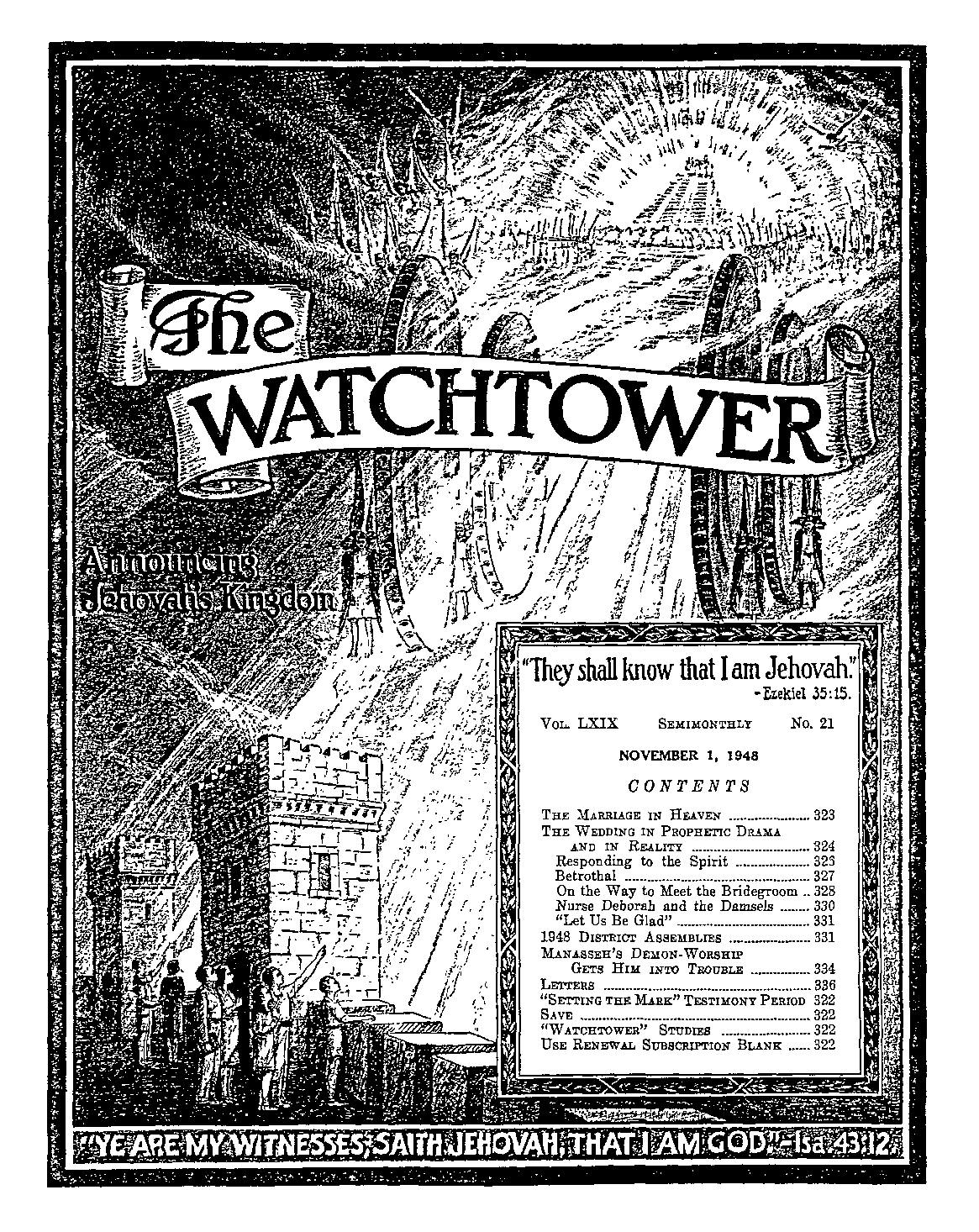
Published Semimonthly By
WATCH TOWER BIBLE & TRACT SOCIETY 117 Adams Street - - Brooklyn 1, N.Y., U.S.A.
Officers
N. H. Knorr, President Grant Suiter, Secretary
“And all thy children shall be taught of Jehovah; and great shall be the peace of thy children.” • Isaiah 54:13.
THE BIBLE CLEARLY TEACHES
THAT JEHOVAH is the only trne God, from everlasting to everlasting, and is the Maker of heaven and earth and Giver of life to his creatures; that the Word or Logos was the beginning of his creation and his active agent In creating all other thln.s; and that the creature Lucifer rebelled against Jehovah and raised the issue of His universal sovereignty;
THAT GOD created the earth for man, made perfect man for the earth and placed him upon It; that man yielded to unfaithful Lucifer, or Satan, and willfully disobeyed God's law and was sentenced to death; that by reason of Adam’s wrong act all men are born sinners and without the right to life;
THAT THE LOGOS was made human as the man Jesus and suffered death In order to produce the ransom or redemptive price for obedient men; that God raised up Christ Jesus divine and exalted him to heaven above every other creature and clothed him with all power and authority as head of God’s new capital organization;
THAT GOD’S CAPITAL ORGANIZATION is a Theocracy called Zion, and that Christ Jesus is the Chief Ollicer thereof and is the rightful King of the new world; that the faithful anointed followers of Christ Jesus are Zion’s children, members of .Tehovuh’s organization, and are Ills witnesses whose duty and priv ileae it is to testify to Jehovah's supremacy and declare Ids purposes toward mankind as expressed in the Bible;
THAT THE OLD WOULD, or Satan’s uninterrupted rule, ended A.D. 1014. and Christ Jesus has been placed by Jehovah upon the throne, has ousted Satan from heaven, and now proceeds to vindicate His name and establish the "new earth";
THAT THE BELIEF and blessings of the peoples can come only by Jehovah’s kingdom under Christ, which has begun: that His next great act is to destroy Satan’s organization and establish righteousness completely in the earth , and that under the Kingdom the people of good-will surviving Aimageddon will cairy out the divine mandate to "fill the earth” with righteous offspring, and that the human dead in the graves will be raised to opportunities ot life on earth.
ITS MISSION
' I 'HIS journal Is published for the purpose of enabling the ] people to know Jehovah God and his purposes as expressed 1 in the Bible. It publishes Bible Instruction specifically designed to aid Jehovah’s witnesses and all people of good-will. It arranges systematic Bible study for Its readers and the Society supplies other literature to aid In such studies. It publishes suitable material for radio broadcasting and for other means of public instruction in the Scriptures.
It adheres strictly to the Bible as authority for Its utterances. It is entirely free and separate from all religion, parties, sects or other worldly organizations. It Is wholly and without reservation for the kingdom of Jehovah God under Christ his beloved King. It is not dogmatic, but Invites careful and critical examination of its contents in the light of the Scriptures. It does not Indulge in controversy, and its columns are not open to personalities.
Notice to Subscribers: Remittances should be seat to office in your country in compliance with regulations to guarantee safe delivery ot mone.v. Remittances are accepted at Brooklyn from countries where no office is located, by international money order only. Subscription rates in different countries are stated below In local curtency. police 0/ ejpuutini (with renewal blank) is sent at least two Issues before subscription expires. Change of address when sent to our office may be expected effective within one month. Send your old as well as new address.
Please address the Watch Tower Society in every ease.
Offices Yearly Subscription Rate
America (U.S.), 117 Adams St., Brooklyn 1, N. Y.
Aiistialia, 7 Beresford Rd.. Strathiield. N. S. W.
British (Vest Indies, 21 Taylor St., Woodbrook, Port of Spain, Trinidad Si 25 Bui ma, 39 Signal Pagoda Road, Rangoon Its 3/s
Canada, 40 Irwin Ave., Toronto 5, Ontario
England, 34 Craven Tertace, London, W. 2
India, 1G7 Love Lane, Bombay 27 Rs. 3/s
Jamaica, 151 King St., Kingston
A eiLjoundland, Post Box 521, St. John’s
Hem Zealand, G. P. O. Box 30, Wellington. C. 1
Philippine Hepubl.c, 104 Rooseieit Itoad, San Francisco del Monte, Quezon City 2 pesos
South Africa, G23 Boston House, Cape Town
T. Iluican, 122S Pensacola Sl, Honolulu 14
West Afuca, P.O. Box G'j5, Lagos, Nigeria
Translations of this journal appear in many languages.
ALL SINCERE STUDENTS OF THE BIBLE who by reason ot Infirmity, novel rv or adier.-ity are unable to pay the subscription pih-e may lime '1 he 11 atclituucr tree upon written .ipplnation to the publisher-, m.iile once each year, stating the reason tor so ic<iuesting it. lie aie glad to tl.us aid the needy, but the written application once each year is required by the postal regulations.
Printed in the United States of America
Enteicd as second-das'! matter at the post office at Brooklyn, .V. y., under the .let of Hutch d, let's.
“SETTING THE MARK” TESTIMONY PERIOD
Humane persons interested in the eternal life of people of good-will in God’s righteous new world will want to make an indelible mark in their intellect by means of the Kingdom truth. That is why the month of December has been set aside as a testimony period of special effort, as indicated by the above-given name. To help in setting the mark upon good-will foreheads, as foretold in Ezekiel, chapter 9, the offer that Jehovah’s witnesses will popularize during this closing month of 1948 will be the latest book, “Let God Be True," and the booklet Pei manent Governor of All Nations (or The Joy of All the People) to all contributors of 35c for the combination. Every reader of The Watchtower can actively associate himself with tins marking work which leads to our being spared by God’s executioners during the oncoming battle of Armageddon. We welcome the co-operation of all, and assure you of our best services in helping to establish your contact with experienced Kingdom publishers. Your report filled out on the form supplied by the Society will greatly interest us at the end of December's work.
SAVE
your personal or home copy of each issue of The Watchtower. Do not throw them away, but preserve them in a binder or drawer or on library shelves. At the end of each year, in its December 15 issue, The Watchtower contains an index of subjects and an index of all the scriptures cited, quoted and commented upon in all the leading articles throughout the year. By saving your copies and keeping them in date order you will have an invaluable reference library tor consultation in your study of the Bible. Organized companies should preserve copies in the libiary of tbeir local Theocratic ministry course school.
“WATCHTOWER” STUDIES
Week of December 5: “The Marriage in Heaven,” fl 1-7 inclusive, also “The Wedding m Prophetic Drama and in Reality”,
fl 1-13 inclusive, The Watchtower November 1, 1948.
Week of December 12: “The Wedding in Prophetic Drama and in Reality”,
fl 14-35 inclusive, The Watchtower November 1, 1948.
USE RENEWAL SUBSCRIPTION BLANK
The renewal blank sent you prior to the expiration of your Watchtower subscription should be filled out and returned to the Brooklyn office or to the Branch office in the country where you reside. Servants in the companies, and individuals, when sending in renewals for The Watchtower, should always use these blanks. By filling in these renewal blanks you are assured of the continuation of your Watchtower from the time of expiration, and without delay. It will also be a great help if you sign your name uniformly, and note any recent change of address, on the renewal slip.
ANNOUNCING JEHOVAH’S KINGDOM
Vol. LXIX November 1, 1948 No. 21
THE MARRIAGE IN HEAVEN
“Let us rejoice and. be exceeding glad, and let us give the glory unto him: for the marriage of the Lamb is come, and his wife hath made herself ready.”—R,ev. 19:7, Am. Stan. Ver.
JEHOVAH has prepared a great joy for heaven and earth. It is like the joy that overflows at the marriage of a dear son to his bride. No creature can know the depth of joy that Jehovah experiences when he unites his chief Son, his firstborn, with the beloved bride that He promised and provides for this Son. Yet all in heaven and earth who are the friends of God and of the marriage principals will rejoice at the delightsome event in heaven.
2 Jehovah God is himself the “husband” of his universal organization of faithful creatures. In his sacred Word he speaks of her as his “woman”. Once this holy organization was like a wife that seemed unable to bring forth the son desired. So she was like a woman cast off from motherhood. But at the right time her “husband” made her fruitful and told her to sing for joy. Assuring her he is still her faithful Spouse, God said: “For thy Maker is thy husband; Jehovah of hosts is his name: and the Holy One of Israel is thy Redeemer; the God of the whole earth shall he be called. For Jehovah hath called thee as a wife forsaken and grieved in spirit, even a wife of youth, when she is cast off, saith thy God.” (Isa. 54: 5, 6, Am. Sian. Ver.) The fact that Jehovah is her “Maker” shows she is His creation, his universal organization of loyal creatures. He redeemed her from her seeming barren state when he brought the promised Son for his purpose forth from her midst. Her name is “Zion”, or “Jerusalem”, a name once borne by a typical organization on earth; and when Jehovah fructifies her to produce the long-awaited Son he rejoices over her as a newly married man exults over the bride who has now become his wife. Comfortingly Jehovah says to her: “No more shall you be named ‘Forsaken,’ nor your land be named ‘Desolate’; but you shall be called ‘My delight is in her,’ and your land ‘Married’; for the Lord delights in you, and your land shall be married. As a young man marries a maiden, so shall your Builder marry you; and as a bridegroom rejoices over his bride, so shall your God rejoice over you.”—Isa. 62: 4, 5, An Amer. Trans.
1. Whar great marriage joy does Jehovah provide for the universe? 2. How does Jeho'ah himself hold a marriage relationship?
3 The sublime words of prophecy just quoted do not apply to some human organization or national organization, for centuries later an inspired writer quoted this prophecy of Isaiah and applied it heavenward, saying: “But Jerusalem which is above is free, which is the mother of us all. For it is written, Rejoice, thou barren that barest not; break forth and cry, thou that travailest not: for the desolate hath many more children than she which hath an husband. Now we, brethren, as Isaac was, are the children of promise. But as then he that was born after the flesh [Ishmael by name] persecuted him that was born after the spirit, even so it is now. Nevertheless what saith the scripture? Cast out the bondwoman and her son: for the son of the bondwoman shall not be heir with the son of the free-woman. So then, brethren, we are not children of the bondwoman, but of the free.”—Gal. 4: 26-31; Isa. 54:1; Gen. 21:8-10.
4 It was near the site of ancient Jerusalem that Abraham, God’s friend, proceeded to offer up as a human sacrifice Isaac, his loved son by his long-barren wife Sarah. (Gen. 22:1-18) It was under such circumstances that faithful Abraham acted as a prophetic picture of Jehovah God the husband, and Sarah the freewoman served as a picture of “Jerusalem which is above”. Isaac, the sacrifice, was used as a picture of God’s only begotten Son, Jesus Christ, whom God gave in sacrifice for the blessing of all the nations of good-will. This unselfish Son of God is the great antitypical Isaac, and all his faithful footstep followers become his brothers, children of his mother, God’s “woman”, who is “Jerusalem which is above” and which is free of all earthly bondage. It is to these footstep followers, his Christian brethren, that the inspired apostle writes: “Now we, brothers, are like Isaac, children born in fulfilment of the promise.”—Gal. 4:28, An Amer. Trans.
5 In due time Abraham arranged for a wife to be bestowed upon his beloved son Isaac. So, too, Jehovah God has arranged for the great antitypical Isaac, Christ Jesus, to have a wife. As a man on 3, 4 Whom did Abraham, Sarah and Isaac typify?
5, G. How is Jesus a bridegroom? Who is his bride, and who is his friend9 earth Jesus died unmarried and childless. Hence the bride that his heavenly Father provides for him is not and can not be an earthly woman, and the promised marriage of him to his “bride” did not take place when he was on earth. The facts show it must be and will be a marriage in heaven. Remember that Jehovah’s “woman” is not a woman of flesh and blood, but is his holy organization of devoted servants throughout the universe, over all of whom he is the Head. Likewise, the wife that he creates for his beloved Son is an organization, a “new creation”, composed of the faithful number of Jesus’ footstep followers. Fully aware of his heavenly Father’s purpose, Jesus on earth referred to himself as a bridegroom. In proof it is written: “And the disciples of John [the Baptist] and of the Pharisees used to fast: and they come and say unto him, Why do the disciples of John and of the Pharisees fast, but thy disciples fast not? And Jesus said unto them, Can the children of the bridechamber fast, while the bridegroom is with them? As long as they have the bridegroom with them, they cannot fast. But the days will come, when the bridegroom shall be taken awav from them, and then shall they fast in those days.”—Mark 2:18-20; Matt. 9:14,15; Luke 5:33-35.
“John the Baptist was not one of the abovementioned “children of the bridechamber”. He died before Christ Jesus was taken away in death. John was like a “friend of the bridegroom” who in Oriental fashion arranges for the bride and brings about the contract between the parents of the bride and those of the bridegroom. John was first to speak of Christ Jesus as a bridegroom, and he shows also that Christ’s bride is the organization of his faithful footstep followers. John had the extreme pleasure of being the one to introduce the first of these disciples to Christ Jesus. He was privileged to get them ready for Christ’s first appearance. After he had acted as a “friend of the bridegroom” and had put Christ Jesus in touch with these first disciples, John said: “Ye yourselves bear me witness, that I said, I am not the Christ, but that I am sent before him. He that hath the bride is the bridegroom: but the friend of the bridegroom, which standeth and heareth him [that is, when he talks to his bride], rejoiceth greatly because of the bridegroom’s voice: this my joy therefore is fulfilled." (John 3: 28, 29) It was not by his own ingenuity that John spoke of Christ Jesus as a bridegroom. He was moved to do so by the power of the holy spirit with which he was filled “even from his mother’s womb”. In turning many believing Israelites to Christ Jesus John was in effect turning them to Jehovah God, for Christ Jesus was the Son and Representative of God. (Luke 1:13-17) In all this marriage transaction as hereafter described watch how God’s spirit works.
7 John’s joy was great over having only an initial part in this matter. But joy will reach its peak at the consummation of the great marriage in heaven. Many others are due to jubilate over it, and an unusual celebration is due to take place then. All this is described for us symbolically in the last book of the Bible, in these words by the apostle who saw the vision: “And I heard as it were the voice of a great multitude, and as the voice of many waters, and as the voice of mighty thunderings, saying, Alleluia: for the Lord God omnipotent reigneth. Let us be glad and rejoice, and give honour to him: for the marriage of the Lamb is come, and his wife hath made herself ready.” (Rev. 19: 6, 7) The consummation of the marriage is here shown to be in the time of the kingdom of Jehovah God Almighty. That time, marked by this joyous event, is here! Let us all rejoice! You may ask, As this is a marriage in heaven, just how can I on earth appreciate it to rejoice at it? Let us, then, make this our study in the article next below.
7. Where and how Is the marriage joy described'1 and when is it*-
THE WEDDING IN PROPHETIC DRAMA AND IN REALITY
ABRAHAM’S son Isaac was a dramatic type of Christ Jesus, God’s only begotten Son. Abraham’s line ran through Isaac, and we read: “Now the promises were made to Abraham and his line. It does not say, ‘and to your lines,’ in the plural, but in the singular, ‘and to your line,’ that is, Christ.” (Gal. 3:16, An Amer. Trans.) This means a blessing to all nations of good-will. This blessing is certain, for at the time that Abraham showed complete willingness to offer up his son Isaac on the altar as a sacrifice to God, Jehovah’s angel from heaven said to Abraham: “Thy seed shall possess the gate of his enemies; and in thy seed [line] shall all the nations of the earth be blessed.” (Gen. 22:17,18) Since this is true, why should not all nations of good-will rejoice at the wedding of the antitypical Isaac, Christ Jesus, in whom they are all destined to be blessed? The wedding that was arranged and consummated for Isaac of old must have furnished us a drama prophetic of the marriage of Christ Jesus, the Lamb of God. This doubtless accounts for it that Isaac’s marital affair is set out in such detail in the sixty-seven verses of Genesis, chapter twenty-four. Suppose, then, that we now consider this prophetic drama in its main features, as told in Genesis 24:1-67.
2 It happened when Abraham was 140 years old. His wife Sarah was dead now for three years. (Gen. 23:1-20) Also Isaac was a mature man of forty years. (Gen. 25:20) Years previous he had offered himself for sacrifice and was delivered from death by God’s intervention. (Heb. 11:17-19) Isaac’s mother Sarah was not a picture of Alary the virgin mother of Jesus, but was a picture of God’s ‘'woman”, Jehovah’s universal organization. Sarah's death does not picture that God’s “woman” (or universal organization) dies or ceases to exist. But when Jesus attained manhood and was baptized and the holy spirit came upon him, God confessed him as his beloved Son. Three and a half years later he laid down his human life, but God raised him from the dead as a spirit Son. There God’s “woman” had served His particular purpose successfully. She had brought forth the antitypical Isaac, namely, the Son of God, Christ Jesus, perfected in the spirit. (Matt. 3:13-17; 1 Pet. 3:18; Acts 13: 33) She had finished that feature, and now the bride class was due to be called.
3 In those ancient patriarchal times the father-selected the bride for his son, using a servant or a friend to act as the go-between for the two families involved. Abraham summoned his oldest slave. Evidently he was Abraham’s steward named Eliezer, who would have become heir to all his property if a son had not been born to Abraham. (Gen. 15:2-4) But now Abraham had given all he had to his true heir Isaac. This fact corresponds with the apostle’s words concerning Christ Jesus, that “God . . . hath in these last days spoken unto us by his Son, whom he hath appointed heir of all things”.—Gen. 24:36; Heb. 1:1,2.
1 Abraham made his slave swear by “Jehovah, the God of heaven and the God of the earth”, that he would not take a wife for his son Isaac from the daughters of the Canaanites among whom he had been dwelling for sixty-five years. He and Isaac were descended from Noah’s son Shem, but those Canaanite daughters were descended from Noah’s grandson Canaan and hence they were under a curse and condemned to be servants of Abraham’s family. After the Flood, when Noah had been treated disrespectfully by his son Ham, he prophesied of Ham’s son Canaan, saying: “Cursed be Canaan; a servant of servants shall he be unto his brethren. . . . Blessed be Jehovah, the God of Shem; and let Canaan be his servant. God enlarge Japheth, and let him dwell in the tents of Shem; and let Canaan be his servant.” (Gen. 9:20-27, Am. Stan. Ver.) Moreover, those Canaanites worshiped devils and were given over to idolatry and other unclean practices, and they could contaminate a worshiper of Jehovah God or make 2 Whom did Sarah picture, and so what did her death picture? 3, 4. To what did Abraham make Eliezer .swear, and why bo? great difficulties for him. So Abraham strictly forbade yoking his son Isaac up unequally with a pagan worshiper of false gods.—2 Cor. 6:14,15.
3 Abraham wisely sought to marry his son to someone that was of the faith in the true and living God, Jehovah. Shem’s descendants, represented in the families of Abraham’s brothers Haran and Nahor then living in northern Mesopotamia, were the ones still holding on to faith in Jehovah. Abraham thus set up a precedent for the rule stated by the apostle Paul, for believers to marry “only in the Lord”. (1 Cor. 7:39) Furthermore, the bride for Isaac must be willing to travel from her land and her parent’s household to Isaac in the Promised Land. So Abraham’s steward was distinctly charged not to bring Isaac to the land from which Abraham had come out at God’s command, in order to procure Isaac’s bride. If no woman from Abraham’s relationship up north would come away to the Promised Land to join Isaac as his wife, then Abraham’s servant would be clear of his oath.—Gen. 24:1-9; 12:1-7; 15:18-20.
6 This fits the fact that Jehovah God arranged for the bride of his Son Jesus Christ to be made up of those who believe in him and consecrate themselves wholly to his worship. Christ Jesus, the antitypical Isaac, was forbidden to become a part of this world in order to get followers, but he must look for his company of followers from among those who worshiped the same God. Therefore Jehovah sent him to earth, not to the Gentile nations of devil-worshipers, but to the Jewish nation. These were natural descendants of Abraham through his son Isaac and professed to worship Jehovah God. To prepare a class among these in advance of Jesus’ public appearance to the Jewish nation, God the Father sent ahead John the Baptist, and for the next seven years the offer was held out exclusively to the Jewish nation to become members of the bride of God’s Son.
7 As in the case of Isaac’s bride, the bride of Christ must agree to forsake this world and all human relationships in order to join Christ Jesus in the spiritual estate pictured by the Promised Land. Incidentally this shows that when Christ Jesus comes to claim his bride he does not come again into this world in the flesh as he did at his first advent, but his bride class must leave the flesh, undergo a change, and become spiritual and enter the spirit realm. The bride class knows Christ after the flesh no more. As we read; “Know ye not that he which is joined to an harlot is one body? for two, saith he, shall be one flesh. But he that is joined unto the Lord is one spirit.” (1 Cor. 6:16,17) Thus in a most complete sense the bride class forsake worldly and fleshly relationships.
8 Fully pledged to obedient action, Abraham’s servant got on his way: “and the servant took ten camels, of the camels of his master, and departed, having all goodly things of his master’s in his hand [or, for all the goods of his master were in his hand]: and he arose, and went to Mesopotamia, unto the city of Nahor.” He, of course, had other men along with him on the caravan journey. (Gen. 24:10, 32, Am. Stan. Ver.) As it appears that Abraham was at that time living at or near Beer-sheba in the south of Palestine, this journey was one of more than five hundred miles through much dangerous country. Here the question is asked, Whom or what does this servant, Eliezer presumably, picture?
9 He does not represent the holy angels, for Abraham told him Jehovah would send his angel before the servant, thus denoting that Jehovah’s angelic company co-operate with what Abraham’s servant pictures. The part that the servant plays matches well with the operation of Jehovah’s holy spirit or active force. And if the servant was, in fact, Eliezer, then his name means “God is help”, and it means that God uses the holy spirit to help in the securing of the bride class for the antitypical Isaac. True to fact, God has sent his spirit to the bride class, and it continues with them till they are united with their Bridegroom Christ Jesus. The angels co-operate with this active force of God: “Are they not all ministering spirits, sent forth to minister for them who shall be heirs of salvation?” (Heb. 1:14) The “ten camels” represent the perfect or complete Word of God, by which God extends the invitation and imparts much of his holy spirit and other spiritual gifts.
10 Outside the city of Nahor, at a well, Eliezer asked for a sign to indicate Jehovah was directing his course and also to speed up the selecting of a bride suitable for Isaac. Eliezer prayed in his heart. (Gen. 24:11-14,42-45) He showed he was a man of good-will toward Abraham’s God. As a male member of Abraham’s household he was circumcised the same as Abraham and Isaac and thus was consecrated to Jehovah God. In these respects he was a suitable picture of the holy spirit that serves God’s purposes. “And it came to pass, before he had done speaking, that, behold, Rebekah came out, who was born to Bethuel the son of Milcah, the wife of Nahor, Abraham’s brother, with her pitcher upon her shoulder. And the damsel was very fair to look upon, a virgin, neither had any man known her: and she went down to the fountain, and filled her pitcher, and came up. And the servant ran to meet her, and said, Give me to drink, I pray thee, a little water from thy pitcher. And she said, Drink, my lord: and she hasted, and let down her pitcher upon her hand, and
8, 9. On the journey what do Eliezer and the camels picture?
10. For what sign did Eliezer pray, and how did Rebekah fulfill it? gave him drink. And when she had done giving him drink, she said, I will draw for thy camels also, until they have done drinking. And she hasted, and emptied her pitcher into the trough, and ran again unto the well to draw, and drew for all his camels. And the man looked stedfastly on her, holding his peace, to know whether Jehovah had made his journey prosperous or not.” (Gen. 24:15-21, Am. Stan. Ver.) Rebekah’s conduct met the details of the sign for which Eliezer had asked.
RESPONDING TO THE SPIRIT
11 Eliezer served Abraham, to whom Jehovah had promised: “In thy seed shall all the nations of the earth be blessed.” Fittingly, Rebekah kindly ministered to Abraham’s servant and men and camels, and this depicted that those who respond to God’s invitation to become the bride of his Seed entertain favorably the great Abrahamic promise concerning the Seed. They do not resist God’s holy spirit, as the rebellious Jews did who rejected Christ Jesus and his apostles. No, they are willing to be at the service of his spirit, desiring that it may rest upon them and operate through them. They lovingly consider the Word of God which bears much of his spirit to them. They take an interest in his written Word, serving it and freshening it up by attending upon it and displaying a sincere concern for its message and purpose, seeking to believe it. Thereby they show the qualities to be desired in members of the bride of Christ. At the time that Rebekah served cool wellwater to this servant of the Abrahamic promise, Abraham’s son Isaac had already been upon the altar of sacrifice and had been raised up from it alive. Hence what here takes place pictures more particularly what occurs after the death of Christ Jesus and his resurrection from death and his ascension into heaven to appear in the presence of God his Father. From then till Pentecost, ten days later, his faithful disciples waited in Jerusalem to receive the holy spirit. Their receiving it and being begotten by it to spiritual life would mean the invitation to them and their betrothal to become the bride of Christ Jesus.—Luke 24:45-52.
12 Eliezer asked if he might be entertained at Rebekah’s parent’s home, and at his request Rebekah identified herself to him as a grandniece of his master Abraham. At this evidence of divine guidance in this matter, Eliezer worshiped Jehovah God and blessed him. Then in appreciation of Rebekah’s willing ministry to him and his caravan at the well he adorned her with two heavy gold bracelets and a golden nose ring. (Gen. 24: 22-27, 45-48, Am. Stan. Ver.) This pictures that on the feastday of Pentecost the first members of the bride of Christ began
to be identified by the imparting of God’s holy spirit and its gifts, which adorn their appearance in this world. On that day, when the holy spirit descended upon them, the faithful apostles and disciples of the Bridegroom began to be begotten of God’s spirit to become his spiritual children. In that way they became true spiritual relatives of Christ Jesus and hence as such they could be invited and betrothed to him as the Bridegroom. They became new creatures, for whom all old things have passed away and who no longer know Christ Jesus as a fleshly creature such as he was when on earth. (2 Cor. 5:16,17) Being now begotten of water (the truth of God’s Word) and of the spirit, they could see and enter into the kingdom of God, which flesh and blood cannot inherit. (John 3:3,5; 1 Cor. 15:50) They say regarding God their Father: “Of his own will begat he us with the word of truth, that we should be a kind of firstfruits of his creatures.”—Jas. 1:18.
BETROTHAL
13 At Rebekah’s home, before ever he would take any of the food they set before him, Eliezer insisted on explaining his errand and determining whether it would succeed at her home or not. It seems that Rebekah’s father Bethuel was dead, and that her brother Laban and a younger brother named Bethuel handled for her. (Gen. 24:28,50,55; Josephus’ Antiquities, Book 1, chapter 16, fl 2) Having told his mission, Eliezer concluded: “And now if ye will deal kindly and truly with my master, tell me: and if not, tell me; that I may turn to the right hand, or to the left.” “Then Laban and Bethuel answered and said, The thing proceedeth from Jehovah: we cannot speak unto thee bad or good. Behold, Rebekah is before thee, take her. and go, and let her be thy master's son’s wife, as Jehovah hath spoken. . . . And the servant brought forth jewels of silver, and jewels of gold, and raiment, and gave them to Rebekah: he gave also to her brother and to her mother precious things.” (Gen. 24: 49-53, Am. Stan. Ver.) That transaction constituted the betrothal of Rebekah to Isaac. She was in effect his wife from then on, as far as obligations to be pure and faithful were concerned. The jewels of gold and silver and the raiment that Eliezer gave her were a foretaste of the coming marriage with Isaac. On the other hand, the precious things given her brother Laban and her mother were a dowry -in payment for the bride. From then on Rebekah belonged to Isaac, who bought her through his father’s servant Eliezer.
14 It was at Calvary that the antitypical Isaac, Jesus Christ, laid his life down for his “little flock” of sheep who make up the bride class. “The good shepherd giveth his life for the sheep,” but first of
13. How wa> the betrothing of Rebekah brought about’
14, 13. How <ioe& Christ’s bride get bought and keep her virginity? all for the “sheep” to whom he says: “Fear not, little flock; for it is your Father’s good pleasure to give you the kingdom.” (John 10:11; Luke 12: 32) When he ascended to heaven and appeared in God’s presence for these he paid over the price for them. He redeemed them from the earth, or from among those of mankind who will be saved, just as Rebekah was purchased from the land of Mesopotamia and from her parent’s household for Isaac in the Promised Land. To compare with the virginity of Rebekah, these keep themselves from defilement with this world, not violating the intended relationship with Christ and not creating ties of bondage to this world. They do not let this world use them according to its pleasure, but recognize the fact: “Ye are bought with a price; be not ye the servants of men.” (1 Cor. 7:23; 6:19,20) When completed the bride class will be the full number that Jehovah God foreordained, namely, 144,000, respecting whom we read: “The hundred and forty and four thousand, which were redeemed from the earth. These are they which were not defiled with women; for they are virgins. These are they which follow the Lamb whithersoever he goeth. These were redeemed from among men, being the firstfruits unto God and to the Lamb.” —Rev. 14:1, 3,4.
15 That the bride is a company, of virgin purity and devotion toward their beloved spouse, is further illustrated in the Bridegroom Jesus’ parable in which the remnant of them on earth at the end of this world are “likened unto ten virgins, which took their lamps, and went forth to meet the bridegroom”. —Matt. 25:1.
13 At Pentecost of A.D. 33 was really when the betrothal of the bride class to Christ began. Then the faithful footstep followers of the Lamb of God could really be invited or called to the Bridegroom who is heavenly and spiritual. Why? Because God then sent his holy spirit down upon them and begot them to be his spiritual children with a heavenly inheritance. Now they were in the same condition that Jesus was after he was baptized and the holy spirit came upon him and God’s voice from heaven was heard to say: “This is my beloved Son, in whom I am well pleased.” They were each a “new creation”, and the marriage of the heavenly Bridegroom and his bride is one of new creatures. The imparting of the spirit from Pentecost forward with its varied manifestations in the form of miraculous gifts was a foretaste of the coming marriage estate in heaven, to compare with the gifts bestowed by Eliezer upon Rebekah.
17 The gift of the spirit was an assurance that God has accepted the merit of Jesus’ ransom sacrifice and that they were bought with it and belonged to the Bridegroom. It was a mark or authentic sign that they had been espoused or betrothed to Christ in heaven. (Eph. 1:13,14) The Bridegroom himself was used to give this spirit of betrothal, as the apostle Peter said on that very day of Pentecost: “This Jesus did God raise up, whereof we all are witnesses. Being therefore by the right hand of God exalted, and having received of the Father the promise of the holy spirit, he hath poured forth this, which ye see and hear.” (Acts 2:32,33, Am. Stan. Ver.) This spirit was to abide W’ith them for the full time of their betrothal to Christ until the marriage is consummated.—John 14:16,17.
18 Thus we discern how Eliezer well represented the holy spirit and the service it renders. Certainly the betrothal of a Christian to the heavenly Bridegroom is not by any man, such as a religious clergyman. It is by God and by means of his holy spirit which he sends forth. However, just as Eliezer was a human creature, so, too, human creatures can be and have been used in connection with the betrothal of consecrated believers to Christ. The apostle Peter, after he himself and his more than a hundred fellow believers were espoused to Christ by the holy spirit at Pentecost, was used in behalf of the betrothal of thousands of others that later believed that same day and that were baptized. “And Peter said unto them, Repent ye, and be baptized every one of you in the name of Jesus Christ unto the remission of your sins; and ye shall receive the gift of the holy spirit.” (Acts 2:38, Am. Stan. Ver.) Peter’s fellow apostles were also used thus that day and after. This was particularly so, because through the laying on of the hands of all these apostles the gift of the holy spirit was bestowed upon the baptized believers. —Acts 2:41-43; 8:14-19.
19 The apostle Paul speaks of himself as taking part in the work of betrothing Christians to the heavenly Bridegroom. Defending his jealous care over those at Corinth, Greece, he said: “I am jealous over you with a godly jealousy: for I espoused you to one husband, that I might present you as a pure virgin to Christ. But I fear, lest by any means, as the serpent beguiled Eve in his craftiness, your minds should be corrupted from the simplicity and the purity that is toward Christ.” (2 Cor. 11:2,3, Am. Stan. Ver.) He was anxious that they continue in their virgin purity to one husband, keeping their ties holy toward him, that they might prove worthy of finally being joined with him in marriage. Paul was no less jealous for these Christians whom he speaks of as betrothing than Eliezer was over Rebekah after betrothing her to Isaac.
20 Paul was speaking, not strictly to Jewish believers, but also to Gentile believers of Corinth, of whom 18, ID. How were men used in connection with her betrothal?
20 . Who make up the betrothed ones? When do the remnant appear? he baptized a few. This was about twenty years after God had sent the apostle Peter to the home of the Gentile Cornelius and had poured out his holy spirit through Christ upon the first Gentile believers, thus calling or inviting Gentile believers to become members of the bride of Christ. (Acts 10:1-48) Hence those who are called to become “the Lamb’s wife” are not exclusively Jewish but are in large number Gentile in extraction. Paul could speak of espousing these consecrated ones at Corinth, not just because he had first preached the gospel truth to them and founded their congregation, but also because he, as an apostle, had been used to transmit the holy spirit of espousal to them. (Acts 18:1 to 19:7; 2 Cor. 12:12) At this end of the world God promised to espouse the remnant of the bride class to his Son by the instrumentality of the holy spirit. (Joel 2:28,29; Acts 2:16-18) They become the remnant of the seed of God’s “woman”, from and after A.D. 1918, as the facts show.—Rev. 12:17.
ON THE WAY TO MEET THE BRIDEGROOM
21 Respecting those of the bride of Christ it is written: “These are they which follow the Lamb whithersoever he goeth.” Did Rebekah faithfully dramatize that feature about them? Yes. The morning after her betrothal Eliezer asked to be let go at once to his master hundreds of miles away. When her brother and mother wanted to keep her for at least ten days longer, Eliezer said: “Hinder me not, seeing Jehovah hath prospered my way; send me away that I may go to my master.” Then her brother and mother decided to submit the matter to Rebekah’s decision. “And they called Rebekah, and said unto her, Wilt thou go with this man [that is, immediately] ? And she said, I will go.” (Gen. 24: 54-58, Am. Stan. Ver.) Like Eliezer, Rebekah recognized Jehovah’s hand in the matter, and she would not try to delay or interfere with the divine will. She added to her beauty of form and feature by setting her affections on her future husband, whom she had never seen, being willing to go at once to him far from home ties and associations. Possibly the psalmist had her in mind when he penned the beautiful words of Psalm 45:10,11 about the bride of the King Christ Jesus. Those who prove worthy of marriage with the heavenly Bridegroom exercise faith and follow the leadings of God’s holy spirit and promptly seek to go to him. How? By bending all their efforts to get ready for his Son, who promised to come at an undisclosed day and hour and receive them to himself as his bride. They redeem the time by faithfully following his example on earth and seeking to be his suitable companion.
22 The prophetic drama moves forward as we read its script: “And they sent away Rebekah their sister, and her nurse, and Abraham’s servant, and his men. And they blessed Rebekah, and said unto her, Our sister, be thou the mother of thousands of ten thousands, and let thy seed possess the gate of those that hate them.” (Gen. 24:59,60, Am. Stan. Ver.) This blessing was fitting for the wife of Isaac, for it agreed with God’s promise to Abraham when Isaac yielded himself up for sacrifice: "By myself have I sworn, saith Jehovah, because thou hast done this thing, and hast not withheld thy son, thine only son, that in blessing I will bless thee, and in multiplying I will multiply thy seed as the stars of the heavens, and as the sand which is upon the seashore; and thy seed shall possess the gate of his enemies; and in thy seed shall all the nations of the earth be blessed.” (Gen. 22:16-18, Am. Stan. Ver.) That was said typically concerning Sarah’s seed Isaac. But now Sarah was dead, and so Rebekah was accounted worthy to have the divine promise renewed to her as an ancestor of Christ, the great Seed, in whom all nations of good-w'ill should be blessed. At the coming universal war of Armageddon Christ Jesus the Seed will conquer the strongholds of all his enemies and will destroy them. And his beloved bride will share the victory with him.—Rev. 17:14, Am. Stan. Ver.
2 3The script of the prophetic drama next says: "And Rebekah arose, and her damsels, and they rode upon the camels, and followed the man: and the servant took Rebekah, and went his way.” (Gen. 24: 61) The journey before them being more than 500 miles, it must have taken a number of days by the use of camels as transportation. In the Near East swift camels are able to run from eight to ten miles an hour, and to keep this up for eighteen hours of a day, thus covering at the best estimate 180 miles a day. But with the women along, it is hardly likely that Eliezer and his men drove the camels that hard each day, so that the return trip consumed a considerable number of days. On this basis the time of Rebekah’s betrothal to Isaac ran from the day of her meeting Eliezer and through the days of her journey to Isaac, a journey which the conditions of those days made very perilous. Jehovah, who sent his angel ahead of Eliezer on his search for Rebekah, now sent him on the return journey to deliver the espoused virgin to her husband.
24 The bride of Christ is a composite one, the members of which began to be called and made ready over nineteen centuries ago. So, the time of her betrothal has extended over all these hundreds of years. Her journey to meet the heavenly Bridegroom has been under the guidance of the spirit of God and attended by his angels. It has been, indeed, a perilous one through this wicked world, with Satan and all 23, 24. How long was Rebekah’s betrothal, and what does it picture?
his wicked demons opposed to the marriage. By A.D. 1918 the majority of the members of the bride class had finished their earthly course and “fallen asleep”, to “sleep in Jesus”. They waited for his coming to rouse them from the sleep of death and to unite them with himself in heavenly wedlock. —1 Thess. 4:13-17. .
25 The second coming of the antitypical Isaac, the Bridegroom, is portrayed in the ancient prophetic drama, as follows: “Now Isaac had come in at the entrance, of Beer-lahai-roi, for he was dwelling in the land of the South [or, the Negeb]: and Isaac came forth to meditate in the field at the approach of evening,—so he lifted up his eyes and looked, and lo! camels coming in.” (Gen. 24: 62, 63, Rotherham; An Amer. Trans.) For God’s ancient people the new day began at evening, or sunset, and hence Isaac’s strolling out into the field at evening’s approach points to the time of the antitypical fulfillment, namely, the time just preceding the thousand-year reign of Christ. “One day is with the Lord as a thousand years, and a thousand years as one day.” (2 Pet. 3:8) It is therefore the time running from A.D. 1914, when Jehovah God enthroned Christ Jesus to rule amidst his enemies, down to the battle of Armageddon, where Christ Jesus destroys all those enemies. After that he rules for a thousand years for the reconstruction of mankind of goodwill. Previous articles in The Watchtower have explained how Christ Jesus came to the spiritual temple A.D. 1918 and ‘judgment began at the house of God’. (Mal. 3:1; 1 Pet. 4:17) It was then that he awakened the faithful sleeping members of his bride class and they were changed. They were “raised a spiritual bodj?’ to be united with their Bridegroom at the temple. Thus the marriage in heaven began for the Lamb and his bride. (1 Cor. 15:44,51-54) But a remnant of the bride class still remains on earth to make ready for union with him to complete the marriage.
26 In the light of the prophetic Scriptures made understandable by the holy spirit the anointed remnant of Jehovah’s witnesses discern that the Bridegroom has come to the temple for judgment work and for the dealing out of the rewards to his faithful followers. To correspond with this we read: "And Rebekah lifted up her eyes, and saw Isaac,—so she alighted with haste [literally, fell] from off the camel; and said unto the servant, Who is this man that is walking in the field to meet us? And the servant said, That is my lord. So she took the veil, and covered herself.” (Gen. 24:64,65, Rotherham, margin) With this meeting the marriage of Isaac and Rebekah began taking place. We note the absence of any priest or religious clergyman to carry on a man-made ceremony and to validate the marriage, the same as with the marriage of Adam and Eve in Eden. But doubtless the uniting of the two was registered or entered into the legal documents of the times. Most certainly it is registered at great length in the Holy Bible, and thus honorably publicized for all to know. The veil with which Rebekah then covered herself enveloped her whole person. It does not correspond with the veil or curtain that hung in the temple and which was rent in two when Jesus died. (Luke 23:44-46; Heb. 9:3-8) Rebekah’s veil was a sign of her husband’s authority over her. Veiling herself thus showed she completely submitted herself to the headship of Isaac as her accepted husband.—1 Cor. 11:9,10, Am. Stan. Ver.
27 Such a veil later concealed Leah’s identity at the time of her marriage to Isaac’s son Jacob, and a veil hid Tamar’s identity when Jacob’s son Judah had marriage relations with her. (Gen. 29:21-25; 38:13-1S) Not with a literal veil, but by faithful obedience to Christ’s example and his commandments, the remnant of his bride class today submit themselves to him as their beloved Bridegroom, whom they discern to be present at the temple.
NURSE DEBORAH AND THE DAMSELS
28 Eliezer identified Isaac to Rebekah with the words, “That is my lord.” This corresponds with the thrilling cry in Jesus’ parable of the virgins at the end of the world: “Behold, the bridegroom cometh; go ye out to meet him.” (Matt. 25:6) Rebekah’s veiling herself and approaching Isaac has a parallel. It is when the wise virgins, the remnant of the bride class, respond to the awakening cry and go forth with lighted lamps to meet the Bridegroom and to enter in with him to the marriage. Since A.D. 1918 this movement has been proceeding, and it is a time of joy and happy anticipation for the bridal remnant.
29 Doubtless as the virgin Rebekah, beneath her veil, drew near to her espoused bridegroom, Isaac, she was not alone. Her nurse Deborah and the damsels, who had attended her on all the long journey from her parent’s home to Isaac’s presence, now followed in her train. They added dignity to the occasion, as Eliezer led Rebekah to her lord and head. “And the servant told Isaac all things that he had done.” (Gen. 24: 66) It is now easy to recognize in the nurse and damsels in Rebekah’s train another delightful picture of the Good Shepherd’s “other sheep”, the people of good-will whom he is now joyfully gathering to the fold of divine security in company with the remnant of his “little flock” of Kingdom sheep.
2b. What did Eliezer’s Identifying of Isaac to Rebekah picture?
29. 30. (a) How chd Rebekah approach Isaac? (b) Whom did her dainseU picture, and what did their journey v,ith her foreshadow?
80 The damsel bridesmaids, of course, outnumbered the bride Rebekah, and nicely pictured the “great multitude” of good-will people who were previsioned to the apostle John, at Revelation 7:9-17. They already outnumber the 144,000 anointed Christians who are rewarded with membership in the heavenly bride class. They are the same as those pictured by the virgin companions appearing in Psalm 45, which describes the marriage of Christ Jesus in kingdom power since A.D. 1914 to his bride class: “The king’s daughter is all glorious within: her clothing is of wrought gold. She shall be brought unto the king in raiment of needlework: the virgins her companions that follow her shall be brought unto thee. With gladness and rejoicing shall they be brought: they shall enter into the king’s palace.” (Ps. 45:13-15) The facts show that since 1918 this virgin-companion class has been accompanying the remnant of the bride class as these go forth to meet the Bridegroom. They have lovingly and courageously shared all the hard experiences and faced the same foes and perils together with the remnant. For their loyal attachment to the King’s interests this virgin-companion class will be spared through the fight at Armageddon. After that victorious fight he will become “the Everlasting Father” to humankind, and they will become his prized children, with hope of eternal life on a paradise earth.
31 As for Deborah, Rebekah’s nurse, this respected woman was older than Rebekah and ministered to her to prepare her for the marriage and her wifely duties. Anciently nurses held an honored position. (Gen. 24: 59; 35:8; 2 Sam. 4:4; 2 Ki. 11:2) Deborah therefore appears to picture persons of good-will toward Christ, but those of such who preceded his death, resurrection and ascension to heaven, namely, the faithful ones from Abel to John the Baptist. (Heb. 11:1-40) Many of these ancient persons as prophets performed a ministry which proved to be in behalf of Christ’s bride class. (1 Pet. 1:10-12) A number of these were earthly forefathers of Jesus. Many of this class will be made “princes in all the earth” as visible representatives of Christ Jesus among mankind during his thousand-year reign after Armageddon. By being resurrected from the grave due to the virtue of His ransom sacrifice these also will become his earthly children. As the prophecy of the King’s wedding says: “Instead of thy fathers shall be thy children, whom thou mayest make princes in all the earth.” (Ps. 45:16) Deborah’s presence at Rebekah’s marriage suggests that those who will be made princes in all the earth will be resurrected from death and be brought in personal contact with the remnant of the bride class before these finish their life in the flesh and join Christ Jesus in heaven.
“LET US BE GLAD”
32 Why should not all persons of good-will toward a bridegroom and bride be unusually glad at the time of their union? So, with gladness and rejoicing the antitypical damsels of Rebekah, the virgin companions, are brought into company with the bridal remnant. Unquestionably they are included in the “great multitude” reported at Revelation 19:6-9, whose voice is heard saying: "Alleluia: for the Lord God omnipotent reigneth. Let us be glad and rejoice, and give honour to him: for the marriage of the Lamb is come, and his wife hath made herself ready. And to her was granted that she should be arrayed in fine linen, clean and white: for the fine linen is the righteousness of saints.” Jehovah took power and began reigning toward our earth A.D. 1914, but this "great multitude” have raised their Hallelujah song only since A.D. 1918, by which time the war in heaven had been won by Jehovah’s Bridegroom Son and Satan the ruler of Babylon had been cast out of heaven. Then the Son came to the temple and began pronouncing judgment upon Satan’s system of organized religion, Babvlon the Great, the mother of harlots. (Rev. 12:7-13; 17:1-5; 19:1-3) The expose of this harlotrous system of organized religion with forehead bare and under no veil of virgin subjection to Christ as King, and also the judgments upon her, stand in awful contrast with the joy that now comes to the Lamb’s wife.—Rev. 19: 7; 21: 9.
33 The “fine linen, clean and white”, which the bride class is now permitted to wear, pictures, not their justification from sin by Christ’s blood, but the “righteous acts of the saints”, or “upright deeds of God’s people”. (Rev. 19:8, Am. Stan. Ver. and An Amer. Trans.) What are these approved acts and deeds? They now consist of the remnant’s privilege of acting as ambassadors for Christ the King and preaching “this gospel of the kingdom in all the world for a witness unto all nations” before the end of this world comes at Armageddon. With such a mark of divine approval upon them the remnant are clothed with a “robe of righteousness”, and they faithfully perform their acts and deeds until the
32. Whom do those rejoicing over the mainage include? Since when? 33 With what is it granted to the bnde to be arrajed, and how? end. (2 Cor. 5:20; Matt. 24:14; Isa. 61:10) In virgin purity they continue true and obedient to their Bridegroom that they may “know him, and the power of his resurrection, and the fellowship of his sufferings, being made conformable unto his death; if by any means [they] might attain unto the resurrection of the dead”, and thus appear in his heavenly presence.—Phil. 3:10,11.
34 John concludes the marriage account with the words: “And he saith unto me, Write, Blessed are they which are called unto the marriage supper of the Lamb. And he saith unto me, These are the true sayings of God.” (Rev. 19:9) The ones thus “blessed” are shown in Jesus’ parables of the supper, at Matthew 22:1-14 and Luke 14:15-24, in which those invited to the supper are the ones who are invited to become members of the bride of the King’s Son, Christ. Not only are these called or invited, but they are unspeakably blessed in finally being chosen as worthy of bridehood with Christ. The faithful remnant on earth now enjoy a foretaste of this heavenly blessedness by anticipation, by the “earnest of the spirit”.
33 The successful union of Bridegroom and bride is pictured for us in the prophetic drama: “And Isaac brought her into the tent of Sarah his mother; thus he took Rebekah, and she became his wife, and he loved her,—and Isaac consoled himself for the loss of his mother.” (Gen. 24:67, Rotherham) This scene calls up Paul’s sublime words describing when Christ Jesus presents himself with his complete bridal company in heaven before his Father, saying: "Husbands, love your wives, even as Christ also loved the church, and gave himself for it; that he might sanctify and cleanse it with the washing of water by the word, that he might present it to himself a glorious church, not having spot, or wrinkle, or any such thing; but that it should be holy and without blemish.” (Eph. 5:25-27) As servants of Isaac’s beloved wife Rebekah, her nurse and her damsels became in effect the honored servants of Isaac, Abraham’s son. And in pleasing similarity the damsel class of good-will of today and the coming “princes in all the earth” will become the honored servants on earth of Jehovah’s wedded Son, Christ Jesus the King.
1948 DISTRICT
SOMETHING new—district assemblies for 1948! In the closing speech of the Pacific Coast convention of Jehovah’s witnesses held at Los Angeles, California, in August, 1947, N. H. Knorr, president of the Watch Tower Bible and Tract Society, stirred his vast audience to loud applause by announcing the new thing. During the following year district assemblies would
ASSEMBLIES
be arranged for in the United States and Canada and throughout all the world, and he would try to attend the six district assemblies in the United States, the four that would be arranged in Canada, and the one in Alaska. The Society’s Branch offices in the various parts of the earth were to arrange district assemblies to accommodate Jehovah’s witnesses in their respective places.
This announcement gave the brethren plenty of notice as to the assembly arrangements for 1948. Expectancy ran high as March 12 approached, for that was the date for the opening of the first district assembly in the United States, to be held at Atlanta, Georgia. All publishers in the United States had their eyes on this gathering. While they would not all attend, knowing it was for U. S. District No. 2, they were wondering what it would be like and what the certain blessings would be that Jehovah would bring to His servants, faithfully assembled at this time. Kingdom publishers from Florida to Virginia and from the Atlantic seaboard to Western Kentucky and Tennessee duly came to Atlanta for their district assembly on March 12-14.
The fine Municipal Auditorium of the city was used, but by the close of the assembly it proved to be too small. All of Jehovah’s witnesses who came were fully satisfied because their feeling of anticipation was soon replaced with that of pleasant satisfaction as each succeeding feature of the program was presented. The talks and demonstrations as planned met the problems of the publishers in that particular part of the country. Because all the advice given in the discourses was so practical, it made the hearts of the hearers swell with appreciation to Jehovah.
Such helpful instructions coming from the Lord’s table must not be wasted. They must use these instructions. So notebooks were quickly put to use, and during the entire assembly you could see the brethren writing down suggestions, ready to take them home and put them into practice and to help the brethren not in attendance to get these same ideas. The publishers of the assembly got a better appreciation of what it meant for a Christian to love his brother and how he could assist his brother in carrying out his covenant relationship with God. They learned, too, how very much interested the Society was in every one of the publishers and how it came to the aid of the publisher in helping him in his ministry. They saw clearly how they were part of a great world-wide organization that God is sending forth to preach this gospel in all the world and that this preaching depends on the individual. They saw, too, that they were sent to do this work.
The brethren were shown that our modern civilization could be a real handicap to the ministry if we allowed it to be Hence the splendid instruction of Christ Jesus and the apostles was set alongside the actual things that exist in our lives today. Our problems today must be tackled in a practical manner. There must not be just theory; we must follow the plain, true statements set out in God’s Word and try to make our lives fit in with those words.
In District No. 2, which is in the southern part of the United States, they have color or racial problems that do not face Kingdom publishers in other places. Auditoriums and halls will not be rented if mixed audiences endeavor to meet together. However, this divisive force which splits the old world hopelessly did not cause any lack of unity at this district assembly of Jehovah’s witnesses. True, in order to rent the Auditorium we had to conform with the rulings to have the white and colored brethren sit in different parts of the hall. But as to division! No. One had but to watch the assembled audience. They smiled together, laughed together, applauded at the same time, sang in unison and with equal fervor. They were united by the bond of truth and appreciation for the provisions of Jehovah. They were united as one people in their desire to laud the name of their Creator and to make known to all men of good-will the Kingdom which will completely remove such divisive forces, and this they did with good effect in the city of Atlanta.
The problems of pioneer ministry were also dealt with by the president of the Society and other speakers. Many from the district sent in their pioneer applications immediately following the assembly. This evidenced that those in position to do so had already begun to apply the instructions and admonition given. With many of their questions answered and a practical plan of operation outlined for them, these ministers had seen the pioneer ministry become, not a hope for the distant future, but a treasured reality. Without question, the practical instruction given on the field ministry proved to be a real benefit to the entire district. Undoubtedly this contributed toward the new peaks of publishers subsequently reached in the United States country-wide.
…