The Watchtower, May 15, 1948
Download: PDF — The Watchtower, May 15, 1948
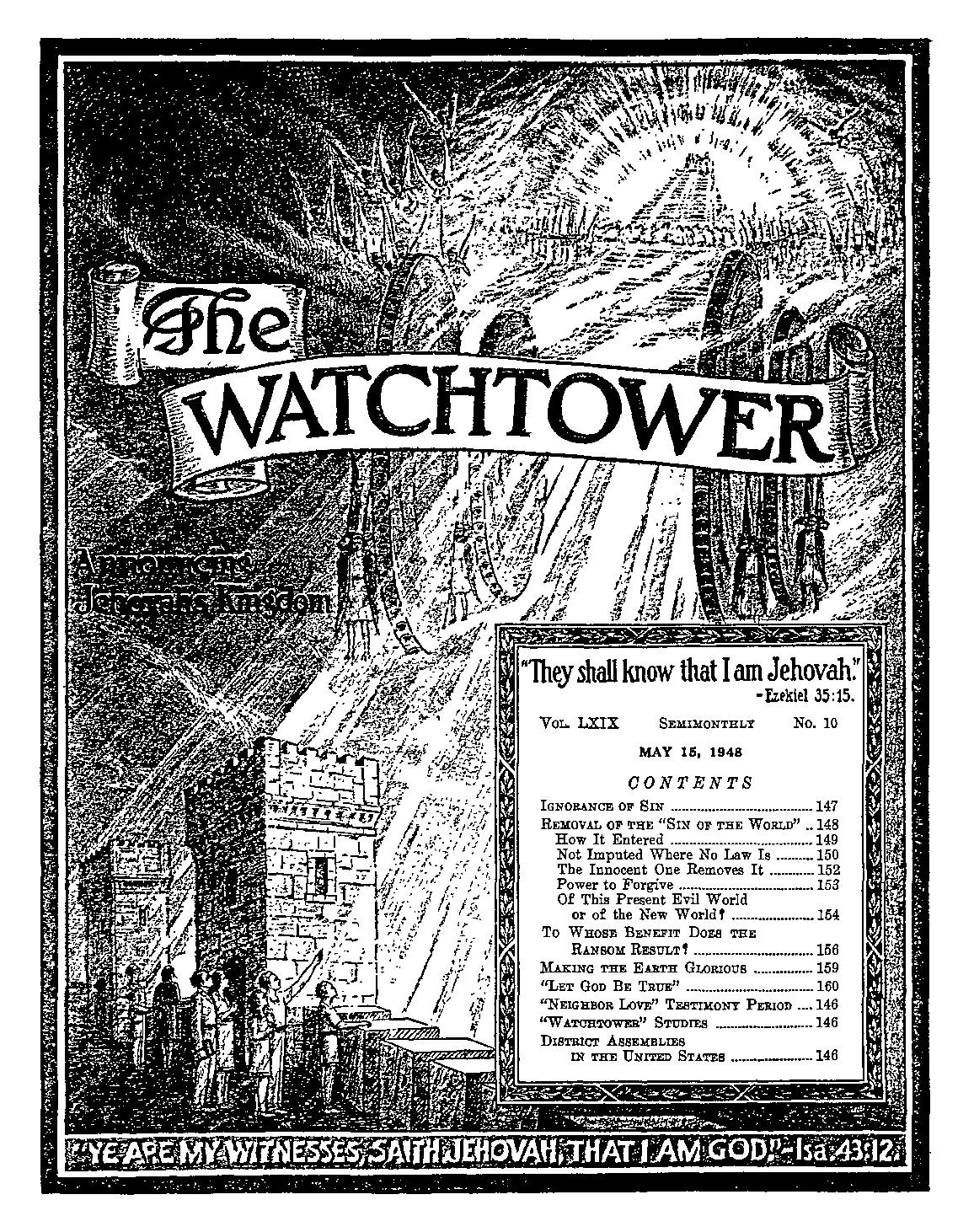
rl>K>
&SJ
■«
,«4‘
mcHTOvgig
W >$. / /S’ FTfci^rl
'i
ft >v3
3 M
"They shall know that I am Jehovah!'
-Ezekiel 35:15.
Vol. LXIX
Semimonthly
No. 10
MAY 15, 1948
At.?
J:
CONTENTS
Ignorance of Sin.......................
Removal of the “Sin of the World” .. 148
How It Entered ............................
Not Imputed Where No Law Is The Innocent One Removes It . Power to Forgive.........................
Of This Present Evil World
or of the New World f ...........
To Whose Benefit Does the
Ransom Result!.....................
Making the Earth Glorious______
“Let God Be True”.......................
7Ej
«<
Hl
R
“Neighbor Love” Testimony Period .... 146
“Watchtower” Studies ... District Assemblies
in the United States
.. 146
1!
THE WATCHTOWER
Published Semimonthly By
WATCH TOWER BIBLE & TRACT SOCIETY 117 Adams Street • • Brooklyn 1, N.Y., U.S A.
OrnoEBa
N. H. Knobb, President Grant Suiter, Secretary
“And all thy children shall be taught of Jehovah; and great shall be the peace of thy children.” - haiah 54:13.
THE BIBLE CLEARLY TEACHES
THAT JEHOVAH is the only true God, from everlasting to everlasting, and is the Maker of heaven and earth and Giver of life to his creatures; that the Word or Logos was the beginning of his creation and his active agent In creating all other things; and that the creature Lucifer rebelled against Jehovah and raised the Issue of His universal sovereignty;
THAT GOD created the earth for mau, made perfect man for the earth and placed him upon it; that man yielded to unfaithful Lucifer, or Satan, and willfully disobeyed God’s law and was sentenced to death; that by reason of Adam's wrong act all men are born sinners and without the right to life;
THAT THE LOGOS was made human as the mnn Jesus and suffered death In order to produce the ransom or redemptive price for obedient men; that God raised up Christ Jesus divine and exalted him to heaven above every other creature and clothed him with all power and authority as head of God's new capital organization;
THAT GOD’S CAPITAL ORGANIZATION is a Theocracy called Zion, and that Christ Jesus is the Chief Officer thereof and is the rightful King of the new world; that the faithful anointed followers of Christ Jesus are Zion's children, members of Jehovah’s organization, and are His witnesses whose duty and privilege it Is to testify to Jehovah’s supremacy and declare his purposes toward mankind as expressed In the Bible;
THAT THE OLD WORLD, or Satan’s uninterrupted rule, ended A.D. 1914, and Christ Jesus has been placed by Jehovah upon the throne, has ousted Satan from heaven, and now proceeds to vindicate His name and establish the “new earth”;
THAT THE RELIEF and blessings of the peoples can come only by Jehovah’s kingdom under Christ, which has begun; that His next great act is to destroy Satan's organization and establish righteousness completely in the earth; and that under the Kingdom the people of good-will surviving Armageddon will carry out the divine mandate to “fill the earth” with righteous offspring, and that the human dead In the graves will be raised to opportunities of life on earth.
ITS MISSION
THIS journal is published for the purpose of enabling the people to know Jehovah God and his purposes as expressed in the Bible. It publishes Bible Instruction specifically designed to aid Jehovah’s witnesses and all people of good-will. It arranges systematic Bible study for its readers and the Society supplies other Hterature to aid in such studies. It publishes suitable material for radio broadcasting and for other means of public Instruction in the Scriptures.
It adheres strictly to the Bible as authority for its utterances. It is entirely free and separate from all religion, parties, sects or other worldly organizations. It is wholly and without reservation for the kingdom of Jehovah God under Christ his beloved King. It is not dogmatic, but invites careful and critical examination of its contents in the light of the Scriptures. It does not indulge in controversy, and its columns are not open to personalities.
Notice to fiuiuoriber*.- . Remittances should bo oeat to office in your country In compliance with regulations to guarantee safe delivery of money. Remittances are accepted at Brooklyn from countries where no office is located, by international money order only. Subscription rates in different countries are stated below in local currency. Notice of expiration (with renewal blank) la sent at least two Issues before subscription expires. Change of address when sent to our office may be expected effective within one month. Send your old as weU as new address.
Please address the Watch Tower Society in every case.
Offices yearly Subscription Rate
America (U.S.), lit Adams St, Brooklyn I, N.Y.
Australia, 7 Beresford Rd, Strathfield, N. S. W.
British West Indies, 21 Taylor St, Port of Spain, Trinidad fl.25
Canada, 40 Irwin Ave;, Toronto 5, Ontario
England, 34 Craven Terrace, London, W. 2
India, 167 Love Lane. Bombay 27 B«. 3/8
Jamaica, 1S1 King St., Kingston
New Zealand, G. P. O. Box 30, Wellington, Cl
Philippine Islands, 2621 Int 2 Berran, Santa Ana, Manila 2 pesos South Africa, 623 Boston House, Cape Town
Translations of this journal appear In many languages.
ALL SINCERE STUDENTS OF THE BIBLE who by reason of Infirmity, poverty or adversity are unable to pay the subscription price may have The Watchtower free upon written application to the publishers, made once each year, stating the reason for so requesting It. We are glad to thus aid the needy, but the written application once each year is required by the postal regulations.
Printed In the United States of America
Entered as second-class matter at the post office at Brooklyn, E. Y., under the Act of March S, 1819.
“NEIGHBOR LOVE” TESTIMONY PERIOD
The June testimony period under the above title touches each professed worshiper of God on the question of whether he loves his neighbor as himself in respect to eternal life. During June, therefore, each one who possibly can will, like the Good Samaritan, get out into the field to bring his neighbors God’s provided means for them to gain eternal life. The special offer to aid them in studying the Bible will be two Watch Tower products, namely, the book “Let God Be True” and the booklet The Joy of All the People, on a contribution of 35c for the combination. Neighborloving Christians throughout the earth will all unite during June in special efforts to help others to eternal life. Will you be one! You can be, you who read this magazine. If necessary, write us to put you in touch with your neighbors who will be glad to have you lovingly work with them in the field. Arrange, also, to make a report at the end of June on what you accomplish.
“WATCHTOWER” STUDIES
Week of June 20: “Removal of the ‘Sin of the World’,” V 1-21 inclusive, The Watchtower May 15, 1948.
Week of June 27: “Removal of the ‘Sin of the World’,” K 22-40 inclusive, The Watchtower May 15, 1948.
DISTRICT ASSEMBLIES IN THE UNITED STATES
In addition to the assemblies previously announced in The Watchtower, there will be district assemblies at the following cities:
Des Moines, Iowa: September 3-5 Des Moines Coliseum
Chicago, Illinois: September 10-12 International Amphitheatre Exchange Ave. & S. Halsted St.
Providence, Rhode Island: September 17-19 Rhode Island Auditorium
These will conclude the series of district assemblies held in North America. Announcement is made early for the benefit of those who must make vacation arrangements well in advance. Addresses of rooming committees will be announced later.
All Watchtower readers are invited to attend these assemblies.
WEST COAST ASSEMBLY CHANGES
The district assembly will not be held in Oakland, but at The Cow Palace, Geneva Ave. at Rio Verde St., San Francisco. The Rooming Committee address is 11 Pearl St., San Francisco 3, California; however, if you have sent mail to the former Rooming Committee address that is all right. It will be received and answered.
WffCH'IDWER
ANNOUNCING JEHOVAH’S KINGDOM
Vol. LXIX May 15, 1948 No. 10
IGNORANCE OF SIN
“He is himself an atoning sacrifice for our sins, and not only for ours but also for the whole world." —1 John 2:2, An Amer. Trans.
JEHOVAH God sees this world as it does not see itself. He knows what is wrong with it, and what is at the bottom of its trouble. It is a difficulty shared by all mankind and common to all nations, and hence all today are in the throes of a world-wide distress. For many centuries He let the nations go on in their ignorance of the root of the trouble, following their own chosen forms of religious worship. But in His due time he began sending all the nations the truth not only about their common condition of sickness, misery, old age and death but also about the way of relief that he has lovingly provided. His truth is simple and plain-spoken, because simplicity and straight talk is for the earliest benefit of those needing help. His truth absolutely agrees with the facts, which facts he knows best of all, and it shows no partiality to any nation, tribe, family, or color. His truth has been written down for consultation by all, and it straightforwardly tells us that the common affliction upon us all is sin. It shows that all humankind are under sin, in order to show how God provides a remedy for all at one and the same time, by one all-sufficient means. As the Creator of mankind, he is also the Great Physician and can accurately probe the cause of mankind’s trouble and also prescribe the only cure-all for them. This he has done, and countless numbers of people till now have benefited by following his prescription.
2 No sick patient nigh to death should rebel against the remedy the physician prescribes who knows his case, pronounces what the real trouble is, and understands the way to cure it. Not if the patient wants to get cured and live in health and happiness. To persons in many nations it may sound distasteful for God’s Word, the Bible, to pronounce the common malady of mankind to be sin. To many persons of various- kinds of religious belief the word sin may come as a strange, new word, a word that has not appeared in their religion. Take, for instance, the Buddhists, who today number about six percent of the world’s population. Their religion, Buddhism, was formulated in the sixth century before our common era. It arose as somewhat of a protest against the Hinduism then prevailing in eastern India, and it spread beyond India into many lands of Asia and of the Pacific, but undergoing some changes by the local native religions it met up with. In India itself it has blended with Hinduism, so that now there are few Buddhists in that great land and the Buddhist pope is located at Lhasa, Tibet.
’ Trying to explain why no man is free from suffering and distress, Buddhism teaches that our existence as humans came about through a natural law and that for us to have a personal intelligent existence means just misery, and that the natural man of earth is wretched as well as evil because he is material. Buddhism also has its “Five Commandments”: not to kill any living creature, not to steal, not to commit adultery, not to lie, slander or swear, and to avoid drunkenness. There are five other commandments for those who devote themselves to a religious life to gain the highest attainment of their religion, nirvana, a ceasing to exist.
4 For Buddhists there is, despite these commandments, no supreme lawgiver with authority. Hence, transgressing these commandments does not mean iniquity and so does not bring any guilt. No repentance is therefore required. If we injure ourselves, but injure no one else by our acts, then we have done no wrong; and if it is ourselves only we are inconveniencing, then nobody else has a right to consider us transgressors. In the Buddhist religious system no act is sin; the idea of sin is unknown. It is simply the case of a bad act’s producing a bad result, and, for that reason, and not because bad acts are sin, they are to be avoided, just as we would avoid a rotten substance that creates a stench. Such acts are bad only if they work injury to another person. But if they produce injury to simply oneself, it does not matter, because each person is lord of himself and responsible to no supreme lawgiver. Thus it would be no crime for a wife to commit adultery, if her Buddhist husband consented, because, it is reasoned, no wrong has been done to the husband. There is no sin, but there is unkindness to others, and such unkindness produces fruit just as a plant or tree does.
5 Certain Buddhists worship devils in hope of getting supernatural help, because they suppose that
devils may exist as well as anything else, and, if devils are treated kindly, they may be as useful to Buddhists as any other friendly allies could be. In much the same manner as pope Pius XI declared he would do business with Satan the Devil himself if it benefited his Catholic religious system. For the Buddhist such devil-worship is not sin, just as for the pope it appears to be no sin to bargain with Satan the Devil. Tradition says the apostle Thomas penetrated into India in the first century of the Christian era. If so, he must have had to contend with Buddhist beliefs.
6 In that first century the apostle Paul stood upon Mars Hill in Athens, Greece, and addressed judges, some of whom were so-called “Epicureans” and others “Stoics”. For these men sin meant nothing more than for the Buddists. The Epicureans believed the world was not made by a Supreme Person, God, but resulted from the chance coming-together of atoms, the only eternal and changeless substances; and that there are no rewards or punishments for human acts after death; and that pleasure now is the supreme good, in fact, the only good, because death ends all. On the other hand, the Stoics acknowledged there was an imperial head over all the universe, and they held that the world was governed by laws. But there were no inducements to obey such laws nor any punishments to keep us from breaking such laws, except the results that would flow from our conduct respecting those laws. Though Stoics believed in a soul separate from the human body, they did not believe in its long survival after death of the body nor in its immortality.
T So, when the apostle Paul spoke to those Epicureans and Stoics and advised repentance for their past ignorant course of life, he was bringing them a new idea. He said: “While God overlooked those times of ignorance, he now calls upon all men everywhere to repent, since he has fixed a day on which he will justly judge the world through a man whom he has appointed, and whom he has guaranteed to all men by raising him from the dead.” (Acts 17: 30, 31, An Amer. Trans.) No wonder some laughed at the idea of repenting from sin, just as nowadays some sneer at the thought of sin. For thousands of years the most part of the world has not known what sin is. Do you know what it is? At any rate, the next article is enlightening.
REMOVAL OF THE “SIN OF THE WORLD”
WHAT is “sin”? In the Bible we read two brief answers: “Whoever commits sin disobeys law; sin is disobedience to law.” And: “Any wrongdoing is sin.”—1 John 3:4; 5:17, An Amer. Trans.
2 The law here meant is the law of the Creator, Jehovah God the Supreme Lawgiver. For all creation he fixed laws of operation or laws of conduct. His way is the right way; and if hurtful results come from pursuing a different way it is because that is the wrong way. It is a violation of His will and law, and hence is a wrong, an offense against the Supreme Lawgiver. It is not just a mere hurt to the person breaking the law. It is a failure to do the will of the righteous Lawgiver; it is disobedience to his law, and he pronounces it sin1 In the Greek language, in which the apostle Paul spoke to the Epicureans and Stoics at Athens, the word for sin originally meant to miss, as, for instance, to miss one’s road. Then it came to mean to fail of doing something, to fail of one’s purpose, to miss one’s point, to go wrong. Now Paul was a Hebrew, and in the Hebrew part of the Bible that he read the word for sin likewise meant originally to miss, hence to fail. For instance, Judges 20:16 reads: “There were seven hundred chosen men left-handed; every one could sling stones at an hair breadth, and not miss." Also Proverbs 19:2: “It is no use to act before you think: to be hasty is to miss the mark." {Moffatt) Also Proverbs 8:36: “But he who misses me [wisdom] wrongs himself, all who hate me love death.” (An Amer. Trans.) Sin is therefore a missing or failing to do the will and law of God. Because his will and law are right and perfect, sin is displeasing to him and must bring punishment.
3 At Romans 8: 3 we read that “God ... condemned sin in the flesh”. That being so, when Jehovah God created the first man from whom we all have sprung, he created him perfect and not missing in any one of his proper human parts and qualities. But to show how different Jehovah God is from mankind today it is written: “His work is perfect: for all his ways are judgment: a God of truth and without iniquity, just and right is he. They have corrupted themselves, their spot is not the spot of his children: they are a perverse and crooked generation.” (Deut. 32:4,5) That makes it a lie for God’s great adversary, Satan the Devil, to say that all visible, tangible matter is evil in itself and that all existence in material, human bodies is wretched and evil in itself. To say that is merely to judge mankind’s beginning by our present, fallen condition. But God did not give mankind such a start. When he had finished preparing this earth for man’s dwelling place he did not pronounce this material earth evil. Contrariwise, the record of crea-
1, 2. What is sin? and what does the word in itself mean?
3. Because condemning sin, what kind of start did God give man''
tion says: "God saw every thing that he had made, and, behold, it was very good.” (Gen. 1:31) Instead of giving man a wretched start in human misery and in a dying condition and with a soul that had transmigrated from some dead beast, fish, bird or insect, the record of creation tells us this: “And Jehovah God formed man of the dust of the ground, and breathed into his nostrils the breath of life; and man became a living soul. And Jehovah God planted a garden eastward, in Eden; and there he put the man whom he had formed.”—Gen. 2:7, 8, Am. Stan. Ver.
* Notice that Jehovah God did not give the first man a transmigrated soul, but that by God’s creative power man “became a living soul”. The first man Adam was himself the soul. Moreover, instead of appointing man from the start to an existence of unavoidable wretchedness and misery God put Adam in the garden of Eden; and this name “Eden” means “delight” or “pleasantness”. God afterward gave the man a wife, whom God made from a part of man’s own body. She was a perfect human soul, the same as her husband Adam, privileged to share with him the delights and pleasantness of the garden of Eden. In this garden they could live forever in ideal happiness with all their children, whom they could bring into this earth as perfect human souls. In that direction God gave them his blessing, not his condemnation. “And God blessed them, and God said unto them, Be fruitful, and multiply, and replenish the earth, and subdue it: and have dominion over the fish of the sea, and over the fowl of the air, and over every living thing that moveth upon the earth.” (Gen. 1: 28) All this disproves the religious lie that God could not produce anything on this earth but wretched, miserable, imperfect creatures, and that all this world of matter is just an evil development, and the best thing for us to do is to try to make our escape from it forever. God condemns the sin that has come to exist in the flesh, and for this reason in the world to come he will people this earth with innocent, sinless, perfect men and women. He will not approve of any other kind of population to inhabit this earth forever. He will therefore remove the “sin of the world”.
HOW IT ENTERED
5 As Creator, Jehovah God was rightfully the Lawgiver to man, and he explained the operation of his law to man in Eden. In the very words of his law to man God showed that man had not yet known or experienced evil; for it is written: “And Jehovah God commanded the man, saying, Of every tree of the garden thou mayest freely eat: but of the tree of the knowledge of good and evil, thou shalt not eat of it: for in the day that thou eatest thereof thou shalt surely die.” (Gen. 2:16,17, Am.Stan.Ver.) If the day never came where man ate fruit from the tree of the knowledge of good and evil in disobedience to his divine Lawgiver, then man would surely never die. He would live forever and be always able to dress and keep the garden of Eden, this earthly paradise of delight. This earth was no evil place for man to escape from; and hence God made no promise to man that if he was faithful and obedient for a certain period of time, then God would deliver him from this earth and take him to heaven for an immaterial, spiritual, angelic existence. What God set before man was either everlasting life on earth or else death, sure death in the day in which he disobeyed his Lawgiver and thus sinned, failed of doing the divine will, and missed the mark of perfect obedience to Jehovah God. Since the perfect human souls Adam and Eve owed their very existence to God, he had the right to demand perfect obedience from them and to punish them, if they acted lawlessly or sinned, by taking away their happy existence.
’ Today we do not see one part of the human race perfect and sinless and another part imperfect and sinful, but all members of our race are far short of perfection, and deep down in sin, and under a reign or rule of death. All this argues that our first parents sinned, and that they did so before ever any children of theirs were born, so that all their descendants down to today have inherited the evil consequences of their wrongdoing, disobedience to law, sin. That is exactly what the Bible says took place. It says: “By one man sin entered into the -world, and death by sin; and so death passed upon all men, for that all have sinned.”—Rom. 5:12.
7 Adam and Eve could not say they were hurting only themselves by lawlessly eating the forbidden fruit, and so they were doing no wrong and nobody could say they were wrongdoers. First of all, they were unlovingly breaking God’s law and bringing reproach upon His name) whereas they owed perfect love to God to whom everything they had was due. Secondly, they were hurting all their children who were to be born, bringing upon them a condemnation to an imperfect, dying existence. Hence it is truthfully written: “All have sinned, and come short of the glory of God.” (Rom. 3:23) Fallen man today is no perfect glory to God, as Adam was in Eden at the beginning. At that time, indeed, it was perfectly true: “A man ... is the image and glory of God: but the woman is the glory of the man.” (1 Cor. 11:7) The man was of God. The woman was of man; and as the perfect woman Eve stood beside her perfect husband Adam, she was a glory to him, an adornment that befitted him, a lovely creature that was of his flesh and bone and was one with him, and adding
6, 7. Wb; bas all mankind sinned and come short ot God's glory? to his completeness. But today, how different! It is because all men have sinned and come short of the glory of God the Creator.
’Who was chiefly blamable for such start of human sin! God’s Word answers, Satan the Devil, "the prince of the demons.” This creature, who was once a heavenly son of God, began wanting to have something selfish, contrary to God’s will. Therefore he rebelled against God his Father and was first in all the universe to start sin. We read: “He that com-mitteth sin is of the devil; for the devil sinneth from the beginning. . . . Cain . . . was of that wicked one, and slew his brother. And wherefore slew he him! Because his own works were evil, and his brother’s righteous.” (1 John 3:8,12) Adam and Eve, when breaking God’s law in Eden, were of the Devil, to whose lie and selfish inducements they yielded. Cain, their first son to be born outside of Eden, was also of the Devil when he murdered his first brother, Abel, because Abel had faith in God and righteously tried to please God. Before Cain devilishly murdered Abel, God mentioned the sin of Adam and Eve to Cain. We read: “And Jehovah saith unto Cain: ‘Why hast thou displeasure ? and why hath thy countenance fallen? Is there not, if thou dost well, acceptance? and if thou dost not well, at the opening [door] a sin-offering is crouching.” (Gen. 4:6,7, Young’s translation; also Rotherham’s) Cain did not recognize that the sin of his parents Adam and Eve required a proper offering for its evil effects to be removed from him. Abel slew an animal of his flock and shed its blood and found acceptance with God. So Cain should have gotten a like animal for a typical sin-offering and done as Abel. Such slain animal would prefigure God’s means for removing the world’s sin.
NOT IMPUTED WHERE NO LAW IS
8 The law given to Adam in Eden did not apply to any of his children, for after his iniquity in Eden he and his wife were driven outside and prevented from touching any of the trees of the garden. There is no record that God gave any statement to mankind of what sin was all the way down to the global flood of Noah’s day, 1,656 years from man’s creation. Though there was no stated law to show what man’s sins outside of Eden were, yet Adam’s offspring were all sinners, from birth on. They had all come into this earth imperfect and had fallen short of God’s glory and missed the mark of perfect obedience to him. That they were sinners Enoch showed by prophesying against them and warning men of the coming judgment day, when mankind must give account to God. (Gen. 5:18-24; Jude 14,15) Because there was no precisely stated law commanding what God wanted mankind to do and pronouncing punishments for dis-8 Who promoted the sin? and what prefigured the sin-offering?
9. Outside of Eden, why was sin not imputed until Moses' time? obedience thereto, God did not execute Cain for murdering Abel. God let Cain live on, but under a curse and with destruction facing him. However, 857 years after the flood broke forth, God did give a written code or systematized collection of laws, giving it to the Israelites, his chosen people, through his prophet Moses. Of course, before this there were man-made codes of law, such as the Code of Hammurabi, king of Babylon 1792 to 1750 B.C. But there was no God-given code of laws according to which to impute or count certain sins to those doing wrong. Just the same, all men were sinners from God’s standpoint, all being born of the sinners Adam and Eve.
10 In support of that we read: “For until the law [by Moses] sin was in the world; but sin is not imputed when there is no law. Nevertheless death reigned from Adam until Moses, even over them that had not sinned after the likeness of Adam’s transgression, who is a figure of him that was to come.” (Rom. 5:13,14, Am. Stan. Ver.) Thus mankind in general, outside of the Israelites, was left in ignorance of what sin is, and this makes it understandable why various worldly religions rose up which take no account of sin and which cannot explain how it began and what its penalty is and how God has made provision to remove it from the universe.
11 There was, to begin with, a sinless world; and God’s purpose is to have a sinless new world in which mankind will live forever in blessedness. That such is his purpose, he disclosed in a particular way 427 years after the great flood of Noah’s day. It was in the days of Abraham, who died about fifty years before the reign of King Hammurabi of Babylon. Because of Abraham’s unshakable faith in God he became called “the friend of God”. Consequently God chose him to be the channel of an everlasting blessing to mankind. We read that while Abraham was still in the city of Ur, in southern Babylonia, “Jehovah said unto Abram, Get thee out of thy country, and from thy kindred, and from thy father’s house, unto the land that I will show thee: . . . and be thou a blessing: and I will bless them that bless thee, and him that curseth thee will I curse: and in thee shall all the families of the earth be blessed.” (Gen. 12:1-3, Am. Stan. Ver.) That divine promise to Abraham is commonly called the covenant with Abraham or the Abrahamic covenant. Years afterward, when Abraham showed he was willing to sacrifice his dear son Isaac in obedience to God, Jehovah enlarged upon that Abrahamic covenant and said: “And in thy seed shall all the nations of the earth be blessed.” (Gen. 22:18) Among other things, that blessing meant that God would justify or would declare free from their sins persons of all nations that would show faith in him like Abraham’s.
12 Commenting upon that scripture the apostle Paul says: “And the scripture foreseeing that by faith God would declare the nations righteous foreannounced the good news unto Abraham, saying— All the nations shall be blessed in thee. So then they who are of faith are blessed with believing Abraham.”—Gal. 3:8, 9, Rotherham.
18 But before this blessing of righteousness through faith in God could come to any of the nations, mankind had to see they were all sinners in God’s sight, unable to purify themselves from sin and unable to escape by themselves the effects of sin which they had inherited from Adam. To reveal this fact to men in a very forceful way Jehovah brought Abraham’s descendants, the nation of Israel, to the mountain of Sinai in Arabia. There he gave them his law by his prophet Moses. The fundamental part of this law was “the Ten Commandments”, which Jehovah’s angel pronounced from Mount Sinai in the hearing of all the people gathered there. (Exodus, chapter 20) With terrifying sights and sounds Jehovah, while giving them the law, displayed his Godship and therefore his right to say what sin is. The first four of the Ten Commandments call notice to his Godship and call for the Israelites to worship him, and not to worship any false gods which did not create the heavens and the earth.
14 The very fact that God gave the Israelites this law was notice to them that they were sinners. Speaking of this law, the apostle Paul says: “But we know that the law is good, if a man use it lawfully; knowing this, that the law is not made for a righteous man, but for the lawless and disobedient, for the ungodly and for sinners, for unholy and profane, for murderers of fathers and murderers of mothers, for manslayers, for whoremongers, for them that defile themselves with mankind, for menstealers, for liars, for perjured persons.”—1 Tim. 1: 8-10.
1S The Israelites became flattered over having such a God-given law, and they got to thinking they could make themselves righteous by keeping that law. They paid no attention to the punishments God dealt out to their nation for repeatedly breaking that law. However, the humble and honest-hearted saw that their fallen condition did not permit them to keep that law, but that they were born in sin like all mankind and that they needed to repent for their sins and to look to God for deliverance from their sinfulness and its bad effects. Such deliverance must come by the promised Seed of Abraham in whom all the nations of the earth are to be blessed. To produce this realization of sin and their need to repent of it and their need of a Savior was really God’s purpose in giving the Israelites his law through Moses. It was to show up their transgressions and to point them to the coming Seed of Abraham, which Seed is Jesus Christ. After they had this law given which declared what sin is, then sin could be imputed to them.
14 In proof of this the apostle Paul explains to us why the law of Moses was added to Jehovah’s promise to Abraham concerning the Seed in whom all the nations are to be blessed. Paul writes: “Now to Abraham and his seed were the promises made. He saith not, And to seeds, as of many [seeds]; but as of one [seed], And to thy seed, which is Christ. Wherefore then serveth the law! It was added because of transgressions, till the seed should come to whom the promise was made; and it was ordained by angels in the hand of a mediator.” (Gal. 3:16,19) Or, to quote a more modern translation: “Then what about the Law! It was a later addition, designed to produce transgressions, until the descendant to which the promise was made should come, and it was enacted by means of angels, through an intermediary.” (Gal. 3:19, An Amer. Trans.; Moffatt) This law produced transgressions by showing what these were and who the transgressors were and by making them realize they were transgressors. “The law entered, that the offence might abound.”—Rom. 5: 20.
17 The psalmist, King David of Jerusalem, was born under Moses’ law, and it is no wonder that he wrote, even of his own people: “There is none that doeth good, no, not one. ... Oh that the salvation of Israel were come out of Zion!” (Ps. 14:3,7) Centuries later Paul was born under that law, and it excites no wonder that he wrote: “As it is written, There is none righteous, no, not one: Nowt we know that what things soever the law saith, it saith to them who are under the law: that every mouth may be stopped, and all the world [Jew as well as Gentile] may become guilty before God. Therefore by the deeds of the law there shall no flesh be justified in his sight: for by the law is the knowledge of sin.” “Nay, I had not known sin, but by the law.” (Rom. 3:10,19, 20; 7: 7) Sin was not known by the Code of Hammurabi, nor by the law or commandments of Buddha, nor by any of the codes of law of any Gentile nations to this day. By none of these law codes is man taught his fallen condition in God’s sight and his need of turning to God in repentance for salvation by his Seed of promise. But by the law of Moses the Israelites or Jews themselves as well as the Gentile nations were shown to be transgressors against Jehovah God. “For as many as have sinned without law shall also perish without law: and as many as have sinned in the law shall be judged by the law; . . . the Gentiles . . . have not the law.” —Rom. 2:12,14.
18 God’s Word says all the world, Jews and Gen-
12, 13. Why and how did God show the Israelites they were sinners’ 16, 17. How did the Mosaic law show all the world guilty before God’ 14^ 15. Why did God add the Mosaic law to the Abrahanuc covenant? 13, Ifi. How was Jesus born a perfect man, though under Moses law’
152 tiles, are guilty before Him. None is righteous of himself or able to make himself righteous before God. That does not even exclude the Jewish virgin who became the human mother of Jesus. There is no inspired scripture to show that this Mary was “immaculately conceived” in order to give birth to Jesus. She was born under Moses’ law. She had to be baptized with John’s baptism for the forgiveness of sins just as the apostle Peter and other Israelites did. Not leaving out Mary, Romans 3: 23 says: “For all have sinned, and come short of the glory of God.” —Mark 1:4; John 3: 22, 23.
THE INNOCENT ONE REMOVES IT
19 Only one man was ever born sinless of a woman. He is the promised Seed of Abraham, namely, Jesus Christ. He was born holy and immaculate, not because his mother was immaculate, for she was not so. It was because he was conceived by a sinless, perfect Father, Jehovah God. Where there is reproduction by two parents, the life sperm comes from the father and this fertilizes the egg in the mother who thereafter produces the body of her offspring. The man Jesus Christ did not receive human life from the sinner Adam, but received only a human body through Adam’s descendant, Mary. Jesus’ life came from Jehovah God, the Holy One. Prior to his human birth to become Jesus on earth, this Son of God was the firstborn and only begotten Son of God and was therefore with his Father from the beginning of all creation. By use of this beloved Son, Jehovah God created all other things that have been created. (John 1:1-3; Col. 1:15-18; Rev. 3:14) At God’s due time for the Seed of Abraham to be born, his perfect life was transferred from heaven to the egg cell in the womb of the virgin Jewess, Mary. To become born of her he had to lay aside all his heavenly glory and position. (Phil. 2:5-8) His human mother was under Moses’ law, which pronounced her and all other Jews sinners; and so it is written: “But when the fulness of the time came, God sent forth his Son, born of a woman, born under the law, that he might redeem them that were under the law, that we might receive the adoption of sons.” (Gal. 4: 4, 5, Am. Stan. Ver.) Although born under Moses’ law, Jesus was not condemned by that law, for he was the only man that kept it perfectly.
90 Jesus’ perfection was absolutely necessary if he was to act for the removal of the sin of the world. At the ripe age of thirty he came to John the Bap-tizer who was immersing repentant Jews in the Jordan river. Not that the Jordan was a so-called “holy river” the waters of which had purifying powers; but that it provided depth of water for persons to be dipped under to picture how they died 20, 21. How did Jesus fulfill Psalm 40:6-8 when coming to baptism?
Brooklyn, N.Y. to their past sins and how they determined thereafter to follow a life in obedience to God’s will. Their sins were not actually removed by such water baptism. Something far more potent was necessary, and this was provided by the perfect man Jesus. When he came to John it was not as a repentant sinner. It was as one now consecrating to enter upon a course of sacrifice that would result in his death as a man. Animal sacrifices, such as bulls and goats, had till then been offered at Jerusalem’s temple altar, but these had not really met justice nor been powerful enough to take transgressions from mankind, who are superior to bulls and goats. Therefore when Jesus came to John to symbolize his baptism into death, he fulfilled the prophecy of Psalm 40:6-8. 21 The apostle Paul calls attention to this fulfillment, saying of Jesus: “For it is impossible that the blood of bulls and goats should take away sins. Wherefore when he cometh into the world, he saith, Sacrifice and offering [of bulls and goats] thou wouldest not, but a body didst thou prepare for me; in whole burnt offerings and sacrifices for sin thou hadst no pleasure: then said I, Lo, I am come (in the roll of the book it is written of me) to do thy will, 0 God.”—Heb. 10: 4-7, Am. Stan. Ver.
22 That Jesus was acceptable to God as a sin-removing sacrifice was proved, because, right after he came up out of the baptismal waters, God’s voice was heard saying from heaven: “This is my beloved Son, in whom I am well pleased.” And the fact that God’s spirit or invisible active force came upon Jesus at that time accompanied by an outward visible sign proved that God had now begotten him again, not again in the womb of Mary to become a man, but by His spirit to become a spirit Son of God, and that hence Jesus must in due time return to heaven to his Father’s side. (Matt. 3:13-17) Some forty days after Jesus was baptized he returned to John. John, who had seen and heard these things, pointed to him and called out to the people: “Behold the Lamb of God, which taketh away the sin of the world.” (John 1:29-36) It was because the man Jesus Christ was innocent and without blemish that he was spoken of as a sacrificial Lamb, the Lamb that God provided from heaven to remove the world’s sin. As such Lamb for sacrifice, Jesus was prefigured thousands of years previously by that lamb that Abel had offered on the altar just outside of the garden of Eden.
23 Jesus saw the religious hypocrisy of the many unrepentant Jews, and he exposed their hypocrisy to the rest of the people. He showed they had the murderous spirit of Cain and, like Cain, were children of the wicked one, Satan the Devil. Out of spite they accused Jesus of being born in sin, of being a 22. How did God and John testify to Jesus’ fitness for sacrifice? 23. How did Jesus and Peter testify to His sinlessness?
mongrel-blooded Samaritan, and of having a demon in him. But knowing his own origin and his own perfect righteousness, Jesus said to them: “Which of you convicteth me of sin?” (John 8: 41-49, Am. Stan. Ver.) His disciples, instead of convicting him of sin in the least thing, testify to his unblemished perfection and innocence. Writing to those who had their sins removed through faith in Jesus’ sacrifice, the disciple Peter wrote: “Ye were redeemed, not with corruptible things, with silver or gold, from your vain manner of life handed down from your fathers; but with precious blood, as of a lamb without blemish and without spot, even the blood of Christ: who did no sin, neither was guile found in his mouth: who, when he was reviled, reviled not again; when he suffered, threatened not; but committed himself to him that judgeth righteously: who his own self bare our sins in his body upon the tree, that we, having died unto sins, might live unto righteousness.” —1 Pet. 1:18,19 and 2: 22-24, Am. Stan. Ver.
24 By reason of offering to God an acceptable sacrifice, his own perfect human life, Jesus Christ became God’s High Priest for the fallen human race estranged from God by sin. By virtue of his perfection he was a suitable High Priest for us, and so the disciple Paul testifies to us, saying: “Such a high priest we needed—godly, blameless, unstained, removed from sinful men and raised above the very heavens; who does not need, as the old high priests did, to offer sacrifices every day, first for his own sins and then for those of the people—for this last he has done once for all, in offering up himself.” (Heb. 7:26,27, An Amer. Trans.) The same writer testifies further to the innocence and perfection of Jesus as a sin-offering, saying: “Be you reconciled to God! For him who knew no sin, he made a sin-offering on our behalf, that we might become God’s righteousness in him.”—2 Cor. 5: 20, 21, The Emphatic Diaglott.
25 Many other scriptures could be quoted to strengthen the proof that Jesus Christ was perfect and without blemish in the flesh. Be this noted, that Jesus, in his own human body, disproved the Buddhist claim that all earthly matter is evil and misery of itself, and that the ideal state is to be separate from that which is material. Jesus as a perfect man was under no condemnation of death from transgressions by himself or by Adam, and he could have lived in the perfect flesh as a man on earth forever. And whereas all other men would have died off, he would have survived alone as a sinless, uncondemned human creature. But Jesus did not come to earth for such a purpose. He came to prove his worthiness to be the Seed of Abraham for vindicating Jehovah God and for blessing all the nations of the earth. He
24 Why is Jesus Christ suitable for us as a High Priest to God? 25. Tor what main reasons did Jesus come to earth as a man? came to give himself as a human sacrifice. He said: “The Son of man came not to be ministered unto, but to minister, and to give his life a ransom for many.” (Matt. 20: 28) “I came that they may have life: and may have it abundantly. I am the good shepherd: the good shepherd layeth down his life for the sheep." (John 10:10,11, Am. Stan. Ver.) Jesus did this.
26 When on earth Jesus did not shun sinners, as if they were of an outcast, untouchable class whose very shadow falling upon him would defile him and spoil his sacrifice. No, but he companied with them so as to do them good. Had he wanted to avoid association with sinners, he would not have come to the earth in the first place to be made in the likeness of men who were then of sinful flesh. He would have remained in heaven with God his holy Father. How, then, would God’s purpose respecting the Seed of Abraham have been fulfilled! So, like a great physician, he came and visited the human family in their sick condition in order to provide the remedy and heal them. As it is written: “This is a faithful saying, and worthy of all acceptation, that Christ Jesus came into the wTorld to save sinners.” (1 Tim. 1:15) Being touched by fallen men did not soil him, as religious Pharisees thought it would do in their own cases. (Luke 7:37-39) In just the opposite way, when the diseased and afflicted touched him with faith in his power, virtue went out from him and healed them. We read: “And the whole multitude sought to touch him: for there went virtue out of him, and healed them all.” (Luke 6:19) Therefore, with confident faith, men of all nations today may approach him for relief from sin.
POWER TO FORGIVE
27 Because he was God’s accepted High Priest who had entered into a contract with God to offer himself to sacrifice for the sin of the world, Jesus on earth could forgive sins. In one instance, a paralyzed man in his bed was deposited before him. When Jesus saw the faith of those who carried him he said to the paralytic: “My son, your sins are forgiven.” Certain religious scribes objected to this utterance and said: “Why does this man talk so! This is blasphemy. Who can forgive sins but God alone?” Not understanding Jesus’ powers as God’s High Priest, religious teachers even of today ask the same question, “Who can forgive sins but God alone?" Drawing wrong conclusions they teach a “trinity” and say that Jesus was God himself. Merely telling the paralyzed man his sins were forgiven could leave those religious scribes doubting whether Jesus’ power to forgive sins was real; and so Jesus gave them the proof of his authority from God to forgive. He said to them: ‘Which is easier, to say to this paralytic, ‘Your sins
26. Why did Jesus not avoid, or need to avoid, touch with sinners?
27. Why could Jesus forgive sins, and bow did he prove it? are forgiven,’ or to say to him, ‘Get up and pick up your mat and walk5 ? But to let you know that the Son of Man has authority to forgive sins on earth,” then he turned to the sick man and said, "I tell you, get up, pick up your mat, and go home!” Thereupon the man did so. (Mark 2:3-12, An Amer, Trans.) In another ease, Jesus pronounced the sins of a notorious woman forgiven.—Luke 7 : 47-49.
28 Today certain religious priests of Christendom claim the power to forgive sins. They base their claim upon Jesus’ words to Peter: "And I will give unto thee the keys of the kingdom of heaven: and whatsoever thou shalt bind on earth shall be bound in heaven: and whatsoever thou shalt loose on earth shall be loosed in heaven.” Also on the day that he was raised by God’s power out of a martyr’s death, Jesus said to his faithful apostles: "Receive ye the holy spirit: whose soever sins ye forgive, they are forgiven unto them; whose soever sins ye retain, they are retained.” (John 20: 22, 23, Am. Stan. Ver.; Matt. 16:19) The Roman CathoHc clergy say they have come by the power to forgive sins because they are, as they claim, successors to the apostles and to all their powers.
28 But aside from their say so, they never produce proof that the sins pronounced forgiven are really forgiven. Jesus said it is just as easy to heal sickness as to say, "Your sins are forgiven.” When he forgave sins, he healed. Likewise, his apostles to whom he committed authority to forgive sins performed instantaneous cures by God’s power. Now let all these Roman Catholic priests with all their boasted, self-claimed powers prove they can forgive sins by immediately healing those forgiven of the sickness afflicting them. Jesus said it is just as easy to do the one as the other for one who is really authorized to forgive sins. If these religious priests of Christendom cannot just as easily do the healing (and they can not do so), then their awe-inspiring claim is proved to be a misleading, God-dishonoring fraud. It is as much a fraud as is their claim to be able to release human souls after death from purgatorial sufferings, for "purgatory” finds no place in the Holy Bible. God’s Word says: "The wages of sin is death,” and, "there is a sin unto death,” not to purgatory torment or to eternal torment in literal hell-fire. (Rom. 6:23; 1 John 5:16) “The soul that sinneth, it shall die.”—Ezek. 18: 4, 20.
30 Jesus on earth had authority to forgive sins. He has such authority in a fuller measure now since he has sacrificed his human fife and has been resurrected from the dead and has ascended back to heaven and has appeared in the presence of God there to present the redemptive value or merit of his human sacrifice. "For Christ is not entered into the
28. 2d. Why do Catholic priests claim such power, but falsely so?
30. Why does Jesus not make perfect in body tboee now forgiven? holy places made with hands, which are the figures of the true; but into heaven itself, now to appear in the presence of God for us:.. • now once in the end of the world hath he appeared to put away sin by the sacrifice of himself.” (Heb. 9:24-26) When on earth Jesus made people well whose sins he forgave. Just so now when forgiving the believers their sins from heaven, he could make them perfect in flesh instantaneously according to their forgiven condition and their sincere desire for righteousness. But he does not do so, because those whom God accepts at his High Priest’s hands for membership in the true Christian congregation are given an imputation of righteousness through Christ’s righteousness. Righteousness is counted to them because of their faith; they are “justified by faith” through the blood of the High Priest’s sacrifice and by the grace of God. (Rom. 5:1,9,15-21) On such grounds as these his faithful body of followers can be acceptable with the God of holiness and can lay down their life in God’s service in imitation of Jesus Christ, that they may live and reign with him in his heavenly kingdom. —2 Tim. 2:11,12.
OF THIS PRESENT EVIL WORLD OR OF THE NEW WORLD?
81 Jesus Christ came into the active Kingdom power A.D. 1914. He is the Seed of Abraham in whom all families and nations of this earth are due to be blessed. The apostle John says to the body of Christ’s followers: “He is himself an atoning sacrifice for our sins, and not only for ours but also for the whole world.” (1 John 2:2, An Amer. Trans.) Well, then, since he now reigns in power, and since he is “the Lamb of God, which taketh away the sin of the world”, does this mean that the King Jesus Christ will spare this old world which has gone on in sin and wickedness for thousands of years ? Will he thus spare it because he has removed its sin by his sacrifice ! And if he removes its sin, will he cure it of its evils and reform and purify it to continue on forever! Certainly not! The above scriptures could not mean this, because Jesus Christ as well as other inspired prophets of God foretold the end of this world in a time of destruction such as it has never before known. Jesus himself will fulfill the scripture that says, when he becomes the acting King, he will dash all the nations to pieces like a potter’s vessel; and he promised to his body of followers, when in heaven with him, a share in that dashing of evil systems of this wicked world to pieces. (Ps. 2:8, 9; Rev. 2:26,27) Despite all the preaching by Jehovah’s witnesses concerning this established kingdom since A.D. 1914, this world of politics, commerce and organized religion continues to reject his kingdom in favor of self-rule or world domination by itself.
31. Will he forgive this wicked world since AJD. 1O14‘) and why? Such sin His sacrifice does not remove. He is no sin-offering for such willful sin of opposition to God’s purpose, and he does not forgive such sin of this evil world.
42 This evil world is dominated by the Devil’s organized system of power which the Holy Bible calls “Babylon”. For Babylon and the nations in league with it there is no forgiveness nor sin-offering. Jesus, in his Revelation to the apostle John, says of this Babylon: “For all nations have drunk of the wine of the wrath of her fornication, and the kings of the earth have committed fornication with her, and the merchants of the earth are waxed rich through the abundance of her delicacies. . . . Come out of her, my people, that ye be not partakers of her sins, and that ye receive not of her plagues. For her sins have reached unto heaven, and God hath remembered her iniquities. . . . Therefore shall her plagues come in one day, death, and mourning, and famine; and she shall be utterly burned with fire: for strong is the Lord God who judge th her.” (Rev. 18: 3-8) How vain, then, at the close of his “Easter address” to the Romans on Sunday, March 28, 1948, was the blessing of pope Pius XII “to the city of Rome and to the world” (urbi et orbi)! Such “blessing” will not shield Rome and the rest of this evil world from the catastrophic end that the Bible predicts for it.
83 The popes, who claim to be the vicar or vicegerent of the Lamb of God, beat Jesus to rulership in this earth by beginning their “reign” at Rome about A.D. 800 in the days of Emperor Charlemagne, or 1,114 years before A.D. 1914. The present pope at Vatican City adds a new one to his list of sins. Fearing the national elections that were due to be held in Italy in April, 1948, the pope addressed Rome’s parish priests and Lenten priests on March 10, 1948, and said: “It is your right and duty to draw the attention of the faithful to the extraordinary importance of the forth-coming elections and to the moral responsibility of all those who have the right to vote.” He said it was “the strict duty of all, both men and women, who are entitled to vote to take part in the elections. Anybody who abstains, especially because of laziness or cowardice, commits a grave sin—a mortal transgression. Everybody must vote according to the dictates of his conscience. Now it is evident that the voice of one’s conscience urges every sincere Catholic to give his vote to those candidates or electoral lists . . . ” (New York Times, March 11, 1948) In such terms the pope who claims to speak for Jesus Christ declares it a most serious sin, “a grave sin—a mortal transgression,” for a Christian not to take part in political elections and not to vote, that is, not to vote for Catholic politi-
32. What does Revelation 18:3-8 say as to modern Babylon's sins? 33. Why and how did the pope recently brand not voting a sin? cians or the politicians whom the-Vatican approves. And yet this vicar who claims to speak for Christ gives no Scripture quotation from Christ’s words to prove such is a mortal sin. He does not do so, because he cannot do so.
84 Rather than for it to be a sin not to vote, it is contrary to true Christian principles as set down in the inspired Holy Bible to meddle in the political affairs of this world to any extent. Therefore those whose Christian conscience has been guided by the Bible, and not by Christendom’s clergy, have refrained from voting for politicians in any of the contending parties in elections. The apostle Paul, when last writing to his fellow worker Timothy, said: "Conduct thyself in work as a go’od soldier of Christ Jesus. No one serving as God’s soldier entangles himself in worldly affairs, that he may please him whose approval he has secured.” (2 Tim. 2: 3,4, Catholic Conf rat. Trans.) When telling Christians to forsake this worldly Babylon the same apostle wrote: ‘Wherefore, ‘Come out from among them, be separated, says the Lord, and touch not an unclean thing; and I will welcome you in, and will be a Father to you, and you shall be my sons and daughters, says the Lord almighty.’ Having therefore these promises, beloved, let us cleanse ourselves from all defilement of the flesh and of the spirit, perfecting holiness in the fear of God.” (2 Cor. 6:17 to 7:1, ibidem) Showing further the separateness of true Christians from the systems of this world the same apostle writes: “Our Lord Jesus Christ . . . gave himself for our sins, that he might deliver us from the wickedness of this present world according to the will of our God and Father.” (Gal. 1:3,4, ibidem) Paul’s words agree with those of Jesus himself to his followers: “You are not of the world, but I have chosen you out of the world.”—John 15:19, ibidem.
“When a true conscientious Christian does not vote for men for whom Christendom’s clergy say he should vote, it does not mean he is indirectly voting for the political parties opposed to such clergy. It is a religious lie to say that a Christian is under the necessity to chose or vote for the lesser of two evils and to work to improve it. The Christian chooses neither of the two evils, for both evils are of this world and he does not choose to share in the responsibility for prolonging either of the two. The apostle Paul, who realized what sin was by the Ten Commandments, said further to Timothy: “Do not lay hands hastily upon anyone, and do not be a partner in other men’s sins. Keep thyself chaste.” (1 Tim. 5: 22, ibidem) According to this rule Bible Christians have refused to lay hands of approval upon any politician of this world. They have thereby refused to
34. Why have Christiana not obeyed clergy voting inatructlona?’ 35. How do they thus keep themselves pure from worldly sin? take part in the responsibility for sins such politician, as for instance, Hitler or Mussolini, has later committed in office. Those who faithfully follow Christ’s instructions keep themselves chaste or pure from this world, because he has chosen them out of it and they are no longer a part of it. They are for the new world, God’s world of righteousness.
36 These Christians are under no necessity to choose or elect between two evils and thus share responsibility for other men’s sins against God’s kingdom and against his people. By their repentance from sin and their consecration of themselves to God through Christ, they have submitted to God’s appointment of his Kingdom, thenceforth praying: “Thy kingdom come!” In place of voting for a political party of sinful men and women of this world which fights against God’s kingdom, they have made their choice once and for all time for a heavenly King, Jesus Christ. In his case, indeed, it is true, “the King can do no wrong.” We have given our unchangeable allegiance to this sinless Ruler and Governor, whose government will be without a single sin or oppression, but which will destroy all the evils of this world and bless the people with deliverance from their sins and from the penalty death and from sin’s originator the Devil. Our King’s name is Jesus, because all who become his people or subjects he will save from their sins.
37 The “sin of the world” for which this King was once sacrificed to remove it is not the sin of this world of which Satan the Devil is the god and invisible ruler. His world will shortly be destroyed for its unforgivable sins against Jehovah’s universal sovereignty and against his kingdom by Jesus Christ. The sin of the world that is removable and that will be all removed by God’s Lamb is the sin of all those who will gain life in the new world of righteousness.
38 The faithful Christians who now find acceptance with God for a place with Christ Jesus in his heaven-
36. What kind of government and ruler have they chosen?
37. What is the “sin of the world” that is taken away or removed? 38. How Is the sinfulness of the Christian congregation removed? ly kingdom receive now the removal of their sins through faith in his sacrifice. At death they cease from this sinful body of flesh. In the resurrection from the dead they are clothed upon with spirit bodies of perfection in order that they may sit down with Jesus Christ in his throne. With him they will reign in the heavens while he blesses all the families of the earth during his grand reign of a thousand years.
39 In the new world that his thousand-year reign opens up, all those on earth rendering themselves to him as subjects will have their sins removed. Tens of thousands of persons of good-will are now learning what sin is and are repenting and turning to God’s Lamb for its removal. Billions of those who are in the graves will hear the royal Lamb’s voice and will come forth from their graves and share in the opportunity of the removal of their sins through his sacrifice. Those refusing it will die in their sins and be destroyed forever.—John 5: 28, 29; 8: 23, 24.
…