The Watchtower, March 1, 1948
Download: PDF — The Watchtower, March 1, 1948
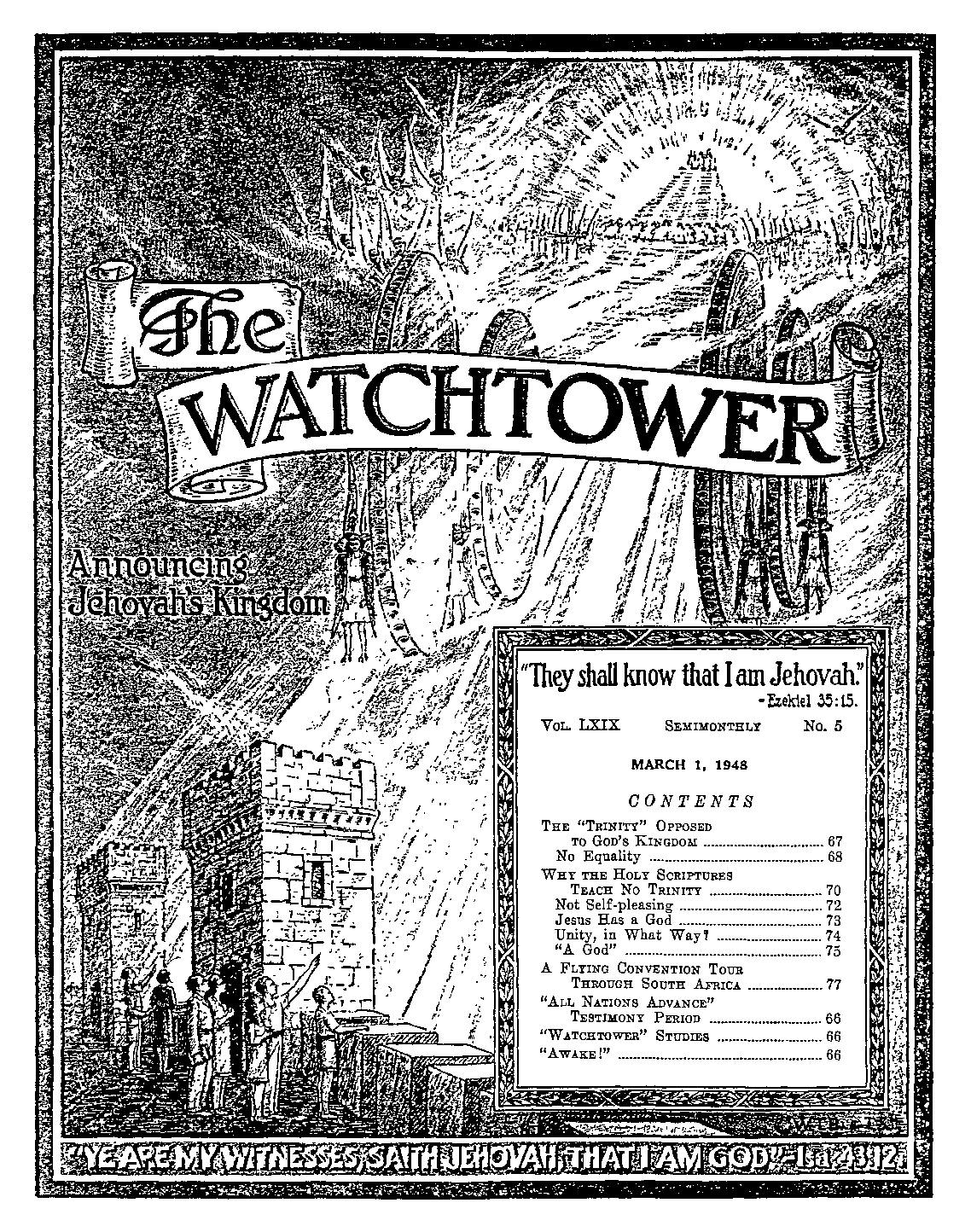
S’HeWATCHTOWER-
Published Semimonthly By
WATCH TOWER BIBLE & TRACT SOCIETY 117 Adams Street - • Brooklyn 1, N.Y., U.S.A.
Orricsss
N. H. Knorb, President Grant Suite®, Secretary
“And all thy children shall be taught of Jehovah; and great shall be the peace of thy children.” - Isaiah 54:13.
THE BIBLE CLEARLY TEACHES
THAT JEHOVAH Is the only true God, from everlasting to everlasting, and is the Maker of heaven and earth and Giver of life to his creatures; that the Word or Logos was the beginning of his creation and his active agent In creating all other things: and that the creature Lucifer rebelled against Jehovah and raised the issue of His universal sovereignty ;
THAT GOD created the earth for man, made perfect man for the earth and placed him upon It; that man yielded to unfaithful Lucifer, or Satan, and willfully disobeyed God’s law and was sentenced to death; that by reason of Adam’s wrong act all men are born sinners and without the right to life;
THAT THE LOGOS was made human as the man Jesus and suffered death in order to produce the ransom or redemptive price for obedient men; that God raised up Christ' Jesus divine and exalted him to heaven above every other creature and clothed him with all power and authority as head of God’s new capital organization;
THAT GOD’S CAPITAL ORGANIZATION is a Theocracy called Zion, and that Christ Jesus is the Chief Officer thereof and is the rightful King of the new world; that the faithful anointed followers of Christ Jesus are Zion’s children, members of Jehovah’s organization, and are His witnesses whose duty and privilege It Is to testify to Jehovah’s supremacy and declare his purposes toward mankind as expressed in the Bible;
THAT THE OLD WORLD, or Satan’s uninterrupted rule, ended AD. 1914, and Christ Jesus has been placed by Jehovah upon the throne, has ousted Satan from heaven, and now proceeds to vindicate His name and establish the “new earth”;
THAT THE RELIEF and blessings of the peoples can come only by Jehovah's kingdom under Christ, which has begun; that His next great act is to destroy Satan’s organization and establish righteousness completely In the earth; and that under the Kingdom the people of good-will surviving Armageddon will carry out the divine mandate to “fill the earth" with righteous offspring, and that the human dead In the graves will be raised to opportunities of life on earth.
ITS MISSION
THIS journal is published for the purpose of enabling the people to know Jehovah God and his purposes as expressed In the Bible. It publishes Bible instruction specifically designed to aid Jehovah’s witnesses and all people of good-will It arranges systematic Bible study tor its readers and the Society supplies other literature to aid in such studies. It publishes suitable material for radio broadcasting and for other means of public Instruction in the Scriptures.
It adheres strictly to the Bible as authority for its utterances. It is entirely tree and separate from all religion, parties, sects or other worldly organizations. It is wholly and without reservation for the kingdom of Jehovah God under Christ his beloved King. It is not dogmatic, but invites careful and critical examination of its contents in the light of the Scriptures. It does not indulge in controversy, and its columns are not open to personalities.
Notice to Subscribers: Remittances ehonld be sent to office in yonr country In compliance with regulations to guarantee safe delivery of money. Remittances are accepted at Brooklyn from countries where no office is located, by International money order only. Subscription rates In different countries are stated below In local currency. Notice 0/ expiration (with renewal blank) Is sent at least two issues before subscription expires. Change of address when sent to our office may be expected effective within one month. Send your old as well as new address.
Please address the Watch Tower Society in every case
Offices Yearly Subscription Rate
America (U.S.), 11T Adams St., Brooklyn 1, N.Y,
Australia, 7 Beresford Rd., Strathfield, N. 8. W.
British West Indies, 21 Taylor St, Port of Spain, Trinidad ,1.25
Canada, 40 Irwin Ave., Toronto 5, Ontario
England, 34 Craven Terrace, London, W. 2
India, 167 Love Lane, Bombay 27 Hs. 3/8
Jamaica, 151 King St., Kingston
New Zealand, G. P. O. Box 30, Wellington, C. 1
Philippine Islands, 2621 Int 2 Herran, Santa Ana, Manila 2 pesos
South Africa, 623 Boston House, Cape Town
Translations of this journal appear tn many languages.
ALL SINCERE STUDENTS OF THE BIBLE who by reason of Infirmity, poverty or adversity are unable to pay the subscription price may have The Watchtower free upon written application to the publishers, made once each year, stating the reason for so requesting it. We ate glad to thus aid the needy, but the written application once each year i required by the postal regulations.
Printed In the United States of America
Entered as second-class matter at the post office at Brooklyn, N. Y , under the Act of march 3, 1879.
“ALL NATIONS ADVANCE” TESTIMONY PERIOD
April is the last of the four-month Watchtower subscription campaign and it has been named “All Nations Advance” Testimony Period. This name agrees with the international effort that this campaign has been witnessing to secure at least 300,000 new subscriptions for The Watchtower in the sixteen languages in which it appears. The special campaign offer, of a year’s subscription together with a premium of eight vital booklets issued by the Watch Tower Society, at the regular subscription rate of $1 (American money), expires at the close of April. All Watchtower readers who want its contents to get to other hundreds of thousands should take advantage of this attractive inducement to subscribe by taking part in the campaign during the remaining time. Help make it an “all nations” participation by seeing that you are with us in the field presenting this offer in your respective nation. We have references and instructions for anyone writing in for them. Let us serve you. To know the scope of the “all nations” effort we ask each campaigner to turn in his report at the glorious end, April 30.
“WATCHTOWER” STUDIES
Week of April 4: “The ‘Trinity’ Opposed to God's Kingdom," fl 1-18 inclusive, The Watchtower March 1, 1948.
Week of April 11: “Why the Holy Scriptures Teach No Trinity,” fl 1-15 inclusive, The Watchtower March 1, 1948.
Week of April 18: “Why the Holy Scriptures Teach No Trinity," fl 16-29 inclusive, The Watchtower March 1, 1948.
“AWAKE!”
This magazine stepped into the field of public service at the Glad Nations Theocratic Assembly of Jehovah’s witnesses in August of 1946, and is published by the Watchtower Bible and Tract Society, Inc. It answers the rousing call for fearless information, not because we have entered the atomic age, but because the world is fast asleep near the brink of that universal war Scrip-turally called “Armageddon" and lovers of life in security need to be awakened to the real sense of the news and the pressing issues upon which to decide. Awake! is aimed to help them make a right decision that leads to life unending in the now-close New World of righteousness. It is a magazine of 32 pages devoted to news and information of world import, gained from world-wide sources. Its make-up is of fine appearance. Its leading articles, without compromise toward commercialism, politics and religion, present the straight facts, without fear to publish the plain truth. Much variety of interest is also provided in shorter articles of educational and instructive value. Under the heading “Thy Word Is Truth”, each number of Awake! offers a moderate-length discussion of Bible teachings of importance. A final section, headed “Watching the World", makes note of the latest world news before going to press and gives the pith of all news items, uncolored, undistorted, concise. Awake! is published on the Sth and 22d of each month. A year’s subscription of 24 issues is $1, American money; individual copy, 5c; mailed anywhere.
ffieWWCmOWER
ANNOUNCING JEHOVAH’S KINGDOM
Vol. LXIX
March 1, 1948
No. 5
THE “TRINITY” OPPOSED TO GOD’S KINGDOM
'"The Lord our God is one Lord.”—Deut. 6:4, Rom. Cath. Douay Version.
(CTEHOVAH our God is one Jehovah: and thou I shalt love Jehovah thy God with all thy heart, J and with all thy soul, and with all thy might.” (Deut. 6: 4, 5, Am. Stan. Ver.) For the reason which Moses here gave, neither he nor the faithful prophets that followed him, down to Malachi, taught a “trinity” or believed in any such thing. The heathen nations of their times did teach various ideas of a trinity, such as the Babylonian, the Assyrian, the Grecian, the Chinese, the Hindu, etc., but not Jehovah’s chosen nation. All his holy prophets warned his chosen people against adopting or compromising with any of the religious teachings of such heathen nations. The reason why was that such teachings, including a so-called “trinity”, were false. They were “doctrines of devils”, inspired by wicked demons opposed to the one living and true God. For this reason the apostles of Jesus Christ followed in the steps of the faithful prophets before them in likewise not teaching any such thing as a “trinity”, but to the very contrary.
2 The Greek word trias came into use before Christ, in the writings of the pagan philosopher of Athens, Greece, named Plato, belonging to the fifth and fourth centuries B.C. This word, meaning the number three or triad, occurs in Plato’s work entitled Phaedo, this being a dialogue on the idea of the immortality of the human soul. The word trias, or trinity, does not occur in the sacred Greek Scriptures written by the apostles and disciples of Jesus Christ, from the gospel account by Matthew to the Revelation by John. The book of Acts of the Apostles was written about 61 (A.D.), about 28 years after Jesus Christ, and yet it nowhere gives any account of his apostles’ meeting together and framing a creed in which they state a belief in one God in three persons, all three persons being one and the same God, of the same identical substance, all three being equal in existence, power and glory. John was the last of the apostles to survive. He wrote his three epistles and his gospel account and the Revelation in the last decade of the first century A.D., or more than 60
1. Why did God’s prophets and people not believe in a trinity?
2, 3. How, when, by whom, was a triad of three persons introduced? years after Jesus Christ. Yet, neither does this late writer teach or betray any belief in a triad of three co-equal, consubstantial, equipotential persons, all three distinct from one another and yet all three blended together in one God.
3 Platonic-minded Theophilus of the second century, who was a bishop of Antioch, Syria, introduced the word trias into his religious writings about A.D. 180. Toward the end of the same century the Latin writer, Tertullian, translated trias into Latin by the word trinitas, meaning trinity, and thus the term was introduced into the religious writings of Christendom. This Tertullian was also the first to use the Latin term persona, or person, to mean a single individual with peculiar qualities of his own; and he speaks of the Father and the Son and the holy spirit as being tres personae, or three intelligent persons. At the same time Tertullian insisted they had a unity of substance (unitas substantiae) because they all three had no beginning but existed from the eternal past. We can thus see that the doctrine that Jehovah God and Christ Jesus and the holy spirit are three persons in one God, or a three-in-one God, does not date from apostolic times or the first century. It dates from almost a century later, which was late enough for the apostasia, or the falling away from the true faith which Paul said was already working in his day, to get far off from the truth and into the cunning teachings of paganism.—2 Thess. 2: 3-12.
4 In the fourth century, in the year 325, came the religious council of Nice because of the heated debate over that trinity teaching. At this council, not the bishop of Rome, but the unbaptized Emperor Constantine presided as the pontiff or pontifex maximus. By decree of Pontifex Maximus Constantine a ban was laid upon Arius, who had opposed the trinitarian doctrine, and the emperor gave his support to the statement of belief which was drawn up by the trinitarians under Athanasius and which has been called the Nicene creed. By the sword of the emperor this creed was enforced as the rule of belief for the Roman empire. The Nicene creed was written, not in
4. How was the Nicene creed drawn up on the trinity?
Latin, but in Greek, and it declared: “We believe in one God the Father Almighty, Maker of all things visible and invisible; and in one Lord Jesus Christ, the Son of God begotten of the Father, Only begotten, that is of the substance of the Father; God of God; Light of Light; very God of very God; begotten, not made; of the same substance with the Father; by whom all things were made, both things in heaven and things in earth.... And in the Holy Ghost.” The creed ends up with cursing or anathematizing those who do not accept it. We dare to challenge that anathema.
5 As in its issue of Sunday, October 10, 1943, the Catholic newspaper The Register in its local edition of Denver, Colorado, might choose to publish that our stand “is actually reviving Arianism!” But we are not going back to the teachings of Arius. We are going farther back, to the teaching of the apostles, and therefore we shall appeal to the Holy Scriptures themselves, three centuries earlier than Arius. Then by examining what Jesus said and did and what his apostles and disciples said and did we shall determine firsthand whether they taught any such confused, unreasonable and inexplainable thing as a trinity. Let no one sidetrack us from this search by saying that the trinity is a mystery that we are not supposed to explain or understand. Let us prayerfully do as the Christians of Berea did respecting the teachings of the apostle Paul, namely, “They received the [apostolic] word with all readiness of mind, and searched the scriptures daily, whether those things were so.” (Acts 17: 11) Thereby we shall arrive at what God’s Word says on the subject, and not follow traditions of the religious elders, which traditions Jesus Christ condemned.—Matt. 15:1-9.
6 Discussion of whether there is a trinity might seem like going back to something away out of date, belonging to the time when musty old theology held the floor in Christendom. But that is not so. Nothing else could be of more timeliness now, when the nations of the earth are in turmoil and the visible part of the world is being divided into a western bloc of nations and an eastern bloc, the eastern bloc being led by those who deny the existence of Jehovah God, and the western bloc claiming to believe in a trinity and thus thinking they have the support of a divine trinity on their side. In the midst of this selfish struggle for the domination of this world the time has come for the living and true God, Jehovah, to vindicate himself as to who he is and what is his true and rightful position and his power and authority in the universe. We are at the time when the prophecy is undergoing fulfillment: “And there were loud voices in heaven saying, ‘The kingdom of this world has become the kingdom of our Lord and of 5. How will we disprove the false charge of '‘Arianism”?
6, 7. Why is it now most timely to discuss the “trinity”? his Christ, and he shall reign forever and ever. . . . We give thee thanks, 0 Lord God almighty, who art. and who wast, because thou hast taken thy great power and hast begun thy reign. And the nations were angered, but thy wrath came and the time for the dead to be judged.’ ”—Apocalypse 11:15-18, Catholic Confraternity New Testament.
7 The question of world domination having now been pushed to the fore as at no time in the past, there was never a world situation before that made it more fitting that the truth of Psalm 83 should be proved to everybody, namely: “Keep not thou silence. 0 God: hold not thy peace, and be not still, 0 God. For, lo, thine enemies make a tumult: ... let them be put to shame, and perish: that men may know that thou, whose name alone is JEHOVAH, art the most high over all the earth.” (Ps. 83:1, 2, 17, 18) The question of supremacy is here involved and must be openly settled, because Moses said there is only one Jehovah, not three Jehovahs. Hence, Is Jehovah supreme as the Most High God?
8 Whereas the Communist-led eastern bloc deny Jehovah’s existence, the western bloc of nations solemnly declare that Jehovah is not alone in his supremacy. They declare he shares it with two more persons whom they designate as the Son Jesus Christ and the Holy Ghost. The so-called “Athana-sian creed”, which has been adopted by the Greek, Roman and Protestant religious organizations, makes this strong statement: “And in this Trinity none is afore or after other; none is greater or less than another. But the whole three persons are coeternal together, and coequal. So that in all things, as is aforesaid, the Unity in Trinity and the Trinity in Unity is to be worshipped. He therefore that will be saved must thus think of the Trinity.” Let the religionists so state, but the belief in a “trinity” will not save the western nations at the battle of Armageddon toward which both the western and eastern blocs are marching in combined opposition to God’s kingdom. And neither will their trinitarian belief save the religious systems of Christendom from a whore’s fiery end at the hands of disgusted world rulers, as described at Revelation (or Apocalypse), chapter 17, verses 12-18. There will be no three-in-one god to come to the rescue of organized religion with her Athanasian creed, because no such god exists.
NO EQUALITY
’ In establishing the kingdom of God it is Jehovah God that puts his Son Jesus Christ upon the throne to reign and thereby blesses him. This is pictured at Revelation 12:5 as the catching up of the newborn man-child “up unto God, and to his throne”, where he must rule all nations, the eastern and western
8. Why will belief in the Athanasian creed not save the nations? 9, 10. How does the Kingdom’s establishment disprove equality? blocs thereof, with a “rod of iron”, to dash them all to pieces at the final war of Armageddon. His being enthroned by Jehovah God both argues and demands that Christ Jesus be subordinate and not equal to Jehovah. Why so? and let us have Scripture proof for it. Such proof follows.
10 At Psalm 21:1-6 David prophetically referred to Christ Jesus and his being raised from the dead and being enthroned as King and says: “The king shall joy in thy strength, 0 Jehovah; . . . For thou makest him most blessed for ever.” (Am. Stan. Ver.) Also Psalm 45:6,7 refers to the enthronement of Christ as King in the heavens, and the apostle Paul quotes those verses and says, at Hebrews 1:8, 9: “But of the Son he saith, Thy throne is God for ever and ever; and the sceptre of uprightness is the sceptre of thy kingdom. Thou hast loved righteousness, and hated iniquity; therefore God, thy God, hath anointed thee with the oil of gladness above thy fellows.” (Am. Stan. Ver., margin) Now fix your attention upon the fact that Jehovah God is the One that confers these royal blessings upon Christ Jesus in the heavens; which fact explodes the trinitarian creed that “none is greater or less than another”. Since Christ Jesus is thus blessed by Jehovah God his God, then Jehovah God the Blesser must be greater and higher than the Blessed One, for the apostle Paul states the rule: “And without all contradiction, that which is less, is blessed by the better.” —Heb. 7: 7, Douay Version.
11 The subordinate place of Christ Jesus in the kingdom of God is shown in that it is at the right hand of Jehovah God that he sits, and not in the central position; as it is written, at Psalm 110:1: “Jehovah saith unto my Lord, Sit thou at my right hand, until I make thine enemies thy footstool.” (Am. Stan. Ver.) This scripture the apostle Peter applies to the resurrected Christ Jesus.
11 Unlike Satan the Devil, the enthroned Jesus Christ does not use his Kingdom power to try to make himself equal with God or “like the Most High”. Before he became a man, he did not try to usurp Jehovah God’s power and place, for we read: “Let this disposition be in you, which was also in Christ Jesus, who, though being in God's form, yet did not meditate a usurpation to be like God, but divested himself, taking a bondman’s form, having been made in the likeness of men.” (Phil. 2: 5-7, The Emphatic-Diaglott) Neither will he attempt a usurpation now that he has ascended up to the heavens to God's right hand. This is proved by what is foretold to take place at the close of his reign after he destroys all of the foes of Jehovah God and of man. After describing Christ’s resurrection and then his second coming to reign in the Kingdom, the apostle
11, 12. How does Jesus show subordination in the Kingdom?
Paul says: “Afterwards the end, when he shall have delivered up the kingdom to God and the Father, when he shall have brought to nought all principality, and power, and virtue. For he must reign, until he hath put all his enemies under his feet. And the enemy death shall be destroyed last: For he hath put all things under his feet. And whereas he saith, All things are put under him; undoubtedly, he is excepted, who put all things under him. And when all things shall be subdued unto him, then the Son also himself shall be subject unto him that put all things under him, that God may be all in all.” (1 Cor. 15: 24-28, Douay) Thus, to the contrary of trying to put Jehovah God under his feet and usurp his power, Christ Jesus excepts or makes an exception of Jehovah God, and at the end of his reign he himself subjects himself to Jehovah God, and shows that the trinitarian co-equality is a religious falsehood.
13 It is useless for trinitarians to argue that Christ Jesus in the kingdom of God in heaven subjects himself only as far as his human nature, his flesh and blood, is concerned, because up there in heaven in the kingdom of God the glorified Christ Jesus has no human nature. We do not say so, but the apostle Paul says so, saying: “Now this I say, brethren, that flesh and blood cannot possess the kingdom of God.” —1 Cor. 15: 50, Douay.
14 In this connection one noteworthy Scriptural fact further exposes the religious idea that the Father and the Son and the “holy ghost” are three intelligent persons, and all of them co-equal, copowerful and co-eternal together. It is this: In all the visions given us in the Apocalypse or Revelation Jehovah God is pictured as sitting upon the throne, and Jesus Christ the Lamb of God is pictured as standing in the midst of the throne, but a “holy ghost” is nowhere envisioned as sitting in or upon the throne at God’s left hand. Look up in Revelation every reference to the heavenly throne, and you will find no mention of any “holy ghost” therein. Why such an insulting omission if there is a trinity of co-equal divine persons, indivisible and inseparable? Also, the great multitude that is seen “standing before the throne, and in the sight of the Lamb”, cry out: “Salvation to our God, who sitteth upon the throne, and to the Lamb.” Why do they make no mention of a “holy ghost”, if such ghost is an intelligent person in a trinitarian Godhead? If this “great multitude” believed or believes in the Athanasian creed of three co-equal persons, why ignore the so-called “third person”, this “holy ghost”?—Apoc. 7: 9,10, Douay.
13 Let trinitarians also explain why it is that Revelation 5: 6, when describing the Lamb of God stand-
13. Why Is Jesus not subject only as to his human nature? 14, 15 How do visions of the throne disprove the trinity? ing in the center before God’s throne before he goes to it and takes the sealed book out of God’s right hand, says: “A Lamb standing as it were slain, having seven horns and seven eyes: which are the seven Spirits of God, sent forth into all the earth”? (Douay) Are there seven “holy ghosts”, instead of one, thus enlarging the trinity to a “nine in one Godhead”? (Rev. 4:5) At the time that faithful Stephen was being stoned to death, the account at Acts 7:55, 56 tells us, “he, being full of the Holy Spirit, looked up to heaven and saw the glory of God, and Jesus standing at the right hand of God; and he said, ‘Behold, I see the heavens opened, and the Son of Man standing at the right hand of God.’” (Cath. Conf rat.) But faithful Stephen does not tell us of seeing any “holy ghost” standing or sitting at the left hand of Jehovah God to form an indissoluble “trinity”. And in the vision of Daniel concerning Christ’s enthronement at the end of the political powers of this world, note that the prophet Daniel reveals no “holy ghost” as being seen anywhere around, when he says: “I beheld till thrones were placed, and the Ancient of days sat: ... I beheld therefore in the vision of the night, and lo, one like the son of man came with the clouds of heaven, and he came even to the Ancient of days: and they presented him before him. And he gave him power, and glory, and a kingdom: and all peoples, tribes and tongues shall serve him: his power is an everlasting power that shall not be taken away.”—Dan. 7:9-14, Douay.
16 However, such reception of power in heaven and in earth does not make this “Son of man”, namely, Christ Jesus, all-powerful and almighty. After his resurrection from the dead Jesus Christ declared that his Father and God gave him all the necessary power in heaven and in earth for his future work. (Matt. 28:18) However, that this did not make him all-powerful or almighty the apostle John shows. He describes the end of this world and says: “There were great voices in heaven, saying: The kingdom of this world is become our Lord’s and his Christ’s, and he shall reign for ever and ever. ... We give
16 How do Daniel and Revelation show Jesus is not co-powerful? thee thanks, 0 Lord God Almighty, who art, and who wast, and who art to come: because thou hast taken to thee thy great power, and thou hast reigned." (Apoc. 11:15-17, Douay) Do not fail to note the omission of all mention of a “holy ghost” with the Lord God Almighty and his Christ. Note also that neither here nor anywhere else in the Apocalypse or Revelation is Jesus Christ called the Pantokrator or Almighty One; and neither is the “holy ghost”.
11 Jehovah God the Father is alone the Pantokrator or Almighty One. He bestows upon his Son Jesus Christ all the power or authority that he needs in heaven and earth to carry out his royal office. Along with this power or authority Jehovah God Almighty gives to Jesus Christ the holy spirit, which is not a “third person” at all, but is the impersonal, invisible active force which emanates or proceeds forth from Jehovah God. The apostle Peter so stated on the day of Pentecost, at which time he said: “This Jesus God has raised up, and we are all witnesses of it. Therefore, exalted by the right hand of God, and receiving from the Father the promise of the Holy Spirit, he has poured forth this Spirit which you see and hear.” (Acts 2:32,33, Cath. Confrat.) The listening multitude did not see the holy spirit itself. They saw just its manifestation upon Peter and his fellow disciples by their speaking with tongues after flames of fire had hovered above their heads, accompanied by a rushing sound as of a violent wind. —Acts 2:1-4.
18 Since Jesus Christ has come into the Kingdom, in 1914, he has poured out afresh of this spirit or active force upon the faithful remnant of his followers in the earth, in a final fulfillment of Joel 2: 28, 29. By the illuminating power of this holy spirit from God through his Christ, this remnant now see Jehovah God and Jesus Christ and the holy spirit in the right relationship and that they do not compose any triune God or trinity. Thus, viewed from the standpoint of the kingdom of God, the so-called “trinity” is seen to be a blasphemous false doctrine. The very intrinsic idea of it is opposed to God’s kingdom by Christ Jesus.
17. What is the holy spirit shown to be in actuality?
18. What do the remnant now see as to Father, Son and spirit?
WHY THE HOLY SCRIPTURES TEACH NO TRINITY
TESUS Christ always confessed and showed himI self inferior to Jehovah God. All the Holy Scrip-J tures bear witness to his subordinate place toward Jehovah the Most High God. Jesus always spoke of himself as the one that God his Father had sent. In his last prayer in company with his faithful apostles he said to his heavenly Father: “And this is life
1 How was Jesu* the Apostle of Jehovah God? eternal, that they might know thee the only true God, and Jesus Christ whom thou hast sent.” (John 17: 3) The apostle John heard that prayer and tells us: “For he whom God hath sent speaketh the words of God: for God giveth not the spirit by measure unto him. The Father loveth the Son, and hath given all things into his hand [not meaning that the Father retained nothing for his own self].” (John 3: 34, 35) Jesus also told the murder-minded Pharisees: "If God were your Father, ye would love me: for I proceeded forth and came from God; neither came I of myself, but he sent me.” Jesus Christ was God's Sent One or Apostle, and in this capacity he was “the Apostle and High Priest of our profession”. —John 8:13, 39-42; Heb. 3:1.
2 Jesus Christ did not in any shame hide the fact that he is the one sent and thus is inferior to God his Father who sent him. When he washed his disciples’ feet, he commented: “Verily, verily, I say unto you, The servant is not greater than his lord; neither he that is sent greater than he that sent him.” (John 13:16) “For whether is greater, he that sitteth at meat, or he that serveth? is not he that sitteth at meat? but I am among you as he that serveth.” (Luke 22:27) Being sent of God, Jesus was not greater than his Father the Sender, neither was he as great. John the Baptist publicly announced himself as sent to baptize, and therefore he served as a servant inferior to God. John accordingly baptized the Son of God in the Jordan river. (John 1: 32-34) Just as Jehovah God with superiority over his Son Jesus Christ sent him to this earth, likewise Jesus Christ as Head and Master over his apostles and disciples sent them forth to preach the kingdom of God. He said in prayer to God his Father: “As thou hast sent me into the world, even so have I also sent them into the world. 0 righteous Father, the world hath not known thee: but I have known thee, and these have known that thou hast sent me.”—John 17:18,25.
’ Incidentally, in like manner the so-called “holy ghost” or holy spirit is proved to be inferior both to Jehovah God and to Christ Jesus. Why? Because Jesus told his disciples that the heavenly Father would send the holy spirit as a comforter in Jesus’ name, and Jesus added that he, in turn, would send this spirit comforter from the Father to his faithful disciples. And at Pentecost Peter declared that Jesus had shed this spirit comforter upon them. (John 14:26; 15:26; Acts 2:33) There is or has been no human nature about this “holy ghost” or holy spirit; and its being sent from God and through Christ proves it is subject to both God and Christ. It cannot be said that the holy spirit is subject only as to its human nature, because it never had any human flesh and blood. That fact alone is sufficient to wreck the whole idea of the “trinity” as to the co-equality of a “holy ghost” person.
4 Let no one raise his eyebrows in amazement at our speaking of Jehovah God as superior to his Son Jesus Christ. Just read 1 Corinthians 11:3, where the apostle writes: “I would have you know, that the head of every man is Christ; and the head of the
2. How does Jesus’ being sent disprove trinitarian equality?
3. How is the holy spirit likewise proved not co-equai?
4, 5. How do headship and servitude disprove the trinity? woman is the man; and the head of Christ is God.” To correspond with the fact that God is his Superior and Head, Jesus declared he came, not to do his own will, but that of his Father, and not to speak his own words or doctrines, but those of his Father.
5 In harmony with the prophecies of old Jesus declared himself to be a servant to God, and not a person co-equal with God. Some prophetic utterances of Jehovah God respecting Jesus Christ as his servant are: “Behold my servant, whom I uphold, mine elect, in whom my soul delighteth; I have put my spirit upon him; he shall bring forth judgment to the Gentiles. . . . the isles shall wait for his law ” “By his knowledge shall my righteous servant justify many; for he shall bear their iniquities.” “Behold, my servant shall deal prudently.” (Isa. 42:1-4; 52:13; 53:11) These prophecies the disciples applied to Jesus, as anyone can prove by referring to Matthew 12:17-21 and Acts 8: 27-37. Doing no dishonor to Jesus Christ by calling him a servant, the disciples in united prayer at Jerusalem said to the Lord God: “The kings of the earth stood up, and the rulers assembled together against the Lord and against his Christ. For of a truth there assembled together in this city against thy holy servant Jesus, whom thou hast anointed, Herod and Pontius Pilate with the Gentiles and the peoples of Israel, to do what thy hand and thy counsel decreed to be done.”—Acts 4:26-28, Cath. Conf rat.
6 Shortly before the above prayer Peter said to the Jews regarding the resurrected, glorified Jesus Christ: “The God of Abraham, and of Isaac, and of Jacob, the God of our fathers, hath glorified his Servant Jesus;... Unto you first God, having raised up his Servant, sent him to bless you, in turning away every one of you from your iniquities.” (Acts 3:13,26, Am. Stan. Ver.) That this servanthood of Jesus toward God means his lower station and subordination to Jehovah God is made certain by Jesus’ own announced rule: “The disciple is not above his master, nor the servant above his lord. It is enough for the disciple that he be as his master, and the servant as his lord.” But this is not saying that for the servant to be like his lord he becomes one person with him, and is at the same time his own lord and his own servant. (Matt. 10:24,25) Toward the close of his earthly life Jesus stressed a servant’s inferiority to his lord or master by saying to his disciples: “Remember the word that I said unto you, The servant is not greater than his lord. If they have persecuted me, they will also persecute you; if they have kept my saying, they will keep yours also. But all these things will they do unto you for my name’s sake, because they know not him that sent me.” (John
6. What did Jesus show servanthood meant?
72 15:20,21) It is because of the servant’s inferiority to his lord that he must suffer with his lord.
NOT SELF-PLEASING
T As a servant, an apostle and a disciple of Jehovah God the great Teacher, Jesus Christ tried to please his heavenly Father, his Life-giver. By this course he denied equality with his Father. It was in order to please his Father with perfect obedience to the death that Jesus submitted to being lifted upon a torture stake by his enemies. “Then said Jesus unto them, When ye have lifted up the Son of man, then shall ye know that I am he, and that I do nothing of myself; but as my Father hath taught me, I speak these things. And he that sent me is with me: the Father hath not left me alone; for I do always those things that please him.” (John 8: 28, 29) Now, suppose that Jesus were the “second person” of a religious trinity, co-equal with his partners. In that case he would be inferior to nothing, and would be free to please himself. But such was not the case, for Jesus had someone greater than himself to please, namely, his heavenly Father. To this effect the apostle writes: “For even Christ pleased not himself; but, as it is written, The reproaches of them that reproached thee fell on me.” The One whose reproaches he bore as a servant was separate and distinct from Jesus, just as our Christian neighbors whom we are exhorted to please are individuals different from ourselves. Hence the apostle uses Christ’s course of not pleasing himself as a reason for saying to us: “We then that are strong ought to bear the infirmities of the weak, and not to please ourselves. Let every one of us please his neighbour for his good to edification.”—Rom. 15: 1-3.
9 Clearly enough for all but trinitarians to see, Jesus came out definitely with the announcement that the Father had superiority over the Son. In the parable in which he likens his followers to sheep Jesus said: “My Father, who hath given them unto me, is greater than all; and no one is able to snatch them out of the Father’s hand.” (John 10:29, Am. Stan. Ver.) The Father’s superior greatness over all others included being greater than his Son, and Jesus said so in these unmistakable words to his disciples: “If ye loved me, ye would rejoice, because I said, I go unto the Father: for my Father is greater than I.” (John 14:28) True, Jesus was yet in the flesh when he said those words; but he had been begotten of God’s spirit after his baptism in the Jordan, and it is begging the question to say that the Father was greater than Jesus only as to Jesus' flesh or human nature. If, by the personal pronoun I, Jesus here meant his flesh, then, by the same reasoning, when Jesus said to the Jews, “Before
7. As to pleading another, how did Jesus show inferiority? 8. How did Jesus state the Father's superiority over him'*
Abraham was, I am,” he meant that, before Abraham was, Jesus’ flesh or human nature was. That would mean that before coming to earth Jesus had flesh as a man in heaven. But, of course, such was not the case.—John 8: 58.
9 By taking on human nature and becoming a man, the Scriptures tell us, “we see Jesus, who was made a little lower than the angels for the suffering of death.” (Heb. 2:9) The trinitarians claim that, at his return to heaven, Jesus took his flesh and bones and blood with him. Then they must also agree that forever Jesus Christ is not only lesser than his heavenly Father but also a little lower than the angels. To the direct opposite of such a thought Paul, in the first chapter of Hebrews, argues to the effect that Jesus Christ “sat down on the right hand of the Majesty on high; being made so much better than the angels, as he hath by inheritance obtained a more excellent name than they.” (Heb. 1:3,4) Agreeing that Jesus was exalted to become better than angels, Peter says: “By the resurrection of Jesus Christ: who is gone into heaven, and is on the right hand of God; angels and authorities and powers being made subject unto him.” That certainly does not mean making Jesus’ flesh in which he hung on the tree to be higher than the angels, for such a thought is unscriptural, according to Psalm 8:4-8 and Hebrews 2:9. Hence the Scriptures teach that Jesus did not and could not take his flesh with him to heaven to make himself always less than angels. He went to heaven as a glorious spirit. Peter positively says so: “Christ also died once for our sins, the just for the unjust: that he might offer us to God, being put to death indeed in the flesh, but enlivened in the spirit.”—1 Pet. 3:18, Douay; 3: 21, 22.
10 The Scripture evidence is all against the trinitarians, for when Jesus said his Father was greater than the Son, he was not referring to his flesh. He was referring to himself as an individual, even before he came to this earth and was made man. Did not Jesus repeatedly say that God the Father sent him and that the Sender is greater than he that is sent? Yes; and when God sent the Son, the Son was still in heaven and not yet a man of flesh and blood. God sent him, not from Bethlehem or from Nazareth as a man, but down from heaven as his Son. In thus sending Jesus from heaven, Jehovah God showed he is greater than the Son whom he sent down.
11 Because the Father was greater than the Son, Jesus could tell his disciples to rejoice. Why? Because greater results would follow if he went to his Father in their behalf. Jesus had done many wonderful works by virtue of the power of God’s spirit upon him. But now by his going to the Father, the Greater One, the results would be greater with
9. How was he once lower than angels, but why not for always? 10. 11 What proves Gori greater more than as to Jesus' flesh?
his disciples. Hence he said in this talk with his disciples: “Verily, verily, I say unto you, He that believeth on me, the works that I do shall he do also; and greater works than these shall he do; because I go unto my Father.” (John 14:12) Yes, greater works shall he do because I go unto my Father, who is greater than I am, is what Jesus here meant.
JESUS HAS A GOD
12 Because Jehovah alone is the Supreme One and is the Almighty One, he is a God to his Son Jesus Christ. The Son therefore worships and adores and serves Jehovah God. In the forty days of temptation in the wilderness Satan the Devil came to Jesus and promised him all the kingdoms of this world and their glory if he would worship Satan. “Then saith Jesus unto him, Get thee hence, Satan: for it is written, Thou shalt worship the Lord thy God, and him only shalt thou serve.” Jesus there quoted the scripture written at Deuteronomy 6:13: “Thou shalt fear Jehovah thy God; and him shalt thou serve.” (Am. Stan. Ver.) Jesus thus made it crystal-clear to Satan the Devil that He was determined to keep on worshiping Jehovah as His God. (Matt. 4:8-10) Later on he told the Samaritan woman at the well that he worshiped Jehovah. He showed her the difference between himself and her people, the Samaritans, by saying: “Ye worship ye know not what: we know what we worship: for salvation is of the Jews.” (John 4:22) What Jesus worships is, not himself, but God.
1S While yet in heavenly glory, that is, before becoming a man, the Son worshiped the Almighty and Supreme One, Jehovah, as his personal God. Before any other things were created in all the universe the Son worshiped the Father as his God. Psalm 22:1,18 foretold that some day the Son on earth would say: “My God, my God, why hast thou forsaken me? why art thou so far from helping me, and from the words of my roaring? They part my garments among them, and cast lots upon my vesture.” When the Son Jesus Christ was hanging upon the torture stake this prophecy went into fulfillment: “And about the ninth hour Jesus cried with a loud voice, saying, Eli, Eli, lama sabachthani? that is to say, My God, my God, why hast thou forsaken me?” (Matt. 27: 46) Jesus, whom the scribes and Pharisees called a blasphemer against God, there acknowledged his Father Jehovah as “my God”. Furthermore, the third day afterward, when he was resurrected, Jesus once again acknowledged Jehovah the Father as his personal God. He said to Mary Magdalene: “Go to my brethren, and say unto them, I ascend unto my Father, and your Father; and to my God, and your
12. How did Jesus1 words show be worships Jehovah?
13. How did Jesus* words show he has a God?
God.” This shows that Jesus was not Jehovah God, nor a “second person” in a “triune God”. A week later he materialized in flesh and revealed himself to Thomas, and this doubter now exclaimed in astonishment: “My Lord and my God.” By this exclamation Thomas was not saying Jesus was Jehovah God. Why not? Because Jesus had just said that Jehovah was his God and the God of Thomas, and the apostle John, who records Thomas’ exclamation, says right afterward: “But these [things] are written, that ye might believe that Jesus is the Christ, the Son of God; and that believing ye might have life through his name.”—John 20: 31.
14 Because Jehovah is his God, Jesus Christ the Son could minister to Him as his high priest. A high priest worships the God to whom he offers sacrifices, just as Aaron the high priest of Israel did. A high priest is certainly not as great as the God whom he worships and to whom he ministers and offers sacrifice. The Son did not assume to be an equal of the Father by taking the office of high priest to himself, but he waited for his Father to swear him into the office. As it is written: “And no man taketh this honour unto himself, but he that is called of God, as was Aaron. So also Christ glorified not himself to be made an high priest; but he that said unto him. Thou art my Son, to day have I begotten thee. As he saith also in another place, Thou art a priest for ever after the order of Melchisedec.” (Heb. 5:4-6) Since it is forever that he is High Priest after Mel-chizedek’s order, Christ Jesus in heavenly glory worships Jehovah God as his personal God forever.
15 In witness that the Father Jehovah is God Almighty to Jesus the Son, the apostle Peter writes: “Blessed be the God and Father of our Lord Jesus Christ, who according to his great mercy hath regenerated us unto a lively hope, by the resurrection of Jesus Christ from the dead.” (1 Pet. 1:3, Douay) And Paul writes: “Blessed be the God and Father of our Lord Jesus Christ, who hath blessed us with spiritual blessings in heavenly places, in Christ: that the God of our Lord Jesus Christ, the Father of glory, may give unto you the spirit of wisdom and of revelation, in the knowledge of him.” (Eph. 1: 3,17, Douay) In the original Greek text, 2 Corinthians 1: 3 reads exactly like Ephesians 1: 3 above, and hence the Douay Version and American Standard Version read: “Blessed be the God and Father of our Lord Jesus Christ, the Father of mercies and God of all comfort.” Further proving the fact that Jehovah the Father is the God whom the Son Jesus Christ worships as his Superior, the apostle John writes regarding Jesus: “He made us to be a kingdom, to be priests unto his God and Father.”—Rev. 1: 6, Am. Stan. Ver.; also Rev. 3:12.
14. On this point, what doea Jesus' being high priest show? 15. How do the words of the apostles show Jesus has a God?
UNITY, IN WHAT WAY?
16 Trinitarians are swift to rush to John 10: 30 for support, for there Jesus the Good Shepherd states: “I and the Father are one.” {Douay; Am. Stan. Ver.) But where is there mention here of any “holy ghost”? Not once in all of Jesus’ parable of the Good Shepherd and his sheep does he even mention the holy spirit; and it takes three persons to make a trinity. At most, then, Jesus’ words here could only speak for a duality. But notice that Jesus did not say he and his Father are one God, so as to make one God in two persons. In all the parable Jesus was not arguing in support of such a thing. He was rather illustrating that his heavenly Father and he have a likeness of occupation, they have common interests and concerns, and they have one purpose, Jesus’ purpose being blended in with that of his Father. Jesus informs us that the Father gave him the sheep and hence Jehovah is the great Shepherd. Jesus was "the Lamb of God, which taketh away the sin of the world”, as John the Baptist called him. Jehovah was therefore a Shepherd even to Jesus, and a shepherd is greater than his sheep. Jehovah permitted Jesus to be ,rbrought as a lamb to the slaughter”, where he was dumb without complaint, just like a "sheep before her shearers”. (John 1: 29, 36; Isa. 53v 7) So, at Psalm 23:1, the shepherd-psalmist David was in reality speaking prophetically for Jesus Christ, when he said: "Jehovah is my shepherd; I shall not want.”—Am. Stan. Ver.
17 In the parable Jesus also said: "I am the good shepherd.” By this he showed oneness with his Father, because he was engaged in a common work with his Father and toward a common end, the eternal salvation of the sheep. In accord with this common purpose Jesus said: “I give unto them eternal life; and they shall never perish, neither shall any man pluck them out of my hand. My Father, which gave them me, is greater than all; and no man is able to pluck them out of my Father’s hand. I and my Father are one.” (John 10:11,14, 28-30) At this the listening Jews jumped to a wrong conclusion and prepared to stone him because, as they said to him, “thou, being a man, makest thyself God.” But even then, Jesus did not argue and maintain he was Jehovah God. He argued that he was simply the “Son of God”, whom God had sanctified and sent into the world. Jesus quoted from Psalm 82:6 to prove he was not blaspheming in saying so. He showed that others also were addressed as “gods”.
ia Jesus did the works of his Father. He did them in his Father’s name as being his Father’s visible representative; and this was what made him and his Father one. (John 10:25,37,38) Being eonsub-
16, 17. What did he mean by saying “I and the Father are one”?
18, 19. How did Pau) illustrate such oneness, at 1 Corinthians 3:5-9’’ stantial or being one and the same substance was not necessary to this unity. How two separate and distinct individuals, by colaboring together and having a common interest and one aim, become one, the apostle Paul illustrates when saying: “Now he that planteth and he that watereth are one.” One in substance? one in person? one in co-equality? By no means; but just one in God’s work. This becomes plain from the entire argument of Paul, to this effect: “Who then is Paul, and who is Apollos, but ministers by whom ye believed, even as the Lord gave to every man? I have planted, Apollos watered: but God gave the increase. So then neither is he that planteth any thing, neither he that watereth; but God that giveth the increase. Now he that planteth and he that watereth are one.”—1 Cor. 3: 5-8.
19 Paul’s planting and Apollos’ watering and God’s giving the increase did not make them a trinity or “three in one” God. Paul was an apostle of Christ before ever Apollos became a Christian and he had greater responsibility and a more important position in God’s organization than Apollos did; yet they two were one because of peacefully colaboring together in God’s organization and service. Because God was the real One that was accomplishing the results through them, therefore Paul spoke of the Corinthian church which he founded as being, nonetheless, God's husbandry, God’s building: “For we are God’s helpers, you are God’s tillage, God’s building.” —1 Cor. 3: 9, Cath. Conf rat.
20 That this was the style of unity that existed between the Son and his Father Jesus explained in his last prayer with his faithful apostles. He said: “And not for them only do I pray, but for them also who through their word shall believe in me; that they all may be one, as thou, Father, in me, and I in thee; that they also may be one in us; that the world may believe that thou hast sent me. And the glory which thou hast given me, I have given to them; that they may be one, as we also are one: I in them, and thou in me; that they may be made perfect in one: and the world may know that thou hast sent me, and hast loved them, as thou hast also loved me.” (John 17:20-23, Douay) In this prayer for oneness Jesus does not mention once any “holy ghost”. No one will reasonably argue from Jesus’ prayer here that he was praying Jehovah God the Father that some “trinity” might be enlarged in order that these disciples might be made part of the ‘several in one’ God and that, in place of being a triune affair, it might become a multiple unity of many persons in one, and yet all one God and all equal in power and glory. Ridiculous 1 you say. And yet belief in a “trinity” or “triune God” reduces itself to this absurdity, in view of Jesus’ prayer above.
20. Hew did Jesus’ prayer ehow the kind of oneness meant?
“A GOD”
” Informed Catholic theologians know better today than to rely on 1 John 5: 7, 8 for support. In their Douay Version those verses read: “And there are three who give testimony in heaven, the Father, the Word, and the Holy Ghost. And these three are one. And there are three that give testimony on earth: the spirit, and the water, and the blood: and these three are one.” They know that the words “in heaven, the Father, the Word, and the Holy Ghost: and these three are one. And there are three that bear witness in earth” do not appear in the oldest Greek manuscripts available, namely, the Vatican MS. No. 1209 and the Sinaitic MS., both of the fourth century, and the Alexandrine MS. of the fifth century. They know such words appear in no Greek MS. earlier than the fifteenth century.* Most plainly they are a forgery and an uninspired interpolation.
22 In a footnote on 1 John 5:7 in the 1931 Westminster Version of the New Testament, Volume IV, the Jesuit editors explain why they left the words in their translation, saying that according to the opinion of “nearly all critics and of most Catholic writers of the present day” those trinitarian words were not found in the original text written by the apostle John, but that until further action is taken by the pope at the Vatican it is not allowed to Boman Catholic editors to cut out the. disputed words from any translation that they make for the use of Roman Catholics. The 1943 translation made by the episcopal committee of the “Confraternity of Christian Doctrine” makes a like comment in a footnote on 1 John 5: 7.
23 Here is the place to say that the words in question do not appear even in Jeromes Latin Vulgate translation made in the fourth and fifth centuries, as is shown by Wordsworth and White’s edition of 1911 of the “Latin New Testament according to the edition of St. Jerome”. The words appear in no Latin MS. earlier than the ninth century. A Latin writer of no outstanding importance, one Vigilius of Thapsus,
"John Wesley (1703-1791), the founder of Methodism, once preached a sermon on the ‘•trinity” and in support of it. In this particular sermon he quoted the words of Michael Servetus, namely: “I scruple using the words Trinity and Persons because I do not And those terms in the Bible.” Wesley’s belief in the doctrine of the “trinity” was based upon the text 1 John 5: 7. Wesley said: “I would insist only on the direct words, unexplained as they lie in the text.” He used the King Janies translation, which contains the text. Evidently he did not know that the Alexandrine MS. of the fifth century, which was then in possession of the king of England, did not contain the text. He did not know of the Vatican No. 1209 MS., which was published in the century following Wesley, nor know of the Sinaitic MS. which Count Tischendorf discovered in 1859. Since Wesley would not use the words trinity and persons for not being found in the Bible, what would he have taught had he known that all three of these most ancient Greek MSS. did not contain those trinitarian words in 1 John 5:71
21, 22. Can theologians rely on 1 John 5:7? and why?
23. What Latin support is there for 1 John 3.7?
North Africa, is the first to cite the text toward the end of the fifth century, long after Jerome. The modern non-Catholic translations are honest enough to omit the words outright.
21 All trinitarians, however, make a strong appeal to John 1:1, to uphold their idea that the Father and the Son as well as the “holy ghost” are one God, one in substance and co-eternal. They try to explain away the fact that in this verse the apostle John himself makes a distinction between “God” and “the Word”, namely, by speaking of God with the definite article (ho in the Greek), but omitting such definite article when referring to the Word as “God”. Trinitarians pass over the fact that here only God and the Word are mentioned, but there is no mention of the “holy ghost”, the “third person” of their trinity, in John 1:1. In fact, no mention of the holy spirit is made by John until later, 31 verses later, at John 1:32, 33, where he describes Jesus’ being baptized with the holy spirit, which spirit was visibly represented, not as a person, but as a bird, a dove. Will trinitarians argue that the holy spirit is subject to God only as to the bird flesh!
25 John well knew that Jehovah God and his Son the Word were separate individuals. He intelligently omitted the definite article (ho) with reference to the Son in order to show the difference. Hence the verses John 1:1, 2 are properly translated: “The Word was in the beginning, and the Word was with God, and the Word was a god. This Word was in the beginning with God.” Such translation is not ours. It is that of “The New Testament in an Improved Version, upon the basis of Archbishop Newcome’s New Translation”, said William Newcome having been archbishop of Armagh and primate of all Ireland till his death in 1800.* The grammatical correctness of the above translation can be checked by any possessor of The Emphatic Diaglott, by referring to its Greek text and to the word-for-word English translation underneath such Greek text.
28 The apostle John knew that the Word, who became Jesus Christ, was a creation of Jehovah God, the first creation. How so! Because John wrote his gospel account, including John 1:1, 2, about A.D. 98, and hence after the Apocalypse or Revelation which Jesus Christ gave to John about A.D. 96. And in this Revelation Jesus Christ said to John: “Thus says the Amen, the faithful and true witness, who is the beginning of the creation of God.” (Apoc. 3:14, Cath. Conf rat.) Here the expression “the beginning” does not mean the author, but means the first one of God’s
• Newcome’s work was entitled “An Attempt towards Revising our English Translation of the Greek Scriptures” (Dublin, 1796, in two volumes, of royal 8vo, size).
24, 25. Why does not John 1 . 1, 2 really >upport the “trinity”?
26. How did John know The Word. Christ Jesus, was create! ? creation, the creation with which Jehovah God began. Hence John began his gospel account by writing: “In the beginning was the Word, and the Word was with God [ho theos], and the Word was God [just theos]. The same was in the beginning with God [ho theos].”—John 1:1,2, Douay Version*
27 The Word, or Jesus Christ, was God’s first creation. Hence when the next verse says, “All things were made by him; and without him was not any thing made that was made” (John 1:3), it means all other things were made by him as God’s Agent or Servant. That the word other is to be understood here is according to the same Scripture practice followed at John 12:44, where some distinguishing words are due to be understood. John 12:44 reads: “Jesus cried and said, He that believeth on me, believeth not on me, but on him that sent me.” He
•One Roman Catholic publication, attacking Jehovah’s witnesses and their presentation of these facts, tried to deny the non-trinitarian translation by saying: “The article was omitted in the expression, 'The Word was God,’ merely in accordance with the general rule of Greek grammar that in the simple sentence the subject takes the article, whilst the predicate omits it!”
By emphasizing such a “general” rule do those Catholic clergy attempt to explain away the omission of the definite article before the second theos in John 1:1. But their “general rule” does not hold good in numerous examples in the Christian Greek Scriptures. It does not hold good at their favorite text, Matthew 16:16 and 22: 32, 26: 63; John 1: 49; 6: 29; 11: 27; 20 : 31; and many other scripture texts with predicate phrases, which any student can check with his copy of a Greek text, for example, The Emphatic Diaglott with its Greek text and the sublinear translation. According to their “general rule” why do not translators put “the” before “Spirit” at John 4:24?
At John 10:33, the Jews said to Jesus, “Thou, being a man. makest thyself God,” omitting the definite article ho before “God”. However, as the Diaglott sublinear reading shows, the Jews said in fact to him, not that he made himself “The God” or Jehovah, but, that, “Thou, being a man, makest thyself a god.” In answer Jesus quoted Psalm 82: 6, “I said, Ye are gods,” omitting the article before “gods”. And then to show a distinction between those “gods” and Jehovah God, Jesus said that ‘the word of The God came unto them’, and then added, ‘I am a Son of The God.’ It is plain that Jesus (or his recorder John) omitted the definite article to show that those addressed as “gods” were different from the God Jehovah. Otherwise stated, the omission of the definite article ho is made at John 10: 34,35 in order to show a distinction between the personalities involved. Why, then, should not this also be true of John 1:1 with its omission of the definite article? It is true, because there two individuals are involved, The God and The Word. John writes of the Word as being a god, or a mighty one, just as properly as the apostle Paul writes of Satan the Devil as being a god, or “the god of this world”, at 2 Corinthians 4: 4.
…