The Watchtower, February 15, 1948
Download: PDF — The Watchtower, February 15, 1948
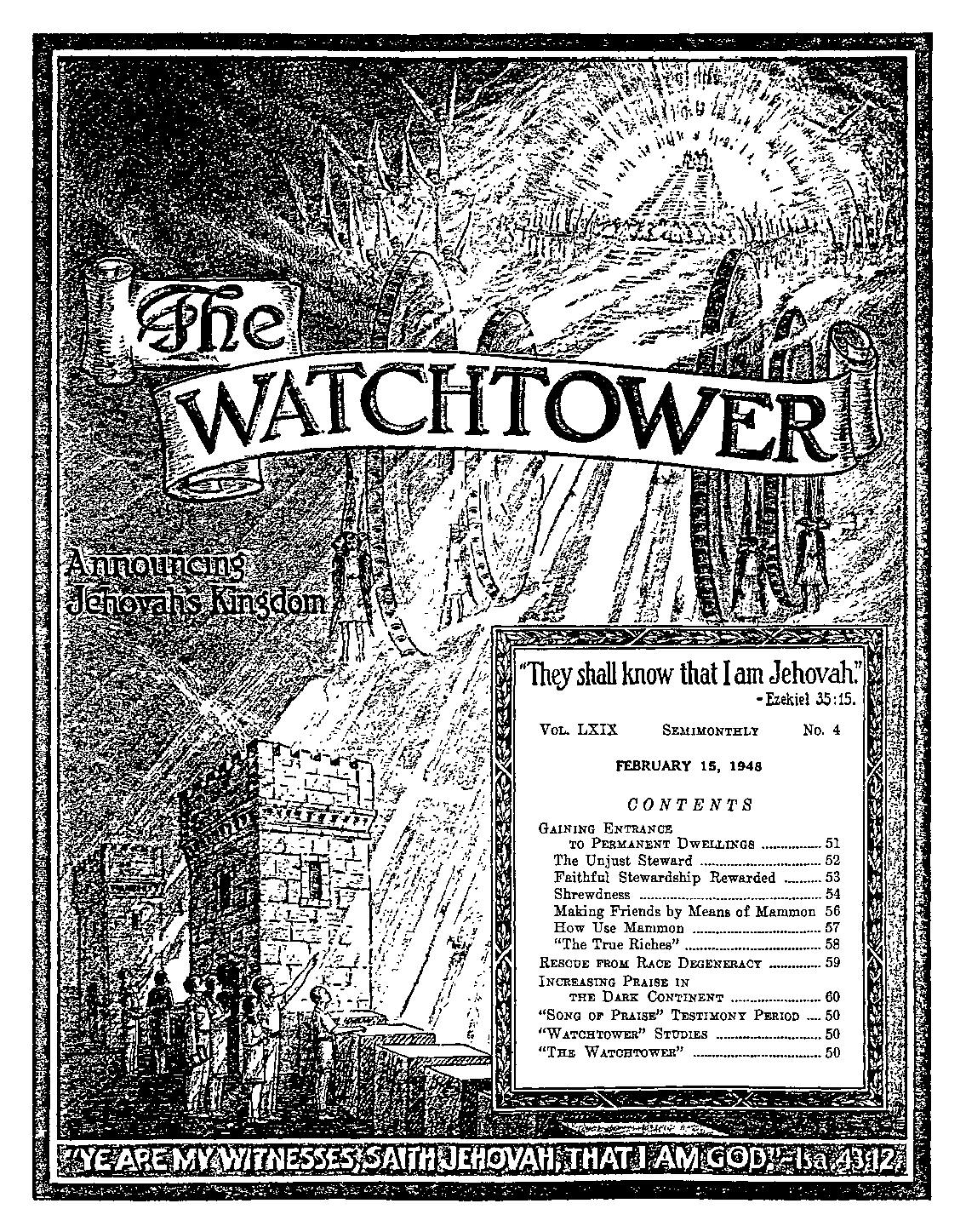
THE WATCHTOWER.
Published Semimonthly By
WATCH TOWER BIBLE & TRACT SOCIETY 117 Adams Street - - Brooklyn 1, N.Y., U.S. A.
Otmcesb
N. H. KNona, President Grant Suiter, Secretary
“And all thy children shall be taught of Jehovah; and great shall be the peace of thy children.” - Isaiah 54:13.
THE BIBLE CLEARLY TEACHES
THAT JEHOVAH Is the only true God, from everlasting to everlasting, and is the Maker of heaven and earth and Giver of life to his creatures; that the Word or Logos was the beginning of his creation and his active agent In creating all other things; and that the creature Lucifer rebelled against Jehovah and raised the issue of His universal sovereignty;
THAT GOD created the earth for man, made perfect man for the earth and placed him upon it; that man yielded to unfaithful Lucifer, or Satan, and willfully disobeyed God’s law and was sentenced to death; that by reason of Adam's wrong net all men are born sinners and without the right to life;
THAT THE LOGOS was made human as the man Jesus and suffered death in order to produce the ransom or redemptive price for obedient men; that God raised up Christ Jesus divine and exalted him to heaven above every other creature and clothed him with all power and authority as head of God’s new capital organization;
THAT GOD’S CAPITAL ORGANIZATION is a Theocracy called Zion, and that Christ Jesus is the Chief Officer thereof and is the rightful King of the new world; that the faithful anointed followers of Christ Jesus are Zion’s children, members of Jehovah’s organization, and are His witnesses whose duty and privilege it is to testify to Jehovah’s supremacy and declare his purposes toward mankind as expressed in the Bible;
THAT THE OLD WORLD, or Satan's uninterrupted rule, ended A.D. 1914, and Christ Jesus has been placed by Jehovah upon the throne, has ousted Satan from heaven, and now proceeds to vindicate His name and establish the “new earth”;
THAT THE RELIEF and blessings of the peoples can come only by Jehovah's kingdom under Christ, which has begun; that His next great act is to destroy Satan’s organization and establish righteousness completely in the earth; and that under the Kingdom the people of good-will surviving Armageddon will carry out the divine mandate to “fill the earth" with righteous offspring, and that the human dead in the graves will be raised to opportunities of life on earth.
ITS MISSION
HIS Journal is published for the purpose of enabling the people to know Jehovah God and his purposes as expressed In the Bible. It publishes Bible instruction specifically designed to aid Jehovah’s witnesses and all people of good-wllL It arranges systematic Bible study for Its readers and the Society supplies other literature to aid in such studies. It publishes suitable material for radio broadcasting and for other means of public instruction in the Scriptures.
It adheres strictly to the Bible as authority for its utterances. It is entirely free and separate from all religion, parties, sects or other worldly organizations. It Is wholly and without reservation for the kingdom of Jehovah God under Christ his beloved King. It is not dogmatic, but invites careful and critical examination of its contents in the light of the Scriptures. It does not indulge in controversy, and its columns are not open to personalities.
Notice to Subscribers: Remittances should be sent to office In your country in compliance with regulations to guarantee sale delivery of money. Remittances are accepted at Brooklyn from countries where no office Is located, by International money order only. Subscription rates In different countries are stated below In local currency. Notice oj expiration (with renewal blank) is sent at least two Issues beiore subscription expires. Change oj address when sent to our office may be expected effective within one mouth. Send your old as well as new address.
Please address the Watch Tower Society in every case.
Offices Yearly Subscription Rate
America (£7.1?.), 117 Adams St., Brooklyn 1, N.Y.
Australia, 7 Beresford Rd., Strathfield, N. S. W.
British West Indies, 21 Taylor St, Port of Spain, Trinidad $1.25 Canada, 40 Irwin Ave., Toronto 5, Ontario
England, 34 Craven Terrace, London, W. 2
India, 167 Love Lane, Bombay 27 Rs. 3/S
Jamaica, 151 King St, Kingston
New Zealand, G. P. O. Box 30, Wellington, C. 1
Philippine Islands, 2621 Int 2 Herran, Santa Ana, Manila 2 pesos South A/rlca, 623 Boston House, Cape Town
Translations of this journal appear In many languages.
ALL SINCERE STUDENTS OF THE BIBLE who by reason of infirmity, poverty or adversity are unable to pay the subscription price may have The Watchtower free upon written application to the publishers, made once each year, stating the reason for so requesting it. We are glad to thus aid the needy, but the written application ante each year & required by the postal regulations.
Printed In the United States of America Entered as second-class matter at the post office at Brooklyn, N. Y., under the Act of March 3, 1879.
“SONG OF PRAISE” TESTIMONY PERIOD
The 1948 Service Calendar designates February as “Song of Praise” Testimony Period. Psalm 18: 49, upon which the designation rests, sets as the rnotif for this period the singing of praises to God’s name among the nations. This we will do by intensifying our efforts in the second month of the 1948 Watchtower campaign for getting subscriptions for this magazine. All house-to-house workers will present the special offer of a year’s subscription together with a premium of eight booklets published by the Watch Tower Society, all at the regular subscription rate of just $1.00, American money. The peak of the northern winter has never halted the forward push of these annual campaigns, and publishers of God's praises are determined it will not this year either. Gome along with us, all you readers of The Watchtower. Your co-operation is appreciated, your service is valued, your joy will be enhanced by singing praises to the Most High. We are always ready to supply information and references for you to work with organized, trained campaigners. Take part and be able to hand in your report at the month's end on what you have accomplished in this “song of praise”.
“WATCHTOWER” STUDIES
Week of March 21; “Gaining Entrance to Permanent Dwellings,” 1-22 inclusive, The Watchtower February 15, 1948.
Week of March 28: “Gaining Entrance to Permanent Dwellings,” 23-43 inclusive, The Watchtower February 15, 1948.
“THE WATCHTOWER”
The Watchtower is a magazine without equal in the earth, and is conceded this rank by all that have been faithful readers thereof during its more than sixty years of publication. The Watchtower has increased in importance with the progress of the years, and never has it been more valuable than today, at this world crisis, when the destiny of each intelligent human creature is being decided. The getting of correct information and instruction, just such as required for the times, to decide your course wisely to a happy destiny, was never more vital than now, for “where there is no vision, the people perish”. Informed persons well acquainted with the consistent contents of The Watchtower agree that those who want to gain life in peace and happiness without end should read and study it together with the Bible and in company with other readers. This is not giving any credit to the magazine's publishers, but is due to the great Author of the Bible with its truths and prophecies, and who now interprets its prophecies. He it is that makes possible the material that is published in the columns of this magazine and who. gives promise that it shall continue to publish the advancing truths as long as it continues to exist for the service of the interests of his Theocratic Government Carefully and prayerfully read this issue of The TFatc/i-tower. Then do not delay to mail in your subscription, that you may receive it regularly, twice a month, twenty-four copies the year. Subscription rates are shown above.
ffieWWCHTOWER
ANNOUNCING JEHOVAH’S KINGDOM
Vol. LXIX February 15, 1948 No. 4
GAINING ENTRANCE TO PERMANENT DWELLINGS
"So 1 tell you, make friends for yourselves with your ill-gotten wealth, so that when it fails, they may take you into the eternal dwellings.1 2’—Luke 16:9, An American Translation.
JEHOVAH God made living creatures and made a I place for them to live in and enjoy life. He knew J each intelligent creature would want a suitable place that he might call home and where he might feel at home. With man and woman in view he created the garden of Eden and put them in it, offering them the opportunity to make it their eternal dwelling-place. In fact, with mankind in view, Jehovah God created our earthly globe, because it was his purpose to have it peopled with lovely, perfect men and women who should occupy the whole of it forever as their permanent home. (Isa. 45:12,18) Agreeable to such purpose, he will never destroy mankind’s natural dwelling-place, this material earth. The present generations of mankind average far less than a hundred years in duration; and contrasting this with the duration of man’s dwellingplace, God’s Word says: "One generation goes, and another comes, while the earth endures forever.” (Eccl. 1:4, An Amer. Trans.) The rest of God’s written Word does not contradict that scientific truth. It declares that the day comes when the righteous men and women will live forever in peace and happiness; and hence the earth was made to abide for all time as their natural place of abode.
2 The coming of the Messiah in the person of Jesus Christ did not alter that divine purpose. It only worked in with that purpose and made it more sure of coming true. By Jesus’ death and resurrection man’s habitation was not changed from earth to heaven, requiring a great moving-day for mankind at the time of the resurrection of the dead. It was simply to the little group of his faithful footstep followers that Jesus Christ said before his death and resurrection: “In my Father’s house are many dwellings ; but if not, I would have told you; because I am going to prepare a place for you. And if I go and prepare a place for you, I am coming again, and will receive you to myself, so that where I am you also may be.” (John 14:2,3, The Emphatic Diaglott) Jesus, after his resurrection from the dead, went to heaven, and his promise of a heavenly dwelling-place belongs, not to mankind in general, but strictly to the “little flock” of his genuine, faithful followers. They were the ones to whom he said: “Fear not, little flock; for it is your Father’s good pleasure to give you the kingdom.”—Luke 12: 32.
• To gain entrance into the abode of the heavenly kingdom, Jesus’ faithful disciples must undergo a change at the time of their resurrection out of death, a change from human personality to spiritual personality, such as Jesus underwent at the moment of his resurrection. (1 Pet. 3:18, Douay Version) Their being clothed upon, then with incorruption and immortality makes it sure that these victorious Christians will be able to occupy their new home in heaven for all time without change.—1 Cor. 15:47-53; 2 Pet. 1:11. . .
4 Men and women of good-will in general have a different permanent dwelling-place to which to look forward, namely, a paradise home on earth perfected under God’s kingdom. That will be in the new world of righteousness, which Jehovah God has promised to bring in by means of the kingdom of his Son Jesus Christ. At present, however, in this old world of unrighteousness, living on earth is quite miserable for hundreds of millions of its inhabitants. In this third year of the postwar period there is a greater housing shortage than ever, untold numbers of human habitations having been wiped out or made uninhabitable by atomic bombs, V-rockets, and blockbuster bombs dropped upon them, as well as by earthquakes, floods, hurricanes and fires. Millions of displaced persons are living in internment camps, former concentration camps, labor camps, or other crowded, unsatisfactory dwellings, and all property rights are becoming more uncertain and insecure. Large blocks of houses are now owned by religious systems, Catholic and Protestant, which take advantage of the scarcity of homes and increase the rents and exploit the poor rather than relieve them, and political governments must step into the situation to restrain greedy property owners.
6 The effect of the wo rid-wide condition is to worry
4. How bas the matter of living abodes become prominent recently? 5. What place did Jesus give anxiety over bousing, and how so? ordinary human creatures. It makes them anxiously seek for comfortable dwelling-places in this present wicked world as a need for future happiness. Very few of them feel inclined to give any thought at all to insuring for themselves eternal dwelling-places in the new world of righteousness. How to gain the latter we are told by Jesus Christ. He put our present housing anxieties in a secondary place when he said: “The foxes have holes, and the birds of the air have nests; but the Son of man hath not where to lay his head.” (Matt. 8: 20) He was seeking a permanent abiding-place elsewhere in God’s realm, and he recommended to all those who want to follow him not to mind so much about their present living quarters. Let them make sure for themselves eternal abodes in the future when the present things fail. He put his recommendation in these words: “And I say unto you, Make to yourselves friends of the mammon of unrighteousness; that, when ye fail, they may receive you into everlasting habitations.” (Luke 16:9) Just exactly what did he mean?
THE UNJUST STEWARD
* Jesus uttered those words as the main point of instruction in an illustration he had just given, known as the parable of the unjust steward. Hence to help us understand his words of instruction we must examine the parable. Jesus had just related the parable of the prodigal son, in the hearing of the Jewish Pharisees and scribes, and while they were still listening he added this new parable from which they as well as his disciples might benefit.
T We read: “And he said also unto his disciples, There was a certain rich man, which had a steward; and the same was accused unto him that he had wasted his goods.” (Luke 16: 1) This was a steward of an oriental kind. In his privileges, powers and authority in the house of this certain rich man he was doubtless like the steward of Abraham, “the friend of God.” “And Abram said, Lord God, what wilt thou give me, seeing I go childless, and the steward of my house is this Eliezer of Damascus?” This statement implies that if Abraham died childless, then steward Eliezer the Syrian would become heir to all Abraham had. (Gen. 15:2) It appears this steward was over all Abraham owned, and he is the one meant when Abraham sent to Mesopotamia to pick a wife for his son Isaac. We read: “And Abraham said unto his eldest servant of his house, that ruled over all that he had, . . . thou shalt go unto my country, and to my kindred, and take a wife unto my son Isaac.” (Gen. 24:2-4) The steward acted as go-between for the parents of the prospective bridegroom and bride. He thus was a friend of the bridegroom Isaac. No doubt during the time that Isaac b-8 (a) What parable did he tell, and what powers did the servant have? (b) What, then, in effect, was this servant?
was under age he was subject to this steward in Abraham’s absence. As it is written by the apostle: “Now I say, for as long a time as the heir is a child, he differs in nothing from a slave, lord of all though he be; but is under guardians and stewards, till that period predetermined of the father. Thus we also, when we were children, were enslaved under the rudiments of the world. Now you brethren, like Isaac, are children of a promise.”—Gal. 4:1-3, 28. Diaglott.
8 Abraham’s great-grandson Joseph, as prime minister of Egypt, had a steward to take care of domestic matters. The Hebrew Bible speaks of him literally as “the man that was over Joseph’s house”: and Joseph’s ten brethren in distress made their explanations of matters to this steward instead of to Joseph. (Gen. 43:19-24; 44:4) It was he that handled Joseph’s money, putting quantities of it into the sacks of Joseph’s brethren before they left Egypt. (Gen, 42:25) He saw to their entertainment at Joseph’s house. The steward was therefore a house manager. This is the literal meaning of what he is called in the Greek Scriptures (oikonomos), and his stewardship was that of house management (or oikonomia). In a parable concerning the end of this world arrangement at his second coming, Jesus spoke of a steward over his lord’s household, saying: “Who then is that faithful and wise steward, whom his lord shall make ruler over his household, to give them their portion of meat in due season? Of a truth I say unto you, that he will make him ruler over all that he hath.” (Luke 12:42,44) Jesus’ parable also of the unjust steward shows that a steward had free and wide control over his master’s properties and monies. Evidently, though, he got no salary for his services, so that, if he was turned out of his stewardship of the house, he was thrown out upon his own resources.
’Who it was that accused this steward, whether it was other servants in the house who were jealous of him or servants who were just faithful to their master’s interests, Jesus does not tell us. It is not of importance here. The result was the same, namely, that the steward was summoned before his master to answer to the charge of squandering that which was not his own, the property of his master. We read: “And he called him, and said unto him, How is it that I hear this of thee? give an account of thy stewardship; for thou mayest be no longer steward.” (Luke 16: 2) The master was firm and decided; the steward could act as house manager no more, unless he could disprove the charge. He must be able to prove faithfulness to his master’s interests, to retain his stewardship.
10 This agrees with the rule stated by the apostle Paul. All those claiming to be Christians must bear this rule in mind and follow it in order not to lose their relationship with God and his Christ. Paul himself was accused, but falsely. He was charged with mismanagement of his position, with conducting his Christian ministry to enrich himself and to satisfy a lust for powrer over fellow Christians. Whatever the charges, the apostle knew that he must answer, not to his accusers, but to his Master, the Lord God. He knew what was the proper rule for stewards, and so he himself quoted it before his accusers and said: “This is how you are to look upon us, as servants of Christ and stewards of God’s secret truths. Now in this matter of stewards your first requirement is that they must be trustworthy. It matters very little to me that you or any human court should cross-question me on this point. I do not even cross-question myself; for, although I am not conscious of having anything against me, that does not clear me. It is the Lord who cross-questions me on the matter. So do not criticize at all; the hour of reckoning has still to come, when the Lord will come to bring dark secrets to the light and to reveal life’s inner aims and motives.”—1 Cor. 4:1-5, Moffatt.
11 The apostle belonged to the “household of faith”. Thus he was in Jehovah’s Theocratic organization. But as one of the twelve apostles he had a special responsibility as a shepherd among God’s flock of “sheep”, and he was a steward in a special sense with many duties of importance. As steward he was responsible to distribute the mysteries or sacred secret truths of God to his “household of faith” and to all those seeking to become members of it. The fourteen epistles or letters that Paul wrote, which are now contained in the Bible, contain many of these sacred secrets which are mysteries to the world. But he distributed these mysteries to us, not only by letter, but also by preaching with his mouth, testifying, as he tells us, both “publicly” and “from house to house”. As a steward dispensing the sacred secrets of God and acting as the servant of Christ Jesus the Head of the “household of faith”, the apostle Paul had to be a preacher, and he confessed that he had to be faithful and trustworthy in acting as such.
11 For Paul to peddle out these divine mysteries in such a way as to gain personal material and social benefit to himself rather than to benefit his heavenly Master’s interests would be unfaithfulness. It would be squandering the gift bestowed upon him by Jehovah God, because it would bring reproach upon God’s name. For the work of distributing the fragrant, life-giving knowledge of these sacred secrets Paul claimed to be qualified, but he disclaimed any com-
J1. How must and did Paul carry out his work as steward?
12. Why could no one accuse him as a steward who squandered? mercial benefit or financial profits from his work. Insisting upon the non-commercial nature of his ministry, he said: “Who is qualified for this task? I am! For I am no peddler of God’s message, like most men, but like a man of sincerity, commissioned by God and in his presence, in union with Christ I utter his message.” (2 Cor. 2:17, An Amer. Trans.; Diaglott) Here Paul was not recommending himself: his works and their fruitage did that for him. But he was showing himself prepared to stand before God and answer to any false accusations against him. No one could rightly accuse him of being an unjust, dishonest, unfaithful steward, disloyal to his trust. For this reason Paul could say to his readers: “Become imitators of me, . . . even as I also am of Christ.”—1 Cor. 4:16; 11:1, Diaglott.
111 The command to conduct ourselves as stewards toward God and his people is directed to all Christians, whether apostles or not. Our last opportunity to lovingly act as such is here, especially since the final end of this wicked world-organization is upon us. Therefore Peter’s words to this effect strike us with particular force: “Now the end of all is near. Steady then, keep cool and pray! Above all, be keen to love one another, for love hides a host of sins. Be hospitable to each other, and never grudge it. You must serve one another, each with the talent he has received, as efficient stewards of God’s varied grace; if anyone preaches, he must preach as one who utters the words of God; if anyone renders some service, it must be as one who is supplied by God with power—so that in everything God may be glorified through Jesus Christ.”—1 Pet. 4:7-11, Moffatt.
14 A person that has the oversight in a company of members of the “household of faith” should take pains to be an example in these respects, remembering he is caring not for his own things, but for God’s. Knowing he must at the last render an account to God his Master, he should do all his acts and deeds as to God, because he loves God and lovingly cares for what belongs to God. Before he is put into such a responsible place, he should have a record that recommends him. “For,” the organization instructions tell us, at Titus 1: 7-9, “it is necessary that the overseer be irreproachable, as God’s steward; not self-indulgent, not passionate, not a wine-drinker, not a striker, not eager for base gain; but hospitable, a friend to goodness, prudent, just, holy, self-governed; maintaining the true Word in his teaching, so that he may be able both to exhort by the sound instruction, and to confute the opposers.”—Diaglott.
FAITHFUL STEWARDSHIP REWARDED
1S Jesus spoke of how God deals with those who are stewards for him, and Jesus’ illustrations are
13, 14. How should all, company servants and others, act0
15. Whom did Jesus foretell as steward at his second coming'' not-incorrect or overdrawn. The reward of the just, prudent and faithful steward stands in direct oppositeness to that of the unjust, dishonest and untrustworthy steward, according to Jesus’ illustration of what -was scheduled to take place at this time of his second coming; and which has taken place. Warning that his coming in the spirit would be sudden and at an hour unknown by us before his arrival, he said: “Who then is the faithful, the wise steward, whom the Lord will appoint over his domestics, to dispense the proper allowance of food in its season? Happy that servant, whom his master, at his arrival, shall find thus employed! I tell you truly, That he will appoint him over all his property.” (Luke 12:42-44, Diaglott) No individual man now on earth was here foretold, but the entire organized company of God’s consecrated people who are dedicated to his service and who work in unity as one man throughout the earth. As God long ago said to this company of devoted ones: “Ye are my witnesses, saith Jehovah, and my servant whom I have chosen; . . . the people which I formed for myself, that they might set forth my praise.”—Isa. 43:10,21, Am. Stan. Ver.
16 Jehovah’s witnesses of today must therefore serve Him unitedly, as a steward over what he has entrusted to them through our Savior Jesus Christ. They must be faithful to God and be wise with heavenly wisdom in doing so. They must serve one another with the spiritual food that God has provided through his Theocratic organization. They must also serve it out to his “other sheep” who are at present strayed and lost from the paths of truth and righteousness and whom the Good Shepherd must yet find and gather to his Theocratic fold. Jehovah’s witnesses have a world-wide assignment, to preach the Kingdom gospel in all nations. Jehovah God, through their Head and Master Jesus Christ, has put them in charge of all. They are necessarily different from the religionists of Christendom, because they have something committed to them that her religious systems do not have. Her religionists falsely accuse Jehovah's witnesses as being false prophets and not true to their name, but because of such religious accusations Jehovah God has not cast them out of his service, nor withheld from them his Bible truths, nor held back his blessing from their witness work, nor yielded them up to their enemies to be utterly suppressed and destroyed. The apostle Paul went right ahead under accusations. We can do the same, letting our activities and works in obedience to God testify to our faithful stewardship and explode all false enemy charges.
17 Note, however, what Jesus said would happen in our day to the company proving itself to be an 3 6, How must Jehovah's witnesses now serve, despite accusations? 17, 18. What does Jesus’ parable of the unfaithful servant show? unwise, disloyal steward. It agrees with what Jesus described in the parable of the unjust steward. After telling the reward, bestowed upon the faithful and wise steward, the Lord Jesus added: “But if that servant should say in his heart, ‘My master delays to come’; and shall begin to beat the servants and the maidens, and to eat and drink and be drunk; the master of that servant will come in a day when he does not expect him, and at an hour of which he is not aware, and will cut him off, and will appoint his portion with the unbelievers. And that servant, who knew the will of his master, and was not prepared, nor did according to his will, he shall be beaten with many stripes; but he who knew not, and did things worthy of stripes, shall be beaten with few. And from any one to whom much is given much will be required; and from him with whom much has been deposited, they will exact the more.”—Luke 12:45-48, Diaglott.
18 For one thing, this prophetic description shows the power and authority that the steward of the house had over his fellow servants and over his master’s property. It shows how the steward could misuse his privileges and authority before being suddenly called to account by his master. Christendom claims to be the steward of God’s interests in the earth and to be in charge of his people and of all his earthly property. So let her look into this mirror of God’s Word; and if it reflects her image as illuminated by the pages of history over sixteen centuries, and particularly since A.D. 1914, then let her know from Jesus’ words what is to be her certain fate from the hand of the Master she professes to serve.
SHREWDNESS
19 The unjust steward of the parable lowered what was due to his master from those in debt to him. While the parable was not told particularly to illustrate the Jewish scribes and Pharisees and the religious clergy of Christendom, yet the facts show that all these classes relaxed and weakened and reduced the requirements of God respecting sinners indebted to him. They did this in a compromising way with this world in order that they might gain favor and advantage with the people that want to remain a part of this world and to continue walking in its ways. Notice how Jesus illustrates this in the parable as he goes on to say: “And the steward said within himself, ‘What shall I do? For my master takes the stewardship away from me; I have not strength to dig: and I am ashamed to beg. I know what I will do, that when I am deprived of the stewardship, they may receive me into their own houses.’ And calling each one of his master’s debtors, he said to the first, Ttow much dost thou owe my master?’ And he said, 10, How did the unjust steward deal ^ith his master's debtors?
‘A hundred baths of oil [estimated as being .more than 800 gallons of oil].’ And he said to him, ‘Take back thy account, and sit down quickly, and write one for fifty.’ Then he said to another, ‘And how much dost thou owe!’ And he said, ‘A hundred cors of wheat [estimated at not quite 1,200 bushels of wheat].’ He says to him, ‘Take back thy account, and write one for eighty [around 900 bushels].’ —Luke 16:3-7, Diaglott.
20 Certain he was to be cast out to shift for himself, the steward tried, before making his final account to his master, to make friends among his master’s debtors in order to “feather his own nest for the future”. He was looking forward to a soft place for him to land. He now showed a form of mercy to his lord’s debtors. As one in charge of his master’s financial affairs he acted inside his duties in altering and reducing the bills owing from his master’s debtors. These, instead of paying in money or cash, paid in kind, that is, in valuable, salable substances such as olive oil, butter, or wheat. If the steward had been an unjust house manager, he likely charged his master’s debtors at exorbitant prices for the sake of taking in some personal graft. By now reducing the charges to what would be normal or proper, it would not really be to his master’s loss, but would bring in the proper returns.
21 However be the case, the master let the final changed accounts stand, recognizing this as the steward’s responsibility, to collect on the debts as the steward arranged with the debtors. Otherwise, by changing the debts back to the first-entered amounts, the master would have spoiled the selfish advantage the steward had gained by reducing the debts. But now, the debts being settled at the reduced amounts, the steward who thus befriended the debtors would be a welcome man in their homes; he would not have to earn a living in the hard way by digging or in a humiliating way by begging. He had a good eye to the future; and lie used the mammon or wealth, riches, material goods, in order to gain this advantage. A shrewd man lie was!
22 The parable goes on to say: “And the lord commended the unjust steward, because he had done wisely: for the children of this world are in their generation wiser than the children of light.” (Luke 16:8) Some readers have taken the words here, "the lord,” to mean the Lord Jesus, as if he were commending-or. praising the dishonest steward. But this could not be the case, for Christ Jesus could not commend the dishonesty and injustice of the steward. The words "the lord” refer to the steward’s lord or master. What the steward had done with the accounts in order to gain entertainment for himself in the homes of those whom he befriended came to light in
20, 21. How was the steward thus acting shrewdly?
22. Who commended him, and according to what proverbs? the investigation, and his lord could not help but admire the shrewdness with which his unfaithful steward had acted in his difficulty. He had acted according to the wisdom of Proverbs 18:16, which says: “A man’s gift maketh room for him, and bring-eth him before great men.” Also the proverb: “Many will intreat the favour of the prince: and every man is a friend to him that giveth gifts. He that getteth wisdom loveth his own soul.”—Prov. 19: 6,8.
23 It was this shrewdness, this ability to act in a practical way with benefit to oneself, that the steward’s master praised. It was this wise, self-benefiting action that Christ'Jesus emphasized as the principal point at which he was driving in his parable. Therefore Jesus added the comment: “For the children of this world are in their generation wiser than the children of light.” Or, more understandably translated today: “For the sons of this age are more prudent as to that generation which is their own, than the sons of light.” {Diaglott) “For the children of this world look further ahead, in dealing with their own generation, than the children of light.”—Moffatt.
24 Persons of this world act shrewdly or with selfish foresight toward other worldly persons in this present-day generation. They take a long-range viev. of matters and seek to provide some future advantage or benefit to themselves, especially by making-many friends by acts of friendliness. Who can deny that the United States is trying to act shrewdly, with enlightened selfishness, in its dealing with European nations in distress by means of the so-called “Marshall plan”? The economic chaos and depression, followed by unfavorable political upsets which this country fears will take place in Europe unless the “plan” is put to work, spurs the United States to extend this help to the needy nations. It does so to win political friends thereby and also to avoid the depression and political troubles that a European collapse might cause in this land. Thus it has its own future interests in view, and this affects and directs the course that it takes now. This course is not necessarily dishonest and unjust toward others, although it results in the most benefits of a selfish kind in the end.
23 That is sound wisdom from a worldly viewpoint, and self-interest dictates it. Should the “children of light” be less wise regarding the things with which they have to do, and especially in view of the knowledge they have of what the future holds? Either they believe in this knowledge of theirs or they do not. The faithful followers of Jesus Christ are the “children of light”, for good reasons. Their heavenly Father is Jehovah God, concerning whom it is written: “God is light, and in him is no darkness at all. ’
23. What did Jesus emphasise about him, and with what comment9 24. How do worldly persons deal shrewdly with their generation?
25. How are we children of light, and how should we be wise?
He is “the Father of lights”. (1 John 1:5; Jas. 1:17) Also Jesus Christ, whom they follow, is “the light of the world”, and he has caused the light from God the Father to shine upon them, thus bringing them forth as bearers of this heavenly light. His apostle says to them: “For ye were once darkness, but are now light in the Lord: walk as children of light." They must produce the works of light, bringing forth the fruitage of God’s light. “For the fruit of the light is in all goodness and righteousness and truth.” (Eph. 5:8,9, Am. Stan. Ver.) The children of this world deal with their own worldly generation. On the other hand, the children of light have to deal with the organization of light and must render account to the great Source of light and its channel, namely, Jehovah God and Christ Jesus. Hence they should act wisely toward God and Christ. God and Christ are pleased to have them do so. That is why Jesus recited this parable of the steward. They should not show less wisdom than the children of this world do in their own way to their own generation. Children of light should be “wise as serpents”, but not harmful as these are. For using wisdom according to the light they have God will bless them through Jesus Christ.
MAKING FRIENDS BY MEANS OF MAMMON
28 How, now, can a person that follows the light of God’s Word make a practical application of the special point of instruction in the parable of the steward? Jesus himself tells in his very next words: “And I say unto you, Make to yourselves friends of the mammon of unrighteousness; that, when ye fail, they may receive you into everlasting habitations.” (Luke 16:9) Here modern translation, with its better grasp of the common (koine) Greek in which the Scriptures were written, makes Jesus’ words more correctly understood: “And I tell you, use mammon, dishonest as it is, to make friends for yourselves, so that when you die they may welcome you to the eternal abodes.” (Moffatt) The translator here uses the phrase “when you die” instead of “when ye fail”. This would show we must take into consideration with whom we have to deal after our life in the present evil world is done. The majority of the translators prefer the text to refer to the failing of mammon or riches, and so translate Jesus’ words in this way: “And I say unto you, Make to yourselves friends by means of the mammon of unrighteousness; that, when it shall fail, they may receive you into the eternal tabernacles.” (Am. Stan. Ver.) “Make friends for yourselves with your ill-gotten wealth, so that when it fails, they may take you into the eternal dwellings.”—An Amer. Trans.; Diaglott.
21 From this we see that the friendships worth making are not with the unrighteous, dishonest, or
26. What practical application did Jesus tell ub to make of this? 27. With whom specifically should we, wisely, make friends? ill-gotten mammon or wealth. We cannot serve God and mammon, said Jesus a few verses later (Luke 16:13). The love of mammon or money is a root of all evil. (1 Tim. 6:10) We cannot, therefore, be seeking the friendship of the wealthy ones of this world, the big landlords and the real estate concerns. We must be seeking the friendship of those who can give us more than material possessions, namely, eternal dwellings, permanent homes. Those able to provide us with such things are Jehovah God the great Builder of all things and Jesus Christ his Son, who said to his disciples: “I go to prepare a place for you.” If we desire to live in happiness for all eternity, these are the ones with whom to make friends; and to do so we should use what mammon or worldly wealth we have in this life.
28 The money-loving Pharisees heard Jesus tell his parable. They did not decide to follow his advice to make friends of the owners of everlasting dwellings by means of their ill-gotten mammon or wealth. They ridiculed him then, and later caused his death on the tree, showing themselves very unfriendly to him and to God his Father. (Luke 16:14) The rich young ruler, who claimed to be an honest man, saying he kept God’s commandments from his youth up, was not wise and foresighted enough to follow Jesus’ advice. He was unwilling to use his mammon or wealth to make friends with Jesus and Jehovah God by using it in the way that Jesus advised so as to have “treasure in heaven”. Hence, “he went away sorrowful: for he had great possessions.” This proved Jesus’ saying, “That a rich man shall hardly enter into the kingdom of heaven.” (Matt. 19: 16-24) The young man’s mammon or wealth became specially unrighteous to him, because he made it his god, and was unwilling to drop his love of it that he might love God with everything that he had.
20 Just before telling about the unjust steward Jesus told the parable of the prodigal son; and this son likewise showed no wisdom or forethought in using his mammon which consisted of his part of his father’s estate. This prodigal pictured those who today are becoming the Lord’s “other sheep”. He spent his money in loose, extravagant living, making friends indeed, but friends that forsook him when his money failed or ran out. He finally found out he had to repent of his past unwise course and make a friend of his compassionate father in order to find a real home. (Luke 15:11-32) The father’s compassion went out to the repentant prodigal. This, and not any mammon, was what provided for the prodigal son a dwelling with a real friend that would never forsake him.
” The repentant tax-gatherer Zacchaeus, who entertained Jesus in his home, showed proper pru-
28, 29 How did the rich young ruler and the prodigal not show wisdom ? 30. How did Zacchaeus and Pentecostal converts make friends? dence, foresight and wisdom by following Jesus’ instruction. “And Zacchseus stood, and said unto the Lord; Behold, Lord, the half of my goods I give to the poor; and if I have taken any thing from any man by false accusation [ill-gotten mammon], I restore him fourfold. And Jesus said unto him, This day is salvation come to this house, forsomuch as he also is a son of Abraham.” (Luke 19:1-10) This proves that Zacchaeus was making the right friends by the course he determined to follow with his mammon. Likewise the early disciples from and after the day of Pentecost used their means in making eternal friendships according to Jesus’ advice. We read: “The same day there were added unto them about three thousand souls. And all that believed were together, and had all things common; and sold their possessions and goods, and parted them to all men, as every man had need.” “Neither was there any among them that lacked: for as many as were possessors of lands or houses sold them, and brought the prices of the things that were sold, and laid them down at the apostles’ feet: and distribution was made unto every man according as he had need.” One specially named as doing this was Barnabas. —Acts 2:41, 44, 45; 4:34-37.
HOW USE MAMMON
S1 Does making friends of God and Christ Jesus with mammon mean they can be bought or bribed for favors? Are the Roman Catholic priests and other religious clergymen right in showing such partiality toward the rich of this world? Not at all! Simon the sorcerer of Samaria thought he could buy the favors of God by the outright gift or commercial exchange of money. He lusted for power to exercise over others that he might exploit them and exalt himself. When he saw the apostles John and Peter imparting the gift of the holy spirit to the baptized believers by laying their hands upon such, Simon, so the account says, “offered them money, saying, Give me also this power, that on whomsoever I lay hands, he may receive the holy [spirit]. But Peter said unto him, Thy money perish with thee, because thou hast thought that the gift of God may be purchased with money.” (Acts 8:9-20) Ananias and his wife, Sap-phira, who jointly acted out a lie with their sale of property and money contribution, were like Simon in thinking they could buy God’s favor to the extent of having a-big reputation in the church as full contributors. (Acts 5:1-10) They failed in their scheme.
” Neither Simon nor Ananias and Sapphira were wise enough to see that handing over money to buy something for a selfish purpose could not be acceptable to God or be an act of friendship. Using money without a loving service of God along with it could
31. What two cases cited show God cannot be bought with mammon? 32. What did Peter's treatment of their offers show as to God? never buy God as Friend so that God would give special powers and position in this life. Peter’s treatment of the offers of Ananias and Sapphira and of Simon shows we cannot buy an influential place, power and miraculous gifts in God’s organization by means of a direct trade with money. Were that not so, then the poor people would be put at a disadvantage and the rich would be able to buy up all powers and special privileges and future hopes and reservations. God would be mercenary. But he is not so, and it would be ridiculous to think of him as such. In connection with his temple or house of worship he says: “The silver is mine, and the gold is mine, saith the Lord of hosts.” (Hag. 2: 8) “The world is mine, and the fulness thereof.” (Ps. 50:10-12) And King David prayed to Him: “All that is in the heaven and in the earth is thine; ... all things come of thee, and of thine own have we given thee.”—1 Chron. 29:11,14.
”We cannot enrich God by giving him what is already his own. What he wants is our love and devotion. By applying our money in his service in the way that he prescribes we show our love for him and hence such use of money is different from the above use. Not by showing selfishness in trying to get something from him for ourselves by money; but by showing loving appreciation and devotion to God in the employment of our material wealth, even be it by a widow's mite, in this unselfish way do we show ourselves friendly to Jehovah God and Christ Jesus and thus make friends with them.
“This way was the way that Jesus told the rich young ruler he could make friends of the owners of eternal habitations. He said: “If thou wilt be perfect, go and sell that thou hast, and give to the poor, and thou shalt have treasure in heaven: and come and follow me.” (Matt. 19:21) To the Pharisees Jesus said: “But rather give alms of such things as ye have; and, behold, all things [both the inside and the outside] are clean unto you.” (Luke 11:39-41) Not that they should make outright money-gifts to the poor, but that they should use the money principally in spreading the gospel of salvation to the poor people of the world that these might thereby gain enduring riches. Such a course will be rewarded with everlasting abodes with heavenly Friends. Jesus indicated so in his reply to Peter who said at the time: “Here we have left all we had and followed you. What are we to have?” Jesus said to his apostles : “In the new world, I tell you, when the Son of Man takes his seat on his glorious throne, you who have followed me will also sit upon twelve thrones, and judge the twelve tribes of Israel! And anyone who has given up houses or brothers or sisters or father or mother or children or land for my sake will receive many times as much, and share eternal
33. How, then, with mammon can we make friends with God?
34. How should we give alms to the poor? with what reward ahead? life.”—Matt. 19:27-29, An Amer. Trans.; Luke 18:28-30.
85 This same course of disposing of one’s present riches or mammon for lasting returns in the new world the apostle tells Timothy to recommend to the rich Christians. He says: “Charge those rich in the present age not to be high-minded, nor to confide in wealth so uncertain, but in that God who imparts to us all things richly for enjoyment; to do good, to be rich in good works, to be liberal, willing to bestow; treasuring up for themselves a good foundation for the future, that they may lay hold of that which is really life.” (1 Tim. 6:17-19, Diaglott) Our wisdom lies, therefore, in treating mammon or riches, not as our master whom we slavishly serve, but as our servant useful in God’s work, just as the God-fearing centurion Cornelius did.—Acts 10:1-4; Luke 7: 3-5.
36 Looking at the matter wisely from the viewpoint of “children of light”, we see this: We do not need to go into real estate deals now in order to provide houses and lands for the use of ourselves and of others in the new world that lies beyond the battle of Armageddon. Even with that battle coming along fast, there is now no need to provide such places as “refuge farms” for any Christians to withdraw to in order to escape the trouble engulfing the world. The prophet Jeremiah was in prison right in the city of Jerusalem when it was under siege by the Babylonians; yet Jehovah preserved him when the city fell, and saved him from its destruction. (Jer. 39:11-18) Jeremiah had the Lord’s protection although in the very midst of danger, and thus he was really safe, contrary to all outward appearances. Hence “refuge farms” or suchlike places of retreat are not necessary as long as we keep faithful in God’s service, for “Jehovah preserveth the faithful”. —Ps. 31:23, Am. Stan. Ver.
37 Seeing that Jehovah God and Christ Jesus are the Ones providing “eternal abodes”, there is no need to build houses now, and tie up money in them, just to prepare places for the lodging of the faithful dead whose return we expect by resurrection. If we faithfully apply our time, strength, and material riches to doing the things God now commands to be done for the getting of the Kingdom message to the poor of this world, then the Lord will take care of those whom he promises to bring back from the dead. Our being at the entry into the new world of righteousness reminds us of the time that Israel crossed the Jordan river into the Promised Land. There the Lord God provided them the dwelling-places, even the homes that enemies were obliged to vacate. Moses foretold this by saying shortly before they crossed Jordan: “It shall be, when the Lord thy God shall
35. In dealing with riches, where does wisdom lie?
3G. Why not provide houses and farms to live through Armageddon? o7, 38. Why not build now foi housing resurrected faithful ones? have brought thee into the land which he sware unto thy fathers, to Abraham, to Isaac, and to Jacob, to give thee great and goodly cities, which thou buildedst not, and houses full of all good things, which thou filledst not, and wells digged, which thou diggedst not, vineyards and olive trees, which thou plantedst not; when thou shalt have eaten and be full; then beware lest thou forget the Lord.” (Deut. 6:10-12) Years later, Joshua testified that the Lord had given them such things.—Josh. 24:13.
38 Regarding the battle of Armageddon and its effect upon those who accumulate houses and lands but do not trust in God and in his Messiah, the prophet Isaiah says: “Woe unto them that join house to house, that lay field to field, till there be no place, that they may be placed alone in the midst of the earth! In mine ears said the Lord of hosts, Of a truth, many houses shall be desolate, even great and fair, without inhabitant.” (Isa. 5:8,9,25) If necessary, the Lord God could have the survivors of Armageddon and the faithful ancients whom he raises from the dead occupy such vacated houses and factories of which he dispossesses the wicked users at the battle of Armageddon. The thing now to do is for Jehovah’s witnesses to use up what they have in his service as gospel-preachers and let him take care of providing for the future.
“THE TRUE RICHES”
89 Remembering that the silver and the gold are Jehovah’s and we cannot enrich him by financial or material contributions, we can appreciate that to devote our money to His service is relatively the least thing we can do. Jesus indicated so when he added these words after his parable of the steward: “He that is faithful in that which is least, is faithful also in much: and he that is unjust in the least, is unjust also in much. If therefore ye have not been faithful in the unrighteous mammon, who will commit to your trust the true riches? And if ye have not been faithful in that which is another man’s, who shall give you that which is your own?” (Luke 16:10-12) Note that comparison which Jesus makes between the unrighteous mammon and the true riches. True riches are not the material things of this world. They are the enduring riches, namely, the Kingdom truth and the privilege of seiwing as a proclaimer and distributor of such truth that brings salvation to all receiving and living up to it. God’s service with these “true riches” is higher than that of using whatever material wealth we have. Of course, we must be faithful in using such earthly riches in God’s service, because, otherwise, he will not commit to us the superior riches of the truth and its continued service. God treats us in harmony with the rule that, if we are not faithful in what is of less
30, Relatively, why le contributing money the least we can do? or of least importance, we will not display ourselves reliable in what is of much value and importance.
40 Giving ourselves to Him in service as a publisher of his kingdom is more valuable and more mighty in results than any mere money gift to him. Our possessing of his holy spirit or active force inside us is more important and powerful than possessing great mammonistic wealth. The possessing of the Kingdom truth from his Word, and the possessing of privileges of preaching which our having that truth offers to us, is more precious and puts greater responsibilities upon us than our possessing delusive riches. God prizes as of greater preciousness and worth our loving devotion to him.
41 Bear in mind this fact shown in the question put to Christian stewards: ‘What hast thou that thou didst not receive?” (1 Cor. 4:1, 2, 7) What we have belongs in reality to another, to the great Giver, Jehovah God. If we selfishly abuse or misuse what he entrusts through Christ Jesus to us as stewards now; that is, if we are untrustworthy and unfaithful in that which is another’s, how or why should he commit to us that which would be forever our own as his children in the new world of righteousness? Whom will God clothe upon with immortality in the resurrection, thus giving them life within themselves? Certainly not any members of his church if they have not proved trustworthy on earth in that which is God’s now, especially by right of purchasing us by the ransom sacrifice of his Son. Neither will he grant everlasting life in the new world to his "other sheep” of today if they do not prove faithful in the use of what he commits to them ac this end of the world.
42 The kingdom of God by Christ Jesus has now been set up in the heavens, to oust and dispossess
40. What is superior to having money or contributing it?
41. In what case will God not commit to us what la our own?
42. Whom will the King let dwell with him in the new world? this wicked, selfish old world that worships mammon as god. The anointed remnant want to live and reign with Christ in that kingdom. Their earthly companions, the “other sheep”, want to enjoy an everlasting abode on a perfect earth beneath that heavenly kingdom. Christ Jesus the King tells us whom he will permit to dwell with him there in that new world. He was foreshadowed by King David, and through the prophetic words of King David we learn who will gain a dwelling with Christ as King in the new world, namely: “Mine eyes shall be upon the faithful of the land, that they may dwell with me: he that walketh in a perfect way, he shall minister unto me. He that worketh deceit shall not dwell within my house: he that speaketh falsehood shall not be established before mine eyes. Morning by morning will 1 destroy all the wicked of the land; to cut off all the workers of iniquity from the city of Jehovah.” (Ps. 101: 6-8, Am. Stan. Ver.) Christ Jesus the King will not want any self-righteous money-lovers around him in his domain, for he abominates them and will never take them into his everlasting habitations. —Luke 16:15.
43 Now that the Kingdom is at hand, is it not high time to think of making and keeping the best kind of friends, using all that we have at our disposal to that end? Is it not time to use wisdom and foresight, now that the old world is failing with all its transitory things and a new world without end is at the door? The King Christ Jesus, and the heavenly Father Jehovah God, who gave him the Kingdom, are possessors of eternal abodes. Be wise. Do not serve mammon, but serve f/iem. They will not be unjust to forget your loving service. (Heb. 6:10) Make them your everlasting Friends, and live forever in the homes they will open to you with a loving welcome.
43. Wbat is it now high time to think of and to do?
RESCUE FROM RACE DEGENERACY
JEHOVAH GOD has for thousands of years been working out his purpose to rescue humankind from race degeneracy. Such a rescue was not needed in the beginning of man’s existence. God created the first man perfect, and gave him a woman as helpmeet. Both Adam and Evo were perfect in body, without pain and sorrow; and were the most beautiful creatures in Eden. They enjoyed the right to life in a perfect home filled with beautiful animals and birds, all subject to man’s dominion. Upon one expressed condition God gave these blessings to man for him to enjoy eternally; that condition was obedience to God’s law. Penalty of violation was loss of life and the right to it. The first pair of human creatures on earth did disobey, and they did lose their lives and their rights thereto.
Because humankind’s first parents possessed no right to life, every child born into the world from then until now has been born imperfect, unrighteous, a sinner, disapproved in God’s sight, under condemnation, and therefore ■with no right to life. The life any have lived has been merely by divine permission; and all who have died have died justly, for nothing but a perfect creature is entitled to life. Under inspiration the apostle Paul sums up the matter of inherited condemnation: “By one man sin entered into the world, and death by sin; and so death passed upon all men, for that all have sinned.”—Rom. 5:12.
All the human race, then, from Adam till now, having been born degenerate or imperfect, it follows that if any ever get full life and the right to life they must get it through the loving Life-giver, Jehovah God. Unless God had made some provision for the redemption of man from death and the lifting up of him again to the condition of perfect life, the time would come when there would be none of the present human race upon earth. We remember that Adam lived 930 years; and now man does not average half a century old. The race has been degenerating for centuries, growing weaker and weaker, and ultimately all would come to that condition in which they would be unable to transmit even the spark of life, and the earth would be depopulated of degenerate creatures. Hence we see our utter dependence upon God; and God has graciously made provision for the rescue of obedient men and women and children.
At the time of Adam and Eve’s first disobedience and sentencing, the invisible troublemaker behind the earthly scenes was given a death sentence, namely, Satan’s head was to be bruised unto death by the promised Seed, Christ Jesus. (Gen. 3:15) God’s righteous judgment against Adam and Eve must stand, but he could be consistent with justice and show his love by providing a redeemer for the offspring of the first human pair. That he has done. (Rom. 5:15, 18) Those persons seeking rescue from race degeneracy must learn of and meet the conditions of the ransom through Christ Jesus.
INCREASING PRAISE IN THE DARK CONTINENT
WEST Africa and South Africa were the objectives of the flight arranged for Brother N. H. Knorr, the Society’s president, and Brother M. G. Henschel, his secretary. The date set for departure on Pan American Airways was December 10, and in view of the fact that the route of flight is through Lisbon, Portugal, it was found possible to plan for brief visits to Portugal and Spain. Gilead graduate John Cooke was booked for the flight to Lisbon as a companion of Brothers Knorr and Henschel.
Weather still stands as a big obstacle for commercial aviation. December in New York ean bring sudden changes in weather, and so it was that late in the afternoon of the 10th the flight was postponed until 4 a.m. the next day. But at 2 a.m. a ’phone call brought the information that departure had been delayed until 6 p.m. Finally, a little later on, the time was set for take-off at 12:30 a.m. on Friday, December 12.
Others in New York had been checking on the flight departure time too and much to our surprise and delight brethren from various units in New York and members of the Bethel family came to LaGuardia Field to wish us bon voyage. It was not until 1:05 a.m. that these brethren were sure the travelers would go, for at that time the big DC-4, a veteran of many flights, took off over New York city, banked to the north and then headed east for Santa Maria, in the Azores. It was a cold night and only after an hour of flying did the plane become sufficiently warm to permit the passengers to remove their overcoats and feel comfortable.
…