The Watchtower, October 1, 1947
Download: PDF — The Watchtower, October 1, 1947
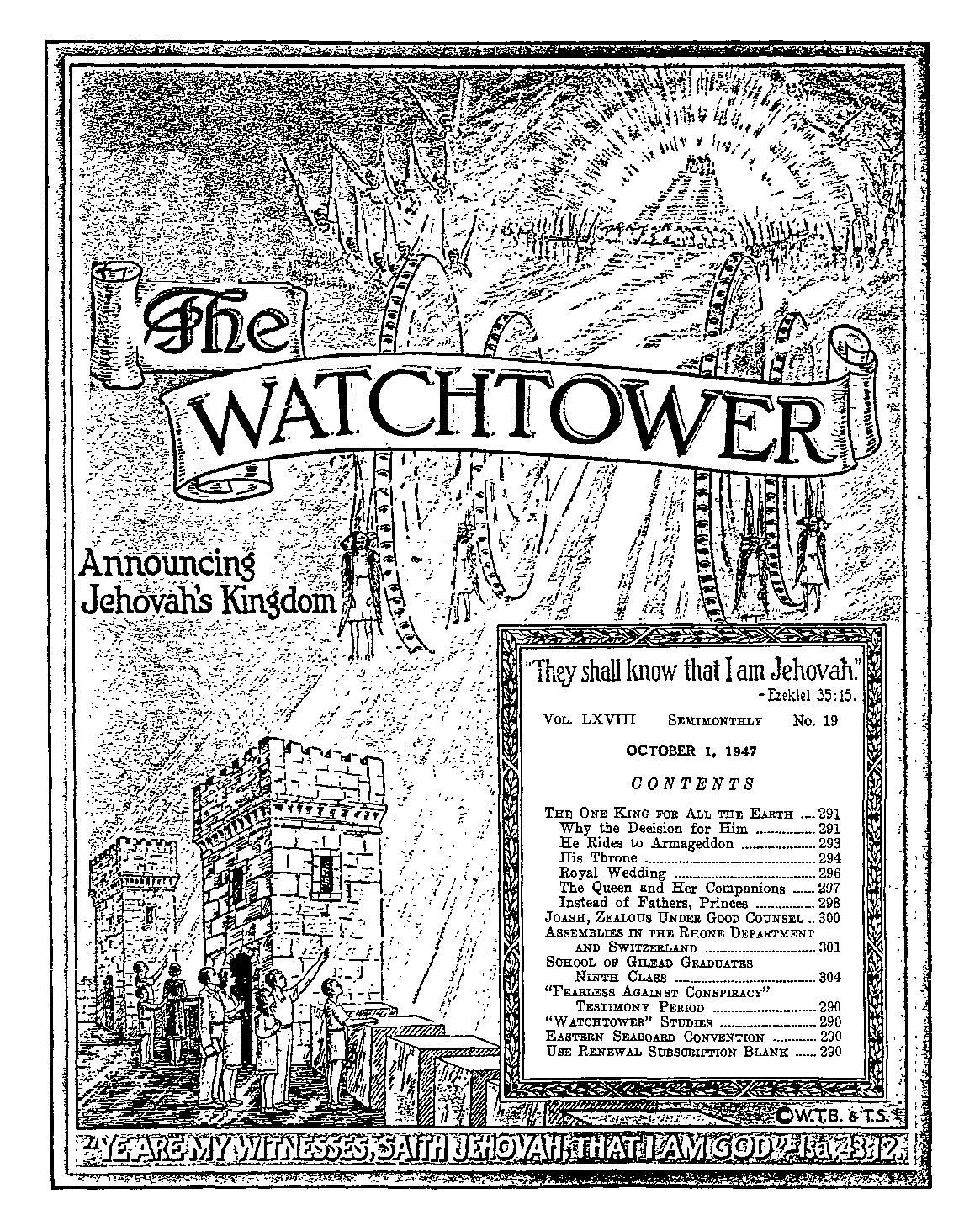
SSEESte^SSE^
&ic^^;&rssssi
'gcjrWg-^-g-^-s
glMBOW
WffiSTOW
Announcing
ft ru
[hey shall know that I am Jehovah?
-Ezekiel 35:15.
Vol. LXVIII Semimonthly No. 19
OCTOBER 1, 1947
CONTENTS
The One King for All the Earth ....291
Why the Decision for Him
He Rides to Armageddon
His Throne
Royal Wedding
The Queen and Her Companions
Instead of Fathers, Princes
Joash, Zealous Under Good Counsel .. 300 Assemblies in the Rhone Department
and Switzerland .......................
School of Gilead Graduates
Ninth Class ...............................
“Fearless Against Conspiracy”
Testimony Period ....................
“Watchtower” Studies ..................
Eastern Seaboard Convention .....
Use Renewal Subscription Blank
fHeWATCHTOWER.
Published Semimonthly By
WATCH TOWER BIBLE 6 TRACT SOCIETY 117 Adams Street - Brooklyn 1, N.Y., U.SA.
Otficbbs
N. H. Knobb, President Grant Suiter, Secretary
“And all thy children shall be taught of Jehovah; and great shall be the peace of thy children.” • Isaiah 54:13.
THE BIBLE CLEARLY TEACHES
THAT JEHOVAH Is the only true God, from everlasting to everlasting, and is the Maker of heaven and earth and Giver of life to his creatures; that the Word or Logos was the beginning of his creation and his active agent in creating all other things; and that the creature Lucifer rebelled against Jehovah and raised the Issue of His universal sovereignty;
THAT GOD created the earth for man, made perfect man for the earth and placed him upon it; that man yielded to unfaithful Lucifer, or Satan, and willfully disobeyed God’s law and was sentenced to death; that by reason of Adam’s wrong act all men are born sinners and without the right to life;
THAT THE LOGOS was made human as the man Jesus and suffered death in order to produce the ransom or redemptive price for obedient men; that God raised up Christ Jesus divine and exalted him to heaven above every other creature and clothed him with all power and authority as head of God’s new capital organization;
THAT GOD’S CAPITAL ORGANIZATION is a Theocracy called Zion, and that Christ Jesus is the Chief Officer thereof and is the rightful King of the new world; that the faithful anointed followers of Christ Jesus are Zion’s children, members of Jehovah's organization, and are His witnesses whose duty and privilege it is to testify to Jehovah’s supremacy and declare bls purposes toward mankind as expressed In the Bible;
THAT THE OLD WORLD, or Satan’s uninterrupted rule, ended A.D. 1914, and Christ Jesus has been placed by Jehovah upon the throne, has ousted Satan from heaven, and now proceeds to vindicate His name and establish the “new earth”;
THAT THE RELIEF and blessings of the peoples can come only by Jehovah’s kingdom under Christ, which has begun; that His next great act is to destroy Satan’s organization and establish righteousness completely in the earth; and that under the Kingdom the people of good-will surviving Armageddon will carry out the divine mandate to “fill the earth” with righteous offspring, and that the human dead in the graves will be raised to opportunities of life on earth.
ITS MISSION
THIS Journal is published for the purpose of enabling the people to know Jehovah God and his purposes as expressed in the Bible. It publishes Bible Instruction specifically designed to aid Jehovah’s witnesses and all people of good-will. It arranges systematic Bible study for its readers and the Society supplies other literature to aid in such studies. It publishes suitable material for radio broadcasting and for other means of public instruction in the Scriptures.
It adheres strictly to the Bible as authority for its utterances. It is entirely free and separate from all religion, parties, sects or other worldly organizations. It is wholly and without reservation for the kingdom of Jehovah God under Christ his beloved King. It is not dogmatic, but Invites careful and critical examination of its contents in the light of the Scriptures. It does not Indulge In controversy, and Its columns are not open to personalities.
Notice to Subscribers: Remittances should be sent to office in your country In compliance with regulations to guarantee safe delivery ot money. Remittances are accepted at Brooklyn from countries where no office is located, by international money order only. Subscription rates in different countries are stated below in local currency. Notice of expiration (with renewal blank) is sent at least two issues before subscription expires. Change of address when sent to our office may be expected effective within one month. Send your old as well as new address.
Please address the Watch Tower Society in every case.
Offices Yearly Subscription Rate
America (17. S.), 117 Adams St., Brooklyn 1, N. Y.
Australia, 7 Beresford Rd., Strathfleld, N. S. W.
British West Indies, 21 Taylor St, Port of Spain, Trinidad 51.25 Canada, 40 Irwin Ave., Toronto 5, Ontario
England, 34 Craven Terrace, London, W. 2
India, 167 Love Lane, Bombay 27 Be. 3/8
Jamaica, 151 King St, Kingston
New Zealand, G. P. O. Box 30, Wellington, C. 1
Philippine Islands, 2621 Int 2 Herran, Santa Ana, Manila 2 pesos South Africa, 623 Boston House, Cape Town
Translations of this journal appear in many languages.
ALL SINCERE STUDENTS OF THE BIBLE who by reason of Infirmity, poverty or adversity are unable to pay the subscription price may have The Watchtower free upon written application to the publishers, made once each year, stating the reason for so requesting it. We are f;lad to thus aid the needy, but the written application once each years required by the postal regulations.
Printed in the United States of America
Entered as second-class matter at the post office at Brooklyn, N. Y., under the Act of March 3, 18 79.
“FEARLESS AGAINST CONSPIRACY” TESTIMONY PERIOD
October is annually a special testimony-period month, and this year it is designated “Fearless Against Conspiracy” Testimony Period. The fact today of world conspiracy against Jehovah God and his kingdom by Christ cannot be denied, and it falls not amiss that during this special testimony His fearless publishers will offer the challenging book "Let God Be True”, making it their initial offer on a contribution of 35c, American, or the equivalent of this in foreign lands. Many new Watchtower readers doubtless feel emboldened by its message to take part in this special effort to place the said book and to lay the foundation for future studies of the Bible with it in the private homes of the obtainers. We invite all such into the ranks of active publishers of God’s presentday message. In harmony therewith we wait to hear from you if wanting to get instructions and any references to companies or groups with whom you can associate unitedly in this privilege of service. For the part that it plays in compiling a world-wide report, we ask for your report of work at the end of October.
“WATCHTOWER” STUDIES
Week of November 9: “The One King for All the Earth,” fl 1-21 inclusive, The Watchtower October 1, 1947.
Week of November 16; “The One King for All the Earth,” If 22-43 inclusive, The Watchtower October 1, 1947.
EASTERN SEABOARD CONVENTION
For the benefit particularly of the brethren living east of the Mississippi river a late autumn convention has been arranged for November 21, 22, 23, in the eastern seaboard city of Philadelphia, Pa. The spacious Convention Hall at 34th Street near Spruce, in that city, has now been engaged for the three-day assembly. At this convention the president of the Watch Tower Society and other official members will be present to serve on the platform as part of a specially prepared program.. The public address will be upon the subject, “Permanent Governor of All Nations.” Brethren that can manage their affairs so as to attend should at once get in touch with the Watchtower Convention Committee, at 1343 W. Venango Street, Philadelphia 40, Pa., for rooming assignments or other information. Kingdom publishers may also consult the October issue of the Informant for additional details.
USE RENEWAL SUBSCRIPTION BLANK
The renewal blank sent you prior to the expiration of your Watchtower subscription should be filled out and returned to the Brooklyn office or to the Branch office in the country where you reside. Servants in the companies, and individuals, when sending in renewals for The Watchtower, should always use these blanks. By filling in these renewal blanks you are assured of the continuation of your Watchtower from the time of expiration, and without delay. It will also be a great help if you sign your name uniformly, and note any recent change of address, on the renewal slip.
ffieWAOITOWER
ANNOUNCING JEHOVAH’S KINGDOM
Vol. LXVIII October 1, 1947 No. 19
THE ONE KING FOR ALL THE EARTH
"My heart swelleth with a good speech; I say, 'My works shall be for the king’:. . . Instead of thy fathers shall be thy children: thou wilt appoint them as princes in all the land.”
—Ps. 45:2, 17, Leeser’s Translation.
JEHOVAH’S inspired poet and prophet looked down the long corridor of more than '2,500 years to this age of the atomic bomb and the United Nations. In his mind there was no uncertainty on the questions, "Who should rule the earth ? and, Who will eventually rule it ? In a book the circulation of which keeps on surpassing that of any other book in history, namely, in the Bible, the poet-prophet made bold to declare his personal conviction as to who should be lung over all the earth, and also his prediction as to who it will be without fail, all enemies to his rule notwithstanding. The prophet died hoping to return to life on earth by a resurrection when his chosen world-ruler should fully be in power, having defeated decisively all enemies opposing his reign. The poetprophet still lies dead, but evidently not for much longer. Yet his prophecy still lives, and the force of it was never more powerful than now to assist us to decide on world rulership.
2 In this time of conflicting ideologies the prophet of Jehovah God is not here to stand forth personally on the stage of this divided world and recite his psalm declaring his choice and making his prediction concerning the ruler of a new world of righteousness. Others must do so for him. Who will they be? or, Who are they? They are persons filled with the same overpowering convictions as the prophet’s; persons as fully devoted to the same God as he was; persons determined to be witnesses for Him and His King, just as the poet-prophet was. In the prophet’s day and thereafter his poem was sung to musical accompaniment by the chorus of trained singers at the temple in Jerusalem. “Korathites” they were called. Hence the poem had the dedication heading: “For the Chief Musician; set to Shoshannim [Lilies]. A Psalm of the sons of Korah. Maschil. A Song of loves.”—Heading of Psalm 45, American Standard Version.
3 Sung to the tune of “Shoshannim” or “Lilies”, this lyric poem was a “maschil” or “instructive psalm”
1. On what questions does the poet-prophet show no uncertainty?
2, 3. (a) What kind of persons must recite his poem today? (b) How must this poem be sung, and by whom ? to all that heard the chorus sing it at the temple, and its theme was the kingdom of God by his Messiah. The singers were the trained male members of the house of Korah, a family of consecrated Levites who were dedicated to Jehovah’s service at the temple, and particularly to the singing under the leadership of the "chief musician”. When singing this song of Kingdom instruction, these consecrated singers were the witnesses of Jehovah God. Witnesses of Jehovah persist to this year 1947, and they are the consecrated followers of Jehovah’s appointed King of the new world of righteousness. It is their honored commission to take up the significant psalm sung by those ancient Korathites and to sing it forth with all the courage of the prophet’s conviction to all the nations in their present dilemma. As these modern-time singers in Jehovah’s service study and ponder over this poem which sets forth the one hopeful solution to all mankind’s problems, their hearts are stirred at the import of the poem. Their hearts swell at its grandeur, and boil and bubble up with the desire to make some vocal expression. Their mouths just cannot be kept still from making a joyful expression regarding Jehovah’s anointed King.
WHY THE DECISION FOR HIM
* “My heart overfloweth with a goodly matter; I speak the things which I have made touching the king: my tongue is the pen of a ready writer.” (Ps. 45:1, Am. Stan. Ver.) Or, as the Jewish Leeser’s translation of 1853 quite reasonably translated the Hebrew text: “My heart swelleth with a good speech; I say, ‘My works shall be for the king:’ my tongue is the pen of a ready writer.” It is a good theme. In fact, there is no theme in the universe nobler than this about a king who will indeed rule “by the grace of God”. He has not been anointed with some ointment by a religious clergyman in an abbey, cathedral or basilica, but has been anointed to office by Jehovah God himself and with the full measure of the holy spirit or invisible active force of God. He is Almighty
4. Why Is the king here song about the right king?
292 STeWATCHTOWER. Brooklyn, N.Y.
God’s choice for king according to God’s own law of ’ The psalmist-prophet now tells why his decision
succession from King David of Jerusalem, with whom Jehovah God made a covenant for an everlasting kingdom. (2 Sam. 7:8-17) According to the king’s forefathers in the line of succession, and according to the sworn oath of the Most High God, this king is without any mistake the right king. He has the divine support to destroy all the enemies of God and man, and to bring in upon this earth an endless era of unfluctuating prosperity, happiness, peace and life.
5 Not amazing, then, that those who come to know and appreciate what the poet-prophet is here inditing bubble over irresistibly with the good news. They openly declare themselves to be for this world ruler. They shape their affairs in life in order to serve him and to advance the interests of his kingdom. In the language of Psalm 45 they say with decisiveness: “My works shall be for the king.” They are uncompromising in that position. In order to specialize on works for the King and to speak loyally about him they do not divide their time and attention and meddle in with the affairs of this world. They have the reliable assurance from God’s Word of prophecy that his mighty King will straighten out the terrible mess of human affairs and do it with more than human power and wisdom. In harmony with this faith they do not join in with the political, commercial and religious movements of worldly men in a vain effort to save this world from extinction. They engage in no violent, revolutionary activities against the political parties, religious organizations or established governments of this world. Their ‘works for the King’ are peaceful works of education, advertising the King and the blessings of his reign to all the distressed people.
6 Hence, while we keep a strict neutrality toward the divided forces and controversial questions of this world, ours is an active neutrality, marked by zealous activity in educating the teachable people concerning the Kingdom. If we are not telling about it by word of the tongue, we are informing the people about it by the written or printed word, by distributing edition after edition of books, booklets and magazines all written on the theme of the Kingdom. This literature tells what the tongue of holy men, inspired by God’s spirit, has dictated and which has been written down in the recorded Word of God, the Bible. “My tongue is the pen of a rapid writer,” said the poet-prophet. A fellow-prophet, King David, said: “The spirit of Jehovah spake by me, and his word was upon my tongue.” (2 Sam. 23: 2, Am. Stan. Ver.) Likewise, when dictating Psalm 45 as fast as the writer could put it down with a pen, the psalmist’s tongue was inspired to dictate by the spirit of God.
5. “My works shall be for the king”—how?
6. How is ours an active neutrality in this world? is for Jehovah’s King to rule the new world which God has promised to set up for the blessing of all men of good-will. He addresses the King himself, to praise him for his qualifications as King which meet God’s requirements and also the needs of mankind’s situation. Who this King is to whom the psalmist addresses his words by inspiration of the spirit we are not left to guess. God lifted the matter out of the realm of supposition by inspiring another of his servants, the apostle Paul, to identify the King for us. The King, by reason of his descent naturally from King David, is called in prophecy “the Son of David”. But that was only according to the flesh. In actuality he is the only begotten Son of God. He is no other than the anointed and glorified Lord Jesus Christ. He is the One who, before his birth as a human, was used in heaven by Jehovah God in creating all the rest of the universe. He was born on earth at the town of Bethlehem as a human descendant of King David. This was in order that he might become the anointed “Son of David”. It was also in order that he might offer himself as a sacrifice to God and thus be able to ransom from sin and death all those believing in him, purging them from their sins in his cleansing blood.
8 He was raised out of death, which he suffered for his faithfulness to God. He was not raised as a human creature, for in that case he would have taken back his human sacrifice and he would also be still a man “made a little lower than the angels”. (Ps. 8:4,5; Heb. 2:5-9) To the contrary, the apostle Paul, in Hebrews, chapters one and two, sets out on an argument to show that Jesus Christ was not left “a little lower than the angels” but was, on the other hand, “made so much better than the angels” by getting an inheritance and name so far more excellent than theirs. This came about by raising him from the dead as a glorified spirit creature, immortal and divine, to life in heaven and by seating him “on the right hand of the Majesty on high”, namely, at the right hand of the Most High God, Jehovah. Therefore, in the Kingdom covenant that he made with King David, Jehovah said of Jesus Christ as “the Son of David” this: “I will be to him a Father, and he shall be to me a Son”; and He also said of this Son: “Let all the angels of God worship him.” (Heb. 1:1-6) Thereupon, to show that the station of Jesus Christ since his glorification in heaven is higher than that of the faithful angels, the apostle Paul then quotes verses six and seven of Psalm 45 and applies them to the glorified JesUs Christ. Yes, Psalm 45 finds fulfillment in Jesus Christ as King, but particularly so since A.D. 1914, because in that year the “times of the Gentiles” ended and,
7. Why praise this king? and who is be identified to be?
8. How do we prove Psalm 45 applies to Him? and since what time’ simultaneously, the glorious occasion came for the birth of the kingdom of God.—Rev. 12:1-5,10.
8 It does not matter whether Psalm 45 was using King Solomon as a typical example, or whether the prophet Isaiah wrote the psalm and used King Hezekiah as a typical model of the Messiah. We know that the words of Psalm 45 are prophetic and are now applicable to Jehovah’s glorified King, Jesus Christ. “Thou art fairer than the children of men: grace is poured into thy lips: therefore God hath blessed thee for ever.” (Ps. 45:2) No description is given us in the Bible of how Jesus looked as a man on earth, and all the paintings supposed to be of him by Roman Catholic and Protestant artists are sheer imagination and distortions. But for a certainty now since his heavenly glorification and becoming “the reflection of God’s glory, and the representation of his being”, Jesus Christ is fairer than all the children of men, and is more beauteous and glorious than the most exalted ruler on earth dressed up in all the ornaments and robes of state. (Heb. 1: 3, An Amer. Trans.) What also makes Jesus Christ most fair beyond comparing with any imperfect, sinful man on earth is his perfect qualities which so completely fit him for his high office and for the work he has to do in vindicating God’s name and sovereignty and in delivering and blessing all men of good-will. While on earth, “learned he obedience by the things which he suffered.” It was as regards obedience to Jehovah God that he was made “perfect through sufferings”, so that his integrity toward the Most High God is without a single flaw and no creature is equal to him in integrity.—Heb. 5:8; 2:10.
10 While on earth Jesus’ lips were constantly graced with the message of God’s kingdom. From the time of his anointing with the spirit of God he was persistently preaching the Kingdom both publicly and privately in the houses of the people. In order to silence his gracious lips, the human agents of Satan the Devil had him killed upon a stake of torture. But by meekly submitting to such death in proof of his loyalty to God’s work and will, Jesus displayed matchless beauty of holiness to his heavenly Father. Hence, in the words of the psalmist, “God hath blessed thee for ever.” Jehovah God did this by resurrecting him from the dead and exalting him to his own right hand, far above all other holy creatures in the universe. Now, as enthroned King, Jesus graces the lips of his faithful remnant on earth with the same message that graced his own lips on earth; and he supervises this anointed remnant in the fulfilling of his own prophecy: “This gospel of the [established] kingdom shall be preached in all the world for a witness unto all nations; and then shall the end come.”—Matt. 24:14.
9. How is this King “fairer than the children of men”?
10. Hov. was or is It true, “Grace is poured into thy lips”?
HE RIDES TO ARMAGEDDON
11 All the prophecies of God’s Word agree that at the end of this world when the occasion should have arrived for starting off the active reign of Jesus Christ in heaven and over our earth, there would be enemies defying him and opposing his rule. With the date of A.D. 1914 in prophetic view, the psalmist calls out to the enthroned King: “Gird thy sword upon thy thigh, 0 mighty one, thy glory and thy majesty. And in thy majesty ride on prosperously, because of truth and meekness and righteousness: and thy right hand shall teach thee terrible things.” (Ps. 45: 3,4, Am. Stan. Ver.) The sword is the symbol of war and also of authority and power from God to execute the enemies. (Rom. 13:1-4) Since God’s kingdom was born in the heavens in 1914, his mighty enthroned King receives the long-awaited authority and girds it upon him to take action against all enemies of Jehovah’s sovereignty.
12 Besides girding upon him this executioner’s authority pictured by the sword, he girds upon himself glory and majesty. That is, he takes to himself the glorious titles reserved for him and the bright-shining, conspicuous role of being Jehovah’s Chief Minister and Vindicator. We join the psalmist and bid this glorious, majestic King and Warrior to ride on prosperously to brilliant success. No such success do we pray upon the United Nations of today or any other human makeshift for God’s kingdom.
13 The truth of Jehovah’s universal sovereignty is being denied and fought against now when it must be exercised through his kingdom. Therefore the King must ride to the final war of Armageddon for the sake of establishing that truth and the truth of all of God’s written Word. As a man on earth the King was meek and lowly, and now his footstep followers show a like meekness. They are also greatly afflicted, persecuted and opposed in all lands. In support of the meekness exhibited by them in obeying God’s will and carrying on his work of gospel-preaching the King must ride. He must make their service to God prosper despite all the opposition.
14 The greatest act of righteousness is the vindicating of Jehovah’s universal sovereignty and sacred name; and for the sake of bringing about such righteousness in all the universe Jehovah’s King must ride on to victory. Revelation, the last book of the Bible, pictures him as riding a white horse and having a bow with which to shoot arrows at the opposing armies. (Rev. 6:1, 2; 19:11-16) As he rides on and overcomes all enemy resistance, his right hand of power in action teaches him, displaying to him what it can do in the realm of “terrible things” against the
11. How and when does this mighty One gird a sword on his thigh'’ 12. How does he gird glory and majesty upon him?
13. For what truth and meekness does he ride prosperously?
14, 15. (a) For what righteousness does he ride? (b) How does his ngnt hand teach him “terrible things”, and what are they?
Devil’s organization in heaven and in earth. The Revelation, in chapter twelve, bares to our eyes that, immediately after the birth of God’s kingdom and the enthronement of his King in the heavenly seat, this mighty one who is like Jehovah God began a vigorous warfare against Satan and all his invisible demon hosts. He toppled them down from the heavens and confined them to this earth, where they are still free to bring great woes to men on land and sea.—Rev. 12:1-13.
15 However, things more terrible than this are due to come from the King’s mighty right hand at the final battle of Armageddon. Predicting that destruction is certain to the Devil’s invisible demon organization and also his visible human organization of politics, commerce and demon religion, the psalmist says to Jehovah’s King now riding: “Thine arrows are sharp; the peoples fall under thee; they are in the heart of the king’s enemies.” (Ps. 45: 5, Am. Stan. Ver.) Like a dead-shot who does'not miss to a hairbreadth, the King -will speed his arrows of destruction to the heart of every one lined up with this ■wicked world in resistance to his righteous government. All the peoples in the Devil’s conspiracy against him will fall in death on the blood-stained field of Armageddon. (Ps. 110:5,6; Jer. 25:32-36) Those who are wise-hearted will now fear and cease resistance and will serve him.—Ps. 2:10-12; Rev. 16:14-16.
HIS THRONE
18 The next two verses of Psalm 45, namely, verses 6 and 7, are the ones that Paul quotes to point out Jesus Christ to be the glorified King, made far better than the angels. Showing the subserviency of the holy angels in contrast with the superior, ruling position of the only begotten Son of God, the apostle Paul writes, at Hebrews 1:7-9: “And of the angels he saith, Who maketh his angels ■winds, and his ministers a flame of fire: but of the Son he saith, Thy throne, 0 God [ho Theos), is for ever and ever; and the sceptre of uprightness is the sceptre of thy kingdom. Thou hast loved righteousness, and hated iniquity; therefore God, thy God, hath anointed thee with the oil of gladness above thy fellows.” (Am. Stan. Ver.) Paul here quotes from the Greek Septua-gint Version of Psalm 45.
lf This is one of the Scripture readings which are especially quoted and strongly relied upon by religious clergymen who teach the doctrine of a “trinity of one God in three persons”. They say, ‘See, the term “God” or “ho Theos” in the original Greek text is here addressed to Jesus Christ the Son of God; and this proves he is the same as Jehovah God and that he and Jehovah God are “one in person, equal in power and glory”.’ Such trinitarians further re-16. What verses of Psalm 45 does Paul quote? from what version? 17. What argument do trinitarians make on Hebrews 1:8, 9? mind us that in Psalm 45: 6, 7, from which Paul made this quotation, the Hebrew word translated “God” and addressed to the Son of God is “Elohim”; and the title Elohim is the very first term or name by which the Supreme God has made himself known to the children of men, at Genesis 1:1, the opening verse of the Bible. So, then, let us now quote Psalm 45:6,7: “Thy throne, 0 God [Elohim], is for ever and ever: a sceptre of equity is the sceptre of thy kingdom. Thou hast loved righteousness, and hated wickedness: therefore God [Elohim], thy God [Elohim], hath anointed thee with the oil of gladness above thy fellows.”—Am. Stan. Ver.
18 Psalm 45 is in Book II of the Psalms. This book includes the Psalms from 42 to 72. In this second book the title Elohim occurs more times than the title El, meaning God, and the name Jehovah. The title Elohim occurs 193 times (twice with Jehovah), but the title El, 15 times, and the name Jehovah, just 27 times. For such reason Book II of Psalms is termed Elohistic. The question now is, Does Psalm 45:6 apply the title Elohim to the Messiah, Jesus Christ the Son of God? Also, since Paul quoted practically word for word from the Greek Septua-gint Version of this psalm, is the title ho Theos applied to the only begotten Son of God? In discussing this point the trinitarians insist that Elohim is in the vocative case or in the form of a person addressed, and hence that it means “0 God” and is addressed to the King, the Son. In “proof” of this they also argue that in the ancient, pre-Christian Septuagint Version the Greek translation of Elohim is ho Theos. They say that ho Theos too is in the vocative or address case and is therefore addressed to Messiah, the Son of God. However, we note that many scholars object to this, and most of them are trinitarians, too.
18 For the consideration of all honest-hearted, un-bigoted persons the facts are these: In the original Hebrew text of Psalm 45: 6 there is not a single verb (or word expressing action or state), and therefore when translating into English we must understand or insert a verb according to the sense of the verse. For this reason that title Elohim could grammatically be in the genitive or possessive case and could mean “of God”. High scholarship agrees with that fact, and, accordingly, the Jewish Leeser translation of this verse in question reads: “Thy throne, given of God, endureth for ever and ever: the sceptre of equity is the sceptre of thy kingdom.” This agrees with the angel Gabriel’s words to the human mother of Jesus: “He shall be great, and shall be called the Son of the Most High: and the Lord God shall give unto him the throne of his father David.” (Luke 1:32, Am. Stan. Ver.) In agreement with the Leeser trans-18 How is Book II of Psalms Elohistic, and in what case is Elohim ? 19. If Elohim is in the genitive case, how could the verse read? lation the reading in the lower margin of the American Standard Version, which gives another possible reading of Psalm 45:6, says: “Thy throne is the throne of God &c.” This agrees also with the Scripture teaching that the source of Messiah’s throne is Jehovah God and that Messiah sits in the throne as the representative of Jehovah God. This was typified by King Solomon, possibly the king addressed in a typical way in Psalm 45. Concerning Solomon it is written: “Then Solomon sat on the throne of Jehovah as king instead of David his father.” “He hath chosen Solomon my son to sit upon the throne of the kingdom of Jehovah over Israel.”—1 Chron. 29:23 and 28: 5, Am. Stan. Ver.
20 The term Elohim at Psalm 45: 6, instead of being in the vocative or in the genitive case, may also be in the nominative case, in the same case as the subject of the sentence, “Thy throne.” In such an instance Psalm 45:6 could read: “Thy throne is God”; that is to say, God is the foundation and support of Messiah’s throne. The Greek Septuagint translation agrees with the understanding that Elohim is in the nominative case and hence translates it ho Theos. A number of modern translators translate it that way at Hebrews 1:8, where Paul quotes from the Greek Septuagint. An American Translation (of 1939) reads: “God is your throne forever and ever!” Archbishop Newcome’s New Translation (1808) reads: “God is thy throne for ever and ever.” The sublinear reading of The Emphatic Diaglott also shows this reading as possible at Hebrews 1: 8.
21 The American Standard Version in its marginal reading at Hebrews 1:8 says: “Thy throne is God for &c.” The Revised Standard Version of 1946 is a revision of the American Standard Version, and in its marginal reading it keeps the old suggestion and says: “God is thy throne.” Moffatt’s translation of 1934 reads: “God is thy throne for ever and ever.” (Besides the foregoing, see the note at the foot of this column.*) Hence, to sum up all this discussion, we can say that neither at Psalm 45: 6 nor at Hebrews 1:8 do the trinitarians have Scriptural proof
* Moffatt’s Bible translation at Psalm 45: 6 further discounts the trinitarian argument, for there we read: “Your throne shall stand for evermore.” Why no mention of God here? It is because Moffatt adopted the view advanced by some that in the original Hebrew text the letters yhyh (pronounced yihyeh) appeared at first, but that the Elohistic scribe who corrected Book II of the Psalms mistook it to be Yhvh (pronounced Yahweh), which is God’s name, and accordingly he corrected the text and changed it to Elohim, to make Book II of the Psalms more Elohistic. If the original Hebrew reading was thth, meaning “shall be”, then Psalm 45: 6 should read like Moffatt’s translation, namely: “Your throne shall be for evermore.” This does away with any mention of God in this verse.
In a note on Psalm 45: 6 in The Polychrome Bible, by J. Wellhausen, it says: “Heb. ¥H¥H (yihyeh), which a subsequent 20, 21. (a) If Elohim Is in the nominative case, how could the verse read? (b) So, then, how do we sum up this discussion? that the Messiah, Jesus the Christ, is the second person of a supposed “trinity” and is the same as Jehovah God in substance and equal to Him in power, glory and eternity. Jesus is Jehovah’s firstborn Son and anointed King.
22 Men and women have long sighed and pined for a righteous government. Let them all turn now to Jehovah’s King for such a satisfying government, because his scepter will be a right scepter, one of equity and with nothing crooked about it in the least. The righteousness of his rule is guaranteed to us for the reason given at Psalm 45: 7 concerning the King: “Thou hast loved righteousness, and hated wickedness.” (Am. Stan. Ver.) For thus loving and hating, Jesus on earth suffered religious persecution down to a disgraceful death at the hands of his persecutors. For this very cause Jehovah God Almighty raised him out of death and exalted him to His own right hand to a most trustworthy and responsible position, where he could fight for righteousness and enforce it with all the needed power in heaven and in earth. He is “Jesus Christ the same yesterday, and to day and for ever”, says Hebrews 13:8. “Therefore God [Elohim), thy God [Elohim), hath anointed thee with the oil of gladness above thy fellows.”—Ps. 45:7.+ .
23 That anointing does not refer to Jesus’ being anointed with the holy spirit right after his baptism in the Jordan river by John the Baptist. He is anointed with the “oil of gladness” after he is glorified in heaven. This anointing refers to his installation in the throne to be king, in 1914. This was a most refreshing experience after he had waited for nineteen centuries at God’s right hand. It ushered him into the joy and gladness of Jehovah’s reigning as King over all the universe, including our earth. This editor mistook for Yhvh, i.e. Jhvh (Heb. Yahveh-, . . . ), and accordingly substituted Elohim = God.”
In its 1930 edition Weymouth’s New Testament in Modern Speech has a footnote on Hebrews 1:6, and concerning the expression “0 God” it says: “Psalm 45 is a Royal Marriage Song, and this translation involves the direct address of an earthly king by the title ‘God.’ The obvious difficulty has led to various conjectures: (1) ‘Thy throne is the throne of God’ (so Revised Version margin in the Psalm). (2) ‘Thy throne is God for ever and ever.’ (3) A corrupt Hebrew text, ‘Yahweh’ (God), being a mistake for the almost identical Hebrew word meaning ‘shall be’ —‘Thy throne shall be for ever and ever.’ This conjecture is widely adopted, . . . . ”
t In a footnote on Psalm 45:7 Rotherham’s Studies in the Psalms calls attention to another likely Elohistic alteration, and concerning the expression “God, thy God” it says: “Doubtless for an original ‘Jehovah thy God’.” So Delitzsch says also.
Also in The Polychrome Bible J. Wellhausen says in his notes on Book II of the Psalms: “The Second Book (Pss. 42-72) is distinguished from the First by a preference for the appellation God (Heb. Elohim) instead of the proper name Jhvh ... In fact, we have God, my God, instead of Jhvh, my God. . . . This peculiarity, found in the Third Book also (for example, God Sabaoth instead of Jhvh Sabaoth, . . .), is due to a reviser.”
22. How does Psalm 45:7 guarantee a righteous rule by the Klug? 23. When and how was he anointed with the “oil of gladness”! was foreshadowed by the anointing of Solomon at the time he was made king on the throne to succeed his father David, an event that was marked by great gladness on the part of Jehovah’s people over whom Solomon was anointed to reign.—1 Ki. 1: 32-40; 1 Chron. 29: 22.
2* This joy of being crowned, enthroned and actively entering in upon the opportunities of his kingship is the pleasure which Jesus Christ shares with his followers whom he approves as good and faithful, when he says to them: “Enter thou into the joy of thy Lord.” (Matt. 25:21,23) The gladness with which Jehovah his God anoints him exceeds that of all fellow kings. This does not mean kings that have reigned upon earth since Jesus' ascension to heaven in 33 (A.D.), but means all the kings of the lineage of David that reigned upon the throne at Jerusalem from David to Josiah. They were all fellows in sharing in the benefits of the Kingdom covenant that God made with King David. But that Kingdom covenant reaches its climax and complete fulfillment in Christ Jesus, for his kingdom and gladness are for evermore. Naturally, of course, his measure of gladness is above that of his joint-heirs in the Kingdom, his faithful footstep followers over whom Jehovah God has appointed him to be the Head. As it is written, at Ephesians 1:17-23: “God . . . gave him to be the head over all things to the church, which is his body.” This church-body becomes his bride in heaven.
ROYAL WEDDING
25 Psalm 45 correctly presents the matter when it describes the King’s wedding as taking place after his triumphant warfare against the enemies of his reign. For nineteen centuries now the members of his bride-to-be have been in process of being taken out from among mankind, starting with the days of the apostles. This was why the apostle Paul said to the congregation at Corinth which he established: “I betrothed you to Christ, to present you as a pure bride to her one husband.” (2 Cor. 11:2, An Amer. Trans.) After the kingdom of God is established in 1914, the Bridegroom-King begins to take the members of this Bride company to himself by resurrecting the faithful members thereof who have died and who have till then slept in the graves. (Rev. 19: 6-9) There is yet on earth in the flesh a remnant of the consecrated members of the “church which is his body”, who are espoused to the Bridegroom-King. His marriage to her will not be fully achieved or consummated until the last of the members of this remnant has finished his course and been changed to a spirit creature in the resurrection from the dead and been personally united with Christ Jesus in the throne of his kingdom.
24. How is he thus anointed “above thy fellows’’?
25. When and how is the King’s marriage fully consummated?
28 At his coming to God’s spiritual temple for inspection and judgment, for which A.D. 1918 is the generally accepted date, the Bridegroom-King begins to receive his bridal company to himself at the temple. He does so by resurrecting the sleeping faithful ones from the dead and ushering them into heavenly spiritual life with himself. The faithful remnant espoused to him behold him at the temple by their eyes of faith and, in the language of Psalm 45:8, 9, they say with delight: “All thy garments smell of myrrh, and aloes, and cassia; out of ivory palaces stringed instruments have made thee glad. Kings’ daughters are among thy honorable women [or, thy female servants]: at thy right hand doth stand the queen in gold of Ophir.” (Am. Stan. Ver.; Rotherham Psalms) They detect his presence by his robes of royal office which are so heavily perfumed that it is as if he were clothed with the fragrance of these redolent substances, myrrh, aloes, and cassia. Actually this is the wholesome fragrance of the knowledge of God. Christ Jesus at the temple now sheds this knowledge upon the faithful remnant, and these in turn have the pleasure of spreading the sweet perfume of this knowledge of God and his kingdom to a multitude of persons of good-will. Like the apostle Paul they can say: “Thank God! he always leads me in his triumphal train, through Christ, and spreads the perfume of knowledge of him everywhere through me as his censer-bearer. Yes, I am the fragrance of Christ to God, diffused among those who are being saved.” (2 Cor. 2:14,15, An Amer. Trans.) Those not pleased with this fragrance will perish at the battle of Armageddon.
27 Befitting the occasion, there must be music in heaven, of an exquisite kind, like that of stringed instruments issuing from palaces adorned with inlaid ivory where the most skillful musicians are playing. No doubt, along with this music, the Bridegroom-King finds the music of the voices of his devoted remnant on earth sweet to his ear as these sing forth to all nations the message of God’s kingdom and the praiseworthy qualities of his anointed King. (S. of S. 2:14) The daughters of kings are said to be among his honorable women dear to him. A great many Hebrew manuscripts say these kings’ daughters were among his female servants.* Their being royal ladies means that they are an honor to the Bridegroom-King. Being devoted to his service also, they seem to picture in the modern-day scene the multitude of persons of good-will who consecrate themselves to God through Christ and who then align themselves with the remnant of his bridal company to honor and serve him. The “queen” gleaming in
* See footnote of Rotherham’s translation at Psalm 45: 9, also his Studies in the Psalms at the same verse and his footnote thereon.
26. How does he begin taking his bride, and how does he smell? 27. What is the music, the honorable women, and the queen? garments inwrought with most precious gold from Ophir and standing at the King’s right hand of favor pictures the church herself in complete number of members. Those of the remnant yet on earth are needed to make up her completeness by proving to be faithful to the Bridegroom to the death and then being resurrected to life with him in his Father’s presence.
28 Jehovah God, through Christ Jesus, gives life to the church, and she is therefore His “daughter”. By the spirit of inspiration in the psalmist Jehovah addresses the church, or rather now the remnant of her yet in the flesh: “Hearken, 0 daughter,* and consider, and incline thine ear; forget also thine own people, and thy father’s house: so will the king desire thy beauty; for he is thy lord; and reverence thou him. And the daughter of Tyre shall be there with a gift; the rich among the people shall entreat thy favor.”—Ps. 45:10-12, Am. Stan. Ver.
29 According to ancient Oriental custom the bride may never have seen the face of her bridegroom before this occasion, especially as this was a royal wedding and hence a state affair. She would therefore have to forget close relatives left behind and persons known and dear to her through familiarity, and to fix her affections upon her bridegroom and make up her mind to love and reverence him as her husbandly head, for the kingdom's sake. Then her bridegroom would find her lovable with more than outward charm and winsomeness. If she was of a nation different from that of her Israelite bridegroom, then she would have to forget her own nation and also its religious gods, and say as Ruth said to her Jewish mother-in-law Naomi: “Thy people shall be my people, and thy God my God.” (Ruth 1:16) Then she will share with her bridegroom in his honors, and his allies will also seek her favor.
30 Christ Jesus, the antitypical Bridegroom, was a Jew according to his earthly connections. From the time of the conversion of the Italian Cornelius the non-Jews or Gentiles have been admitted into his espoused church. Apparently, the majority of the members of the church will prove to be of Gentile extraction, never having seen the face of Jesus when on earth. But all members of the betrothed church, Jew and Gentile alike, must forget human relations and national connections. That is, they must not let these influence and overpower them and hold them back from forsaking all and going to the One with whom God arranges for them to become married. Through the gospel message they hear God’s invitation; they consider it and humbly bend a favorable
• Even the Jewish authors of the Targums or Chaldee Paraphrases suggest, on Psalm 45:10, that Messiah’s “bride” is to be no individual woman but “a congregation”.
23. Whose daughter is the queen and how is she now addressed?
29, 30. How did the ancient daughter obey this exhortation? and how does the antitypicai daughter obey it? ear to it, and then they fix their affections on the promised Bridegroom, Jesus Christ.—Col. 3:1-4.
31 The remnant today are no exception to this. Having consecrated themselves to God and having been begotten by the spirit of life as his children and then having received his invitation to become Christ’s joint-heirs, they must forget the things behind and cultivate and strengthen their appreciation and devotion toward the things set before them by their heavenly Father. For the Kingdom’s sake they will not let human relations and earthly nationalities govern their choices, decisions and course of action. They turn the back upon the religious, commercial and political gods of this world, and worship the God of their Bridegroom-King. They honor the King as they honor the Father. They bow to the will of their heavenly Father in mating them up with his anointed King: “whom having not seen, ye love.” (1 Pet. 1:8) They believe Psalm 45 regarding his beauty, and they try to appear lovely to his eyes, if not to men’s eyes, that he may desire their spiritual beauty and take them to himself in the heavenly kingdom. Because of seeing this faithful devotion of the remnant to Jehovah’s King, some persons see these are real Christians, and now entreat their favor or spiritual help. Such were foretold by the expressions “the rich among the people” and “the daughter of Tyre”. When David and Solomon were kings, the daughter, that is to say, the city, of Tyre was in alliance with the kingdom of Israel, to picture those of good-will who now ally themselves with God’s kingdom and its King.
THE QUEEN AND HER COMPANIONS
32 The description that now follows compares with that of “the holy city, new Jerusalem, coming down from God out of heaven, prepared as a bride adorned for her husband”. She is said to be “the bride, the Lamb’s wife”. (Rev. 21:2,9-27) Evidently from the psalmist’s viewpoint the royal bride has been brought from her earthly father’s home to a palace or suitable house within Jerusalem, where she waits to be led in a most joyous procession to where her longing bridegroom waits for her. “The king’s daughter within the palace [or, in the inner chamber] is all glorious: her clothing is inwrought with gold. She shall be led unto the king in broidered work [or, on tapestry of divers colors]: the virgins her companions that follow her shall be brought unto thee. With gladness and rejoicing shall they be led: they shall enter into the king’s palace.”—Ps. 45:13-15, Am. Stan. Ver.; Leeser; Rotherham’s Psalms.
33 The gloriousness with which the bride is attired and in which she is conducted to her bridegroom and king pictures the celestial glory with which the com-
31. How are the remnant today no exception to this course of action? 32. How is the bride described as being led to the King?
33. How is the “bride” now brought glorious, and to whose joy? pleted church is presented to Christ Jesus in the kingdom above, following the resurrection of the last member of her. “It is sown in dishonor; it is raised in glory.” (1 Cor. 15:42,43) The heavenly Bridegroom awaits the rapturous moment when he may present himself ■with his church-bride at his side before the heavenly Father: “in order to have the church as his very own, standing before him in all her glory, with never a spot or wrinkle or any such flaw, but consecrated and unblemished.” (Eph. 5:27, Moffatt) This joy of having this lovely “bride” was part of the joy that was set before Christ Jesus, the beginner and perfecter of our Christian faith; and for her sake he gave himself in sacrificial death, willing to endure the tortures of the tree and despising the shame connected therewith.—Heb. 12:2; Eph. 5:25.
34 At the time of marriage the “bride”, this daughter of the “King of eternity"’, Jehovah, is well attended, to add to the splendor and dignity of the event. This fact foretells something pleasant for our day since A.D. 1918. The psalmist, like a reporter at the wedding, tells us: “The virgins in her train, her companions, are brought to you. With gladness and joy are they brought in; they enter the palace of the king.”—Ps. 45:14,15, An Amer. Trans.
35 These virgin companions of the bride portray the consecrated persons of good-will whom the Good Shepherd Christ Jesus is now gathering. He is bringing them into fellowship with the remnant that represents the bride. He speaks of them as “other sheep”, because these persons do not have a heavenly destiny and inheritance, but have the divine promise of eternal life on earth under the Kingdom. Their present position in companionship with the remnant of the bride is one of privilege, bringing great inward pleasure. Although they are not of the remnant with the prospect of heavenly marriage, they are glad in what the Lord provides for them. They are glad He associates them -with his Theocratic organization as represented on earth by the remnant who are espoused to the Head of the Theocratic organization. The joy these virgin companions have at present is not that of fulfilling the divine mandate to marry, be fruitful and fill the earth with righteous offspring to be the earthly subjects of Christ. Their present privilege is that of serving God in company with the remnant. They consider this to be cause for the greatest joy, without anything to equal it in the future. Their present privileges will never be repeated in any future time after the battle of Armageddon. They rejoice because of the King’s joy at receiving the Kingdom and entering upon his work of restoring the pure worship of Jehovah God in the earth and of clearing out all those who reproach God’s
34. By whom is the bride described as attended, and why?
35. Who are the virgin companions now, and why are they joyful? name from the universe and introducing a righteous government over all the earth.
33 These modern-time virgins keep themselves pure and clean from this world and commit no spiritual fornication with it. (Jas. 4:4) -Hence the King now accepts their vows of allegiance and makes them the companions of his bridal remnant. Obediently they follow in the train of the remnant, assisting them to serve Jehovah God and to preach the good news of his kingdom by Christ. How do they “enter into the king’s palace”? Not by going to heaven with his bride, but by having present privileges of proclaiming the Kingdom in companionship with the remnant and then by living through to the time when the marriage of the heavenly Bridegroom and of his glorified bride, the church, will be carried through to include the final member of the bride class. It is just as when virgin bridesmaids, by entering into the royal palace after the bride, would see the marriage ceremony consummated. The Greek Septuagint, at Psalm 45:15, reads: “They shall be brought to the temple of the king.” (Thomson) This identifies the virgins with the “great multitude” described as in the temple, at Revelation 7:15. Surviving through to the climax of the marriage, they will witness all the changes and all the new relationships that this joyous nuptial event will mean for those on earth in the new world of righteousness.
INSTEAD OF FATHERS, PRINCES
37 Now the attention turns from the spiritual bride and her earthly virgin companions to the glorious King. The psalmist once more addresses himself to the King now about to undertake the responsibility of marriage to his God-given bride, and says: “Instead of thy fathers shall be thy children, whom thou shalt make princes in all the earth.” (Ps. 45:16, Am. Stan. Ver.) It is true that the Syriac Version of Psalm 45 has the pronouns thy and thou of this verse in the feminine gender, causing the verse thereby to be addressed to the bride, the church. Were that so, the “fathers” would he hers and the “children” would be hers. Her children would be the children of the church, that is to say, the members of the church, because the members of an organization are spoken of as its children. (Matt. 23:37; Luke 19:41-44) These members of the church she would make princes in the earth, just as the Roman Catholic religious organization enthrones its bishops in all the earth and styles them “princes of the church”. However, the Bible does not agree that the bride, the queen, takes duties out of the hands of her head, the King, and appoints his children to princely places. That is the King’s right and duty. Furthermore, in the original Hebrew text of Psalm 45:16 the pronouns
36. How do these as virgins “enter into the king's palace"? 37. To whom is Psalm 45:16 addressed, and why? thy and thou are in the masculine gender, showing that the verse regarding fathers and children is directed to the King Jesus Christ.—Matt. 20: 20-23.
38 According to the divine promise at Isaiah 9: 6, Christ Jesus will fulfill the titles “The mighty God [El Gibbor, not Elohim'], The everlasting Father, The Prince of Peace”. During his thousand-year reign he will give life to all of humankind on earth who believe on him and who render unbreakable obedience and fidelity to him as King. He died for all such earthly believers; and if they persist in their obedience and loyalty to him as God’s one King over all the earth, then their life will extend into all eternity to come. In this way he ■will become Everlasting Father to all such earthly believers, and will have many earthly “children”. But, reasonably, he will not appoint them all to be “princes” or rulers in all the earth, to act as the visible earthly representatives of the heavenly kingdom. Who, then, -will be made such earthly princes?
39 Evidently his “fathers” and other ancient men of a like degree of faithfulness to God and his Sovereignty. Fathers here seems to refer to Jesus’ faithful forefathers according to the flesh, just as, when addressing the bride at verse 10 above, it tells her to forget her father’s house. Such human forefathers of “the man Christ Jesus” would include King David, Jacob, Isaac, Abraham, Noah and Enoch. Since all of these are dead now for thousands of years, how could he make them “princes in all the earth”? By resurrecting them at God’s appointed time and then stationing them in various parts of the earth in princely positions to act for him. Whether he raises them before or after Armageddon we do not here discuss.
*° What Christ Jesus the King will do for his faithful “fathers” he will also do for other faithful men of old who were not his ancestors according to the flesh, such as Abel, Job, Moses, Joshua, Daniel, Nehemiah, John the Baptist, etc. Some of these faithful ancients are named in chapter eleven of the book of Hebrews. For this reason, evidently, Psalm 45:16 has long been confused with Hebrews 11:39, 40, which reads: “And these all, having had witness borne to them through their faith, received not the promise, God having provided some better thing concerning us, that apart from us they should not be made perfect.” (Am. Stan. Ver.) These two verses of Hebrews 11 could not refer to Jesus’ making his earthly “fathers” to be his sons and princes in all the earth, for Hebrews 11 names men not his fleshly forefathers and also mentions women, such as Sarah, Rahab, and women who “received their dead by a resurrection”, and then Hebrews 11 says that “these all, having had witness borne to them through their faith”, would not be made perfect in life apart from the Christian church, the bride of Christ. Psalm 45:16 says nothing about making mothers and women to be princesses.
“ Nevertheless, all those alluded to in Hebrews 11 are certain to be resurrected to life on earth under the King’s heavenly government. Women and men alike, they will eventually be perfected in their title to everlasting life in its fullness. But the “fathers” of Christ the King, and other faithful men of ancient times whom he will resurrect, will he choose to serve as visible princes for him in all the earth. Seeing that the uniting of the bride with her heavenly Bridegroom is now in progress through the resurrection of all those of the church dying faithful, we have reason to believe also that Christ Jesus the King will soon break the long sleep of death of those due to be made his visible princes in all the earth. When he wakes them, they will come forth from the tombs and be instructed about the established Kingdom and then be installed in office.
42 Such being the divine program set before Jehovah’s anointed King, every believer devoted to God and His universal sovereignty will agree that Christ’s government is the one government that will be perfectly righteous and meet the needs of all humanity, and that Christ Jesus is definitely the one King for all the earth.
43 If this is our strong conviction and unchangeable decision, then we can take up with determination the final words of the psalmist addressed to this one King: “I will make thy name to be remembered in all generations: therefore shall the peoples give thee thanks for ever and ever.” (Ps. 45:17, Am.Stan. Ver.) It remains for us to give energy and force to that declaration. How ? By now publishing in all the world for a witness to all nations this good news about the Theocratic Government of this one King of Jehovah’s appointment. The present-day “virgins” who are the companions of the King’s bride will do that very thing in company with the faithful remnant of his bride class. For their loving devotion to God’s one King and his royal interests, these virgin companions from among all peoples and nations will inherit everlasting life under his government. In what generations of children they bring forth under the Kingdom according to the divine mandate issued anew, they can make the name of their King to be remembered while they fulfill their duties as parental instructors. They will be a blessed part of those peoples who will live on earth as the happy subjects of Jehovah’s King and who will “give thee thanks for ever and ever”.
38. Who will be his “children”?
39. Who are the “fathers” that he makes “princes”?
40. What others does he also make princes?
41. Why may we believe he will soon make them princes?
42. What, then, should we believe as to government for ali the earth?
43. What words do we now take up with determination, and how?
JOASH, ZEALOUS UNDER GOOD COUNSEL
JEHOVAH takes counsel with none. “With whom took he counsel, and who instructed him, and taught him in the path of justice, and taught him knowledge, and showed to him the way of understanding?” (Isa. 40:14, Am. Stan. Ver.) He gives counsel, and wise, meek creatures take it gratefully. His counsel stands, and its promised goodness is sure of fulfillment. Its sound wisdom is laid up in the inexhaustible storehouse of God’s Word, the Bible, where its treasuresome merit may be drawn upon by all those righteously disposed. (Prov. 2:7) Faithful prophets and priests in Israel gave good counsel based upon Jehovah’s requirements and purposes, and in the multitude of such Scripture-wise counselors there could be nothing but safety. Without such counsel the people would certainly fall to demon religion. (Prov. 11:14) The truth of the principle of safety under wise counselors and downfall under evil ones is exampled by a king in Judah more than twenty-eight centuries ago.
…