The Watchtower, February 15, 1947
Download: PDF — The Watchtower, February 15, 1947
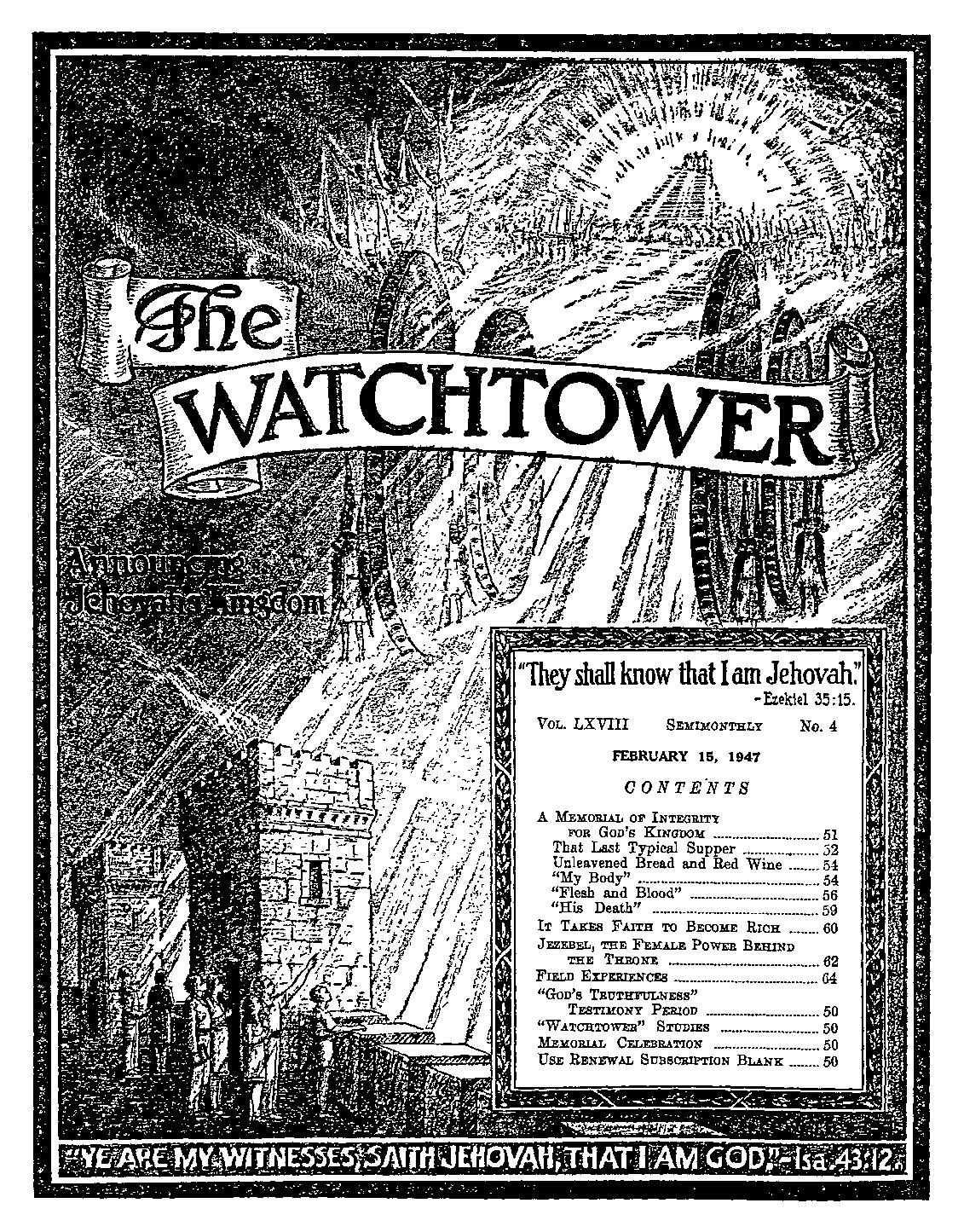
Vol. LXVIII
Semimonthly
No. 4
FEBRUARY 15, 1947
CONTENTS
f/j
They shall know that I am Jehovah!
Ezekiel 35:15.
>f-S
rf’J
r.n
o4
A Memorial of Integrity
bob God’s Kingdom
“Flesh and Blood”
“His Death”
It Takes Faith to Become Rich
the Thbone
Fjeld Experiences
“God’s Truthfulness”
Testimony Period .
“Watchtower” Studies
Memorial Celebration
Use Renewal Subscription Blank
Vv\v i
>Z
That Last Typical Supper
Unleavened Bread and Red "Wine
“My Body
Jezebel, the Female Poweb Behind
:'YEAVXM^IfNE55£5;5AlfHJEtiOVAH,THATIAMGOD.',-l5a.43.'l2,
Published Semimonthly By
WATCH TOWER BIBLE & TRACT SOCIETY 117 Adams Street - - Brooklyn 1, N.Y., U.SA-
OrriCEBS
N. H. Knobs, President W. E. Van Ambuboh, Secretary “And all thy children shall be taught of Jehovah; and great shall be the peace of thy children.” - liaiah §4:13.
THE BIBLE CLEARLY TEACHES
THAT JEHOVAH is the only true God, from everlasting to everlasting, and Is the Maker of heaven and earth and Giver of life to his creatures; that the Word or Logos was the beginning of his creation and his active agent in creating all other things; and that the creature Lucifer rebelled against Jehovah and raised the Issue of His universal sovereignty;
THAT GOD created the earth for man, made perfect man for the earth and placed him upon It; that man yielded to unfaithful Lucifer, or Satan, and willfully disobeyed God's law and was sentenced to death; that by reason of Adam’s wrong act all men are born sinners and without the right to life;
THAT THE LOGOS was made human as the man Jesus and suffered death In order to produce the ransom or redemptive price for obedient men; that God raised up Christ Jesus divine and exalted him to heaven above every other creature and clothed him with all power and authority as head of God’s new capital organization;
THAT GOD’S CAPITAL ORGANIZATION is a Theocracy called Zion, and that Christ Jesus Is the Chief Officer thereof and Is the rightful King of the new world; that the faithful anointed followers of Christ Jesus are Zion’s children, members of Jehovah's organization, and are His witnesses whose duty and privilege It Is to testify to Jehovah’s supremacy and declare his purposes toward mankind as expressed In the Bible;
THAT THE OLD WORLD, or Satan’s uninterrupted rule, ended A.D. 1914, and Christ Jesus has been placed by Jehovah upon the throne, has ousted Satan from heaven, and now proceeds to vindicate His name and establish the “new earth”;
THAT THE RELIEF and blessings of the peoples can come only by Jehovah’s kingdom under Christ, which has begun; that His next great act is to destroy Satan’s organization and establish righteousness completely in the earth ; and that under the Kingdom the people of good-will surviving Armageddon will carry out the divine mandate to “fill the earth” with righteous offspring, and that the human dead In the graves will be raised to opportunities of life on earth.
ITS MISSION
HIS Journal Is published for the purpose of enabling the people to know Jehovah God and his purposes as expressed in the Bible. It publishes Bible Instruction specifically designed to aid Jehovah’s witnesses and all people of good-wilL It arranges systematic Bible study for its readers and the Society supplies other literature to aid in such studies. It publishes suitable material for radio broadcasting and for other means of public instruction in the Scriptures.
It adheres strictly to the Bible as authority for Its utterances. It Is entirely free and separate from all religion, parties, sects or other worldly organizations. If is wholly and without reservation for the kingdom of Jehovah God under Christ his beloved King. It is not dogmatic, but invites careful and critical examination of Its contents in the light of the Scriptures. It does not indulge In controversy, and Its columns are not open to personalities.
notice to Subscribers: Remittances should be sent to office In your country In compliance with regulations to guarantee safe delivery of money. Eemittancee are accepted at Brooklyn from countries where no office Is located, by International money order only. Subscription rates in different countries are stated below in local currency. Notice of expiration (with renewal Hank) Is sent at least two issues before subscription expires. Change of address when sent to our office may be expected effective within one month. Send your old as well as new address.
Please address the Watch Tower Society in every case.
Offices Yearly Subscription Rate
America (U.S.), 117 Adams St., Brooklyn 1, N.Y.
Australia, 7 Beresford Rd„ Strathfield, N. S. W.
British West Indias, 21 Taylor SU Port of Spain, Trinidad
Canada, 40 Irwin Axe., Toronto 6, Ontario
England, 34 Craven Terrace, London, W. 2
India, 167 Love Lane, Bombay 27 Rs. 3/6
Jamaica, 161 King SU Kingston
New Zealand, G. P. O. Box 30, Wellington, S. 1
Philippine Islands, 2621 Int. 2 Henan, Santa Ana, Manila $2.00 South Africa, 623 Boston House, Cape Town
Translations of this journal appear in many languages.
AT.I, SINCERE STUDENTS OF THE BIBLE who by reason of infirmity, poverty or adversity are unable to pay the subscription price may have The Watchtower free upon written application to the publishers, made once each year, stating the reason for so requesting It. We are glad to thus aid the needy, but the written application once each year is required by the postal regulations.
Printed In the United States of America
Entered as second-class matter at the post office at Brooklyn, N. Y., under the Act of March S, ISIS.
“GOD’S TRUTHFULNESS” TESTIMONY PERIOD
The Testimony Period during February, stressing God’s truthfulness, will catch up the four-month-long subscription campaign for The Watchtower and Awake! and will carry it forward through this midwinter month. Hence, the same as during the campaign’s initial month, January, all active readers of these magazines will keep on offering jointly the subscriptions for both of these magazines, together with the premium of two bound books (Watchtower publications), all at the regular rate for the two subscriptions, namely, two dollars. By determined efforts on the part of all having strong convictions concerning the truthful contents of The Watchtower and Awake! the subscription campaign will suffer no lag during this month of heavy winter up north, and we believe your field-service reports for February will show this. Many Watchtower readers will want to swell the ranks of'4;he house-to-house subscription-takers, and so we say to all who want to start during “God’s Truthfulness” Testimony Period: Write us at your earliest for all needed information and references.
“WATCHTOWER” STUDIES
Week of March 23: “A Memorial of Integrity for God’s Kingdom,” fl 1-21 inclusive, The Watchtower February 15, 1947.
Week of March 30: “A Memorial of Integrity for God’s Kingdom,” 1J 22-45 inclusive, The Watchtower February 15, 1947.
MEMORIAL CELEBRATION
The time for observing the Memorial this year will be after sunset or after 6 p.m., Standard Time, of Sunday, April 6. Each company of Jehovah’s witnesses should meet that night at an announced hour, both those of the anointed remnant and all persons of good-will. Before those of the remnant partake of the Memorial emblems, some competent brother should present a brief speech extemporaneously or read some pertinent paragraphs from the most up-to-date Watchtower articles on the subject. As shown in the February 15, 1947, issue of The Watchtower both emblems should be served together, seeing that the partaking of the broken unleavened bread and the red wine together show forth the one thing. All companies meeting together in observance of the Memorial will please report to this office, stating the total attendance and indicating the number of partakers. Song and prayer should close the observance.
USE RENEWAL SUBSCRIPTION BLANK
The renewal blank sent you -prior to the expiration of your Watchtower subscription should be filled out and returned to the Brooklyn office or to the Branch office in the country where you reside. Servants in the companies, and individuals, when sending in renewals for The Watchtower, should always use these blanks. By fining in these renewal blanks you are assured of the continuation of your Watchtower from the time of expiration, and without delay. It will also be a great help if you sign your name uniformly, and note any recent change of address, on the renewal slip.
sTieWICHTOWER
ANNOUNCING JEHOVAH’S KINGDOM
Vol. LXVUt
February 15, 1947
No. 4
A MEMORIAL OF INTEGRITY FOR GOD’S KINGDOM
"And this day shall be unto you for a memorial." (Ex. 12:14) "This do in remembrance of me”
—1 Cor. 11:24.
JEHOVAH God the Creator established no kingdom over mankind in the garden of Eden. After the first man and woman sinned against the Creator, and just before they were driven from their garden home, Jehovah made a promise openly to bring forth a deliverer for humankind. He said to the wicked tempter of Adam and Eve in their hearing : “I will put enmity between thee and the woman, and between thy seed and her seed; it shall bruise thy head, and.thou shalt bruise his heel.” (Gen. 3:15) That is to say, before ever the deliverer crushed the tempter's head the deliverer should himself suffer a painful wound, comparable to being bitten in the heel by a serpent. He must be willing and courageous enough to suffer' this for the sake of the kingdom of God. Ender the suffering he must keep his integrity toward Jehovah God, in order to prove worthy to occupy the throne of the Kingdom.
2 It was first after the days of Nimrod that this deliverer began to be spoken of as a king. Nimrod was the first man that the great tempter caused to be enthroned as king on earth, and his kingdom in defiance of God was founded at Babylon. (Gen. 10:8-10) This seemingly raised an issue between God and the tempter on the question of a kingdom over earth. Sometime after Nimrod there came suddenly to view in Palestine Melchizedek as king of Salem. He was also “the priest of the most high God”. Hence Melchizedek the king-priest was the first man that God used as a prophetic type of the coming Ruler in the kingdom of God.—Gen. 14:18-20; Ps. 110:1-4.
3 In their only reported meeting, Kang-Priest Melchizedek blessed victorious Abraham. This was very meaningful, and well so. The further prophecies of God disclosed-that the promised King would be a descendant of Abraham through Bang David. David, it appears, came to be the first Jewish king of the same city in which Melchizedek had reigned about
1. By his Edenic promise what did God Indicate would be required of the Deliverer, the woman’s Seed?
2. When did the Deliverer come to be spoken of as a king, and who was first used as a type of him?
3. In whose line of descent was the King disclosed to come, and on what occasion was he publicly identified with a demonstration? nine hundred years earlier, namely, Jerusalem. (Ps. 76:1,2) God promised David that the foretold King would cortie through his line, and hence the promised King was called “the Son of David”. (2 Sam. 7:12-17) Over a thousand years after David, the Jews in and about Jerusalem played an important dramatic act that showed up plainly who this King is who becomes the Bruiser of the Serpent’s head. Their dramatic act identified the King as the man then generally known as “Jesus the prophet of Nazareth”. This was at the time that Jesus rode into Jerusalem in the fashion of the ancient kings of Israel, namely, astride an ass. This was a few days before the Jews’ celebration of the yearly passover A.D. 33.
4 One eyewitness of the event tells us that there the prophecy of Zechariah 9:9 was fulfilled. He says: “A very great multitude spread their garments in the way; others cut down branches from the trees, and strawed them in the way. And the multitudes that went before, and that followed, cried, saying, Hosanna to the son of David: Blessed is he that cometh in the name of the Lord; Hosanna in the highest.” Another writer tells us they cried out, saying: “Blessed be the King that cometh in the name of the Lord: peace in heaven, and glory in the highest.” Another writer describes other shouts of the people as “Hosanna; Blessed is he that cometh in the name of the Lord: Blessed be the kingdom of our father David, that cometh • in the name of the Lord: Hosanna in the highest.” Not only along the route of Jesus’ ride, but also in the temple, the children cried: “Hosanna to the son of David!” which is to say, 'God save the Son of David!’—Matt. 21: 8,9,15; Luke 19:38; Mark 11:9,10.
“ The subject of God’s kingdom was thus thrust into the celebration that year of the passover. During the three and a half years before that, Jesus had shown that God’s kingdom is the leading issue before all mankind. Jesus did so by preaching publicly and
4. With what public outcries was he then identified?
5. What subject was thus thrust into the passover celebration? and why did God answer the people’s cries of “Hosanna"? privately the good news of the kingdom of God. After his triumphal ride into Jerusalem he spoke many parables and prophecies concerning the Kingdom, to make plain who would be associated with him in it and how it would be set up and when. On passover day he died on a tree at Calvary, with the handwriting posted over his head as a sedition charge against him: “Jesus of Nazareth, the King of the Jews.” (John 19:19,20) On the third day after his death Jehovah God answered the people’s pleas of “Hosanna!” which had ascended to him. He saved his King, the Son of David, out of the embrace of death, 'by raising him to life immortal that he might in due time bruise the Serpent’s head. God rewarded Jesus in this glorious way because never under all the suffering down to the pouring out of his lifeblood did Jesus break his integrity toward Jehovah, the Sovereign Majesty of all the universe and the Founder of the Kingdom.
’ It was at a dear cost that Jesus Christ gained the chief place in God’s kingdom, but Jesus was willing to pay it. Why1? Because the Kingdom is the chief issue before all the universe. The Kingdom is the universal Government that the Most High God puts in power and operation in order to vindicate His own sovereignty as universal and unchangeable and in order to clear his holy name of all the reproaches and slanders that the Serpent, the tempter, has cast upon it for these six thousand years. Seeing that Jehovah God is the Supreme One and the Source of all life and creation, the vindication of His universal sovereignty and good name is of vaster importance than the saving of sinful human creatures. And yet it is through that very vindication that the redemption and saving of any human sinners is brought about. Evidently realizing that the foremost reason for his going down into death was to prove his integrity and to vindicate Jehovah’s name arid sovereignty, Jesus set up a memorial among his footstep followers on the night of that passover A.D. 33. But first he ate the passover with them.
THAT LAST TYPICAL SUPPER
’ Being a Jew by his human birth, Jesus rightly celebrated the passover at Jerusalem, the city where Jehovah God had caused His name to be put and his temple to be built. The date of this yearly passover celebration was the fourteenth of Abib, or fourteenth of Nisan, as it was later called. Jehovah God appointed Abib to be the first month of the Jewish year. He made it a law that the Israelites celebrate the passover annually as a memorial of the first passover that their forefathers held down in Egypt. At that time he delivered them from slavery in Egypt and killed all of Egypt’s firstborn in order to break the Egyptians’ will to resist Israel’s leaving Egypt. God said to the Israelites through Moses as prophet: “And this day shall be unto you for a memorial, and ye shall keep it a feast to Jehovah: throughout your generations ye shall keep it a feast by an ordinance for ever.” (Ex. 12:14, Am. Stan. Ver.) The slaying of a passover lamb, and the sprinkling of the blood outside on the doorways, and then the eating of the roasted lamb indoors that last night of slavery in Egypt, figured prominently in the celebration. But the future celebrations of the feast were not to be in memoriam of the passover lamb, but were to be a memorial to God, a “feast of Jehovah”. The celebration memorialized Jehovah’s act of vindicating his supreme power over Egypt and delivering his chosen people, and not primarily memorializing the passover lamb.
8 Israel’s deliverance from Egypt came more than three thousand years ago. It prophetically pictured how Jehovah delivers all those who become his people from this oppressive world of which the Serpent, the tempter, is the ruler mightier than Pharaoh of Egypt. The passover lamb, because of whose blood the firstborn children of the Israelites were passed over and spared .from death, typified someone. Whom? The One by whom Jehovah vindicates his name and delivers his people. For this reason John, who baptized Jesus in the Jordan river, pointed to Jesus and said: “Behold the Lamb of God, which taketh away the sin of the world.” That this was particularly a reference to the passover lamb is shown by the apostle Paul, who writes: “For even Christ our passover is sacrificed for us: therefore let us keep the feast, not with old leaven, neither with the leaven of malice and wickedness; but with the unleavened bread of sincerity and truth.” (John 1:29; 1 Cor. 5: 7, 8) Hence it agreed with the fitness of things that Jesus, after celebrating his last typical passover with his disciples in Jerusalem, was killed later on that same day, Nisan 14. In that way he fulfilled to a completeness the prophetic picture of the passover lamb and made the passover celebration an out-of-date observance. With his death as the Lamb of God the time had come to celebrate the eternal realities which the ancient passover had merely typified or foreshadowed.
8 Jesus knew he was due to suffer for the kingdom of God on that same day, and hence he was very desirous of celebrating this final passover with them. He so said to them, as we read, at Luke 22:13-18: “And when the hour was come, he sat down, and the twelve apostles with him. And he said unto them, With desire I have desired to eat this passover with you before I suffer: for I say unto you, I will not any more eat thereof, until it be fulfilled in the kingdom of God. And he took the cup, and gave thanks, and said, Take this, and divide it among yourselves: for I say unto you, I will not drink of the fruit of the vine, until the kingdom of God shall come.” From such remarks it is evident that as Jesus ate of the roast passover lamb which pictured his own self and drank of passover wine his thoughts were not centered upon himself. He had in mind much more the great issue before all the universe, the rightful sovereignty of his Father Jehovah God. This he was determined to uphold and abide by although it meant bitter agony for him and suffering to the shameful death on the tree.
10 One account (Luke 22:14-20) indicates that Jesus followed the Jewish customs of the time in celebrating the passover. The law given through Moses had not mentioned or called for the use of wine in the celebration, but by Jesus’ time wine had been introduced into the celebration. Red wine, which was considered better than white wine, was used. Among Jews it continued to be used up until the thirteenth century of our common era, when it was changed on account of the so-called “blood accusation”.—See footnote below.1
“According to the established custom four cups were required to be offered to each male Jew at the passover meal, and the record of this has been preserved in the Jewish Talmud. To quote from the Babylonian Talmud,f in the section entitled Pesa-
10. What shows Jesus followed the then custom of celebrating?
11. What has the Jewish Talmud recorded concerning this custom? chim, chapter 10: “Mishnah [99b]—On the eve of Passover close to the minhah [offering] . . . they should give him not less than four cups.” And the footnote comment on this says: "Which every Jew must drink on the night of Passover. These correspond to the four expressions of redemption employed in Exodus 6: 6, f.: ‘I will bring you out from under the burdens of the Egyptians, and I will rid you out of their bondage, and I will redeem you with a stretched out arm, and with great judgments; and I will take you to me for a people.’ ” Over each cup of red wine the custom called for a benediction or blessing to be pronounced. The cup mentioned above by Luke (22:17) was not the first cup, but was one of the three cups the drinking of which took place after the eating of the passover lamb, and hence after the traitor Judas left. Before passing it around, beginning with the disciple at his right hand (evidently John), Jesus pronounced a blessing upon it or gave thanks. He then told them to pass it around to the right, having in mind the drinking of the joy of the Lord in the kingdom of God.
12 For part of that passover gathering of Jesus and his twelve disciples there was one man present that definitely would not get into that kingdom of God to drink the wine of joy and gladness, and he left the feast when Jesus told him to. That man was Judas Iscariot. Jews at passover washed after drinking the first of the four cups of wine. When Jesus washed the feet of his disciples on this occasion he referred to the presence of this unclean traitor when he said: “He that is washed, needeth not save to wash his feet, but is clean every whit: and ye are clean, but not all.” And the apostle John comments on this remark, saying: “For he knew who should betray him; therefore said he, Ye are not all clean.” After the foot-washing, the eating of the paschal lamb proceeded.
13 During eating of the flesh of the lamb a sauce of bitter herbs was sopped up with a piece of unleavened bread. At that time Jesus by a special sign to his apostle John indicated who was the one to betray him. John tells us Jesus’ words first: “Verily, verily, I say unto you, The servant is not greater than his lord; neither he that is sent greater than he that sent him. If ye know these things, happy are ye if ye do them. I speak not of you all: I know whom I have chosen: but that the scripture may be fulfilled, He that eateth bread with me hath lifted up his heel against me. Now I tell you before it come, that, when it is come to pass, ye may believe that I am he. Verily, verily, I say unto you, He that 12, 13. During passover bow did Jesus refer to the traitor among them? the mazzah [unleavened bread] and drinking the wine, the position of free men (that is, reclining on the left side against cushions) was obligatory on all male participants. . . . The benedictions over the several cups were specified.” receiveth whomsoever I send receiveth me; and he that receiveth me receiveth him that sent me.” Then John adds:
14 ‘'When Jesus had thus said, he was troubled in spirit, and testified, and said, Verily, verily, I say unto you, that one of you shall betray me. Then the disciples looked one on another, doubting of whom he spake. Now there was leaning on Jesus’ bosom one of his disciples, whom Jesus loved. Simon Peter therefore beckoned to him, that he should ask who it should be of whom he spake. He then lying on Jesus’ breast [Jesus reclining on his left elbow on the same couch behind John] saith unto him, Lord, who is it? Jesus answered, He it is, to whom I shall give a sop, when I have dipped it. And when he had dipped the sop, he gave it to Judas Iscariot, the son of Simon. And after the sop Satan entered into him. Then said Jesus unto him, That thou doest, do quickly. Now no man at the table knew for what intent he spake this unto him. For some of them thought, because Judas had the bag, that Jesus had said unto him, Buy those things that we have need of against the feast; or, that he should give something to the poor. He then having received the sop went immediately out: and it was night. Therefore, when he was gone out, Jesus said, Now is the Son of man glorified, and God is glorified in him.” —John 13:16-31.
“ This determines it for us that Judas the traitor left the upper room before Jesus began the new memorial. According to the consecutive reading of the verses of Luke’s account it would seem that Judas was present at the new memorial and partook of it. However, a comparison of Luke’s account with those of Matthew, Mark and John makes it certain that Judas left during the course of the passover and before Jesus instituted the memorial. (See footnote.*) Matthew’s account and Mark’s account both make it definite that the exposing of Judas and hence his departure took place before the memorial, and John’s account shows Judas left right after being exposed, without waiting for anything else. (Matt. 26: 20-26; Mark 14:17-22; John 13: 21-31) Thus the one who was like leaven among Jesus’ disciples was purged from their midst before Jesus ushered his
* Judas’ departure before Christ’s memorial is recognized even by leading religious authorities. For instance, see A Harmony of the Four Gospels in English, pages 120-123, by Edw. Robinson; also A Harmony of the Gospels, pages 144-148, by A. T. Robertson; also “The Four Gospels Paralleled” of The System Bible Study, pages 172-174 (published in Chicago, Ill.). Also the Ten Canons published by Eusebius of Caesarea about A.D. 340 show this fact about Judas.
Many of our readers have the book “Equipped for Every Good Work" and should consult page 287, of the chart entitled “Main Events of Jesus’ Earthly Sojourn”. faithful ones into the sacred privilege of the new memorial.
UNLEAVENED BREAD AND RED WINE
18 The account of what followed we now take from translations based on the most ancient Greek manuscripts available and considered the most authoritative and reliable. We read: “As they were eating Jesus took a loaf and blessed it, and he broke it in pieces and gave it to his disciples, saying, ‘Take this and eat it. It is my body!’ And he took the wine-cup and gave thanks and gave it to them, saying, ‘You must all drink from it, for this is my blood which ratifies the agreement, and is to be poured out for many people, for the forgiveness of their sins. And I tell you I will never drink this product of the vine again till the day when I shall drink the new wine with you in my Father’s kingdom!’ ” (Matt. 26:26-29, An Amer. Trans.) Here again we note that Jesus ties in the kingdom of God with the memorial that he then established.
17 Jesus’ words over the loaf of unleavened bread and cup of red wine were not magical words changing the whole substance of the bread and wine into his literal body and his literal blood. His words were simply the announcement that the bread and wine were symbols or emblems. In harmony with this fact Moffatt translates Jesus’ words: “Take and eat this, it means my body. . . . Drink of it, all of you; this means my blood, the new covenant-blood, shed for many, to win the remission of their sins.” (Matt. 26:26-28, Moffatt) That no so-called “transubstan-tiation” of the bread and -wine took place is proved not only by common sense and by God-given reason but also by the rest of the inspired Holy Scriptures. Hence the point to be determined is what was symbolized by the unchanged bread and wine of which Jesus’ faithful apostles there partook.
“MY BODY”
18 Take, for example, the first statement of Jesus: “This is my body.” Many who see the symbolic purpose of the memorial bread say this means the literal body of Jesus which the apostles there saw among them. They say that right in the same chapter and just some verses earlier is the account of Mary’s anointing of Jesus’ head and feet, at which Jesus said: “In that she hath poured this ointment on my body, she did it for my burial”; and there Jesus was undeniably speaking of his literal body of flesh, blood and bones.—Matt. 26: 6-13; Mark 14: 3-9; John 12; 2-8.
18 Furthermore, say they, in later verses of the
16. What does Matthew’s account say of Jesus* instituting the memorial? and what did Jesus tie in with it?
17. Why did Jesus* words not produce any transubstantiation ? and what point must therefore be determined?
IS, 19. To what do many say Jesus’ words “This is my body” refer? and why so? gospels it tells of Jesus’ body being on the tree and being taken down from the tree after his death and being buried in a new tomb. “The Jews therefore, because it was the Preparation, that the bodies should not remain on the cross upon the sabbath (for the day of that sabbath was a high day), asked of Pilate that their legs might be broken, and that they might be taken away.” (John 19:31, Am. Stan. Ver.) ‘And behold, a man named Joseph, who was a councillor, a good man and righteous man (he had not consented to their counsel and deed), a man of Arimatheea, a city of the Jews, who was looking for the kingdom of God: this man went to Pilate, and asked for the body of Jesus. And he took it down, and wrapped it in a linen cloth, and laid him in a tomb that was hewn in stone, where never man had yet lain. And it was the day of the Preparation, and the sabbath drew on. And the women, who had come with him out of Galilee, followed after, and beheld the tomb, and how his body was laid.” (Luke 23:50-55, Am.Stan.Ver.; John 19:38-42) Hence, say they, the context proves that Jesus’ words, “This is my body,” meant his body that was anointed, impaled and buried.
20 About Jesus’ personal body which he had on earth till his death his apostles make definite statements. That this body was of flesh and that in it Jesus Christ bore the penalty of the sinners that believe in him we plainly read, in these words: “And you, that were sometime alienated and enemies in your mind by wicked works, yet now hath he reconciled in the body of his flesh through death, to present you holy and unblameable and unreprove-able in his sight.” “Who his own self bare our sins in his own body on the tree, that we, being dead to sins, should live unto righteousness: by whose stripes ye were healed.” “Wherefore, my brethren, ye also are become dead to the law [of Moses] by the body of Christ; that ye should be married to another, even to him who is raised from the dead, that we should bring forth fruit unto God.” (Col. 1:21, 22; 1 Pet. 2:24; Rom. 7: 4) When Jesus consecrated himself to Jehovah God at the time of being baptized in the Jordan, he referred to his human body. By offering this body once for all he paved the way for the sanctification of those who become his spiritual brethren, members of his church. We read: “Wherefore when he cometh into the world, he saith, Sacrifice and offering thou wouldest not, but a body hast thou prepared me: in burnt offerings and sacrifices for sin thou hast had no pleasure. Then said I, Lo, I come (in the volume of the book it is written of me,) to do thy will, 0 God. By the which will we are sanctified through the offering of the body of Jesus Christ once for all.”—Heb. 10: 5-7,10.
21 Jesus’ sacrifice was typified or symbolized by the sin-atoning animals sacrificed on the Jewish annual atonement day; and concerning this it is written: “For the bodies of those beasts, whose blood is brought into the sanctuary by the high priest for sin, are burned without the camp. Wherefore Jesus also, that he might sanctify the people with his own blood, suffered without the gate [of Jerusalem]. Let us go forth therefore unto him without the camp, bearing his reproach.” (Heb. 13:11-13) Like those animal victims whose bodies were cremated outside the camp of the Israelites, so Jesus in the days of his flesh on earth suffered reproaches unto death as if he was an offensive sinner outside of God’s people.
22 Before further comment on Jesus’ expression “my body”, let us consider his corresponding expression over the wine-cup. Whether this was the third or the fourth cup of wine regularly used in the passover celebration in those days we cannot be certain, but over each of those cups the Jewish celebrants were accustomed to pronounce a separate, individual blessing. After such a blessing Jesus said: “Drink ye all of it; for this is my blood of the covenant, which is poured out for many unto remission of sins.” Or: “This cup is the new covenant in my blood, even that which is poured out for you.” (Matt. 26: 27, 28 and Luke 22:20, Am. Stan. Ver.) This symbol very positively pointed to Jesus’ death, for blood that is shed and caught in a container like a wine-cup told of the death of the victim whose blood was shed. Furthermore, a covenant was first brought into force over the death of a sacrificial victim. Making certain this fact, the apostle Paul writes: “For where a covenant is, there must of necessity be the death of him that made it. For a covenant is of force where there hath been death: for it doth never avail while he that made it liveth. Wherefore even the first covenant [by Moses] hath not been dedicated without blood.” (Heb. 9:16-18, Am.Stan.Ver., marginal reading) Moses acted as mediator of the old covenant of the law, but Jesus acts as Mediator of a new covenant. '
23 In view of the function or purpose that his death as a human was due to serve Jesus spoke of the cup of symbolical wine as “my blood of the covenant” or “the new covenant in my blood”. He is the Good Shepherd who laid down his life for the sheep or saved ones; and it is because of dying or shedding his blood that he has become great or mighty to save them to life everlasting. Accordingly the apostle Paul writes to the “little flock” of Christ’s sheep this
22. What were Jesus’ words over the wine-cup? and to what did his expression point?
23. For what purpose has Jesus become mighty by shedding his blood? and who are declared to be purchased by Lt? loving prayer: “May God, the giver of peace, who brought back from the dead our Lord Jesus who through the blood by which he ratified the everlasting agreement has become the great shepherd of the sheep, fit you by every blessing to do his will, and through Jesus Christ carry out in us what will please him.” (Heb. 13:20,21, An Amer. Trans.) It is by the Lord Jesus’ own blood that the “little flock” are now declared to be purchased by the presentation of the value or merit of his blood to God in heaven. Hence Paul said to the overseers of the church at Ephesus: “Take heed to yourselves and to all the flock of which the holy spirit has appointed you guardians; shepherd the church of the Lord which he has purchased with his own blood.”—Acts 20:28, Moffatt; also Newcome.
24 To the blood of our Lord Jesus the Scriptures assign the power of redeeming, sanctifying and reconciling. Concerning its redemptive power the apostle Peter says: “Ye were not redeemed with corruptible things, . . . but with the precious blood of Christ, as of a lamb without blemish and without spot.” (1 Pet. 1:18,19) Peter doubtless here compared Jesus with the passover lamb. The apostle Paul says of God’s dear Son: “In whom we have redemption through his blood, even the forgiveness of sins.” “Neither by the blood of goats and calves, but by his own blood he entered in once into the holy place, having obtained eternal redemption for us.” (Col. 1:14; Heb. 9:12) The apostle John tells us of the new song to be sung to Christ Jesus, namely: “Thou art worthy . . . for thou wast slain, and hast redeemed us to God by thy blood out of every kindred, and tongue, and people, and nation.”—Rev. 5:9.
25 Now concerning the sanctifying or purifying power of Jesus’ own blood Paul and Peter and John again testify. Says Paul: “How much more shall the blood of Christ, who through the eternal spirit offered himself without spot to God, purge your conscience from dead works to serve the living God?” (Heb. 9:14) Hence the following warning by Paul against denying the sanctifying blood: “Of how much sorer punishment, suppose ye, shall he be thought worthy, who hath trodden under foot the Son of God, and hath counted the blood of the covenant, wherewith he was sanctified, an unholy thing, and" hath done despite unto the spirit of grace?” (Heb. 10: 29; 13:12) Peter tells the church they are “elect according to the foreknowledge of God the Father, through sanctification of the spirit, unto obedience and sprinkling of the blood of Jesus Christ”. (1 Pet. 1:2) And John tells them: “The blood of Jesus Christ his Son cleanse th us from all sin.” (1 John 1:7) “Unto him that loved us, and washed us from our sins in his own blood.” (Rev. 1: 5) Concerning the “great multitude” of persons of good-will who have appeared since A.D. 1918 John tells us: “These are they which came out of great tribulation, and have washed their robes, and made them white in the blood of the Lamb.”—Rev. 7:14.
26 Jesus’ lifeblood has conciliatory power, that is, power to bring us into friendly relations with God. The apostle Paul makes special mention of this, saying: “But now in Christ Jesus ye who sometimes were far off are made nigh by the blood of Christ.” (Eph. 2:13) “For it pleased the Father that in him should all fulness dwell; and, having made peace through the blood of his cross, by him to reconcile all things unto himself.” (Col. 1:19,20) “Having therefore, brethren, boldness to enter into the holy place by the blood of Jesus, let us draw near with a true heart in fulness of faith, having our hearts sprinkled from an evil conscience: and having our body washed with pure water.” “To Jesus the mediator of a new covenant, and to the blood of sprinkling that speaketh better than that of Abel.”—Heb. 10:19, 22 and 12: 24, Am. Stan. Ver.
27 The blood stands for Christ’s life poured out or laid down in death, as the prophet Isaiah testifies, saying: “He hath poured out his soul unto death: and he was numbered with the transgressors.” (Isa. 53:12) He laid down his earthly life painfully, on a tree of torture, under great reproaches as though he was a transgressor against Jehovah God. But by exercising faith in his blood or sacrificed life the believer has its redeeming power applied to him. He is bought back from the power and effects of sin and is sanctified or cleansed from sin and is brought into peaceful and friendly relations with God. Thus Jesus’ earthly life laid down makes valid the new covenant by means of which God takes out from all nations a redeemed “people for his name”.—Acts 15:14.
“FLESH AND BLOOD”
28 Throughout the Scripture record of Jesus the term “flesh” is used to refer to his humanity and his human relations, to show he was actually a man and not a mere spirit person clothed or incarnated in visible bodies such as those angels had who appeared at times to men. In heaven he was a spirit person and, as such, he was The Word of God, or God’s Spokesman and Chief Executive. But by human birth he actually became flesh and blood. Hence the
26 . What does Paul say of Its conciliatory power?
27 . By exercising what does the sinner experience these effects of the blood of Jesus Christ5
28 . To show what is the term “flesh” used in respect to Jesus? declarations of the Holy Scriptures are to the following effect :*
29 “The Word was made flesh, and dwelt among us, (and we beheld his glory, the glory as of the only begotten of the Father,) full of grace and truth.” (John 1:14) Jesus thus came “in the flesh”, beyond all contradiction,1 and was manifested in flesh.2 According to the flesh which he got through a Jewish mother he was an Israelite;3 and, his mother being a descendant of King David, Jesus also “was made of the seed of David according to the flesh”.4 He suffered during those “days of his flesh”, even to the point of tears, strong cryings and prayers to God.5 Nevertheless, while alive in the flesh he rested in hope in God.’ Finally he was “put to death in the flesh”. Yet his flesh was not left to see corruption, but was miraculously disposed of by God, for he was resurrected and was “made alive in the spirit”.7 To then show himself alive after his resurrection he, now as a spirit, was obliged to materialize bodies of “flesh and bones” to be seen and felt by his disciples.8 Having long ago ascended to heaven, he is no more fleshly and we know him no more “after the flesh”.9 At his first coming he had been sent “in the likeness of sinful flesh” and for the sake of a sin-offering, but at his second coming he does not come as a sin-offering and hence comes not in flesh.10
30 By his flesh which was put to death on the tree he abolished Moses’ law and opened the way for nonJews as well as Jews to become the spiritual children of God, at peace with one another.11 Because of sacrificing “the body of his flesh” he is able to present his followers reconciled to God.12 Therefore his spiritual followers may have “boldness to enter into the holiest by the blood of Jesus, by a new and living way, which he hath consecrated for us, through the veil, that is to say, his flesh”.13—See footnote below for the Scripture texts making the foregoing declarations.*
31 The above abundance of scriptures raises the question: In telling the symbolic meaning of the bread and wine why did Jesus not say: “This is my flesh," as well as “This is my blood”? The reference to flesh and blood as meaning his own human nature and human life was nothing strange to Jesus’ speech. When expressing his joy at Peter’s answer to a question, “Thou art.the Christ, the Son of the living God,” Jesus said: “Blessed art thou, Simon Bar-jona: for'flesh'and blood hath not revealed it unto
B11 John 4:2, 3; 2 John 7; 21 Tim. 3:16; 2 Rom. 9:4, 5; 4 Rom. 1:3; Acts 2:31; 5 1 Pet. 4:1; Heb. 5:7;’ Acts 2: 26; T1 Pet. 3:18, Am. Stan. Ver.; 8 Luke 24:39; 9 2 Cor. 5:16; loRom. 8:3; Heb. 9:28; llEph. 2:15; 12 Col. 1:22; 13 Heb. 10:19, 20.
thee, but my Father which is in heaven.” (Matt. 16:15-17) Again Jesus associated flesh and blood together when he said to the selfish Jews who tagged after him in hope of getting regular meals of loaves and fishes: “I am the living bread which came down from heaven: if any man eat of this bread, he shall live for ever: and the bread that I will give is my flesh, which I will give for the life of the world. . . . Verily, verily, I say unto you, Except ye eat the flesh of the Son of man, and drink his blood, ye have no life in you. Whoso eateth my flesh, and drinketh my blood, hath eternal life; and I will raise him up at the last day. For my flesh is meat indeed, and my blood is drink indeed. He that eateth my flesh, and drinketh my blood, dwelleth in me, and I in him. As the living Father hath sent me, and I live by the Father: so he that eateth me, even he shall live by me. This is that bread which came down from heaven: not as your fathers did eat manna, and are dead: he that eateth of this bread shall live for ever.” (John 6: 51-58) He says nothing of my body.
82 The use of the expression “flesh and blood” was not strange, either, to Jesus’ apostles. John used it, saying; “As many as received him, to them gave he power to become the sons of God, even to them that believe on his name: which were born, not of blood, nor of the will of the flesh, nor of the will of man, but of God. And the Word was made flesh, and dwelt among us.”—John 1:12-14.
33 Paul used the expression in four of his epistles. He gives us invincible proof that Jesus did not take an organism of flesh and blood with him to heaven, when he writes: “Now this I say, brethren, that flesh and blood cannot inherit the kingdom of God; neither doth corruption inherit incorruption.” (1 Cor. 15: 50) He tells us why, at Jesus’ first coming, he came in flesh and blood, saying: “Since then the children are sharers in flesh and blood, he also himself in like manner partook of the same; that through death he might bring to nought him that had the power of death, that is, the devil; and might deliver all them who through fear of death were all their lifetime subject to bondage. For verily not to angels doth he give help, but he giveth help to the seed of Abraham.” (Heb. 2:14-16, Am.Stan. Ver.) Furthermore, Paul, who got the revelation of the gospel truth from the glorified Jesus, shows that Jesus did not have an organism of flesh and blood with him in heavenly glory, for Paul writes: “But when it pleased God, who separated me from my mother’s womb, and called me by his grace, to reveal his Son in me, that I might preach him among the heathen; immediately I conferred not with flesh and blood.” (Gal. 1:15, 16) Finally, to warn Christians that their fight is not against or with human crea-
32, 33. What hare we to show that the expression “flesh and blood” was not strange to Jesus* apostles9 tures, Paul writes: “We wrestle not against flesh and blood, but against principalities, against powers, against the rulers of the darkness of this world, against spiritual wickedness in high places. Wherefore take unto you the whole armour of God.”—Eph; 6:12,13.
84 Evidently, then, at instituting the memorial, Jesus deliberately used the expressions “This is my body” and “this is my blood”. He did so because he was not referring to his then literal organism of flesh and blood but was referring to a larger “body”, the church of God, of which church-body Jesus Christ is the Head or capital member. Also he was referring to the death which that body dies, namely, Christ’s kind of death. Some readers will register protest at this explanation of Jesus’ memorial sayings. They will say that the context surrounding Jesus’ sayings refers to his own human body which Mary anointed and which his disciples took down off the tree. But because things in the context apply to Jesus’ human body it does not prove that Jesus’ memorial words about “my body” meant his own personal fleshly organism. Neither because Jesus said of the wine, “This is my blood,” does it necessarily require that the other words, “my body,” must mean his flesh.
“ The expression “body” is not always to be taken as meaning the “flesh”, as though “body” and “flesh” were always synonymous. In proof let us refer to Paul’s words at Colossians 1:23,24: “I Paul am made a minister; who now rejoice in my sufferings for you, and fill up that which is behind of the afflictions of Christ in my flesh for his body’s sake, which is the church.” Although Paul speaks of his own flesh, yet the body he next mentions is not the fleshly body of Jesus on earth, but is Jesus’ church. Notice in the context, just before this, that Paul does refer to Jesus’ human body on earth, saying, in verses 21, 22: “And you . . . hath he reconciled in the body of his flesh through death, to present you holy and unblameable and unrep roveable in his sight.” But just before that, at verse 18, Paul speaks of Jesus Christ’s body of another kind, saying: “And he is the head of the body, the church.” (Col. 1:18, 21,22) Then later in this same epistle, at Colossians 2:19 and 3:15, he speaks of this body of Christ which is the church. Note also Paul’s mention of this “body of Christ”, the church, at Ephesians 1:23; 2:16; 4:4; 12,16; and 5: 23, 30.
86 Hence, because the context surrounding Jesus’ words at memorial designates Jesus’ physical organism of flesh, this does not absolutely require that his expression “my body”- mean the same thing, his organism of flesh and blood. Our making this unusual statement is not based upon our own reasoning or any eccentric thinking, but is because the inspired apostle Paul, who conferred not with flesh and blood, makes this clear in his writings.
87 Paul’s first letter to the Corinthians was written before the gospels of Mark, Luke and John and could therefore make dear in advance Jesus’ words appearing in those gospels. In the said letter Paul refers to the Lord’s supper thus: “When therefore ye assemble yourselves together, it is not possible to eat the Lord’s supper: . . . For I received of the Lord that which also I delivered unto you, that the Lord Jesus in the night in which he was betrayed took bread; and when he had given thanks, he brake it, and said, This is my body, which is for you: this do in remembrance of me. In like manner also the cup, after supper [hence not the first cup, which was drunk before passover meal], saying, This cup is the.new covenant in my blood: this do, as often as ye drink it, in remembrance of me. For as often as ye eat this bread, and drink the cup, ye proclaim [one thing, namely] the Lord’s death till he come.” (1 Cor. 11:20-26, Am. St an. Ver.) But before thus describing the Lord’s supper or memorial the apostle Paul explained the meaning of the unleavened bread and red wine.
88 In the chapter ahead, chapter ten, the apostle explained that the memorial bread meant the church and that the cup of wine meant the kind of death such as the Lord Jesus died in vindication of God’s name and kingdom. Paul’s words of explanation are: “Wherefore, my beloved, flee from idolatry. I speak as to wise men; judge ye what I say. The cup of blessing which we bless, is it not a communion of the blood of Christ? The bread which we break, is it not a communion of the body of Christ? seeing that we, who are many, are one bread [loaf], one body: for we all partake of the one bread. . . . But I say, that the things which the Gentiles sacrifice, they sacrifice to demons, and not to God: and I would not that ye should have communion with demons. Ye cannot drink the cup of the Lord, and the cup of demons: ye cannot partake of the table of the Lord, and of the table of demons.”—1 Cor. 10:14-21, Am. Stan. Ver.
88 Christ Jesus is the Head of his church, which is his body; and the memorial bread is emblematic or symbolic of this spiritual body. Jesus’ consecrated followers, who are begotten not of the will of their fleshly parents but of God by his spirit to a heavenly destiny in the Kingdom, are “one bread” or “one loaf”. Why? Because they are the members of Christ’s body, the church. Paul explains this to them
37. Before what gospels did Paul write 1 Corinthians ? and In It what did he say about “the Lord’s supper”?
38. In the chapter ahead, what does Paul say of the bread and wine? 39. How, then, are Christ’s spirit-begotten followers “one bread”? in chapter twelve of this epistle, saying: “For as the body is one, and hath many members, and all the members of that one body, being many, are one body: so also is Christ. For by one spirit are we all baptized into one body, whether we be Jews or Gentiles, whether we be bond or free; and have been all made to drink into one spirit. Now ye are the body of Christ, and members in particular.”—! Cor. 12:12,13, 27; also Rom. 12:4,5.
40 Hence at the yearly memorial celebration the Christian heirs of the heavenly kingdom partake of the memorial bread. They should not look upon it as symbolizing Jesus’ fleshly humanity, but should discern it to represent “the Lord’s body”, the church, of which they themselves are members, body members under Christ Jesus the head. (1 Cor. 11: 27-29) Their partaking of the emblem of the bread is an open confession that they are consecrated, spirit-begotten members of the “body of Christ”, which is the church. By eating the “one bread” they declare their communion or oneness with Christ the Head, to do God’s will as he set them the example and to suffer affliction in this world as he suffered it. Symbolically they eat the “bread of affliction”. (Deut. 16:3) But despite the afflictions and sufferings for the Idngdom of God they tenaciously hold on to their Christllke integrity toward God.
“HIS DEATH”
41 What, then, does the “communion of the blood of Christ” mean? The communion of the body of Christ does not refer to Jesus’ human organism or literal flesh, but refers to the church. So, too, the “blood of Christ” here refers to what the shedding of Jesus’ blood signified, namely, the death that he died, which was of a unique kind. It was a death sacrificially in vindication of the kingdom of God. In numerous scriptures shed blood is employed as a symbol of death.* Hence the “communion of the blood of Christ” means the common sharing or common participation in the death such as Christ Jesus died, and in which kind of death all the faithful body-members of Christ must share. By it they “glorify God”, just as the apostle Peter who partook of the memorial emblems did. (John 21:19) Paul partook of the memorial emblems of bread and wine because he said: “I have suffered the loss of all things, and do count them but dung, that I may win Christ, . . . that I may know him, and the power of his resurrection, and the fellowship of his sufferings, being made conformable unto his death; if by any •Matt. 23:30, 35; Luke 11:50, 51; Rom. 3:15; Heb. 12:4; Rev. 6:10; 17:6.
means I might attain unto the resurrection of the dead.”—Phil. 3j 8-11.
43 To his fellow body-members who partake of the emblems of bread and wine Paul has written: “Know ye not, that so many of us as were baptized into Jesus Christ were baptized into his death? Therefore we are buried with him by baptism into death: that like as Christ was raised up from the dead by the glory of the Father, even so we also should walk in newness of life. For if we have been planted together in the likeness of his death, we shall be also in the likeness of his resurrection. Now if we be dead with Christ, we believe that we shall also live with him.” (Rom. 6:3-5,8) So those partaking of the memorial emblem of the wine-cup do openly declare by this that they, as members of Christ’s body (the church), are going down into death with him in support of the kingdom of God. Jesus has said to all these: “Be thou faithful unto death, and I will give thee a crown of life.” (Rev. 2:10) By eating the memorial bread and drinking the memorial wine, they do proclaim or show forth the one thing, namely, “the Lord’s death.”—1 Cor. 11: 26.
43 Seeing that both emblems, unleavened bread and red wine, point to the one and the same thing, namely, Christ’s death in vindication of his Father’s universal sovereignty and sacred name, it is proper that both emblems be taken together by Christ’s bodymembers who celebrate the memorial each year on its anniversary date, and this year on the night of Sunday, April 6. This signifies that no separate blessing is pronounced over the memorial cup of wine. With us today the passover is not intertwined with the memorial as it was in Jesus’ day, when four cups of wine were used on that memorial night and a blessing was pronounced over each of the four cups according to the custom of that day. The passover meal with its four cups of wine the unbelieving Jews celebrate even to this day, but the annual memorial celebrations of Christians on Nisan 14 are absolutely distinct from such passover meal since Jesus’ death. Hence a single prayer pronounced by one consecrated Christian over both emblems, bread and wine together, is sufficient and does not result in any undue repetition before Jehovah God.
44 “This do in remembrance of me,” said Jesus. His words in no way instruct us to celebrate the memorial to the exclusion of memories of Jesus’ Father and God, Jehovah, the Universal King. The passover was a memorial to Jehovah God, commemorating his act of vindication over Egypt rather than commemorating primarily the paschal lamb then slain. Among the Lord Jesus’ disciples the Lord’s 42. According to Romans 6:3-8 what do drinkers of the memorial cup declare? and what one thing does partaking at the memorial show? 43. Why should both emblems be partaken of together? and what, therefore, about prayer over the wine-cup?
44. At the celebration what do Christians memorialize? and in what way do they do this “In remembrance of me”, as Jesus said? supper on each Nisan 14 has taken the place of the passover. Thus the day which Jehovah appointed for a memorial to Almighty God the Lord Jesus did not push aside but held on to, to mark it by a different celebration of larger meaning. For a certainty, when setting up the memorial for his body-members on Jehovah’s memorial day of Nisan 14 our Lord Jesus was not instituting a celebration more in his own honor than in Jehovah’s honor. Christ’s death, while it also accomplished the ransoming of humankind, was primarily for the vindication of Jehovah’s name and universal sovereignty. Hence Christ’s bodymembers celebrate the memorial to the honor of Jehovah, but with remembrance of Jesus Christ as the One whom Jehovah uses chiefly for His vindication and as the One whom all Christians must imitate, with integrity to the death.
"All persons of good-will who today take their stand for Jehovah’s cause may attend the memorial celebration on the night of Nisan 14, this year on April 6. Yes, they are cordially invited to attend each memorial celebration, not to partake of the emblems with the members of “Christ’s body”, of course. But they attend in order to be present as observers of the memorial and to honor our one God and Father, Jehovah, and also his one King, Jesus Christ.
45. May persons of good-will attend the memorial? and why?
IT TAKES FAITH TO BECOME RICH
IN THESE tense years when the communistic Russia and the capitalistic democracies eye one another suspiciously, it is an uncomfortable thing to be rich in this world’s goods. The Bible does not favor the communist side of the controversy when it declares at James 5:1: “Go to now, ye rich men, weep and howl for your miseries that shall come upon you.” That prophetic warning applies to all nations, including mighty Russia with all her internal wealth and abundance of resources, and also the Vatican and the far-flung religious organization under it. The fact that the Vatican is one of the wealthiest religio-commercial organizations on earth today does not say that it possesses the faith that brings the true and enduring riches, for the Vatican’s material riches and earthly splendor and its religious traditions will disappear at the battle of Armageddon amid the howling and weeping of its wealth-gathering, richly-clad hierarchy and priests.
The source of enduring riches is Jehovah God, and the dispenser of such riches is Jehovah’s only begotten Son, Jesus Christ. “The Father loveth the Son, and hath given all things into his hand.” (John 3:35) Only those who come to a knowledge of Jehovah and who then obey him will receive the riches that He dispenses by his Son. For this reason the Son said: “And this is life eternal, that they might know thee the only true God, and Jesus Christ whom thou hast sent.” (John 17: 3) Eternal life is riches indeed.
Many persons having a desire for the blessings of life but having been misled and greatly confused religiously are heard to say something like this: “I believe that if I do what I can see to be right I will be saved to eternal life.” That idea is entirely erroneous. There are not many ways, but only one way, by which man can obtain the blessings of enduring riches, and that one way God has appointed. How may man find that one and right way?
In the Bible these words are written for the benefit of man who is searching to find the right way, namely: “Without faith it is impossible to please him: for he that cometh to God must believe that he is, and that he is a rewarder of them' that diligently seek him.” (Heb. 11:6) What is such “faith”?
Properly, which means Scripturally defined, faith is the having of a knowledge of Jehovah’s purpose as expressed in his Word, the Holy Scriptures, and then the confidently relying upon his Word as the truth. Faith must be based upon what is known to be true, and we have absolute assurance that God’s Word is true. Concerning those Scriptures Jesus said in prayer to God: “Thy word is truth.” (John 17:17) In harmony with the foregoing explanation those Scriptures of truth define faith in these words: “But faith is a basis of things hoped for, a conviction of things unseen.” (Heb. 11:1, according to The Emphatic Diaglott) “Now faith is a well-grounded assurance of that for which we hope, and a conviction of the reality of things which we do not see.”—Weymouth.
A man cannot have confident assurance of anything that is based merely upon his mental conception, and that without any proof issuing from a truthful source. Anything not based upon the absolute truth is merely a guess. No sane person would want to let his eternal welfare in the New World rest upon merely a guess.
…