The Watchtower, February 1, 1947
Download: PDF — The Watchtower, February 1, 1947
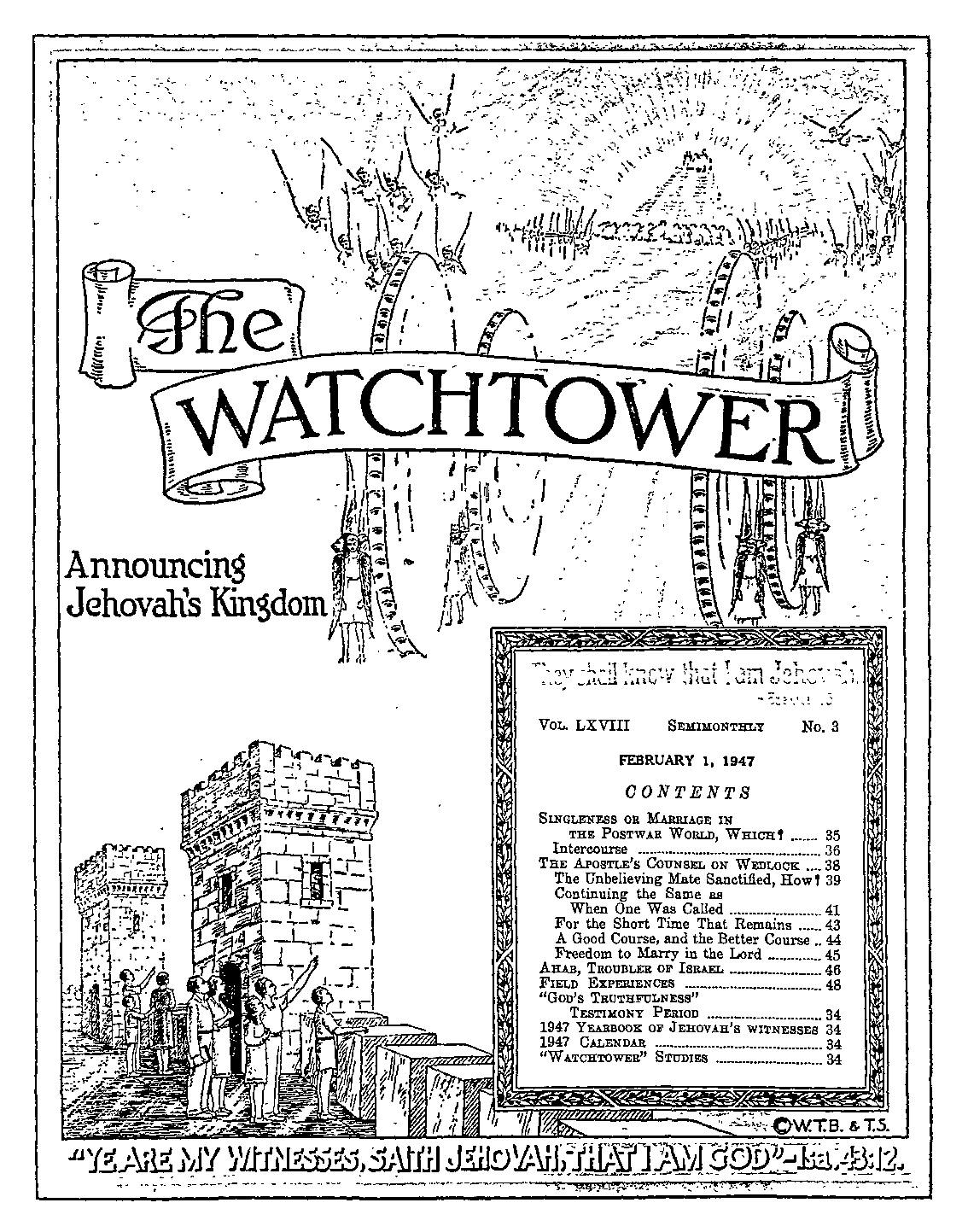
S^eWATCHTOWEK
Published Semimonthly By
WATCH TOWER BIBLE & TRACT SOCIETY 117 Adams Street - • Brooklyn 1, N.Y., U.SA-
Officers
N. H. Knoeb. President W. E. Van Ambuboh, Secretary “And all thy children shall be taught of Jehovah; and great shall be the peace of thy children.” • Isaiah 54:13.
THE BIBLE CLEARLY TEACHES
THAT JEHOVAH Is the only true God, from everlasting to everlasting, and Is the Maker of heaven and earth and Giver of life to his creatures; that the Word or Logos was the beginning of his creation and his active agent in creating all other things; and that the creature Lucifer rebelled against Jehovah and raised the Issue of His universal sovereignty;
THAT GOD created the earth for man, made perfect man for the earth and placed him upon It; that man yielded to unfaithful Lucifer, or Satan, and willfully disobeyed God’s law and was sentenced to death; that by reason of Adam’s wrong act all men are born sinners and without the right to life;
THAT THE LOGOS was made human as the man Jesus and suffered death in order to produce the ransom or redemptive price for obedient men; that God raised up Christ Jesus divine and exalted him to heaven above every other creature and clothed him with all power and authority as head of God's new capital organization;
THAT GOD’S CAPITAL ORGANIZATION is a Theocracy called Zion, and that Christ Jesus is the Chief Officer thereof and is the rightful King of the new world; that the faithful anointed followers of Christ Jesus are Zion's children, members of Jehovah’s organization, and are His witnesses whose duty and privilege it Is to testify to Jehovah's supremacy and declare his purposes toward mankind as expressed In the Bible;
THAT THE OLD WORLD, or Satan’s uninterrupted rule, ended A.D. 1914, and Christ Jesus has been placed by Jehovah upon the throne, has ousted Satan from heaven, and now proceeds to vindicate His nnme and establish the “new earth”;
THAT THE RELIEF and blessings of the peoples can come only by Jehovah’s kingdom under Christ, which has begun; that His next great act is to destroy Satan’s organization and estabilsb righteousness completely In the earth; and that under the Kingdom the people of good-will surviving Armageddon will carry out the divine mandate to “fill the earth" with righteous offspring, and that the human dead in the graves will be raised to opportunities of life on earth.
ITS MISSION
THIS Journal Is published for the purpose of enabling the people to know Jehovah God and bls purposes as expressed In the Bible. It publishes Bible Instruction specifically designed to aid Jehovah’s witnesses and all people of good-will. It arranges systematic Bible study for Its readers and the Society supplies other literature to aid In such studies. It publishes suitable material for radio broadcasting and for other means of public instruction in the Scriptures.
It adheres strictly to the Bible as authority for Its utterances. It Is entirely free and separate from all religion, parties, sects or other worldly organizations. It Is wholly and without reservation for the kingdom of Jehovah God under Christ bis beloved King. It Is not dogmatic, but Invites careful and critical examination of its contents in the light of the Scriptures. It does not Indulge in controversy, and Its columns are not open to personalities.
Notice to Subscribers: Remittances should be sent - to office in your country In compliance with regulations to guarantee safe delivery of money. Remittances are accepted at Brooklyn from countries where no office is located, by international money order only. Subscription rates hi different countries are stated below in local currency. Notice of expiration (with renewal blank) Is sent at least two issues before subscription expires. Change of address when sent to our office may be expected effective within one month. Send your old as well as new address.
Please address the Watch Tower Society In every case.
Offices Yearly Subscription Rate
America {U.S.f, 117 Adama St, Brooklyn L N.Y.
Australia, 7 Beresford R<L, Strathfield,' N. S. W.
British West Indies, 21 Taylor St., Port of Spain, Trinidad
Canada, 40 Irwin Ave^ Toronto &, Ontario
England, 34 Craven Terrace, London. W. 3
India, 167 Love Lane, Bombay 27 Rs. 3/0
Jamaica, 151 King St, Kingston
New Zealand, G. P. O. Box 30, Wellington, S. 1
Philippine Islands, 2621 Int 2 Berran, Santa Ana, Manila $2.00
South Africa, 623 Boston House, Cape Town
Translations of this journal appear in many languages.
ALL SINCERE STUDENTS OF THE BIBLE who by reason of infirmity, poverty or adversity are unable to pay the subscription price may have The Watchtower free upon written application to the publishers, made once each year, stating the reason for so requesting it. We are glad to thus aid the needy, but the written application once each year is required by the postal regulations.
Printed In the United States of America Entered as second-class matter at the post office nt Brooklyn, N. Y., under the Act of March S, 1879.
“GOD’S TRUTHFULNESS” TESTIMONY PERIOD
The Testimony Period during February, stressing God’s truthfulness, will catch up the four-month-long subscription campaign for The Watchtower and Awake! and will carry it forward through this midwinter month. Hence, the same as during the campaign’s initial month, January, all active readers of these magazines will keep on offering jointly the subscriptions for both of these magazines, together with the premium of two bound books (Watchtower publications), all at the regular rate for the two subscriptions, namely, two dollars. By determined efforts on the part of all having strong convictions concerning the truthful contents of The Watchtower and Awake! the subscription campaign will suffer no lag during this month of heavy winter up north, and we believe your field-service reports for February will show this. Many Watchtower readers will want to swell the ranks of the subscription-takers, and so we say to all who want to start during “God’s Truthfulness” Testimony Period: Write us at your earliest for all information and references.
1947 YEARBOOK OF JEHOVAH’S WITNESSES
The first postwar year of action by the Lord’s kingdom publishers in more than seventy lands is reported on in the 1947 Tearbook of Jehovah’s witnesses. This report was prepared by the president of the Watch Tower Bible and Tract Society. It discloses the growing magnitude of Jehovah’s visible organization and of the “strange work” he is accomplishing through it. Supplementing this interesting report is the president’s comment on the yeartext for 1947, together with a daily Bible text for the year’s 365 days and a comment thereon as taken from this past year’s issues of The Watchtower. The limited printing obliges us to post the contribution rate for this 1947 Tearbook at 50c a copy, mailed postpaid to you. All group units should combine the orders of their members and forward same here through the appointed servant, to bring about economies of time and expense at this end.
1947 CALENDAR
The yeartext for 1947 is “Oh praise Jehovah, all ye nations”. (Ps. 117:1, Am. Stan. Ver.) The Society’s new calendar features this over a composite three-color picture that differentiates it from any previous calendar and shows the tangible agencies that will be used for time to come in extending the call of the yeartext to earth’s many nations. The calendar date-pad beneath is a real service reminder, designating the six testimony periods and the special objectives of the alternate months. The contribution is 25c a calendar, mailed postpaid, or $1.00 for five copies to one address.
-WATCHTOWER” STUDIES
Week of March 2: “Singleness or Marriage in the Postwar World, Which
fl 1-16 inclusive, The Watchtower February 1, 1947.
Week of March 9: “The Apostle’s Counsel on Wedlock,” fl 1-21 inclusive, The Watchtower February 1, 1947.
Week of March 16: “The Apostle’s Counsel on Wedlock,” fl 22-38 inclusive, The Watchtower February 1,1947.
ffieWffCHTCWE'R.
ANNOUNCING JEHOVAH’S KINGDOM
Vol. LXVin
February 1, 1947
No. 3
SINGLENESS OR MARRIAGE IN THE POSTWAR WORLD, WHICH?
"It is a good, thing for a man to remain just as he is."—1 Cor. 7:26, An Amer. Trans.
JEHOVAH did not let the first man, Adam, stay single. He set before the man a life of marriage by presenting a woman to him for his wife. Being the Creator-Father of Adam, who was a perfect earthly son of God, Jehovah had the right to do so. He did so, not simply with man’s happiness in mind, but with a great purpose in view. It was to have the earth populated -with a perfect race of mature men and women, all of them worthy to enjoy everlasting life in a delightful paradise that glorified the whole earth. The creature man as the son of God must serve God, and one part of his service to God was to reproduce his land and to people the earth -with them. Addressing the man and his lovely wife, God "blessed them, saying: Increase and multiply, and fill the earth, and subdue it”. (Gen. 1:28, Douay Version) This increasing and multiplying was not to be left to the original married couple alone. Their sons and daughters were to grow to maturity and join with them in realizing the divine mandate. From this standpoint Jehovah God set before the children of Adam and Eve the bliss of married life in paradise with God’s goal in view of having a populated, gardenized earth. Their marriage unions were to endure and to serve God’s happy purpose by fruitfulness, not a barren womb to be found among them, never a marriage separation to bring domestic infelicity and heartaches. The entrance of such unfortunate things into the earth is traceable to the sin of mankind.
2 Now we are in the year 1947, about six thousand years distant from that rapturous wedding day in Eden when Jehovah God brought the first bridegroom and bride together and blessed their union and gave them fatherly information as to its purpose. Today earth is teeming with population, but for all’such'population the earth is far from being in a subdued condition like a paradise. We have just come through the second global war of this twentieth century of our common era. The intent and effects of both these global wars were absolutely opposite to God’s mandate to man and woman in Eden to
1 Why did God not let Adam stay single?
2. Why is the outlook for those wanting to marry discouraging, but what makes the situation not hopeless? increase and multiply and fill the earth -with a big human family and to subdue the earth to be an agreeable place on which to live in peace, joy and abundance for all time to come. We of 1947 live in what men call "the postwar world”, and fears are expressed that the human race will be wiped out by a not-impossible third world war with weapons of wholesale destruction such as this scientific century has never before known or extensively used. The outlook for those who want to marry and rear a family to continue their name is very discouraging and is threatened with frustration. The situation would be completely hopeless were it not that a wonderful message is heard being proclaimed to “men of good will" now. No, it is not the message of the United Nations. It is the message that the kingdom of Jehovah God in the heavens was established in the hands of his King, Jesus Christ, A.D. 1914 and that it will destroy the worldly nations at the final war of Armageddon and then bless the earth with a reign of lasting peace and prosperity.
2 In these days the matter of staying single or of marrying is a problem for a person of this world. It is particularly so for a person that has given himself to the Lord God Jehovah in full consecration through Jesus Christ. The person of the world may hesitate over the matter because of the general economic conditions and the question of finding a mate that is clean and that will prove companionable, faithful and true amid the lowering moral condition of mankind, and also the possibility of a third world war inside a generation’s time, when his children would be of age and subject to military conscription. The true Christian, however, with the Bible viewpoint of matters studies the matter, not only with the above consideration in mind, but also •with the question in mind of carrying out his consecration and obligatory service of God. For such one the matter becomes doubly serious, because we have reached the consummation or “time of the end” of this old world and the prophecy must now be
3. With what considerations does the Christian now study the matter of getting married?
carried into fulfillment by Christians under their Leader and Commander, Jesus Christ, namely: "This glad message of the Idngdom will be proclaimed in all the inhabited earth, for a witness unto all the nations,—and then will have come the end [or finish of this old world].” No Christian desiring to be* faithful and to have God’s final approval can afford to miss having a part in giving this Kingdom witness to all the nations.—Matt. 24:14, Rotherham.
* So as not to hamstring himself in his efforts to take part in the witness work in obedience to God’s command through Christ, the Christian wisely studies over the subject of marriage, before he marries in haste to repent in leisure. For the benefit of such the apostle Paul was guided to write some very plain and forthright advice in chapter seven of his first epistle to the Corinthians.
5 Paul wrote such counsel to the Christians there at Corinth, Greece, in answer to certain questions they put to him concerning the subject of marriage as it affects a Christian. Paul was once a Jewish sectarian, a Pharisee, a student of Gamaliel the grandson of Hillel I and hence a member of the rabbinic school of Hillel; and Paul was well acquainted with the teachings concerning marriage as taught by that school and later written down in the Jewish Talmud. (Acts 23:6; Phil. 3:5) But it was as a Christian and an apostle that he wrote to the church at Corinth, and he was filled with the spirit of the Lord God and the mind of Jesus Christ when thus he wrote. Consequently his advice is the best that could be had in these days as regards marriage. The fact that his advice was given nineteen centuries ago does not make it out-of-date, but does make certain that, if followed, it will help the servants of God back to that purity and moral healthiness of life such as the faithful Christians of apostolic days maintained. The apostle’s advice is so balanced, so sane in thought and so in keeping with a married person’s obligations and a Christian’s obligations, that both married persons and single persons as well cannot fail to gain an enlargement of mind and appreciation from it. Such ones, therefore, will welcome our full discussion of Paul’s advice here.
INTERCOURSE
6 In Paul’s day the city of Corinth was notorious for its heathenish immoral practices. Some members of the church had been heathens guilty of such practices. Now such erstwhile heathens were transplanted into the pure Theocratic organization of Jehovah God, which is a morally pure organization under Jesus Christ the Head. Also, former Jews who had
4. Why does the wise Christian not now marry in haste?
3. Why Is the apostle's advice the best to be had today on marriage? 6. What was the attitude of mind of the church of Corinth then toward marriage? been under Talmud-like teachings were now members of that Corinthian church. (Acts 18:1-10; 1 Cor. 6:9-11) Perforce, questions arose as to marriage: Was it fitting for Christians! and how should Christians already in the marriage bond deport themselves with their matrimonial partners! There was such gross looseness of conduct between the sexes in heathen Corinth that, apparently, it unbalanced the minds of some Christians there regarding marriage and regarding what is due between married persons. Some of the Corinthian brethren may have inclined to think that a celibate life or single, unmarried life was the only land for a Christian, and they tried to apply this idea even as between those in the ties of legal marriage. Did the apostle Paul take the same stand? Did he write his full approval of those of that frame of mind? Fortunately, what the apostle wrote has been preserved for our study and guidance in these perilous “last days”.
T Paul wrote: “Now concerning the things whereof ye wrote unto me: It is good for a man not to touch a woman.” (1 Cor. 7:1) From the way this reads, it sounds as if the Corinthians had said to Paul that it was good for a Christian not to have any intercourse with a woman, either by not getting married or by refraining from it if he was married. But if the Corinthians just asked for information and expressed no opinion about the matter, then the various modern translations render the apostle’s words better; for example, Moffatt’s translation of 1922, which reads: “Now about the questions in your letter. It is an excellent thing for a man to have no intercourse with a woman; but there is so much immorality that every man had better have a wife of his own and every woman a husband of her own.” (1 Cor. 7:1, 2) Thus the apostle Paul was not off-center on the matter. He did not enforce celibacy or insist upon it as the inflexible rule of life for each and every Christian person.
“ For the best of reasons, which Paul explains later, it would be a good thing for an unmarried Christian not to change his single estate. Paul’s words do not say that a single Christian cannot keep from committing immorality in this lustful world. His words are to be understood as saying this: If it should come to choosing between immorality and wedlock, then the servant of God that cannot hold himself in check should take the honorable course. He should get married according to God’s law and in compliance with all proper regulations of government of the country. This is so because God the Creator instituted marriage, and
7. In the opening of his advice how did Paul show he was not off-center as regards marriage?
8. In a choice between immorality and wedlock what will the Christian that Is single do?
marriage according to His will and in harmony with His purpose is not sinful or unclean. Rather than lead a free and loose life in frequent fornication and at the same time appear to lead a single life, the God-fearing Christian will undertake the responsibilities and the restraints and will get married. He will thus keep clean in God’s sight and honorable before men and bring no reproach on God’s name.
9 Of all persons, married Christians ought not to be the ones that ignore the law which God has implanted in the make-up of the male and in the make-up of the female, namely, the law of attraction. The male is attracted to the female, and vice versa. God’s righteous purpose in this in the beginning was the bringing forth of children to fill the earth. When a male and a female get married each loses a measure of independence, and each must thenceforth show consideration of the other and must contribute to the health, happiness and mental balance of the other. For one of the married couple, or for both, to become Christian does not lessen this obligation. Hence neither of them can decide one-sidedly upon a course of conduct that would deprive the other of the marriage dues. Doing so even conscientiously does not make the matter right, but merely creates undue trouble. Even should both parties to the marriage agree upon a course contrary to nature and thereby take a course that works hardship upon the physical body, it leads into difficulty. It may lead to hypocrisy one toward the other in this time of moral distress that exists in the world all round and about us. Because of such deprivation, either one-sidedly or by the agreement of both for an unreasonable time, the Devil may find an opening to get in and cause domestic unhappiness and unfaithfulness in the way of violations of the marriage vow. So Paul writes:
i° “Tile husband must give the wife her conjugal dues, and the wife in the same way must give her husband his; a wife cannot do as she pleases with her body—her husband has power, and in the same way the husband cannot do as he pleases with his body—his wife has power. Do not withhold sexual intercourse from one another, unless you agree to do so for a time, in order to devote yourselves to prayer. Then come together again. You must not let Satan tempt you through incontinence. But what I have just said is by way of concession, not command.”—1 Cor. 7: 3-7, Moffatt.
” If Christ’s footstep followers were perfect as Adam and Eve were originally in Eden and thus had perfect self-control and were not victims of inherited passion, it would not have been necessary for
9. Why should married Christians not be incontinent In sexual relations toward their mates?
10. How does the apostle show that married persons have each lost a measure of personal independence?
11. Why did the apostle make the above concession or grant to married Christians ?
the apostle to write the above. But, due to the weakened condition of the race and the working of passion in the bodily members, the apostle gave the above advice to married persons as something granted, but not as a command to them. It was a reasonable grant or concession in view of the realities of the case.
12 In taking advantage of this concession, no Christian husband would demand more than his due to the point of working physical abuse to his wife, especially if she was a Christian and desired to devote more time, strength and attention to spiritual things, such as prayer to God. The course that either one takes should be a reasonable one, not governed by uncontrolled, unrestricted passion. Each one will lovingly consider the other, so that no physical hardship will result to either one, and especially that no spiritual hurt will follow through taking more pleasure in fleshly delights than in the unselfish interests of God’s kingdom. God’s saying to Eve in Eden, “Thy desire shall be to thy husband, and he shall rule over thee,” was no authorization for the husband to be brutal in any respect toward his wife. The wife is one flesh with him, and he should not act toward her as if he hated his own flesh. But as Jesus Christ loves the church, his bride, so the Christian husband will love his wife, and the wife will love her husband in response. (Eph. 5:28-33) Both by guarding against over-indulging in those things which are due or granted to one, and by guarding against unreasonably withholding the marriage privileges, the married Christian resists the great tempter or foils him.
“Were all Christians like the apostle Paul, they would be free from the difficulties which he discusses above. Hence Paul adds: “For I wish all men to be even as myself; but each one has his appropriate gift from God; one, indeed, of one kind, and another of another.” (1 Cor. 7:7, The Emphatic Diaglott) The gift is a gracious gift, a free gift, from Jehovah God; and the particular land of gift that the individual Christian receives as his own seems to depend upon his measure of faith. Because of his faith, zeal and earnest devotion Paul was given the gracious gift of an apostleship. By a life of singleness he applied himself to his duties as apostle, so that he came not one whit behind the eminent ones of the twelve apostles of Jesus Christ. If, according to ancient opinions, Paul had once been married, it seems he was now a widower and was abiding in that state for the Lord’s work’s sake. (1 Cor. 9:1-5; 2 Cor. 11:5,23-33) He kept single, not in his own strength, but by the power of faith and divine grace which he talks of as his own special
12. To what extent will the Christian take advantage of this concession, and why?
13 How did Paul use his gift from God? and why should married Christians not be discouraged? gift from God. But if every Christian does not have such a gift by the strength of which he can stay single in his service to God, the married Christian also receives a gift from God whereby he too may serve the Lord God in conjunction with his married life. Hence the married ones need not be discouraged, but should strive to live up to the measure of God’s favor to them.
14 To those who had already had marriage experience but lost their mates through death the apostle now gives this word, which is good counsel also for those who have never tried marriage: “But I say to the unmarried [males] and to widows [females], It is good for them if they abide even as I.” Which seems to indicate that Paul himself was then a widower. (1 Cor. 7:8, Am. Stan. Ver.) There is no reproach to the Christian for being a widower or widow. A Christian is not under the law of levirate marriage as recorded by Moses at Deuteronomy 25:5-10, whereby a Jewish woman-could require the nearest male relative of her dead husband to marry her; and the brother or closest relative of her late husband was under the proper obligation to marry her, in order to raise up children by her to the name of the dead husband. Christians are free of that law and so are free to remain unmarried after death has taken away their mate or that of relatives. And it is good for them to do so, just as it was for the apostle Paul. However, too, they are free to remarry, and the apostle suggests when it would be advisable, saying: “But if they have not continency, let them marry: for it is better to marry than to burn.”—1 Cor. 7:9, Am. Stan. Ver.
" It is too ridiculous and unscriptural to consider the religious interpretation of some that the apostle was arguing that it is better to marry than to burn in a theologically-invented “hell” of actual fire commingled with brimstone stoked by asbestos red-devils. The Greek verb that the apostle uses, besides meaning literally to burn, also means in its passive form “to be excited or inflamed”, as at 2 Corinthians 11:29. Here as Paul uses it, it means to be excited or inflamed with passion according to the law of sex.
18 Hence modern translators sensibly and properly render Paul’s words: “But if they cannot control themselves, let them marry. For it is better to marry than to be on fire with passion.” (An Amer. Trans.) “Still if they cannot restrain themselves, let them marry. Better marry than be aflame with passion!” (Moffatt) Why so! Because it is better to seek satisfaction with a lawful wife and according to the divine purpose of marriage than to be uncomfortable with passion. Such passion may prevail upon one to take a wrong step in morals or it may interfere ■with one’s fixing his desire and attentions upon serving God. (See verse two again; also Proverbs 5:15-20.) This would be harmful spiritually. It would break up the Christian’s harmonious relations with God and might result in bringing reproach upon God’s name. Hence the Christian that is subject to passion that threatens to get the better of him should wisely and sanely consider the matter and follow the apostle’s advice. No fellow Christian has a right to criticize him for following it in this postwar world.
14. Wl.y are Christian widowers and widows free from obligation to 15- What does “to burn” mean here? remarry? 16. Why is it better to marry than to burn?
THE APOSTLE’S COUNSEL ON WEDLOCK
IN THE apostle Paul’s day some had become Christians when they were already married. In some cases the believer’s husband or the believer’s wife did not come along into the truth and consecrate to God. So what? Had the marriage bonds been weakened as a result of this? Were the marriage obligations and responsibilities lightened or lessened as a consequence, with the result that separations, divorces and remarriages could easily and lightly be engaged in? In answer the apostle does not embolden himself to speak his own opinion, but draws his instructions from the Lord, saying: “To those already married my instructions are—and they are not mine, but the Lord’s—that a wife is not to separate from her husband. If she does separate, she must remain single or else become reconciled to him. And a husband must not divorce his wife.” —1 Cor. 7:10,11, An Amer. Trans.
s Paul here took his instructions from the Lord Jesus. So he must have had Jesus’ words in mind that fornication is the only ground recognized by God for divorcing one’s unfaithful mate, and that, otherwise, no human creature should separate and put apart those who God’s original institution of marriage in Eden decreed should dwell together as one flesh. God does not personally intervene to make human matches and to join together all human marriage couples and thus become responsible if they turn out bad; but by His creating of woman and mating her with Adam God did show the unity that should apply to all humans that join together in marriage, and that should be recognized. (Matt.
1. Whose Instructions does Paul give to those already married?
2. What grounds for divorce do such instructions lay down, and why9
19:9; Mark 10:6-12) The apostle does not, therefore, encourage separations and does not sanction them, except for the reason that the Lord announced, namely, fornication, which dissolves the marriage bond between the faithful and the unfaithful one, and which dissolution can be legalized according to the law of the land.
s If a Christian woman, then, separates from her husband either with his consent or of her own decision, without fornication of her husband as the cause, she should not think she is released from her marriage vow and tie to him. She is not to think she is free to marry someone else: that would be fornication on her part. Before God she is under obligation to stay single in her separation, and she must take the consequences of her separated condition. She may find this is too much of a hardship or burden or inconvenience for her. Then if she wants husbandly attentions and care the only way left to her is to be reconciled to her legitimate husband and return to living ■with him. Her freedom of separateness she may not turn to license, if she would avoid sinning before God. On the other hand, the husband has no authority from God to dismiss his wife, even if he can get it from divorce courts of the land. If he does it for reasons other than fornication, he is not free to remarry. God’s law to Christians obliges him to stay single, because he is still married. Thus dealt with, marriage is seen to be a serious and sacred contract, not to be treated flippantly as if mattering little in God’s sight.
4 Fornication? Well, if a person is guilty of spiritual fornication by being a friend of this world or by being an unconsecrated unbeliever, is that not valid ground for a Christian man or woman to divorce the mate and remarry another person, and do so without guilt before God? Is not spiritual fornication just as powerful as fleshly fornication in supplying just cause for divorce? If it were so, then suppose a Christian marries an unconsecrated person tied up with this world and friendly with it. Why, at the very start he would be entering into an adulterous relationship with such worldly person and would be sinning before God. On that basis, Timothy’s mother Eunice, who was a Christian married to an unconverted Greek, was guilty of fornication as long as she remained living with her unconverted husband. But Paul did not so judge Timothy’s mother, even though at that time Paul was carrying the special letter from the Christian council at Jerusalem instructing the Gentile Christians to abstain from fornication. (2 Tim. 1:5; Acts 16:1-4; 15:22-31) Neither did Paul urge “spiritual fornication” as an
3. Separation, except for fornication, bears what restrictions?
4, 5. What argument shows splritnal fornication is no valid ground for divorce?
argument for separation and divorce when he wrote:
6 “But to the remaining matters I speak, the Lord does not [in that till iffien He had not caused any pronouncement to be made on these remaining matters, in the expressed law of God];—If any brother have a wife, an unbeliever, and she is pleased to dwell with him, let him not dismiss her [divorce her]; and if any wife have a husband, an unbeliever, and he is pleased to dwell with her, let her not dismiss the husband. For the unbelieving husband is sanctified in the believing wife, and the unbelieving wife is sanctified in the brother [husband]; otherwise, indeed your children were impure, but now they are holy.”—1 Cor. 7:12-14, Diaglott.
6 The fact that a husband or wife is no believer consecrated to Jehovah God is no solid excuse for the believing one to resort to worldly law-courts and press for a separation or divorce. The believer must leave it up to the unconsecrated one to decide if he wants to take action to free himself from the spiritually unequal yoke. If the unconsecrated unbeliever does not object and is willing to stay in marriage association with the consecrated believer, then no valid foundation exists for breaking asunder the relationship and the home life together. Under such circumstances each one has to adapt or adjust himself to the other and thus get along as agreeably as they can together, with mutual respect for each other’s rights and privileges. It does not necessarily follow that the unbelieving mate will take the treacherous course concerning which Jesus warned at Matthew 10:34-37. But the unbeliever must not be allowed to cause unfaithfulness to God, no matter what the difficulties of the situation. The Christian must see to it that the unbelieving one is not loved more than the Lord God. Then, in cases where conscience is involved, he will not be persuaded or forced into making any spiritually harmful compromises.
THE UNBELIEVING MATE SANCTIFIED, HOWT
' The believer has sanctified himself to the Lord God, which means that he has set himself apart to God to please and serve him and has cleansed himself from this world and has prepared and set himself to do God’s will. The believer does not sanctify his unbelieving mate by forcing such one to consecrate to God, but deals now with such mate from a sanctified viewpoint. In God’s eyes they are one flesh, and when one of the married pair sanctifies himself to God then the other one of the one flesh is affected and undergoes an indirect sanctification. Certainly such sanctification could not mean divorcing the unbelieving one who is one’s flesh. It must mean that henceforth what proper, due services and compan-6. Hence how must the Christian deal with the unconsecrated mate? 7. How Is the unbeliever sanctified by the believing mate? ionship the sanctified believer renders to the unbeliever, he does it as unto the Lord God whom the believer is consecrated to serve. He must do so, because he may not, except for fornication, break off the marriage tie and oneness of flesh. This fact should be a great consolation to sanctified believers whose mates are not in the truth nor consecrated to God. It should be a blessing, and should be a deterrent to efforts at divorce for unwarranted cause.
8 If the above were not so, then the children born to such a married couple would be like mongrels and unclean in God’s sight. But God recognizes their being married and knows that the sanctified believer is one flesh with the unconsecrated mate; so God mercifully recognizes the children of such union as holy or sanctified. It is because the unbelieving one is sanctified by his believing mate. And just as the believer treats his unbelieving mate from this standpoint in his endeavor to honor and please God, so he will treat his children which he has by the unbelieving one. Hence he will discharge his parental duty of bringing such children up in the nurture and admonition of the Lord. From this standpoint, then, a child or children that such a marriage union brings forth could hardly be viewed as a mistake or as undesirable and as coming into the family because Satan the Devil overreached the parents. How could such a view of children born legitimately according to God’s natural law agree with the fact that they are not unclean, but holy ? It could not. To take the Bible viewpoint of them, though, works a blessing. The children will then not be begrudged an existence as being offensive and burdensome. There will be no parental prejudice against them, because there should be no prejudice against that which is holy. Parents are glad that they themselves were born. Equitably, they should concede to the child the right to be glad at being born and being alive.
’ But supposing that the unbeliever thinks it unendurable for him to keep house with a consecrated Christian, what then? The apostle’s answer endued with heavenly wisdom is: “But if the unbeliever withdraw, let him withdraw; the brother or the sister is not enslaved in such cases,—but in peace God has called us;—for how knowest thou, 0 wife, whether thou shalt save thy husband? or how knowest thou, 0 husband, whether thou shalt save thy wife? If not [that is, if it does not result in such salvation], as the Lord has apportioned to each one, even as God has called each one, so let him walk. And thus in all the congregations I appoint.” (1 Cor. 7:15-17, Diaglott) A Christian, as far as marriage with an unbeliever is concerned, is not like a slave
8 Why are the children of such union holy? and how are they to be treated as such?
9, 10. How shiuld an unbeliever who wants to leave his Christian mate be dealt with? and why so? that is bound to his master and that must abide in his master’s household.
10 If the unbeliever, in objection to the faith and consecration of his mate, chooses to break loose, then the Christian should let such dissatisfied mate depart. Such separation on the basis of dissatisfaction and disagreement does not, however, free either party to the marriage to seek a new marriage. The Jewish rabbis of Jesus’ day allowed a divorce because one of the married parties changed his religion, but Jesus still came out for fornication as the only ground proper for dissolving the marriage tie by a divorce. However, while it does not liberate the Christian for remarriage, the unbeliever’s separating himself does make for the peace of the consecrated believer. If the dissatisfied unbeliever were kept from leaving because the Christian tried to force him to stay, then he most likely would make it disagreeable for the Christian and disturb the Christian’s peace. Hence in the interests of peace, the Christian can conscientiously let the unbeliever separate himself, because God has called Christians to peace and to be peacemakers.
11 But if the unbeliever chooses to stay, the Christian should view this as a situation that might work for the salvation of the unbeliever. The apostle Peter, who agrees with Paul in this view of the subject, points to this same opportunity, saying to the Christian women: “In like manner, let wives be subject to their own husbands, so that if some are disobedient to the word, they may without a word be gained through the conduct of their wives; having seen your conduct chaste with fear. Whose decoration, let it not be that external one, of braiding the hair, and putting on of gold chains, or wearing of apparel; but decorate the hidden man of the heart with what is incorruptible,—a meek and quiet spirit, which is very precious in the sight of God.” (1 Pet. 3:1-4, Diaglott) In this case a Christian will be just as much interested to help his mate to the side of God’s kingdom as to help the people of good-will in his field territory to which he is assigned for delivering the witness from house to house. The removal of the unbeliever from the side of his mate takes away this close-at-hand opportunity from the married Christian. So, as long as the unconsecrated one elects to stay, the Christian should act upon the opportunity. The conversion of the unbelieving mate would greatly bless the home.
12 If, alas, it does not work out so, the Christian should make the best of the situation, all the while holding fast to his integrity toward God. If the Lord Jesus let it fall to one’s lot to become a Christian while married and if God has called such
11. If the unbelieving mate chooses to stay, how should the Christian deport himself?
12. If staying together does not result In converting the unbelieving mate, how should the Christian act? believer to the heavenly Kingdom while living with an unbelieving mate, then the Christian should not seek to force a separation for merely this reason. He should pursue his Christian walk in life under the circumstances existing, assured that the Almighty God can still help him to preserve his integrity and to fulfill his consecration vow to God. With God’s full approval the apostle Paul declared this as the divine arrangement to all the churches or companies.
CONTINUING THE SAME AS WHEN ONE WAS CALLED
13 The apostle had already told the Corinthian church that God had called them to partnership with his only begotten Son in the heavenly kingdom: “God is faithful, by whom ye were called unto the fellowship of his Son Jesus Christ our Lord.” (1 Cor. 1:9) Rightly, these Corinthian Christians, as members of the body of Christ, were interested in how their earthly condition in the flesh would affect them in making good on their calling. Would they have to revolutionize matters in an outward way in order not to miss out on their heavenward calling? Evidently not, since God does not look on the outward appearance and he does not show respect or partiality toward persons on account of race, color, nationality or social and economic condition. Obedience from the heart is what counts with him. Such obedience can be rendered to God in whatever unchangeable outward conditions a person may have been when God called him. Otherwise, if his chance to make good under such circumstances was nil, then God would not have called him, because then to call him would be simply to mock him. In harmony with this Paul writes:
11 “Was a man circumcised at the time he was called? Then he is not to efface the marks of it [by some Idnd of surgery]. Has any man been called when he was uncircumcised? Then he is not to get circumcised. Circumcision counts for nothing, uncircumcision counts for nothing; obedience to God’s commands is everything. Everyone must remain in the condition of life where he was called. You were a slave when you were called? Never mind. Of course, if you do find it possible to get free, you had better avail yourself of the opportunity. But a slave who is called to be in the Lord is a freedman of the Lord. Just as a free man who is called is a slave of Christ (for you were bought with a price; you must not turn slaves to any man). Brothers, every one must remain with God in the condition of life where he was called.”—1 Cor. 7:18-24, Moffatt.
15 It does not matter whether one has the marks
13. Why does a Christian not have to revolutionize matters outwardly in order to make good on his calling to the Kingdom?
14. In harmony with this what does Paul write?
15. Why does it not matter whether he was a Jew or Gentile? or indications in his flesh that he was a Jew or a Gentile when he acted upon God’s message of the Kingdom and consecrated himself and was begotten of God's spirit and became called to the Kingdom. “For in Christ Jesus neither circumcision availeth any thing, nor uncircumcision, but a new creature,” and such spiritual new creature must display the “faith which worketh by love”. (Gal. 6:15; 5:6) He shows he loves God by keeping His commandments, and not by outward appearance in the flesh according to some out-of-date rule of life.
14 As circumcision was a much-debated question in Paul’s day, likewise slavery was a practice among both Jews and Gentiles, slavery not merely of blacks but also of whites. But Paul did not waste time and sidetrack himself to go in for reforming this old world socially. He did not start a movement for abolition of slaves, for he knew that God by Christ Jesus will wipe out economic, industrial and social slavery at the battle of Armageddon by destroying this world organization of Satan the Devil. Paul did just the one thing: represent God’s kingdom and preach the gospel of the coming Kingdom. When he met up with the runaway slave Onesimus and converted him to Christianity, Paul did not pronounce Onesimus economically and socially free, but sent him back to his master Philemon, to slavery, indeed, but under a Christian master. (Philem. 10-19; Col. 4:9) Paul would not have done so if' he had considered Onesimus’ personal freedom economically and socially to be an absolute necessity to maldng his calling sure with God. If his old master Philemon was willing to give Onesimus his freedom because of his conversion to Christianity, then Onesimus was under no obligation to refuse it but should rather use it profitably in God’s service by reason of the larger opportunities it opened up to him.
17 Onesimus, however, was not to selfishly seek such freedom or to insist upon it because of having the same faith and calling as his master Philemon. With relation to Philemon Onesimus might be a slave according to the flesh and Roman law; but according to Christ Onesimus was a freedman, free from the tyranny of sin and of Satan “the god of this world”. That is the real freedom that counts, but that none of the religious, social, economic and industrial slave-drivers of this world have. (John 8: 31, 32, 34-36) On the other hand, Philemon was a freeman according to social standards and arrangements of the Roman Empire. Toward Onesimus he was a slaveowner, but according to Christ he was a slave servant, just the same as Onesimus was a slave servant to Christ. Why? Because by becoming a Christian who accepted the ransom sacrifice of the
16. Hence, what stand did Paul take toward the slave question?
17. What counterbalancing facts were true of slaves and freemen, so that they should not become servants of men’
Son of God, Philemon as well as Onesimus had been bought with a price for God, namely, the price of the perfect human sacrifice of Jesus Christ. To both Philemon and Onesimus Paul’s words apply: “You are not your own, you were bought for a price; then glorify God with your body.” (1 Cor. 6:20, Moffatt) Hence before God Philemon and Onesimus were both on the same level, and neither of them should become servants of men by violating Christian principles to please men. Even Onesimus, in rendering economic service to Philemon, must render it as unto the Lord and not unto the man his slavemaster. —Eph. 6:5-9; Col. 3:22-24.
18 In such a way Onesimus could abide in the legally-imposed condition in which he was at the time of being called, and he could abide with God as the bought servant of God’s Son Jesus Christ. Of course, this does not mean that a Christian today who is free cannot change his trade or occupation. Paul, who was freeborn, changed from being a tentmaker to becoming a full-time missionary to foreign lands when he was economically able to do so. (Acts 22:27, 28; 18:1-3,18,19; 2 Thess. 3:7-10) That was something that Paul could control and change; he was not obliged to abide as a tentmaker.
19 Now you ask, How does this apply to those in the virgin state and those in the married state? The apostle returns to this consideration, but here he can cite no written commandment of the Lord. So he expresses himself as one who is faithful to God and who can therefore be relied upon to advise that which is in harmony with God and his law, saying: “Now concerning virgins I have no commandment of the Lord: yet I give my judgment, as one that hath obtained mercy of the Lord to be faithful. I suppose therefore that this is good for the present distress, I say, that it is good for a man so to be. Art thou bound unto a wife? seek not to be loosed. Art thou loosed from a wife? seek not a wife.”—1 Cor. 7: 25-27.
20 Note Paul’s reference to “virgins” (parthenoi, in his original Greek text). After the classical period of Greek literature passed, this word virgin (parthe-nos) was used, not only to denote a female, but also in a masculine sense to denote a young, unmarried man.* Undeniably the apostle John uses the term virgin to include both sexes when he writes concerning -the 144,000 followers of Christ: “The hundred and forty and four thousand, which were redeemed from the earth. These are they which were not
• Liddell and Scott’s A Greek-English Lexicon (1856); also Parkhurst’s Greek & English Lexicon says it denotes “a person in a virgin state” and that “the word plainly includes both sexes”, 1 Cor. 7:25 (compare Revelation 14:4)”.
18. What freedom does this allow as to changing one’s trade or occupation? .
19. As concerns virgins, why did Faul give no commandment of the Lord? 20. To whom does the term “virgins” apply here? defiled with women; for they are virgins [parthe-noi].” And Jesus’ parable of the ten virgins applies to males and females.—Rev. 14: 3,4; Matt. 25:1-13.
21 For the above reasons the Syriac Version reads well when it translates the text: “And concerning virginity, I have no precept from God.” (1 Cor. 7:25, Murdock; Lamsa) Also Rotherham’s The Emphasised Bible does best when it attaches no gender to the term virgin by translating as follows: “But concerning them who are virgin, injunction of the Lord have I none; yet a judgment do I give as one who hath obtained mercy from the Lord to be faithful:—I consider this, then, to be good in the circumstances, by reason of the existing distress,— that it is good for a man so to be [stay as he is]: Hast thou become bound to a wife? Do not seek to be loosed [if there is no fornication practiced by her]; hast thou become loosed from a wife [on the ground of her fornication] ? Do not seek a wife. If, however, thou shouldst even marry, thou hast not sinned; and if one who is virgin [male or female] should marry, that one [male or female] hath not sinned;—but tribulation of the flesh shall such have: —howbeit I spare you.”—1 Cor. 7: 25-28.
22 By rendering the above judgment Paul put the church on guard against what he forewarned was due to come later, saying: “Now the Spirit speaketh expressly, that in the latter times some shall depart from the faith, giving heed to seducing spirits, and doctrines of devils; forbidding to marry, and commanding to abstain from meats, which God hath created [together with marriage] to be received with thanksgiving of them which believe and know the truth.” (1 Tim. 4:1,3) As one judged of the Lord to be faithful, Paul did not forbid marriage, not even especially for the ‘flatter times”. Most positively he did not lay any foundation for the religious instituting of monasteries and convents of monks and nuns and of a priestly hierarchy all under the requirement to stay unmarried. Paul knew that Peter had a wife and a mother-in-law. (Matt. 8:14; 1 Cor. 9:5) Paul granted Peter that privilege, and did not seek to build up a Christian church composed all of single men and single women. That would have been unreasonable, and neither was it the arrangement of God for His church under Christ the Head.
23 Nevertheless, for the sake of the Christian’s service to God directly Paul does set forth good reasons for not getting married. Among those reasons is that those who give up their virginity or singleness will have the outward troubles of married life, “tribulation of the flesh,” and he would like to
21. As the best translation, how does Rotherham's render the apostle’s words at verses 25-28?
22. Thus writing, againn what did Paul guard the church, and what did he not seek to build up?
23. What was the “tribulation of the flesh” Paul wanted to spare the single ones?
have the single ones to be spared that. It was not because there was any “distress” present upon them just then in the way of persecutions and so it would be burdensome and inconvenient to have a wife and children under harassment by persecutors. But it was because in the ordinary course of married life the couple marrying have taken on a burden in each other and it may lead to further responsibilities in the way of children. Unavoidably, troubles are due to come amid this present distressed condition of the world and because of human imperfections, faults and unwisdom. Hence let those in a virgin state be cautioned beforehand that, although they may not sin by now getting married, they will be putting themselves in the way of new troubles, which they must bear while fulfilling their obligations in God’s service.
FOR THE SHORT TIME THAT REMAINS
24 But now, conceding that Christians are not debarred the right and privilege of getting married, what follows henceforth? If what the apostle next says applied to the servants of Jehovah God in that first century when he wrote, it peculiarly applies in these perilous “last days” since A.D. 1914, when Satan and his demons have been cast down from heaven to this earth and Satan knows he has now but a short time before the battle of Armageddon. P.aul says: “The opportunity [or seasonable time] is contracted for what remaineth—in order that they who have wives may be as though they had none, and they who weep as though they wept not, and they who rejoice as though they rejoiced not, and they who buy as though they possessed not, and they who use the world as though they used it not to the full,—for the fashion of this world passeth away, and I desire you to be without anxiety.” —1 Cor. 7:29-32, Rotherham; Am. Stan. Ver., margin; Young.
25 The gist of what the Lord here instructs us through his apostle is this: The Christian should not give his whole or chief attention to personal selfish matters which have to do with the flesh or human body, whether these be enjoying a wife or husband, or be one’s own joys or sorrows, or commercial activities or necessary dealings with this world. The Christian should not bury or sink himself too deeply in 'these things to the neglect of what is eternal; because this world, and its scheme or fashion of things, are due to pass off the stage of this earth. As against becoming overcharged with the swiftly-passing selfish things of this present, one should lay up treasures for the new world which will soon now be upon us. For the Christian that is a member of Christ’s body and called to the heavenly
24. Why are Paul’s words at verses 29-32 peculiarly fitting now?
25. What is the gist ot these verses? kingdom, the seeking of the Kingdom and of God’s righteousness is the thing of first importance. Neither wife, husband, children, nor griefs and joys, nor business relations and activities, should be allowed to engross the Christian’s time and attention and to interfere with his gaining the kingdom of righteousness. Instead of an overload of the cares of this life in this old world, he should try to relieve himself of such cares as far as possible or avoid them. Then he can concern himself more fully with the things of God’s kingdom, which kingdom must now be advertised to all the nations as a witness to them. The death and resurrection of Jesus Christ, and now his coming into the possession of the Kingdom in 1914, have curtailed the remaining existence of this old world. We must redeem the time for the new world interests.
28 There are anxious cares attached to living in this world. In showing the comparative freedom that the unmarried Christian may enjoy from such cares and how the interests of the married Christians necessarily are divided between the fleshly and the spiritual, Paul continues on: “And I desire you to be without anxiety:—The unmarried man is anxious for the things of the Lord, how he may please the Lord; but he that hath married is anxious for the things of the world, how he may please his wife— and he is divided; and the unmarried woman or the virgin is anxious for the things of the Lord, that she may be holy both in her body and in her spirit; but she that hath married is anxious for the things of the world, how she may please her husband. This, however, with a view to your own profit am I saying,— not that a snare upon you I may cast, but with a view to what is comely and devoted unto the Lord without distraction.”—1 Cor. 7:32-35, Rotherham; Diaglott; Moffatt.
27 No true Christian, married or wanting to get married, will take exception to what Paul says above. No such one will resent what the apostle says, as if he were interfering with the affairs of other Christians and not minding his own business. By advising in favor of the unmarried, single or virgin state, the apostle was not trying to ensnare Christians into working for him in order that he might tax their work and gain selfish material benefits from their efforts at serving presumably the Lord God. Not at all. It was their spiritual profit, and hence their everlasting benefit in the new world, that he was after. Hence the state that allowed the greatest freedom from distraction in order that they might serve God in a becoming manner and with attentive devotion to Him was what Paul recommended to the inquiring Christians.
26. How does Paul show the comparative freedom from anxious care of the single as contrasted with the married?
27. In speaking so, why was Paul not casting a snare upon them'’
” The married person, as Paul already explained, does not have the full authority over his body, for his mate is one flesh with him and has therefore some claim upon his body. Seeing this, Paul correctly states that the unmarried Christian or the Christian keeping virginity is able to be holy to God, that is to say, fully set apart and reserved for God’s direct service, both in body and in spirit. The spirit, or mental inclination, of such single Christian leans and urges him to the active service of God’s kingdom. So, having no spouse claiming part control of his body, he can follow the spirit or inclination of his mind and heart. He can specialize upon God’s service with concentration of body and mind. Thus he can best look to pleasing only the Lord with the greatest of personal liberty. Likely being a widower who did not choose to lead around a sister, a Christian wife, as Peter and other apostles did, Paul knew whereof he spoke and was competent to give trustworthy advice to the inexperienced. His advice so pleased the Lord that the Lord saw good to preserve it among the books of the Bible.
A GOOD COURSE, AND THE BETTER COURSE
29 What the apostle next says in verse 36 and thereafter has not a thing to do with a so-called “spiritual bride”, which is the way one translation renders the Greek text into English. This suggests improperly that one could have a bride in a spiritual sense but never marry her in a fleshly sense; one could be betrothed to her but without ever marrying her in this world, thus having spiritual claims over her lest she should marry someone else in this world. (1 Cor. 7:36,37, Moffatt) Other modern translators render the Greek text to link it up with what is written in the Apocrypha, at Ecclesiasticus 42:9,10, so as to make it refer to a Christian father’s giving or withholding his daughter as regards marriage. (Murdock; Lamsa; Moffatt; An Amer. Trans; Am. Stan. Ver.) But what the apostle is here talking about is virginity of a single Christian, whether male or female. He discusses the control that such Christian man or woman has over such personal virgin state, either to keep it or to discontinue it by getting married. Hence Rotherham’s translation best renders the Greek text, when it says as follows:
8<r “If,'however, anyone considereth it behaving unseemly towards his virginity, if he should be beyond the bloom of life,—and thus it ought to come about, what he chooseth let him do,—he sinneth not: let them marry 1 But he that standeth in his heart steadfast, having no necessity, but hath authority concerning his own will, and this hath determined in
28. How can the unmarried and virgin be holy in body and spirit? 29, 30. WUv do verses 36-38 not refer to spiritual brides or a father’s disposal of his daughterand how does Rotherham show this? his own heart, to preserve his own virginity, well shall he do. So that he that giveth in marriage his own virginity doeth well; and he that giveth it not shall do better.”—1 Cor. 7: 36-38, Rotherham; also The Emphatic Diaglott.
…