The Watchtower, August 1, 1946
Download: PDF — The Watchtower, August 1, 1946
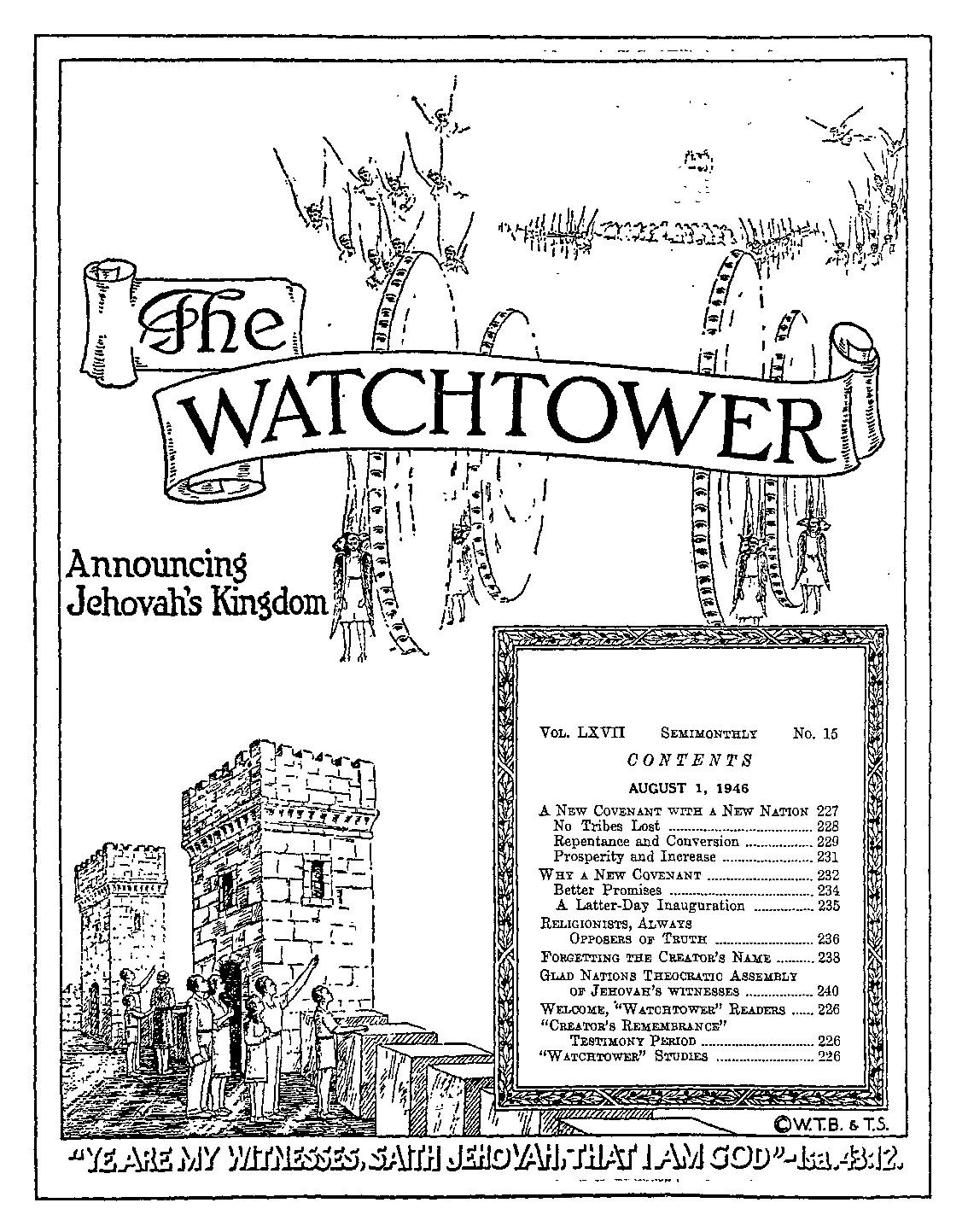
THE WATCHTOWER.
Published Semimonthly By
WATCH TOWER BIBLE & TRACT SOCIETY 117 Adams Street - - Brooklyn 1, N.Y., U.SA..
Officbbb
N. H. Knobb, President W. E. Van Ambuboh, Secretary
“And all thy children shall be taught of Jehovah; and great shall be the peace of thy children.” - Isaiah 54:13.
THE BIBLE CLEARLY TEACHES
THAT JEHOVAH Is the only true God, from everlasting to everlasting, and is the Maker of heaven and earth and Giver of life to his creatures; that the Word or Logos was the beginning of his creation and his active agent in creating all other things; and that the creature Lucifer rebelled against Jehovah and raised the issue of His universal sovereignty;
THAT GOD created the earth for man, made perfect man for the earth and placed him upon it; that man yielded to unfaithful Lucifer, or Satan, and willfully disobeyed God's law and was sentenced to death; that by reason of Adam’s wrong act all men are born sinners and without the right to life;
THAT THE LOGOS was made human as the man Jesus and suffered death in order to produce the ransom or redemptive price for obedient men; that God raised up Christ Jesus divine and exalted him to heaven above every other creature and clothed him with all power and authority as head of God’s new capital organization;
THAT GOD’S CAPITAL ORGANIZATION is a Theocracy called Zion, and that Christ Jesus is the Chief Officer thereof and is the rightful King of the new world; that the faithful anointed followers of Christ Jesus are Zion's children, members of Jehovah's organization, and are His witnesses whose duty and privilege it Is to testify to Jehovah’s supremacy and declare his purposes toward mankind as expressed In the Bible;
THAT THE OLD WORLD, or Satan's uninterrupted rule, ended A.D. 1914, and Christ Jesus has been placed by Jehovah upon the throne, has ousted Satan from heaven, and now proceeds to vindicate His name and establish the “new earth”;
THAT THE RELIEF and blessings of the peoples can come only by Jehovah's kingdom under Christ, which has begun; that His next great act is to destroy Satan’s organization and establish righteousness completely in the earth ; and that under the Kingdom the people of good-will surviving Armageddon will carry out the divine mandate to “fill the earth” with righteous offspring, and that the human dead In the graves will be raised to opportunities of life on earth.
ITS MISSION
HIS Journal 18 published for the purpose of enabling the people to know Jehovah God and his purposes as expressed in the Bible. It publishes Bible Instruction specifically designed to aid Jehovah’s witnesses and all people of good-wilL It arranges systematic Bible study for its readers and the Society supplies other literature to aid in such studies. It publishes suitable material for radio broadcasting and for other means of public instruction in the Scriptures.
It adheres strictly to the Bible as authority for its utterances. It is entirely free and separate from all religion, parties, sects or other worldly organizations. It Is wholly and without reservation tor the kingdom of Jehovah God under Christ his beloved King. It Is not dogmatic, but invites careful and critical examination of its contents in the light of the Scriptures. It does not Indulge in controversy, and its columns are not open to personalities.
Ybablt Subscription Prick
United States, 3 1.00; all other countries. 51 50, American currency; Great Britain, Australasia, and South Africa, 6s. American remittances should be made by Postal Note cr by Postal or Express Money Order or by Bank Draft Outside of the United States remittances should be made direct to the respective branch offices. Remittances from countries other than those mentioned may be made to the Brooklyn office, but by International Postal Money Order only.
Foreign Orness
Australia 7 Beresford Rd., Strathfield, N. S. W.
Canada_______________________________ 40 Irwin Ave , Toronto 5, Ontario
England _____________________________34 Craven Terrace, London. W 2
India 167 Love Lane. Bombay 27
Newfoundland P. O. Box 521, St John’s
New Zealand _________________________ 177 Daniell St., Wellington, S 1
Philippine Islands 1219-B Oroquieta St.. Manila
South Africa________________ 623 Boston House. Cape Town
Please address the Society in every case.
Translations of this journal appear in several languages.
ALL SINCERE STUDENTS OF THE BIBLE who bv reason of Infirmity, poverty or adversity are unable to pay the subscription price may have The Watchtower free upon written application to the publishers, made once each year, stating the reason for so requesting it We are glad to thus aid the needy, but the written application once each year is required by the postal regulations.
Notice to Subscribers: Acknowledgment of a new or a renewal subscription will be sent only when requested. Change of address, when requested, mav be expected to appear on address label within one month Old and new addresses must be given. A renewal blank (carrying notice of expiration) will be sent with the journal one month before the subscription expires.
Printed In the United States of America
Entered as secomrclass matter at the post office at Brooklyn, N. y., under the Act of March 3, 1879.
WELCOME, “WATCHTOWER” READERS
You are cordially invited to attend the Glad Nations Theocratic Assembly of Jehovah’s witnesses, Cleveland, Ohio, August 4-11, 1946.
Jehovah's witnesses world-wide are looking to the Glad Nations Theocratic Assembly as a time of feasting upon the Lord's Word, assembling with their brethren from all parts of the earth and engaging in the true worship of Jehovah God. Representatives from many nations will tell you about Jehovah’s witnesses’ activity in other lands.
We hope that you will be one to enjoy all the convention (its eight days) ; or, if not, at least a portion of it, including the last day, Sunday, August 11, 1946, to hear the lecture “The Pnnce of Peace”. If you are planning to be baptized in water, thus symbolizing your consecration to Jehovah, be sure to be there by Thursday evening, as the baptism will be Friday morning. Make your plans now and arrange for your room accommodations. Cleveland will be a crowded city, for it is expected that upward of 70,000 joyful people will come from the United States, Canada and other parts of the world. Address your inquiry on rooming accommodations to Watchtower Convention Rooming Committee, 2515 Franklin Blvd., Cleveland 13, Ohio.
Please read the last page of this issue of The Watchtower and you will get some idea of what is in store for the conventionera. Come and feast with the Lord’s servants at the Glad Nations Theocratic Assembly of Jehovah’s witnesses!
“CREATOR’S REMEMBRANCE” TESTIMONY PERIOD
For a month usually devoted to the recuperation of one’s physical vigor and strength and youthfulness in the Northern hemisphere the above name is very fitting. Not only school children then enjoying their vacations but also all others of Jehovah’s witnesses will want to remember their Creator by publishing the message of his name and kingdom. During August the thousands of Jehovah’s witnesses assembled at Cleveland and all other'publishers will offer to the reading public the combination of four of the Society’s booklets on a contribution of 10c, or ten selected booklets, including “Be Glad, Ye Nations”, on a contribution of 25c. The distribution of booklets has proved a splendid way for many new publishers to get started in the work of giving witness to God among the people, and doubtless many Watchtower readers will be interested to take part therein and thus show remembrance of their Creator. All that is necessary to be put in touch with those who will give practical instruction and association in the field service is to drop us a brief word. Do so, and we shall give it our earliest attention. At the close of this August Testimony Period we shall be delighted to receive field reports of more publishers of the Kingdom message.
“WATCHTOWER” STUDIES
Week of September 1: “A New Covenant with a New Nation.” fl 1-17 inclusive, The Watchtower August 1, 1946.
Week of September 8: “A New Covenant with a New Nation,” fl 18-29 inclusive, also “Why a New Covenant,” fl 1-4 inclusive, The Watchtower August 1, 1946.
Week of September 15: “Why a New Covenant,”
fl 5-26 inclusive, The Watchtower August 1, 1946.
ffieWWCHTOWER
ANNOUNCING JEHOVAH’S KINGDOM
Vol. LXVII August 1, 1946 No. 15
A NEW COVENANT WITH A NEW NATION
'Behold, the days come, saith Jehovah, that I zvill make a new covenant with the house of Israel, and with the house of Judah.”—Jer. 31: 31, Am. Stan. Ver.
TEHOVAH has produced a new covenant. It has I brought forth a new people, a new nation, distinct J and different from all the nations of the earth. That nation represents a new government, whose rule will reach to the ends of this earth to bestow upon all its willing subjects the blessings of enduring peace, freedom, prosperousness, security, health and life.
2 The new covenant which produces the people for this government of blessings has been in operation for more than nineteen centuries. Soon it will have served its purpose in producing the complete membership of this governmental body. Although the time of duration of the covenant has been so long, yet the membership of the new nation and its government is comparatively small. This goes to emphasize the excellency of this government and the high qualifications and requirements for anyone to participate in it. The covenant being now near its conclusion, we can look back over its history and note its course, especially its course in these momentous days of ours. This we shall now do with much benefit.
3 It is in the thirty-first chapter of Jeremiah’s prophecy that Jehovah God first disclosed his purpose to make the new covenant. In our last preceding issue of The Watchtower we considered the first seventeen verses of this chapter and marked how the Lord God promised to return his people from the land of the enemy and make them a free, happy and prosperous people in their homeland. We marked that this prophecy underwent a literal but partial fulfillment in the sixth century B.C., but now it had started out on a complete and major fulfillment in the first century of our common era. With pleasure we noted that the finish of the final and complete fulfillment takes place within our remarkable twentieth century.
4 Involved in the first and miniature fulfillment of this prophecy of restoration and reconstruction were
1. By producing a new covenant what has Jehovah brought forth?
2. How long is this covenant in operation, and why with such a small membership?
3. Where did Jehovah announce this covenant, and what did we note concerning this prophecy in the last Watchtower issue?
4. What developments led to friction and rivalry between the tribes of Judah and Ephraim? the twelve tribes of the nation of Israel in the land of Palestine. Outstanding among these twelve tribes were two, namely, Judah and Ephraim. They were both descended from a common forefather, Jacob, but by different mothers. The mother of the tribe of Judah was Jacob’s first wife, Leah, and Judah was her fourth son. Jacob’s second wife was Rachel, and Ephraim was her grandson. The father of Ephraim was Joseph, the first son that Rachel bore to Jacob. The promise of kingdom rulership was made to the tribe of Judah, but Ephraim was promised to be the most populous tribe. For these reasons there developed a friction and rivalry between the tribes of Judah and Ephraim.
5 In Jeremiah, chapter thirty-one, we hear Ephraim bemoaning the plight into which he had come. There Jehovah God says: “I have surely heard Ephraim bemoaning himself thus, Thou hast chastised me, and I was chastised, as a calf unaccustomed to the yoke: turn thou me, and I shall be turned; for thou art Jehovah my God. Surely after that I was turned, I repented; and after that I was instructed, I smote upon my thigh: I was ashamed, yea, even confounded, because I did bear the reproach of my youth.”—Jer. 31:18,19, Am. Stan. Ver.
“Why was this? Briefly, it was on this account: Under King Solomon of the tribe of Judah there arose discontent within Ephraim and nine of its brother tribes. Failing to get satisfaction from Solomon’s successor and son, Rehoboam, the ten discontented tribes revolted under the leadership of Ephraim and set up a kingdom of their own with an Ephra-imite, Jeroboam, as their king. The tribe of Judah was thus left with only the tribe of Benjamin and the Levites as its allies and supporters. But many individual Israelites crossed the boundaries over into the kingdom of Judah to live under it instead of under the newly formed kingdom of Israel. (See 2 Chronicles 11:13-16; 15:9.) Thus there were representatives of all twelve tribes, besides the Levites, living under Judah’s kingdom.
5. In the prophecy, with what words do we hear Ephraim bemoaning himself?
6. How did the kingdom of Israel and the kingdom of Judah come Into
existence? 227
T Early in the youth of the new ten-tribe kingdom of Israel they turned from the worship of Jehovah at his temple. In order to prevent the ten tribes from regularly going up each year to the foreign capital Jerusalem to worship Jehovah, the Ephraimite king of Israel started the worship of two golden calves as the national worship. Because the tribe of Ephraim was the leading and dominant tribe in the new kingdom of Israel, the entire kingdom of ten tribes was also often called “Ephraim”, as at Jeremiah 31:9, 18, 20. The other kingdom was called “the kingdom of Judah”, because its king was of the line of David of the house of Judah.
8 The kingdom of Israel went deeper and deeper into idolatry, finally going over to the worship of the sun-god Baal and other false gods of the Gentiles or heathen. God’s wrath came against them, therefore, and in 740 B.C. he permitted the Assyrian empire to destroy their capital city Samaria and to take the ten tribes of Israel off into exile in the distant lands of Assyria. (See 2 Kings, chapter seventeen.) Before this, however, many God-fearing Israelites took refuge in the kingdom of Judah that they might worship Jehovah God at his temple in Jerusalem. (2 Chron. 30:10-18) But finally even the majority of the kingdom of Judah fell away from Jehovah’s worship into idolatrous demon-worship. Hence, in the fortieth year of Jeremiah’s prophesying He permitted the Babylonians under King Nebuchadnezzar to destroy the once-holy city of Jerusalem and to take most of the surviving inhabitants of the kingdom of Judah into captivity in Babylon, in 607 B.C. Thus all the twelve tribes of the nation of Israel were at length found in captivity to the dominant world power, Babylon, and exiled from their homeland. Jeremiah’s prophecy was spoken, therefore, to show that a repentant remnant would be found of all twelve tribes and that this remnant would turn to the Lord Jehovah God as their God and would be restored to the Holy Land of Palestine. Therefore none of the twelve tribes would be wholly lost or destroyed, but there would be a faithful remnant drawn from all twelve, from Ephraim and the ten tribes which it represented as well as from the tribe of Judah and its allies, the Levites and the tribe of Benjamin.
9 In their captivity Ephraim, or all ten tribes for which it stood, did bemoan itself. That is, a remnant thereof did. In shame they confessed the reproachful sin of their youth, that of turning to calf-worship together with Baal-worship later on, thereby idolizing and worshiping creatures instead of the Creator God. This was called “the sin of Samaria”, because Samaria was the capital of the ten-tribe kingdom of
7. What sin did “Ephraim” commit in hig youth?
8. (a) What finally befell the kingdom of Israel and the kingdom of Judah for their course in sin? (b) Accordingly, what was Jeremiah’s prophecy spoken to show regarding the survivors?
9. What did bemoaning Ephraim confess and do?
Israel. (Amos 8:14) The remnant of Ephraim confessed that they were bearing the penalty for the sin of departing from the true worship. Now they appealed to Jehovah as the true God, the God of their faithful forefathers. They asked him to turn or return them to their homeland. In grief they smote themselves upon the thigh or the breast. They confessed that it was the true God that was mercifully chastising them in letting them be exiled in a pagan demon-worshiping world. The modern versions agree with the ancient Septuagint Version in reporting them as saying: “My exile led me to repent”; or, “Since I was exiled, I have repented.” (Moffatt; An Amer. Trans.) This is the kind of sorrow that the apostle Paul speaks of when he remarks: “Godly sorrow worketh repentance to salvation not to be repented of." (2 Cor. 7:10) What, then, followed?
10 By Jeremiah his prophet, Jehovah foretold that such repentance even upon the part of long-time sinning Ephraim and fellow tribes would arouse his loving compassions. Hence in the prophecy we hear the Lord God saying: “Is Ephraim my dear son 1 is he a darling child? for as often as I speak against him, I do earnestly remember him still: therefore my heart yearneth for him; I will surely have mercy upon him, saith Jehovah.” (Jer. 31: 20, Am. Stan. Ver.) Hence, when the repentant and faithful remnant of Israel were restored to Palestine from and after 537 B.C., there wete members of Ephraim or of the ten tribes represented by him among them. The old love that God had for them was expressed once again to them when he delivered them from Babylon and put them back in their homeland and set them to rebuilding the temple that they might worship Him only as their God.
NO TRIBES LOST
11 So it came about that in the days of Jesus and his apostles, when a remnant of the Israelites turned from the Jews’ religion to the pure Christianity, there were representative members of all tribes of Israel in Palestine, of Ephraim and the rest of the ten tribes as well as of the tribes of Judah and Benjamin and the Levites. Modern religious teaching that the ten tribes of Israel under Ephraim were lost after they were carried exile to the Assyrian provinces is not based upon Bible facts. One of the ten tribes headed by Ephraim was Asher; and Anna the prophetess, who was at the temple in Jerusalem when the 41-day-old babe Jesus was brought in at Mary’s purification, was of the “tribe of Aser”. (Luke 2:36-38) That all Israel was recognized as then dwelling in Palestine is shown by the angel’s command to Joseph in Egypt, where he had taken Jesus:
10. When did God’s old love tor Ephraim express itself again, and how? 11. During Jesus' inf&nthood were ten of the tribes of Israel lost to the land of Palestine? and wh&t evidence is there?
“Arise, and take the young child and his mother, and go into the land of Israel: for they are dead which sought the young child’s life.” “And he arose, and took the young child and his mother, and came into the land of Israel.”—Matt. 2r 20, 21.
12 God’s angel said concerning John the Baptist: “And many of the children of Israel shall he turn to the Lord their God.” (Luke 1:16) Jesus’ own statements agree that all twelve tribes were back in Palestine, for he said to them: “Verily I say unto you, I have not found so great faith, no, not in Israel." To his apostles whom he sent out to preach he said: “But go rather to the lost sheep of the house of Israel. . . . When they persecute you in this city, flee ye into another: for verily I say unto you, Ye shall not have gone over the cities of Israel, till the Son of man be come.” Also he said to a non-Israelite woman: “I am not sent but unto the lost sheep of the house of Israel."—Matt. 8:10; 10: 6, 23; 15: 24.
13 The faithful disciples of Jesus never spoke of ten tribes as lost to their nation, but always spoke of all the tribes as being recovered and living once more in Palestine. They said to Jesus: “Lord, wilt thou at this time restore again the kingdom to Israel?" (Acts 1:6) To the celebrators at the feast of Pentecost from various parts of the earth Peter said: “Ye men of Israel, hear these words; .. . Therefore let all the house of Israel know assuredly, that God hath made that same Jesus, whom ye have crucified, both Lord and Christ.” (Acts 2: 22, 36; also 4: 27) Peter later said, when before the Jewish Sanhedrin: “Ye rulers of the people, and elders of Israel, Be it known unto you all, and to all the people of Israel, that by the name of Jesus Christ of Nazareth, whom ye crucified, whom God raised from the dead, even by him doth this man stand here before you whole.” (Acts 4:8, 10; also 3:12) As concerning those reached by Jesus’ preaching in Palestine Peter said to Cornelius, the first Gentile convert: “The word which God sent unto the children of Israel, preaching peace by Jesus Christ: (he is Lord of all:) that word, I say, ye know.” (Acts 10:36,37) Peter’s expressions are all against the religious theory of ten lost tribes of Israel.
14 Another witness to the historical fact that the ten tribes of the kingdom of Israel headed by Ephraim were regathered back to Palestine with the other tribes of the kingdom of Judah is Paul the apostle. In an address to the synagogue at Antioch in Pisidia Paul said: “Men of Israel, and ye that fear God, give audience. The God of this people of Israel chose our fathers, and exalted the people ... Of this man’s [David’s] seed hath God according to his
12 . What did Jesus say, throwing light upon this question?
13 What expressions did the disciples, and particularly Peter, make, throwing further light upon the question?
14 , 15. (a) How did Paul also bear witness to the regathering of all Israel? (b) What religious theory therefore falls flat? and how do Ezekiel, Ezra and Nehemiah further disprove It? promise raised unto Israel a Saviour, Jesus: when John had first preached before his coming the baptism of repentance to all the people of Israel." (Acts 13:16,17, 23,24) At Caesarea, the capital of Judea, Paul’s words to King Agrippa are noteworthy, for he said to the king: “Now I stand and am judged for the hope of the promise made of God unto our fathers: unto which promise our twelve tribes, instantly serving God day and night, hope to come.” —Acts 26: 6,7.
15 In further proof that all twelve tribes had been regathered and none were “lost” in Assyria or elsewhere, Paul wrote these words: “Israel, which followed after the law of righteousness, hath not attained to the law of righteousness. Wherefore? Because they sought it not by faith, but as it were by the works of the law. For they stumbled at that stumblingstone; as it is written, Behold, I lay in Sion a stumblingstone and rock of offence: and whosoever believeth on him shall not be ashamed. Brethren, my heart’s desire and prayer to God for Israel is, that they might be saved.” (Rom. 9:31-33; 10:1) Paul here quoted from Isaiah 8:14, which speaks of the “stone of stumbling and . . . rock of offence to both the houses of Israel”, namely, the house of Judah and the house of ten Israelite tribes. (1 Pet. 2:8) The fanciful Anglo-Israelite theory that the supposed “ten lost tribes of Israel” are today none other than the British nation and the American peoples of Anglo-Saxon stock falls flat therefore, being contrary to the inspired Bible. The prophecy of Ezekiel 37:20-28 foretold that the tribes of Israel under Ephraim and the other tribes under Judah would all be restored to their homeland of Palestine and would again be brought to a unity. The records of Ezra and Nehemiah concerning the remnant of Israelites that did return to Palestine from and after 537 B.C. proves that all the tribes of all Israel had their representative brethren return there in unity. For authoritative proof read all the Scripture citations in the footnote below.*
REPENTANCE AND CONVERSION
“Directing his words to all the tribes of Israel in captivity and showing that they must retrace their steps, Jehovah by his prophet Jeremiah calls out: 'Erect thee waymarks, set thee up finger-posts, apply thy heart to the highway, the road by which thou didst depart,—Return, O virgin of Israel, return unto these thy cities. How long wilt thou turn hither and thither, O apostate daughter? For Yahweh hath created a new thing in the earth, A female defendeth
•Ezra 2: 2, 59, 70; 3:1; 4:3; 7:7, 10, 28; 8: 25, 29; 9:1; 10:1, 2, 5, 10; Nehemiah 2:10; 7:7, 61, 73; 9:1, 2; 11:3, 20; 12:47; 13:3; and Malachi 2:11; Luke 1:80; 7:9; John 1:31; 3:10.
16. With what words did Jehovah speak of their returning as a certainty? and what did their returning mean? a strong man!” (Jer. 31:21,22, Rotherham') Thus Jehovah speaks of it as a certainty that all twelve tribes would return in due time to the land of Jehovah’s re-established worship. With that in view, when being led off into captivity and exile in Babylon, they were to set up guidemarks along the way to serve for guidance when they should return. Their returning meant not merely a bodily return to Palestine but also the return from their apostasy to the true worship, that of Jehovah God at his temple in Jerusalem.
17 Those who depart from the right worship of the true God can, if they will just meditate, mark the course by which they went on a sidetrack from His worship into captivity to religion, which is of this Babylonish world. The way back to God’s service and to peaceful and blessed relationship -with Him at his spiritual temple is taken, therefore, by repenting of one’s wayward course and then by converting or turning one’s course back to Him according to the way He makes plain. Shortly before God made the new covenant with the new nation John the Baptist came preaching to the descendants of the twelve tribes in Israel: “Repent ye: for the kingdom of heaven is at hand.” Later, Jesus approached the Israelites in the same way, saying: “The time is fulfilled, and the kingdom of God is at hand: repent ye, and believe the gospel.” (Matt. 3:1, 2; 4:17; 10:7; Mark 1:14,15) The “two houses of Israel” did stumble over Christ Jesus as God’s appointed Foundation Stone or King; but a remnant out of all the tribes of Israel showed the true repentance and became converted. Such believing and faithful remnant returned from the bondage of religion in which the Jewish nation was held in a tight grip. Thus they got back to the land or position of God’s favor under his anointed King, Christ Jesus, of the house of David. Under him their King they became the nucleus or original part of the new nation, spiritual Israel, distinct from “Israel after the flesh” of whom the great majority rejected the Kingdom’s Foundation Stone, Christ Jesus.—1 Cor. 10:18; 1 Pet. 2:9,10.
18 In support of the truth that there is a new nation ■with whom the new covenant is made the apostle Paul writes: “In Christ Jesus neither circumcision [of Israel after the flesh] availeth any thing, nor uncircumcision, but a new creature. And as many as walk according to this rule [as regards a new creature], peace be on them, and mercy, and upon the Israel of God.” (Gal. 6:15,16) Paul writes further in proof that Christ Jesus is the Head of a new creation, a new nation, saying: “Henceforth know we no man after the flesh: yea, though we have known Christ after the flesh, yet now henceforth know we him
17. (a) What, therefore, is the way back to relationship with God? and how did John’* and .Teens’ words show it? (b) How did a remnant then return, and what did they become?
18. Supporting the truth that there is a new nation in the new covenant, what do Paul and Peter write? no more. Therefore if any man be in Christ, he is a new creature: old things are passed away; behold, all things are become new. And all things are of God.” (2 Cor. 5:16-18) In harmony with this the apostle Peter writes to this body of new creatures as a nation and says: “But ye are a chosen generation, a royal priesthood, an holy nation, a peculiar people; that ye should shew forth the praises of him who hath called you out of darkness into his marvellous light: which in time past were not a people, but are now the people of God.”—1 Pet 2:9,10.
18 As foreshadowed by that faithful Jewish remnant in the days of Jesus and his apostles, there has been a faithful remnant from and after A.D. 1918. They have not stumbled over Christ Jesus as the Foundation Stone of the righteous new world and as its rightful King. “Christendom” boastfully claims to be the new nation in the new covenant with God by Christ, yet she refuses to recognize the ending of the Gentile times of world domination A.D. 1914. Hence she refuses to give up her domination of the world and to accept Christ Jesus as God’s glorified King whose due time to reign is here since 1914. Out of all “Christendom” only a remnant has come forth who, in word and in deed, do accept and hail Christ Jesus as the reigning King whom they will serve and obey with unbreakable allegiance.
20 The remnant are consecrated witnesses of Jehovah, who since 1914 have been proclaiming to the nations of “Christendom” and all the world: “The Idngdom of heaven is at hand.” During World War I, of 1914-1918, they were greatly oppressed by the nations of “Christendom” because of their allegiance to Christ. Because of measurably giving way to fear of religious-political governments, they came into captivity to the great antitypical Babylon, this world. They yielded then to religious and political restraints upon their witness to God’s kingdom by Christ. Then, like the Israelite remnant in exile in ancient Babylon, they saw they had come short of the clean, pure worship of Jehovah God. They repented of their failure to serve Him actively without fear of creatures and sought to retrace their steps. In 1919 God, by his King Christ Jesus, began to deliver them from the enemy’s restraints both in a literal way and especially in a spiritual way. Then they fulfilled in a complete and final sense Jeremiah’s prophecy that the remnant of the “Israel of God” would return to their God-given homeland, his organization.
21 Then God created the new thing in the earth: “A female defendeth a strong man.” Other Bible trans-
19. How do “Christendom” and the present-day remnant differ as regards God's reigning King?
20. Why did this remnant have to repent? and how was Jeremiah’s prophecy concerning the remnant’s return fulfilled upon them?
21. How has the new thing been created, namely, “A woman shall compass a man”? lations render this: “A woman shall compass a man.” {Auth. Ver.) “Frail woman becomes manly!” {Moffatt) “The woman woos the man!” {An Amer. Trans.) Whichever is preferred, each translation contains the thought that those once womanly and hence weak would become strong and active like men. This has come to pass with the faithful remnant from and after 1919 by the spirit or active force of God poured out upon them. Instead of having Jehovah God woo and seek after them, they have wooed and hung around Him, who is the great “husband” of his universal organization. They have wooed and cleaved to Christ Jesus, who is the Bridegroom to his church. With manly courage they have since stood up boldly before all the world and confessed Jehovah’s name and proclaimed the glad tidings of His Idngdom now established in the hands of His King, Christ Jesus. The world-wide testimony to the Kingdom which these Christian witnesses of Jehovah have since given is therefore something new in this twentieth century, something the like of which this world has never before seen. It is Jehovah’s “strange work” in the earth prior to Armageddon.—Isa. 28: 21.
PROSPERITY AND INCREASE
22 What the prophet Jeremiah next foretells points to the prosperousness which the remnant of Jehovah’s witnesses have experienced in spiritual benefits, activities, and numbers of fellow worshipers of Jehovah God. “Thus saith Jehovah of hosts, the God of Israel, Yet again shall they use this speech in the land of Judah and in the cities thereof, when I shall bring again their captivity: Jehovah bless thee, 0 habitation of righteousness, 0 mountain of holiness. And Judah and all the cities thereof shall dwell therein together, the husbandmen, and they that go about with flocks. For I have satiated the weary soul, and every sorrowful soul have I replenished. Upon this I awaked, and beheld; and my sleep was sweet unto me. Behold, the days come, saith Jehovah, that I will sow the house of Israel and the house of Judah with the seed of man, and with the seed of beast.”—Jer. 31: 23-27, Am. Stan. Ver.
23 The capital of the kingdom of Judah was Jerusalem. In it was found the holy mountain upon which the temple was built by Solomon for the worship of the true and living God. The Babylonian armies wrecked that temple and profaned its sacred hill in 607 B.C., but the Israelite remnant that returned seventy years later rebuilt the temple upon its old site. For this Jehovah God blessed the faithful remnant with large flocks and plenteousness of farm products in their homeland. He multiplied their once small numbers, both as to men and as to domesticated 22. With what words did Jeremiah then foretell the prosperity which the remnant have experienced?
23. Why and how did Jehovah bless the remnant of 537 B.C.? and how would Jeremiah’s sleep have been made sweet for him? animals. If Jeremiah had then awaked out of his sleep of death and beheld that first or miniature fulfillment of the prophecy, his further sleep of death thereafter until God’s kingdom is established would have been sweetened for him. His was no idle dream of pleasantness. If that ancient witness of “Jehovah of hosts, the God of Israel”, could see how the prophecy has come true in completion since 1919 upon Jehovah’s witnesses now, it would be most pleasant to him, because it vindicates God’s Word as true.
24 In these days Jehovah has blessed the habitation of his righteous kingdom by Christ and has restored the pure worship at the holy mountain of his spiritual temple. He not only has regathered his remnant of ■witnesses to a fearless, united worship and service of Him throughout all the earth but has blessed their work in the witness field and among the flocks of God. He has increased their means and methods for holding forth the fruits of the Kingdom to the peoples of all nations. He has also added -to the small number of his remnant a vast number of consecrated persons of good-will, who increase daily in numbers. This is satisfying, filling to us.
25 Guaranteeing that this blessed state of his faithful remnant will not be reversed, Jehovah of hosts, the God of Israel, adds: “And it shall come to pass that, like as I have watched over them to pluck up, and to break down, and to throw down, and to destroy, and to afflict; so will I watch over them, to build, and to plant, saith the Lord. In those days they shall say no more, The fathers have eaten a sour grape, and the children’s teeth are set on edge. But every one shall die for his own iniquity: every man that eateth the sour grape, his teeth shall be set on edge.”—Jer. 31: 28-30.
26 The reason why Jehovah was alert and on the watch to uproot, overturn and demolish as regards the twelve tribes of Israel was that they forsook the worship of the Creator, disobeyed his laws and commandments, and thereby broke the law covenant which he made with them through His prophet Moses. Such covenant-breakers turned to the worship of creatures and built up a great religious organization in imitation of the heathen. Thereby they brought much reproach upon the name of Jehovah, whose name they took upon themselves in vain. He had not given them the Promised Land for such purposes, and hence he chastised them at the hand of their enemies for a long period of time. At length he acted to uproot and destroy completely their religious organization in the Promised Land. In 740 B.C. he caused the ten tribes of the kingdom of Israel to be
24. How has Jehovah blessed the habitation of righteousness and the mountain of holiness, and also the remnant of today?
25. With what words does Jehovah guarantee that this blessed state of the remnant will not be reversed?
26. Why did Jehovah watch over the Israelites to pluck up and destroy? and how did he do these things? completely conquered and deported to the distant provinces of Assyria; and in 607 B.C. he meted out like treatment upon the kingdom of Judah. Its subjects were plucked up off their homeland and made captives in the enemy land of Babylon. Then the land of Judah and Jerusalem lay desolate for seventy years, as forewarned.
” Now that the remnant had repented and mended their ways and turned from religion to God’s right worship, Jehovah promised to be alert to show them mercy, for His own name’s sake, to "build and to plant” them in their homeland, from 537 B.C. onward, when he restored them. However, the fulfillment of the prophecy back there was only partial and in miniature. Why! Because once again there was a fall into religion, by the offspring of that restored remnant, under the influence of which they yielded to their religious heads and turned over the Messiah, Christ Jesus, to Roman hands to be killed like a blasphemer and malefactor. They then proceeded to persecute the remnant who followed in the steps of the Messiah. On that account the Lord God caused them to be uprooted from Palestine and their religious organization therein to be overturned and destroyed A.D. 70. In that year the Roman armies destroyed Jerusalem for its second time and then pushed ahead to uproot the Israelites from the land and scatter them into all countries of the earth.
28 Nothing is more evident, therefore, than that there must come a complete and major fulfillment of the prophecy. It has come upon the faithful remnant of Jehovah’s witnesses at this end of the world. These repented of all their failures in 1918 and then God’s power reinstated them in their spiritual privileges and opportunities from and after 1919. Because of cleansing themselves from all religion and faithfully
27. (a) Why did He watch over them to do them good? (b) What then happened to prove the prophecy’s fulfillment only partial?
28. upon whom does the prophecy’s complete fulfillment come, and why and how?
engaging in His service since then, God watches over this remnant to do them good, and that without an end. Because Jehovah of hosts, the God of Israel, has built them up and planted them in the earth as His witnesses, their enemies will fail to uproot, tear down, and destroy the remnant of faithful worshipers. The enemies shall themselves be destroyed at the battle of Armageddon.
29 Hence now is when it is no more to be said, “The fathers have eaten sour grapes, and the children’s teeth are set on edge. But every one shall die for his own iniquity: every man that eateth the sour grapes, his teeth shall be set on edge.” (Am. Stan. Ver.) The remnant avoid the sour grapes which are borne by the vine of the Devil’s visible earthly organization ■with its politics, selfish commerce and God-dishonoring religion. The remnant, instead, hold forth the fruits of God’s true Vine, the King Christ Jesus, whose “branches” they are as heirs of the Kingdom. Hence their Father Jehovah is glorified. (John 15:1-8) His Theocratic organization of the remnant will not go wrong and bring His condemnation and death upon the children or members of the organization. Individual members of the organization may go wrong, being attracted to the sour, death-dealing grapes of religion’s counterfeit kingdom of God and its “new world made with human hands”; but eating such grapes will painfully sensitize only their own teeth. They only will be the ones to suffer death at God’s hands for their unfaithfulness and not keeping integrity. But the Theocratic organization of the remnant will continue to live on, enjoying God’s approval, announcing his kingdom, and declaring the purposes for which his name stands. (Zeph. 3:13; Rev. 22:3-5) Let each one of the remnant and of their good-will companions take heed, therefore, to himself, holding fast to the Theocratic organization.
29. How 1? it true now that “every man that eateth the sour grape* his teeth shall be set on edge”?
WHY A NEW
AMONG the new things which the Creator introduces among men is the new covenant or new compact with his new nation. “Behold, the days come, saith Jehovah, that I will make a new covenant with the house of Israel, and with the house of' Judah: not according to the covenant that I made with their fathers in the day that I took them by the hand to bring them out of the land of Egypt; which my covenant they brake, although I was a husband unto them, saith Jehovah.”—Jer. 31: 31, 32, Am. Stan. Ver.
2 This is a hard saying for the Jews who emphati-
1. According to Jeremiah, chapter thirty-one, what new arrangement has Jehovah introduced among men?
2. Why is that a saying hard for the Jews practicing Judaism?
COVENANT
cally claim to hold fast to the law covenant which Jehovah made with their nation through Moses as mediator, but which covenant they continue to break by the "Jews’ religion”, or Judaism, which they practice under the leadership of rabbis. A new covenant would mean a new mediator, a new priesthood, and new commandments and laws. That would mean, too, that the almost idolized Moses would be set aside, together with the rabbis who pretend to hand down the oral and unwritten law from Moses by the traditions of the long line of rabbis. Still the fact remains that Jehovah, the God of Moses, promised to make a new covenant different from that which he made with the Israelites through Moses. Let no natural Jew think, however, that this is any discredit to the much respected Moses. It is rather a testimony against the Israelite covenanters, because, as God said, they broke His covenant made with them in Egypt through Moses.
3 Since no covenant is made and put in force except over blood ef sacrificial victims, therefore the lawcovenant by Moses was made in Egypt over the blood of the passover lamb just before God took the nation of Israel by the hand to lead them out of that land of bondage. (Ex. 12:1-51) About fifty days after they left Egypt, Jehovah God inaugurated the law covenant toward his freed people, at Mount Sinai in Arabia. (Ex. 24:1-8) Disclosing that the purpose of this covenant or compact was to take out a people from this world to be a people called by His name and exclusively serving His purposes, Jehovah said to them at Mount Sinai: “Ye have seen what I did unto the Egyptians, and how I bare you on eagles’ wings, and brought you unto myself. Now therefore, if ye will obey my voice indeed, and keep my covenant, then ye shall be a peculiar treasure unto me above all people: for all the earth is mine: and ye shall be unto me a kingdom of priests, and an holy nation.” Through Moses as their mediatorial spokesman the natural Israelites told Jehovah God that they agreed to His terms.—Ex. 19:1-8.
* By keeping this covenant they would be preserved as a people different from all the w-orld. They would continue to be prized as Jehovah’s own possession whom he rescued from death-bringing slavery in Egypt. They would be a Theocratic kingdom with Jehovah God as their invisible but real King and Lawgiver. Their priests would be the King’s representatives and would have an accepted, recognized standing with Him and thus be fit to offer acceptable sacrifices to him for their sins. They would be .a holy nation, that is, an unworldly nation entirely given over to God’s righteousness and clean and separate from all other nations on earth and their religion. To produce such a people was the purpose of this Mosaic covenant.
3 Jehovah was a “husband” to that Theocratic organization of Israelites, because he joined it to himself as its Lord and Owner to serve him and to bring forth the people for His name. But this typical organization proved to be an unfaithful woman to Jehovah God, for they kept on breaking that covenant till finally he cast them away. As some modern versions read, in harmony with the ancient Septua-gint Version translation of Jeremiah 31: 32: “That covenant of mine which they broke, so that I had to reject them” (An Amer. Trans.); “The compact that 3. Where and how waa the law covenant made and inaugurated? and what did Jehovah’s words show its purpose to be’
4. How, by keeping the covenant, would such a people be produced? 5. How was Jehovah a “husband” to them? but what was the outcome to tbeir course of action toward the covenant? they broke, till I had to reject them.” (Moffatt) “They continued not in my covenant, and I regarded them not.” (Heb. 8: 9, according to the Septuagint) Their continued covenant-breaking reached its high point A.D. 33, when they handed the Promised One of whom Moses had written prophetically over to the Gentiles to be nailed to a tree at Calvary. So there Jehovah God finally rejected Israel according to the flesh, but at the same time made a new covenant for his new nation, spiritual Israel.
’ Notice with whom it is that Jehovah promised to make the new covenant, namely, “with the house of Israel and with the house of Judah.” Besides showing that the covenant would be made -with all twelve tribes of Israel, this shows that no ten tribes would be lost at the time of making the covenant, but that members of all twelve tribes, including Ephraim, would be in Palestine or in other Jewish communities with synagogues at the time of making the new covenant. (See pages 228, 229, fl 11-15.) When the covenant was made, it was not made with fleshly Israel as such, through its representative chief priests, scribes, lawyers and religious rulers, for these rejected Christ Jesus, who spoke to his disciples about the new covenant. Nevertheless, Jehovah did not cast off all the fleshly Israelite nation, but made his covenant with a remnant who followed the Messiah and who were drawn from each and all of the tribes of natural Israel. The apostle Paul so says, at Bomans 11:1-7.
7 However, because the Israelites brought into the new covenant were just a remnant and insufficient to make up the entire new nation of people for Jehovah’s name, in due time he brought in the believing and obedient Gentiles into the covenant. Thus the nation of people for Jehovah’s name and purposes is not strictly Jewish in its extraction nor exclusively Gentile in its extraction, but those from among the Israelites and from among the Gentiles are made one in this nation. It is a new nation under a covenant different from the covenant of the law of Moses. It is spiritual Israel, and all members of it are fellow citizens.—Eph. 2:11-22.
8 Since the old Mosaic covenant had its sacrifice of validation and its mediator, and its priesthood, the making of a new covenant means there must be a new sacrifice, a new mediator, a new priesthood, and not inferior ones, but better ones, because the new covenant is a better covenant based upon better promises. The priestly Israelite, John the Baptist, and also the Pharisee Jew, Paul, a pupil of Rabbi Gamaliel, both testify that Jesus of Nazareth is in his sacrificial
6. With whom was the new covenant promised to be made? and with whom actually was it made?
7. Why is the people of the new covenant not strictly of Jewish extraction? and why is it a new nation?
8. (a) As compared with the old covenant, what does the making of the new one mean? (b) Identify the new covenant’s sacrifice of validation, its mediator, and its high priest? death the real Passover Lamb, "the Lamb of God which taketh away the sin of the world.” And Peter and John also agree that Jesus was the Lamb, whose sacrifice validates the new covenant. (1 Cor. 5:7; John 1:29, 36; 1 Pet. 1:18,19; Rev. 5: 6-13; 7:9-14) Peter also testified that Christ Jesus is the Prophet whom God told Moses that He would raise up like unto Moses but greater than him. Hence Christ Jesus is the reasonable one and the one qualified to act as Mediator of the new covenant with its better promises. (Acts 3: 20-26) Seeing that he was the Son of God come down to earth and born as a natural Israelite, he offered a better sacrifice than the Jewish priests did in that he offered up his own human self. He was therefore fit to serve as a High Priest better and more effective than the Aaronic priesthood of the old Mosaic law covenant. Let Jews as well as Gentiles note these facts and act on them and be glad with God’s new nation of the new covenant. These facts are true. Note the inspired testimony thereto now quoted:
3 "For there is one God, and one mediator between God and men, the man Christ Jesus; who gave himself a ransom for all, to be testified in due time.” (1 Tim. 2: 5, 6) “But when Christ arrived as the high priest of the bliss that was to be, he passed through the greater and more perfect tent which no hands had made (no part, that is to say, of the present order), not taking any blood of goats and oxen but his own blood, and so entered once for all into the Holy place, securing a redemption that is eternal. For if the blood of goats and bulls and the ashes of a heifer, sprinkled on defiled persons, give them a holiness that bears on bodily purity, how much more shall the blood of Christ, who in the spirit of the eternal offered himself as an unblemished sacrifice to God, cleanse your conscience from dead works to serve a living God? He mediates a new covenant for this reason, that those who have been called may obtain the eternal inheritance they have been promised, now that a death has occurred which redeems them from transgressions involved in the first covenant.
“Thus, in the case of a will, the death of the testator must be announced, for a will only holds in cases of death; it is never valid so long as the testator is alive. Hence even the first covenant of God’s will was not inaugurated [at Mount Sinai] apart from blood; for after Moses had announced every command in the Law to all the people, he took the blood of calves and goats, together with water, scarlet wool and hyssop, sprinkling the book and all the people, and saying, This is the blood of that covenant which is God’s command for you. He even sprinkled with blood the tent
9. (a) How did Christ Jesus serve and officiate to be the Mediator? (b) How was the need of the blood of his sacrifice prefigured? and all the utensils of worship in the same way. In fact, one might almost say that by Law everything is cleansed with blood. No blood shed, no remission of sins! Now, while the copies of the heavenly things had to be cleansed with sacrifices like these, the heavenly things themselves required nobler sacrifices. For Christ has not entered a holy place which human hands have made (a mere type of the reality!); he has entered heaven itself, now to appear in the presence of God on our behalf.”—Heb. 9:11-24, Moffatt.
10 With a perfect understanding that he is the Mediator of the new covenant because he is at the same time the sacrificial victim over whose blood the new covenant comes into force, Jesus celebrated the last passover with his disciples A.D. 33 and then with his eleven faithful apostles he set up a Memorial of Christ’s death. "He took the cup, and gave thanks, and gave it to them, saying, Drink ye all of it; for this is my blood of the new testament, which is shed for the remission of sins.” (Matt. 26: 27, 28; Mark 14: 23, 24) Those who are brought into the new covenant as the members of the new nation must drink his blood, figuratively speaking. That is, his shed blood represents death sacrifically for the vindication of Jehovah’s name; and so these in the new covenant must die with him and be “made conformable unto his death” and be “baptized into his death”. (2 Tim. 2:11; Phil. 3:10; Rom. 6: 3-5) At his death on that passover day, Nisan 14 of A.D. 33, the new covenant was made valid. But it was not inaugurated till he ascended to heaven after his resurrection from the dead. As its mediator he inaugurated it on the day of Pentecost, fifty days after his resurrection, by pouring out the holy spirit upon the faithful remnant of Jews who were taken into the new covenant. —Acts 2:1-33; 2 Cor. 3: 6-8.
BETTER PROMISES
11 Referring to the new nation, spiritual Israel, the Lord God tells of the better promises on which the new covenant rests, saying: “But this is the covenant that I will make with the house of Israel after those days, saith Jehovah: I will put my law in their inward parts, and in their heart will I write it; and I will be their God, and they shall be my people. And they shall teach no more every man his neighbor, and every man his brother, saying, Know Jehovah; for they shall all know me, from the least of them unto the greatest of them, saith Jehovah: for I will forgive their iniquity, and their sin will I remember no more.”—Jer. 31: 33, 34, Am. Stan. Ver.
12 Thus, with the new covenant, there was promised to come an inward, heartfelt love of righteousness, and a thorough-going knowledge of the God of the 10. (a) How must those in the new covenant drink his blood? (b) When and how was the new covenant made operative and then inaugurated? 11. What better promises did Jehovah make regarding the new covenant’ 12. How were such promised benefits better than those of the old? eovenant, and a justification from sin in his sight. This was far better than the benefits of the old law covenant, for the Mosaic law of that old covenant was carved upon hard, cold stone and also written upon manuscript scrolls; and the knowledge of Jehovah and of his law was mainly reposed with the priests and Levites as instructors; and the animal sacrifices which such priests offered did not justify or perfect the Israelites but needed to be repeated regularly year after year.
13 The apostle Paul was a minister of the new covenant. (2 Cor. 3: 5, 6) By the spirit’s illumination he shows that Christ Jesus was made God’s High Priest with the divine oath and is therefore so much better than the Levitical priests of the old law covenant, saying: “For they indeed have been made priests without an oath; but [Christ Jesus] with an oath by him that saith of him, The Lord sware and will not repent himself, Thou art a priest for ever); by so much also hath Jesus become the surety of a'better covenant. And they indeed have been made priests many in number, because that by death they are hindered from continuing: but he, because he abideth for ever, hath his priesthood unchangeable. Wherefore also he is able to save to the uttermost them that draw near unto God through him, seeing he ever liveth to make intercession for them. For such a high priest became us, holy, guileless, undefiled, separated from sinners, and made higher than the heavens; who needeth not daily, like those high priests, to offer up sacrifices, first for his own sins, and then for the sins of the people: for this he did once for all, when he offered up himself.”—Heb. 7:21-27, Am. Stan. Ver.
14 The apostle continues, saying concerning Jesus: “But now hath he obtained a ministry the more excellent, by so much as he is also the mediator of a better covenant, which hath been enacted upon better promises. For if that first covenant had been faultless, then would no place have been sought for a second [covenant]. For finding fault with them [the Israelites], he saith, Behold, the days come, saith the Lord, that I will make a new covenant with the house of Israel and with the house of Judah; not according to the covenant that I made with their fathers in the day that I took them by the hand to lead them forth out of the land of Egypt; for they continued not in my covenant, and I regarded them not [rejected them], saith the Lord. For this is the covenant that I will make with the house of Israel after those days, saith the Lord; I will put my laws into their mind, and on their heart also will I write them: and I will be to them a God, and they shall be to me a people: and they shall not teach every man
13. How does Paul show that Jesus is a Priest higher and more effective than the many Levitical pnests of the law covenant?
14. With respect to what is the new a “better covenant”? and how was the second covenant shown to be necessary? his fellow-citizen, and every man his brother, saying, Know the Lord: for all shall know me, from the least to the greatest of them. For I will be merciful to their iniquities, and their sins will I remember no more.
15 “In that he saith, A new covenant, he hath made the first old. But that which is becoming old and waxeth aged is nigh unto vanishing away.” (Heb. 8: 6-13, Am. Stan. Ver.) At the vanishing away of the old law covenant A.D. 33 came in the new covenant with its better sacrifice, its superior priesthood and mediator, its better promises, and a new nation with greater blessings and opportunities.
18 Pointing to the blessing of actual justification that comes to this new nation through the one sacrifice of the greater Mediator and High Priest, Christ Jesus, the apostle says: “For by one offering he hath perfected for ever them that are sanctified. And the holy spirit also beareth witness to us; for after he hath said, This is the covenant that I will make with them after those days, saith the Lord: I will put my laws on their heart, and upon their mind also will I write them; then saith he, And their sins and their iniquities ■will I remember no more. Now where remission of these is, there is no more offering for sin.” (Heb. 10:14-18, Am. Stan. Ver.) Jesus’ sacrifice, therefore, needs no repeating.
A LATTER-DAY INAUGURATION
17 In our days, from and after 1919, the promises of the new covenant are fulfilled in a grand way toward the remnant of the witnesses of Jehovah, the final members on earth of the new nation. When the new covenant toward the Jewish remnant was inaugurated on the day of Pentecost A.D. 33 at Jerusalem, the spirit or Jehovah’s active force was poured out upon them and they began giving a far-reaching witness to His purposes in many languages. By that spirit God’s law of the new covenant was imprinted upon their hearts and minds. Then those spirit-filled Christians, though of the uneducated class, were taught a knowledge of Jehovah God and of his anointed Son, Jesus Christ, far in advance of the highly educated priests, scribes, lawyers, Pharisees and Sadducees of the Jews’ religion.
18 As published in past issues of The Watchtower, for example, that of August 1, 1944, fl 27-38, pages 232-234, there was a corresponding outpouring of spirit upon Jehovah’s faithful remnant of witnesses from and after A.D. 1919. It resulted in a world-wide witness to Jehovah’s name and kingdom such as earth has never known till now. This argues that the new
15. How was the law covenant made old? and with its vanishing away what came in?
16. How was justification from sin shown to be promised in the new covenant? and how does it come?
17. When the new covenant was first inaugurated, what took place?
18. What corresponding facts argue that the new covenant has been inaugurated now in a final and complete sense? covenant has been inaugurated in a final and complete sense by Christ Jesus at the temple, because we have reached the “mountain” of God’s established kingdom. (Heb. 12:18-29) In keeping with the better promises of the new covenant Jehovah has shown, in a most manifest way before all the worldly nations, that this remnant of witnesses are his people. And this remnant have, without any fear or shame, confessed that Jehovah is their God, whose name they are glad and thankful to bear and honor.
19 Trusting in the divine promises attached to the new covenant, that the Lord God Jehovah shall be known to all fellow citizens of his new nation, they look to no clergymen or man-made religious system for teaching and instruction. They do not view any of themselves as their teachers and then follow such. They are children of Zion, God’s Theocratic organization ; and they rely upon his promise to her: “And all thy children shall be taught of Jehovah; and great shall be the peace of thy children.” (Isa. 54:13, Am. Stan. Ver.; John 6:45) They may have eaten the bread of adversity and drunk the water of affliction, but they prize Jehovah’s teaching as better than material things and earthly comforts, and they recognize Him as their Teacher by Christ Jesus. They have his promise: “Though My Lord should give you bread in short measure and water in scant allowance, yet will thy Teacher not hide himself any more, but 19. To whom, therefore, do the remnant look for teaching? and how are They taught?
…