The Watchtower, August 1, 1945
Download: PDF — The Watchtower, August 1, 1945
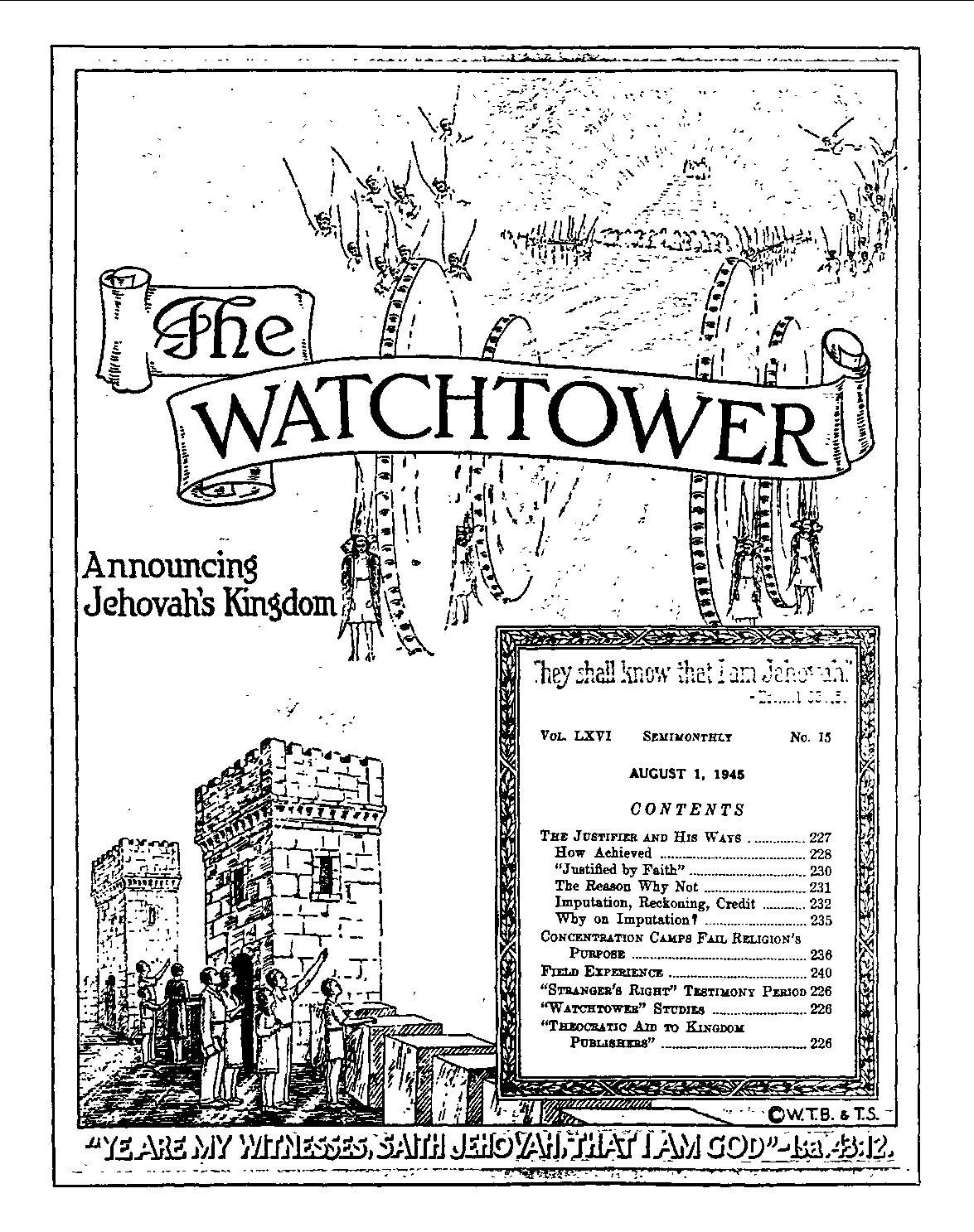
fHeWATCHTOWEK
Published Semimonthly By
WATCH TOWER BIBLE & TRACT SOCIETY 117 Adams Street - - Brooklyn 1, N.Y., U.S-A
01TICEBS
N. H. Knorr, President NJ. E. Van Amburgh, Secretary “And all thy children shall be taught of Jehovah; and great shall be the peace of thy children.” - Itttah 54:13.
THE SCRIPTURES CLEARLY TEACH
THAT JEHOVAH is the only true God and is from everlasting to everlasting, the Maker of heaven and earth and the Giver of life to his creatures; that the Logos was the beginning of his creation, and his active agent in the creation of ail other things, and is now the Lord Jesus Christ in glory, clothed with all power in heaven and earth, as the Chief Executive Officer of Jehovah;
THAT GOD created the earth for man, created perfect man for the earth and placed him upon it; that man willfully disobeyed God’s law and was sentenced to death; that by reason of Adam’s wrong act all men are born sinners and without the right to life;
THAT THE LOGOS was made human as the man Jesus and suffered death in order to produce the ransom or redemptive price for obedient ones of mankind; that God raised up Jesus divine and exalted him to heaven above every other creature and above every creature’s name and clothed him with all power and authority;
THAT GOD’S CAPITAL ORGANIZATION is a Theocracy called Zion, and that Christ Jesus is the Chief Officer thereof and is the rightful King of the world; that the anointed and faithful followers of Christ Jesus are children of Zion, members of Jehovah’s organization, and are his witnesses whose duty and privilege it is to testify to the supremacy of Jehovah, declare his purposes toward mankind as expressed in the Bible, and to bear the fruits of the Kingdom before all who will hear;
THAT THE OLD WORLD ended in A.D. 1914, and the Lord Jesus Christ has been placed by Jehovah upon his throne of authority, has ousted Satan from heaven and is proceeding to the establishment of the “new earth” of the New World;
THAT THE RELIEF and blessings of the peoples of earth can come only by and through Jehovah’s kingdom under Christ, which has now begun; that the Lord's next great act is the destruction of Satan’s organization and the complete establishment of righteousness in the earth, and that under the Kingdom the people of good-will that survive Armageddon shall carry out the divine mandate to “fill the earth" with a righteous race.
ITS MISSION
THIS journal is published for the purpose of enabling the people to know Jehovah God and his purposes as expressed in the Bible. It publishes Bible instruction specifically designed to aid Jehovah’s witnesses and all people of good-will. It arranges systematic Bible study for its readers and the Society supplies other literature to aid in such studies. It publishes suitable material for radio broadcasting and for other means of public instruction in the Scriptures.
It adheres strictly to the Bible as authority for its utterances. It is entirely free and separate from al] religion, parties, sects or other worldly organizations. It is wholly and without reservation for the kingdom of Jehovah God under Christ his beloved King. It is not dogmatic, but invites careful and critical examination of its contents in the light of the Scriptures. It does not indulge in controversy, and its columns are not open to personalities.
Ysailt Sobscbiption Pbicb
Unitbd Statu, *1.00; all other countries, *1.60, American currency; Great Britain, Austbalasia, ano South Arica. 6a. American remittances should be made by Postal or Express Money Order or by Bank Draft. British, South African and Australasian remittances should be made direct to the respective branch offices. Remittances from countries other than those mentioned may be made to the Brooklyn office, but by International Postal Money Order only.
Fobsion Ontcaa
British 34 Craven Terrace, London, W. 2. England Asatrnlosiait 7 Bereeford Road, Btratbfield, N. 3. IV., Australia South African...........Boston House, Cape Town, South Africa
Indian . ■ - - ________ 167 Love Lane, Bombay 27, India
Please address the Society In every ease.
Translations of this journal appear In aeveral languages.
ALL SINCERE STUDENTS OF THE BIBLE who by reason of Infirmity, poverty or adversity are unable to pay the subscription price may have The Watchtower free upon written application to the publishers, made once each year, stating the reason for so requesting it. We are Siad to thus aid the needy, but the written application once each year i required by the postal regulations.
Notice to Subscribers: Acknowledgment of a new or a renewal subscription will be sent only when requested. Change of address, when requested, may be expected to appear on address label within one month. A renewal blank (carrying notice of expiration) will be sent with the journal one month before the subscription expiree.
Printed In the United States of America
Bntered as second-class matter at the post office at Brooklyn, N. T., under the Act of March 1, ISIS
“STRANGER’S RIGHT” TESTIMONY PERIOD
August is the month of the “Stranger’s Right” Testimony Period. During this month all lovers of right and truth will be diligent to accord to the “stranger” class the right to hear the Word of God and to have help in understanding it, by bringing to them the Kingdom message. They will specialize on the combination of the book “The Kingdom Is at Hand" and the booklet released for this period, The “Commander to the Peoples", offering this on a contribution of 25c. Many of our Watchtower readers may view themselves as “strangers” and yet want to join in taking part in the spread of this wonderful message. Let such be informed that it is their God-given right to have a part therein. So let all such write us for information, and we will link them up with a group of veteran publishers active in the work for companionship. As a finishing touch to your efforts during August, please submit us a report of what you do.
“WATCHTOWER” STUDIES
Week of September 2; “The Justifier and His Ways,” fl 1-22 inclusive, The Watchtower August 1, 1945.
Week of September 9: “The Justifier and His Ways,” fl 23-46 inclusive, The Watchtower August 1, 1945.
“THEOCRATIC AID TO KINGDOM PUBLISHERS”
The proper purpose of gaining any knowledge at all of the truths about God’s kingdom should be to pass the benefit that we ourselves gam therefrom along to others. Hence all Watchtower readers deserve notice of this new 384-page book, Theocratic Aid to Kingdom Publishers. Whether for private study and instruction, or for study in classes at Kingdom Halls, or for use as a readyreference handbook to be carried with us as a companion when we engage m proclaiming the Kingdom message afield, all Watchtower readers will find good use for a copy of Theocratic Aid to Kingdom Publishers. Besides two introductory chapters calling attention to the reason for the book and outlining its efficient usage m classroom study, this Aid sets out 90 lessons, accompanied by Review questions. These instruct us on how to get information direct from the Bible and from Bible helps, how to formulate such gathered information for presenting it to audiences of one or more, under varied conditions and circumstances, how to meet and overcome the arguments of opposers, how to avoid the confusion of religions ; in short, how to be a confident, well-equipped and effective publisher of God’s kingdom. It is a real aid to this end, and, being Theocratic, is non-religious. The book is bound in brown cloth, with gold-stamped title and cover-embossing, and is indexed. The edition and ita circulation being limited, it is supplied on a contribution of 50c a copy, mailed to you postpaid. Servants of companies or of groups should combine orders to allow for shipment to one address.
ANNOUNCING JEHOVAH’S KINGDOM
Vol. LXVI August 1, 1945 No. 15
THE JUSTIFIER AND HIS WAYS
“It is God that justifieth."—Rom. 8:33.
JEHOVAH God is the Justifier. Because of this fact he becomes the Source of everlasting life to men who are favored with a share in the gladsome New World of righteousness. Out of mercy, and for his own name’s sake, he provides the righteous way for the wrongdoer’s guilt to be removed and for “justification of life” to come to whoever takes the path of God’s righteousness.
* Says Jehovah: “I, even I, am he that blotteth out thy transgressions for mine own sake, and will not remember thy sins. Put me in remembrance: let us plead together: declare thou, that thou mayest be justified. Thy first father hath sinned, and thy teachers have transgressed against me.” (Isa. 43: 25-27) Those words show who is the justifier. They were directed to the nation of Israel, the descendants of Jacob, and which nation strove to justify itself before God by works of self-righteousness. They forgot or minimized the fact that their first father and our first father, Adam, had sinned; and that they as well as all non-Israelites descended from a sinner and could not of themselves overcome the imperfection and sinfulness which they inherited from him. Furthermore, the men that undertook to teach the Israelites were transgressing against God by folio-wing the practices of religion instead of the commandments of God, and were thus increasing all the more the sinfulness of the nation of Israel.
• Under such circumstances how could such Israelites, even with God’s written law in their possession, plead not guilty and justify themselves! In trying to do so by keeping on in religious practices they continued under the wrath of God. “Therefore,” says Jehovah God, “I have profaned the princes of the sanctuary, and have given Jacob to the curse, and Israel to reproaches.” (Isa. 43: 28) Jacob, or Israel, did not seek justification from God, who blots out transgressions for his own sake and then remembers sins no more. So Jehovah God gave the nation of Israel over to the curse of destruction and to inter-
1. a« the Justifier, what does Jehovah God become to men? and for what causes?
2. With what words to Israel did Jehovah show who is the justifier? ■pd how were his words true of Israel?
3. How were they unsuccessfully trying to justify themselves? and therefore to what did Jehovah give them over? national reproaches. In view of such course of that nation, the apostle Paul discussed the question of justification at great length and said concerning Israel: “For they being ignorant of God’s righteousness, and going about to establish their own righteousness, have not submitted themselves unto the righteousness of God.” (Rom. 10: 3) The “righteousness of God” is the only means to everlasting life in the New World.
‘Let all righteously disposed persons interested in gaining everlasting life take note of one essential truth that the experience of Israel demonstrates. It is this: That no nation nor any human creature can justify self to life eternal by works at trying to keep the law. Try as hard as a person might, in order to develop himself to perfection, he cannot relieve himself of the sin and imperfection that he inherited from mankind’s first father, Adam the sinner. He cannot blot out his transgressions and sins nor lift from himself the condemnation of God which descended upon him with his inheritance of sin and imperfection from Adam. The Israelites, with the law of God given to them through Moses, could not do it. Their inability to keep God’s law perfectly simply proved them to be covenantbreakers before God, and it made their sinfulness all the more outstanding. The failure of the Israelites under the law covenant proved that there is absolutely none of mankind that is righteous in himself, but that all who gain life through righteousness must do so by the righteousness of God, the righteousness or justification which He provides. Whether the Jews of today get a Jewish State set up in Palestine or not, it does not change this fundamental fact as to their standing with God.
‘Writing to Jewish Christians who knew the law of Moses, Paul, himself once a Jew, says: “What then! are we better than they! No, in no wise: for we have before proved both Jews and Gentiles, that they are all under sin; as it is written, There is none righteous, no, not one: there is none that under-
4. What one essential truth does Israel's experience demonstrate, that we should take note of?
S. At Homans 3:9-18, what did Paul ask the Jewish Christians? and what doea hla quoting from several of the Psalms prove? standeth, there is none that seeketh after God. They are all gone out of the way, they are together become unprofitable: there is none that doeth good, no, not one. Their throat is an open sepulchre; with their tongues they have used deceit; the poison of asps is under their lips: whose mouth is full of cursing and bitterness: their feet are swift to shed blood: destruction and misery are in their ways: and the way of peace have they not known: there is no fear of God before their eyes.” (Rom. 3:9-18) Of course, we can well agree that those words closely fit the condition of all the world. But the apostle Paul quoted those words from several psalms, such as Psalm 14:1-3, Psalm 55:1-3, Psalm 5: 9, Psalm 140: 3, and Psalm 36:1; and in them the psalmist was not speaking about the Gentile heathen, but about Jews, about Israelites who were under the law covenant with God. Interesting! you say, but what of it! This: The words that the apostle Paul quoted were a condemnation of'the law-bound Jews. This proves that the law covenant had not lifted the Jews out from under God’s condemnation, and that they are found to be no better than the Gentile heathen.
’ This is not our interpretation of such matters. It is the apostle Paul’s inspired conclusion. For, after quoting from the Psalms, he writes down this Scriptural conclusion: “Now we know that what things soever the law saith, it saith to them who are under the law: that every mouth may be stopped, and all the world [meaning Jews as well as Gentiles] may become guilty before God. Therefore by the deeds of the law there shall no flesh be justified in his sight: for by the law is the knowledge of sin.” —Rom. 3:19, 20.
7 Being guilty before God the same as were the Gentiles, the Jews were for certain not justified before God. They were not able to develop themselves to human perfection by trying to do the deeds of the law covenant. No matter how sincerely they tried, they could not do so, because their inheritance of sin and of mental and physical defects was against them. The law, by specifying the particular forms of sin, made the honest-hearted ones keenly aware of the many ways in which they came short of absolute righteousness and sinned against God. Moreover, the sacrifices which their priesthood offered up year by year only served to remind them they were sinners and needing atonement in order to have continued relationship with God. Besides that, many of the Jews sinned unwittingly against God’s law covenant and its commandments and ordinances by following the traditions and precepts
6. Id proot that this la not oar interpretation, what conclusion did Paul himself write down?
7. Why could the Jews not justify themselves? and how was the knowledge of sin by the law? which the religious clergy fastened upon the Jews. Such traditions and precepts got around God’s law and made it as if it did not exist.—Matt. 15: 1-9.
‘ Thus, year after year, those Jews remained guilty and unjustified before God. Their animal sacrifices for themselves as individuals or for the whole nation collectively did not really make propitiation for them with God. How could such sacrifices, being lower in value than a perfect man, ever satisfy the justice of God and give the Jews a clean bill with Him! Not all the blood of animal sacrifices offered for 1,500 years could equal in value the life of human perfection which Adam forfeited by sin. That is why, year after year, the Jewish high priest had to go into the Most Holy of the temple at Jerusalem and sprinkle the blood of animal sacrifices there before God’s propitiatory or “mercy seat”. (Heb. 10: 1-4; 9: 6, 7; 13:11) However, the time came when those sacrifices needed no more to be offered. Also, seeing that the law covenant was not accomplishing actual justification with His covenant people, Jehovah at that same time set aside the law covenant as having served its temporary usefulness and purpose.
HOW ACHIEVED
* If, now, self-righteousness, or righteousness by their own deeds, was impossible for the Jews under that law covenant, it was equally impossible for the Gentiles not under God’s law. If righteousness and hence justification before God does not arise from ourselves, its only source could be God, and that by his mercy. How, then, did righteousness from God come to humans, since it could not come by giving the righteous Law of Moses with its sacrifices of propitiation! Our question is answered by the apostle Paul, in these words of his argument on justification: “For God has done what the Law, weakened here by the flesh, could not do; by sending his own Son in the guise of sinful flesh, to deal with sin, he condemned sin in the flesh, in order to secure the fulfilment of the Law’s requirements in our lives, as we live and move, not by the flesh but by the Spirit.” (Rom. 8: 3, 4, Moffatt) In other words: “For what was impossible to the Law—thwarted as it was by human frailty—God effected. Sending His own Son in the form of sinful humanity to deal with sin, God pronounced sentence upon sin in human nature; in order that in our case the requirements of the Law might be fully met.”—Weymouth's translation.
10 Christ Jesus, the Son of God, was not thwarted by human frailty. He was not weakened in the flesh
8. Why did Dot their animal sacrifices bring about propitiation for their aim? and what at last happened to those sacrifices?
9. Since not by God’s giving the law through Moses, bow does righteousness come to human creatures, as explained by Paul at Romans 8:3, 4 ?
10. Why was Jesus Dot thwarted like Moses as mediator? and what testifies to Jesus' being just before God?
by sin. He was not like Moses, the mediator of the old law covenant with the Jews. Moses, although he was a man of faith, was an imperfect man and subject to sin. But the inspired testimony concerning Jesus as a man on earth is that he was “holy, harmless, undefiled, separate from sinners”. (Heb. 7: 26) He did not derive his life from Adam, even though he was born of a virgin female, descended from Adam, because Jesus’ life was transferred down from heaven. Hence the death that entered the world by Adam’s sin did not pass down through Jesus’ human mother upon him, and he was not born a sinner. Hence when the grown-up man Jesus came to John the Baptist, who was baptizing the Jews in water for the remitting of their sins, John objected to baptizing Jesus. But Jesus overruled John’s objection, saying: “Suffer it to be so now: for thus it becometh us to fulfil all righteousness.” (Matt. 3:13-15) Jesus as a man was absolutely righteous in the flesh. He was justified before God, and could say to the self-righteous Pharisees who plotted to kill him: “Which of you convinceth me of sin?” (John 8:46) By Jesus' resistance against sin even under persecution and temptation he maintained his justification before God, and thereby God through his Son in the flesh condemned sin in the flesh. “And without controversy great is the mystery of godliness; He who was manifested in the flesh, justified in the spirit, seen of angels, preached among the nations, believed on in the world, received up in glory.”—1 Tim. 3:16, Am. Stan. Ver.
"Jesus, in his righteousness, was the equal of the perfect man Adam in Eden. Jesus, abiding in his justification, could have lived on earth forever, in which case he would have remained a fleshly creature, visible to human eyes. But Jesus did not receive from God the mandate which Adam and Eve received in the garden of Eden; nor did God provide a perfect human bride for Jesus. Jesus’ purpose in being put on earth was different. His fleshly presence on our planet was only temporary. God’s will concerning him as a man was different from that of the divine mandate given to the perfect Adam. Jesus’ primary purpose on earth was to vindicate his Father’s name, which name Adam in an Eden of perfection had failed to vindicate because of willfully sinning against Jehovah God’s universal sovereignty and its law. This primary purpose of Jesus, therefore, included his being a witness for Jehovah. Said Jesus: “To this end was I born, and for this cause came I into the world, that I should bear witness unto the truth."—John 18: 37.
11 Jesus’ secondary purpose in being born into
11. Why did not Jesus receive the same mandate aa Adam and Eve9 and what therefore was Jesus’ primary purpose in becoming man?
12 What was Jesus’ secondary purpose in being born? and why did it not include relieving Adam of his penalty? this earth as a perfect human creature was that he might provide a perfect human sacrifice that could pave the way for mankind’s justification with God. His sacrifice was not for the purpose of exonerating or lifting the guilt off Adam. No; Adam was a willful wrongdoer against God and disrespected his own human perfection. God’s sentence upon Adam is something that cannot be withdrawn. God’s law applies against Adam the same as in the case of a willful manslayer who fled to one of the Jewish cities of refuge for mercy through the high priest; which law reads: “Moreover ye shall take no satisfaction for the life of a murderer, which is guilty of death: but he shall be surely put to death. And ye shall take no satisfaction for [an accidental manslayer] that is fled to the city of his refuge, that he should come again to dwell in the land, until the death of the priest.” (Num. 35:31, 32) Hence the sacrifice of the perfect man Jesus was offered to provide satisfaction unto divine justice for Adam’s offspring, who had been wronged by their father and been helplessly born in sin and imperfection and under condemnation. (Rom. 5:12) Thus Jesus, by the sacrifice of his righteous humanity or justified humanity, provided a way according to the will of God for members of Adam’s offspring to gain justification from God.
11 What Jesus redeemed by the sacrifice of his own perfect human life was not the sinner Adam, but the perfect human life which Adam had willfully forfeited by sin and which he had failed to pass on to his offspring. “Life shall go for life.” (Deut. 19:21) And God, in accepting the perfect sacrifice of Christ Jesus, was showing forth his own righteousness. That is, by so doing, God was not setting aside his own sentence against Adam nor by-passing His own perfect, inviolable justice; but he was receiving the sacrifice of Jesus in order to provide a righteous basis for settling the claims of justice against the members of Adam’s offspring and for justifying them. That was God’s righteous way of providing righteousness for humankind; not for fallen angels, mark you, but for humankind, because Jesus’ sacrifice was one of justified humanity.
Thus, without doing despite to justice, Jehovah God was showing mercy and loving-kindness toward mankind. While it was his Son that died, it was Jehovah God that provided the sacrifice, in that he willed for Jesus to thus die. Also, he performed the miracle by which Jesus’ life could be transferred from heavenly glory to the womb of the Jewish virgin. Note how well this is stated through the inspired apostle. After stating that the Jews did not
13. What, then, did Jesus’ sacrifice redeem? and bow did it serve for justification?
14. What was Jehovah thus showing to mankind? and why was he the Provider of the sacrifice? succeed in gaining righteousness from God through the law covenant, Paul says:
15 “But now God’s way of uprightness has been disclosed without any reference to law, though the Law and the Prophets bear witness to it. It is God’s way of uprightness and comes through having faith in Jesus Christ, and it is for all who have faith, without distinction [between Jew and Gentile]. For all men sin and come short of the glory of God, but by his mercy they are made upright for nothing, by the deliverance secured through Christ Jesus. For God showed him publicly dying as a sacrifice of reconciliation to be taken advantage of through faith. This was to vindicate his own justice (for in his forbearance, God passed over men’s former sins) —to vindicate his justice at the present time, and show that he is upright himself, and that he makes those who have faith in Jesus upright also. Then what becomes of our boasting? It is shut out. On what principle! What a man does! No, but whether a man has faith. For we hold that a man is made upright by faith; the observance of the Law has nothing to do with it. Does God belong to the Jews alone! Does he not belong to the heathen too! Of course he belongs to the heathen too; there is but one God, and he will make the circumcised [Jews] upright on the ground of their faith and the uncircumcised [heathen] upright because of theirs.” (Rom. 3:21-30, Goodspeed) The expression translated “made upright” and “makes upright” (verses 24, 26, 28, 30) in the above translation from the Greek is rendered “justified” and “justifier” in other English translations, such as the King James and American Standard Versions.
“JUSTIFIED BY FAITH”
” In the previous issue of The Watchtower we suggested that our readers of good-will today ought to understand this subject. They entertain the hope of surviving Armageddon and gaining life on earth in the New World, and they ought to make certain if they are now “justified by faith” or what their justification will mean to them, however it comes to them. In this time of crossing over from the unrighteous old world into the righteous new world it is important for all of us to know the Scriptural facts. The loss of Adam’s justification with God meant death and loss of human perfection and of earthly life-rights for him and also for his posterity. Justification “through the redemption [or, deliverance] that is in Christ Jesus” means life and the gaining of human perfection and earthly life-rights. Thus this is a “justification of life”, and this is the justification which we are here discussing.—Rom. 5:18. 16 At Romans 3:21*30, how does Paul disclose bow justification Is accomplished, and for what primary purpose?
10 why should Watchtower readers of today understand this subject of justification?
,T No informed student will dispute the declaration that the members of the “church of God” who are in line for the “kingdom of heaven” are justified now. Paul, writing his first letter to the Corinthians, says at the opening: “Unto the church of God which is at Corinth, to them that are sanctified in Christ Jesus, called to be saints, with all that in every place call upon the name of Jesus Christ our Lord, both theirs and ours. God is faithful, by whom ye were called unto the fellowship of his Son Jesus Christ our Lord. But of him are ye in Christ Jesus, who of God is made unto us wisdom, and righteousness [uprightness], and sanctification, and redemption.” (1 Cor. 1: 2, 9, 30) Later, at chapter 6, verses 9-11, Paul says to these sanctified, called and redeemed ones: “Know ye not that the unrighteous shall not inherit the kingdom of God! Be not deceived: neither fornicators, nor idolaters, nor adulterers, nor effeminate, nor abusers of themselves with mankind, nor thieves, nor covetous, nor drunkards, nor revilers, nor extortioners, shall inherit the kingdom of God. And such were some of you: but ye are washed, but ye are sanctified, but ye are justified in the name of the Lord Jesus, and by the spirit of our God.” Seeing that unrighteous persons will never inherit God’s Idngdom, none such could ever be of the “church of God” unless they were first justified.
“ Someone will now object: ‘Granting that all the true members of the “church of God” down through the Christian era were justified, how is it that they all died! If they had justification of life, how is it that they were not actually perfect in the flesh, like Jesus Christ their Head and Leader! And why did they not keep on living, seeing that they were free from God’s condemnation of death!’ The answer is, Because they were justified by having righteousness imputed to them or reckoned or accounted to them.
1,1 To help us to understand these questions, the apostle Paul draws on the patriarch Abraham for an illustration. The Bible speaks of Abraham as having been justified; and the question arises over him, Did he receive back there the “justification of life”! The Bible replies, No. James 2:21-24 refers to Abraham’s works and deeds which were a practical evidence of his faith, and says: “Was not Abraham our father justified by works when he had offered Isaac his son upon the altar! Seest thou how faith wrought with his works, and by works was faith made perfect! And the scripture was fulfilled which saith, Abraham believed God, and it was imputed unto him for righteousness: and he was called the Friend of God. Ye see then how that by 17. Is the “church of God” now justified? and what scripture is submitted on this point?
IS. As to the tact of the church's justification, what questions are raised in objection? and whet, in brier, is the answer?
19. How was Abraham justified, and what was he therefore called? works a man is justified, and not by faith only.” Why so ? “For as the body without the spirit is dead, so faith without works is dead also.” (Jas. 2: 26) In this quotation from James the word “imputed” is translated from logidzomai (Greek), which is also elsewhere translated reckon, count, account, esteem. These words have all the same sense, so that it would be equally right to say: ‘Abraham believed God, and it was reckoned, counted, or accounted unto him for righteousness, and he was esteemed as righteous.’
20 The Bible statement that Abraham’s faith or believing was put to his account as righteousness occurs much earlier than in connection with his offering up of his son Isaac. (Gen. 22:1-19) When Abraham (or Abram as he was then called) was still childless, being then about 85 years old, Jehovah God brought him forth from his tents out under a starry sky and, referring to the stars, said to Abram: “So shall thy seed be.” Even years before that, God had said to Abram, “Unto thy seed will I give this land.” We ask, Had Abram by now lost hope of being father to a seed (offspring)? Could he now believe that his seed would become multitudinous like the stars?
21 As to whether the attitude Abram now struck toward God’s promise credited or discredited him in God’s eyes, the Bible says: “And he believed in the Lord [Jehovah]; and he counted it to him for righteousness.” (Gen. 15:1-6; 12:7) Or, otherwise said: “And he trusted the Lord, who counted it to his credit.” (Amer. Trans.) This fact the apostle Paul repeatedly harps on in his writings, saying: “What does the Scripture say? ‘Abraham had faith in God, and it was credited to him as uprightness.’ Now paying a workman is not considered a favor, but an obligation, but a man who has no work to offer, but has faith in him who can make the ungodly upright, has his faith credited to him as uprightness. . . . What we say is, Abraham’s faith was credited to him as uprightness.. . . and he was afterward given the mark of circumcision as the stamp of God’s acknowledgment of the uprightness based on faith that was his before he was circumcised. . . . He did not incredulously question God’s promise, but his faith gave him power and he praised God in the full assurance that God was able to do what he had promised. That was why it was credited to him as uprightness.” (Rom. 4:3-5, 9, 11, 20, 21, 22, Amer. Trans.) “Just as Abraham had faith in God and it was credited to him as uprightness.”—Gal. 3:6, Amer. Trans.
22 The above Scripture quotations provoke a 20, 21. Under what circumstances did the statement concerning Abraham’s justification first occur? and what does Paul say about Abraham’s justification ?
22. What question does this provoke concerning Abraham? and how do some argue thereon? question, and it is this: To what was Abraham justified? In reply some will argue that ‘justification is justification’; by which they mean that the term signifies one and the same thing throughout all the Bible, and that therefore Abraham had the same “justification of life” that the “church of God” has had since the days of Christ. In support of such argument they will further say that God credited in advance to Abraham the justification which the Christians get by faith in Christ Jesus. Well, then, according to such an argument, all the men of faith before Christ, all the way back to Abel, had the Christian’s justification, and that would then be the meaning of Hebrews 11:7, which says: “By faith Noah, being warned of God of things not seen as yet, moved with fear, prepared an ark to the saving of his house; by the which he condemned the world, and became heir of the righteousness which is by faith.” However, the Scriptures do not agree with the argument that Noah and the other faithful men and women of old had the justification which is peculiar to the “church of God”. Why not?
THE REASON WHY NOT
22 The things of faith in which the Christian must believe for ‘‘justification of life” are fuller and farther in advance of what Abraham believed. Of course, Abraham had God’s promise: “In thy seed shall all the nations of the earth be blessed” (Gen. 22:18); and Abraham believed that such Seed would come. Christ Jesus, who is that Seed of Abraham, confirmed that fact, saying: “Abraham rejoiced to see my day: and he saw it, and was glad.” (John 8: 56) Abraham believed that there would be a Seed to bless all the nations of the earth. But Abraham could not identify specifically who that Seed would be, whether it would be his son Isaac, or his grandson Jacob, or his great-grandchildren the twelve tribes of natural Israel. Christians, on the contrary, have that Seed definitely identified for them to believe on. It is written to them: “Now to Abraham and his seed were the promises made. He saith not, And to seeds, as of many [seeds]; but as of one, And to thy seed, which is Christ.”—Gal. 3:16.
24 Furthermore, Abraham did not appreciate that such Seed would die in vindication of Jehovah’s name before the blessing to the nations would come. Abraham, when he was offering up his beloved son Isaac, did not know or realize that he was picturing God in offering up His only begotten Son, Christ Jesus, in death. The Jewish descendants of Abraham did not know or appreciate that fact either; and even when Jesus told his Jewish apostles that he must die and be raised again from the dead, they 23. As to the promised Seed, bow is the Christian's faith fuller and more advanced than that of Abraham?
24. What other vital facts did Abraham not have as part of bls faith? and when did the faith for justification of life come? did not then believe him. The apostle Peter rebuked Jesus and said: “Be it far from thee, Lord: this shall not be unto thee.” (Matt. 16: 21-23) But these vital facts are part of the faith or belief of the justified Christian. It is evident, therefore, that neither Abraham nor his Jewish descendants under the law covenant had such articles of faith. The faith that resulted in the “justification of life” came with Christ Jesus. In support of this, Paul speaks to the Jewish Christians who were once under the law covenant and says: “But before faith came, we were kept under the law, shut up unto the faith which should afterwards be revealed. Wherefore the law was our schoolmaster to bring us unto Christ, that we might be justified by faith. But after that faith is come, we are no longer under a schoolmaster. For ye are all the children of God by faith in Christ Jesus.”—Gal. 3:23-26.
” Hence “justification of life” by faith was almost two thousand years later than Abraham’s day, and it came only through the actual arrival of the promised Seed of Abraham, Christ Jesus. In harmony with this we must conclude that to Abraham, even with all his faith, no “justification of life” could be given in advance of or in anticipation of the bringing forth of this Seed. That was not God’s arrangement for Abraham; and God does not run ahead of himself,, when his purposes are fixed. How do we know that Abraham’s justification by works of faith, or his imputed righteousness, was not the “justification of life” that is reckoned or credited to the Christian “church of God”! Because if it had been such, then Abraham would not have died and been buried with his fathers. He would have been given human perfection as an earthly son of God, such as Adam had in Eden; and Abraham’s continual faithfulness to God would not have allowed for his dying at 175 years of age.
” But supposing that Abraham had been thus justified, and supposing that his descendants, the Jewish twelve tribes, had inherited Abraham’s justification, what then! Would God then put the Jews under the law covenant through Moses! Why should God then put those chosen descendants of faithful Abraham, Isaac, and Jacob under the law covenant in order to demonstrate that “by the deeds of the law there shall no flesh be justified in his sight: for by the law is the knowledge of sin”! Certainly God would not have done so, if Abraham’s justification has been a “justification of life” bestowed in anticipation of the death of Abraham’s Seed Christ Jesus. Remember that Joshua, the successor of Moses, was under the law covenant
25. What, then, do we conclude as to Abraham's Justification? and how does Abraham’s death back up that conclusion?
26 If Abraham’s justification bad been that of life, why would Jehovah have dealt differently with the Israelites? which Moses mediated; and so were the high priest Aaron, the architect Bezaleel, the prophet Samuel, the judges Barak and Gideon, the shepherd-king David, and the prophet Isaiah, all of whom were used as types or prefigurements of Christ Jesus. And yet “justification of life” was not advanced to them on that account before Christ Jesus had actually died.
” Furthermore, if “justification of life” had been advanced to Abraham in anticipation of Christ’s death, and if it had been the same justification as that bestowed upon the church of God, why, then, was not Abraham a member of the church of God! Moreover, seeing that Abraham was faithful unto death, why does not his resurrection from the dead usher him into heaven, into the church’s glorious reward in the “kingdom of heaven”! But the Scriptures exclude Abraham from heaven; and Jesus declared that the least in the kingdom of heaven should be greater than Abraham and his descendant John the Baptist. (Matt. 11:11) All the actual proof is, therefore, that Abraham did not have “justification of life” reckoned to him because of his faith. Let persons of good-will who some day expect to see Abraham on earth mark that fact well.
“ Hence we must conclude with the Scriptures that what Abraham’s faith resulted in was justification to friendship with God. His justification opened up to him the privilege to serve as a type of Jehovah God and to have God’s promises made to him and to be the earthly forefather of Him who should become the Seed, Christ Jesus. “And so the Scripture came true that says, ‘Abraham had faith in God, and it was credited to him as uprightness, and he was called God’s friend.’ ” (Jas. 2: 23, Goodspeed} The faithful Abraham is called God’s “friend” at Isaiah 41: 8 and 2 Chronicles 20: 7.
IMPUTATION, RECKONING, CREDIT
” The special point to note in this connection is this: That righteousness or uprightness was imputed, reckoned, accounted or credited to Abraham by reason of his faith in God and His word. That is, Abraham was not actually made righteous in the flesh, for his body continued imperfect as before and also the death which descended from the sinner Adam finally overtook Abraham. But during his life his justification by faith gave him a privileged standing with God, a righteous standing, so that he could enjoy the privileges of a friend of God. Now what was possible for God to do with or toward Abraham was also possible for him to do toward others. What!
2?. Wb*i other consequences following upon “justification of life” show that Abraham did not have the same justification as that of the Christian church?
28. Hence, to what must we conclude that Abraham was justified? 29. What is the special point that should be noted in this connection? and hence in what wav was Abraham's justification typical?
Justify them by faith; reckon, impute, account or credit righteousness to others on the basis of their faith. Abraham’s justification was that type of justification and hence may be said to be typical. That is, it was of the kind of justification that God would follow toward others in the future. Such is the argument upon which the apostle Paul dwells in chapter four of Romans, verses 20-25, saying:
” “[Abraham] did not incredulously question God’s promise, but his faith gave him power and he praised God in the full assurance that God was able to do what he had promised. That was why it was credited to him as uprightness. It was not on his account alone that these words, ‘it was credited to him,’ were written, but also on ours, for it is to be credited also to us who have faith in him who raised from the dead our Lord Jesus, who was given up to death to make up for our offenses, and raised to life to make us upright.’’ {Goodspeed) That is to say: “Who was delivered for our offences, and was raised again for our justification.”—Authorized Version.
" The ones to whom the apostle is thus writing are not “all men” or “the mass of mankind”, but are the “church of God”. His introductory words show this: “To all that be in Rome, beloved of God, called to be saints: Grace to you and peace from God our Father, and the Lord Jesus Christ.” (Rom. 1:7) Upon such ones in his favor God bestows the imputation of righteousness due to their faith. Such imputation of righteousness brings them peace with him and results in a justification which could not be had prior to Christ’s being raised from the dead. Therefore Paul, when he preached at Antioch in Pisidia, said to the Jews concerning Jesus: “He, whom God raised again, saw no corruption. Be it known unto you therefore, men and brethren, that through this man is preached unto you the forgiveness of sins: and by him all that believe are justified from all things, from which ye could not be justified by the law of Moses.” (Acts 13:37-39) This is a justification to which Abraham could not attain away back there, because the necessary conditions had not then been provided. Hence, the likeness between God’s treatment of Abraham and his treatment of the Christian church is not as to the degree of justification, but is as to the imputation of righteousness. The likeness is as to the use of imputation, of reckoning, accounting, or crediting. The justification which the church of God enjoys, however, ushers them into privileges of greater degree than those enjoyed by Abraham back there.
“ Turning our minds again to that question raised 30. With what words does Paul dwell on this point at Romans 4:20-25? 31 To whom did Paul address those words? and In what way Is there a likeness between God's dealing with them and dealing with Abraham7 32 Why, then, does the church of God, if justified, not have actual perfection in the flesh? in paragraph 18, namely: Why, if it now has “justification of life”, does not the church of God on earth have actual perfection in the flesh, as Adam had it! The matter of imputation or crediting explains it. Actual righteousness or perfection in the flesh is not literally given to them, but it is imputed, reckoned, accounted or credited to them. And by reason of this righteousness which is credited to their account they have justification with God. Prior thereto, due to their birth in sin, they were under condemnation before God. Sin and imperfection were charged to their account and stood against them. But now God’s mercy made a righteous way whereby this bad account, this debit, could be canceled, and they could have a clean bill with him and something to their credit.
'• This may be illustrated by Paul’s treatment of Onesimus, a slave who ran away from his master Philemon and met up with Paul and became a Christian. Writing to Philemon, Paul asked of him this favor concerning Onesimus: “If he hath wronged thee, or oweth thee ought, put that on mine account.” That is to say: “If he has caused you any loss or owes you anything, charge it to my account.” (Philem. 18; Goodspeed) Paul adjusted Onesimus’ account with his debtee, Philemon; and thus Paul justified Onesimus with Philemon, but without actually giving any literal money to Onesimus. Paul could make such an arrangement, because what service he had rendered to Philemon was more than money could buy, worth far more than what financial damages Onesimus had caused his master Philemon.
s‘ So Jehovah God credits to the members of the church of God what Adam had, or the equivalent of what Adam had, in the garden of Eden before his sin, to wit, righteousness and human perfection, with human life-rights in Paradise, including human sonship of God. Of the perfect Adam it is written: “Adam, which was the son of God.” (Luke 3:38) Do you ask, How can God justly extend such credit to the church, and why does he! It is because he raised Jesus from the dead; and Jesus ascended to heaven and appeared in God’s presence. Concerning this it is written, at Hebrews 9: 24-26: “Christ is not entered into the holy places made with hands, which are the figures of the true; but into heaven itself, now to appear in the presence of God for us: nor yet that he should offer himself often, as the [Jewish] high priest entereth into the holy place every year with the blood of others; for then must he often have suffered since the foundation of the world: but now once in the end of the world hath he appeared to put away sin by the sacrifice of himself.”
33. How may tbit be Illustrated by Paul's dealing with Onesimus and Philemon?
34. What does God credit to members of the church? and bow can he justly do ao?
44 Christ Jesus having laid down his perfect human life and its privileges in death and then being resurrected as a spirit person, he could present the value of his human sacrifice in God’s holy presence to be used there to the account of God’s debtors. Men of the world may say, Who could put any stock in that arrangement? Who could believe all that? Well, we reply, that is where the element of faith comes in, and that is where the believers benefit. Of course, the angels would not draw on that credit account. It was not presented to God on their behalf; and the holy angels do not need it. Moreover, they would not want human perfection and its life-rights in Eden credited to them, because perfect man is ‘made a little lower than the angels’. (Ps. 8:5) It is men in debt to God through birth in sin that need to draw on such an account.
*’ Now, then, how do those who become members of the “church of God” draw on. this merciful provision made for them? On what grounds will Jehovah God absolve them from the sin and imperfection to which they are subject by inheritance at birth? How will God credit to them the value of the perfect man and his sonly privileges in Eden? It is because of their faith. If they did not believe in God and his provision through Christ, they would not apply to him for this benefit. They must have faith in order to do so; and that is God’s requirement of them. Hence their justification is one by faith; and it results from having righteousness in its perfection imputed, reckoned, accounted or credited to them with God.
47 What a gracious, merciful arrangement! Yes; and that is why the members of God’s church are reminded that they are “justified by his grace”. (Tit. 3:7) Without his grace or favor their being made right with God would not have been possible. It is free of cost to them, inasmuch as their faith in God does not enrich him in any way or pay in anything to him. The words of Elihu to patient Job are very fitting to them: “If thou be righteous, what givest thou him? or what receiveth he of thine hand?” (Job 35: 7) “Or who hath first given to him, and it shall be recompensed unto him again? For of him, and through him, and to him, are all things: to whom be glory for ever. Amen.” (Rom. 11:35, 36) For such reason, and also for the reason that the justification is accomplished through our being delivered from sinful debt by Jesus’ presentation of his sacrifice to God, it is said to the Christian church: “Being justified freely by his favor, through that redemption which is by Christ Jesus; whom God has set forth to be a mercy-seat, by his own blood,
35. Who benefit! from this arrangement? and how?
30 How do members of the church draw on this provision? and hence what kind of justification is theirs called?
37. Why are they said to be “justified by his grace”? through the faith; for an exhibition of his righteousness in passing by the sins formerly committed, during the forbearance of God.”—Rom. 3: 24, 25. The Emphatic Diaglott.
44 Thus it was possible for the apostle Paul to say, as quoted above (paragraph 17), that some of the Christian church had been fornicators, idolaters, adulterers, thieves, covetous, drunkards, revilers, extortioners, etc., but now they were washed, sanctified, and “justified in the name of the Lord Jesus, and by the spirit of our God”. (1 Cor. 6:9-11) “In the name of the Lord Jesus” means by the power and office of Redeemer which the Lord Jesus occupies. In that name the Christians believing in him had their sinful estate canceled out from the sight of God; and then their justification by faith put them on the same footing as Adam, the perfect son of God in Eden. Because of this, they had died to sin; and therefore they should no longer willingly indulge in any sin, nor do so for the perverted pleasure that the imperfect flesh has in sinning. They should no longer be the servants of sin. “How shall we, that are dead to sin, live any longer therein? For he that is dead is freed [justified] from sin.” (Rom. 6:2, 7; margin) “For he who died has been justified from sin.”—The Emphatic Diaglott; Rotherham.
44 Therefore, if the Christian tries to live consistently with his justification, he will try not to yield himself to sin. Not that he can henceforth live perfectly in the flesh, because that he cannot do, he being still in the imperfect flesh; but that he has no pleasure in or sympathy with sin. When the Christian commits sin due to the inherited condition of his flesh, then he still has available for his benefit the basis for his justification with God, namely, the blood of Jesus Christ. He still may exercise faith in that sacrificed life of Jesus and its benefits. So doing, he obtains from God forgiveness of his sins, and maintains a clean, righteous standing with God. The Scripture proof for this is at 1 John 1:9, 10: 2:1, 2: “If we acknowledge our sins, he is upright and can be depended on to forgive our sins and cleanse us from everything wrong. If we say, ‘We have not sinned,’ we are making him a liar, and his message is not in our hearts. My dear children, I am writing you this so that you may not sin; yet if anyone does sin, we have in Jesus Christ one who is upright and will intercede for us with the Father. He is himself an atoning sacrifice for our sins, and not only for ours but also for the whole world.” —Goodspeed.
38. In what name, and bow thereby, were they justified? and what U their relation henceforth to ein?
39. Can the justified Christian live perfectly in the fieeb? and of what can he avail himself as needed?
WHY ON IMPUTATION!
40 Having had the foregoing explanation of how righteousness is imputed or credited to the church of God, some minds may still be troubled with the proper question, namely, Why is righteousness given to the church of God now on imputation? What is the sense of such an arrangement, the real objective of it? Why give them the “justification of life” on an imputation basis? Upon our examination of the Scriptures the answer appears.
41 You will notice that the apostle’s argument on justification, as it applies to the church of God, occurs in conjunction with such things as sanctification, glory of God, heirs of God, kingdom of God, etc. For example, Titus 3: 7 reads: “That being justified by his grace, we should be made heirs [of God] according to the hope of eternal life.” Also 1 Corinthians 6:10, 11, 19, 20: “Nor thieves, nor covetous, nor drunkards, nor revilers, nor extortioners, shall inherit the kingdom of God. And such were some of you: but ye are washed, but ye are sanctified, but ye are justified in the name of the Lord Jesus, and by the spirit of our God. What? know ye not that your body is the temple of the holy [spirit] which is in you, which ye have of God, and ye are not your own? For ye are bought with a price: therefore glorify God in your body.” Also Galatians 3:24, 26, 27, 29: ‘Wherefore the law was our schoolmaster to bring us unto Christ, that we might be justified by faith. For ye are all the children of God by faith in Christ Jesus. For as many of you as have been baptized into Christ have put on Christ. And if ye be Christ’s, then are ye Abraham’s seed, and heirs according to the promise.” Also Romans 5:1, 2: “Therefore being justified by faith, we have peace with God through our Lord Jesus Christ: by whom also we have access by faith into this grace wherein we stand, and rejoice in hope of the glory of God.”
42 Justification occurring in connection with such other things as apply to Christians, this fact shows that justification by faith is not an end in itself. It is a steppingstone to something else. Otherwise, the justification of the Christian church would stop at making them actually perfect and righteous in the flesh with the expectancy that they would live on earth forever in a terrestrial paradise or garden of Eden. But that is not the destiny for which God is dealing with the church, which is the “body of Christ”. God has called Christians who are of the body of Christ unto a heavenly calling, to be joined with Christ Jesus in the kingdom of heaven. To them the apostle Paul writes: “That ye would walk worthy
40. On what feature of justification is question now properly raised? 41. In connection with what other things does Paul’s discussion as to the church's justification occur, as shown by Scripture texts?
42. What does that fact show? and wbat would be the case otherwise? of God, who hath called you unto his kingdom and glory.”—1 Thess. 2:12.
“And so, in spite of their justification by faith, Jehovah God has not restated the divine mandate to such Christians, namely, to “multiply and fill the earth”. (Gen. 1: 28, Roth.) God did not restate such divine mandate to their Head, the perfect “man Christ Jesus”. That indicated that, in justifying them, he had no earthly, fleshly destiny in store for them. Bear in mind, also, that the apostle declares: “Now this I say, brethren, that flesh and blood cannot inherit the kingdom of God; neither doth corruption inherit incorruption.” (1 Cor. 15: 50) Now justification by faith such as the church has at present applies to the flesh, their human bodies; and so even if one had justification as to the flesh, even with righteousness according to the flesh imputed to one, such one on earth could not get to heaven on that basis alone, for flesh and blood cannot inherit God’s kingdom. The perfect man Adam, a creature of flesh and blood, was not made for heaven. The perfect man Jesus, therefore, before he returned to heaven, laid down his human life and gave his perfect flesh as bread for the life of the world, and was raised from the dead a spirit creature. He left an example for his footstep followers. And hence those who are members of his body may not forever remain living as creatures of flesh and blood, but must likewise die faithful. Rather than remain forever on the earth, they must for ever forsake the things of the flesh, that is, this earthly human existence. They must be presented in sacrifice to God for a vindication of His name, as their Leader Christ Jesus was.
44 Before ever such followers of Christ could be presented in acceptable sacrifice to God, they must necessarily be first justified by God’s mercy through Christ Jesus. Otherwise, their natural condition, with inborn sin and imperfection and under God’s just condemnation, would bar them from his accepting them as a pleasing sacrifice. From this standpoint the all-essential need of justification becomes clear, if they are to inherit the heavenly kingdom. This justification comes to them by faith. This faith or belief in God and in his provision through Christ they must show or prove by making a full consecration of themselves to God through Christ. They must trust that they will be receivable through Christ Jesus, or “accepted in the Beloved”. (Eph. 1:6) Thus they ‘deny themselves’. (Matt. 16: 24) In order that his High Priest, Christ Jesus, may present these believers as an acceptable sacrifice, Jehovah God justifies the consecrated believers and imputes 43. What facta farther show that the charch'a destiny la not earthly and that justification is only a steppingstone to something else?
44. (*) In connection with such sacrifice how does the need of justification become clear? (b) How do the believers prove their faith, and how does God deal with those accepted for sacrifice? to them perfect righteousness. Then, accepting these as sacrificed through Christ, Jehovah God begets them by his life-giving spirit to a new life, hence to a new destiny, the heavenly destiny in the Kingdom with Christ Jesus. And by his spirit God sanctifies them to his service as his witnesses and servants.—1 Pet. 1:2-4; John 3:3, 5; Rom. 8:16-18.
45 Now we can see the economical dealing of Jehovah God in giving justification by faith to those of the “church of God” and doing so by the imputation of righteousness. Foreknowing that these Christians are to be sacrificed after they have made their consecration to him, Jehovah does not give them actual perfection in the flesh. He imputes or credits it to them because of their faith and obedience and by virtue of the value of Jesus’ perfect human sacrifice. Thus these can be sacrificed as human sons, foregoing for ever their right to everlasting perfect human life on earth. Thus, too, Jehovah can now beget them by his spirit of life and set before them the hope of life immortal in the heavenly kingdom of his dear Son. He does not have to wait until the end of the thousand-year reign of his dear Son in order to have perfect human sons who would be in condition to go through this sacrificial process. The imputation or crediting of righteousness through faith in Christ Jesus provides for him the just way to accomplish all this now during the reign of sin and death of humankind.
44 All the foregoing facts open our eyes to see the distinction between the justification of the members of the “church of God” and the justification which comes to "men of good will” in the glorious world to come. Concerning which, please, see leading articles in our issue of August 15, which conclude this series of discussions.
45. How, then, la sucb dealing of God with bls church seen to be 46 What are our eyes now opened to see, and where shall we look economical? for discussion of it?
CONCENTRATION CAMPS FAIL RELIGION’S PURPOSE
RELIGION’S purpose always is to close the mouths of God’s witnesses. She has ever sought to silence Kingdom testimony And to gain her end she has always made alliances with the political powers of this world. Outstanding in her career of ‘soiling her skirts with the blood of the souls of the poor innocents’ was the foul murder of Chnst Jesus, “the faithful and true witness.” (Jer. 2:34; Rev. 3:14) That she engineered through Roman political tools. She has not changed. Ravenous, leopard-like religion is still spotted and spattered with the blood of Christians. (Jer. 13:23; Rev. 17:6) During this twentieth century religion’s venom against Jehovah’s witnesses has found its freest outlet tn the late German Third Reich. The political tool has been the never-excommunicated Catholic, Adolf Hitler. The religious power wielding this latest “Church sword” has been the Roman Catholic Hierarchy.
…