The Watchtower, March 15, 1944
Download: PDF — The Watchtower, March 15, 1944
“FREEDOM OF WORSHIP” TESTIMONY PERIOD
April is the month of the Testimony Period so named. This period concludes the three-month campaign in behalf of the subscription list of The Watchtower. Hence those jealously guarding as well as faithfully exercising the freedom of worship will continue their earnest efforts to secure new subscriptions for this journal of God-given freedom. A new feature of the campaign is added by the release this month of the booklet The Coming World Regeneration, and this, together with the book “The Truth Shall Make You Free", will be offered as a premium to everyone giving a year’s subscription, at no more than the regular rate of $1.00. Our efforts are having God’s blessing, and co-operation by all our regular subscribers and all other believers in freedom of worship will be welcomed durning the remainder of this campaign. Requests by all such for instructions will be gladly received and given prompt attention.
MEMORIAL
The date Scripturally arrived at for 1944 for celebrating the Memorial is Saturday, April 8. After 6 p. m. that day each company should assemble, and the anointed ones thereof celebrate the Memorial, their companions as the Lord’s “other sheep” being present as observers. Before the partaking of the Memorial emblems a competent brother may deliver a brief discourse or appropriate paragraphs may be read from Watchtower articles on the Memorial to those assembled. The bread-breaking and winedrinking both picturing the death in which Christ’s body-members partake, both emblems should be served together at partaking, namely, unleavened bread and red wine. Jesus and his apostles most certainly used red wine in symbol of his blood, and we should follow their lead. Report your celebration, the total attendance and partakers of the emblems to the Society, as instructed also in the Informant.
“THE COMING WORLD REGENERATION”
It is gratifying to announce the production of a new booklet of the above title. Its thirty-two pages set out the public address delivered by the Society’s president to large audiences at various assemblies in the United States and Cuba. The speech gives for the first time, by the Lord’s grace, the full scope of the glorious regeneration promised in His Word, and the front-cover design artistically suggests this great event. Copies of The Coming World Regeneration are now available, at 5c a copy. Read it and prepare for its coming distribution, as detailed elsewhere.
“WATCHTOWER” STUDIES
Week of April 23: “The Firstfruits of Resurrection,” 1-21 inclusive, The Watchtower March 15, 1944.
Week of April 30: “The Firstfruits of Resurrection,” 22-41 inclusive, The Watchtower March 15, 1944.
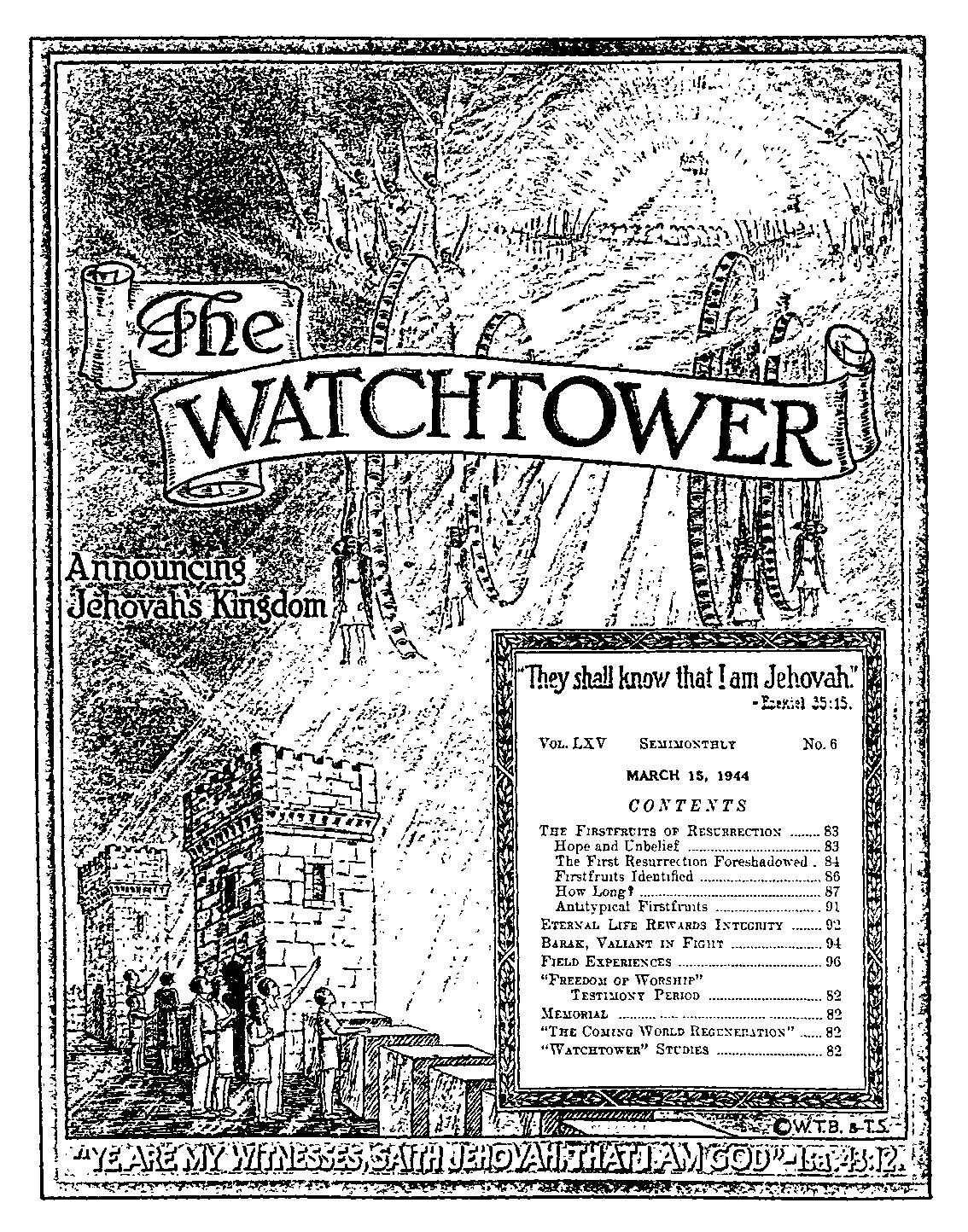
Vol. LXV March 15, 1944 No. 6
THE FIRSTFRUITS OF RESURRECTION
"I continue unto this day, witnessing both to small and great, saying none other things than those which the prophets and Moses did say should come: that Christ should suffer, and that he should be the first that should rise from the dead."—Acts 26:22,23.
JEHOVAH’S truth concerning His purposes and man’s destiny differs radically from all religion. Sacred truth is not a religion. In no way can this be better seen than by comparing the truth with the teachings of religion. “Thy word is true from the beginning,’’ said the adoring psalmist to Jehovah God. Centuries later the One of whom the psalmist was a prototype added: “Sanctify them through thy truth: thy word is truth.” (Ps. 119:160; John 17:17) Therefore it is certain that the Holy Bible is not a book of religion. It has nothing in common with religion, although religion has all along endeavored to mix some of the Bible with itself in order to take on an appearance of truth. Religion, however, cannot adopt the whole Bible, because the two are irreconcilable foes.
2 Religion shuns to face the truth regarding the dead and the hope of future life, which truth the Bible sets forth with understandable plainness. Early in man’s existence religion was introduced to man to answer the issue of death and to pervert the truth concerning the state of the dead. The Creator, who brought man to life, was the first to mention to man the matter of death. The prospect of everlasting life on earth which the Creator set before the perfect man was not life through the so-called “portals of death", but by continual obedience to his Maker. (Gen. 2:16,17) The Devil, through the serpent in Eden, denied the divine law and its penalty to the man’s wife, and held forth another hope before mankind, at the price of disobeying God. Human disobedience followed, and God sentenced the disobedient to destruction.—Gen. 3: 1-21.
3 Only from the religious words of contradiction to God could the sentenced man and woman draw any expectation of not really dying, but of living on as gods, as spirits, just as God is a spirit. Those who were due to pass out of existence would want to believe that death did not end all, and that the serpent possibly spoke true: “Ye shall not surely die: . . . and ye shall be as gods, knowing good and evil.” (Gen. 3:4,5) In such religious words was the promise of never dying, even by those disobeying God. That spelled deathlessness, immortality, in the religious view of things. It meant that, even if Jehovah God executed his sentence of death by the dissolving of their fleshly body to the dust, yet his decree of destruction would be defeated by the survival of an intelligent, living spark within sinner man after the crumbling of the body in death. Such view of human immortality, as based on Satan the Devil’s lie. is the view that is held to by all religious organizations of “Christendom" and “heathendom” to this day. In this fundamental respect religion differs from the Word of truth; for the inspired Bible nowhere teaches human immortality, but that the dead are altogether lifeless, out of existence. The truth-speaking psalmist said to the Creator: “From everlasting to everlasting, thou art God. Thou turnest man to destruction; and sayest. Return [to the dust], ye children of men.” (Ps. 90: 2, 3) In all the pre-Christian Hebrew Scriptures the words immortality and incorruption occur not once.
1 Why is not the Bible a book of religion?
2 Why and how was religion first Introduced to man?
3 In the Serpent’s religious words what was promised to man, and therefore in what fundamental respect does religion differ from God's Word of truth?
HOPE AND UNBELIEF
4 Contrary to religion's doctrine of human immortality, the first and real basis for life beyond death was laid in the Son of God, who died as a man and then attained to life beyond the grave. That the first opportunity to immortality (not human immortality, however) was then opened up, it is written in the Word of truth: “God . . . hath saved us, and called us with an holy calling, not according to our works, but according to his own purpose and grace, which was given us in Christ Jesus before the world began, but is now made manifest by the appearing of our Saviour Jesus Christ, whohath abolished death, and hath brought life and immortality [incorruption] to light through the gospel.” (2 Tim. 1:8-10) Christ Jesus is the Seed of God’s “woman”, which Seed is appointed to bruise the head of the serpent, Satan the Devil, and to destroy all religion with him. (Gen. 3:15) It is through Christ’s suffering the bruising of the heel and yet proving faithful and true to Jehovah God, even to the death, that he has brought the hope of eternal life and of immortality or incorruption to the true light of day. Such hope is set forth, not in the many religions, but in the gospel, or “good news”, of God's kingdom through his Son Jesus Christ.
4 When was the basis for life beyond the grave truly laid, and where is such hope set forth?
5 What, then, was the hope of the faithful men who received and believed the truths Jehovah God was pleased to reveal before Christ? It was not a hope of human immortality and of an unbroken continuance of living beyond the grave by reason of some supposed immortality of the soul. Theirs was the hope of future life by virtue of the lifting of the condemnation of sin and by a resurrection from the dead. Concerning the patriarch Abraham, and the testing of his faith in God’s truthfulness and power, it is written: “By faith Abraham, when he was tried, offered up Isaac; and he that had received the promises, offered up his only begotten son, of whom it was said, That in Isaac shall thy seed be called: accounting that God was able to raise him up, even from the dead; from whence also he received him in a figure.”—Heb. 11:17-19.
6 Under prophetic inspiration the psalmist David wrote: “For thou wilt not leave my soul in hell; neither wilt thou suffer thine Holy One to see corruption. Thou wilt shew me the path of life.” (Ps. 16:10,11) Such phrase expressed faith in the power and purpose of Jehovah God to restore the worthy One to life. (Verse 3) After David the prophet Isaiah, inspired by the spirit of truth, enlarged on God's purpose, saying: “He will swallow up death in victory; and the Lord God will wipe away tears from off all faces.” (Isa. 25: 8) There was another expression of faith in the resurrection of dead ones. (1 Cor. 15: 51-54; Acts 13: 33-37) The Holy Bible, containing those prophecies, stands alone as the book which not only does not teach the immortality of the human soul but does teach also, in harmony with human mortality, the resurrection of the dead.
7 Therein lies a key difference between religion and the truth. Religion teaches life after death by an imagined immortality of the human soul. Directly opposite, the written Word of God points to the mortality of the human soul or creature and the necessity for the resurrection of the dead by Jehovah’s power. Naturally the Greek religionists at Athens who believed in human immortality and hence in no resurrection said respecting the apostle Paul: “He seemeth to be a setter forth of strange gods: because he preached unto them Jesus, and the Resurrection [Anastasis].” Paul ended up his speech to those religionists, saying: “Because [God] hath appointed a day in the which he will judge the world in righteousness by that man whom he hath ordained; whereof he hath given assurance unto all men, in that he hath raised him from the dead.” “And when they heard of the resurrection of the dead, some mocked: and others said, We will hear thee again of this matter.” — Acts 17:18, 31, 32.
5 What, then, was the hope of faithful men of old as Illustrated in Abraham?
6 What did David and Isaiah speak foretelling faith in a resurrection? and how, therefore, does the Bible stand alone from other books?
7 What, then, is a key difference between religion and the truth? and how was this forcibly shown by Paul's experience at Athens?
8 Religionists could swallow whole the impossible doctrine of the inherent immortality of man's soul, contrary to the plain word of God; but when it came to the Scriptural truth of the resurrection it was needful for Paul to ask a religionist: “Why should it be thought a thing incredible with you, that God should raise the dead?” One was considered by some religionists to be mad for arguing for the resurrection, as in Paul’s case after he declared Jesus’ resurrection. “And as he thus spake for himself, Festus said with a loud voice, Paul, thou art beside thyself; much learning doth make thee mad.” (Acts 26: 8, 24) Modern religionists, forced to admit that God's Word teaches resurrection of the dead, mix Bible with religion by trying to tie the resurrection in with the Devil doctrine of human immortality; how? By claiming that at the resurrection the body in which the sinner died will be united again with an immortal soul that departed from the body at death. But such doctrines cannot mix, any more than the Bible and religion, because where there are immortals and no dead ones, there can be and need be no resurrection of any out of death. The very doctrine of the “resurrection of the dead” is proof of the Bible teaching that the dead are non-existent and that human immortality is a religious lie.
THE FIRST RESURRECTION FORESHADOWED
9 The first resurrection to take place was foreshadowed by the restoring of Abraham’s son Isaac from the altar of sacrifice. Besides that, the Almighty God had a yearly picture of this same resurrection enacted by the descendants of Abraham and Isaac namely, the nation of Israel. Israel was the new name of Abraham’s grandson Jacob, from whom came forth the twelve tribes of Israel. The annual resurrection picture was carried out by such Israelites in the land of Palestine on the sixteenth day of Abib or Nisan, the first month of the year as ordained by Jehovah God. — Ex. 12:2; 13:4.
8. How further was this difference shown during Paul's appearance before Festus? and, because the Bible teaches resurrection, what do modern religionists seek to do, and how go?
9. How, when, and among whom was the first resurrection to take place foreshadowed?
10 It came about in this manner: For 215 years the twelve tribes of Israel sojourned in the land of Egypt, where, in course of time, the mighty Pharaoh of the land enslaved them. In his appointed year Jehovah God broke their bonds, on the fourteenth day of Abib or Nisan, which day was the passover day. That day in Egypt the Israelites under God’s prophet Moses obeyed God’s command and sacrificed the passover lamb, one lamb to each Israelite household. They sprinkled the lamb’s blood on the doorposts and lintels of their homes and retired within for the night. Then they roasted the lamb and partook of it with unleavened bread and bitter herbs, at the same time standing prepared to move out of their land of bondage. At midnight of Nisan 14 Jehovah’s angel of death passed over the blood-marked homes of the Israelites but smote the firstborn of all the homes and stalls of the Egyptians. Pharaoh, losing his own firstborn son, and being under irresistible pressure by all the bereaved Egyptians, yielded to Jehovah's demand and let His people go forth a free nation. The Israelites were now God’s covenant people, being brought into the covenant with him through Moses as mediator and over the blood of the passover lamb as the validating means.
11 Jehovah God thereafter gave them the laws of the covenant. He decreed that his people should celebrate Jehovah’s deliverance of them by celebrating the passover supper regularly on its anniversary. The passover day must then be followed by a sevenday feast of unleavened bread, from Abib (or Nisan) 15-21 inclusive. The covenant law concerning such feast reads:
12 “These are the feasts of the Lord, even holy convocations, which ye shall proclaim in their seasons. In the fourteenth day of the first month at even is the Lord’s passover. And on the fifteenth day of the same month is the feast of unleavened bread unto the Lord: seven days ye must eat unleavened bread. In the first day [Nisan 15] ye shall have an holy convocation: ye shall do no servile work therein [it being therefore a special sabbath day]. But ye shall offer an offering made by fire unto the Lord seven days: in the seventh day is an holy convocation: ye shall do no servile work therein. And the Lord spake unto Moses, saying, Speak unto the children of Israel, and say unto them, When ye be come into the land which I give unto you, and shall reap the harvest thereof, then ye shall bring a sheaf [(Hebrew) an omer, or a handful] of the first- fruits of your harvest unto the priest: and he shall wave the sheaf [omer] before the Lord, to be accepted for you: on the morrow after the sabbath [of Nisan 15] the priest shall wave it. And ye shall offer that day [Nisan 16] when ye wave the sheaf an he lamb without blemish of the first year for a burnt offering unto the Lord. And the meat [meal] offering thereof shall be two tenth deals of fine flour mingled with oil, an offering made by fire unto the Lord for a sweet savour: and the drink offering thereof shall be of wine, the fourth part of an hin [liquid measure].”—Lev. 23:4-13.
10. As a preliminary thereto, how did the passover come about and how were the Israelites brought into the law covenant with Jehovah?
11. In the laws of the covenant, what did Jehovah decree regarding the passover and what should immediately follow?
12 . what did his law state concerning such, and particularly the firstfruits to be offered?
13 The Lord God declared that the next feast in order was to be calculated from that firstfruits day, Abib or Nisan 16. The law of his covenant with the Israelites reads: “And ye shall eat neither bread, nor parched corn, nor green ears, until the selfsame day that ye have brought an offering [the firstfruits] unto your God: it shall be a statute for ever throughout your generations in all your dwellings. And ye shall count unto you from the morrow after the sabbath, from the day [Nisan 16] that ye brought the sheaf of the wave offering; seven sabbaths shall be complete: even unto the morrow after the seventh sabbath shall ye number fifty days; and ye shall offer a new meat [meal] offering unto the Lord. Ye shall bring out of your habitations two wave loaves of two tenth deals: they shall be of fine flour; they shall be baken with leaven; they are the firstfruits unto the Lord. And ye shall offer with the bread seven lambs without blemish of the first year, and one young bullock, and two rams: they shall be for a burnt offering unto the Lord, with their meat offering, and their drink offerings, even an offering made by fire, of sweet savour unto the Lord. Then ye shall sacrifice one kid of the goats for a sin offering, and two lambs of the first year for a sacrifice of peace offerings. And the priest shall wave them with the bread of the firstfruits for a wave offering before the Lord, with the two lambs: they shall be holy to the Lord for the priest. And ye shall proclaim on the selfsame [fiftieth or Pentecostal] day, that it may be an holy convocation unto you: ye shall do no servile work therein: it shall be a statute for ever in all your dwellings throughout your generations.” —Lev. 23:14-21.
14 The above feast came to be known as the feast of Pentecost, because of the number of the day upon which celebrated. In the numbering, please note that the expression “seven sabbaths” means “seven weeks”, and the “seventh sabbath” means the “seventh week”, the term “sabbath” being thus used to mean, not a restday, but a week. Hence Pentecost was also called “the feast of weeks”. (Compare Deuteronomy 16:9,10.) At a number of places in the inspired Scriptures after Christ the term “sabbath” is used meaning a “week”.—Matt. 28:1; Mark 16:2; Luke 18:12; 24:1; John 20:1, 19; Acts 20: 7; 1 Cor. 16: 2, Roth.
13. What was to be the next annual feast thereafter, and what did God’s law say concerning It?
14. What, therefore, did this feast come to be called? and how is the term “sabbath" used la the law concerning such feast?
15 Instructions were also given by the Lord for the celebration of a third feast in the year, on the fifteenth day of the seventh month, and called “the feast of tabernacles”, the “feast of ingathering”, or the “feast of harvest”. (Lev. 23:33-44) All such feasts are important to study, for Jehovah God ordained them in his covenant because they were 'shadows of good things to come’. Hence they were not religious celebrations to mystify his people and to glorify the priests and Levites carrying on the performance. (Heb. 8:5; 10:1; Col. 2:16,17) By the regular observance of such significant feasts his faithful people would be prepared to recognize God’s works when he would cause the fulfillments of those prophetic shadows, and so they would not be misguided by religion. In fact, the law covenant was made with the nation of Israel for the express purpose of protecting them from religion and its deathdealing errors and bondage till Christ Jesus should come and begin a new covenant. Galatians 3:19 so states, saying: “'Wherefore then serveth the law! It was added because of transgressions, till the seed should come to whom the promise was made; and it [the law covenant] was ordained by angels in the hand of a mediator [Moses].”
FIRSTFRUITS IDENTIFIED
18 The passover lamb is unmistakably identified as to its symbolical meaning. The Word of inspiration declares: “For even Christ our passover is sacrificed for us: therefore let us keep the feast.” (1 Cor. 5: 7, 8) This fact required that Christ Jesus match the passover shadow in a number of outline details, among which was the day of the month on which he should be sacrificed as “the Lamb of God which taketh away the sin of the world”. In an equally certain manner is made plain for us the symbolic meaning of the sheaf or omer of the first- fruits of the barley harvest that was waved by the priest at Jerusalem’s temple on Nisan 16, the third day from the passover. Again the Word of divine interpretation says: “But now is Christ risen from the dead, and become the firstfruits of them that slept. For since by man came death, by man came also the resurrection of the dead. For as in Adam all die, even so in Christ shall all be made alive. But every man in his own order: Christ the first- fruits; afterward they that are Christ’s at his coming.” (1 Cor. 15: 20-23) This fact made it necessary that Christ Jesus match the shadow as to the month and day of the month on which he should be raised from the dead by the power of God, who ordained the shadow. It also required that Christ Jesus, having suffered as the antitypical passover Lamb unto death, “should be the first that should rise from the dead” and that he should be “the firstborn from the dead” or “firstbegotten of the dead”. — Acts 26: 23; Col. 1:18; Rev. 1:5.
15. (a) What third annual feast did God’s law ordain, and why is it important to study such feasts? (b) Why would observing such feasts be beneficial, and for what express purpose was the law given to Israel?
16. How do the Scriptures identify the antitypes of the passover lamb and of the firstfruits offering, and what did such types require in the case of the fulfillment thereof?
17 Did the Son of God vindicate God’s Word as true by meeting the time requirements here set by the great Shadow-thrower, Jehovah God! He did. However, in a publication entitled “144 Self-Contradictions of the Bible” a society of infidels endeavor to prove that the Word of God contradicts itself on the vital point of the time when Christ Jesus was raised from the dead. A number of religionists, in trying to meet such infidel argument, serve only to stir up more confusion. Christ Jesus, say the unbelievers or infidels, “was to be three days and three nights in the grave,” whereas the Bible shows he “was but two days and two nights in the grave”; and they quote Jesus’ words at Matthew 12:40 as contradicting Mark 15: 25,42-46; 16:9. The religionists, for their part, do not permit the Bible to supply its own explanation, but lean to their own understanding. Consequently, even though undesignedly, their arguments inject further apparent contradiction into God’s Word, whereas none actually exists at all.
18 For the vindication of God's Word as true, and as being of One who “cannot deny himself" and “cannot lie”, let us permit these seeming difficulties to resolve themselves. The Bible contains many prophetic dramas which forecast the works of God and the career of his Christ and the followers of Christ Jesus. Among such is the drama of the Jewish prophet named Jonah. This drama is of special interest to us who are unquestionably at the end of the world of wickedness and at the beginning of the new world of everlasting righteousness. As it is stated at 1 Corinthians 10:11: “Now all these things happened unto them for ensamples: and they are written for our admonition, upon whom the ends of the world are come.” The Lord Jesus particularly showed that Jonah’s career was a drama of prophetic scenes, when he referred to Jonah 1:17, which reads: “Now the Lord [Jehovah] had prepared a great fish to swallow up Jonah. And Jonah was in the belly of the fish three days and three nights.”
19 The infidels argue that this means that Jonah must be three full days or a period of exactly 72 hours in the belly of the whale. But does God’s Record, by its form of expression, require that Jonah be there three literal nights and at least 72 hours before it was that “the Lord spake unto the fish, and it vomited out Jonah upon the dry land”! Scrutiny of other occurrences of like time-expressions answers No! When Joseph’s ten half brothers came down to Egypt to buy foodstuffs during the famine, Joseph, unrecognized by them, accused them of being spies, to put them to a test. The Record reads: “He put them all together into ward three days.” Did that mean or require they be kept in ward three full days, equaling a 72-hour period! No; for the Bible interprets the time period for us, saying that “Joseph said unto them the third day, This do, and live; for I fear God,” and then he let them out. (Gen. 42:17,18) In other words, on the first day he arrested them, and on the third day he released them; which fact allowed them to be actually in ward but two nights, and only parts of three days; even though in Egypt the 24-hour day was counted as starting at sunrise. Joseph loosed them before nightfall of the third day.—See also Genesis 40:12,13, 18-20 and compare the expressions “three days" and “third day”.
17. Did Christ Jesus meet such time requirements? and how do the infidels and religions seek to bring contradiction and confusion into the matter?
18. By what can these seeming difficulties resolve themselves, and why is the prophetic drama of Jonah now of special interest to us?
19. What do infidels argue concerning Jonah’s time spent within the whale, but what does the record concerning Joseph’s putting of bls ten half brothers in ward show as to like time-expressions?
20 Another instance of this measurement of time is found in the account concerning Solomon’s successor, King Rehoboam of Jerusalem. At 2 Chronicles 10: 5 it states: “And he said unto them. Come again unto me after three days. And the people departed.” According to the infidels this should mean that the king ordered them not to return until after 72 hours (or three 24-hour periods) had passed; which would not allow them to appear again in king's court before the fourth day. But God's Word interprets the king's time-assignment otherwise, saying, at verse 12: “So Jeroboam and all the people came to Rehoboam on the third day [not on the fourth day], as the king bade, saying, Come again to me on the third day.” The day upon which the king issued the order was the first day, the next day was the second, and the next succeeding day was the third day, upon which day, before it expired at sundown, the Israelites returned to the king. — See also 1 Kings 12: 5, 12.
21 Centuries later the Jews throughout the Persian empire were threatened with death by the king’s decree as framed by his vizier Haman. What did the king’s Jewish queen instruct her cousin to do! “Then Esther bade them return Mordecai this answer, Go, gather together all the Jews that are present in Shushan, and fast ye for me, and neither eat nor drink three days, night or day: I also and my maidens will fast likewise; and so will I go in unto the king, which is not according to the law: and if I perish, I perish.” (Esther 4:15,16) Does God’s Word warrant us in taking Esther’s instruction to mean literally three 12-hour days and three 12-hour nights, or a total period of 72 hours of fasting, after which, on the fourth day, she would appear uninvited in the king’s court! Regardless of what infidels or religionists may argue to the contrary, the record at Esther 5:1 answers No, saying: “Now it came to pass on the third day, that Esther put on her royal apparel, and stood in the inner court of the king’s house, over against the king's house: and the king sat upon his royal throne in the royal house, over against the gate of the house.” Also compare the expressions “third day” and “three days and three nights” and “three days agone” at 1 Samuel 30:1,11-14, to note Hebrew time-calculations.
20 What like construction upon time-measurement was there in the case of King Rehoboam and the people under Jeroboam?
21 What parallel construction upon a three-day period was shown in the case of Queen Esther?
HOW LONG?
22 On one reported occasion Jesus said: “For as Jonas was three days and three nights in the whale's belly; so shall the Son of man be three days and three nights in the heart of the earth.” (Matt. 12: 40; see also Matthew 16:4; Luke 11:30) Ignoring the evidence given in the above foregoing paragraphs, certain religionists as well as infidels insist that Jesus meant he would be three night periods as well as day periods in the sepulcher, or an even 72 hours. On such grounds the religionists reckon back three full days from Saturday evening, when the Jewish first day of the week began and on which first day Jesus appeared to his disciples. Then they conclude that Christ Jesus was crucified on Wednesday and died at 3 p. m. and was buried before sundown. For their support they quote Mark 8:31, which reads: “And he began to teach them, that the Son of man must suffer many things, and be rejected of the elders, and of the chief priests, and scribes, and be killed, and after three days rise again.” (See also Mark 9:31; 10:34, Am. Stan. Ver.) But that the expression “after three days” does not mean after 72 hours but refers to an event or action on the third day before the day. expires, Scriptural proof has been given in our preceding paragraphs. For further proof compare Joshua 1:11; 2:16, 22; 3: 2; 9:16, 17, and the interlocking expressions “within three days”, “there three days,” “after three days,” “at the end of three days,” and “the third day”. Study also 1 Samuel 20: 5, 18, 19, 27, 34, 35, and the related timedesignations, “unto the third day,” “three days,” and “second day of the month” and “in the morning”.
23 It is of no force to quote the words of Jesus’ enemies to Pilate: “Sir, we remember that that deceiver said, while he was yet alive, After three days I will rise again”; for the enemies added: “Command therefore that the sepulchre be made sure until the third day, lest his disciples come by night and steal him away, and say unto the people, He is risen from the dead.” (Matt. 27: 63, 64) At the trial the false witnesses against Jesus testified: “We heard him say, I will destroy this temple that is made with hands, and within three days I will build another made without hands.” Also while he was hanging on the tree his enemies passed by and said: “Thou that destroyest the temple, and buildest it in three days, save thyself.” (Mark 14: 58; 15: 29, 30; Matt. 27: 40; 26: 61) Such testimony and ridicule doubtless refer to what is recorded at John 2:19-22: “Jesus answered and said unto them, Destroy this temple, and in three days I will raise it up. Then said the Jews, Forty and six years was this temple in building, and wilt thou rear it up in three days? But he spake of the temple of his body. When therefore he was risen from the dead, his disciples remembered that he had said this unto them.” And, indeed, on the third day Christ Jesus, as the Head of the spiritual temple of God which is not made with human hands, was raised from the dead. Then he proceeded to build up those who should be the members of his body, the “body of Christ”, namely, his disciples, then scattered, confused and dejected.—1 Cor. 3:16,17, margin.
22 (a) What did Jesus say concerning his fulfillment of the Jonah-type? (b) How do religionists therefore argue as to the day he died? and what above evidence shows they miscalculate the time?
23 Why do the testimony and the ridicule of Jesus' enemies not favor the religionists' time-calculation? and how was Jesus' statement at John 2:19-22 concerning three days fulfilled?
24 Wisdom’s way is to let the Scriptures deal with the expression “after three days” and explain it. Nowhere do they interpret it to mean “after 72 hours” or “on the fourth day”. Jesus, as quoted by the other Gospel writers, explains the expression used in Mark’s account. “Jesus said unto them, The Son of man shall be betrayed into the hands of men: and they shall kill him, and the third day he shall be raised again.” (Matt. 17:22,23; also 20:18, 19; 16: 21; Luke 9: 22; 18: 32, 33) To King Herod Jesus sent this message: “Go ye, and tell that fox, Behold, I cast out devils, and I do cures today and to morrow, and the third day I shall be perfected.” (Luke 13: 32) That the close disciples of Jesus so counted the time is evident from comment made by the two disciples on the way to Emmaus, when Jesus met them on his resurrection day. Not recognizing their risen Master, they said to him: “The chief priests and our rulers delivered him to be condemned to death, and have crucified him. But we trusted that it had been he which should have redeemed Israel: and beside all this, to day is the third day since these things were done.” (Luke 24: 13-21) They counted the time from his crucifixion, not from his burial or the placing of the guard at the tomb, which burial and guard they did not mention or had not witnessed. That they had reckoned the time correctly as the third day since the crucifixion, Jesus confirmed when he appeared shortly after to his disciples in Jerusalem on the same day and said to them: “Thus it is written, and thus it behoved Christ to suffer, and to rise from the dead the third day.” — Luke 24: 33-46.
24 . (a) How did Jesus explain the expression “after three days" according to what he said to his disciples and to King Herod? (b) How did the two disciples on route to Emmaus on resurrection day calculate the time, and how did Jesus confirm it that same day?
25 Several years later the apostle Peter testified to the first Gentile converts, Cornelius and his household: "We are witnesses of all things which he did both in the land of the Jews, and in Jerusalem; whom they slew and hanged on a tree: him God raised up the third day, and shewed him openly.” And the apostle Paul, who miraculously saw the Lord’s glory after Jesus’ ascension to heaven, writes: “That Christ died for our sins according to the scriptures ; and that he was buried, and that he rose again the third day according to the scriptures.” (Acts 10:39,40; 1 Cor. 15:3,4) The accounts in the Gospels must therefore be understood and explained on the basis of a third-day resurrection. The Scriptures do not agree with the contention that He died late on Wednesday afternoon and was resurrected late in the afternoon of the following Saturday, or on the seventh day of the Jewish week.
26 Contenders for the Lord’s death as on a Wednesday afternoon also reason that the last supper which the Lord ate with his disciples before his betrayal and arrest was not the passover supper, but was an ordinary private meal, after which he instituted the Memorial of Christ’s death, on Tuesday evening. The statement at John 18:28 has been variously understood, by some to mean that Jesus did not eat the passover at all with his disciples, and by others to mean that Jesus did eat the passover, but by anticipation, that is, a day ahead, in order not to miss observing it before his death and in order to institute the Memorial or “Lord's supper” at the close of the passover supper. Such action cannot rightly be attributed to Christ Jesus, for he declared that the Scriptures must be fulfilled and that he came not to destroy but to fulfill the prophetic shadows of the law covenant. (Matt. 5: 17-19) Hence it is Scripturally impossible to think that he broke his Father’s commandment as to eating the passover and failed to fulfill the type of the passover lamb’s death by dying ahead of the due time by one day. Matthew 26:17-30 and Mark 14:16-26 and Luke 22: 13-30 are very plain that Jesus did celebrate the passover in his capacity as a Jew after the flesh, and that he observed it on the evening of the proper date, Nisan 14, and thereafter introduced the Memorial.
27 John 13:1, 2 does not disagree, which reads: “Now before the feast of the passover, when Jesus knew that his hour was come that he should depart out of this world unto the Father, having loved his own which were in the world, he loved them unto the end. And supper being ended, ...” Who can deny that before the passover Jesus knew such facts? The Emphatic Diaglott reading of John 13: 1 makes this very clear: “Now Jesus knowing before the feast of the passover, that his hour was come, that he should depart out of this world to the Father,” etc. But why, then, does Jolin 18:28 say that the Jews leading Jesus captive to Pilate’s judgment hall refused themselves to go “into the judgment hall” of a Gentile, “lest they should be defiled; but that they might eat the passover” thereafter? This must refer to their trying to keep ceremonially clean outwardly, that they might partake of the seven-day feast of unleavened bread that followed and was inseparably connected with the passover. (Deut. 16:2; 2 Chron. 35: 8, Douay) (Some suggest that these high-ranking Jews celebrated the passover a day later than the common Jews. Others suggest, with some proffered “proof”, that due to possible errors of reckoning time the cautious Jews celebrated two passovers to make sure that one of the two days was correct.)
25. Years later what did Peter and Paul say as to the resurrection day? and on what basis, therefore must the Gospel-accounts statements concerning the day be understood?
26 How has John 18, 23 been variously understood concerning Jesus' last supper and death, and why is it Scripturally impossible to agree with such understandings?
27. (a) Why does John 13:1. 2 not disagree with the fact that it was the passover that Jesus then ate? (b) How. then, must John 18:28 be understood in order to harmonize therewith?
28 The religionists, proceeding on a 72-hour timetable, claim that, Jesus dying on a Wednesday and then appearing on Sunday, two sabbath days intervened: first, the sabbath of the day of convocation that followed the passover and which was the first day of the feast of unleavened bread; and, second, the regular weekly sabbath on Saturday, the seventh weekday, shortly before sundown of which Saturday they say Jesus was raised. However, the Scriptures mention only one sabbath as intervening between Jesus’ death and his resurrection. John 19: 31 reads: “The Jews therefore, because it was the preparation, that the bodies should not remain upon the cross on the sabbath day, (for that sabbath day was an high day,) besought Pilate that their legs might be broken, and that they might be taken away.” Since Jesus died before sunset or end of the passover day, his corpse must not be left hanging on the tree during the night, according to Deuteronomy 21:22,23. Hence he was taken down and buried on that same passover day, therefore the first day of his being in the tomb or “heart of the earth”. The second day of his entombment began at sundown. Not merely was that second day the sabbath immediately after the passover day and opening up the feast of unleavened bread, but it was also the weekly sabbath or seventh day. Hence it was “a high day”, due to such coincidence. In other words, Nisan 15, convocation day, fell on the seventh day of the week in A.D. 33. “And the women also, which came with him from Galilee, followed after, and beheld the sepulchre, and how his body was laid, and they returned, and prepared spices and ointments; and rested the sabbath day according to the commandment.” — Luke 23: 54-56; Mark 15: 42-47; Ex. 20: 8-11.
28 According to the law concerning the feast and also John 19:31, did one or two sabbaths intervene between Jesus' death and resurrection, and how so?
29 Religionists refer to Matthew 28:1, particularly to the Syriac Version thereof, as proof that the Lord’s resurrection occurred on the weekly sabbath day that ended Saturday at sundown, and that the women came to the tomb Saturday after sunset. The Syriac Version reads: “And in the close of the sabbath, as the first [day] of the week began to dawn, came Mary of Magdala and the other Mary, to view the sepulchre.” (Murdock’s translation) In the Greek manuscript text of this verse the words above translated “sabbath” and “week” are the same Greek word, “sabbaton,” in the plural number. Why the different translation of the two occurrences of the same word so close together? Evidently because of misunderstanding. As stated in paragraph 14 above, the Hebrews and the Greeks used the word “sabbath” not merely to mean the sabbath day but, at times, also to mean the whole week. Hence the Rotherham translation of Matthew 28: 1, 2 reads: “And late in the week, when it was on the point of dawning into the first of the week came Mary the Magdalene, and the other Mary, to view the sepulchre. And lo! a great commotion [earthquake] occurred,—for a messenger of the Lord descending out of heaven and coming near had rolled away the stone, and was sitting upon it.” The Emphatic Diaglott is therefore correct in reading: “Now after the Sabbath, as it was dawning to the first day of the week,” etc. Only a violent wresting of the plain Scriptures could twist the account to mean a sabbath resurrection of Jesus.
30 Although Mark 16: 9 is not contained in the two oldest Greek manuscripts, it is contained in many other Greek manuscripts and versions, among which is the Syriac Version, which reads: “And in the morning of the first day of the week, he arose; and he appeared first to Mary Magdalena, from whom he had cast out seven demons.” (Murdock) The Emphatic Diaglott reading is: “And having risen early’ on the first day of the week,” etc. And with this the readings of the American Standard Version, Rotherham, Weymouth, and Moffatt translations all agree. But regardless of whether Mark 16:9-20 is genuine or not, the Gospel accounts as well as the prophetic shadows written aforetime all combine to prove the Lord’s resurrection on Nisan 16, the day that followed the sabbath after the passover, and which day in A.D. 33 was the first day of the week, now called “Sunday”. To attach the name “Easter” to it is heathenish, because “Easter” was a demongoddess worshiped by the pagans, and the one occurrence of the word at Acts 12:4 (A.V.) is an English mistranslation of the word passover; and certainly the pagan religious “Easter” is not the Jewish passover. Neither does the true anniversary of our Lord’s resurrection day fall each year on the same day of the week, Sunday. It shifts, just as the anniversary of the passover and Memorial shifts from one day of the week to another.
29 . By Matthew 28:1 (especially the Syriac Version thereof), what do religionists try to prove? but how should such verse be understood according to the Rotherham and Emphatic Diaglott renderings?
30 . (a) How does the Syriac Version rendering of Mark 16:9 agree with the true day of resurrection, and also other versions of that verse? (b) Why is it improper to call it “Easter Sunday"?
31 Reasonably Jehovah God would demonstrate the fact of Jesus’ resurrection on the same day on which it occurred, and not on the next day. On the next day it could not be proved that he was raised the previous day, no man having seen him and none having visible proof thereof. If he was raised late on Saturday afternoon close to sundown, why would God cause his angel to descend and open the tomb about twelve hours later, Sunday about 6 a.m., if it was to be proved he was raised the day previous? To argue that the angel’s comment, “He is not here; for he is risen,” proves that he was raised the previous day is no valid argument at all. But by God’s opening the tomb on the third day of Jesus’ entombment, such being the first day of the week, and then by Jesus’ manifesting himself to his disciples before such third day expired, there would be the visible and absolute proof of his being raised that day, the first weekday.
32 To correspond with Matthew 28:1, the account at John 20:1,2 reads: “The first day of the week cometh Mary Magdalene early, when it was yet dark [not when it began to grow dark Saturday evening], unto the sepulchre, and seeth the stone taken away from the sepulchre. Then she runneth, and cometh to Simon Peter,” etc. Let it be noted that the Greek word here translated “early” is translated “in the morning” at Matthew 16:3; 20:1; Mark 1:35; 11:20; 13: 35; 15:1; 16: 2; and “morning” at Acts 28: 23, reading, “from morning till evening.” There was no Saturday evening visit of disciples to the tomb.
33 The prophecy at Daniel 9:24-27, that Messiah should be “cut off” and “in the midst of the week he shall cause the sacrifice and the oblation to cease”, has no reference to a week of seven days, but to a week of years, as in Genesis 29: 18-27. The “seventy weeks” predicted to Daniel began in the twentieth year of Artaxerxes, or in 454 B. C. Hence to declare that, if Jesus died on Wednesday, it would agree with the prophecy of the “midst of the week” is without basis. Furthermore, a week of seven days, Jewish time, would reach its midst on Wednesday at 6 a. m., because the Jewish week began at sundown or 6 p. m. on Saturday. However, Jesus died at the ninth hour of the daylight period, namely, at 3 p. m. — Matt. 27:46; Mark 15:34.
31 . Reasonably, on what day would God first demonstrate the fact of Jesus’ resurrection? and why is an argument for bis resurrection the day before his appearing invalid?
32 What does John 20:1, 2 show as to Matthew 28:1 regarding time? 33 Why does the prophecy in Daniel 9 concerning rhe “seventy weeks” not prove Jesus as having died late Wednesday afternoon?
34 Any contention for a Saturday resurrection would make that event occur on the fourth day of Jesus’ entombment; for Wednesday before sundown would be the first day of his interment, the second day would begin at Wednesday sundown, the third day would begin at Thursday sundown, and the fourth day would begin at Friday sundown and would extend till Saturday sundown. Hence the next day, or Sunday, would be the fifth day since his death on the tree, whereas the two disciples whom the risen Jesus met on the road to Emmaus mentioned his execution and said: “To day is the third day since these things were done”; and “to day” in their case was the first day of the Jewish week. —Luke 24:1, 13-24.
35 The account at Mark 16:1 states that the faithful women visiting the tomb had bought sweet spices with which to anoint Jesus’ corpse. The record at Luke 23: 56 indicates that they had obtained these before sundown of the day of Jesus' death and burial, and hence before the combination weekly sabbath and postpassover sabbath began. They could also have purchased some extra spices after sunset of Saturday, which would be after that “high day” or double sabbath had passed. Coming to anoint his body on Sunday, the first day of the week, they would not reasonably choose the fifth day to do so, because of what Martha said to Jesus about her dead brother Lazarus: “Lord, by this time he stinketh: for he hath been dead four days.” (John 11:17, 39) It cannot be Scripturally shown that those women with spices understood Psalm 16:10 and applied it to Jesus, that his human body should not see corruption, and that they would therefore attempt an anointing of him beyond the third day.
36 Generally religionists claim that it was Jesus’ fleshly body that was raised and taken with him to heaven, contrary to the Scriptures. (1 Cor. 15:50; 1 Pet. 3:18; John 6:51; 2 Cor. 5:16) Were their claim true, then the stone would have to be rolled away from the sepulcher’s door at the time that the resurrection took place in order to let the fleshly body get out. If the resurrection occurred on Saturday just before sundown, then the earthquake must have been at the same time, and the Lord's angel must have then descended and rolled away the sealed stone, to the great terror of the soldiers guarding the sealed tomb. The question then arises: How long did the angel sit upon the stone? All through Saturday night, keeping the terror-stricken guards in a continuous paralysis? Was the sepulcher door open all that time also, without being noticed before the morning or dawn of the “first day”? Matthew 28:1-15 definitely asserts that the earthquake, the angel’s descent and the stone's removal took place early Sunday morning, marking Jesus’ resurrection then; and that when the women with spices arrived the recovered soldier guard had gone; and that, when all the women except Mary Magdalene were hastening back from the tomb to report the vision of the angels, “some of the watch came into the city, and shewed unto the chief priests all the things that were done.” Certainly, if the resurrection and accompanying events had happened shortly before sunset on Saturday, those frightened guards would not have waited till shortly before dawn of Sunday morning to go to the close-by city and report to their superiors.
34 Counting from his supposed death on Wednesday, what day therefrom would Saturday be, and also Sunday, contrary to what the disciples on the way to Emmaus said?
35 According to Mark 16:1, when did the women obtain apices for anointing Jesus’ body, and why would an attempt to anoint him the fifth day after a burial be unreasonable and unscriptural?
36 Based on religion’s claim of Jesus resurrection in flesh, what further unreasonable difficulties appear as to the sepulcher guards, if be was raised just before sundown Saturday?
37 Moreover, the Jewish clergy had the guard stationed at the tomb because they charged Jesus with saying: “After three days I will rise again.” In which case the soldier guard would hardly have watched at the tomb Saturday night, for that would be the fourth night from Wednesday and would also be the beginning of the fifth day from any burial on Wednesday afternoon. Matthew 27:64 says the clergy commanded the tomb to be “made sure until the third day, lest his disciples come by night, and steal him away.” Therefore, if those guards were still on watch Saturday night, which the account shows that they were, then it must have been only the third day.
ANTITYPICAL FIRSTFRUITS
38 God does not set aside his word unfulfilled. Among the things written aforetime that Jesus said must be fulfilled concerning himself is that at Leviticus 23: 5-11 as to the offering of the firstfruits of the barley harvest by the high priest, on Nisan 16, the day next after the sabbath that followed the passover. Since Jesus died as the antitypical passover lamb, and hence since his death must be on passover day, Nisan 14, his death could not have taken place on Wednesday and also match the prophetic shadow outlined at Leviticus 23. Why not? Because then the day next after the postpassover Sabbath would have been Friday, making it (till sundown) Nisan 16. On Friday, then, the priestly offering of the firstfruits of barley harvest would have had to be waved according to the Mosaic law. And to correspond, Christ Jesus would have had to be raised from the dead on that day as the firstfruits unto God from the dead, “the firstfruits of them that slept.” But Jesus was not raised on Friday; he was resurrected early on the first day of the week, or on Sunday. The passover supper having been celebrated by him Thursday night and his death on the tree having followed at 3 p. m. of Friday, before Nisan 14 expired, then the third day therefrom (or Sunday before 6 p. m.) was the proper day (Nisan 16) for offering the barley firstfruits to God at the temple. That was the day for Jesus to be raised from the dead an immortal spirit.
37. According to the clergy's Instruction regarding guarding the tomb, what further difficulty arises from the argument for a Wednesday- afternoon burial?
38. How does the time-feature concerning offering up the firstfruits after passover also disprove a Wednesday-afternoon death and burial?
39 That day of offering the firstfruits, and likewise of Jesus’ resurrection, was also the day to begin counting to the feast of weeks, or Pentecost, fifty days thereafter. (Deut. 16:9-12) If Nisan 16 had fallen on Friday and the high priest offered up the firstfruits that day, then the law of Leviticus 23:15-21 required that the fifty-day count begin Friday, which would land the day of Pentecost on Friday. Even this would not be on the same weekday as those religionists claim Jesus was raised; and furthermore, it would be only 49 days, and not 50 days, from a Saturday resurrection. Such would mean, too, that Pentecost landed on the sixth day of the week, and not on the seventh day on which they insist Jesus was raised.
40 In that case, also, the second firstfruits, or Pentecostal firstfruits, would not be offered up to God on the same day that the barley firstfruits were offered. All such is contrary to the infallible Scriptures. According to the rule, since the first day of the count to Pentecost was on the first day of the week, the fiftieth day would fall upon the same day of the week. Hence, since Christ Jesus was raised from the dead on the first day of the week as the “firstborn from the dead”, then on the first day of the week came the feast of Pentecost. Upon that feast-day the holy spirit of God was poured out upon the faithful disciples of Jesus at Jerusalem and the members of the “body of Christ” began to be offered up as a firstfruits unto God, pictured by the two leavened wheat loaves that the high priest waved before the Lord. — Acts 2.
41 The sacred Word of Jehovah God, therefore, stands vindicated. It is evident that when Jesus spoke of being “three days and three nights in the heart of the earth” he referred to three different days of the week, Nisan 14-16, or the sixth, seventh and first days, and not to a period of 72 hours or the equivalent of three full 24-hour days. In faithful fulfillment of the prophetic types, he died as God’s “Lamb” and was entombed on passover day, Nisan 14, on the sabbath day Nisan 15 he continued in the tomb, but on the third day, Nisan 16, the first day of the week, he was revived from the dead and he showed himself alive to his disciples. Unlike others that were temporarily raised from the dead and thereafter died again, "Christ, being raised from the dead, dieth no more; death hath no more dominion over him.” (Rom. 6:9) He is “alive for evermore”. (Rev. 1:18) He is indeed the first to be resurrected from the dead, and his resurrection is the beginning of “the first resurrection”.
39. What counting of days up to the next feast began to be made on Jesus' resurrection-day? and how would a death and burial on Wednesday affect such counting and the day of the feast?
40 How would that affect the agreement between the weekday of first- fruits and that of Pentecost? and, Scripturally, on what day did Pentecost occur, and how was It marked?
41. (a) How, therefore, does God’s Word stand vindicated as to time of Jesus' entombment and the day of his resurrection? (b) Despite others' haring been awakened from the dead, how was Jesus ths first to be resurrected from the dead?
ETERNAL LIFE REWARDS INTEGRITY
CAN Almighty God put on the earth men who, when subjected to the severest test put upon them at the hand of the adversary Satan, will maintain their integrity by remaining true and faithful to Jehovah God? That is the question raised by the wicked challenge of Satan long ago and restated at Job 2:1-6. Failure to maintain one’s integrity toward God means death, “everlasting destruction.” (2 Thess. 1:9; Matt. 25:46) Maintaining one’s integrity toward God means life. To understand and appreciate salvation to life, that question raised by the challenge of the Devil must always be kept in mind. If salvation were granted to man in the absence of the test, no opportunity would be afforded to prove the matter adequately and settle the question at issue.
It necessarily follows that Satan must have a free hand to put the test upon men. Since .imperfect men cannot successfully cope with Satan, it follows that such men must have some help. God has provided that needed help to be administered to men by and through Christ Jesus. But men who receive the same must do something in order to receive the provided help. God's requirement is that man must believe in the existence of the Almighty God, whose name is Jehovah; and such is the first step toward receiving help Man must believe that Jehovah God is supreme and holds the universal domination; that God is the “rewarder of them that diligently seek him”; and that he is the One who has provided salvation for man by and through Jesus Christ. If a man says, 'I do not believe there is any Almighty God, who is the rewarder of them that diligently seek him,' that man has no faith and cannot please God and will not receive the provided help by and through Christ Jesus. (Heb. 11: 6) Or if that man says. ‘When I do what appears in my own eyes to be right, and I continue in that way, I think I shall be saved,’ that means that the man is without faith and cannot receive the provided help, and he puts himself in the class of the fool. (Prov. 12:15; Ps. 14:1) Likewise one who relies upon sentiment or feeling is void of understanding. Faith is the first essential to please God; and it is written in the Scriptures: “Faith cometh by hearing, and hearing by the word of God.” (Rom. 10: 17) That means that one must be guided by the Word of God, and not by sentiment or by what some other creature may tell him. (Ps. 119:105) Then the question arises, In the many centuries that have come and gone, who have believed? As expressed at Isaiah 53:1: “Who hath believed our report? and to whom is the arm of the Lord revealed?”
In pronouncing sentence upon the rebellious man and woman at Eden God announced His purpose to raise up a Seed through his universal organization (God’s “woman”), which Seed in time would destroy “that old serpent”, Satan the Devil, and all his cohorts. Later God made promise that in that Seed so raised up all blessings should come to the human race. (Gen. 3:15; 12: 3; 22:18) The Scriptures set forth the overwhelming proof that sueh Seed of promise is Christ Jesus, the Lord or Savior, and the King of the New World, who shall rule it in righteousness at the command of the Almighty, Jehovah God. (Gal. 3:16; Phil. 2:9-11; Isa. 32:1) Some persons have had full faith and confidence in the promise thus made by the Almighty God, as the facts and the Scriptures clearly show.
As individual persons are of small importance and classes of persons are made more prominent by the Word of Jehovah God, it is important for one to get into one of such classes. Jehovah has laid down his rules that relate to each class; and in His due time those who comply with his rules find a place in one of his provided classes. Consider now some classes of believers.
Abel is the first one named in the Scriptures as exercising faith in God. (Gen. 4:4; Heb. 11:4) In the eleventh chapter of Hebrews a list follows Abel in which are listed and named Enoch, Noah, Abraham, together with Sarah his wife, Isaac, Jacob, Moses, and others, all of whom were in a class known as faithful men. Such men were counted righteous by reason of their faith in God and obedience to His commandments. It is written of those persons that they ‘looked for a city [a city symbolizing a government or kingdom] which hath foundations, whose builder and maker is God”. Those men lived in the world of wickedness, surrounded by the servants of the Devil. But under those adverse conditions they had faith in Jehovah God and in his promise to set up a government of righteousness that would administer life and all attending blessings to them that serve and obey God. They believed God's promise that he would send the Messiah, or Christ, to save, to rule, and to bless, but just how He would accomplish that great work they did not know, because God did not reveal it to them.
…