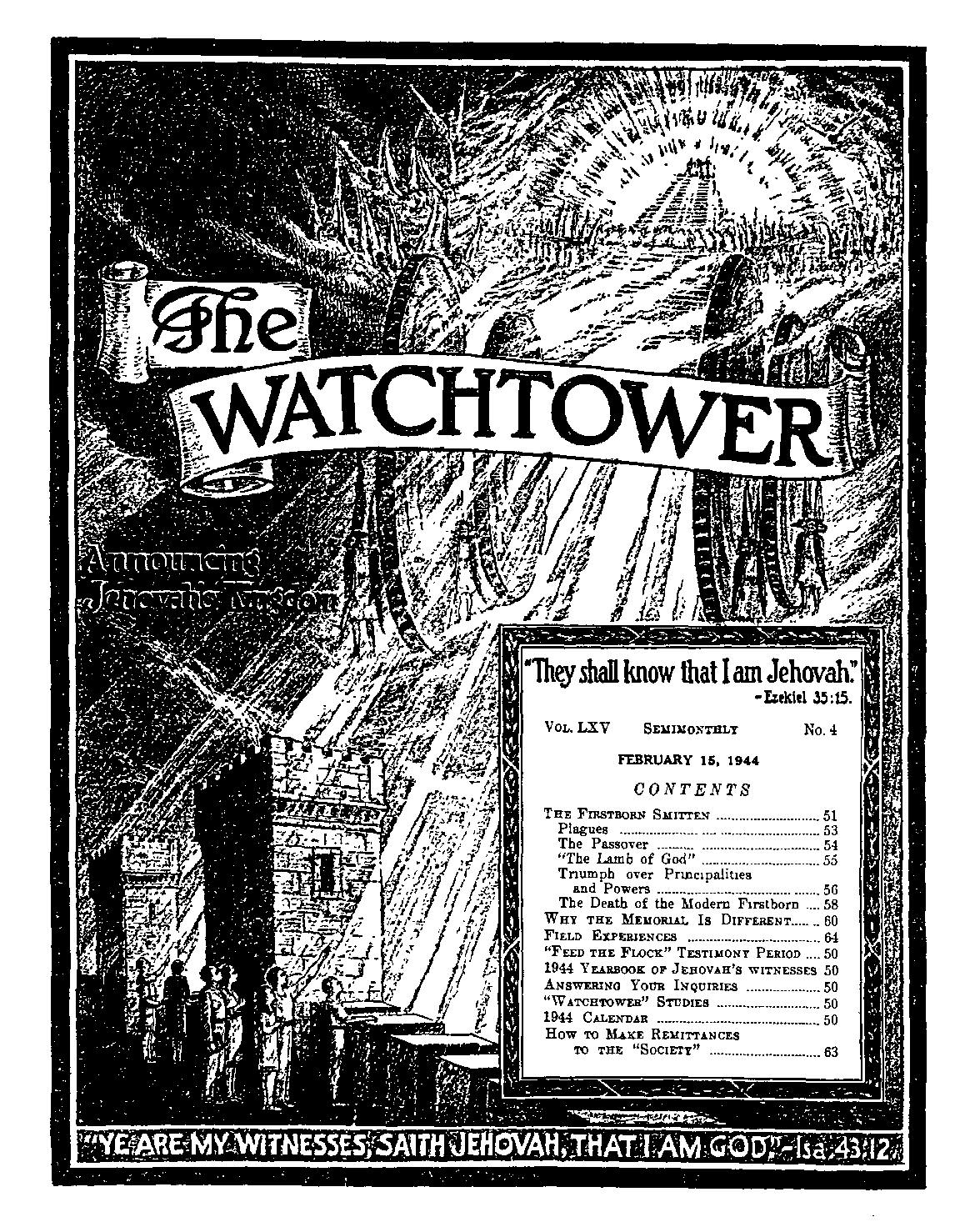
The Watchtower, February 15, 1944
Download: PDF — The Watchtower, February 15, 1944
“FEED THE FLOCK” TESTIMONY PERIOD
February, expected to be the blackest month of the Northern winter for food supplies, has no want for spiritual nourishment. The month has been named “Feed the Flock” Testimony Period. Great effort to reach the scattered sheep with “meat in due season” is now made by Jehovah’s witnesses and their companions. February opens a great three-month house-to-house campaign wherever the magazine is permitted circulation, to increase the subscription list of The Watchtower. A special offer has been authorized of a year’s subscription for this journal, together with a copy of “The Truth Shall Make You Free” and Freedom in the New World as a premium, at the regular subscription rate of $1.00. For anyone’s part in this special campaign considerable preparation is required. Jehovah’s witnesses and companions having accordingly planned and prepared are now launching out at the opening of the campaign fully equipped and instructed, eager to exceed anything that has been attained heretofore in such an effort for 100,000 new American subscribers.
1944 YEARBOOK OF JEHOVAH’S WITNESSES
Despite the unfavorable conditions, the 1944 Yearbook of Jehovah’s witnesses has been produced covering the world-wide accomplishments of these Bible educators during this past service year of 1942-1943. The stirring report thereof has been prepared by the president of the Watch Tower Bible and Tract Society, and it sets out also the key-features and objectives of the work immediately ahead, thus providing valuable material for service discussions and also counsel for all educators of men of good-will. A daily text and comment covering each day of the year 1944, as based on The Watchtower, makes it a daily handbook of spiritual food. The new Yearbook, of over 350 pages, enclosed in a sturdy binding, may be had at 50c a copy, postpaid. Those associated in a group or company should combine orders and send through the local servant, to economize time and shipping expense.
ANSWERING YOUR INQUIRIES
Some of the brethren are writing the Society inquiring, “When should I arrange my vacation so as to be able to attend the 1944 convention?” The answer is, Include the dates August 9 to 13, 1944.
“WATCHTOWER” STUDIES
Week of March 26: “The Firstborn Smitten,”
1-20 inclusive, The Watchtower February 15, 1944.
Week of April 2: “The Firstborn Smitten,”
21-40 inclusive, The Watchtower February 15, 1944.
1944 CALENDAR
The Watch Tower Society’s 1944 calendar features the yeartext; namely, “Teach me to do thy will; for thou art my God.” (Psalm 143:10) The up-to-date animated picture accompanying (in color) conforms to the text and illustrates how it is being earned out by those who now make the text their own. The calendar pad announces the bimonthly Testimony periods of 1944, and also the service themes and supporting scriptures of the alternating months. The calendar is now available, and will be mailed on a contribution of 25c a copy, or 5 copies to one address on a $1.00 contribution.
Vol. LXV
February 15, 1944
No. 4
THE FIRSTBORN SMITTEN
"For I will go through the land of Egypt in that night, and will smite all the first-born in the land of Egypt, both man and beast; and against all the gods of Egypt I will execute judgments: I am Jehovah. And the blood shall be to you for a token upon the houses where ye are.”
—Ex. 12:12,13, Am. Rev. Ver.
JEHOVAH has caused a great outcry to be raised against himself and his name in “Christendom”. From her most exalted ruler on down to the lowliest toiler for the world organization have gone up wails of anguish and fear, together with angry protests and bitter, hard-hearted denunciations. Since the stopping of the World War in 1918 Jehovah has been doing a “strange work” in all the habitable earth for a witness to all the nations. It has been a torment, like a never-ending succession of annoying and destructive plagues, particularly to the religious leaders and their political and commercial partners. They have finally been touched at their most vital spot, and now they would that they had nothing more to do with the representatives on earth of Jehovah God. The turn of affairs is like that which befell the ancient land of the Nile. Thirty-five centuries ago it was a fell night for the realm of the Pharaohs, one night never to be forgotten. Its anniversary is observed to this year. There have been other developments since that original night of Nisan 14 in plague-smitten Egypt, and the meaning of the anniversary has been added to. Hence its observance in 1944 by Jehovah’s witnesses, on Saturday, April 8, after 6 p. m. Standard Time, cannot be otherwise than with an enlarged understanding and appreciation that thrill us.
2 The tremendous issue has now been set squarely before all nations and may no longer be ignored, but must early be settled. It can better be measured by looking back to its historical foreshadowing in ancient Egypt. What was the great question for settlement then that affected Egypt’s ruling dynasty, the religious guides, the princes of wealth, the mighty military chiefs, and every house and family in Egypt as well? What issue was it that, being decided wrongly by the ruler on his throne as advised by his religious counselors, would hurt every house-hold? The voices out of the past set it before us: “Thus saith Jehovah, the God of Israel, Let my people go, that they may hold a feast unto me in the wilderness.” It is the prophet Moses and his brother Aaron presenting the demand before the throne of the land. “Who is Jehovah, that I should hearken unto his voice to let Israel go? I know not Jehovah, and moreover I will not let Israel go.” This is the voice of Pharaoh of Egypt breathing out such defiance. (Ex. 5:1,2, Am.Rev.Ver.) Moses and Aaron were speaking for Jehovah, the God of freedom. So stubborn Pharaoh must have been speaking for Jehovah’s adversary, Satan, the god of oppression.
(a) How has Jehovah caused a great outcry to be raised against himself and his name in "Christendom"? (b) To what night long ago in Egypt does this development call our attention, and when and by whom is this observed in 1944?
2. What historical foreshadowing in ancient Egypt helps us to measure better the issue set before all nations for settlement?
3 The controversy that set in with the above words now posed the issue, Who is supreme, the God of Moses and Aaron or the god of Pharaoh? The men who here faced one another, Moses and Aaron as standing for the oppressed Hebrews or Israelites and Pharaoh as standing for the mighty nation of Egypt, had their respective convictions as to the answer to this hot question. They must now determine their lines of action accordingly. They had to decide, therefore, the corresponding issue, Whom will you serve, God or Satan?
4 From Pharaoh’s haughty reply it is clear that he chose to obey and serve the “gods of Egypt”, that is, the invisible demons whom Pharaoh and his people worshiped, namely, the principalities and powers lined up under Satan the Devil. Heavy responsibility rested upon Pharaoh, for not only he but also his entire people would suffer the effects of any unwise choice and action by him. The demand which he must consider was a reasonable and righteous one, and, if answered aright, would not harm the nation but would spare them much annoyance. Only pride and selfishness and religion would hinder the granting of the demand of Jehovah God through Moses and Aaron.
3. What controversy then set in? and what corresponding Issue did each of the opposing sides have to decide?
4. What choice did Pharaoh make, and under what heavy responsibility?
5 Consider the facts in the case. Two hundred and fifteen years before this the Hebrew named Israel (or Jacob) had moved down into Egypt with all his family. They located in the land of Goshen, in northeastern Egypt along the delta of the Nile. Israel and his descendants understood that they would not remain permanently in Egypt, because God had promised the land of Canaan to their forefather Abraham and to his seed after him and they must therefore move into the promised land in God’s due time. Hence they were in the land of Egypt but were not of it and had no territorial ambitions against this land of their sojourn. They were an independent people and served the God of their fathers, Jehovah. They came down into Egypt at a time of crisis to the nation, when a member of their family, Joseph, was being used of Jehovah God to conduct Egypt’s affairs and to spare it from ruin by a world-wide famine. Egypt really owed the family of Israelites a lasting debt of gratitude.
6 While sojourning, even during Joseph’s long administration, the family of Israelites grew rapidly. Sixty-four years after Joseph’s death Moses was born. By that time the people of Israel had increased surprisingly in numbers, twelve tribes of them being in evidence but yet holding together as one people. They did not try to force the worship of their God, Jehovah, upon the nation of Egypt, but held separate from Egypt because that nation worshiped demon gods, the principalities and powers under Satan. This very separateness, however, was a testimony on the part of the Israelites to Jehovah as the true and living God. Nevertheless, they were obedient to all the laws of Egypt which were not out of harmony with Jehovah’s worship, and were thus law-abiding sojourners in the alien land. They had God-given rights, and it would be wrong for Egypt and her Pharaohs to try to take such rights away and to put down their free exercise. The Israelites reserved to themselves foremost the right to serve, obey and worship Jehovah, the God of Abraham.
7 The demon principalities and powers, which gave Egypt its religion, were responsible for Egypt’s attempt to destroy the Israelites; for, aside from the faithful man Job of the land of Uz, they were the only people on earth not worshiping the demons or practicing religion. Satan and his demons, working through official magicians, wise men and religious priests of the royal court, caused Pharaoh and his princes to overlook the nation’s debt to Jehovah’s people among them. Satan stirred up Pharaoh and his princes to jealousy at the population increase of the Israelites and to view them as a potential menace to the state, who might prove to be seditionists giving aid to the enemies of the state or even scheming to outnumber and overpower the Egyptians and take over the government. Of course, Pharaoh did not care to remember that, when Joseph was Pharaoh’s prime minister for eighty years, the Israelites did not attempt to overturn or take over the government themselves. And why not? Because they looked to Jehovah’s promise to bring them up out of Egypt and to settle them in the land of Palestine. Pharaoh had confirmatory evidence of this Israelite hope. He knew that at their father Israel’s death in Egypt this patriarch had ordered his bones to be buried, not in Egypt, but in a sepulcher in the promised land; and also that at Joseph’s death he had given command that his bones be carried up out of Egypt by the Israelites on their exodus and buried in Canaan land. The faithful Israelites looked for a “better country” ruled by the God of heaven.
5 How did the Hebrews come to be residing in Egypt, and why were they to be there only for a limited time?
6 To what extent bad they multiplied? and as respects Egypt what position did the Israelites take toward worship?
7 Who were responsible for Egypt’s religion and for her attempt to destroy the Israelites? and why were Pharaoh's fears respecting the Israelites unfounded, within his own knowledge?
8 Under no other than demon influence and with religion’s full approval Pharaoh took up the fight against Jehovah by persecuting those worshiping Him. Some time before Moses’ birth the oppression began. Pharaoh exalted the state above Jehovah God and looked upon it as the “higher powers ’. He looked upon his people as the master race, and upon Jehovah’s people as property of the state to be dealt with as the state chose to frame its laws. He began a planned official course of plaguing the people of Jehovah. Such plaguy governmental policy lasted, not over a few days, but over more than a generation of time, more than eighty years, and that with increasing harshness and oppressiveness. He ordered the male babies, not merely the firstborn but all males, to be killed at birth. Thus in a generation's time the male population would die out and the women be forced to make marriages with the demon- worshiping Egyptians.
9 That murderous decree the faithful Israelites rightly refused to obey, not because they were seditious, but because it was contrary to the will and command of the Most High God, whom they worshiped. Hence Aaron and Moses, though born under that governmental decree, survived to the day of facing Pharaoh, their would-be murderer, and calling a halt to his anti-Jehovah program. The Israelites resisted the mischievously framed birth-control law and manifestly had God’s approval, because their population kept increasing. Pharaoh then decreed a national service law for the Israelites and ground them down with hard labor at works of state under governmental supervisors and taskmasters. This took them away from their flocks and herds, for they were primarily peace-loving shepherds. It denied them the right of free enterprise and choice of occupation according to God’s will, as well as wore them out almost to death. It was bound to interfere with their freedom to worship Jehovah and to act upon His commandments to worship him.
8. When and under what official views did Pharaoh begin oppressing the Israelites? and how did be seek to plague them to the point of dying out as a people?
9. Why did the Israelites disobey that murderous decree? and what was the effect upon them of tbe national service law that followed?
10 The Lord God was long-suffering and forbearing toward that first world-power, but such a situation could not go on without his interference at the proper time. What Egypt under demon and religious influence was doing was a challenge to Jehovah God, because the Israelites were his people and worshipers and his purposes were now ripening to full flower. A free nation was about to be born. God’s word of promise that Abraham’s descendants should be afflicted for four hundred years and that God would then judge the nation afflicting them and would bring Abraham’s natural seed out from under their afflicters was now due to be fulfilled. God Almighty could not let it fail. Hence the appearance of Moses and Aaron before Pharaoh in the four-hundredth year. It must now be demonstrated whose word goes, whose purpose must succeed, who are the “higher powers”, and who is the true and living God to be worshiped and obeyed. Moses and Aaron stood for Jehovah’s side of the controversy. They were Jehovah’s witnesses, and that before the topmost official of the then dominant world-power. Egypt, as represented by her political ruler and his religious instructors and commercial princes, was “the king of the south” and took a hard stand against Jehovah God and Jehovah’s witnesses and people. Thereby Egypt, or her ruling powers, hurt the interests of all the people of Egypt and lined them up against the great Life-giver and Savior, Jehovah God.
PLAGUES
11 It was God's demand, not man’s, that Moses and Aaron his mouthpiece served upon Egypt's royal majesty. What was it? This: “The God of the Hebrews hath met with us: let us go, we pray thee, three days’ journey into the desert, and sacrifice unto the Lord our God; lest he fall upon us with pestilence, or with the sword.” (Ex. 5:3) This was a demand for the freedom to exercise the worship of God in the manner he prescribed and in the place where he commanded.
12 Jehovah’s witnesses, Moses and Aaron, made it plain that if they disobeyed this divine command to worship and service it would mean their destruction. It was a serious matter for them, of either life or death, and they could not afford to let their consciences be overridden by the political powers of the land. Nor was it for the political power as judge, advised by the religious counselors, to determine whether the worship of Jehovah was right. That would be letting man’s mere opinion decide whether to deny them freedom of worship while at the same time granting freedom of religion to his priests and their dupes. Pharaoh was confronted with no mere human law and demand, but with the Most High God’s. Hence it was the right and wise thing for the state to bend to Jehovah’s demand.
10 Why could God not let such a situation go on without interference? and what respective positions and offices did Moses and Aaron and Egypt's ruling factor? then hold?
11 Whose demand was it that was made? and for what?
12 Why was obedience to the divine command a serious matter for Moses and Aaron? and why was mere human judgment on the matter out of order?
13 Pharaoh then hurled the charge that the demand of these Jehovah’s witnesses was interfering with the national service and the state’s works program. He said: “Wherefore do ye, Moses and Aaron, let the people from their works? get you unto your burdens.” And with that he slapped on extra oppressive measures against them, treating them as slaves of the state and keeping them from the active worship and service of their God. (Ex. 5:4-14) Jehovah receiving such an answer, the contest over righteousness and supremacy was on. Then Jehovah sent his answer: plagues upon those who plagued his people and who plagued the name of Jehovah. It was time for Him to make a great name for himself, seeing that his name was under reproach and the demand made in His name was not respected as of any weight or genuineness. The name and power of Jehovah must be thrust under the nose of Pharaoh by God’s righteous judgments expressed in plagues. Neither the religious, political, commercial and military powers of Egypt nor the invisible demon principalities and powers could prevent it; for Jehovah is God Omnipotent. The rightness and fitness of granting to His people freedom of worship must become a sore and vexatious problem with Egypt until her stubborn resistance and fight against Him were defeated. It would have been easy for him to wipe out the whole nation of Egypt at once. That, however, would not have permitted them, while still living, to see the uselessness of their opposition and that they were fighting really against God, who is irresistible and undefeatable. First his name must be declared famously among them before he showed his supreme power over them in their destruction.
14 In quick succession ten plagues from the God of the helpless Hebrews followed. First came the plague of blood throughout all the land of Egypt, and even her holy river of commerce, the Nile, was turned to blood. How this irked the religionists as to their religious susceptibilities those seven days! Frogs next plagued the land even to the inmost living quarters of the people. Next the whole nation became lousy. Pharaoh’s religious backers, who had duplicated on a small scale the previous signs and plagues displayed by Moses, tried to meet lice with lice. “But they could not: so there were lice upon man, and upon beast. Then the magicians said unto Pharaoh, This is the finger of God." Yet Pharaoh hardened his heart against God and His witnesses. By Moses Jehovah now announced that the next and last seven plagues would not smite the Israelites in the land of Goshen; for He would put a division or redemption between his people and the Egyptians. —Ex. 8:18-23.
13. What false charge did Pharaoh then make against Moses and Aaron? and did it then become fitting to pour out plagues upon Egypt?
14. What three plagues then came, what admission did the magicians make, and how were the seven remaining plagues to be applied?
15 Swarms of flies came, then a grievous murrain upon Egypt’s livestock, then an epidemic and epizootic of boils breaking forth with blains. Whereas each plague softened up Pharaoh to let God’s people go, the demon forces always proved stronger than Pharaoh their servant, for each time they influenced Pharaoh to presume upon God’s mercy. Hence the repeating of God’s demands, followed by his lifting the then raging plague at Pharaoh’s entreaties, merely hardened the tyrant’s heart, and he thought he could play on indefinitely with Jehovah and finally wear him down. In warning against any such conclusion Jehovah prefaced the seventh plague with this notice to Satan’s representative: “Even now I might have stretched out my hand, and I might have smitten thee and thy people with the pestilence; and thou wouldst have been cut off from the earth; but for this cause have I allowed thee to remain, in order to show thee my power; and in order that they may proclaim my name throughout all the earth.” (Ex. 9:15,16, Leeser’s translation) That warning went also for Satan the Devil, who was backing up Pharaoh. Satan could now know definitely why Almighty God has permitted him to continue to exist operating wickedness and woe. But now came the worst hailstorm in Egypt’s history, pelting man, beast, and every grown herb of the field, and the trees. Goshen and the Israelites were untouched.
16 The stating of God’s requirements for the worship by his people again hardened Pharaoh’s heart despite the compromising attitude of his frightened servants. Then swarms of locusts swept in and darkened the land and ate it bare. That not enough for Pharaoh, three days of darkness so thick as to be felt settled down upon his domain. When next Moses said they must take along their herds that the Israelites might have wherewith to sacrifice to God, Pharaoh got hard again and drove Moses and Aaron from his court: “Take heed to thyself, see my face no more; for in that day thou seest my face thou shalt die.” (Ex. 10: 27, 28) Such ultimatum was well timed, for one more plague, and only one, was due to strike, and it must bring the showdown. It appears that, as on previous occasions, before taking leave of Pharaoh, Moses described the tenth and last plague to that dictatorial monarch. It would be the death of Egypt’s prized firstborn ones of man and beast. What Jehovah had warned Pharaoh before the plagues began was at last due to fall: “Thus saith the Lord, Israel is my son, even my firstborn: and I say unto thee, Let my son go, that he may serve me: and if thou refuse to let him go, behold, I will slay thy son, even thy firstborn.” (Ex. 4: 22,23) Pharaoh did not believe this, or his pride convinced him that if Jehovah thought He could break him with this disaster, He was mistaken and nothing could subdue the spirit of the chief of state.
15. Why did Pharaoh repeatedly harden his heart? and how did God pretace with a warning the seventh plague, and for whom?
16. Pharaoh's further hardening of his heart reached a climax is what final threat to Moses and Aaron? and why was it well timed?
THE PASSOVER
17 That the Israelites, even though in Goshen, might be passed over and spared in this plague, Jehovah issued through Moses instructions to His people, thereby testing their faith and obedience. Such instructions also started a rule of Theocratic law over them as the people whom he was now to purchase for his possession. “This month [Nisan or Abib] shall be unto you the beginning of months: it shall be the first month of the year to you. Speak ye unto all the congregation of Israel, saying, In the tenth day of this month they shall take to them every man a lamb, according to the house of their fathers, a lamb for an house: . . . Your lamb shall be without blemish, a male of the first year: ye shall take it out from the sheep, or from the goats: and ye shall keep it up until the fourteenth day of the same month: and the whole assembly of the congregation of Israel shall kill it in the evening. And they shall take of the blood, and strike it on the two side posts and on the upper door post of the houses, wherein they shall eat it. And they shall eat the flesh in that night, roast with fire, and unleavened bread; and with bitter herbs they shall eat it. Eat not of it raw, nor sodden at all with water, but roast with fire; his head with his legs, and with the purtenance thereof. . . . And thus shall ye eat it; with your loins girded, your shoes on your feet, and your staff in your hand; and ye shall eat it in haste: it is the Lord’s passover.
18 “For I will pass through the land of Egypt this night, and will smite all the firstborn in the land of Egypt, both man and beast; and against all the gods of Egypt I will execute judgment: I am the Lord. And the blood shall be to you for a token upon the houses where ye are: and when I see the blood, I will pass over you, and the plague shall not be upon you to destroy you, when I smite the land of Egypt. And this day shall be unto you for a memorial; and ye shall keep it a feast to the Lord throughout your generations; ye shall keep it a feast by an ordinance for ever. . . . and none of you shall go out at the door of his house until the morning. . .. This is the ordinance of the passover: There shall no stranger eat thereof: but every man's servant that is bought for money [being hence of the household], when thou hast circumcised him, then shall he eat thereof. A foreigner [alien] and an hired servant shall not eat thereof. And when a stranger [sojourner] shall sojourn with thee, and will keep the passover to the Lord, let all his males be circumcised, and then let him come near and keep it; and he shall be as one that is born in the land: for no uncircumcised person shall eat thereof.”—Ex. 12:2-14, 22, 43-45, 48.
17. What Instructions did God then issue that the Israelites might be spared the tenth plague? and for what kind of test?
18. (a) At what token would Jehovah pass over them? (b) How was the day to be memorialized, and who besides Israelites could be admitted to the passover supper?
19 When the fourteenth day of Nisan set in at sundown, the Israelites killed the passover lamb, sprinkled its blood on the doorways, and retired within and ate the passover. The lamb’s blood was the seal of validity to their covenant with Jehovah to be his people subject to his Theocratic law. At midnight as the full paschal moon shone down upon the blood-bespattered doors of the people of Jehovah his angel of destruction passed by those feeding on the lamb, but smote the firstborn in all Egyptian homes and stalls of herds. “And there was a great cry in Egypt; for there was not a house where there was not one dead.” Truly alarmed for his own life and that of all the surviving Egyptians, Pharaoh thrust the people out of the land of Egypt. Girded, shod, and with staff in hand, the Israelites under Moses began at once to move out of Egypt, a free nation. “On the morrow after the passover the children of Israel went out with an high hand in the sight of all the Egyptians. For the Egyptians buried all their firstborn, which the Lord had smitten among them: upon their gods also the Lord executed judgments.”—Num. 33: 3,4.
20 A miraculous pillar, being of cloud by day and of fire by night, represented Jehovah’s presence with his delivered people, and led them toward the Red sea. The demons saw that the Israelites’ line of march was disclosed to Pharaoh. Filled with vengeance for the firstborn of Egypt and for the indignity to Egypt’s gods, Pharaoh ignored the recent show of Jehovah’s power and mustered all his horses and chariots and his armed forces. Then he pursued the “fugitive slaves”. Jehovah’s cloud got in between and prevented Pharaoh’s hosts from overtaking the Israelites. When Pharaoh thought he had them trapped at last at the seaside, then Moses raised his staff and Jehovah made a path through the depths of the sea for his chosen people to go through dryshod to the shores of Arabia on the other side. Heedlessly the Egyptian hosts dashed in after them, but car trouble slowed their progress. Suddenly while they were amidst the sea and, in panic, were turning to get back to Egypt and safety, Jehovah’s power released the watery walls and Pharaoh’s terrifying hosts were baptized in destruction.—Exodus 14.
19. What then took place on the night of Nisan 14? and under what circumstances did the Israelites start moving out of Egypt?
20. What action did Pharaoh next take, what prevented the Israelites from being overtaken, and how were Pharaoh's hosts baptized in destruction?
21 With songs of deliverance on their lips to Jehovah’s praise, the nation made up of witnesses to his power and supremacy moved on. In the third month after getting out of Egypt they reached Mount Sinai, the mountain of God, where the Lord God had informed Moses that the Israelites should worship him. At this mountain Jehovah confirmed them as a “people for his name” by ratifying the covenant which he had made with them in Egypt over the lifeblood of the passover lamb. Through Moses He gave them the tablets of the Ten Commandments and many auxiliary laws and ordinances. At this dedication of the law covenant Moses took the blood of the animal victims sacrificed and with it he sprinkled both the book of the law and the people, saying: “Behold the blood of the covenant, which the Lord hath made with you concerning all these words.” Thus the law covenant was dedicated or ratified with blood. (Ex. 24:3-8; Heb. 9:16-22) In the ordinances of this law God provided for sin- offerings, and, most prominently of all, for an annual sin-offering for the whole nation. On that atonement day each year the high priest sprinkled the blood of the sin-offerings before the mercy seat of God’s ark in the Most Holy of the tabernacle or temple. However, the bodies of the sin-offering victims were burned without the camp of the Israelites. No part of the sin-offerings was eaten, but the sprinkled blood atoned pictorially for their sins. Thereby they could keep on in covenant relationship with God. —Lev. 16:1-34; Heb. 13:10-13.
"THE LAMB OF GOD"
22 Skip now with one bound the intervening fifteen centuries across to Nisan 14 of A. D. 33. According to God’s ordinance the passover supper is still being kept, but now at Jerusalem, the city which He had chosen to put his name there. (Deut. 12: 5-16) One particular gathering keenly interests us. It is in a “large upper room”. Thirteen men are present. (Mark 14:12-17) As we watch we see that they do not follow out all the details of the first passover, that one down in Egypt. Entering in by the door, we see that its posts and lintels are not sprinkled with blood. No; the passover lamb was killed at the temple in Jerusalem, its blood was poured at the altar base, and then it was roasted and served on the table of the upper room. As the thirteen eat, Jesus and his twelve intimate disciples, they are not standing, with loins girded, feet shod, and staff in hand and eating in haste. They are reclining at the table, and disciple John is on the same couch with Jesus and reclining in his bosom. The roast Iamb, without a bone broken, is there, also the bitter herbs and the unleavened bread. But there is a sauce to dip in with a sop, and also wine, usually red wine being used. Several cups of wine are passed about in the course of the evening. At close of supper they do not stay indoors for fear of a destroying angel. Shortly after midnight they go forth, having first sung a hymn from the book of the Psalms. This was the last valid celebration in memorial of the original passover down in Egypt, and, as such, it was the last passover having recognition of Jehovah God. Why?
21. Where and how was God’s covenant with the Israelites ratified? and what provisions did bls ordinances to them make for sin-atonement?
22. In A. D. 33, at the last valid memorial celebration of the passover, in what ways was this manner of celebration different from the manner down in Egypt?
23 The passover in Egypt, accompanied by the death of Egypt’s firstborn, was not just an actual historical event that could be memorialized each year on its anniversary date, but was also a prophetic shadow of grander things to come. It told of a greater lamb and of a larger deliverance, of eternal duration. On that Nisan 14 of A. D. 33 the time for the shadow to meet up with the reality had arrived, and the time for the eternal realities to begin was at hand. The real victim whose shed blood would bring deliverance was present, presiding at this last passover. He was the one to whom John the Baptist had pointed, saying: “Behold the Lamb of God, which taketh away the sin of the world.” On that same day on which the typical passover lamb was killed he was there at Jerusalem to be killed, thus fulfilling the typical picture. The passover was the first feature to be observed of God’s law covenant with Israel, inasmuch as the covenant was made valid over the blood of the lamb. Likewise at the fulfillment thereof by the death of the true Lamb of God the law covenant was due to pass out as out of date, because the substantial realities were now coming in to fulfill all the typical features of that law covenant.—Heb. 10:1; Col. 2:16, 17.
24 Knowing that the passover supper must cease henceforth among the true servants of Jehovah God, Jesus the “Lamb of God” finished the supper. He had meantime dismissed the unfaithful disciple Judas, who should betray him to his religious enemies for him to be killed. Thereupon Jesus introduced something new. It was something to fixate the attention of his faithful apostles and of all his other disciples down till today upon the momentous realities which must fulfill the typical things of old. After the identifying and dismissing of his betrayer, the Record reads: “And as they were eating, Jesus took bread, and blessed, and brake it; and he gave to the disciples, and said, Take, eat; this is my body. And he took a cup, and gave thanks, and gave to them, saying, Drink ye all of it; for this is my blood of the covenant, which is poured out for many unto remission of sins. But I say unto you, I shall not drink henceforth of this fruit of the vine, until that day when I drink it new with you in my Father’s kingdom. And when they had sung a hymn, they went out into the mount of Olives.”—Matt. 26: 26-30, Am. Rev. Ver. (See our supplementary article “Why the Memorial Is Different”, on page 60 herein.)
23 How was the first passover more than a mere past historical event, when did it begin to be fulfilled, and with what effect upon the law covenant?
24 After the passover was finished, what new thing did Jesus institute, and why?
TRIUMPH OVER PRINCIPALITIES AND POWERS
25 The hour was at hand for the antitypical pass- over, “the Lamb of God,” to be slain that all believers might thereafter manifest to all the world their faith in his blood. One of such believers wrote these words: “For our passover also hath been sacrificed, even Christ: wherefore let us keep the feast, not with old leaven, neither with the leaven of malice and wickedness, but with the unleavened bread of sincerity and truth.” (1 Cor. 5:7,8, Am. Rev. Ver.) The evening of Nisan 14, marked by the slaying and eating of the passover lamb and by the new Memorial, was passing, and the morning of the same day was now coming on. Before that day should pass out at the coming sundown the true passover Lamb, Christ Jesus, must die to fulfill the type on the correct date. The third hour of the day after sunrise, or about 9 a. m., Jerusalem time, saw the Lamb of God hoisted on the tree at the place called “Golgotha” or “Calvary”. (Mark 15:25; Luke 23:33; John 19:17) After six hours of enduring the greatest of reproach and maintaining his integrity toward God under most intense pain, the Lamb of God died, about the ninth hour of the day, or 3 p. m., amid an unnatural darkness. The invisible principalities and powers must have rejoiced and felt triumphant. Their foremost religious servants on earth, the Jewish clergy who had procured the Lamb’s death, rejoiced in the spirit of their father, the Devil. (Luke 23:44-46; John 8: 44) And when the body was taken down from the tree and laid in the grave by those who believed in Jesus, the religious leaders caused the rock door of the sepulcher to be sealed with the Roman governor's seal and a soldier guard to be stationed there to prevent the removal of the body by any human power.
25 At 1 Corinthians 5 how did a believer identify the real Lamb, how did such Lamb fulfill the type right on time, and how did the enemy forces seek to complete their seeming triumph?
26 It was not necessary for Jesus to die in literal Egypt to fulfill the passover type. Egypt was a part of the Devil’s world, which fact he pointed out to Jesus in the mount of temptation. Hence Egypt was a type of the world, and Pharaoh was a type of the invisible ruler of this world, Satan the Devil. While in no wise a part of it, yet Jesus was in the world. Quite right he said to the Roman governor, Pontius Pilate: “My Kingdom . . . does not belong to this world. If my Kingdom did belong to this world, my subjects would have fought to save me from being delivered up to the Jews. But, in fact, my Kingdom has not this origin.” (John IS: 36, Weymouth) Jesus was therefore in antitypical Egypt, which is this world, and in it he died. As the scripture testifies: “The great city, which spiritually is called Sodom and Egypt, where also our Lord was crucified.” (Rev. 11:8) The antitypical Pharaoh, “the god of this world,” may have thought that he had won and that the deliverance of any of humankind from under his oppressive sway was for ever blocked. His religious clergy among the Jews thought they too had won and would continue to hold high station and power and control among the people, now that Jesus was dead and buried. They could hold the people in bondage to the so-called “Jews’ religion”. — Gal. 1:13, 14.
27 Back in Egypt the slaying of the passover lamb had been preceded by great plagues, nine of them, upon Pharaoh’s realm. The slaughter of the passover lamb was followed by the worst plague, the death of all Egypt’s firstborn, to the great reproach of her gods. Correspondingly, prior to Jesus’ death his activities and preaching were very destructive of religion among the Jews and hence they were like plagues to the Devil and his chief ones on earth, particularly the clergy. Jesus exposed their traditions of the elders as being hypocritical worship and contrary to the Word and commandments of God. (Matt. 15:1-9) He told them they were of their father the Devil, and not representatives of God. His worst judgment declaration was made against such religious clergy just a few days before they had him nailed to the tree, when he said: “Woe unto you, scribes and Pharisees, hypocrites! ... ye blind guides,... Ye fools and blind: ... ye also outwardly appear righteous unto men, but within ye are full of hypocrisy and iniquity. ... Ye serpents, ye generation of vipers, how can ye escape the damnation of hell?” (Matt. 23:13-33) What a devastating plague to religion!
28 Jesus was also a problem to the political rulers, such as Herod the king of Galilee and Pontius Pilate. When he was maldng his last journey up to Jerusalem, “there came certain of the Pharisees, saying unto him, Get thee out, and depart hence: for Herod will kill thee. And he said unto them, Go ye, and tell that fox, Behold, I cast out devils, and I do cures to day and to morrow, and the third day I shall be perfected.” (Luke 13: 31,32) At Jesus’ trial before Pilate, that governor claimed power over him, saying: “Speakest thou not unto me? knowest thou not that I have power to crucify thee, and have power to release thee!” “Jesus answered, Thou couldest have no power at all against me, except it were given thee from above: therefore he that delivered me unto thee hath the greater sin.” By such utterances made to political rulers representing the world empire of Rome Christ Jesus showed that he did not consider Rome or her official representatives as “the higher powers”. (John 19:10, 11; Rom. 13:1) He submitted to being impaled on the tree because this was the cup his Father poured for him, to die as the antitypical passover Lamb. But did the plagues on antitypical Egypt cease with his death? No.
26 Why was it not necessary for Jesus to die in literal Egypt to fulfill the type? and to what extent did Satan and his servants think they had won?
27 In Egypt what preceded the slaying of the passover lamb? and what like thereto preceded the death of the “Lamb of God”?
28 How was Jesus also an annoying problem to the political rulers?
29 That he might serve as the Mediator greater than Moses and might lead the spiritual Israelites forth from the bondage of this world, Jesus was raised from the dead by the miraculous power of God. Concerning this and its meaning as to his disciples, the inspired Word says to the non-Jewish Christians: “But now, in Christ Jesus, ye who sometimes were far off are made nigh by the blood of Christ. For he is our peace, who hath made both [Jewish and Gentile believers] one, and hath broken down the middle wall of partition [the law covenant with the Jews] between us; having abolished in his flesh the enmity, even the law of commandments contained in ordinances; for to make in himself of twain one new man, so making peace; and that he might reconcile both unto God in one body [the church] by the cross, having slain the enmity thereby: and came and preached peace to you [Gentiles] which were afar off [from God’s covenants], and to them [the Jews] that were nigh.”—Eph. 2: 13-17.
30 The old law covenant had made a difference between natural Jews and natural Gentiles. Henceforth faith in Christ Jesus brought both together in one “body” under the Head Christ Jesus. The law covenant was not meant to last forever, but only until Messiah or Christ. (Gal. 3: 17-19) The features of the “law of commandments contained in ordinances” were fulfilled in him. Hence when dying on the tree he abolished that covenant and provided the blood to make valid the new covenant in behalf of his followers, whether natural Gentiles or Jews. By his integrity maintained toward God unto the death, not a natural death, but one of extreme reproach on the tree, Jesus was made a curse. But thereby he lifted the curse of the law covenant from all believing Jews. (Gal. 3:13,14) All this was a defeat for Satan the Devil, who hoped to hold all the Gentiles as well as Jews under his tyrannical power. It was a great plague to the Jewish religionists who held onto the now hollow shell of the law covenant, the outward observances thereof. It resulted in the death of the religious clergy, that is, as far as their authority and awe-inspiring influence and power affected the Jewish disciples of Christ.
29. What miracle made it possible for Jesus to continue as Mediator of the covenant? and what was tbe effect of his death on the tree as respects Jews and Gentiles?
30. How did Jesus’ death abolish the law covenant and its curse? and how was this as a death-dealing plague to the Jewish clergy?
31 That Jesus’ faithfulness to death and his resurrection out of death were a plaguing blow to antitypical Pharaoh, Satan the Devil, the apostle further explains. He says regarding Jesus: “Blotting out the handwriting of ordinances that was against us, which was contrary to us, [he] took it out of the way, nailing it to his cross; and having spoiled principalities and powers, he made a shew of them openly, triumphing over them in it. Let no man therefore judge you in meat, or in drink, or in respect of an holyday, or of the new moon, or of the sabbath days: which are a shadow of things to come; hut the body is of Christ.” (Col. 2: 14-17) Or, as another translation renders it: “Having blotted out the bond written in ordinances that was against us, which was contrary to us: and he hath taken it out of the way, nailing it to the cross; having despoiled the principalities and the powers, he made a show of them openly, triumphing over them in it.” (Am. Rev. Ver.) Christ Jesus kept his perfect integrity toward God even to the putting off from himself his earthly life. Thereby he gained the victory over the demon principalities and powers of Satan as well as over their official representatives upon earth, all of whom were trying to force Jesus into a fracture of his integrity. But by his perfection of obedience to God he triumphed over all the enemy powers of this world. He stripped them of all their false charges against him and of all their boasts of being “the higher powers” superior to Jehovah.
32 Along with that, Jesus triumphed over all the religious forces, too. The fact of his resurrection was a deathblow to the religious clergy, who are prominent among Satan’s firstborn ones or chief ones of Satan’s strength. The killed but resurrected Jesus Christ brought his disciples deliverance from this world, antitypical Egypt, as pertains to their worship of Jehovah. Jesus nailed to his tree the contrary legal handwriting of the law covenant, which condemned them as sinners, and thereafter the religious clergy could no longer judge his disciples upon the basis of the law covenant. They could not make it a requirement to the salvation of Jesus disciples, requiring these to live as natural Jews according to the handwriting or bond of ordinances with its obligations. Christ Jesus has nailed such to his tree, and has made his disciples free. They must not care for the judgment of religionists, nor permit the religionists to drag them back into the keeping of the formalities of the typical law covenant and making a religion of such, thereby giving up their Christian liberty. The religious clergy have been plagued to the death as far as true Christians are concerned; and the apostles of Christ Jesus declared their liberty from such “dead” ones, when they said to the Jewish clergy: “We ought to obey God rather than men.”—Acts 5: 29; also 4:19.
31. How were Jesus’ death and resurrection a plaguing blow to Satan's principalities and powers, and a despoiling triumph over them?
32. How have Jesus’ faithful disciples thereby been delivered? and how did his apostles show that the clergy were as dead to Christ’s followers?
THE DEATH OF THE MODERN FIRSTBORN
33 Bible prophecy, casting its light upon world events since A. D. 1914, illuminates the fact that we have been in the “time of the end” since that year. The inspired apostle, at 1 Corinthians 10:11, warns us that what things befell the Israelites of old were types or examples, whose larger and final fulfillment is due to come upon us at the end of the world. Not strange, then, that Revelation chapter sixteen, with its symbolisms of the seven last plagues, shows that the ten plagues upon ancient Egypt must have the full-scale fulfillment upon this world, spiritual Egypt where also our Lord was crucified. In 1914 Christ Jesus, the Greater Moses, was enthroned in power. He has been sent to the temple, there to judge all nations of the Greater Pharaoh and to demand liberty of worship for the spiritual Israelites, Jehovah’s witnesses. These are his visible mouthpieces, just as Aaron was spokesman for Moses when commanding Pharaoh to let Jehovah’s people go forth of Egypt to worship Him.
34 Since 1918 Satan’s answer to this demand for freedom to worship Jehovah by publishing His name and kingdom world-wide has been the introduction and application of totalitarian principles and methods of rule to all the world. The particular aim is to suppress Jehovah’s witnesses. In this effort the “god of this world” has used his firstborn, “the beginning [or chief] of his strength,” and Jehovah’s witnesses have been hated in all nations and viciously and violently persecuted. The burdens upon these witnesses and their good-will companions have been increased, but only to be followed by pain to the Greater Pharaoh and his religious magicians and wise men and his political princes and his lords of wealth and business.
33 How do we know that the plagues upon ancient Egypt must have a full-scale fulfillment now since AD 1914? and who are how the mouthpieces of the Greater Moses?
34 What has been Saturn modern-day answer to the demand for free worship of Jehovah? and what has been the result to Satan and his ruling factors?
35 Particularly since 1922, beginning with the international convention of Jehovah’s witnesses that year at Cedar Point, Ohio, where, ten thousand strong, they issued a Challenge to the rulers of this world, plagues have gone forth to “Christendom” specially. The Greater Moses, who is Christ Jesus at the temple, is responsible for the plagues. He has been authorized by Jehovah God to enforce them upon stubborn, resisting “Christendom”. Such plagues are messages of judgment from Jehovah God and are revealed through his Bible. They are expressed against all things of this world of religion, or demonism, and politics and commerce. Such judgment messages expose this world as Satan's and boldly declare what shall soon come upon it in the battle of Armageddon, now near. Like Aaron who used Moses’ rod, so Jehovah’s witnesses, joined by their good-will companions, have been used to deliver these judgment proclamations in Jehovah’s name and guided and protected by His holy angels.
36 Such messages have been like plagues to all modern-day Egyptians or worldlings. They have shown up the lousy, spiritually diseased, bloody, death-dealing and bedarkened state of this world and its firstborn pets in religion, politics and greedy commerce. (For a full description of the modern descent of such antitypical plagues, see the book Jehovah, published in 1934.) There were ten plagues, ten being a symbol of perfection or completeness as to things earthly. In Egypt the Israelites were exempt from the seven last plagues. In the seventh year from 1922, namely, in 1928, the last of a series of annual judgment messages was released. The tenor of that message discloses that the last of the “seven last plagues” was sent forth upon antitypical Egypt, the world. (See the publication Light, Book Two, for greater detail.) Does that mean the modern likeness of the tenth plague in Egypt has struck! The facts say Yes. Does that mean the firstborn of ‘spiritual Egypt, where our Lord was killed’, have been smitten! Yes, smitten by Jehovah’s judgment message. Now the world’s firstborn ones in religion, polities and commerce are dead in His sight and as respects His witnesses and their companions. (Isa. 26:13, 14) No more are these permitted to restrain Jehovah’s witnesses from serving Him.
37 The judgment of death against the firstborn ones of the three ruling elements of this world was seen to be in effect when the Lord, in 1928, revealed to his witnesses on earth that the “higher powers” are not the political and ecclesiastical rulers of this world, but are Jehovah God and Christ Jesus. (Rom. 13:1) That same year Jehovah revealed that Christianity is not a religion, but is the truth. These disclosures, published more widely from and after 1929, stirred up a great controversy. A tremendous cry arose in all “Christendom” particularly. Her firstborn ones had been smitten dead in their relation to the worship by Jehovah’s witnesses of the Most High God. The firstborn’s deadness shows up when Jehovah’s witnesses boldly say before worldly courts and authorities: “We ought to obey God rather than men.” Hence Jehovah’s worship goes on!
35 Since when in particular have such plagues gone forth upon "Christendom", what in effect are they, and through what agency are they delivered?
36 What hare these antitypical plagues shown up’ and what do the facts disclose as to the last plague as respects the firstborn?
37 When and how was the judgment of death upon the firstborn seen to be in effect? and what followed such disclosures?
38 The year 1940 was a dark year, seeming to threaten the death of the followers of the “Lamb of God”, due to the mob violence and other adverse action against Jehovah’s witnesses, most flagrantly so in America. But instead of breaking ranks and running and leaving the field to totalitarian religion and her judicial, political and commercial aides, Jehovah’s witnesses held fast the freedom of worship of Jehovah, and abode under the shed blood of the “Lamb of God” and proclaimed the day of God’s vengeance openly at the doorways. They exposed the totalitarian religious clergy as fifth columnists against democracy and flung into their corpselike faces the new book Religion and the public lecture “Religion as a World Remedy” and its printed form, all such publications being judgment messages from Jehovah, exposing religion as lifeless in His sight.
39 The march out of modern Egypt is under way. Jehovah's witnesses and the multitude of their companions are marching in freedom to the Red sea of Armageddon. Their troubles at the hands of Pharaoh Satan and his modern Egyptians are not ended, but Satan and all his hordes of religious intolerance and other forms of persecution are in hot pursuit, like Pharaoh’s chariots and horsemen of war. Now Jehovah’s cloud of his presence and power has gotten in between and holds them off from overwhelming his delivered people until his “strange work” by them is done in this world.
40 The “Red sea” will rid Jehovah’s people for ever of demon and human pursuers. As we near the anti- typical Red sea, with these persecuting Egyptians continually harassing us from the rear, Jehovah God bids us be unmurmuring and uncomplaining and to have faith. We have nothing to fear of the Red sea of Armageddon. Through his Greater Moses, Jehovah commands us: ‘The Lord will fight for you. Bid the people go forward!’ (Ex. 14:14,15) And the faithful do so. Jehovah’s witnesses and the multitude of their companions will go through that blood- red battle of Armageddon and come out on the other side in the free New World of righteousness. The pursuing demon-led Egyptian hosts, rashly pushing on to the final assault against the witnesses of the Most High God, will enter into the Red sea of Armageddon, but will never come out alive. Satan’s entire world will be swallowed up in destruction. Then, on freedom’s shores in the New World, all of Jehovah's delivered people will, under the Greater Moses, Christ Jesus, sing praises to Him who gains the victory, “Jehovah of hosts, mighty in battle.” — Ex. 15:1-22.
38. Why was 1940 a dark year for Jehovah’s witnesses? but what did they do then which exposed the actual condition of religion?
39 . Whither are we now marching? and what prevents us presently from being overwhelmed by the enemy?
40 . As we near the sea of Armageddon what does Jehovah command through Christ? and what will be the final event respectively to the pursuing enemy and to Jehovah’s faithful people?
WHY THE MEMORIAL IS DIFFERENT
GREAT confusion has arisen in the minds of some. Because Jesus set up the memorial after the passover, and because the real “Lamb of God” said concerning the bread, “This is my body,” some think the passover was a type of the Memorial and foreshadowed it. They think, therefore, that the same applications hold true concerning the emblems used at the Memorial as held true concerning the passover emblems, and that therefore the Lord’s “other sheep” or “men of good-will’’ should partake now of the Memorial the same as do the remnant of spiritual Israelites. Careful examination of the subject, however, discloses that such is not the case.
One of the most decisive differences is as to the treatment of the blood of the passover lamb and the blood of the “Lamb of God”. God’s law covenant with the nation of Israel was made binding between them and God by virtue of the passover lamb’s blood sprinkled in Egypt. The law covenant was brought about between Jehovah God and the Israelites by means of a go-between, that is, the mediator Moses. Moses himself was a type or prophetic figure of a greater mediator, Jesus Christ; but Moses could not die to mediate the law covenant and also thereafter ratify such law covenant at Mount Sinai. Hence, to spare Moses, the passover lamb was slain instead, and it pointed into the future to the coming Mediator greater than Moses. This Mediator, who is Christ Jesus, establishes by his death a new covenant between God and his disciples. Concerning those taken into the new covenant and who are therefore Israelites after the spirit it is written: “For there is one God, and one mediator between God and men, the man Christ Jesus; who gave himself a ransom for all, to be testified in due time.”—1 Tim. 2:5, 6.
The passover lamb, therefore, foreshadowed Christ Jesus. He is the “Lamb of God” that takes away the sin of all those who gain life in the new world of righteousness. (John 1:29, 36) It is not to be overlooked that the blood of the passover lamb was not eaten or drunk. To have done so would have been a violation by the Israelites of Jehovah’s everlasting covenant with Noah and his family at the appearance of the rainbow after the flood. By that covenant the blood of any animal was forbidden to all mankind to partake of, in these words: “But flesh with the life thereof, which is the blood thereof, shall ye not eat. I do set my bow in the cloud, and it shall be for a token of a covenant between me and the earth,” (Gen. 9:4, 13) That prohibition against drinking or eating blood was also put in the law covenant which was made operative over the blood of the passover lamb, in these words: “I will even set my face against that soul that eateth blood, and will cut him off from among his people. For the life of the flesh is in the blood: and I have given it to you upon the altar to make an atonement for your souls: for it is the blood that maketh an atonement for the soul. Therefore I said unto the children of Israel, No soul of you shall eat blood, neither shall any stranger that sojourneth among you eat blood.”—Lev. 17:10-12.
Instead of drinking the passover lamb’s life-fluid, the Israelites sprinkled its blood upon the lintels and doorposts of their houses. Then they remained indoors under it, so signifying that they were obedient to the Lord Jehovah as the true God, and were also trusting in the blood of the unblemished lamb, the sacrifice approved of God. Such obedient action pictured faith in the shed blood of Christ Jesus as the means to spare one from the wrath of God and from the execution of death at the hands of his Executioner. Today such faith in Christ’s blood, followed up and proved by a complete consecration of ourselves to God to be one of his redeemed people, frees us from the obligation to justify ourselves before God by our own merit and works of righteousness. Despite all our works toward self-righteousness, our consciences would accuse us as under the wrath of God still and subject to condemnation due to inborn sin. Faith in Christ Jesus’ blood as the atonement does bring justification to the consecrated believers and makes them alive unto righteousness. Wherefore it is written: “How much more shall the blood of Christ, who through the eternal spirit offered himself without spot to God, purge your conscience from dead works to serve the living God.” (Heb. 9:14) “While we were yet sinners, Christ died for us. Much more then, being now justified by his blood, we shall be saved from wrath through him.’’ — Rom. 5:8, 9.
Within the blood-marked doors the obedient Israelite families met, and the sojourners among them, all males of whom had been circumcised. They ate the flesh of the passover lamb, not a bone of whose frame had been broken or must be broken. “Neither shall ye break a bone thereof ” (Ex. 12:46) Sinee the blood is that which makes atonement for the sinner and results in cleansing, the eating of the flesh of the passover lamb could not represent justification to the believer in Christ. Rather, the eating of the flesh pictured the fellowship which the believer in Christ’s blood has with Jesus in doing God’s will. It means the following in Jesus’ footsteps by the believer while on earth in the flesh.
…