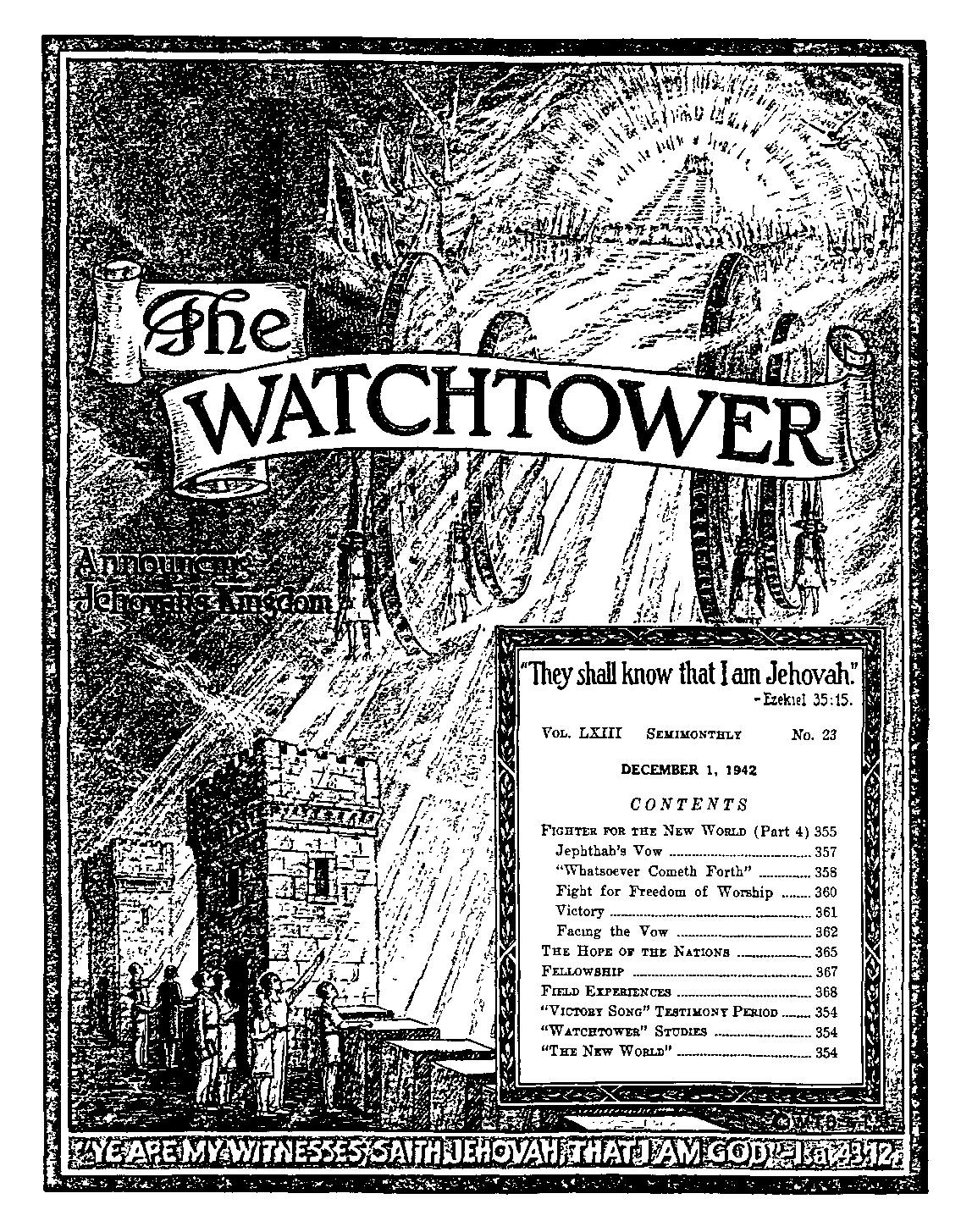
The Watchtower, December 1, 1942
Download: PDF — The Watchtower, December 1, 1942
“VICTORY SONG” TESTIMONY PERIOD
December is the month that brings to a close the calendar year of the old world. It is with joy that the servants of Jehovah sing the Victory Song after a long battle, but they look forward to further battles and victories. The faithful do say with gladness of heart that they have remained “blameless in the day of our Lord” and will continue to do so. by the Lord’s grace. During the “Victory Song” Testimony Period the song of the new world will be sung. To do this the publishers of The Theocracy will offer to the people the publication The New World and the booklet Peace—Can It Last? on a contribution of 25c. If you wish to join in the “Victory Song” Testimony Period during the month of December, make arrangements now with your local company servant. If you are not associated with a company, write direct to the Society for further information.
“WATCHTOWER" STUDIES
Week of January 3: “Fighter for the New World” (Part 4), 1-22 inclusive, The Watchtower December 1, 1942.
Week of January 10: “Fighter for the New World” (Part 4), 23-47 inclusive, The Watchtower December 1, 1942.
“THE NEW WORLD”
In these lurid days when the handwriting on the wall is seen dooming the wicked old world to early destruction in appalling violence, this book entitled “The New World” is published as a special provision of the great Creator of the new world for the comfort and hope of those who long for a righteous world and who are now obliged to suffer sorely for righteousness’ sake The New World has a jacket of peach-colored cloth, with a planetary front-cover embossing matching the title. On opening the book the end-sheets will surprise you with their pictorial story, but your full measure of delight and thrills will come with reading through the 384 pages of the story of worlds, the amazing fulfillment of the ancient drama of Job, the final end of wicked rule, and the triumph of righteousness at last in the new earth and heavens. Artistic pictures in color enliven the swiftly moving theme; and an index of subjects, and another of all Scripture texts cited, make it valuable for study and reference. The New World, the “Publishers’ Edition”, put up in better binding, will be mailed postpaid to your address on order accompanied by your contribution of 50c a copy.
Vol. LXIII
December 1, 1942
No. 23
FIGHTER FOR THE NEW WORLD
PART 4
"Jesus answered, My kingdom is not of this world: if my kingdom were of this world, then would my servants fight."—John 18:36.
JEHOVAH’S spirit is the power behind the new world. It is his invisible power, ever holy because J its Source is such and it is all-powerful for good and righteousness. It is a power for light, and that is what it brought to this globe. In the day of earth’s creation when a vast cloud canopy covered the entire globe like swaddling bands of thick darkness, then, says the Inspired Record, “the spirit of God moved [brooded] upon the face of the waters. And God said, Let there be light: and there was light. And God saw the light, that it was good.”—Job 38:4,9; Gen. 1:2-4.
2 After six thousand years of human existence upon this earth, a destructive darkness due to the unholy powers of demonism hangs like a pall over its two billion inhabitants. The guns of war booming for world domination make horrible the darkness. Educators, statesmen, clergymen, politicians and social leaders say that only the morale of the people can carry them through until the combined and rising might of nations under assault gathers strength to overpower and destroy the demonized totalitarian enemy. However, in the final battle, Armageddon, following which the righteous new world comes, it will not be morale that will carry any people through, but the spirit of Jehovah God. To those who “worship the Father in spirit and in truth” he says: “Not by might, nor by power, but by my spirit, saith Jehovah of hosts.” (Zech. 4:6, Am. Rev. Ver.) His spirit is the invincible power unto victory and survival. His spirit Jehovah puts upon those who devote themselves to His purposes and who offer themselves for his service and seek to vindicate His name.
3 It was the spirit of Jehovah God that Jephthah the Gileadite needed as he took over the command of the armies of Israel at Mizpah and sent the challenge and warning notice to the king of the Ammonites who had invaded Israel’s God-given land. The Israelites had repented and converted from demon worship and turned to the worship of Jehovah God and subjected themselves to Theocratic rule. According to this rule they put themselves under the valorous man of faith, Jephthah, that he might lead them in the fight for Theocracy and worship of Jehovah God. Jephthah agreed to continue in headship over the Israelites upon the condition that Almighty God would give him the victory over the forces of demonism. “Then the spirit of Jehovah came upon Jephthah, and he passed over Gilead and Manasseh, and passed over Mizpeh of Gilead, and from Mizpeh of Gilead he passed over unto the children of Ammon.” (Judg. 11:29, Am. Rev. Ver.) The coming of the spirit upon the man proves that the battle at hand was the Lord God’s, and that Jephthah was approved of Him and was his choice and his representative among His covenant people. This further confirms that Jephthah was a man of faith and an approved “witness for Jehovah”, and was not simply the choice of the elders of Gilead who had marked his deeds of valor and called upon him for his military assistance. Other cases of the coming of Jehovah’s spirit upon his consecrated creatures for victory are those of Judge Othniel, Judge Gideon, Samson, and shepherd boy David. — Judges 3, 6, 14, 15; 1 Samuel 16.
1. What is the power behind the new world, and what did it bring to this globe at the time of creation?
2 Will it be what is called “morale” or some other power that will carry any people through Armageddon and upon whom is It put?
3 (a) What were the developments leading up to Jephthah’s taking over the command of the armies of Israel, and what then came upon Jephthah as be moved to the fight? (b) What did its coming prove both as to the fight and as to Jephthah?
4 The tribe of Manasseh occupied the territory of Bashan and part of Gilead, and the Ammonites crossed over the border and encamped in Gilead. They refused to heed Jephthah’s protest and warning and get out. In a modern parallel action: Particularly since the signing of the concordat between the Vatican and the totalitarian dictator of Nazi Germany in July, 1933, there has been a persistent invasion of the rightful earthly domain of Jehovah’s covenant people who worship him and serve as his witnesses. By the propaganda and Catholic Action of the Vatican’s Hierarchy the totalitarian spirit of encroachment spread unchecked to the lands where democracy has long obtained, and deep inroads were made upon the freedom of worship and of service to Jehovah. Due protest was raised. In February, 1941, the booklet God and the State was published showing that Jehovah God is supreme and no human law is valid except when in harmony with His law and that Christians obey all laws of the state save those which conflict with God's supreme laws. At the same time the booklet Theocracy was issued showing from the Scriptures that God's kingdom by Christ Jesus is a Theocracy, and that Jehovah’s visible organization among his servants and worshipers on earth must be Theocratic, hence governed by His supreme law and subject to the headship of Christ Jesus.
4. Since 1933 what modern parallel has there been to the Ammonite invasion of Gilead, and what two booklets appeared in 1941 as part of the protest thereto?
5 Hot off the press, both Theocracy and God and the State were mailed free to 12,800 newspapers and non-Catholic publications over all the United States, and thereafter copies were submitted to public school boards, to city and county officials, and to the political lawmakers in the legislative houses of all state capitals and of Washington, D. C. Further, the booklet Theocracy was presented to all Protestant and Jewish clergy to enable them to see how grossly Jehovah’s witnesses have been misrepresented by religious-totalitarian agents and dupes. Finally Theocracy and God and the State were released for general distribution and were circulated in several languages to the millions of copies. All this publication of such a challenging message to an anti-Theocracy world required the spirit of the Lord upon his people. The irresistible spirit of Almighty God will continue to move the remnant of his witnesses and their earthly companions until his “strange work” on earth is completed and the time arrives for his “strange act”, the battle of Armageddon.
6 Jephthah’s purpose in passing through Gilead and other territories of the tribe of Manasseh was doubtless in order to recruit more men for the army already encamped at Mizpah, and also to mop up any enemy sympathizers and groups and agents behind the battle front. It appears that the great God of hosts was holding back the beginning of the decisive battle, thereby to provide the opportunity to call to other Israelites to turn out for the field service and have a share in the vindication of Jehovah’s name and Theocracy. In preparing to face the Ammonites on the field of battle who for eighteen dreary years had oppressed Israel, Jephthah displayed great faith and was putting his life in his hands. It was during this preparatory period that there occurred what Jephthah later stated in answer to the false charge of the tribe of Ephraim across the Jordan river. “And Jephthah said unto them, I and my people were at great strife with the children of Ammon; and when I called you, ye delivered me not out of their hands. And when I saw that ye delivered me not, I put my life in my hands, and passed over against the children of Ammon.”—Judg. 12:1-3.
5. (a) How were these two booklets used in delivering the protest? (b) As in Jephthah’s case, what was required for such action?
6 (a) What was Jephthah’s purpose in passing over Gilead and Manasseh, and why was Jehovah holding back the beginning of the battle? (b) To what extent of personal risk was Jephthah obliged to go at this time, and why?
7 Battle was not launched against the aggressor Ammonites as soon as Jephthah took charge of the armies of Jehovah’s typical Theocracy. First more warriors for Theocracy and defenders of the worship of Jehovah God were called for and enlisted. Likewise with the installing of Theocratic rule over Jehovah’s witnesses in October, 1938, there was a call for more publishers of God’s kingdom and for all active publishers to give more time in the field. The desired increase of active field-witnesses for Jehovah and his Theocracy came, by His grace. There was also an increase in the time devoted to the field activity, especially since the publishing of the rousing article “Kingdom Activities” in The Watchtower, December 1, 1938. Said this article: “The army of the Lord on earth is small, but. with its equipment, can perform miracles, by the Lord’s grace, in spite of the Devil’s opposition. The faithful will see to it that this work is done to promote the kingdom interests.” The record of field activities since then shows those words are true. Now despite the violent conditions of global war, the witness work goes on, with increase of publishers in America, Canada, Australia, and Britain, and under extreme difficulties. Also at great hazard to life and freedom some faithful witnesses carry on the witness to Jehovah’s name and kingdom in the lands lying crushed under Nazi-Fascist-Vatican forces.
8 Some professing to be consecrated to God have acted like the tribe of Ephraim and ignored the invitation to service and have not crossed ‘the waters of the Jordan river’ in between, the stream of peoples alienated from Jehovah and who are rushing down the broad road to destruction in the “Dead sea” at Armageddon. To the shame of these spiritual “Ephraimites”, the most of those offering themselves willingly for Jehovah’s field witness-work are from among the persons of good-will, the Lord’s “other sheep”, who have his promise of life in the new world on an earth cleansed of all wicked-doers.
7. (a) Before launching off on battle against Ammon what was done after Jephthah took the command of armies, and what like operation was carried on after installing Theocratic rule over Jehovah's witnesses in 1938? (b) In this respect what does the record of field activities to date show?
8. How have some consecrated ones conducted themselves like the tribe of Ephraim at the call to arms? and who are the ones chiefly offering themselves willingly?
9 From Mizpeh of Gilead Jephthah passed over at last to meet the hosts of Ammon. (Judg. 11:29) “Mizpeh of Gilead” means, literally, “Watchtower of the Heap of Witness.” Such name agrees well with the circumstances and the purpose of the Lord’s visible Theocratic organization in carrying on in his “strange work”, namely, to heap up a tremendous witness to His name and purpose before he shows his power over Satan’s organization in the “battle of that great day of God Almighty”. (Ex. 9:16) Those engaged in the “strange work” anxiously watch to keep their covenant with Jehovah to be his faithful and true witnesses like Christ Jesus. The enemy whom Jephthah challenged and moved out to engage were not far distant: “then the children of Ammon were gathered together, and encamped in Gilead.” (Judg. 10:17) Jephthah’s movements against them denoted offensive action against demonized oppressors and invaders, who were on territory of the typical Theocracy and where they had no right to stand.
10 It is thus seen that those children of Ammon, under the standards of their “king-god”, Molech, pictured the political element of the nations gone totalitarian and which line up with the proposed “new world order”. “Organized religion” will dominate such “new order” briefly, as pictured by the harlot Babylon riding the scarlet-colored beast, at Revelation 17:1-5, 14. All the elements that formulate, set up and compose the new order are against Jehovah’s Theocracy. Hence the religionized “New World order” after this war is certain to be anti- Theocratic. It is therefore abominable to God and Christ. It is the final form of the “abomination of desolation” foretold by the prophet Daniel and Christ Jesus and it marks the final end of Satan’s world. (Dan. 11:31; 12:11; Mark 13:14) The question now pushed to the fore is, Can religion if restored to power maintain “peace and safety” and save the world from disaster? The Roman Catholic Hierarchy and other religious leaders claim Yes, and religious politicians fall for this snare, and will entrust religion with the task, by peace-conference arrangements and guarantees. Religion will then assume to undertake such task. She will try to ride the “new order” creature or “beast” and make it use its ten horns against The Theocracy and against those who have taken their stand for it.
9 (a) From what citv did Jephthah finally pass to meet the Ammonites, and how is the name of the city in agreement with the circumstances and the purpose of God's organization now carrying on his “strange work”? (b) Where had the Ammonites encamped, and what therefore does Jephthah’s movement against them denote?
10 (a) Whom therefore did the children of Ammon there picture, and of what is their worship of the “king-god", Molech, an indication in this connection? (b) What question concerning the world’s fate therefore now comes to the fore? and will religion undertake the task, and how?
JEPHTHAH’S VOW
11 The Lord God Almighty did not require any special vow from his servant Jephthah as a condition for granting him and the Israelites under him the triumph over Ammon. The repentance of the Israelites and the faith of Jephthah and his fellow warriors were the basis for bestowing the victory. “According to your faith be it unto you.” (Matt. 9:29) A vow on Jephthah’s part would be entirely voluntary, but must be in harmony with God’s will and pleasing to him. “And Jephthah vowed a vow unto the Lord, and said, If thou shalt without fail deliver the children of Ammon into mine hands, then it shall be, that whatsoever cometh forth of the doors of my house to meet me, when I return in peace from the children of Ammon, shall surely be the Lord’s, and I will offer it up for a burnt offering.” —Judg. 11:30,31.
12 The vow being absolutely of his own accord, it manifested Jephthah’s earnestness for a winning fight in order that God’s name and honor might be vindicated. Religious commentators, in the running heads of their Bible editions, speak of Jephthah’s utterance as “his rash vow”. However, Jephthah was an actor in a prophetic drama staged by Jehovah’s power and which was enacted for our benefit today. He doubtless received the mental suggestion by means of an angel of the great Director of this drama. There was no compulsion upon Jehovah’s servant, but he willingly acted on the thought. Thereby God permitted him to show the all-sacrificing devotion of a faithful Jehovah’s witness who was fighting for the Theocratic cause. As to the uncompelled spirit behind acceptable vows, note the Lord’s law: “When thou shalt vow a vow unto the Lord thy God, thou shalt not slack to pay it: for the Lord thy God will surely require it of thee; and it would be sin in thee. But if thou shalt forbear to vow, it shall be no sin in thee. That which is gone out of thy lips thou shalt keep and perform: even a freeicill offering, according as thou hast vowed unto the Lord thy God, which thou hast promised with thy mouth.”—Deut. 23: 21-23.
13 Concerning the obligation to pay one’s vow to God when once made, even though of one’s free will, the Scriptures say: "Vow, and pay unto the Lord your God: let all that be round about him bring presents unto him that ought to be feared. He shall cut off the spirit of princes: he is terrible to the kings of the earth.” (Ps. 76:11,12) “When thou vowest a vow unto God, defer not to pay it; for he hath no pleasure in fools: pay that which thou hast vowed. Better is it that thou shouldest not vow, than that thou shouldest vow and not pay. Suffer not thy mouth to cause thy flesh to sin; neither say thou before the angel that it was an error: wherefore should God be angry at thy voice, and destroy the work of thine hands?” (Eccl. 5:4-6) Hannah, the mother of a later judge of Israel, displayed the same unselfish earnestness in her vow as did Jephthah. “And she vowed a vow, and said, O Lord of hosts, if thou wilt indeed look on the affliction of thine handmaid, and remember me, and not forget thine handmaid, but wilt give unto thine handmaid a man child, then I will give him unto the Lord all the days of his life, and there shall no razor come upon his head [he shall be a Nazarite].”—1 Sam. 1:11.
11. Was a vow from Jephthah a requirement for victory, and what did he vow?
12. (a) What did Jephthah’s vow manifest respecting himself, and why was it not a rash act? (b) What was God’s law concerning vows and the performance thereof?
13. (a) What was God’s law concerning the obligation to pay vows when once made? (b) How did Samuel’s mother, Hannah, display the same earneatness and in like manner as Jephthah?
14 Jephthah was eager for winning because Jehovah’s name and Theocracy were tied in with the result of the fighting. His vow showed he believed that Jehovah “is, and that he is the rewarder of them that diligently seek him”, and that He is allpowerful and able to deliver up the enemies for destruction by his executioners. A like unselfish vow in behalf of the vindication of God’s name upon his enemies was earlier vowed by the Israelites under Moses when approaching the Promised Land, Canaan. Numbers 21:1-3 records it: “And when King Arad the Canaanite, which dwelt in the south, heard tell that Israel came by the way of the spies; then he fought against Israel, and took some of them prisoners. And Israel vowed a vow unto the Lord, and said, If thou wilt indeed deliver this people into my hand, then I will utterly destroy their cities [as devoted and cursed; and hence not go after their booty]. And the Lord hearkened to the voice of Israel, and delivered up the Canaanites; and they utterly destroyed them and their cities: and he called the name of the place Hormah [meaning ‘utter destruction’].” From Jephthah’s familiarity with Israel’s history as shown in his challenge to the Ammonites he must have known of Israel’s vow and how God granted its appeal.
15 Like earnestness of desire fills the hearts of Jehovah’s witnesses today. It is desire for the triumph of the “strange work” of the Theocratic organization over all the inroads, assaults and persecutions by the Ammonitish totalitarian-religious crowd. The present concern is not over the fight at Armageddon, but over finishing the work of testimony and the hunting out the Lord’s “other sheep” who must be gathered into the one fold under the Good Shepherd. Our eyes have been opened to see that Satan’s visible organization is symbolized by the seven-headed beast that rose out of the sea of humanity which is alienated from Jehovah God and such beast is bent on world domination and hence opposed to Jehovah’s worship on earth. We see also that the issue is between political rule by men under Satan and God’s Theocratic Government by Christ Jesus, which Government Jehovah’s witnesses represent as its ambassadors. Since the last World War the modern Ammonites, under the guidance of the demons and their religious clergy, have set up an “image” of the ‘sea-beast’, a federation of nations which they have tried to palm off as a substitute for The Theocracy. To God it is the “abomination of desolation” he foretold. It desolates men’s faith in God’s true kingdom. It makes faithless men feel they can dispense with the kingdom of God and can independently set up just as good a rule over themselves and even better and more suited to governing mankind.—Rev. 13:1-18.
14 (a) Why especially was Jephthah eager to win the tight, and what belief did he show by bis vow? (b) Of what earlier vow of like unselfishness made by Israel must Jephthah have known, and how did God respond to that vow?
15 (a) Over what matter of concern does like earnestness of desire fill Jehovah’s witnesses today? (b) What have our eyes been opened to see concerning the issue as it relates to the earth, and why is the arrangement set up by modern Ammonites the “abomination of desolation”?
16 The effort has been made and will yet be made to regiment all humankind into the worship of this idolatrous “beast” and his “image”. The earnest vows of Jehovah’s faithful servants in his Theocratic organization is that they might gain the victory over the “mark of the beast” and his “image”, and be faithful unto and carry on the pure and undefiled worship of Jehovah God. (Jas. 1:27, Syriac) Thus they would have part in the vindication of His name together with Christ Jesus. The religious totalitarian Ammonites might dissolve the chartered legal organizations recognized by the state, but they cannot dissolve the real Society of Jehovah’s witnesses which depends upon union with their Theocratic Head, Christ Jesus, and which is above and beyond the decrees of human political states. The divinely commanded activities of that Theocratic Society must go on till finished, and it is for this they make their unselfish vow unto Jehovah God. Jephthah’s vow, which sets the pattern for their vow today, absolutely proves that Jehovah’s witnesses are unselfish, not seeking commercial profit, and are not ambulating peddlers, as the Supreme Court majority ruling of June 8,1942, classified them.
“WHATSOEVER COMETH FORTH”
17 By the terms of his vow, “whatsoever cometh forth of the doors of my house to meet me,” Jephthah could not have meant some four-footed animal as possible to come forth first. Such kind of clean animal acceptable for sacrifice, as a sheep, ox, or goat, was not kept in the Israelite homes and granted free run there. Unquestionably Jephthah had many such animals in possession in the pens, folds and fields, so that the offering of any such would just be one of the ordinary kind of sacrifice. It would be no peculiar hardship to Jephthah nor show extraordinary devotion to Jehovah God. In his vow Jephthah was referring to the human inmates of his home at Mizpah, including his men servants and maid servants, and not excluding his only daughter, or his wife, if she was alive. Such human creatures would hear in advance of Jephthah’s victory, when gained, and would arrange to meet him and would turn out to do so at the announcement of his approach. They would come forth through the doors of his house. Jephthah knew that his daughter was at home and that she might be the one, but he made his vow so sweeping as to cover and include her. Thereby he expressed the fullness of his devotion, the wholeheartedness of his desire to see Jehovah’s cause triumphant, all for the vindication of God’s name and the maintenance of his typical Theocracy and the continuance of it to worship and serve Jehovah. Jephthah was aware of the possibility that his only child might be the one. Hence it is wholly wrong to say his vow was “rash”.
16 (a) What effort will be made with respect to the ”beast” and bis “image”, and for what, therefore, is the vow of Jehovah’s servants made? (bi What does such vow prove as to the motives and work of Jehovah’s witnesses?
17 (a) To what creatures did Jephthah have reference by his expression, “whatsoever cometh forth of the doors of my home to meet me”’ (b) How did Jephthah thereby show the wholeheartedness of bis desire In Jehovah's behalf?
18 Jephthah’s attitude was, Cost what it may, pay what I must, I shall be glad and willing for it to be so for the sake of the name of my God and his Theocratic rule over his covenant people. Jephthah was not making a mental reservation or secretly hoping it might not be his only child and daughter. Nor was his vow any burst of impetuousness, ill-considered and excessive, to be later regretted. He would have in mind Abraham’s sacrifice of his only son Isaac.
19 The fond hope, “when I return in peace from the children of Ammon,” meant a peace established by Almighty God, and not by religionists or politicians. No negotiated peace of compromise with the enemy, but the complete pushing back of the demon-worshipers, the Ammonites, breaking the power of their eighteen-year oppression and keeping the Theocratic Holy Land free of the rod of these wicked aggressors. Jephthah was not authorized to meddle in Ammon’s internal affairs and cross over into the land God assigned the Ammonites and wipe them out of existence. (Deut. 2:19-21) He would not return home in peace to attend to the internal affairs of the house of which he was head until, by God’s grace, the rod of the wicked oppressor had been lifted.
18 What was Jephthah’s attitude concerning the coat of victory to him personally, and what room was left for regrets on bis part later?
19 With peace only on what conditions did Jephthah hope to return home from the Ammonites?
20 Jephthah’s vow that the creature first meeting him “shall surely be the Lord’s” meant this: Such human creature shall henceforth not be retained in my home for the service and interests of Jephthah’s house or for the preservation and perpetuation of his name in Israel, but shall be dedicated to the exclusive sendee of the Lord God. Whatever be the service such one is qualified for or is called upon to perform mattered not. Jephthah knew of the case of the heathen inhabitants of Gibeon. By God’s decree condemning all Canaanites to destruction the Gibeonites of Canaan had been devoted to be destroyed by Jehovah’s executional forces, the hosts of Israel. The Gibeonites escaped by willingly coming over onto the side of Joshua in unconditional surrender without a show of fight. The only escapearrangement for sparing these doomed Gibeonites was to dedicate them to the exclusive service of Jehovah at his tabernacle or temple. This dedication was not their own choice. It was by Jehovah's Theocratic servant Joshua, who said to the Gibeonites: “Now therefore ye are cursed; and there shall none of you be freed from being bondmen, and hewers of wood and drawers of water for the house of my God.” “And Joshua made them that day hewers of wood and drawers of water for the congregation, and for the altar of the Lord, even unto this day, in the place which he should choose.” (Josh. 9: 23,27) The Gibeonites in being saved from execution by Jehovah’s special provision could not become the servants of men, but must serve the Lord God as being his property. Therefore they picture the Lord’s “other sheep”, Jonadabs.
21 By vowing to “offer it up for a burnt offering”, did Jephthah mean to kill the human victim and burn it on an altar, as God commanded Abraham to do to his son Isaac? No; a vow was not at God s command. Jephthah meant that this human creature thus devoted should wholly and with fiery zeal serve God, rather than that Jephthah should offer up a literal offering of some clean beast acceptable for sacrifice by fire upon the literal altar. Jephthah knew that God’s law did not allow for literal human sacrifice, but that Jehovah God condemned such sacrifices as demonistic, religious. What pleases God is stated by him at Psalm 50:13,14: "Will I eat the flesh of bulls, or drink the blood of goats? Offer unto God thanksgiving; and pay thy vows unto the Most High.” Psalm 69:30, 31 expresses the vow of the Christian: ‘I will praise the name of God with a song, and will magnify him with thanksgiving. This also shall please the Lord better than an ox or bullock that hath horns and hoofs.” Also Psalm 51: 16,17 : “For thou desirest not sacrifice, else would I give it: thou delightest not in burnt offering. The sacrifices of God are a broken spirit: a broken and a contrite heart, O God, thou wilt not despise.”
20 (a) What did Jephthah mean by his vow that the one first meeting him should “surely be the Lord's”? (b) What heathen Canaanites were likewise dedicated to Jehovah’s service at the tabernacle and whom did these picture?
21 Did Jephthah’s vowing to “offer it up for a burnt offering” mean a human sacrifice on the altar, and how do God’s law and good pleasure determine this?
22 Concerning the human sacrifices as marks of demon worship Jehovah said to his covenant people: “There shall not be found among you any one that maketh his son or his daughter to pass through the fire, or that useth divination, or an observer of times, or an enchanter, or a witch.” (Deut. 18:10) “And thou shalt not give any of thy seed to make them pass through the fire to Molech; neither shalt thou profane the name of thy God: I am Jehovah.” (Lev. 18: 21, Am. Rev. Ver.) The demon god Molech, symbolizing Satan, was the “abomination of the children of Ammon”. Against Ammon Jephthah was fighting; and he would not vow to imitate their religious practice in order to make sure of needed help from God, who condemned such practice.— 1 Ki. 11:7.
23 The figure of a “burnt offering” was rightly used by Jephthah. Why? Because no part of the burnt offering was eaten by the priest or the offerer, but was wholly offered up to the Lord upon his altar, only the skin of the flayed animal being given to the sacrificing priest. (Lev. 1:3-17; 7:8) True, Abraham was commanded to offer his only son as a “burnt offering”, but after Abraham’s faith and spirit of obedience had been fully proved to the point of actual execution, Jehovah provided a ram as substitute for Isaac. (Gen. 22:1-13) However, no one could vow to do a thing contrary to the Theocratic law of God and then hope to have such vow recognized and its performance approved by God. Hence Jephthah’s use of the figure of a burnt offering was to indicate the wholeness and completeness with which he would dedicate the one that Jehovah would designate to be thus devoted. Victory for Jehovah’s sake was worth it.
24 Jephthah thus vowing pictured Christ Jesus the heavenly Head of the visible part of Jehovah’s Theocratic organization on earth, of which organization there is yet a small remnant left on earth as the anointed witnesses of Jehovah. This remnant was brought under Theocratic rule in October, 1938, as explained in previous issues of The Watchtower. In the real drama of which Jephthah’s was only a prophetic pattern, the vow is the expression of the Theocratic organization under Christ Jesus to this effect: Whatever class of persons gaining life by Christ’s sacrifice first comes out to greet as victor such organization under its Theocratic King, that very class shall be used for no selfish advantage nor to perpetuate any earthly creature’s name. Such class shall be rendered up fully and unreservedly to the Most High God for his service at his holy temple of worship. This proves that Jehovah’s witnesses are not trying to get “joiners” or to build up any human organization called by some human person’s name or of any subversive nature.—Ps. 56:12.
22 What did God’s law specifically state concerning human sacrifice by fire, and whom would a vow to render such sacrifice be imitating? 23 (a) Why was use of the figure of a ‘’burnt offering” right in Jephthah’s vow? (b) To be recognized of God. with what must a vow be in agreement?
24 (a) In thus vowing, whom did Jephthah picture? (b) In the fulfillment of the prophetic drama, what is the substance of the vow, and what does it prove regarding the organization involved?
FIGHT FOR FREEDOM OF WORSHIP
25 “So Jephthah passed over unto the children of Ammon to fight against them; and Jehovah delivered them into his hand.” (Judg. 11:32, Am. Rev. Ver.) Likewise since the inauguration of Theocratic rule in 1938 the Society of Jehovah’s witnesses under their Head Christ Jesus have passed over to the fight. They fight in a new line-up against the religious-totalitarian aggressors, who menace and invade the right and liberty of free worship of the Supreme Ruler of the universe.
26 The fight of the modern Jephthah corresponds with that of King David at Mount Perazim, because the battle of Perazim foreshadowed God’s “strange work” preliminary to the fight at Armageddon. (Isa. 28: 21) At Perazim the enemy were routed and left behind their demon-god images to be burned by David and his men. (2 Sam. 5:17-21) Jephthah’s fight also corresponds with Samson’s last action against the Philistines in the temple of Dagon, because it also pictures the “strange work” against religion and the “do or die” spirit of those who fight for the Theocratic new world. Now to the “Jephthah” Society Jehovah has given a forevision of the final form of the “abomination of desolation”. Like the Ammonites, it will presume to stand in the place where it ought not, in defiance of God. Hence the powers going to make up that “abomination” impudently move to crack down with their rod of power upon the lot of Jehovah’s righteous ones and forcibly regiment them to put forth their hand to iniquity, lawlessness against God and their Gospel commission from Him. This Jehovah’s consecrated servants refuse to do. They have the Almighty’s assurance that though the modern Ammonites and their “abomination” beastly legislate and persecute, yet their wicked rod shall never rest and stay put upon the lot which God has assigned to his faithful righteous servants. (Ps. 125:3) They know and can prove their ordination and commission from the Most High, and such they will never let go. Jephthah said as much to the Ammonites before throwing them out: “Wilt not thou possess that which Chemosh thy god giveth thee to possess? So whomsoever Jehovah our God hath dispossessed from before us, them will we possess.”—Judg. 11: 24, Am. Rev. Ver.
25 What did Jephthah’s passing over to the Ammonites to fight against them illustrate?
26 (a) How does Jephthah’s fight against the Ammonites correspond with battle actions by David and Samson? (b) Like the Ammonites, what do the powers making up the “abomination of desolation'' move to do toward the lot of Jehovah's consecrated servants, and do these submit thereto?
27 Jehovah delivered the Ammonites into Jephthah’s hands. He has also now delivered up the religious-totalitarian aggressors, to be withstood, outmaneuvered, outfought, and turned back by his Theocratic Society under Christ Jesus. This will be true until the “strange work” is done, and the dividing of the people as “sheep” and “goats” is completed and all these “other sheep” of the Lord are gathered into the fold at the right side of the King. (Matt. 25: 31-46) Jehovah’s witnesses fight not with carnal weapons, for they know that they fight not with “flesh and blood”, but with the demons who are back of the religious-totalitarian crowd. (Eph. 6:12) Their fight is to uphold the worship of Jehovah by serving as his witnesses and honoring his name. Jephthah was not on the defensive, and neither are they. The persecution upon them by the modern “Ammonites” shall be defeated in its purpose. Jehovah’s “strange work” strategy shall gain all its objectives. Therefore His servants take heart and obey his command: “In that day it shall be said to Jerusalem, Fear thou not: and to Zion, Let not thine hands be slack.”—Zeph. 3:16.
28 The Ammonites are delivered up, and to his faithful witnesses pictured by the prophet Jeremiah God Almighty says: “They [the modern Ammonites] shall fight against thee, but they shall not prevail against thee; for I am with thee, saith the Lord.” (Jer. 1:19) That verse was the yeartext of the Society during the first year of Theocratic organization, namely, 1939, and the first article of the year in The Watchtower was based on that text and entitled “Deliverance Guaranteed”. All throughout that year The Watchtower repeatedly stressed that text. On November 1, 1939, The Watchtower published the challenging article based on Jesus’ words at John 17:16 as the theme text: “They are not of the world, even as I am not of the world.” This was indeed a challenge, because for the first time since the great apostasy of “Christendom” this article set forth the stark Scriptural and therefore correct position of genuine Christians toward the elements of this world and their violent controversies. When the writer thereof (now deceased) submitted the article to the board of directors and others for hearing, discussion and vote as to its publication, he said to them: “This may cost you your lives.” But, now guided with this correct understanding of the Lord’s position for them in this world, Jehovah’s witnesses have been enabled to triumph over the Ammonitish assaults and encroachments against their integrity.
27 How has Jehovah delivered tip the modern Ammonites, and how and for what do His witnesses tight in that connection?
28 How did the articles in the Watchtower issues of 1939 indicate that the Ammonites were delivered up, and bow were Jehovah’s witnesses aided thereby?
VICTORY
29 By help of Jehovah, to whom he had appealed with an extraordinary vow, Jephthah steadily pushed back the demon-worshipers: “And he smote them from Aroer, even till thou come to Minnith, even twenty cities, and unto the plain of the vineyards, with a very great slaughter. Thus the children of Ammon were subdued before the children of Israel.” (Judg. 11:33) This meant a rout of the enemy. Aroer, its name meaning “ruins, heap”, was the town on the river Amon, hence at the southern boundary of the territory claimed by Ammon (verse 13); and Minnith, its name meaning “allotment”, was about thirty miles north of Aroer and was famous for its fine wheat, which was exported to the markets of Tyre. (Ezek. 27:17) This source of food-supply was therefore cut off from the Ammonites. “The plain of the vineyards,” or, “Abel-cheramim” (Am. Rev. Ver.), was the city or region famous for its vineyards. It was near the headwaters of the river Jabbok, hence at the northern border of the territory Ammon claimed. It was about six Roman miles from Rabbath-Ammon, the chief Ammonite city, about thirty-eight miles northeast of Aroer. (Ezek. 21: 20, 28-32) The source of joy of the Ammonites was crimped and the exhilarating wine cut off from their lips. In the above stretch of territory the invaders had seized and occupied twenty cities, or double ten. Jephthah made a clean sweep of those cities, marching on from victory to victory.
30 Just how the series of battles was fought and how the Lord God put the Ammonites at the mercy of Jephthah and his Theocratic fighters is not described in detail. All that matters is this. The battle was Jehovah’s and he fought and maneuveied the course of battle and gave a resounding victory to his men of faith, courage and unselfishness. Victory, not the details of battle, is the outstanding thing!
31 In the first year of Theocratic organization of the Society violence broke out between “the king of the north” and “the king of the south”, as foretold by Daniel’s prophecy, chapter eleven. With lightning- like rapidity the totalitarian-religious elements struck and extended their aggressions. Under nothing less than demon inspiration they used the disturbed world conditions as their big chance to transgress on “the glorious land”. They encroached upon the full, proper and rightful exercise of Jehovah’s worship by his covenant people. But, clad in the “whole armour of God”, his servants under the Greater Jephthah smote the aggressors with the “sword of the spirit”, with Bible arguments in which they were trained to meet and repel the totalitarian encroachments on the worship of God. Jehovah’s witnesses are not pacifists, but fighters for the new world, in God’s way.
29 What was the extent of Jephthah’s rout of the Ammonites?
30 In the record of Jephthah’s battle campaign, what is it that should be noted in the absence of details?
31 In the first year of the Society’s Theocratic organization what did the totalitarian-religious element use the wartime conditions to do, and how did those under the Greater Jephthah prove whether they were pacifists or fighters?
32 On June 3, 1940, came the decision of the Supreme Court on the flag salute case. That was the signal for outrageous mob violence throughout this land of democracy. The results thereof to date show that that 8-to-l decision has failed to serve the modern Ammonites as a stepping-stone to victory. The God-fearing children and their elder fellow witnesses march on straight forward against demonism, and toward the new world. A month later came the action on America’s Independence Day, July 4, 1940, when the Quebec-Catholic justice minister of Canada outlawed the work of Jehovah’s servants throughout that Dominion. It likewise has failed the totalitarian religionists’ purpose, and the proclamation of The Theocracy by God’s ordained ministers goes on, whereas that Canadian justice minister has since died. In counter action, on December 1, 1941, the Theocratic organization made arrangements for more intensive work among the people. Without loosening one whit the binding ties of Theocratic unity, it made the working arrangement more capable of coping with the devilish aggressions of the Ammonites. It has put all Jehovah’s witnesses on notice of the Theocratic rule (Gal. 6: 5), “Every man shall bear his own burden,” wherever the enemy action physically scatters him. Comes now the Supreme Court decision of June 8, 1942, upholding license-tax ordinances as applied against serving the spiritually starved people from door to door. That 5-to-4 decision threatens to affect the food-supply distribution from the Lord’s table; but here let Jephthah’s victory at Minnitb be recalled as our assurance from on high. Jephthah’s “very great slaughter” of the Ammonites will eventually be duplicated in God’s further “strange work”, for all the nations will become a battle-ground on this issue as they go totalitarian and agree on the final form of their desolating abomination.
33 The children of Ammon were subdued before Jehovah’s Theocratic nation of Israel. Equally so, Jehovah’s faithful remnant and their earthly companions will hold fast to The Theocracy, which is now here. They will, down to the last, gain victory over the “beast” and his “image” and over the “mark” of such anti-Theocracy powers. (Rev. 15: 2; 14:9-12; 20:4) The Lord’s “strange work” will without successful interruption be carried through to the finish. His name will be declared throughout all the earth, the Kingdom gospel will be preached down to the final end, and the Lord’s “other sheep” will be hunted out and gathered every one to the side of salvation at the King’s right hand. At the finish thereof, the Ammonitish “abomination of desolation”, at its last border and on its way out for ever, will act against the servants and ambassadors of The Theocracy. It will, in self-deception, to bolster its morale, cry, “Peace and safety!” But it will be too late. Jehovah’s “strange work” by his Greater Jephthah will have victoriously succeeded over all persecution and opposition. It will be all done. Vain the enemy efforts after that! The actual destruction of the “Ammonites” at the battle of Armageddon that follows their cry was foreshadowed by what befell the Ammonites and allies before Jerusalem in the days of King Jehoshaphat.— 2 Chronicles 20.
32 (a) What judicial rulings in the United States and Canada in 1940 were made the basis of aggressions against Jehovah's witnesses, and with what success in stopping their advance? (b) What counter action under the Greater Jephthah began December 1, 1941, and will the Supreme Court decision of June 8, 1942, halt bis “very great slaughter" of modern Ammonites?
33 (a) How, then, will the outcome be realised, as expressed, namely, “Thus the children of Ammon were subdued before the children of Israel"? (b) How was the actual destruction of the modern Ammonites at Armageddon foreshadowed at ancient Jerusalem?
FACING THE VOW
34 The anticlimax of the prophetic drama now begins, and it also finds its fulfillment since 1938 and before the battle of Armageddon, as will be proved by Scripture and fact. “And Jephthah came to Mizpeh unto his house, and, behold, his daughter came out to meet him with timbrels and with dances; and she was his only child: beside her he had neither son nor daughter.” (Judg. 11: 34) Jephthah’s action afield was against foreign foes, the Ammonites. His coming home to Mizpah, which name means "Watchtower”, pictures the Greater Jephthah as he turns attention to the home affairs of the Theocratic organization over Jehovah’s covenant people today. Under his guidance, and after the serving of notice on the political officials in the early part of 1941 as above described, the Watch Tower Society turned the attention of all Theocratic fighters to their obligation henceforth, “Comfort all that mourn.” (Isa. 61:2) The official Ammonites and allies had had their warning. Let the “other sheep” now have attention.
35 Jephthah did not by-pass his house to avoid fulfilling his vow. His God-given triumph over Ammon was Jehovah’s confirmation that Jephthah be “head and captain” henceforth over all Gilead. (Judg. 11:11) He being father and owner of his home, “his house” would be his household and all the servants thereof. Today the Head of the Theocratic organization of which the Society forms the visible part is Christ Jesus. He is also “The Everlasting Father” to his “other sheep”, the consecrated faithful ones to whom he gives everlasting life on earth. (Isa. 9:6; John 10:16) Jephthah’s daughter pictured such “other sheep”. On Jephthah’s arrival home his daughter was of marriageable age, possibly eighteen or more years old. Likewise the “other sheep” class is some years old now, it having come into existence since the Lord’s coming to the temple in 1918 for judgment. (Matt. 25:31,32) In contrast with these there are many religionists who profess to be serving Christ Jesus, but, like the servants of Jephthah’s house, they do not come out first like Jephthah’s daughter to greet Jehovah’s victorious Warrior, through whom life eternal comes to the “sheep”.
34 What was pictured by Jephthah’s coming home to his house in Mizpah?
35 (a) Whom did Jephthah’s house include, and what did bls relationship thereto picture? (b) What is pictured by the age of Jephthah’s daughter at his return, and by the non-appearance of the servants of his house?
36 When Jephthah took over the command of Israel’s armies encamped at the time in Mizpah, his daughter in the house near by in Mizpah approved. Note the modern fulfillment. Instanter with the publication of the Watchtower article “Organization”, in June, 1938, followed by the application of the Theocratic principles of organization and operation to the Society, the “other sheep” class as companions of the anointed remnant at once accepted that truth and arrangement enthusiastically. They lined up unhesitatingly with the Theocratic organization of the Society under the Greater Jephthah. The eighteen years of Ammonitish oppression from 1918 on had ended, and the big fight with religious totalitarians was impending. Since 1938 there has been a great ingathering of these “other sheep”. Now must come a great manifestation of these as to their stand. The questions must be answered: Who sees the great universal issue? Who sees the uncompromising stand of Jehovah’s Theocratic organization against totalitarianism? Who sees God is with his faithful remnant, approving their stand against demon rule as right and Scriptural? Who sees that The Theocracy and its worship of Jehovah is on the offensive and will continue clear through to victory over the forces of demonism? Jephthah’s daughter foreshadows the answer.
37 Being first to come out and also meeting Jephthah with timbrels and with dances proves that his daughter had heard in advance how Almighty God had favored him with a crushing defeat of the enemy. She rejoiced that the Ammonites were driven out of Theocratic territory. She prepared herself to meet her father joyfully as was due him in honor of his and her God. She did not keep her joy to herself, but went out openly and publicly to express it and thereby to call much attention to the victory of the Lord God and his typical Theocracy. How like the earlier woman Jael who slew Captain Sisera in her tent and then went forth to greet victorious Barak coming from the slaughter of God’s foes, and to show her harmony and co-operation therewith. (Judg. 4:22) Like Jephthah’s daughter of old, the persons of good-will, the Lord’s “other sheep”, are the only earthly class out of all this present generation of mankind to show favor to the Jephthah class, whom Jesus called “the least of these my brethren”. It is only such “other sheep” that the kingly Judge puts at his right hand as approved ones, to be blessed of his Father Jehovah. They are put in line for life everlasting on earth under the Theocratic government of which he is King.—Matt. 25: 31-46.
36 (a) What was Jephthah’s daughter’s attitude at his taking over command of the armies of Israel, and what was the modern fulfillment? (b) On what questions must the "other sheep” now manifest their stand? 37 (a) What does Jephthah’s daughter's coming forth with rejoicing to meet him prove, and how was she in this like the woman Jael? (b) How, therefore, are the Lord's “other sheep" like Jephthah’s daughter?
38 What affected Jephthah’s daughter affected his whole offspring, for “beside her he had neither son nor daughter”. Aside from the “other sheep” and their “princes” there are no offspring of the Theocratic organization of which Christ Jesus is Head, and this sole offspring at this end of the world is the only earthly class that shall survive the tribulation at Armageddon alongside the remnant. Christ Jesus, by his proclamation of “this gospel of the Kingdom” and his judgment of the nations thereby, has brought forth this class of “men of good-will" toward Jehovah and his Righteous Government.
39 “And it came to pass, when he saw her, that he rent his clothes, and said, Alas, my daughter! thou hast brought me very low, and thou art one of them that trouble me; for I have opened my mouth unto the Lord, and I cannot go back.” (Judg. 11:35) Jephthah’s daughter by coming forth first to greet him automatically imposed a great responsibility and service upon herself, of which she was possibly not aware. If, however, anyone had heard Jephthah’s vow spoken and had noised it abroad and it preceded Jephthah’s arrival and came to his child’s ears, then she deliberately decided, vow or no vow, to let none be ahead of her in praising Jehovah’s defeat of the foe nor be ahead of her in gratefully offering her lifelong service to Him as her thank-offering. Likewise the joyful welcoming of the Theocratic organization for its triumphs in Jehovah’s name puts a great responsibility and service obligation upon the Lord's “other sheep” or “daughter” class.
40 When Jephthah saw her and rent his clothes, he did not mean to signify that he regretted his vow. This manifestation of feeling was enacted in order to show the deep love and attachment he bore toward his only child and daughter, just as David had great love for his friend Jonathan, “passing the love of women.” (2 Sam. 1: 26) It testified also that to have a glorious part in the vindication of God’s name was at no light cost to Jephthah. It was at the expense of what on earth was tenderest to him and touched him most. It called very much upon his faith and faithfulness toward the great Theocrat.
38. What does Jephthah’s haring "beside her neither son nor daughter” show regarding the modern fulfillment?
39 In the drama and its fulfillment, what does such coming forth first impose on those so doing, and is It deliberately decided to do this? 40 If not regret, what was Jephthah’s expression of feeling at the sight of his daughter meant to show?
41 Jephthah’s rending his clothes and the "words escaping his lips were permitted of the great Dramatist Jehovah also in order to put a test upon Jephthah’s daughter and to call forth from her an expression as to her position and her feeling with regard to carrying out her father’s vow. Hence this dramatic scene is not staged to picture that Christ Jesus and the remnant members of the Theocratic organization give way to grief and sorrow over payment of their vow and over the requirements and obligations that come upon the Lord’s “other sheep”. Rather the scene makes prominent the deep love that those of the remnant have and express for those devoted “other sheep” of the Lord, who are their friends that ‘stick closer than a brother’.
42 That the remnant of the Theocratic organization under Christ the Head saw this “daughter” class coming out first on the side of The Theocracy, before Armageddon, is manifest. They do not say, as do many professed ones blinded by religion or demonism, Where is the great multitude? Where is there any evidence of such?’ No; but in the summer of 1939 the book Salvation was published as “A Textbook for the Jonadabs”, as so stated on the title page, the Jonadabs being the same as the “other sheep”. (2 Ki. 10: 15-23) The coming of this “daughter” class is an open and indisputable token of the victory of the Theocratic Society under Christ Jesus over the unrighteous, unconstitutional encroachments of the religious-totalitarians. The years 1940 and 1941 were crucial years, Jehovah’s witnesses being then violently beset by modern Ammonites as never before. But the “Jephthah” class pressed on in God’s service over the vicious opposition of the “Ammonites”. The “daughter” class took note of it and manifested themselves, and of this there was a marked manifestation in August, 1941.
43 That the Greater Jephthah saw the “daughter” class taking their stand for the triumphant Theocracy, and realized the urgency of the situation, is proved by the preparation early in 1941 of the book Children and the arranging for “Children’s Day” at the St. Louis Theocratic Assembly, due to be held August 6-10. Here, then, was an expression of deep love and care of the “Jephthah” Society for the prospective children of the King-Father Christ Jesus. This tender affection was touchingly expressed at the Theocratic Assembly, and especially on the last day. There were 75,000 expected at that mighty gathering, but on Sunday, the final day thereof, “Children’s Day,” the convention was climaxed by an overflowing attendance of more than 115,000 at the speech “Children of the King”. A heart-endearing sight it was to see 15,000 boys and girls of between the ages of 5 and 18 years, immediately in front and in full view of the speaker, the president of the Watch Tower Society who has since finished his course.
41. In what way was Jephthah’s demonstration permitted to affect his daughter, and what was this scene staged to picture in this time?
42. (a) What is there to show that the remnant saw the "Jephthah’s daughter" class coming forth? (b) Of what is the coming of this "daughter" class an open token?
43. What preparation and arrangement in 1941 are proof that the Greater Jephthah saw the "daughter" class taking their stand, and on what occasion did this reach a marked climax?
44 At the conclusion of the speech the president directly addressed his words to the young children. He questioned them on their consecration and allegiance to Jehovah the great Theocrat and His King Christ Jesus, to which they responded in their thousands as with one voice and pledging that they would use the instrument that the Lord provided for them to use in His service. Then the president announced and held forth the instrument, the new book Children, and bestowed, upon each of these children before him a copy as a gift from the Theocratic Society. Many onlookers wept at the sight, especially those of the older members of the Society, being as touched to the heart as was Jephthah at the sight of his daughter whose future he could then envision because of his vow to Jehovah. Thereafter the book Children was released to all other prospective children of the King there assembled and those others throughout the earth.
45 Due to the conflict between the totalitarian and the democratic world powers, a like Theocratic Assembly was not held in Britain until the following month, at Leicester, England. On the “Children’s Day” there, with a like assembly of young children, a surprise total attendance of 12,000 braved the airraid menace and listened to the exact reproduction of the original speech on “Children of the King”. (See report of ‘Theocratic assemblies of Jehovah’s witnesses’ of 1941.)
46 The impression of these vast assemblies was overwhelming and stirred the depths of the soul of the “Jephthah” Theocratic organization. Why? Because it was a visible manifestation of Jehovah’s granting to his advocates of The Theocracy victory over the modern Ammonites; also because it was evident that the vast attendances at the assemblies were made up predominantly of the “Jephthah’s daughter” class, the Lord’s “other sheep”, or Jonadabs, the prospective sons and daughters of the King of kings and Lord of lords, and who shall inherit life for evermore on a glorious earth under the heavenly Theocracy. The spiritual remnant of that Government are continually diminishing from the earth as they prove faithful unto death, but the number of those joyfully putting in appearance to celebrate The Theocracy and its King who shall be their “Everlasting Father” is increasing. It greatly moves the remnant and kindles loving affection in their heart.
44. On that occasion, how was the younger element of that "daughter" class led to express themaehes toward Jeho\ah and his King, and how were many affected emotionally thereby?
45 What like demonstration by those of the "daughter" class was made the next month in Britain?
46. What did these assemblies make manifest as to the fight against modern Ammonites, and what was evident as to the attendances at these assemblies?
…