The Watchtower, June 1, 1939
Download: PDF — The Watchtower, June 1, 1939
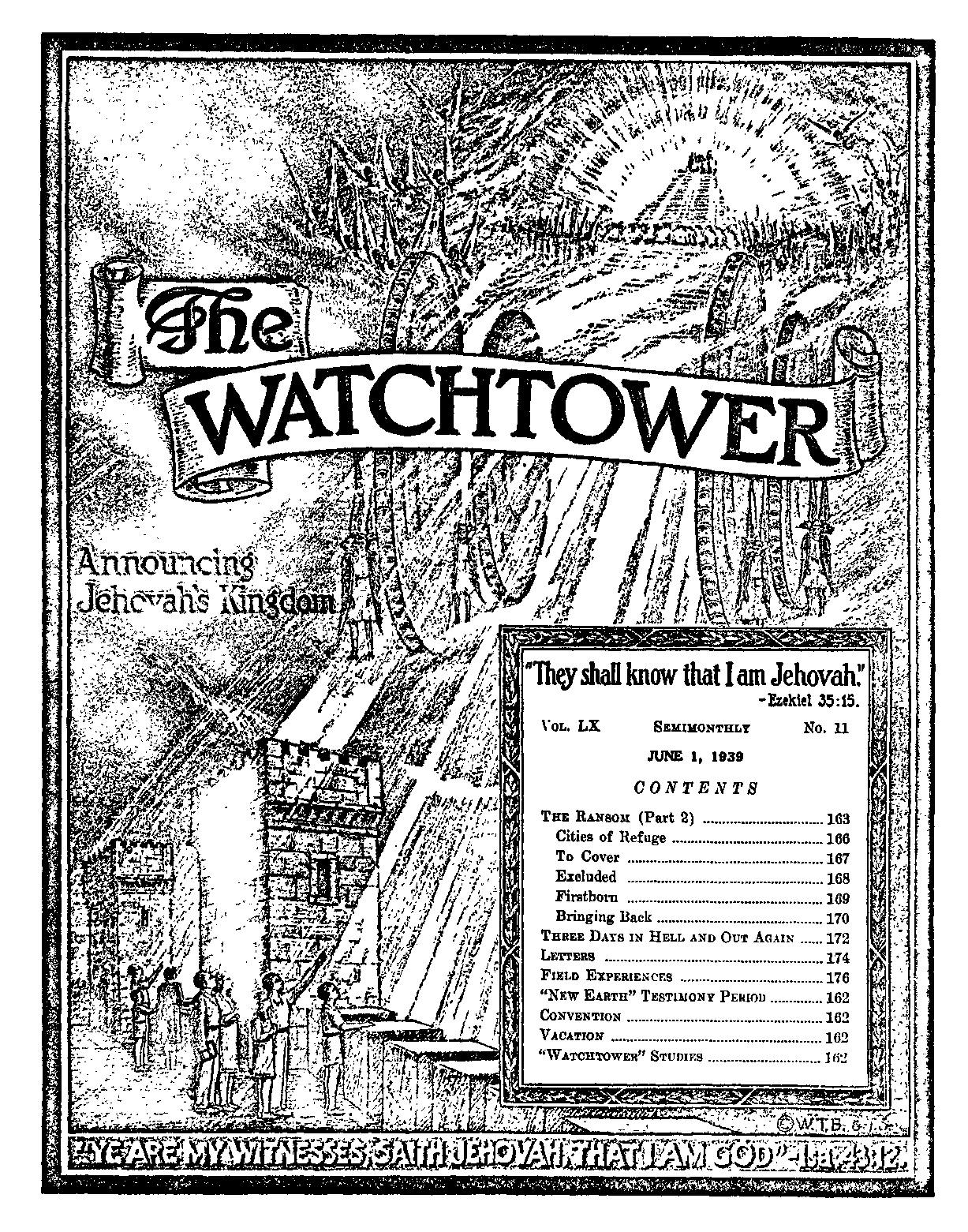
“NEW EARTH” TESTIMONY PERIOD
June is thus designated, and the activities outlined for the month are related to the work now proceeding of laying the foundation of the new earth. Jonadabs as well as the anointed kingdom publishers will rejoice to have part therein. An attractive special offer should make June outstanding for the placement of booklets, to wit, seven booklets on a contribution of but 25c, three being self-covered and four being colored-cover booklets. People unable to take the combination should be offered the new booklet Fascism or Freedom on any contribution they can afford. This applies to foreign-language booklets also. Fuller details are to be found in the Informant, which consult concerning your active share in this testimony period. A good report for the month is expected from you.
CONVENTION
At New York City, June 23-25, a convention of Jehovah’s witnesses' will be held. Thousands desire to attend who are too far away, and for their convenience arrangements are being made to connect Los Angeles, Chicago and some other cities in the United States, and London, Glasgow and other cities in England, by wire direct from Madison Square Garden in New York City. The president of the Society will address the convention on Saturday the 24th, from 3: 00 to 4: 00 p.m., and on Sunday, June 25, will address the public, 4:00 to 5:00 p.m., New York time. More details in Informant.
VACATION
Notice! The Brooklyn factory and office will be closed for the two weeks beginning Saturday, July 22, and concluding Sunday, August 6. This will enable the Bethel family, after a year of consistent strenuous activity here, to get away for a temporary change and to enjoy opportunities of field service in common with the other Kingdom publishers. All publishers will therefore order in advance enough supplies of literature to last them over the Bethel vacation period, and to the end of August. Do this in good time to allow for shipment from here before the factory closes Friday evening, July 21. No orders will be filled and shipped, nor mail be opened and answered, during this vacation period.
“WATCHTOWER” STUDIES
Week of July 2: “The Ransom” (Part 2), fl 1-27 inclusive, The Watchtower June 1, 1939.
Week of July 9: “The Ransom” (Part 2), fl 28-48 inclusive, The Watchtower June 1,1939.
Vol. LX
June 1, 1939
No. 11
THE RANSOM
PART 2
“But now thus saith the Lord that created thee, O Jacob, and he that formed thee, O Israel, Fear not; for I have redeemed thee, I have called thee by thy name; thou art mine. For I am the Lord thy God, the Holy One of Israel, thy Saviour; I gave Egypt for thy ransom, Ethiopia and Seba for thee. Since thou wast precious in my sight, thou hast been honourable, and I have loved thee: therefore will I give men for thee, and people for thy life.”—Isa. 43:1,3,4.
JEHOVAH’S revealed purpose is first to ransom and deliver the church, that is to say, those who constitute the members of the body of Christ, which selected ones shall reign with Christ in his kingdom. Second, after the selection of the elect ones is completed to the required number, then follows the work of the Lord in gathering and delivering his “other sheep”, and which latter work is now in progress. Long before the coming of Christ Jesus to earth as a man God, by the mouth of his holy prophets, told of His provision for the salvation of humankind that would believe and obey him. This matter is of such vital importance to those who believe that it appears well to here consider somewhat in detail the prophetic scriptures written before the ransom price was actually provided, and which part of the Holy Scriptures have been long designated “The Old Testament”.
2 The English word “ransom” (translated from the French) is from the Latin word redemptio (French: rancon). Thus the two words ransom and redeem are related one to the other, and such is also true in the Holy Scriptures. Because the English word ransom is used in our studies, the definition of ransom as given by Webster, the lexicographer, is here set out, to wit: “Ransom,” as a noun, means “act of ransoming; a redeeming or releasing of a captive by payment of a consideration. The money, price, or consideration paid or demanded for the redemption of a captured person or persons; a payment that releases from captivity, a penalty, or a forfeit. One who or that which ransoms or redeems.” As a verb: “To redeem from captivity, slavery, punishment, or the like, by paying a price; to buy out of bondage. To deliver, as from sin, its penalty, or the like; to be the redeemer of.”
3 The word redeem is defined: “To regain possession of by payment of a stipulated price; to repurchase. To ransom, liberate, or rescue from captivity or bondage, or from any obligation or liability to suffer or to be forfeited, by paying a price or ransom. To recover or regain, as pledged or mortgaged property, by the requisite fulfillment of some obligation as by the payment of what may be due. To rescue; deliver; reclaim.”
4 In the original of the Holy Scriptures various Hebrew words are translated by the words “ransom”, “redeem,” “redeemed,” “deliver,” and like words above used. For instance, the Hebrew words khopher and pidhion are translated “ransom”. The Hebrew words gaal and pahdah are translated “to ransom” and “to redeem”. There must be some simple root-meaning of each Hebrew word, making it fitting and usable in all the various connections; that is to say, that of freeing or delivering. Examples are given herein.
5 The Hebrew word gaal, translated “redeemed”, is first used in the Scriptures at Genesis 48:16 in connection with Jacob: “the angel which redeemed me.” The Lord gave command to Moses: “Wherefore say unto the children of Israel, I am the Lord, . . . I will redeem you [not with sacrifices, but] with a stretched out arm.” (Ex. 6:6) After crossing the Red sea Moses said to Jehovah: “Thou in thy mercy hast led forth the people which thou hast redeemed.” (Ex. 15:13) In the following texts the same Hebrew word is translated “redeemed”: “Remember thy congregation, which thou hast purchased of old; the rod of thine inheritance, which thou hast redeemed; this mount Zion, wherein thou hast dwelt.” (Ps. 74:2) “Thou hast with thine arm [not by sacrifice] redeemed thy people, the sons of Jacob and Joseph.” (Ps. 77:15) The prophetic words in the Psalm next quoted are concerning Jesus our Redeemer, to wit: “Draw nigh unto my soul, and redeem it; deliver me, because of mine enemies.” (Ps. 69:18) Jesus is Jehovah’s duly commissioned King, concerning whom it is written: “Give the king [Christ Jesus] thy judgments, O God, and thy righteousness unto the king’s [Jehovah, the King of Eternity’s] son.” “He shall spare the poor and needy, and shall save the souls of the needy. He shall redeem their soul from deceit and violence; and precious shall their blood be in his sight.” (Ps. 72:1,13,14) Likewise the same word appears in the following texts: “Bless the Lord, O my soul; and all that is within me, bless his holy name. Who redeemeth thy life from destruction; who crowneth thee with lovingkindness and tender mercies.” (Ps. 103:1,4) “Let the redeemed of the Lord [the remnant from Satan’s organization] say so, whom he hath redeemed from the hand of the enemy.” (Ps. 107:2, 3) “Hear the word of the Lord, O ye nations, and declare it in the isles afar off, and say, He that scattered Israel [spiritual Israel, in the year 1918] will gather him [His favored and faithful ones in 1919 and onward], and keep him, as a shepherd doth his flock. For the Lord hath redeemed Jacob, and ransomed him from the hand of him that was stronger than he. Therefore they shall come and sing in the height of Zion, and shall flow together to the goodness of the Lord.” —Jer. 31:10-12.
6 “Jacob” symbolically stands for God’s anointed people on the earth, to whom the Lord Jehovah says: “But now thus saith the Lord that created thee, O Jacob, and he that formed thee, O Israel, Fear not; for I have redeemed thee, I have called thee by thy name; thou art mine. Ye are my witnesses, saith the Lord, and my servant whom I have chosen; that ye may know and believe me, and understand that I am he.”—Isa. 43:1,10.
7 Among other scriptures in which the Hebrew word gaal is translated “redeemed” is the following: “Sing, O ye heavens; for the Lord hath done it; shout, ye lower parts of the earth; break forth into singing, ye mountains, O forest, and every tree therein; for the Lord hath redeemed Jacob [God’s elect people], and glorified himself in Israel. Thus saith the Lord, thy redeemer, and he that formed thee from the womb, I am the Lord that maketh all things; that stretcheth forth the heavens alone; that spreadeth abroad the earth by myself.” (Isa. 44:23,24) Likewise in the sixth verse: “Thus saith the Lord, the King of Israel, and his redeemer the Lord of hosts; I am the first, and I am the last; and beside me there is no God.” (Isa. 44: 6) It was in the year 1919 that the Lord delivered the antitypical “Jacob” class, his faithful remnant, from Satan’s organization, and brought them into the kingdom, gathering them into the temple.
8 A similar use of the word "redeemed” appears in the following text: “Loose thyself from the bands of thy neck, O captive daughter of Zion. For thus saith the Lord, Ye have sold yourselves for nought; and ye shall be redeemed without money.” (Isa. 52:2, 3) Note that these were redeemed without a purchase price. The remnant have now been delivered or redeemed from Satan’s organization and will be completely free therefrom when the Lord at Armageddon destroys everything pertaining to Satan’s organization, and then all who survive shall see the salvation of Jehovah in behalf of his people. God’s anointed remnant have been free from Satan’s organization since recognizing that Jehovah and Christ are the only “higher powers”. They are still surrounded and opposed by Satan’s organization, however, and will be completely delivered therefrom at Armageddon. Isaiah 52: 9,10: “Break forth into joy, sing together, ye waste places of Jerusalem; for the Lord hath comforted his people, he hath redeemed Jerusalem. The Lord hath made bare his holy arm in the eyes of all the nations; and all the ends of the earth shall see the salvation of our God.”
9 Again the remnant is shown as redeemed and delivered in the following text: “Go ye forth of Babylon, flee ye from the Chaldeans, with a voice of singing declare ye, tell this, utter it even to the end of the earth; say ye, The Lord hath redeemed his servant Jacob.”—Isa. 48:20.
10 The faithful are shown as redeemed in the following text: “For the day of vengeance is in mine heart, and the year of my redeemed is come.” (Isa. 63:4) That does not refer to the purchase price, but refers to the deliverance of God’s people at the time he executes his wrath upon the enemy.
11 In the following text a contrast is shown between those who, once enlightened, became unfaithful and who are designated under the symbol of “Ephraim”, and those who remain faithful and true to the Lord and who are born in Zion, hence are the children of Zion, God’s organization, to wit: “The iniquity of Ephraim is bound up; his sin is hid. The sorrows of a travailing woman shall come upon him [meaning the unfaithful who form the ‘evil servant’ class]: he is an unwise son [once enlightened and who then takes a wrong course]; for he should not stay long in the place of the breaking forth of children [that is, other children of Zion, beginning in the year 1918 at the coming of the Lord Jesus to the temple, when he began to gather them into his temple]. I will ransom [(Hebrew) pahdah: release] them [the faithful who are born in Zion] from the power of the grave: I will redeem them [the children of Zion born from and after 1918] from death: O death, I will be thy plagues; O grave, I will be thy destruction: repentance shall be hid from mine eyes.” (Hos. 13:12-14) Instead of this text’s referring to the ransom of Adam’s offspring by the precious blood of Jesus, it applies to the “new creation”. (2 Cor. 5:17, Diaglott) In confirmation of this conclusion that the ones here redeemed are the faithful ones brought into God’s organization, the apostle quotes from this very text, to wit: “O death, where is thy sting? O grave, where is thy victory?” (1 Cor. 15:55) These anointed ones of God were redeemed from death at the time they were justified by Jehovah, following their consecration. The redemption here prophesied by Hosea, however, takes place after the spirit-begotten ones have proved their faithfulness and maintained their integrity toward God and are brought into the temple.
12 This text could not be properly applied to the purchase of the entire human race by the shed blood of Christ Jesus, since we see that the language of the text refers only to those who have been justified and begotten of the spirit. (John 3:3,5) The redeemed ones are delivered into the kingdom by being brought into the temple. In 1918 or thereabout Satan attempted to destroy all the consecrated. The “Ephraim” class fell away and became the “evil servant” (Matt. 24:48-51), and God did not permit that class to stay long in Zion; and as to these faithful ones, these were ransomed or delivered from the power of the adversary, who hoped to put them in the grave and destroy them in death. The year 1914 marked the time when Christ Jesus took his power to reign and was sent forth by Jehovah to reign. The war began in heaven and also in the earth. (Rev. 12:7-12) That marked “the beginning of sorrows” upon the earth (Matt. 24: 7,8), and from then until 1919 God’s spirit-begotten ones were in much distress; and in the year 1919 the Lord redeemed and delivered the faithful ones from Satan’s organization and thus prevented the enemy from overwhelming them. Note further this text that confirms that conclusion: “Be in pain, and labour to bring forth, O daughter of Zion, like a woman in travail; for now shalt thou go forth out of the city, and thou shalt dwell in the field, and thou shalt go even to Babylon; there shalt thou be delivered; there the Lord shall redeem thee from the hand of thine enemies.”—Mic. 4:10.
13 By his prophet Jehovah tells of a “highway”, called “the way of holiness”, over which the cleansed of the Lord must walk. (Isa. 35:8-10) Prior to the coming of the Lord to the temple in 1918 the faithful were compelled to mingle with Satan’s organization and the faithful believed that the rulers of this wicked world constituted the “higher powers” (Rom. 13:1). When the Lord revealed to his faithful ones his capital organization and their relation thereto, then they discerned the true meaning of the “highway” and they immediately began their march thereupon. All the righteous must go there upon. The remnant must take the lead upon the highway and teach others who are seeking the way to righteousness, that they may know the way to come to God and to Christ Jesus. The “unclean” are not permitted to enter that highway. Who shall go thereupon and go over the highway ? The “redeemed” of the Lord; as it is written: “No lion shall be there, nor any ravenous beast shall go up thereon, it shall not be found there; but the redeemed shall walk there.”—Isa. 35: 9.
14 The text last above quoted discloses the persons who are redeemed. In the following texts it appears that it is God’s consecrated and devoted ones who are redeemed and that Jehovah God is the redeemer of those who are faithful to him, and that he is not the redeemer of the unbeliever or wicked ones. In support hereof note the following texts: Isaiah 41:14; Isaiah 43:14; Isaiah 44: 6,24; Isaiah 47:4; Isaiah 48:17,20; Isaiah 49:7,26; Isaiah 63:16; Jeremiah 50: 33,34.
15 Jehovah God is the Redeemer of Zion: “For thy Maker is thine husband; The Lord of hosts is his name; and thy Redeemer the Holy One of Israel; The God of the whole earth shall he be called. In a little wrath I hid my face from thee for a moment; but with everlasting kindness will I have mercy on thee, saith the Lord thy Redeemer.”— Isa. 54:5,8.
16 The redeemed are brought fully into God’s capital organization: “And the Redeemer shall come to Zion, and unto them that turn from transgression in Jacob, saith the Lord.” (Isa. 59:20; 60:16) Job pictures or represents those only who are wholly devoted to God, and as such he uses these words: “For I know that my Redeemer liveth, and that he shall stand at the latter day upon the earth.” (Job 19:25) This text shows that the redemption or deliverance takes place in the latter days when Jehovah delivers his anointed people from Satan’s wicked organization, particularly the religious element, which Satan uses to oppose, reproach and persecute them. “For their redeemer is mighty; he shall plead their cause with thee.”—Prov. 23:11.
17 In all the foregoing texts quoted or cited there is no direct mention made of a redemption- or redemptive money price or payment. The clear meaning given to all of such texts is that of liberation, freeing, rescuing, delivering from the hand of the enemy, that is, Satan’s organization, including his agents that oppose and persecute God’s anointed people. None of the enemy organization are ever redeemed, but, on the contrary, the redemption is always spoken of as from the enemy. It is Jehovah, acting by and through his Chief Executive Officer, Christ Jesus, that accomplishes such liberation, rescuing or deliverance from the enemy. The same Hebrew word gaal is translated “redeem” and “redeemed”, and used in connection with a purchase price, in the following texts: “If thy brother be waxen poor, and hath sold away some of his possession, and if any of his kin come to redeem it, then shall he redeem that which his brother sold. And if the man have none to redeem it, and himself be able to redeem it [(margin) his hand hath attained and found sufficiency]; then let him count the years of the sale thereof, and restore the overplus unto the man to whom he sold it, that he may return unto his possession. . . . And if it be not redeemed within the space of a full year, then the house that is in the walled city shall be established for ever to him that bought it, throughout his generations : it shall not go out in the jubilee. . . . And if a man purchase of the Levites [(margin) one of the Levites redeem them], then the house that was sold, and the city of his possession, shall go out in the year of jubilee: for the houses of the cities of the Levites are their possession among the children of Israel. . . . After that he is sold he may be redeemed again; one of his brethren may redeem him: either his uncle, or his uncle’s son, may redeem him, or any that is nigh of kin unto him of his family may redeem him; or, if he be able, he may redeem himself. And he shall reckon with him that bought him from the year that he was sold to him unto the year of jubilee; and the price of his sale shall be according unto the number of years; according to the time of an hired servant shall it be with him.” (Lev. 25:25-50) In the following texts, note that the redeemer was required to add one-fifth extra to the price at which the priests valued the thing to be redeemed.—Lev. 27:13,15,19,20,27, 28, 31, 33.
18 In the foregoing texts the use of the Hebrew word gaal is like that in the book of Ruth, which according to Young’s translation reads as follows: “And Naomi said to her daughter-in-law: ‘Blessed is he [Boaz] of Jehovah, who hath not forsaken His kindness with the living and with the dead’; and Naomi saith to her [Ruth]: ‘The man is a relation of ours; he is of our redeemers.’ ” (Ruth 2:20) In the following text the word “kinsman”, as it appears in the Authorized Version of the Bible, is from the same Hebrew word gaal, which, according to Young, is in each instance rendered “redeemer”. In reading the Authorized Version substitute the word redeemer for kinsman, wherever it occurs in these texts, to wit: Ruth 3: 9,12,13; Ruth 4:1, 3,4, 6, 8,14. A similar transaction is described at Jeremiah 32: 7-9, wherein the word is similarly used. In the fulfillment of the picture made by Ruth and Boaz, the class represented by Ruth is the remnant of Jehovah brought to the Lord, after his coming to the temple, by Christ Jesus, the Greater Boaz, who applies his ransom merit from and after the year 1922, purchasing them that they might be justified and accepted as a part of his royal organization ; which are then brought into his fold and made members of the “body of Christ”.
CITIES OF REFUGE
19 The same Hebrew word gaal is used in connection with the cities of refuge and the avenging of the blood of the slain one. In such case something is required to be paid over that is equal to what was lost, that is to say, a life for a life, the same rule that was applied in Deuteronomy 19: 21, wherein it is written: “And thine eye shall not pity; but life shall go for life, eye for eye, tooth for tooth, hand for hand, foot for foot.” Referring to the cities of refuge, one who slays a murderer is called “the revenger [or redeemer] of blood”. In the texts following, the Authorized Version renders the Hebrew word gaal “avenger” or “revenger”, and Young translates the same Hebrew word “redeemer”, to wit: Numbers 35:12,19, 21, 24, 25, 27. That redeeming of the blood, in each case, does not refer to the blood- bought redemption at Calvary, but to the paying in kind, that is, a retribution paid out to the death-dealing enemies of the Lord at the battle of Armageddon, and which is paid by the antitypical Revenger or Redeemer, Christ Jesus, as an offset to the blood that was spilled by the enemies of the Lord. Otherwise stated, the Revenger or Redeemer, Christ Jesus, squares the account with the enemies of the Lord at the battle of Armageddon.
20 One who had unawares, unwittingly and without enmity or malice slain another might escape the blood-avenger or redeemer by fleeing to and remaining in the city of refuge until the death of the sin-atoning high priest; that is, antitypically he must flee to God’s organization under Christ and there remain under the sin-atoning blood of Christ Jesus, trusting in that shed blood as a means of protection and salvation. Those who in the present time have unwittingly done violence to God’s law and against his people may gain redemption from destruction by and through the redeeming blood of the great High Priest, Christ Jesus. In this picture the destruction of the enemy of God at Armageddon is foreshadowed as a redemptive price for those slain by the wicked. Christ Jesus, the great High Priest and Executive Officer of Jehovah, with the value of his sacrifice, provides redemption for those who flee to him for refuge, and he is the Executioner of those who remain in the enemy camp and who because of their wickedness suffer destruction in order to offset the wickedness done by them to the Lord and his people. In both cases there is a freeing or delivering by means of a meeting or squaring the obligation, that is, meeting the penalty for sin. The redemptive price provided at Calvary was for those who exercised faith in and obedience to the commands of the Lord. The redemption at Armageddon punishes the deserving ones, that is, the ones who have caused damage intentionally or otherwise. Those who have thus damaged or committed violence against God’s little ones are indebted or obligated on account of their wickedness, and such are bound to pay and they pay at Armageddon with their lives. They cannot pay the debt to the damaged one, because that one is dead, but they must pay to the dead one’s next nearest of kin in flesh and blood. As he who causes the death of the slain one is a debtor, so death must be meted out to that slayer by the slain one’s nearest of kin, “the redeemer,” and the redeemer removes the debt by exacting the life of the slayer. Note now God’s words concerning “Christendom” and all the nations that have willfully violated the everlasting covenant. The account must be squared with all of these, and therefore the Lord says: “The land shall be utterly emptied, and utterly spoiled; for the Lord hath spoken this word. The earth mourneth, and fadeth away; the world languish- eth, and fadeth away; the haughty people of the earth do languish. The earth also is defiled under the inhabitants thereof, because they have transgressed the laws, changed the ordinance, broken the everlasting covenant.”—Isa. 24: 3-5.
21 In the case of the unwitting slayer, life is not exacted of him, but in the type he is covered and shielded by the high priest, and in the antitype by the great High Priest, Christ Jesus, who makes atonement for those who flee to Christ. In the type the malicious, willful and deliberate slayer could in no wise have satisfaction met or accepted for his life by any other means, but his life must be taken by the avenger or redeemer. This is done upon the wicked by the great Redeemer at Armageddon. This well pictures and foretells the fact that the sacrificed life of the man Jesus does not stand as an atonement for or ransom for the willfully wicked who spurn God and his provisions for salvation. Such as die at Armageddon under such conditions of willful wickedness certainly will never have a redemption. (Num. 35:30-33) All the Scripture texts wherein the Hebrew word gaal is used prove that in no case are the wicked redeemed, but that only the Lord’s poor and needy are redeemed. By “poor and needy” are meant those who come to a realization of their own utter inability to save themselves and who desire to be saved, who exercise faith in God and in Christ Jesus, and apply to Christ Jesus to be saved or redeemed. All those who are wicked and refuse to accept God’s provision for salvation abide under the condemnation resulting from Adam’s sin: “The wicked shall be turned into hell, and all the nations that forget God.”—Ps. 9:17.
TO COVER
22 The Hebrew word khopher is also translated “ransom”. It is derived from the Hebrew khaphar, which means “to cover”. It first appears in the Bible at Genesis 6:14, wherein God said to Noah: “Make thee an ark of gopher wood: rooms shalt thou make in the ark, and shalt pitch it within and without with pitch [khopher].” This same word describes the cover charge or covering price concerning the owner of a death-dealing ox in the following text, to wit: “But if the ox were wont to push with his horn in time past, and it hath been testified to his owner, and he hath not kept him in, but that he hath killed a man or a woman; the ox shall be stoned, and his owner also shall be put to death [for willful negligence in not responding to the notice given]. If there be laid on him [the owner] a sum of money [khopher; a price to cover the damage; according to Young: an atonement], then he shall give, for the ransom of his life, whatsoever is laid upon him.”—Ex. 21: 29, 30.
23 As it appears that the payment of a money ransom was allowed only because the owner of the ox was not the deliberate and direct slayer of the one who was killed, but had been indirectly the cause of death by reason of his negligence, a cover charge or atonement money was taken.
24 After the census of the Israelites was taken, a ransom was to be paid, as stated in the following text: “When thou takest the sum [census] of the children of Israel, after their number, then shall they give every man a ransom [(Hebrew) khopher] for his soul unto the Lord, when thou numberest them; that there be no plague among them when thou numberest them. This they shall give, every one that passeth among them that are numbered, half a shekel after the shekel of the sanctuary: (a shekel is twenty gerahs:) an half shekel shall be the offering of the Lord.”—Ex. 30:12,13.
25 Certainly the ransom named in this text was not a “corresponding price”. The Septuagint renders the Hebrew by the Greek word lytron, which is translated into the English “ransom”. This shows that the English word “ransom” in itself does not at all times mean “an exact corresponding price”. Not all ransoms are a corresponding price; but that of Christ Jesus, that is, his own precious blood, was and had to be a corresponding price because such was required to purchase for Adam’s offspring that which Adam had lost for them.
26 In the following text in which the word “ransom” appears the translation is from the Hebrew khopher and has often been improperly applied to mankind in general, to wit: “If there be a messenger with him, an interpreter, one among a thousand, to shew unto man his uprightness; then he is gracious unto him, and saith, Deliver him from going down to the pit; I have found a ransom [an atonement (Voting)]. He will deliver his soul from going into the pit, and his life shall see the light.” —Job 33:23,24,28.
27 In this prophetic picture Job represents the faithful followers of Christ Jesus, and the covering ransom is found in the advocacy of Christ Jesus, who is called in this scripture the Messenger or Interpreter. In the year 1918 the antitypical Job class, the faithful followers of Christ Jesus whom Job represented, were in great distress because of oppression heaped upon them by the enemy. In that year the Lord Jesus came to the temple of Jehovah God. The holy spirit that had been the guide of God’s people, having performed its functions, was taken away, and the Lord Jesus himself, being present, represented his people and advocated in their behalf before Jehovah God, that is, in behalf of those who had fallen into distress because of their failure to properly use their lips in proclaiming the truth. That class is pictured in the prophecy of Isaiah, wherein they cried unto the Lord and the Lord heard them and relieved them. (Isa. 6:6,7; 12:1) The faithful who thus cried unto the Lord are the ones who found a covering ransom in the advocacy of Christ Jesus. Certainly this did not apply to the “evil servant” class. Only a faithful remnant were spared from going down into the pit, because for them there was a covering. This text has heretofore been applied as a “restitution” text, that is, to the ‘people that will be restored in the days of Christ’s reign’. But the application in this manner is not correct. It was the faithful who found an atonement or deliverance by and through their Advocate, Christ Jesus.
EXCLUDED
28 That there are those who are excluded from the beneficial results of the ransom is fully shown from the following scriptures. It appears from the context that the unransomed cases appear before and down to the time of Armageddon, and not beyond Armageddon and during the thousand-year reign of the King, Christ Jesus. The provision in relation to the city of refuge is in point of proof, showing that God foretold by this prophetic picture that there are those for whom satisfaction or atonement cannot be made. The text in point reads: “Moreover, ye shall take no satisfaction [atonement (according to Young’s translation)] for the life of a murderer, which is guilty of death; but he shall be surely put to death. And ye shall take no satisfaction [atonement] for him that is fled to the city of his refuge, that he should come again to dwell in the land until the death of the priest.” —Num. 35:31,32.
29 Not even the atonement of the great High Priest, Christ Jesus, could cover the malicious, willful and deliberate man-slayer. Also those receiving the sin- atoning merit of the great High Priest before Armageddon and who get out from under the covering thereof could not hope for any chance of salvation during or after Armageddon, and during the reign of Christ. The prophet Samuel applies this same rule, as noted in 1 Samuel 12:3, margin: “Behold, here I am: witness against me before the Lord, and before his anointed: whose ox have I taken? or whose ass have I taken? or whom have I defrauded? whom have I oppressed? or of whose hand have I received any bribe [(margin) ransom] to blind mine eyes therewith? and I will restore it you.” Thus it is seen that some are completely excluded from the benefit of the ransom sacrifice.
30 God’s servant Elihu, in the picture relative to Job, spoke with authority announcing God’s fixed rule, when he said: “But thou hast fulfilled the judgment of the wicked: judgment and justice take hold on thee. Because there is wrath, beware lest he take thee away with his stroke: then a great ransom [atonement (Voting)] cannot deliver thee.” (Job 36:17,18) Men of great wealth, either of money or of position, influence and honor amongst men, such as the exalted clergy or their rich “principal of the flock”, think themselves especially favored of God and Christ and rely for safety upon their own wealth, honor and position. But what is the end thereof, according to the Scriptures ? “They that trust in their wealth, and boast themselves in the multitude of their riches; none of them can by any means redeem his brother, nor give to God a ransom [atonement (Young)] for him; (for the redemption of their soul is precious, and it ceaseth for ever;) that he should still live for ever, and not see corruption.” (Ps. 49:6-9) Such men die like brute beasts, because they have no standing above the beast: “Man that is in honour, and understandeth not, is like the beasts that perish.” —Ps. 49:20.
31 In the following texts the word for “envy” (Strong’s) is translated in the Authorized Version “jealousy”. “For jealousy [envy] is the rage of a man; therefore he will not spare in the day of vengeance. He [Christ Jesus, the great High Priest] will not regard any ransom [atonement]; neither will he rest content, though thou givest many gifts [from human priests or clergy or intermediary, whether paid for ‘purgatory’ prayers or otherwise] .”—Prov. 6:34,35.
32 Nor can such provide for or purchase their life by throwing their gold into the streets. Their deliverance cannot be bought by themselves in any manner. Man’s riches cannot ransom him: “There is that maketh himself rich, yet hath nothing: there is that maketh himself poor, yet hath great riches. The ransom [which the guilty would pay] of a man’s life are his riches [which Jehovah rebukes]: but the poor [of the Lord, who is poor in his own estimation, relying solely upon the Lord] heareth not rebuke.”—Prov. 13:7,8.
33 The wicked become the ransom for the righteous in certain conditions. And how? “The wicked shall be a ransom [atonement (Young)] for the righteous, and the transgressor for the upright.” (Prov. 21:18) This scripture applies at Armageddon. In the expression of Jehovah God’s wrath through Christ Jesus at that time the wicked and willful transgressors must be put to death as the price of freedom for the righteous and upright, to the end that the righteous and the upright may be delivered from the abuse and oppression by the wicked and willful transgressors. By the death of the willfully wicked transgressors they ransom the righteous. The reason is, because the wicked and transgressors will not submit to any other arrangement for the freedom of the righteous and the Lord enforces this remedy against them. In support of this, note Isaiah 43:1,3,4: “But now thus saith the Lord that created thee, O Jacob, and he that formed thee, O Israel, Fear not; for I have redeemed thee, I have called thee by thy name; thou art mine. For I am the Lord thy God, the Holy One of Israel, thy Saviour: I gave Egypt for thy ransom [atonement], Ethiopia and Seba for thee. Since thou wast precious in my sight, thou hast been honourable, and I have loved thee: therefore will I give men [the wicked men] for thee, and people [the transgressors] for thy life.”
34 The religious Israelites conspired together to kill Jeremiah, God’s faithful servant and prophet. Likewise the present-day religionists and their allies conspire together to kill Jehovah’s witnesses, of whom the prophet Jeremiah was a type, example or pattern. At the direction of the Lord, God’s prophet records the purpose of Jehovah concerning such: “For they [the religious conspirators] have digged a pit to take me [God’s anointed], and hid snares [traps laid by the clergy and their religious allies against Jehovah’s witnesses] for my feet [the ‘feet’ of Christ Jesus, the last members on earth]. Yet, Lord, thou knowest all their counsel against me to slay me: forgive not their iniquity [thou dost not cover over their iniquity (Young)], neither blot out their sin from thy sight; but let them be overthrown [at Armageddon] before thee: deal thus with them in the time of thine anger.” (Jer. 18:22,23) This shows that such conspirators do not have the benefit of the ransom sacrifice at Armageddon or thereafter.
35 The sons of Eli, the high priest of Israel at Shiloh, were wicked; and those wicked sons pictured “the man of sin”, made up of the “evil servant”, the religious persecutors of God’s people, and allies, and concerning such it is written: “For I have told him that I will judge his house for ever for the iniquity which he knoweth; because his sons made themselves vile, and he restrained them not. And therefore I have sworn unto the house of Eli, that the iniquity of Eli’s house shall not be purged with sacrifice nor offering for ever.” (1 Sam. 3:13,14) What befell Shiloh pictures what shall shortly come to pass upon the religionists of “Christendom”, and this is shown by Jeremiah 7:14: “Therefore will I do unto his house, which is called by my name, wherein ye trust, and unto the place which I gave to you and to your fathers, as I have done to Shiloh."
36 The Scriptures written under inspiration by the apostles fully corroborate this conclusion, that there is no ransom for those who are knowingly wicked and who purposely persecute others because of the faithfulness of such others in their devotion and service to the Lord. (Heb. 6:4-6) “For if we sin wilfully after that we have received the knowledge of the truth, there remaineth no more sacrifice for sins, but a certain fearful looking for of judgment, and fiery indignation, which shall devour the adversaries. He that despised Moses’ law died without mercy under two or three witnesses; of how much sorer punishment, suppose ye, shall he be thought worthy, who hath trodden under foot the Son of God, and hath counted the blood of the covenant, wherewith he was sanctified, an unholy thing, and hath done despite unto the spirit of grace?”—Heb. 10:26-29.
FIRSTBORN
37 The Hebrew word pahdah is rendered “ransom”. It means “to let go; to let loose; to ransom”. This word is used at Exodus 13:13,15, and is rendered in the Authorized Version of the Bible “redeem”, and according to Young is translated “ransom”. To Moses Jehovah said: “And every firstling of an ass thou dost ransom with a lamb; and if thou dost not ransom it, then thou hast beheaded it; and every first-born of man among thy sons thou dost ransom. Yea, it cometh to pass when Pharaoh hath been pained to send us away, that Jehovah doth slay every first-born in the land of Egypt, from the firstborn of man even unto the first-born of beast; therefore I am sacrificing to Jehovah all opening a womb who are males, and every first-born of my sons I ransom.” (Young’s translation) This shows that the original firstborn of Israel in Egypt were ransomed from death at the hand of God’s destroying angel although a “correspondent price” was not given.
38 Referring again to the man who owned an ox that killed a man and against whom the obligation rested as the owner, it is written: “If there be laid on him [that is, the owner of the ox] a sum of money [as a penalty], then he shall give, for the ransom of his life, whatsoever is laid upon him.” (Ex. 21: 30) In such a case his ransom is from the penalty of death; that is to say, he paid a sum of money instead of paying by his life.
39 There is nothing in the typical picture that foreshadows or foretells that Jehovah provides a ransom or redemption for all human creatures down to and including the wicked individuals; and therefore the conclusion must be that during the thousand-year reign of Christ the willfully wicked will not be brought back from death. Note that before the coming of Jesus the “ransom” or “redemption” spoken of in the Scriptures applied as follows: To Israel (Jacob) as shown at Deuteronomy 7:8; 13:5; 21:8; Psalm 25: 22; 1 Chronicles 17: 21; applied to “thine inheritance” (Deuteronomy 9: 26); applied to David, out of adversity and distress (2 Samuel 4:9; 1 Kings 1:29); applied to “my soul” (Psalm 49:15); to “his soul” (repentant ones) (Job 33:27,28); to Christ Jesus (Psalm 69:18-20); to the remnant, already justified by faith through the ransom price of Christ Jesus, and now needing deliverance from the strong enemy (Jeremiah 15:21), which latter text reads: “And I will deliver thee [the remnant, represented in Jeremiah] out of the hand of the wicked, and I will redeem [have ransomed (Young)] thee out of the hand of the terrible.”—Jer. 15:21.
40 The following texts apply exclusively to those who have previously been bought with the precious blood of Christ Jesus but now have the promise of deliverance from the enemy: Isaiah 35:10; Isaiah 51:11; Isaiah 1:27; Jeremiah 31:11,12; Hosea 13:14. “I will hiss for them, and gather them [to the temple, that is, Zion]; for I have redeemed them [from Babylon, Satan’s organization]: and they shall increase as they have increased.”—Zech. 10:8.
BRINGING BACK
41 It has been held by many that the Scriptures guarantee that “all must come back from the dead” at Christ’s return and during his thousand-year rule. (Studies in the Scriptures, Volume Five, pages 478486) That conclusion does not appear to have support in reason or in the Scriptures. No one will receive the benefit of the ransom sacrifice or ransom price that has been paid unless he willingly avails himself of that privilege. It appears, then, that God would bring back from death only those who could and possibly would avail themselves of the ransom when coming to a knowledge of the truth, because the ransom is available only for such, and not those who have no desire to be reformed or saved. The gift of God is not forced upon unwilling creatures.
42 Let it be fixed in mind that in the redemption of mankind by the blood of Christ Jesus the attribute of justice is not involved. If the divine rule of justice alone is invoked and applied, then the entire human race must perish because of sin and imperfection. It is the attribute of love that is involved. Mercy is the result of the exercise of God’s loving-kindness. From the viewpoint of justice God is under no obligation whatsoever to ransom sinful men, nor is God obligated to extend his mercy to every creature regardless of whether that creature desires and seeks mercy. With the two sons of Isaac God made a prophetic picture, showing his foreknowledge of the class of persons who seek the way of righteousness and life, and also of that class that takes exactly the opposite course. It is written: “As it is written: Jacob have I loved, but Esau have I hated.” (Rom. 9:13) “Jacob” here represents that class that seek the Lord and find him and faithfully serve him; and such God loves. “Esau” represents the unfaithful class, who do not regard God’s gracious provision for mankind. God foreknew those two classes, and he so foretold the same, because he foreknows everything: “Known unto God are all his works, from the beginning of the world.” (Acts 15:18) Surely God foreknew those human creatures who shall spurn his proffered blessings of life, and he foreknew the class that would gladly accept his gracious provision. It follows, then, that those who have no desire to know God and Christ Jesus, and no desire to receive God’s blessings through Christ Jesus, on such He will not have mercy, and God will not force his mercy upon them. Could it be argued that justice toward all would require God to force his mercy upon all, even though he knows in advance that such persons would reject his loving-kindness? Certainly not. Justice is righteousness, and injustice is unrighteousness. The argument advanced by the inspired Word of God is: “What shall we say then? Is there unrighteousness with God? God forbid. For he saith to Moses, I will have mercy on whom I will have mercy, and I will have compassion on whom I will have compassion. So then it is not of him that willeth, nor of him that runneth, but of God that sheweth mercy.” (Rom. 9:14-16) This statement is made in connection with the challenge of the Devil made to Jehovah God, and thus God discloses His purpose to extend his mercy toward those who hear the testimony and prove their integrity toward Jehovah. To hold that because God is just he is under obligation to extend mercy to everyone is entirely inconsistent and wrong. To hold that because of justice God is bound to give every creature the benefit of salvation by the ransom sacrifice is wrong, and wholly unsupported either by reason or the Scriptures. To hold that God is obligated to save all men in order to fully prove his supremacy is entirely wrong and unsupported by any authority. The challenge of the Devil raised the question of God’s ability to put any man on earth who willingly would remain faithful and true to God when he was subjected to the test imposed by the Devil. Concerning that challenge all the evidence abundantly shows that God has proved Satan a liar and has proved his own supremacy beyond any question of doubt, in this, that many men up to the present time have maintained their integrity toward God. At Armageddon God will completely wipe out everything that Satan has brought forward in opposition to God, and therefore will completely establish His own supremacy. Whosoever, therefore, willingly avails himself of God’s gracious gift will be blessed with life, and he will have an opportunity of proving that Satan’s wicked challenge is a defamation of God’s name and His word, and that Satan is a liar and God is true. Men have gotten themselves into great difficulty concerning the ransom by proceeding upon the theory that the question of justice is involved.
43 When God sentenced Adam to death justice required the forfeiture of Adam’s life. When Adam went down into the dust from which he came justice was completely satisfied. Justice has been satisfied at all times since, so far as Adam was concerned. Adam’s offspring justly came under condemnation by inheritance, but, not being under direct judgment themselves, God could consistently extend his mercy toward them. It was not a question of satisfying justice by the death of another perfect man, and the death of Jesus was not for the purpose of satisfying justice. If Jehovah would accept the perfect life of Christ Jesus in satisfaction of justice, that would mean that either the judgment against Adam was not satisfied or else the lifeblood of Jesus poured out was a double satisfaction; which would be entirely inconsistent and impossible with Jehovah God.
44 Viewing the matter now from the point of love: God unselfishly provided, and, without a doubt, Jesus agreed with Jehovah, that he should become a man, and that he should lay down his life and that perfect human life laid down would be equivalent to what Adam’s offspring would have been entitled to and would have received from their father Adam. When that equivalent, to wit, the perfect human life of Jesus and the right thereto, is presented to Jehovah God in heaven, it constitutes and constituted the purchase price of all the rights which Adam’s offspring had lost by reason of Adam’s sin. Therefore Christ Jesus’ receiving life as a spirit creature and paying over his right to life as a human creature made him by right of purchase the owner of every one of Adam’s offspring that would comply with God’s requirements, to wit: have faith in God and in Christ Jesus, and meet the rules subsequently made to govern all who take that step of faith. The ransom sacrifice of the Lord Jesus Christ is a price exactly corresponding to what Adam lost; but it is not a substitute for Adam, nor was it given for the purpose of satisfying justice, but was given as a purchase price. Jehovah God makes Jesus “the Everlasting Father”, that is to say, the one who administers life everlasting. But upon what condition? That men comply with God’s requirements. (Isa. 9:6) Hence it is written that life is the gift of God through Jesus Christ our Lord’. (Rom. 6:23) A gift cannot become operative except by the meeting of the minds of the giver and the receiver. Otherwise stated, the offer must be made, and the one to whom it is offered must willingly accept that offer. It follows, then, that the man to whom the offer is made available and who refuses or fails to accept that offer, the gift does not operate toward him. Consequently the ransom sacrifice inures to the benefit of only those who ask for and willingly receive its benefits.
45 As stated in the Scriptures, all men have come under condemnation, which must result ultimately in death unless provision is made for redemption. (Rom. 5:12) God has graciously provided and placed before mankind the way of escape from death and hence the way to obtain life everlasting. Men must choose either to remain under condemnation that justly rests upon them or to avail themselves of the loving-kindness and mercy of God and seek and willingly accept God’s gracious provision of salvation by which man obtains life. The way of escape from death and the way to everlasting life are by and through Christ Jesus. God laid him as the foundation, and there is no other way and no other name whereby man receives life. Only those who believe that God has made such provision and that Christ Jesus is the means of salvation can possibly be saved. During the centuries past many have been brought face to face with God’s provision for life and have willfully and deliberately spurned the same. They have died in their sins, that condemnation abiding upon them. It is not reasonably possible that God will bring them back and give them another chance to reject his gracious offer of life.
46 What is here said is not in the least contrary to or out of harmony with the Scriptural declaration uttered by John the Baptist concerning Jesus, to wit: “Behold the Lamb of God, which taketh away the sin of the world.” (John 1:29) This emphatic declaration cannot be construed to mean that Jesus removes the sin of all those of the world who refuse to avail themselves of the opportunity but who willingly choose the way of wickedness, which means absolute death. In times past there have been many, and there are yet many of such. The words of Jesus are emphatic, to wit: “For God sent not his Son into the world to condemn the world; but that the world through him might be saved. He that believ- eth on him is not condemned; but he that believeth not is condemned already, because he hath not believed in the name of the only begotten Son of God.” —John 3:17,18.
47 When Jesus was on the earth he vigorously condemned the Pharisees and their religious allies, telling them that they were the offspring of the Devil and worthy of death. To hold that the ransom sacrifice would apply to such opposers of the Lord and his kingdom would be to deny the sincerity and truth of Jesus’ condemnation of such wicked ones. The loving-kindness and mercy of Jehovah is extended to all men who willingly and voluntarily believe God and faithfully serve him and his beloved Son, Christ Jesus: “Whoso is wise, and will observe these things, even they shall understand the lovingkindness of the Lord.”—Ps. 107:43.
48 There is a class of clergymen throughout “Christendom”, wise in their own conceit, who adopt the words of the bishop of Birmingham, who says: “The story of the sin and fall of Adam, and redemption by Christ Jesus, is folklore.” Those men are known as “higher critics” and deny that there is any value in the shed blood of Jesus. They have an opportunity to know of God’s provision of salvation, and willfully and deliberately shun the same and lead others into the same error. Those higher critics pose before the people as preachers of righteousness. They call themselves “doctors of divinity”, “clergymen,” “bishops,” and other high-sounding titles. They are religionists and leaders in religious organizations. They have substituted the doctrines of men for the Word of God, and thus they have made the Word of God of none effect. (Matt. 15:6-9) The people must choose either to follow these human leaders of man-made organizations or else to accept the Word of Jehovah God and the Lord Jesus Christ. To follow religionists who thus deny God’s Word, therefore, means that all who do, remain under the condemnation that came upon them by inheritance, and are subjects of God’s wrath. To disregard these worldly-wise men and give full heed to the Word and admonition of Jehovah and his Son, Christ Jesus, means to find life. The scripture upon this point is emphatic: “He that believeth on the Son hath everlasting life: and he that believeth not the Son shall not see life; but the wrath of God abideth on him.” (John 3:36) All by inheritance being under condemnation, and God having provided the one way to get out, there is no other way, and therefore Jesus says: “This is life eternal, to know thee the only true God, and Jesus Christ, whom thou hast sent.’ (John 17:3) Surely, then, everyone who has a desire for life will eagerly seek to know what God requires of man in order to receive life everlasting.
THREE DAYS IN HELL AND OUT AGAIN
TEMPEST in the Mediterranean sea! Man overboard! Why no rescue line tossed out to him ? He was deliberately thrown to the raging waves by the sailors of that ship in distress. The man is a Jew, Jonah. Now, miraculously, “the sea ceased from her raging.” But what of the prophet Jonah? The man’s own talc of the sea reads: “Now the Lord had prepared a great fish to swallow up Jonah. And Jonah was in the belly of the fish three days and three nights.” (Jonah 1:17) The Lord God Jehovah did not create a fish right then and there and for the purpose of swallowing Jonah, but He appointed and had on the spot at the proper time a great fish, which had no doubt been in existence for a long while, and that fish performed its part in this prophetic picture. That the great fish swallowed Jonah was not for the purpose of punishing him, but as a means of his safety: Jonah could never have gotten to land in safety without the use of that fish.
Concerning a like experience a Greater than Jonah said: “For as Jonas was three days and three nights in the whale’s belly; so shall the Son of man be three days and three nights in the heart of the earth.” (Matt. 12:40) The spokesman, Jesus, could not have been brought out of the grave and again to the land of the living except by the exercise of the power of the Almighty God, even as God exercised his power in causing the fish to land Jonah.
Three days and nights in the belly of the fish was long enough for any man to be digested and absorbed by the fish, and hence a miracle was required to save Jonah; and God performed that miracle and thus showed his loving- kindness toward His servant. While taking that strange voyage Jonah had ample time to think, and did so. “Then Jonah prayed unto the Lord his God out of the fish’s belly, and said, I cried by reason of mine affliction unto the Lord, and he heard me; out of the belly of hell cried I, and thou heardest my voice.” The record in the American Revised Version Bible reads: “Out of the belly of Sheol cried I, and thou heardest my voice.” In the translation by the Jewish authority, Lceser, the record reads: “Out of the depth of the grave have I cried, and thou hast heard my voice.” The Catholic Douay Version Bible reads: “I cried out of the belly of hell, and thou hast heard my voice.”
In the foregoing comparative readings of the text the word Sheol (A.R.V.) is the original Hebrew word; the words “hell” and “grave” are but the English translations of that one original Hebrew word, as rendered by Catholic, Protestant and Jewish translators. What, then, is “hell”, according to the Holy Scriptures? If “hell” had been “eternal torment”, then according to religious teachings Jonah could not and would not have gotten out.
There is no place for the eternal torture of men or souls. God is not a fiend, as the clergy would make him appear. God is love. What good could result from torturing one of Jehovah’s creatures? How could love be expressed in such a manner? Furthermore, how could torment in any wise comply with the law which God expressed to Adam, and which provided death as the penalty for sin ? The doctrine of eternal torment is an invention of the Devil for the purpose of supporting his original lie; namely, that there is no death. (See Genesis 3:4.) The Devil saw that if man should believe the doctrine of the inherent immortality of the human soul he likewise must believe that the wicked are somewhere in torment. If he could induce man to believe that God had provided a place for the eternal torture of that soul, then he would succeed in turning man away from God and causing him to hate Jehovah. The doctrines of eternal torture and of inherent human immortality are meant to support each other, and, both being false, both must fall.
Our English Bible was translated from other languages. The “Old Testament” is from the Hebrew, and the “New Testament” from the Greek. The English word “hell” is translated from the Hebrew word sheol in the “Old Testament”, and is translated from the Greek words hades, gehenna and tartaro'o in the “New Testament”. In the King James or Authorized Version Bible the Hebrew word sheol is translated “grave” and “pit” more times than it is translated “hell”, to wit, 31 times “grave” and 3 times “pit”, but 31 times “hell”. In the Catholic Douay Version Bible sheol is translated 62 times “hell”, and once “grave” (3 Ki. 2:9), once “pit” (Job 17:16), and once “death” (Hos. 13:14). In the American Revised Version Bible sheol is left untranslated “Sheol” in all 65 cases. For example, the Catholic Bible renders 1 Kings 2:6 (in A.V., 1 Samuel 2:6): “The Lord killeth and maketh alive, he bringeth down to hell and bringeth back again”; as in the case of Jonah. Now, if sheol means torment in one place, it must mean this in all. A few scriptures on the point will illuminate the mind on this question.
Jacob, or Israel, was one of the men whom God approved. Jacob’s son Joseph had been taken away and sold into Egypt, and representation had been made to Jacob that his son was killed. His sons and daughters came about him to comfort him; but he said: “I will go down into the grave [sheol; (Catholic Bible) hell] unto my son mourning.” (Gen. 37:35) Years afterward there was a famine in the land where Jacob lived, and he sent his sons into Egypt for corn. They encountered Joseph there. They returned with the request that the father send Benjamin, the youngest son. Jacob responded to their request with these words: “My son shall not go down with you; for his brother [Joseph] is dead, arid he [Benjamin] is left alone: if mischief befall him by the way in the which ye go, then shall ye bring down my gray hairs with sorrow to the grave [sheol].”—Gen. 42:38, King James Version. See also Genesis 44: 29,31.
Here the word sheol is translated “grave”. The Catholic Douay Version Bible renders it “hell”: “I will go down to my son into hell.” And the priest’s comment in the foot note thereon says: “That is, into limbo, the place where the souls of the just were received before the death of our Redeemer. . . . Protestants here translate it, 'the grave,’ being unwilling to admit a third place in the other world for the soul.” (Haydock) Such comment is an attempt on the part of the Roman Catholic clergy to hide the plain Bible truth with a lying invention of their own. The Hebrew and Christian writers of the Holy Scriptures nowhere mention or name such a place as limbo. Limbo is an un-Christian imagination, and hence is contrary to the Scriptural teaching that the soul dies and at death ceases to exist. Ezekiel 18:4, 20 states: “The soul that sinneth, it shall die.” As concerns the Protestant translators, who believed that after death there remain only two places, either heaven or a hell of conscious eternal torment, they saw that they could not translate sheol in Genesis 37: 35; 42:38; 44:29, 31 to read “hell”, as they have translated sheol in thirty-one other places; for if they had translated sheol “hell” as applying to Jacob, it would be rather inconsistent to argue that Jacob’s gray hairs would last long in fire and brimstone in a hell of eternal torment. That Jacob, by saying the word sheol, was referring to the grave, and not to a spiritual limbo, is proved by the fact that Jacob said his gray hairs would go down to sheol, which must be the grave, for that is where Jacob's gray hairs actually did go, many years later, when Joseph buried him. (See Genesis 50:7-13.) The modern revision committee, in translating the American Revised Version, left this word sheol untranslated, evidently expecting thereby to deceive the uneducated.
…