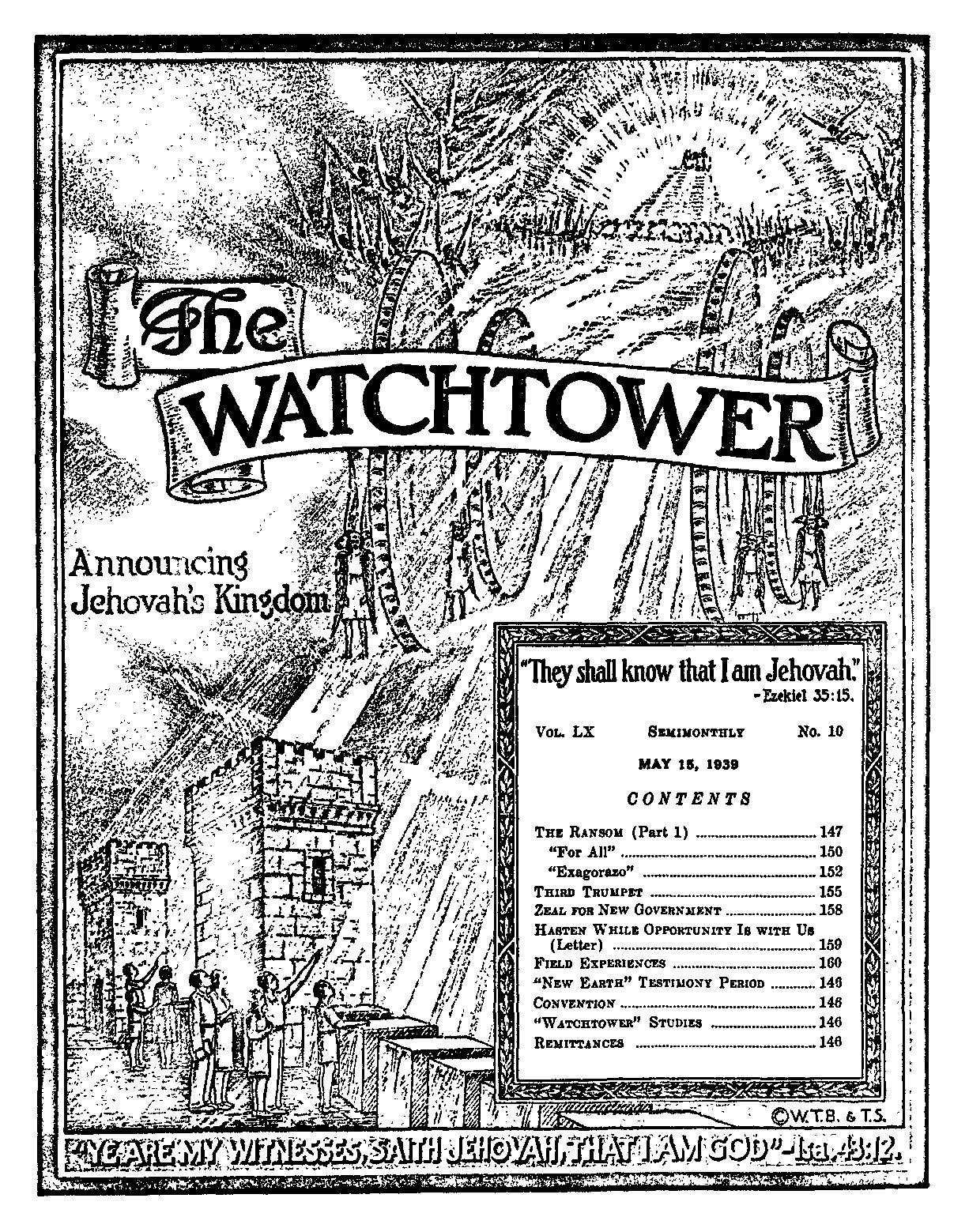
The Watchtower, May 15, 1939
Download: PDF — The Watchtower, May 15, 1939
“NEW EARTH” TESTIMONY PERIOD
June is thus designated, and the activities outlined for the month are related to the work now proceeding of laying the foundation of the new earth. Jonadabs as well as the anointed kingdom publishers will rejoice to have part therein. An attractive special offer should make June outstanding for the placement of booklets, to wit, seven booklets on a contribution of but 25c, three being self-covered and four being colored-cover booklets. People unable to take the combination will be offered the new booklet Fascism or Freedom on any contribution they can afford. This applies to foreign-language booklets also. Fuller details are to be found in the Informant. Your part now is to prepare and equip yourself for an active share in this testimony period. A good report for the month is expected from you.
CONVENTION
At New York City, June 23-25, a convention of Jehovah’s witnesses will be held. Thousands desire to attend who are too far away, and for their convenience arrangements are being made to connect Los Angeles, Chicago and some other cities in the United States, and London, Glasgow and other cities in England, by wire direct from Madison Square Garden in New York City. The president of the Society will address the convention on Saturday the 24th, from 3: 00 to 4: 00 p.m., and on Sunday, June 25, will address the public, 4: 00 to 5: 00 p.m., New York time. Other cities desiring to be tied in to this convention should notify the Brooklyn office immediately. More details later.
“WATCHTOWER” STUDIES
Week of June 18: “The Ransom” (Part 1) fl 1-17 inclusive, The Watchtower May 15,1939.
Week of June 25: “The Ransom” (Part 1) fl 18-43 inclusive, The Watchtower May 15, 1939.
REMITTANCES
Enclosing coin or currency with an order for books or other publications often results in disappointment when the sender is notified that neither order nor remittance has been received by us. In this day of disturbed financial conditions even the use of checks involves a needless risk. We suggest that everyone use the money order (either postal or express). Keep each money order receipt for reference. For all remittances the money order should be made payable to the Watch Tower Bible & Tract Society, with a memorandum attached as to how much is desired for The Watchtower, for Consolation, or for anything else. Do not remit to International Bible Students Association.
Vol. LX
May 15, 1939
No. 10
THE RANSOM
PART 1
“For God is one, and there is one mediator of God and men, that man, Christ Jesus, who gave himself a ransom in behalf of all, the testimony in its own seasons; for which I was appointed a herald and an apostle”—1 Timothy 2:5-7, Emphatic Diaglott.
JEHOVAH GOD is the Savior of men, and he has provided and revealed to man the sure foundation for hope of salvation: “For other foundation can no man lay than that is laid, which is Jesus Christ.” (1 Cor. 3:11) “This is the stone which was set at nought of you builders, which is become the head of the corner. Neither is there salvation in any other; for there is none other name under heaven given among men, whereby we must be saved.”—Acts 4:11,12.
2 Why did God lay the foundation for salvation of sinful men? For the vindication of his holy name. The challenge of Satan put God’s name at issue. Imperfect men, when relieved from inherited disability, and who then prove their integrity toward God, are a vindication of the name of Jehovah and a complete refutation and disproval of Satan’s challenge. The judgment entered against Adam was just. It must stand forever. Adam’s offspring are sinners by reason of inherited sin. God could consistently permit another to purchase the offspring of Adam; and those men who would exercise faith in God and in the purchaser and render themselves in obedience and who would then maintain their integrity toward God would be a vindication of God’s name. God exercised mercy towards sinful man by laying the foundation for man’s salvation. How is the foundation for man’s salvation laid? It was laid by permitting the man Jesus to bring the required price for the purchase of mankind, that is, the descendants of Adam, and pay over that purchase price for the relief or release of such offspring of Adam from bondage.
3 What price is required for the purchase of mankind? The life of a perfect human creature. God’s law requires a life for a life. (Deut. 19:21) Adam was a perfect man when he willfully and deliberately sinned in violation of God’s law, and the law of God required the forfeiture in death of that perfect human life. (Gen. 2:17) Nothing less and nothing more could be required to purchase the offspring of Adam, but only a perfect life. The life of an angel could not furnish the perfect price, because an angel is greater than man. Because all of Adam's offspring are by inheritance imperfect, no one thereof could bring the required purchase price. (Ps. 49:7) All men, being imperfect, could live only a short space of time and then die and remain dead forever, unless God makes provision for such to have life. What has been done for man’s relief from death and for his salvation to life?
4 The answer to the foregoing question is found in the scripture, to wit: “But we see Jesus, who was made a little lower than the angels, for the suffering of death, crowned with glory and honour: that he by the grace of God should taste death for every man.” (Heb. 2:9) Since Jesus always does the will of God, it must have been understood between God and his beloved Son that Jesus should become a man, “lower than the angels,” and suffer death, thereby proving his faithfulness unto God even to an ignominious death, and by his death also providing the required purchase price for man’s salvation from death. The original name of the Son was Logos, and from the beginning the Logos was with God and, by God’s direction, carried into operation God’s purpose. He was the spokesman of Jehovah God. He was a spirit. By the miraculous power of Almighty God a virgin conceived and gave birth to the man-child Jesus. (Matt. 1:18-23) It is written that from the beginning the Son was “the Word”, or Logos, “with God,” and by him were all things created.—John 1:1-3, Diaglott.
5 The time came to begin laying the foundation for man’s salvation and God caused the Logos to become a man: “And the Logos became flesh, and dwelt among us, and we beheld his glory, a glory as of an Only-begotten from a Father, full of favor and truth.” (John 1:14, Diaglott) “But when the completion of the time arrived, God sent forth his Son, having been produced from a woman, born under law.” (Gal. 4:4, Diaglott) “And the child grew, and waxed strong in spirit, filled with wisdom; and the grace of God was upon him.”—Luke 2:40.
6 When the man Jesus was thirty years of age he presented himself unto God in full and complete consecration or agreement to do the will of God, and this was symbolized by his immersion in the Jordan river. (Luke 3:21-23; Ps. 40:7,8; Matt. 3:16) Jesus was then a perfect man possessing all the qualifications requisite to the furnishing of the purchase price of sinful man. Was there an agreement between Jesus and his Father, Jehovah God, that he, Jesus, the man, should die ? The answer is written: “As the Father knoweth me, even so know I the Father; and I lay down my life for the sheep.” “Therefore doth my Father love me, because I lay down my life, that I might take it again. No man taketh it from me, but I lay it down of myself. I have power to lay it down, and I have power to take it again. This commandment have I received of my Father.”—John 10:15,17,18.
7 From the beginning, it clearly appears, it was agreed between the Father and the Son that Jesus should become a man, suffer contradiction and indignities and reproach upon his name, prove his integrity toward God, die as a sinner, and, proving his faithfulness, then be resurrected out of death and take life again, which would mean that by his death Jesus did not forfeit his life or the right thereto, as Adam had forfeited life. Jesus laid down his life and received life again in full accord with the commandment he had received from Jehovah God, and which commandment Jesus fully agreed to obey. Carrying out that agreement, God raised Jesus out of death and gave him life as a spirit. (1 Pet. 3:18; Acts 3:26; 1 Cor. 15:3,4,20) Jesus, not having forfeited his right to human life, still possessed that right to human life when he was raised from the dead; and that right to human life constitutes the purchase price for sinful man. When God raised Jesus from the dead he clothed Jesus with all power in heaven and in earth; that is to say, God made Jesus Christ his Executive Officer, fully equipped with all necessary power and authority to carry into operation the purpose of Jehovah, both in heaven and in earth. (Matt. 28:18; Phil. 2:9-11) When Jesus Christ was exalted to heaven he presented to God in heaven the value of his human life; and that asset, which was exactly equal to what Adam had forfeited, was received by Jehovah God as the offering of Jesus for sin, that is to say, as the purchase price offered and presented by Jesus in behalf of sinful men. This God caused to be shown in type or picture in the sacrifice performed at the tabernacle in the wilderness. (See Leviticus chapter 16.) On the typical atonement day the picture was made in this manner: A bullock without spot or blemish, which represented the man Jesus, was brought into the court of the tabernacle and slain there, which court of the tabernacle pictured the earth. The blood of the bullock, representing the lifeblood of Jesus, which lifeblood was poured out as an offering for sin (Isa. 53:10), was then carried by the typical priest into the Most Holy of the tabernacle and thereafter sprinkled upon the mercy seat. (Lev. 16:14) The Most Holy of the tabernacle pictured heaven itself, where Jesus Christ appeared, presented and offered the asset or valuable thing, his right to human life, as the purchase price for the offspring of Adam. (Heb. 9: 3-25) The sacrifice offered at the tabernacle in the wilderness once each year on the typical atonement day foreshadowed or pictured the work of Jesus in offering himself, that is, his human life, as the purchase price for man. Concerning the type, or picture, and the reality, it is written: “Now when these things were thus ordained, the priests went always into the first tabernacle, accomplishing the service of God. But into the second [the holiest of all, or Most Holy, picturing heaven] went the high priest alone once every year, not without blood, which he offered for himself, and for the errors of the people.” “It was therefore necessary that the patterns of things in the heavens should be purified with these; but the heavenly things themselves with better sacrifices than these. For Christ is not entered into the holy places made with hands, which are the figures of the true; but into heaven itself, now to appear in the presence of God for us. Nor yet that he should offer himself often, as the high priest entereth into the holy place every year with blood of others; for then must he often have suffered since the foundation of the world; but now once in the end of the world hath he appeared, to put away sin by the sacrifice of himself.” (Heb. 9:6,7,23-26) Thus it is seen that Christ Jesus, God’s great High Priest, the spirit creature, when he appeared in heaven, presented and offered unto Jehovah the asset he possessed, to wit, his right to human life, as the purchase price for man, which offering was accepted by Jehovah, and Christ Jesus became the owner of all of Adam’s offspring that willingly comply with the rules of Jehovah governing salvation. Thus God laid the foundation in Christ Jesus for the salvation of man, and there is no other possible means of salvation.
8 The lifeblood of the man Jesus is the ransom price for man. As God declares in his law: “The life of the flesh is in the blood: . . . the blood of it is for the life thereof.” (Lev. 17:11,14) So the lifeblood of the man Jesus is the asset, the valuable thing, by which he ransomed sinful men. The English words ransom, redeem, redeemed and redemption are often used in the Bible, but do not always mean the same thing exactly. That part of the Bible written by the inspired followers of Christ Jesus and which for long has been commonly called “the New Testament” is translated from the Greek into the English, and in our Authorized Version of the Bible different Greek words are translated ransom. While comparatively few persons read the Greek, it will be profitable to here call attention to the different Greek words used and translated “ransom”, and these words appearing herein in English will enable all students to get an understanding. A well- known authority is Parkhurst. Parkhurst’s Greek and English Lexicon says concerning “ransom”: “Anti'lytron is from anti [meaning] in return, or correspondency; and lytron, a ransom.—A ransom, price of redemption, or rather a correspondent ransom. 'It properly signifies a price by which captives are redeemed from the enemy; and that kind of exchange in which the life of one is redeemed by the life of another.’ [Hyperius] So Aristotle uses the verb antilytro'o for redeeming life by life.”
9 The word anti'lytron appears only once in the Scriptures, and that in the following text, to wit: “Who gave himself a ransom in behalf of all [whom God wills to be saved (verse 4)], the testimony in its own seasons; for which I was appointed a herald and an apostle.” (1 Tim. 2:4-7, Emphatic Diaglott) According to Parkhurst: “Who gave himself a correspondent ransom.” This text does not say or mean that Adam was or is ransomed, but does mean that the human perfection once possessed by the perfect man Adam (and which human perfection carried with it the right to life, which life and right thereto were forfeited by the willful disobedience of Adam) is purchased or bought back or ransomed for Adam’s offspring, who were prevented from receiving that life and right thereto by reason of Adam’s sin. The offspring of Adam who accept God’s provision for their purchase, and who comply with God’s fixed rules concerning the same, are privileged to receive the benefit of the ransom price. By his own lifeblood Jesus ransomed or purchased life and the right to human life for those of Adam's offspring that are saved. The clear meaning of the Scripture is this, to wit: That God desires all men to be saved and to come to an accurate knowledge of the truth who comply with his fixed and unchangeable provisions. “For this is good and acceptable in the sight of God our Saviour; who will have all men to be saved [by availing themselves of the ransom price, because God is impartial], and [then] to come to [an accurate] knowledge of the truth [in order that they might continue to walk in the right way]. For there is one God, and one mediator between God and men, the man Christ Jesus; who gave himself a ransom for all [who will be saved], to be testified in due time.” (1 Tim. 2:3-6, A.V.) It is this gracious provision that God has made for the salvation of men, concerning which the apostle then adds: “Whereunto I am ordained a preacher, and an apostle.”
10 The man Jesus, by the will of God his Father, turned his perfection and right to life as such a man into a thing of value with sufficient purchasing power to purchase or buy back all the rights which Adam forfeited for himself and which his offspring lost by reason of Adam’s sin. That does not mean that Adam was purchased, but that every right that Adam once possessed was purchased. It was not the will of God to send Jesus to the earth to give his life a ransom price and that in so doing Jesus should for ever go out of existence in the place or stead of Adam, in order that Adam and his offspring might exist forever; but that the man Jesus might lay down his life as a man and thereafter take life again, as Jesus said: “Therefore doth my Father love me, because I lay down my life, that I might take it again. . . . This commandment have I received of my Father.” (John 10:17,18) Life or existence Jesus did take again, not as a man, but as a spirit. At the same time he still held the right to life as a man because he had not forfeited that right. God raised Jesus out of death a spirit; and, Jesus still possessing that right to life as a man, that asset or thing of value he paid over to Jehovah God as the price required, and thereby became the owner of Adam’s offspring who had not willfully sinned as did Adam, and who should in due time avail themselves of the value of that ransom price. Jesus then could release or deliver Adam’s offspring from the bondage of sin and death which had come upon them by reason of Adam’s sin, by which the right to life had been denied Adam’s offspring. That means that the ransom sacrifice would inure to the benefit of the worthy ones of Adam’s offspring; by “worthy ones” meaning those who would follow God’s rules. For instance, Abel was a worthy one and had God’s approval, but could not receive life or the right thereto until the ransom or purchase price was paid over and accepted by Jehovah. Being murdered a long time before the ransom price was paid, he must await God's due time to be awakened out of death and receive the full and complete benefit of the ransom price. When Jesus Christ paid over the value of his perfect human life he then by right of purchase became the owner of obedient mankind. He did not become a substitute for Adam in death, but he became the purchaser of Adam’s offspring by paying over a thing exactly similar to that which Adam forfeited; therefore the life of the man Jesus, which he gave up, is a price exactly corresponding to the life of perfect Adam. Jesus purchased for Adam’s worthy offspring the right to life, and it is his privilege to minister life according to the will of God; as it is written: ‘Life is the gift of God through Jesus Christ our Lord.’ (Rom. 6:23) Who is to determine what ones of Adam’s offspring are worthy? The Lord Jesus Christ, who acts with full authority from Jehovah God. Christ Jesus is “the Everlasting Father”, or “Life-giver”. (Isa. 9:6) As a father he has power and authority to bring creatures into life who have died and to give life to as many as he will according to the pleasure of Jehovah God. Such rescued life Jesus Christ could rightfully bestow on those only, and no others than the ones for whom Adam had lost the right to life; and since Adam lost the right to life for all mankind, He can bestow life on only such of Adam’s race as meet the required rules made by Jehovah.
“FOR ALL”
11 Does not the ransom price of Jesus result to the everlasting benefit of all? Does not the scripture at 1 Timothy 2:6 above quoted prove that Jesus gave his life a ransom for all? and is not that a guarantee that all of the human race must have the full benefit of the ransom sacrifice or ransom price? No; such a conclusion is not correct. Some of the human race, the offspring of Adam, are willfully wicked, and such are not benefited by the ransom. If they comply with God’s rules concerning the ransom they might become righteous, and then they would receive the benefit of the ransom price. Concerning this Jesus said: “As thou hast given him power over all flesh, that he should give eternal life to as many as thou hast given him. And this is life eternal, that they might know thee the only true God, and Jesus Christ, whom thou hast sent.”—John 17:2,3.
12 Those persons who refuse to know God and Christ Jesus cannot receive life. Many persons to whom the truth is presented and who are shown God’s provision for life and salvation spurn such truth and say, in substance: “I am not at all interested. I am satisfied with what I have.” There is no reason to expect Adam to receive life, because he was a willful and deliberate sinner; nor is there any reason to expect any of Adam’s offspring to receive life who willfully refuse to hear of God’s provision for life. To give Adam the benefit of the ransom sacrifice would mean that God would thereby show that his judgment against Adam was not just; whereas the Scriptures plainly say: ‘Justice is the foundation of God’s throne.’ (Ps. 89:14) To give Adam’s offspring the benefit of the ransom sacrifice, which offspring spurn God’s provision, is wholly inconsistent with God’s purpose expressed in the Scriptures. The text at 1 Timothy two above quoted shows that “God is no respecter of persons” (Acts 10:34), and hence the ransom is for the benefit of all who conform themselves to God’s will or law; and because there is only one Almighty God, whose name is Jehovah, there is one mediator between God and men and that One is the man Jesus, who gave his life a ransom for all, meaning, of course, as stated, all who God wills shall be saved and who comply with the requirements that God has laid down. There is no authority to say that the ransom sacrifice automatically operates for the benefit of all.
13 The English words buy, bought, purchase and redeem are translated from the Greek agorazo (derived from the word agora, meaning “the town square” or “market”, and ageiro, meaning “gather”, as to the town square or market place). Thus agorazo literally means to go to market and hence to purchase and redeem that which is sold. As an example: Slaves were bought and sold at the market place; concerning which the word agorazo properly is applied. Note here an example of the use of the word, to wit: “Again, the kingdom of heaven is like unto treasure hid in a field; the which when a man hath found he hideth, and for joy thereof goeth and selleth all that he hath, and buyeth that field.”—Matt. 13:44.
14 Many who have tried to interpret the Scriptures have said that the word field, used in the foregoing text, symbolizes the entire human race, the wicked and all others. Certainly that is wrong. Mark this: the scripture says “the kingdom of heaven is like”, and so on. It is the kingdom of heaven which is bought, and certainly the entire human race is not the kingdom of heaven. Nor is the kingdom of heaven hidden within the folds of the sinful human family. The kingdom of heaven is the hidden treasure, and it is that which is bought. It is the treasure within God’s universal organization, which is holy and in no wise sinful. The “kingdom of heaven” is the hidden mystery. (Eph. 1: 20-23; 5: 32) “Even the mystery which hath been hid from ages and from generations, but now is made manifest to his saints.” (Col. 1:26) Christ Jesus, by rendering himself in full obedience to his Father’s will, became the heir of all things, including the hidden mystery, the kingdom of heaven. (Heb. 1:2; Rom. 8:16,17) God made known to Jesus his purpose to have a capital organization, to wit, his government, “the kingdom of heaven,” which for ages was a mystery and which mystery was hidden from all others of God’s creation until God’s due time to reveal it. When Jesus learned of this, he sold his all to become the heir thereof and the head of the kingdom. It was not his human life as the ransom for humanity that bought that estate of the kingdom of heaven; it was his surrender of everything, including human life, to maintain his integrity and faithfulness to God under the greatest pressure, even unto an ignominious death; which he did for that field and its hidden treasure. The suffering of Jesus had nothing to do with the purchase price of mankind, but it was by his suffering that he learned obedience and proved his integrity and faithfulness and became the heir of eternal salvation and of the kingdom. - Heb. 5: 8, 9.
15 The same Greek word, agorazo, is translated “bought” in the following text: “Again, the kingdom of heaven is like unto a merchantman, seeking goodly pearls; who, when he had found one pearl of great price, went and sold all that he had, and bought it.” (Matt. 13:45,46) This has the same meaning as the parable stated in the preceding verses forty-three and forty-four. Those two parables include the body members of the body of Christ, because they form a part of the kingdom of heaven. If the purchase or buying that is mentioned in the foregoing text concerning the kingdom of heaven referred to the ransom price the body members would have no part therein, because they do not have any part in the purchase of the human race. That the body members of Christ have a part in the kingdom is true beyond any doubt. (Rom. 8:16,17; Rev. 1:6; 20:4) Those who faithfully follow Christ Jesus and become a part of the kingdom of heaven are first bought by the precious blood of Christ Jesus before they can start on their way to be made a part of the kingdom. (1 Pet. 1:18,19) “What! know ye not that your body is the temple of the holy [spirit] which is in you, which ye have of God, and ye are not your own? For ye are bought with a price; therefore glorify God in your body, ...” (1 Cor. 6:19,20; the remaining words in that twentieth verse are spurious. See Diaglott.) This text refers only to the anointed Christians as the ones that are bought. This text could not be construed to mean that it drags along with those purchased every member of the human family, wicked and otherwise, and that these are automatically bought. Would a slave be bought and be given his freedom who refused to obey his master? Note that the agreement with Joseph in Egypt by the people was this: that the people first came to Joseph and asked to be bought before Joseph would buy them for Pharaoh. This is a picture of the purchase and redemption of those of the human race who come to Christ Jesus to be bought. (Gen. 47:19-23) Those who become members of the body of Christ first come to Christ Jesus and agree to do whatsoever is his and the Father’s will. Then his purchase price applies to them, and they become his and no longer belong to themselves. They are his bond servants or bond slaves, thereafter obligated to do his will and obey his commandments. They were not purchased against their will, but because they desired to be purchased. God’s rule is the same at all times.
16 Whether the person is called by the Lord and granted life in the spirit or whether his hope of life is on the earth, the course of procedure concerning his purchase is exactly the same. The following text is directed to those of the little flock: “For he that is called in the Lord, being a [man’s] servant, is the Lord’s freeman; likewise also he that is called, being free, is Christ’s servant [that is, the bond servant or slave of Christ]. Ye are bought with a price; be not ye the servants of men.” (1 Cor. 7: 22,23) These were not called until they first surrendered themselves in consecration to do God’s will, and then the purchase or ransom price operated toward them and they were bought and the Lord became their owner. Being accepted in the Lord, such became his bond servants because they have willingly and voluntarily agreed to be bought on the Lord’s terms. They have sold themselves to the King.—1 Ki. 21: 20, 25.
17 Those who are wicked are not purchased: “But there were false prophets [in Israel] also among the people, even as there shall be false teachers among you [who are Christians], who privily shall bring in damnable heresies, even denying the Lord that bought them, and bring upon themselves swift destruction.” (2 Pet. 2:1) Such were first bought, but afterwards became wicked, denying the Lord and the value of his blood by which they were bought; and for such there is no salvation, as is plainly stated in the Scriptures. (See Hebrews 6: 4-10; 10:26-29.)
18 The Scriptures refer to mature and faithful Christians as “elders”, who are bought and redeemed: “And they [the twenty-four elders named as members of the body of Christ] sung a new song, saying, Thou [Christ Jesus] art worthy to take the book, and to open the seals thereof; for thou wast slain, and hast redeemed us to God by thy blood, out of every kindred, and tongue, and people and nation.”—Rev. 5: 9.
19 This scripture could have no application to the wicked, because they are not redeemed unto God. The language of this text shows conclusively that none are automatically redeemed, because the elders were redeemed, as stated, “out of every kindred.”
20 The members of the body of Christ are the ones ransomed and redeemed, as stated, in the following text: “And they sung as it were a new song before the throne, and before the four beasts, and the elders; and no man could learn that song but the hundred and forty and four thousand, which were redeemed from the earth. These are they which were not defiled with women; for they are virgins. These are they which follow the Lamb whithersoever he goeth. These were redeemed from among men, being the firstfruits unto God and to the Lamb.”—Rev. 14:3,4.
21 The fact that these were “redeemed from among men” shows that all men were not automatically redeemed. The members of the body of Christ, here mentioned, first consecrated themselves by agreeing to do God’s will, and hence asked to be bought. The purpose and provision of God is for the redemption of men without discrimination, but all who are redeemed must first have faith in God and in Christ Jesus, and then fully consecrate themselves to do God’s will. This rule of God applies to all. Furthermore, these members of the body of Christ are “the firstfruits” unto God and Christ; which proves that there will be others who will see the privilege of being bought and who will avail themselves of that privilege by willingly exercising faith in God and in Christ by fully consecrating themselves to do God’s will.
“EXAGORAZO”
22 Another Greek word, exagorazo, and which is stronger and more emphatic than agorazo, means “to buy or redeem from; to buy up entirely; to get the whole, all; to ransom; to rescue, and to release”. It is applied both to the redeeming of creatures and to buying back time as to creatures. Note Galatians 3:13,14: “Christ hath redeemed us from the curse of the law, being made a curse for us; for it is written, Cursed is every one that hangeth on a tree; that the blessing of Abraham [as to Abraham’s seed] might come on the Gentiles through Jesus Christ; that we might receive the promise of the spirit through faith.”
23 Disobedient and unwilling Jews were not redeemed from the curse of the law, neither are the unwilling Gentiles redeemed from the curse or bondage of sin. This text says: “That we might receive the promise of the spirit through faith”; which shows that they that are Christians willingly believe on and follow Christ Jesus. All others of the Jews remain under the curse of the law. Again, it is written: “But when the fulness of the time was come, God sent forth his Son, made of a woman, made under the law, to redeem them that were under the law, that we might receive the adoption of sons.” (Gal. 4:4,5) According to this text only those of the Jews who ‘received the adoption of sons’ are those who were redeemed. This is fully supported by the scripture, to wit: “He [Jesus] came unto his own, and his own received him not. But as many as received him, to them gave he power to become the sons of God, even to them that believe on his name: which were born, not of blood, nor of the will of the flesh, nor of the will of man, but of God.” —John 1:11-13.
24 It follows that those who did not believe were not bought, and those who did believe and devoted themselves to Christ were “bought up entirely”. That same Greek word, as applied to buying back of time, is used in the following text: “Redeeming the time, because the days are evil.”—Eph. 5:16.
25 The Greek verb lyo, which means simply “to loosen”, is the base or root of the Greek words rendered “redeemed” in the following texts: “But we trusted that it had been he which should have redeemed [lytro'o] Israel; and beside all this, to day is the third day since these things were done.” (Luke 24: 21) “Forasmuch as ye [elect] know that ye were not redeemed [(Greek) lytro'o] with corruptible things, as silver and gold, from your vain conversation received by tradition from your fathers; but with the precious blood of Christ, as of a lamb without blemish and without spot.”—1 Pet. 1:18,19.
26 This last scripture is addressed only to those who had fled from Satan’s organization and devoted themselves to God by and through Christ Jesus. The Greek word lytrosis, which means to ransom or “redemption” by paying over a price, is used in the following text, to wit: “Blessed be the Lord God of Israel; for he hath visited and redeemed [literally: wrought redemption for] his people.” (Luke 1: 68) None except those who have become the Lord’s are included. Again in Luke 2: 36-38 mention is made only of those who “looked for redemption” through the One whom Jehovah had promised. In Hebrews 9:12 it is written: “By his own [Christ’s] blood, he entered in once into the holy place, having obtained eternal redemption for us.” Here the apostle is not classifying himself with the entire human race, but speaking of “us” (9:24), who have fled to Christ and joyfully consecrated ourselves to do God’s will.
27 Apolytrosis, meaning “to loosen away from”, particularly the act of loosening; “the redemption; a releasing on payment of a ransom price; a ransoming,” is translated “redemption” and “deliverance”, as used in the following text: “And when these things begin to come to pass, then look up, and lift up your heads; for your redemption [(Dia- glott) deliverance] draweth nigh.” (Luke 21:28) The redemption here is such a deliverance as was experienced by the Israelites when they were delivered from Egypt (Ex. 6: 6; 15:13; Ps. 106: 9-11); also such as the faithful followers of Christ Jesus being released from Satan’s organization, that is, Babylon. After 1918 the faithful remnant of the seed of the Lord’s organization were released or delivered from Satan’s organization by the exercise of the Lord's power. (Ps. 107:2,3; Isa. 52:9-11; Jer. 31:10-12) “Even the righteousness of God, which is by faith of Jesus Christ, unto all and upon all them that believe; for there is no difference: for all have sinned, and come short of the glory of God; being justified freely by his grace, through the redemption that is in Christ Jesus.” (Rom. 3:22-24) Here again the redemption applies only to them that have faith and believe, which results in justification to such believers. Such are set free or loosened from bondage, and this applies to none other.
28 In the following text the same Greek word is translated “redemption”: “Not only they [the people of good will, the Lord’s ‘other sheep’], but ourselves also, which have the firstfruits of the spirit, even we ourselves groan within ourselves, waiting for the adoption, to wit, the redemption of our body.” (Rom. 8:23) In this text it is “our body”, of which Christ Jesus is the Head, that is, The Christ, including Christ Jesus, the Head, and 144,000 body members, that experiences redemption or deliverance. The visible manifestation of this redemption is by the deliverance of the faithful on earth from the bondage of Satan’s organization, where they had been captives and prisoners down to 1918, at which time the Lord came to his temple and gathered the faithful into it. Again those only who are in Christ Jesus are considered in the following text: “But of him are ye in Christ Jesus, who of God is made unto us wisdom, and righteousness, and sanctification, and redemption.” (1 Cor. 1:30) Certainly this does not apply to those who spurn God’s provision through Christ Jesus.
29 At Ephesians 1:7,14 the same word is used: “In whom we have redemption through his blood, the forgiveness of sins, according to the riches of his grace.” “Which is the earnest of our inheritance, until the redemption of the purchased possession, unto the praise of his glory.” At verse fourteen the words “purchased possession” here translate the one Greek word peripoiesis, the same as used at 1 Peter 2:9, which describes the “people for God’s own possession”. (A.R.V.) The “purchased possession” here mentioned is the body of Christ, and none other. At Ephesians 1:7,14 “redemption” is limited to those who apply to God for the blood of Christ as the only means of salvation, and who receive the forgiveness of sins and then receive “the earnest” (a hand payment, to bind the bargain) of the spirit. When Satan’s organization is destroyed such “purchased possession” experience complete deliverance.
30 Again, at Colossians 1:14: “In whom we have redemption through his blood, even the forgiveness of sins.” The “redemption” here mentioned is not applied automatically to anyone, but only to those who first voluntarily seek and ask for such. It is broad enough to cover all persons that do come to God desiring salvation.
31 At Hebrews 11:35 the same Greek word is rendered “deliverance”, and according to Young, “redemption.” “Women received their dead raised to life again; and others were tortured, not accepting deliverance; that they might obtain a better resurrection.” The faithful ones of old refused to accept any redemption that purchased deliverance from torture and at the price of a compromise with the Devil’s agents or organization. When those faithful ones are raised from the dead they will gladly and with intelligence accept redemption through Christ Jesus. They exhibited faith in God and in his promise to send them the Messiah, and they maintained their integrity.
32 The Greek lytron, which means “something to loosen with”, that is, a redemption “price”, is translated “ransom” in the following text, to wit: “And whosoever will be chief among you, let him be your servant; even as the Son of man came not to be ministered unto, but to minister, and to give his life a ransom for many.” (Matt. 20:27,28) The word lytron here is followed by the preposition anti, meaning instead of, corresponding to, or in behalf of, and the last more correctly translates the same. This is the very reverse of the compound word antilytron at 1 Timothy 2: 6. At Matthew 20: 28 the anti could not mean “exactly corresponding” in price, because the lifeblood of Jesus was not exactly corresponding to the “many”, but was “in behalf of” the many. God’s law as stated at Deuteronomy 19:21 shows that the life that buys must be the price exactly corresponding to that which was forfeited; and hence the life of Jesus must be equivalent to what Jesus ransoms for the many. The same matter is correctly stated at Mark 10: 44, 45: “And whosoever of you will be the chiefest, shall be servant of all. For even the Son of man came not to be ministered unto, but to minister, and to give his life a ransom for [lytron anti] many.” Jesus gave his life a ransom in behalf of many, and he bought for such the full and complete life, with the right thereto, for as many as comply with God’s fixed rules relating to salvation. Certainly Jesus did not come to save and to give his life for the willfully wicked. It is true, as written at Romans 5:8,10, that Christ died for us while we were enemies. “But God commendeth his love toward us, in that, while we were yet sinners, Christ died for us.” “For if, when we were enemies, we were reconciled to God by the death of his Son, much more, being reconciled, we shall be saved by his life.” The persons referred to in the word “we” in these texts do not include everyone, but only those who are “called to be saints”.—Rom. 1:7.
33 The epistle of 1 Timothy is addressed to Timothy, who was commissioned and sent forth to instruct those persons who had already made a consecration to do the will of God, which includes, of course, those taken out of the world for Jehovah’s name. The sum of the inspired statement of the apostle is this: God is no respecter of persons, but it is his will that ‘all men might be saved, and come to a knowledge of the truth, for there is one God and one mediator between God and men, and that one is Christ Jesus, who gave himself a ransom in behalf of all’; meaning, of course, all of those who seek the Lord. The meaning here manifestly is that Christ Jesus is the Mediator of all who have first entered into a covenant to do the will of God. From all the foregoing Scripture texts it is seen that the ransom sacrifice of Jesus does not automatically affect every man, whether he wishes it or not, but only those receive the benefits resulting therefrom who first seek the way of righteousness and believe on God, that He is the Almighty and that the blood of Christ Jesus is the means of salvation, and who then voluntarily agree to do the will of God. Without Christ Jesus the Mediator, no man could be reconciled to God. Jesus has bought the race with his own blood, and he relieves from the disability of sin only those who are willing to be delivered and saved.
34 God has shown his mercy to sinful men, the offspring of Adam, and such is the result of his loving-kindness. Therefore, says the scripture: “For God so loved the world, that he gave his only begotten Son, that whosoever believeth in him should not perish, but have everlasting life.” (John 3:16) Only those who believe in him are rescued from perishing: “For God sent not his Son into the world to condemn the world; but that the world through him might be saved.” (Verse 17) This manifestation of God’s mercy is that men “might be saved”, and not that they must be saved whether they desire, believe or do otherwise.
35 Without the ransom sacrifice no man could be saved, because he is a sinner by inheritance from Adam and upon all sinners the “wrath of God”, that is, God’s just condemnation, falls because of imperfection resulting from sin. God cannot approve an imperfect thing. Not by the exercise of justice, but by the exercise of his loving-kindness God provides that Jesus may buy men and that, when men exercise faith in God and in Christ, such will have the benefit of being released from the bondage of sin and given an individual opportunity to prove their integrity toward God and, so doing, receive salvation to life by and through Jesus Christ. But certainly those who fail or refuse to believe could not have salvation. If they could, then it would mean that the conditions of belief are of no effect. Therefore says the scripture plainly: “The Father loveth the Son, and hath given all things into his hand. He that believeth on the Son hath everlasting life; and he that believeth not the Son shall not see life; but the wrath of God abideth on him.”-John 3: 35, 36.
36 There is no way for man to escape the just punishment of everlasting death except by and through the merit of Christ Jesus applied to and received by him. The doctrine, therefore, of ‘a ransom for all regardless of belief’ is entirely without Scriptural authority.
37 The ransom price is the valuable thing or price provided for the purchase of mankind, and which price exactly corresponds to that which the perfect man Adam forfeited for himself and lost to all of his offspring.
38 The sin offering is the presentation of and the paying over to Jehovah God of that asset, valuable thing or purchase price. Jesus died on the earth. His lifeblood was poured out as the ransom price. God raised Jesus out of death a spirit and exalted him to heaven, fully clothed with all power and authority to carry out God’s purpose. Christ Jesus, the Divine, in heaven, presented to Jehovah God the valuable asset, to wit, his right to human life, as an offering for sin. Such is the sin offering. The act of ransoming includes both the providing of the purchase price and the presentation and paying over of that purchase price. The entire work of providing the valuable asset and paying it over is performed by Christ Jesus according to the will and command of God. It therefore follows that Christ Jesus alone and separate and apart from the members of his body performed the act of ransoming mankind.
39 The prophetic picture made on the typical atonement day in the sacrifices performed at the tabernacle in the wilderness fully supports the foregoing conclusion. The bullock, which was a type of the man Jesus, was brought into the court of the tabernacle and was slain there, which pictures the earth where Jesus was slain. Israel’s high priest, in the type, took the blood of the bullock and carried it into the “holiest of all”, corresponding with heaven, and there sprinkled the blood, which pictured the life of the slain man, Christ Jesus. In fulfillment of that part of the picture Christ Jesus, the great High Priest, ascended into heaven itself and presented and paid over the valuable asset, to wit, his right to human life, to God. In the type the blood was sprinkled on the mercy seat by the priest seven times. “Seven,” being a symbol of completeness in heaven, shows that the blood was sprinkled in heaven in completeness by the Lord himself, that is, that Christ Jesus fully and completely paid over the purchase price for the human race. (See Leviticus chapter 16.) The high priest in the type went alone into the Most Holy, and no one was permitted to be there with him.
40 Note now the text: “But into the second [holiest of all], the high-priest alone, once annually, not without blood, which he offers on behalf of himself, and the sins of ignorance of the people.” (Heb. 9: 7, Diaglott) “And there shall be no man in the tabernacle of the congregation when he goeth in to make an atonement in the holy place, until he come out, and have made an atonement for himself, and for his household [the priestly anointed class in the type], and for all the congregation of Israel.” (Lev. 16:17) Likewise in the antitype Christ Jesus, the great High Priest, presented the value of his human life, the purchase price, in behalf of the royal house, which God selects, and also for the sins of the people.—Heb. 9:17,24.
41 It has been repeatedly said that the church, that is, the glorified members of the body of Christ, by reason of their sacrifice, have a part in the sin offering; and in support of that theory the following scripture is offered: “Then shall he kill the goat of the sin offering, that is for the people, and bring his blood within the vail, and do with that blood as he did with the blood of the bullock, and sprinkle it upon the mercy seat, and before the mercy seat.” —Lev. 16:15.
42 Neither the foregoing nor any other scripture sustains the conclusion that the body members of Christ have any part in the sin offering. It is the lifeblood of the man Jesus alone that is the valuable thing, the purchase price, and which price is presented and paid over as a sin offering. What, then, will be asked, does the sacrifice of the Lord’s goat and the sprinkling of its blood, as shown in the type, mean, if not sprinkled in behalf of mankind as a part of the sin offering? It is true that the blood of the Lord’s goat was taken into the Holy the same as that of the bullock. In the type the goat did not sacrifice itself, but the sacrifice was done by the high priest. In the antitype no man sacrifices himself, but the Lord Jesus, the great High Priest, does the sacrificing. The meaning of the sacrifice and sprinkling the blood of the Lord’s goat manifestly is this: That everyone of the humankind that is called to the “high calling” must bear the reproaches that fall upon Christ Jesus and must therefore suffer with him and die with him as a condition precedent to reigning with him in heaven. In support of this are the inspired words of the apostle: “Who now rejoice in my sufferings for you, and fill up that which is behind of the afflictions of Christ in my flesh for his body’s sake, which is the church.” (Col. 1:24) “It is a faithful saying: For if we be dead with him, we shall also live with him; if we suffer, we shall also reign with him; if we deny him, he also will deny us.” (2 Tim. 2:11,12) “For even hereunto were ye called: because Christ also suffered for us, leaving us an example, that ye should follow his steps.” (1 Pet. 2:21) In the type the Lord’s goat pictured those who are begotten of the spirit and who therefore as human creatures must die and must be faithful unto death, that they may participate with Christ Jesus in his kingdom, enjoying the highest element of life and reigning with him: “Fear none of those things which thou shalt suffer: behold, the devil shall cast some of you into prison, that ye may be tried; and ye shall have tribulation ten days: be thou faithful unto death, and I will give thee a crown of life.” (Rev. 2:10) “And they lived and reigned with Christ a thousand years.”—Rev. 20: 4.
43 The following cannot be successfully contradicted, to wit: That God has provided salvation by and through his Son, Christ Jesus; that the lifeblood of the man Jesus poured out at Calvary is the purchase price of sinful man, which price purchased all the right that Adam lost for his offspring; that such purchase price was presented in heaven and paid over to God as a sin offering in behalf of as many as do believe on the Lord Jesus Christ; that such was done and performed by Christ Jesus in obedience to God’s will; that Christ Jesus, having paid over the ransom price, is the owner of all men, and all receive the benefit thereof who believe and obey; that life everlasting is the gift of Jehovah God through Jesus Christ our Lord, because salvation belongs to Jehovah and Christ Jesus is his means of administering the same; that there is no other means of gaining life; and that no man can gain life or receive life everlasting unless he believes God and believes on the Lord Jesus Christ and asks for salvation by making an unconditional agreement to do the will of God.
(To be continued)
THIRD TRUMPET
BEGINNING with the year A.D. 1922 a series of seven pronouncements, of world importance and in the form of Resolutions or Declarations, began to be adopted and published by the annual international conventions, each year in a different city, of Jehovah’s witnesses, who were then known as International Bible Students. A close examination of these seven annual convention Resolutions, together with the public speeches in support of them, and a comparison of them with sacred prophecy, proves, in the light of the historic events that followed, that these things had been foretold. They were the fulfillment of a prophetic symbolic picture, to wit, the “seven trumpets” sounded one after another by the “seven angels” that came forth from the temple of God. (See The Revelation, chapters eight to eleven.) The blowing of each trumpet was followed by strange events, described in symbolic language, and they are now understandable in the light of the above seven annual blasts of truth and what accompanied them.
Accordingly, the first trumpet began to sound at the 1922 convention of Jehovah’s witnesses at Cedar Point, Ohio, in September of that year. The second trumpet began to blare forth its resounding message the following year at the international convention of Jehovah’s witnesses at Los Angeles, California, in August of 1923. Jehovah’s invisible angels, under the command of Christ Jesus at His temple, had to do with these spiritual matters.
Again God put it in the mind of his people, by his angel, to act and to carry out his purposes. In July, 1924, at an international assembly of God’s people at Columbus, Ohio, a resolution designated “Indictment” was adopted, which, together with the supporting discourse, “Civilization Doomed,” was later printed and widely distributed amongst the peoples of earth and was shortly thereafter followed by a world-wide series of discourses by many speakers.
“INDICTMENT
"We, the International Bible Students, in convention assembled, declare our unqualified allegiance to Christ, who is now present and setting up his kingdom, and to that kingdom.
"We believe that every anointed child of God is an ambassador for Christ and is duty-bound to give a faithful and true witness on behalf of his kingdom. As ambassadors for Christ, and without assuming any self-righteousness, we believe and hold that God has commissioned us to ‘proclaim the day of vengeance of our God and to comfort all that mourn’.—Isa. 61:2.
“We believe and hold that it is God’s due time for his displeasure to be expressed against wicked systems that have blinded the people to the truth and thereby deprived them of peace and hope; and to the end that the people might know the truth and receive some comfort for future blessings we present this indictment, based upon the Word of God, and point to the divine provision as the remedy for man’s complete relief:
“We present and charge that Satan formed a conspiracy for the purpose of keeping the peoples in ignorance of God’s provision for blessing them with life, liberty and happiness; and that others, to wit, unfaithful preachers, conscienceless profiteers, and unscrupulous politicians, have entered into said conspiracy, either willingly or unwillingly ;
"That unfaithful preachers have formed themselves into ecclesiastical systems, consisting of councils, synods, presbyteries, associations, etc., and have designated themselves therein as popes, cardinals, bishops, doctors of divinity, pastors, shepherds, reverends, etc., and elected themselves to such offices, which aggregation is herein designated as ‘the clergy’; and that these have willingly made commercial giants and professional politicians the principal ones of their flocks.
"We present and charge that the clergy have yielded to the temptations presented to them by Satan and, contrary to God’s Word, have joined in said conspiracy, and in furtherance thereof have committed the overt acts as follows, to wit:
"(1) That they have used their spiritual powers, enjoyed by reason of their position, to gratify their own selfish desires by feeding and exalting themselves and failing and refusing to feed or teach the people God’s Word of truth;
“(2) That loving the glory of this world, and desiring to shine before men and have the approval of men (Luke 4:8; Jas. 4:4; 1 John 2:15), they have clothed themselves in gaudy apparel, decked themselves with jewels, and have assumed a form of godliness while denying God’s Word and the power thereof;
“(3) That they have failed and refused to preach to the people the message of Messiah’s kingdom and to point them to the evidences relating to his second coming; and being unwilling to await the Lord’s due time to set up his kingdom, and being ambitious to appear wise and great, they have, together with their coconspirators, claimed the ability to set up God’s kingdom on earth without God, and have endorsed the League of Nations and declared it to be ‘the political expression of God’s kingdom on earth’, thereby breaking their allegiance to the Lord Jesus Christ and declaring their allegiance to the Devil, the god of evil; and to this end they have advocated and sanctified war, turned their church edifices into recruiting stations, acted as recruiting officers for pay, and preached men into the trenches, there to suffer and die; and when the Lord presented to them the clear and indisputable proof that the old world has ended and that his kingdom is at hand, they have scoffed at and rejected the testimony, persecuted, arrested and caused the imprisonment of witnesses for the Lord.
“DOCTRINES
“We further present and charge that the clergy as a class have constituted themselves the fountain of doctrines which, in the furtherance of said conspiracy, they have sent forth to the people, claiming such doctrines to be the teachings of God’s Word, well knowing the same to be untrue, in this, to wit:
“(1) That they falsely claim to be the divinely appointed successors to the inspired apostles of Jesus Christ; whereas the Scriptures clearly show that there are no successors to the Lord’s apostles;
“(2) That they claim the sole right to interpret the Scriptures, and that therefore they alone know what the people should believe; and by this means they have kept the people in ignorance of the Bible; and now in this time of increased knowledge and much reading, when the people might read and understand, these self-constituted 'successors to the apostles’ discourage the people from reading the Bible and Bible literature, deny the inspiration of the Scriptures, teach evolution, and by these means turn the minds of the people away from God and his Word of truth;
“(3) That they have taught and teach the divine right of kings to rule the peoples, claiming such rule to be the kingdom of God on earth; they hold that they and the principal of their flocks are commissioned of God to direct the policy and course of the nations, and that if the people do not submissively concur in such policies then the people are unpatriotic or disloyal;
“(4) That they are the authors of the unreasonable and false doctrine of the trinity, by which they claim and teach that Jehovah, Jesus, and the holy spirit are three persons in one, which fallacy they admit cannot be understood nor explained; that this false doctrine has blinded the people to the true meaning of the great ransom sacrifice of Jesus Christ, through which men can be saved;
“(5) That they teach and have taught the false doctrine of human immortality; that is to say, that all men are created immortal souls, which cannot die; which doctrine they well know to be false, for it is based exclusively upon the statement of Satan, which statement Jesus declares to be a great lie (Gen. 3:1-6; John 8:44);
“(6) That they preach and teach the doctrine of eternal torment; that is to say, that the penalty for sin is conscious torment in hell, eternal in duration; whereas they know that the Bible teaches that the wages of sin is death; that hell is the state of death or the tomb; that the dead are unconscious until the resurrection, and that the ransom sacrifice is provided that all [not willfully wicked] in due time may have an opportunity to believe and obey the Lord and live, while the willfully wicked are to be punished with an everlasting destruction;
"(7) That they deny the right of the Lord to establish his kingdom on earth, well knowing that Jesus taught that he would come again at the end of the world, and that the fact of that time would be made known by the nations of ‘Christendom’ engaging in a world war, quickly followed by famine, pestilence, revolutions, the return of God’s favor to the [ones spiritually or inwardly] Jews, distress and perplexity of the nations; and that during such time the God of heaven would set up his kingdom, which will stand forever (Dan. 2:44); that ignoring and refusing to consider these plain truths and evidences, they have willingly gone on in darkness, together with their allies, profiteers and politicians, in an attempt to set up a world power for the purpose of ruling and keeping the people in subjection; all of which is contrary to the Word of God and against his dignity and good name.
“The doctrines taught by the clergy, and their course of action herein stated are admitted; and upon the undisputed facts and upon the law of God’s Word they stand confessedly guilty before God and in the eyes of the world upon every charge in this indictment.
“Upon the authority of the prophecy of God’s Word now being fulfilled, we declare that this is the day of God’s wrath upon ‘Christendom’; and that he stands in the midst of the mighty and controlling factors of the world, to wit, the clergy and the principal of their flocks, to judge and to express his righteous indignation against them and their unrighteous systems and doctrines.
“We further declare that the only hope for the peace and happiness of the peoples of earth is Messiah’s kingdom, for which Jesus taught his followers to pray.
“Therefore we call upon the peoples and nations of earth to witness that the statements here made are true; and in order that the people might, in this time of perplexity and distress, have hope and comfort, we urge upon them the prayerful and diligent study of the Bible, that they might learn therefrom that God through Christ and his kingdom has a complete and adequate provision for the blessing of mankind upon earth with peace and prosperity, liberty, happiness and eternal life, and that his kingdom is at hand.”
…