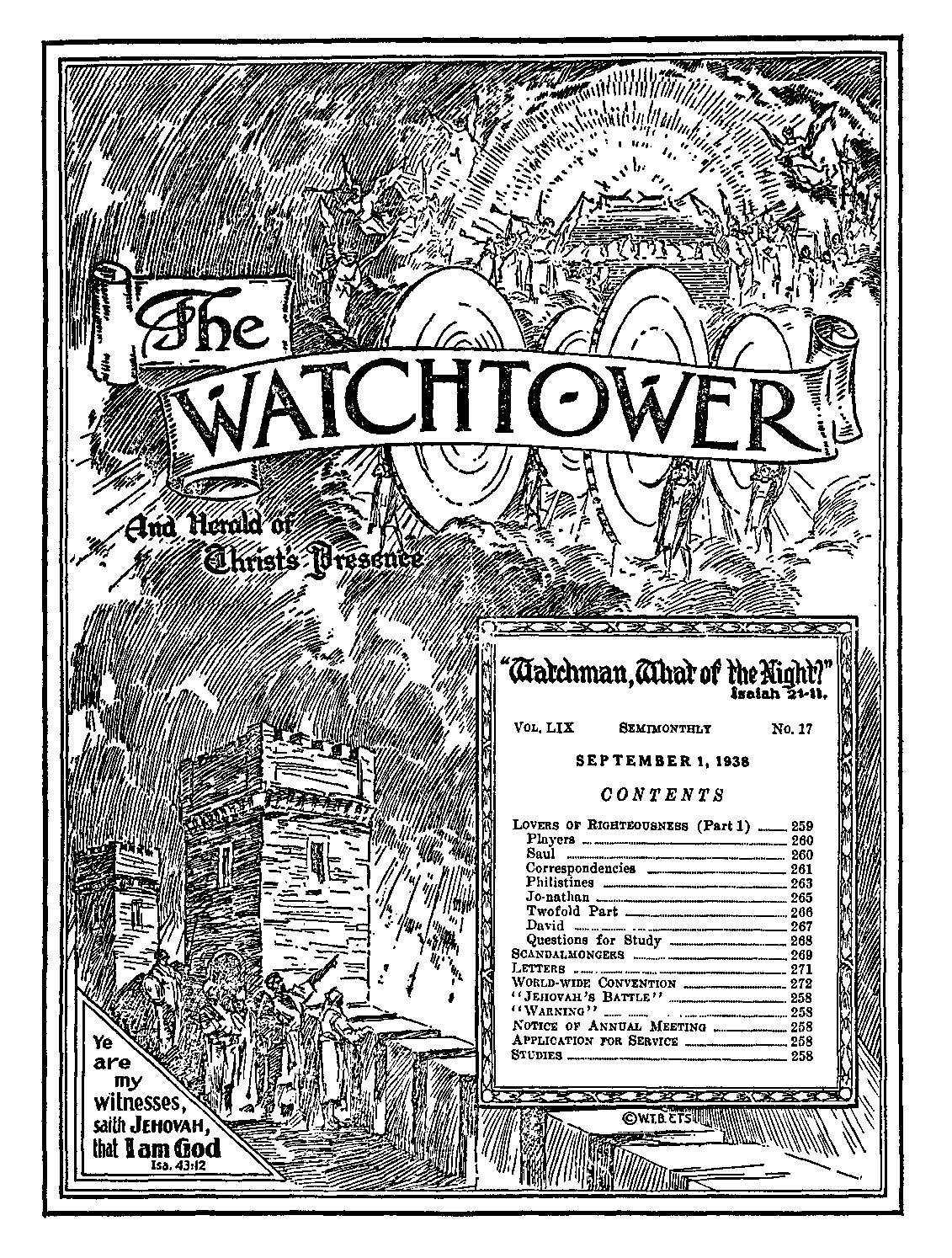
The Watchtower, September 1, 1938
Download: PDF — The Watchtower, September 1, 1938
“JEHOVAH’S BATTLE”
This testimony period, embracing October 1 to 9, is international and begins the new service year. It will introduce to the peoples the latest provision of the Lord, to wit, the new booklet Warning, and on a 5c contribution. During this period all publishers of the kingdom will specialize on placing this booklet alone, that the obtainers thereof may in turn give undivided attention to this concentrated message of warning concerning Jehovah's battle nigh at hand. Begin now to plan and arrange your affairs for a large participation in giving this warning testimony Those not under the supervision of a branch office should at once get in touch with our main office here and arrange for territory assignment, supplies, etc. We anticipate your report of activity and results with much pleasure.
“WARNING”
This new booklet, with cover design illustrating its title, combines under one cover the two recent public speeches of the Society’s president, the one at the Sydney (Australia) convention and the other at the Seattle (Washington) convention this year. The demand and the need for these speeches in print is world-wide, and elsewhere is announced the time of release of this booklet for distribution to the general public. Meantime get your personal copy, remitting 5c contribution therefor, for private study and to prepare yourself to in due time put it in the hands of others.
NOTICE OF ANNUAL MEETING
Pursuant to the provision of law and the charter of the Watch Tower Bible & Tract Society, notice is hereby given that the annual business meeting of the said Society will be held at Pittsburgh, North Side (formerly Allegheny), Pennsylvania, at ten o’clock a.m., Saturday, October 1, 1938, at which the usual annual business will be transacted.
There will be the triennial election of the officers of the Society. A proxy blank appears on page 253, August 15 issue.
APPLICATION FOR SERVICE
The Society desires to renew all applications for service at Brooklyn. Every consecrated person of the anointed or Jonadabs who is fully devoted to the Lord and anxious to be in the service of his organization will please send a postcard request to the Society for a questionnaire, which will be sent to you.
STUDIES
Quite frequently the one presiding at a study is not equipped to give a proper sum-up on a question. For this reason the questions should be confined to the paragraph under consideration and in every instance the paragraph should be last read as a sum up of the matter. This rule should bo followed in Watchtower studies and in all other studies of the books and booklets.
Vol. LIX
September 1, 1938
No. 17
LOVERS OF RIGHTEOUSNESS
PART 1
“For the righteous Lord loveth righteousness; his countenance doth behold the upright. ”—Ps. 11:7.
JEHOVAH is love; which means that he is wholly unselfish. He loves righteousness, and he loves his creatures that follow after righteousness. The foregoing text, according to Rotherham, reads: “For righteous is Jehovah; righteous acts he loveth, an upright one shall have vision of his face.” This rule of the Most High is a signboard pointing the way to life, and those who desire to live will give heed thereto and go accordingly. Jehovah God created the heaven and the earth: “The heavens declare his righteousness, and all the people [who live everlastingly] see his glory.” (Ps. 97:6) “According to thy name, O God, so is thy praise unto the ends of the earth; thy right hand is full of righteousness.”—Ps. 48:10.
2 Jehovah God is the source of life, and he is the Giver of life to all his obedient creatures. (Prov. 12:28) Only those who love righteousness shall be blessed with life. “The righteous shall inherit the land, and dwell therein for ever. The mouth of the righteous speaketh wisdom, and his tongue talketh of judgment. The law of his God is in his heart; none of his steps shall slide.” (Ps. 37:29-31) The wicked are exactly opposite to the righteous, and God will recompense each according to the way he goes. “The eyes of the Lord are upon the righteous, and his ears are open unto their cry. The face of the Lord is against them that do evil, to cut off the remembrance of them from the earth.” (Ps. 34:15,16) Jehovah God administers life to his creatures through his beloved Son, of whom it is written: “Thou lovest righteousness, and hatest wickedness; therefore God, thy God, hath anointed thee with the oil of gladness above thy fellows.”—Ps. 45: 7.
3 A lover of righteousness is one who is unselfishly devoted to that which is right and just. The one who possesses such quality is not turned away from the path of rectitude, justice and right because of fleshly relationship, either by affinity or by consanguinity; and regardless of who the creature is, if one secs another is right and doing the right thing toward his fellow creatures, then that lover of righteousness stands by the side of the one who is right. A lover of righteousness does not attempt to justify the action of another because that other is related to him or because he may feel under obligation to one who seeks his approval. A lover of righteousness takes the side of the one who is right, regardless of who the creature is or what is his position, and no other course is pleasing to the Lord. Jehovah extends his favor to those who love righteousness; and because his beloved Son ‘loves righteousness and hates iniquity’ (or wickedness), God has placed him in the most exalted position. The Logos, that is, Jesus, has always been wholly on the side of Jehovah God, and for this reason ‘God anointed him with the oil of gladness above his fellows’. Thus he is placed in the highest official position to represent the Most High, It must be assumed, therefore, that when Lucifer rebelled against God, the Logos was in the lead of all those who stood firmly on the side of Jehovah, because that was the right side and he knew none other. The Lord Jesus is the great lover of righteousness amongst all the creatures. All who please Jehovah God must be put to the test, and, if receiving God’s approval, they must show that they are lovers of righteousness because God is right and righteous. “The judgments of the Lord [Jehovah] are true and righteous altogether.” (Ps. 19:9) “Righteous art thou, O Jehovah, and equitable are thy regulations. Thou hast righteously commanded thy testimonies, yea in great faithfulness. Thy righteousness is righteous to times age-abiding, and thy law is truth.”—Ps. 119:137,138,142, Roth.
4 When a creature demonstrates by his course of action that he is a lover of righteousness, then we may know that Jehovah God loves that creature and will show him his favor; as it is written: “He [Jehovah] loveth righteousness and justice.” (Ps. 33:5, Roth. Psalms) Jehovah reveals himself and his purpose to those who love righteousness and who hate wickedness and who so prove themselves by diligently doing the will of God. “Light is sown for the righteous, and gladness for the upright in heart.” (Ps. 97:11) It is only those who follow the course of righteousness that receive the benefit of God’s revealed light. The Scriptures uniformly show that it is the righteous who gain knowledge and understanding thereof, and the facts fully corroborate the Scriptures. It is written that ‘righteousness exalteth the nation’. (Prov. 14:34) There is but one nation in existence or that ever did exist that fulfills this scripture, and that nation is composed of God’s people under Christ Jesus. “The righteous shall flourish like the palm tree; he shall grow like a cedar in Lebanon. Those that be planted in the house of the Lord shall flourish in the courts of our God.” (Ps. 92:12,13) The man who was once enlightened concerning Jehovah God and his purposes, and who then turns away from God, forsaking righteousness, shall for ever perish. “Jehovah is righteous, he hath cut asunder the cords of the lawless. Let all who hate Zion [Jehovah’s holy nation, the Christ, made up of Jesus and the anointed, who are members of his body] be ashamed and shrink back.”—Ps. 129:4,5, Roth.
5 The foregoing scriptures unanimously announce the fixed and unchangeable rules or laws of Jehovah God. Such God has caused to be recorded as a guide for those creatures who love what is right and seek the right way. Jehovah’s organization must be guided by such rules or laws. To further enable his meek creatures to know and to understand his purpose, and in harmony with his law, Jehovah God long ago caused various prophetic pictures or dramas to be made and recorded, and now in these latter days God is making known to his teachable creatures the meaning of those prophetic pictures. In this and subsequent issues of The Watchtower the prophetic picture concerning Jonathan and David is considered. This is certain to enlighten and encourage all those who love God and seek to serve him. Jonathan was the lover companion of David, and his love for David began when Jonathan first heard David speak before the king of Israel: “And it came to pass, when he had made an end of speaking unto Saul, that the soul of Jonathan was knit with the soul of David; and Jonathan loved him as his own soul.”—1 Sam. 18:1.
6 As a guide to enable the careful student to gain a clear perception of the prophetic picture, note the following:
PLAYERS
7 The chief players in this prophetic picture are, to wit: Saul, the first king of Israel; Jonathan his son; and David, whom God made king over Israel. The prophetic picture clearly shows that Saul pictured chiefly the “man of sin”, “the son of perdition,” once enlightened, and who professes to be a servant of God and who becomes unfaithful. Saul therefore pictures the hypocritical clergy, who carry on a racket, together with the “evil servant”, and which combination constitutes the “man of sin”, “the son of perdition.”
8 Jonathan, the son of Saul, pictures those faithful servants of God who were true lovers of righteousness and whom the Scriptures name as from Abel to John the Baptist; and also pictures the present-day people of good will toward God and Christ, which people constitute the “other sheep”, the “great multitude”, and all of which shall be a part of Jehovah’s glorious organization.
9 David played a part picturing particularly Christ Jesus, the anointed King of Jehovah, and also members of the body of Christ, including the remnant now on the earth, who are anointed and who are doing the will of Jehovah God.
10 While those three named were the principal players, others took a part in that prophetic picture and played their respective parts and foreshadowed those today who are involved in the unfolding of what concerns the people who have a desire to live and serve Jehovah. It seems to be God’s due time to make known his purpose in making and recording this prophetic picture; and since it is for the aid and comfort of his people, it is spiritual food for those now on earth who love righteousness. Seeing that Jehovah caused this picture to be made, and the details thereof to be recorded, it behooves us to examine the details of the picture, giving careful consideration to the surrounding circumstances.
SAUL
11 Because of the wicked crowd whom Saul foreshadowed, and the part that these wicked ones have played in their professed service of God and in the religious affairs of the world, it seems proper to consider the more minute details pertaining to Saul. He was the first king of Israel. The name Saul means “asked for”, and his name certainly fits the facts, because the Israelites asked for a king and their asking was not pleasing to Jehovah. That their asking displeased Jehovah is shown by the following: “But the thing displeased Samuel, when they said, Give us a king to judge us. And Samuel prayed unto the Lord. And the Lord said unto Samuel, Hearken unto the voice of the people in all that they say unto thee; for they have not rejected thee, but they have rejected me, that I should not reign over them.”— 1 Sam. 8: 6, 7.
12 Then Samuel told the people what God had instructed him to tell them, and amongst other things was this: “And he said, This will be the manner of the king that shall reign over you: He will take your sons, and appoint them for himself, for his chariots, and to be his horsemen; and some shall run before his chariots. And he will appoint him captains over thousands, and captains over fifties, and will set them to ear his ground, and to reap his harvest, and to make his instruments of war, and instruments of his chariots.”—1 Sam. 8:11,12.
13 Furthermore, Samuel, at the direction of the Lord, said to the people of Israel concerning the king that they had asked for: “He will take the tenth of your sheep; and ye shall be his servants. And ye shall cry out in that day because of your king which ye shall have chosen you, and the Lord will not hear you in that day.”—1 Sam. 8:17,18.
14 The people still desired a king because they wanted to be like the nations round about them, and further Samuel said to them: “Now therefore behold the king whom ye have chosen, and whom ye have desired! and, behold, the Lord hath set a king over you. If ye will fear the Lord, and serve him, and obey his voice, and not rebel against the commandment of the Lord, then shall both ye, and also the king that reigneth over you, continue following the Lord your God: but if ye will not obey the voice of the Lord, but rebel against the commandment of the Lord, then shall the hand of the Lord be against you, as it was against your fathers.” “Is it not wheat harvest to day? I will call unto the Lord, and he shall send thunder and rain; that ye may perceive and see that your wickedness is great, which ye have done in the sight of the Lord, in asking you a king.” “And all the people said unto Samuel, Pray for thy servants unto the Lord thy God, that we die not; for we have added unto all our sins this evil, to ask us a king.”—1 Sam. 12:13-15,17,19.
15 Saul’s home was at Gibeah, and because of his association therewith it became known as “Gibeah of Saul”. (1 Sam. 10:26; 11:4) Gibeah had a bad reputation for unchastity because of the practice of many there of the crime of homosexuality, or sodomy, and also by reason of the crime committed by the men of Gibeah against the Levite and his concubine.—Judg. 19:12-30; 20:1-43.
16 It was an act of disobedience and lack of faith in God for the Israelites to ask for a human king as ruler over them, and as a substitute for Jehovah, their great invisible King. Thus the Israelites were conforming themselves to Satan’s way. (1 Sam. 8:5-19) They had yielded to the wily influence of the Devil and turned away from God and from their covenant. Samuel, the prophet, anointed Saul, and this was done at God’s command, manifestly that the Israelites might have an opportunity to see their folly. (1 Sam. 10:1) Saul, therefore, was a “messiah” or “christ”, that is to say, he was an anointed one. For this reason David called him “the Lord’s anointed” and refused to do Saul physical injury, and David showed great respect for the office that Saul filled, even after Saul had committed great wickedness.—1 Sam. 24: 6-10; 26:9, 11,16, 23; 2 Sam. 1:14-16.
17 At the commencement of the reign of Saul he had a son old enough to command a division of his army, and the name of that son was Jonathan. Since there are sixteen different Jonathans mentioned in the Bible, attention is called to the fact that the Jonathan involved in the prophetic picture here examined was the son of Saul of Gibeah of the land of Benjamin. Jonathan must have been at least twenty years of age at the beginning of Saul’s reign, and Saul was probably no younger than thirty-five or forty years of age. Saul was rejected of God because in the second year of his reign he ran ahead of God and disobeyed his commandments. (1 Sam. 13:1,14,15; 2 Sam. 7:15) However, it appeared that God put Saul on a period of probation, which probation ended when he willfully disobeyed God’s commandment with respect to the disposal of the Amalekites. (1 Sam. 15:1-29) For his own name’s sake, however, God did not forsake his covenant people Israel because of Saul’s sin. God’s name was called upon that people with whom he had made a covenant, and God had respect to his name. Saul reigned for forty years, and then Jehovah’s judgment previously written against him was executed.—Acts 13: 21, 22.
18 The life and action of Saul pictured whom? From the Scriptures and the well-known facts he clearly pictured the unfaithful clergy or leaders in the pretended or professed worship of God, together with those who have learned of the Lord and who form the “evil servant” class; and this combination constitutes the “man of sin”, “the son of perdition.” —2 Thess. 2:3-8.
19 As a class the clergy claim to be spiritual and that they are the anointed ones of God to bring in and set up God’s kingdom, and to save the people. God never made any provision for the clergy, nor did he appoint them; but men set them up as a class, and they rule because the people wish it so. The “evil servant” class (Matt. 24:48-51) is made up of those persons consecrated to the Lord and begotten of the spirit and once in line for the kingdom. They made a covenant to do the will of Jehovah God and claimed to be God’s chosen people, yet they became unfaithful, and the Lord Jesus designates such as the “evil servant”.
CORRESPONDENCIES
20 That a just comparison may be had there is set out below in the paragraph first numbered that which relates to Saul, and in the immediately following paragraph containing the same number is set forth that which relates to the “man of sin”, “the son of perdition.” Reading these two paragraphs, and considering them together, it can be seen how well the facts, well known, and which have come to pass, fit the picture, to wit:
(1) Saul was an Israelite after the flesh.
(1) The clergy and “evil servant” class claim to be spiritual Israelites.
(2) Saul was asked for as king by the faithless and disobedient people, who, so doing, thereby rejected God.
(2) The clergy were asked for or desired as visible spiritual rulers by the professed Christians “having itching ears”, and desired to follow the traditions of men. (2 Tim. 4:3,4) God let the people have their own way and said: “My people love to have it so.” —Jer. 5: 31.
(3) Saul was sought for by the people, due to the worldly, political pressure induced by the Devil because the Israelites were threatened with an invasion by the Ammonites and the desire of Israel was to be like other nations of Satan’s organization and hence to have a king.—1 Sam. 12:12.
(3) The clergy and others, such as the "elective elders” and those who have that spirit, were set up, due to the worldly, political influence that existed in the "churches” and the methods that were carried on in the congregations in order to gain political power amongst the political rulers of the nations, and such ambition was induced by Satan’s influence. This was done in order to have an imposing Hierarchy that would correspond with the heathen priestcraft and which Hierarchy would embrace the political power of the world and make the clergy appear necessary and far more important. The “evil servant” class manifest the same spirit.
(4) Saul became king, and was ‘given in God’s anger’. (Hos. 13:11) Jehovah permitted the Israelites to have their way, for a purpose.
(4) The clergy, the “man of sin”, were permitted to be established in the congregations of "Christendom” ; in the pretended “Christian” organizations, to the displeasure of God, the clergy professed Jehovah’s name, but instead they have brought reproach to his name.
(5) Although Saul was notified in advance of his appointment, yet he was not responsive, but had to be pushed forward at the time of the public confirmation of his appointment. (1 Sam. 10:1,17-27) He was not prompt in organizing the kingdom, but waited till some national danger threatened.—1 Sam. 10:24 - 26; 11:5-15.
(5) His counterpart (“the man of sin”) manifested the mock modesty to be seen of men. They have been unwilling to assume the real responsibilities of the true kingdom interest, and have not been prompt in obeying God’s commandments concerning the kingdom, and have been indifferent and inefficient respecting the kingdom interests. — Matt. 25:14,15,18, 24-30; Luke 19:12,13,20-24.
(6) Saul failed to consult the ark of God’s covenant (1 Chron. 13:3) : nor did he consult Samuel the prophet, but ran ahead of God and his prophet Samuel.—1 Sam. 11:6-15; 13:5-16; 14:35-37.
(6) His counterpart consulted not the Bible, the Word of God, nor considered God’s will nor the spirit of the Lord in their own plans, programs and actions, though they have uttered audibly many prayers with the pretense of being guided by the Lord, but, in fact, to be admired of men. They have run ahead of God and tried to do it their own way.
(7) Saul thrust his rash will upon the Israelites in a time of need, with sin resulting to them, compelling them to yield to an unreasonable rule. (1 Sam. 14:24-34) He spared certain things of the Amalekites and raised no objection when the Israelites broke God’s command.—1 Sam. 15: 7-9,15, 24.
(7) His counterpart, ignoring God’s will and carrying out their own will, forced the people to refrain from certain things, with sin resulting on the part of the people. They force the people into political
practice to advance their own selfish interest. They have compromised and spared one another in order to have interdenominational peace in what they call “good neighbor policy”. They have ignored the will and commandment of God and satisfied their own personal ambition.
(8) Saul was unreliable, selfish, disobedient, and one who feared men. (1 Sam. 15:1-31) He desired honor of men and to shine before men.
(8) His counterpart has displayed the same spirit or traits toward God and his servants. They are men- pleasers, always justifying themselves, eager for human honor, with itching ears, using their voice and mannerism and dress to attract the attention and praise of men without regard to any effort to please God.—Eph. 6:6; Col. 3:22; Luke 16:14,15; John 5:43,44; 8:44.
(9) Saul slaughtered the high priest, Ahimelech, and his fellow priests (1 Sam. 22: 9-21), because they innocently aided God’s anointed one, David, when fleeing from Saul, who sought to kill David; and this he did to advance his own selfish interest.- 1 Sam. 21:1-10.
(3) Saul’s counterpart have killed or caused to be killed the true followers of Christ Jesus, Jehovah's witnesses, who are in line for the royal priesthood; and this they have done because these true priests of God and Christ have rendered help to their brother Christians and others seeking to know God’s way, when these Christians were being persecuted by the religious clergy and their allies. (Rev. 18:24; 17: 6) The "man of sin” has persecuted the true followers of Christ because of their faithfulness to God.
(10) Saul made life and activity uncertain even for God’s prophet Samuel.—1 Sam. 16:1,2; 25:1; 28:3.
(10) The counterpart of that wicked king make it dangerous to the life of Jehovah’s witnesses because these faithful witnesses declare the prophecies of God’s Word and publicly announce who is the truly anointed One of Jehovah.
(11) Saul violated Israel’s sworn covenant with the Gibeonites in that he slaughtered many of them to make a self-display of national and racial zeal.— 2 Sam. 21:1-6.
(11) His counterpart, "the man of sin,” acts against the life interest of the modern-day Gibeonites, to wit, the great multitude or people of good will, by opposing the proclamation of the life-giving truth to the great multitude, which Jehovah’s witnesses bring to them, even going so far as to kill some of the people of good will that unite with Jehovah’s witnesses in proclaiming the truth.
(12) Saul rejected David, the one whom God had anointed to be king over Israel, and this Saul did for selfish reasons.—1 Sam. 20:30,31; 24:16-22.
(12) Saul’s counterpart, “the man of sin,” rejects God’s anointed King, the Stone laid in Zion, and instead prefer a human organization as a substitute for God’s anointed One; and also reject God’s witnesses, who are anointed with his spirit to be joint-heirs with Christ Jesus.
(13) Saul cruelly and wickedly persecuted David and formed conspiracies to have David put to death. —1 Sam. 18:14-17.
(13) The “man of sin” forms conspiracies to have Jehovah’s witnesses destroyed, and prosecutes cruel conspiracies to accomplish his ultraselfish and malicious purposes.
(14) Saul took away David’s open freedom of action and in effect made him a prisoner or an exile by forcing David into hide-outs.—1 Sam. 24:1-8; Psalm 142.
(14) Saul’s counterpart have made Jehovah’s faithful remnant prisoners, and this they did especially during the World War, and formed a conspiracy to have them put to death, opposed their release, and continue to persecute God’s anointed servants.—Isa. 42:7; 49:9; Pss. 79:11; 102:19,20.
(15) Saul was suspicious, treacherous, and held malicious envy toward David, who had God’s approval and his spirit, and such envy was carried on to the end.—1 Sam. 18: 6-29; 19:1, 2, 8-24; 20: 30-33.
(15) The “man of sin” clergy and the “evil servant” are suspicious, treacherous, envious, and malicious toward Jehovah’s witnesses because the latter have Jehovah’s spirit and his approval.
(16) Saul was unrepentant and proud, trying to soothe his worries and his ill-feeling by music rather than by humbly seeking the right means to remove such wrong spirit.—1 Sam. 16:15-17; 19: 9; 28: 6, 7.
(16) His counterpart are likewise unrepentant and full of pride, and make a great show in their effort to remove the symptoms of their troubles, indulging in the pleasing things of this world rather than humbly seeking the cure and the removal of their disfavor in God’s sight.
(17) Saul was rejected from being king over Israel.—1 Sam. 13:13,14.
(17) The clergy and “evil servant” have been rejected of the Lord, and all kingdom privileges taken away from them, and their place appointed with all other hypocrites.—Matt. 21: 42, 43; 24: 50, 51.
(18) Saul was denied the kingdom covenant, which would have kept the kingdom in his family or house, the kingdom covenant being made with David.—1 Sam. 13:13,14; 20:30,31; Ps. 89:27-37.
(18) The “man of sin” class have never been taken into the covenant for Jehovah’s kingdom under Christ, even though they pretended to represent Christ, and whereas after 1918 God’s faithful remnant or witnesses were taken into such covenant of faithfulness and obedience for the kingdom.—Luke 22: 28-30.
(19) Saul was cut off from communication with Jehovah God, was abandoned to Satan, and sought the aid of the demons.—1 Sam. 28: 5, 6,15 ; 16:14,15.
(19) The “man of sin”, clergy class and “evil servant” are denied communion with or relationship to
the Lord because they are friends of the Devil’s world, which is at enmity with God, and they have turned to Satan, and God has turned them over to Satan’s destruction. They seek the aid of demons.—1 Cor. 5:5; 1 Tim. 1:20; Ezek. 7:26; Amos 8:11.
(20) Saul turned to devilism and died unfaithful as a rebel against the Lord, even though he fought against Israel’s enemies at the last.—1 Sam. 15: 22, 23; 30: 3-25; 31:1-13.
(20) The “man of sin” class have given heed to “seducing spirits and doctrines of demons”, ignored God’s Word, relied upon tradition, and maintained a form of godliness, but, denying the power thereof, are given over to Devil religion and disregard God’s commandments. Although claiming to be opposed to the Devil, they communicate with the wicked spirits and submit themselves to Devil practice and forms. —1 Tim. 4:1; 2 Tim. 3:5-9.
(21) Saul declared himself a suicide. — 1 Sam. 31: 3-5; 2 Sam. 1:1-10.
(21) Likewise the clergy, the “man of sin” class, seeing the handwriting on the wall, now engage with other elements of the Devil’s organization to “rule or ruin”, and thereby announce that they are deliberately committing suicide in their effort to escape humiliation at the hands of those whom they describe as “uncircumcised”.—1 Sam. 31:4.
(22) Saul was ‘slain by the Lord’ at the hands of the Lord’s executioner.—1 Chron. 10:13,14.
(22) Saul’s counterpart will be destroyed by Jehovah God by and through Christ Jesus, the great Executioner of Jehovah, at Armageddon.
(23) Saul was a father in Israel and one of “the elders”, and even addressed the Lord’s anointed as “my son David”. —1 Sam. 14:49; 15:30; 24:16; 26:17,21,25.
(23) The clergy, and specifically the Roman Catholic Hierarchy, assume the role of spiritual fathers of “Christendom”, and demand that they all be addressed as “Father”, and lined up with such are many of those who have been “elective elders” amongst the Lord’s people and who have willingly become a part of the “evil servant” class.
21 These correspondencies clearly show that God has foretold the course of the clergy, the “evil servant” class, and those who practice religion for a selfish purpose, and has foretold the destiny of such. This comparison will enable the student to more carefully understand this prophetic picture as progress is made.
PHILISTINES
22 During the reign of Saul the Philistines fought against the Israelites. The Israelites were God’s covenant people, and Saul was their king, whom they had chosen. The opposing Philistines, warring against the covenant people of God, pictured those today who are against everything and everyone that claims to stand for God, whether that claim is false, as Saul’s and that of his unfaithful house, or one is really devoted to God, as was the case of Jonathan and David. The modern-day opposers, whom the Philistines at this point in the prophecy picture, are antireligious, anti-God and anti-Kingdom, such as the Fascists, Communists and anarchists. At this point Saul pictured the religionists who rule under the leadership of the Roman Catholic Hierarchy, and which take the lead in all religions of the present time. Saul was against David, God’s anointed king, and did not fight for the advancement of God’s kingdom. Likewise the modern-day Saul class do not fight for the honor and glory of God’s kingdom under Christ, but fight to advance their own organization and for selfish preservation, that they may maintain themselves in the position of ecclesiastics, which enables them to obtain political favor and exercise political power, and to carry on their racket. Like Saul, they are ultra-selfish. The Roman Catholic Hierarchy and allied religionists are greedy for material wealth and power, and hold on to everything and try to bring all things within their own organization. The picture, therefore, shows that the religionists, under the leadership of the Roman Catholic Hierarchy, fight against the modern-day Philistines, Communists and anarchists, and particularly will this be true at the beginning of Armageddon.
23 At Gilboa Saul fought the Philistines and was defeated. Likewise, as the picture discloses, the religionists, at the beginning of Armageddon, will fight against the modern-day Philistines and will suffer sore defeat because it is the day of Jehovah for the execution of his judgment against the enemy, even as at Gilboa God permitted the enemy to express his judgment against Saul.
24 The modern-day Philistines, that is to say, the Communists and anarchists in particular and suchlike radical elements, are against Jehovah’s witnesses, who truly represent God’s kingdom, and they fight against Jehovah’s witnesses, even as the ancient Philistines fought against David, God’s anointed king, and against Jonathan, who stood by David. Today Jehovah’s witnesses, prosecuting their part of the warfare against the anti-Kingdom, anti-God crowd, do so because they are for Jehovah and his King and for his kingdom under Christ Jesus. It is that kingdom that the modern-day Philistines, that is to say, the religionists, bitterly oppose because the kingdom takes away their own power and standing. As the battle of Gilboa drew near it appeared that David was in the camp of the Philistines and it looked as though he might be allied with them against Saul; but in truth he was not allied against Saul. Today as the battle of Armageddon draws near, it appears to many that Jehovah’s witnesses are in the camp of the antiGod crowd, and they are accused of being in that crowd because Jehovah’s witnesses are against religion, which dishonors God’s holy name. Jehovah’s witnesses have nothing in common with the Communists or any other organization amongst men, but the Roman Catholic Hierarchy, leading in religious opposition to the kingdom, do wrongfully charge that Jehovah’s witnesses are in league with the Communists, not because the Communists and Jehovah’s witnesses are both against the Roman Catholic Hierarchy, but for a far different reason. Communists are against all religions, because they are against Jehovah God and they think religion comes from him as they have been taught. Jehovah’s witnesses are against religion because they are for Jehovah God and they know that religion dishonors and reproaches Jehovah’s holy name. It is important to note that David did not fight against Israel at any time or even against his cruel enemy Saul to the aid of the Philistine army. Likewise Jehovah’s witnesses do not help the modern-day Philistines in their fight, nor do they use violence of any kind against the religionists, who were pictured by Saul. The campaign of Jehovah’s witnesses against religion is not carried on to aid the anti-God people, but Jehovah’s witnesses are engaged solely in declaring the truth of God’s Word, as set forth in the Bible, in order that the people of good will may be informed and that the stumbling-stones may be removed, which will enable all people who desire righteousness to find the way to God and to his kingdom.
25 Just why David was marching in the rear of one division of the Philistine army it is not necessary here to consider; but this fact certainly appears, that the Philistines for a time tolerated David because they thought to use him against the Israelites. Later they showed their hostility to David because they concluded that he was on the side of the Israelites, even though David and his men had separated themselves from Saul and his followers. (1 Sam. 29:1-11; 1 Chron. 12:19) It therefore definitely appears that the Philistines were against Jehovah’s anointed king, David, even as today they are against God’s anointed King, the Greater-than-David, Christ Jesus. The anti-God forces today probably think that Jehovah’s witnesses are in the same class with them, because they do not distinguish between religion and the Word of God. The modern Philistines, the Communists, and anarchists, classify Jehovah’s witnesses with religionists because they uphold the Bible and teach it. The Philistines showed that they were against God’s people, not only by fighting against Saul, but also in repeatedly assaulting and trying to unseat David, when he was made king over all Israel and when he was fully established at Jerusalem. (2 Sam. 5:17-25) That the Philistines were violently against God’s anointed king was demonstrated at the battles of Mount Perazim and Gibeon. (Isa. 28:21) Note now the facts at the present time, when the religionists, led by the Roman Catholic Hierarchy, are also against God and his kingdom and would run the earth in their own way and in full opposition to God’s anointed King, Christ Jesus. Therefore, today, we see in progress “God's strange work” of declaring the truth of and concerning his kingdom, and that his kingdom is against religionists. All who oppose Jehovah and his King and kingdom are classed as enemies, and therefore his “strange work” will be followed by God’s “strange act” in which all the opponents of his anointed King will be put to flight and ultimately destroyed. The “strange work” of God is to notify all persons that he is against the religionists as well as against all other opponents. His “strange act” is the destruction of all the opponents.
26 The picture made in ancient times, therefore, definitely shows that the religionists, led by the Roman Catholic Hierarchy, and all who are against Jehovah God and his kingdom, are anti-God and anti-Kingdom. Otherwise stated, there is an alliance on the part of the religionists who pretend to be for God with all those who openly oppose God and his kingdom, the purpose of which conspiracy or alliance is to destroy Jehovah’s witnesses. This supports the conclusion that after the destruction of the religious elements at Armageddon the others of Satan’s organization will continue to violently oppose all who are on the side of Jehovah and his King. Such enemies constitute the forces of Satan, lined up in full opposition to Jehovah’s organization. Jehovah’s witnesses must therefore keep in mind that opposition to them and their work will continue until Jehovah, by and through Christ Jesus, smites the opponents at the battle of the great day of God Almighty. It is a well-known fact that in fulfillment of this prophetic picture the religionists, the Communists and the Nazis, and the Fascists, the professional political element and the lovers of money, are all against God and his King, Christ Jesus, and his witnesses in the earth. All this opposition is embraced within the statement of 'kings and rulers of the earth’, of whom God long ago caused this to be written: “The kings of the earth set themselves, and the rulers take counsel together, against the Lord, and against his anointed, saying, Let us break their bands asunder, and cast away their cords from us.” (Ps. 2:2, 3) The Lord now reveals to his people this line-up of the combined enemy against him and his witnesses, and this he does for their encouragement, comfort and hope.
JO-NATHAN
27 The part played by Jonathan, the son of Saul, is important, and therefore it is profitable to observe his life more particularly in detail. The name “Jonathan” (Jo-nathan) means “Jehovah given” or “Jehovah’s gift”. The latter part of his name, Nathan, is the Hebrew word from which is derived the name “Nethinim”, meaning “given ones”, that is, “given” for Jehovah’s service at the temple. (1 Chron. 9:2) This would indicate that Jonathan pictured those who serve at the temple. At his birth Saul would consider his son as a “gift” from God. He was, however, more particularly the gift of Jehovah to serve the persecuted king David, who pictured the Head of the temple. In line with this conclusion the modern-day Saul class, that is to say, the religionists, claim that the modern Jonathan class is a gift for them, to be exploited and bossed by the religionists. The name, however, marks the class whom Jonathan pictured as “Jehovah’s gift” to Christ Jesus, the Greater David, and to the “feet” members of Christ, the remnant now on the earth (John 17:1,2), therefore clearly showing that Jonathan pictured the “companions” of the anointed.
28 Jonathan was the first-born son of Saul and was therefore heir presumptive to the throne of Israel. (1 Chron. 8:33; 1 Sam. 20:30,31) Jonathan had descendants which continued in Israel. (1 Chron. 8:34-40) He was expert with the bow, and he may have learned from his grandfather Kish, whose name means “bow”, to efficiently and skillfully use the bow. (1 Sam. 18:4) Jonathan’s descendants appeared to have learned bowmanship from Jonathan. (1 Chron. 8:40) This may mean that the class here pictured by Jonathan shall join with others to shoot arrows into the opponents of God’s kingdom; and the facts show they are doing that very thing.—Jer. 50:14.
29 The “man of sin” class, particularly the Roman Catholic Hierarchy, say of those who support the Roman Catholic organization, "They are our spiritual children; they are children of the church and are therefore a gift to us, the Hierarchy.” The big moguls of the Hierarchy require their so-called “children of the church” to address the priests as “Father” and to address the, big mogul as “the Holy Father”. The religious clergymen claim to have been anointed and ordained of God to declare his message (that is, according to their own idea of the message). The Roman Catholic Hierarchy have, for a long time, ruled as kings and princes of spiritual Israel, as the apostle Paul says of such, “reigned as kings without us” (1 Cor. 4:8); and at the same time have exercised political and temporal power throughout “Christendom”, being really a political and commercial organization sailing under a religious name. The so-called “Protestant” clergy claim that they are representatives of God and Christ, and claim “spiritual children” in their organization as the gift of God to them, and thus the clergy put themselves above the laity and “strut their stuff” as important amongst creatures. Both the Catholic and the Protestant organizations pursue a similar course, but within those organizations there have been and are yet those honest and sincere men and women who desire righteousness, and who arc seeking the way to Zion. Pursuing this course, in due time they shall find the “highway” (Isa. 35: 8), because many of the great multitude will doubtless come from these religious organizations and take their stand on the side of God and his kingdom.
TWOFOLD PART
30 It appears that in the prophetic picture Jonathan played parts picturing two classes, both of whom serve Jehovah God and are ultimately brought into one fold under Christ Jesus the King. At the time Saul was made king his son Jonathan was a man of mature responsibility. Jonathan was then an army officer of high rank and, at the beginning of his father’s reign, a commander of a large portion of the army. (1 Sam. 13:1-3) David was born about the tenth year of Saul’s reign, and at the close of Saul’s reign David was about thirty years of age. (2 Sam. 5:4) Saul reigned forty years, and it therefore follows that Jonathan was about twenty-five to thirty years older than David. (Acts 13:21,22) The fact that Jonathan was much older than David, being probably more than fifty years of age when David began to reign as king, suggests that he, a part of the time in the picture, represented some persons who served God before the coming of Christ Jesus, the Greater- than-David. During the first part of Saul’s reign and before he knew David, Jonathan was doing faithful service in Israel, and therefore pictured that class of faithful men who served as witnesses of Jehovah God and who did exploits of faith before the coming, the death and the glorification of Christ Jesus; that is to say, Jonathan, in one part of this prophetic picture, represented the faithful men of old from Abel down to and including John the Baptist, which men are mentioned specifically in Hebrews the eleventh chapter.
31 Exploits of Jonathan, which demonstrated his faith in God, may well be noted here, to wit: As a captain in the army of Israel he smote the Philistine garrison at Geba. (1 Sam. 13:2,3) Humanly supported only by his armor-bearer companion who had great faith in God, and Jehovah God being his helper, Jonathan assaulted the Philistines at Bozez-Seneh, and there “turned to flight the armies of the aliens” (Heb. 11:34), the Lord performing a miracle after him. (1 Sam. 14:6,8-10,12,23,45) In these exploits he well pictured the faithful men of old who gave their lives as a testimony to God and his coming kingdom.
32 Jonathan put his life in danger at his father’s hand by violating Saul’s unreasonable oath, which oath was hampering the Israelites in their war against the Philistines. Because Jonathan had violated the foolish oath of Saul his father, Saul would have had Jonathan slain, but the people rescued Jonathan and exonerated him. (1 Sam. 14:27-45) Likewise before the coming of Christ Jesus the faithful men of old, who were witnesses of Jehovah, were put in peril of their lives by enemies of God, like Saul, and under the circumstances proved their integrity to God. It appears, therefore, that Jonathan pictured the faithful martyrs who preceded the day of the coming of the Lord Jesus, and whom the Lord, in due time, will “make princes in all the earth”.—Ps. 45:16.
33 Furthermore, Jonathan pictured another company, after he met David and knew him. Note now that Jonathan saw that David was right and therefore he took David’s side; and hence he would picture and did picture an earthly class, to wit, the people of good will, who see Jehovah’s witnesses are right, who take their side, and who ultimately go to make up the great multitude. Particularly after 1922 there appeared an earthly class who saw that Jehovah’s witnesses were right, and they showed then, and continue to show, their faith in Jehovah God and his King, and recognize Jehovah’s witnesses as the servants of God, and of his King, and therefore they take the side of Christ Jesus and his followers, even as the faithful men of old did before the coming of Christ. Jonathan, it is observed, displayed great faith in God, before and after he met and knew David, and thus he well appears to picture the faithful men who preceded the coming of the Lord Jesus and the faithful men who follow the gathering of the temple company, and who constitute the “other sheep” of the Lord.
34 Jonathan’s being much older than David agrees with the fact now known to God’s people, that the earthly company of God’s servants began before the coming of Christ Jesus. Although the faithful men of old were witnesses for Jehovah before the coming of Christ Jesus, they are secondary in point of being perfected, their perfection waiting until after the spiritual class is selected and made perfect. (Heb. 11: 39,40) Jonathan, continuing to show his faith in God and also his devotion to David, shows that he pictured another earthly class that stands on the side of God and shows great faith in God and his King, Christ Jesus, and that this latter class appear after the second coming of the Lord Jesus and his appearing at the temple. In this, therefore, Jonathan pictured those “other sheep”, or the great multitude, that are gathered to Jehovah under Christ.
35 Jonathan pictured an earthly, and not a spiritual class. He was an Israelite, but he lacked two things so far as picturing a spiritual class is concerned. Jonathan was neither directly nor through his father Saul in a covenant for the kingship or rulership of Israel. He was never anointed to be king of Israel. The spiritual Israelites are taken into the covenant for the kingdom and are in line for the kingdom. Spiritual Israelites are anointed for membership in the royal house. Jehovah definitely eliminated Jonathan from the kingdom, but for no fault of Jonathan’s, and such elimination occurred about eight years before David was born, and when Saul performed the foolish act; concerning which it is written: “And Samuel said to Saul, Thou hast done foolishly; thou hast not kept the commandment of the Lord thy God, which he commanded thee; for now would the Lord have established thy kingdom upon Israel for ever. But now thy kingdom shall not continue: the Lord hath sought him a man after his own heart, and the Lord hath commanded him to be captain over his people, because thou hast not kept that which the Lord commanded thee.” (1 Sam. 13:13,14) Although for a time Jonathan appeared to be heir presumptive to the throne of Israel, yet he never came into possession of it, and was never even anointed for it. This shows, according to the picture and to the facts, that the class whom Jonathan foreshadowed is an earthly class and can never enter into heaven or the kingdom of heaven. Likewise there have been many persons of good will who sought God and his kingdom through religious organizations, and who appear to be in line for the kingdom, or for a heavenly home, but who by reason of the wrongful conduct of the Saul class, to wit, the clergy or “man of sin” class, are hindered from finding the way to the kingdom of heaven; even as Jesus said: “But woe unto you, scribes and Pharisees, hypocrites! for ye shut up the kingdom of heaven against men; for ye neither go in yourselves, neither suffer ye them that are entering to go in.” (Matt. 23:13) “Woe unto you, lawyers! for ye have taken away the key of knowledge; ye entered not in yourselves, and them that were entering in ye hindered.” —Luke 11: 52.
36 Now God’s time has come when those people of good will, and who are associated with the religious organizations and have been kept in their prisons, escape from such organizations and seek the way leading to Zion. They go about learning from Jehovah’s witnesses the truth and, finding this way, they go with rejoicing to God’s organization. When they see and appreciate Christ his King and that his kingdom is at hand, they see that which is the right way; and being desirous of doing right, and hence lovers of righteousness and haters of iniquity, the Lord opens the way for them, and they find safety in his organization. Jonathan therefore clearly appears to picture (1) the faithful prophets of old from Abel to John the Baptist, the last prophet; and (2) the people of good will, the “other sheep”, whom the Lord gathers unto himself after he assembles his faithful to the temple and then makes the “other sheep” ultimately all of one fold.
DAVID
37 The important one who appears in this drama or prophetic picture and played his part was David, whose name means “Beloved”, and who pictured Christ Jesus, the beloved Son of God. David was an Israelite of the tribe of Judah and of the town of Bethlehem The office which David filled, and therefore David, the one who filled it, was determined upon before David was conceived and born, and his selection as king was in fulfillment of Genesis 49:10: “The sceptre shall not depart from Judah, nor a lawgiver from between his feet, until Shiloh come; and unto him shall the gathering of the people be.”
38 It appears that about eight years before David’s birth God rejected Saul and 'sought him a man after his own heart’, and after God had rejected Saul he raised up David, thus showing that David was determined upon by Jehovah long before his birth. (Acts 13:22) David was called to be king over Israel and was anointed of God. (1 Sam. 16:1,13) At that time Jonathan had not seen or known David.
39 As David the king was foretold, so also was Christ Jesus the king foretold long before his human birth and his later baptism and spiritual birth. Concerning Jesus Christ it is written that God raised him up as the Savior of the world. (Acts 13:23) Both David and the child Jesus were born at Bethlehem, even as God had caused to be prophesied. (Mie. 5:2; Matt. 2:1-6) The collective membership of Christ’s body, the church, was also foreknown and foreordained of God. (Eph. 1:3,4; Rom. 8:29,30; Gen 3:15) All of such, that is, Jesus and the members of his body, are spiritual Judeans, that is to say, praisers of Jehovah God, the true meaning of “Judeans”. Christ Jesus comes out of Bethlehem the greater “house of bread”, through which God gives life to all who believe on him. All these things were recorded aforetime for the encouragement, learning and hope of God’s people who are now on the earth, and God is graciously revealing it to them.
40 David was a son of Jesse, and at the time of his anointing by Samuel he was a stripling youth, the youngest of Jesse’s sons, and a lad of ruddy complexion. As compared with Saul, David was small of stature. (1 Sam. 10:23,24; 16:11-13; 17:55,56) As men look upon other men, David was the least likely to be chosen by men as king. (1 Sam. 16:6-12) He was a shepherd boy, who must meet deadly foes of the flock that he tended, and he was not a coward. He was a fighter from his youth up, “a mighty valiant man, and a man of war.” (1 Sam. 16:17,18; 17:34-37, 48-50) Jesus could not have been a sanctimonious, easy-going, non - resisting sissy, as the religionists would make him appear. Jesus was really the only “man” that has ever been on earth, and he was a he man and all man, that is to say, he was fearless, bold, strong, courageous, kind and loving. He was always for that which was right; and David pictured these very things. David’s father was named Jesse, and his name means “existing; living; extant”. Jesus Christ is the only begotten Son of the great life-giving One, Jehovah God, the King of Eternity. As the name “David” means “beloved”, so Christ Jesus is “the darling” or “beloved” of God, the everlasting Father. Like David, Jesus was a man after God’s own heart. Thus it is seen that the clergy have slandered and reproached the name of Christ Jesus in practically every possible way. They would make him appear as a spineless one, who would resist nothing, whereas the Scriptures describe him as one who loved righteousness and hated iniquity. Jesus was anointed with the spirit of God and immediately entered upon service as “the Good Shepherd”, looking to the welfare of the sheep that needed to be rescued from the Devil, the great lion and bear. David had to be a fighter to slay the lion, and to do this David pictured the Lord Jesus also. Jesus was a bold and valiant fighter for God’s cause, and his weapon of war was and is the truth, the Word, “the sword of the spirit,” which he wields to destroy the wicked and to uphold the lovers of righteousness. Jesus taught his disciples to be bold and fearless, and all of his true followers are bold and fearless of creatures. They fear God, and not man, and therefore they obey God, and not man.— Matt. 10: 26-28 ; Isa. 53:1-6.
41 Noting the further comparison of David and Jesus, it is to be observed that David was an accomplished musician, skilled in the use of the harp, which instrument was used in association with the prophets of God. (1 Sam. 10:5; 1 Chron. 25:3) David was a composer of poems, set to music, which he sung to the praise of Jehovah God. (Ps. 18:1-49) Jesus was skilled in the use of the “harp of God”, that is, the Word of God. “I will incline mine ear to a parable; I will open my dark saying upon the harp.”—Ps. 49:4; Matt. 13: 34, 35.
42 David was a prophet, who uttered prophecy as the spirit of God directed him. (2 Sam. 23:1, 2) Christ Jesus was and is the Great Prophet. (Luke 24:19; Acts 3: 22,23; Deut. 18:15-19) The remnant of Christ Jesus, to whom he has committed his testimony today, publish abroad the meaning of and the fulfillment of the prophecies, which Jehovah by Christ Jesus has opened upon the harp, which prophecies include those written by David.—Luke 20:42; 24: 44.
43 When Saul was under the influence of demons and was in a melancholy and a fit of madness, David was brought before him to make sweet music to soothe Saul’s madness. (1 Sam. 16:14-23) Because David was the servant of Jehovah the Devil took advantage of this occasion to have David killed, and therefore he induced Saul to bring David close by him so that he might kill the servant of God. (1 Sam. 18:9-12) Today the modern Saul class, the religious leaders, employ threats and boycott and other wrongful methods to induce Jehovah’s witnesses, the remnant of the devoted class on earth, to make music pleasing to the clergy that they might be soothed during their fits of madness. Therefore they would have “the harp of God”, his Word, used only to soothe their satanic madness; but Jehovah’s witnesses refuse to thus compromise with the Devil and his agents. Jehovah’s witnesses delight to play upon God’s harp, and they do so continuously, but their music does not remove the cause of the clergy’s madness. The wickedness increases in the clergymen as they hear the music from the Lord’s harp, and they seek the destruction of Jehovah’s witnesses, even as Saul sought to kill David. The Scriptural music played by Jehovah’s witnesses does not drive out the Devil’s spirit that controls the clergy of “Christendom”, but, instead, those clergymen use the occasion for a chance to kill off Jehovah’s witnesses. (1 Sam. 18: 9-12; 19: 9-11) It is vain to try to comfort the clergy as a class. As David avoided Saul, so now the faithful witnesses of Jehovah avoid modern clergymen, because they know they can do them no good. (1 Sam. 18:11) Although David was introduced into the court of the king, yet he was humble enough, when rebuffed, to return to his father’s house and continue to look after the sheep. (1 Sam. 17:14,15) Likewise today, in spite of the cruel opposition of the clergy, who rebuff Jehovah’s witnesses, these faithful witnesses continue to minister unto the sheep, who have been held in the corrals of the clergy, and upon whom God’s mercy is now bestowed.
44 At this point of the prophetic picture there appeared upon the stage a monstrosity, uttering defiance to the anointed king of Israel and to the Almighty God himself. What modern-day thing was pictured by that monstrosity ? In the picture a great issue was raised that had to be settled immediately. It is even so today.
(To be continued)
QUESTIONS FOR STUDY
1. What is meant by the statement that Jehovah is love? What and whom does he love and approve?
2. Compare the righteous and the wicked as to course of action, and the result of such course.
3. How is the lover of righteousness identified in his action toward his fellow creatures? How do the Scriptures emphasize the importance of love of righteousness?
4. How is love of righteousness related to approval and enlightenment by Jehovah?
5. How and for what purpose has Jehovah provided instruction and example for those who love righteousness and seek the right way?
6, 7. Who are the chief players in this prophetic picture? Whom did Saul picture, and how?
8. Who were pictured by Jonathan?
9. David pictured whom?
10. Why is it so important to carefully examine the details of the prophetic picture here under consideration?
11. Why is it well to consider here the more minute details pertaining to Saul? What significance is seen in his name?
12,13. What did Samuel, at the direction of Jehovah, tell the people concerning the king that they were seeking?
14,15. Would their having the king of their choice bring them good or evil?
16. Account for the Israelites’ seeking for a human king, and for God’s granting and anointing for them such king of their choice.
17. Who was Jonathan here mentioned? When and why was Saul rejected of God? Why did God prolong Saul’s reign after he had rejected Saul?
18,19. The life and action of Saul pictured whom? and in what facts is this seen?
20. As showing how fitting is the prophetic picture, compare that which relates to Saul and that relating to the “man of sin’’, “the son of perdition,” in that (1) Saul was an Israelite after the flesh. (2) Saul was asked for as king by a people who thereby rejected God. (3) Saul was sought for by a people seeking political advantage. (4) Saul became king though ‘given in God's anger’. (5) Saul, though notified of his appointment, was not responsive. (6) Saul did not seek divine guidance. (7) Saul thrust his rash will upon the Israelites and involved them in sin. (8) Saul was unreliable, and feared men and sought the honor of men. (9) Saul slaughtered the high priest and his fellow priests because, innocently, they aided David. (10) Saul made life and activity uncertain even for God’s prophet. (11) Saul violated Israel's covenant with the Gibeonites, slaying many of them, to make a self-display. (12) Saul selfishly rejected David, whom God had anointed to be king over Israel. (13) Saul persecuted David and conspired to have him slain. (14) Saul deprived David of freedom and in effect made him a prisoner. (15) Saul was envious and malicious toward David, who had God’s spirit and approval. (16) Saul was impenitent and proud, and sought comfort otherwise than from God. (17) Saul was rejected from being king over Israel. (18) Saul was denied the kingdom covenant. (19) Saul forfeited communication with Jehovah God. (20) Saul turned to devilism and remained a rebel against God though at the last he fought against Israel’s enemies. (21) Saul declared himself a suicide. (22) Saul was 'slain by the Lord’. (23) Saul was a father in Israel and one of “the elders”, even addressing the Lord’s anointed as “my son David”.
…