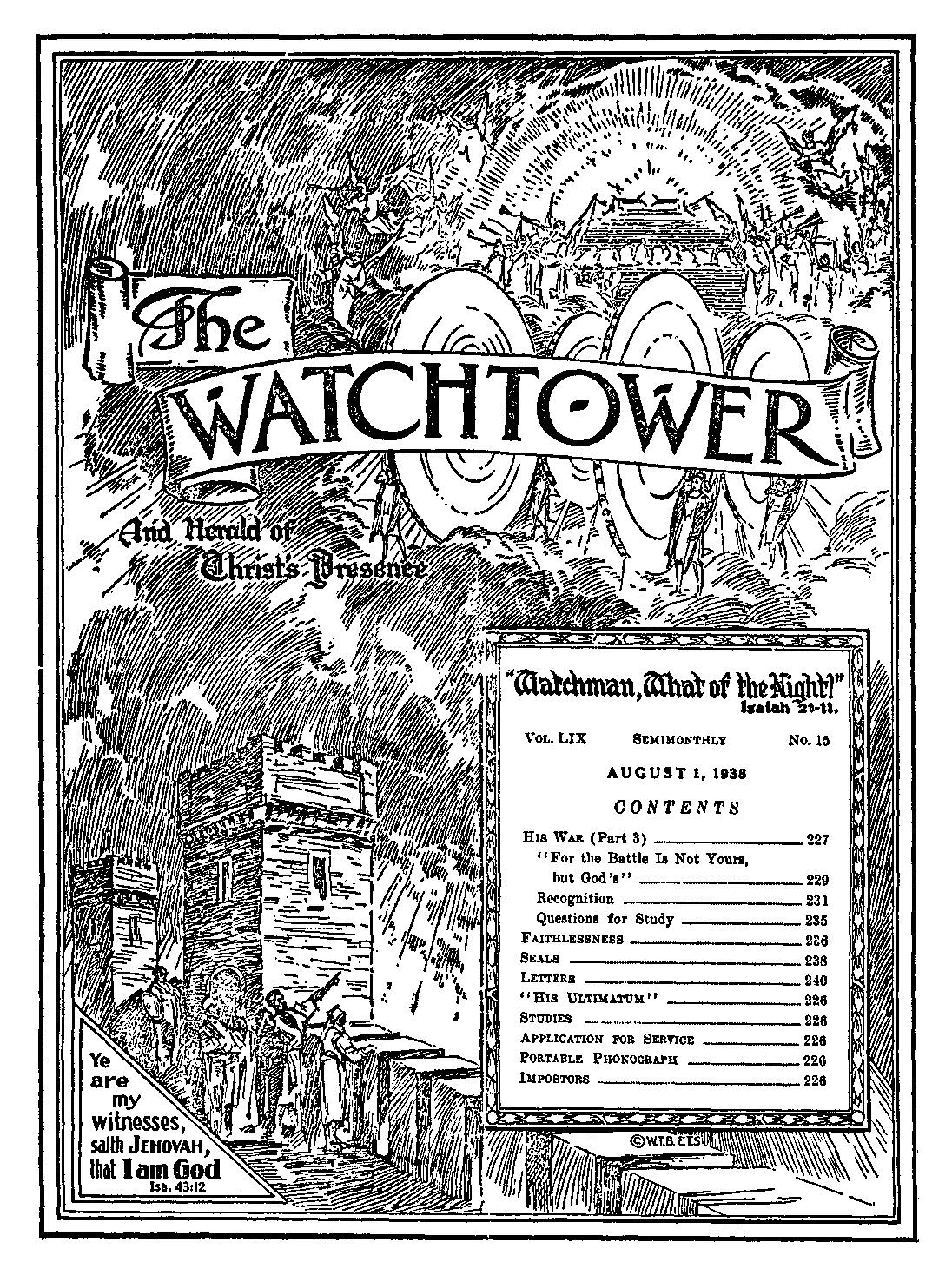
The Watchtower, August 1, 1938
Download: PDF — The Watchtower, August 1, 1938
“HIS ULTIMATUM"
The midsummer testimony period, August 6 to August 14 inclusive, is named “His Ultimatum’’. The message of the book Enemies is very fitting to this name, and during the period this book together with another bound book of the series will be offered to all on a 50c contribution. This period will also inaugurate the two-month special campaign, during which time there will be offered Enemies, Riches and four other bound books on a contribution of a dollar. See Informant tor details. This being the season generally for vacations from secular employment, many should be able to arrange their vacation to coincide with the testimony period, thereby to be able to devote extra time to delivering the Lord’s ultimatum before the fast approaching final battle. The season will be excellent for work in the rurals. Arrange for shipments of the needed literature as early as possible, besides making all other arrangements as to territory, etc. Your prompt reports will be awaited with interest, for the record.
STUDIES
Quite frequently the one presiding at a study is not equipped to give a proper sum-up on a question. For this reason the questions should be confined to the paragraph under consideration and in every instance the paragraph should be last read as a sum-up of the matter. This rule should be followed in Watchtower studies and in all other studies of the books and booklets.
APPLICATION FOR SERVICE
The Society desires to renew all applications for service at Brooklyn. Every consecrated person of the anointed or Jonadabs who is fully devoted to the Lord and anxious to be in the service of his organization will please send a postcard request to the Society for a questionnaire, which will be sent to you.
PORTABLE PHONOGRAPH
The Society now manufactures and has to offer a light-weight phonograph, being 14 by 13 by 5 1/2 inches in size, and covered with brown cloth and having rounded corners. It weighs 9 pounds 13 ounces. With three phonograph discs it can be carried with tone arm in position and weighs 12 pounds 6 ounces. It can, however, accommodate ten discs. Volume of sound is strong, and the tone is of the best quality. As shipped out from our factory, the phonograph is timed properly, at 78 r.p.m., and should be checked from time to time. This model, including three discs, is offered on a contribution of $10.00; without the three discs, $8.00. Remittances should accompany orders. Also specify the particular discs wanted.
IMPOSTORS
Persons going about the country, and claiming to be in the truth and Jehovah’s witnesses, present themselves at different places and collect money and get other favors of the brethren. We warn the brethren everywhere to have nothing to do with these impostors.
Vol. LIX
August 1, 1938
NO. 15
HIS WAR
PART 3
“Be not afraid ... the battle is .. . God’s.”—2 Chron. 20:15.
JEHOVAH GOD has his own time and good way to communicate to his people his answer to their prayers. As, for example, Cornelius, a devout man, prayed much to God, even before the door of opportunity was opened to the Gentiles, and in which time Jehovah heard his prayers and sent his angels to inform Cornelius to that effect: “Thy prayers and thine alms are come up for a memorial before God.” (Acts 10:4) David appealed to Jehovah in prayer: “Hear my voice, O God, in my prayer; preserve my life from fear of the enemy” (Ps. 64:1); and that prayer of David is appropriate now. Again the servant of God prayed: “Hear my prayer, O Lord, and let my cry come unto thee. Hide not thy face from me in the day when I am in trouble; incline thine ear unto me: in the day when I call, answer me speedily. . . . He will regard the prayer of the destitute, and not despise their prayer.” (Ps. 102:1,2,17) “For the eyes of the Lord are over the righteous, and his ears are open unto their prayers.”—1 Pet. 3:12.
2 The typical covenant people of God stood with upturned faces and anxious hearts waiting and in hope that God would give answer to the prayer uttered by Jehoshaphat, and then the line of communication from the throne of Jehovah to his people on earth was opened: “Then upon Jahaziel, the son of Zechariah, the son of Benaiah, the son of Jeiel, the son of Mattaniah, a Levite of the sons of Asaph, came the spirit of the Lord in the midst of the congregation.”— 2 Chron. 20:14.
3 The names Jehovah gives to his servants are significant. Manifestly for that reason the name and genealogy of the servant of God whom he used on that occasion are made known. The name “Jahaziel” means “beheld of God”, that is, those who are righteous in the sight of God. “The Lord is in his holy temple, the Lord’s throne is in heaven: his eyes behold, his eyelids try, the children of men. The Lord trieth the righteous; but the wicked, and him that loveth violence, his soul hateth. For the righteous Lord loveth righteousness; his countenance doth behold the upright.”—Ps. 11:4, 5,7.
4 Jahaziel therefore pictured the Lord’s sheep gathered at the temple, who are approved by the great Judge, Christ Jesus, and who are clothed with the robe of righteousness, and who then proceed to offer unto the Lord an offering in righteousness. Jahaziel was “the son of Zechariah”, whose name means “remembered of Jehovah”. God remembered the original faithful remnant of Israel and brought them back from Babylon. (Isa. 49:14-17) The genealogy of that man evidently was given to show that he was of a class of men faithful to God. He was a “son of Benaiah”, which name means “built of Jehovah”, that is to say, built into the royal house as a son of God. —Ps. 113:9.
5 Continuing with the genealogy of Jahaziel it is written that he was a descendant of Jeiel, which latter name means “carried away of God”, probably meaning or referring to the sweeping away of the refuge of lies (Isa. 28:17); and he was “the son of Mattaniah”, which name means “gift of Jehovah”, as at Revelation 2:17 it is written: “To him that overcometh will I give ... a white stone, and in the stone a new name written, which no man knoweth [before 1931; until after the Lord revealed the new name to his people] saving [first] he [the faithful remnant] that receiveth it”; and is also illustrated or pictured by the Lord’s giving to the workers in the vineyard their wage.—Matt. 20: 8.
6 Jahaziel was a Levite, as was Mattaniah, “the Levite” (R.V.), hence one who is “joined” (Levi) unto the Lord (Gen. 29:34; Ex. 32:26), that is to say, one for ever dedicated to God’s service at the temple under the great High Priest of Jehovah. (Num. 3: 6-10) Jehoshaphat and the other Judeans were not temple servers. Jahaziel was born a Levite. Therefore the message through him would be a message from Jehovah God to his temple people, and from him who is present with the temple, and which, in the antitype or fulfilled picture, means now the Lord Jesus Christ. This Levite was a son of Asaph, which name means “collector” or “assembler”, as when the Lord gathers together first his remnant of the royal house, the “little flock”, and then later his “other sheep”, and brings them to a grand feast, that is, the feast of ingathering or tabernacles. “Gather my saints together unto me; those that have made a covenant with me by sacrifice.”—Ps. 50: 5.
7 Concerning that ingathering in the type it is written; “And the feast of ingathering, which is in the end of the year, when thou hast gathered in thy labours out of the field.” (Ex. 23:16) The genealogy of this Asaph back to Levi is given in 1 Chronicles 6:1-39. He was a musician. King David appointed him as chief musician or singer at the temple (1 Chron. 16:1,4, 5) He was also a “seer”, or one who discerns the will of God as written or otherwise published. He was a composer of music and of the psalms which were set to and sung with music at the temple. (2 Chron. 29 :30) Some of the Psalms bear the title “A Psalm of Asaph”. The “sons of Asaph” were “instructed in the songs of the Lord, even all that were cunning”; or, according to the American Revised Version, all “that were instructed in singing unto Jehovah, even all that were skilful”. (1 Chron. 25: 2, 6-9) Certain it is that this genealogy is set forth by the Lord in his record for a purpose, and clearly and strongly suggests that by using such singers at the temple he discloses the course of action to be taken by the temple company now on the earth when an hour of peril or emergency has arisen, and thus indicates the course of action the temple company shall take and that they must be singers of praise to Jehovah.
8 The spirit of Jehovah is that invisible power that operates according to the will of God moving those who are devoted to him to act according to his purpose; and therefore it is written in the text concerning Jahaziel that upon him “came the spirit of the Lord in the midst of the congregation”. Thus God inspired him and moved him to speak Jehovah’s message to the people. “For the prophecy came not in old time by the will of man: but holy men of God spake as they were moved by the holy spirit.” (2 Pet. 1:21) The chief singer used to sing praises of Jehovah at the temple was on that occasion to give utterance to Jehovah’s will concerning the gathered Judeans. Thus Jahaziel pictured the present-day channel or vessel or instrument of the Lord which he uses to speak the message from the temple according to the will of God and to now give assurance to his people of and concerning the battle of the great day of God Almighty, which rapidly approaches. Since the coming of the Lord Jesus Christ to the temple in 1918 he has not used any and every individual among those professing to be devoted to the Lord to give utterance to his message of instruction to his people in the hour of emergency, but he has used his temple agency, that is to say, his channel of communication with his people on the earth. That channel of communication is designated “The Society”, which speaks to the people of God through its publications, and particularly The Watchtower. The statement that the spirit of the Lord came upon that Levite in the midst of the congregation shows that the Lord speaks now to his people who are gathered unto him at the temple, and who are fully united and are anxiously waiting and ready and alert to follow instructions that come to them from the temple. It is also certain that the Lord will thus speak only to those who remain in full harmony and unity with him, standing firmly bound together in love, with their hearts wholly devoted to God and to his kingdom. There will therefore now be no division amongst the people of God. It is an hour of great peril; and let every one who professes to be a child of God take particular note of this fact and deport himself accordingly.
9 Jehovah then spoke through his servant to the assembled people: “And he said, Hearken ye, all Judah, and ye inhabitants of Jerusalem, and thou king Jehoshaphat; Thus saith the Lord unto you, Be not afraid nor dismayed by reason of this great multitude; for the battle is not yours, but God’s.” (2 Chron. 20:15) “All Judah” here in the text pictures all who give praise to Jehovah, fully trusting him and obeying his commandments. That means that everyone of the temple company, and those who stand before the temple with them, are giving praise to God and to his Christ. He addresses the “inhabitants of Jerusalem”, as well as Judah; which seems clearly to indicate that there were others there, who pictured the Jonadabs or people of good will who are now associated with the temple company. Then Jehovah’s servant Jahaziel said: “And thou king Jehoshaphat”; thus suggesting that the voice heard was merely that of Jehovah’s servant, and that therefore the one speaking now to the temple company is Jehovah through Christ Jesus the King, who announces the truth. It follows that there is no creature within Jehovah’s organization, and particularly in the visible part thereof, but that he too must hear, recognize and give heed to the written instructions given in this hour of great emergency. Consequently the words used, ‘and thou Jehoshaphat,’ take in everyone who has an ear to hear. The Israelites were there standing and anxiously and breathlessly waiting for Jehovah to answer their cry and the prayer that had been uttered by King Jehoshaphat. Today all those on the earth who are now fully devoted to Jehovah, and who see the great wrath of the combined enemy, armed to the teeth, and who are approaching to the final assault, all these faithful ones stand anxiously and breathlessly waiting the instruction from the throne of the Most High, and they are eager to obey that instruction.
10 Then Jahaziel said to the assembled people: “Thus saith the Lord [Jehovah] unto you [all there assembled], Be not afraid.” The time and situation being so critical, more than a message from a mere creature was needed, and hence God sent his message. None but God’s own message could meet that emergency and give assurance to the distressed people. And it is so in the present hour of great peril and anxiety on the part of God’s people. For some time now the faithful have felt the bitter persecution heaped upon them by the enemy, and at this moment they see the combined, wicked element, fatally bent on doing great violence to the people of God. Any words of assurance that could come from an earthly creature would now be wholly inadequate to bring assurance to the people of God and give them hope. They must have a message from Jehovah, and Jehovah never fails his people. Therefore the Lord Jesus Christ at the temple transmits the message through his earthly agency and says to his people now in this hour of great peril: “Be not afraid” at the manifestation of the enemy’s power and malicious purpose. (Matt. 10:28) Here we have a picture for the encouragement of God’s people. A similar example was that of Elisha at Dothan, when a host of fully equipped warriors encompassed him and his servant about; and when his servant cried out in fear, Elisha spoke the message of the Lord, to wit: “And he answered, Fear not; for they that be with us are more than they that be with them.” (2 Ki. 6:16) The host of Jehovah’s angels were there to shield and protect Elisha and those with him. As it was then, so it is today, as the battle of Armageddon draws near. If the oncoming enemy threatening destruction of the people of God were to them a manifestation of God’s displeasure with his people, they would have great reason to be afraid; but now those who love and serve Jehovah remember the promise to them, “According to your faith be it unto you.” Having full faith and confidence in the Lord, they fear neither man nor devil; but they fear Jehovah and, as he has said to them, "sanctify the Lord of hosts himself; and let him be your fear, and let him be your dread.”—Isa. 8:13.
11 Further speaking to his people, Jehovah through Jahaziel said: “Be not . . . dismayed by reason of this great multitude”; that is to say, be not discouraged or prostrated or broken down to the point of giving up and lying down and letting the enemy walk roughshod over you, and that without resistance. The same thing now applies to the remnant, the anointed at the temple. As Elisha said, so now his words are appropriate to the people of God on earth: “They [the higher powers, Jehovah and Christ] that be with us are more than they that be with them [the enemy].” Furthermore, for the encouragement of his devoted people Jehovah says to them through his prophet: All “the nations [combined] are as a drop of a bucket, and are counted as the small dust of the balance”, which at a puff from Jehovah and his Executive Officer will be blown out of existence. This is no time to fear men or devils. There is but one possible result so far as the Lord and his organization are concerned. Why should the people of God now have no fear of the enemy? And the answer from the throne of the Most High is,
“FOR THE BATTLE IS NOT YOURS, BUT GOD’S.”
12 The Hebrew word here rendered “God” is Elohim, which is never applied to Jesus or to anyone else, but is exclusively applied to Jehovah. Those words were full assurance to the Israelites standing with Jehoshaphat that the approaching battle was not a curse from God upon his covenant people, and therefore not for their punishment. Likewise today these words from the throne of the Most High fully assure those who are on the earth and who are of the temple and therefore fully devoted to Jehovah that the bombastic threats of the combined modern-day Ammonites, Moabites, and Mount Seir, and the danger that is threatened by reason of this marching mob, are not because of any wrongdoing on the part of God’s people. The enemy is not marching upon them at the behest or will of Jehovah to punish the people of the Lord, but it is the will of the Almighty that the battle shall take place expressly for the destruction of the enemy. It is the battle of the great day of God Almighty, and it shall be a vindication of his name. Today the sanctuary of the Lord is cleansed and all of the temple company are one, fully and completely united in Christ Jesus; and therefore this scripture specifically applies: “There shall be no more curse [from Jehovah upon his faithful people] ; but the throne of God and of the Lamb shall be in it; and his servants shall serve him; and they shall see his face; and his name shall be in their foreheads.” (Rev. 22: 3,4) Because it is the battle of the Almighty God, he is now maneuvering the enemy forces and leading them into a trap into which they are certain to fall, and which will result in the complete destruction of the enemies of the Lord.—Ezek. 38:4-8.
13 To be sure, it was a great relief to those assembled Judeans to hear the inspired words from Jehovah spoken to them by his servant; and so it is now a great relief and full assurance to the people of Jehovah God assembled at the temple to hear the assuring words from the throne of the Most High spoken by his elect servant, Christ Jesus. There was to be no delay on the part of the people of God then, and certainly no delay now, but the gun must be well loaded before the shooting began, speaking figuratively. Likewise God’s people must now be ready. As a short time would bring the enemy closer, even so today a little time is given to allow the enemy to approach closer, and, while so doing, the time and opportunity is afforded for God’s people to study his Word and to deliberate upon how to carry out his will, and hence time and opportunity to organize themselves in an orderly and more efficient manner for service, and to thereby express their faith in God and in the Lord Jesus Christ, and to thus show their fearlessness of the enemy.
14 The Judeans were then assured that the battle was not theirs, but that God would fight it for them; and likewise today those that praise and serve Jehovah, the temple company and their companions, know that the approaching battle is not theirs, but God’s. Then Jehovah, through his servant, further instructed the Judeans, to wit: “To morrow go ye down against them: behold, they come up by the cliff of Ziz; and ye shall find them at the end of the brook, before the wilderness of Jeruel.”—2 Chron. 20:16.
15 At that very moment that the message of the Lord came to the assembled Judeans, the conspiring and combined enemies were marching along the west shores of the Dead Sea, the level of which is more than a thousand feet below the level of the Mediterranean Sea. At that time, therefore, the Judeans or Israelites were about 3,000 feet above the level of the Sea and hence above the enemy. Instead of holing themselves up at Jerusalem those faithful Judeans and companions, at the command of the Lord, marched out to meet the enemy and publicly to display themselves before the enemy. So now God’s anointed remnant are standing on Mount Zion with Christ Jesus, “high and lifted up,” with the Lord in his temple, and far above the enemy. (Isa. 6:1; Rev. 14:1) The enemy forces maliciously marching on to the assault are in the earth and are low down in the depression, groveling in wickedness of Satan and his works, and hence they know nothing about Jehovah and his purposes. To them the law of God is entirely hidden. And in that state of degradation, and steeped in filthiness, behold, now they are marching on with cruel hands anxious to spill human blood.
16 Jahaziel could not see the enemy, because of their location in the depression, but God had inspired him to speak and the exact location of the enemy was revealed to him; and such shows that Jehovah keeps a watch on the enemy and keeps his people sufficiently informed as to the movement of the enemy and his purpose. For this reason the prophecy was written aforetime for the learning of those now on the earth who are devoted to God. (Rom. 15:4) The combined enemy was then near by the cliff Ziz, “by the ascent of Ziz.” (R.V.) The name means “bloom; twinkle; gleam; or projection”; and probably it was so named because the place was on the west shore of the Dead Sea and would reflect the sun’s rays from the sea. The enemy must be definitely located, and so the Lord told the Israelites or Judeans where to find them, saying: “And ye shall find them at the end of the brook [at the end of the ravine (Rotherham)], before the wilderness of Jeruel.” That name “Jeruel” means “founded (or taught) of God”, or, “fear of God.” What Jehovah shortly thereafter brought about upon that enemy at that point certainly “taught” them and others the fear of God and founded firmly the faith of those who covenanted to do God’s will and who began to do so. As we see this prophecy now in course of fulfillment, we know what shall shortly take place, and that it will prove to all that Jehovah is the Almighty God and will certainly teach all to fear him, if they live, and will fully establish their faith in Jehovah as the Mighty One; and thus Jehovah’s name will be put in the proper place in the minds of such.
17 The instructions next given to the assembled Judeans specifically apply to the temple company at the present time, because those faithful Judeans were a type or ensample for the faithful people of God now on the earth. (1 Cor. 10:11) Jehovah through his messenger then said to the Judeans: “Ye shall not need to fight in this battle [it is not for you to fight in this matter (Rotherham)] ; set yourselves, stand ye still, and see the salvation of the Lord with you, O Judah and Jerusalem; fear not, nor be dismayed; to morrow go out against them; for the Lord will be with you.” —2 Chron. 20:17.
18 Even if any of the Judeans were fully armed with war weapons, they did not need to use such. It was to be Jehovah’s fight and was his fight; and so the psalmist expresses the matter, in these words: “Through thee will we push down our enemies; through thy name will we tread them under that rise up against us. For I will not trust in my bow, neither shall my sword save me. But thou hast saved us from our enemies, and hast put them to shame that hated us.”—Ps. 44:5-7.
19 The same is now true of the remnant, the modern Judeans. They do not see the physical approach of the enemy, but by faith in God’s Word they know the enemy is coming from every quarter. With Armageddon staring the faithful right in the face, they know that they do not need carnal weapons of war, nor any like equipment, because they are not to employ any such. It is a great consolation to them to have the full assurance from Jehovah God, through Christ Jesus, that this is Jehovah’s battle. As Jehovah’s prophet said, so now he says to his people: “Take your station.” (Roth.) Mark this, that God did not direct the Judeans to make a dugout or a trench and crawl into that and watch the enemy through a peephole, but he told them to go out right in the open, where the enemy might see them and identify them as his people, and where the Judeans could plainly see the enemy. For that reason the Judeans were commanded to march out and go down and face the enemy. The combined enemy had invaded the territory of the Israelites, but the Lord had not permitted them to come far enough to even see the city of Jerusalem. So today the combined enemy of religionists, politicians, and commercial and other cutthroats do not see Jehovah’s organization as such; they have no conception of it; but they are marching on those who represent the Lord, with a determination to destroy them. Jehovah’s witnesses are not now directed by the Lord to hole up in some supposed place of security in the backwoods, nor to follow the practice inaugurated by the monks and nuns of the Roman Catholic crowd, to confine themselves in convents or other buildings behind massive walls. Those who serve the Lord are not to move softly or crawl about in an apologetic way to represent the Lord. Jehovah’s witnesses must now march out to face the enemy, take their position in the open, and in plain view, where they can be seen, and openly, boldly and emphatically make known the message of Jehovah God by proclaiming his name and his kingdom. As David went forth fearlessly to fight the giant of the Philistines, putting his trust wholly in Jehovah, so now God’s people, under the Greater David, move out in the open, trusting wholly in the Lord.
20 The Judeans must march to the point or site of battle, there facing the enemy, and, having reached the appointed place, to obey the commandment: “Stand ye still, and see the salvation of the Lord.” This part of the picture was enacted, and the word spoken and recorded, for the special benefit of Jehovah’s people now on the earth.
21 Another example took place at the Red Sea, when God delivered his people from Egypt. (Ex. 14:13-15) The salvation of God’s people today cannot come to them by heiling men and saluting flags, but must come solely from Jehovah through Christ Jesus.
22 “The salvation of the Lord,” as stated in the text, does not mean salvation of men from death by reason of their faith in the shed blood of Christ Jesus. Jehovah’s witnesses have already experienced that through justification and by their becoming new creatures and being taken out for the name of Jehovah. “Salvation,” as used in the text, means deliverance from the power of Satan’s institution or organization, which attempts the destruction of God’s anointed. Jehovah will deliver his people who are faithful, and carry them through the battle of the great day: “Salvation belongeth unto the Lord; thy blessing is upon thy people.” (Ps. 3: 8) “Thou didst ride upon thine horses and thy chariots of salvation.” (Hab. 3:8) ‘For Jerusalem’s sake I will not rest until the righteousness and the salvation thereof go forth as a lamp that burneth.’ (Isa. 62:1) “Then shall the Lord go forth, and fight against those nations, as when he fought in the day of battle.” (Zech. 14:3) So God gave advance information to his people at Jerusalem, and likewise he now gives advance information to his people, assuring them that the fight just ahead is not their own, in which they must win by their own strength, but that it is Jehovah’s fight and therefore they are to look on and behold their salvation or deliverance, which will come to them by the hand of the Almighty God.
23 Jahaziel, under the direction of the spirit of Jehovah, then repeated the words which had been spoken by him previously: “Fear not, nor be dismayed; to morrow go out against them; for the Lord will be with you.” It seems now to clearly appear that at the present time, 1938, God’s people must have arrived at the antitypical "tomorrow”, the time when they must “go out against them”, that is, the enemy. It was following the Washington, D.C., convention in 1935, and by what was published immediately thereafter, that the Roman Catholic Hierarchy as the antitypical Philistines was made known to his people by the Lord, and when that religious crowd was made bare and shown to be the modern-day Edomites. It is against that wicked crowd that God commands his people to now “arise . . . against her in battle”. (Obadiah 1) Therefore God’s people are not to be fearful or dismayed at the sight of the boasting and wicked action of the enemy, but, on the contrary, the faithful are to boldly “go out against them” by proclaiming the King and his kingdom, which will vindicate Jehovah’s name. The faithful witnesses of Jehovah now have the assurance from him: “For the Lord [Jehovah] will be with you.” It is Jehovah who has said to them, his faithful ones, “I will never leave thee, nor forsake thee. So that we may boldly say, The Lord is my helper, and I will not fear what man shall do unto me.” (Heb. 13: 5, 6) Confidently relying upon Jehovah, having always in mind “If God be for us, who can be against us?” (Rom. 8:31), the faithful go forth. Thus Jehovah gives the positive assurance that he will wholly and completely back up his people; and this gives them courage, and therefore they march forward with boldness, confidence, and the joy of the Lord.
RECOGNITION
24 Jehovah has given his word that he will direct his people who trust in and acknowledge him. (Prov. 3:5, 6) Jehoshaphat, the king, immediately recognized that the message spoken by the Levite was from Jehovah. “And Jehoshaphat bowed his head, with his face to the ground: and all Judah and the inhabitants of Jerusalem fell before the Lord, worshipping the Lord.” (2 Chron. 20:18) There was no doubt in his mind, and hence Jehoshaphat did not rebel against the message. He recognized the “higher”, the supreme, power had spoken through his obedient servant Jahaziel, and in faith and gratitude Jehoshaphat there worshiped Jehovah with his face to the ground. The message received was one giving all glory and honor to God, and one allowing of no compromise with the enemy, and hence was for the vindication of Jehovah’s name. All the people standing there followed the lead of Jehoshaphat and worshiped Jehovah. Jahaziel, together with all the others, joined in the worship toward Jehovah’s temple, because God had promised to show his strength in behalf of his own people and against the enemy: “I will worship toward thy holy temple, and praise thy name for thy lovingkindness and for thy truth; for thou hast magnified thy word above all thy name. In the day when I cried thou answeredst me, and strengthenedst me with strength in my soul.”—Ps. 138:2, 3.
25 The covenant people of God now on the earth clearly recognize that this message was delivered aforetime for their learning, and therefore they likewise worship Jehovah in spirit and in truth. Fully trusting in him, they now engage in Jehovah’s “strange work”, doing their part by proclaiming his name and his kingdom. They know that at Armageddon, the battle of the great day of God Almighty, Jehovah will perform his “strange act” and thus magnify his name, and his faithful servants are now determined to proclaim his name from this time until that battle is fought.
26 Jahaziel was the instrument used by Jehovah to transfer His message to his covenant people, and in that respect Jahaziel pictured the Lord’s channel or instrument, the Society, or his “faithful and wise servant” collectively, and the means used by that servant for transmitting the Lord’s information to the people. Other Levites were present at the temple, but they were not the sons of Asaph; but they engaged in praising the Lord: “And the Levites of the children of the Kohathites [sons of Kohath], and of the children of the Korhites [Korahites (R.V.) ; through Levi’s great grandson Korah], stood up to praise the Lord God of Israel with a loud voice on high.” (2 Chron. 20:19) At the time of Korah’s rebellion and of his destruction that followed, those sons of his, the Korhites, must have separated themselves from their rebellious father, and hence escaped destruction by remaining faithful to God. (Num. 16:1-35) Those therefore continuing in their faithful devotion to Jehovah, the Korhites, were honored with temple service. Heman, the singer, was the writer of several of the Psalms, and he was a Korhite, and some of the Korhites were doorkeepers of the temple. (1 Chron. 6:33-37; 9:17-19; 26:1-19) All these Levites, who were singers at the temple, stood next to the inner court and were regular singers of Jehovah’s praises in his sanctuary. This suggests that there is no favoritism shown to creatures by the Lord, nor prejudice manifested against any because of their family relationship. Sometimes the parents and their children in the truth began to follow the Lord and to praise Jehovah, and then the parents drop out, while the children continue faithful to the Lord; and such was foreshadowed by the Korhites. God honors those who honor him by remaining faithful to him. All that stood before the temple joined in singing praises to Jehovah “with an exceedingly loud voice”. (Roth.) They did not hide themselves for fear of the enemy or sing lowly for fear of arousing the enemy. By faith and in advance of the victory they were celebrating God’s victory over the enemies. So likewise today Jehovah’s witnesses have full faith in Jehovah and in Christ Jesus and they are certain of the Lord’s victory over the enemies and, knowing that Armageddon will soon be fought, that it will be the scene of victory, and they engage in the Lord’s service, and with full confidence they push forward in doing the witness work. This they do by publishing his kingdom message publicly; not secretly, but openly and “with an exceedingly loud voice”. They are bold in this day of judgment (1 John 4:17,18), and they decline to soft-pedal the message because of fear of the enemy. Jehovah’s witnesses trust in the Lord with all their heart and in all their way acknowledge him, and therefore have the assurance that Jehovah directs their course and provides for them protection and salvation.
27 There must have been a genuine eagerness on the part of the Judeans to get away to the scene of battle in obedience to the instructions which they had received from the Lord. They were to go next morning, and doubtless they slept very little. During the night those faithful Judeans would be preparing for the march on the morrow, and hence it is written: “And they rose early in the morning, and went forth into the wilderness of Tekoa; and as they went forth, Jehoshaphat stood and said, Hear me, O Judah, and ye inhabitants of Jerusalem; believe in the Lord your God, so shall ye be established; believe his prophets, so shall ye prosper.” (2 Chron. 20:20) From Jerusalem to the scene of battle was a long march for that mixed multitude of people to make on foot, having in mind that there were many little ones and babes in the arms of their mothers. To reach Tekoa they must march through Bethlehem. They got up early in the morning and according to instructions previously given, and straightway marched to the scene of battle that they might arrive on time to witness the forces of the enemy put to complete rout by the strength of the Almighty God. They did not have to be urged. They were willing to go; and so the psalmist, speaking of the faithful in the present day, says: “Thy people shall be willing in the day of thy power, in the beauties of holiness from the womb of the morning [early, that is, at the beginning of the reign of Christ amongst his enemies]: thou hast the dew of thy youth.”—Ps. 110: 3.
28 The wilderness section lies east of Tekoa, the place where the Israelites were to meet the enemy and witness their destruction. Early in the morning the Judeans or Israelites formed in line and began their march, and “as they went forth” through the gates of Jerusalem, there Jehoshaphat stood and addressed the people. As an example of the believers in God it was his duty and privilege, by word and by his own course of action, to show the others that he had complete faith in Jehovah and that he would joyfully obey His commandment given to his people through his prophet. So King Jehoshaphat made it a point to strengthen and encourage the people. Likewise now Christ Jesus, the great King of kings at the temple, building up and strengthening the faith of his true followers, the remnant, proceeds repeatedly to remind them of the prophecies of Jehovah and to reveal to them the fulfillment of such prophecies. Jehoshaphat, standing there, pictured not only the Lord Jesus Christ, but also the members of the temple company in their proper relationship to one another. To the people marching out of the city Jehoshaphat said: “Hear me, O Judah, and ye inhabitants of Jerusalem.” These words indicate that there were “strangers” within the gates who heard Jehoshaphat, and those strangers would picture the present-day people of good will, the “other sheep”, the Jonadabs, who now hear and give heed to the words of the Lord. The day of battle was near and, in harmony with the admonition given in the Scriptures, those of the temple company should now be “exhorting one another: and so much the more as ye see the day approaching”. (Heb. 10:25) Each of the temple company should be encouraging the others and pointing to the fact that the kingdom is the only thing worth while and for them to share in the kingdom they must be faithful and true to Jehovah now. We know that the battle of the great day is near; and therefore it is the privilege and duty of everyone of the remnant to exhort others of his brethren to watchfulness and faithfulness.
29 Jehoshaphat did not swagger about and stick out his chest or his chin to impress the people with his own great importance and to let them know that he was leading the others that would meet and overthrow the enemy. He did not manifest the bossy, “elective elder” spirit. On the contrary, Jehoshaphat acknowledged and humbly submitted himself to Jehovah, and he said to the people: “Believe in the Lord your God, so shall ye be established.” Here he was admonishing them to trust Jehovah; and so now the temple company must do with one another. Real faith in God was required of that civilian crowd of people, entirely without military training, and with no real war equipment, to march out against the approaching hosts that were armed to the teeth. It is exactly so with the Lord's people today. They behold the host of wicked ones armed with every possible instrument of destruction marching on them, and Jehovah’s witnesses have no carnal weapons, and, if they had, they could not use them. Nor should Jehovah’s witnesses become flustered, uneasy and disturbed and excited, and rush about aimlessly, but they move with care and consideration. “He that believeth shall not make haste.” (Isa. 28:16) What would result to the Judeans if they, according to Jehoshaphat, ‘believed in God’? “Ye will have permanence” (Leeser), in the Lord’s land or organization. A failure to believe in God would result in the very opposite, and they would not be permanently established in God’s organization. Those that believe Jehovah and prove their belief by faithfully serving him in obedience to his commandment abide in his organization for ever.—Ps. 101: 6.
30 Let the temple company now on earth be forcibly reminded of the importance of believing in the Lord and studying and trusting in his Word. To believe means to obey; and by no other means can one prove his belief. Christ Jesus is at the temple, where he has gathered his people, and he commands that all of his people shall be at complete unity. All must dwell in peace and pray for peace within the ranks and with the “other sheep”. (Psalm 122) Those who cause trouble in the temple or who do lawless acts shall be lacking in faith or belief, and Christ Jesus declares that he shall gather out such and cast them into darkness. (Matt. 13:41) In order to believe, within the meaning of the Scriptures, each one must keep in mind God’s promise and have his mind fixed upon the kingdom, because the kingdom is the only thing worthy of consideration. That means to have fully at heart the kingdom interests, and an honest and sincere effort put forth to safeguard and advance the kingdom interests, by learning and doing God’s will. Some of that company who marched through the gates of Jerusalem might have murmured or complained; but suppose they bad indulged in speech like this: “Look at that other woman’s dress. How much better it is than that of this woman walking with me! She looks like a wench. I don’t like to walk in the same line with her.” Suppose men had been saying one to another: “You are no good. Look at me. I am one of prominence, and you should do as I do, because I am an important one here.” Had there been suchlike in those ranks, Jehoshaphat would have ordered them out of the ranks at once. That marching company were marching in unison and engaged in singing. A great crisis was at hand, and every one of those Judeans must be on the alert to hear and to obey the commandments and orders given. Today a far greater crisis is here and every one of the temple company must keep his eyes upon the Lord and hear and quickly obey his commandments. They must have in mind God’s promises, must be filled with the truth, and not with any foolishness, nor permit their minds to dwell on things of no importance. They march out to see the Lord’s act executed in the greatest fight of all time, and their own safety and deliverance depend upon true faith and absolute faithfulness to God and his King.
31 Jehoshaphat, the king, was in command of the Jerusalem marchers. A Levite, the servant of the Lord, had spoken the prophetic message. Jehoshaphat did not try to exalt himself, but, on the contrary, he said in substance: ‘Believe in God’s prophet,’ that Levite, what he has spoken to you. There may have been some self-conceited, “wise” ones in that company who attempted to speak, but such would not be believed. Only the prophets of Jehovah would be believed. Likewise today God’s people are to believe Jehovah’s prophets, who wrote long ago as the spirit of God moved them to write, and who wrote for the benefit of those of God’s people now on the earth who truly worship him. Those prophecies and the meaning thereof the Lord at the temple now reveals to his people, and this he does through his channel of communication. If amongst those of the Lord’s people there are some “wiseacres” attempting to prophesy, let them blow off their steam, but let the people that are devoted to God give no heed to such. The true worshipers are to believe Jehovah’s message. Today God gives no new prophecies by inspiration, but by Christ Jesus he gives his prophecies “written afore-time” to be fulfilled and verified and reveals the meaning thereof to others who are his witnesses at the temple. God raises up no prophets today; and if anyone claims to be a prophet now, let it be known that such a one is a foolish person and a false prophet, even as Jesus foretold. (Matt. 24:24) But God does have a channel of communication through which he makes plain the fulfillment of the word of the former inspired prophets, and the temple company or remnant must believe in that channel of communication as the agency used by the great Prophet, Christ Jesus, and must believe in the prophecies set forth and must follow in line with such prophecies revealed to them by the Lord. Now is “the time of the end”, and it is God’s time to unlock his prophecies, and it is the time for his remnant to study them and to get the proper appreciation of such prophecies and then to exercise active belief or faith in such prophecies by doing the commandments of God.—Dan. 12:4-9.
32 Manifestly there are those who claim to be in the truth and in the temple who do not carefully study the prophecies and what is published in explanation of the same. They proceed upon the assumption that they know the truth and do not need to study and to give careful consideration to what is published by the Lord’s grace. Such a course is a great mistake on their part and may lead to a fatal error. If persisted in, it must result in disaster. That which the Lord gives to be published for his people in this day constitutes spiritual food, or food for the mind, that the people of God may be equipped to carry out the instructions given in the Word and explained by the Lord Jesus Christ. The admonition of the scripture is to “study to shew thyself approved unto God”. (2 Tim. 2:15) To be approved by man is of no importance, but is valueless. To be approved by the Lord is, of course, important, and this can be gained only by ascertaining God’s will as Written for his people and then by exercising diligence in doing his will as directed.
33 To “believe his prophets” and the words recorded by them shall result in prosperity. To be sure, Jehovah would prosper and gain the victory over combined enemies, regardless of whether the Judeans believed or not, but their failure to believe would mean great loss to them instead of prosperity. To believe and act in proof thereof meant to honor God, and that would result in their protection, preservation and salvation, and they would share in the spoils or results of his glorious victory. Note this example of blessing and prosperity that came to those who returned from Babylon and builded the temple: “And the elders of the Jews builded [the temple], and they prospered through the prophesying [which they believed] of Haggai the prophet, and Zechariah the son of Iddo; and they builded, and finished it, according to the commandment of the God of Israel, and according to the commandment of Cyrus, and Darius, and Artaxerxes king of Persia.”—Ezra 6:14.
34 Certainly now the Judeans, the praisers of Jehovah, his remnant people, on the march to meet their combined enemies, to wit, commercial, political and religious, who have conspired to destroy them, should pray as the Lord indicated and put that prayer before them and in their mouths, to wit: “Save now, I beseech thee, O Lord; O Lord, I beseech thee, send now prosperity.”—Ps. 118:25.
35 Regardless of what any creature on earth may do, the Lord will destroy the enemy in vindication of his holy name; but those, and only those, who show their full faith and obedience in and to God’s Word, as written in the prophecies, will prosper and therefore share in the results of his glorious victory. As the anointed march to the final conflict, they must all be in full and complete unity, because the Lord has so commanded. They must participate in the fulfillment of the prophecies heretofore written, and as they are fulfilled, and they must believe in God’s Word and deport themselves accordingly if they would prosper.
36 Jehoshaphat, after giving instruction and counsel to the people, then selected some for specific service: “And when he had consulted with the people [And when he had given counsel unto the people (Roth.)], he appointed singers unto the Lord [he appointed such as should sing unto Jehovah (Roth.)], and that should praise the beauty of holiness, as they went out before the army, and to say, Praise the Lord; for his mercy endureth for ever.”—2 Chron. 20:21.
37 Without a doubt such singers included Jahaziel, who was one of the sons of Asaph (2 Chron. 35:15), and also other Levites, all of whom would know by heart the temple songs, and would not sing any songs of praise to devils. The term “singers” used in this text implies the idea of marching from place to place as minstrels do. (1 Chron. 25:6,7) The singers “should praise the beauty of holiness”, which means Jehovah God, who is in verity “the beauty of holiness”. Because of his holiness and beauty Jehovah will clear out all unholy things and institutions, such as devil leaders against Jehovah’s organization. Clearly those singers picture the anointed remnant, the antitypical Levites, cleansed at the temple, and who now offer unto Jehovah their offering in righteousness, which consists of songs of praise to his beauty of holiness. (Mal. 3:3; Hebrews 13:15; Pss. 110:3; 29:2,9) Those singing Levites would be clad in their temple dress or uniform, “with holy adorning” (Roth.), which picture those of the temple class, who now identify themselves as wholly devoted to God and to his King. These go forth, not to be admired of men, but to the pleasure of the Lord, and to let the onlookers see that they are delighted to be the servants of God and Christ and to bear the reproaches that have fallen upon the Lord.—Rom. 15: 3.
38 Doubtless there were a few armed men in that Judean company, since it is written that the singers “went out before the army [armed men (Roth.)]”. That gave greater prominence to the temple of God and the servers at his temple who praise his name than it did to the weapons of war, and showed that the faith of the people was in Jehovah, and not in themselves, nor in any earthly force. The singers would sing exactly in harmony, because they were trained and because they were commanded to say: “Praise the Lord.” That shows complete harmony and unity in action, rather than everyone singing his own song or composition. They were to sing (according to Rotherham): “O give thanks unto Jehovah.” Thus they were thanking Jehovah in advance and in anticipation of his victory over the enemy and of their own deliverance. Thus they showed that they were believing Jehovah and his prophets. Also they sang: “For his mercy endureth for ever”; and this shows that God’s mercy never fails toward those who obey him. The mercy of God in behalf of his people was much needed at that time. He is the God of mercy, “showing mercy unto thousands of them that love [him], and keep [his] commandments” (Ex. 20:6): mercy not only to those who are of the temple, but toward the thousands of “other sheep”, the great multitude, is needed and is received from the Lord. Such mercy betokens God’s deliverance of his people from the enemy’s oppressive power, and taking them through and preserving them alive at the battle of the great day.
39 A thousand years before Jehoshaphat’s reign the Devil had tried to destroy Israel. Jehovah’s continued preservation of that people, and his deliverance of them to be his servants, could be accounted for on no other basis than that of his mercy’s for ever enduring for his word and his name’s sake in accordance with his promise to Abraham. “Who is a God like unto thee, that pardoneth iniquity, and passeth by the transgression of the remnant of his heritage? he retaineth not his anger for ever, because he delighteth in mercy. Thou wilt perform the truth to Jacob, and the mercy to Abraham, which thou hast sworn unto our fathers from the days of old.”—Mic. 7:18, 20.
40 Jehovah’s people now on earth see and appreciate the mercy of Jehovah in preserving them and keeping them for his service that they may have a part in the vindication of his name. From The Watchtower December 15, 1928, the Lord began to make known to his people on the earth that he would take some of them through the battle of Armageddon, and then they began to have a better understanding; and so they began to sing of Jehovah’s mercy and his lovingkindness, which will preserve his people who are builded up into Zion, where God has placed his name, and that he will use these to have a part in the vindication of his name before and at the battle of Armageddon and beyond that time. The revelation of this truth was a mercy to them. God’s mercy is accompanied and followed by revelations of his truth. Following the mercy shown to his people in 1918 and 1919 by bringing them forth to again be his witnesses, God gave to his devoted ones an abundant revelation of his truth, thereby disclosing to them his purposes, and now his devoted ones truly sing: “Surely his salvation is nigh them that fear him; that glory may dwell in our land. Mercy and truth are met together; righteousness and peace have kissed each other.”— Ps. 85:9,10.
41 It is also now Jehovah’s good pleasure to bring about a better organization of his people for service, and he makes the servants or overseers in his organization peace and righteousness. (Isa. 60:17) Jehovah, by and through the Head of the temple company, Christ Jesus, now reveals his truth to his people, which truth fills them with joy and so thrills them that they cannot keep back the songs of praise to his “beauty of holiness”. Surely the Scriptures, fully supported and corroborated by the facts now well known to those who are on the Lord’s side, clearly prove that the battle of the great day of God Almighty is nigh at hand; that the combined enemy is marching onward against them with the malicious determination to destroy all who are on the Lord’s side; that Jehovah has fully informed his devoted ones that the war that is now impending is not theirs, but is God’s, and that he will gain the complete victory; that now he has put his singers in the van and through Christ Jesus has committed to them the testimony concerning the kingdom, and that these are marching out facing the enemy, and as they go they are singing the praises of Jehovah. And what will be the final result?
(To be continued)
QUESTIONS FOR STUDY
1. What assurance has Jehovah given that he will answer the prayers of his people?
2. How did Jehovah answer the prayer uttered by Jehoshaphat?
3-5. What prophetic significance is seen in the name Jahaziel? In Jahaziel’s being “the son of Zechariah”? In his being a descendant of Benaiah? and of Jeiel? and of Mattaniah?
6, 7. Of what significance is the further fact that he was also a Levite, a descendant of the sons of Asaph?
8. What is meant by “the spirit of the Lord”? That “upon Jahaziel” came the spirit of the Lord “in the midst of the congregation” is of what significance?
9. Who were pictured by “all Judah” and by “ye inhabitants of Jerusalem”? and in what facts is this seen? Why was Jehoshaphat the king included among those here addressed?
10. Of what significance and importance is the statement “Thus saith the Lord”, for that time and in the fulfillment? Of what should Jehovah’s people now “be not afraid”, and why?
11. Why should Jehovah’s people “be not dismayed by reason of this great multitude”?
12. What assurance is seen in the statement that “the battle is not yours, but God’s”?
13. What was the purpose then, and the effect, of this assurance given to them just before their going forth to face the enemy forces?
14,15. Describe the situation as seen in the record at verse 16, and show that it was prophetic.
16. What was foreshown in Jehovah’s making known to his people the exact location of the enemy?
17,18. To whom does the instruction at verse 17 apply, and what is their part in relation to the battle?19-21. Where, and with what equipment, do the modern Judeans ‘take their station’? Compare this with the practice followed by the Roman Catholic crowd, and account for the difference.
22. With scriptures, explain “the salvation of the Lord’’ as that expression is here used.
23. “Go out against them,’’ when? With scriptures, show that God’s people need not fear nor be dismayed in the face of the enemy.
24. What was the response by those to whom the foregoing counsel from Jehovah was addressed?
25. How do the covenant people of God now respond to this message from Jehovah?
26. Whom or what did Jahaziel, and the other Levites at the temple, there picture? and how is this shown?
27. How did their immediate eagerness and preparation to go forth foreshow the attitude and procedure of those whom they there pictured?
28. Apply the prophetic picture of their rising early and going forth, and of Jehoshaphat’s standing and saying “Hear me’’, and giving them counsel and encouragement.
29. Point out the importance, for that time and for the present, of Jehoshaphat’s admonition, “Believe in the Lord your God.’’
30. How does ‘believing in the Lord’ result in ‘being established’?
31,32. Why was it so important then, and why is it particularly essential now, that God’s people ‘believe Jehovah’s prophets’? How, only, can this be done at the present time?
33. How does ‘believing in Jehovah’s prophets’ result in ‘prosperity’?
34,35. For whom only, and for what purpose, was the prayer of Psalm 118: 25 recorded?
36,37. How does Jehoshaphat’s ‘ appointing singers unto the Lord, and that should praise the beauty of holiness’, have fulfillment?
38. That the singers were to go out “before the army” was for what purpose, and of what prophetic significance? What were they to sing? and why that?
39. Account for Jehovah’s so long preserving and repeatedly delivering Israel.
40. Show that the words of praise there to be sung, also those of Micah 7: 18,20 and Psalm 85: 9,10, are appropriate for God’s devoted ones at the present time.
41. Into what condition and position, and responsibility, and prospect, has Jehovah graciously brought his people?
FAITHLESSNESS
JEHOVAH’S battle at Armageddon is approaching. It will permanently ruin the business of false prophets and prophetesses. By his true prophets Ezekiel and Isaiah, Jehovah foretold his purpose concerning all faithless and false teachers and would-be leaders of mankind:
“Therefore ye shall see no more vanity, nor divine divinations; for I will deliver my people out of your hand; and ye shall know that I am [JEHOVAH].” —Ezek. 13:23.
When their business is gone they will know then that they have been liars and have not represented Almighty God or served him.
“Thus saith [Jehovah], thy redeemer, and he that formed thee from the womb, I am [Jehovah] that maketh all things; that stretcheth forth the heavens alone; that spreadeth abroad the earth by myself; that frustrateth the tokens of the liars, and maketh diviners mad; that turneth wise men backward, and maketh their knowledge foolish; that confirmeth the word of his servant, and performeth the counsel of his messengers.” (Isa. 44:24-26) Those whom both Ezekiel and Isaiah foreshadowed, to wit, the “faithful servant” class of Jehovah, must now speedily proceed to give testimony to such faithless prophets or predictors, both male and female, of and concerning the written judgments of Almighty God and the expression of his vengeance upon such.
Attention is here called to the fact that in serving notice upon the elders Ezekiel did not go to them, but that the elders came to him and sat before him, ostensibly for the purpose of being taught, but were, in fact, insincere, without faith in the true God whose word Ezekiel was given to communicate. Ezekiel, representing the “faithful and wise servant” class, must tell the truth; and hence Jehovah’s witnesses must now tell the truth to such insincere and faithless inquirers, because, says Ezekiel, “the word of [Jehovah] came unto me.” (Ezek. 14:1,2) “Then came certain of the elders of Israel unto me, and sat before me. And the word of Jehovah came unto me.” The elders pictured those of today who pose as “old timers”, advanced ones or leaders among God’s people, claiming to have oversight of their welfare. Besides the so-called “fathers”, pastors and other beskirted or bearded paternalistic hybrids comprising the religious department of Satan’s organization in all lands, there are many who have served as “elective elders” in the classes or ecclesias of God’s people, and probably some who are still serving in other groups, that are not wholly and sincerely devoted to God. The record of Ezekiel’s prophecy (chapter 14) is doubtless provided to enable every honest learner and doer of God’s commandments to identify that class of persons among God’s people who are not wholly devoted to him.
“Elders,” as the word is here used, means “aged ones” or “ancients” (Douay version) ; not necessarily those who are very old in years, but those who have thought themselves long in the truth of God and who have been teachers or leaders in “Christendom”, including ecclesias or classes of students of the Bible, and who have attempted to teach God’s Word. From 1914 on there has been a flourishing crop of these (Ps. 92:7), and they have been made known or have made themselves known to God’s people since that time. These “ancients” are shown as coming to Ezekiel, ostensibly to ascertain the will of God, but, in fact, to bring pressure upon Ezekiel and to induce him to confirm their own selfish views, to compromise his course of action, and to speak compromisingly and to tickle their itching ears. Since 1916 it has been easy to identify this self-serving class of elders among the people of God.
…