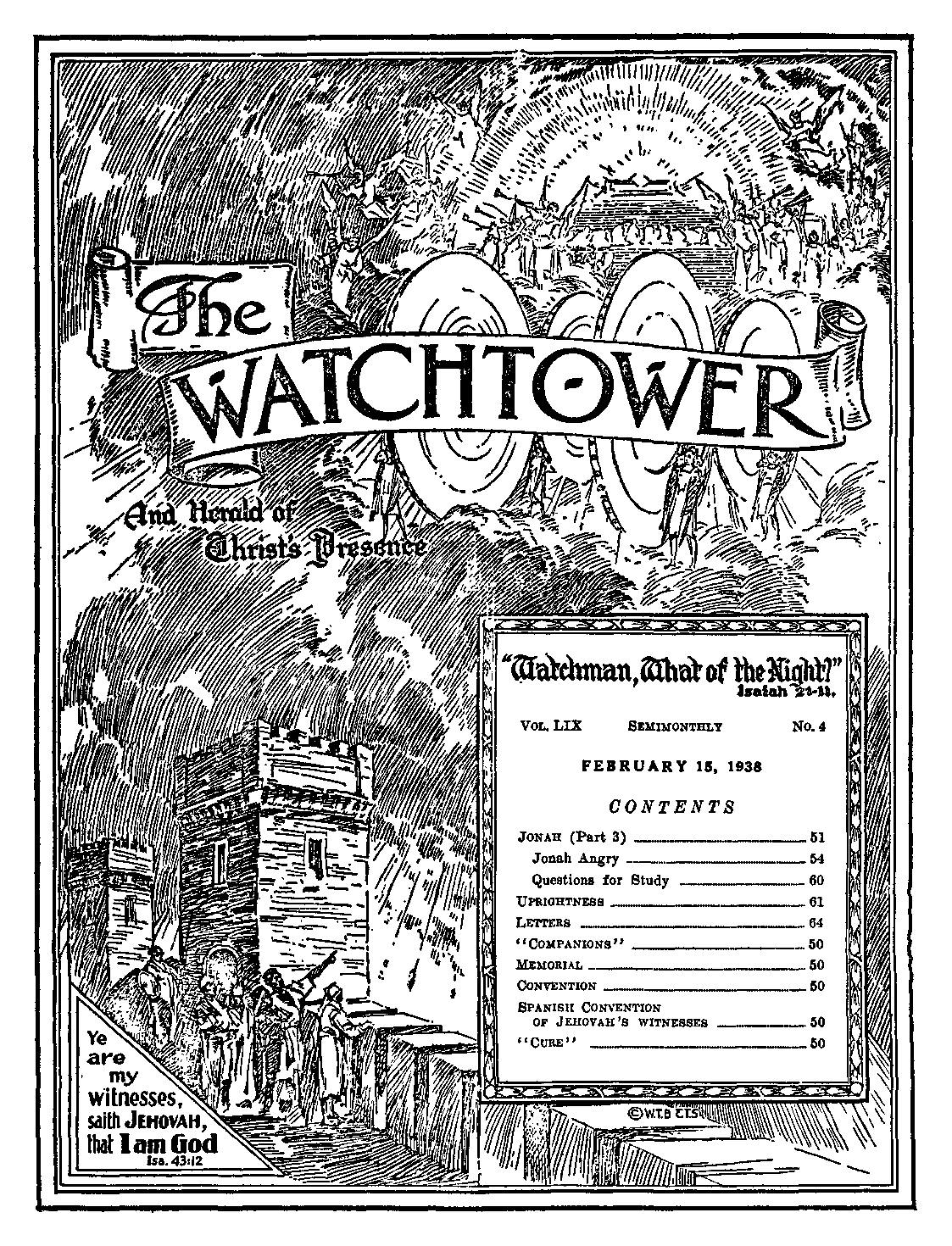
The Watchtower, February 15, 1938
Download: PDF — The Watchtower, February 15, 1938
“COMPANIONS”
The Memorial season this year will be marked by the testimony period named “Companions”, from April 9 to 17, inclusive. The name indicates that all that are companions in Jehovah’s service, to wit, the anointed remnant and the Jonadabs, will signalize this period by intense united activity throughout all the world. The campaign strategy will offer the unusual combination of a year’s subscription for Consolation together with the book Enemies (or Riches) and the new booklet Cure, all on a $1.00 contribution. This announcement is supplemented by much detailed information in forthcoming issues of the Informant. The magnitude and scope of this campaign calls for careful planning and advance arrangements, losing no time. A faithful report in the regular way will be awaited from you at the close of the testimony.
MEMORIAL
The date for the celebration of the name of Jehovah God and to the sacrifice of his Vindicator, Christ Jesus, in 1938 is Friday, April 15, after six p.m. After six p.m. on April 15 let each company of the anointed assemble and celebrate the Memorial, their companions the Jonadabs also being present. Let the emblems be unleavened bread and real red wine. The Lord and his apostles used real red wine in symbol of His blood, and the anointed should follow their lead.
CONVENTION
Jehovah’s witnesses will assemble in convention at Sydney, Australia, April 22-25 inclusive. This convention will serve both Australia and New Zealand. The public address of the president will be radiocast. All who love and serve Jehovah will be welcome.
SPANISH CONVENTION OF JEHOVAH’S WITNESSES
The Society is arranging for a convention of Jehovah’s witnesses particularly for the Spanish-speaking brethren, to be held at San Antonio, Texas, April 15-17 inclusive. All Spanish-speaking brethren who can reasonably attend should make it a point to do so. The local company at San Antonio will have charge of the arrangements of the convention, under the direction of the Society. Brothers Montero and Keller will attend the convention. Brethren desiring to attend this convention may communicate with J. D. Carter, 517 Stonewall St., San Antonio, Texas.
“CURE”
Amid the vain pursuit by nations and individuals of a remedy the Society now brings forth a new booklet, entitled Cure, and written by Brother Rutherford. It is a most excellent short composition, enclosed in a striking cover. Release of Cure for campaign purposes is elsewhere announced. Preliminary thereto, all kingdom publishers will familiarize themselves with its interesting contents. Copies for your individual purposes may be obtained on contribution of 5c each.
Vol. LIX
February 15, 1938
No 4
JONAH
PART 3
“He hath shewed thee, O man, what is good; and what doth the Lord require of thee, but to do justly, and to love mercy, and to walk humbly with thy God?”—Mic. 6:8.
JEHOVAH announces his fixed rules, which his creatures who please him must obey. The above text is an emphatic rule that applies to all who undertake to do God’s will. The servant of Jehovah, therefore, must do justly, love mercy, and show mercy to others, and must walk obediently with God, that is, according to the rules which he has made known. Some who have started to follow Christ Jesus never learn to obey the foregoing fixed rule, and they soon lose out. Those who ultimately receive the approval of the Lord are diligent to learn the meaning of the rule above announced and then to faithfully obey the same. It will be seen that the prophetic picture in which Jonah played the important part discloses both of these classes and emphasizes the present-day importance of giving attentive heed to the commandments of Jehovah. Justice requires one to act without partiality. Mercy requires the servant to rejoice when the erring one repents and puts forth an effort to do the will of God. To walk humbly requires one to be diligent in learning God’s way of dealing with his creatures, and then to be diligently endeavoring at all times to do likewise and to be guided in all things by the will of Jehovah God.
2 That no partiality be shown to the Assyrians, God’s message was taken to the king, whose name, however, is not disclosed; and this shows that the king is not important, but the part which he played is important. One who acquires wisdom from on high learns to act with mercy and without partiality, and this truth Jehovah impresses upon his faithful servants. (Jas. 3:17) “For word came unto the king of Nineveh, and he arose from his throne, and he laid his robe from him, and covered him with sackcloth, and sat in ashes.’’ (Jonah 3: 6) The message of warning of God concerning the approaching disaster upon “Christendom” has been presented without partiality to those high in the councils of the world, that is, the religious, political and commercial elements, and has particularly been sent forth between the years 1922 and 1932, and the warning continues to go to them from time to time. The king of Nineveh repented, and that must have galled the Devil and at the same time was a surprise to Jonah, who by reason of his experience with the Israelites would hardly expect the mighty among the heathen to repent. “Christendom’s” ruling factors do not repent in these days, however, and do not use their influence to turn the people toward God. The action of the king of Nineveh shows that such would be the right course for “Christendom”. While the ruling factors take the wrong course, there are certain individuals among them who do see the right way and endeavor to walk therein.
3 Not only did the king repent, but he issued a proclamation to all the people, to wit: “And he caused it to be proclaimed and published through Nineveh, by the decree of the king and his nobles, saying, Let neither man nor beast, herd nor flock, taste any thing; let them not feed, nor drink water; but let man and beast be covered with sackcloth, and cry mightily unto God; yea, let them turn every one from his evil way, and from the violence that is in their hands. Who can tell if God will turn and repent, and turn away from his fierce anger, that we perish not?”—Jonah 3:7-9.
4 Had the rulers of “Christendom” taken a similar course when first hearing the warning, and had they repented and issued a proclamation in harmony therewith to the people, a far different condition would now prevail in the earth. There would not be so much distress and perplexity. But the Devil sees to it that the rulers of all nations are gathered to the battle of the great day of God Almighty, and therefore they take the wrong course. The action of the king of Nineveh was a great condemnation of the unfaithful Israelites, because they pretended to serve God and did not repent when they heard the warning. The same condition exists amongst the antitypical Israelites, namely, the so-called “Christian religionists”. Since the year 1918 judgment has been in progress, and all nations are gathered before the great Judge, Christ Jesus. (Matt. 25:32) It is those of good will who hear, repent and turn to the Lord. The repentance of the antitypical Ninevites, that is, those who will compose the great multitude, is a great condemnation of the religionists of “Christendom”. The queen of Sheba well represents the same class, as stated by the Lord at Matthew 12:42: “The queen of the south shall rise up in the judgment with this generation, and shall condemn it; for she came from the uttermost parts of the earth to hear the wisdom of Solomon; and, behold, a greater than Solomon is here. ’’
5 In this day of judgment through Christ Jesus many persons, by reason of the warning being published throughout the earth, are seeing that Abraham, Isaac and Jacob will be the earthly representatives of the kingdom, and therefore be in God’s kingdom organization, and at the same time they see that the religious Jews, the natural descendants of the faithful men of old, and their antitype, the religionists of the present day, will be cast away; as Jesus said: “And I say unto you, That many shall come from the east and west, and shall sit down with Abraham, and Isaac, and Jacob, in the kingdom of heaven. But the children of the kingdom shall be cast out into outer darkness; there shall be weeping and gnashing of teeth.”—Matt. 8:11,12.
6 Here again the great multitude is pictured by those who come from every point of the compass seeking the Lord. The religious Jews, and likewise the religionists of this day, Catholic and Protestant, all claim to be the favored ones of God and to be the spiritual ones who claim to be the descendants of Abraham and the other faithful men of old, and yet they continue to openly practice the Devil religion in defiance of Jehovah. They will therefore never be of the kingdom.
7 In this day of judgment the “other sheep” of the Lord, who will compose the great multitude, are hearing the truth and turning to Jehovah. The religious practitioners hear the message of warning at the mouth of Jehovah’s witnesses acting under the direction of Christ Jesus, as it is proclaimed to those of good will, and they hear the announcement made by the Lord that Abraham, Isaac and Jacob and all the prophets shall be in the kingdom, and that the religionists are cast out, and that makes them very mad; and, being exceedingly angry, they gnash their teeth against the witnesses of the Lord. In this day of judgment the great Judge, Christ Jesus, says to those hypocrites: “Depart from me, all ye workers of iniquity. There shall be weeping and gnashing of teeth, when ye [who claim to be the spiritual successors of God’s covenant people] shall see Abraham, and Isaac, and Jacob, and all the prophets, in the kingdom of God, and you yourselves thrust out. And they shall come from the cast, and from the west, and from the north, and from the south, and shall sit down in the kingdom of God.”—Luke 13:27-29.
8 Judgment will be completed with the climax at Armageddon, and then there will be no religionists to thus rebuke. Therefore the foregoing texts apply at the present time, before Armageddon. That terrible castigation of the clergy is now being delivered, and when the witness work commanded by the Lord is done the religionists will be done for ever.
9 The action of the king of Nineveh did not mean that among those who will compose the great multitude there is any rank or class distinction, or any superior officers of the land that will proclaim what the others must do. The message or proclamation comes from the “King of Eternity”, who was represented in the king, before whose throne the great multitude must stand and ascribe salvation, and that message of Jehovah shows the great multitude what they must do, and that is, that they must repent and seek the Lord. In this picture the king of Nineveh played a part representing Jehovah, and probably therefore the king’s name is omitted from the prophetic record. The King’s message is set forth in another prophecy, particularly so at Zephaniah 2:3: “ Seek ye the Lord, all ye meek of the earth, which have wrought his judgment; seek righteousness, seek meekness; it may be ye shall be hid in the day of the Lord’s anger.”
10 The thoroughness of the repentance of the Ninevites is shown by the fact that the fast was also imposed upon the cattle. It was not a time for feasting, but a time for sober fasting, and all were required to take that course. Clothing himself in sackcloth and turning away from violence, the picture here made by the king shows that those who become of the great multitude have first come to a point where they mourn and sorrow, because they have had a part in the wickedness of Satan’s organization and a part in the abominations done in the political and religious parts thereof, which has brought such great reproach upon the name of Jehovah and his King. They do sigh and cry because of these abominable things, and God hears their cries. (Ezek. 9:4) By sending Jonah to Nineveh Jehovah was making no attempt to proselyte the people of Nineveh to become Jews or to follow Jonah in the course he was taking. He required all of the Ninevites to show faith in his message, which Jonah brought them, and that they should turn away from wickedness, that they might be spared the destruction that he purposed to bring upon the city. This foreshadows that the people of “Christendom” that are of good will cannot stop “Christendom” in her practicing of evil and violence, but all those of good will can turn away from such and refuse to ‘ touch the unclean thing’, and can take their stand wholly on the side of Jehovah and his King. The proclamation of the king said: “Who knoweth whether God will not turn and repent, . . . that we perish not?” (R. V.) Thus was faith beginning to be exercised in the Lord.
11 Jonah informed them that God was angry and their repentance might bring about their salvation. Jehovah did not spare Nineveh from later destruction, but he did spare the repentant generation then living at Nineveh from that destruction. Likewise Jehovah will not spare “Christendom” at Armageddon nor desist from his expression of wrath at that time, but in that destruction he will not include those of good will who now turn to him and form a part of the great multitude; and this he will do because they obey his admonition to ‘seek righteousness and meekness’, and flee from the devil religion and “refuge of lies”.— Isa. 28:15,17.
12 Jonah’s commission to preach to the Ninevites had not been completed when repentance was shown on the part of some of the Ninevites: “And God saw their works, that they turned from their evil way; and God repented of the evil that he had said that he would do unto them; and he did it not.’’ (Jonah 3:10) The forty days of grace promised were not yet up. This shows that while the kingdom message is being preached to the people before Armageddon, Jehovah opens the way for those of good will to come out, take their stand on his side, and form the “great multitude”. The chronological forward movement of “this gospel of the kingdom”, and identification of the great multitude, is here considered to be of profit to those who love God; which facts disclose Jehovah’s mercy and loving-kindness. Beginning with the year 1923, the Resolution “A Warning” was distributed throughout “Christendom”, that is, antitypical Nineveh, and thereafter appeared the identification of a “sheep” class and their proper course of conduct toward the least of Christ’s brethren. (See The Watchtower of November 1, 1923, page 326.) In the November 15, 1926, Watchtower there was published the statement that a multitude of prisoners were in Satan’s organization ; but it was then understood that such prisoners constituted a secondary spiritual company, and for that reason the attention of God’s people was not properly focused on the earthly people of good will, who were pictured by the repentant Ninevites. In 1927 the message “Freedom for the People” was published by a radio network, till then the greatest ever on earth, and by world-wide distribution of that message in printed form. The message pointed out to the people of good will the Scriptural line of action they should follow; and yet the great multitude was not then properly identified. In 1931 the people of good will were identified as being of ‘‘ Christendom ’’ and being those who ‘sigh and cry because of the abominations done amongst the religionists’. (See Ezekiel 9:4; see Vindication, Book One, pages 94-116.) The turning to Jehovah of the modern Ninevites became more noticeable when, in 1932, God revealed to his people that such non-Jews were pictured by Jonadab, and by Jehu’s inviting Jonadab into his chariot. In this day of judgment the modern-day Ninevites began to rise up and condemn the religionists of “Christendom”, who claim to be followers of Christ Jesus, and the course of action of the Lord’s “other sheep” is a strong condemnation of “Christendom”.
13 Later the. Ninevites and other Assyrians assaulted, captured and carried away captive the typical people of God, and thereby brought great reproach upon the name of Jehovah. (Ps. 83:8, 9) In that assault upon Israel Nineveh pictured “Christendom”, which today openly reproaches the name of Jehovah God and conspires to destroy Jehovah’s people now on the earth. Against that wicked crowd Jehovah reveals his denunciation as prophesied by Nahum and Zephaniah. Jonah’s prophecy relates entirely to a different time. By his prophets God warns of his coming wrath against “Christendom”, and concerning that time the people of good will are warned to flee: “Before the decree bring forth, before the day pass as the chaff, before the fierce anger of the Lord come upon you, before the day of the Lord’s anger come upon you. And he will stretch out his hand against the north, and destroy Assyria; and will make Nineveh a desolation, and dry like a wilderness. And flocks shall lie down in the midst of her, all the beasts of the nations; both the cormorant and the bittern shall lodge in the upper lintels of it: their voice shall sing in the windows ; desolation shall be in the thresholds: for he shall uncover the cedar work. This is the rejoicing city that dwelt carelessly; that said in her heart, I am, and there is none beside me: how is she become a desolation, a place for beasts to lie down in! every one that passeth by her shall hiss, and wag his hand. ’’-Zeph. 2:2,13-15.
14 Referring now to the prophecy of Jonah: Those of Nineveh who at that time repented at Jonah’s preaching pictured the great multitude, and for their sakes Jehovah delayed or postponed the destruction of Nineveh. That afforded the repentant ones an opportunity to seek and serve the Lord.—See book Prophecy, page 267.
15 From 1918 forward Jehovah held off or delayed the destruction of “Christendom”; and this he did, as he states through Christ Jesus, for the sake of his own “elect”. (Matt. 24: 21, 22) From then until 1931 the Lord continued to gather and prepare the remnant or elect for his own service, and at this latter date Jehovah revealed to them that he had given to them a “new name”. The faithful “elect” or remnant had been acting under their new name, but it was not revealed to them until 1931. That new name was like a “penny” paid for a day’s work, and giving all the faithful ones in the service the same amount, to wit, the new name, is pictured by the paying of the penny. (Matt. 20:1-16) During the intervening years the modern Ninevites, those of good will of the present day, were hearing the message and a considerable number of them were repentant, and in 1931 such repentant ones were revealed and identified as those people who ‘sigh and cry’ and who by the Lord’s direction received the ‘mark in the forehead’, which mark is administered by the “man clothed in linen” with “the writer’s inkhorn by his side”. For the sake of those repentant ones, who are thus marked, Jehovah docs not destroy “Christendom” until a later time, and the reason is, that those of good will may be informed, learn of God’s kingdom, and seek righteousness and meekness, that they may be spared at the execution upon “Christendom” at Armageddon. Thus it is shown that the Lord has gradually revealed these truths to his people, causing them to perform work which they did not at the time understand; and it is shown that Jehovah has made ample provision for the people of good will, and has made it incumbent upon the remnant to carry the message to those people of good will. The remnant are afforded the opportunity of dealing justly with others seeking the truth, loving and showing mercy toward them, and walking obediently according to God’s commandment.
JONAH ANGRY
16 The prophecy now shows Jonah playing a part of a class of murmurers: “But it displeased Jonah exceedingly, and he was very angry.” (Jonah 4:1) God had shown mercy toward even a heathen people; which further proves that God is love. He had shown Jonah how his mercy was extended toward the heathen. Jonah had become angry, peeved, and murmured against the Lord. Why should Jonah become angry? Probably Jonah reasoned that, if Nineveh was permitted to repent and survive, it might be expected that that nation would make war upon Israel, and Jonah thought God would forestall such assault upon Israel by then and there destroying Nineveh. The most reasonable conclusion as to the cause of Jonah’s anger, and which reasoning is fully supported by the Scriptures and physical facts, is this: Jonah had been miraculously delivered from the whale’s belly. He was the accredited prophet of Jehovah God and now stood prominently before the heathen, as well as the Israelites; and now he had appeared at the great city and authoritatively declared that Nineveh must be destroyed in forty days, and for God to refuse to back up Jonah by destroying the city within forty days would ruin Jonah’s reputation as a prophet, and he concluded that the destruction of the heathen people was not nearly of as much importance as the reputation of himself. Jonah could not stand to be humiliated, or, at least, he played a part representing those who show that disposition. Therefore Jonah began to murmur against God. But do not criticize Jonah. He was merely playing a part in this prophetic picture, and the facts in fulfillment of the prophecy show that selfishness is the moving cause for the conduct of those whom Jonah pictured at this point. We must keep in mind that Jonah was one of the prophets of Jehovah, and doubtless is included in the approved list mentioned in Hebrews eleven. When we understand that he was playing a prophetic part, then the man is not important, but the part which he plays is important because it foretells a class that shall come into existence later. What was in Jonah’s mind at that time is not important. We must look at it from a prophetic viewpoint and find the application in modern times.
17 Jonah then sought to justify his huff, and this shows he pictured a class that take a similar course in these latter days: “And he prayed unto the Lord, and said, I pray thee, O Lord, was not this my saying, when I was yet in my country? Therefore I fled before unto Tarshish; for I knew that thou art a gracious God, and merciful, slow to anger, and of great kindness, and repentest thee of the evil.”—Jonah 4:2.
18 The selfish ones amongst the consecrated are here again pictured. Note the facts in fulfillment of the prophetic picture. In 1931 Jehovah revealed to his people that he had given them a new name, that is, the name “Jehovah’s witnesses”. That was the payment of the “penny”, described in the parable by the Lord Jesus. It was revealed then that those marked in the forehead by the man with the writer’s inkhorn by his side constitute the people of good will, and these were foreshadowed by the repentant Ninevites. When these great truths were announced, and particularly the new name and the giving of the penny, some of the prominent ones amongst the consecrated were greatly displeased and murmured. The new name meant that more work was to be done and that “Christendom” would be spared destruction for a time in order that this further work might be done. The selfish ones were daily expecting to get away to heaven, that they might occupy some high position. But now, it being revealed and shown that more work must be done before Armageddon and that this work must be done in the face of opposition by the antitypical Assyrians, that is, the political, religious element, such work would be very hard on the proud ones. Being anxious to get off to heaven while they had some reputation amongst the people as prophets or preachers, these truths revealed in 1931 caused the selfish ones to become huffy and angry. The blame, therefore, is not on Jonah, but upon those who fulfill the prophecy. In 1932 the Lord revealed that the “elective elders” are those who think more highly of themselves than they ought to think, and are despicable in the eyes of the Lord because they are “elders” by election and not by virtue of faithful service to God. —See The Watchtower of August 15, September 1, 1932.
19 Many who were of the “elective elder” spirit were greatly displeased at the publication of this truth. They were also greatly huffed and displeased by the announcement of Jehu’s inviting Jonadab into his chariot, which shows that there must be some work done by the anointed in behalf of the Jonadabs. This meant more work and less reputation, and by reason of their selfishness and of their great desire to maintain their reputation amongst men they became angry. Their reputation as important ones in the truth might be destroyed, and that greatly confused them and caused them to become huffy. They had preached that in an early time God would overthrow “Christendom”. Many had emphasized the year 1925 as the date, and then when that date did not materialize the date was moved up to 1932. Again, 1932 came and ‘‘ Christendom” was not destroyed, and now it was discovered that “Christendom” would be spared for a while longer for the sake of the Jonadab class, and this made the proud “elective elder” crowd very mad. They had preached ‘restitution’ for the world in general, but they expected that work to be done only after they, the wise and important ones, had ‘ceased from their labors’ and had reached a place of blissful rest in heaven. They did not desire to be used on earth, and they were not willing for anyone besides the spirit-begotten ones to have a look-in until after the heavenly class should reach their glory-home. They said in effect: “Let the world be taken care of during the Millennial rule. Why should we bother about it now? Have we not taught that all such work is to be done after we have reached heaven?” The revealed truths showing that God’s mercy was being extended to the people of good will and giving his servant class an opportunity to do something in their behalf caused the selfish ones to become very angry and sulky. The physical facts fully bear out that these are the ones that Jonah foreshadowed when he became angry. When a man gets “real sore” and disappointed by reason of his selfish desires’ being frustrated, he is ready to die, he thinks. Jonah represented that class at this point, because Jonah concluded it was better for him to die than to be humiliated: ‘‘ Therefore now, O Lord, take, I beseech thee, my life from me; for it is better for me to die than to live. ’’—Jonah 4:3.
20 Particularly since 1931 there have been, and are now, those among the professed followers of Christ Jesus who are, as they put it, “anxious to go home”; meaning that they want to die and go to heaven and get out of this turmoil and strife brought on by reason of faithful service. But it may well be asked: “Will they ever get home ? ’’ Jesus says: “ He that shall endure unto the end, the same shall be saved.” (Matt. 24:13) That endurance must continue until ‘this gospel of the kingdom is preached for a witness and that work is completed’; and during that time there will be much to endure. The selfish will not care to endure. When the consecrated one is assigned a specific duty in caring for the kingdom interests and he becomes weary and, suffering under the galling experiences, he cries out, “Oh, let me get away from here. It is better that I die than to try to do any further work,” such is a manifestation of cowardice. Cowardice is the very opposite of courage; and courage is the result of full faith and confidence that the Lord is backing one up and therefore the Lord will sustain him in the worst time. One who complains because of an assigned duty is not trusting wholly in the Lord. A courageous person trusts wholly in the Lord and fights on to the end. Selfishness is the moving cause for complaint and murmurings. The one who forgets self always rejoices in the Lord regardless of how severe his trials may be. Seeing that God has set a day for Armageddon, at which time he will afford opportunity for some to be spared, and that God has given opportunity to the remnant to now preach or carry the message of truth to those of good will that they might be of the saved class, it appears to the faithful as a great and blessed privilege of serving God, and this makes the faithful to rejoice. But not so with the selfish. He wants to do his own will, and not the will of God.
21 How Jehovah regards the complaining or murmuring ones is shown by his words to Jonah: “Then said the Lord, Doest thou well to be angry?” (Jonah 4:4) In substance the words of Jehovah are: This is a time of joy, and not a time for repining and expression of peeved selfishness. “Art thou rightly angry?” (Rotherham) Such words are similar to those employed by Jesus when addressing those to whom the penny was paid and who at the time murmured because they did not get more than the ones who came later into the field. To such Jesus said: “Is thine eye evil because I am good?” (Matt. 20:15) The Lord conducts his work as it pleases him, and all who love him rejoice in the knowledge of that fact and delight to do according to his will. ‘‘ For he saith to Moses, I will have mercy on whom I will have mercy, and I will have compassion on whom I will have compassion.” (Rom. 9:15) It is not for any creature to criticize Jehovah because he extends his mercy to anyone he may will to do good unto. Because men tried to fix the date when God would destroy modern Nineveh and God did not back up their prophecy but apparently extended the time in order to give others an opportunity to hear the truth and take their stand on the side of the Lord, is that any cause to be peeved? Such is the real meaning of God’s words to Jonah: Is there any justification for your peevish murmuring or angry condition? There is certainly none. The true servant delights to do the will of his Master.
22 When Jehovah thus spoke those words of rebuke Jonah began to sulk even more: “So Jonah went out of the city, and sat on the east side of the city, and there made him a booth, and sat under it in the shadow, till he might see what would become of the city.” (Jonah 4:5) He concluded that if Nineveh was going to be destroyed as he had prophesied, then he would not care to be found dead in the city, as then that might sully his reputation. Some might be permitted to survive. Anyhow, he was angry, and he went outside of the city and fixed himself up a shack and settled down for a while, and there sulked and pouted. Jonah here pictured that class of professed consecrated ones who sulk and pout and find fault because they have preached or prophesied certain things would come to pass and their prophecies are not fulfilled, and so they sit down to wait and see what is going to come to pass. Jonah did not go into a booth that represented rejoicing, such as was done at the feast of tabernacles, but he fixed himself up a shack for his own ease and comfort; and likewise the class whom Jonah there pictured ‘hide themselves in a shack’ and wait to be taken home. They are really indulging in a sit-down strike, and that is further evidence that sit-down strikes are induced by the enemies of God, to wit, the Devil and wicked angels. Those who really complain against God are yielding to the influence of the Devil. Like Jonah in the picture, the sulkers wish to avoid “the heat of the sun” that always comes with real work. The picture shows Jonah hopeful that he might sit there and see Nineveh destroyed without mercy. He was not at all concerned about the welfare of the repentant ones. Likewise the class is there pictured as having no concern about the welfare of the “other sheep” or Jonadabs, who have repented and fled to the Lord, but these sulking ones prefer to ‘slack the hand’, sit down, and take it easy until the time that God smites “Christendom”. They conclude that they are so important that God will certainly not fail to take them to heaven and give them the best job there. It is not at all material whether Jonah was in fact a selfish man or not, because he was there carrying out a prophetic picture that later would reveal a class of persons that would show an attitude which he portrayed.
23 Again Jehovah showed to Jonah his mercy and loving-kindness by preparing protection for him: “And the Lord God prepared a gourd, and made it to come up over Jonah, that it might be a shadow over his head, to deliver him from his grief. So Jonah was exceeding glad of the gourd.” (Jonah 4:6) The Lord made this part of the picture, without doubt, to further instruct the consecrated of this day that they must do justice, which is to joyfully do the will of God; that they must love mercy and bestow mercy upon others; and that they must walk obediently with Jehovah as he directs. God performed a miracle now by causing a gourd, stalk, branches, leaves and all, to grow up to full maturity in one night and be large enough to furnish a shade for Jonah’s shack and to protect him from the sun and make it more pleasant for him while he camped there. That made Jonah glad for the time being, because he was getting something for himself. Jonah did not plant the gourd, but God’s mercy permitted Jonah to have and enjoy its shade and protection; and that, according to another translation, the Lord did “to deliver him from his evil case”. (R.V.) The picture must be further extended by giving Jonah some more experience that he might see his own selfishness and that the mercy extended him by the Lord might help to get out of his mind his unhappy state. This foreshadows that Jehovah is long-suffering towards the disgruntled ones who get into his organization, and that he continues to extend to them his mercy and loving-kindness and, if they do not appreciate it, to thus give them time to hang themselves or to learn and to obey him joyfully. In recent months one who for several years was an official representative of the Society was put out of that position, and undoubtedly the Lord put him out, and those who are always opposing the work done by the Society continue to utter sarcastic criticism against the Society and its officers and in favor of the ousted one by using words like these, to wit: “ If you knew he was crooked for some time previous, why didn’t you put him out immediately ? ’ ’ The answer is that it is always best to follow the course that Jehovah marks out and wait upon the Lord. A man might be recovered from the error of his way, and therefore we must show mercy and wait for the Lord to act, because his wisdom is perfect and he always acts at the right time. When that man shows himself wholly rebellious and opposed to the Lord and his organization, then God takes the proper action to oust him. ‘The mercy of Jehovah endures for ever.’ He is kind to the unthankful, to give them opportunity to learn the right way if they will.
24 Jehovah showed mercy to Jonah, and for the time Jonah appeared to appreciate that mercy, because it is written: “So Jonah was exceeding glad [because] of the gourd.” He was enjoying some ease, and the gourd brought him some more shade and rest, and that pleased him; but he did not consider that others would be glad to enjoy similar protection and comfort. In sparing the repentant people of Nineveh Jehovah was showing mercy to them and giving others an opportunity to repent, and those others included the nation of Israel. So likewise now, in withholding Armageddon, Jehovah is showing great mercy to those of “Christendom” who do repent and flee to his organization, and also affording opportunity for others to repent and flee to him, and those who do turn to the Lord are a rebuke to “Christendom” for not repenting. God will not destroy “Christendom” until he first shows mercy upon the repentant ones who are in “Christendom”. This fact should be an example of warning and an aid to all “Christendom”, and doubtless would be to many, many more if it were not for the clergy who aid the Devil in holding the people back from the Lord. Like the religionists of Israel, the religionists of “Christendom” constitute, as Jesus said, “an evil and adulterous generation,” having made and continuing to carry on an illicit alliance with other parts of the Devil’s organization. “Christendom,” like the Israelites, ask for a sign more specific than that pictured by Jonah’s preaching. The religionists ask for something more than the proof that the Jonadabs, the modern-day repentant Ninevites, are fleeing to God, when they hear of his gracious provision for salvation; but they shall have no other, according to Jesus. The words of Jesus, therefore, apply with stronger force to the religious leaders of “Christendom” than to the religionists of Israel. “O ye hypocrites! ye can discern the face of the sky; but can ye not discern the signs of the times? A wicked and adulterous generation seeketh after a sign; and there shall no sign be given unto it, but the sign of the prophet Jonas. And he left them, and departed.” —Matt. 16:3,4.
25 In connection with uttering these words Jesus warned his disciples against the clergy of that time, and likewise he warns all now against the clergy of modern times. (Matt. 16:6) Today “Christendom” need expect nothing in the way of a “sign” save the sending by the Lord of his servants or witnesses to preach the kingdom of heaven and the warning of the coming destruction of Satan’s organization at Armageddon, even as Jonah preached to the Ninevites both for the benefit of Nineveh and for that of Israel. In this part of the prophecy Jonah pictured the disgruntled and peeved ones, and also the religionists of “Christendom” toward whom God is long-suffering and continues to send his witnesses to preach to them that “millions now living will never die” and that such millions will be those who flee to God’s kingdom before Armageddon. That is all the sign they will get. It is God’s mercy and loving-kindness that gives them that sign. Jonah displayed an unmerciful attitude, thereby showing he failed to profit by the extension of God’s mercy toward him. And then God took some further action: “But God prepared a worm when the morning rose the next day, and it smote the gourd that it withered.” (Jonah 4:7) That meant no more shade for Jonah. He had to take the heat as it then came. He must receive a dose like that he had administered to others. (Jas. 2:13) The gourd of mercy was quickly removed. Here Jonah played a part picturing those who were at one time in line for the kingdom, and whom God did not mercilessly wipe out in 1918, but for the sake of whom, together with his ‘elect servant’, he shortened the day of tribulation. The selfish class here pictured by Jonah had been shown God’s mercy, even for a time after they exhibited displeasure and murmured and expressed their great desire to die and go home to heaven. Although offended at Jehovah, He continued to be merciful toward them for a time. But that day of mercy comes to an end both for the murmurers and for “Christendom”. The gourd being removed, the condition of cool ease and “peaceful rest” was done for and they must then take things that were not pleasant. In the year 1935 came another expression of Jehovah’s judgment made known by Christ Jesus at the temple. Up to that time the “halfway faithful” had strutted their stuff before the assembly of God’s people, and relied upon a ‘secondary spiritual class’ into which they might drop and rest in ease and comfort. It was now shown by the Lord it does not exist. The disgruntled ones rest by faith in what that ‘secondary spiritual class’ would mean to them. They reasoned that even if they did not come up to the standard required for the kingdom, they would surely land in that ‘secondary spiritual class’ called the “great company”. That was a kind of safety-net into which they expected to fall as a last resort. Claiming to be spirit-begotten, they concluded that if they should be found to be only partially faithful, certainly they would land in the great multitude; and therefore they rested on their oars. They instituted a sit-down strike and held hands and took it easy, and some continue to do so. But that supposed spiritual net disappeared in 1935, and it was readily seen that the same was a mere myth. The Lord made it known to his people that there is no Scriptural authority for claiming a secondary, halfway-faithful spiritual class, but that the “great multitude” is made up of the Jonadabs, or “other sheep” of the Lord, and that their hope is earthly, and that they must prove the same kind of zeal and faithfulness as that exhibited by the spiritual class that is saved. Therefore in 1935, when the Lord revealed the true situation of the great multitude, the antitypical gourd withered and disappeared for the murmurers and “halfway faithful” ones. It is a noticeable fact that almost immediately after the Washington convention some of those departed from the Lord’s organization. The gourd being removed, the heat of battle was too great for them and they scooted off for some other shade.
26 Nineveh doubtless was a very hot city, even as Jerusalem is situated in a hot climate. Likewise it is hot now in “Christendom”, and all who sympathize with “Christendom” are feeling the heat: “And it came to pass, when the sun did arise, that God prepared a vehement east wind; and the sun beat upon the head of Jonah, that he fainted, and wished in himself to die, and said, It is better for me to die than to live.”—Jonah 4: 8.
27 Jonah continued in his attitude of selfishness, and with him God’s mercy came to an end, so far as the picture is concerned. That does not mean that God was displeased with his faithful prophet. Jonah was playing his part, but the class whom Jonah represents fulfilled the reality. In these modern days those who took offense when the “spiritual secondary class”, pictured by the gourd, was removed continued in a selfish attitude. Shortly thereafter some of them fell completely into the Devil’s organization, and others continue to fall. The heat of the blazing sun and the hot winds accompanying, like the sultry hot winds of Assyria, beat down upon the selfish ones, and their “comfort and ease” disappeared. The crucial hour for them comes. Under the blasting hot wind Jonah wanted to die. He saw Nineveh surviving, and that was permitted in recognition of the repentant ones. By this Jonah was greatly humiliated. He did not want such pity to be extended to Nineveh, but he wanted pity for himself, and now he wanted to die and be done with the entire matter. He was entirely different then from what he was when in the belly of the fish, at which time he prayed and hoped for an opportunity to further prove his faithfulness to God. Now under the hot, blazing sun he prayed to die, just because of his selfish desire to have his own will done and because his reputation had not been maintained as he had desired. In this he pictured a class of the consecrated who are “happy” while things are going according to their selfish pleasure, and who have often expressed themselves in this manner: “I am happy to have this comfort and ease and blessing of the Lord.” What a difference the joy of the Lord brings to one who fully devotes himself to Jehovah God! When self-ease and comfort and honor are taken away, the selfish want to get off the earth and they cry out: “Let me get out of here and go somewhere that I may serve the Lord. ’ ’ They reason that if they could die and go to heaven and there lord it over some others, that would be fine and to their liking. Some men are happy when they can shine and be patted on the back, but when it comes to a real fight they sulk and creep away.
28 The true servant of God sticks where he is put, and he recognizes and relies upon the promise that God makes that all things work together for good to those who love the Lord and who are called according to his purpose. (Rom. 8:28) He trusts in the Lord, and he knows the Lord will permit the proper things to come to pass. The joy of the Lord means to earnestly look forward to the vindication of Jehovah’s name and to have some part therein by maintaining one’s integrity toward God under all conditions and by seeing other human creatures prove their faithful devotion to God, and thereby prove Satan to be a liar. With joy of the Lord such faithful ones endure hardness and suffer, and they are determined that, come what may, they will serve God and his King faithfully to the end. But a contrary class is pictured here by Jonah, and which class find no joy in the Lord, because they do not appreciate the meaning of the vindication of Jehovah’s name. Selfishly they look for their own ease, comfort, reputation and honor. They do not rejoice that the Lord’s “other sheep” are fleeing to his fold and that this will be a vindication of Jehovah’s name. They are like the Pharisees, who complained and murmured and said of Jesus: “This man receives sinners”; and to whom Jesus replied: “And the Pharisees and scribes murmured, saying, This man receiveth sinners, and eateth with them. And he spake this parable unto them, saying, And when he cometh home, he calleth together his friends and neighbours, saying unto them, Rejoice with me; for I have found my sheep which was lost. I say unto you, that likewise joy shall be in heaven over one sinner that repenteth, more than over ninety and nine just persons, which need no repentance. ’’—Luke 15: 2, 3, 6,7.
29 The true and faithful followers of Christ Jesus realize that one’s honor and good reputation among men amounts to nothing, but that honor and vindication of Jehovah’s name amounts to everything because only those who prove the vindication of Jehovah’s name will live. They care not for their own honor, so long as God approves them. They are not man-pleasers, and they are not seeking to please men.
30 The religionists of Jerusalem complained against Jesus because he was receiving with joy men who had been sinners but who when hearing the gracious words that fell from the lips of Jesus turned to him that they might learn more about God and his kingdom. A like condition is clearly made manifest in the present day. The true followers of Christ Jesus, the remnant or “faithful and wise servant”, proclaim the truths within the hearing of sinners, and they rejoice to do so because it is the will of God. Hearing the message of the Lord, people of good will come from every land and clime, inquiring the way to God’s kingdom, and these soon form the great multitude. The faithful witnesses of the Lord rejoice to go through much tribulation and hardship in order to carry the truth to the great multitude, and they do so faithfully and gladly. Murmurers and complainers denounce the servants of the Lord because they proclaim the truth to sinners. The Pharisees were in fact offended at God because he was showing mercy to others than themselves and that made the Pharisees appear much smaller in the eyes of the people. They wanted to be the only ones in the light of God’s favor.
31 Their counterpart today, who assault Jehovah’s servants, are in fact offended against God because he causes his mercy to be exhibited through Christ Jesus to others, namely, the people of good will. The clergy murmur against Jehovah’s witnesses and persecute them. Those of the “evil servant” class likewise murmur against Jehovah’s witnesses and persecute them. They say all manner of cruel and wicked things against the servants of God in an effort to disgrace such servants in the eyes of men. They publish all manner of vicious lies against God’s servants, but they are in fact fighting against God and Christ Jesus and the kingdom.
32 Why do those today, who profess to serve God, single out those who are bending all their efforts to faithfully carry the kingdom message to the people, and why upon those faithful servants do the professed ones heap vile, lying and malicious accusations? Let us suppose, merely for the sake of the argument, that those who are accused are in fact guilty of every crime charged against them. Would that in any wise lessen the value of God’s message ? Is it not far better for a man to proclaim God’s kingdom rather than to be against it? The real and faithful servants of the Lord are not concerned about their own reputation, and for that reason they do not take time to answer vile, lying, malicious charges against them. The reputation of an individual is of no importance, because such is beside the real issue. To harp about the reputation of a man is but to becloud the great and important issue. This is the Devil’s way of turning the attention away from God and to creatures. Of course, such is no excuse for anyone to indulge in wrongdoing or to plead this as a justification for wrongdoing; but the point here made is that the ones who accuse the servants of the Lord are really opposing or fighting against God. Every servant must stand or fall to his own master; as it is written: “Who art thou that judgest another man’s servant? to his own master he standeth or falleth. Yea, he shall be holden up; for God is able to make him stand.” (Eom. 14:4) Therefore to assault or vilify one who is serving the Lord, in an attempt to destroy the value of that servant’s work, means nothing less than judging God’s servant and fighting against God and opposing his kingdom. The wicked will take their own course and come to the end that God has appointed for the Devil and all of his servants.
33 The religious clergy and the “evil servant” together constitute the “man of sin”, the “son of perdition”, and Jehovah in his Word serves notice upon them that they are the servants of the Devil, that they are fighting against God, and that their station and end shall be the same as that of the Devil. The efforts of the “man of sin” shall not retard the onward march of God’s kingdom. Jehovah’s purpose in having Jonah proclaim the message of warning to the people of Nineveh was that all those of Nineveh who were of good will toward him and who would repent might be spared at the time of the destruction of the city. Jehovah’s purpose now in holding back the execution of his wrath upon “Christendom” and causing his witnesses to go forth and proclaim the kingdom message and the day of his vengeance is for the purpose of permitting the people of good will, whether they be politicians, commercial men, or common people, to hear the message, repent, and flee from the Devil’s organization and find refuge in the Lord. This work God commands must be done and completed before Armageddon. Those who oppose the work in any manner, whether by assaulting God’s servant class or by themselves showing selfishness and a peeved and sulky attitude and refusing to engage in God’s service, are thereby opposing God.
34 Anger against Jehovah God is never justifiable: “And God said to Jonah, Doest thou well to be angry for the gourd? And he said, I do well to be angry, even unto death.” (Jonah 4:9) Jonah’s reply to Jehovah’s question was rebellious, to say the least, and therefore in this he represented those who rebel against God and try to justify their own course. God now exhibits his mercy and loving-kindness toward those who are in the world that are of good will toward him, and his work in behalf of such continues by his faithful servants. Against God’s mercy the objectors and complainers rebel and show great anger. They see others coming to Jehovah’s organization and themselves not permitted to occupy the positions they have long coveted. That causes their anger to greatly increase and them to say: “Yes, we do well to be angry, even unto death.” They put themselves in opposition to the work of the Lord on earth, and they are therefore cast out of God’s kingdom. The angels of the Lord Jesus Christ, that guard the entrance to the temple, do the casting-out work at the command of the Lord: ‘‘ The Son of man shall send forth his angels, and they shall gather out of his kingdom all things that offend, and them which do iniquity; and shall cast them into a furnace of fire; there shall be wailing and gnashing of teeth. ’’—Matt. 13:41, 42.
35 It is those who remain faithful and true to the Lord and rejoice in obeying his commandments by walking humbly with their God that shall receive his approval and honor from the Lord, but they shall not be honorable in the eyes of sinful men. Note that Jesus, in this connection, says about those who remain under the “robe of righteousness” and fight for the King: “Then shall the righteous shine forth as the sun in the kingdom of their Father. Who hath ears to hear, let him hear.”—Matt. 13:43.
36 These words of the Lord Jesus furnish a warning now to all who claim to be his servants. If any seek the honor and praise of men, they are certain to fall. If they earnestly, watchfully and diligently serve and are keen to carry out their work in behalf of the kingdom interests, showing the zeal peculiar to the Lord’s house, they shall receive the Lord’s approval and shall shine in his eyes; and that is of all importance to them.
37 Ignorance of God’s law is cause for extending mercy toward such. Knowledge increases one’s responsibility : ‘‘ Then said the Lord, Thou hast had pity on the gourd, for the which thou hast not laboured, neither madest it grow; which came up in a night and perished in a night.” (Jonah 4:10) Mercifully God had provided the gourd for Jonah in order that the class whom Jonah there pictured might learn to be merciful toward others. Divine mercy cannot be taught by any creature’s labor, but it proceeds from love of God, who is the perfect expression of unselfishness. In justice God could have destroyed the consecrated in 1918, but he had pity on them for his name’s sake. (Ezek. 36:21,22) They were measurably ignorant of God’s purpose then. Jehovah extended mercy toward all of such, and then the disgruntled ones, pictured by Jonah, thought it was grand to receive God’s mercy; but when the time came for them to show mercy toward others, they failed entirely. The faithful remnant, on the contrary, are grateful for God’s mercy shown to them, and they delight to obey his commandments and in mercy to carry his message and his name to all of those of good will toward God. They rejoice that God has permitted them to remain on the earth and be his witnesses, and they are not at all concerned about how long they must remain on earth and continue in his work here. With them the doing of the will of God is all important. The miraculous growth of the gourd, and its quick disappearance, is a prophetic testimony of Jehovah’s swift judgment and expression thereof by Christ Jesus, the great Judge at the temple. To the merciful he extends mercy, but to those who have had an opportunity to know better and who have spurned or disregarded the favor of the Lord and have turned against him and refused to carry the message of mercy and comfort to the antitypical Ninevites, toward them the judgment of the Lord is executed without further mercy.
38 It is man’s great privilege to learn of God’s way and to follow that, as it was stated by the Lord Jesus: “And this is life eternal, that they might know thee, the only true God, and Jesus Christ, whom thou hast sent.” (John 17:3) As Jehovah then spoke to Jonah in type, so now he speaks to the class of persons whom Jonah pictured in the time of his anger: “And should not I spare Nineveh, that great city, wherein are more than sixscore thousand persons that cannot discern between their right hand and their left hand; and also much cattle?” (Jonah 4:11) In other phrase, Jehovah says: “I magnify my mercy by giving Nineveh a chance to repent; I magnify my mercy by sparing the people of good will in ‘Christendom’ and furnishing them an opportunity to repent, because they were once wholly ignorant.” The fact that Nineveh was wholly heathen did not debar Jehovah from extending mercy toward that city. It was a very large city, and the people had been blinded and kept in ignorance, and they were outside of God’s law which he had given to Israel: “Because the law worketh wrath: for where no law is, there is no transgression.” (Rom. 4:15) Because Israel had God’s law, the Israelites were far more reprehensible than the Ninevites. (Rom. 5:13) Likewise “Christendom” has for a long while had the Word of God, and, claiming to follow it, “Christendom” is far more reprehensible than those who have been kept in ignorance of the Word of God; and now, just preceding the destruction of “Christendom” in the battle of the great day of God Almighty, Jehovah sends his witnesses, pictured by Jonah, to give warning to “Christendom”. One of the chief purposes of this warning is that those who have been blinded and kept in ignorance may learn of the right way, take their stand on God’s side, and find protection there. Such is great mercy toward them. To those who undertake to serve the Lord he says: “Blessed are the merciful, for they shall obtain mercy.” (Matt. 5:7) Those who learn of God and walk obediently with him will therefore delight to have an opportunity to carry the message of the kingdom to the people of good will and thus inform them of Jehovah’s mercy toward the people of good will. As there were “sixscore thousand persons” in Nineveh entirely ignorant so today there are millions in “Christendom” that are entirely ignorant by reason of the blinding influence exercised over them by the Devil and by his religious practitioners. It is the will of God that such ignorant ones may have an opportunity to know and to take the right course before his execution of final judgment, and by sending them the truth he shows his mercy and loving-kindness toward them. The record shows that also the cattle were included in God’s mercy. Thus he displays his loving-kindness even toward dumb animals, and in Nineveh those dumb brutes were made to join in the fast.
39 Men have leveled a great deal of unjust and sarcastic criticism against Jonah. Those who have reproached him have chiefly been amongst the religionists. There is no reason whatsoever to criticize Jonah when we see that Jehovah was using him chiefly to foreshadow conditions that would exist amongst professed followers of Christ Jesus. We must keep in mind that Jonah was one of God’s holy prophets and such prophets had his approval as faithful witnesses, because of them it is written: “And what shall I more say ? for the time would fail me to tell of Gedeon, and of Barak, and of Samson, and of Jephthae; of David also, and Samuel, and of the prophets.” (Heb. 11:32) And furthermore it is said of these witnesses of the Lord: “And these all, having obtained a good report through faith.” Jonah was a witness for Jehovah; and these witnesses are set forth as examples to Jehovah’s witnesses of modern times, disclosing the right course for them to take.—Heb. 12:1.
40 There is nothing more in the record about Jonah, and this is further proof that the prophecy of Jonah is a prophetic picture in which Jonah plays various parts at different times, and that the picture was made by Jehovah for the benefit of those to whom he has given the opportunity of knowing and serving him. Jonah, and the sailors, the fish, and the Ninevites, and the dumb beasts, played their respective parts, and the picture magnifies the importance of knowing and joyfully obeying Jehovah God and his great Officer, Christ Jesus. The true remnant of God, his witnesses on the earth, love the Lord’s “other sheep”, who are called “ Jonadabs”, and regard and treat them as companions. (Ps. 122:8,9) They delight to be the messengers of Jehovah and bear to such people of good will God’s message of mercy and loving-kindness: “How excellent is thy lovingkindness, O God! therefore the children of men put their trust under the shadow of thy wings. They shall be abundantly satisfied with the fatness of thy house; and thou shalt make them drink of the river of thy pleasures. For with thee is the fountain of life; in thy light shall we see light. ’’ (Ps. 36:7-9) “Because thy lovingkindness is better than life, my lips shall praise thee. Thus will I bless thee while I live; I will lift up my hands in thy name. My soul shall be satisfied as with marrow and fatness; and my mouth shall praise thee with joyful lips.”— Ps. 63:3-5.
…