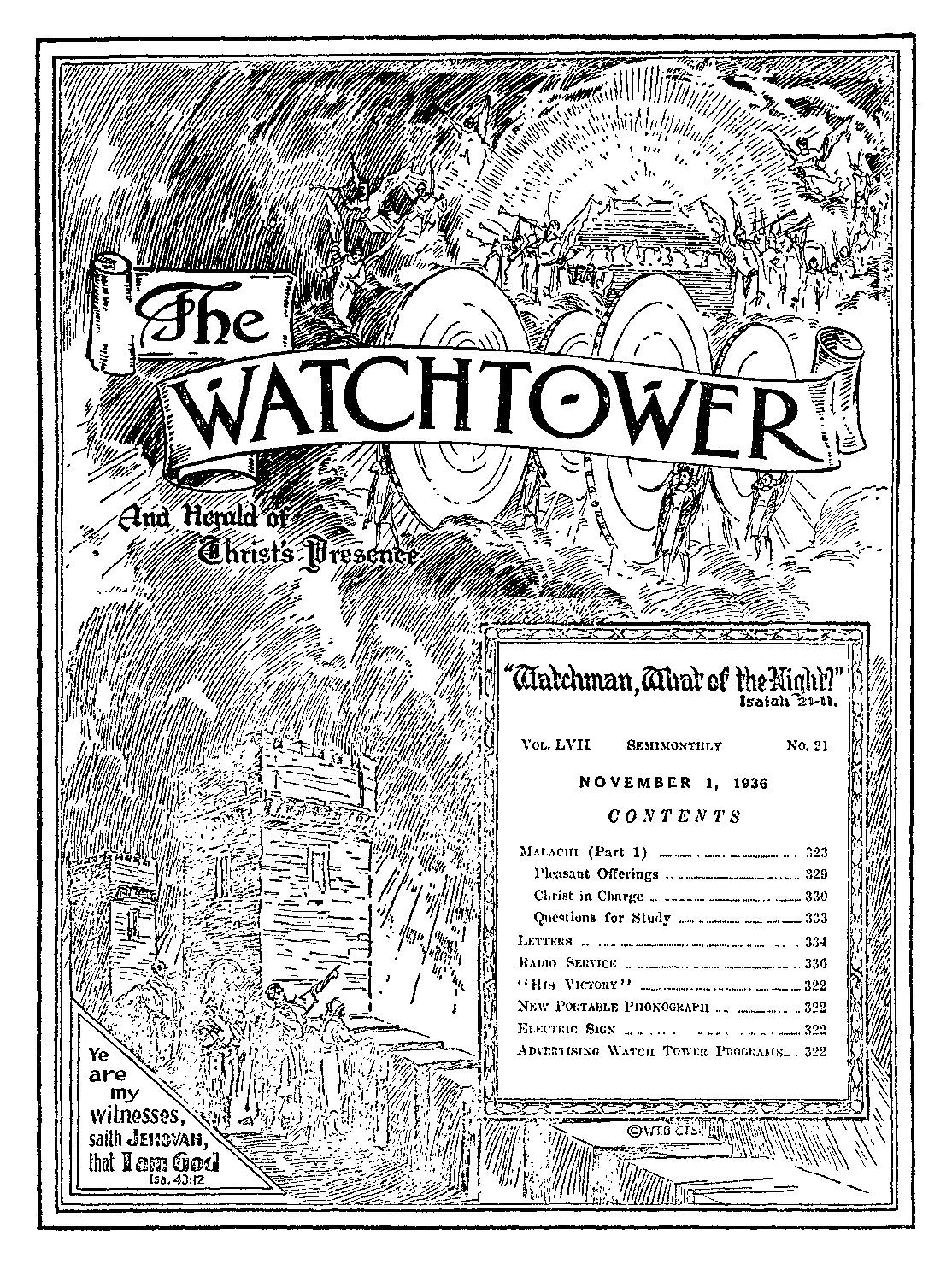
The Watchtower, November 1, 1936
Download: PDF — The Watchtower, November 1, 1936
“HIS VICTORY”
This thrilling term designates the next testimony period of Jehovah’s kingdom publishers, December 5-13. Let tins notice suffice to at once interest you therein and to cause you to begin preparing forthwith. The printed message offered to the truth-needy peoples during this period will be the combination consisting of the book Riches and three booklets, including the booklet Choosing and a self-covered booklet, on a 35c contribution. Consult the forthcoming Informant for further details and then get all set for your full part in this testimony. Your promptness in inputting results of your activities will be appreciated.
NEW PORTABLE PHONOGRAPH
The Society now manufactures and has to offer a light-weight phonograph of new design, which is 14 by 13 by 5 inches in size, and covered with brown cloth and having rounded corners. It weighs 9 pounds 13 ounces, which is 5 1/2 pounds lighter than the previous model manufactured by the Society. With the three phonograph discs which can be carried in it, it weighs 12 pounds 6 ounces. The volume of sound is just as strong as that of the previous model, and the tone is of the best quality. As shipped out from our factory, the phonograph is timed properly, at 78 r.p.m., and should be checked from time to time. This new model, including three discs, is offered on a contribution of $10.00; without the three discs, $8.00. Remittance should accompany orders, Also specify the particular discs wanted.
ELECTRIC SIGN
For your homes and other places, to call attention of all passers-by to the kingdom message which Jehovah has entrusted to you to dispense. This sign is attractive. The wording on the insisted signs can be changed at small co f, and the Society will supply such changes from time to time so that they will be uniform throughout all the earth. The Society will fill the orders at once, shipped to any address in the United States, at $1.50 each, remittance to accompany order. If possible, order in lots of two at least, as they are packed two in a carton. They come complete with cord, flasher, electric bulb and sign. Groups should order there through their company servant, sending in one order for all required by the group.
ADVERTISING WATCH TOWER PROGRAMS
Witnessing parties and all individuals engaging in the field service should mention the radio station in their vicinity which carries the Watch Tower programs. This magnifies to the people called upon the message which Jehovah’s witnesses introduce and often results in interest in the printed message the part of the radio listener. This is one of the chief purposes of sending out the message over the radio, to encourage the people to read the literature. In this behalf the Society supplies radio folders, and all workers should make constant use of them in house to house calling, leaving one of them, if nothing else.
Vol. LVII
November 1, 1936
No. 21
MALACHI
PART 1
"But who may abide the day of his coming? and who shall stand when he appeareth? for he is like a refiner’s fire, and like fullers’ soap.”—Mal. 3:2.
JEHOVAH made Malachi his servant a prophet and caused him to deliver a message pertaining particularly to the great Servant and Prophet of Jehovah. The name Malachi means “angel of Jehovah’’ or “messenger of Jehovah”. He prophesied in the time of Nehemiah. Some have said that he was Nehemiah; but such does not appear to be the fact. He was a separate and distinct prophet, having the name Malachi. It is appropriate that Jehovah should use Malachi to declare the prophecy bearing his name.
2 Jesus had prophesied concerning his coming in the spirit to receive unto himself those who had proved faithful, and of his taking possession of and ruling the world. When Jesus ascended into heaven he was commanded to wait until God's due time, and when that due time came Jehovah caused his beloved One to give attention to the things of the earth, and particularly to the people of earth who had agreed to do his will. The tribe of Levi foreshadowed those who had made a covenant to do the will of God. Following the days of the apostles there was a long period of time in which great darkness came upon the peoples of the world and many of the consecrated fell away to the religious teachings and practices of insincere men.
3 The prophecy of Malachi pertains particularly to the “day of Jehovah” and centers around the third chapter of that prophecy. It is Jehovah who sends his angel or messenger; hence the prophecy says: “Behold, I will send [Behold, I send (R.V.); Behold me! sending (Roth.)] my messenger, and he shall prepare the way before me: and the Lord, whom ye seek, shall suddenly come to his temple, even the messenger of the covenant, whom ye delight in: behold, he shall come, saith the Lord of hosts.”-—Mal. 3:1.
4 The announcement is a very important one and is a warning to those who had entered into a covenant to do God's will. This prophecy, like many others of the Scriptures, seems clearly to have both a miniature fulfillment and a major fulfillment. Jehovah sent John the Baptist as his messenger or announcer of the coming of Christ Jesus, and concerning the miniature fulfillment of Malachi's prophecy it is written: “There was a man sent from God, whose name was John. The same came for a witness, to bear witness of the Light, that all men through him might believe. He was not that Light, but was sent to bear witness of that Light. John bare witness of him, and cried, saying, This was he of whom I spake, He that cometh after me is preferred before me; for he was before me.”—John 1: 6-8,15.
5 Jesus said concerning the messenger whom Jehovah sent to prepare the way before him: “For this is he of whom it is written, Behold, I send my messenger before thy face, which shall prepare thy way before thee.” (Matt. 11:10) “As it is written in the prophets, Behold, I send my messenger before thy face, which shall prepare thy way before thee. The voice of one crying in the wilderness, Prepare ye the way of the Lord, make his paths straight.”—Mark 1: 2, 3.
6 Zacharias, the father of John the Baptist, prophesied concerning the child: “And thou, child, shalt be called the prophet of the Highest; for thou shalt go before the face of the Lord, to prepare his ways; to give knowledge of salvation unto his people, by the remission of their sins.” (Luke 1:76,77) Jehovah used John the Baptist to prepare the way before Jesus, whom He sent to proclaim his truth and to vindicate his name and to save the obedient ones of mankind. How did he prepare the way? “For he shall be great in the sight of the Lord [as his witness], and shall drink neither wine nor strong drink; and he shall be filled with the holy [spirit], even from his mother's womb. And many of the children of Israel shall he turn to the Lord their God. And he shall go before him in the spirit and power of Elias, to turn the hearts of the fathers to the children, and the disobedient to the wisdom of the just; to make ready a people prepared for the Lord.”—Luke 1:15-17.
7 About the year 1878 the major fulfillment of Malachi's prophecy began, and that ‘preparing the way’ before Jehovah continued for approximately forty years. This corresponds to the forty years of wandering of the Israelites in the wilderness under the leadership of Moses, as it is written: “And I have led you forty years in the wilderness: . . . that ye might know that I am the Lord your God.” (Deut. 29: 5. 6) The work of ‘preparing the way before Jehovah’, from 1878 to 1918, was to qualify the prepared ones to be witnesses for Jehovah in the earth; and so the Lord caused Isaiah to write concerning the prepared ones: “Ye are my witnesses, saith the Lord, and my servant whom I have chosen; that ye may know and believe roe, and understand that I am he: ... I have declared, and have saved, and I have shewed, when there was no strange god among you [to do thus]: therefore ye are my witnesses, saith the Lord, that I am God.” (Isa. 43:10,12) The way was being prepared before Jehovah and that the prepared ones might be witnesses for Jehovah to his name or for his name’s sake.
8 When the work of preparing the way before Jehovah was done, then the Lord Jesus, Jehovah’s great Prophet, Messenger, Judge and Vindicator, comes suddenly or straightway to the temple: “Behold, I will send my messenger, and he shall prepare the way before me; and the Lord [Adon; the Son, and not Jehovah], whom ye seek, shall suddenly come to his temple, even the messenger of the covenant, whom ye delight in: behold, he shall come, saith the Lord of hosts.”—Mal. 3:1.
9 The Lord Jesus, who had been given the disciples and for whom his faithful followers had long been looking, is the “Lord” here mentioned. He is the one “whom ye seek”, meaning the one whom the faithful ones, who follow in the footsteps of Jesus and who are afterwards made the “faithful and wise servant” class, seek and for whom they were watching. Says the prophecy: He “shall suddenly come to his temple”, that is, unexpectedly, instantly, straightway; and for that reason it was very necessary for the ones expecting him to come to be watching, as Jesus had told them they must do. “Watch therefore; for ye know not what hour your Lord doth come. But know this, that if the goodman of the house had known in what watch the thief would come, he would have watched, and would not have suffered his house to be broken up. Therefore be ye also ready: for in such an hour as ye think not, the Son of man cometh.”— Matt. 24:42-44.
10 Prior to the coming of the Lord to the temple many of the truths that had long been hidden were brought to light, and those consecrated ones who were sincere and faithful were prepared for the coming of the Lord Jesus. Such were faithful to what they did understand, although the revelation of the prophecies must wait until the coming of the Lord Jesus to the temple.
11 Then came the great Messenger of Jehovah “suddenly” to the temple. Note that in the tenth verse of this prophecy, of the third chapter, the temple is called “mine house”, that is, the house of Jehovah. It is Christ Jesus that appears at the temple as the official representative of God, and thus Jehovah appears in a representative capacity at his temple. When the tabernacle was built in the wilderness the ark of the covenant was placed in the Most Holy and there represented the presence of Jehovah. “Then a cloud covered the tent of the congregation, and the glory of the Lord filled the tabernacle.”—Ex. 40:20-35.
12 When Solomon’s temple was completed and dedicated, the ark of the covenant was placed in the Most Holy of the temple. “And they brought up the ark of the Lord, and the tabernacle of the congregation, and all the holy vessels that were in the tabernacle, even those did the priests and the Levites bring up. And the priests brought in the ark of the covenant of the Lord unto his place, into the oracle of the bouse, to the most holy place, even under the wings of the cherubims. And it came to pass, when the priests were come out of the holy place, that the cloud filled the house of the Lord, so that the priests could not stand to minister because of the cloud; for the glory of the Lord had filled the house of the Lord.”—1 Ki. 8:4, 6,10,11.
13 The temple Solomon built was destroyed in 606 B.C., and later the temple was rebuilt by Zerub-babel and Joshua, and which was the temple in Malachi’s day; and in that temple last mentioned there was no ark of the covenant. Neither Ezra nor Nehemiah mentions the ark of the covenant as being there. In the temple of which Ezekiel had a vision there was no ark of the covenant shown as being in the most holy. The ark of the covenant shows the presence of Jehovah at the tabernacle and at Solomon's temple; but now in the real temple the Lord himself is present, hence there is no need for his presence to be shown by some object. Jehovah is present in the temple in the person of his beloved Son, who is the express image of his Father, and hence the glory of the Lord tills the temple.—Heb. 1:3; Hab. 2:20.
14 The coming of the Lord Jesus as Jehovah’s special representative to the temple is the time for the inauguration of the new covenant; hence says the prophecy of Malachi: “Even the messenger [angel] of the covenant, whom ye delight in,” The old or law covenant was inaugurated at Mount Sinai, where the tabernacle was first erected, and that covenant “was ordained by angels [that is to say, the messengers under Jehovah’s archangel] in the hand of a mediator”. (Gal. 3:19) Now at the coming of the Lord Jesus to the temple the new covenant is inaugurated at the hand of Jehovah’s great Messenger or Angel, the Lord Jesus Christ in glory. It is this messenger in whom those who love him and love his appearing have great delight. “And [at the inauguration of the new covenant] I will shake all nations, and the desire of all nations shall come; and I will fill this house with glory, saith the Lord of hosts.”—Hag. 2:7.
15 Concerning this the faithful inspired apostle wrote: “When Christ, who is our life, shall appear then shall ye also appear with him in glory." (Col 3: 4) “For our conversation [citizenship (Roth.)] is in haven; from whence also we look for the Savior, the Lord Jesus Christ.’’ (Phil. 3:20) “When he shall come to be glorified in his saints, and to be admired in all them 1hat believe (because our testimony among you was believed) in that day.’’—2 Thess. 1:10.
16 The apostle emphasizes the fact that those who “love his appearing’’ [at the temple] would then receive the crown of life, showing that at his appearing at the temple the faithful dead would first be awakened out of death and join the Lord at the temple. (2 Tim. 4: 8; 1 Thess. 4:16) There could be no doubt of his coming when Jehovah’s due time arrives, because Jehovah brings to pass his purpose according to his will. “Behold, he shall come, saith the Lord of hosts.’’ This is in exact accord with the words of Christ Jesus: “He which testifieth these things saith, Surely I come quickly.’’—Rev. 22:20.
17 This declaration concerning the Lord’s coming to the temple is a special announcement to those who had made a covenant by sacrifice to do Jehovah’s will and who therefore are in line for the priesthood. The words which Jehovah put in the mouth of his prophet definitely show that the announcement is for those who had agreed to be entirely submissive to the will of Jehovah. Says the prophet of the Lord: “And now, O ye priests, this commandment is for you.” (Mal. 2:1) The clear inference is also that there would be some who would show their faith and faithfulness and would receive the Lord’s approval at his coming, and some who would receive his curse because of unfaithfulness. “If ye will not hear, and if ye will not lay it to heart, to give glory unto my name, saith the Lord of hosts, I will even send a curse upon you, and I will curse your blessings; yea, J have cursed them already, because ye do not lay it to heart. Behold, I will corrupt your seed, and spread dung upon your faces, even the dung of your solemn feasts, and one shall take you away with it.”—Mal. 2:2, 3.
18 Those persons without authority who assume to bestow blessings of the Lord upon others, and who are God’s enemies, he curses. For instance, the pope declared, in 1933, a holy year and attempted to pronounce blessings upon the world, which is Satan's organization and God’s enemy, but the year brought upon the world curses and not blessings. Those whom the pope represented, including himself, falsely assume to be the representatives and priests of the Lord.
19 That the coming of the Lord Jesus to the temple marks a crucial testing is definitely settled by these words of the prophet: “But who may abide the day of his coming? and who shall stand [approved by the Lord] when he appeareth? for he is like a refiner’s fire, and like fullers’ sope.” (Mal. 3:2) This coming of the Lord Jesus to the temple is in “the day of Jehovah”, which day reaches a great climax at Armageddon. Christ Jesus comes to the temple to take account with those who have agreed to do God’s will, and those who are in an implied covenant to do his will, and it is therefore a time of judgment, which begins at the house of God and extends to all those who are in an implied covenant to do God’s will. The question is raised, Who will abide that day? who will maintain his integrity and show himself truly devoted to Jehovah during that trying period? This does not necessarily mean that all who maintain their integrity will survive in the flesh to and through the time of the battle of the great day of God Almighty, but it does mean, Who will remain true and steadfast and on the Lord’s side throughout that day? This part of the prophecy corresponds to the statement of the Lord, “For the great day of his wrath is come; and who shall be able to stand?” (Rev. 6:17) That some will not successfully come through that fiery trial must be inferred from the prophecy itself. Other prophecies of the Lord support that conclusion, showing that there will be some of the consecrated who in that period of time become ungodly and shall not stand. “The ungodly are not so: but are like the chaff which the wind driveth away. Therefore the ungodly shall not stand in the judgment, nor sinners in the congregation of the righteous. For the Lord knoweth the way of the righteous; but the way of the ungodly shall perish.”—Ps. 1:4-6.
20 The completeness of examination and cleaning up of the ones judged is emphasized by these words of the prophet concerning the great Judge: “He is like a refiner’s fire,” that is, the fire that melts down the close attachment of all dross to the real and precious metals. The great Refiner causes the dross to be separated from the real and to appear on the surface as scum so that it may be taken off and cast away by the angels attending upon the serving the Lord, the great Judge, at the temple. Continuing the prophet says: “And like fullers' sope”; “and like the lye of the washers” (Leeser) ;“and like fullers’ alkali. "(Roth.) According to the Hebrew of this text, the clothes were trampled upon in the fulling process. Prior to end up to the time of the beginning of this judgment the consecrated were mixed up in Babylon, or Satan’s organization, and when they came out they returned to the Lord with their garments soiled, that is, they being soiled with such marks or spots as would identify them as having been associated with the unclean. They must be cleaned up; and the great Judge cleans up all who submit, themselves willingly to his cleansing work, and he makes their garments such that they are identified thereafter as God’s sons and servants. They are made “white as snow”. (Mark 9:3) “Now Joshua was clothed with filthy garments, and stood before the angel. And he answered and spake unto those that stood before him, saying, Take away the filthy garments from him. And unto him he said, Behold, I have caused thine iniquity to pass from thee, and I will clothe thee with change of raiment.”—Zech. 3:3,4.
21 The cleansing work removed from the garments of those who love the Lord all spots that would identify them as having been with the Babylonish organization. That would include the taking away from them of improper names or means of identification, such as “Watchtower people”, “Russellites,” “Bible Students,” “Millennial Dawnists,” etc. Others who desire may keep such names, while the true and faithful will have only the “new name”, which the mouth of Jehovah gives to them. (Isa. 62:2) The cleansing work at the temple is the same as named by the apostle when he wrote: “Every man’s work shall be made manifest; for the day shall declare it, because it shall be revealed by fire; and the fire shall try every man’s work of what sort it is. If any man’s work abide which he hath built thereupon, he shall receive a reward. If any man’s work shall be burned, he shall suffer loss; but he himself shall be saved; yet so as by fire.”— 1 Cor. 3:13-15.
22 The material used by the builders, as indicated in the last above quoted text and designated symbolically ‘hay, wood and stubble’, was such as character building, adulation of men, and other marks received in Babylon, and such must be and is burned up by the fiery test. But if the ones who do use such material in building gladly let the same go and with continued rejoicing stand on the firm foundation of Christ Jesus, building with the precious things that are indestructible, such are saved “as by fire”. That fiery test takes place while the Lord Jesus, the great Judge, is at the temple.
23 Some who claim to be servants of God and Christ Jesus have failed to appreciate and see that the Lord Jesus is at the temple of Jehovah. Some of such scoff at the statement that he is at the temple, and this of itself proves that they are not made pure by the fiery tests. Surely those who are tried and approved would know that the Lord is at the temple, because, says the prophet, “he shall sit as a refiner and purifier of silver; and he shall purify the sons of Levi, and purge them as gold and silver, that they may offer unto the Lord an offering in righteousness.”—Mal. 3:3.
24 At his judgment work the Lord must apply the fire, that is, the crucial tests, so as to cause the dissolution or separation of the approved from the disapproved and thereby show up or make manifest that which is precious and that which is base or dross. The fire that causes the separation appears to be the prophetic truths which the Lord reveals, together with the publication and service of such truths in vindication of Jehovah’s name. “Is not my word like as a fire? saith the Lord.” (Jer. 23:29) “For the word of God is quick and powerful, and sharper than any two-edged sword, piercing even to the dividing asunder of soul (those walking after the flesh] and spirit [those walking after the spirit of the Lord Jesus, which is to vindicate his Father’s name], and of the joints and marrow, and is a discerner of the thoughts and intents of the heart.” (Heb. 4:12) “Every branch in me that beareth not fruit he taketh away: and every branch that beareth fruit, he purgeth it, that it may bring forth more fruit. Now ye are clean [purged] through the word which I have spoken unto you.” —John 15:2,3.
25 But those who have received or used the truth for a selfish purpose will not and do not stand the fiery test. Likewise those who fear men or man-made institutions will not stand when the time comes to apply the fire. The fear of man shows that one is selfish and that he does not really love Jehovah God and Christ Jesus and rely wholly upon God and Christ. All who really love the Lord God are without fear of man. (1 John 4:17,18) Fear of man, which leads one to refrain from telling the truth and testifying to Jehovah’s name when opportunity is offered, leads that fearful person right into Satan’s snare. (Prov. 29: 25) Those who have part in the vindication of Jehovah’s name will stand firmly for Jehovah and maintain their integrity when the fire is applied. It seems proper that others must be forewarned. For this reason The Watchtower makes a statement of fact that has occurred.
26 Recently, in Germany, some who had held places of prominence in the service of the Society and engaged in that service in the Lord’s name were arrested and brought before the courts of Germany and put on trial, and when before the courts, the representative of Satan and his organization, those men failed completely to stand for the name of Jehovah and his kingdom. The German government, under the control of Satan and his chief marshal, Gog, is now operated by the wicked ones, the visible part of the organization under the direction of the Roman Catholic Hierarchy, and has cast great reproach upon the name of Jehovah, by word of mouth, by public declaration, and by cruelly persecuting Jehovah’s witnesses. Because the faithful followers of Christ Jesus have pursued their God-given right and duty to obey God’s commandments by assembling together and studying the Word of the Lord, and because of telling others about Jehovah and his kingdom, these faithful ones have been arrested and ill-treated and cast into prison. When before the courts on trial under these unjust charges the opportunities were offered to those who were in a covenant with the Lord to plainly state before the representatives of Satan that they do serve Jehovah God, and will obey him first, last and all the time. The faithful ones could take no other course, and there have been many faithful ones who have taken such course. But at a recent trial of some of the more prominent ones of the Society, these latter ones failed to make use of such opportunity, but their testimony before the court showed that they feared men and were fearful of telling the truth concerning God’s kingdom. Such is a clear illustration of a failure to withstand the fiery test.
27 The great Refiner, Christ Jesus, at the temple, ‘sits as a refiner and purifier of silver,’ which symbolizes a precious class, that is, spirit-begotten ones, who are given the privilege to be the sons of God. “For thou, O God, hast proved us: thou hast tried us, as silver is tried.” (Ps. 66:10) The faithful ones desire to have all the dross taken away that they may stand approved by the Lord and shine forth to his glory. ‘‘Take away the dross from the silver, and there shall come forth a vessel for the finer [Refiner]. Take away the wicked from before the king [Christ Jesus], and his throne shall be established in righteousness.” (Prov. 25:4,5) It can never be said of the work of Christ Jesus, the great Refiner, that ‘‘the bellows are burned [having become hot from the exposure to the heat of fire] ; the lead [which was used as a solvent to absorb the dross from the silver] is consumed of the lire; the founder melteth in vain: for the wicked [refuse or dross] are not plucked away.” But concerning the unfaithful it is said: ‘‘Reprobate silver shall men call them, because the Lord hath rejected them.” (Jer. 6:29,30) Concerning “Christendom” and all the unfaithful it is written: “Thy silver is become dross, thy wine mixed with water.” (Isa. 1:21-23) The fiery tests are applied to the approved ones in order that these might be made clearly to appear to the glory of the Lord.
28 This is not a trial upon the worldly class that has never agreed to do the will of Cod, but, says the prophecy, “He shall purify the sons of Levi,” that is to say, those who have consecrated themselves and set themselves aside to do the will and service of the Lord Cod. The prophecy here is limited to those so agreeing. Why is it necessary to purify the sons of Levi? These are the ones who are in line for a place in the temple. They include the priestly and non-priestly class, that is, some who have occupied one place in the service, and some a separate and different place in the service, but all standing equal and having an equal and fair trial before the Lord. Not all of these have served in the priest’s office, because there are not enough places, but all who are Levites are set aside for the service of the Lord, and all are equally responsible to prove their faithfulness to the Lord. This does not mean that the priests picture a “little flock”, and those who are non-priests picture the “great multitude”. This matter is more fully discussed in The Watchtower of June 1, 1936. The tribe of Levi stands here for all consecrated ones in line for the kingdom of Cod under Christ and who necessarily must appear before the Lord Jesus when he is at the temple for judgment. The prophet gives the reason why this trial or testing must be had, when he says, to wit: “And now, O ye priests, this commandment is for you. If ye will not hear, and if ye will not lay it to heart, to give glory unto my name, saith the Lord of hosts, I will even send a curse upon you, and I will curse your blessings; yea, I have cursed them already, because ye do not lay it to heart. Behold, I will corrupt your seed, and spread dung upon your faces, even the dung of your solemn feasts, and one shall take you away with it. And ye shall know that I have sent this commandment unto you, that my covenant might be with Levi [as being my covenant with Levi (Rotherham)], saith the Lord of hosts. My covenant was with him of life and peace; and I gave them [life and peace] to him [on what condition?] for the fear wherewith he feared me, and was afraid [in awe] before my name. But ye [priests] are departed out of the way; ye have caused many to stumble at the law: ye have corrupted the covenant of Levi, saith the Lord of hosts. Therefore have I also made you contemptible and base before all the people, according as ye have not kept my ways, but have been partial [(R. V.) have had respect of persons] in the law.”— Mal. 2:1-5, 8,9.
29 The “covenant of Levi” is declared by the Word of Cod in these words: “And of Levi he said, Let thy Thummim and thy Urim be with thy holy one [Levi set aside as holy to the Lord], whom thou didst prove at Massah [Temptation], and with whom thou didst strive, at the waters of Meribah [Strife; Chiding] ; who [the tribe of Levi] said unto his father and to his mother [if unfaithful to God], I have not seen him : neither did he acknowledge his [unfaithful] brethren, nor knew his own children [because of their worshiping the golden calf at Mount Sinai] : for they [the sons of Levi] have observed thy word, and kept thy covenant. They shall teach Jacob thy judgments, and Israel thy law ; they shall put incense before thee, and whole burnt sacrifice upon thine altar. Bless, Lord, his substance, and accept the work of his hands: smite through the loins of them that rise against him [as the ‘wicked servant’ class have done], and of them [‘Christendom’] that hate him, that they rise not again.”—Deut. 33:8-11.
30 The prophet Malachi further says concerning the sons of Levi: “And purge them as gold and silver”; because of their faults toward God and the covenant made with him. The coming of the Lord Jesus to the temple for purging or cleansing of the Levites was absolutely necessary because those in the church, and particularly the “elective elder” portion thereof, were taking honor to themselves and almost all in the church were giving honor and praise to creatures, which honor and praise was due only to the Lord. By his prophet the Lord pointed out these faults, to wit: “A son honoureth his father, and a servant his master: if then I be a father [toward you of spiritual Israel], where is mine honour [due me from you] ? and if I be a master [sovereign or controller], where is my fear [due from you]? saith the Lord of hosts unto you, O priests, that despise my name. And ye say, Wherein have we despised thy name? Ye offer polluted bread [received from would-be sacrificers] upon mine altar; and ye say [self-righteously and contemptuously], Wherein have we polluted thee? In that ye say, The table [altar] of the Lord is contemptible. And if ye offer the blind [and therefore blemished animals] for sacrifice, is it not evil? and if ye offer the lame and sick [animals for sacrifice], is it not evil ? offer it now unto thy governor; will he be pleased with thee, or accept thy person? saith the Lord of hosts. But ye have profaned it [Jehovah’s name], in that ye say, The table of the Lord is polluted ; and the fruit thereof, even his meat [offered on his altar], is contemptible. Ye said also, Behold, what a weariness is it! and ye have snuffed at it [at me (Roth., margin)], saith the Lord of hosts: and ye brought that which was torn, and the lame, and the sick; thus ye brought an offering; should I accept this of your hand? saith the Lord.” (Mal. 1: 6-8, 12,13) Thus the Lord shows that these have offered unto him an offering not acceptable but which was prompted by selfishness.
31 Were there any servants in the priest’s office in 1917 and 1918 that proved themselves to be enemies, deceiving themselves and others? The type shows that there must have been, and the indisputable facts show that there were such in fulfillment of the prophecy. Concerning such the prophet Malachi says: ‘‘But cursed be the deceiver [among the priests], which hath in his flock a male, and voweth, and sacrificeth unto the Lord a corrupt thing [the priests not objecting to it]: for I am a great King, saith the Lord of hosts, and my name is dreadful among the heathen [nations].” (Mal. 1:14) Those who were striving to serve the Lord faithfully in the years 1917 and 1918 call to mind the many acts of others who at the same time claimed to be devoted to the Lord but who were honoring themselves and honoring others, deceiving themselves and deceiving many others, and doing violence to the Lord’s work, and who were doing no honor whatsoever to the name of Jehovah God. According to the rule announced by the prophet these must be rejected, gathered out from amongst the faithful ones, and set on the side, even as Jesus had foretold.—Matt. 13: 41.
32 The doors of Solomon’s temple were made of olive wood and hung with golden hinges. (1 Ki. 6:31,32,34; 7:50; 2 Ki. 18:16) In symbol these represented the way of entrance by those who were wholly devoted to Jehovah, the olive being a symbol of The Christ. (Zech. 4:3, 14; see Preparation, pages 64-66) Men serving in the priest’s office amongst God’s people, and who received honor and gave honor to creatures, were not honoring Jehovah; and little wonder, therefore, that the Lord exclaims: ‘‘Who is there even among you [the priests] that would shut the doors [lock up the doors of the sanctuary] for nought? neither do ye kindle fire on mine altar for nought. I have no pleasure in you, saith the Lord of hosts, neither will I accept an offering at your hand.”—Mal. 1:10.
33 Such servants were not giving honor to Jehovah’s name, but were always looking for a handout lor their individual selfish enjoyment, which was void of the spirit expressed by the psalmist, which says that all those wholly and unselfishly devoted to Jehovah and his service delight to serve in his temple. ‘‘For a day in thy courts [in thy temple] is better than a thousand. I had rather be a doorkeeper [ (margin) I would choose rather to sit at the threshold] in the house of mv God, than to dwell in the tents of wickedness.” —Ps. 84:10.
34 Jehovah is pleased with them that worship him in spirit and in truth, and not with those who merely give outward form or appearance to worship. (John 4:23) The men impressed with their own importance deceive themselves by making themselves believe that they are more holy than others, and they deceive others by reason of their sanctimoniousness and hypo- critical appearance.
35 The antitypical Levites must be purged ‘‘as gold and silver”, that is, be put into the crucible and have the heat to the melting point applied. There is nothing that cleanses like fire. Only the pure and indestructible can remain. It appears that this prophecy had a miniature fulfillment after the Jews returned from Babylon to build the temple at Jerusalem. Nehemiah then found existing conditions that are described by Malachi, the prophet, and Nehemiah proceeded to cleanse or clean them up. The Jews had associated themselves with the Devil’s organization by marrying wives of Ashdod, of Ammon and Moab. Likewise the Levites, at the coming of the Lord Jesus to the temple, had associated themselves with ‘‘Babylon” by adopting ceremonies such as Babylon used, and showed that they cared more for the approval of men than for the approval of Jehovah God and Christ Jesus. Concerning the condition existing amongst the Jews in Nehemiah’s day that prophet wrote: “Remember them, O my God, because they have defiled the priesthood, and the covenant of the priesthood, and of the Levites. Thus cleansed I them from all strangers, and appointed the wards of the priests and the Levites, everyone in his business. ”—Neh. 13: 29, 30.
36 After the coming of the Lord Jesus to the temple and the applying of the ‘‘refiner’s fire” test he sends forth his angels and clears out or cleans out all those antitypical Levites who were once in line for the kingdom but who had failed to keep their covenant and to serve God in spirit and in truth. This the Lord does that the remaining or purified ones may be like gold and silver made pure, faithful, dependable and indestructible, ‘‘that they may offer unto the Lord an offering in righteousness.” Such remnant or approved ones are described by the prophet Zechariah as the ‘‘third part”, which are brought through the fire. ‘‘And it shall come to pass, that in all the land, saith the Lord, two parts therein shall be cut off, and die; but the third shall be left therein.”—Zech. 13:8,9.
37 The Scriptures make no mention of an acid test’s being applied to God’s people, such as is used in modern chemistry. There is no Scriptural reason to try to fit such a list into the type and antitype. The acid test is an invention of man, and not of the Lord The refining with fire, such as the Scriptures describe, means to fuse metals, to melt, as gold is melted, as a goldsmith does his metal; and this pertains to destroying everything that is foreign to the gold, and symbolically means destroying everything that is of the Devil or Babylonish ceremony amongst those who covenant to do God's will. This is done according to the “covenant of Levi’’, and those receiving the approval of the Lord show the zeal for the Lord peculiar to his house in putting away everything that pertains to Satan’s hypocritical organization and practices amongst the members of that organization. As an example: The young priest Phinehas with much energy and zeal helped to oust Baal worship in Israel, and because of his faithfulness in so doing the Lord said: “Wherefore say, Behold, I give unto him my covenant of peace: and he shall have it, and his seed after him, even the covenant of an everlasting priesthood; because he was zealous for his God and made an atonement for the children of Israel.’’—Num. 25:10-13.
38 Note that the prophecy above quoted applies to the zealous priest Phinehas “and his seed after him’’, which included Zadok and his sons, of whom Joshua, the high priest in Zerubbabel’s day, was one. (Hag. 1:1; Zech. 3: 1-9) Also, it appears that that “seed’’ included Zacharias, the father of John the Baptist. John the Baptist did not serve in the temple, but undoubtedly the promise here concerning the priesthood included him also. (Luke 1:5,13) God said concerning the sons of Zadok: “But the priests the Levites, the sons of Zadok, that kept the charge of my sanctuary when the children of Israel went astray from me, they shall come near to me to minister unto me, and they shall stand before me to offer unto me the fat and the blood, saith the Lord God: they shall enter into my sanctuary, and they shall come near to my table, to minister unto me, and they shall keep my charge.’’ (Ezek. 44:15,16) These therefore foreshadowed or pictured the faithful or ones approved by the Lord at his judgment time at the temple.
39 A ‘righteous offering unto the Lord’, such as mentioned by the prophet Malachi, could not be mixed with and therefore contaminated by any halfway faithfulness, such as compromising with any part of the Devil’s organization. The offering must be unblemished, and spiritually such offering must be “spiritual sacrifices, acceptable to God by Jesus Christ’’. (1 Pet. 2:5) Attempting to gain favor among men by compromising with any part of Satan’s organization could not be acceptable to the Lord. The offering must be a whole-hearted devotion unto Jehovah, together with “sacrifice of praise to God continually, that is, the fruit of our lips, giving thanks to his name’’. (Heb. 13:15) The work of ‘offering an offering in righteousness’ must mean that the soiled garments worn while amongst the Babylonians must be taken away from the antitypical tribe of Levi after leaving the antitypical Babylonish crowd, and all uncleanness removed, that the acceptable service of God might be clearly identified as being for the Lord first, last, and all the time. The robe of righteousness is given to such to cover their imperfections, that they may offer an acceptable sacrifice of devotion and service unto God. (Zech. 3:1-5; Isa. 6:1-11; 61; 10; 2 Cor. 6:14-18) The sanctuary must be cleansed by removing all compromisers, who seek the favor of creatures. (Dan. 8:14) It follows that any who indulge in compromising with the Devil's organization for any reason whatsoever are prevented from entering or remaining in the temple. (Sec Ezekiel 40:8-10; Vindication, Book Three, pages 199,200.) One might continue for a time to mingle with the approved remnant while here in the flesh and yet not be of the temple class, and these will be manifested by their course of action as to where they really stand. The Lord judges all according to the heart condition, and all selfishness and the compromising spirit will in due time be made clearly manifest and the disapproved set aside from the Lord’s holy organization.
PLEASANT OFFERINGS
40 The cleansing and refining work applies to the entire antitypical tribe of Levi, and this proves conclusively that the Levites aside from the. priests do not picture a class of consecrated ones that are partially faithful and that must be forced into sacrifice. Those of the antitypical Levites serve in different places and in different capacities in God’s organization, but all the approved ones must he equally clean and equally faithful and dependable. God sets the members in the body as it pleaseth him, and whether one is serving in one place or another he must be equally clean and approved by the Lord. It is the purified and approved sons of Levi in office, and doing service where placed by the Lord, that the prophet refers to when he says: “Then shall the offering of Judah and Jerusalem be pleasant unto the Lord, as in the days of old, and as in former years.’’ (Mal. 3:4) The ones mentioned in this verse of the prophecy as “of Judah” would mean the remnant of the true Judeans since the cleansing work of the Lord is performed at the temple. The sons of Aaron were of half Levite and half Judah strain, because their father Aaron married a daughter of the tribe of Judah, the family which was in line for the royal house. (Ex. 6:23) “Jerusalem” is a name of Jehovah’s organization, the mother of the remnant of the true Judeans yet on the earth. (Gal. 4: 2G) All these now must offer a pleasant offering unto the Lord, because that offering must be entirely free from all creature-worship, which creature-worship is of “the sin of Samaria”. Such offering must also be free from all Baal worship in any form whatsoever. It must be a service devoted exclusively to the vindication of Jehovah ’s name. It is for this purpose that Jehovah takes out from amongst men “a people for his name”. These taken-out ones are made the anointed witnesses of Jehovah, who must henceforth faithfully represent him. When accosted or asked by those who represent the Devil on earth whether you are engaged in the service or work contrary to the law of the land or not, the faithful will answer, in substance: ‘We are not careful to obey the law of the land when such law is in exact conflict with God’s law. Our God, to whom we are devoted and whom we serve, has commanded us to make known that his kingdom is at hand, and this we will do, by His grace, even though the law of the land commands us to refrain from so doing. Our duty and our desire is to obey God whether it pleases men or not. We should serve God rather than men.’ (Dan. 3:16-18; Acts 5:29) This does not mean that the servant of the Lord should be rude at any time or should attempt to provoke others to anger or wrath. The servant of God must be bold in declaring the truth; and to be bold means to tell the truth without the fear of men. It means to tell it calmly, plainly, firmly, and not to shun to declare it when required to do so. Boldness in telling the truth is what God’s people are commanded to have at this time. (1 John: 4:17,18) That means to be frank, outspoken, and to show complete confidence in the Lord, whom we serve. Some conceive the idea that they must use harsh speech in defiance of the officers of the world. Such a course is entirely wrong. Some have thought it right to go upon the premises of schools and publicly put forth a sound transcription record regarding the protest against being compelled to salute the flag. Such a course of action is rudeness and without justification. We should always seek occasion to tell the truth, and tell it, but not to put ourselves in a position to provoke others to wrath by entering a public school or assembly place without invitation. Boldness and frankness mean never to hesitate to tell the truth when opportunity arises and to watch for opportunities to tell the truth. If brought into court and required to tell why we are making known this gospel of the kingdom, the faithful one will not compromise by withholding any portion of the truth or by complimenting worldly officers, such as some have done, as stated. The faithful one will with calmness, frankness, and with full confidence in the Lord say that he is preaching the gospel of the kingdom and that he is doing so in obedience to God’s commandment, and that God’s law and commandments are supreme, and far above any law that any man or man-made government can make. Such boldness and frankness in telling the truth by giving testimony to the name of Jehovah will be an evidence to those who are against the truth that such witnesses have the backing of the Lord, and this always puts the evil one to flight. Concerning this the apostle wrote: “And in nothing terrified by your adversaries: which is to them an evident token of perdition, but to you of salvation, and that of God. For unto you it is given in the behalf of Christ, not only to believe on him, but also to suffer for his sake. ”—Phil. 1:28,29.
41 Because of such open frankness and bold faithfulness unto God some of the remnant may suffer severe physical punishment, even unto death; but shall we fear to displease men in order to avoid punishment by men, or shall we fear to displease our Lord and Jehovah God, and suffer the loss of everything.' (Matt. 10:28-33) The offering of the antitypical, purified Levites must now be pleasing to the Lord, “as in the days of old,’’ such as when King David ruled in Jerusalem. Now God has raised up “the tabernacle of David’’, that is to say, his capital organization under the Greater David, Christ Jesus, and has sent forth his witnesses to make known his name and his kingdom: “In that day will I raise up the tabernacle of David that is fallen, and close up the breaches thereof: and I will raise up his ruins, and I will build it as in the days of old: that they may possess the remnant of Edom, and of all the heathen, which are called by my name, saith the Lord that doeth this.’’—Amos 9:11,12.
42 The foregoing prophecy was applied by the apostle in this manner: “That the residue of men might seek after the Lord, and all the Gentiles, upon whom my name is called, saith the Lord, who doeth all these things.’’ (Acts 15:17) When Jesus was in the flesh on the earth, and his faithful apostles with him, neither Jesus nor his apostles shunned to speak the truth with frankness and with full confidence in Jehovah. As it was ‘in the former days’, so now it must be. The name of Jehovah shall be made known, and his witnesses, the antitypical Levites, are sent forth to make it known, according to God’s good pleasure.
CHRIST IN CHARGE
43 The Lord Jesus Christ is in full command of the witness work on the earth. To him is committed all power in heaven and in earth, and he is commissioned to do the judging and the execution of judgment. (Matt. 28:18; John 5:22,27) The Lord has anointed his servant class and sent them forth to be his representatives; and the Lord Jesus himself being in charge, not one of his servants need fear what men can do to him, nor should they be exalted in their own estimation because of their position. With calmness, sobriety and dignity becoming one who represents the King, and with complete courage, the witnesses, the faithful, backed by the Lord, will go forth to the service. “And I will come near to you to judgment; and I will be a swift witness against the sorcerers, and against the adulterers, and against false swearers, and against those that oppress the hireling in his waves the widow, and the fatherless, and that turn aside the stranger from his right, and fear not me, saith the Lord of hosts.’’—Mal. 3:5.
44 The Lord Jesus has gathered the faithful into the temple. Now in his holy temple he is near them that love and serve him. His judgments rendered and executed at the temple are swift against those who claim to be for the Lord but who are not. The Lord at the temple opens up the books of the Scriptures, that is to say, the prophecies now in course of fulfillment, and to those who love him he gives an understanding and appreciation of these prophecies. But to the selfish ones, who seek to exalt themselves or to do injury to any part of God’s organization, he does not give an understanding or appreciation of these prophecies. Jehovah gives this revelation or unfolding of his prophecies by and through his Son, Christ Jesus, because Jehovah and Christ are the teachers and interpreters of prophecy. The unfolding of his prophecies, the knowledge and understanding thereof, the Lord transmits to his faithful and true witnesses, that they may go forth and give the true testimony concerning the same. Concerning this the Lord caused to be written: “I beheld till the thrones were cast down [in 1914, the beginning of Jehovah’s day], and the Ancient of days did sit, whose garment was white as snow, and the hair of his head like the pure wool; his throne was like the fiery flame, and his wheels as burning fire. A fiery stream issued and came forth from before him; thousand thousands ministered unto him, and ten thousand times ten thousand stood before him: the judgment was set, and the books were opened.”—Dan. 7 : 9,10.
45 These prophecies of the Lord bear a “swift witness against the sorcerers”, that is, against those who practice magic or witchcraft. Such are sorcerers. “For rebellion is as the sin of witchcraft, and stubbornness is as iniquity and idolatry. Because thou hast rejected the word of the Lord, he hath also rejected thee from being king.”—1 Sam. 15:23.
46 Those that sell themselves to the Devil would cast a spell over God’s faithful people, if possible. Such sorcerers are those who defy the word of the great Prophet, Christ Jesus, and the true witnesses of the Lord that speak his Word. (Deut. 18:10; Jer. 27:9,10) In this class of sorcerers are included the ones who attempt to hinder the progress of the Lord’s witness work, such as attracting attention of the workers to themselves, and thus interfering with the united and forward movement of God's people in service. Jehovah is a “swift witness” against such as try to interfere with the progress of his work in any form, and Christ Jesus, the great Officer at the temple, acts towards such interferers and sends forth his angels to gather out such sorcerers and casts them out of the kingdom, that is, out of the temple.—Malt. 13:41; Rev. 21:8; 22:15.
47 If one has been entrusted with the service of the Lord in the name of the Lord and he is faithful, having in mind only one thing, that is, to exalt the name of Jehovah, that person will not be hunting something to find fault with and hinder the work of God’s organization. On the contrary, he will show his full faith and confidence in the Lord and that the Lord knows how to conduct his own affairs, and he will have faith that God and Christ Jesus will permit no interference therewith. The faithful well know that those who insist on interfering with the Lord’s work he gathers out and separates from his true and faithful ones. Those who thus by faultfinding are interfering in any manner with the forward progress of the proclamation of God’s kingdom message show that they are entering into darkness and will soon be in full darkness and have no appreciation of the prophecies, which the Lord is now unfolding. The prophet Malachi, speaking the words of the Lord, says that he is “against the adulterers”. In the type made by the Israelites, “adultery” consisted of illicit relationship with another’s woman. God’s “woman” is Zion, and she gives birth to the sons of God and she stands for Jehovah’s organization. Satan’s “woman” is Babylon and gives birth to the seed of the Serpent, that serves him. For one of God’s sons to have mutual relationship with the Devil’s woman, that is, the Devil’s organization, is, within the meaning of the Scriptures, spiritual adultery. One who is thus guilty is induced by selfishness, that his own selfish desires may be gratified. Concerning this it is written in the Scriptures: “Ye ask, and receive not, because ye ask amiss, that ye may consume it upon your lusts. Ye adulterers and adulteresses, know ye not that the friendship of the world is enmity with God ? whosoever therefore will be a friend of the world, is the enemy of God.”—Jas. 4: 3, 4.
48 A person moved by a selfish desire to have some favor from the Devil’s organization, seems clearly to come within the definition of “adulterer” as given in the foregoing scripture. “Be ye not unequally yoked together with unbelievers: for what fellowship hath righteousness with unrighteousness? and what communion hath light with darkness? And what concord hath Christ with Belial ? or what part hath he that believeth with an infidel? And what agreement hath the temple of God with idols? for ye are the temple of the living God; as God hath said, I will dwell in them, and walk in them; and I will be their God, and they shall be my people.”—2 Cor. 6:14-16.
49 Jehovah’s faithful witnesses must be entirely separate from Satan’s organization, and they must “touch not the unclean thing”. (2 Cor. 6: 17,18) Every one that remains in God’s organization must be wholly and completely devoted to Jehovah and his kingdom, and his course of action must be so clear and straightforward for the Lord that there cannot be any. doubt about where he stands.
50 Likewise the Lord, by his prophet, here declares that he is against the “false swearers”. When one makes a consecration to do the will of God he covenants and agrees to be faithful to God; and if he fails or refuses to keep that covenant vow, such a one is a false swearer. (Ps. 78:10) Such false ones are they that take God’s name in vain. (Ex. 20:7) Jehovah is against that kind of persons, and his curse is on them. (Zech. 5:3,4) It is written concerning such false swearers that they are 'proud, boasters, inventors of evil things [that which works evil to others], disobedient to parents [Jehovah’s commandments and the law of his organization], without understanding, covenant breakers, and against which God renders an adverse judgment, and declares that they are worthy of death. ’—2 Tim. 3:1-5; Rom. 1: 30-32.
51 Likewise Jehovah God, through his prophet, here says that he is “against those that oppress the hireling in his wages”. The Lord has hired his laborers to work in his vineyard, and now these have received at his hand the “penny”, that is, the ‘new name, which the mouth of Jehovah has given them’. (Matt. 20:2-15 ; Isa. 62:1-3) Opposers are those who try to prevent the hired laborers from working in the vineyard. This they do by trying to hold them back from using the “penny” in the service of Jehovah as his witnesses. Even at this late date some who were among the ones hired complain because those hired later receive the same full wages. All of those who are truly devoted to God and his kingdom will rejoice to see the laborers working firmly together and bending every effort to the honor of Jehovah’s name. The faithful will not oppose or attempt in any manner to hinder the work, but will joyfully engage with their brethren in the service to the honor of Jehovah’s name, gladly bearing the reproaches such as fell upon the Lord Jesus Christ because of his faithfulness to his Father.
52 Likewise the Lord, by his prophet Malachi, here says that he is against them “that oppress . . . the widow and the fatherless”. There are many persons now on earth who are of good will toward God, the Giver of life, but, not having heard the truth, and not having had opportunity to embrace it and take their stand on the side of Jehovah, such are truly “fatherless”, A widow is a woman (symbolic of any organization) that is without a husband. Jehovah is the husband of his woman, or organization. (Isa. 51:1-10) There are organizations in the land many persons amongst which apparently desire to serve the Lord, but are held back and restrained by Satan’s representatives, and such organizations are in fact “widows”, because, although claiming God as their husband, he rejected them, it is written: “Pure religion and undefiled before God and the Father, is this, To visit the fatherless and widows in their affliction, and to keep himself unspotted from the world.”—Jas. 1:27.
53 Thus the Lord, by his apostle, defines true “religion”. The religion that is practiced by the organizations under the Devil’s supervision consists of forms and ceremonies that dishonor God and Christ Jesus. It is the true followers of Christ Jesus, those who are Jehovah’s anointed witnesses, that practice the pure religion as defined by James, and this they do by making it their regular and formal business to work and to go about in the land visiting the “widows”, that is, those organizations that desire to know of God and his kingdom; and “the fatherless”, that is, those who sigh and cry concerning the abominable things that they see amongst men and who hunger and thirst for righteousness. It is the formal and regular business of these faithful ones to visit and comfort such by exhibiting to them the truth. That is exactly what Jehovah's witnesses are doing today. Any other formal or regular work in the name of the Lord is a false religion. Manifestly the apostle here uses the words ’true religion’ to distinguish the proper work of a follower of Christ Jesus from the formalism called “Christian religion”, which is practiced by many organizations in the name of the Lord, but which is in fact a devilish formalism. There are many who oppose the work of Jehovah’s witnesses, which is prompted by loving obedience to God, and these opposers oppress the ‘widows and fatherless’, as above described; that is to say, when they see some seeking after the truth a d righteousness the opposers endeavor to prevent such truth- seekers from finding the truth. Those opposers include the ones who claim to serve God and yet would, if possible, hold back Jehovah’s witnesses from carrying the message of comfort to those who are called Jonadabs, or “other sheep”, and who form the “great multitude” class. It is the “widow” and “fatherless” now who are seeking the way of righteousness, to whom the message must be carried, and who will shortly form the great multitude. To carry the message of truth to such is a part of the present-day work of those anointed witnesses of Jehovah. The opposers and oppressors here mentioned by the prophet are the ones who do not ‘keep themselves unspotted from the world’, as James describes, but are the ones who mix with Satan’s organization and by compromise or other means seek favor thereof. It is the bounden duty of the antitypical Levites, after having burn purged, to go about amongst the people and “comfort all that mourn”, and to mark such by giving them an intelligent understanding of God’s purpose. (Isa. 61:2, Ezek. 9:4) There are those in Zion who must receive comfort, and there are those who are seeking the way to Zion that desire comfort, and to whom the faithful witnesses will carry the message of comfort. What is here said is not at all out of harmony with The Watchtower of March 15, 1932, but is rather in addition thereto.
…