The Watchtower, April 15, 1936
Download: PDF — The Watchtower, April 15, 1936
"CHOOSING"
As a worthy companion to the new book Riches comes forth a new booklet entitled Choosing. It contains the message that people of good will throughout the earth ate eager to lead and study, to wit, the recently broadcast speech “Separating the Nations”, and also a clear-cut treatise on "Your Choice”, showing that everyone must now choose between (не распознано) or ruin. The booklet's cover is colorful and very striking to the eye. Its ... to the public has only recently become effective. You may procure a copy on a contribution of 10c to the Society. Head it and you will be instantly enthusiastic for its distribution to others.
ADVERTISING WATCHTOWER PROGRAMS
Advertising the Kingdom helps also to advertise the radio stations which are broadcasting the kingdom message. Hence all witnessing parties and all individuals engaging in the field service should ... the radio station in their vicinity which carries the Watchtower programs. This magnifies to the people called upon the message which Jehovah’s witnesses introduce, and other ... in interest in the .... message on the part of the ... . This is one of the chief purposes of sending out the message over the radio, to encourage the people to read the ... . In this behalf the Society supplies radio ... , and all workers should make constant use of them in house-to-house calling, leaving one of then, if nothing else.
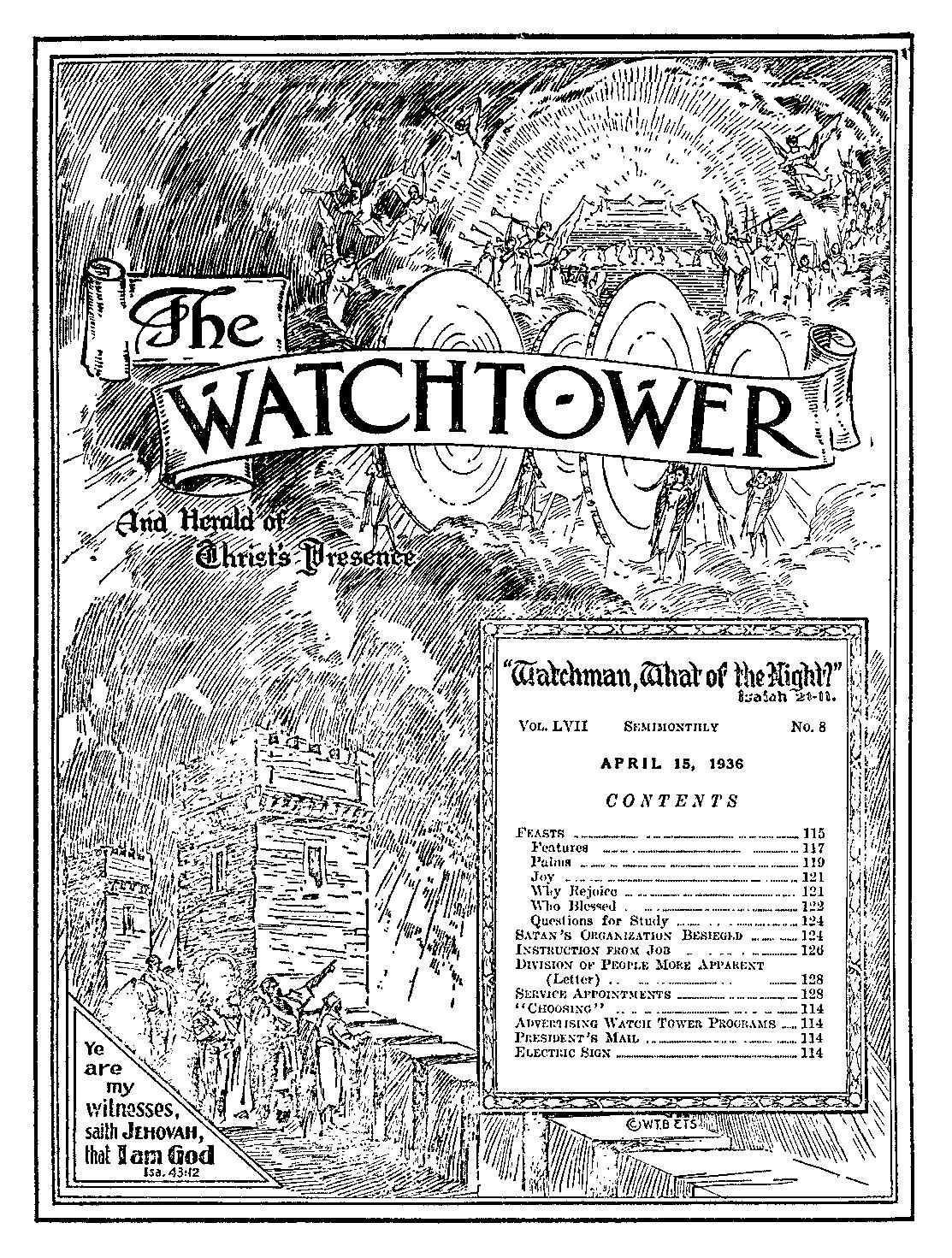
Vol. LVII
April 15, 1936
No. 8
FEASTS
“Thou shalt observe the feast of tabernacles seven days after that thou hast gathered in thy corn and thy wine.”—Deut. 16:13.
February 23, 1936, was the first time, so far as known, when a general convention of the people of Jehovah assembled in different parts of the earth and was simultaneously addressed by one speaker. On that occasion the president of the Society spoke to a large assembly at Los Angeles, California, and at the same time the speech was instantaneously transmitted by radio and wire connection to huge companies assembled at various points in America, Mexico, Canada, Great Britain, Continental Europe, and other places. The text of the speech is set out herein. At the conclusion of the address the many assembled listeners unanimously adopted the declaration appealing herein at the end of this article. Immediately responses came by cable and telegraph from the divisions assembled, giving evidence that the speech and resolution had been clearly and enthusiastically received. It was a joyful feast, participated in by many of God’s people, and to Jehovah is given all glory and honor. The evidence is conclusive of the united action of the Lord's consecrated ones in their determined forward movement to make known the message of the kingdom.
JEHOVAH commanded that the Israelites should observe three great feasts during the year, each one a feast unto Jehovah. This shows that the three feasts directly and specifically related to the vindication of Jehovah’s name. Those three feasts are named by the Lord, to wit: “Feast of unleavened bread,’’ or the passover; “feast of harvest,” or Pentecost; and the “feast of ingathering”, that is, the “feast of tabernacles”. “Three times thou shalt keep a feast unto me in the year. Thou shalt keep the feast of unleavened bread: (thou shalt eat unleavened bread seven days, as I commanded thee, in the time appointed of the month Abib; for in it thou earnest out from Egypt; and none shall appear before me empty:) and the feast of harvest, the firstfruits of thy labours, which thou hast sown in the field: and the feast of ingathering, which is in the end of the year, when thou hast gathered in thy labours out of the field.”—Ex. 23:14-16.
2 The passover marked the beginning of the year; Pentecost was fifty days after the first day after the sabbath following the passover and was likewise a sabbath with Israel, and the feast of tabernacles began on the fifteenth day of the seventh mouth ending the special feature of the year. The people of Israel having been commanded by Jehovah to keep these three feasts, the question arises, Is spiritual Israel, and particularly the remnant, directly concerned about all three of these feasts? — Ex. 34:18, 22; Lev. 23: 6, 10, 34.
3 Jehovah specifically fixes the time and place for each of the feasts. The time never varied. At first the place was at Shiloh. (Josh. 18:1) Later Jerusalem was appointed as a place where these feasts were to be observed. The feasts were directly associated with the harvest time of the people of Israel. The passover was observed on the fourteenth day of Abib, the first month, and the feast of unleavened bread followed immediately thereafter, at which feast the high priest offered a sheaf of the first ripe corn or barley and waved it before the Lord to be accepted by him as from the people. (Lev. 23:9-12) On the fiftieth day thereafter, before the commencement of the “feast of weeks”, later known as Pentecost, the high priest waved two loaves baked of newly ripened wheat and baked with leaven, the offering of the people as the firstfruits of the harvest. That was called the “feast of harvest, the firstfruits of thy labours”. (Ex. 23:16; Lev. 23: 17) The time fixed for the celebration of the feast of tabernacles was at “the end of the year”, when the harvest was gathered in, and it was called the “feast of ingathering”. “Speak unto the children of Israel, saying, The fifteenth day of this seventh month shall be the feast of tabernacles for seven days unto the Lord. ’ ’—Lev. 23: 34.
4 Jehovah gave command to Israel by the mouth of Moses concerning all three of these feasts. Moses was a type of Christ Jesus, and Christ Jesus is directly associated with all three of the feasts. It would seem, therefore, that those who are in Christ would be directly concerned. The passover was instituted in Egypt by the slaying and eating of the paschal lamb, and this was fulfilled in the sacrifice of Christ Jesus, at which time Jesus instituted the memorial of his death and memorial to the name of Jehovah and to the vindication of his name. At the command of the Lord his people have kept that feast and still observe it. Now the Lord Jesus has come to the temple and gathered his people unto himself and they are still celebrating the feast of the passover, or memorial, drinking the new wine with the Lord in the kingdom and rejoicing.
5 Pentecost marks the time of the outpouring of the holy spirit as prophesied by Joel and fulfilled first on the apostles, as recorded at Acts the second chapter. The time corresponds with the time of the coming of the Lord’s spirit upon Gideon, when he blew the trumpet. (Judg. 6:34) The second fulfillment of the prophecy of Joel concerning the outpouring of the holy spirit, as appears from the overwhelming testimony, began in 1922. (See Vindication, Book One, page 57.) The Pentecost date also corresponds with the coming of the Ruth class to a knowledge of the truth, the climax of the prophetic book of Ruth. The larger fulfillment of the outpouring of the holy spirit marks a time of great rejoicing amongst God’s people on earth. In the language of the prophet the anointed ones sing, ‘This is the day the Lord hath made, and we will rejoice and be glad in it.’—Ps. 118:24.
6 The passover feast and Pentecost are directly related to the new covenant. The making of the new covenant was marked by the death of Jesus, the anti-typical passover Lamb. The inauguration of the new covenant is marked by the final outpouring of the holy spirit. (Acts 2:16-18) Particularly since the second out pouring of the holy spirit the Lord's people on earth have understood and appreciated that the time of rejoicing is here, because they are privileged to drink the new wine with the Lord in the kingdom and to enter into his joy. It is the feast of joy unto the Lord, as it is written: “Rejoice, ye heavens, and ye that dwell in them.’’ (Rev. 12:12) Since the outpouring of the holy spirit the remnant have understood and appreciated that the work of the Lord Jesus is the vindication of Jehovah's name and that since he has come to the temple and gathered his faithful ones unto himself these have entered into the joy of the Lord, being privileged to participate in the vindication of Jehovah's name. They have also an appreciation of the words of the scripture, “The joy of the Lord is your strength.’’—Neh. 8:10.
7 In the past we have been told that the waving of the two loaves baked with leaven, and which were waved at Pentecost, pictured two spiritual classes offered to the Lord, to wit, the “little flock’’ and the “great multitude’’, both being spiritual classes. Now we see, however, that such could not be true, for the reason that God does not have two spiritual classes, one wholly faithful and the other partially faithful. The facts now well known seem to support the conclusion that the waving of the two loaves at Pentecost pictured a division amongst those who claim to serve God. At the first outpouring of the holy spirit there were many dwelling in Jerusalem who were devout men or at least claimed to be. Some of these were amazed at what they saw, while others mocked. (Acts 2: 5-13) There was a division then and there, and that division called forth the speech by Peter concerning the fulfillment of the prophecy of Joel. “Then they that gladly received his word were baptized.” (Acts 2:41) The inference must be drawn that those who did not gladly receive his words put themselves in opposition. At the passover only unleavened bread could be used, whereas the two loaves waved by the priest at Pentecost were baked with leaven. Leaven being a symbol of imperfection and sin, the leaven in the two loaves therefore seems clearly to say in symbol that the offering in behalf of the people would not be without taint, that all would be contaminated to some extent with the world, and, when informed by the Lord, it would be the responsibility of those presented to the Lord to purge themselves by separator; themselves completely from Satan’s organization. This is exactly what the remnant are commanded to do. This supports the conclusion that the two loaves waved by the priest at Pentecost pictured the division, that is, a separation, of those who are accepted by the Lord, from those who are rejected by the Lord.
8 The second outpouring of the holy spirit undoubtedly has disclosed two classes of persons, both of which h were presented before the Lord when he appeared at the temple and began judgment at the house of God (Mal. 3:1-3; 1 Pet. 4:17) One class is made up of those that are approved, which the Lord designates as the “faithful and wise servant”, and to that class he commits his kingdom interests on earth. The other class is not approved, and is designated by him the “evil servant” class. Those of both classes claimed to be sincere when presented to the Lord at the temple, but the Lord caused the selfish ones to demonstrate that they were moved by selfishness and therefore not unqualifiedly devoted to Jehovah and his kingdom. The words of the apostle at 1 Corinthians 5:1-3 fully corroborate these words, and hence the apostle ad-monishes the sincere ones to have nothing to do with the insincere ones who continue to compromise with Satan’s organization. The two loaves, therefore, show that one class is rejected and one class accepted by the Lord. The feast of the passover and that of Pentecost undoubtedly are limited to those who are in ... for the kingdom. What is to be said, then, about the feast of tabernacles?
9 At one and the same time Jehovah commanded his chosen people Israel to keep these three feasts above named. For many years it seems to have been taken for granted that the feast of tabernacles, anti-typically celebrated, is exclusively related to the millennial reign of Christ and hence the church while on earth would have nothing to do therewith, the question arises, Did the feast of tabernacles foreshadow things that must come to pass during the millennial reign of Christ, or does its fulfillment begin while the remnant are still on the earth engaged in the service work? If the feast of tabernacles is having an antitypical fulfillment at the present time, then surely we should expect that the Lord would reveal that fact to his covenant people. The Scriptures and the facts are now here submitted for the purpose of showing that the feast of tabernacles directly concerns the remnant and the “great multitude’’ and that the antitypical feast is now being fulfilled.
10 Why should we conclude that Jehovah commanded the feast of tabernacles to be kept by the Israelites, his covenant people, merely to show what shall come to pass during the millennial reign? The positive statement is made in the Scriptures that “whatsoever things were written aforetime were written for our learning, that we through patience and comfort of the scriptures might have hope’’ (Rom. 15:4); and also that “all these things happened unto [Israel] for ensamples [or types]: and they are written for our admonition, upon whom the ends of the world are come’’. (1 Cor. 10:11) Paul thus limits these things to the class to which he belonged, consequently to the church. The Scriptures are graciously provided by the Lord for the benefit of men during the period of time when wickedness is permitted and when the wicked one is allowed to prosecute his work, and these scriptures arc thus provided that the man of God may be instructed and thoroughly furnished unto all good works. (2 Tim. 3:16, 17) The vindication of Jehovah’s name is the all-important matter, and it is the royal house of God that has particularly to do with the vindication of his name. The Devil raised the issue of the supremacy of Jehovah, and that issue will be settled by the destruction of the Devil and his organization, and that work must be accomplished and will be accomplished before the thousand-year reign of regeneration begins. Jehovah first declares his purpose to bring forth by his “woman” or organization a righteous seed, and that the seed of his organization will destroy the seed of the Serpent. The seed is brought forth, and then follows the prophecy recorded by Jude (14 and 15) of Jehovah’s purpose to execute his judgment by and through Christ Jesus. Before that judgment is executed, however, the Scriptures show not only that the “little flock” of sheep led by Christ Jesus shall come to him but that he will also gather his “other sheep”, which latter flock is the “great multitude”. To Abraham Jehovah declared his purpose in these words: “I will bless them that bless thee, and curse him that curseth thee.” (Gen. 12:3) From other scriptures it clearly appears that the execution of this purpose takes place at the time when Christ Jesus is at the temple for judgment during the day of Jehovah, and not at the end of the thousand-year reign. (Matt. 25:31-46) The prophecies concerning judgment clearly are fulfilled and apply at the time when Jehovah arises to make known his name in all the earth and to vindicate his name by his great right Arm, his Vindicator, Christ Jesus.
11 The Scriptures were not written merely to show how some may inherit the heavenly life. True, they do tell of that hope through Christ Jesus to those who are called, chosen, and prove faithful, but the primary purpose is the selection of a people for the name of Jehovah and who have to do with the vindication of his name, and after these have proved their integrity then God gives them a place in heaven. Those taken out for the name of Jehovah are first put to the test, must maintain their integrity, and then receive God’s approval before they are given a heavenly inheritance. It seems certain, therefore, that the fulfillment of the prophecies, including that concerning the feast of tabernacles, has to do with the church, and particularly the remnant, and those closely associated with the remnant, during the time of a special work being done by the Lord Jesus at the temple of Jehovah.
FEATURES
11 By looking at certain features of the type we may be enabled to determine whether or not there is now a fulfillment of the feast of tabernacles in the experiences of the remnant. As stated by the Scriptures it was “the feast of Jehovah”, which shows that the time foreshadowed the vindication of Jehovah’s name. The command as recorded in God’s law is: “Howbeit on the fifteenth day of the seventh month, when ye have gathered in the fruits of the land, ye shall keep the feast of Jehovah seven days: on the first day shall be a solemn rest, and on the eighth day shall be a solemn rest.” (Lev. 23:39, A.R.V.) Thus is shown that the first day was a sabbath day and the last day was a sabbath day. The feast was celebrated in the middle of the seventh month, at the season of the year when the harvest was gathered in, and is therefore called “the feast of ingathering”. (Ex. 23:16) It was a time of rejoicing before the Lord, the people being reminded that Jehovah is the source of all life and of all their joys. They were to eat and drink and to rejoice before the Lord.
13 This matter is specifically emphasized when some of the captives returned from Babylon. When they were in captivity they did not keep the feast of tabernacles. When Nehemiah and others returned, the people were found weeping because they learned that the law of God commanded them to keep the feast of tabernacles, which they were not doing. It was then that preparation was made to celebrate the feast, and Nehemiah said to the people: “Go your way, eat the fat, and drink the sweet, . . . for this day is holy unto our Lord; neither be ye sorry; for the joy of the Lord is your strength.” — Neh. 8:9,10.
14 Two special features of the feast of tabernacles are noted, to wit: (1) The people were commanded to dwell in booths for the seven days of the feast, and (2) that, beginning with the first day, they were to offer thirteen bullocks, and continue to offer bullocks one less each day thereafter, concluding on the seventh day with the offering of seven bullocks, making a total of seventy bullocks offered during that period of the feast. The eighth day was a day of rest and a solemn assembly unto the Lord. (Num. 29:12-35) That whole convocation was to remind Israel that their blessings would come to them because Jehovah had chosen them as his people for his purpose and for the honor of his name.
15 The dwelling in booths appeared to be significant. A booth is a temporary dwelling place, while those therein dwelling are looking for a permanent abode. All the people of God, including the spiritual and human class, have been brought onto the side of Jehovah during the time that Satan has ruled in wickedness. Dwelling in booths therefore seems to say that they are not a part of Satan’s organization but are separate and apart therefrom, that temporarily they must dwell in Satan’s world but are no part of it, and that they are looking for a permanent and righteous government in which righteousness dwells. Abraham and the other faithful men of old, being on the Lord’s side, were in that condition. Concerning him it is written that ‘he dwelt in tabernacles with Isaac and Jacob, the heirs with him of the same promise, for they looked for a city which hath foundations, whose builder and maker is God’. Concerning all the others mentioned by the apostle it is written that they confessed that they were pilgrims and strangers on the earth, desiring a heavenly country. – Heb. 11:8-16.
16 As Jesus declared, “My kingdom is not of this world,” so all those who are on the side of God and his King are not of Satan's world, but are dwelling temporarily here, waiting for the full establishment of God’s government under Christ. This is literally true with reference to the “great multitude”, because they separate themselves from the Devil’s organization and take their stand with the Lord's organization. When the Israelites returned from captivity they made booths and sat under them and wore glad. For a long while those persons of good will have been in captivity to Satan’s organization, and now when they receive the light of the truth they take their stand on the side of Jehovah and are antitypically strangers in a strange land, waiting for the full establishment of the kingdom of God.
17 The offering of the seventy bullocks must have some important meaning. It is noted in the tenth chapter of Genesis that mention is made of seventy families of the sons of Noah. “These are the families of the sons of Noah, after their generations, in their nations; and by these were the nations divided in the earth after the flood.” (Gen. 10: 32) There is a tradition amongst the ancient Jews that the seventy bullocks offered at the feast of tabernacles pictured or represented the seventy families of the earth as mentioned in the foregoing scripture. Jewish history tells of certain other things that were done in connection with the feast. There was a special lighting of the temple, and each day water was drawn from the pool of Siloam and carried to the temple altar, where it was received amidst the blast of trumpets and the repeating of the words of the prophecy by the people: “With joy shall ye draw water out of the wells of salvation.” (Isa. 12: 3) (Peloubet's Bible Dictionary) These water wells pictured the fact that the remnant and Jonadabs who have lately associated themselves with the remnant have come to appreciate the truth that salvation, pictured by the water, comes only from Jehovah God through Christ Jesus and these truths are revealed by the Word of God, the well of salvation. No other persons on earth recognize that salvation proceeds from Jehovah through Christ Jesus.
18 Jesus associated himself directly with the feast of tabernacles, and this of itself shows that the remnant on earth bear some relation thereto, that is to say, that those who compose the “little flock” must be closely associated therewith and that those also of the “other sheep”, the “great multitude”, are included in what the feast of tabernacles foreshadows. When Jesus identified himself with the feast of tabernacles it was the time when the religionists were seeking to kill him. “Now the Jews’ feast of tabernacles was at hand. But when his brethren were gone up, then went he also up unto the feast, not openly, but as it were in secret. Then the Jews sought him at the feast, and said, Where is he?”—John 7: 2, 10, 11.
19 Jesus had sent his disciples up before him, and he wont secretly. But when the feast was well under way he appeared in the temple and taught: “Now about the midst of the feast, Jesus went up into the temple, and taught.” (Vs. 14) The religionists saw Jesus standing there expounding the Word of God, and they said of Jesus: “How knoweth this man letters, having never learned? Jesus answered them, and said, My doctrine is not mine, but his that sent me. If any man will do his will, he shall know of the doctrine, whether it be of God, or whether I speak of myself.”—John 7:15-17.
20 This corresponds with the present time. As Jehovah’s witnesses stand in the public places and speak the truth, the clergy say of them: ‘How do those fellows know anything, seeing they have never been to a theological school?’ Jesus there continued to speak boldly, and so now his faithful followers boldly speak the truth, regardless of opposition. As the feast drew near to a close Jesus continued to boldly declare the truth, and there was a division amongst those who heard him, some supporting him, while others sought his life: “In the last day, that great day of the feast, Jesus stood and cried, saying, If any man thirst, let him come unto me and drink. He that believeth on me, as the scripture hath said, out of his belly shall flow rivers of living water. Many of the people therefore, when they heard this saying, said. Of a truth this is the Prophet.” (John 7:37,38,40) It appears that probably it was the eighth day, or the time of the holy convocation, that Jesus said in the presence and hearing of the religionists: “Then spake Jesus again unto them, saying, I am the light of the world; he that followed me shall not walk in darkness, but shall have the light of life.” – John 8:12.
21 It was at the feast of tabernacles that Jesus showed the clear distinction-between those religionists, whom he told that they were on the side of the Devil, and those of honest heart who took the side of Jesus. “And he said unto them, Ye are from beneath; I am from above; ye are of this world; I am not of this world. I said therefore unto you, that ye shall die in your sins; for if ye believe not that I am he, ye shall die in your sins.” (John 8:23,24) The religionists not only rejected Jesus, but sought to kill him. But many of the common people believed on him: ‘‘Then said Jesus to those Jews which believed on him, If ye continue in my word, then are ye my disciples indeed; and ye shall know the truth, and the truth shall make you free. If the Son therefore shall make you free, ye shall be free indeed.”—John 8: 31, 32, 36.
22 This is the only place revealed by the record that Jesus taught in connection with the feast of tabernacles. By associating himself with the feast of tabernacles Jesus proves conclusively that he fulfilled the type in miniature and that the fulfillment in completeness must begin while the remnant members of his body are on the earth and during the time when Christ Jesus is at the temple conducting judgment. What Jesus, when on earth, did at the feast of tabernacles finds a similarity in things that have come to pass since his appearance at the temple. As the Officer of his Father, Jesus, at the last of the feast of tabernacles, boldly cried out to the people. Since coming to the temple he, as the Officer of Jehovah, cries out and calls upon all the nations to be silent and give ear to what he says: “But the Lord is in his holy temple; let all the earth keep silence before him.” (Hab. 2:20) At the feast of tabernacles Jesus told the religionists that they were of the Devil. In these last days the remnant, as his faithful witnesses and acting under his command, give warning to the religionists, calling attention to the fact that they are defaming the name of Jehovah and are the chief instruments of the Devil on earth. On the last day of the feast Jesus issued an invitation to the people, saying to them: “If any man thirst let him come unto me, and drink,” and live. —John 7: 37, 38.
23 Since the coming of the Lord Jesus in power and glory at the temple he says: “ I am . . . the Bright and Morning Star,” and “let him that heareth say, Come.” He commands the members of his body, the remnant on earth, to join in that proclamation. In addition thereto he calls upon those persons who are of good will among the people to take up the glad message or proclamation and tell it to others; as it is written: “And the Spirit and the bride say, Come. And let him that heareth say, Come. And let him that is athirst come; and whosoever will, let him take the water of life freely."—Rev. 22:17.
24 The Scriptures and the attending facts, therefore, show that the great antitypical fulfillment of the feast of tabernacles has begun. This is the time when Christ Jesus is separating the nations and making it clearly appear that there are two separate and distinct classes, one that is against him and Jehovah, and one class that is for him and Jehovah, and that all who would live must now identify themselves as being on the side of Jehovah and his kingdom.
PALMS
25 Another prominent feature of the celebration of the feast of tabernacles was that concerning the branches of palm trees, which the people must take on the first day of the feast and use throughout the period of the feast. (Lev. 23: 40, 41) Boughs of other trees are mentioned, but the branches of the palm tree are specifically mentioned. The waving of palm branches must be done with rejoicing before the Lord, the manifest purpose of which was a recognition by the people that Jehovah God was and is their Deliverer from Satan’s power, and their Savior. The entire performance was looking to the vindication of Jehovah’s name, rejoicing in him as the supreme and holy One. That the people thus recognize Jehovah as their Savior and Deliverer he said to them that they must keep this feast, ‘‘that your generations may know that ... I am the Lord your God.” (Lev. 23: 43) The fact that palm trees are specifically mentioned in connection with the feast of tabernacles shows that they were symbolically used to foreshadow some greater thing that must come to pass in the future.
26 The eleven faithful disciples of Jesus recognized him as the Christ and followed him gladly. Later, when he rode into Jerusalem to offer himself as King, it was the common people who met him on the way, waving their palm branches and shouting to his honor and to the praise of Jehovah. At the first outpouring of the holy spirit at Pentecost the faithful disciples rejoiced, recognizing Christ Jesus as Jehovah’s glorious King whom he had raised up and exalted to heaven. In 1922, at the second outpouring of the holy spirit, the faithful servant company recognized Christ Jesus at the temple and greatly rejoiced. The point is that the recognition of the King as having come is the occasion for joy. Since 1922 others who are not of the remnant, but who are of good will toward God, have recognized Christ Jesus as King, the Savior and Deliverer, and they have rejoiced.
27 The palms must be used in connection with the feast of tabernacles, and in the use thereof others aside from the remnant appear to be specifically pictured. The use of palms symbolically says by those using them: “We hail our glorious Warrior and Victor, our Deliverer and Savior.” That the palm branches specifically locate the ‘‘great multitude ’ ’ is shown by the record at Revelation 7: 9. Sometime after the second outpouring of the holy spirit, and not until the year 1935, was the true meaning of the great multitude discerned by the remnant on earth. Concerning the great multitude it is written: “After this I beheld, and, lo, a great multitude, which no man could number, of all nations, and kindreds, and people, and tongues, stood before the throne, and before the Lamb, clothed with white robes, and palms in their hands.” (Rev. 7:9) This shows the remnant beholding a class of persons other than themselves as coming from all the nations and which class recognize the only name whereby men can be saved, and that class is the great multitude. The description above given of the great multitude exactly fits the prophecy concerning the palms used at the typical feast of tabernacles.
28 The feast of tabernacles was called “the feast of ingathering ... in the end of the year, when thou hast gathered in thy labours out of the field”. (Ex. 23:16) Jesus declares “other sheep” he will bring or gather to himself, and these are the Jonadabs or “great multitude” class, gathered at the end of the antitypical year and after Christ Jesus has gathered the spiritual class to the temple. Those persons of good will are gathered unto the Lord and become a part of his flock or organization. When Moses at the command of Jehovah had instructed the Israelites at Moab, he said: “And Moses commanded them saying, At the end of every seven years, in the solemnity of the year of release, in the feast of tabernacles, . . . gather the people together, men, and women, and children, and thy stranger that is within thy gates, that they may hear, and that they may learn, and fear the Lord your God, and observe to do all the words of this law.”— Deut. 31:10-12.
29 According to this commandment God’s people were to gather all men and women and children and the strangers within their gates, who were of good will toward the Lord. This shows a direct relationship of the spiritual class, that is, the remnant, to those of the “other sheep”, whom the Greater Moses gathers to himself at the end of the year. (John 10:16) The Lord Jesus uses his anointed ones to proclaim “this gospel of the kingdom” for the purpose of gathering to himself his “other sheep”, and which ingathering must be done before Armageddon.
30 Those who are gathered in must dwell in booths; which symbolically says: “We are not of this wicked world of Satan. At present we are in a temporary abiding place, but we arc confidently looking for the establishment of the rule of Christ Jesus in all the earth.” The taking of the palm branches and using them shows that they are recognizing and attributing to Jehovah God and Christ Jesus all protection and salvation. They hail Jehovah and Christ as the Savior, Deliverer and Victor.
31 Note now how well the description of the great multitude gathered from all nations fits the prophetic picture, particularly as pertaining to the gathering of all persons of good will as commanded by the Lord through Moses. ‘Standing before the throne, clothed with white robes’ shows that those of the great multitude have an approved standing before the Lord, and with palms in their hands they hail Jehovah and Christ Jesus: “And cried with a loud voice, saying, Salvation to our God which sitteth upon the throne, and unto the Lamb.” (Rev. 7:10) These refuse to attribute salvation to what any flag may represent. They hail Jehovah God as the Supreme One, and Christ Jesus his anointed and enthroned King as the victorious Warrior and righteous Ruler. They refuse to hail men or any man-made thing and to thereby attribute salvation to such. This shows a company of persons other than the “little flock” brought into the fold of Christ and that such are in exact harmony with the Lord and serve Him. Then the scripture discloses that all of God’s organization arc in full harmony therewith and are saying, “Amen,” and are thereby attributing protection and all power and salvation to God and to Christ Jesus. (Rev. 7:11,12) Palm trees and wells of water are symbolically used to show that the people recognize Jehovah as the great Victor and Savior and the Giver of life; and this is shown by the first mention made in the Bible concerning palm trees. Moses, at the command of Jehovah, had led the Israelites successfully out of Egypt and over the Red sea. Jehovah had thus gained the victory over Pharaoh, the Devil’s representative, and had saved the Israelites, and thus had shown them that their salvation is of Jehovah. He brought them to Elim. “And said, If thou wilt diligently hearken to the voice of the Lord thy God, and wilt do that which is right in his sight, and wilt give ear to his commandments, and keep all his statutes, I will put none of these diseases upon thee, which I have brought upon the Egyptians; for I am the Lord that healeth thee. And they came to Elim, where were twelve wells of water, and threescore and ten palm trees; and they encamped there by the waters.” (Ex. 15:26, 27) This statement is repeated at Numbers 33: 9, and certainly recorded there for a purpose. The name “Elim” means ‘strength’, and with its fountains of living waters and seventy palm trees there is made a picture of complete strength and victory and the fountain of life everlasting, all given at the hands of the gracious Giver, Jehovah God, through his chosen and anointed One, Christ Jesus.
32 That which was required by the law given to the Israelites, and which was typical, exactly fits what the Lord and his anointed ones do in these last days. Christ now at the temple stands forth and cries out: “I am the way, and the truth, and the life.” He causes this good news to be proclaimed to all nations as a witness. He sends forth his anointed ones to say to those of good will in every nation: ‘Come, and learn of Jehovah, and drink of the water of life.’ He then invites and commands the Jonadabs, or “other sheep”, which form the great multitude, to say to all who would hear, ‘Come, and take of the water of life.’ These facts are further proof that the antitypical feast of tabernacles is now being celebrated, and that those who have heretofore been ‘strangers in the land unto the Lord’ have heard the message of the kingdom, learned of the Lord, and are recognizing him and hailing him; which is pictured by the waving of their palm branches. For this reason those who have associated themselves with God’s organization do not and will not hail men or man-made power nor attribute salvation to such.
JOY
33 Each one of the three great feasts which the Lord commanded to be kept by the Israelites was celebrated with much rejoicing. Each one was a feast unto Jehovah because he is recognized and acclaimed as the supreme and almighty One. The chief purpose of the feast is a recognition of the vindication of Jehovah’s name. Christ Jesus, the great Vindicator, has now come, and, true to his promise, he is now drinking the new wine of joy with his anointed ones in the kingdom. (Matt. 26: 29) The joy of the Lord Jesus Christ is the vindication of his Father’s name. Now he has gathered the faithful unto himself at the temple, and to them he says: ‘Because ye have been faithful over a few things I will make you ruler over many things; enter thou into the joy of thy Lord.’ (Matt. 25: 23) It is the “faithful and wise servant’’ class to whom Christ commits his kingdom interests and who join with him in the joy of vindicating Jehovah’s name.
34 Since the second outpouring of the holy spirit the remnant have discerned the Lord at his holy temple illuminating the minds of each and that he is sending them forth to carry out Jehovah’s purpose, and this has greatly increased the joy amongst the people of the Lord. They have appreciated the great privilege of bearing the name of Jehovah and greatly rejoice to be witnesses to the honor of his name. The feast of tabernacles and feast unto Jehovah is therefore a feast of joy unto the Lord participated in by his anointed ones. In recent months Jehovah’s witnesses have experienced a new expression and superabundance of joy for the reason that to them Jehovah through Christ Jesus has revealed the truth concerning the “great multitude” and the remnant see that it is the privilege of such at the command of the Lord to proclaim the truth and have a part in the ingathering of the great multitude to the glory of Jehovah God.
35 When God’s typical people were released from captivity and saw their privilege of celebrating the feast of tabernacles, they immediately ceased their weeping and all rejoiced. In the keeping of the feast of the passover and Pentecost the remnant do not cease from their work and the joy thereof. They continue therein, but have the added joy of having a part in the work of ingathering of the great multitude, and in this joy those of the great multitude join. All of Jehovah’s people keep the feast together, and particularly the great multitude is shown by waving palm branches and thus recognizing and hailing Christ as King, Victor and Savior sent to them by Jehovah.
36 When Moses was concluding his instructions to the Israelites on the plains of Moab he said: “Rejoice, O ye nations, with his people.” (Deut. 32:43) This surely must indicate that those aside from the anointed, who take their stand on the Lord’s side, rejoice with the anointed. The apostle quoted these words of Moses, at Romans 15:10, and this is further proof that the anointed remnant and the great multitude are now celebrating the feast of tabernacles together.
WHY REJOICE
37 The great rejoicing is now taking place amongst those of the Lord’s people because the day of deliverance is at hand. (Luke 21:28) Many scriptures and the attending facts show that Armageddon is near. The mighty Warrior, Christ Jesus, is pictured as traveling in great strength, seated upon his war mount, and this he does in the day of Jehovah, and in response to a question propounded to him he says: “For the day of vengeance is in mine heart, and the year of my redeemed is come.” (Isa. 63:4) Jehovah’s anointed ones, the remnant, must be active in “the day of vengeance of our God”, ministering comfort to those who sigh and cry, because such is the specific commandment to them from the Lord. (Isa. 61:2; Ezek. 9:4) Those who are comforted by the message they hear join with the comforters in rejoicing and in singing the praises of Jehovah and in bearing testimony to others. That means that the remnant and Jonadabs or great multitude together ‘with joy shall draw water from the wells of salvation’. (Isa. 12:3) All of these know that salvation is of Jehovah through Christ Jesus, and they so say to others who have a hearing ear.
38 The day of atonement was on the tenth day of the seventh month, or just five days before the feast of tabernacles, and on that day the jubilee trumpet was sounded by commandment of the Lord. “Then shalt thou cause the trumpet of the jubilee to sound on the tenth day of the seventh month; in the day of atonement shall ye make the trumpet sound throughout all your land.” (Lev. 25: 9) The sounding of the jubilee trumpet means liberty for those on the side of Jehovah, and of necessity must include the remnant and those who associate themselves with the remnant, to wit, the great multitude. To the remnant the jubilee trumpet appears to mean this: The higher powers are not the rulers of this world, as we once thought. Such rulers are Satan’s agents. The higher powers are Jehovah God and Christ Jesus. Only in recent years have the remnant come to a knowledge of this great truth, and since then they have realized that they are free from worldly powers and from the iron bands of worldly government, and that these do not bind the spirit of such as are devoted to Jehovah and his kingdom. Referring to the sounding of the jubilee trumpet, which the Lord commands must be sounded on the tenth day of the seventh month, the psalmist says: “Blessed is the people that know the joyful sound [jubilee sound]; they shall walk, O Lord, in the light of thy countenance.” (Ps. 89:15) Within five days following the feast of tabernacles was celebrated. The blowing of the jubilee trumpet, therefore, must refer to the release of all prisoners or bound ones, including the remnant and the great multitude. It is for all such as appreciate that they are free from Satan’s organization and that their salvation comes to them from Jehovah through Christ Jesus.
39 Jehovah’s comprehensive covenant is his unchangeable declaration made to Abraham and which he bound with his oath. (Heb. 6:17-19) That declaration was that Jehovah would produce a seed through which he would administer his purpose. In that covenant Jehovah stated: ‘I will bless them that bless thee. . . . And thy name shall be a blessing, and I will bless them that bless thee, and curse him that curseth thee.’ (Gen. 12: 2, 3) The cursing and blessing are directly connected. Before the curse is executed Christ Jesus at the temple separates the blessed from the cursed, that is to say, the sheep from the goats. He puts Jehovah’s curse upon the goat class and administers blessings to his “other sheep”, which is the great multitude, and this he does because the goats have cursed the faithful remnant, who are a part of The Christ, and his “other sheep” have blessed the remnant and done them good. (Matt. 25: 31-46) This cursing and blessing takes place before the time of regeneration begins. The little flock and the “other sheep” therefore rejoice together, because the “other sheep”, or great multitude, have been gathered unto the Lord, and this being the ingathering of the harvest of the earth, and the little flock having been used in connection therewith, they all rejoice together to the glory of God. It appears to be certain that the “feast of ingathering” must begin while some of the priestly class are with those of the earthly class. Is there any Scriptural reason for holding that the promised blessing cannot begin until after Armageddon? There certainly appears to be none. The primary purpose of the Abrahamic covenant is the vindication of Jehovah’s name. The other or added covenants are for the purpose of providing God’s instrument for his name’s sake to be used in the vindication of his name. The vengeance, or vindication, and the blessing are tied together and show that there must be some blessing before the vindication; otherwise there would be none spared and taken through Armageddon as a vindication to Jehovah’s name. It is this blessed class to whom Jesus the Vindicator says: “Come, ye blessed of my Father, inherit the kingdom prepared for you from the foundation of the world.” This is further proof that the antitypical feast of tabernacles, which is a feast of Jehovah, has begun and the remnant and the great multitude are enjoying it together.
WHO BLESSED
40 To Abraham Jehovah said: “In thy seed shall all the nations of the earth be blessed.” (Gen. 22:18) This promise must be considered in the light of other explanatory scriptures. It certainly does not mean the universal blessing of all people regardless of whether they are wicked or good. It means only those who take their stand on the side of Jehovah and obey him and who come from all nations. The blessed ones must keep the feast of tabernacles. Otherwise they shall have no blessing. It is written: “And it shall come to pass, that every one that is left of all the nations which came against Jerusalem, shall even go up from year to year to worship the King, the Lord of hosts, and to keep the feast of tabernacles.” (Zech. 14:16) This scripture also helps us to locate the beginning of the feast of tabernacles.
41 What nations came up against Jerusalem? It is those who are left out of the nations, which nations came up against Jerusalem, that keep the feast. The name “Jerusalem” applies to the new Jerusalem, which is God's capital organization, composed of Christ Jesus and the faithful members of his royal house, which is his kingdom. That nation was born in the year 1914, when Jehovah sent forth Christ Jesus to rule in the midst of his enemy. (Ps. 110: 2) Thereafter, and particularly in 1917 and 1918, Satan assembled all the nations, of “Christendom” in particular, against the Lord’s “holy nation” and, in the language of the prophet, ‘spoiled that nation’ by turning the “evil servant” class wholly to Satan, and at the same time the Lord preserved the remnant, the “faithful servant” class, and sent the latter forth to bear testimony to the name of Jehovah. The bearing of this testimony must be done between the time of this attack upon “Jerusalem” and Armageddon, and must be done by God’s faithful witnesses Before the battle of Armageddon is fought Satan sends forth his wicked spirits, headed by Gog, to gather all nations against God’s organization, and Satan makes war on the remnant "because these keep the commandment of God and have the testimony of Jesus Christ. (Rev. 12:17; 16:13-16) Today those on the side of the Lord have experienced and are experiencing the very things which Jesus foretold: “ Ye shall be hated of all nations for my name’s sake.” Those who rule the nations of earth, being Satan’s representatives, do hate those who are for the kingdom of God. These are hated because they bear testimony to the name of Jehovah and his King. The Lord uses his faithful witnesses to carry the message of the kingdom to other persons of good will, who are designated as ‘Jonadabs’ or “other sheep” or the “great multitude”. These hear the message and, like Jonadab, join themselves to the Lord’s chariot or organization, and are included in the hated ones, all of which are designated by the prophet as the “nation not desired”. (Zeph. 2:1) All the nations came up against Jerusalem, and out of those nations subsequently comes the great multitude. These are now told that they must seek meekness and righteousness before the day of God’s wrath if they would be hid and carried through Armageddon.
42 Only a few months ago the Lord revealed that those “other sheep”, or Jonadabs, are the ones who compose the great multitude coming from all these nations. Now we behold these standing before the Lord waving their palm branches and hailing Christ as King and singing out with a loud voice that they attribute salvation to Jehovah God and Christ Jesus, and to none other. The Lord then discloses that all the faithful remnant and all the resurrected ones, and the angels of heaven, together with the great multitude, arc proclaiming Jehovah’s praise and rejoicing. (Rev. 7:11, 12) That marks the beginning of the feast of tabernacles, the feast unto Jehovah, and these are the ones, according to the prophecy of Zechariah, that keep the feast of tabernacles. Some men, wise in their own conceits, tell you that “we are getting nowhere”, and that “the great multitude cannot come forth until Armageddon”. Such conclusion is void of reason and without Scriptural support. The Lord’s promise is that he will carry some through Armageddon, and those few will be the ones who keep the feast of tabernacles to the praise of Jehovah. Armageddon will work an indescribable devastation of the nations, and, says the prophet, “it shall come to pass, that everyone that is left of all the nations which came against Jerusalem, shall even go up from year to year to worship the King, the Lord of hosts, and to keep the feast of tabernacles.” It is manifest that this scripture must be construed as meaning that those of all the nations who refuse to keep the feast of tabernacles by worshiping the King shall not be left, but shall be destroyed. Furthermore it means that the Jonadabs or the great multitude must joyfully obey and worship and serve Jehovah God all the time if they would be carried through Armageddon. They must prove their integrity toward God before the wrath of God is expressed. That means that they must hear and learn the truth and obey it now and that the obligation is laid upon Jehovah’s witnesses and all that do hear to continue joyfully and energetically to proclaim the truth from now on.
43 Jehovah having commanded his chosen people to keep the feast of unleavened bread and of Pentecost and of tabernacles, it appears that the antitypical fulfillment of such prophetic feasts, including the feast of tabernacles, must be performed while the remnant are on the earth and that those who participate with the remnant in that latter feast are the great multitude, and that none of all the nations aside from the great multitude do participate in that feast, and that the remnant and great multitude must continuously celebrate that feast when once begun. They must do it “from year to year”, which means all the time, rejoicing and praising Jehovah. Concerning those who are dead, and who will be resurrected and given an opportunity for life, they shall have a blessing, as indicated by the Scriptures, only if they come up to God’s organization and worship the King, the Lord of hosts, as it is written: “And it shall be, that whoso will not come up of all the families of the earth unto Jerusalem to worship the King, the Lord of hosts, even upon them shall be no rain.”—Zech. 14:17.
44 It is now the privilege and obligation laid upon the remnant to energetically and joyfully carry the message of the kingdom to the people of good will and to do this work faithfully to the end and before Armageddon. It is the privilege and obligation laid upon the Jonadabs or “other sheep” or great multitude to join in that work and to continue therein faithful to the end and up to Armageddon. Many of those who will be of the great multitude are now prisoners. God commands his witnesses to bear testimony before the people and to “say to the prisoners, Go forth; . . . Shew yourselves”. Those who do show themselves by taking their stand on the side of Jehovah and Christ Jesus participate in the feast and receive the blessing: “They shall feed in the ways, and their pastures shall be in all high places.” (Isa. 49: 9) Undoubtedly these arc of the great multitude, because they “serve him day and night in his temple”, that is, they serve him continuously. “He that sitteth on the throne shall dwell among them. They [the great multitude] shall hunger no more, neither thirst any more; . . . For the Lamb, which is in the midst of the throne, shall feed them.” – Rev. 7:15-17.
45 Furthermore Jehovah commanded his covenant people to keep the feast of tabernacles, which must begin “after that thou hast gathered in THY corn and THY wine” (Deut. 16:13), clearly meaning, anti-typically, at the conclusion of the gathering of the temple company, each one of whom has made a covenant by sacrifice. (Ps. 50:5; 2 Thess. 2:1) 'When gathered to the Lord in the temple and anointed, then the remnant discerns the true meaning of the great multitude and that the gathering thereof has begun, and then the feast of tabernacles antitypically must begin. It has begun and is progressing with increasing joy. The witnessing to the great multitude must now be energetically done, and no one who loves God will now ‘slack the hand’ in doing that work or cease to rejoice in this feast of Jehovah.
46 That the great multitude, together with the remnant, participate in this feast of rejoicing is further supported by the words of the prophet Isaiah: “Behold, these shall come from far; and, lo, these from the north and from the west; and these from the land of Sinim. Sing, 0 heavens, and be joyful, O earth; and break forth into singing, 0 mountains; for the Lord hath comforted his people, and will have mercy upon his afflicted.”—Isa. 49:12, 13.
47 There can be no strife between those fully devoted to the Lord. The remnant and great multitude must dwell together in peace, and work together harmoniously in proclaiming the kingdom message. The Lord has graciously provided this message in a simple form, as set forth in the book Riches, which each of you now should carefully digest and then be diligent to carry that message to others who have a hearing car, that they too may participate in the feast of joy to Jehovah by giving honor and praise to his name.
48 Every person on earth who loves Jehovah is invited to join in this emphatic Declaration:
We are mindful that the war is on to the finish of the enemy, and notice is now served on the Devil and his chief earthly agent, the Hierarchy at Rome, and her allies,
That we will not stultify ourselves by compromising with or yielding to the enemy's demands.
Our trust is wholly in Jehovah and his King, and we will attribute salvation to none other.
It is our privilege and duty to serve Jehovah, following the lead of his Faithful and True Witness, and this, by his grace, we will do. If because of our faithfulness we die at the enemy’s hands, we die! If we survive, it will be as loyal subjects of Almighty God.
Jehovah’s Vindicator cannot be defeated, and by his grace and in performance of our covenant we will follow him into the very jaws of death, being fully confident that God will preserve our everlasting existence.
With the zeal of his house we will continue to march forward, and as we go we will joyfully sing our victory song:
The sword of Jehovah and his glorious King!
QUESTIONS FOR STUDY
1-3. What feasts did Jehovah command the Israelites to observe, and when and where were these feasts to be kept? What was the purpose of these feasts?
4-6. That Jehovah gave command by the mouth of Moses concerning all three of these feasts is of what significance? When and how was the passover instituted, and fulfilled? Pentecost? How are these related to the new covenant?
7, 8. Explain the waving of the two leavened loaves in offering at Pentecost, and what was prophetically pictured thereby.
9-11. What was the feast of tabernacles? Whom does it concern, and how is tins shown? When does it have fulfillment?
12-10. Point out how certain features of the type enable us to determine whether the feast of tabernacles is now having fulfillment in the experiences of the remnant, and whether the “great multitude” have part therein.
17-19. What appears to have been foreshown (a) by the offering of the seventy bullocks at the feast of tabernacles? (b) By the fact, time and manner of Jesus’ identifying and associating himself therewith?
20-21. Show that the occasion described at John 7: 2, 10, 11, 14-17 corresponds with the present time. What is shown by the fact that Jesus thus associated himself with the feast of tabernacles? What Jesus did there finds what similarity in things that have come to pass since his appearance at the temple?
25-27. What is shown in the fact that palm trees are specifically mentioned in connection with the feast of tabernacles , that palm blanches were used when Jesus rode ... Jerusalem to offer himself as King, and that the “great multitude’’ had palms in their hands?
28-30. What was the feast of ingathering? and what was foreshown therein? Why were all the Israelites to dwell in booths? and what was the prophetic meaning of that requirement?
31, 32. Point out (a) how well the description of the “great multitude” (Rev. 7: 10) fits the prophetic picture. (b) that the requirements in the type exactly tit what the Lord and his anointed ones do in these last days.
33-36. What was the prophetic significance of the joy that attended celebration of these feasts? What new occasion for joy now attends the feast of tabernacles and feast to Jehovah? Compare this with the experience of God's typical people when they were released from captivity.
37. What is (a) the occasion for the great rejoicing among the Lord’s people now? (b) The responsibility of the anointed ones at this time? (c.) The privilege of these who are comforted by the message they hear ?
38. Point out the relationship of the founding of the jujube trumpet and the least of tabernacles, in the type, and in the fulfillment.
39. To whom and how does Genesis 12: 3 apply?
40-42. Who are they that are to be blessed according to the declaration recorded at Genesis 22: 18? Show how Zechariah ??: 10 helps to locale the beginning of the feast of tabernacles, and to determine who keep this feast, and when, and how?
43. Tint in the same expression Jehovah commanded his chosen people to keep the feast of ... bread and of harvest and of ..., and this form year to year, is of what prophetic significance?
41-46. “Say to the prisoners, Go forth; . . Slew yourselves.” To whom does this apply? and is it the expression of a privilege or of an obligation? How do the “ "prisoners” ‘go forth, and slow themselves’? With related ..., show the prophetic significance of the time set for keeping the feast of tabernacles.
47. What provision has Jehovah made for all those fully devoted to him to celebrate together the feast of tabernacle
48. What are the points upon which every person on earth who loves Jehovah is now invited to join in declaration?
SATAN’S ORGANIZATION BESIEGED
IN Nahum’s prophecy is given a symbolic description of the forces which Jehovah God sets in motion for the overthrow of the Devil’s terrible organization which has afflicted and oppressed the human race for these thousands of years. The overthrew of that vicious organization is right at the door. Jehovah’s siege forces are even now moving into action for the final conflict. Painting a vivid and colorful picture the prophet Nahum (2:3) says: ‘‘The shield of his [Jehovah’s] mighty men is made red. the valiant men arc in scarlet: the chariots shall be with flaming torches in the day of his preparation, and the fir trees shall be terribly shaken.”
A shield wards off or turns aside the blows of the enemy. Jehovah is the Shield to the members of Zion, his organization. The members of his organization say, in the language of Psalm 18:33: ‘‘Thou last also given me the shield of thy salvation.” Jehovah is the right-hand support of his “mighty” officer, Christ Jesus, in the battle. (Ps. 110: 5) Describing the ... ful of the Lord who “finally” or at the end are equipped for the war, the apostle Paul, in his letter to the Ephesians (6:16), mentions the shield of faith which turns aside the fiery missiles of the enemy. The abiding faith of God’s anointed ones yet on earth in the shed blood of Christ Jesus and also the faithful keeping of the covenant by sacrifice into which they have been graciously brought by the Lord well represent the shield which the prophet says is “made red”.
…