The Watchtower, March 15, 1936
Download: PDF — The Watchtower, March 15, 1936
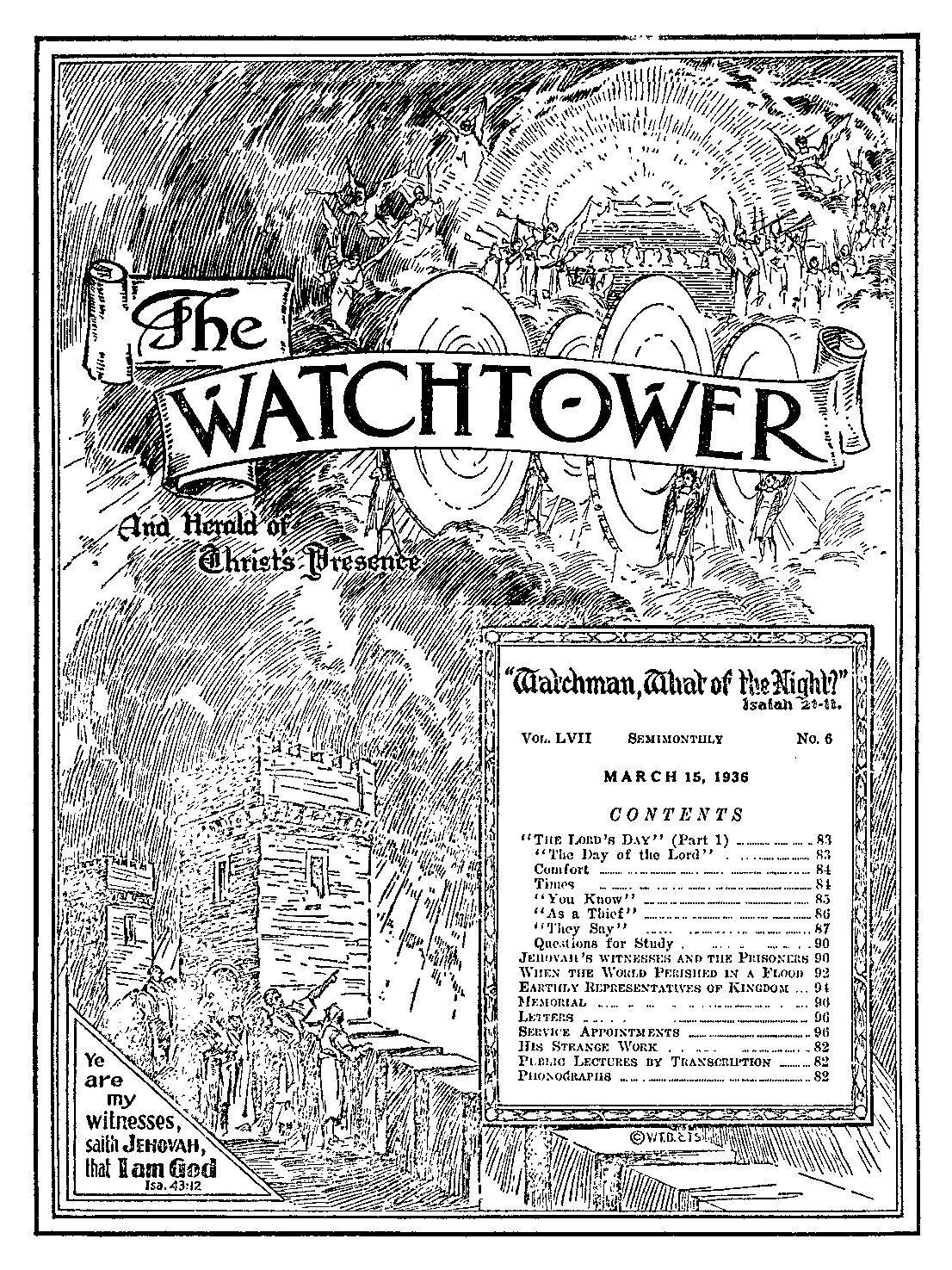
HIS STRANGE WORK
Testimony Period for April, “His Strange Work,” which dates from the 4th to the 12th day inclusive, will be another Beason of extraordinary blessing to the publishers of the kingdom. It will be during this period that all desirous of singing forth the name of Jehovah will call upon the people with the book Riches. The Lord’s publishers will have carefully read the autographed edition by April 4 and will be fully prepared and anxious to place this wonderful message in the hands of the people on a contribution of 25c. Tins book is being published in many languages. The importance of it cannot be overstressed, as you can appreciate only after you read the book carefully.
The directors should be planning now for this campaign. Individuals not associated with the companies should write the branch office in the country in which they live or the head office at 117 Adams St., Brooklyn, N. Y., expressing their desire to participate in the witness. The Watchtower has heretofore stated that the Society would soon publish a book especially for the benefit of the “great multitude”. Here it is! Get it into the hands of the people, thereby informing them of Jehovah’s “strange work”.
PUBLIC LECTURES BY TRANSCRIPTION
Jehovah's blessing has been markedly upon the use of the portable transcription machine. He has plainly manifested that this machine meets the need of the hour, when the enemy, under Gog, is seeking to curtail the use of the radio by God's anointed and when the people are eager to hear, not man’s message, but God’s. The transcription machine has --- the power of Jehovah’s Witnesses afield to preach His truth manyfold, so that the desire for the literature is stimulated and study classes of many interested heaters are being formed. Besides more than 700 such machines in the United States alone, great numbers are now being effectively used in countries near and afar. For more information, write the Society.
PHONOGRAPHS
Jehovah God has duly provided another effective instrument for the kingdom proclamation, to wit, a portable phonograph equipped with electrically transcribed records of 41-minute speeches by Brother Rutherford on vital Bible topics. ---to date from pioneers and others already equipped with and using this phonograph attest the success and potency of this method of introducing and driving home the Lord's message. The machine is manufactured by the Society at its Brooklyn factory, and is specially designed for its work, and is the ---available for the purpose. Strong, compact, with a powerful spring-wound motor, and carrying space for several dises, it weighs 21 pounds with six discs bearing twelve recording. To cover the bare cost the phonograph, with 18 recordings pay be had for $19,25. All orders therefor, remittance accompanying, should be sent to the Brooklyn office of the Society.
Vol. LVII
March 15, 1936
No. 6
"THE LORD’S DAY”
PART 1
“For you yourselves know accurately, that the Lord’s day is coming like a thief at night.” — 1 Thess. 5:2, Diaglott.
JEHOVAH’S day or "the Lord’s day” is not Sunday or any other twenty-four-hour day as the clergy have tried to teach the people. It is that period of time beginning when Jehovah sent forth his Son as King of the world and to oust Satan and to rule all creation. Jehovah’s day began in the autumn season of A.D. 1914 and continues thereafter. The beginning of that period of time is also designated by these words, to wit: "We give thanks to thee, 0 Lord God, the Omnipotent, thou who art and thou who wast; because thou hast taken thy great power, and reigned.” (Rev. 11:17, Diaglott) It is the same period of time designated by the words of the prophet, to wit: "The Lord shall send the rod of thy strength out of Zion; rule thou in the midst of thine enemies. Thy people shall be willing in the day of thy power, in the beauties of holiness from the womb of the morning: thou hast the dew of thy youth.”—Ps. 110:2,3.
2 The "day of the Lord” marks the beginning of sorrows upon Satan’s organization, because it is then that Jehovah by the hand of Christ Jesus interrupts Satan’s long reign of wickedness. Within that period of time there must be a great witness to the name of the Lord Cod, and this must be given throughout the earth, as designated by the prophet Isaiah, to wit: “In that day shall there be an altar to the Lord in the midst of the land of Egypt, and a pillar at the border thereof to the Lord. And it shall be for a sign and for a witness unto the Lord of hosts in the land of Egypt [the world] ; for they shall cry unto the Lord because of the oppressors, and he shall send them a saviour, and a great one, and he shall deliver them.” —Isa. 19:19, 20.
3 In that time God will take account with all the nations because they serve Satan, and to them he says: "Howl ye; for the day of the Lord is at hand; it shall come as a destruction from the Almighty. Behold, the day of the Lord cometh, cruel both with wrath and fierce anger, to lay the land desolate; and he shall destroy the sinners thereof out of it. Therefore I will shake the heavens, and the earth shall remove out of her place, in the wrath of the Lord of hosts, and in the day of his fierce anger.”—Isa. 13: 6, 9, 13.
4 While Satan’s organization will be in great sorrow the remnant of God’s organization on the earth will sing: "In that day shall this song be sung in the land of Judah: We have a strong city; salvation will God appoint for walls and bulwarks. Open ye the gates, that the righteous nation which keepeth the truth may enter in.” (Isa. 26:1,2) "In that day shall the Lord of hosts be for a crown of glory, and for a diadom of beauty, unto the, residue of his people, and for a spirit of judgment to him that sitteth in judgment, and for strength to them that turn the battle to the gate.” —Isa. 28: 5, 6.
5 While they sing this song multitudes of people will turn away from Satan’s organization and seek the Lord. "And in that day shall the deaf hear the words of the book, and the eyes of the blind shall see out. of obscurity, and out of darkness. The meek also shall increase their joy in the Lord, and the poor among men shall rejoice in the Holy One of Israel.” (Isa. 29: 18, 19) The day of Jehovah is a great day, a day of wondrous things, and blessed is the man who is wholly on the side of Jehovah in that day.
"THE DAY OF THE LORD”
6 There is a distinction in the meaning of "Jehovah’s day” and "the day of the Lord” as the latter term is used in 1 Thessalonians 5:2. Jehovah’s day began when he sent forth his Son to rule in the midst of his enemies. At that time Christ Jesus, the precious Stone, had not been laid in completeness in Zion, but such laying in Zion in completeness took place in 1918, when the Lord Jesus Christ came to the temple for judgment. (Isa. 28:16) The laying of that precious Stone marked the beginning of "the day” concerning which the apostle wrote in First Thessalonians five. The fact that the apostle says to his brethren, ‘For you yourselves know accurately, That the day of the Lord cometh as a thief,’ is an emphatic statement showing that it is the time when the faithful remnant would come to an accurate knowledge of the truth. (1 Tim. 2:4) It is the time, says the scripture, when "ye need not that any man teach you”. (1 John 2: 27) It is the time when Jehovah and the Lord Jesus Christ do the teaching of the faithful. (Isa. 30:20) It is “the day when God shall judge the secrets of men by Jesus Christ". (Rom. 2:16) It is therefore the time when Christ Jesus, the great Judge, comes to the temple for judgment. Undoubtedly the following texts refer to the same time, that is to say, when the Lord Jesus appears at the temple and begins his judgment, to wit: “Waiting for the coming of our Lord Jesus Christ: who shall also confirm you unto the end, that ye may be blameless in the day of our Lord Jesus Christ.” (1 Cor. 1:7,8) That condition of blamelessness could not come until the Lord Jesus Christ is at the temple and gathers the approved ones unto himself and covers them with the robe of righteousness. —Isa. 61:10.
7 “Being confident of this very thing, that he which hath begun a good work in you will perform it until the day of Jesus Christ.” (Phil. 1:6) “Now we beseech you, brethren, by the coming of our Lord Jesus Christ, and by our gathering together unto him, that ye be not soon shaken in mind, or be troubled, neither by spirit, nor by word, nor by letter as from us, as that the day of Christ is at hand.” (2 Thess. 2:1, 2) That particular day began in A.D. 1918, and judgment began at the house of God. (1 Pet. 4:17) From that time on judgment is laid to the line, and righteousness to the plummet, with respect to things earthly, including the Devil’s visible organization. — Isa. 28:17.
8 It was Jehovah who enthroned Christ Jesus in 1914 and sent him forth to rule. (Pss. 2:6; 110: 1, 2) That marked the beginning of “the day of Jehovah”. Within that day, and three and one-half years after its beginning, “the day of the Lord Jesus Christ” began when he opens his court for judgment. It is the day of Jehovah throughout the entire period, because Christ Jesus is carrying out Jehovah's purpose, but “the day of the Lord” (Christ) about which the apostle writes refers to the time when Christ Jesus begins his work of things pertaining to the judgment of the earth. The picture in The Revelation shows these facts: That in 1914 Jehovah’s woman (organization) being with child (that is, with the kingdom) and ready to be delivered, the Devil stood by ready to devour the “man child” (the new-born kingdom) and, when born, the Devil undoubtedly attempted to destroy that new-born child. A war was then fought in heaven, resulting in the defeat of Satan and casting of him down to the earth. Judgment had not yet begun, but after that Christ Jesus came to the temple of God for judgment, and that marks the beginning of “the day of the Lord”. It is concerning this latter period, “the day of the Lord,” that the apostle writes in 1 Thessalonians 5: 2. It is well to keep in mind the distinction, when giving consideration to the words of the apostle. To be enabled always to readily have in mind the clear distinction, hereinafter in this article the period beginning in 1914 will be designated “Jehovah’s day”, and the period beginning in 1918 will be designated “Christ’s day”.
COMFORT
9 One of the purposes of the apostle in writing to his brethren was to comfort them and to tell them how they might comfort one another. In 1 Thessalonians 4 he speaks in detail about the descending of the Lord Jesus from heaven and the raising of those who had died in Christ and then of the gathering unto the Lord of those that remain alive and that prove faithful, and that these would be for ever with the Lord. He was giving his brethren the information for their comfort by assuring them that those who had died in faith God would bring to life at the coming of the Lord Jesus Christ. Nor were they to be comforted only with that heart-cheering information, but also with the succeeding words set out in the fifth chapter of First Thessalonians concerning “the timesand the seasons”; and this is shown by the use of the words in verse eleven: “Wherefore comfort yourselves together, and edify one another, even as also ye do.” The latter part of 1 Thessalonians chapter four, and the first part of chapter five, both give comfort by calling attention to the things that would come to pass when the day of the Lord Jesus Christ should come. Not only was the coming of Jesus Christ and the bringing to life of the dead a great comfort, but it was needful for the inspired apostle to so inform his brethren, that they might have assurance. Not so, however, with regard to “the times and the seasons”. The apostle concludes with the words of comfort in chapter four, and then immediately says “But”. This conjunction connects what follows with the immediately preceding context. It was not fitting or necessary to go into detail concerning the times and seasons.
TIMES
10 Says the text: “Of the times and the seasons [concerning the times and the seasons (R.V.)].” The use of the definite article “the” removes the discussion from a mere consideration of general chronological times to certain specific “times”, namely, to those things that should lead up to and follow the events just previously described by the apostle. The apostle was not there encouraging the study of chronology, concerning which many persons have wasted valuable hours that might have been employed profitably. No one can fix dates and tell what is coming to pass on a day certain. The “signs” to which the Lord calls attention are far more determinative than the dates the fixing of which, with man, is a mere guess. Paul here evidently refers to the same as Jude: “But, beloved, remember ye the words which were spoken before of the apostles of our Lord Jesus Christ; how that they told you there should be mockers in the last time, who should walk after their own ungodly lusts.” — Jude 17, 18.
11 All the “times” mentioned by Jehovah are indefinite periods of time so far as human creatures are concerned. When the thing comes to pass as prophesied, then we know that the things foretold are here in fulfillment of prophecy. The apparently indefinite time period during which the mystery of God continues to be unexplainable was appointed to end “in the days of the voice of the seventh angel, when he shall begin to sound’. — Rev. 10: 6, 7.
12 The apostle mentions not only “times”, but “seasons”. The Greek word chronos denotes the length or space of time; and the Greek kairos (the plural of which is here translated “seasons”) means, “due or proper time, and opportunity,” that is, “a certain fixed time or season.” These “seasons” have their signs, that is to say, “the signs of the times.” (Matt. 16:3) When that time arrives, then Christians may judge some things; as it is written: “Judge nothing before the time.” (1 Cor. 4:5) At the fullness of the seasons Christ Jesus must have the dispensation or administration of all things, that is, “the dispensation of the fulness of times.” (Eph. 1:10) Here the same word (Greek: “kairos”) is used as at the text: “The time is come that judgment must begin at the house of God.” (1 Pet. 4:17) That time is when the Lord Jesus comes to the temple of Jehovah for judgment.
13 When do “the times and the seasons” begin? Manifestly with the desending of Christ Jesus from heaven after he casts Satan out, and when Christ Jesus comes to the temple and when the faithful dead are judged. (Rev. 11:18) In 1 Thessalonians 4:13 the apostle tells his brethren not to sorrow as those who have no hope, because, if they believe in the resurrection, about which they have been taught, then they should not sorrow for the dead who died faithful, because God had promised to bring them again to life at the coming of the Lord Jesus Christ. Their sorrow was apparently not because they were uninformed concerning the resurrection of the dead, but because those who had died would not be on the earth to participate in the Lord’s work of vindicating Jehovah’s name when Christ Jesus came to the temple. Therefore the apostle explains about the dead in Christ, that when Christ Jesus descended from heaven the faithful dead saints would be the first raised out of death and gathered unto the Lord, and that thereafter the remnant of God’s faithful ones would be “caught up . . . to meet the Lord in the air”, that is, in the temple, and thus they would be for ever with the Lord. That information would be of great comfort to all who fully believed. ‘But,’ says the apostle, ‘my brethren, you do not need to be told about the day of the Lord.’ The word “brethren” here really applies to the remnant, who are on 1he earth now and who are of the elect. (Matt. 24:21,22) These brethren, like the apostle Paul, have now been born of God’s “woman”. (Isa. 54:13) They have been caught up to meet the Lord Jesus Christ in the air, that is, in the temple. (1 Thess. 4:17) Therefore there is no need that the apostle write unto them concerning the day of the Lord Why not? Because at the time this prophecy should be considered and understood by the remnant, the brethren of Paul, the Lord Jesus Christ would be at the temple and, all of these being the sons of God by his woman Zion, all such would be “taught of God” by and through Christ Jesus and such teaching would be by giving them an understanding of the prophecies of the Bible. The statement “. . . no need that I write unto you” does not mean that there is no need that The Watchtower should refrain from the publication of the explanation of these texts. The Watchtower would not and does not give any man’s opinion, but, guided by the Lord and Used by him, sets forth to the remnant information which Jehovah and the Lord Jesus Christ give them concerning the Scriptures and concerning things brought to pass which are in fulfillment of the prophecies. The Watchtower therefore would not be, violating the apostle’s word at all by these things. All those that are taught of God and Christ Jesus can readily determine what is the truth when called to their attention.
“YOU KNOW”
14 It is for the benefit of the remnant that the apostle says: “For you yourselves know accurately.” (Diag.) “Ye yourselves ... know.” (Roth.) The use of the emphatic term of the pronoun, second person, here shows that the faithful, anointed remnant, at the temple and taught of the Lord, would then “conic to an accurate knowledge of the truth” (1 Tim. 2: 4, Diag.), and that would be the time, as stated by the apostle, that “ye need not that any man teach you”, because taught by the Lord. (1 John 2:27) The word “know”, as used by the apostle, implies that the remnant, the “brethren”, see or discern clearly, because the Lord opens the eyes of their understanding more widely and they more fully see the prophecies and the physical facts now before them and which show the fulfillment of the prophecies. “Know accurately” means that they have been diligently inquiring and searching the prophecies and the facts in fulfillment thereof and have come to an understanding of the same. It is the time when “many shall run to and fro” in the study of the prophecies and “knowledge shall be increased”. —Dan. 12:4.
15 Know accurately,” that “the day of the Lord” begins, not with the beginning of Jehovah’s day, but with the beginning of the day of the Lord Jesus Christ, the same time to which the apostle refers in 1 Thessalonians 4:15, to wit, ‘They which are alive and remain unto the coming of the Lord.’ Then says the apostle: “For the Lord himself shall descend from heaven with a shout,” and ‘then those alive and remaining shall be caught up to meet the Lord in the air [that is to say, in the temple condition, where no human eyes can see], and [remaining faithful] they shall be for ever with the Lord’. Literally that “day of the Lord” is exactly the same as in 2 Peter 3:10, to wit: ‘‘But the day of the Lord will come as a thief in the night.” Also, “the day when God shall judge the secrets of men, by Jesus Christ, according to my gospel.” (Rom. 2:16) The same period of time about which the apostle wrote when he said: “A crown of righteousness, which the Lord, the righteous judge [Christ Jesus], shall give me at that day.” (2 Tim. 4:8) It is the day of the Lord Jesus Christ when he is brought forth at the temple and presented as the world’s rightful ruler and which date is A.D. 1918.
“AS A THIEF"
16 How shall that day come? Not with full information to all, but it ‘so cometh as a thief at night’. The time and manner of thieves’ invading the home of others is here used to illustrate the time and manner of the coming of the day of the Lord Jesus Christ. It is the whole “day”, or entire period of time under consideration, that comes as the thief. The coming of the Lord Jesus has already taken place, but “sudden destruction”, which takes place in the day of the Lord, is yet future. The beginning of the “day of Jehovah”, to wit, 1914, did not come as a thief. And why not? For the reason, as early as A.D. 1880 the Watch Tower publications emphasized the date 1914 as the end of the world. Thereafter and until 1914 the Watch Tower publications continuously brought 1914 prominently to the attention of all its readers. Millions of free tracts were published setting forth that date. So well advertised was that date that it became a byword and a sneering joke in the mouth of the clergy and their close associates. The Roman Catholic Hierarchy and Protestant clergy and their allies were watching that date and waiting for it to arrive, that they might further ridicule those who had proclaimed it, and when it did arrive and the earth was not destroyed they scoffed more than ever before. It is certain that 1914 date, the beginning of the day of Jehovah, did not come as a thief in the night.
17 But how about 1918, the beginning of the day of the Lord Jesus Christ when coming to the temple for judgment? Did that come as a thief in the night? It certainly did. Even to this very hour no one aside from those who are devoted to Jehovah has an understanding of the Lord Jesus’ coming to the temple. Commenting on 1 Thessalonians 5:1,4, concerning the Lord’s day which ‘overtakes you as a thief’, the Roman Catholic Hierarchy Doway translation of the Bible, in notes thereon, says: “But of the times and moments: That is, of the day of judgment, of the end of the world, of the destruction of Jerusalem. It is enough to know the time is uncertain and that death cometh as the thief in the night. ... It is a subject of astonishment that some people are so childishly afraid of the judgment day that they cannot think of it without consternation, lest it should happen in their time. Weak souls! Do they not recollect that death will certainly overtake them, and that will be to them individually the end of the world, and the last day? The whole world then does perish as far as regards them.’’
18 It is true that The Finished Mystery, published in July 1917, made mention of the year 1918, but not with the proper understanding and application of that date. The time of tribulation that had been expected to come in 1914 was merely pushed up three and one-half years, showing that there was not a proper understanding of the date. (See The Finished Mystery, pages 62, 64, 393, 395, 513.) In 1918 many persons were then in line for the kingdom of God who have since lost that position and are now of the “evil servant” class. Not only did the day of the Lord come upon them as a thief in the night, but they are still in complete darkness concerning the Lord’s coming to the temple, even as Jesus foretold they would be. (Matthew 13:41,42) With all the information and light the Lord has now given to the faithful the “evil servant” class today scornfully rejects everything pertaining to the Lord’s being at the temple of God for judgment.
19 To those who wore in line for the kingdom Jesus said: “Watch therefore; for ye know not what hour your Lord doth come. But know this, that if the goodman of the house had known in what watch [watches were kept at night to mark the time] the thief would come, he would have watched, and would not have suffered his house to be broken up [into]. Therefore be ye also ready: for in such an hour as ye think not, the Son of man cometh. ... But and if that evil servant shall say in his heart, My lord delayeth his coming; and shall begin to smite his fellowservants, and to eat and drink with the drunken: the lord of that servant shall come in a day when he looketh not for him, and in an hour that he is not aware of.”—Matt. 24 : 42-50.
20 The beginning of the “thief” day arrived in 1918. “Thieves break through and steal.” (Matt. 6:19; John 10:10) “Remember therefore how thou hast received and heard; and hold fast, and repent. If therefore thou shalt not wateh, I will come on face as a thief, and thou shalt not know what hour I will come upon thee.” (Rev. 3: 3) Concerning the final conflict, the battle of the great day of God Almighty, Jesus says: “Blessed is he [in the temple] that watcheth, and keepeth his garments [on, identifying himself as a faithful soldier and watcher of the Lord], lest he walk naked [in the temple], and they see his shame [and throw him out].” (Rev. 16:15) Watchers must now continue to be diligent in watching the unfolding of Jehovah’s purpose.
21 The thieves come in the night, when men sleep naturally and when many others are maudlin drunk and so stupefied that they do not discern the approach of marauders. Prior to 1918, and since, “Protestant” clergy and the Roman Catholic Hierarchy fought and continue to fight against the messengers of Jehovah’s kingdom and by opposing the kingdom show that they are drunk or sound asleep as to their privileges of serving the King. Likewise the foolish-virgin class now soundly sleep and are inactive and in darkness. Prior to 1918 all “Christendom” was, and since is, beastly drunk, like night revelers, filled with and befuddled by the strong drink of Satan's joy in persecuting Jehovah’s witnesses and in endeavoring to destroy the Watch Tower Society. Also all “Christendom” was and is in darkness, and willingly so. (2 Pct. 3:5) Therefore, all such being in darkness, the day of the Lord Jesus Christ has overtaken them as a thief overtakes the sleepers and drunken ones in the night.
22 Even the “faithful servant” class, the remnant, did not discern the coming of the Lord to the temple at the time it occurred. Those faithful ones were fully trusting in the Lord and waiting upon him, yet it was not until 1922 that the Lord revealed to them that he was at the temple for judgment. Now all who love God must bestir themselves and be diligent in his service. By his prophet the Lord Jehovah has foretold the awakening of the faithful ones to their privileges of service, as set forth in Isaiah G:l-8. When the remnant, pictured by the prophet Isaiah, saw that they had been very drowsy and thereby negligent of their duties, they were in great distress and cried unto the Lord and the Lord cleansed them and opened their understanding and sent them forth to his service.
23 The darkness that had partially surrounded those who afterwards became members of the remnant class completely enfolded all “Christendom”, and particularly the “evil servant” class, so that the day of the Lord Jesus Christ overtook them as a thief. The clergy have no conception of the Lord's coming to his temple for judgment. Concerning them God by his prophet says: “Thus saith the Lord concerning the prophets that make my people err, that bite with their teeth [into the handouts given to them], and cry [to the giver], Peace; and he that putteth not into their mouths, they even prepare war against him.”—Mic. 3:5-7.
‘THEY SAY’
24 To the faithful church the apostle says: “For when they shall say, Peace and safety; then sudden destruction cometh upon them, as travail upon a woman with child; and they shall not escape.” (1 Thess. 5:3) It is certain that the time must come when “they shall say, Peace and safety”. It is not the saints to whom this part of the epistle refers, because, says the apostle, “you yourselves know.” It is those in darkness that will say “Peace and safety”. According to The Diaglott and Rotherham the word “for” is omitted and the text simply reads, “When they” say. The conjunction ‘‘when’’ does not refer to the time immediately before the beginning of the day of Christ Jesus in 1918. It was in the spring of 1918 that the enemy shut down the activities of the Lord's people. The “when” refers to some time after 1918 and after the renewed activities in the service of Jehovah by his people began, and within and not before “the day”. It manifestly is a short period of time just before the destruction coming upon the enemy and during or within “that day”. The ones designated by the apostle as “they” are called “ambassadors of peace”, that is, those who cry peace but who are certain to “weep bitterly”. (Isa. 33:7) They are in a position exactly contrary to that of the ‘feet of him that bringeth good tidings of good, that publisheth peace’ and salvation, and that lift up their voice in song. (Isa. 52: 7, 8) Nor could the pronoun “they” refer to the rank and file of the people, but must refer to the leaders and molders of public opinion and the makers of propaganda, to whom the others listen and give heed, and whom they follow and support; and therefore the “they” must refer to the clergy and the principal ones of their flocks.
25 “The day of Christ Jesus” is a period of time when he separates the sheep from the goats. (Matt. 25:31,32) The pronoun “they” therefore must refer to the goat class, and particularly to the leaders thereof, that is, the ones who pretend to stand for God and support and apply the Word of God, claiming divine right and appointment so to do, when in fact they are doing the very opposite. Such men claim to be in position to give reliable assurance to the other goats as to what the Holy Scriptures have to say. The other goats give serious and respectful heed to the advice of their leaders, who claim to speak with authority. It is not what the ordinary common people say, but what is said by those who assume to speak ex cathedra. “They” are the ones whose peace and safely are threatened and disturbed and whose “religious susceptibilities have been shocked” by the public proclamation of the truth of God's Word. There is no possible reason for the disturbed ones to fear that Jehovah’s witnesses are about to inflict bodily harm upon them by means of carnal weapons, but their peace is disturbed by reason of the truth. They are the wicked who oppress and fight against Jehovah's witnesses, concerning which the psalmist says: “. . . my deadly enemies that compass me about. They are inclosed in their own fat: with their mouth they speak proudly. They have now compassed us in our steps; they set their eyes to east us down to the earth. He is like a lion that is greedy of his prey, and as it were a young lion lurking in secret places” [the Protestant “young lion”, which has been dead as Protestant since 1918. The “lion” here means all religious leaders who persecute Jehovah’s witnesses.]. The faithful witnesses of the Lord then pray: “Arise, 0 Jehovah, confront him, cast him down: deliver my soul from the wicked by thy sword; from men by thy hand, O Jehovah, from men of the world, whose portion is in this life, and whose belly thou fillest with thy treasure; they are satisfied with children [so-called ‘successors of the apostles’], and leave the rest of their substance to their babes [whom they teach to take up and carry on their wicked organization]. As for me, I shall behold thy face in righteousness; I shall be satisfied, when I awake, with beholding thy form.” (Ps. 17:9-15, A.R.V.) In this fifteenth verse the faithful show their complete trust in the Lord and are shown as being brought into the temple and made of the ‘‘faithful and wise servant” class, anointed and enlightened. Their awakening took place after 1918 with a vision of Jehovah and his glory in the temple. Again says the psalmist: “When I awake, I am still with thee [as approved servant].” Then showing their complete trust in Jehovah the faithful pray: “Surely thou wilt slay the wicked, O God: depart from me therefore, ye bloodthirsty men. For they speak against thee wickedly, and thine enemies Like thy name in vain. Do not I hate them, O Jehovah, that hate thee? And am not I grieved with those that rise up against thee? I hate them with perfect hatred: they are become mine enemies. Search me, O God, and know my heart: try me [at the house of God, where judgment begins], and know my thoughts; and see if there be any wicked way in me, and load me in the way everlasting.” (Ps. 139:18-24, A.R.V.) The enemies here mentioned are “they” that scoff at the published fact that the Lord Jesus has descended from heaven with a shout or command from the Most High. Because they are in darkness they sleep in fancied security and imagine peace from the Lord’s quarter. They say, as stated by the apostle Peter; “Knowing this first, that there shall come in the last days scoffers, walking after their own lusts, and saying, Where is the promise of his coming (presence] ? for since the fathers fell asleep, all things continue as they were from the beginning of the creation.’’ — 2 Pet. 3: 3, 4.
26 “They shall say” (according to the Revised Version: “When they are saying”; and according to the Diaglott: ‘‘When they may say”) “Peace and safety.’’ Just how long they will be saying what they do say is not indicated; but it is “when they are saying” what they have to say about peace and safety that destruction comes. To whom do they say? Not to Jehovah’s witnesses or Jonadabs, because these faithful ones will not listen to what they say. They that say “Peace and safety” say it to one another, and to one another of their own crowd and those who are under the influence and control of them, and who are blind to the truth. Hypocritically they say “Peace and safety” to those people who put their trust in such men. “For they speak not peace; but they devise deceitful matters against them that are quiet in the land.’’ — Ps. 35: 20
27 The apostle was conversant with the prophecies and was also speaking as an inspired servant of Jehovah and Christ Jesus, and he quoted some of the prophecies and foretold that “they” would say, “Peace and safety.” Therefore it is not that “maybe” they will say so, but it is certain that they will say, “Peace and safety.” Jehovah maneuvers the enemy, and he permits them to reach the conclusion that induces them to say, “Peace and safety.”
28 By crying out or saying ‘‘Peace and safety’’ they are bidding for God and Christ Jesus to compromise with them, and their speech is in effect this: “Is it peace, Jehu?” What was said by those enemies of Jehu foretold what would be said to Christ Jesus, the Greater Jehu, and he answers: ‘What! Peace, so long as the whoredoms of that old woman Jezebel and her witchcrafts are so many?’ (2 Ki. 9:22) Not much! “There is no peace, saith the Lord, unto the wicked.” (Isa. 48:22) Likewise Haman the Amalekite was peaceful and considered himself secure when he was conspiring to have Mordecai put to death; but he was in fact not safe. – Esther 5: 9-14.
29 The leaders in religious organizations of the world expect to bring peace and safety to the people by their own methods. The Roman Catholic Hierarchy have induced themselves to believe that their organization is invulnerable and that ‘the gates of hell cannot prevail against it’, and claim that they have made an agreement with death and hell and that therefore they are entirely secure. That organization is certain that it will rule the world, and in saying “Peace and safety” they would not be referring to the world’s peace among the nations, but to what they think is accomplished by the Roman Catholic Hierarchy and their allies against the forces that have disturbed their peace. There no longer being any real Protestants or Jews, who worship the true God, those who call themselves “Protestants” and “Jews” join with the Roman Catholic Hierarchy in saying “Peace and safety”. Before the destruction comes God will make the Roman Catholic Hierarchy hoar the truth and make the leaders understand some things about the truth, and such is a great vexation to them. “It shall be a vexation [peace-disturbing] only to understand the report” of impending destruction, when he shall make them (the scoffers) to understand the report, that is, concerning the truth. (Isa. 28:19) The proclaiming of God’s message of truth, that the Roman Catholic Hierarchy is built upon lies and that God, through Christ Jesus, will sweep away that great mountain of lies, constitutes a great disturbance of the peace of the Roman Catholic Hierarchy and their allies and associates who are compelled to hear it. That message is proclaimed by sound cars, transcription machines, phonographs, and radio, as well as in printed books. It is the truth that shocks their susceptibilities. Heretofore the Roman Catholic Hierarchy has been able to put to silence all who have spoken against that institution ; and if, even for a short season, God permits these opposers to stop the proclamation of the truth of the kingdom the vexation of the Hierarchy would cease and that crowd would cry out, “Peace and safety.”
30 It is the priests, and prophets, that is, preachers, who the prophet foretells will cry “Peace”, and who do not bring healing to the nations. “Every one dealeth falsely.” (Jer. 6:13) They suppress the message of the kingdom brought to the people by Jehovah’s witnesses and at the same time shout “Peace”, that is, tolerance for themselves, and this they do to camouflage and to deceive the people concerning their work of opposing Jehovah and his kingdom message. Those clergymen assume to be preservers of the peace while at the same time they seek the destruction of God’s messengers of real peace. As the clergy amongst the Jews said of Jesus, so now the clergy say of Jehovah’s witnesses: “We found this fellow perverting the nation, and forbidding to give tribute to Caesar” in their refusing to obey men’s laws which say they cannot preach without a permit’s being had and obtained from police officers. (Luke 23:2,5) The clergy said practically the same thing to Paul and his companions: “These men, being Jews, do exceedingly trouble our city.” (Acts 10:20,21) “These all do contrary to the decrees of Caesar. ”—Acts 17:6,7.
31 When Jesus rode into Jerusalem and the multitudes sung his praise the clergy of that time said: “Behold, the world is gone after him.” (John 12: 19) They then set about to destroy Jesus, that their own peace and safety might be made sure. Now the “great multitude”, known as “Jonadabs”, are beginning to seek the Lord, and many are joining themselves to his kingdom. The Jonadabs are coming with joyful song, praising the name of Jehovah, and it must be expected that soon the religious crowd will say: “We must put an end to this proclaiming of the kingdom, that we may insure our own peace and safety.” If they succeed temporarily, as they have in Germany, they will take it for granted that such is a sign that God is on their side and that they are at peace with him and Christ Jesus, the Greater Jehu. God will permit them to “believe a lie”, as in Haman’s case. – 2 Thess. 2:11.
32 Then will they say, “Peace and safety,” that is, that the Roman Catholic Hierarchy, her allies and her dupes, have reached a point of safety from the annoying message carried by Jehovah’s witnesses and therefore their safety, as well as their peace, is certain. Their use of the word “safety” implies that they have curtailed the activities of Jehovah’s witnesses. The same crowd thought themselves safe when they caused the tomb of Jesus to be sealed and made sure. —Matt. 27:64-66
33 All the facts, together with the sure word of prophecy, show that the hour is near when the religious forces, led by the Roman Catholic Hierarchy and supported by the strong arm of the law of the nations, will be crying out to one another, “Peace and safety.” That they will do, because they are of the opinion that the “pestiferous” witnesses of Jehovah are silenced. These undisputed facts and scriptures spur Jehovah’s witnesses to bend every effort to do the witness work and finish it according to the will of God. In several countries the work of preaching the gospel has been stopped, and the Boman Catholic Hierarchy continues to move forward confident of its power to crush the witness work everywhere. Let all the faithful bear in mind that he who is for us is greater than all that can be against us. The Lord has sent forth his servants to deliver his message, and nothing can successfully prevent that message from being delivered until it is finished. Those who are faithfully obeying the commandments of the Lord in bearing the message of the kingdom to the people are the ones that are in fact in peace and safety. To such Jehovah’s promise is: “Thou wilt keep him in perfect peace, whose mind is stayed on thee; because he trusteth in thee. ” (Isa. 26:3) The “faithful servant” class is made up of those who are joyfully obedient to the commandments of the Lord, and these are now in the temple for ever with the Lord. (1 Thess. 4:17) “And I will make with them a covenant of peace, and will cause the evil beasts to cease out of the land; and they shall dwell safely in the wilderness, and sleep in the woods. And I will make them and the places round about my hill a blessing; and I will cause the shower to come down in his season; there shall be showers of blessing. And the tree of the field shall yield her fruit, and the earth shall yield her increase, and they shall be safe in their land, and shall know that I am the Lord, when I have broken the bands of their yoke, and delivered them out of the hand of those that served themselves of them. And they shall no more be a prey to the [nations], neither shall the beast of the land devour them ; but they shall dwell safely, and none shall make them afraid.”— Ezek. 34:25-28.
34 To those faithful ones Jehovah now says: “I will bring them again unto this place [the temple], and I will cause them to dwell [in safety], and they shall be my people, and I will be their God.” (Jer. 32:37,38) Fear not the enemy; but what the Lord tells the faithful in the temple, which is a place of darkness to the enemy, the faithful witnesses must go and proclaim boldly in this day of judgment.—Matt. 10:26; 1 John 4:17, 18.
35 The Lord informs the faithful in advance of what is certain to come to pass, and thus he does that they may have full assurance of faith. The witness work must be carried forward to completeness according to the will of the Lord before the final expression of Jehovah’s wrath. What is required of every one who receives God’s approval is that he must maintain his integrity toward Jehovah, proving his faithfulness under all conditions. Such would be impossible except that God permits the enemy to persecute his witnesses. It is plain that Jehovah is maneuvering the enemy forces as well as his own, preparatory to the final conflict; and being informed as to what will be the result the faithful have every reason to rejoice and press on doing with their might what their hands find to do. These faithful ones move on together in perfect peace, joyfully responding obediently to organization instructions, knowing that, whatsoever awaits them, they are safe in the hand of the Lord.
36 The enemy will be permitted to conclude that they have rid themselves of Jehovah's witnesses. By persecuting and oppressing these faithful ones they are fighting against God, and thus doing they will have reached a climax in the reproach of Jehovah’s name. If their “peace and safety’’ cry were done in ignorance, such would not of itself merit the calling down upon them of the wrath of God; but acting maliciously and hypocritically puts the matter in a different light. When the Philistines had Samson in their custody, that was their occasion for feasting, drunkenness and self-gratulations. In like manner the religious clement of the world is now thoroughly drunk on the wine of Satan, and when they think they have successfully shut down the work of Jehovah’s witnesses, that will be the occasion for a drunken revel and their congratulations of one another. They will sing out: 'We are now at peace and entirely safe.’ Then what?
(To be continual)
QUESTIONS FOR STUDY
1. "Jehovah’s day" is what period of time? How is that day designated in the Scriptures?
2-5. What great event in heaven marks the beginning of the day of Jehovah? Followed by what activities on earth?
6-8. With scriptures and facts, distinguish between "Jehovah’s day” and "the day of the Lord” as the latter is used in 1 Thessalonians 5: 2.
9. What was one of the purposes of the apostle in writing to his brethren? How would the information in 1 Thessalonians 4 serve this purpose? That in the part of chapter five here under consideration?
10-12. What is meant by the expression "the times and the seasons”? How would these be discerned? For what purpose were these appointed?
13. When do "the times and the seasons” begin? Account for the apostle’s words of 1 Thessalonians 4:13-18. Justify his statement at 1 Thessalonians 5: 1.
14,15. What is seen in the apostle’s emphatic words, "You yourselves know accurately”? When and how would this be fulfilled?
16-18. What is meant by the apostle’s statement that "the day of the Lord” would come "as a thief in the night”? Why would the "day of Jehovah" not come "as a thief”, whereas "the day of the Lord" would so come? What do the facts show in this connection?
19-23. Compare Jesus’ words of Matthew 24:42-50 and Revelation 3: 3 and 16: 15 with the facts, to show whether those for whom the warning was provided have given dm heed thereto.
24-26. Referring to 1 Thessalonians 5:3: Who will say "Peace and safety”? When? "Peace and safety” from what? To whom will they say "Peace and safety”? Why do they seek such ‘‘peace and safety”? Describe the situation to which Psalms 17: 9-15 and 139: 18-24 and 2 Peter 3:3,4 apply or in which they have fulfillment.
27-30. Account for their saying "Peace and safely” at the appointed time. What is the purpose in their saying "Peace and safety”? On what grounds, and by what methods, will they seek to justify their plea for "peace and safety"?
31-31. Compare the occasion when Jesus rode into Jerusalem and the situation today, as showing that the hour for then foretold cry of "Peace and safety” is now near. With corroborative scriptures, explain whether this will affect the activity and security of the faithful witnesses of the Lord.
35, 36. Account for the persecution now coming, and yet to come, upon the faithful, and for their confidence and security in the face of such persecution and oppression. Why will Jehovah visit his wrath upon the enemy? When the time arrives that in their drunken revel the persecution boast, ‘We are now at peace and entirely safe,’ then what.
JEHOVAH’S WITNESSES AND THE PRISONERS
LONG centuries ago God caused bis prophet to write and foretell that a time would come when a campaign of education would be carried forth in the earth, and that this would be done by his “servant’’ in whom Jehovah God delights, saying: “Behold my servant, whom I uphold, mine elect, in whom my soul delightcth; I have put my spirit upon him; he shall bring forth judgment to the Gentiles [nations].’’—Isa. 42:1.
It will be observed from this prophecy that at the time of its fulfillment there are blind people whose eyes must be opened, and that there are prisoners in the prison houses who must have an opportunity to be relieved. The prophecy must have a fulfillment, because it is uttered under the direction of Jehovah by his prophet upon whom he has placed his approval. The student of prophecy will look for the physical facts showing a fulfillment of this prophecy, and, if it is in course of fulfillment, he will be able to discern who are the prisoners and who are they that are blind.
It has been sugecsted that the grave is "the prison’’ and that the dead are in “the prison houses". That conclusion is clearly incorrect. The Scriptures show that the prisoners groan and cry unto God for help, and he hears them. Dead people do not groan and cry. They are unconscious and know not anything, waiting in the grave for God's due time to awaken them out of death. (Eccl. 9: 5, 10; Ps. 115:17) A prison i; a place where men are held in restraint of person of liberty. Thus a man may be held behind iron bars, or he may be held in restraint by fear and for that reason be unable to exercise his liberty. “The fear of man bringeth a snare.’’ (Prov. 29: 25) A prisoner held by reason of coercion that puts him in fear is just as truly a prisoner as one who is physically restrained.
The Scriptural proof is now here submitted, showing that the prison houses mentioned by the prophet consist of organized systems of Satan, and particularly so-called “organized Christianity’’. There are many congregations, symbolically called “houses", ---Catholic and Protestant, all of which have taken the name of Christian, but which in fact show by their course of action that the organizations are anyth but Christian. The worship in those houses or congregations is formalism. The worshipers bow down before images and go through forms of worship, which is contrary to the Word of God. They draw near to the Lord with their lips only, but there is no heart devotion to the Lord. They magnify men and go through a ceremony that, instead of reflecting honor upon the Lord, brings reproach upon his name. God is pleased only with those who worship him in spirit and in truth. (John 4:23,24) Formalism is an abomination in the sight of the Lord God.
The Israelites in ancient times fell away to idolatry and formalism, and their course was prophetic, foretelling how professed spiritual Israel would fall away from God and into idolatry. God commanded that no graven image should be made, saying: “Ye shall make you no idols nor graven image, neither rear you up a standing image, neither shall ye set up any image of stone in your land, to bow down unto it: for I am the Lord your God.”—Lev. 26:1.
The formalism that is practiced in so-called "organized Christianity” comes clearly within the definition of graven images. (Isa. 44:9; 29:13; 2 Tim. 3:1-5) For that reason such becomes a part of the Devil’s religion (Babylon, as the Scriptures call it), because the purpose is not to honor Jehovah’s name but to build up an organization that dishonors his name and turns the people away from him. The ecclesiastical systems are therefore prison houses.
The chief prison keeper, or warden, is Satan himself, because he has by fraud obtained control of the organization called "Christian”. In each congregation of these ecclesiastical organizations there is a shepherd, or watchman, otherwise called "pastor”. These men, who are clergymen, call themselves the shepherds of the flock, or the clergymen of the flock. Each one looks to his own congregation for support. By their course of action they prove that they do not love God and Christ and his kingdom, because they give allegiance and support to the League of Nations, which is the Devil’s makeshift. They otherwise participate in the politics of this world, and are more interested in what they call civic affairs than in telling of God’s great purpose and his kingdom. They refuse to hear the testimony of his Word, and therefore they are blind to what the Lord God is really doing at this time. Not only do they refuse to hear, but they put forth their best endeavors to prevent their congregations from hearing. These clergymen are like their counterpart, the Jewish Pharisees, to whom Jesus said: "Woe unto you, lawyers [doctors] ! for ye have taken away the key of knowledge: ye entered not in yourselves, and them that were entering in ye hindered.” — Luke 11:52; Matt. 23:13.
The lawyers, the Pharisees, the politicians and the commercial leaders stood together amongst the Jews. Today the politicians and the commercial powers support the ‘doctors of divinity’, so called. Not only are they blinded to the truth themselves and refuse to hear it, but they take every action within their power to prevent the members of their congregations from hearing the truth. The clergymen and the principal of their flocks are blind guides, and, as Jesus said, they will fall into the ditch. (Matt. 15:14) God foretold the condition and course of action of these clergymen who are called "watchmen”, in these words: "His watchmen are blind; they are all ignorant, they are all dumb dogs, they cannot bark; sleeping, lying down, loving to slumber. Yea, they are greedy dogs which can never have enough, and they are shepherds that cannot understand; they all look to their own way, every one for his gain from his quarter.”—Isa. 56:10,11.
It is these clergymen that are local prison keepers. Probably in every one of the denominational organizations, called "a church”, and in every congregation thereof, there are those who do love God and who are anxious to know about him and to obey him. But because of the influence of the clergymen and the "principal of the flock” they are not permitted to freely discuss the Bible in the church meetings, and are discouraged from going anywhere else to get a knowledge of it. In fact, it is in a very few of these organizations that there is any Bible study. The clergy do not talk about the Bible. In fact, the modern clergymen deny that the Bible is God’s Word of truth. If the attention of these clergymen is called to some book that gives instruction in the Bible and sets forth the Scriptural proof of God’s purpose, the clergymen strongly denounce the book and ask their congregations to have nothing to do with it. The clergymen claim to be the only ones authorized to interpret the Bible. The result is that the people in those congregations are in darkness concerning the true teaching of the Word of God.
The congregation observes that the pastor or clergyman devotes his sermons to worldly politics, science so called, civic affairs and social matters, but never does he give them any food from the Word of God that establishes the faith of the people in God and in his purpose of salvation. If it is suggested that members of the congregation go elsewhere to hear the truth, the clergyman vehemently opposes this, saying that if they withdraw from the church they will be doing an evil work and will therefore participate in wrecking society, and that they will find their own eternal destiny in torment. Many good people are thereby held in fear and restraint in the denominational organizations called "churches”. As the prophet foretold, they have a superstitious fear of God but that fear toward God "is taught by the precept of men”. —Isa. 29:13.
God foretold through his prophet that the clergymen, or shepherds, would come to a time when they would not feed the congregation but would feed themselves, and he expressed his decided disapproval of such. The Lord caused his prophet to write foretelling these conditions in these words: “Son of man, prophesy against the shepherds of Israel, prophesy, and say unto them, Thus saith the Lord God unto the shepherds, Woe be to the shepherds of Israel that do feed themselves! should not the shepherds feed the flocks? Ye eat the fat, and ye clothe you with the wool, ye kill them that are fed: but ye feed not the flock. The diseased have ye not strengthened, neither have ye healed that which was sick, neither have ye bound up that which was broken, neither have ye brought again that which was driven away, neither have ye sought that which was lost; but with force and with cruelty have ye ruled them. Therefore, 0 ye shepherds, hear the word of the Lord; Thus saith the Lord God, Behold, I am against the shepherds; and I will require my flock at their hand, and cause them to cease from feeding the flock; neither shall the shepherds feed themselves any more: for I will deliver my flock from their mouth, that they may not be meat for them. For thus saith the Lord God, Behold I, even I, will both search my sheep, and seek them out.”—Ezek. 34:2-4, 9-11.
People of good will in these church organizations sec that there is no longer any truth taught to the congregation by the clergymen nor by the principal of the flock. When the congregation assembles it is chiefly for the purpose of exhibiting the fine clothes of some and listening to a discourse that has no reference to God’s Word. Therefore there are hungry souls in the denominational church systems who are in great distress because of the condition they see there existing. They know that the name of God is not honored in the congregation; and they know that the people on the outside, commonly called ‘‘heathen”, look with disgust upon the profession of the clergymen, well knowing that they are hypocrites and that their claim to represent God is not true.
Those who willingly and joyfully separate themselves from the worldly religious systems, in obedience to the Lord's commands (2 Cor. 6:16-18) are not thenceforth “prisoners”. Feeding upon the Word of God, they have become strong and have left the prison houses, have consecrated themselves to do the will of Jehovah God, and have been brought unto Zion, God’s organization. Many of such were once “prisoners” to Babylon, even as Jehovah’s witnesses themselves once were (in 1918), but they came away from Babylon, the Devil's organization, and rejoiced. “Then said they among the heathen [the nations], The Lord hath done great things for them.” (Ps. 126:2) But those who remain in the Devil's organization and its denominational systems and are held there by being put in fear or by restraint, are yet held as prisoners, and these are they that now cry for relief. (Ezek. 9:4) God’s great Prophet, Jesus, then shows that the prisoners yet to be set free go to make up the “great multitude”, who must “come out of the great tribulation” (R.V.) and wash their robes in the blood of the Lamb and thereby receive God's approval, and that then “God shall wipe away all tears from their eyes”. They will not be of the royal family of heaven as Jehovah’s witnesses will be, but they devote themselves to Jehovah in consecration and serve on earth “before the throne of God”. (Rev. 7: 9-17) It is to such now that Jehovah’s witnesses are commissioned to proclaim the “opening of the prison” and that the time is at hand wb.cn “the Lord looseth the [yet remaining] presoners”. - Isa. 61:1; Ps. 146:7.
WHEN THE WORLD PERISHED IN A FLOOD
THIS occurred about forty-three hundred years ago as recent findings by archaeologists in the Mesopotamian valley clearly bear out, thereby supporting the Bible account of the world-wide flood of Noah’s time. Picture now to yourself the great ark, four hundred and fifty feet long and with a seventy-five-foot beam, built upon the dry ground, and Noah and his three sons and their wives, together with all the animals and birds that had been taken in, safely housed in the are and tensely awaiting the moment for God to release the great flood waters.
The rivers of waters flowed peacefully on toward the seas. The water springs gave forth their regular supplies for man, while lakes afforded pleasure to the eye and bore up the vessels of men that glided over their peaceful bosoms. Never in the memory of man up to that time had these rivers overflowed their banks, nor had the water supply been increased or diminished. No man had ever seen any rain fall, because none had fallen since man was upon the earth. Moisture was supplied for the vegetation by a mist that arose from the earth to water it. The record of Genesis, chapter two, verses five and six, plainly says of those days before the great flood these words: “For the Lord God had not caused it to rain upon the earth, and there was not a man to till the ground [before he created Adam]. But there went up a mist from the earth, and watered the whole face of the ground.”
Why, then, should anyone expect a great rain to come? God had said that it was coming, and his word is true; and Noah believed and obeyed accordingly. The Lord God knew exactly what day and hour he would open the windows of the great “deep” of waters which were held suspended far above and all about the earth, like a great canopy. He told Noah that the. flood would come seven days after he entered the are. Noah went in and waited. Six days had passed and no rain had come, and now the seventh day was here
All during the time that the are was in the course of construction wickedness continued to increase. The Nephilim who had assumed human bodies, under leadership of Satan, had indulged in every conceivable crime, and mon of renown had joined them in crime, and their thoughts were nothing but evil. The completion of the are and the entrance thereinto by Noah would be a signal to these devils in human form, and their human slaves, to indulge in the greatest revelry, debauchery and crime. The Devil, or some of his angels, at that time would doubtless have made a bonfire of the are and destroyed it and its inmates, had not the hand of the Lord restrained them. God’s faithful witness was inside that are. The Lord God always protects his faithful ones. The promise of Psalm thirty-four, verse seven, is: “The angel of the Lord eneampeth round about them that fear him, and delivereth them.”
…