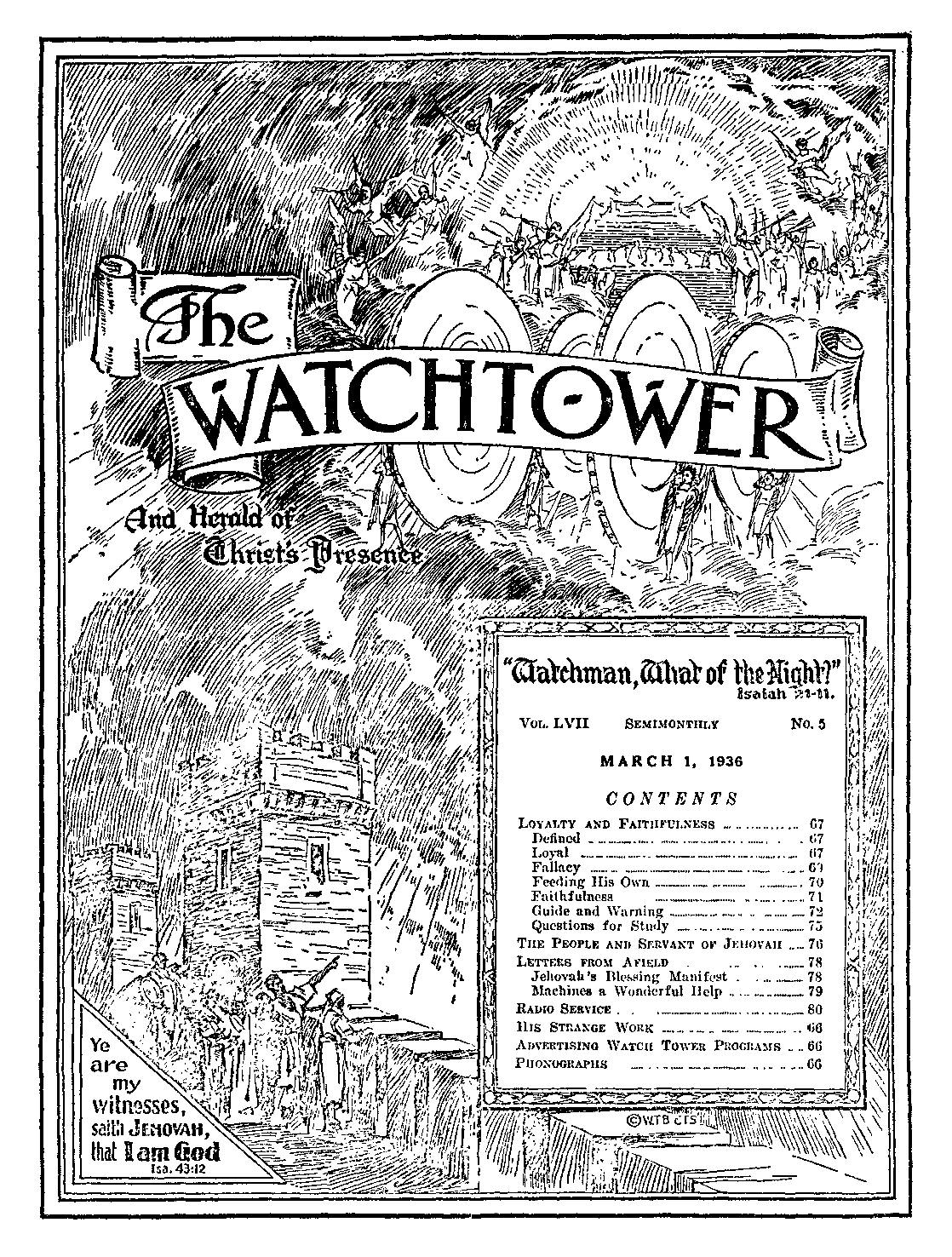
The Watchtower, March 1, 1936
Download: PDF — The Watchtower, March 1, 1936
HIS STRANGE WORK
Testimony Period for April, “His Strange Work,’’ which dates from the 4th to the 12th day inclusive, will be another season of extraordinary blessing to the publishers of the kingdom. It will be dining this period that all denounce of singing forth the name of Jehovah will call upon the people with the book Etches. The Lord's publishers will have carefully lead the autographed edition by April 4 and will be fully prepared and anxious to place this wonderful message in the hands of the people on a contribution of 25c. This book is being published in many languages. The importance of it cannot be over stressed, as you can appreciate only after you lead the book carefully.
The directors should he planning now for this campaign. Individuals not associated with the companies should write the branch office in the country in which they live or the head office at 117 Adams St., Brooklyn, N. Y., expressing their desire to participate in the witness. The Watchtower has heretofore stated that the Society would soon publish a book especially for the benefit of the “great multitude”. Here it is? Get it into the hands of the people, thereby informing them of Jehovah’s “strange work”.
ADVERTISING WATCHTOWER PROGRAMS
Advertising the Kingdom helps also to advertise the radio stations which are broadcasting the kingdom message. Hence all witnessing parties and all individuals engaging in the field service should mention the radio station in their vicinity which carries the Watchtower programs. This magnifies to the people called upon thy message which Jehovah’s witnesses introduce, and often results in interest in the punted message on the part of the listener. This is one of the chief purposes of sending out the message over the radio, to encourage the people to read the literature. In this behalf the Society supplies radio folders, and all workers should make constant use of them in house-to-house calling, leaving one of them, if nothing else.
PHONOGRAPHS
Jehovah God has duly provided another effective instrument for the kingdom proclamation, to wit, a portable phonograph equipped with electrically transcribed records of ??-minute speeches by Brother Rutherford on vital Bible topics. Reports to date from pioneers and others already equipped with and using this phonograph attest the success and potency of this method of introducing and driving home the Lord's message. The machine is manufactured by the Society at its Brooklyn factory, and is specially designed for its work, and is the belt available for the purpose, Strong, compact, with a powerful spring-wound motor, and tarrying space for several discs, it weighs 21 pounds with six discs beating twelve recordings To cover the bare cost the phonograph, with is recordings may be had for $19.25. All orders therefor, remittance accompanying, should be sent to the Brooklyn office of the Society.
Vol. LVII
March 1, 1936
No. 5
LOYALTY AND FAITHFULNESS
“My son, keep thy father’s commandment, and forsake not the law of thy mother; bind them continually upon thine heart, and tie them about thy neck. For the commandment is a lamp, and the law is light; and reproofs of instruction are the way of life.”—Prov. 6:20, 21, 23.
JEHOVAH requires absolute loyalty and faithfulness of every one whom he makes a member of his royal organization. The same rule appears to apply to all who receive life everlasting. Jehovah is the Father, or Life-giver, and there is no life everlasting received save that which proceeds from him. He dispenses the great gift of life by and through Christ Jesus, his executive officer. (Rom. 6:23) The mother of the members of the royal house is Jehovah God’s organization, symbolized by his woman, otherwise called Zion. All who are born of her receive life from and are taught by Jehovah God. (Isa. 54:13) In brief, the meaning of Proverbs 6:20 is this: That the sons of God must keep his commandments and be guided by the law of his organization, for “the commandment is a lamp, and the law is light; and reproofs of instruction are the way of life”.
2 While the English word loyalty does not appear in the Scriptures, yet there are many words in the Bible that have exactly the same meaning as loyalty. The Scriptures clearly teach that every man who receives life everlasting must prove himself both loyal and faithful. There is a distinction between loyally and faithfulness. Technically, one might be loyal and not be faithful. No one is chosen as a member of the royal house unless that one proves to be both loyal and faithful. Always loyal and faithful, it is written of Jesus Christ that he is The “Faithful and True”. He is Lord of lords and King of kings, and they that are with him are called and chosen and faithful. (Rev, 19:11; 17:14) Thus it is seen that each one of the body members of Christ must be an image of the Head, Christ Jesus. — Rom. 8:29.
DEFINED
3 The correct definition of the words loyalty and faithfulness are found in the Scriptures. The word loyal is from the same root as the word law. Law means a rule of action or conduct prescribed and made binding by the supreme governing authority, commanding what is right, and naming a penalty for the infraction of that fixed rule or law. Lawful means that which is permitted by and done in conformity to law. Loyal means that which is done in strict conformity with the law; that which is done in accordance with the law of God. A loyal creature is one who proceeds according to God’s law. Loyalty to God therefore means to carefully and strictly be obedient to his law. His will is his law whether expressed or unexpressed, and that will is expressed by him in his Word for the correct guidance of the man who desires to be right. “Thy word is a lamp unto my feet, and a light unto my path.” (Ps. 119:105) There is no other correct guide.
4 Faithfulness means more than merely to obey the letter of the law. A faithful one is trusty, trustworthy, established, steady, firm, secure, true and certain. Faithful means fidelity in the adherence to right as directed by the Lord. It means watchfulness and carefulness in the observance and performance of a duty or the discharge of an obligation. To be faithful means to be honest, constant and unchangeable. It means integrity. To maintain one’s integrity toward God he must be faithful. That means he must be true and constant in his allegiance and devotion to God, because he is bound to God and Christ by a solemn covenant. It means that the man in the covenant with God must be thorough and firm in the observance and performance of service entrusted to him. It means to be true, reliable, worthy of dependance and entirely dependable. Only the righteous who maintain and preserve their integrity toward God enter into his royal house. “Open ye the gates, that there may enter in a righteous nation preserving fidelity.” (Isa. 26: 2, Roth.) In the examination of the texts that follow the distinction between loyalty and faithfulness may be seen, and also that God requires his sons to be both loyal and faithful.
LOYAL
5 The law of Jehovah, that is, the rule of action or conduct prescribed by him for man, is perfect, and he who walks truly and sincerely in the law of God goes in the right way, and, continuing therein, that man will receive the everlasting favor of God. (Ps. 19: 7-9) Of Jesus these words are recorded: “I delight to do thy will, O my God; yea, thy law is within my heart.” (Ps. 40:8) That means that at all times Jesus is entirely devoted to Jehovah God’s rule prescribed for the righteous, that such at all times was the rule of his heart, and that at all times he delights to do the will of God. A similar rule applies to all men who are blessed of God; as it is written: ‘‘Blessed is the man that walketh not in the counsel of the ungodly, nor standeth in the way of sinners, nor sitteth in the seat of the scornful: but his delight is in the law of the Lord; and in his law doth he meditate day and night.’’ (Ps. 1:1.2) To meditate on the law of God day and night means to consider it all the time, that is, the man always considers the will or law of God and is diligent to be guided by that law. He is constantly examining his course of conduct in the light of God’s law. The “heart” means both the seat of motive and devotion, and must be always in harmony with God’s law. “The mouth of the righteous speaketh wisdom, and his tongue talketh of judgment. The law of his God is in his heart: none of his steps shall slide.” — Ps. 37:30,31.
6 A person may outwardly observe the law of God, that is to say, perform what is often called the latter of the law, and others observing his course would say: “That is a lawful man.” But it is for the Lord to judge. He judges from a different viewpoint from that of man, because God looks at the motive that causes the man to act. “The Lord seeth not as man seeth; for man looketh on the outward appearance, but the Lord looketh on the heart.” (1 Sam. 16: 7) It is quite easy to deceive men, but no one can deceive the Lord.
7 Unless one delights in doing the will of God he cannot live. “Let thy tender mercies come unto me, that I may live; for thy law is my delight. Let my heart be sound in thy statutes, that I be not ashamed. I have longed for thy salvation, O Lord; and thy law is my delight.” (Ps. 119:77, 80, 174) The moving cause for obedience to the law of God must be love, that is, a ready response to the requirements of the law without reference to what may be personally gained in this life. The right motive must be a sincere desire to serve God because he is right, righteous and just. For this reason God’s commandment is of the greatest importance, which says to man: “Thou shalt love the Lord thy God with all thy heart, and with all thy soul, and with all thy mind.” (Matt. 22: 37) The creature who is pleasing to God cannot divide his affection or devotion between God and any creature or any image or thing.
8 The law of God is his rule of action or conduct prescribed for all men. The commandment of the Lord is a positive and emphatic expression of his will or law concerning one that is in a covenant with God, the commandment directing the creature in the right way to go, and what he mint do. Every commandment of the Lord is a part of his law. Commandments not only prescribe the correct course of man or conduct, but make it imperative that those to whom the commandments are addressed follow such course of conduct. The Israelites were God’s covenant people, having voluntarily agreed to do his will. They were, as a nation, forerunners of those who have started to follow in the footsteps of Jesus Christ that they might be a part of God's holy nation. The true Israelites are those who have entered into a covenant with Jehovah, trusting in the merit of Christ Jesus’ blood, and who are specifically and emphatically bound to obey his law and his commandments For that reason God gave tins commandment to all of his covenant people, to wit : “Thou shalt have no other gods before [besides (Rotherham)] me. Thou shalt not make unto thee any graven image, or any likeness of anything that is in heaven above, or that is in the earth beneath, or that is in the water under the earth: thou shalt not bow down thyself to them.”—Ex. 20:3-5.
9 Every creature must choose either to remain with and serve the Devil if he so desires or to serve God, but when one voluntarily agrees to do the will of God he enters into a covenant with God and therefore he takes the name of Jehovah God. If he divides his devotion and service between God and the Devil or any of the Devil’s agents or representatives or images he takes the name of God in vain. That means he takes God’s name without any good resulting, but, on the contrary, there results to such a creature disaster. That man becomes an idolater, and must suffer complete loss.
10 The emphatic commandment of the Lord at Exodus 20:3 is given for the benefit of the creature, because the creature who has agreed to do God's will must keep and perform his covenant or agreement and this he can do only by having no god besides Jehovah. For this reason one in a covenant with God cannot pursue a course of conduct contrary to God's law. The saluting of a flag of an earthly government or the hailing of a man who is the visible ruler of such government is attributing salvation to what the flag or the man hailed stands for or represents. There is no salvation or life for man save that which God has provided through Christ Jesus. The one who has entered into a covenant with God has fully agreed to that great truth. (Acts 4:12) For that creature to attribute salvation to any man-made thing, rule or image, such as that which is represented by a flag of a nation or the man or men that control the nation, is a direct violation of the commandment of God and means that the man so doing is taking the name of God in vain, and if he persists in such a course he must suffer destruction.
11 To some persons the saluting of a flag of a nation or hailing a man who is the ruler of the government means little or nothing, because they have no understanding of God’s commandment and have not entered into a covenant with God to do his will. Many persons get in line with such ceremony of saluting because they fear the power of men, and many salute because others do so, and many are unable to give any reason for so doing. It is entirely different concerning those persons who have entered into a covenant to do the will of God. There is no excuse for their not knowing. Some person who has covenanted to do God's will may salute flags and hail men in order to avoid adverse criticism or persecution, and he may do such saluting with a mental reservation that he does not regard the flag or the man as of any real importance. Thereby such a person deceives men, but he does not deceive God, who looks at the heart or motive. A person in a covenant, so acting, is a hypocrite and is an abomination in God's sight.
12 The covenant people of God have no right to tell others who are not in the covenant with the Lord to decline to salute flags or hail men or to salute and had men. Each one must choose for himself. The follower of Christ Jesus is directed to be quiet and attend to his own business. (1 Thess. 4:11) It is no part of his business to tell others what they may do or not do. With God's covenant people, however, each one must look well to his own course of action, that it is in harmony with the will of God. The covenant people of Jehovah God can be loyal to him only by strictly walking according to the divinely fixed rules. The Lord caused a record to be made in his Word concerning time faithful Hebrews who refused to bow down to the image of the Devil’s organization, and without doubt this was done for the very purpose of emphasizing the necessity of strict obedience to God’s law or commandment. (Daniel 3) The covenant people of God properly obey every law of the land which is in harmony with God’s law, but when there is a direct conflict between the law of man and the law of God the covenant people of God must obey God’s law regardless of what men may say or do. – Acts 4: 19; 5: 29.
FALLACY
13 One in a covenant with Jehovah may attempt to reason himself into a position where he can justify his conduct. He permits his selfish motive to direct him in the wrong course. He builds up an argument to support his course, which argument is fallacious. That this point may be emphasized, note again the words of the first text herein: “Keep [obey] thy father’s commandment, and forsake not the law of thy mother.” The selfish man says, in substance: “I have reasoned this matter out for myself, and my understanding is that 1 can outwardly obey every Jaw of man, even such laws as are in direct conflict with God’s law, and I think it best to proceed along the course of least resistance, that I may dwell in peace with all fellow creatures; therefore I will get in line with whatever is the rule of conduct in my community.” A person thus reasoning is not exercising the spirit of a sound mind. The covenant people of God must keep in mind that human reasoning and conclusions are often very fallacious. There is but one sure and safe guide, and that is the Word of God, and therefore the Lord says to his covenant people: “Trust in the Lord with all thine heart; and lean not unto thine own understanding. In all thy ways acknowledge him, and he shall direct thy paths.” (Prov. 3:5, 6) The follower of Christ Jesus must measure his course of action or conduct by the law of God, and that alone.
14 “The law of thy mother” is the proper course of conduct to be pursued by those who are of God’s organization. Great is the favor to man to be brought into and form a part of the organization of the Lord. No person will long be permitted to remain in that organization, however, who willingly violates organization instructions. To violate the instructions coming from God’s organization means to “forsake . . . the law of thy mother”. Jehovah has a capital organization, of which Christ Jesus is the head, and that organization, being the highest part or “hill” of his holy mountain, is also called Zion. Concerning the rule of action by which God’s people must be guided Jehovah says: “Out of Zion shall go forth the law.” (Isa. 2:2-4) We are now in the “last days”, and the house of the Lord is established above the kingdoms of this world. The Lord is in his holy temple and commands that all the earth keep silence before him. it is the time when many people, that is, the great multitude, are coming and saying: ‘Let us go up to the kingdom of the Lord, to the house of the God of Jacob, that we may walk in the right way.’ Thereby they attach themselves to God’s organization. On the earth the Lord has an organization, and his servants in that organization the Lord teaches, directs, guides and instructs. The law or rule for man, and for the conduct of that organization, the Lord Jesus sends forth as the executor of Jehovah. The obligation is upon every one of the organization to be strictly attentive to and joyfully obedient to the instructions that the Lord sends forth from Zion. Christ Jesus, the head of that organization, is Jehovah’s great Prophet, and all who are in the covenant with God must give heed to and fully obey that great Prophet, and he who fails or refuses to obey suffers destruction. (Acts 3:23) In that organization God has placed every man as it pleaseth him. No man can take that honor to himself. (1 Cor. 12:18; Heb. 5:4) Each one in the organization of the Lord must stand or fall to his Master. (Rom. 14:4; Eph. 6:9) A man whom the Lord has favored by giving him a place in his organization, and which place is subordinate to some other place assigned to some other person in that organization, reasons that he is wiser than the other, possesses greater ability than others and that therefore he will ignore organization instructions and pursue his own course. Instructions come to him through the regular course in the organization which he not only ignores but for which he substitutes his own ideas in performing duties to the organization. He regards organization instructions as of no consequence so far as he is concerned, and speaks with contempt concerning those who convey the instructions to him. He murmurs and complains of what he is requested to do, is haughty, austere, high-minded, and follows his own selfish course. Thereby he is guilty of forsaking the ‘law of his mother’, that is, of God’s organization. When his attention is called to the fact that he is disregarding organization instructions, such reproof angers him and he applies words of abuse to those who call his attention to his derelictions or shortcomings. The Lord has his own good way of rebuking those who stray from the path of strict obedience to his law or organization instructions. If one takes the improper course and is reproved, such reproof is for his good if properly received, as it is written: “For the commandment is a lamp, and the law is light; and reproofs of instruction are the way of life.’’ (Prov. 6: 23) The converse of this statement of the scripture must be true. One in the covenant with God who disregards the commandment of Jehovah and the instructions of his organization is not in the way of life.
15 If a man fears God he will think soberly and take the wise course, because “the fear of the Lord is the beginning of wisdom’’. (Ps. 111:10) “The fear of the Lord is to hate evil,’’ that is, to hate and refrain from anything that would do injury to God’s organization or those who are diligent in performing service in that organization. (Prov. 8:13) Obedience to the law of God and to his organization is the only way that leads to life; as it is written: “The law of the wise is a fountain of life, to depart from the snares of death.’’ (Prov. 13:14) To scorn, hate or willfully violate organization instructions, that is, the law of God’s organization, is a foolish course for one to take. One reaches the point where he must decide quickly whether he will heed the reproof received and turn to the right, or whether he will take his own selfish course and disregard the reproof that comes to him. One course leads to death, the other to life and the blessing of the Lord. Concerning this it is written: “How long, ye simple ones, will ye love simplicity? and the scorners delight in their scorning, and fools hate knowledge? Turn you at my reproof: behold, I will pour out my spirit unto you, I will make known my words unto you. But ye have set at nought all my counsel, and would none of my reproof; I also will laugh at your calamity; I will mock when your fear cometh.’’ - Prov. 1: 22, 23, 25, 26.
16 It is rank fallacy for a man to build up an argument to justify his own conduct and to willingly disregard reproof that comes to him for violating organization instructions. It may please God to put one man in his organization whose duty is to give instructions and who has less natural ability than many others, but that is no excuse or justification for others to disregard the instructions that proceed from the Lord’s organization. Each one has the choice of being obedient to organization instructions or of calmly and quietly withdrawing from the organization. If he would please the Lord he will do with his might what his hands find to do, trusting in the Lord to cause all things to work together for his good.
FEEDING HIS OWN
17 The teachers of God’s covenant people, and who therefore feed them upon spiritual food convenient for them, are not men. This is particularly true since the coming of the Lord Jesus to the temple. God and Christ Jesus are the teachers. (Isa. 30: 20) The Lord Jesus at the temple is the dispenser of food for his own. He must employ some human means to convey the spiritual food to the mind of creatures who have a human organism. He would not employ divers means and numerous channels through which to operate his organization and transmit his spiritual food. The Lord has proved to his people, particularly within the List few years, that he is feeding his people the truth through the Watch Tower publications. No human ingenuity or ability could set forth the meaning of the prophecies which God's people have received within the past few years. Prophecy is not of private interpretation, and he who attempts to place a private interpretation upon prophecy shows himself to be a tool, for the reason that by his course of conduct he says in his heart. There is no God, that is, God and Christ are not directing the covenant people. (2 Pet. 2.20; Ps. 14:1 ??) The Lord himself leads his people and feeds them, and this includes the remnant as well as the “great multitude’’.—Rev. 7:17.
18 If a man has received the favor of the Lord by being assigned to some place in his organization on the earth, and then disregards the spiritual food which the Lord has caused to be published for the benefit of his people, and that man substitutes his own teaching and interpretation, he is thereby without doubt ‘forsaking the law of his mother’. When his wrongful course is thus called to the attention of such a man, that of itself constitutes a reproof from the Lord and affords that man the opportunity to turn to the right. That it is the duty of The Watchtower to call attention to these things appears to be certain from the Lord’s Word. When one sees that he has departed from ‘the law of his mother’, and thus receives reproof from the Lord, it is his privilege to give heed to that reproof and quickly face about. Can he receive the blessings of everlasting life if he fails and refuses to do so? The answer is found in the scripture which says: “For that they hated knowledge, and did not choose the fear of the Lord: they would none of my counsel; they despised all my reproof; therefore shall they eat of the fruit of their own way, and be filled with their own devices. For the turning away of the simple shall slay them, and the prosperity of fools shall destroy them.’’ (Prov. 1:29-32) If he does heed the reproof and turn to the right, the Lord says to him: “But whoso hearkeneth unto me shall dwell safely, and shall be quiet from fear of evil.”— Prov. 1: 33.
19 If one favored with being made a member of God’s organization on earth insists on following his own ideas and in ignoring ‘the law of his mother’, and puts himself in opposition to the organization of the Lord, he by so doing becomes a worker of iniquity. The meaning of the word iniquity is not limited to these who commit heinous crimes against others. The word is from “inequity”, meaning lawlessness or one who acts contrary to God's law. It is those who are in line for the kingdom who are in danger of the pitfall of lawlessness. Obedience to the law of the Lord is required, as Jesus says: ‘Not everyone who says Lord, Lord, shall enter into the kingdom of heaven, but he that does the will of my Father in heaven.’ The Lord then shows that when he comes to the temple for judgment many will think that they should receive the Lord’s everlasting blessing and enter the kingdom, even though they have been following their own selfish course. “Many will say to me in that day, Lord, Lord, have we not prophesied in thy name? and in thy name have cast out devils? and in thy name done many wonderful works? And then will I profess unto them, I never knew you; depart from me, ye that work iniquity.” (Matt 7:22, 23) The angels of the Lord solving at the temple are directed by the Lord to oust all such lawless ones. “The Son of Alan will send forth his messengers, and they will collect out of his kingdom all the causes of stumbling, and the doers of lawlessness, and will cast them into the furnace of fire; there will be wailing and gnashing of teeth.”—Matt. 13:41, Roth.
20 One in the covenant with God, and who loves God, will not find any excuse to be offended and to put himself in opposition to God’s organization. If his heart is right, nothing can turn him away from the service of the Lord. He may think he has been unjustly treated by others in God’s organization; he may feel sorely grieved by reason thereof; but if he loves God and his law he will conclude that the trial has come upon him and will operate for his own good if he will stand firm for the Lord and in his service, and if he does love God he will do so. “Great peace have they which love thy law; and nothing shall offend them.” — Pss. 119:165.
21 The man may be forsaken and persecuted by his earthly parents, by his brothers and sisters, and by everyone whom he expects to be his friend, and yet that is no excuse for offense against the Lord and his organization. If one is obedient to the great commandment to love God, nothing will stand in his way of serving God and nothing will cause him to withdraw from the service of the Lord’s organization. “If anyone cometh unto me, and hateth not his own father and mother, and wife and children, and brothers and sisters, further also even his own life, he cannot be my disciple.”—Luke 14:26, Roth.
23 Based upon God’s commandment to his covenant people the following words are addressed to the sons of God now on the earth: “Keep yourselves from idols.” (1 John 5:21) “Wherefore, my dearly beloved [brethren], flee from idolatry.” (1 Cor. 10:14) ‘Stubbornness is lawlessness and idolatry.’ (1 Sam. 15: 23) Those in the covenant with God, and who love him and who will receive his ultimate approval, will permit nothing to stand between them and absolute and complete devotion, obedience and service to the Lord within his organization. The citizenship of these faithful ones is in heaven. (Phil. 3:20, Ruth.) The Lord Jesus is their King, and has taken his kingdom. The allegiance of the faithful ones is and must be wholly to God and his kingdom, and they will refuse to compromise in any manner with the enemy. Like the faithful apostle who has received his crown of life, each one of the faithful remnant now says: “For I am persuaded that neither death, nor life, nor angels, nor principalities, nor powers, nor things present, nor things to come, nor height, nor depth, nor any other creature, shall be able to separate us from the love of God, which is in Christ Jesus our Lord.” (Horn. 8: 38, 39) In the heart of each one of these is written the law of God, and by his grace they will obey his law.
FAITHFULNESS
23 Jehovah assigned Lucifer to an important position in his organization. Lucifer became greatly impressed with his own importance and coveted that which belonged solely to Jehovah and to which Lucifer had no right. Perfect from the beginning, fully capable of obeying the law of God, instead of so doing he became proud and turned to lawlessness or iniquity. (Ezek. 28:15) To carry out his selfishness he invented and published the first lie, and therefore became the father of lies, whose end is destruction. For centuries God has permitted the Devil to remain and exercise his lawlessness until God’s due time to vindicate his Word and name, and this has afforded the opportunity to other creatures to voluntarily show their lawful obedience or to follow a course of lawlessness, to be faithful or unfaithful, and thus each one becomes responsible for his own destiny.
24 God took out from Egypt, the world power over which the Devil had and exercised a control, the descendants of Jacob and caused Moses to lead them through the desert on the way to the land of promise. When they reached the land of Moab Moses assembled the Israelites and by the direction of Jehovah said to them: “Know therefore that the. Lord thy God, he is God, the faithful God, which keepeth covenant and mercy with them that love him and keep his commandments, to a thousand generations; and repayeth them that hate him to their face, to destroy them: he will not be slack to him that hateth him, he will repay him to his face.”—Deut. 7: 9, 10.
25 Here God was announcing his unchangeable rule that he is faithful always and likewise does what he promises, and that he requires like faithfulness on the part of all those who enter into a covenant with him. The question then was and now is, Who will stand on the side of Jehovah and there remain steadfast, immovable, dependable and true? Who will maintain his integrity toward God?
26 It is not enough that a man take his stand on the side of Jehovah and loudly proclaim Jehovah’s name. He must prove his complete devotion to Jehovah under the test. Proud Lucifer was not faithful to his covenant. Since Satan is to be destroyed because of his unfaithfulness, that is the unchangeable rule announced, that all shall suffer a like end who become unfaithful to God. That unchangeable rule is again emphasized by God’s Word: “O love the Lord, all ye his saints; for the Lord preserveth the faithful, and plentifully rewardeth the proud doer.” (Ps. 31:23) “Mine eyes shall be upon the faithful of the land, that they may dwell with me; he that walketh in a perfect way, he shall serve me. He that worketh deceit shall not dwell within my house; he that telleth lies shall not tarry in my sight. I will early destroy all the wicked of the land, that I may cut off all wicked doers from the city of the Lord.”—Ps. 101: 6-8.
27 The clergy have blasphemously said that God through Christ is holding out his hands, begging men to come to him. That is a wicked, blasphemous statement. The question is not, How many can the Devil get and how many can God get? but is, How many’ under the test will stand firmly on the side of Jehovah, maintain their integrity toward God, and live? Can the Devil get all men on his side and against Jehovah? He will no doubt get the most of them, but there will be many who will maintain their integrity and prove Satan a liar. All the unfaithful shall die, and only the faithful shall live, because God gives life only to the faithful. His blessing is only for those who will remain true and steadfast. But he who makes haste to be rich in power, money, and honor amongst men, that he may’ satisfy his selfishness, is on the road to certain destruction: “A faithful man shall abound with blessings; but he that maketh haste to be rich shall not be innocent. ’ ’—Prov. 28: 20.
GUIDE AND WARNING
28 God has caused to be recorded in his Word “examples” and “ensamples” of faithfulness and of unfaithfulness, that such may serve as a guide to those who would do right and a warning to those who are pursuing the wrong course. (1 Cor. 10: 6-11; 1 Thess. 1:7; 2 Thess. 3:9; Phil. 3:17) He commands his people to ‘study to show yourself approved unto God’. (2 Tim. 2:15) It is vitally essential that we thus consider the ones who have preceded us and received God’s approval. Furthermore, this rule may be set down as unchangeable, to wit: That no man can be faithful unless he loves God, and if he loves God he will put himself out of the way and be diligent in seeking to know and to do the will of God.
29 Adam became unfaithful because he did not love God. He did not love Eve, even though he may have said he did. Adam desired Eve for himself and desired to have his own way. The same disposition continues to crop out amongst other men. A man may say: “I love Jehovah and I am faithful.” It is then up to that man to prove what he says. He faces a test in which he must choose between pleasing his wife and serving and pleasing God. The man says: “I love my wife and I will stand by her regardless of what comes.” In fact he does not love his wife, neither does he love God. If he loved God he would joyfully do the will of God by obeying his commandments, and if he loved his wife, seeing that she had taken a wrongful course, he would point out this fact to her and attempt to guide her in the right way according to God’s Word. The man who really loves God will firmly stand on the side of the Lord and let his course of action be a sample or guide to help those who are near to him by earthly ties and who are also under the test. One has no excuse or justification for departing from a righteous way in order to help somebody who is out of the way.
30 It is the small things that disclose faithfulness and unfaithfulness. God did not require of Adam the performance of a great task, but he did require him to be firm, steadfast and obedient. God has not required of those following Christ Jesus to perform great things, but he does require that they remain steadfast, true, faithful and dependable. “Moreover, it is required in stewards, that a man be found faithful.” (1 Cor. 4:2) Whatever duty is assigned to one who is in a covenant to do God’s will, that servant must be faithful in the performance of such assigned duty.
31 Jehovah has never put his stamp of approval upon an unfaithful man, nor one who is partially unfaithful. God’s rule shows that faithful men of old were approved because of their faithfulness; likewise those of the royal house and of the great multitude must prove faithful and true to the Lord. In God’s organization men are selected and sent forth to give aid to others that they may have a better understanding of their privileges of serving God and Christ. It is a small matter for them to do what they are asked to do in the service of the Lord. The truth is not the product of any man. The truth is the Word of God, who through Christ Jesus teaches his people. The Lord gives interpretation to his prophecies and causes the same to be published. It is the bounden duty of those sent to the companies of God’s people, therefore, to give consideration to what is published by the Lord’s organization for the aid and comfort of his people. If one is sent to a company and he disregards or fails to recognize the Watch Tower publications and the subject matter treated in The Watchtower, and in place and stead thereof substitutes his own private interpretation, the course of that man is both lawless and unfaithful; lawless, because of his failure or refusal to be obedient to organization instructions; unfaithful, because of pride and a disposition to exalt himself, and hence a failure to safeguard the kingdom interests. Men are not sent to the companies to exhibit their own learning and wisdom, nor to exhibit the learning of any other man. The kingdom is here, and the Lord’s commandment to those in line for the kingdom is that they must go and tell these great truths to others as a witness to the name of Jehovah. (Matt. 24:14) It is of God, his King, his purpose and his truth that is to be told to the people. As certain as the Lord has caused these truths to be published in The Watchtower the one who fails or refuses to use the same and substitutes his own ideas or teachings is lawless and unfaithful to the duties and obligations laid upon him. This does not mean that such a servant must read The Watchtower to the companies, but it does mean that he will discuss, consider, and elucidate the subject matter that is treated in The Watchtower and try to help the members of the companies to get a better understanding thereof, that they may all be better equipped for the service of the Lord as commanded.
32 If one is placed in a position to represent the Lord’s Society, his organization on earth, and therefore to have a part in the Lord’s witness work, and that person ignores The Watchtower and the instructions which the Lord gives therein, and substitute his own individual ideas about the interpretation of prophecy, seeking to make himself appear in the eye of others as learned and important, that man is unfaithful in giving attention to and looking after the kingdom interests. Such a person comes dearly within the rule laid down by the inspired Word, to wit: “If any man teach otherwise, and consent not to wholesome words, even the words of our Lord Jesus Christ, and to the doctrine which is according to godliness, he is proud, knowing nothing, but doting about questions and strifes of words, whereof cometh envy, strife, railings, evil surmisings, perverse disputings of men of corrupt minds, and destitute of the truth, supposing that gain is godliness; from such withdraw thyself.’’ —1 Tim. 6:3-5.
33 If one does not believe The Watchtower is used by the Lord to transmit to his people the truth, then that one should not attempt to serve in God’s organization. If he does believe that the Lord uses The Watchtower to dispense his truth to his people, then in order to be faithful he will be diligent in carrying out the instructions of the organization and will give consideration to the subjects that are set forth in The Watchtower. Any other course tends to confusion and division, which is both unlawful and unfaithful on his part. Persisting in following his own ways and devices contrary to the rules of God’s organization, he will in due time be gathered out from that organization.
34 A man is assigned to the position of service director in a company of God’s people, and receives instructions from the organization of the Lord as to what are his duties. If he is faithful and is serving because he loves God, that servant will gladly be diligent to carry out organization instructions. The service director may think he is wiser than any other in the organization of the Lord, yet that is no excuse for him to insist on doing things in his own selfish way, contrary to the instructions he has received. Service in the organization is not for the purpose of enabling men to shine or show forth their ability. The Lord’s organization must be and will be harmonious and work together harmoniously, and the one causing discord will certainly be removed by the Lord. Therefore no one should attempt to lord it over his brethren or to rule them. The purpose of the servant of God and his work is to aid others, that all in the service may accomplish the will of God to his honor and glory.
35 Faithfulness also means careful observance and diligence in performing assigned duties. One is sometimes heard to say: “I love the Lord and I am so glad to be on the Lord’s side.’’ He must be more than that. He must prove his love for God, and ‘this proves one’s love for God, that he obeys his commandments joyfully’. (1 John 5:3) If a task or duty of service is assigned to that one and he is forgetful, indifferent and negligent in the performance thereof, such is clearly proof of unfaithfulness on his part. It shows he is not dependable. It is not the one who says, Lord, I love you, but the one who does the Lord's will, that proves his faithfulness. (Matt. 7:21) The Lord has committed to his people his goods or kingdom interests. Such interests being entrusted to them, the specific duty of the servant is to be diligent in doing what he is assigned and to do it as unto the Lord, and to make known to others that the kingdom is here and that everything must be subservient to the King and the kingdom. Whatever the task is, do and perform it as unto the Lord. “And whatsoever ye do, do it heartily, as to the Lord, and not unto men.’’ - Col. 3:23.
36 No servant of the Lord can shirk his duty to the Lord in order that he might please men. Faithfulness means that one must be true, constant and wholly devoted to God and his kingdom interests regardless of what any men may think or say. “Not with eyeservice, as men-pleasers; but as the servants of Christ, doing the will of God from the heart.’’—Eph. 6: 6.
37 If there is entrusted to one a duty to perform in the Lord’s organization and, in order that he might please some person and have that person to think well of him, he in any manner compromises or fails to perform fully that duty for this reason, he is to that extent unfaithful. If a man uses fair speech in connection with his performance of duty to the Lord’s organization, and does so in order that he may have men’s persons in admiration, he is to that extent unfaithful to the Lord. (Jude 16) One who maintains his integrity toward God must be for God and his organization first, last, and all the time, and that without regard to any person connected with the organization or outside of it. How mon may judge you is of no consequence. The Lord’s judgment is of supreme importance. For that reason the true servant of God is blind to everything save that which is pleasing to the Lord. — Isa. 42:19.
38 If one thinks to treat lightly the small things committed to him to do and to perform because they are of small moment, such is a tendency to unfaithfulness. Fidelity to the Lord requires one to exercise great care and thoroughness in the performance of duty or in discharging an obligation in the Lord’s organization, however small it may appear to be. If you are assigned to a duty and you say, That is such a small and insignificant matter I will let someone else do it, such is a lack of appreciation of serving the Lord and a lack of fidelity and faithfulness. Honesty and integrity and the discharge of obligation or the performance of duties do not constitute the development of character, but such is proving whether or not we love God and his organization or whether we will please self or some other creature. If unfaithful in the small things it will be easy for one to be negligent and unfaithful in matters of greater importance. “He that is faithful in that which is least, is faithful also in much ; and he that is unjust in the least, is unjust also in much.” (Luke 16:10) The rule for all true followers of Christ Jesus must be fidelity in all things.
39 In this time of judgment the test is now upon human creatures and is, Who will stand on the Lord’s side against all opposition? The faithful therefore must be constant and unchangeable, always showing allegiance and devotion to God. The question was put squarely up to Moses, and the record of his course of action is made for the purpose of showing what is the correct course for one to take and please God. Having been reared in the royal family of Egypt, Moses could have received all the honors and plaudits that men might bestow upon another. To receive such he must be unfaithful to God and to his people. The Hebrew's were the chosen people of God and were greatly in disrepute amongst men, and because they were God’s people they suffered at the hands of Satan and his agents. Moses chose to share the afflictions that came upon his fellow Hebrews rather than to enjoy the riches of the great world power. He had faith in God and maintained his integrity. (Heb. 11:24-26) Moses was a type of the Lord Jesus Christ. Moses and his faithful fellows refused to yield to the Devil, but remained steadfast and true and received the approval of God. (Heb. 11:32-39) Thus the rule is definitely fixed.
40 When Jesus began to perform his covenant the first thing the Devil did was to attempt to cause Jesus to be unfaithful to Jehovah. Hungry and faint after a fast of forty days, it might seem to be a small thing for Jesus to use his power to make some food to refresh his body. The very smallest act of unfaithfulness Jesus would not do. In that and other temptations that followed Jesus declared himself constant and unchangeable toward God and summed up the whole matter by saying: “It is written, Thou shalt worship the Lord thy God, and him only shalt thou serve.” (Matt. 4:10) Such must be the rule of all faithful followers of Christ.
41 To some who have made a covenant to do the will of God it may seem a small thing to salute a flag and sing certain songs of fealty to earthly powers. It is small, but to yield to pressure and to so salute and attribute salvation to any except Jehovah God is an act of unfaithfulness to God. Those in a covenant with God well know that salvation, security, protection and blessings proceed only from God and his kingdom and that there is no other. To salute flags and men means to attribute salvation to them, which is unfaithfulness to God. During the past two years this test has been particularly upon Jehovah’s people in Germany. Some have fallen under the test, while others have stood true and firm, preferring to suffer imprisonment, stripes and death rather than to be untrue to God and his kingdom. They have chosen the wise course. It is written of the faithful men of old who stood firm under persecution that ‘the world was not worthy of them’; and likewise it must be said that those who today withstand persecution and remain firm, constant and faithful to God, the world is not worthy of them.
42 The Devil brought to bear upon Christ Jesus all of his cruel and wicked agencies to cause Jesus to cease bearing the message of his Father to men. Jesus stood firm and immovable, always remaining faithful. Charged with sedition and treason, condemned without any evidence, he was sent to an ignommous death by the political rulers in order to appease the bloodthirsty clergy who were aiding as the Devil’s visible agents. Jesus remained true and steadfast, and therefore God gave to him the title “The Faithful and True”. Jesus warns his followers that they must be subjected to similar persecution. (John 15:19, 20) God permits such wicked persecutions to be carried forward by the Devil until his time ends, and this affords to man an opportunity to prove his integrity and to prove the Devil a liar and to have a part in the vindication of God’s name. While his covenant people are passing through these terrible trials Jehovah continues to say to them: ‘God preserveth the faithful.’ (Ps. 31:23) The unfaithful shall perish.
43 The hour of most crucial test is now upon the people of God because Satan knows that his time is short until the final showdown. The unfaithful will compromise and side-step the issue. The true and faithful will remain constant, firm and immovable, regardless of what men may do unto them. They will not fear man, who can only kill them, but their fear is of God who is able to destroy their very existence. They will not deny the Lord nor forsake his organization, but remain faithful and true and receive his approval. (Matt. 10:26-35) To those on the Lord’s side, and therefore in the covenant with the Lord, Jesus says: “Fear none of those things which thou shalt suffer; behold, the devil shall cast some of you into prison, that ye may be tried; and ye shall have tribulation ten days; be thou faithful unto death, and I will give thee a crown of life.”—Rev. 2:10.
44 This does not mean that one must merely believe on God and Christ Jesus and continue so to believe until death overtakes him. It means that the faithful followers of Christ Jesus will, by his grace, remain true and constant, giving unto God and Christ full and complete allegiance, constant, immovable and unbreakable love, and thus they will remain even as they go down into death. They will be faithful unto God and his kingdom when everything is serene, and faithful when opposed in service by many, and will carry on to the end. They will be faithful in the midst of tribulation and persecution, refusing to yield to the devilish influence and refuse to compromise with any part of Satan’s organization. They will steadfastly maintain their integrity even with the very last breath. Men have died faithful to each other for an unrighteous cause. How much greater the privilege of dying faithful unto God and in his righteous cause!
45 The faithful and true follower of Christ Jesus, who will ultimately be in God’s royal house, will give all diligence to ‘keep his Father’s commandments’ and will be careful to ‘forsake not the law of God’s organization’. Because such love God and his law nothing will cause them to become offended and to turn away from God’s organization and the service thereof. Any part of the kingdom interests that is entrusted to such, be it ever so small, that kingdom interest will be carefully safeguarded, looked after, protected, and the duty and obligation in connection therewith will be honestly performed and discharged. No deviation from faithful performance of duty will be tolerated or permitted; no putting on of the soft pedal in order to please men or to receive the good wishes of men; no compromise with the Devil or any part of his organization. Fidelity in the performance of all duty, constancy and unchangeableness, true and immovable, will be their course of conduct.
46 God says that he 'hates that which sows discord amongst the brethren’. Any who insist on murmuring and complaining against God’s organization, and who insist on walking after their own selfish desires, are causing discord amongst the brethren. (Prov. 6:16-19; Jude 16) Those who cause offense and act in a lawless manner, the Lord will gather out and cast into outer darkness. This he has already shown in his dealing with certain ones. The sons of God who receive his approval must dwell together in peace and must avoid strife. (Psalm 133) The throne of the Greater David is set, and judgment is now in progress, and those of the house of the Lord will say: “Peace be within thy walls, and prosperity within thy palaces. For my brethren and companions’ sakes, I will now say, Peace be within thee. Because of the house of the Lord our God I will seek thy good.” (Ps. 122:7-9) The true and faithful will maintain their integrity, and therefore will now stand shoulder to shoulder, fighting for the good news of the kingdom and looking out for and safeguarding the interests of the kingdom, continuing loyal and faithful each to the others who are loyal to God, and thus will continue to do unto the very end. They will ‘never for a moment quail before their antagonists’, but will bravely and firmly and courageously stand for the Lord. Their ‘ fearlessness will now serve as a sure token to the enemy of the enemy’s impending destruction’, and to the faithful ‘their fearlessness will be to them a sure token of salvation from God!’ — Phil. 1:28, 29.
47 Jehovah has given his Word that he will preserve those who maintain their integrity toward him. ‘Faithful is he who has promised, and he will do it.’ (1 Thess. 5: 24) Faithful is he who has called you, and he will accomplish his purpose and will vindicate his holy name and will give his faithful ones a part in the vindication thereof.
QUESTIONS FOR STUDY
1, 2. What does Jehovah require of those whom he makes members of his royal house? Identify the fattier, the mother, and the son, mentioned in Proverbs 6: 20. Why are they so designated?
3, 4. What is the meaning of loyalty and of faithfulness? How only may one be loyal and faithful to Jehovah?
5-7. What is the law of Jehovah? and what is meant by its being perfect? What is the meaning of Psalm 40: 8? Apply Psalm 1: 1, 2, together with Psalm 37: 30, 31.
8. Illustrate the relationship between the “commandment” and the “law” of Jehovah.
9. What is meant by 'taking the name of God in vain’? and what is the outcome of such course of action?
10-12. To whom and for whom does Jehovah give the emphatic commandment recorded at Exodus 20: 3? Point out the importance of a dear understanding of that commandment at this time.
13-16. Show the importance now of a correct understanding and careful application of Proverbs 6: 20 and 3: 5, 6. Also of Psalm 111:10 and Proverbs 6:23, 8: 13 and 13: 14. For what situation is Proverbs 1:22, 23, 25, 26 provided?
17-19. From whom, and how, do the Lord’s people receive their spiritual food? What is to be done with the instruction and the reproof provided by the Lord from his Word through his appointed earthly instrumentality? What is the outcome of one’s course of action in this regard?
20, 21. What do the Scriptures show as to the proper procedure even in the face of injustice supposed or actual?
22, 23. Apply the Scriptural warning against idolatry. How does the record concerning Lucifer serve to instruct and warn others!
24-27. Point out other scriptures that also emphasize the unchangeableness of the rule announced in Deuteronomy 7:9, 10. Show whether the clergy have understood Jehovah’s purpose concerning mankind.
28. With scriptures, show that the Bible record of “examples” and “ examples ” of faithfulness and unfaithfulness is more than history. What unchangeable rule is here again seen?
29, 30. Illustrate the possibility of mistaking selfish desire for love. What is the proof of real love for God?
31-34. What is the proper attitude, and procedure, for those who are sent by the Society to the companies of God’s people, in view of the purpose for which they are sent? Also, for those assigned to the position of company service director?
35. Explain whether love for the Lord and being on the Lord’s side constitute faithfulness.
36, 37. Apply Ephesians 6: 6.
38. How does one's attitude toward small things indicate his faithfulness or lack thereof? How has Jesus expressed this matter?
39, 40. What is the test now upon human creatures? How did Moses meet that test? How did Jesus also meet that test and set the example for his faithful followers?
41, 42. Explain whether faithfulness to God is affected by saluting flags or mon or by singing songs of fealty to earthly powers. What instruction in this regard is seen in Jesus’ course and experiences?
43, 41. Apply Revelation 2: 10. Why is the correct understanding thereof now so important?
45-47. What will now be the position maintained and the course of procedure of all who will ultimately be in Jehovah’s royal house?
THE PEOPLE AND SERVANT OF JEHOVAH
TODAY the earth seems to have forgotten Jehovah God. Truly the words of the psalmist apply now concerning the agents of Satan who pretend to be Christians: “God is not in all his thoughts.’’ (Ps. 10:4) At the present time human policies, human greed, and position of power and wealth have brought their harvest to the full. At the present time, though there is much profession amongst so-called “Christian’’ communities, the thoughts of the people composing “organized Christianity” are far from God. Not only are their thoughts removed from God, but such hypocrisy is practiced openly in the name of the Lord that it casts reflection upon his name, which makes it now necessary for the Lord to destroy the organization of the earth even as he destroyed the world or wicked organization in the great flood of Noah’s day. The latter are really the ‘destroyers of the earth’, as Jesus called them. (Rev. 11: 18) People are much to blame for their lack of knowledge of Jehovah. They have had the opportunity to follow the teachings of Jehovah rather than of the wicked one and his earthly leaders, but their greed and selfishness have made them forget God. The course of ancient Egypt foretells the course of the whole world. In former times Egypt alone was involved, but now the whole world is involved. Today the poor are oppressed by those in authority. The religious teachers have frightened many of the people and burdened them with the nightmare of eternal torment, while others have been so thoroughly disgusted with their religion that they have turned entirely away from God.
Satan’s visible organization, made up of the religious, commercial and political elements, is referred to in the Scriptures under the symbol of a wild beast. Many of the people, either by coercion or by choice, have “the mark of the beast” (Rev. 13:16) in this, that they mentally and actively support the Devil's organization. There are millions of people in so-called “organized Christianity” who wink at the evil deeds and hypocritical practices of “organized Christianity”. Many other millions are held in subjection by fear. They claim to be the people of the Lord; but, by their course of action in either openly or tacitly approving the conduct of the leaders who reproach God, they prove themselves to be only professed people of God, and not his people in fact.
Jehovah, through his prophet, foretold this condition that we now see existing in the world. Concerning this time it is written: “For among my [professed] people are found wicked men [clergymen who pretend to represent God and yet in fact reproach his name]; they lay wait, as he that setteth snares: they set a trap, they catch men [they inveigle men into their organizations regardless of whether they have any faith in God or not]. As a cage is full of birds, so are their houses [organizations] full of deceit: therefore they [the clergy, the leaders and principal ones of their flock] are become great, and waxen rich. They are waxen fat, they shine: yea, they overpass the deeds of the wicked [they wink at the wicked deeds of politicians and Big Business as well as those of the preachers]: they judge not [righteously] the cause, the cause of the fatherless, yet they prosper: and the right of the needy do they not judge”; the people need the truth, but they do not give it to them; they do not properly and righteously consider what the people need. They feed them on politics, “science” so called, and other like provisions. The Lord thus describes the miserable condition of “organized Christianity” of the present time. Never before was there such hypocrisy practiced in the name of the Lord. Then God caused his prophet to say further: “Shall I not visit for these things? saith the Lord: shall not my soul be avenged on such a nation as this? A wonderful and horrible thing is committed in the land [‘Christendom’, or ‘organized Christianity’]; the prophets [clergy] prophesy falsely, and the priests [those who have responded to God’s call and have been in line for his royal priesthood] bear rule by their means; and my [professed] people love to have it so: and what will ye do in the end thereof ? ’’ — Jer. 5: 26-31.
…