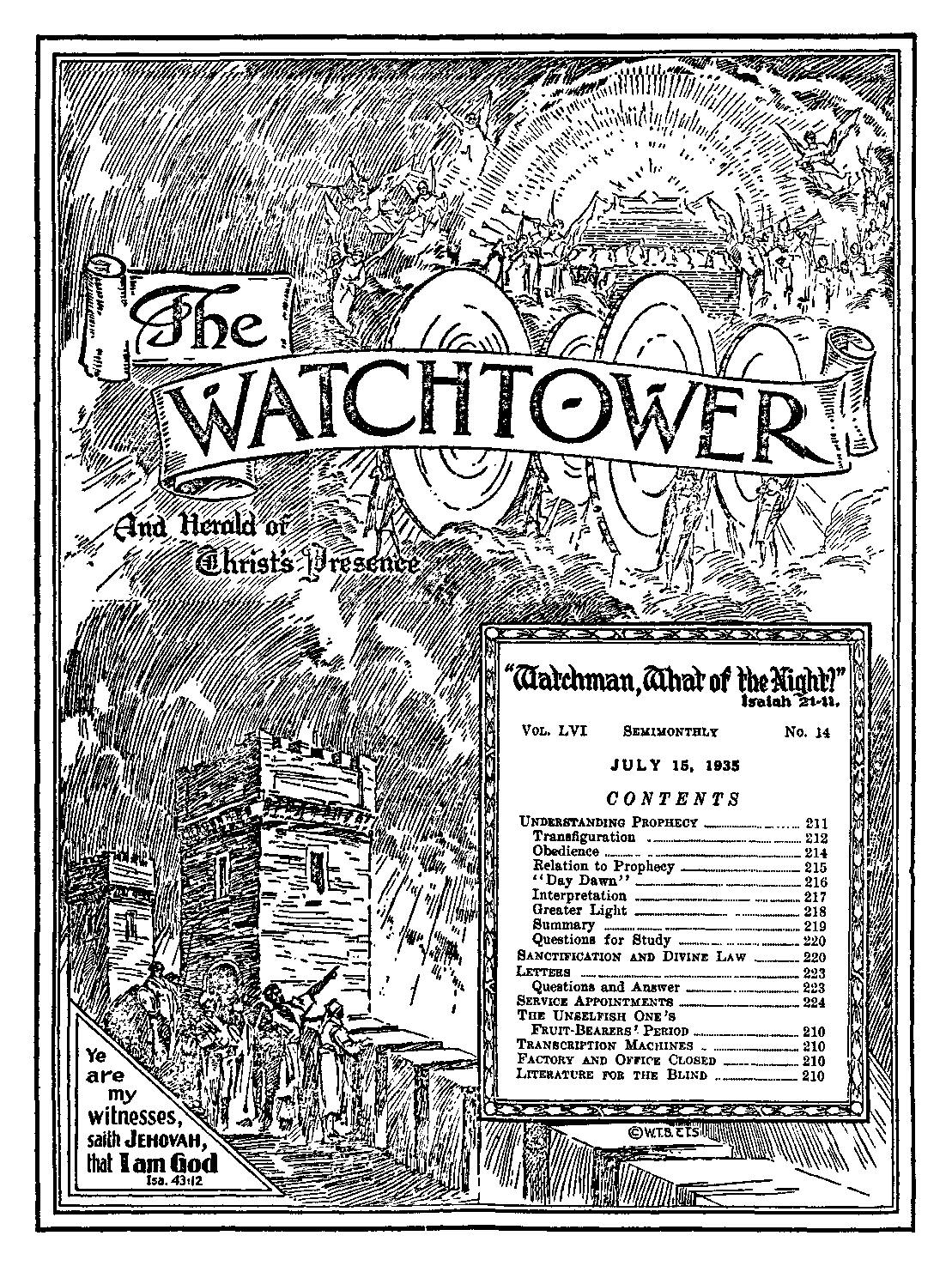
The Watchtower, July 15, 1935
Download: PDF — The Watchtower, July 15, 1935
THE UNSELFISH ONE’S FRUIT-BEARERS’ PERIOD
This period of unitedly giving testimony to the name of Jehovah, the Unselfish One, begins Saturday, August 3, and ends Sunday, August 11. During these nine days all those on the side of Jehovah will have a special season of showing forth the same spirit of unselfishness as Jehovah has displayed in giving us his life-giving and life-sustaining fruit, the kingdom truth. Those who are "trees of righteousness, the planting of Jehovah, that he may be glorified’’, will surely delight in bearing his fruit forth to others, and so will all people foreshadowed by Jonadab. the particular literature to be specialized on, and the testimony to introduce it, during that period will be duly set forth in the service Bulletin. But the other necessary arrangements, as reservation of time and obtaining of territory for work, can and should be taken up and settled promptly with this announcement.
TRANSCRIPTION MACHINES
The Society has made arrangements to construct and assemble portable transcription machines at our own factory at 117 Adams Street. These machines are somewhat different in construction from those previously furnished. They will be spring-wound, and operated from a 6-volt wet-cell battery. Every machine will be furnished complete with the battery and a battery charger, so that it can be kept up to its full strength. We are pleased to announce that this machine can be offered at $100, complete, to brethren in the United States.
FACTORY AND OFFICE CLOSED–JULY 27-AUGUST 11
All publishers afield will please take notice that the Bethel home, factory and office at Brooklyn will be closed from July 27 to August 11 inclusive. This will afford the members of the Bethel family opportunity to get away from the regular routine work and enjoy field privileges with their brethren. Because of this no shipments of literature will be made to anyone during that time. You will therefore please get your orders into the Brooklyn office in sufficient time for handling and filling before the shipping department shuts down. Be sure to order sufficient literature to carry you to the end of August.
Please do not write letters to the Society during this period. It is hoped that the only mail then received will be the regular service reports and mail accumulating in response to radio lectures, and renewals of The Watchtower and The Golden Age. We hope to give this immediate attention on reopening of the factory, and such other mail as is urgent.
LITERATURE FOR THE BLIND
Of the new series of booklets, Dividing the People, Hereafter, Cause of Death, Who Is God? and What Is Truth? can be supplied, in Braille, for the blind. These are obtainable at $1 a copy, or may be had on loan by any blind reader. Address the Society’s branch for the blind, 1210 Spear St., Logansport, Ind.
Vol. LVI
July 15, 1935
No. 14
UNDERSTANDING PROPHECY
"Knowing this first, that no prophecy of scripture is of private interpretation. For no prophecy ever came by the will of man: but men spake from God, being moved by the holy spirit."–2 Pet. 1:20,21, A.R.V.
JEHOVAH is the author of all prophecy. In olden times men who were devoted to Jehovah were permitted to make a record of prophecy and to give utterance to the same, but no man could ever properly take credit to himself for writing prophecy. The same is true relative to the interpretation of prophecy; and for this reason no creatures could have an understanding of prophecy until God’s due time to reveal the understanding thereof. When Jehovah’s time comes to unfold his prophecy, he causes those who are devoted to him to clearly see that all prophecy makes paramount these great truths, to wit: Jehovah’s purpose to vindicate his own holy name, and that he will perform that purpose by and through his beloved loyal and faithful Son, Christ Jesus. One of God’s officials had become a traitor and had brought great reproach upon Jehovah’s name, and now God would make the Logos his highest official and his Vindicator. Before vindication would be accomplished the Vindicator must first qualify by proving that man can maintain his integrity toward God under the most adverse conditions. For that reason, it is written concerning the beloved Son: "Though he were a Son, yet learned he obedience by the things which he suffered; and being made perfect, he became the author of eternal salvation unto all them that obey him." (Heb. 5: 8, 9) Jesus did not make himself a candidate for this high office, but Jehovah called him to the exalted position and made him the great High Priest to for ever carry out Jehovah’s purpose.–Heb. 5:4-6.
2 Vindication of Jehovah’s name is of first importance, but the salvation of man to life is closely related thereto. The question raised by Satan may be summed up in this manner, to wit: Is Jehovah supreme? and can he accomplish his purpose concerning his creatures? Can God put men on the earth that under all conditions will remain true and faithful to the Creator, or will all men under certain tests turn away from God and curse him? Jehovah had created the man perfect and announced to him that absolute obedience was required and that disobedience would be punished by the death of the man. Satan, being covetous and ambitious for self-honor and glory, denounced Jehovah God as a liar by saying to man, "Ye shall not surely die," and by further saying to God that ‘man would curse God to his face’ when put to the test. (Gen. 3:4,5; Job 2: 4-6) Thus the word and name of Jehovah God were put at issue. That which at once became of primary importance was the word and name of Jehovah God, and the salvation of man became secondary in importance. To decide the issue in favor of God, at least one man must prove his absolute devotion to Jehovah, being obedient under all conditions and remaining true and faithful to God. The man Jesus met every requirement under the test, proving his faithfulness unto Jehovah, even enduring an ignominious death. Because of his faithfulness Jehovah God raised Jesus out of death and made him the author of eternal salvation for all men who would follow in the footsteps of Jesus and who would prove their devotion to God.
3 From the beginning Jehovah purposed to have the question at issue decided in his favor and to the glory of his name and thus prove his own supremacy. His purpose also was that his beloved and obedient Son should be his Vindicator and, proving his faithfulness, should be the Savior of mankind. Men in order to get life must believe on God and Christ Jesus and follow the leadership of Christ.
4 Jehovah caused his law and his prophecy to be written. His law is written in plain language, that can be understood by his creatures. Prophecy he caused to be written so that it can be understood only in God’s due time, and then by those who love him. The law of God, as set out in his Word, is the light to guide men in the right way, showing them how they may maintain their integrity toward him. (Ps. 119: 105) Therefore it is written that the Scriptures point out the right way for man who devotes himself to God, that such a man may be thoroughly furnished unto all good works. (2 Tim. 3:16,17) If a man strictly follows the Word of God to the very best of his ability and remains faithful and true to God under all circumstances, he thereby maintains his integrity toward Jehovah. Faithful men of old did that very thing, including such men as Abraham and Job. It is written in the Psalm: "Thou hast magnified thy word above all thy name." (Ps. 138: 2) The understanding which God has heretofore given to man has magnified his Word above his name, but the time has come, since the coming of the Lord Jesus to the temple, that Jehovah will fully vindicate and magnify his name as well as his Word. Why should he magnify his name now more than in times past? Because Jehovah’s Vindicator has come and has been enthroned, and now he will execute Jehovah’s purpose to the glory and vindication of God’s name. The presence of the Lord Jesus at the temple of Jehovah and the unfolding of prophecy are therefore closely related one to the other.
TRANSFIGURATION
5 Peter wrote to the followers of Christ Jesus under inspiration and authority from Jehovah God given to him by Jesus Christ. (2 Pet. 1:1) Peter was one of the witnesses to the transfiguration vision on the mountain, and it is of importance to take note that he mentioned that vision in connection with the interpretation of prophecy; and this throws light upon the time for the understanding of prophecy. The record concerning the transfiguration is: "And after six days Jesus taketh Peter, James, and John his brother, and bringeth them up into an high mountain apart, and was transfigured before them: and his face did shine as the sun, and his raiment was white as the light. And, behold, there appeared unto them Moses and Elias, talking with him."–Matt. 17:1-3.
6 Beholding the inspiring vision, Peter, addressing the Lord Jesus, suggested the building there of three tabernacles; but this request apparently was entirely ignored by the Lord. "While he [Peter] yet spake, behold, a bright cloud overshadowed them: and, behold, a voice out of the cloud, which said, This is my beloved Son, in whom I am well pleased; hear ye him. And when the disciples heard it, they fell on their face, and were sore afraid."–Matt. 17: 5, 6.
7 It now appears that the transfiguration in the mountain was a prophetic tableau giving testimony to the high office of Jesus and foretelling greater things to come to pass thereafter. That transfiguration being a prophecy, its true meaning and importance would appear to God’s people only in God’s due time to interpret the same and make it plain. This is one of the secrets of Jehovah which belongs unto him until he makes it known to his children in his own due time. (Deut. 29:29) God does not reveal his secrets to rebellious ones, but only to those who are devoted to him, and then to them only in his due time. "For the fro- ward is abomination to the Lord; but his secret is with the righteous." (Prov. 3:32; Ps. 25:14; 1 Pct. 1: 10-12; Eccl. 3:1,17) Greater light is given to God’s people at the end of the world and after Christ Jesus is enthroned. (1 Cor. 10:11) That would appear to be Jehovah’s time to unfold the meaning or interpretation of his prophecy. For many years it has been known that Moses was a type of Christ Jesus, but not until the coming of the Lord Jesus to the temple of God was it known that what Moses wrote applies particularly to the Lord Jesus and his people while at the temple. Only in recent years and since the coming of the Lord Jesus to the temple has it been known that Christ Jesus is that great Prophet foreshadowed by Moses and to whom all the remnant must now be especially obedient, and when everyone who is called to the kingdom and who fails or refuses to obey that Prophet shall be destroyed.
8 What, then, is the meaning of the prophetic transfiguration scene in the mountain? Did Moses there picture ‘the overcoming Jews’, who slept in death waiting for the resurrection? Did Elijah represent there the overcoming saints who ‘would not sleep but be changed in a moment, in the twinkling of an eye ’ ? as we have heretofore been taught? (Studies in the Scriptures, Volume 6, pages 676, 677) If such is the correct conclusion, then more importance is given to man by this vision than is given to Christ Jesus and Jehovah. That alone would preclude the interpretation heretofore given from being the correct one.
9 That which the prophetic transfiguration on the mountain magnifies as of greatest importance is the vindication of Jehovah’s name by and through his beloved Son, Christ Jesus, and that this begins particularly to take place at the time of the coming of the Lord Jesus in power and glory. This statement may appear to be dogmatic, and therefore in support of this conclusion it is important to consider the words of the apostle leading up to his emphatic statement made, to wit: "Knowing this first [that is, of first importance], that no prophecy of the scripture is of any private interpretation." (2 Pet. 1: 20) Peter is here addressing his brethren, not as a teacher, but as one whom Jehovah and Christ Jesus had specifically favored and who had received certain important information, which he desired to impart to his brethren that they might keep that information in remembrance for their own wellbeing. He declared that he would not be negligent to put them in remembrance of certain things, and then said: "Yea, I think it meet, as long as I am in this tabernacle, to stir you up, by putting you in remembrance." (2 Pet. 1:13) Peter expressed his opinion that shortly his earthly ministry would end, and that while he had opportunity he would stir up his brethren to greater zeal and that they might have in mind these important truths. The Diaglott rendering of the text here is, to wit: "And I think it right, as long as I am in this tabernacle, to excite you by remembrance; . . . Now I will also endeavor always to have you, after my departure, to make mention of these things." (2 Pet. 1:13-15) "Make mention of these things"; of what things? Manifestly the things that came to pass at the time of the transfiguration in the mountain, of which things Peter was one of three witnesses. This is made certain by Peter’s words: "For we have not followed cunningly devised fables, when we made known unto you the power and coming of our Lord Jesus Christ, but were eyewitnesses of his majesty."– 2 Pet. 1:16.
10 Referring now to Matthew’s account of the transfiguration vision, it is noted that the apostles were not permitted to tell anything about it until after the resurrection of Jesus Christ took place. "And as they came down from the mountain, Jesus charged them, saying, Tell the vision to no man, until the Son of man be risen again from the dead." (Matt. 17:9) The apostles thereafter obeyed the Lord’s commandment. If the matter had been told by any of the apostles before the resurrection of Jesus, and Jesus had confirmed their statements before others, it might have been said that the proof was much stronger and men would be more likely to have full faith in the statement of what occurred in the mountain. Probably some of the consecrated ones had said to Peter at or previous to the time he wrote his second epistle something to this effect: "It is easy for you to tell a tale like that now. Probably you were very much excited at the time and you think you saw that which you did not in fact see." The language of Peter is equivalent to an admission that such might have been a cunningly devised fable and that others had suggested that. To offset that very conclusion he said to his brethren: ‘We have not followed a cunningly devised fable . . . ; we were eyewitnesses to it.’ They were eyewitnesses of a vision that related to the ‘coming of the Lord Jesus Christ in power and glory’. That definitely establishes the fact that the vision was a prophesy relating to the coming of the Lord Jesus in glory and power for judgment at the temple. (Matt. 25:31) This would strongly support the conclusion that the understanding of the vision would not be given to God’s people until after the coming of the Lord to the temple for judgment.
11 Jesus, with three of his faithful followers, was in the mountain, but Jesus is the only really important one that was there. He was the one who appeared with his ‘face shining as the sun and his raiment white as the light’. Clearly that would picture Christ Jesus at the time when God placed him on the throne as the world’s rightful Ruler and Jehovah’s mighty Vindicator. That enthronement of the Lord Jesus took place in 1914. (Ps. 2: 6) His coming to the temple as the great Judge was in 1918; therefore the transfiguration vision pointed forward to the time God would inaugurate his kingdom with Christ Jesus on the throne and as his mighty Judge and Vindicator. The unfolding and understanding of the prophetic vision could not come until the prophecy had begun to have fulfillment; hence God has kept it a secret until his due time for fulfilling the prophecy and making it known.
12 The record in the prophecy says: "And, behold, there appeared unto them Moses and Elias, talking with him.’’ (Matt. 17: 3) Of course, Moses and Elijah were not actually there present, because they were dead; but Jesus was actually there. The vision disclosed Moses and Elijah talking with Jesus, and that would clearly indicate in the tableau that those men had done certain things in the past which foreshadowed greater things that Jesus would do. Moses wrote much of the prophecy of God, and Jesus on another occasion said, "Moses . . . wrote of me." (John 5:46) The appearance of Moses in the vision, talking with Jesus, was equivalent to saying that the law, which Moses delivered to the Israelites, applies specifically to those who are followers of Christ Jesus and who are spiritual Israelites; that the covenant of God given to the Israelites on the plains of Moab by the hand of Moses foreshadowed the covenant of faithfulness for the kingdom, which God makes through Christ Jesus with those who are called to the kingdom; that those who will enter into the kingdom must faithfully perform that covenant of faithfulness; and that when Christ Jesus, the Greater Moses, comes to the temple, then every soul of the temple class must be wholly obedient unto Christ Jesus or else be destroyed. This conclusion is clearly supported by the words of Peter at Acts 3: 22, 23, and these truths the remnant learned and began to appreciate after the coming of the Lord Jesus to the temple in glory and power.
13 Elijah wrote certain prophecies and performed certain prophetic work, which foreshadowed Christ Jesus and a work Jesus would do, which work was preparatory to the coming to the temple of God. That work had particular reference to the restitution of the great and important doctrines concerning the kingdom of God, which truths had been delivered to the Israelites and to the apostles after the coming of Jesus, but which had been lost sight of after the death of the apostles and were hid until the Lord Jesus turned his attention to the things of the earth a short time prior to his coming to the temple. That this is the correct conclusion is shown by the conversation that took place between Jesus and the disciples, to wit: "Why then say the scribes that Elias [Elijah] must first come? And Jesus answered and said unto them, Elias truly shall first come, and restore all things.’’ (Matt. 17:10,11) The prophetic work done by Elijah was fulfilled in miniature by John the Baptist, who, as the forerunner, announced the coming of Jesus at his first advent. The work foreshadowed by Elijah was performed in completeness by the Lord Jesus immediately preceding the time of his coming to the temple, and, having performed this work thus prophesied, then he suddenly or straightway appeared at the temple.–Mal. 3:1-3.
14 The appearance of Moses and Elijah in the prophetic transfiguration vision had no relationship whatever to the resurrection of the dead, because there is nothing either directly or indirectly said about resurrection. Men who have tried to uphold the false doctrine that "there is no death" have grabbed upon this transfiguration scene as recorded and used it in their attempt to prove that Moses and Elijah were alive at that time; and those who opposed that false doctrine, and attempted to answer it, were led into the error of concluding that Moses and Elijah referred to the resurrection of the faithful prophets of old and of the faithful followers of Christ Jesus who would be changed in a moment, in the twinkling of an eye. It is true that Moses is dead and must await the resurrection, and it is true that Elijah was taken up in a fiery chariot by a whirlwind; but that has no relationship whatsoever to the transfiguration vision.
15 The overshadowing important part of the transfiguration vision was the announcement by the voice from heaven that the Lord Jesus is the approved One of Jehovah and the One who is the Chief Officer of Jehovah for the vindication of God’s name. The voice out of the cloud said: "This is my beloved Son, in whom I am well pleased; hear ye him." (Matt. 17: 5) Here in substance is the emphatic statement from Jehovah God that Christ Jesus is the great High Priest, Judge and King, to whom all creation must render absolute obedience, because God in due time would send Christ Jesus to be his Vindicator and to carry out all of his purposes and this would be done when Christ Jesus is enthroned as the Ruler and the Judge of the world. The overshadowing cloud symbolically spoke of the presence of Jehovah, and the fact that the cloud overshadowed the three disciples, who were witnesses, also suggests that the fulfillment of this prophetic vision would take place at the time of the second presence of the Lord. The words which the three disciples heard expressed by a voice out of the cloud would mean that Christ Jesus had maintained his integrity towards Jehovah, and the further fact that Jesus warned them that they were to tell the vision to no man "until the Son of man be risen again from the dead" shows that the exaltation of Jesus to the position of honor would be after his resurrection, to which facts the apostles subsequently testified.–Phil. 2:5-11; Heb. 5:7-9.
OBEDIENCE
16 Jesus had been sent by his Father to the earth to do his Father’s will, and Jesus had been wholly obedient to his Father. Jesus declared that he was sent to bear witness to the truth, and his faithfulness in the performance of his commission earned for him the title "The Faithful and True Witness". (Rev. 3:14; 19:11) The words which the three witnesses heard from the cloud disclosed the necessity for them to be likewise obedient to God and, since Jesus spoke with authority, that whatsoever the Lord Jesus commanded they must obey. This fixes the rule that all the followers of Jesus must obey his commandments. Obedience is one of the fixed rules of Jehovah, and there is no deviation therefrom permitted. God’s inflexible rule concerning his creatures was long ago announced, to wit: "Behold, to obey is better than sacrifice; . . . For rebellion is as the sin of witchcraft [turning away from God to the Devil], and stubbornness is as iniquity [lawlessness] and idolatry [Devil worship]."–1 Sam. 15: 22, 23.
17 The apostle stressed the importance of obedience. Knowledge of the truth increases one’s obligation to obey; because God is merciful to the ignorant, but holds responsible those who know and then fail to do. One who is going in the wrong way, even though ignorant, is lawless; but when the Lord shows him the right way, then his responsibility increases. This rule concerning those who are bound in fetters of ignorance is announced in these words: "He [God] preserveth not the life of the wicked; but giveth right to the poor. . . . And if they be bound in fetters [of ignorance], and be holden in cords of affliction; then he sheweth them their work, and their transgressions that they have exceeded. He openeth also their ear to discipline, and commandeth that they return from iniquity. If they obey and serve him, they shall spend their days in prosperity, and their years in pleasures; but if they obey not, they shall perish by the sword, and they shall die without knowledge."–Job 36: 6-12.
18 With the coming of the Lord Jesus to the temple knowledge has increased, and all who have made a covenant to do the will of God have opportunity to grow in knowledge and in wisdom, and therefore their responsibility to the Lord increases. In the Psalm the "chief musician", Christ Jesus, speaks to those who hear his words and says: "As soon as they hear of me, they shall obey me: the strangers shall submit themselves unto me." (Ps. 18:44) This prophetic statement of the psalmist applies to those hearing the truth after the coming of Christ to the temple, and with greater force than prior thereto. A fulfillment of the prophetic vision of transfiguration is after the Lord Jesus comes to the temple. Christ Jesus at the temple is the Greater Moses and the one whom Moses typified, and in the transfiguration scene Moses there pictured Christ Jesus, the great Prophet; and when he appears at the temple for judgment these words uttered by Peter specifically apply to all those who are brought to a knowledge and understanding of the truth; which words are as follows, to wit: "For Moses truly said unto the fathers, A prophet shall the Lord your God raise up unto you of your brethren, like unto me; him shall ye hear in all things, whatsoever he shall say unto you. And it shall come to pass, that every soul, which will not hear that prophet, shall be destroyed from among the people. Yea, and all the prophets from Samuel, and those that follow after, as many as have spoken, have likewise foretold of these days." (Acts 3:22-24) All the prophets of God had foretold the coming of the King, the Messiah; therefore upon the coming to the temple of the Lord Jesus all who were called to the kingdom must render absolute obedience unto the Greater Moses, in order to maintain their integrity towards Jehovah. This great and important truth is taught and magnified by the transfiguration on the mountain and what was there said.
19 Those who have not been teachable and obedient to the great Prophet upon his coming to the temple have made no progress in gaining a knowledge of God’s will in wisdom and spiritual understanding. Many who were once in line for the kingdom have since become blind, and they deny the coming of the Lord to the temple; and manifestly the apostle Peter speaks of these disobedient ones at the time Christ Jesus is at the temple for judgment, and calls them ungodly. "For the time is come that judgment must begin at the house of God; and if it first begin at us, what shall the end be of them that obey not the gospel of God? And if the righteous scarcely be saved, where shall the ungodly and the sinner appear ?"–1 Pet. 4:17,18.
20 One of the specific commandments given to the consecrated by the Lord Jesus at his coming to the temple is, to wit: "And this gospel of the kingdom shall be preached in all the world for a witness unto all nations; and then shall the end come.’’ (Matt. 24:14) Some have thought they could ignore this command and still get into heaven; but all the Scriptures appearing upon the point show that they cannot ignore this commandment, refuse to have a part in the witness, and yet have an entrance into the kingdom of heaven. Only those who obey receive the Lord’s approval; and this was emphasized at the transfiguration vision by the words: "This is my beloved Son, in whom I am well pleased; hear ye him’’; that is to say, ‘obey him. ’ To hear what the great Prophet now says means, not idleness, but diligence in performing the work which he has commanded shall be done, namely, giving the witness concerning Jehovah and his kingdom.
RELATION TO PROPHECY
21 In the second epistle Peter urges his brethren to ‘give all diligence’ to the doing of certain things there mentioned, in order that they might "neither be barren [margin: idle] nor unfruitful", failing to bear fruit, as stated by Jesus in John 15:2-6. The doing and the performing of such things as the apostle mentioned are precedent to God’s approval and to their entrance into the kingdom of God. The apostle then declares: "I will not be negligent to put you always in remembrance of these things." "And I think it right, as long as I am in this tabernacle, to excite you by remembrance; . . . Now I will also endeavor always to have you, after my departure, to make mention of these things."–2 Pet. 1:13-15, Diag.
22 The faithful are urged to make mention of these things; and clearly the things that they are to make mention of are the coming of Christ Jesus to the temple as God’s great Vindicator and Judge, and the necessity of full and complete obedience to his commandments. It is at this point that the apostle introduces the transfiguration vision and emphasizes its importance by saying: "For we have not followed cunningly devised fables, when we made known unto you the power and coming of our Lord Jesus Christ, but were eyewitnesses of his majesty. For he received from God the Father honour and glory, when there came such a voice to him from the excellent glory, This is my beloved Son, in whom I am well pleased. And this voice which came from heaven we heard, when we were with him in the holy mount."–2 Pet. 1:16-18.
23 Without a question of doubt the apostle was, in the foregoing text, referring to the coming of the Lord Jesus to the temple for judgment, for it is then that Jesus ‘appears in power and glory’. "When the Son of man shall come in his glory, and all the holy angels with him, then shall he sit upon the throne of his glory." (Matt. 25:31) This further shows that the prophetic transfiguration vision began to have its fulfillment at the time of the appearing of the Lord Jesus at the temple for judgment. It is at that time that Jesus began to exercise his power as King, Priest, Prophet and Teacher, which was foreshadowed by Moses. It is from that time forward that there must be a wider witness given to the message of and concerning Jehovah and his kingdom, and the followers of Christ Jesus, the anointed ones, must from that time onward be diligent to make mention of these things and also be diligent in bearing testimony, that is to say, bearing the fruit of the kingdom before others. It is from that time onward that those who hear the message that the King has come and his kingdom begun must also obey by taking up the glad tidings and proclaiming them to others, as stated at Revelation 22:17. But what relationship does the transfiguration vision bear to the understanding of the prophecies of Jehovah?
24 It may be well to here state the Scriptural answer to this question and then submit the argument in support thereof, to wit: the prophetic transfiguration vision relates to the coming of the Lord Jesus Christ to the temple of Jehovah for judgment, and it is a confirmation or corroboration of the prophecies previously given by Jehovah through his holy men; and that such prophecies are not of private interpretation, but can be understood only after fulfillment begins. Therefore the fulfillment of the prophetic transfiguration vision is understandable after the coming of the Lord Jesus to the temple, because that is God’s time to reveal the understanding thereof.
25 Peter emphasizes the fact that three witnesses on the mountain with Christ Jesus had not followed a cunningly devised fable, but that their own eyes had seen what there took place and that they were stating the truth. Then he adds: "We have also a more sure word of prophecy; whereunto ye do well that ye take heed, as unto a light that shineth in a dark place, until the day dawn, and the day star arise in your hearts." (2 Pet. 1:19) Did Peter mean that the word of prophecy is more sure than the transfiguration vision? Or did he mean that the prophecy was more sure than the apostle’s declaration concerning that vision? Or do his words convey the meaning that prophecy is made more sure by reason of the transfiguration's thus having been given? These questions must be answered in the light of and in full harmony with other scriptures that are now understood. If the prophecy previously written was more sure than what is taught by the transfiguration vision, then why should Peter stress the importance of the transfiguration vision and the necessity for others to make mention of it? If the prophecy was more sure than Peter’s declaration concerning the vision, then it does not appear that there was any necessity for calling attention to it unless it was to establish the veracity of Peter; and surely that was not necessary. Clearly the correct meaning of Peter’s words is that the transfiguration vision is a corroboration or confirmation of what the prophets of old had written at God’s dictation; and when the time had arrived for the fulfillment of the prophetic transfiguration vision, then would be the time when the prophecies of old written by holy men could be understood. This conclusion is supported by the rendering of the text by another translation: "And we have the word of prophecy made more sure. " – A.R.V.
26 Peter’s argument is this: The prophets of old wrote concerning the Messiah’s coming in power and glory, but now here is a vision of that glorious coming, and three of us were eyewitnesses to this vision which speaks of the 'coming of the Lord Jesus in power and glory’. To emphasize the matter he declares that this is not a cunningly devised fable that has been concocted by us or others, but that it is the truth and it confirms, supports and makes sure what the prophets of old have written. The Diaglott reads: "And we have the prophetic word more confirmed"; that is to say, corroborated, strengthened and made certain. The words used by Peter could hardly be said to draw a comparison between the importance of the prophecies written of old and that of the transfiguration vision. He had previously quoted the scripture, "The word of [Jehovah] endureth for ever." (1 Pet. 1:25) Now he says in substance, The transfiguration vision corroborates the prophecy, and when the vision is fulfilled the prophecy will be understandable. Peter knew that the fulfillment of prophecy is absolutely certain, because he was familiar with the scripture in which Jehovah said: "As I have purposed, so shall it stand"; "I have purposed it, I will also do it." (Isa. 14:24; 46:11) "Nothing could add to or take away from that word of God, but it could be confirmed or corroborated by the vision which was given in the mountain. Concerning confirmation of things written Paul wrote: "How shall we escape, if we neglect so great salvation; which at the first began to be spoken by the Lord, and was confirmed unto us by them that heard him; God also bearing them witness, both with signs and wonders, and with divers miracles, and gifts of the holy [spirit], according to his own will?" (Heb. 2: 3, 4) The confirmation that was given by the transfiguration scene would strengthen the faith of those who waited and looked for the coming of the Lord Jesus in power and glory.
"DAY DAWN"
27 The prophecy written in olden times, the transfiguration vision on the mountain, and what was preached concerning Jesus, were concerning greater things that were to come to pass in the future, and therefore the followers of Christ Jesus must wait until God’s due time for these things to be fulfilled and understood. The followers of Christ Jesus must have some knowledge as a basis for faith. Until God’s due time to give them an understanding of the meaning of prophecy they must keep in mind the law of God and the prophecies, including the transfiguration scene. This is shown to be the fact, because Peter says to them: "And we have the word of prophecy made more sure; whereunto ye do well that ye take heed, as unto a lamp shining in a dark place, until the day dawn, and the day-star arise in your hearts."–2 Pet. 1:19, A.R.V.
28 The apostle does not here mention any specific prophecy, but manifestly he had in mind all prophecy concerning the coming of the King and the kingdom, concerning which all the prophets had foretold. (Acts 3: 24) Prior to the coming of Jesus to earth to give his life a ransom for man the prophets of old had foretold that coming, but until he did come it was not understood what the prophecy really meant. Likewise the coming of Christ Jesus in power and glory; all the prophets foretold that coming, when the name of Jehovah must be made known to all, but no one understood the meaning of these prophecies until the coming of the Lord Jesus to the temple.
29 What, then, is the meaning of the words "until the day dawn"? Manifestly these words mean the beginning of the "day of Jehovah", which had its beginning when Jehovah placed his King upon his throne in Zion, which took place in 1914, and when he was sent forth to rule. (Rev. 11:17,18; Pss. 2:6; 110:2) It appears that Peter did not expect prophecy to be understood in his day, nor during the life of the men who lived at that time, but that the Word of prophecy and the corroborative testimony concerning the same, given by the prophetic transfiguration vision, would be unto the followers of Christ Jesus as a light in a dark place shining for their guidance, and that this condition of little light would continue until the "day dawn", at which time there would be a change and hence greater light and clearer understanding. In the meantime he urged his brethren to be watchful and diligent in doing with their might what their hands found to do, and if they would be diligent in doing these things mentioned by him they would never fall. (1 Pet. 1:5-7) They must continue to keep in mind that God has given his word that he would send his King in due time and that they were to look forward to the kingdom and to hold firmly to their hope which God had set before them, and that they must keep themselves separate and distinct from the wicked world. If they should become negligent and indifferent they would become blind and even forget that Christ Jesus had died for them, and that they were cleansed from sin, and that hence they could not see afar off concerning the coming of the King and his kingdom.
30 When the "day dawn", that is, the "day of Jehovah", should arrive, would all then see clearly? Not all who had once believed on the Lord, but only those whose heart devotion is to God and his kingdom. Says the apostle: "Until . . . the day star arise in your hearts." The words "day star" here used mean the "Morning Star", which is Christ Jesus, the glorious King. "I Jesus have sent mine angel to testify unto you these things in the churches. I am the root and the offspring of David, and the bright and morning star." (Rev. 22:16) The rising of the "day star", as here stated, seems clearly to relate to the coming of Christ Jesus to the temple, and his sending forth his angels to direct the course of action to be taken by those on the earth who are wholly devoted to God and his kingdom. The prophecies of the Scriptures are directed to the church and were written aforetime for the comfort of those devoted to the Lord at the time of his appearing. God, by his prophet, had said that "there shall come a Star out of Jacob, and a Sceptre shall rise out of [spiritual] Israel". (Num. 24:17) Christ Jesus is "the Bright and Morning Star", who proclaims the new day, and it is those whose heart devotion is to God and his King that see, and to these the Lord makes known the meaning of his prophecy.
31 It is this faithful class, whom Jesus finds when he comes to the temple, that he ‘makes ruler over all his goods’. (Matt. 24:44-47) The word "star" means prince, which is one of the titles given to the beloved Son of God. He is the "Prince of Peace", upon whose shoulder rests the government of the world. Those whose heart devotion is to the King and Prince and who are anxious to obey him are the ones that are favored by receiving an understanding of the prophecies written in olden times. If a man’s heart is not fully devoted to the King he cannot understand and appreciate prophecy. The transfiguration on the mountain foretold the coming of Christ Jesus, the Head of Jehovah’s kingdom, and those who were then found devoted to Jehovah and his King would be favored by receiving an understanding and appreciation of prophecy. Those who are fully devoted to God and his King prove their devotion by keeping his commandment, and therefore they joyfully go forth to deliver the testimony of Jesus Christ according to God’s commandment.–Rev. 12:17.
INTERPRETATION
32 The apostle Peter did not attempt to interpret prophecy, manifestly for the reason it was not God’s due time and he knew that he could not interpret prophecy without the Lord’s direction. No doubt there were some self-constituted "wise men" in Peter’s day that thought themselves able to interpret prophecy, and among such were those who claimed to be followers of Christ Jesus, and this situation called forth the words of the apostle at 2 Peter 1:20. No matter how wise a man thinks he is, he cannot interpret prophecy. Many have tried it, and, of course, they have failed. Long before the coming of the man Jesus the prophets of old had foretold that there would be born at Bethlehem a mighty One who should rule, but those prophecies could not be understood and were not understood until Jesus came and declared himself, and then only a few believed the prophecy. All the prophets foretold the coming of Jesus and the setting up of the kingdom, which was typically set up in David’s time. But no one could fully understand those prophecies until the coming of the Lord Jesus and the beginning of the kingdom, and then only a few have believed since his coming and his appearing at the temple for judgment. Many of those who have claimed to be in line for the kingdom positively reject all testimony that the Lord is at the temple. It is apparent that Peter did not expect prophecy to be fulfilled in his day but that the understanding thereof must wait until the great day of Jehovah. He did not urge his brethren to become interpreters of prophecy, but his advice was that they should keep the prophecy before their minds in connection with the prophetic vision on the mount of transfiguration, and that such would be to the faithful as light in a dark place, shining for their aid until the "day dawn".
33 God had revealed enough to give to the faithful some light disclosing to them the right way, and such conditions would continue until the "day dawn" and the "day star arise". The word "until" as used by the apostle is important. The presumption must be indulged that up to a certain fixed time there would be a small amount of light and then greater light would come when Christ Jesus appeared in power and glory. Many who have had some measure of knowledge of the Scriptures have persuaded themselves to believe that the Word of God was given for their own special benefit and that God has laid upon them the obligation to interpret and use prophecy, and then they felt free to use it according to their own ideas. Such a position is entirely wrong. Jehovah has not given his Word for any creature and given him freedom to interpret it and use it as he might choose.
34 In the early days of the Christian era Satan began to induce men to use the Word of God deceitfully, using the Scriptures to fit such conclusions as they had selfishly reached and twisting other scriptures to make them fit their selfish conclusions. (2 Cor. 4:2) The Roman Catholic hierarchy, for many centuries, has claimed the exclusive right and power to interpret the Scriptures, and has proceeded to interpret the same deceitfully and to meet the selfish and unrighteous desires of that wicked organization. They have made merchandise of the Word of God and continue so to do. The men of that unholy organization, which is wrongfully called the church of God, have followed their own pernicious ways. (2 Pet. 2:2,3) Various other organizations called "church denominations’’ have done likewise. No doubt there have been some serious and honest readers of the Bible amongst them, but the doctrines held and taught by these organizations have been the conclusions of men who have put forward their doctrines and interpretations to suit their own convenience and which have dishonored God’s holy name. Such men, thinking more highly of themselves than they ought to think, being selfish and desirous of shining before others, have easily fallen to the seductive influence of Satan and have advanced theories and doctrines which they have claimed to be according to the will of God, but which doctrines, in fact, greatly reproach God’s name. Satan has had his wicked hand in all of this, and selfish and ambitious men have fallen easy victims to his fraud and deceit.
35 False interpretations and doctrines not only have brought reproach upon God’s name, but have turned many honest persons away from God and caused them to look upon prophecy with disgust. In more recent years some sincere followers of Christ have discerned that the prophets foretold the coming of Christ Jesus and have attempted to fix the exact time of his coming and the establishing of his kingdom and, their predictions having failed, many have not only been disappointed but turned away from God entirely. Such as the "Plymouth Brethren’’, the "Disciples" and the "Millerites", and others, have attempted to interpret prophecy, and these have held forth such fantastic views, which have never come to pass, that the most of their following has fallen away entirely. Had the admonition of the apostle been heeded, and his instructions followed, much of this at least would have been avoided.
36 Then came the time when the work foreshadowed by the prophet Elijah must be done, and which was done immediately preceding the coming of the Lord Jesus as "the messenger of the covenant" to the temple. Within that period many sincere students of the Scriptures searched the Bible in an attempt to find out the meaning of prophecy, and they saw that the coming of the Lord Jesus was emphasized and that at the time of his coming there would be a gathering of his faithful followers unto him. They gained some knowledge of chronology and by it attempted to tell not only when the Gentile times would end but exactly what would take place at that time. Many persons accepted these interpretations and looked forward to the time when they would be admitted into heaven and aid in the operation of the universe, and when their expectations were not realized at the fixed time they were disappointed and fell away. Considering that every man was free not only to study but to advance his own interpretation of prophecy as the correct one led many to a misconception of the purpose of the Scriptures.
37 For several years before the coming of the Lord Jesus to the temple many who then thought themselves in "present truth" attempted to interpret prophecy and to use prophecy to make all manner of types and shadows, and they promulgated their doctrines in a dogmatic manner. Amongst those elected to the office of "elder" in the congregation quite a number considered themselves especially qualified to interpret prophecy, and even at the present time there are those who think that they are especially qualified to tell what the prophets meant when they wrote, and they continue to draw fantastic conclusions and pass them around for others to believe. In Peter’s day there were false prophets; and even so at this late date there are false teachers, who bring in dangerous heresies. (2 Pet. 2:1) During the Elijah period the assemblies of the Lord’s people were well noted for various "wise" interpreters amongst the "elective elders" to draw about them companies, especially in the evening, to give some fancied interpretation of a prophecy which caused the gullible to open their eyes and mouths with great astonishment, but which interpretations never came to pass.
GREATER LIGHT
38 Paul under inspiration of the holy spirit wrote, in substance, that things that came to pass in the earlier days were written for the benefit of those " upon whom the ends of the world are come" (1 Cor. 10:11); and the presumption must be indulged that that would be the time of understanding. Prior to that time the prophecies, including the transfiguration on the mountain referring to the coming of the Lord Jesus in glory and power, served as a light shining in a "dark place", "a dry place," "a wilderness or desolate place." (Parkhurst) Clearly the words of Peter mean that until the coming of the Lord Jesus in kingdom power and glory the light would be dim, and that dimness would continue in others until "the day star" arose in their hearts, that is to say, until those devoted to the Lord discerned the Lord Jesus at the temple and rejoiced in his appearing. Until the coming of the Lord Jesus in power and glory prophecy would be only as a small light shining in a dark place, but when the "day dawn", and "The Day Star" arose in the hearts of God’s people, then there would be greater light for such. Prophecy does not belong to any man; and therefore says the apostle: "Not at any time was prophecy brought by the will of man, but men from God spoke, being moved by holy spirit." (2 Pet. 1: 21, Diag.) Prophecy belongs to Jehovah, and only in his due time can it be understood by man. Now God's people see plainly that prophecy cannot be understood by any man until the prophecy at least begins to be fulfilled, and more then until after it is fulfilled. They have observed therefore since 1922 that the Lord permits his people to participate in the fulfillment of prophecy some time before they are permitted to understand the meaning thereof.
39 Jehovah God brings to pass events in fulfillment of his prophecy, and these physical facts, set alongside the prophetic words, enable those devoted to God, and in whose hearts the "Day Star" has risen, to see the meaning of the prophecy. No man can uncover prophecy; but Jehovah himself uncovers it, and this he does in his own way to his own people and gives them the information by and through Christ Jesus. Jehovah said: "Gather my saints together unto me; those that have made a covenant with me by sacrifice." (Ps. 50:5) In his due time and in fulfillment of these prophetic utterances by the psalmist, Christ Jesus came to the temple and gathered unto himself those in a covenant to do God’s will. (2 Thess. 2:1; 2 Tim. 4:1) The prophecy and the facts in fulfillment thereof disclose the coming of the Lord Jesus to the temple in 1918, at which time those spirit-begotten ones fully devoted to God and in Christ Jesus were gathered to the temple. Such saints were born of God’s "woman", and Jehovah became their great Teacher. "And all thy children shall be taught of the Lord; and great shall be the peace of thy children." –Isa. 54:13.
40 Now Jehovah teaches his children by and through the Head of his royal house, Christ Jesus, and no more do the faithful ones look to man for instruction and no more do they see their Teachers pushed into a corner. "And though the Lord give you the bread of adversity, and the water of affliction, yet shall not thy teachers be removed into a corner any more, but thine eyes shall see thy teachers." (Isa. 30:20) Jehovah the great Teacher caused his Word of prophecy to be written, and he determines when it shall be understood by his people; and a man who claims to interpret prophecy and does so to suit his own selfish ideas is presumptuous before the Lord.
41 A parable spoken by Jesus foretold that, when he appeared at the temple in power and glory, some in line for the kingdom would show themselves stubborn and refuse to hear and to obey, and that these would form the "evil servant" class. They became stubborn because of their own selfish views, which had not come to pass as they had expected. Such ‘stubbornness is lawlessness and idolatry’. (1 Sam. 15:23) The stubborn and lawless will not be permitted to be in the temple; therefore Jesus declared that he would send forth his angels and remove such and cast them into outer darkness. (Matt. 13:41,42) It is those who remain in the temple that see the greater light and that shine by reflecting the light which they receive from the Lord. (Matt. 13:43) It is to such obedient ones that the prophecies continue to unfold, because the "Day Star" has arisen in their hearts, meaning that their heart devotion is entirely to God and to his kingdom.
SUMMARY
42 The sum of the matter may be said to be this: Peter under inspiration of the holy spirit informed his brethren that Jehovah had given unto them all things pertaining to life; that therefore they should give all diligence to add to their faith virtue, knowledge, self-control, patience and godliness and if they were diligent in doing so they would be fruitful bearing the fruit of the kingdom to others; that otherwise they would be blind to their privileges and would fall away. He said nothing about the development of character that would qualify anyone to help the Lord rule the universe. He emphasized the great importance of the coming of the Lord Jesus and his kingdom and urged his brethren to keep this at all times in mind. In support of the prophecies he introduced the transfiguration vision, telling his brethren that such, which was witnessed by himself and his brethren, was not a cunningly devised fable, but was a great truth, and that James, John and himself had been eyewitnesses there to the majesty, power and glory of the Lord Jesus at his coming. His words show that it is his purpose in citing the transfiguration vision to show its corroboration and confirmation of the prophecies previously written by faithful men of old relative to the coming of the Lord Jesus and his kingdom; that all of his brethren should keep this in mind continuously, and such would serve as some light to them, as a light in a dark place shining dimly but sufficiently to guide them until the dawning of the new day, the day of Jehovah, and that when that day came and the Day Star should arise in their hearts, the meaning of the prophecy would be revealed to them. His admonition was that they were not to be drawn away from the truth by private interpretation placed upon prophecy by any man. The rising of the "Day Star" "in your hearts" would mean Christ Jesus, the Morning Star, coming to the temple in power and in glory. It was to that time the apostle Paul manifestly referred, when he wrote: "Henceforth there is laid up for me a crown of righteousness, which the Lord, the righteous judge, shall give me at that day; and not to me only, but unto all them also that love his appearing." (2 Tim. 4: 8) This must mean that, when Christ Jesus appeared at the temple, and those who "love his appearing" were watching and waiting for his coming, the hearts of such would be devoted to him and his kingdom, and that then greater light would come to them, and that that is when the crowns are assigned to the faithful who enter the temple.
43 Now the facts well known to God’s people plainly show the fulfillment of prophecy. During the Elijah period of the church the work of preparing the way before the Lord was done, and during that time faithful witnesses were looking for the dawn of the new day, when the Lord Jesus would appear. In 1914 Jehovah placed his beloved Son upon his throne, and that marked the beginning of the new day. the birth of the kingdom. In 1918 the Lord Jesus appeared at his temple in glory and in power, and there arose the Morning Star, the Day Star, the Prince of Peace. Those whose hearts were wholly set upon God and his kingdom were then gathered unto the Lord, and as others have come to a knowledge of the truth and devoted themselves they have been gathered into the temple. Henceforth these have no more been looking at a light shining in a dark place, but in the temple they are favored with the privilege of flashes of light upon the Word of God. There they are taught by Jehovah and Christ Jesus, and these great Teachers are the only teachers of those devoted to the Lord, and under their teaching the anointed are given an understanding of prophecy. The faithful witnesses have been suffering great indignities at the hands of the enemy, and continue thus to suffer, and, while thus suffering, the Lord unfolds to them the meaning of his prophecy and shows them the reason why they have suffered, and tells them what he will do to our persecutors within a short time; and this he makes known to them before it comes to pass.–Isa. 65: 24.
44 The faithful have recently seen clearly why God permits the wicked conspirators to continue to heap persecution upon his anointed witnesses; that this affords the anointed an opportunity to prove their integrity unto God and to have a part in the vindication of his holy name, and at the same time furnishes testimony that is laid up against the persecutors. Now the faithful, obedient ones have come to appreciate the great truth that all these things in the prophecies were written by holy men of old who were moved upon by the holy spirit of God and that these things "were written aforetime . . . for our learning, that we through patience and comfort of the scriptures might have hope". (Rom. 15:4) There is now no occasion for any of the remnant to have any doubt as to the fact that they are in the right way or to be in fear of what man or devil may do unto them. The faithful ones know that they are on the right side, and abiding in the secret place of the Most High they know that all things God will cause to work together for their own good. Jehovah is feeding them upon the food convenient for them, and the remnant are rejoicing and boldly singing the praises of Jehovah and his King. They are carrying the message to the "great multitude", and this great multitude is also rejoicing.
QUESTIONS FOR STUDY
1. How was the Scripture record of prophecy provided? When and how may prophecy be understood? What are the great truths made paramount therein? How was a qualified vindicator found?
2, 3. What points were involved in the question raised by Satan! How were the word and name of Jehovah put at issue? How would this issue be rightly decided? What secondary purpose would also be accomplished? What was the outcome of this test ?
4. When could Jehovah’s law and his prophetic record be understood? "What has been the reason for this difference? Under what condition does Jehovah make known his purpose? Who have met this condition? When does Psalm 138: 2 apply, and why at that time?
5. What important light is seen in Peter’s position in relation to the transfiguration vision and his mentioning the vision in connection with the interpretation of prophecy?
6, 7. What greater light is now seen concerning Jehovah’s time for unfolding the meaning of his prophecy? How does this apply to what Moses wrote?
8-10. What is it that is magnified by the prophetic transfiguration? Point out the scriptures in support of this conclusion. Account for the apostle’s words of 2 Peter 1: 16.
11. What concerning the then future office of Christ Jesus was pictured in the descriptive words of Matthew 17: 2?
12-15. Explain (a) that part of the vision related in Matthew 17: 3. (b) The expression of identification and command recorded in verse 5.
16-19. Account for Jesus' title "The Faithful and True Witness". What is the lesson therein for his followers? How do other scriptures make clear the importance of faithfully meeting the responsibility which comes with knowledge of the truth?
20. Point out the importance now of proper appreciation and diligent application of the words of the "voice" as recorded in verse 5.
21-23. What are "these tilings" referred to by the apostle in 2 Peter 1: 10,12,15? What does he declare as to the importance of diligently doing these things and of ‘making mention’ thereof to others? Explain the occasion, and the significance, of the apostle’s words of 2 Peter 1: 16-18.
24. What relationship does the transfiguration vision bear to the understanding of the prophecies of Jehovah?
25, 26. Explain Peter’s words "We have also a more sure word of prophecy".
27-29. To what "word of prophecy" does the apostle refer? How could his brethren "take heed" thereto in the meantime, "until the day dawn"?
30, 31. What is meant by "until the day dawn"? With corroborative scriptures, identify the "day star".
32, 33. Account for the words of the apostle at 2 Peter 1: 20. When, how, and to whom is the true interpretation of prophecy made known? Why, then, did the apostle admonish his brethren to take heed to the word of prophecy in the meantime?
…