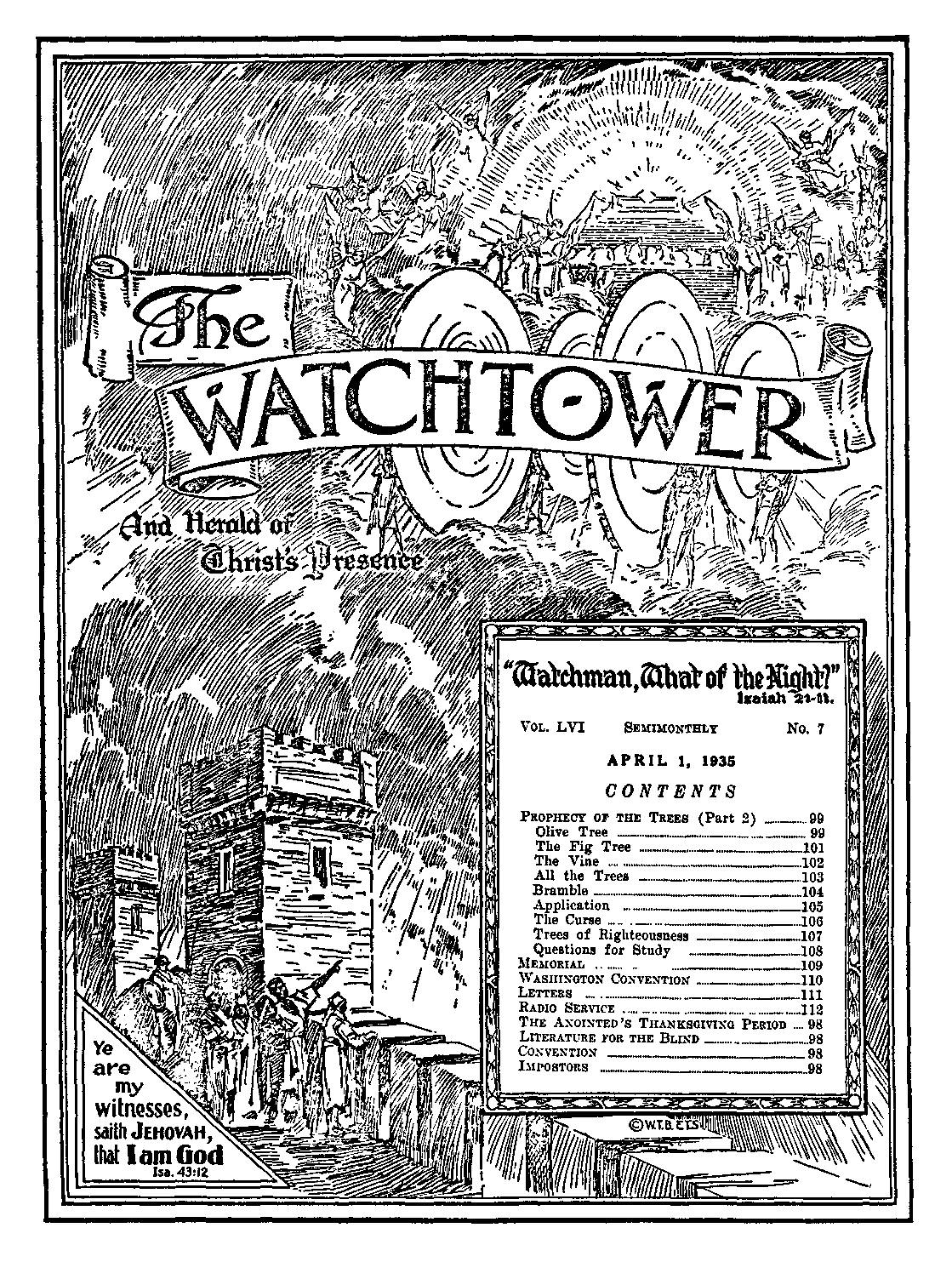
The Watchtower, April 1, 1935
Download: PDF — The Watchtower, April 1, 1935
THE ANOINTED’S THANKSGIVING PERIOD
This period, April 13-21, inclusive, embraces the season memorializing the holy name of Jehovah as also our Lord’s death, hence marks a special season of thanksgiving and praise to God. God's anointed ones everywhere, regardless of national boundaries drawn by men, will as one man in Christ Jesus work in unison these special days. Those not anointed by God’s spirit, but nonetheless devoted people of good will, the Lord God invites to also take part in this world-wide expression of thanksgiving to Jehovah and his anointed King before all nations. Let attention be given immediately to your having a full share in the season’s privileges, by making due preparation and arrangements as to time, territory, literature, etc. During this period an extraordinary offer of three booklets will be featured. All Watchtower readers not working under one of the Society’s branch offices should communicate with our main office at Brooklyn both as to arrangements and as to reporting results of work.
LITERATURE FOR THE BLIND
Of the new series of booklets, Dividing the People, Hereafter, Cause of Death, Who Is God? and What Is Truth? can be supplied, in Braille, for the blind. These are obtainable at $1 a copy, or may be had on loan by any blind reader. Address the Society’s branch for the blind, 1210 Spear St., Logansport, Ind.
CONVENTION
Again The Watchtower reminds its readers that a convention of Jehovah’s witnesses and Jonadabs will be held at Washington, D. C., beginning May 30 and ending June 3, 1935. It is hoped that many of the remnant and the Jonadabs may find it convenient to attend this convention. Heretofore not many Jonadabs have had the privilege of attending a convention, and the convention at Washington may be a real comfort and benefit to them. See page 110 of this issue.
IMPOSTORS
Persons going about the country, and claiming to be in the truth and Jehovah’s witnesses, present themselves at different places and collect money and get other favors of the brethren. We wain the brethren everywhere to have nothing to do with these impostors.
ANNOUNCING COMPANY MEETINGS
Many hearers of radio transcription lectures have the desire to meet with Jehovah’s witnesses and to study his Word with them. Hence wherever the kingdom message 13 radiocast, the time and place of meeting of the local company of Jehovah’s witnesses should be announced after the transcription. The time on the air being paid for, the station manager ought to readily grant your request to make such announcement.
Vol. LVI
April 1, 1935
No. 7
PROPHECY OF THE TREES
"That they may be called trees of righteousness, the planting of Jehovah, that he may be glorified." – Isa. 61; 3, A.R.V.
PART 2
JEHOVAH uses men to declare his purposes, but the men are of small importance. He could just as well use inanimate things to express his will. Men often think more highly of themselves than they ought to think, because God favors them, and, thus exalting themselves, they fall. Inanimate things cannot fall because of pride and vainglory. The use of inanimate and animate things by Jehovah is emphasized by the words of Jesus, when he said concerning his disciples: "If these should hold their peace, the stones would immediately cry out." (Luke 19:40) Jehovah placed Jotham on the top of Mount Gerizim and inspired him to speak the message of God and to speak it within the hearing of God’s enemies. Had Jotham, because of fear of the multitude of men below or for any other reason, failed or refused to speak as commanded, God could have caused the rocks of the mountain to speak his message. Likewise Jehovah has favored men and women in these days of peril by making them his witnesses. He has anointed them and placed them upon his "high mountain" as his representatives of his kingdom; he has put his message into the mouth of these witnesses, and if the witnesses, because of fear of Satan’s representatives which they behold below, or for any other cause, should fail or refuse to proclaim that message, Jehovah could, and no doubt would, use even the inanimate things to speak for him. Let no one of Jehovah’s witnesses take to himself honor by reason of his position. Jehovah God has given honor to his faithful ones by making them his witnesses, and they should meekly and humbly appreciate this fact. The faithful will perform their duty with firmness and without fear of any creatures, and in so doing will walk humbly before the Almighty God, giving glory and praise to his name and to his beloved Son the King.
2 By placing Jotham, whose name means "Jehovah is perfect", on the mountaintop and inspiring him to speak, Jehovah there, in substance, said to the multitude below: ‘Your way’ is wholly wrong, but my way is perfect. This man speaks a perfect message, because he is my messenger; therefore hear what he will say unto you. I have delegated to him the privilege of speaking, that I may make known my purpose. As lie stands upon this immovable mass of rock and proclaims my message, so shall my purpose be immovable and unchangeable, and my word shall not return unto me void. I have purposed it, and I will also do it.’ There Jehovah was acting according to his unchangeable rule to serve notice upon his enemy’ of the enemy's impending destruction. Jotham, being the last of the sons of Gideon, pictured the last of Jehovah’s witnesses on the earth just preceding the downfall of Satan’s organization and declaring God’s purpose concerning the destruction of the enemy. This, together with other well-known facts, is proof that the "prophecy of the trees" is now in course of fulfillment and that the unfolding thereof is for the comfort of the remnant, that they may be strong in hope, giving glory to God.
3 For many centuries the rulership of the world has been at issue, and therefore the question, Who is supreme? In this prophecy of the trees we have further or cumulative evidence that the wicked shall not continue to rule; that Jehovah God is supreme, and that his "trees of righteousness" shall forever be used by him to his glory in expressing and carrying out his purpose.
4 Trees symbolically stand for living creatures. Satan’s great "tree" that towered above the other "trees" of Eden rebelled against God and set up an opposition rule. When God had organized the Israelites and put his name upon them as his people, Satan set about to draw that people away from God. Formal religious worship was instituted and used to seduce and debauch the Israelites, and that was the means that the Devil used to bring about their destruction. Becoming wicked and dissatisfied with Jehovah’s provision for them, the Israelites turned to the devilish leaders of Satan’s visible organization and sought a king to rule over them in like manner as the heathen nations had kings.
OLIVE TREE
5 Jotham began the utterance of his proverbial prophecy of the trees in these words: "The trees wentforth on a time to anoint a king over them; and they said unto the olive tree, Reign thou over us." (Judg. 9: 8) The trees here mentioned and which went forth to anoint a king, specifically referred to in verse fifteen of this chapter, are the cedar trees of Lebanon. These trees are used as symbols of selfish, covetous, ambitious men, who act under the domination and control of Satan. Being proud, they seek to lift themselves up and to do their own will for personal gain. "For the day of the Lord of hosts shall be upon every one that is proud and lofty, and upon every one that is lifted up, and he shall be brought low; and upon all the cedars of Lebanon, that are high and lifted up, and upon all the oaks of Bashan." (Isa. 2:12, 13) They correspond to the "forest of the south field". (Ezek. 20:46) In this prophecy they picture and find a miniature fulfillment in (1) the selfish, ambitious and idolatrous men of Shechem, and (2), the greater fulfillment, in the chief men of "Christendom", who were misled by the clergy, and the multitude of "Christendom", who support these ambitious men. Those "trees" (men of Israel) were looking to have a king of their own selection and liking. In this they were acting under the influence of Gog, the chief representative of the Devil. They wanted a visible king, and Satan there steered them in the direction to gratify their selfish desires. Likewise the leading men of "Christendom" at the close of the World War were particularly anxious to have the world rule according to their idea. The World War resulted in "Christendom’s" loss of one "whelp", and so she took another of her whelps and made him a young lion (king of beasts) to rule the world. The World War demonstrated that the Anglo-American Empire does not rule by divine right, but that it is in bondage to the commercial-political and militarism. Now "Christendom" brings forth the League of Nations to make it the stabilizer and ruler of the world.–See Ezekiel 19:5; Vindication, Book One, page 252.
6 The trees, that is, selfish creatures of men, first addressed the olive tree, saying, "Reign thou over us." This must of necessity first refer to Gideon, when he was invited to rule over Israel and refused: "Then the men of Israel said unto Gideon, Rule thou over us, both thou, and thy son, and thy son’s son also; for thou hast delivered us from the hand of Midian. And Gideon said unto them, I will not rule over you, neither shall my son rule over you: the Lord shall rule over you." (Judg. 8: 22, 23) This shows that the "olive tree", there pictured, finds, first, its miniature fulfillment in Gideon, and, second, its greater fulfillment in the Greater Gideon, Christ Jesus, who is the Mediator of the new covenant. The "olive tree" is particularly associated with the new covenant as stated in Romans 11: 24-27. The "olive tree" therefore represents those of God’s organization, and is made up of those taken out from amongst men and brought into the new covenant to be a "people for his name", to bear witness for Jehovah before the nations. The "olive tree" in symbol therefore represents also the remnant now on earth bearing testimony to the name of Jehovah God. In support of this application of the parable concerning the olive tree, note the following texts: "But I am like a green olive tree in the house of God: I trust in the mercy of God for ever and ever. I will praise thee for ever, because thou hast done it: and I will wait on thy name; for it is good before thy saints." (Ps. 52:8, 9) "I will be as the dew unto Israel: he shall grow as the lily, and cast forth his roots as Lebanon. His branches shall spread, and his beauty shall be as the olive tree, and his smell as Lebanon." (Hos. 14:5,6) "And two olive trees by it, . . . These are the two anointed ones, that stand by the Lord of the whole earth." (Zech. 4:3,14) "And I will give power unto my two witnesses, and they shall prophesy a thousand two hundred and threescore days, clothed in sackcloth. These are the two olive trees, and the two candlesticks standing before the God of the earth."–Rev. 11: 3, 4.
7 The offer to make the olive tree ruler shows an attempt of Satan to induce those who are devoted to Jehovah God to turn away from him and, by compromising, yield to the Devil. Satan tried that very thing on Jesus in the wilderness when he offered to give Jesus all the kingdoms of the earth upon the condition named by Satan, to wit, that Jesus was to worship Satan. The offer, of course, was refused. (Matt. 4:1, 2, 8-11) In 1914 the Greater Gideon, Christ Jesus, was sent forth by Jehovah, because Satan’s world had then come to an end; and at the end of the World War "Christendom", as the representative of Satan, asks Christ to rule over her upon the terms named by "Christendom", to wit, that Christ would permit the kingdoms and the rulers of this world to remain in operation, and that "Christendom" select her own successive rulers and represent Christ politically and financially on earth, and that they would rule for him as his visible representatives. "Christendom" then brought forth the League of Nations, which was of its own selection, and boldly and presumptuously declared it to be the expression of Christ’s kingdom on earth, "Christendom" then demanded that God’s remnant, who are branches of the "olive tree", must worship and preach according to "Christendom’s" rules, and which were announced by the combined religious element. This element brings forth the League of Nations as the substitute for God's kingdom, and which is an abomination in the sight of Jehovah. The remnant decline to compromise with any part of the Devil’s organization, and therefore they reject the terms and entirely separate themselves from "Christendom".
8 The olive tree made response to this offer. "But the olive tree said unto them, Should I [Jehovah’s witnesses] leave my fatness, wherewith by me they honour God and man, and go [outside of Jehovah’s organization] to wave to and fro over the trees?" (Judg. 9: 9, R.V.) The olive tree by its fatness honors God. "The root and fatness of the olive tree." (Rom. 11:17) The olive tree produces an oil which is transmitted, as God’s prophet shows, into the golden candlestick that is in the temple, and gives forth light disclosing Jehovah’s purpose, which is given through Christ Jesus, God’s beloved Son. (Zech. 4:2,3; see Preparation, pages 64, 65) Gideon had refused to rule over Israel, saying that "the Lord shall rule over you"; likewise Christ Jesus declined all similar efforts, because he rules as Jehovah’s King and representative and for the honor and glory of Jehovah’s name. He is the chief ‘tree of righteousness, the planting of the Lord’.
9 The "fatness of the olive tree" is a symbol of joy, and the joy of the Lord Jesus is to exalt and vindicate the name of Jehovah. The remnant, by entering into the "joy of the Lord", do "honour God and man", as stated in the text. (Ps. 66: 2) They shine forth as lights in the world to the glory of God. (Phil. 2:15, 16) Their shining is not because of their inherent brightness, but because the glory of Jehovah has risen upon them, and his light is seen upon them. (Isa. 60:1, 2) For Jehovah’s witnesses to join in the reign with Satan’s organization would be to dishonor Jehovah God’s holy name. The faithful remnant refuse to have anything to do with the politics or political affairs of this world. Jehovah’s witnesses do not honor men of the earth, but they do honor "the man Christ Jesus", the Greater Moses, the Mediator of the new covenant, and the One whom Jehovah has crowned with glory and honor. (Heb. 12: 24; 2: 6-9; Ps. 8: 4, 5) Christ Jesus has now actually entered into this honor described by the Scriptures, and Jehovah’s witnesses declare his glory and honor. They honor the Father and the Son. While Jehovah’s witnesses do not honor any man on earth, they do obey Jehovah’s commandments to honor the Son even as they honor the Father. (John 5:23) Jehovah’s remnant continuously honor Jehovah God and Christ Jesus, his beloved Son, by telling the people that the kingdom of God under Christ his King is the only hope of mankind, and that it will completely vindicate Jehovah’s name. Therefore is fulfilled the prophetic parable as to the remnant with reference to their refusal to ‘leave their fatness wherewith they honor God and man’, and they refuse to go and be promoted by any part of Satan’s organization.
10 Christ Jesus now at the temple of Jehovah has committed to the faithful remnant "the testimony of Jesus Christ". The faithful remnant are olive branches in the "olive tree" and they refuse to compromise with Satan’s organization, and they refuse to ask permission of Satan’s organization to preach. They deliver the testimony of Jesus Christ in obedience to God’s commandment, and not in obedience to man’s commandment. (Rev. 12:17) This shows that the "olive tree" has refused to consider "Christendom’s" proposition. Christ refused to "wave to and fro over the trees" of the wicked world and has shown his disapproval of that unrighteous rule. Christ Jesus, the great "olive tree", has rejected "Christendom", or Satan’s organization, and now serves notice on it that its destruction is near. Likewise the branches in that great olive tree, the remnant, refuse to be lured away from honoring Jehovah God and his beloved Son, "the man Christ Jesus." They have come to the kingdom, pictured by Mount Zion, and to the new covenant, which has been inaugurated toward them, and they have received their new name, which the mouth of Jehovah has given them. They, like their Head, Christ Jesus, reject all promotion that comes from men, and look alone to Jehovah for promotion. (Ps. 75:6) They stand firmly to the terms of the new covenant, and as witnesses for Jehovah they now vigorously and joyfully shout to the enemy: "We are for Jehovah and for his Vindicator " Christ Jesus, the greater olive tree, will rule the world, not according to the terms dictated by selfish men or by Satan, but according to the rule of Jehovah, the King eternal.
THE FIG TREE
11 Flattery is an instrument Satan employs to entrap men, and selfish and ambitious men yield thereto and are quickly ensnared. "A man that flattereth his neighbour spreadeth a net for his feet." (Prov. 29:5) "And a flattering mouth worketh ruin." (Prov. 26:28) With flattering speech the trees then turned to the fig tree. "And the trees [of Satan’s organization] said to the fig tree, Come thou [into our organization], and reign over us." (Judg. 9:10) This part of the prophetic parable is further evidence of Satan’s subtle method employed to turn men away from God, and, yielding, they are ensnared and necessarily they bring about their destruction. "The fig tree" in this prophecy pictures and finds its first and miniature fulfillment in Jether, the firstborn of Gideon, and who was one of the three hundred in the battle. (Judg. 8:20) He was a legitimate son of Gideon, whereas Abimelech was a bastard. (Judg. 8:31) The Israelites had asked that the sons of Gideon rule over them after Gideon, and this Gideon had refused, and hence the first application of the parable is to the firstborn of Gideon. The second and greater fulfillment of the "fig tree" is found in the "holy nation" of God. It is the riсh, fruit-bearing organization of which Christ Jesus is the head and is the all-essential One. (1 Pet. 2: 9) The "holy nation" of God was born in 1914. (Rev. 12:1-5) As a further proof that in its full application the fig tree applies to the holy nation it is noted that Jehovah had selected the nation of Israel to be a people for his name, and when Christ Jesus came to that nation as his Father’s official representative, he looked upon the nation and likened it to a fig tree without fruit and cursed it, because it had failed to hold forth the fruit of the kingdom. (Matt. 21:19, 20; Luke 13: 6,7; Jer. 24:1-8; 29:17; Joel 1:7) It is those trees that hold forth or bear the truth to the glory of God that receive his approval. "Whoso keepeth the fig tree shall eat the fruit thereof; so he that waiteth on his master shall be honoured."–Prov. 27:18.
12 "Christendom" has made loud profession that she desires the nation of God to rule over the people thereof, but her professions are entirely hypocritical, because she has insisted that the nations of "Christendom" should be let alone and that God’s kingdom should not "rule [the] nations with a rod of iron" and compel the obedience to righteousness, but that "Christendom" should rule in her own way under the name of God and Christ. (Ps. 2: 8, 9; Rev. 2: 26,27) "Christendom," and particularly including her ‘bastard’ bosses, in effect says to Jehovah and Christ Jesus: ‘You may rule in heaven, but we will rule on the earth, and we will call ours the expression of your rule.’ Being as "cedars of Lebanon", that is to say, Satan’s children, these chief men in "Christendom" do not like to hear the voice and command of Jehovah God, because "the voice of the Lord breaketh the cedars ... of Lebanon". (Ps. 29:5) "Christendom" invites the Lord’s nation to join her family or League, which would be a compromise with the Devil, and which Christ Jesus and all his faithful followers flatly decline.
13 In the prophecy the "fig tree" refuses the offer and states the reason why acceptance would be impossible: "But the fig tree said unto them, Should I forsake my sweetness, and my good fruit, and go to be promoted over the trees?" (Judg. 9: 11) The refusal is stated in question form, but in such forcible terms that there could be no mistake of its meaning. The fruit of the fig tree is sweet, and the doing of the will of God is sweet to those who by his grace compose the new nation. Those of the new nation delight to do the will of God, because his law is right. They worship him as the only true God and worship him in spirit and in truth. They do not fear creatures, but they do fear God and are exceedingly anxious to obey his commandments, and that is sweetness to them. (Ps. 19:9, 10) The fig tree says: "Should I forsake ... my good fruit ?" which good fruit is lifegiving and life-sustaining truth of the kingdom. Such alone is good fruit, and this fruit of the kingdom Jehovah commits to the holy nation, including the remnant which bear it before the world as witnesses to Jehovah’s name. These say as his witnesses, "We should bring forth fruit unto God." (Rom. 7: 4) The word of truth of the gospel of the kingdom is committed to those of the holy nation, and the Lord fills the mind of his remnant people with this precious message of truth. "Be filled with the knowledge of his will, in all wisdom and spiritual understanding; that ye might walk worthy of the Lord unto all pleasing, being fruitful in every good work, and increasing in the knowledge of God." (Col. 1:9, 10) Such fruit-bearing is required of all the remnant at the temple. When Christ Jesus came at the birth of the holy nation he failed to find in hypocritical "Christendom", which is the spurious "fig tree", any fruit or witness to the truth, and hence he cursed "Christendom" and cast her away.–Matt. 21:18-20.14 Why should anyone, so greatly favored by Jehovah by being made a part of the new nation, "go to be promoted over the trees," that is, to have part in the rule over this ungodly world? If a Christian should so do he would be refusing to express Jehovah’s judgment against Satan’s wicked organization, and hence he would be compromising with the Devil. God’s people on earth today, by reason of their enlightenment from the Word of God, are far better equipped than those of the world to put in operation an equitable rule amongst men, but for them to turn aside from their God-given commission and to yield to the flatteries of men of this world by accepting or participating in holding office, would mean to fail in the purpose for which Jehovah has called them, and they would fall into the flattering snare of Satan and be for ever destroyed. The faithful witnesses of Jehovah, forming a part of the new and holy nation, which is Jehovah’s capital organization, flatly refuse to yield to worldly flattery or coercion and, turning away therefrom, they continue to sing out: "We are for Jehovah and for his Vindicator."
THE VINE
15 The Devil made three separate and distinct attempts to turn Jesus away from Jehovah, that Jesus might bring about his self-destruction, and in all of them he failed. In the parable under consideration failure resulted in the effort of Satan’s representatives to turn the olive tree and the fig tree away from their righteous course. Then the third attempt was made: "Then said the trees [Satan’s representatives] unto the vine, Come thou, and reign over us." (Judg. 9:12) The vine in its first, miniature application is to the legitimate sons or house of Gideon as represented in the words "thy son, and thy son’s son also", whom the Israelites had asked to reign over them. (Judg. 8:22) Its greater and complete application is to the royal house of Jehovah, of which Christ Jesus is the chief member and Head, which royal house has the supreme joy of participating in the vindication of Jehovah’s name. The vine produces good wine, which is a symbol of joy: "For the joy [of wine] of the Lord is your strength." (Neh. 8:10) Jesus Christ as the chief member of the royal house constitutes "the vine": "I am the vine, ye arc the branches [including the remnant now on the earth and who have entered into the joy of the Lord]. . . . These things have I spoken unto you, that my joy [the joy of Jesus as the Vindicator of his Father’s name] might remain in you, and that your joy might be full." (John 15:5, 11) That the complete application of the prophetic parable is in the "day of Jehovah", note these proof texts: "In that day the Lord with his sore and great and strong sword [Christ Jesus] shall punish leviathan the piercing serpent, even leviathan that crooked serpent; and he shall slay the dragon that is in the sea. In that day sing ye unto her, A vineyard of red wine." (Isa. 27:1, 2) Following the World War "Christendom" invites Christ to be her ruler upon condition that she bear his name while at the same time she pursues her own selfish course. Should the people understand that "Christendom" no longer has the name of Christ, that would be to her detriment; hence "Christendom" invites Christ to be her ruler upon her own terms and purely for a selfish reason. "Christendom" and her chief men would deny Christ and his faithful remnant members of his house the privilege and joy of proclaiming the name of Jehovah God. She would prevent the faithful remnant from giving honor and joyful praise by proclaiming the name of Jehovah and from thus having a part in the vindication of his name. "Christendom" and all of her chief men insist on drinking Babylon’s "wine". (Rev. 17:2-4) "Christendom" would have Christ to be a "vine of Sodom" and not cheer and give joy to the great husbandman Jehovah. Could the royal house of Jehovah agree to any such terms?
16 Jehovah has given joy and strength to his royal house, and this joy must remain with them for ever. Hence the vine replied to the trees: "Should I leave my wine, which cheereth God and man, and go to be promoted over the trees?" (Judg. 9: 13) To compromise with "Christendom" by ‘touching the unclean thing’ or by having anything in common with her or by holding any official position under her organization, the remnant would thereby be required to forsake the joy of the Lord, and that would mean to "leave my wine, which cheereth God and man", that is to say, Jehovah God and "the man Christ Jesus". Jehovah has joy in the vindication of his own name, and those who "walk in the light" with Christ Jesus, the Vindicator, have partnership with him in the vindication of his name, which the wine of the vine here pictures. (1 John 1:5-7) Jehovah God finds cheer in the wine from his "vine" which he has planted for his own joy. "Wine maketh merry [margin, maketh glad the life]." (Eccl. 10:19) "Christendom" serves Satan and makes glad the heart of Satan with its wickedness and lies. (Hos. 7:3) The wine of Jehovah not only cheers his heart but makes glad the heart of the "man Christ Jesus", because the joy of Jesus is the vindication of his Father’s name and he rejoices over the remnant that participate with him in that joyful work. (Isa. 61:10) It is to Jehovah and Christ Jesus that the faithful remnant give cheer by their full devotion to God, his King and kingdom. The remnant are not seeking to be pleasers of men on earth, but seeking only to please God and Christ. "Not as pleasing men, but God, which trieth our hearts." (1 Thess. 2:4) "Ye ought to walk ... to please God." (1 Thess. 4:1) These words of admonition apply to those who are of the royal house, and therefore to the branches of the true vine. Said Jesus, the true vine: "I do always those things that please him." (John 8:29) "And whatsoever we ask, we receive of him, because we keep his commandments, and do those things that are pleasing in his sight." (1 John 3:22) "And wine that maketh glad the heart of man, and oil to make his face to shine, and bread which strengtheneth man’s heart.’’ – Ps. 104:15.
17 Jehovah’s witnesses are now privileged to participate in gathering the "vine of the earth" preparatory for its destruction. Should these, who have received the anointing of the Lord, "go [and touch the unclean thing of ‘Christendom’] to be promoted over the trees" of Satan’s organization, it would mean their unfaithfulness to God, and they would lose all opportunity of joyfully participating in the vindication of Jehovah’s name. It would also mean to them the loss of all the precious things promised by the Lord. "And he that overcometh, and keepeth my works unto the end, to him will I give power over the nations: and he shall rule them with a rod of iron; as the vessels of a potter shall they be broken to shivers: even as I received of my Father."–Rev. 2: 26, 27.
18 The remnant must be complete overcomers in order to enjoy this promise. Christ Jesus has flatly rejected the terms of "Christendom", and his faithful followers, the remnant, must do likewise. They in obedience to God’s commandment must continue to deliver "the testimony of Jesus Christ", which is committed unto them, and to do this without apology to anyone, and without asking the permission of any creature so to do. They continue and will continue to the end to declare the name of Jehovah, to point the people to Jesus Christ as the great Treader of the winepress of the fierceness of the wrath of Almighty God, and thus to warn "Christendom" that she and all of Satan’s organization will soon be crushed. They faithfully and joyfully sing, as they march to Armageddon, that they are for Jehovah and for his Vindicator, Christ Jesus.
ALL THE TREES
19 The honesty and sincerity of a creature is determined by the course of action which he takes, and thus it is well said that "actions speak louder than words". Abimelech and his supporters, as pictured by "the trees", disclose their insincerity and dishonesty by asking the olive tree, and the fig tree, and the vine, to rule over them. Likewise "Christendom", and particularly the clergy and the "principal ones of the flock", disclose their dishonesty by the course of action taken. The clergy had claimed a desire for Christ to rule, and the principal ones of their flock joined in this formal request, and the rabble or hangers-on bowed down and dropped their shekels into the basket, all of them thereby hoping to purchase some favor to themselves, but such ones of "Christendom" had not received the truth that they had heard into a good and honest heart. During the Elijah period and up until 1918 the truth of God’s kingdom had been repeatedly proclaimed throughout "Christendom", but these trees of "Christendom" were not growing on good ground and the truth did them no good. "But that on the good ground are they, which, in an honest and good heart, having heard the word, keep it, and bring forth fruit with patience." (Luke 8:15) The end of the Gentile times came, and the religionists were told that Christ’s kingdom had come. The righteous rule of Christ was not according to the liking of the selfish clergy, the commercial and political "trees", nor to the supporters of this official element. Many who had been engaged in the Elijah work did not find or realize, in 1914, what their selfish hearts had desired. They had expected then to be exalted, but failing in this these unfaithful ones, forming the "evil servant" class, joined the other trees; "then said all the trees unto the bramble [thistle, or thorn tree], Come thou, and reign over us." (Judg. 9:14) The text emphasizes the point that "all the trees" joined in this request. "All the trees" here must of necessity include the "evil servant" or "'man of sin" class, because at the time of the fulfillment of the prophetic parable the "evil servant" class as "trees" now bow and wave their arms to the earthly visible rulers and declare them to be the "higher powers", and they thus betray the Lord Jesus, as represented in his brethren, the "faithful and wise servant" class. The "man of sin" class here becomes also the Judas class, "the son of perdition." By their course of action they prove that they had not received the truth in an honest and good heart but that they through selfishness and dishonesty looked for selfish gain. "All the trees," being insincere and dishonest, could not agree on anything that is good and honest, but they do all agree on one thing, to wit, their united opposition to God’s kingdom and to his anointed servants on the earth. Their course of action now proves their hypocrisy and discloses that they never did honestly and sincerely desire Christ Jesus, as pictured by the olive and fig trees, and the vine, to rule over them. Therefore "all the trees" turned to the bramble, or thorn tree. What does the bramble, or thorn tree, picture?
BRAMBLE
20 In the miniature fulfillment of the prophetic parable, according to Judges 9: 6, the bramble, or thorn tree, represented Abimeleeh. In the larger or complete fulfillment of the prophecy it pictured the low-down, injurious, extremely selfish and unfaithful ruling factors, that is to say, the professional politicians and the commercial giants, "the principal of the flock," and who therefore constitute the ‘bastard’ Christians of "Christendom". These do not devote themselves to the general welfare of the people, and certainly not to the honor of God. Concerning these hypocrites, false prophets, insincere and dishonest ones, Jesus said: "Ye shall know them by their fruits. Do men gather grapes of thorns, or figs of thistles? Even so every good tree bringeth forth good fruit; but a corrupt tree bringeth forth evil fruit. A good tree cannot bring forth evil fruit, neither can a corrupt tree bring forth good fruit. Every tree that bringeth not forth good fruit is hewn down, and cast into the fire." (Matt. 7: 16-19) "A good man out of the good treasure of his heart bringeth forth that which is good ; and an evil man out of the evil treasure of his heart bringeth forth that which is evil: for of the abundance of the heart his mouth speaketh." – Luke 6: 45.
21 In 1918 Christ Jesus, "The Stone in Zion," was laid, and now Jehovah by his anointed and installed King and Judge gave the commandment: "But the Lord is in his holy temple: let all the earth keep silence before [hear and obey] him." (Hab. 2:20) Instead of obeying the Lord’s command, "all the trees" of "Christendom" turned to the bramble, that is to say, to the selfish, heartless men of "Christendom", and said: ‘Come thou, and rule over us.’ "Christendom" and her principal of the flock did not then go to those who were in the new covenant as a people for Jehovah’s name, that is to say, "the olive tree"; nor to "the fig tree", which brings forth the fruit of the kingdom; nor to "the vine", which has the joy of the Lord in sharing in the vindication of Jehovah’s name; but they joined together in putting forth "the bramble", or thorn tree, to rule, which does not respond with appreciation to God’s "rain" of truth. Call to mind now the men who have been placed in positions to rule in the earth since 1918. Among them there is not a single one who has stood for God and Christ. All have ignored the truth altogether, even though the truth has been directly brought to their attention. They have refused to consider God’s kingdom under Christ as the remedy for the world’s ills. On the contrary, these selfish visible rulers have brought forth various selfish schemes by which they hope to rule the world, such as fascism, Hitlerism, N.R.A., and "Holy Year" fiasco, and like selfish things, and they ask the people to put their faith and hope in these things. Instead of receiving God’s message of truth, they persecute and ill-treat his messengers who bring them the fruit of his kingdom. Thus it is seen that the "ground" of "Christendom" has received the rain of God’s truth, which has been repeatedly showered upon them, and "Christendom" refuses to give heed even to the notice and warning of her impending destruction, and absolutely has ignored God and Christ, and hence her days are numbered and she is nigh unto destruction: "For the earth which drinketh in the rain that cometh oft upon it, and bringeth forth herbs meet for them by whom it is dressed, receiveth blessing from God: but that which beareth thorns and briers is rejected, and is nigh unto cursing; whose end is to be burned." – Heb. 6:7, 8.
22 Being cast out of heaven, and seeing Jesus enthroned as the King, Satan in 1918 knew that he must hasten in his work of destruction; hence he would get all the people in the nations to turn away from God and to put their trust in him, the Devil, and his earthly agencies; and this is shown by the prophetic parable by the response of the bramble: "And the bramble said unto the trees, If in truth ye anoint me king over you, then come and put your trust in my shadow; and if not, let fire come out of the bramble, and devour the cedars of Lebanon."– Judg. 9:15.
23 The "bramble", or modern Abimelech, that is, the selfish commercial and political rulers, aided, encouraged and whitewashed by the clergy, orders the "trees", that is to say, the peoples of "Christendom", to line up under Satan’s banner and put on their uniforms or garments of identification, carry a flag and give a specific salute, and recognize and bow down to those in Satan’s organization, and to hail them as the "higher powers" and to give their allegiance and complete devotion to such rulers. All are commanded to take a position against Jehovah and Christ Jesus, the Greater Gideon, and against Jehovah’s witnesses as the representatives of the Lord on earth. Thus the modern Abimelech would have the people, pictured by the "trees", to come under and "trust in the shadow of Egypt".–Isa. 30:2, 3.
24 They must obey "Christendom’s" rulers and get under the shadow of the Devil’s big "tree". (Ezek. 31: 6, 17) God’s faithful people are under the shadow of the Almighty, but the attempt of the Devil is to drive everyone under his tree. (Ps. 91: 1) The bramble wrongfully assumes to be taller and greater than the cedar trees, that is, the people. The low-down rulers of today assume exactly that position. If the people do not bow down to these cruel and devilish representatives who rule, then what would happen to them? And the bramble answers: "And if not, let fire come out of the bramble, and devour the cedars of Lebanon [that is to say, the trees which invited the bramble to rule over them]." If the people do not render blind obedience and fealty to the harsh, cruel and thorny rulers, then the strong-arm squad and the firing squad bring hot destruction upon them. The facts that have come to pass since 1918 show a fulfillment of the prophecy as here stated.
25 "Lebanon" means "white", and the "cedars of Lebanon" used in this text picture the self-righteous crowd of "Christendom", that is to say, the selfexalting, authoritative ecclesiastical element and their allies, which includes the "man of sin" class. (Sec verse 20.) The cruel "bramble" rulers have caused laws to be made or declared with "teeth" in them, by which they expect to compel obedience to their mandates and to their various schemes. If the people do not abide by and obey the commercial price-fixing rules, or flag rules, or salute rules, or "bring in the gold" rule, or the crop-reduction and pig-destruction rule, or any other edict or rule which the bramble crowd secs fit to make and promulgate, then hot punishment is inflicted upon the people, and the "strong-arm squad", for the sake of their own jobs, are ready and willing to inflict such punishment. The facts that have come to pass recently abundantly support this statement. "Christendom" has turned entirely to the Devil and against Christ and his kingdom. The hypocritical clergy claim to represent Christ and his kingdom, at the same time pointing to the devilish, cruel and bloody rule of the present day and saying, ‘This is the only light that is in the world, because it is the expression of God’s kingdom.’ Jehovah’s witnesses must now proclaim the truth, because the time for the dividing of the people is here, and the people must hear the truth in order that they may take whatsoever course they may choose.
APPLICATION
26 Jotham, having spoken the prophetic parable, makes the application of the parable. Likewise Jehovah’s witnesses, whom Jotham pictured, must proclaim the application of the prophetic parable in the hearing of the people today. That message and its application puts it squarely up to "Christendom" as to her honesty and sincerity in the course she has taken. Jotham called upon the people of Shechem to determine for themselves whether or not they had been sincere and honest in murdering the sons of Gideon and in making Abimelech king: "Now therefore, if ye have done truly and sincerely in that ye have made Abimelech king, and if ye have dealt well with Jerubbaal and his house, and have done unto him according to the deserving of his hands; (for my father fought for you, and adventured his life far, and delivered you out of the hand of Midian; and ye are risen up against my father’s house this day [the day of Jehovah], and have slain his sons, threescore and ten persons, upon one stone, and have made Abimelech, the son of his maidservant [his concubine], king over the men of Shechem, because he is your brother;) if ye then have dealt truly and sincerely with Jerubbaal and with his house this day, then rejoice ye in Abimelech, and let him also rejoice in you." – Judg. 9:16-19.
27 Jotham’s words must have scorched Abimelech and his supporters and made them exceedingly hot and afflicted them with great fear, even while the coronation ceremonies of Abimelech proceeded. How could they have done truly and honestly and sincerely in selecting Abimelech as king, when by so doing they were rejecting Jehovah as king over Israel? They could not have been honest with Jehovah and with the man Jerubbaal, whom Jehovah had used to deliver them from their enemies. They showed their insincerity and dishonesty when they maliciously murdered all the sons of Gideon except Jotham, who had escaped them. Hearing these strong words from the man high up in the mountain, Abimelech and his supporters must have known that they not only were dishonest and insincere but were cruel, malicious and cold-blooded murderers.
28 In this day the application of the prophetic parable comes to "Christendom" in even stronger words. The clergy and the principal of their flock have long claimed to serve God and Christ. They have had the record of God’s dealing with the faithful men of old, as set forth in the Bible, as well as the record of the unfaithful. They have heard the words of Jesus, the Greater Gideon, and time and again these truths have been drummed into their ears that Jesus, like Gideon, not only adventured his life but suffered the most ignominious death, that men who would believe upon him and serve God might live. "Christendom" has received an abundance of testimony that the kingdom of Christ is the only hope of the world. Jehovah’s witnesses, the sons whom God gave Christ Jesus, have repeatedly brought to "Christendom’s" attention the message of God concerning his kingdom. Instead of receiving these witnesses as the representatives of God and Christ, the commercial, political and clergy elements of "Christendom" have heaped upon these faithful witnesses all manner of cruel treatment, and in this cruel treatment the "man of sin" class has maliciously participated. The work of Jehovah’s witnesses, the sons of his royal house, "Christendom" has slain, and when the remnant, pictured by Jotham, goes forth to deliver God’s message, those wicked men like cruel billy-goats butt and bruise and injure the remnant and heap upon them all manner of cruel treatment. In this, have they been honest, sincere and true before God? Can their course be justified by the outcome? If yes, then they will have cause to rejoice.
29 "But if not," then what? The experience of the "Holy Year" fiasco should be sufficient evidence to convince them that their course is not justified by the result, and that rule and result would apply to everything they have attempted. The rapid and continued disintegration of the nations since 1918 ought to convince all men that have any faith whatsoever in God’s Word that the course of "Christendom" in that period of time, and the results, show that she is entirely wrong. Since 1918 there has been no real prosperity and happiness amongst the people. Cruel selfishness has been in the saddle all the time, and the burdens of the people constantly increase. As an illustration: The public debt of the United States has increased within that period 100 percent; the tax burden is far greater than it has ever been before; want and poverty continue to increase, and there is nothing to indicate to the people that there is any prospect for prosperity and happiness to them.
30 Jotham was speaking under inspiration and direction of Jehovah, and hence the end was known from the beginning. Jotham states the matter in the alternative. If they had been honest and true, then they had reason for rejoicing. "But if not, let fire come out from Abimelech [the bramble], and devour the men of Shechem, and the house of Millo; and let fire come out from the men of Shechem, and from the house of Millo, and devour Abimelech." (Judg. 9: 20) The words of Jotham constituted the curse of Jehovah put upon the men of Shechem, and this is proved by this text: "And all the evil of the men of Shechem did God render upon their heads: and upon them came the curse of Jotham the son of Jerubbaal."– Judg. 9:57.
31 By putting Jotham high up on the mountain to deliver this message, Jehovah had provided the means for his escape from the wrath of the men of Shechem. This finds its greater fulfillment in this, that Jehovah has provided a way for his faithful witnesses to escape the wrath of Satan’s agents now on earth and that he will protect and preserve his faithful ones during the time of the great battle at Armageddon. "And Jotham ran away, and fled, and went to Beer [well], and dwelt there, for fear of Abimelech his brother." (Judg. 9: 21) The remnant find security in him who is the great Well of life and truth. He is their strong tower and refuge, and they know that if they should venture out of his secret place of his security they would be in danger of immediate destruction by the enemy. The only place of safety for Jehovah’s witnesses is to remain close to the Lord, which requires their absolute and complete devotion to him.
THE CURSE
32 In the miniature fulfillment of the prophetic parable "fire [did] come out from Abimelech and devour the men of Shechem", and after he had destroyed the city he "sowed it with salt". (Judg. 9: 39, 45-49) Will the religious element of "Christendom", including "the man of sin", meet a like fate? Jehovah God denounces the religious element of "Christendom" as grossly hypocritical and as the most degraded prostitute. (See Revelation 17; Light, Book Two, pages 80-89; Ezekiel 23:2-4; Vindication, Book One, page 305.) "And the ten horns which thou sawest upon the beast, these shall hate the whore, and shall make her desolate and naked, and shall eat her flesh, and burn her with fire." (Rev. 17: 16) The ruling element in "Christendom" today bring forth no remedy for the general welfare and uplift of the people, but, on the contrary, bring forth devouring fiery experiences upon the people, and the people continue to suffer and are marching on to destruction. "Christendom" today turns the attention of the people away from God and his kingdom, which is their only hope, thereby causing the people to take a course that will bring upon them the fire of God’s indignation.–Zeph. 3: 8.
33 Abimelech, after the destruction of the people of Shechem, pursued a course of violence resulting in his own death. In his assault upon Thebez, meaning "Brightness", he met a violent death. "And a certain woman cast a piece of a millstone upon Abimelech’s head, and all to brake his skull." (Judg. 9: 53) Although God’s King is upon his throne and "Christendom" has been told that in Jehovah’s King the people must put their trust and hope, yet the rulers of "Christendom" persistently try to keep the people in a state of violence and bloodshed in violation of the everlasting covenant. "Christendom’’ will bring upon her own head everlasting ruin, just as Abimelech did upon his own head. "Christendom" would now destroy Jehovah’s witnesses if permitted to do so, just as Abimelech and his men would have destroyed Jotham, had not God protected him. To his faithful remnant Jehovah now says: "Before your kettles can perceive the [kindled] bramble, be he green or be he withered, he shall be swept away. The righteous man [remnant] will rejoice when he hath seen an avenging, his feet will he bathe in the blood of the lawless one." (Ps. 58: 9, 10, Roth.) The result shows that the course of Abimelech pictured the course of "Christendom’s" rulers, and that neither was wise or just, but entirely wrong and devilish.
34 Divine justice must and will triumph. Abimelech was visited with retributive justice. (Judg. 9:22-25) God has permitted the Devil and his organization to remain and continue in operation until God’s due time to destroy them. He permits the Devil to bring woe upon the people, not for the purpose of causing the people to return to God, but to permit the Devil to use all of his power to turn them away from God if he can, and then God in his own due time will execute his just judgment upon the enemy, that is, upon Satan and all of his organization. "Whoso sheddeth man’s blood, by man shall his blood be shed." (Gen. 9: 6) Those who have rebelled against and opposed Jehovah God will find rebellion within their own ranks. "Christendom" today stands completely guilty and is convicted entirely by her own acts. "They have sown the wind, and they shall reap the whirlwind."–Hos. 8: 7.
35 The curse pronounced by Jotham God rendered upon Abimelech and upon the men of Shechem. (Judg. 9:56, 57) As Abimelech and his followers slew the sons of Gideon, so "Christendom" has slain the sons of the living God who have followed in the footsteps of Christ Jesus, and God will avenge their blood. "And when he had opened the fifth seal, I saw under the altar the souls of them that were slain for the word of God, and for the testimony which they held: and they cried with a loud voice, saying, How long, O Lord, holy and true, dost thou not judge and avenge our blood on them that dwell on the earth?" (Rev. 6: 9, 10) "And shall not God avenge his own elect, which cry day and night unto him, though he bear long with them?" (Luke 18:7, 8) As the curse pronounced by Jotham was inspired by Jehovah, in like manner Jehovah sends forth a curse flying through "Christendom" and his faithful remnant are commissioned to declare that curse of wrath of God. (Zech. 5:1-4) Jehovah confirms the word pronounced by his remnant. (Isa. 44: 26) This he will do at Armageddon.
TREES OF RIGHTEOUSNESS
36 The paramount truth that is taught by the prophecy of the trees is the purpose of Jehovah to vindicate his name, and the manner or means that he will use to bring to pass that purpose. Why is it of greatest importance that the name of Jehovah be vindicated? Because his name stands for justice, wisdom, love and power. No creature could live everlastingly in happiness unless that creature is in harmony with the name of Jehovah; hence the name of Jehovah is of the greatest importance to all creatures. The vindication of his name means that he must and will enforce his judgment against all who defame his name and oppose righteousness. Wickedness must perish and for ever end, and only the righteous shall survive. "The Lord preserveth all them that love him: but all the wicked will he destroy."–Ps. 145: 20.
37 All things created belong to God, because he is the Maker thereof. The heavens are his, and the earth and its fullness are his. (Ps. 24:1) "Thou art worthy, O Lord, to receive glory and honour and power: for thou hast created all things, and for thy pleasure they are and were created." (Rev. 4:11) Eden was the garden of glory and beauty, and the things inanimate there pictured the creatures animate which God created. There God planted the most magnificent forest of trees, and those trees are made symbols of his animate creatures. Among the multitude of those beautiful trees in the garden of God was a cedar tree planted near by an abundance of sweet waters and which had everything to supply its needs, and its stature and beauty of appearance was above that of all other trees of the forest. That tree was a symbol of Lucifer, whom God had made overlord of the creation of earth; hence it stood above all the other trees of the forest. Of that tree Jehovah caused to be written: "I have made him fair by the multitude of his branches: so that all the trees of Eden, that were in the garden of God, envied him." (Ezek. 31:3-10) Selfishness and covetous ambition found place in the heart of Lucifer, and he rebelled against God, and became the great adversary of Jehovah and man’s worst enemy. God then entered his judgment of destruction against Lucifer and thereafter designated him as Satan the Devil. (Ezek. 28:14-19; Rev. 20:1-3) Satan defied Jehovah to put men on earth that he could not turn away from God. (Job 2:2-5) In substance Satan’s challenge was that God could not plant a "forest" that Satan could not bring under his control. The question raised must be settled, and to settle it for ever in the right way Jehovah withheld the execution of his judgment or vindication of his name until such time as Satan would have had full opportunity to prove his challenge; hence Satan was permitted to remain.–Ex. 9:16.
38 Immediately following that wicked rebellion Jehovah began the planting in the earth of another forest, that such might be ‘trees of righteousness, the planting of the Lord, that his name might be glorified’, and hence such might have a part in the vindication of his name. The beloved Jesus was the first "tree" of that righteous forest. He proved his integrity under the test and is made the mighty tree of righteousness that vindicates Jehovah’s name and by and through which life must come from Jehovah to all who become obedient to God’s law. The faithful apostles are other trees planted in that righteous forest. Jehovah has continued to take from amongst the nations of men others whom he has planted as his trees to be witnesses for his name. These too must prove their integrity before they can be fully made members of Jehovah’s glorious organization. These trees are planted by the Lord beside his still and deep waters of truth, that they might drink deep of these precious things that God has provided for them and that they might be in the image and likeness of his beloved Son Jesus, being wholly and completely devoted to him and his kingdom.
39 The day of final reckoning comes. It is Jehovah’s day, because in this period of time he causes his message of truth to be proclaimed throughout the earth. The supreme issue must now be settled for ever. It is the day of the execution of Jehovah’s judgment; hence the day of his vindication. It means that the trees of his planting will now be put to the most crucial test and that the Devil will put forth his greatest efforts to destroy these trees of God’s planting. In the exercise of his loving-kindness toward his own Jehovah now reveals to his faithful remnant the meaning of his many prophecies, which includes the prophecy of the trees, and this he does that his faithful witnesses may be at the time fully assured that they are in the right way, and that their hope may be strong. For the benefit of these faithful ones the waters of truth are abundantly supplied by the Lord, and the witnesses are commanded to first drink deeply of these truths and then proclaim the meaning thereof to others, who are also symbolized as trees of the earth, that the latter may have an opportunity to choose which side to take. The doing of this work by Jehovah’s witnesses must be done under great adversity and is a real and crucial test to the remnant. Every tree in the earth, that is, all men of earth, must take their choice of standing by Satan and receiving of his plagues, or standing firmly by Jehovah and Christ Jesus and receiving the blessings of God.
40 To the remnant Jehovah now says in substance: ‘You are commissioned to go forth and proclaim the day of the vengeance of your God; you are commissioned as trees of God’s planting to give this faithful witness, that you may be trees of righteousness to the glory of the Most High.’ No creature ever enjoyed such a privilege as this. Seeing the unfolding of these prophecies, which makes known Jehovah’s purpose, every true and faithful one of the remnant will now joyfully say, We are for Jehovah and for the Greater Gideon, his Vindicator. Each one now will be able to meet the test only if he, like the trees planted by the waters, reaches down deeply and drinks of the truth and then faithfully and unhesitatingly, boldly and fearlessly declares the truth.
41 Jehovah has enthroned the Greater Gideon as King. His Vindicator is marching to Armageddon, and Jehovah commands his witnesses to say to the people concerning his great King and Vindicator, "In his name shall the nations hope." The kingdom is the only hope of the world; and what a blessed hope that is now set before the people who are downtrodden "trees" of this world! Those who turn to the King and the kingdom of Jehovah will have every reason to clap their hands and rejoice. Therefore Jehovah commands the remnant, the people for his name: "Say among the [nations] that the Lord reigneth: the world also shall be established that it shall not be moved: he shall judge the people righteously. Let the field [leap for joy], and all that is therein: then shall all the trees of the [forest shout in triumph (Roth.)] before the Lord: for he eometh, for he cometh to judge the earth: he shall judge the world with righteousness, and the people with his truth." –Ps. 96:10-13.
42 The capital organization of Jehovah constitutes the ‘trees of righteousness, the planting of God’, and these will ever be in the van of those who bring glory and honor to the name of the Most High. All of the trees that survive must get in line, and then shall "everything that hath breath praise Jehovah".
QUESTIONS FOR STUDY
1. What do the Scriptures say as to necessity that Jehovah use men to declare his purposes? Account for his thus using them. How, then, should the witnesses of Jehovah regard their relationship to him, and respond to his thus honoring them?
2, 3. What, in substance, was the message conveyed in Jehovah's placing Jotham on the mountaintop and inspiring him to speak? Apply the prophetic picture.
4. In this connection account for the Israelites' seeking an earthly king to rule over them.
5-7. With supporting scriptures, identify "the trees" mentioned in Judges 9:8. Also, with corroborative scriptures, point out fulfillment of the prophetic statement,
(a) "The trees went forth on a time to anoint a king over them." (b) "They said unto the olive tree, Reign thou over us."
8-10. Explain the olive tree's response to the offer of rulership, and how this part of the prophetic parable finds fulfillment.
11, 12. What is seen in verse 10 as to Satan's tactics? How was this part of the prophecy fulfilled in miniature? What are the facts to show that its greater fulfillment is now taking place?
13, 14. Explain the prophetic significance of the fig tree's words of reply, (a) "Should I forsake my sweetness," (b) "and my good fruit," (c) "and go to be promoted over the trees?"
…