The Watchtower, April 1, 1934
Download: PDF — The Watchtower, April 1, 1934
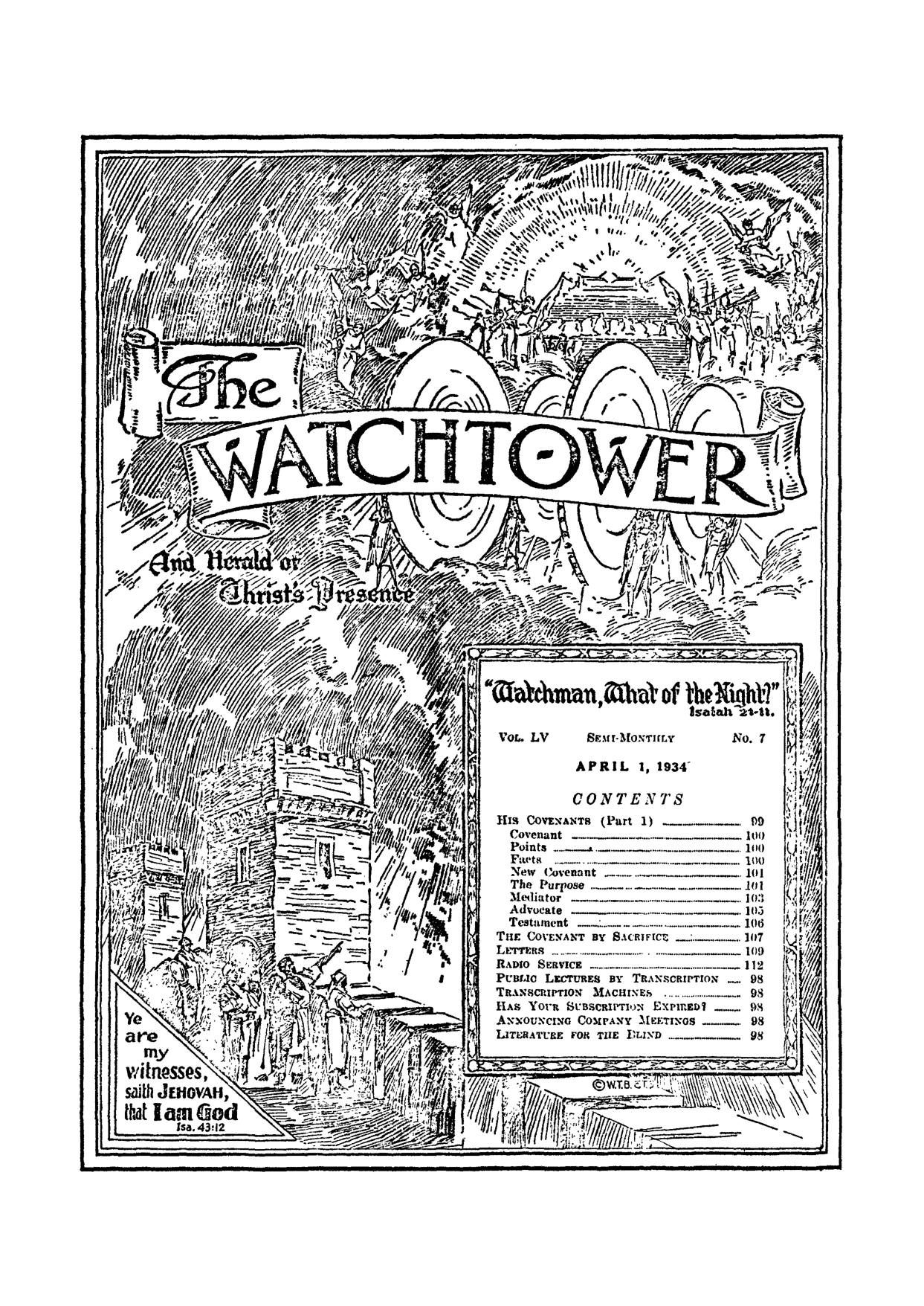
PUBLIC LECTURES BY TRANSCRIPTION
Jehovah’s blessing has been markedly upon the use of the portable transcription much ne. He has plainly manifested that this machine meets the need of the hour, when the enemy, under Gog, is seeking to curtail the use of the radio by God's anointed and when the people’s ears are eager to hear, not man’s message, but God's. The transcription machine has increased the power of Jehovah's witnesses afield to preach His truth manyfold, so that the desire for the literature is stimulated and study classes of many interested hearers are being formed. Besides more than 450 such machines in the United States alone, great numbers are now being effectively used in countries near and afar. For more information, write the Society.
TRANSCRIPTION MACHINES
The Society has made arrangements to construct and assemble portable transcription machines at our own factory at 117 Adams Street. These machines will be somewhat different in construction from those previously furnished. They will be spring-wound, and operated from a 6-volt wet-cell battery. Every machine will be furnished complete with the battery and a battery charger, so that it can be kept up to its full strength. We are pleased to announce that this machine can be offered at $100, complete, to brethren in the United States.
HAS YOUR SUBSCRIPTION EXPIRED?
For the benefit of subscribers, and for their convenience, a renewal blank is seat with this journal one month (on foreign subscript ions two months) before the subscription is due to expire. Machinery used to print subscriber’s address on label or wrapper is so constructed that the plate bearing address is automatically dropped from the list at expiration; thus discontinuance of an expiration is accomplished mechanically in every instance.
ANNOUNCING COMPANY MEETINGS
Many heaters of radio transcription lectures have the desire to meet with Jehovah's witnesses and to study his Word with them. Hence wherever the kingdom message is radiocast, the time and place of meeting of the local company of Jehovah’s witnesses should be announced after the transcription. the time on the air being paid for, the station manager ought to readily grant your request to make such announcement.
LITERATURE FOR THE BLIND
Of the booklets of the new series, Hereafter, Cause of Death, Who Is God? and iChat Is Truth? can bo supplied, in Braille, for the blind. These are obtainable at $1 a copy, or may be bad on loan by any blind reader. Address the Society’s branch for the blind, 1210 Spear St., Logansport, Ind.
Vol. LV April 1, 1934 No. 7
HIS COVENANTS
PART 1
“Gather my saints together unto me; those that have made a covenant with, me by sacrifice. And the heavens shall declare his righteousness: for God is judge himself.”–Ps. 50: 5, 6.
JEHOVAH’S purpose is to vindicate his name. Let that great truth always be foremost in the mind of every faithful student of God’s Word. All other things are incidental to and hence secondary to the vindication of Jehovah’s name. Having builded up his capital organization Zion Jehovah now appears in his glory to those of Zion. The children of Zion, now gathered unto him at his temple, are taught of God by and through Christ Jesus, the chief one of the Zion organization. The faithful now see their Teachers, to wit, Jehovah and Christ Jesus, and, being obedient to what they are taught, the children of Zion walk on in the right way singing the praises of the Host High. (Isa. 30: 20, 21; 54:13) The children of Zion are Jehovah’s saints now made to ‘sit with Christ Jesus in heavenly places’ and form a part of the heavenly organization, and being thus gathered unto the Lord they ‘shall declare his righteousness: for God himself is Judge’. The faithful remnant are doing this very thing.
2 In times past God’s faithful people had a dim vision of his purpose, but now they may have a clearer understanding thereof. The chief reason for greater enlightenment now is the fact that it is God’s due time to make known his purpose to his people. Those who arc born of Zion, and hence gathered together unto the Lord at the temple, now have Jehovah and Christ Jesus for their instructors, and the flashes of the light at the temple reveal Jehovah’s truths to them, and as these great truths arc revealed to them they continue to declare God’s righteousness.
3 But there is another reason why the consecrated have not had a clear vision of God’s Word heretofore, and that reason is largely due to selfishness or a desire for personal gain. Selfishness or the looking for personal gain will now hinder even those of the anointed in understanding and appreciating the truth. For many centuries almost all of those who have consecrated themselves to do the will of God have done so with the expectation of personal gain or benefit. Leaders of “Christendom” have taught the people that God is trying to save the human race from hell torment and to take the saved ones to heaven. The motive for becoming members of the organization of those ecclesiastical systems has been entirely selfish, that is, a desire to be saved and escape punishment. During the Elijah period of the church the doctrines held and taught by the followers of Christ Jesus in the truth were in brief these:
4 The human race, condemned to death by reason of Adam's sin, is bought by the blood of Christ Jesus; hell is not a place of conscious torment, but the state of the dead, and none can escape eternal death except by and through the merit of Christ Jesus’ sacrifice; the plan of God is to take out from the world his church, the members of which find their eternal home in heaven and will, together with Christ Jesus, rule the world and restore the obedient ones to human perfection. The doctrine of “no hell torment” was greatly stressed, and salvation in heaven or upon the earth was the chief motive inducing creatures to serve God and Christ Jesus. It was thought that each one consecrating himself to the Lord must even by his own efforts bring himself to a point of character development that would entitle him to a high seat in the courts of heaven. It must be conceded that such motives were largely selfish. To be sure, some who consecrated in that time had the unselfish desire to serve Jehovah, but all were looking to the reward. While the doctrines above mentioned as held during the Elijah period were and are generally true, the primary purpose of Jehovah was not. seen, hence the higher motive was not the moving cause for creatures to serve God. Now those of the temple who are proving faithful appreciate the great truth that the vindication of Jehovah's name is the all-important thing and that to have a part in the vindication of his holy name these faithful creatures must unselfishly devote themselves to him. Such unselfish devotion to Jehovah is the key of knowledge and understanding. The religious leaders amongst the Jews by reason of their selfishness took away from themselves and from others the key of knowledge, and when Jesus presented to them the truths of the kingdom the Pharisees not only rejected the truth, but caused others to do likewise. (Luke 11: 42-52) The same thing has been true of the organizations of so-called “Christianity”, and particularly of the “man of sin” class. Self-gain blinds the eyes of one to the proper devotion to God, and, thus blinded, one makes no progress in knowledge and understanding.5 It follows, therefore, that if the anointed will hold the key of knowledge and understanding they must keep always to the fore that the chief purpose of Jehovah is the vindication of his name, that it is his name that is involved, and that the kingdom is the means used to accomplish the vindication of his name. To have part in the vindication of Jehovah’s name is not a selfish work. The part which the remnant can have is that of being faithful witnesses for Jehovah, and thus they maintain their integrity toward him. Those of the anointed who are faithful unto death will receive everlasting life and be associated with Christ Jesus in his heavenly work and glory. But such reward is secondary to the vindication of Jehovah’s name and is given only where unselfish devotion is shown to God. To have part in the vindication of his holy name is the condition precedent to the entering into divine life.
COVENANT
6 covenant is a binding agreement or promise to do or not to do a certain thing. Jehovah’s expressed purpose to do a certain thing is an unconditional or one-sided covenant. When Jehovah gives his word of promise he unconditionally binds himself to carry out that purpose, lie says: “I have purposed it, I will also do it.” (Isa. 46:11) “My word . . . shall accomplish that which I please.” (Isa. 55:11) A covenant made by Jehovah with one or more of his creatures is a bilateral or two-sided agreement to do certain things, and the other parties to the covenant must do the tilings mentioned. Jehovah always faithfully performs his part of his covenants.–Deut. 7: 9.
POINTS
7 The following abstract points are here set out that the student, by carefully following this outline, may be better enabled to consider the argument as he progresses:
(1) The greatest of all questions before creation is, Who is the supreme, almighty God, from whom comes all life in happiness?
(2) All covenants made by Jehovah toward man are made for the primary purpose of vindicating his name. They are called Jehovah’s covenants because he is the originator and maker of them, and he takes others into his covenants as it pleases him.
(3) The Abrahamic covenant is an unconditional promise of Jehovah to produce by his organization Zion, symbolized by his “woman”, a seed by or through which all the families of the earth may have an opportunity for the blessing of life, the primary purpose of which covenant is the vindication of Jehovah’s name. The “seed” of that covenant is Christ, who is the Savior and Redeemer of man and the Vindicator of Jehovah God’s name. That covenant is unchangeable because bound by the word and oath of Jehovah.
(4) Because of the abounding of transgression or sin against God's law, Jehovah added to the Abrahamic covenant the law covenant, made in Egypt with Moses as mediator, and that covenant served as a schoolmaster to lead the teachable ones of Israel to Christ, the “seed” and Vindicator, and it was continued until the coming of Christ. The purpose of the law covenant was to produce a people for the name of Jehovah; lienee the primary purpose thereof was the vindication of Jehovah’s name.
(5) The new covenant was made in the place and stead of the old law covenant. The purpose of the new covenant was not for the salvation of men, but for the purpose of selecting a people for the name of Jehovah, which people so selected must be witnesses to the name of Jehovah; and, proving faithful therein, these participate with Christ Jesus in the vindication of Jehovah’s name.
(6) The new covenant was made with Christ Jesus at the time of his death. Before that Jesus made his covenant of sacrifice, and then others were invited to make a covenant by sacrifice in order that they might be offspring of and taken into the new covenant and have a part in the vindication of Jehovah’s name.
(7) The new covenant has no reference to the world of mankind in general, does not relate to the restitution of mankind, but pertains exclusively to spiritual Israel; and no one can be an offspring of the new covenant until after that one has made a covenant by sacrifice; and it is the ones making the covenant by sacrifice, and who prove faithful thereto, that are gathered together unto the Lord God and made members of his company, and who declare his righteousness and participate in the vindication of his name.
FACTS
8 At Eden Lucifer defamed Jehovah’s name, charging him with being a liar and without the ability to carry out his purpose. Satan then defied Jehovah to put on earth a man that would maintain his integrity toward Jehovah. (Job 2:2-4) This was a further reproach to the name of Jehovah God. Jehovah's purpose is to prove to all creation that he alone is the Almighty God, and this he does in vindication of his name. There could be no blessing to the human race without life; and since life is the gift of Jehovah God, the creature by proving his faithfulness to God and maintaining his integrity toward God and receiving life from God would thus be a vindication of the name of the Most High. Jehovah then took Abraham out of his native land and sent him down to Canaan and there made a covenant or unconditional promise, using Abraham as the one to whom the promise was at the time expressed, and there expressed his purpose to produce a seed by and through which all the families and nations of the earth may be blessed. The ‘promised seed’ is Christ, whom Jehovah constitutes as his chief witness, high priest and vindicator. (Gal. 3:16) Surely the selection of the seed of promise was not merely for the salvation of men, because God could have killed Adam and started a new race. The selection of the seed was for the very purpose of vindicating Jehovah’s name, that is, proving Jehovah carries out his purposes according to his will. A secondary provision thereof was that those who should obey the seed would be blessed with everlasting life. His original name, Abram, means “exalted father’’, which name the Lord changed, calling him Abraham. The name Abraham means “father of many nations”. This is proof that Abraham was here used as a symbol to represent Jehovah God himself, who alone is the Giver of life, hence the great Father of the families and nations of the earth that live, and that the seed is Christ, by and through whom Jehovah gives life to man. (Rom. 6:23) When Jehovah said to Abraham, “I will . . . make thy name great,” manifestly God meant that he would make his own holy name great. (Gen. 12: 2) The dealing of Jehovah with the natural descendants of Abraham was for his, Jehovah’s, own name’s sake. (Ezek. 20:9) The purpose of the Abrahamic covenant, therefore, was not primarily for man’s benefit, but was and is for the vindication of Jehovah’s name; and this conclusion is abundantly supported by the Scriptures. A long period of time is permitted to elapse during which period of time Jehovah God permits Satan to remain and carry forward his nefarious work in order that he, Jehovah, in his own due time may have a testimony given in the earth concerning his name and then exhibit his power to convince all creation that he is the Supreme One. Let it be kept in mind that the salvation of creatures is entirely secondary to the great purpose of Jehovah.
NEW COVENANT
9 The Scriptures disclose other covenants of Jehovah, among which are the covenant made at Egypt and confirmed at Sinai, and the new covenant, made thereafter. Much has been said and written concerning the new covenant, and it has been emphasized in most of such writings that the new covenant belongs to the millennial reign of Christ, under which all the families of the earth shall be blessed. The following quotation is the gist of what has been held and taught for many years, to wit: “The new covenant is an arrangement which God provides by and through which he can have mercy upon the fallen race.” (Studies in the Scriptures, Volume 5, page 455) The Scriptures do not support that conclusion. From about 1907 to 1909 a great deal was published about the new covenant, and a shaking amongst the consecrated occurred and a division resulted by reason of a disagreement as to the new covenant. For the two reasons hereinbefore named the purpose of the new covenant was not then understood; but now in the day of the Lord, when he is at the temple enlightening his people, the purpose may be understood by those who are devoted to him, and who are of the temple, and for this reason The Watchtower now considers again the question of the covenants. Again it is suggested that the seven points above set out be kept in mind as the study progresses.
10 The new covenant is not for the direct purpose of saving any creature, but is for a far higher and greater purpose. The new' covenant is not a restitution covenant, to be employed by the Lord during the Millennial reign. In fact, it has nothing to do with the regeneration of the human race. The blood of Christ Jesus is the purchase price of the human race, and a covenant is not required in order for God to have mercy on those who come to Jesus in God’s appointed way.–John 6:37-40.
THE PURPOSE
11 What is the purpose of the new covenant? It is Jehovah’s instrument to gather unto himself a people for his name, to be used for the vindication of his name. It therefore applies to the church, and not to the world at all. The new covenant was foreshadowed by the old law covenant, as well as being a replacement substituted for the old law covenant. That being true, then, it follows that the purpose of the old law covenant foreshadowed the purpose of the new covenant. The purpose of the old law covenant could not have been the salvation of the Jewish nation. It was not needed to save that nation. Eventually the Gentiles will have the same opportunity of salvation, and they never had any relationship to the law covenant, but were aliens to it and also to the new covenant. (Eph. 2:12) Furthermore the Jewish nation, being God’s chosen people, did not foreshadow the Gentile nations in general, but did foreshadow God’s chosen people taken out from the world. The law covenant imposed an additional obligation upon the Jews which was never upon the Gentile nations, and hence the Gentile nations would not have to be relieved thereof. To redeem the Jews from that additional curse imposed by the law covenant Jesus must die on the tree as and in the place and stead of the sinner. (Gal. 3:13; Deut. 21:23) This fact, however, does show a special responsibility resting upon those who are in the new covenant. It is quite certain that the apostle had in mind this responsibility when he quoted from the prophecy uttered by Moses, to wit: “He that despised Moses’ law died without mercy under two or three witnesses: of how much sorer punishment, suppose ye, shall he be thought worthy, who hath trodden under foot the Son of God, and hath counted the blood of the covenant, wherewith he was sanctified, an unholy thing, and hath done despite unto the spirit of grace? For we know him that hath said, Vengeance belongeth unto me, I will recompense, saith the Lord. And again, The Lord shall judge his people. It is a fearful thing to fall into the hands of the living God.” (Heb. 10:28-31) This prophecy was spoken by Moses. (Deut. 32:35,36) The responsibility of those in the new covenant is here compared with that of those in the law covenant.12 God made the old law covenant with Moses as mediator for his chosen people. God made the new covenant with Christ Jesus, whom Closes foreshadowed, as the Mediator for his chosen ones. Jehovah sent Closes to Egypt primarily to make a name for Himself, and secondarily to redeem the Israelites. (2 Sam. 7:23) To this end Moses was required to bear testimony before the Israelites and before the Egyptian ruler, and this he must do prior to the making of the law covenant. Jehovah sent Jesus into the world, antitypical Egypt, to bear witness to his name, hence to make a name for Himself, and he must bear witness before the Jews and others before the now covenant is made. (John 18:37) Jesus said: “I am come in my Father’s name.” (John 5:43) That the chief purpose of the coming of Jesus was to glorify and vindicate Jehovah’s name is shown by his words: “For this cause came I unto this hour. Father, glorify thy name. Then came there a voice from heaven, saying, I have both glorified it, and will glorify it again.” (John 12:27,28) The lifeblood of Jesus poured out in sacrifice was the blood that made good the new covenant, and also provided the redemptive price for man. It is by and through the new covenant that a people is taken out for the name of Jehovah; hence the name of Jehovah becomes paramount to the redemption of man.
13 The Israelites, God’s selected people, must prove their faithfulness to the terms of the law covenant in order to become God’s holy nation, as it is written: “And Moses went up unto God, and the Lord called unto him out of the mountain, saying, Thus shalt thou say to the house of Jacob, and tell the children of Israel: Now therefore, if ye will obey my voice indeed, and keep my covenant, then ye shall be a peculiar treasure unto me above all people: for all the earth is mine. And ye shall be unto me a kingdom of priests, and an holy nation. These arc the words which thou shalt speak unto the children of Israel.” (Ex. 19:3,5,6) This proves that a people was foreshadowed by the Israelites and that such people who were foreshadowed by the Israelites in the law covenant must prove their faithfulness under the terms of the new covenant in order to become God’s holy nation. Addressing that people foreshadowed by the Israelites the inspired apostle says: “But ye are a chosen generation, a royal priesthood, an holy nation, a peculiar people; that ye should shew forth the praises of him who hath called you out of darkness into his marvelous light: which in time past were not a people, but are now the people of God; which had not obtained mercy, but now have obtained mercy.” (1 Pet. 2:9, 10) This holy nation is made up of those who become members of the royal house of which Christ Jesus is the Head.
14 The purpose of the law covenant was to produce a seed; as it is written: “Which things are an allegory: for these [women] arc the two covenants; the one from the mount Sinai, which gendereth to bondage, which is Agar [Hagar]. For this Agar is mount Sinai in Arabia, and answereth to Jerusalem which now is, and is in bondage with her children.” (Gal. 4: 24, 25) Abraham’s wife Sarah was past the natural age of child-bearing, and she requested Abraham to use her Egyptian maid to get an heir for the reason, “it may be that I may obtain children by her.” (Gen. 16:2,3) God had promised Abraham to give him a seed, and Hagar was given to Abraham by his wife that this might be accomplished. Hagar’s offspring did rot prove acceptable to God as the promised seed, and likewise the children of the old law covenant, that is, Israel after the flesh, did not prove acceptable unto God. That the law covenant foreshadowed the new covenant, the seed of which docs prove acceptable, is clearly shown by the words of the apostle: 'For what was impossible to the Law, thwarted as it was by human frailty, God effected. Sending his own Son in the form of sinful humanity to deal with sin, God pronounced sentence upon sin in human nature; in order that in our case the requirements of the Law might be fully met.’–Hom. 8:3,4, Wey.
15 The reason for the failure of the law covenant was not because of any fault with the law, but was because of the fault of the Jewish nation; hence its failure made it necessary to make a new covenant, in the place and stead of the old in order that God might have a people for his own name; hence, says the scripture: “For if that first covenant had been faultless, then should no place have been sought for the second [covenant]. For finding fault with them, he saith, Behold, the days come, saith the Lord, when I will make a new covenant with the house of Israel and with the house of Judah.” (Heb. 8:7,8) It is therefore apparent from these scriptures that neither the old law covenant nor the new covenant is made for the purpose of saving men, but that the purpose thereof is to gather together a people for the name of Jehovah, the faithful ones of which people he promises shall have a part in the vindication of Jehovah’s name, and which proves his side of the controversy and the vindication of his name.
16 It is true that the Lord declared: “Ye shall therefore keep my statutes, and my judgments; which if a man do, he shall live in them; 1 am (Jehovah).” (Lev. 18:1.5) This scripture docs not say that one would get life by keeping the covenant; hence it does not mean that the purpose of the covenant is to dive life. The real purpose, as disclosed by this scripture, is to identify the vindicator of Jehovah’s name. God’s promise here is that the man in the covenant who should obey the statutes and judgments of the Lord would thus live in them and would be maintaining his integrity and thus vindicate Jehovah’s name, as against Satan’s challenge to God to produce such a man. Obedience to the terms of the covenant would prove the qualification of the man to be the vindicator of Jehovah’s name when the time should arrive for the issue to be finally settled. That is exactly what Jesus did. To construe this scripture to mean that, had the Jews kept the covenant, they could have lived would mean that the ransom sacrifice could be omitted; whereas there is no means of getting life except by and through the ransom sacrifice. The clear purpose of this declaration above quoted, therefore, is to identify the vindicator. Jesus suffered reproach at the hands of Satan and his agencies, and because of his faithfulness in keeping the law of God, and proving his obedience under such suffering, he thereby demonstrated his qualification to be the vindicator of Jehovah’s name and the author of eternal salvation to all those who obey him; and this is the plain statement of the scripture written by the apostle under inspiration. – Heb. 5: 8, 9.
17 This conclusion is further expressed on another occasion by the apostle. He emphasized the point that the promised seed is of paramount importance. Then he says: “It [the law covenant] was added [to the Abrahamic covenant] because of transgressions, till the seed should come to whom the promise was made; and it was ordained by angels in the hand of a mediator.” (Gal. 3:18,19) The Jews were imperfect, and therefore transgressors or sinners, which prevented them from maintaining their integrity in perfection, and hence the law was added until the promised seed should come. “Which things are an allegory: for these are the two covenants; the one from the mount Sinai, which gendereth to bondage, which is Agar.”–Gal. 4:24.
18 Further showing that the law covenant was not made to give to the people of natural Israel the salvation of life it is written: “Is the law then against the promises of God? God forbid: for if there had been a law given which could have given life, verily righteousness should have been by the law.” (Gal. 3:21) Is the law against the promises of God? To be sure, Jehovah knew this beforehand, and this proves that in making a covenant he had an objective or purpose different from the salvation of the Jews to life. Salvation of the Jews and Gentiles is not by any covenant. Salvation is through Christ Jesus, whom Jehovah first makes his vindicator, establishes his kingdom, and then brings the people to a knowledge of the truth in order that they, under the kingdom, may receive life everlasting if obedient to its terms. The purpose of the law covenant with the Jews was to get for Jehovah a people for his name; but that failed because of the imperfection of the Jews. When Christ Jesus, the Greater Moses, came he was the seed according to the promise made by Jehovah to Abraham, and those Jews who were then found faithful were transferred from Moses to Christ and thereby were made a part of the ‘people taken out for his name’. The faithful disciples of Jesus Christ are striking examples of this fact. They were already consecrated to do the will of God and had been baptized into Moses and “in the cloud”, and now it was not necessary for them to again undergo baptism. (1 Cor. 10:1-4; John 1:47) If the law covenant could not give life (which it could not, most emphatically), neither can the new covenant give life, for the reason that the new covenant is a substitute for the old. Life is given only to those who have faith in Jesus Christ and continue faithful. The purpose of the new covenant therefore clearly appears to be to gather out from the human race and unto God a people that will maintain their integrity toward God while suffering reproach and contradiction of Satan and his agents, and which people become the witnesses to the name of Jehovah and who, then continuing faithful, have a part in the vindication of his name.
MEDIATOR
19 Jehovah provides a mediator of the old law covenant and a mediator for the new covenant. The Jews as a nation were incompetent to make a covenant with Jehovah. Moses had faith in the promise of Jehovah and by faith “looked for [forward to] a city [the kingdom of God under the promised seed] which hath foundations, whose builder ... is God”. (Heb. 11: 10-20) By reason of his faith and faithfulness to God Jehovah chose Moses as mediator of the law covenant that he purposed to make and afterwards did make in Egypt. This selection of Moses was made at Mount Horeb. (Ex. 3:1-22) That was some time before the covenant was made, and Moses must first give testimony to the name of Jehovah before the Israelites and before the rulers of Egypt. Concerning this law covenant it is written: "It was ordained by angels in the hand of a mediator.” (Gal. 3:19) The Greater Moses was chosen by Jehovah as the mediator of the new covenant, and this selection was made after Jesus was baptized in the Jordan and following his temptation in the wilderness. It was then that he became the surety (pledge) and mediator of the new covenant later to be made. The law covenant was made at the time of the slaying of the paschal lamb in Egypt, and the new covenant was made at the time of the slaying of the antitypical paschal lamb, Christ Jesus; but Jesus had been selected as the mediator three and one-half years prior to that time.
20 Where there is a mediator this shows that there are others in the covenant, which Jehovah makes: “Now a mediator is not a mediator of one, but God is one.” (Gal. 3:20) If there were not others in the covenant there would be no need for a mediator. Since the chief purpose of the coming of Jesus was and is the vindication of Jehovah’s name, if Jesus were to be alone in this covenant work there would be no need for the existence of a mediator. Jesus is the offspring and seed of the Abrahamic covenant, which takes precedence over both the law covenant and the new covenant. A mediator’s being provided for the new covenant therefore shows that the purpose of the covenant is to bring others into it to act with Christ Jesus and under his direct supervision.
21 The new covenant is made more than two thousand years after the Abrahamic covenant, yet it could not take the place of the Abrahamic covenant, the seed of which is the means of blessing all the families of the earth. This is further proof that the new covenant is not a covenant of blessing or giving of life, but that it is a means of providing a people to bear testimony to the name of Jehovah, and who may have a part in the vindication of his name. The mere fact of the provision for a mediator shows that others would be joined with Christ Jesus in the vindication of Jehovah’s name. Who, then, are the others? Necessarily it follows that the “others” are those taken into the new covenant after it is made with Christ Jesus, and after the others mentioned have made a covenant with Jehovah Cod by sacrifice and have been accepted by Jehovah as his sons.
22 As further proof that the covenant is the instrument of Jehovah to accomplish his purpose of vindicating his name, note that Jehovah appoints the mediator before the covenant is made and that he makes this selection unconditionally. He selected his beloved Son Christ Jesus as his high priest, and he makes Christ Jesus his chief officer for the carrying out of all his purposes and Christ Jesus has nothing to do with selecting himself for this office. “So also Christ glorified not himself to be made an high priest; but he that said unto him, Thou art my Son, to day have I begotten [brought forth and acknowledged as his beloved Son] thee. As he saith also in another place, Thou art a priest for ever after the order of Melchisedec.” (Heb. 5:5,6) When he appointed Jesus to the high office of priesthood Jehovah bound his word with his oath: “And ... by so much [more, that is, by such oath] was Jesus made a surety [the intermediary or guarantor for the others of the covenant, hence a mediator].”–Heb. 7:20,22.
23 At his baptism in the Jordan Jesus made and began the performance of his covenant by sacrifice and which performance was finished at Calvary. “But now hath he [Jesus] obtained a more excellent ministry [than that of Moses, the mediator of the law covenant], by how much also he is the mediator of a better covenant, which was established upon better promises.” (Heb. 8: 6) Because of his covenant by sacrifice, which sacrifice was holy and acceptable unto God, Jesus is made the mediator of the new covenant. “The blood of Christ, who through the eternal spirit offered himself without spot to God, . . . And for this cause he is the mediator of the new testament [covenant, R.V.], that by means of death, for the redemption of the transgressions that were under the first testament [covenant], they which are called [not the Jews as a nation, nor the world in general, but they that are called to the kingdom, that is, the church] might receive the promise of eternal inheritance [in heaven].” (Heb. 9:14, 15) The church of Christ does not form any part of the mediator, but Christ Jesus alone is the mediator of the new covenant. (Heb. 12:24) Christ Jesus is the mediator of the new covenant toward his own brethren, that is to say, spiritual Israel, during the period of time God is taking out from the nations a people for his name. (Acts 15:14) The apostle shows his relationship to the covenant, when he says: “Who will have all men to be saved, and to come unto the knowledge of the truth. For there is one God, and one mediator between God and men, the man Christ Jesus; who gave himself a ransom for all, to be testified in due time. Whereunto I am ordained a preacher, and an apostle, (I speak the truth in Christ, and lie not;) a teacher of the Gentiles in faith and verity.”–1 Tim. 2:4-7.
24 This text docs not say, and it does not mean, that the man Christ Jesus is mediator for all men. What the text does say is this: that there is one God, who is Jehovah, and there is one mediator between God and men. What men? The men, that is, human creatures, who have exercised faith in Christ Jesus and agreed to do God’s will. Why should God appoint a mediator in behalf of men who defame his name and the name of Jesus Christ? The text shows that the apostle does not have in mind all the human family. He is addressing Timothy, and hence others of like precious faith, and was telling Timothy to pray in behalf of “all men”, meaning all men coming into God’s organization. Surely the apostle was not exhorting and advising that prayer be made in behalf of all those who wickedly oppose God and Christ Jesus. lie does advise that prayer be made “for kings and for all that are in authority”. Did lie mean all men in authority in Satan’s organization? Surely not; but he did mean those in authority in God’s organization, that is to say, those in the church whom the Lord had placed in positions of authority, and that prayer should be made for all such that all of the church might abide together in peace and in unity. (See The Watchtower 1933, page 137.) It follows, therefore, that the word “men” used in verse five of the foregoing text does not refer to all men of the world but does refer to those who have made a covenant to do the will of God; and concerning all such it is the will of God that they be saved and come to an accurate knowledge of the truth, and for all such there is a mediator in the covenant with God. Who is that mediator? The scripture answers, “the man Christ Jesus, who gave himself a ransom for all.” These last quoted are words of identification which definitely name the one who is the mediator between God and men (but not all men), that is to say, the men who have exercised faith in Christ Jesus and have entered into a covenant to do the will of God. It is not the will of God that any of such be lost as accept Christ Jesus. If any of them are lost it is their own fault. This is proved by the words of Jesus concerning the twelve which God gave to him. (John 17:12) The “man of sin’’ class at one time was in the covenant to do the will of God. That class will be lost, not by reason of any fault of God, but by reason of their own unfaithfulness.
25 The Authorized Version of the words of the apostle read: “Who gave himself a ransom for all, to be testified in due time.’’ (1 Tim. 2:6) Some men have added to this text the words “to all’’, and manifestly for the purpose of trying to make this text apply to all the human race. Is such a conclusion warranted? It is certainly not warranted. It is true that Jesus Christ gave his life a ransom for all, and all who accept Jesus Christ as such, and arc obedient to him, may live; but that is no reason why there should be added to this text the words to all, which words are not in the text at all. Another translation of the text above mentioned is this: “ ‘Who gave himself as a ransom for all’:–in due time this was attested, and I was appointed to be its herald and apostle (I am not telling a lie, it is quite true), to teach the Gentiles faith and truth.’’ (Moffatt) “Who gave himself a ransom in behalf of all, the testimony in its own fit times: unto which I have been appointed proclaimer and apostle–Truth I speak, I utter no falsehood – A teacher of nations in faith and truth.’’ (Rotherham) “Who gave himself a ransom in behalf of all, the testimony in its own seasons: for which I was appointed a herald and an apostle, (I speak truth, I do not falsify,) a teacher of nations in faith and truth.” (Diaglott) In this text, therefore, the apostle identifies Jesus Christ as the Redeemer of mankind, as the mediator between God and men in the covenant, and that he, Paul, is ordained as a preacher and an apostle to teach the Gentiles as well as the Jews. The apostle was here specifically instructing Timothy and in substance states to him thus: ‘You should pray for all men in the church, including those in authority, such as the apostles and others appointed to serve in the church.’ (Eph. 4:11-14) These in authority were put there to render aid in preparing a people for the name of Jehovah; it is the will of God that all such men should be saved, and in order to be saved they must be faithful. In this organization there is ‘one God and Father of all, who is above all and over all and in all’; there is one mediator between God and men, that is, all men who are consecrated to do the will of God, and that mediator is Christ Jesus the Redeemer, ‘and I Paul am appointed a special minister to make known these truths.’ (Eph. 4: 3-6) 1 Timothy 2:3-6 can therefore not properly be applied to all mankind, and is not a restitution text. While it does show that Christ Jesus is the redeemer for all men, it clearly appears from the context that its application is to those who have first entered into the covenant by sacrifice.
26 The new covenant corresponds to the old law covenant. Moses was not the mediator between God and all the Gentiles. He was the mediator for all of God’s chosen people, that is to say, the nation of Israel. The Jews “were all baptized unto Moses in the eloud and in the sea”. (1 Cor. 10:2) Moses was therefore the mediator for all such and none other; hence the Jews that were found faithful at the coming of Christ Jesus were transferred from Moses to Christ, and Christ was made the mediator for all such and all Gentiles who covenant to do the will of God. “And Moses verily was faithful in all his house, as a servant [mediator], for a testimony of those things which were to be spoken after; but Christ as a son [mediator] over his [Jehovah’s] own house; whose house are we, if we hold fast the confidence and the rejoicing of the hope firm unto the end.”–Heb. 3: 5, 6.
ADVOCATE
27 It has been said that Jesus is the advocate for the church and mediator for the world. But the Scriptures do not warrant that conclusion. There is nothing inconsistent in Jesus’ being the mediator for the church, and also the advocate for the church, both of which positions he docs actually fill. Does not a mediator advocate for one who needs help? Moses was mediator of the law covenant, and he advocated for the Israelites who had sinned, when he prayed to God to forgive them. (Ex. 32:29-32) Likewise Christ Jesus, the mediator of the new covenant, is the advocate of those in God’s organization who sin; as it is written: “My little children, these things write I unto you, that ye sin not. And if any man sin, we have an advocate with the Father, Jesus Christ the righteous.” (1 John 2:1) Prior to the coming of the Lord Jesus to the temple the holy spirit is designated in the Scriptures as a paraclete, comforter, or advocate or helper. Since the coming of the Lord to the temple the office of the holy spirit as advocate has ceased, but that docs not affect the fact that Christ Jesus at Mount Zion both mediates and advocates.
28 At the Jordan river, when baptized, Jesus presented himself without spot or blemish unto God in fulfilment of the prophecy previously written concerning him. “Then said I, Lo, I come: in the volume of the book it is written of me, I delight to do thy will, O my God: yea, thy law is within my heart.” (Ps. 40:7,8) That was the covenant of sacrifice between God and Christ Jesus, since it was the will of God that he should be a sacrifice. There Jesus unconditionally offered himself to do whatsoever is the will of God, and it was then the will of God that Christ Jesus should be his vindicator; and that to qualify for such he must maintain his integrity under the most severe test even unto an ignominious death, and that his lifeblood poured out should be and is the redemptive price for man. ‘And for this cause he is made the mediator of the new covenant.’ (Heb. 9:15, A.R.V.) Jehovah God gave to Jesus the ministry of the covenant, that is, the work of taking out a people for his name, which ministry is more excellent than that committed to Moses. (Heb. 8:6) When the apostles believed on the Lord Jesus as the Christ and left all to follow him, that marked the time of their entering into a covenant by sacrifice. (Luke 18: 28-30; Matt. 16:24, 25) The covenant by sacrifice means to believe on the Lord Jesus Christ as the ransomer and, based upon this faith, to exercise such faith by unconditionally agreeing to do the will of God. Three and one-half years after Jesus entered into the covenant by sacrifice God made the new covenant with him. This seems clearly to fix the rule that no one can be taken into the new covenant until after having entered into a covenant with Jehovah by sacrifice. All begotten of God necessarily have made a covenant by sacrifice, and all such are appointed to die a sacrificial death, and this includes the “great multitude’’ class. (Ps. 79:11) Not everyone who makes a covenant by sacrifice proves faithful, and hence not everyone, by any means, who makes a covenant by sacrifice is embraced within the class that is ‘the people taken out for his name'. Only the faithful ones are the saints of God, and it is of such Jehovah speaks when he says: “Gather my saints together unto me; those that have made a covenant with me by sacrifice.” (Ps. 50:5) These saints have been taken into the new covenant with Christ Jesus, the high priest of Jehovah, and to such Jesus now says: “Be thou faithful unto death, and I will give thee the crown of life.” (Rev. 2:10, A.R.V.) This proves that only those who are absolutely faithful after being taken into the new covenant receive the crown of life.
TESTAMENT
29 Men have designated that part of the Bible from Genesis to Malachi inclusive as the Old Testament; and that part from Matthew to Revelation inclusive as the New Testament. There is no Scriptural authority for so doing. The word testament appears for the first time at Matthew 26:28, and there means “covenant”. The text 2 Corinthians 3:6 (Sinaitic MS) is the third mention of the “new testament”, and there means the “new covenant”, and is so rendered by the Revised Version. In the fourteenth verse of the same chapter appears for the first time the words “old testament”, but which are properly rendered “old covenant”, and refer to the law covenant, which became old when it ended. Many have very unwisely concluded that the Scriptures designated “The New Testament” constituted all that is needed for the instruction of the follower of Christ. All scriptures that are written at the dictation of Jehovah God constitute his Word; as it is written: “All Scripture, divinely inspired, is indeed profitable for teaching, for conviction, for correction, for that discipline which is in righteousness; so that the man of God may be complete, thoroughly fitted for every good work.” (2 Tira. 3:16,17, Diag.) Jehovah is now revealing to his faithful witnesses the meaning of the prophecies more clearly than at any time heretofore, which gives aid and comfort to the remnant at this time. (Rom. 15:4) He gives the revelation of his Word and a clearer meaning thereof to those who are diligent to learn and to do his will. (I’s. 119:105) It is for those whom the Lord has gathered into the temple that he now spreads a feast. The faithful are feeding upon these divine provisions, and they continue to give praise to Jehovah’s holy name. These constitute a part of the heavens declaring the righteousness of Jehovah God, for they know lie is Judge himself and that his day of judgment is at hand.
(To be continued)
QUESTIONS FOR STUDY
1. What is Jehovah’s primary purpose? Who are the children of Zion? By whom are they taught? and where, how, and for what purpose?
2-4. Account for the clearer vision which the consecrated now have of the purposes of Jehovah.
5. How only may the anointed hold the key of knowledge and understanding? How is their future rewind related to the purpose of their having been received into the covenant with Jehovah?
6. What is a covenant? Define and illustrate two kinds of covenants which Jehovah has made with one or more of his creatures.
7. Briefly state the points here presented as an aid in the study of Jehovah’s covenants.
8. Point out facts which prove that in connection with the Abrahamic covenant Abraham was used to represent Jehovah himself, and that the purpose of the covenant, was primarily for the vindication of Jehovah’s name.
9, 10. Why is it now of special importance to reconsider the question of the covenants? From Jesus’ words (John 6: 37-10) show whether the new covenant is the means provided for saving and regenerating the human race.
11. What is the purpose of the new covenant? To whom does it apply? How is it related to the law covenant? How does the relationship of the new covenant to the law covenant servo to indicate the purpose of the new?
12. Show, with scriptures to support, that in providing the law covenant and the new covenant, and each with a mediator, the vindication of his name was and is Jehovah’s paramount purpose.
13. Apply the conditional promise recorded in Exodus 19:5, 6 to the people whom the Israelites there foreshadowed?
14. To what does Paul refer in Romans 8: 3? What is there shown to be the purpose of the law covenant, and the relationship of the law covenant to the new?
15. How does Paul account for the necessity for the new covenant? What is apparent therefrom as to the purpose of both the law covenant and the new?
16. Explain whether Leviticus 18:5 was a promise of life to those who would keep the law covenant. What, then, was the purpose in that declaration?
17, 18. What further information does Paul give on the purpose of the law covenant (and therefore of the new covenant also) and its relation to the Abrahamic covenant?
19. Compare the condition which made necessary a mediator of the law covenant with that necessitating a mediator for the new covenant. On what principle was each of those mediators chosen? Compare the procedure required of each of these from the time he was chosen until the making of the covenant of which he was to be the mediator.
20. Jehovah's appointing Christ Jesus as mediator of the new covenant shows what as to the purpose of the covenant?
21. What in the statement by Paul (Galatians 3) and in the relation of the law covenant to the new covenant shows whether the latter is a covenant provided for giving life?
22. With scriptures, show whether Jehovah’s selection of the mediator of the new covenant is made conditionally. What does this prove in regard to the purpose of this covenant?
23, 24. How did Moses and Jesus obtain the ministries committed to them? Wherein was that of Jesus a “more excellent ministry’’? Toward whom, and to what end, is Jesus the mediator of the new covenant?
25. For whom did Christ Jesus give himself a ransom? To be testified when, by whom, and to whom?
26. Between whom was Moses mediator? What does this show in the same respect concerning the new covenant, and how?
27. With scriptures, and by pointing out the relationship of the new covenant to the law covenant and of the mediator of the new covenant to that of the law covenant, show whether Jesus Christ is both the mediator for the church and the advocate for the church.
28. Where, when, and how did Jesus enter into the covenant by sacrifice? What did this mean for him? Make clear the application of Psalm 50: 5.
29. What is the proof that the Scriptures were all provided for those devoted to the purposes of Jehovah and particularly for the faithful remnant in the latter days?
THE COVENANT BY SACRIFICE
Responsibility rests upon each one who has agreed to obey the will of God as that is expressed in his Word, the Bible. In this time of judgment, an understanding of this responsibility is of pressing importance.
Jehovah never interferes with the free moral agency of his creatures. He does not compel sacrifice or even obedience. It will he observed that his method is to accomplish his purposes by means of covenants or solemn agreements to do the things involved in the covenants. He states the terms of his covenant, and the rules governing the same, and just recompense for disobedience or obedience thereto.
God is always faithful and true; and those on the other side of the covenant with him, who are prompted by love in the performance and who are faithful in the performance of such covenant, always receive a reward at the hands of the Lord. The Christian therefore can go forward with full and complete assurance that faithfulness on his own part is absolutely certain to result in benefit to himself. But be it noted that the moving cause for such performance must not be a desire for the reward, but must be the unselfish devotion of the creature to Jehovah God. Here is where the greatest test comes to the Christians. Satan’s effort is always to cause the Christian to swerve from his faithful devotion to God. To this end he uses all manner of subtlety, fraud and deceit. God permits temptations to be laid before the Christian in order to test the loyalty and faithfulness of the creature. For this reason it is written that Jesus was tempted in all things like as his followers; but that in all these temptations he was faithful and without sin. Jesus is therefore able to sympathize with his followers in their trials and temptations and is able to succor them that are tempted. – Heb. 2:18; 4:15.
Throughout the Christian era everyone who has professed to be a Christian has been put to the test. The great issue has been and is, Who is God, and whom shall we serve? Satan has encouraged pride and ambition in the minds of the clergy to cause them to fall at this test. They have overlooked God’s statement that the meek or teachable will he guide in judgment. (Ps. 25:9) Becoming wise in their own conceits and feeling their great importance, they have been easily turned away from the truth and from the Lord. By their lips they have claimed to serve God and by their acts they have denied him and serve the Devil. They have not been humble-minded, but have been arrogant and disobedient. Because thereof God has resisted them and pushed them away from him and they have willingly gone on serving the Devil and his organization. Had they been humble and obedient to God and served him and his truth because of love for him and his Word, he would have favored them.
The Lord’s rule of action upon this point he has caused to be plainly stated by his inspired witness: “God resisted: the proud, and giveth grace to the humble. Humble yourselves therefore under the mighty hand of God, that he may exalt you in due time.” (1 Pet. 5: 5, 6) Not willing to wait until God’s due time, they have sought to exalt themselves. For this reason the clergy have lost the understanding of the Scriptures and now have no vision or understanding of God’s great purpose for the vindication of his great and holy name. They are no longer proper guides for the people. It is now plainly the will of God that the people shall individually and personally study his Word that they may be brought to a knowledge of the truth. An understanding of God’s covenants enables one to see the progressive stops of the divine program looking to the producing of a Vindicator of his name and of a people for his name.
Jehovah makes another covenant looking to the determination of the great issue. That covenant involves the greatest of all sacrifices. It involves a sacrifice on the part of Jehovah himself and the sacrifice of his beloved Son Jesus, and even others are taken into that covenant. It is therefore appropriately named in the Scriptures the “covenant by sacrifice”. All creatures taken into and participating in that covenant, and who are faithful to the completion thereof, receive the greatest favor at the hand of Jehovah God. As the complete performance of that covenant nears an end, God commands: “Gather my saints together unto me; those that have made a covenant with me by sacrifice.”–Ps. 50:5.
Dumb animals were sacrificed in connection with the Abrahamic covenant and the law covenant, but such were merely the reflection of the sacrifice involved in the great covenant by sacrifice which began when Jesus was baptized in the Jordan river.
As used in the text of Psalm 50, just quoted, the word "sacrifice” refers emphatically to a bloody sacrifice; that is to say, a covenant in which the shedding of blood is the essential element. The word “sacrifice” here is translated from the Hebrew word which means “to slay”. The following scriptures are in point: “Then thou shalt kill of thy herd and of thy flock, which the Lord hath given thee.” (Deut. 12:21) “And he slew [margin, sacrificed] all the priests of the high places.” (2 Ki. 23:20) “And the woman had a fat calf in the house, and she hasted, and killed it.” (1 Sam. 28:24) In each one of these texts the word “kill”, “slew,” or “sacrifice” is from the one Hebrew root meaning “to slay”.
Christians living on earth in the days of the apostles had a vision or understanding of the covenant by sacrifice. This being an important feature in the divine program, Satan was energetic to blind Christians thereto. He therefore subtly and stealthily led the ambitious clergy into his trap, caused them to lose all vision of the covenant by sacrifice, and then to become bold advocates of Satan’s cause. These selfish and ambitious men declared and continue to deciare themselves to be the representatives of God. They were not willing, however, to follow the humble example of the apostles. God’s faithful witness under inspiration wrote: “But to us there is but one God, the Father, of whom are all things, and we in him; and one Lord Jesus Christ, by whom are all things, and we by him.”–1 Cor. 8: 6.
Ambitious clergy have not been willing to accept this plain statement of truth. On the contrary, they desire to announce a mysterious dogma which they call ‘the trinity of three Gods in one’. The clergy cannot understand “the trinity” themselves, because it is false. They have known all the time that the people could not understand it. The Devil tickled their ambition and induced them to believe that by announcing this mysterious dogma the people would consider the clergy great men, even supernatural by reason of this wonderfully mysterious doctrine. Being self- centered and willing to disobey the truth, they have continued to walk on in darkness. They have not been willing to follow the example of the apostles and to preach Christ Jesus and him crucified. (1 Cor. 2:2) On the contrary, they have desired to make manifest their own wisdom, that the people might look upon them as something great. Unable to harmonize or to explain as reasonable their erroneous doctrines of “inherent immortality’, “eternal torment” and “the trinity”, they have concluded it is now wise to call in question the truthfulness of the Scriptures and to claim that the men who wrote them were less learned than the modern clergymen. Now the major portion of their number boldly deny that there is any efficacy in the sacrificial blood of Christ.
Why have they reached such a condition? The apostle answers: ‘“They received not the love of the truth, that they might be saved. And for this cause God shall send them strong delusion, that they should believe a lie: that they all might be damned who believed not the truth, but had pleasure in unrighteousness.” (2 Thess. 2:10-12) They have taken real pleasure in unrighteousness, in denying the sin of man and his fall as a consequence thereof, and in denying the necessity for his redemption and reconciliation, and in denying the blood of Jesus as the basis for reconciliation. They have taken real pleasure in the unrighteousness of advocating the Devil’s organization, particularly the League of Nations as a means for bringing the desire of the people. They boldly state that their ‘chief business is to develop character and by so doing we can lift ourselves up to perfection’. To this end they indulge in politics and have been guilty of associating themselves with wicked profiteers and bootleggers to fasten upon the people, under the guise of law, the fraudulent arrangement of so-called prohibition. They take pleasure further in unrighteousness by bringing into their flocks, and making them the chief members, men who are high in political circles and strong among the financial powers that oppress the people. They take pleasure in the unrighteousness of denying God’s kingdom as a way and means of establishing righteousness on the earth. Truly, then, as the apostle declared, God has sent them an energy of delusion, and they have fallen to the blandishments of Satan and believe his lie rather than believe the truth.
The clergy have now reached the condition as foretold by God's prophet, namely, that the Scriptures to them is as a sealed book. (Isa. 29:10,11) Their eyes are entirely blinded to the fact that Satan is the god of this world. (2 Cor. 4:4) They have ignored the plain command of the Scriptures to keep themselves unspotted from the world. (Jas. 1:27) On the contrary, they have become a part of the world itself. They boldly broadcast to the people a message to this effect: ‘The business of religion and the business of the world are inseparable.’ They have entirely lost sight of the fact that their association with the world and their attempt to run the politics of the Devil’s organization make them adulterers in the sight of the Lord and in the terms of the Scriptures, wherein it is written: “Ye adulterers and adulteresses, know ye not that the friendship of the world is enmity with God? whosoever therefore will be a friend of the world, is the enemy of God.” (Jas. 4:4) By their course of action they have become the enemy of God and of Christ and of the people and are working against the best interests of the people. Each one of the clergy looks upon his congregation as his own flock, and holds that it is his prerogative to fleece his flock for his own personal gratification. They have lost sight of the fact that God foretold this condition and said to those who claim to be shepherds of the flock: ‘Woe to the shepherds that feed themselves and that do not feed their flocks; that eat the fat, and clothe themselves’ at the expense of the flock. (Ezek. 34:2,3) Contrary to the Scriptures they have assumed titles, such as “Doctor of Divinity”, and sign their names, “Reverend Timothy Jones, D.D.,” etc. They call themselves the watchmen of the flock, and they watch their flock only for the clergymen’s own selfish interests. They have entirely lost sight of the fact that God through his prophet foretold this condition and caused him to write these words: “His watchmen are blind; they are all ignorant, they are all dumb dogs, they cannot bark; sleeping, lying down, loving to slumber. Yea, they are greedy dogs which can never have enough, and they are shepherds that cannot understand; they all look to their own way, every one for his gain from his quarter.”–Isa. 56:10,11.
…