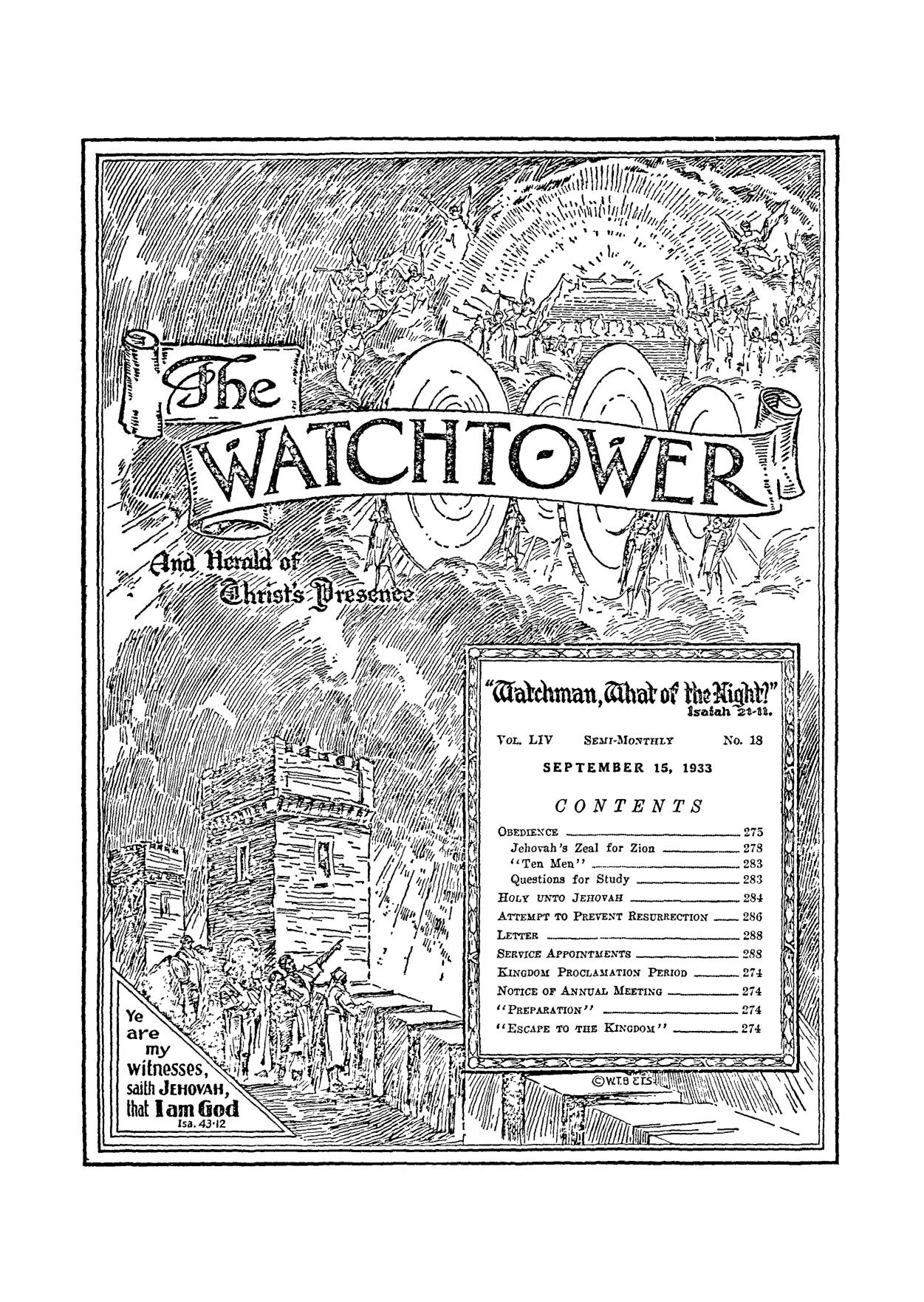
The Watchtower, September 15, 1933
Download: PDF — The Watchtower, September 15, 1933
KINGDOM PROCLAMATION PERIOD
This period, September 30 to October 8 inclusive, marks the opening of a new service year. Believing that at that time the pure river of the water of life will flow out from the throne of the kingdom in greater volume over the earth than during any previous world-witness period, none excepted, we here give prompt notice thereof that due preparation may be begun at once. Realizing that THE KINGDOM IS HERE and has been steadily increasing and that of its increase there shall be no end, Jehovah’s witnesses in all lands will have growing boldness, zeal and joy in proclaiming that kingdom. The increasing numbers of the Jonadab class should be invited, as of the Lord, to share actively in the proclamation. Those not working under any branch of the Society will please report direct to this office at the close of this period. The Bulletins will contain full details and instructions.
NOTICE OF ANNUAL MEETING
Pursuant to the provision of law and the charter of the Watch Tower Bible and Tract Society, notice is here given that the annual business meeting of the said Society will be held at Pittsburgh, North Side (formerly Allegheny), Pennsylvania, at 10 o’clock a.m., Tuesday, October 31, 1933, at which the usual annual business will be transacted.
“PREPARATION”
With deep gratitude to Jehovah, by whom all the sons of Zion are taught through Christ Jesus, The Watchtower here announces a new book bearing the above title. Its stirring contents give the fundamental explanation of each chapter and verse of the book of Zechariah and its relation to the cleansing of Jehovah’s sanctuary. The beautiful binding and embossed cover befit what is inside. A special edition of Preparation, containing the author’s letter and autograph, will be available October 1, at 50c a copy. This privileges Jehovah’s witnesses to have a share in bearing the initial costs of producing this grand book. Arrangements for distributing this book to the general public will be announced in due time.
“ESCAPE TO THE KINGDOM”
Such is the title of Brother Rutherford’s newest booklet. It fulfils the desire of the brethren everywhere that Brother Rutherford’s three radio addresses “The Way of Escape’’, “Effect of Holy Year on Peace and Prosperity,” and “Kingdom Blessings for the People” should be made available under one cover for use in proclaiming Jehovah’s kingdom truths the world over. The cover design will thrill you; it is in thorough keeping with title and contents of the booklet. The booklet may be had at 5c a copy.
Vol. LIV
September 15, 1933
No. 18
OBEDIENCE
“As an earring of gold, and an ornament of fine gold, so is a wise reprover upon an obedient ear.” – Prov. 25:12.
JEHOVAH’S sanctuary class must first learn obedience before having a part in the vindication of his great name. God provides his covenant people with his Word and gives them an understanding thereof in due time, that they might be instructed, and then they must do his will. To those who are in the covenant with him he says: “Be thou instructed, 0 Jerusalem, lest my soul depart from thee; lest I make thee desolate, a land not inhabited.’’ (Jer. 6: 8) These words of Jeremiah apply to those now on earth who are in a covenant to do God’s will. The wise man is one who diligently seeks to know the will of God, as stated in his Word, and who then hastens to do that will. To merely hear with the ears what his Word says is not sufficient: “Thou seest that faith wrought with his works, and by works was faith made perfect.’’ (Jas. 2: 22, R. V.) This shows that those are in a state of delusion who take the letter of the Word and not the spirit of it, and who fail to do what God tells them. Mere formalism in service of the letter of the Word is displeasing to Jehovah because it is mockery, and “God is not mocked’’. (Gal. 6: 7) When Christ Jesus appeared for judgment and to take the approved ones into the temple, the facts and the Scriptures show, there were two classes before him, one that indulged in formalism, such as the pious, sanctimonious in appearance, those who loved to engage in public prayer and fasting that they might appear good to others, as having developed themselves to such a state that they were fit and necessary for the kingdom; and another and different class, namely, the ones who are meek or teachable, faithful in the performance of what they learned to be the will of God, and doing that will with joy, never looking to their own powers or attainments. The first class mentioned is the disobedient, and the other mentioned, the obedient class. These two classes must be separated, that the approved ones may be prepared for the work in the temple and for the vindication of Jehovah’s name in connection with the battle of the great day. Those of both classes stand before the judgment seat, having sacrificed their right to live as human creatures. But now something more important has arisen. They must obey. “Hath the Lord as great delight in burnt offerings and sacrifices, as in obeying the voice of the Lord? Behold, to obey is better than sacrifice, and to hearken than the fat of rams. For rebellion is as the sin of witchcraft, and stubbornness is as iniquity and idolatry.’’ (1 Sam. 15: 22, 23) The prophecy of Zechariah delivered in connection with the building of the temple shows both the disobedient and the obedient class. The separation of the two classes takes place, and the obedient ones are prepared, received into the temple, and have a part in the vindication of Jehovah’s name.
2 The opening of the seventh chapter of Zechariah’s prophecy discloses certain men of the Israelites being sent from the city of Bethel to pray and make speech before the temple builders. This occurred more than two years before the temple was completed, which proves that these men were not sent to pray at the temple; and therefore the Authorized Version is a poor rendering of the text. The correct rendering is: “And it came to pass in the fourth year of king Darius, that the word of Jehovah came unto Zechariah in the fourth day of the ninth month, even in Chislev. Now they of Bethel had sent Sharezer and Regem-melech, and their men, to entreat the favor of Jehovah.’’ (Zech. 7:1, 2, A.R.V.) In the Hebrew, “house of God’’ is “Bethel”. The meaning of this text here is that these men were sent from the city of Bethel to Jerusalem. Those people had returned with the remnant from Babylon and now occupied Bethel. (Ezra 2: 28; Neh. 7: 32; 11: 31) The two men Sharezer and Regem-mclech were proceeding under names or titles of foreign derivation, although now living in the holy land, and this suggests that they were not entirely in line with Jehovah’s arrangement to carry forward his work. Those men therefore fitly represent that class of professed followers of Christ who heard the truth and who took part in the Elijah work and who have made much ado about their being a part of the house of God, that is, Bethel. About 1918 and thereafter certain companies of dreamers have been in evidence, claiming to be in “present truth” and in line for the kingdom. The two men coming from Bethel, as above named, show by their course of action that they were "old-timers” who had not kept up to date with the Lord’s truth and service. Likewise the class they foreshadowed prove to be "old-timers” belonging to and holding to old forms set up by men, such as observing dates and months, times and seasons. (Gal. 4: 10) They have not entirely broken away from Satan’s organization, but still think they should be subject to the political powers that rule the land, and they refuse to tell the truth about these as being a part of Satan’s organization lest they cause someone to turn away from what they call "the truth”. These come to "pacify the face of Jehovah” (Roth.); and this suggests a class of persons who indulge chiefly in so-called "devotional exercise”, delighting to sing hymns and tell of their own virtues and of their devotion to some hero of faith, but they show no real zeal and devotion to the service of the Lord God as he has commanded. They even call the hypocritical clergy, who form a part of the Devil’s organization, "our Christian brethren.” Since they are not a part of God’s organization, probably this is not out of the way for them to call the hypocrites ‘‘Christian brethren”. It is no wonder they desire the soft pedal to be put on when Satan’s organization is mentioned. “Birds of a feather flock together.”
3 Joshua the high priest and Zechariah and Haggai the prophets were at work at the temple when these men who appeared to be very devout came there to show themselves. Doubtless they wore long, well greased beards and had a very solemn and sanctimonious air and spoke with great gravity and sanctimonious solemnity to the priests at the temple, and, while speaking, shed a few crocodile tears. "And to speak unto the priests which were in the house of the Lord of hosts, and to the prophets, saying, Should I weep in the fifth month, separating myself, as I have done these so many years ? ” (Zech. 7:3) When they were in Babylon they had sat down and wept, and ever since had been great sticklers for formalities, and they had continued to indulge in shedding tears, even when they had been favored by being brought back to their homeland. They did not appreciate God’s goodness, but thought they must continue to weep and to appear to be good men. For sixteen years they had seen the temple lie in waste and nothing being done, and yet they continued to shed tears at regular intervals that others might say: ‘Behold these devout men.’ Had they been really sincere and devoted to God they would have risen up long before, ceased their weeping, bravely and fervently faced the enemy, and joyfully entered into the work of building the temple at God’s commandment. It is even so, since 1916, with the class above mentioned, and particularly after 1918. There are those who were brought out of Babylon, or Satan’s organization, and given the truth that was published prior to that date, and because one man, their earthly leader, was taken away from them, they said: ‘There is no more truth, and we will sit together and talk about the past and weep over what we have lost.’ The Lord has very marvelously foreshadowed all these minute things that are now being enacted, and this he has done for the very purpose of aiding the faithful ones to discern between the hypocrites and the zealous servants of God in order that the faithful might be greatly strengthened and prepared to press forward in the battle of the great day.
4 The men appearing at Jerusalem inquired of the priests and the prophets, asking if they should weep in the fifth and seventh months and separate themselves as they had been doing for many years. The seventh day of the fifth month was the day that Babylon had destroyed Jerusalem and the temple. (2 Ki. 25: 8, 9) They now saw faithful men rebuilding the temple; and not seeing these faithful men weeping but working with joy, these pious hypocrites evidently thought to rebuke the builders in some measure by thus inquiring and at the same time showing themselves to be very extremely good men. The Lord show’s it was no longer proper to fast and to weep, but that the ‘fast of the fifth month shall be joy and gladness’. (Zech. 8: 19) Since the coming of the Lord Jesus to the temple of Jehovah, and the gathering of the faithful together, it has been a time of joy; but those ‘dreamers’, the "old-timers” who hold to the traditions of men, continue to fast and weep, and verily they have their reward, which is their approval amongst themselves. (Matt. 6: 16) The present-day weeping ones do not see that the Lord Jesus is at the temple. In fact, that is one great truth that they vehemently deny, and they use strong language against Jehovah’s witnesses because they declare that the Lord is at his holy temple. This shows that the temple does not exist for them, that they do not see the temple, and are not of it, and hence are not born of God’s organization and not taught of him. If they had been gathered unto the Lord and anointed they would see the great and wonderful truths which the Lord now reveals to his faithful ones. They would cease all outward formalities of fasting and weeping. ‘All of the temple show forth the glory of the Lord,’ and the ‘joy of the Lord is their strength’. — Ps. 29: 9; Neh. 8: 10.
5 Jehovah then gave his prophet a message to be delivered to these "old-time” weepers: "Then came the word of the Lord of hosts unto me.” (Zech. 7: 4) The giving of the word to Zechariah finds a parallel in the increased light that comes to the faithful after 1922. Note now with joy some of the wonderful things the Lord has brought to the temple class since that date. It has pleased the Lord to use The Watchtower as a means of conveying his message to his covenant people; and in the year 1923 the Lord began to bring the message of joy to his hungry ones and they learned for the first time the meaning of "The joy of Jehovah is your strength”. (Neh. 8: 10, A.R.V.) Then in February of the same year the Lord revealed to his people that the cup of wine at the Memorial pictures good cheer resulting from the coming of the King and the kingdom. (The Watchtower, 1923, page 56) Then came for the first time the correct understanding of the parables of the talents and of the pounds, which involve the joy of the Lord. (The Watchtower, 1923, pages 35, 71) Then the parable of the virgins, showing that the oil pictures joy and that the joy is in them because of God’s favors. {The Watchtower, 1923, page 296) Since then Jehovah has continued to cause his lightnings to flash upon the temple, and the temple class has continued to rejoice and put forth increased zeal and energy in his service.
6 Knowing that the Lord Jesus is at the temple, all of the temple rejoice. It would be entirely inappropriate for them to weep, and it would therefore be displeasing to the Lord. Hence the Lord commanded Zechariah to speak to these “old-time weepers” and say: “When ye fasted and mourned in the fifth and seventh month, even those seventy years, did ye at all fast unto me, even to me?” (Zech. 7:5) The divine message of advice and instruction was and is for all of God’s covenant people, that is to say, the ones holding responsible positions as well as all others, including the Mordecai-Naomi class, and the Esther and Ruth class that came to a knowledge of the truth later. This part of the prophecy shows that all of these had indulged to some measure in things which were no longer proper. They had mourned and wept in the past; but now that the Lord is at the temple they must no longer fast and weep, because it is a time of joy. The very language of the fifth verse of the prophecy shows that fasting “in the fifth and seventh month” must have been a self-imposed fast in commemoration of the destruction of Jerusalem. (2 Ki. 25: 25, 26) There is no evidence that Jehovah by his prophets during the seventy years’ captivity enjoined these fasts upon the exiles. They had instituted these fasts at the instance of men. Likewise the many formalities that have been indulged in by the covenant people of God have been and are the institutions of men, and concerning such the words of the apostle are here very fitting: “If you died with Christ from the elements of the world, why, as living in the world, do you subject yourselves to ordinances: (“Eat not,’ ‘taste not,’ ‘handle not’; all which things are consumed in the using;) according to the commandments and teachings of men ? which ordinances, having a wordy show of wisdom in self-devised worship and humility, by a non-indulgence of the body, not in any honor, are only for a gratification of the flesh.”— Col. 2: 20-23, Diag.
7 These modem dreamers and fasters were following the instruction of men, such as “character development”, which is pleasing to their own flesh and to other persons; and they think to do so to make themselves fit subjects for heaven, and that they may appear in the sight of others as approved ones. They abstain from things that are not forbidden by Jehovah, while at the same time they indulge in things that are forbidden by him. Their fasts, therefore, are not set by Jehovah. The unnatural life of self-affliction is not pleasing to God, but it pleases God for one to be active and positive in bearing the ‘fruits of his kingdom ’ as he has commanded and to do so with zeal and joy. One who indulges in a “form of godliness”, and has his heart affections on himself or on some other creature, could not be pleasing to God. Outward show of righteousness is mockery, and to such the Lord is not blind.
8 Jehovah’s prophet then tells these self-constituted, sanctimonious dreaming idolaters that when they did eat and drink in their time of prosperity they did it, not to use their strength in the service of the Lord, but for their own selfish benefit: “And when ye used to eat, and when ye used to drink, was it not of your own accord ye did eat, and of your own accord ye did drink? Should ye not [have been doing] the things which Jehovah had proclaimed by the hand of the former prophets, while yet Jerusalem was inhabited and in peace, with her cities round about her, and the South and the Lowland were inhabited?”—Zech. 7: 6, 7, Roth.
9 Prior to 1916 those in a covenant with Jehovah were in a prosperous condition for that time. The great adversity and captivity to Satan’s organization came in 1917 and 1918. Thereafter the dreamers, who are opposers, wept and howled, and still weep and howl, because ‘the last will and testament of a dead man was not strictly followed’, assuming that any man could put a restriction upon God’s work. Jehovah by his prophet says to them that instead of being sticklers for adhering to the words and opinions of a deceased man they should study the prophecies, which were aforetime written for the comfort and aid and instruction of God’s people, and that they should feed upon these words of the Lord and be diligent to obey his commandments. The Lord caused the prophet Isaiah to write concerning the same class. (Isa. 58: 4, 5) The Watchtower called attention to this prophecy and urged upon the lukewarm and the weeping ones to awaken and become obedient to the commandments of the Lord. But they continue to go on in their own way and give no heed to the Word of God.—The Watchtower, 1929, pages 131, 147.
10 Now the time has come to preach the truth and the remnant must give the strictest heed to all the commandments of the Lord. (Acts 3: 22, 23) If they will avert the great calamity of going into captivity to Satan’s organization and therefore falling at Armageddon, they must follow closely the Word of God as set forth by his prophets and which Word was written for the special aid and comfort of the temple class. It behooves every one of the temple class to now walk circumspectly and render full obedience unto the Lord.
11 God’s covenant people are commissioned to declare the judgments previously written and to render justice unto others. “And the word of the Lord came unto Zechariah, saying, Thus speaketh the Lord of hosts, saying, Execute true judgment, and shew mercy and compassions every man to his brother.’’ (Zech. 7: 8, 9) Those who have agreed to do the will of God are admonished that they should not show partiality or exalt the name of man. (Ps. 50: 20; Luke 16: 15) Every member of the body of Christ should show mercy and compassion to his brethren and to all the consecrated. This is what the Lord God requires. (Mic. 6: 8) To take selfish advantage of a brother is a very reprehensible thing in God’s sight. “And oppress not the widow, nor the fatherless, the stranger, nor the poor; and let none of you imagine evil against his brother in your heart.’’ (Zeeh. 7: 10) Evil surmising and evil speaking against a brother is a manifestation of the spirit of the “man of sin” and is evil against God’s anointed, and the practice of such will land the perpetrator of the wrong into the “evil servant” class. (1 Thess. 5: 15) Those men who came from the city of Bethel to the temple builders had been fasting, not to the glory of the Lord, but for selfish reasons; and the lesson is for those who are now on earth and who claim to be followers of Christ Jesus to devote themselves, not to fasting, but to joyful service to the Lord.
12 The Israelites were stiff-necked and refused to obey; and they suffered therefor. Their course of action and punishment are noted as “ensamples” for our benefit, that we may take the proper course: “But they refused to hearken, and pulled away the shoulder, and stopped their ears, that they should not hear.” (Zech. 7: 11) Not only is this the history of 2,500 years ago, but it exactly fits what “Christendom” and the “evil servant” class are doing and have been doing since 1922. Many who claim to be God's children, instead of willingly putting their shoulder to the wheel with others in exalting the name of Jehovah, have opposed the kingdom work and continue to oppose it and to do so with strong words and acts. “Yea, they made their hearts as an adamant stone, lest they should hear the law, and the words which the Lord of hosts hath sent in his spirit by the former prophets: therefore came a great wrath from the Lord of hosts.” (Zech. 7: 12) They have closed their ears to the truth and set their hearts against the kingdom work. The wrath of God came upon Israel for their disobedience; and that foreshadows that in the battle of the great day of God Almighty a like punishment shall come upon the opposers.
13 “Christendom” would not hear during the Elijah period of the work, and still persists in stubbornness; and the “evil servant” class now make an alliance with others of Satan’s organization and put themselves in opposition to God’s kingdom, and when they cry to God he will not hear their cries. “Therefore it is come to pass, that as he cried, and they would not hear; so they cried, and I would not hear, saith the Lord of hosts.” (Zech. 7: 13) “Wisdom crieth without; she uttereth her voice in the streets. Turn you at my reproof: behold, I will pour out my spirit unto you, I will make known my words unto you. Then shall they call upon me, but I will not answer; they shall seek me early, but they shall not find me: for that they hated knowledge, and did not choose the fear of the Lord.”—Prov. 1: 20, 23, 28, 29.
14 Jehovah scattered the Israelites with great trouble by permitting them to be overthrown. (Zech. 7: 14) This is typical of the “great multitude”, which is already like “desolate heritages”. (Isa. 49:8) The “great multitude” disregard the Word of God and are brought low, but in due time they will be loosed. But those who have been returned from Babylon, and enlightened and called to the kingdom and given the privilege of temple work, and who then willfully become lukewarm and disobedient, how much greater will be their punishment! (Rev. 3: 14-18; 1 Pet. 4: 17; 2 Pet. 2: 12, 13) Outward show for selfish reasons and hypocrisy will receive a just recompense at the hands of the Lord. Those who joyfully obey will receive the approval of the Lord.
JEHOVAH’S ZEAL FOR ZION
15 Jehovah put his name on Jerusalem, and for his name’s sake he brought back the faithful. He is now likewise jealous (or zealous) for Zion his organization. Hence it is written in the prophecy: “And the word of Jehovah of hosts came saying, Thus saith Jehovah of hosts, I am jealous for Zion with a great jealousy, yea with great wrath am I jealous for her.” (Zech. 8: 1, 2, Roth.) After Satan was cast out of heaven there was great persecution upon God’s organization on earth. “Christendom” rejected Christ Jesus the King, and for these things Jehovah’s wrath will be expressed against “Christendom”. His zeal does not tarry long before taking action for the relief of Zion. (Jer. 25: 12) After the “king of Babylon” (which is Satan) and “that nation” (the invisible part of Satan’s organization) had been cast out of heaven with great fury Jehovah’s zeal for Zion moved him to make preparation for the final punishment of the wicked organization, which punishment he will inflict at Armageddon.
16 Jehovah gave his word that his woman should bring forth a seed that would destroy the enemy. For six thousand years that promise was apparently forgotten ; but it was not in fact forgotten. During that period the heavenly part of Jehovah’s organization was like a widow. By his prophet Jehovah declares: “For a small moment have I forsaken thee; but with great mercies will I [at my return] gather thee.” (Isa. 54: 5-8) At 1914 the Lord returned his favor to his heavenly organization, symbolized by his “woman”. As for the earthly part of his organization, Jehovah did not return until 1918, when his Messenger straightway came to the temple. In harmony with this Zechariah prophesied: “Thus saith the Lord, I am returned unto Zion, and will dwell in the midst of Jerusalem; and Jerusalem shall be called, A city of truth; and the mountain of the Lord of hosts, The holy mountain.” (Zech. 8: 3) By the mouth of other prophets Jehovah made known his purposes to return his favor to Zion, which he has done. (Ps. 102: 13-16) In Zion his faithful remnant now take refuge. (Isa. 14: 32; 24: 23) “And a Redeemer will come to Zion, and unto them that turn from transgression in Jacob, saith Jehovah. And as for me, this is my covenant with them, saith Jehovah: my spirit that is upon thee [Christ the Greater-than-Isaiah], and my words which I have put in thy mouth, shall not depart out of thy mouth, nor out of the mouth of thy seed [remnant, as pictured by Isaiah’s three sons], nor out of the mouth of thy seed’s seed [Ruth class, the ‘daughterin-law of Naomi’ class], saith Jehovah, from henceforth and for ever.” (Isa. 59: 20, 21, A.R.V.) (Mic. 4: 7, 8; Isa. 33: 5, 6) This prophetic promise Jehovah has fulfilled to his faithful ones on earth and has made them his witnesses.
17 Jehovah’s organization, symbolized by Jerusalem, shows prosperity thereafter. ‘It shall be called The city of truth, ’ that is, the organization of fidelity and steadfastness, first by the earthly remnant, the Judah class, and then by the Jonadab class, and in due time by the “great multitude”. But the angel of the Lord will gather out all offenders and workers of iniquity. (Rev. 22:15) “Look upon Zion, the city of our solemnities: thine eyes shall see Jerusalem a quiet habitation, a tent that shall not be removed, the stakes whereof shall never be plucked up, neither shall any of the cords thereof be broken. But there Jehovah will be with us in majesty, a place of broad rivers and streams, wherein shall go no galley with oars, neither shall gallant ship [Satan’s commercial power, particularly represented in the British empire] pass thereby. For Jehovah is our judge, Jehovah is our lawgiver, Jehovah is our king; he will save us.”—Isa. 33: 20-22, A.R.V.
18 Jehovah will for ever be a refuge unto his people, and no “strangers” in army formation will pass through her again. (Joel 3: 16, 17, 21, A.R.V.) God’s remnant people now see these blessings, and they rejoice; and to them Jehovah says: “Thou shalt not fear evil, any more. ... Fear thou not; O Zion, let not thy hands be slack.” (Zeph. 3:14-17, A.R.V.) Jehovah has sent his great Judge to the temple; therefore he has now ‘restored thy judges’ and has sent his “Wonderful Counsellor”, and henceforth his organization shall be called The faithful city of righteousness. (Isa. 1: 26; 30: 20) Those born of Zion are taught of God and are in great peace and joy.—Zeph. 3: 13.
19 Many prophecies show that many people will discern God’s organization before Armageddon and will acknowledge that Jehovah is not at all responsible for the woes and wickedness now in the earth and that the kingdom of Jehovah is the world’s true remedy. The day of great distress is here for those who fight against God. The day of prosperity, joy and blessings is here for those who take their stand on Jehovah’s side and remain true and steadfast for him. The people will come with gladness to Zion, the kingdom, and give joy to the King. — Jer. 31: 23; Ps. 48: 1, 2; Joel 3: 17.
20 Eighteen years after the remnant came back from Babylon this prophecy was uttered: “Thus saith the Lord of hosts, There shall yet old men and old women dwell in the streets of Jerusalem, and every man with his staff in his hand for very age. And the streets of the city shall be full of boys and girls playing in the streets thereof.” (Zech. 8: 4, 5) This could not refer to the dreamers mentioned in Joel’s prophecy as “old men’’, for Jehovah is against them that prophesy false dreams and tell them and cause the people to err by their lies; and these he clears away. (Jer. 23:32) The prophecy of Zechariah therefore shows in figurative language that in the old age of the church, that is, at the end of the world, God will restore his remnant to his organization and they shall then be fruitful. (Ps. 37:25; 92:14,15) The faithful remnant shall abide in Jehovah’s organization, as it were in old age, and they shall have protection and shall not be cut off therefrom by the enemy. (Ps. 31: 23) Mordecai and Naomi were both old at the time the Esther and Ruth dramas were performed; and the “boys and the girls [that is, the younger ones] in the streets” suggests that the Esther and Ruth class are there foreshadowed as members of the remnant. These younger ones are children of Zion; hence they certainly picture a portion of the remnant. (Isa. 66: 8; Ps. 113: 9; Ps. 127: 3-5) At the fulfilment of this prophecy Zion says: “Who hath begotten me these [Esther and Ruth class], seeing that I have been bereaved of my children?” (Isa. 49: 19-22, A.R.V.) Happy children play in streets. The prophetic statement that these children are playing in the streets shows that they are care-free, trustful, and joyful in the Lord. “Let the children of Zion be joyful in their King. Let them praise his name in the dance.”—Ps. 149: 2, 3.
21 These blessings bestowed upon Zion at the present time are marvelous, and the faithful see it proceeds from the Lord. “Thus saith the Lord of hosts, If it be marvellous in the eyes of the remnant of this people in these days, should it also be marvellous in mine eyes? saith the Lord of hosts.” (Zech. 8: 6) With Jehovah nothing is impossible. The fulfilment of the prophecy is due to the fact of Jehovah’s returning his favor to Zion and bringing his covenant people that prove obedient and faithful unto the temple, anointing and enlightening them; and they exclaim: “This is the Lord’s doing; it is marvellous in our eyes.”—Ps. 118: 23.
22 The people of Jehovah are those who gladly obey him, and he protects and blesses them: “Thus saith the Lord of hosts, Behold, I will save my people from the east country, and from the west country, and I will bring them, and they shall dwell in the midst of Jerusalem; and they shall be my people, and I will be their God, in truth and in righteousness.’’ (Zech. 8: 7, 8) To save them he first brings forth his King, ousts Satan and his organization from heaven, stops the World War for the sake of his elect, and then sends forth his obedient ones prepared and equipped as his witnesses to represent him in further preparation for Armageddon. The remnant dwell safely because they have taken their refuge in the name of Jehovah. (Prov. 18: 10) No longer do they give honor and glory to men. They worship and serve Jehovah.
23 The faithful remnant are Jehovah’s people taken out for his name, and they have a work to do and must use the message and their divine equipment in the Lord’s service. “Thus saith the Lord of hosts [to the remnant], Let your hands be strong, ye that hear in these days these words by the mouth of the prophets, which were in the day that the foundation of the house of the Lord of hosts was laid, that the temple might be built.’’ (Zech. 8: 9) It is those who hear and appreciate the prophecies which Jehovah has opened and made plain to his people in this day that must be strong and active. It is their privilege to help the weaker ones understand, that is, to ‘ strengthen the weak hands’. (Isa. 35: 3) The temple work is now in progress, and the Lord supplies the needed food to his remnant that they may be strong in him and in the power of his might.
24 It was in 1922 that the people of God learned that Christ was at the temple, and only from that time forward could they appreciate the privilege of kingdom work. “For before these [those, R.V.] days there was no hire for man, nor any hire for beast; neither was there any peace to him that went out or came in, because of the affliction; for I set all men every one against his neighbour.’’ (Zech. 8: 10) Zechariah was not here prophesying about the present commercial depression that exists in Satan’s organization, but about conditions that came to pass among God’s people prior to 1922. They did not seriously realize prior to that date the importance of organized service; hence there was no hire or effective service for them. There was no real peace. There was a measure of fear and restraint because of bowing down and being submissive to the commercial and political elements of Satan’s organization and of recognizing such as “the higher powers’’; consequently there was no peace. Character development was the chief doctrine and the matter chiefly discussed by the “elective elders’’ who wished to shine; and they put the service work in the rear. No real, zealous and effective work was done. God’s people were afflicted and hindered by the “Samaritans” who still continue to commit the “sin of Samaria” by looking to the words of men and not to Jehovah as to what should be done. The Devil used these “Samaritans” and other elements of Satan’s organization to oppress and put fear in the hearts of God’s people; there was also strife in their company or class where the swell-headed ‘ elected elders’ lorded it over God’s heritage. These must be cleared out of God’s sanctuary before unity would fully exist. Even after they are cleared out some of that opposing element will continue their efforts to hinder the work of Jehovah’s witnesses; but the faithful ones will go steadfastly ahead and give no heed to the opposition, avoiding those who attempt to hinder.
25 When Zechariah prophesied, the foundation of the temple had been laid and the work had progressed for two years. That well corresponds to the time from 1922, and particularly from 1926, which latter date marks the beginning of the time of blessedness. (Dan. 12: 12) “But now I will not be unto the residue [the remnant] of this people as in the former days, saith the Lord of hosts.” (Zech. 8: 11) The “former days” were the days of negligence. But when God's covenant people came to realize that Jehovah had a work for them to do, conditions amongst them changed and prosperity followed. “For the seed shall be prosperous [Roth., secure] ; the vine shall give her fruit, and the ground shall give her increase, and the heavens shall give their dew; and I will cause the remnant of this people to possess all these things.”—Zech. 8: 12.
26 Take note how Jehovah has fulfilled this prophecy by and through Christ Jesus, the mighty Builder of the temple. The security or prosperity mentioned by Zechariah exactly corresponds with the prophecy of Haggai 2: 19 and of Isaiah 30: 23. Hence there is now an abundance of spiritual food for those who care to partake of it. This spiritual food the Lord graciously permits to be published in the Watch Tower publications and to be put within the reach of all who love God. The “seed” has prospered, resulting in ‘peace that passeth the understanding of man’.
27 Jehovah produces the fruit by his “vine”. (Isa. 27: 2,3; John 15: 1,2) The remnant delight to bear that fruit to their brethren and to all who hear. The remnant at the same time ‘drink deeply of the fruit of the vine new’ and give praise to the King and to Jehovah. (Matt. 26: 29; Luke 22: 18) The Lord has blessed the labors of his remnant in building up the land or organization, and thus has brought the increase and good resulting to the glory of the Lord. (Mal. 3: 11) The promise that “the heavens shall give their dew” in symbol says that there shall be no scarcity of truth but the Lord will continue to supply the remnant with all things needed. The Lord has placed upon his table an abundance of fresh, life-sustaining food for his remnant and has brought them great joy and peace. In times past about one-half of The Watchtower space was taken up with “Views from the Tower”, meaning things pertaining to the world; but since 1924 such things have disappeared and all the space is given to the truths pertaining to Jehovah’s kingdom, and this gracious provision of the Lord has kept his faithful people refreshed. “My doctrine shall drop as the rain, my speech shall distil as the dew, as the small rain upon the tender herb, and as the showers upon the grass: because I will publish the name of the Lord: ascribe ye greatness unto our God.” (Deut. 32: 2, 3) Now his people have learned that the truths set out in the book of Deuteronomy apply particularly to God’s people who are brought to the temple. Those in Christ have been brought into unity, which unity is “as the dew of Hermon, and as the dew that descended upon the mountains of Zion: for there the Lord commanded the blessing, even life for evermore”. (Ps. 133: 3) Jehovah’s promise by Zechariah was, “I will cause the remnant of this people to possess all these things”; and truly he has fulfilled this promise and continues to do so. The work began in earnest in 1922, and in a very marked degree from and after 1926, which year marks the beginning of the special work of cleansing the sanctuary in preparation for the greater work to follow. (Joel 2: 23-28) The obedient ones of Jehovah continue to rejoice and praise him while engaged in temple work, regardless of what the enemy may say or do, well knowing that they have protection from Jehovah and in his name they are safe.
28 Jehovah uses his people as instruments of blessings for others; hence Zechariah prophesied: “And it shall come to pass, that as ye were a curse among the heathen, 0 house of Judah, and house of Israel; so will I save you, and ye shall be a blessing; fear not, but let your hands be strong.” (Zech. 8: 13) The mention of the ‘house of Judah and Israel’ shows that the prophecy has fulfilment at a time of unity in Christ. Because of disobedience they were under God’s curse and they dwelt amongst the heathen who also cursed them; and this was the condition of spiritual Israel prior to 1922, when God was angry with his covenant people because of disobedience and negligence. Then his anger was turned away. (Isa. 12: 1) Now the faithful delight to diligently proclaim his name and his works, and so continue; and “there shall be no more curse” for them. (Rev. 22: 3) Diligence in proclaiming the message of Jehovah’s kingdom is indeed a blessing to many people, particularly to the Jonadab class. “And the remnant of Jacob shall be in the midst of many people, as dew from the Lord, as the showers upon the grass, that tarrieth not for man, nor waiteth for the sons of men. And I will execute vengeance in anger and fury upon the heathen, such as they have not heard.”—Mic. 5: 7, 15.
29 Jehovah is preparing his people for the battle of the great day, and hence he commands them to fear not. "Hear, O Israel; ye approach this day unto battle against your enemies; let not your hearts faint; fear not, and do not tremble, neither be ye terrified because of them.” (Deut. 20: 3) Gog has brought into the conspiracy all of his forces, and these are directing their efforts against Jehovah’s “hidden ones”; but those who trust Jehovah implicitly need not and will not fear. (Ps. 27:1; 118: 6; Zeph. 3:16; Heb. 13: 6; 1 John 4: 17, 18) Therefore the remnant in this day of judgment are bold in declaring the message of the kingdom and will continue so to do regardless of all opposition.
30 Prior to 1918 Jehovah caused the truth then due to be proclaimed on earth, and “Christendom” had an opportunity to know about the kingdom. While the Elijah work was thus being done, and particularly in the year 1918, the Lord’s faithful people were ill-treated by “Christendom”. Among God’s covenant people in that time there were the “elective elders” who failed to serve God, and because of their unfaithfulness it became necessary to clear these out that the approved ones might be prepared for God’s purposes. “For thus saith the Lord of hosts, As I thought to punish you, when your fathers provoked me to wrath, saith the Lord of hosts, and I repented not.” (Zech. 8: 14) The Lord did not repent, but has done the purging work that he may have a company who will “offer unto [him] an offering in righteousness”. (Mal. 3: 1-4; Ezek. 20: 35-38) Judgment must begin at the house of God and continue until the sanctuary is cleansed, and then lawlessness shall have an end. – 1 Pet. 4: 17; Ezek. 21: 24,25.
31 From and after 1922, and more particularly since 1926, Jehovah has prospered his “faithful servant” class. “So again have I thought in these days to do well unto Jerusalem, and to the house of Judah; fear ye not.” (Zech. 8: 15) This Jehovah has done because it is the time for the vindication of his name, and not because the remnant deserved the blessing. (Ezek. 36: 21-23) The “man child” having been born, meaning the kingdom having begun, it is the “set time” to favor Zion and to honor and vindicate Jehovah’s name.—Ps. 102: 13; Isa. 63: 4.
32 If the remnant would remain in the temple and partake of the good things which Jehovah prepares at this time they must do what he commands them. “These are the things that ye shall do: Speak ye every man the truth to his neighbour; execute the judgment of truth and peace in your gates.” (Zech. 8: 16) This commandment of the Lord cannot be fulfilled by making speeches before the people of God concerning “character development” or any other kind of speeches that merely sound nice. The speakers must speak the truth, and it is not true that man by his own efforts can prepare himself and make himself fit for the kingdom of heaven; nor by amusing or entertaining his hearers by his speech can he accomplish God’s purposes. He must obey the Lord God and the Lord Jesus Christ. Having been brought to the point of unity each one must speak the kingdom message of truth which the Lord has provided. “And that ye put on the new man, which after God is created in righteousness and true holiness [margin, holiness of truth; that is, the truth alone]. Wherefore putting away lying, speak every man truth with his neighbour; for we are members one of another.” (Eph. 4: 24, 25) They must speak up-to-date truth, and not what was learned during the Elijah period of the church. They must be frank to point out the true qualifications of a follower of Christ, his commission, and his responsibility, speaking the truth of and concerning the kingdom and plainly telling the truth concerning the enemy as God commanded. Those who refuse to obey Jehovah’s great prophet in this and in other matters of importance shall be destroyed. Hypocrisy will not longer be tolerated. (Acts 3: 22, 23) The truth concerning Jehovah’s judgment must be told, because he has commanded this to be done. Avoid all controversy, but be diligent in telling the truth; as it is written: ‘‘Pray for the peace of Jerusalem: they shall prosper that love thee. Because of the house of the Lord our God I will seek thy good.” (Ps. 122: 6,9) “But if ye bite and devour one another, take heed that ye be not consumed one of another.” (Gal. 5: 15) The faithful remnant will keep the unity in Christ and go forward joyfully in the army of the Lord God. (Eph. 4: 13; Phil. 1: 27) Unfaithfulness to the Lord’s organization is hateful to Jehovah. (Isa. 58: 1) Each member thereof is responsible to the Lord and must put self in the background and give strict heed and attention to the interests of the kingdom. “And let none of you imagine evil in your hearts against his neighbour; and love no false oath: for all these are things that I hate, saith the Lord. ’ ’ —Zech. 8:17.
33 Jehovah gave answer to the question propounded by the inhabitants of the city of Bethel. (Zech. 7: 2, 3) The fast of the fourth month commemorated the fall of Jerusalem and the capture of the king. (2 Ki. 25: 3-5) The fast of the fifth month commemorated the destruction of the temple; the fast of the seventh month commemorated the time of the complete desolation; and the fast of the tenth month, the time when Ezekiel received the news that the city had been smitten. (Ezek. 33: 21) Concerning this Jehovah said: ‘This shall not be a time of weeping now, but shall be to the house of Judah joy and gladness, and cheerful feasts [pleasant appointed meetings, Roth.].’ Therefore says the Lord: “Thus saith the Lord of hosts, The fast of the fourth month, and the fast of the fifth, and the fast of the seventh, and the fast of the tenth, shall be to the house of Judah joy and gladness, and cheerful feasts: therefore love the truth and peace.” (Zech. 8: 19) When the trouble came in 1917 to 1919 God’s covenant people should have received it with joy, accepting it as being permitted by Jehovah that his purposes might be accomplished. Certainly after 1919 those who love the Lord and his truth should no longer mourn about what had come to pass. Those who do are “laying again the foundation of repentance from dead works” and not ‘going on to perfection’. (Heb. 6: 1) Instead of obeying the Lord and walking on joyfully in the light he has given to his people, many “weepers” have continued to observe days and months and times and years, and to hold solemn and weepy meetings to commemorate the death of one who in the past led them, and on such occasions to pray:“God bless his memory.” They also have tried to perpetuate the dead Elijah work, the dead pyramid stones, and such things, all of which is displeasing to the Lord. The time having arrived, the temple work must be done, and it is time to ‘forget the things that are behind’ and with joy reach out and do the work which Jehovah has commanded must be done looking to the vindication of his name. The Lord says: “Therefore love the truth and peace.” That means unity and peace in doing God’s will, and not peace that comes by compromise with the enemy. (Heb. 12: 14) The true and faithful ones have responded to the Lord’s commandment. The large and small “service conventions”, the world-wide “united testimony periods”, the campaigns carried forward to the honor of Jehovah and to his praise, and this in the face of stubborn resistance by the enemy, in such places as Plainfield, Bergenfield and Asbury Park, N. J., and in other like places in the land, are proof of their faithful devotion to Jehovah. This obedience they have rendered with joy and in great peace. These have been no “weep fest” occasions. The remnant are rejoicing in the truth that Jehovah continues to provide for them and which he has given them, particularly since 1922.
34 Jehovah’s promise given through Zechariah is that many who have been under Satan’s organization will come and seek the truth at the hands of the Lord’s representatives. (Zech. 8: 20) God’s capital organization shall become a house of prayer for all nations or people who ever get life. (Isa. 56: 7) The truth must reach the ears of many people, that they may identify themselves as on the Lord’s side, and this must be done before Armageddon; and this was foreshadowed by Solomon’s prayer. (1 Ki. 8: 41-43) Zechariah 8: 21, 22 shows that many people shall come to a knowledge of the truth and will tell others about it. The class foreshadowed by Jonadab is now hearing and saying, in the language of the prophet: “I will go also” and tell others about the kingdom, not out of envy or strife, but of good will to help others. (Phil. 1: 15-17) This part of the prophecy of Zechariah shows that many people of different nationalities, such as the Japanese, Chinese, Indians and others, will hear this gospel of the kingdom. The facts show that this part of the prophecy is now in course of fulfilment. The kingdom message is now printed in sixty languages and there are witnesses to Jehovah and his kingdom in seventy-eight countries of the earth. Those who hear and accept the truth will no longer pray unto priests, preachers and rabbis, but will seek the truth at the temple of Jehovah. This is now in process of fulfilment.—Isa. 2: 3; Mic. 4: 2.
“TEN MEN”
35 The number “ten” symbolically represents completeness of things pertaining to the earth, or all things, and in this manner it is used in the following prophecy: “Thus saith the Lord of hosts, In those days it shall come to pass, that ten men shall take hold, out of all languages of the nations, even shall take hold of the skirt of him that is a Jew, saying, We will go with you; for we have heard that God is with you.” (Zech. 8: 23) The time, “those days,” has now begun; and “all languages” means all of those people who constitute the Jonadab class, regardless of nationality, and these are beginning to seek the kingdom truth. (2 Ki. 10: 15-23; Ps. 68: 31; Isa. 55: 5, 6) The skirt of the garment hangs down at the feet, and hence the language of the prophecy, “shall take hold of the skirt of him that is a Jew,” necessarily means “the feet” of the Christ, the One who gives “praise” and vindication to Jehovah’s name, because that is the meaning of the name “Jew” or “Judah”. Christ Jesus is “the Lion of the tribe of Juda” and the King to all that praise Jehovah’s name. (Rev. 5:5) His faithful followers on earth are his feet members, the remnant, which now bring good news of the kingdom and sing the praises of Jehovah. (Isa. 52: 7, 8) The “evil servant” class say: “We are Jews”; but the Lord says they are members of Satan’s organization; and He knows. (Rev. 3: 9; 2: 9) Jehovah has put his name upon his anointed, and therefore the “ten men” means all persons of earth who honestly seek the truth and who will not be misled in determining who is “The Jew”. They will know it is Christ, that is, Christ Jesus and his anointed body members. (Isa. 62: 2; 65:15 ; Rev. 2:17) These persons of good will are now saying to the feet members of Christ, the “Jew”, in the language of the prophecy: ‘We are with you’; meaning we are supporting Jehovah’s witnesses and we are for the kingdom. Today Jehovah’s witnesses, in obedience to his commandments, are taking the lead, and the Jonadab class follow and are thus getting into the chariot or the organization. (Isa. 60:10; 57: 13, 14; see Vindication, Book Three, page 29) The faithful remnant render themselves in full obedience to Jehovah’s commandment and his organization instructions, and he is pleased to use them in the temple service and to continue to prepare them for Armageddon, which is just ahead.
QUESTIONS FOR STUDY
1. What preparation and action are necessary that Jehovah's sanctuary class may have part in the vindication of his name? Apply James 2: 22 to the present situation of God’s covenant people. Who are the wise? Account for there being two classes manifest upon Christ Jesus’ coming to the temple for judgment. How does he deal with these classes?
2-4. Explain whether the men from Bethel were sent to pray and speak at the temple. Show that these men prophetically represented a class in evidence since 1916. Account for the existence of such a class at this time.
5. Apply the prophetic statement (7:4) “Then came the word of the Lord of hosts unto me”.
6, 7. How may we know whether the fasts prophetically referred to in verse 5 are set by Jehovah? Quote the apostle Paul’s words concerning formalism. Point out the facts which show the importance of an understanding of this matter by those now in temple service.
8-10. What does the prophet then tell these idolaters in regard to their purpose when eating and drinking? What should they have been doing? What is the evidence that in this respect they foreshadowed a class now manifest? Point out the present importance of verse 7.
11. What is the application of the prophetic statement “The word of the Lord came unto Zechariah’’? Just what is meant by “Execute true judgment’’? Apply, with illustrations, verses 8-10. How is Psalm 50: 20 applicable here? Luke 16:15? Micah 6:8? 1 Thessalonians 5:15?
12-14. Show that the course taken by the Israelites (verses 11, 12) exactly fits what “Christendom” and the “evil servant” class have been doing since 1922. Also that the result to the latter was truly foretold in the record (verses 13, 14) concerning the Israelites. Point out the harmony therewith of Proverbs 1: 20, 23, 28, 29. What is the position of the “great multitude” in this connection? That of the lukewarm and of the disobedient?
15, 16. In the sense of its prophetic application (8:1), “the word of Jehovah of hosts came” to whom? When? How? How, when, and why was Jehovah of hosts “jealous for Zion” “with great wrath”? According to other scriptures as well as the facts, how did he manifest his ‘jealousy for Zion’ and make known his ‘return to Zion’?
17, 18. ‘Jerusalem shall be called The city of truth,’ by whom, and when? Apply Isaiah 33: 20-22. Joel 3: 16, 17, 21. Zephaniah 3:14-17. Isaiah 1: 26; 30: 20. Zephaniah 3: 13.
19. How can it be truly said that the day of great distress is here as well as the day of prosperity, joy and blessings?
20, 21. With supporting scriptures, explain Zechariah 8: 4, 5. What is the thought conveyed in the question appearing in verse 6?
22. How has Jehovah fulfilled his promise recorded in verses 7, 8? Why was this done?
23. To whom, prophetically, are the words of verse 9 addressed? What is meant by the command “Let your hands be strong”? How has Jehovah provided for their meeting this requirement? What privilege attends their ‘hearing these words by the mouth of the prophets’?
24. Apply verse 10.
25, 26. Account for the statement of verse 11 as introducing the declaration of verse 12. How and when was this prophecy fulfilled? Compare this prophecy with that of Haggai 2: 19 and of Isaiah 30: 23.
27. Recount some of the blessings that have attended the work of the remnant which began with the fulfilment of the prophecy of Joel 2: 23-28.
28. What is the significance of the fact that the words of verse 13 are addressed to both the “house of Judah” and the “house of Israel”? How were they “a curse among the heathen”? How did Jehovah “save” them and provide for their being “a blessing”?
29. When and how do the words of Deuteronomy 20: 3 have their prophetic application?
30, 31. Whom had Jehovah “thought to punish”? What was the ‘provocation’? Show that the Lord “repented not”, and, further, ‘has in these days done well unto Jerusalem and to the house of Judah.’
32. How will the remnant meet the requirements set forth in verse 16?
33. Of what were the fasts of the fourth, fifth, seventh, and tenth months commemorative? Explain whether God’s covenant people have properly responded to the Lord’s commandment set forth in verse 19.
34. In addition to verses 20-22, apply other scriptures that indicate the purpose and the result of this proclamation of the kingdom message?
35. Explain verse 23, to show whether this prophecy is in course of fulfilment. What further privilage awaits the faithful remnant?
HOLY UNTO JEHOVAH
ABOUT thirty-five centuries ago the ancestors of the Hebrew people now living upon earth were virtually slaves, or worse than slaves, under the oppressive government of Egypt. To both Hebrews and so-called “Gentiles” of today there is a deep significance in the contract or covenant made by God through Moses with that multitude of slaves who were then, by the power of God, delivered from Egypt.
Horeb is the general name for the Sinaitic mountains in Arabia. The two names as used in the Scriptures mean practically the same thing. The question may arise, Do not the following scriptures prove that the law covenant was made at Sinai and not in Egypt? “The Lord our God made a covenant with us in Horeb.” (Deut. 5:2) “Remember ye the law of Moses my servant, which I commanded unto him in Horeb for all Israel, with the statutes and judgments.’’ (Mal. 4:4) “Which things are an allegory: for these are the two covenants; the one from the mount Sinai, which gendereth to bondage, which is Agar.” (Gal. 4: 24) They do not so prove, for the reasons now to be stated.
What took place at Mount Sinai in connection with the law covenant was about fifty days after the Israelites left Egypt. Manifestly at Sinai the action there taken was the dedication or confirmation of what had taken place in Egypt at the time of the passover. At Sinai the law of the covenant was specifically stated to the Israelites. First was given the fundamental law, which constitutes the ten commandments. (Ex. 20:1-17) That was followed by the statutory provisions of the law. At the dictation of Jehovah, Moses wrote the law and then it was delivered to the Israelites. Animals were sacrificed at that time and the blood thereof was sprinkled upon the altar and upon the people. (Ex. 24:7, 8) This was a confirmation or dedication of what had been done in Egypt. At the passover in Egypt the Israelites sprinkled the blood of the lamb upon their doorposts and over the door of the house, and all the family remained inside. That was equivalent to sprinkling all the members of the household. There the blood was a test upon each one of the household.
At Mount Sinai it was more of a national matter, confirming with all the nation what had been done with each household which was part of the nation. Because of the covenant made by the passover rite Jehovah immediately gave the Israelites the benefit of the covenant by delivering them from Egypt. That constituted the ransom of the Israelites from Egypt, as it is written: “I gave Egypt for thy ransom.” (Isa. 43:3) “Art thou not it which hath dried the sea, the waters of the great deep; that hath made the depths of the sea a way for the ransomed to pass over?” (Isa. 51:10) Egypt represented the world wherein the Israelites were. Horeb is the mount of God and represents heaven itself. In making the picture here it was only appropriate that the book of the law should be sprinkled with the blood at Horeb, and not at Egypt. The evidence therefore shows that the covenant was made in Egypt and confirmed or ratified at Mount Sinai.
Why should Jehovah make a covenant with the Israelites? Surely not because they were worthy or that God was under any obligation to them! They had defiled themselves with the idols of Egypt. When God was about to lead them out he said: ‘‘Cast ye away every man the abominations of his eyes, and defile not yourselves with the idols of Egypt: I am the Lord your God.” (Ezek. 20:7) This proves that they were not deserving of God’s favor. Then why should God make a covenant with them at all? Jehovah had made his covenant with Abraham, which must stand firm. He restated it to Isaac and Jacob. These men constitute the fathers of Israel. God loved Israel for their fathers’ sakes. The apostle writes: “As touching the election, they are beloved for the fathers’ sakes.” (Rom. 11:28) Through his prophet God said: “And I have also heard the groaning of the children of Israel, whom the Egyptians keep in bondage; and I have remembered my covenant.” (Ex. 6:5) It is here stated that God remembered his covenant. What covenant did he remember? The one with Abraham, of course, because at that time the law covenant had not been made. “Wherefore say unto the children of Israel, I am the Lord, and I will bring you out from under the burdens of the Egyptians, and I will rid you out of their bondage, and I will redeem you with a stretched out arm, and with great judgments.” —Ex. 6:6.
Jehovah had promised that he would bless all the families of the earth and that the blessing of reconciliation and life he would extend to all the families and nations of the earth through the “seed” of promise. God could not and would not use to carry out his purpose of blessing mankind any creature who was in league with or under the control of Satan the enemy. The Israelites had defiled themselves with idols which Satan furnished for the Egyptians. Now God would teach these natural descendants of Abraham that none of them could be of that promised “seed” unless he depart from iniquity. The Israelites must be informed as to what constitutes sin. God would now give them his law whereby they would gain a knowledge of what constitutes sin.
…