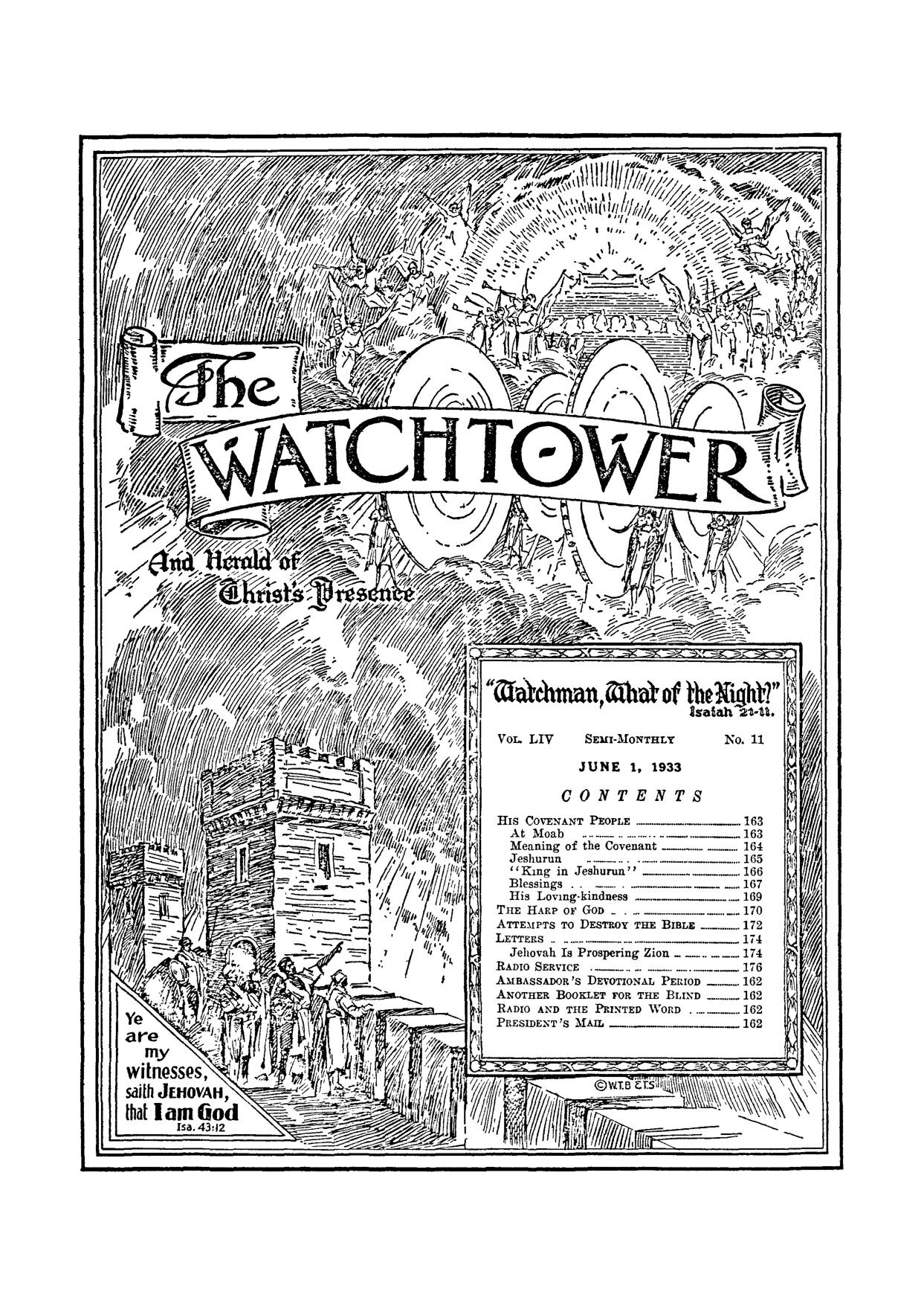
The Watchtower, June 1, 1933
Download: PDF — The Watchtower, June 1, 1933
AMBASSADORS’ DEVOTIONAL PERIOD
Jehovah has again, through his organization, arranged that a special effort be put forth by his witnesses to spread the kingdom message. July 1-9 inclusive is designated as Ambassadors’ Devotional Period, and during this time books and booklets that pertain to Jehovah’s purposes will be offered to the people. The Crisis booklet especially should be stressed, and an effort made to leave one of these booklets in every home.
The Society is pleased to note that during the last Testimony Period, in April, the workers in the field far exceeded any number previously engaged in the witness work. Evidently those people of good will, the Jonadab class, are saying, “Come and drink of the water of life freely.” We should welcome all of good will to participate in the proclamation of the kingdom during this special season, July 1-9. Be sure you are well supplied with literature.
ANOTHER BOOKLET FOR THE BLIND
What Is Truth, another of the series of new booklets, is now ready, in Braille, for blind readers. It will be furnished at cost, $1, or may be had as a loan. Please address the Society’s branch for the blind, 1210 Spear St., Logansport, Ind. Jehovah’s witnesses may well mention this to blind persons whom they meet in house-to-house witnessing.
RADIO AND THE PRINTED WORD
All witnessing parties and all individuals who engage in the witness work should mention the radio station in their vicinity that is broadcasting the watchtower programs. This often proves a means of opening the way to place the books in the hands of the people. Have in mind that the chief purpose of the radio is to call the people’s attention to the truth and then furnish the opportunity for them to get a wider understanding of the message concerning the government of Jehovah by reading what is being printed.
Every one who now participates in the field work in territory served by broadcasts of the watchtower program may have a share in telling the people that this unique service is available each week. Workers report that distribution of the radio folder (supplied by the Society) is proving to be a convenient and effective method of giving continual public notice of this program while engaging in the house-to-house witnessing.
PRESIDENT’S MAIL
Please take note that, until the middle of July, Brother Rutherford will be in Europe and mail should be sent to his address, 124 Columbia Heights, Brooklyn, only when absolutely necessary. No mail will be attended to in Europe except special matters. If your letter is not answered promptly, you will understand the reason why.
Vol. LIV
June 1, 1933
No. 11
HIS COVENANT PEOPLE
“For the Lord’s portion is his people; Jacob is the lot of his inheritance.”—Deut. 32: 9,10.
JEHOVAH sent Moses to Egypt as a vindicator of his name. Moses delivered the testimony of Jehovah as commanded and then led the Israelites safely out of Egypt and across the Red sea. There that one picture ended. On the other side of the Red sea and in the wilderness Jehovah used Moses to make other prophetic pictures which in due time would be fulfilled by the Greater Moses, Christ. The picture made by Moses going into Egypt began to have its fulfilment in the year 1914, as stated in a previous issue of The Watchtower. Other pictures made by Moses after leaving Egypt were fulfilled, some at a much earlier date, and some of them at a later date. Each one of these pictures is complete in itself, because each one was dictated by Jehovah and made according to his will.
2 Jehovah had commanded Moses to bring the Israelites to Mount Sinai, which he did. There God confirmed with Israel his covenant which had its beginning in Egypt and the basis for which was the slain lamb. As a go-between Moses laid the words of Jehovah before the people, and they accepted the terms thereof. “And Moses came, and called for the elders of the people, and laid before their faces all these words which the Lord commanded him. And all the people answered together, and said, All that the Lord hath spoken we will do. And Moses returned the words of the people unto the Lord. ’’ (Ex. 19: 7, 8) In this connection the Israelites expressly agreed to do the will of God. No man can come unto God except by faith in the shed blood of Christ Jesus. When a man exercises faith in the blood of Jesus as Gods provision for salvation he thereby enters into a covenant to do the will of God. The basis of that covenant is the blood of the Lamb which takes away the sin of the world. The covenant confirmed at Mount Sinai foreshadows this latter covenant. The covenant which Jehovah made with the Israelites in Egypt by the hand of Moses, and which was confirmed at Sinai, was not the only covenant he made with that chosen people before reaching the land of Canaan.
AT MOAB
3 Moses led the Israelites from Sinai through the wilderness for nearly forty years, and now they were
in the land of Moab and almost to the banks of the Jordan, where they would soon cross into the promised land. There Moses spoke to the Israelites according to the commandment of Jehovah. The time is definitely fixed: “And it came to pass in the fortieth year, in the eleventh month, on the first day of the month, that Moses spake unto the children of Israel, according unto all that the Lord had given him in commandment unto them.” (Deut. 1:3) This fixed time was only two months before the beginning of the new year of Israel. There Moses gathered the people together and recounted to them what Jehovah had done for them since the confirmation of the covenant at Sinai. On that occasion ‘Moses repeated the fundamental law to the assembled Israelites, and from that repetition the book of Deuteronomy takes its name. (Deut. 5:6-21) Doubtless one of the purposes in repeating the law was to remind the Israelites that as a people they were obligated to do the will of God. Of the multitude that left Egypt not many remained alive, most of them having died on the way. Almost all of those to whom Moses there spoke were the children of the ones who had come out of Egypt, with the exception of Caleb, Joshua, and some of the tribe of Levi. Moses was very definte in his statement that the covenant God made at Sinai was not made with Abraham and Isaac, but with those present at Sinai, some of whom were now in Moab.
4 That covenant made at Moab was not merely a repetition of the one confirmed at Sinai, but was a separate and distinct covenant; and this is shown by these words: “These are the words of the covenant, which the Lord commanded Moses to make with the children of Israel in the land of Moab, beside the covenant which he made with them in Horeb.” (Deut. 29:1) Moses then and there recounted to the Israelites the many wonderful things Jehovah had done for them since leaving Egypt and that he had led them forty years in the wilderness, and then he said: “Keep therefore the words of this covenant, and do them, that ye may prosper in all that ye do. Ye stand this day all of you before the Lord your God; your captains of your tribes, your elders, and your officers, with all the men of Israel. Your little ones, your wives, and thy stranger that is in thy camp, from the hewer of thy wood unto the drawer of thy water: that thou shouldest enter into covenant with the Lord thy God, and into his oath, which the Lord thy God maketh with thee this day: that he may establish thee to day for a people unto himself, and that he may be unto thee a God, as he hath said unto thee, and as he hath sworn unto thy fathers, to Abraham, to Isaac, and to Jacob.” (Deut. 29:9-13) These words of the covenant disclose Jehovah's purpose to have a people for himself and that they must prove their fidelity to him if they would prosper, and that the covenant there made was made with and embraced all of the faithful, whether present or not. “Neither with you only do I make this covenant and this oath; but with him that standeth here with us this day before the Lord our God, and also with him that is not here with us this day.” (Deut. 29:14,15) The terms of the covenant at Sinai and the one made at Moab show that the latter is far more comprehensive. (Deut. 10:16-20; 30:11-14) “Circumcise therefore the foreskin of your heart, and be no more stiffnecked.” (Deut. 10:16) These words concerning the circumcision of the heart were not an amendment of the covenant confirmed at Sinai, but they did constitute a specific commandment in the covenant made at Moab. The law covenant at Sinai fixed the death penalty for transgression, but the “curse” was not mentioned until the end of the wilderness journey when the covenant was made at Moab. It was at the time of the making of that covenant at Moab that Moses first announced that which Peter quoted after Pentecost, to wit: “And it shall come to pass, that every soul, which will not hear that prophet, shall be destroyed from among the people.” (Acts 3:23) This prophecy applies specifically after the second coming of Christ, at which time the real issue of life and death is placed before and determined upon those whom the Lord has anointed and upon whom he has laid the obligation to be obedient to the commandments of Christ Jesus, the Greater Moses.
MEANING OF THE COVENANT
5 A careful reading of the book of Deuteronomy at this point will be profitable. It is suggested that the name Jehovah appears therein more than in any other place in the Bible. Having the positive Scriptural proof that Moses there pictured or foreshadowed Christ Jesus, such prophecy has its greater fulfilment at the second coming of Christ; and also knowing that all of these things were written for the admonition of those upon whom the end of the world has come, and written for the specific encouragement and comfort of the remnant, we should expect to find a present-day application of the covenant made at Moab. —Deut. 18:15,18; 1 Cor. 10:11; Rom. 15:4.
6 The forty years’ journey of the Israelites under the leadership of Moses was about at an end, and the assembly of that people on the plains of Moab near the borders of the land of promise, which God had declared they should inherit, fitly pictures the people in the covenant with Jehovah to do his will and assembled and gathered together at the beginning of the judgment of Christ Jesus, the Greater Moses, and at the time this great Judge appeared at the temple of Jehovah. (Matt. 25:31-46; 2 Thess. 2:1, 2) It was in 1878 that the Lord Jesus gave his special attention to his professed followers on earth, and from then until 1918. In that period the work of preparing the way before the Lord Jehovah was done; and about the end of that period, to wit, 1918, the Great Prophet, the Messenger of Jehovah, ‘suddenly came to the temple’ for judgment and then and there began the purging of the “sons of Levi”. (Mal. 3:1-3) Within the period of time from 1878 to 1919 the covenant people of Jehovah were in the wilderness, passing through some very trying experiences. Shortly after the making of the covenant at Moab Jehovah would send the Israelites into their inheritance in the land of promise; and likewise within a short period of time after the coming of Christ Jesus to the temple the faithful, by the grace of Jehovah, shall enter into their inheritance. Thus we are enabled to see that the covenant made at Moab relates specifically to the covenant for the kingdom. In the covenant confirmed by Jehovah with Israel at Sinai the people were asked if they would perform their part thereof, and they expressed their willingness to do so. In the covenant made on the plains of Moab there was no such request for the people to agree to do God’s will, because they had already agreed to do God’s will, when they left Egypt. Likewise those who are in the covenant to do the will of Jehovah at the coming of the Lord Jesus to the temple must be willing to accept the terms of any additional covenant, which is in fact a covenant of faithfulness, and they must prove faithful before entering into their inheritance. This is in harmony with the Scriptures, which provide that, after one is called to the kingdom, he must be chosen or taken into the covenant and then he must prove faithful.—Rev. 17:14.
7 After reminding the Israelites that he had led them for forty years in the wilderness Moses said: ‘Yet the Lord hath not given you the heart to perceive, and the eyes to see, and the ears to hear, until this day.’ (Deut. 29:4) Likewise when the covenant people of Jehovah were gathered together for judgment at the coming of the Lord Jesus to the temple, they had not up to that time had the heart to perceive or eyes to see and to understand the meaning of the name and the purpose of Jehovah. The deeper things came to them thereafter. Since then only the approved ones who have joyfully and willingly obeyed have been taught of Jehovah God. (Ps. 110:3; Isa. 54:13) The covenant entered into on the plains of Moab therefore clearly foreshadowed the covenant for the kingdom, which includes continued faithfulness and obedience unto God and his kingdom. Thereafter all entering the covenant for the kingdom must continue to faithfully perform their part as a condition precedent to entering into the fullness of their inheritance. Such are the ones mentioned by Moses as the “inheritance” of Jehovah. “For the Lord’s portion is his people; Jacob is the lot of his inheritance.” (Deut. 32:9) Such constitute the holy nation whom the Lord has taken out from amongst men to be witnesses for him and who must show forth his praises. (1 Pet. 2:9,10) “Blessed is the nation whose God is Jehovah, the people whom he hath chosen for his own inheritance.” (Ps. 33:12, A.R.V.) Clearly these are the people who become Jehovah’s witnesses and who must continually and faithfully perform their part of the covenant before entering fully into the inheritance. These are they whom Jehovah makes members of his ‘elect servant’ class and whom he gives as a covenant for the nations to bear testimony of him and his kingdom before the people, and this honor he gives to none other.—Isa. 42:1-8.
8 It is the anointed ones to whom Jehovah says: “The eyes of your understanding being enlightened; that ye may know what is the hope of his calling, and what the riches of the glory of his inheritance in the saints.” (Eph. 1:18) Jehovah fixes the place for his covenant people, and no one can remain in that place unless he joyfully accepts and does the will of God in the day of judgment. (1 John 5:3; 4:17,18) The curses of Jehovah are upon those who become unfaithful to their covenant, and his blessings everlasting are given to those who continue faithful; therefore the words of Moses quoted by the apostle Peter apply at the present time: “Repent ye therefore, and be converted, that your sins may be blotted out, when the times of refreshing shall come from the presence of the Lord; and he shall send Jesus Christ, which before was preached unto you: whom the heaven must receive until the times of restitution of all things, which God hath spoken by the mouth of all his holy prophets since the world began. For Moses truly said unto the fathers, A prophet shall the Lord your God raise up unto you of your brethren, like unto me; him shall ye hear in all things, whatsoever he shall say unto you. And it shall come to pass, that every soul, which will not hear that prophet, shall be destroyed from among the people.” (Acts 3:19-23) To the same class brought into the temple Jesus now says: “Be thou faithful unto death, and I will give thee the crown of life.”—Rev. 2:10, R.V.
9 At Moab Jehovah told the Israelites that if they would be diligent to hearken unto his commandments to love and to serve Jehovah with all their heart and soul he would give them “the first rain and the latter rain”. (Deut. 11:13,14) This is in accord with the prophecies uttered by Joel and Hosea. (Joel 2:23; Hos. 6:3) It is also in harmony with the prophecy of Ezekiel 34:26: “And I will make them and the places round about my hill a blessing; and I will cause the shower to come down in his season: there shall be showers of blessing. ’ ’ These texts further confirm the conclusion that the covenant made at Moab has its fulfilment on God’s people who are gathered together at the temple and who, after having been brought into the temple, receive the showers of “the latter rain”. Such has been the time of refreshing and blessing in which God’s anointed people have been greatly blessed by receiving from Jehovah’s hands an understanding of his prophetic utterances. Only those who have been taken into this covenant for the kingdom, and who have been diligent to perform their part of it, have been privileged to receive and enjoy these blessings foreshadowed by the latter rain. “In the light of the king’s countenance is life; and his favour is as a cloud of the latter rain. ’ ’—Prov. 16:15.
JESHURUN
10 Jehovah designates his covenant people by the name “Jeshurun”. This name appears only four times in the Scriptures: three times in the book of Deuteronomy, and once in Isaiah’s prophecy. (Deut. 32:15; 33: 5, 26; Isa. 44: 2) It was first used in the address delivered by Moses on the plains of Moab when the covenant was made. Nothing stated by Jehovah in his Word is unnecessary or redundant. Therefore we must conclude that both the time and the place of using the word are significant. The name signifies “a righteous people” and would therefore apply to all who are assembled at the temple for judgment and who stand in the righteousness of Christ Jesus. All such have been brought forth as the sons of God and been called to and have accepted the call and are in line for the kingdom, hence made righteous by and through the shed blood of Christ Jesus. The “evil servant” class must at one time have been counted as righteous, otherwise such could not have been gathered out of the kingdom. The name “Jeshurun” would more particularly apply to those who are approved at the judgment and taken into the temple and anointed. Therefore Jehovah says to them: “Thus saith the Lord that made thee, and formed thee from the womb, which will help thee; Fear not, O Jacob my servant; and thou Jesurun, whom I have chosen. ’ ’—Isa. 44: 2.
11 In the prophetic song of Moses, written and delivered by him to the Israelites at the time of the covenant at Moab, there appeared these words: ‘ ‘ But Jeshurun waxed fat, and kicked: thou art waxen fat, thou art grown thick, thou art covered with fatness: then he forsook God which made him, and lightly esteemed the Rock of his salvation.” (Deut. 32:15) This prophecy fulfilled on the greater scale at the temple judgment shows that there would then be a class to whom the name of “Jeshurun” once applied and who would afterwards become unfaithful and forsake Jehovah. The name “Jeshurun” signifies a close relationship between Jehovah and his people, and it seems quite clear that Jehovah promised his people such close relationship at the time the covenant was made at Sinai when he said to them: “Now therefore, if ye will obey my voice indeed, and keep my covenant, then ye shall be a peculiar treasure unto me above all people: for all the earth is mine.” (Ex. 19:5) This would show that such a close relationship is promised to those who enter into the covenant to do God’s will, and which they receive upon condition of faithfulness. Those who had responded to the call for the kingdom, and who stood before Christ at the temple for judgment, therefore were all at that time included in that name of “Jeshurun”, but the name would continue only with those who were chosen and who continued faithful.
12 The facts which are well known support this conclusion. From and after the coming of the Lord Jesus to the temple there were those in line for the kingdom who became wise in their own conceits, self-centered, rebellious and lawless. As the prophet Moses put it, “Thou art grown thick, thou art covered with fatness: then he forsook God which made him, and lightly esteemed the Rock of his salvation. ’ ’ “Thick” or “fatness”, as here used, means “to shine and become gross ’ ’. There are those who have a great desire and ambition to shine before men and such have become unfaithful to the terms of their covenant. These are the ones who become lawless or workers of iniquity and who refuse to give heed to God’s way of carrying forward his work and who instead follow their own selfish ways in order that they may shine before men. Such are the ones who offend or set snares for others and draw followers after them and whom the Lord Jesus declared that he would gather out of his kingdom. “The Son of man shall send forth his angels, and they shall gather out of his kingdom all things that offend, and them which do iniquity.” (Matt. 13:41) It follows, therefore, that first they must have been in line for the kingdom. It is this class that makes up the “evil servant”, the “man of sin”, “the son of perdition.” (Matt. 24: 48-50; 2 Thess. 2:3-9) The great Rock is Jehovah, and the “evil servant” class, “the son of perdition,” disregards the instructions given by Jehovah, and of such the prophecy by Moses says: “Of the Rock that begat thee thou art unmindful, and hast forgotten God that formed thee. And when the Lord saw it, he abhorred them, because of the provoking of his sons and of his daughters. And he said, I will hide my face from them, I will see what their end shall be: for they are a very froward generation, children in whom is no faith. For they are a nation void of counsel, neither is there any understanding in them. O that they were wise, that they understood this, that they would consider their latter end! To me belongeth vengeance, and recompense; their foot shall slide in due time: for the day of their calamity is at hand, and the things that shall come upon them make haste. ’ ’—Deut. 32:18-20, 28, 29, 35.
13 The judgment here recorded is against those and will be executed against those who are unfaithful to the terms of their covenant for the kingdom, and this is fully supported by the words of the prophet Moses uttered on the same occasion and quoted by Peter after Pentecost. (Acts 3:23) This is further proof that it is the covenant people of Jehovah who are in the covenant for the kingdom that must hear and obey the commandments of the Lord Jesus Christ as Jehovah’s Chief Officer and Great Prophet. Certain facts and circumstances have come to pass in recent months which are clearly a fulfilment of this prophecy. In some companies where men have held the office of ‘elective elder’, and which men have heretofore attempted to shine, these have set themselves in opposition to the work of the kingdom carried on by God’s anointed people on earth, and announce their opposition because The Watchtower has published what clearly appears to be the Scriptural truth concerning elders. Such things are to be expected. This confirmation or fulfilment of prophecy is an encouragement to the faithful because it informs them that they are in the right way.
“KING IN JESHURUN”
14 The words of Jesus make it clear that at the temple judgment he would make manifest the faithful class to whom he would commit all the kingdom interests on earth, and that he would make such the “faithful and wise servant”. (Matt. 24:45-47) The prophecy uttered by Moses in Moab locates the time when the faithful servant class is made manifest, and such time corresponds to the time of judgment at the temple. It is written: “And he was king in Jeshurun, when the heads of the people and the tribes of Israel were gathered together.” (Deut. 33:5) The “king in Jeshurun” mentioned in this text plainly means Jehovah God, and this is shown by the context and by other scriptures. Christ is the head of the church (God’s anointed ones), “and the head of Christ is God.” (1 Cor. 11:3) Therefore the “heads” of Jehovah’s covenant people are Jehovah himself and the Lord Jesus Christ. At what time, then, were these “heads of the people” gathered together? Manifestly at the time that Jehovah builds up Zion, his capital organization. “When the Lord shall build up Zion, he shall appear in his glory.” (Ps. 102:16) Jehovah’s organization Zion is symbolized by his woman who remains barren until God’s due time to assemble his organization.—Isa. 54:1-7.
15 In due time Jehovah sent forth the Head of his capital organization, the Greater Moses, to the temple and there he gathers together unto himself those who are devoted to Jehovah God. “Gather my saints together unto me; those that have made a covenant with me by sacrifice.” (Ps. 50:5) Furthermore, the covenant made with Israel in Moab and announced by Moses typically included all of the people of Jehovah that shall inherit the land of promise. Note that the Lord God said: “Neither with you only do I make this covenant and this oath; but with him that standeth here with us this day before the Lord our God, and also with him that is not here with us this day.” (Dent. 29:14,15) When Jesus Christ appeared at the temple not all who shall inherit the kingdom were there for judgment, but some were afterwards brought into the temple. These latter are illustrated in the prophetic dramas of Esther and Ruth. The assembly of Zion would also mean the ones who had died faithful and who had partaken of the first resurrection. Since the Scriptures were written especially for the benefit of those on earth at the end of the world, therefore the covenant here in Moab specifically refers to the remnant. The building up of Zion took place in 1918, and since then children have been born in Zion. When Zion is built up Jehovah becomes King over his covenant and anointed people which is Jeshurun.
16 Since the name “Jeshurun” means “righteous people” or “beloved people”, that name would cease to attach to those who became unfaithful, but it would remain with those who continued faithful. In Deuteronomy 33: 3 it is written: “Yea, he loved the people; all his saints are in thy hand: and they sat down at thy feet; every one shall receive of thy words.” This scripture shows a close relationship between God and his people. Jehovah bestows his special love upon Zion, and this shows that “Jeshurun” means the beloved people of God. “For the Lord hath chosen Zion: he hath desired it for his habitation.” (Ps. 132:13) According to one standard translator the name “Jeshurun” means “blessedness and prosperity”. (Fausset) Jehovah grants his blessings and prosperity only to his righteous people who continue faithful. In harmony with this it is written: “The stone which the builders refused is become the head stone of the corner. This is the Lord’s doing; it is marvellous in our eyes. This is the day which the Lord hath made; we will rejoice and be glad in it. Save now, I beseech thee, O Lord: O Lord, I beseech thee, send now prosperity. Blessed be he that cometh in the name of the Lord: we have blessed you out of the house of the Lord. God is the Lord, which hath shewed us light; bind the sacrifice with cords, even unto the horns of the altar.” (Ps. 118:22-27) The facts show that these prophecies began to have fulfilment in the year 1918, and which was more particularly marked from and after 1922.
17 The mere fact that Jehovah causes to be recorded a prayer for his people, to wit, ‘Send prosperity,’ proves that he will send prosperity to those who are faithfully obedient to him as members of his organization. These words apply to the faithful Jeshurun class, which is Zion. The words of the psalmist, “God is the Lord, which hath shewed us light, ’ ’ prove that Jehovah instructs and gives light to his covenant people who are gathered together under their head Christ Jesus and who are faithful. These are the children of Jehovah by his “woman” Zion and are made members of his organization and are taught of God and are at peace; as it is written: “And all thy children shall be taught of the Lord; and great shall be the peace of thy children.” (Isa. 54:13) Those of the temple class are taught of God and are at peace and continue to rejoice in the light which God gives them.
18 It is not so with those who were once of Jeshurun but who have forsaken their covenant and have taken a course contrary to God’s commandment. These are not taught of Jehovah, and hence they continue to speak evil against Jehovah’s organization and the work which his organization is now doing on the earth. Among some of the later truths which Jehovah has revealed to his faithful people is that concerning elders and the ‘elective office’ thereof. He has shown his people that elders are not made by the votes of creatures, but that true elders are made by growth in the likeness of the Lord Jesus Christ. Those who were once of Jeshurun and who have become “fat” refuse to agree to and accept these truths. Furthermore, they reject and oppose the paramount duty laid upon God’s covenant people to proclaim the name of Jehovah and to declare the day of his vengeance against Satan’s organization. These disobedient ones are not taught of God, and for this reason they make false charges against those who do faithfully serve Jehovah. The point that must be stressed here is this, that the covenant made at Moab shows that those whom the Lord approves and anoints upon coming to the temple must thereafter continue to faithfully obey all commandments of the Lord if they would enter into their glorious inheritance. This can be accomplished only by full and unselfish devotion to Jehovah and his kingdom. Jehovah will now have his name made known in the earth, and those who love him will work together in unity in doing the will of the Most High.
BLESSINGS
19 The Israelites on the plains of Moab were soon to enter their inheritance, and they were informed that they would have to fight before their inheritance would be gained. The covenant people of Jehovah now brought into the temple are informed that soon they will enter into their inheritance if they are faithful to the end, but before doing so they must fight. Their fight is not with carnal weapons, but consists in faithfully resisting the enemy, and faithfulness in bearing the testimony of Jehovah and declaring that his vengeance shall be executed upon Satan’s organization. These must declare that Jehovah is God over the whole earth and that his name shall now be vindicated. The faithfulness of Jehovah's witnesses in performing their covenant of obedience brings upon them the assaults of the enemies. The enemy under the leadership of Gog, the marshal of Satan, conspire to destroy, and they act to destroy the faithful ones of Jeshurun, and these enemies particularly include the “evil servant” class. In order that the faithful ones may be fully encouraged, comforted and made hopeful Jehovah now enlightens them by giving them an understanding of the things he caused to be written long years ago. Thus he continues to place upon his table for their benefit the food that is convenient for their well-being.
20 After Moses had spoken at length to the Israelites concerning the covenant and had written the song and delivered it to them in obedience to the commandment of Jehovah, then he told the faithful of the blessings they might expect to receive: “And this is the blessing, wherewith Moses the man of God blessed the children of Israel before his death.” (Deut. 33:1) Undoubtedly these words of blessing spoken by Moses were written for the special benefit and comfort of the righteous remnant now gathered together unto Christ in these last days. Within a short time he will take these faithful ones into their everlasting inheritance, and these are informed that before receiving that inheritance they must fight faithfully and truly under the name and banner of the eternal King. The assembling of the tribes before Closes seems to have a correspondency in the sealing of the tribes of Israel, as stated in Revelation 7. The covenant people of Jehovah are now before him to hear all that he might say unto them by Christ Jesus, and then to render full and loving obedience to his commandment. Moses spoke all the words of the Song or Psalm in the hearing of the people there gathered before him, concluding with these words: “Set your hearts unto all the words which I testify among you this day, . . . For it is not a vain thing for you; because it is your life; and through this thing ye shall prolong your days in the land, whither ye go over Jordan to possess it.” (Deut. 32:46,47) After hearing the words of this Song doubtless the people sang it together.
21 Now we see the Greater Moses, Christ Jesus, has assembled the covenant people of Jehovah God and brought the approved ones into the organization pictured by Mount Zion. Of the great multitude that left the world to follow after Christ Jesus only a few are now in God’s organization. Many turned away from Jehovah and the Commander of his host. Some of these grew “fat” and forsook the Lord and drew others after them. Only the anointed stand with Christ Jesus upon Mount Zion at the present time. Only these can learn to sing the “new song”. (Rev. 14:1-3) The faithful remnant have learned the name of Jehovah and its meaning, and as his servants they are privileged to know and to sing the song of praise as no others can. They see that Jehovah will vindicate his name at the greatest battle that will ever have been fought, that he will cover himself with the laurels of victory and everlasting glory. Now the remnant see that “Jehovah’s portion is his people; Jacob [his anointed] is the lot [cord] of his inheritance”. (Deut. 32:9) They know that Jehovah is their Father and King Eternal and that because they are righteous through Christ Jesus and wholly devoted to the kingdom they are the people of Jeshurun. Furthermore they know that Jehovah has given to them the new name, which is “Jehovah’s witnesses”, and has sent them forth to sing his praises in the earth as a testimony to his name. They have a vision of the mighty organization like unto a great war chariot, with Jehovah riding above all. With a song expressing great joy they now say: “There is none like unto the God of Jeshurun, who rideth upon the heaven in thy help, and in his excellency on the sky. ’ ’ —Deut. 33: 26.
22 Without doubt Jehovah caused Moses to write these words for the special encouragement of the faithful remnant people now on earth. Scattered throughout the national divisions of the earth, yet being no part of the world, these faithful witnesses of Jehovah see that the day of entering into their everlasting inheritance is now at hand. They know that there must first come, however, the battle of the great day of God Almighty and that they must bear the testimony of Jehovah until the great battle is fought. The enemy has come up and encamped against them, expecting to block their advance movement and to cut them off from being a nation. These faithful witnesses of Jehovah are small in number and have no strength within themselves, but their faith and confidence in their leader Christ Jesus and their King Eternal Jehovah is absolute, and in that strength they can accomplish God’s purposes. They see that the name of Jehovah which they are now privileged to bear is their high tower of refuge, and into it they run and are safe. Jehovah gives them further aid and comfort because he is the Father of mercy and God of all comfort, and to them, the faithful remnant, he now says: ‘‘ The eternal God is thy refuge, and underneath are the everlasting arms: and he shall thrust out the enemy from before thee; and shall say, Destroy them. ’ ’—Deut. 33: 27.
23 With this emphatic declaration from the mouth of the Almighty God ringing in their ears, who among the remnant should fear any part of Satan's organization? Those who do fear men or devils will fall into a snare, but those who confidently trust in God shall not be moved. The precious promise of Jehovah to bear up his people with his everlasting arms has never applied until the gathering of his approved ones into the temple. These are made a part of Jehovah’s host under Christ Jesus that goes into battle with the enemy and before which mighty host the enemy is certain to fall. Jehovah now gives full assurance to those who are his that he will thrust out the enemy and destroy him, and he commands his covenant people to sing out this great truth that others may hear. The approved ones of Jehovah, the Jeshurun or faithful witness class, stand at the entrance of their inheritance singing Jehovah’s praises, and to the guardian angels that keep the way they say: ‘Open to me the gates of righteousness that the righteous nation which keeps God’s law may enter in.’ Because of the faithfulness and complete devotion of the anointed this benediction is pronounced for them: “Thou wilt keep him in perfect peace, whose mind is stayed on thee: because he trusteth in thee. Trust ye in the Lord for ever; for in the Lord JEHOVAH is everlasting strength.” (Isa. 26:1-4) This is in exact keeping with the encouraging words of Christ Jesus, the Greater Moses, now spoken to the faithful: ‘‘Be not afraid, the dear little flock! for your Father delighteth to give you the kingdom. ’ ’—Luke 12: 32, Roth.
HIS LOVING-KINDNESS
24 The loving-kindness of Jehovah extended to his beloved people through Christ Jesus is beyond the comprehension of man. None on the earth can have an appreciation thereof now except those who are entirely devoted to God. For the benefit of the last members of Christ on the earth Jehovah made many pictures. He confirmed a covenant with Israel at Mount Sinai, and forty years later he made another covenant with them on the plains of Moab. This latter covenant corresponds to the time when Jesus gathers together those who are called to the kingdom and who are approved and are brought into the covenant for the kingdom. Thus being chosen they must remain for ever faithful. The covenant people of God, gathered at the temple, are all designated at first under the name “Jeshurun”, but only the approved ones retain that name. This is not their official name, but rather the name showing a close relationship of the faithful to Jehovah God. To those whom the Lord approves, and whom he anoints, he gives a new name which the mouth of Jehovah names. (Isa. 62:2) These are sent forth as his witnesses, and they are no longer in the dark as to the will of God. ‘ ‘ For this commandment which I command thee this day, it is not hidden from thee, neither is it far off. But the word is very nigh unto thee, in thy mouth, and in thy heart, that thou mayest do it.” (Deut. 30:11,14) The faithful remnant is made a part of the host of Jehovah under the Greater Moses, and these must hearken unto his every word and joyfully obey. (Deut. 18:18; Acts 3:23) As Moses said to the Israelites in Moab, so now the Greater Moses says to the covenant people in the temple: ‘ ‘ See, I have set before thee this day life and good, and death and evil.” (Deut. 30:15) If the remnant would live they must now continue uncompromisingly against the enemy organization and wholly and completely devote themselves to Jehovah and his organization. Into their mouths Jehovah has put his word, and as members of his organization they must finish the testimony of Jesus Christ committed to them.
25 Writing to the covenant people of God in Christ, Paul quotes the words of Moses, showing that they apply to the anointed particularly at this day. (Rom. 10:5-11) Jehovah has equipped his people to bear his testimony, and in order to be faithful to their covenant they must do that very thing. At the Columbus convention in 1931 Jehovah made known to his people that he had given them a new name and had constituted them his witnesses and made them a part of his elect servant, to whom alone he gives this honor. This manifestation of his loving-kindness is too great for us to fully comprehend. Those who have seen and appreciate this favor from Jehovah have joyfully entered into his service to bear testimony to his name. Regardless of all the hardship and vicissitudes that now beset them these faithful ones go on in the strength of the Lord, knowing that soon victory will be complete. It is only the faithful anointed that appreciate that they are the children of Jehovah by his woman Zion and that they all are taught of God. Jehovah now feeds his people abundantly with the precious things from his table, and therefore they continue to sing his praises in the words written for them, to wit: ‘‘Praise ye Jehovah. I will give thanks unto Jehovah with my whole heart, in the council of the upright, and in the congregation. He hath made his wonderful works to be remembered: Jehovah is gracious and merciful. He hath given food unto them that fear him: he will ever be mindful of his covenant. He hath showed his people the power of his works, in giving them the heritage of the nations. The works of his hands are truth and justice; all his precepts are sure. He hath sent redemption unto his people; he hath commanded his covenant for ever: holy and reverend is his name. The fear of Jehovah is the beginning of wisdom; a good understanding have all they that do his commandments: his praise endureth for ever.”—Ps. 111: 1,4-7, 9,10, A.R.V.
QUESTIONS FOK BEREAN STUDY
1, 2. For what purpose did Jehovah send Moses to Egypt? How was that purpose accomplished? How and when did Jehovah use Moses to make other prophetic pictures? When were these prophetic pictures fulfilled? What took place at Mount Sinai, and what did it foreshadow?
3. By whom were the words of Jehovah delivered which are recorded as the book of Deuteronomy? When? Where? To whom, in relation to those to whom Moses spoke at Mount Sinai? Of what does the book of Deuteronomy consist? With whom was the covenant made which was confirmed at Sinai?
4. Was the covenant made at Moab the same as that confirmed at Sinai or related thereto? Quote scripture in proof thereof. What prominent feature of the divine purpose is disclosed in the words of Deuteronomy 29: 9-13? Show that the covenant made at Moab is far more comprehensive than that confirmed at Sinai.
5. Give reasons for expecting to find a present-day application of the covenant made at Moab.
6. Show that the journey of the Israelites through the wilderness suggests the period during which the work of ‘preparing the way before Jehovah’ was done. Explain what was pictured in the situation on the plains of Moab and the covenant which Jehovah there made with the Israelites.
7, 8. Apply Deuteronomy 29: 4. What, therefore, did the covenant made at Moab foreshadow? Who are included therein, and what is the condition precedent to their entering into the fullness of their inheritance ?
9. Point out the provisions regarding the “latter rain” and the “showers of blessing” to be given to God’s covenant and faithful people, and how those prophecies have been in course of fulfilment.
10-13. Explain and apply the name “Jeshurun”. Account, then, for the unfavorable prophecy regarding “Jeshurun” recorded at Deuteronomy 32: 15. Point out the facts which show present fulfilment of this prophecy together with the judgments recorded against those who are unfaithful to the terms of their covenant for the kingdom.
14, 15. Identify the “king in Jeshurun”, “the heads of the people,” and “the tribes of Israel”, mentioned in Deuteronomy 33: 5. When and how were these ‘ ‘ gathered together”? Apply Deuteronomy 29:14,15.
16, 17. Harmonize the significance of the name “Jeshurun” with the statement made in Deuteronomy 32: 15. Point out (a) scriptures which show that in his due time the “king in Jeshurun” would hear the prayer of his faithful people, (b) Facts which prove that he has sent them light, prosperity and peace.
18. Describe the course taken by some contrary to their covenant and God’s commandment. Account for their taking such course. The covenant made at Moab holds forth what important lesson for all those of the anointed class who would enter into their glorious inheritance.
19. In regard to the requirements for entering into their inheritance, compare the position of the Israelites on the plains of Moab with that of Jehovah’s covenant people at the present time. In each instance, how would they prevail against the enemy?
20-23. Upon whom were the blessings pronounced by Moses as recorded in Deuteronomy 33? For whose special benefit and comfort was the record provided, and how does it serve that purpose? Quote the concluding words of the song which Moses there gave to the Israelites. How does that prophetic occasion picture the present position of Jehovah’s covenant people? Apply Deuteronomy 33: 27.
24. Show that in the fulfilment of the prophetic pictures made with the Israelites from Egypt to Moab Jehovah has manifested his loving-kindness to his faithful covenant people. What responsibility attends this great favor bestowed upon them?
25. By pointing out the provision which Jehovah has made for his people, show that his words at Psalm 111: 1, 4-7, 9,10 have been in course of fulfilment.
THE HARP OF GOD
A MUSICAL instrument invented many centuries ago is the harp. When properly strung and played upon it yields sweet music, making glad the heart. The first mention of the harp made in the Bible is in the fourth chapter of the book Genesis, verse twenty-one. The inventor’s name was Jubal. He was therefore called “the father of all such as handle the harp and organ”.
It was eighteen hundred and twelve years before the coming of Jesus in the flesh that God organized the twelve tribes of Israel, the descendants of Jacob, into a nation, which nation thereafter was known as the nation of Israel. It was the only nation with which God made a covenant or solemn contract, and he did not recognize any other nation in the same way. (Amos 3:2) The nation of Israel was used to make living pictures or types, foreshadowing better things to come; and those who study the Scriptural account of Israel’s experiences are able to approximate closely future events which will be good for mankind.—1 Cor. 10:1-13; Heb. 10:1.
With the nation of Israel the harp was an instrument consecrated to joy and exultation. David, who for forty years was king of Israel, was an expert player on the harp, and it will be noted that in the Psalms, many of which he wrote, the harp is used to symbolize or teach some great truth. The Jews used this instrument on occasions of joy, such as jubilees and festivals.
Josephus, a writer of Jewish history, is authority for the statement that the harp usually had ten strings, but that at times it was smaller and had only eight strings. The number ten is used in the Scriptures to symbolize that which is complete or perfect as pertaining to man. We would understand, then, that the harp with ten strings pictures the great fundamental truths concerning the divine purpose. When two of these strings were absent, there being only eight, the indication is apparently given that there would be a time when two important features of the divine purpose would not be seen by men. God promised that greater light should come upon his Word at the end of the age, or end of the world. Since we have reached that time, we confidently look for more light, and thus we find it.
The book of Revelation, which is the last book in the Bible, is written largely in symbols. In Revelation, chapter fourteen (2, 3) and chapter fifteen (2, 3), we find a brief description of a class of glorious creatures who are playing upon their harps, and these are described as the “harps of God’’. The harp here is used as a sign or symbol of some great truth, or feature of the divine arrangement; in fact, a great deal of the Bible is written in symbolic phrase. The Lord uses objects which we know to illustrate great unseen things which we do not know; and the harp is so used.
Before we can know God and understand his great purpose it is first necessary for us to believe that he exists and that he rewards all who diligently seek him. (Heb. 11: 6) But how can we believe? We must first have some knowledge. But how can we know that there is a great God? Let us look at some of the simpler things about us and reason upon the matter.
Look at the flowers in your garden. Out from the same soil grow the many varieties of different hues and colors. Likewise from the same soil spring the divers kinds of trees, bringing forth different fruits at different seasons of the year. Some wisdom superior to man’s must have arranged these things. Observe the broad fields, the lofty mountains, the mighty rivers, and then behold the ocean, exhibiting unlimited power, upon the waves of which majestically ride the great ships. Are we not compelled to conclude that there is a wise One, greater than anything we see, who created these things?
Now gaze into the silent heavens above you, and there number, if you can, the stars and planets which are noiselessly moving through space. Many of these are far greater than the earth, and yet each one hangs in its place and moves noiselessly about in its orbit. Surely they could not have come there by chance, but the reasonable mind must say that a Creator greater than the planets put them there. When King David looked at these wonders of creation he was so impressed with the greatness of their Creator that he wrote: “The heavens declare the glory of God: and the firmament sheweth his handywork. Day unto day uttereth speech, and night unto night sheweth knowledge. There is no speech nor language, where their voice is not heard. Their line is gone out through all the earth, and their words to the end of the world.” —Ps. 19:1-4.
Consider man. What a wonderful piece of mechanism is his body! The framework is there; the muscles that hold each part in place; the nerves, like a great electrical system, by which messages are conveyed from the brain to all parts of the body. He has power to reason and to plan and to carry out these plans. Truly no machine can be compared to man for intricacy of construction and harmony of action. Who, then, is the Creator of this wonderful thing? We must conclude that there is a great First Cause who made and put into action all things visible in the universe, as well as things to us invisible. And who is he ? Jehovah is his name; the great God of the universe.—Ps. 83:18; Gen. 17:1; Ex. 6:3; 20:2-5.
The name Jehovah means more than self-existing one; it signifies his purposes toward his creatures. Jehovah is without beginning and without end, and of him the prophet Moses wrote: “From everlasting to everlasting, thou art God.” (Ps. 90: 2; Isa. 26: 4) He is the great Almighty Jehovah God and there is none besides him, and his honor and dignity none other possesses. (Isa. 48:11) He is the great all-wise Creator of all things that are made. (Isa. 40:28; Gen. 1:1) The four great and eternal attributes of Jehovah are justice, power, love and wisdom. These attributes work together in exact harmony at all times; and in various times and ways he makes manifest these attributes. At certain times he has specially manifested such attributes.
His justice was made manifest by inflicting punishment for the violation of his law. Power was particularly manifested in the great flood of Noah’s day that destroyed all things on the earth. His love was especially exhibited in the sacrifice of the dearest treasure of his heart, his beloved Son, that mankind might have an opportunity for life. His wisdom is particularly manifested in his great arrangement, which he gradually unfolds and permits man to see. His attributes have no limitations. He is so wise that he knew the end from the beginning and foretold his great purpose to the very minutest detail.- Acts 15:18.
It is conceded by all that man is the very highest type of all living creatures on the earth. His intelligence is far superior to that of any other earthly creature. Truly man is fearfully and wonderfully made. Is it not reasonable for him to expect that the Almighty God would reveal to man something of the divine greatness and purposes? Yes, and such revelation is found in that wonderful book, the holy Bible.
Who wrote the Bible? What is known as the Old Testament was written by holy men of old who were moved upon by the invisible power of Jehovah to write it. (2 Pet. 1: 21; 2 Sam. 23:2; Luke 1: 70) The New Testament consists of the spoken words of Jesus, the Son of God, who ‘spake as never man spake’, and whose words were recorded by those who heard him and witnessed his acts; and in addition thereto, the written testimony of his disciples, who wrote under inspiration from God.
The holy spirit means the invisible power of Jehovah, holy because he is holy. This power of Jehovah operated upon the minds of honest men who loved and were devoted to righteousness, directing them in the writing of the Bible. The spirit of God, that is, his invisible power, previously moved upon the waters covering the face of the earth, and thereby he created. (Gen. 1:2) In like manner his invisible power operated upon the minds of men and directed them what to write. Thus did Moses write the first five books of the Bible. The invisible power of God, which is the holy spirit, operating upon Moses ’ mind, enabled him to make a record of the chief events that had occurred and to write the law of God, as given to his people through Moses. In no other way could the true history of creation have been written. These facts and truths were, therefore, written by inspiration of God. (2 Tim. 3:16; Job 32: 8) The prophets of the Bible foretold the great events that were to take place in the earth. Their accounts were written at different times and under widely different conditions, yet their testimonies agree. Their testimony foreshadowed future events.
History, when written, is a recorded statement of facts and events, arranged in a chronological order.
Prophecy, which is true, is a statement of facts and events foretold to take place at some future time. Otherwise stated, prophecy is history written before it occurs.
No human mind could actually foretell facts or events to happen in the future. Only the divine mind could do that. If, then, we find that the Bible foretold certain facts and events to happen and the record of the same was made centuries before these facts and events did happen, and these events and facts are now definitely established as having taken place, such would be the strongest proof that the persons recording such facts and events were directed in so doing by the divine mind; hence that such writing was under divine inspiration.
As an illustration of this point: All lightnings proceed from Jehovah and are a manifestation of his power. This is proved by the words of Jehovah to Job: “Canst thou send lightnings, that they may go, and say unto thee, Behold us?” (Job 38: 35, margin) Wireless telegraphy and the radio are modern inventions. This text of Job has been applied to the radio stations and their operators, but the text cannot mean that. The radio is in the nature of lightning and it belongs to Jehovah, and except by his permission man cannot use the radio. Manifestly the text means that God sends his lightnings and that man has no such power. The radio is therefore a manifestation of God’s power and not the power of any creature. The radio belongs to Jehovah, and man uses it only by virtue of His permission.
Through his holy prophets God foretold that at a time future there would come into the world a mighty man; that he would be born a Jew (Deut. 18:15), God specifying the place where he would be born (Micah 5:2); that he would come to his own people and they would not receive him; that he would be despised and rejected of men, a man of sorrows and acquainted with grief (Isa. 53:1-3) ; that he would ride into Jerusalem upon the colt of an ass, and offer himself as king to the Jews (Zech. 9:9); that he would be rejected by the Jews (Isa. 53:3); that he would be betrayed for thirty pieces of silver (Zech. 11:12) ; that he would die, but not for himself (Dan. 9:26) ; that there would be no just cause for his death (Isa. 53: 8, 9,11) ; that nevertheless he would be numbered among the transgressors (Isa. 53:12) ; that he would die a violent death, yet not a bone of his body should be broken (Ps. 34:20); that his flesh would not corrupt and that he would be raised from the dead (Ps. 16:10) ; all of which and many more similar prophecies were completely fulfilled by Jesus of Nazareth, the great Teacher who lived about and died at Jerusalem.
All of the foregoing facts show that the Bible was written, as it is claimed, by holy men of old, who were directed in writing it by the power of Jehovah, and that it is a record which God caused to be kept and has given to man for his guidance in righteousness, and which foretells the course and final destiny of man and, chiefest of all, the kingdom of Jehovah and the vindication of his name thereby. It is by the divine record of the Bible that we ascertain the significance of the symbolic “harp of God” and the significance of its ten melodious strings.
ATTEMPTS TO DESTROY THE BIBLE
THE sacred Scriptures, known as the Bible, were originally written partly in the Hebrew language and partly in the Greek. A translation of the Bible in other languages than the originals is called a version. The first to give us the Bible in the English language was John Wycliffe. The next English version of the Bible of noteworthy importance is that of William Tyndale, which has furnished the basis of practically all the English versions of the Bible that are in vogue at the present time.
Satan the enemy used the clergy of England to persecute Tyndale because of his faithfulness in translating the Bible. This is one of the proofs that Tyndale was a faithful servant of the Lord. After translating a portion of the Scriptures he was forced into exile in Germany, where he finished the translation and there published many copies of the New Testament. He was determined to get this translation into the hands of the English people. He smuggled it into England by sending his printed copies in barrels, in bales of cloth, in sacks of flour, and in many other secret ways.
The bishops of the Church of England (which was then Roman Catholic) and others of the clergy used every means within their power to stop the publication of Tyndale’s version of the Bible. Thousands of copies were seized by them and publicly burned at the old cross of St. Paul’s in London. Tyndale was kept in exile and refused many attempts to induce him to return to England, knowing that if he went back to England the bishops and other clergymen would cause his death. He was betrayed by a clergyman in Germany and was forcibly seized and imprisoned in a dungeon, and thereafter suffered much from cold and want of food; and he was taken from prison and burned at the stake. This was done at the instance of the clergy.
But Satan and his agencies could not prevent the people from having the Bible, because God’s time had come for them to have it. Shortly after Tyndale’s death there appeared what is known as “Matthew’s Bible”. It was really Tyndale’s Bible published under a different name. Then followed the publication of what is known as the “Great Bible”, which was published in fifteen hundred and thirty-nine; and later what is known as the “Geneva Bible”, published in fifteen hundred and sixty. All of these were but revised editions of Tyndale’s translation.
In the year sixteen hundred and eleven (A.D.) what is commonly known as the Authorized Version was produced. It is otherwise known as the King James Version, because King James of England was the prime mover in having it prepared. The revisers who did the work were divided into six companies, and a portion of the work was assigned to each company; and every aid or help that was accessible was used by these revisers in their work. These men carefully studied the Hebrew and the Greek and the translations in the Spanish, Italian, French and German, and compared them one with the other.
…