The Watchtower, February 15, 1933
Download: PDF — The Watchtower, February 15, 1933
MEMORIAL
As far as Jehovah’s Word indicates to his witnesses, the due time to celebrate the Memorial in 1933 of our Lord’s death will be Sunday, April 9, after six p.m. Advance notice is here inserted that the members of Jehovah’s ‘elect servant’ in all parts of the earth may make due preparation to keep the feast in unity. The Society will be pleased to know the number participating. Company secretaries will oblige by notifying the Brooklyn office promptly after Memorial. Pioneers in this country and isolated brethren should make reports to the Brooklyn office. Those in foreign lands will report to the branch office under whose supervision they work. Brethren residing in countries not under supervision of a branch should report direct to the Brooklyn office.
REMNANT’S THANKSGIVING PERIOD
April 8 to 16, inclusive, of this year has been set aside for Jehovah’s witnesses in every province of the earth to make a united effort in a special expression of thanksgiving unto the great bountiful Jehovah. The Memorial of our Lord Jesus’ death will be observed on the evening of the second day of this special period. This being a Sunday evening, it will allow for practically all the remnant to precede their partaking of the Memorial by witnessing in the field to the praise of His name all or the half-holiday part of Saturday and all of Sunday preceding the feast. If all the faithful members of Jehovah’s remnant everywhere will strive to do this, the number of those taking an active part in giving the testimony afield as compared with those celebrating the Memorial will be greater this year than for the corresponding period last year.
During the week immediately following the Lord’s supper, all the remnant, with the Memorial blessings abounding in their hearts, will be privileged to redeem as much time as possible for publicly expressing from house to house their gratitude to Jehovah and thus share with the poor of this world the good things on which Jehovah has made his remnant to feast.
ORDERING FOREIGN-LANGUAGE LITERATURE
Some brethren in the United States and other countries sometimes believe it advisable to ship literature direct from themselves to parties in other countries. This is a very unwise practice, for the reason that it causes much trouble in getting the literature into the other countries and in many cases it is confiscated. We earnestly request that all the brethren refrain from this practice. If you desire some individual in another country to have the literature in a certain language, please send your order with remittance to the Brooklyn office, or to a branch office, so that it can be properly filled. Large supplies of literature in different languages are kept in all countries where there is a branch, and it is better for the branch office to fill orders for people residing in that country.
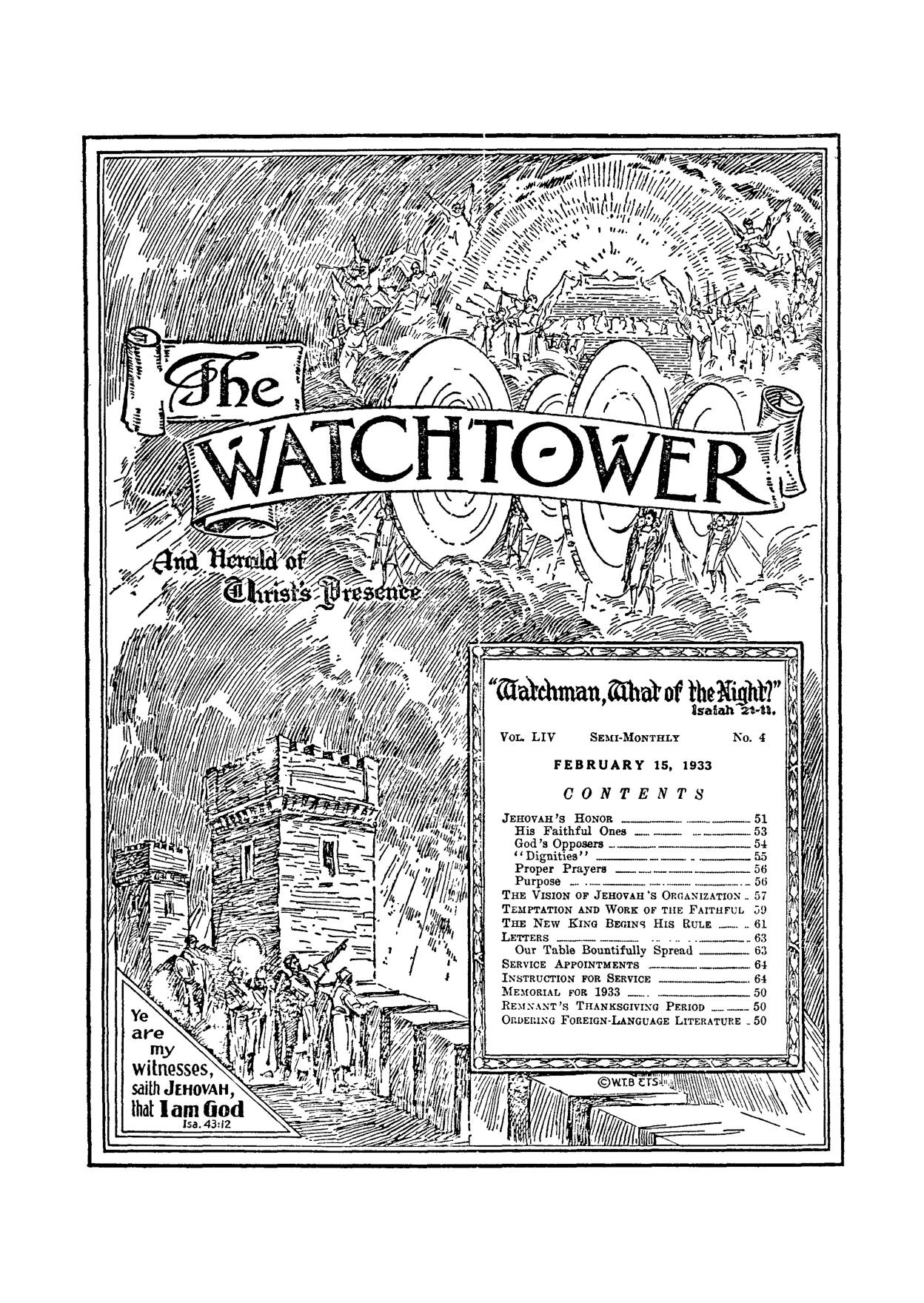
Vol. LIV
February 15, 1933
No. 4
JEHOVAH’S HONOR
“That men may know that thou, whose name alone is JEHOVAH, art the Most High over all the earth.” — Ps. 83:18.
JEHOVAH’S honor is closely related to his faithful people. Jehovah has appointed his servant class to be his witnesses and to declare that he is God. The faithful remnant now on the earth constitute the visible witnesses of Jehovah. Into the mouth of these Jehovah has put his Word and commanded that they go and declare his Word to the people. When he says that he has put his hand over them it must mean that the remnant is threatened with destruction and that Jehovah protects them by his almighty power and so informs them at this time that they may be fully assured of safety. It is reasonable and Scriptural that those who hate Jehovah’s witnesses hate Jehovah in fact and are therefore the enemies of God. Jehovah enlightens his remnant, and in so doing he discloses to them his enemies and at the same time shows the remnant how they are related to the honor of his name. The well-being and preservation of the remnant because of their faithfulness and obedience and devotion to God will have to do with the vindication of his name. It will prove that Jehovah can put creatures on the earth who will be faithful to him under stress and maintain their integrity toward him, and that he preserves those who truly love him.
2 The eighty-third Psalm is a prayer to Jehovah that he will destroy his enemies that his great and honorable name may be known amongst men and that they may- know that he alone is Jehovah the Most High. There is but one class of people now on earth that sincerely and truly try to honor Jehovah's name, and that class is his “faithful servant” class, whom Jehovah has made his witnesses in the earth. The prayer of the eighty-third Psalm was therefore prophetically written as the prayer of the “servant” or remnant, and it is right and proper for them thus to pray, because God has made a record thereof in his Word with approval. When Jesus was on earth he said to his disciples: “Pray for them which despitefully use you, and persecute you.” (Matt. 5:44) Is this statement of Jesus contradictory of the Psalm which put a prayer in the mouth of the remnant, or how may the two scriptures be harmonized ? There are no scriptures in God’s Word that are contradictory. All are in exact harmony. It should be kept in mind also that Jesus said, “Bring hither [mine enemies], and slay them before me.” (Luke 19:27) Also, Jesus quoted with approval the words of the psalmist: “Sit thou on my right hand till I make thine enemies thy footstool.” —Luke 20:42, 43.
3 The apostle admonishes us to rightly divide the Word of truth. The above texts are in exact harmony when applied at the proper time. They prove that the forbearance of God continued until a set time and that then he acts to destroy his enemies. During the period of time which Jesus was commanded to sit on Jehovah’s right hand and wait his true followers must pray for those who despitefully use them. This they have done and have made no attempt to retaliate, having in mind always that Jehovah said: “Vengeance is mine; I will repay.” During the period of waiting above mentioned, by praying for their enemies the followers of Christ have shown themselves in exact harmony with the will of God, to wit, to wait for his due time to execute them. The time of God’s forbearance comes to an end and he sends forth his great Officer, Judge and Executioner to enforce his decree against the enemies, which decree was previously written. It being Jehovah’s due time to take drastic action against his enemies, it is therefore the due time for his faithful witnesses to show that they are in full harmony with his will by praying that he will destroy his enemies and do it now. The faithful remnant do not pray that God will destroy others merely because they have done injury to the remnant, but because these enemies hate God and have lifted up themselves against him. The prayer of the remnant would not hasten the action of Jehovah, and is not made for that purpose, but manifestly for the purpose of showing the complete obedience of the remnant to Jehovah and that they are in harmony with his action as expressed in his Word.
4 Addressed to the followers of Christ Jesus are these words: “Therefore judge nothing before the time, until the Lord come, who both will bring to light the hidden things of darkness, and will make manifest the counsels of the hearts: and then shall every man have praise of God.” (1 Cor. 4:5) This scripture further supports the conclusion that time has much to do with the proper application of Scriptural texts. Until the coming of the Lord Jesus to the temple for judgment his followers are admonished to judge nothing. When he appeared at his temple for judgment together with all his holy angels to serve under his direction, it follows that all who are made members of the temple class must be completely in harmony with him and must have something to do with the judging. (Ps. 149:9) It is therefore the time to judge; and, in harmony with the apostle’s statement to judge nothing before the time, the language of this latter text particularly shows that there must come a time when the remnant have something to do with judgment. The part performed by the remnant is to declare the judgments already written. Members of the remnant have nothing to do with judging individuals. It would not be proper for any of the remnant to single out another and render judgment against that one. The remnant makes announcement of Jehovah’s judgments previously entered of record against those who are the enemies of God. They pray God to carry forward his announced purpose. Let the anointed of the Lord be careful to make no mistake by thinking they have the right to judge individuals.
5 In the Lord’s due time he brought to his people an understanding of the words relating to “the man of sin, . . . the son of perdition”, which is the opponent of God. The eighty-third Psalm appears to be a further support of the Scriptural proof disclosing that monstrous opponent of the Most High. Doubtless Paul was led by the spirit of God to write what appears at 2 Thessalonians two, as a further elucidation of the eighty-third Psalm. The disclosure of the “man of sin” doubtless has the same effect on the class composing that enemy as the words of Jesus had upon Judas, the type thereof, when Jesus said to Judas: “That thou doest, do quickly.” From that time Judas was definitely identified as the instrument of Satan, and he let the Devil take complete possession of him. Since the publication of the truth of and concerning the “man of sin”, clergymen have uttered the most vicious and wicked speech against Jehovah’s witnesses and have used their power and influence to have these witnesses suffer bodily harm. In their wicked work they have been aided and abetted by those who were once enlightened concerning Jehovah’s purposes and who were supposed to be and probably were of the truth, but who are now opposers of Jehovah and his organization. Some of those latter mentioned have recently spoken against Jehovah’s witnesses in the most vicious manner, and this wicked speech has been indulged in because of the faithfulness of Jehovah’s witnesses in proclaiming his great and holy name.
6 The eighty-third Psalm is a prophetic statement of an attempt to destroy God’s covenant people. It had a miniature fulfilment upon the Israelites in the combined attack of Edom, Moab and Mount Seir. (2 Chron. 20) The greater fulfilment is the attack upon the true people of God made by the combined efforts of those who lay claim to being Christians. Clearly the Psalm must have its complete fulfilment in the day when the name of Jehovah is made known to all men, and this is shown definitely by the eighteenth verse of the Psalm. We are now at that time, and the remnant of Jehovah diligently go forward with the work of making known his holy name; and those who oppose such work are the religionists and their open allies, and who are more effectually aided and abetted by that class of persons who once walked side by side with the remnant, and who claim to be of the truth but who have now become opponents of the work that Jehovah is having done in the earth. This they manifest particularly by taking counsel against God’s hidden ones, that is to say, his faithful people.
7 Jehovah’s witnesses made up of the faithful remnant have issued a challenge to the organization of Satan. The clergy and those once in the truth, but who are now opponents, claim that they have the right to speak for Jehovah and that therefore the remnant are presumptuous in claiming to be Jehovah’s witnesses. The opponents enter into a conspiracy to destroy Jehovah’s witnesses. The thirty-eighth chapter of Ezekiel’s prophecy, the explanation of which appears in Vindication Book Two, shows that Gog, the chief officer of Satan, forms a conspiracy against Jehovah’s witnesses and draws others into that conspiracy. By faith in the Word of God, and by the extraneous evidence showing the fulfilment thereof, Jehovah’s witnesses now see that this conspiracy has been formed and that overt acts are being committed in furtherance thereof. “An overt act” means an open or public act done in the furtherance of the wrongful agreement and intent to do injury to Jehovah’s witnesses. Such acts are now in progress in practically every part of the earth which goes to make up the seventh world power. Where a conspiracy is formed by many creatures, and one or more of those creatures act to do injury to Jehovah’s witnesses, such is the act of all the conspirators and makes all guilty before God. While this conspiracy proceeds to execution, apparently God is keeping silent, and the remnant therefore pray: ‘ ‘ Keep not thou silence, O God: hold not thy peace, and be not still, O God. For, lo, thine enemies make a tumult: and they that hate thee have lifted up the head.” (Ps. 83:1, 2) As a coiled serpent raises the head to strike, so now God’s enemies do likewise.
8 The fulfilment of this Psalm is no ordinary occasion when wicked men have attempted to do injury to the followers of Christ. The prophecy relates to the time when there is a challenge of the wicked against God, and this is manifest by the open attack of the wicked against those who openly and vigorously declare the name of Jehovah. It is not merely an attempt to silence Jehovah’s witnesses, but it is a vigorous effort to destroy them. As the psalmist states, the wicked class has “lifted up the head” and arrogantly announces that Jehovah’s witnesses shall be exterminated.
9 As Esther and Mordecai saw the danger threatening them, so now the remnant see the wicked threatening them also. The remnant see their privilege of prayer to God, and the prophet of God puts the proper words in their mouth; and the physical facts and the prophecy exactly agree that this is the day for the fulfilment of it, and hence they pray accordingly for the destruction of the enemies of God. Although God is apparently keeping silent, he is not silent. In another place in his Word he makes known to his people why he is permitting the wicked enemy to pursue the persecution of his faithful witnesses. Jehu was a picture of Christ Jesus. Jehu caused the enemies of God to put on garments or vestments to definitely and clearly identify them as God’s enemies, and when this was done he caused them to be slain. Likewise the Lord Jesus as the great Executive Officer of Jehovah now causes the representatives of Gog and the Devil on earth, and who claim to be worshipers of God and whose claim is false, to fully identify themselves as being against God. This they do by taking action against God’s anointed ones. Expressing their willingness to destroy God’s anointed ones they definitely identify themselves as Jehovah’s enemies; therefore the psalmist says: “They have taken crafty counsel against thy people, and consulted against thy hidden ones.”—Ps. 83: 3.
10 The phrase here used by the prophet, “They have . . . consulted against thy hidden ones,” indicates that some who are in the conspiracy have a very intimate knowledge of Jehovah’s witnesses and the work in which they are engaged. This description fits exactly those who once were of the truth, and then walking with those who now go to make up the remnant. Those who were gathered out when the Lord came to his temple, and who make up the “evil servant” class, have become the open opponents of the remnant who are diligent in serving Jehovah. As Judas was intimate with Christ Jesus before he became the “son of perdition”, so also those composing the class foreshadowed by him were once intimate with the “faithful servant” class. The “evil servant” class now stands at the head of those designated the “man of sin”. What this “wicked servant” class does in secret against the remnant of God will be made known to the remnant by the Lord, because that fact is important to the remnant. The manifest purpose of the publication of the scriptures and facts concerning the “man of sin” is that the remnant may be forewarned and be watchful and always have in mind the place of safety or security.
HIS FAITHFUL ONES
11 The eighty-third Psalm could not have its complete fulfilment until the coming of the Lord Jesus to the temple of Jehovah. Prior to that time the consecrated were merely units, known only to Jehovah and the Lord Jesus Christ. With the coming of the Lord to the temple, and the gathering together of the saints, the faithful are made one unit. This was done in obedience to Jehovah’s order. (2 Thess. 2:1; Ps. 50:5) The reason for this gathering appears to be this: (1) That Jehovah would bring his own into unity so that they could be dealt with as one; (2) that he would have a people for his name who must be his witnesses; and (3) that he would make manifest his faithful servant class to the rulers on earth and by so doing demonstrate his power to produce a people on earth that would be faithful to him under severe tests and thus maintain their integrity toward him. This people known as the remnant must be his champions in the day of battle and hence the true David class on earth that is openly opposed to the monster “man of sin”. The judgment and separating work of Christ Jesus took place when he came to the temple, and the “evil servant” class was then formed. Christ Jesus forms his “faithful and wise servant” class into a unit and commits to that servant his work on earth. There is a definite opposition on both sides. The two seeds are the battle lines. Jehovah will now have creatures on the earth who will boldly stand forth before the rulers and the people and declare the name and the honor of the Most High. This fact angers those who have been unfaithful, and they take counsel together with others to bring about the downfall of these witnesses of Jehovah; and hence they are the open enemies against God.
12 The Psalm makes known who compose this crowd of conspirators. Of those mentioned are Edom, Ishmaelites, Moab, and the Hagarenes, and Ammon, all of whom were kinsmen of the Israelites. According to the best authorities the Gebalites were also relatives of Israel. The others mentioned, except Assur (Assyria), were in the land of Palestine before the Israelites went there. Assur (or Assyria) was an outsider called into the unlawful combination. The near relatives mentioned well picture those who were once of the truth. The others mentioned in the Psalm well picture the elements that make up the so-called “organized Christianity” which opposes those who boldly proclaim the name of Jehovah. The avowed purpose of the combine is to cut them (the remnant who claim to be and are now a nation) off from being a nation. (Ps. 83:4) The conspirators say: “Let us take to ourselves the houses of God in possession. ” (Ps. 83:12) In effect the conspirators say: “We will set up the kingdom for ourselves, and we will rule the world.” At the head of these conspirators is Gog, and back of him is the subtle and wicked Satan who says: ‘The world is mine; I have made it for myself.’ The conspiracy and all the conspirators are anti-Jehovah and against his kingdom. They are therefore against Jehovah’s witnesses. Jehovah says to the enemy; “I am against you.” Therefore the issue is squarely drawn, and the day of battle is near.
13 Jehovah’s faithful ones see the line of battle, and they are eager for the fray and for the victory which they know is certain to be given to Jehovah’s great Executive Officer. The remnant know that they are in great danger; but they do not limit their prayers and supplications for their own safety, but they pray for the war to begin and to be carried to the limit of complete victory in the destruction of the enemy for the honor of Jehovah’s name. They know that the destruction of the enemy must take place. The remnant are moved by the spirit of righteous indignation against all who oppose Jehovah God, and hence pray for the annihilation of the enemy that all may know that Jehovah alone is supreme. A failure or refusal to thus pray would prove that they were not loyal to God. The remnant, therefore, do not hesitate to utter the prayer set out for them by the words of Jehovah’s prophet. They pray for the complete destruction of the wicked that all who desire righteousness and life may see that Jehovah is the righteous one and the Giver of life. While they thus pray they work in harmony therewith by diligently hurrying from place to place to tell others that Jehovah is God and that the kingdom is here and that the kingdom is the hope of mankind.
GOD’S OPPOSERS
14 What constitutes a willful opposer of God? One who has learned of God and his kingdom under Christ and who then willfully refuses to obey God’s orders or commandments. It was first thought that the only way to commit the sin unto death was and is by repudiating the ransom sacrifice. Without a question of doubt one who first believes in the blood of Christ Jesus as the ransom sacrifice, and who enters into a covenant with Jehovah, and who then renounces the blood of Christ as the purchase price of man, thereby for ever deprives himself of life. The greatest part of the sin, however, is the willful transgression against the will of God, and hence that is the sin unto death. It is an insult to God and a repudiation of God’s provision. There are other ways of committing the sin unto death than by denying the ransom. There are at least three separate and distinct ways of committing the sin unto death marked out in this scripture: “Woe unto them! for they have gone in the way of Cain, and ran greedily after the error of Balaam for reward, and perished in the gainsaying of Core.” (Jude 11) It is those who have claimed to be in Christ and who have associated with his faithful followers of whom mention is made here as ‘‘spots in your feasts”. Concerning such the scripture reads: ‘‘These are spots in your feasts of charity, when they feast with you, feeding themselves without fear; clouds they are without water, carried about of winds; trees whose fruit withereth, without fruit, twice dead, plucked up by the roots; raging waves of the sea, foaming out their own shame; wandering stars, to whom is reserved the blackness of darkness for ever.”—Jude 12,13.
15 The sin of Cain was presumptuous before God. His offering was the fruits of the ground that caused him no sacrifice. No blood was with his sacrifice acknowledging that the sentence of death upon man was just and that there could be atonement only by the sacrifice of another life. Cain’s offering had no acknowledgment from God, and Cain was therefore offended and turned away from God and to wickedness. He well pictures those who outwardly acknowledge Jehovah God and who are willing to give God of their material substance but who will not acknowledge that Jehovah God’s judgment against man is just and that the death of Christ Jesus was and is the only means of salvation. Rather than show their belief in this great truth they turn away from God and ally themselves with the Devil’s organization.
16 Balaam does not picture those who take issue on the great doctrine of the ransom sacrifice. With Balaam the man it was, How much can I gain for myself? He had knowledge of God and professed to be a true worshiper of God, but, of course, was not. He prayed to God, but he did not want to do the will of God; and his prayers were not answered. He was willing to use the name of Jehovah for his own personal gain. Balaam, therefore, well pictures that class of men who have made the so-called “Christian ministry” a mere profession by the means of which they could earn a livelihood and gain fame and reputation amongst men. These have knowledge of the texts of the Scriptures, but refuse to truly believe or to obey them. They also willingly use the name of God and of Christ for personal gain. This class is not entirely confined to the clergy, by any means, but includes those who have been favored with a knowledge of God’s truth since the manifestation of Christ Jesus’ second presence, and who have used that knowledge for personal gain. The gain sought has not been money or pecuniary profit, but the honor and plaudits of other creatures, that they might shine above their fellows and that they might even be regarded by the world as superior creatures. These commit the sin unto death because they are disobedient to God’s orders or Word by turning to the world and seeking the approval of men after having been taught better.
17 The Old Testament record is that Co're (or Korah) led a rebellion against God’s order or commandment. (Num. 16:1-35) Jehovah organized Israel according to his own will and directed Moses and Aaron what to do, and they did his commandments. Korah challenged that arrangement, claiming that he had a right to perform certain things; and he therefore put himself against God. Korah and his allies professed to be the safeguards of the liberties of Israel by insisting that God’s work be done in a different manner from what the Lord God had pointed out. By taking issue with Moses and Aaron, Korah and his allies put themselves openly against God, who had made the order. Jehovah destroyed these rebels.
18 These three names mentioned by Jude, to wit, Cain, Balaam and Co're (Korah), who were great sinners before God, prove that the sin unto death is committed by those who willingly disobey the commandments of God, and by putting themselves in opposition to God they make themselves his enemies. They join Satan and must suffer the same fate that Satan will suffer. God’s prophet defines rebellion when he says: “For rebellion is as the sin of witchcraft, and stubbornness is as iniquity and idolatry.” (1 Sam. 15:23) Those who willingly, that is to say, knowingly, go contrary to God’s orders, are guilty of rebellion.
“DIGNITIES”
19 The scripture written by Jude further shows that it is willful disobedience to Jehovah’s orders or commandments that leads to destruction, when he says: “These . . . despise dominion, and speak evil of dignities. ’ ’ Concerning the same class Peter says, ‘ ‘ They are not afraid to speak evil of dignities.” (2 Pet. 2:10) No man properly takes honor or dignity to himself. (Heb. 5:4) Jehovah has declared his purpose to give his specific honor or dignity to his ‘ ‘ servant”. (Isa. 42: 8) Nor does it appear from the Scriptures that Jehovah gives honor to individuals aside from his beloved Son. While Jude and Peter used the word ‘dignities’ in connection with creatures, yet it is manifest that the reference is to the office filled by creatures, and not to the creatures themselves as such. The “faithful and wise servant” class on the earth is counted a part of the ‘elect servant’ of Jehovah. It is that “servant” to whom Jehovah gives honor and glory and which therefore as such “servant” is a dignity. Evil speech against Jehovah’s “servant” is therefore speaking against God, because against God’s honored one. The “evil servant” class has no hesitancy in speaking against God’s “faithful servant” class on earth that is proclaiming his name. Jehovah anoints his “servant”; which means that he places the “servant” in an important office and puts his spirit upon his “servant” in a double measure. The “servant” is thus equipped for service of Jehovah, and hence occupies an honorable place in Jehovah’s great organization because he is under Christ and a part of The Christ. Those who are the enemies of Jehovah’s “servant” are therefore God’s enemies.
20 The sin committed by Korah is in a class all by itself, because rebellion is there magnified. It is not connected with doctrine. It is an open rebellion against God’s orders. It is like the sin committed by Lucifer when he challenged God’s order concerning His work and His purposes. It is a presumptuous sin, and hence a sin unto death. That sin is conceived in selfishness, and “when it is finished, [it] bringeth forth death”. (Jas. 1:15) If it is true that Jehovah has a visible part of his organization on earth which he has commissioned to carry on his work, then opposition to that “servant” means opposition to God, because the servant is God’s instrument. The question is not whether the person or persons in that organization are pleasing and acceptable to other creatures. The sole and determining matter is this: Is that arrangement of the Lord? The creatures may be entirely ignored, but no one can willingly ignore God’s orders with impunity.
21 The Apostle John, addressing the church, says that one should pray for his brother who is at fault, provided the sin committed by that brother is not the sin unto death, and then adds: ‘ ‘ There is a sin unto death; I do not say that [you should] pray for it.” (1 John 5:16) Ezekiel’s wife was taken away by sudden death, and God said to Ezekiel: “Neither shall thy tears run down.” (Ezek. 24:16-18) The wife of Ezekiel appears clearly to have been used to illustrate the result to those who are unfaithful to their covenant with God through Christ Jesus, who is the Head of the church. The lesson there to be gained is that when one becomes unfaithful to God and turns against God’s organization those who remain faithful and true to the Lord God are not to weep or mourn nor to regret the loss of the companionship of the wrongdoers. The judgments of Jehovah are just and right, and all who have his spirit are in full accord with the justice thereof. For this reason it would be wrong for the faithful to pray for the recovery of those who have become unfaithful and have openly rebelled against God’s order or commandment. It is concerning this class that the apostle says: “ I do not say that [you] shall pray for it.” What, then, is the proper course of those who are diligently striving to serve God toward those who have become unfaithful and made themselves the enemies of God and his organization? The Scriptural answer in substance is: Do not take them into consideration at all. Do not pray for them or even think of them. “Avoid them. For they that are such serve not our Lord Jesus Christ, but their own belly; and by good words and fair speeches [deceitful speech] deceive the hearts of the simple.” —Rom. 16:17,18.
22 Nor is it necessary that one be brought forth as a spiritual son of God in order to commit the sin unto death. He who receives some enlightenment concerning Jehovah and his beloved Son the Redeemer of man knows what is right and what is wrong. If, possessing such knowledge, that creature then willfully, that is to say, knowingly and intentionally, persecutes or opposes the brethren of the Lord Jesus Christ, because they are proclaiming the truth of Jehovah’s kingdom, the deeds of that creature are wrong and done against the Lord. Jesus laid down this rule, which rule he declared would be enforced when he appeared at the temple for judgment, when he said that the doing of wrong to the least of his brethren was doing it unto him. Concerning the punishment of such wrongdoers he further stated: “And these shall go away into everlasting punishment.” —Matt. 25:42-46.
PROPER PRAYERS
23 The prayers of the servant of God should always be in exact harmony with the expressed will of God. The will of God is ascertained by gaining an understanding of his Word. His expressed will toward his creatures is that from the beginning of the church until the coming of the Lord Jesus to his temple the followers of Christ Jesus should pray for those who ill-treated them, but leave their punishment entirely to the Lord. When the Lord appeared at his temple for judgment he there began the gathering unto himself of the faithful, and those gathered into the temple are first judged; and then the approved are given a part in making the announcement of Jehovah’s judgments previously written. The time having come for judgment, these faithful ones judge against God’s enemies who are in rebellion against Jehovah, and this they do by praying to God and by announcing his judgments to others. If some who have been near and dear to one of the faithful become unfaithful, the faithful one is not to pray for such, but to avoid them. Concerning those who form the “evil servant” class, “the man of sin,” “the son of perdition,” such are the open enemies of God; and the prophet puts the proper prayer into the mouth of God’s anointed, as set forth in the eighty-third Psalm. Those who oppose the witness work being done by Jehovah’s witnesses are therefore opponents of God. These have openly rebelled against God, his orders and commandments; and his judgment concerning such is already written, and the faithful pray in harmony with that judgment.
PURPOSE
24 The prayer of the faithful is not that the enemies be destroyed to satisfy some personal feeling of the creature against them. The whole matter reverts to the great issue before all creation, to wit, Who is the Most High? Long ago Satan raised that issue, and now it must be settled because it is God’s due time. Knowing this fact the faithful witnesses of Jehovah pray for the execution of his judgment, and the purpose is stated by the psalmist, to wit: “That men may know that thou, whose name alone is JEHOVAH, art the Most High over all the earth. ’ ’—Ps. 83:18.
25 Jehovah will not destroy his enemies to gratify a grudge, as many men have taught. The Devil has instilled that wrongful conclusion into the minds of men. All of Jehovah’s judgments are just and right, and in him there is no unrighteousness at all. (Ps. 19:9) He will destroy all his enemies for the best interests of righteousness, because the universe could not be clean until they are gone. The wicked would never go voluntarily; therefore God must destroy them. Long ago he set the time to do this work, and now his time has come and he has sent forth Christ Jesus to take action. The Lord Jesus Christ is the “right hand” of Jehovah, meaning that he is the Chief One whom Jehovah uses to carry out his purpose. Therefore says the psalmist: ‘ ‘ Thine hand shall find out all thine enemies: thy right hand shall find out those that hate thee. Thou shalt make them as a fiery oven in the time of thine anger: the Lord shall swallow them up in his wrath, and the fire shall devour them. Their fruit shalt thou destroy from the earth, and their seed from among the children of men. For they intended evil against thee; they imagined a mischievous device, which they are not able to perform. Therefore shalt thou make them turn their back, when thou shalt make ready thine arrows upon thy strings against the face of them.” (Ps. 21: 8-12) The remnant, by faith now seeing that this great work of execution by the Lord will shortly be accomplished, in harmony therewith sing, at Psalm 21:13: “Be thou exalted, Lord, in thine own strength: so will we sing and praise thy power.”
26 It is the name of Jehovah that must now be exalted and placed where it belongs, that all may know who is supreme. Therefore the safety of the remnant could be nowhere else than in the name of Jehovah. For the remnant to now fail or refuse to proclaim the great name of Jehovah would mean that they would lose all protection and quickly fall at the hands of the enemy. Jehovah God is the true Friend of his “servant” class, and the “servant” class must remain true and steadfast to Jehovah if the “servant” would live. The Lord graciously points the “servant” to the right way and says for his benefit: ‘The name of Jehovah is a strong tower; it is your place of protection.’ The enemies of Jehovah hate his witnesses and conspire to destroy the witnesses, and the witnesses know that they are in danger. But, knowing that Jehovah is for them, they have no fear of the enemy. They confidently rely on Jehovah and in harmony with his will pray that he will proceed to the execution of his enemies in the vindication OF HIS NAME. The “servant” class champion the cause of Jehovah in this day of his judgment and boldly sing forth his praises. Men cannot manifest their open defiance of God, because he is invisible; but they can and do show their malicious hatred against those who are proclaiming Jehovah’s message of truth, and hence by so doing they are manifesting themselves as enemies of God and against his kingdom. All who do not honor the name of Jehovah will suffer at Armageddon. The “servant” class must now take the lead amongst men and point the people to the name of Jehovah, that they may see the way to life.—Isa. 62:10.
27 There are a number of the Psalms that tell of God’s wrath being visited upon the enemy and hence are called “cursing psalms”, and these have received much harsh criticism from critics of the Bible. Manifestly the time of the application and fulfilment of such prophetic utterances of the Lord is in the day of his judgment, when he will destroy all who ally themselves with Satan and his organization. Rightly dividing the Word of truth and applying it at God’s proper time enables the student to see that every part of God’s Word is harmonious with every other part, and that it is all truth and righteousness, and gives honor to his great name.
28 All shall know that Jehovah is the Most High over all things, and “blessed are all they that put their trust in him”. (Ps. 2:12) “And they that know thy name will put their trust in thee; for thou, Lord, hast not forsaken them that seek thee.” (Ps. 9:10) “They that trust in the Lord shall be as mount Zion, which cannot be removed, but abideth for ever.” (Ps. 125:1) “Trust ye in the Lord for ever; for in the Lord JEHOVAH is everlasting strength.”—Isa. 26:4.
QUESTIONS FOR BEREAN STUDY
1. Describe Jehovah’s dealing with his faithful people as indicating that they are closely related to the honor of his name and that their maintaining their integrity has to do with the vindication of his name.
2,3. Of what does the eighty-third Psalm consist! How does this indicate its application? Prove that it is in harmony with Matthew 5: 44.
4. Show that the element of time is important in the consideration and proper application of Scriptural texts. The remnant have what to do with the judgment here prophetically declared? What important distinction must here be observed?
5. What is evidently the connection between Psalm 83 and Second Thessalonians two? What are the facts which indicate that John 13: 27 is now being fulfilled?
6, 7. Show that Psalm 83 is a prophetic statement. Point out its miniature fulfilment. What is the evidence that its greater fulfilment is now taking place?
8,9. What is the occasion referred to in verse 2 which calls for the entreaty of verse 1? How may it be known that this prayer is now due? What are the purposes served in Jehovah’s permitting the present persecution of his faithful witnesses?
10. Apply the prophetic statement, “They have . . . consulted against thy hidden ones. ’ ’ What is manifestly God’s purpose in now revealing the “man of sin’’?
11. Why could this Psalm not have its complete fulfilment prior to the Lord’s coming to the temple? What appears to be the reason for the Lord’s then gathering his saints together unto him? What was the result of the judgment or separating work which there took place? What definite position is taken by each class there formed?
12. What present situation was pictured in the fact that there were those who were relatives of Israel but who conspired to “cut them off from being a nation’’ and to 'take to themselves the houses of God in possession’?
13. How do the remnant regard the impending conflict? For what do they pray? Why? Show that their course of action is in harmony with their prayer.
14. What constitutes a willful opposer of God? What is meant by repudiating the ransom? In what does the greater part of such sin consist? What is the result of such sin? Point out at least three other ways of committing the sin unto death than by denying the ransom. Of whom is Jude 11 written? What is said of them in Jude 12, 13?
15-18. Explain how, of an unfaithful class now manifested, (a) some “have gone in the way of Cain’’. (b) Some 'have run after the error of Balaam for reward’. (c) Some ‘will have perished in the gainsaying of Core’.
19, 20. What is the meaning and the application of the apostle’s statement, “These . . . despise dominion, and speak evil of dignities’’? Why is the sin committed by Korah a sin unto death?
21. What lesson for the faithful is contained in 1 John 5: 16 and Ezekiel 24: 16-18? What course, then, should the faithful take toward those who have become unfaithful and made themselves enemies of God and his organization?
22. Explain whether only the spirit-begotten can commit the sin unto death.
23. Show that the prayer set forth in Psalm 83 is in harmony with Jesus’ instruction to his followers to pray for those who have ill-treated them.
24. Point out, with scripture, the reason which makes right the prayer of the faithful that the enemies be destroyed.
25. Why will Jehovah destroy his enemies? Account for his not having done this work in the past.
26. Why is the name of Jehovah now “a strong tower’’ and the only place of protection for the remnant? Why does the enemy’s defiance of God find expression in a manifest hatred against those who are proclaiming Jehovah’s message of truth?
27. How only will the student of God’s Word be enabled to see the complete harmony thereof as a whole? In what respect is this particularly true in regard to the Psalms?
28. What do the Scriptures say of those who know the name of Jehovah and who put their trust in him?
THE VISION OF JEHOVAH’S ORGANIZATION
JEHOVAH God has always had an organization, and from time immemorial his only begotten Son, the Logos or Word of God, was the chief officer of Jehovah’s organization. Because of the rebellion of Lucifer (now Satan) and the resulting fall of man, God in his due time made the Logos a man upon our earth. At the time of his baptism at the Jordan river, there began what the Scriptures call the “new creation” of God, which “new creation” he will use, especially in dealing with mankind in reconciling the world to himself. The Logos, or Jesus Christ, was put to the test and proved faithful and true, and was exalted from the earth to the highest place in heaven and was again made the Head of God’s organization for ever. And this was in fulfilment of prophecy, such as that of Psalm one hundred and ten, verse four, which reads: “The Lord [Jehovah] hath sworn [to Jesus] and will not repent, Thou art a priest for ever after the order of Melchizedek. ’ ’ Also, Hebrews, chapter seven, verse seventeen, reads to the same effect.
“Typical” means being or having significance as a prophetic picture, foreshadowing something real and larger to come in the future. God organized typical Zion in the land of Palestine, and it was prophetic of the coming of the real Zion. Later, with Christ Jesus as the Head thereof, God organized the real Zion, which is therefore God’s organization real. The faithful followers of Christ Jesus, built up in Zion and made a part thereof, form that part of God’s organization which will carry out Jehovah’s purposes concerning man. The Lord Jesus, as God’s executive officer, prepares a place for his faithful followers in the organization, even as he told his disciples shortly before his death, saying: “I go to prepare a place for you. And if I go and prepare a place for you, I will come again, and receive you unto myself; that where I am, there ye may be also.”—John 14: 2, 3.
God’s prophet Ezekiel was given a vision, the description of which the prophet records in the first chapter of his book. Ezekiel was a young man, wholly devoted to God, and was used by Jehovah as prophet to write prophecy for the benefit of those “upon whom the ends of the world are come ’ ’. So the Apostle Paul states. (1 Cor. 10: 11) In that vision there appeared four living creatures, every one of which had four faces and four wings. The prophecy describes them, saying: “Thus were their faces; and their wings were stretched upward; two wings of every one were joined one to another, and two covered their bodies. And they went every one straight forward: whither the spirit was to go, they went; and they turned not when they went. As for the likeness of the living creatures, their appearance was like burning coals of fire, and like the appearance of lamps; it went up and down among the living creatures; and the fire was bright, and out of the fire went forth lightning. And the living creatures ran and returned as the appearance of a flash of lightning.”—Ezek. 1: 11-14.
In the vision Ezekiel saw also four wheels of one likeness, the four of them being placed with respect to one another like the four wheels of a chariot-wagon. The prophet goes on to say: “Now as I beheld the living creatures, behold one wheel upon the earth by the living creatures, with his four faces. The appearance of the wheels and their work was like unto the colour of a beryl: and they four [wheels] had one likeness: and their appearance and their work was as it were a wheel in the middle of a wheel. When they went, they went upon their four sides; and they turned not when they went. As for their rings, they were so high that they were dreadful; and their rings [or, rims or circumferences] were full of eyes round about them four. And when the living creatures went, the wheels went by them: and when the living creatures were lifted up from the earth, the wheels were lifted up. Whithersoever the spirit was to go, they went, thither was their spirit to go; and the wheels were lifted up over against them: for the spirit of the living creature was in the wheels. When those went, these went; and when those stood, these stood; and when those were lifted up from the earth, the wheels were lifted up over against them; for the spirit of the living creature was in the wheels. And the likeness of the firmament [or, expanse] upon [or, above] the heads of the living creature was as the colour of the terrible crystal, stretched forth over their heads above. And under the firmament were their wings straight, the one toward the other: every one [of the living creatures] had two [wings], which covered on this side, and every one had two, which covered on that side, their bodies. And when they went, I heard the noise of their wings, like the noise of great waters, as the voice of the Almighty, the voice of speech, as the noise of an host: when they stood, they let down their wings. And there was a voice from the firmament that was over their heads, when they stood, and had let down their wings.”— Ezek. 1: 15-25.
Then the prophet beheld in the vision a firmament, and above the firmament and above everything animate and inanimate there appeared the likeness of a throne upon which a glorious person sat enshrined in perfect light. Ezekiel (1: 26-28) says: “And above the firmament that was over their heads was the likeness of a throne, as the appearance of a sapphire stone; and upon the likeness of the throne was the likeness as the appearance of a man above upon it. And I saw as the colour of amber, as the appearance of fire round about within it, from the appearance of his loins even upward, and from the appearance of his loins even downward, I saw as it were the appearance of fire, and it had brightness round about. As the appearance of the [rain]bow that is in the cloud in the day of rain, so was the appearance of the brightness round about. This was the appearance of the likeness of the glory of the Lord. And when I saw it, I fell upon my face, and I heard a voice of one that spake.” That one was Jehovah God.
“Four” is a divine number representing completeness. The vision, in picturing that which is marked by the number four twice, speaks prophetically therefore of something complete. It is a vision or prophecy to have fulfilment in due time. The living creatures and the inanimate objects, or instruments (the wheels), appearing in the vision, together give the appearance of an enormous living chariot-like organization, extending high into the heavens, and over all of which Jehovah God presides. In that organization, and appearing next to Jehovah, is his great High Priest and Executive Officer, Christ Jesus. With him in heaven, and forming a part of the great living organization, are those faithful followers of Jesus, including the apostles, who died and for whom the Lord prepared a place in God’s organization, and who had their resurrection and were put in their places when the Lord Jesus came to his temple in nineteen hundred and eighteen.
There appear in the organization living creatures, or cherubim, who are executive officers of Jehovah and therefore members of the organization. Then appear legions of pure and mighty angels who have their places in the organization and perform their respective duties. Down on the earth is what the Scriptures speak of as God’s “remnant”. This remnant constitutes what the Prophet Isaiah describes as “the feet of him”, which means the last members on earth of the body of Christ, for whom the Lord has prepared a place to stand and to walk about in God’s organization; and these on earth do what the Lord has for them to do, and they are a part of his organization.
As represented by the symbols in Ezekiel’s vision, particularly by the rims of the wheels’ being full of eyes round about, the entire organization of God revolves within a circlet of divine wisdom and is directed by the perfect wisdom that is from heaven above. The vision, therefore, speaks prophetically of God’s perfect and mighty organization. The prophet says that in the vision “out of the fire went forth lightning”. That must mean that Jehovah sends forth his truth through his organization, and that the lightning represents the illumination of that truth which comes from Jehovah. The vision is a prophecy; and it is now in course of fulfilment, because the organization is functioning since the Lord came to his temple.
Those creatures on the earth who are members of God’s organization are small in number and are surrounded on every side by the enemy and his agencies. They are God’s remnant. They need have no fear, however, and they do not fear. They love Jehovah with a perfect love, and perfect love casteth out fear. (1 John 4: 18) For their encouragement the Lord caused his prophet to write, saying: “Unto thee, O Lord, do I lift up my soul. O my God, I trust in thee: let me not be ashamed, let not mine enemies triumph over me.”—Ps. 25: 1, 2.
Because of their complete devotion to the Lord they will never again, as the prophecy (Isa. 30: 20) assures, ‘see their teachers [who are Jehovah God and Jesus Christ] removed into a corner’; but their eyes shall see these rightful Teachers of God’s true church given their proper place of authority in their midst. They are fearless, because Jehovah declares in his Word (Isa. 51: 16) that he has put his hand over them, which is their protection. Jehovah God has brought them into his royal house, and, they being in “the secret place of the Most High”, he says to them: “Thou shalt not be afraid for the terror by night; nor for the arrow that flieth by day.”—Ps. 91: 5.
The prophetic vision of Ezekiel, and the fulfilment thereof, shows the faithful saints, such as the Apostle Paul, now resurrected and assigned to their places in God’s organization in heaven. Those who compose the faithful remnant on earth must have their resurrection change before they can enter a like glorious place in the invisible part of God’s organization. That change comes about through death, because these, the remnant, are in the covenant with God by sacrifice. (Ps. 50: 5) As long as they are faithful these have no fear of death, because Jesus uttered a prophecy that has its fulfilment from and after the time that the Lord builds up Zion, saying, “Blessed are the dead which die in the Lord from henceforth: Yea, saith the spirit, that they may rest from their labours, and their works do follow them.”—Rev. 14: 13.
Such faithful ones are in the Lord and in the earthly part of God’s organization now; and, there continuing until the time of their resurrection, their change will come “in a moment, in the twinkling of an eye”. (1 Cor. 15: 51, 52) To such the Lord Jesus now says: “Be thou faithful unto death, and I will give thee a crown of life.” (Rev. 2: 10) Blessed, therefore, is the man who today has the testimony of Jesus Christ that he is of God’s organization, and who appreciates the great privilege of performing the part assigned to him in that organization.
TEMPTATION AND PUBLIC WORK OF THE FAITHFUL
“FAITHFUL and True! ’ ’ That title has been conferred by the Most High God Jehovah upon the most beloved and worthy of his heavenly sons, Christ Jesus. Faithful and true to God during all the ages of his existence up in heaven before ever he became a man, Jesus specially manifested the faithful and true qualities while down here on our earth as a man; and it is since this his earthly demonstration of devotion to God his heavenly Father that Jesus has been honored with the grand and honorable title of “Faithful and True”. Immediately after his baptism in the Jordan river, Jesus withdrew into the solitude of the wilderness, there to study over the Word of God and to determine upon the will of God as the holy spirit now began to make it clear to his inquiring mind.—Mark 1: 12,13.
Satan was egotistical enough to believe that he could induce Jesus to be unfaithful to Jehovah and thereby bring about Jesus’ self-destruction. Jesus had now been forty days and nights in the barren mountain without food and, of course, would be hungry at the end of that long fast. Satan seized the opportunity to present to him a temptation, appealing to his fleshly wants and needs, which temptation on the face of it seemed innocent; and yet, if yielded to, Satan knew it would lead to the death of Jesus. He said to Jesus: “If thou be the Son of God, command that these stones be made bread.” (Matt. 4: 3) He thought of course that Jesus would say: I will make myself some bread and satisfy my hunger.
Doubtless Jesus possessed the power to change the stones into bread and by that means to satisfy his hunger. The argument might be presented: What harm will result to anyone from making bread of these stones? The answer is, God had not commanded him to do so. It was the will of God that Jesus should be governed by God’s expressed will, and should await the Father’s due time to direct him in what course he should take. Being faithful to the Father, Jesus refused to yield to this temptation, and responded to
Satan: “It is written, Man shall not live by bread alone, but by every word that proceedeth out of the mouth of God.” (Matt. 4: 4) Otherwise stated, bread may be needed for the natural requirements of the body, but such will not sustain life except temporarily. Life is a gift from God, and he who possesses life must abide by the word that proceeds from the mouth of God.
Then the Devil tried another method. He knew that Jesus was born to be king of the Jews. Addressing the Son of God, the Devil said: “If thou be the Son of God, cast thyself down [from the pinnacle of the temple in Jerusalem]: for it is written, He shall give his angels charge concerning thee: and in their hands they shall bear thee up, lest at any time thou dash thy foot against a stone.” (Matt. 4: 6) To paraphrase Satan’s words, he said to Jesus something like this:
‘You have come for the purpose of setting up a kingdom, to be king of the Jews. You are going about it in a poor way. Your conduct is that of a meek and lowly one of heart. By pursuing this course you will have great difficulty in convincing the people that you are king. There is a lot of rich men in this country, and there are associated with them scheming politicians; and of course the priests are with them, likewise the scribes and Pharisees. They are men of great influence, to whom the people look for advice. Before you can accomplish anything you will have to do something to overshadow their greatness and thereby convince the people that you are sent from heaven. Why not demonstrate to them that you are sent of God? No man has ever gone upon that temple spire and jumped off. You go up now to the top of the temple and jump down into the valley below. You being the Son of God, your Father will see to it that you are not injured; and then the people will say, Surely you are sent from God and are not a man; and they will make you king immediately. In proof of what I say, that God will not let you be injured, it is written that he shall give his angels charge concerning you and in their hands they shall bear you up lest at any time you dash your foot against a stone. ’ —Ps. 91:11.
This was a subtle and wily temptation, but it did not induce the Lord Jesus to be disloyal to God. For the Lord Jesus to yield to this would be to tempt his Father. Even though he might know that his Father would not permit him to be injured under such circumstances, yet it would be wrong for him to put the Father to this test. Therefore Jesus replied to Satan: “It is written again, Thou shalt not tempt the Lord thy God.” (Matt. 4: 7) Again the Devil had failed.
And now Satan must try one more scheme to see if he could not accomplish his purposes. God had made Lucifer the overlord of the world at the time of the creation of the first man, Adam; and when Lucifer rebelled against God and thereby became Satan, this commission as overlord had not been taken away from him. At the time of the temptation of Jesus Satan was the god of the whole world. The Apostle Paul so states in his second letter to the Corinthians (4: 4). Jesus always recognized Satan as “the prince of this world”, and did not deny his title. (John 12: 31) And now Satan laid before Jesus a subtle temptation. To paraphrase his language, Satan said: ‘All the kingdoms of this world are mine and all the glory of them. You recognize that I am the prince and ruler of this world. You have come for the purpose of being king. In order for you to be king of the world you will have to oust me. But I will surrender to you now. I will give you all the kingdoms of this world; and I will ask but one thing of you, and that is: If you will fall down and worship me.’— Matt. 4: 8, 9.
At that time Satan again manifested his insatiable desire to be worshiped. He knew, also, that if the Lord Jesus should worship him for one minute, then Jehovah God would take away from Jesus all his rights and privileges. Yet Satan was egotistical enough and presumptuous enough to believe that he could induce Jesus to take that course. He was maliciously bent on Jesus’ destruction. The reply of Jesus showed his utter contempt of the tempter and the temptation. He said: “Get thee hence, Satan: for it is written, Thou shalt worship the Lord thy God, and him only shalt thou serve.” (Matt. 4: 10) Here was positive testimony that every creature in the universe at some time must choose between the worship of God and the worship of wickedness, and that in God’s due time sufficient knowledge will be brought to every man that he will have an opportunity thus to choose. Satan had failed in this temptation. The Lord Jesus had won the victory; and it is written: “Then the devil leaveth him.”
Jesus began his ministry by preaching “The kingdom of heaven is at hand”. (Matt. 4: 17) Seeing that nearly nineteen hundred years have passed since he uttered these words and that there is wickedness yet on the earth, what could Jesus have meant by those words? The term “kingdom” primarily means the governing factors authorized to rule. When, in the year six hundred and six before Christ, God overthrew Zedekiah, the last king of Israel, he said: “I will overturn it, . . . until he come whose right it is; and I will give it him.” (Ezek. 21:27) Now with the anointing of Jesus at the time of his proving faithful under the severe temptations in the wilderness he received the right to rule. Therefore he had come whose right it is. There was delegated to him the authority to be King; hence he could say with authority: “The kingdom of heaven is at hand.” The royal One, the King, who shall in due time exercise his regal authority, was present. It was not necessary for him to begin his reign at that time in order to make the afore-quoted statement true. It was the will of God that he should possess this right for a long period of time before he should actually begin to exercise his authority as king. This right, as the Scriptures show, he began to exercise nearly nineteen hundred years later, namely, in the year nineteen fourteen.
…