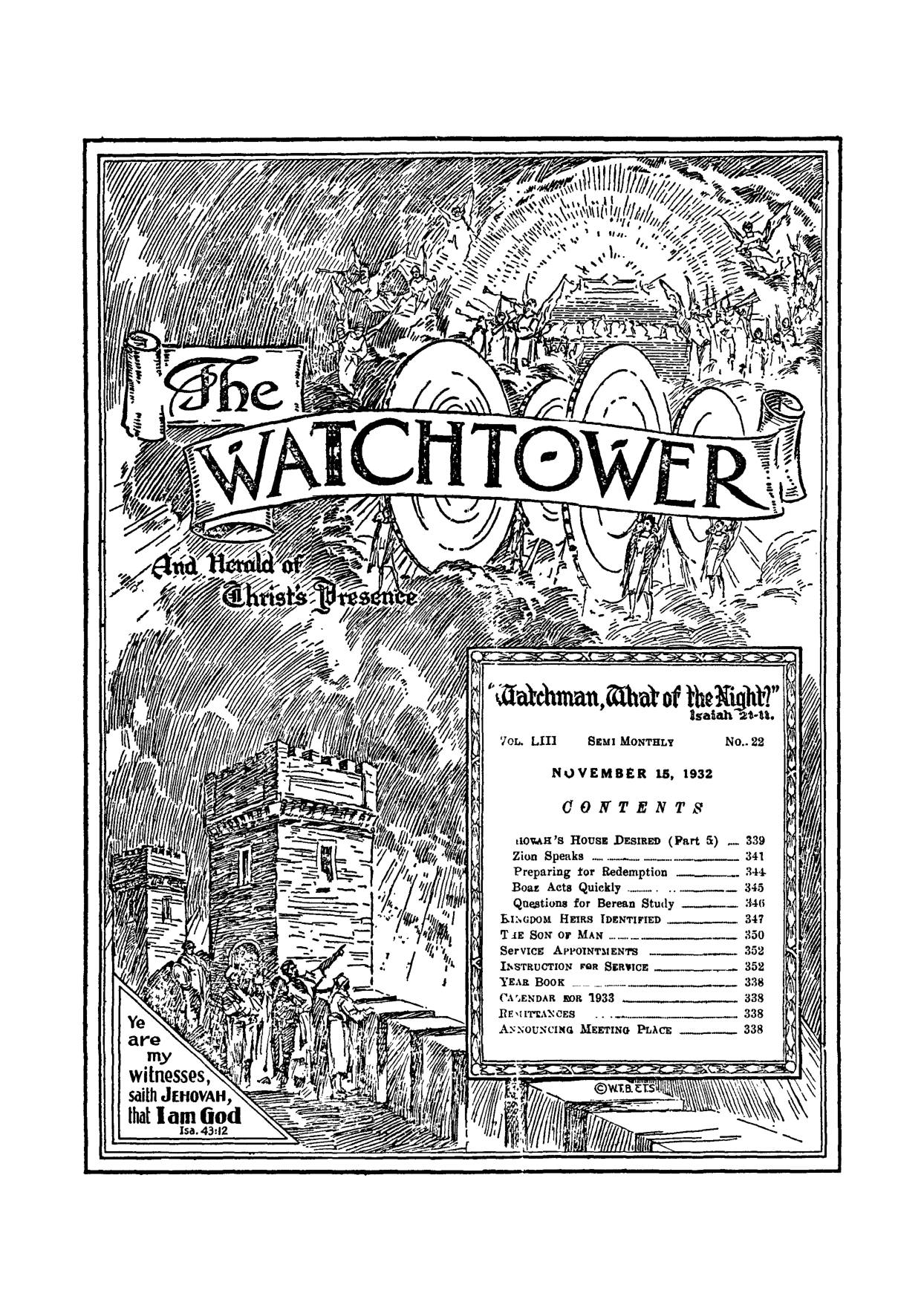
The Watchtower, November 15, 1932
Download: PDF — The Watchtower, November 15, 1932
YEAR BOOK
The Watchtower is pleased to announce that the Year Book for 1933 is in course of manufacture. It contains the President’s annual report of the work accomplished by the Lord’s people throughout the earth, and this will be most encouraging to all of Jehovah’s witnesses. The Year Book also contains daily texts and comments, each of which will be a real help to the anointed; also the year’s text and a short discussion of it.
We shall appreciate it if members of the companies will place their orders with the stockkeeper, so that one shipment can be made. This will save considerable shipping expense and will also help to make prompt shipments. We expect to fill orders about December 15. A limited edition will be printed and the usual 50 cents is asked for each copy.
CALENDAR FOR 1933
The Calendar for next year, printed by the Society, will be ready for the friends about December 1, 1932. It contains the year’s text and a very beautiful picture in harmony therewith. The date pad is especially designed for Jehovah's witnesses. The Calendar will be to the anointed an encouragement and help throughout the year. The amount asked for one copy is 25c; for 5 or more copies sent to one address, 20c each.
REMITTANCES
Please take note: For all remittances to the Watch Tower Bible & Tract Society, whether for The Watchtower, The Golden Age, or other literature, the money order or bank draft should be made payable to the Watch Tower Bible & Tract Society, with a memorandum attached as to how much is desired for The Watchtower, for The Golden Age, or for anything else. This will be economical both for the one remitting and for the Society, and will avoid much inconvenience. Make no remittances to the International Bible Students Association, as that only causes more work and confusion.
ANNOUNCING MEETING PLACE
Where the radio is used to broadcast the Truth, it would be well to announce the local meeting place of the company for Bible study. Consent to so announce should be obtained from the manager of the station, and, since the time is paid for, it is presumed that this may be done. This will enable the interested to find a place for study and further consideration of the Lord’s Word.
Vol. LIII November 15, 1932 No. 22
JEHOVAH’S HOUSE DESIRED
“And Ruth said, Entreat me not to leave thee, or to return from following after thee: for whither thou goest, I will go; and where thou lodgest, I will lodge: thy people shall be my people, and thy God my God.”– Ruth 1:16.
PART 5
JEHOVAH preserves and blesses those who love him. The love of the creature for the Creator is shown by keeping his commandments. God’s Word makes it plainly to appear that he will not permit one to become a member of his house and abide there unless that one proves his love for Jehovah. Only such could have a part in the vindication of Jehovah’s name. This point cannot be overstated. The fact that one makes a covenant to do God’s will and is called to the kingdom, responds to that call, and is taken into the covenant for the kingdom, is no guarantee that he will be of the Lord’s glorious house. He must maintain his integrity toward God by continually showing his unstinted and undivided love for Jehovah and his kingdom until the end of his earthly course. -Rev. 2: 10.
2 Ruth had been shown much favor by Boaz. She had responded to his invitation and had eaten at the table of Boaz. Many have responded to the invitation to eat at the table of the Lord, have partaken of his goodness, and then disregarded his commandments by failing or refusing to do further service in obedience to the will of God. The Ruth class, however, are willing souls in this day of the Lord, and this was manifested by the actions of Ruth. After feasting at the table of Boaz she again busied herself with her work. Boaz did not give command to his young men until Ruth had again undertaken her work. “And when she was risen up to glean, Boaz commanded his young men, saying, Let her glean even among the sheaves, and reproach her not: and let fall also some of the handfuls of purpose for her, and leave them, that she may glean them, and rebuke her not.’’ (2:15, 16) It would be vicious and wicked to hold that Boaz was infatuated with Ruth, and that they were carried away in a so- called sensual love affair. The strong intimation of such by some commentators is wholly unwarranted.
3 Boaz was a man of God and in this drama was performing his part which foreshadowed the outworking of God’s purposes. The claim made by some that because he was an elderly man and Ruth was young and beautiful, therefore he was gratifying an old man’s fancy, is not worthy of consideration. He was familiar with God’s law governing the Israelites, and knew that Naomi must be given first consideration in the question of a levirate marriage, and that if Ruth should take the place of Naomi there was still a nearer kinsman than himself who would have first claim, and whose duty it would be to exercise that right.
4 Further supporting this conclusion, all of his instructions to his young men were given without the knowledge of Ruth, thus showing he was not attempting to influence her in his behalf. Boaz had commended Ruth because of her kindness to Naomi. The mother-in-law, knowing that she could not bear a son to Boaz, and seeing the kindness of Boaz to Ruth, was thereby encouraged to do what she could to have Boaz marry Ruth in order to fulfil the law of God and to prevent a break in the lineage leading up to the King. The kindness of Boaz to Ruth corresponds to the call of the Lord to the Ruth class to the “prize of the high calling’’ and to joint-heirship with Christ in the kingdom. – Phil. 3:14; Rom. 8:16, 17
5 Boaz did not himself assume the honor of taking to wife the fair young maiden, but he let it come about in God’s appointed way; and thus his actions picture that God does the espousing, like unto what Abraham did in selecting a wife for Isaac. (See Genesis 24: 2-4.) It is Jehovah who does the calling to the kingdom, and the selection of the members of the bride of Christ, and who are hence made members of his royal house. (1 Thess. 2:12; John 6:44) It is Jehovah God who takes out a people for his name and who anoints and commissions them to do the work in his name and to his honor and glory. This is not left to any creature.
6 The results of Ruth’s efforts show her to be energetic. She not only worked well in gleaning, but she beat out the grain that she had gleaned. “So she gleaned in the field until even, and beat out that she had gleaned: and it was about an epnah of barley.” (2: 17) The result of her labor on that day amounted to about one bushel of grain. This good day’s work was clearly the result of the kindness of Boaz in directing his reapers to pull out and let drop some grain of the sheaves so that Ruth might pick up this barley that was dropped. This suggests that the Lord does not leave his beloved ones on earth to starve either in material or spiritual things, but permits them to have and enjoy these good things that are for their well-being. To enjoy them, however, the Ruth class, even as Ruth did, must keep busy, “working with [their] hands the thing which is good, that [they] may have to give to him that needeth”. (Eph. 4:28) This is exactly what Ruth did, and she shared with Naomi, giving to her what was needed for her wellbeing. “It is more blessed to give than to receive,” said Jesus; and this negatives the conclusion that some have that they should constantly hold out their hands to receive from others. The unselfish one not only desires to be like the Lord, but puts forth an effort to render aid to others as opportunity may arise. The one who labors is the one who has the joy and delights to share that joy with others of like precious faith and knowledge.
7 The day’s work being done, Ruth went home to share the effects of her labors with her mother-in-law. “And she took it up, and went into the city; and her mother in law saw what she had gleaned; and she brought forth, and gave to her that she had reserved after she was sufficed.” (2:18) Doubtless Ruth exchanged some of her grain for other kinds of food that were needed, and what she had left, that is, “after she was sufficed,” she gave to Naomi. The amount of grain Ruth brought home showed she had been favored by some good friend, and Naomi immediately took notice of this: "And her mother in law said unto her, Where hast thou gleaned to day? and where wrought- est thou? blessed be he that did take knowledge of thee. And she shewed her mother in law with whom she had wrought, and said, The man’s name with whom I wrought to day is Boaz.” (2:19) Both of the women were happy, and both gave glory and thanks to the Lord God for his goodness to them and called down the blessing of the Lord upon the one who had been good to Ruth.
8 The Lord has continued to increase every year since 1922 his provision for his people, and has increased the opportunities of making known the glad tidings of his kingdom. All those who have enjoyed this privilege, and who have had the proper appreciation thereof, give honor and glory only to Jehovah God through Christ Jesus for these favors and call upon Jehovah to bless the great Master of the harvest, who is the dispensing agent of Jehovah’s blessings to his people.
9 The part played by Naomi at this point in the drama more particularly pictures those found faithful in 1918, and whom the Lord then constituted “the faithful and wise servant” class, and corresponds to the part played by Mordecai as set forth in the drama of the book of Esther. When Naomi learned that Ruth had been favored by her kinsman Boaz she recognized the hand of the Lord in their affairs and her heart was made glad and she manifested this in her speech to Ruth. “And Naomi said unto her daughter in law, Blessed be he of the Lord, who hath not left off his kindness to the living and to the dead. And Naomi said unto her, The man is near of kin unto us, one of our next kinsmen [the marginal rendering, one that hath right to redeem].” (2:20) The word “kinsmen”, as used in this verse twenty, means to redeem according to the oriental law of kinship, which has the meaning of buying back, and relates to property or the marrying of the widow of the deceased kinsman.
10 It is different in the Hebrew from the word used to translate “kinsman” in chapter 2:1. The use of this different word by Naomi shows that she was speaking with proper discernment and discrimination and that she was being guided in so doing by the hand of Jehovah. Naomi recognized the Lord was guiding them and she gave praise to God, saying: “ [He] hath not left off his kindness to the living and to the dead.’’
11 The Elijah work of the church died in 1918, or came to an end, which is represented by death. Later the Naomi class discerned that the Lord had made provision for the members thereof and had blessed them; that he had blessed the Elijah work then completed or dead, and was now beginning to bless the work foreshadowed by Elisha. These faithful ones were thankful to the Lord and eager to proceed with his work to his glory; hence they prayed in the language of the psalmist: “Save now, I beseech thee, 0 Lord [Jehovah] : O Lord, I beseech thee, send now prosperity. Blessed be he [Christ Jesus, the Master of the harvest] that cometh in the name of the Lord; we have blessed you out of the house of the Lord.” (Ps. 118:25, 26) Jehovah and Jesus in the temple blessed the faithful ones out of the house of the Lord. This is foreshadowed by the words and actions of Naomi in the preceding verse.
12 Boaz made provision for Ruth to continue her work in the field, as she then told Naomi. He directed her to keep close by his young men. ‘‘And Ruth the Moabitess said, He said unto me also, Thou shalt keep fast by my young men, until they have ended all my harvest.” (2:21) This would picture God’s faithful people working in the field under Christ and keeping in close touch, by his grace, with the angels accompanying the Lord at his temple. In other words, this shows a close relationship between the angels of the Lord and the Naomi and Ruth class, picturing the remnant, even though there is no direct communication between the seen and the unseen ones. The Lord himself looks after this relationship.
13 For Ruth to continue to glean throughout the period of the harvest would test her endurance and afford her the opportunity to prove her worthiness to be chosen as a member of the household of the prospective king of Israel. This test corresponds to the twelve months of purification that Esther was required to undergo. (Esther 2:12-16) Likewise the class whom Ruth pictured after having responded to the call or invitation to work in the field of the Lord, these must continue in faithful service and devotion to the Lord of the harvest. This furnishes an opportunity for them to prove and maintain their integrity toward God and determines whether or not they measure up to the requirements for a place in the house of Jehovah.
14 As Mordecai advised Esther, Naomi continues to advise and instruct Ruth. “And Naomi said unto Ruth her daughter in law, It is good, my daughter, that thou go out with his maidens, that they meet thee not in any other field.” (2: 22) Naomi advised Ruth to do one thing, that is to say, stick to the work which the master of the harvest had given her.
15 Likewise the faithful Naomi class has advised and continues to advise the Ruth class to ‘do this one thing’ and not to be double-minded or unstable or tossed about by the opinions of men. Stick closely to the work that the Lord has provided, and slack not the hand. (Phil. 3:13; Jas. 1:8; Zeph. 3:16) Having first been given the favor of serving in the Lord’s organization, then the faithful continue to “follow the Lamb [and no others] whithersoever he goeth”. (Rev. 14:4) Jesus Christ is the Head over Jehovah’s organization; and the remnant, represented by both Naomi and Ruth, have been given the privilege of serving in his organization, and they must stick to it faithfully and, in so doing, show gratitude and thankfulness to the Lord. The divine rule is elsewhere stated in these words: ‘‘The ox knoweth his owner, and the ass his master’s crib”; but there are those who claim to be Israelites who do not know. (Isa. 1:3) There are some who have made a covenant to do God’s will who do not know where to go to feed, and are always being tossed around by the selfish advice of someone else.
16 Ruth faithfully stayed at her work through both the barley and the wheat harvest. “So she kept fast by the maidens of Boaz to glean unto the end of barley harvest, and of wheat harvest; and dwelt with her mother in law.” (2:23) During the harvest work Boaz would be too busy to attend to the near kinship or redemption claim, and Naomi appreciated that fact; hence she remained quiet until the harvest work was completed. At the opportune time Naomi would act and instruct her daughter-in-law, and this shows that the Lord God was directing the drama.
ZION SPEAKS
17 With the opening of the third chapter of the book of Ruth, Naomi again fades out of the picture, so far as representing a particular part of God’s people, and plays the role picturing Zion, God’s organization, and it is Zion that here becomes the speaker. The Naomi class, however, is a part of Zion, and the words of verse one of chapter three are particularly addressed to those who were not anointed at the time there foreshadowed. The barley and wheat harvest ended with Pentecost, which corresponded to about the autumn season of 1922 in the fulfilment of the prophetic drama. “Then Naomi her mother in law said unto her, My daughter, shall I not seek rest for thee, that it may be well with thee?”. – 3:1
18 Naomi, here picturing God’s organization, was looking out for “rest” for Ruth, meaning a house and rest in the house of her husband. Likewise between the years 1919 and 1922 those of Zion, and who were in responsible positions in God’s organization on the earth, were seeking to know what would be in harmony with God’s will and for the well-being of their younger brethren, that these might be brought into the royal house of Jehovah and there find rest, and in this the Lord was directing their course. In a similar manner Mordecai was advising and assisting Esther at the opportune time, that she might be prepared for a place as queen in the royal house of King Ahasuerus. – Esther 2:1-11.
19 Further addressing Ruth, Naomi said: “And now is not Boaz of our kindred, with whose maidens thou wast? Behold, he winnoweth barley to night in the threshingfloor. Wash thyself, therefore, and anoint thee, and put thy raiment upon thee, and get thee down to the floor: but make not thyself known unto the man, until he shall have done eating and drinking.” – 3: 2, 3.
20 The Watchtower of November 15, 1907, page 344, made comment upon this verse in the following language: “The advice of Naomi to Ruth concerning Boaz was not of unalloyed wisdom. Such a course today would brand any woman as a loose, if not a disreputable, character. And that Boaz feared such reproach is also clear from his request of chapter 3:14. In advising such a course Naomi again betrayed the weakness of her trust in God.’’
21 The foregoing comment appearing in The Watchtower could not be correct, and should here be corrected. There is nothing in the record to indicate that Boaz reproached Ruth in taking the course that Naomi advised; even as there is nothing in the divine record to indicate that Jehovah rebuked Jacob for following Rebecca’s advice to deceive blind Isaac. In both instances God was directing the events which foreshadowed greater things to come. “Unto the pure all things are pure.” (Titus 1:15) “Jehovah seeth not as man seeth; for man looketh on the outward appearance, but Jehovah looketh on the heart. ” (1 Sam. 16:7, A.R.V.) It could not be right to criticize the Word of God or the course of action taken by certain of God’s players in his drama merely to please the fancy of some imperfect man or- to maintain what is claimed to be the world’s standard of wisdom, purity and righteousness. The clergy have criticized much of God’s Word, that they might make themselves to appear holy, wise, pure and great, and that they might receive the commendation of other men. It is better to trust the Lord God, who never makes a mistake, and to know that what he directs is pure, holy and righteous. “It is better to trust in the Lord, than to put confidence in man.” (Ps. 118:8) Again in their attempt to make themselves appear as upholding the world’s standard of purity they have made themselves ridiculous in the sight of God.
22 If man had been making out the genealogy leading up to Christ the names of Tamar, Rahab and Ruth would have been omitted. It is the practice of the self-righteous churchgoer of ‘ ‘ Christendom ’ ’ to superciliously lift the eyebrows in “holy” horror at the course of these women or to blush at the mention of some things about them as though these things marked them as outcasts and unfit for the elite society of “organized Christianity”. But to the character-developing, “holier-than-thou” chief priests and elders and Pharisees of his day Jesus said: “Verily I say unto you, That the publicans and the harlots go into the kingdom of God before you. For John came unto you in the way of righteousness, and ye believed him not; but the publicans and the harlots believed him: and ye, when ye had seen it, repented not afterward, that ye might believe him.’’ (Matt. 21:31,32) Thus Jesus ’ words are directly in keeping with Jehovah’s procedure in rejecting other women, perhaps outwardly more refined and righteous according to self-established human standards, and permitting Tamar, Rahab and Ruth, branded by some as mere harlots, to get into the human ancestry of the Chief One of the kingdom of God, Jesus Christ.
23 Probably the Lord God put these in as a rebuke to those who think they can outline a standard by which others may enter the house of the Lord. God himself has prepared the way, and it is presumptuous for anyone to question or criticize the way that he has prepared.
24 God’s law made provision for a levirate marriage, and Ruth, by washing and anointing herself, and dressing for the occasion, was preparing to be taken by Boaz as his wife by a levirate marriage that very night, and that without the necessity of some sanctimonious and pious-faced, hypocritical preacher’s being present to perform the ceremony. Ruth must be sweet in body, just as Esther was required to be prepared by twelve months’ purification. Jehovah by his duly provided officers was directing the drama in both instances, and every part of it was right.
25 Paul must have had some of these things in mind when under inspiration he wrote: “Let God be true, though every man be false.” (Rom. 3: 4, Diag) What is here said is not a harsh or undue criticism of an individual, but is said in order that the Word of God might be placed in its proper setting and in the proper place in the minds of his people. We should criticize ourselves when we see our mistakes, and hasten to take the right position when this is ascertained. The purpose is only to publish the truth, regardless of what some men may think.
26 It appears that Boaz was sleeping on the threshingfloor in his field. It was the time for the separating of the grain from the chaff and for the approved to be brought into the house of the Lord. Further advising Ruth, her mother-in-law said to her: “And it shall be, when he lieth down, that thou shalt mark the place where he shall lie, and thou shalt go in, and uncover his feet [margin, lift up the clothes that are on his feet], and lay thee down; and he will tell thee what thou shalt do.’’ –3:4
27 Scoffers and critics have made much over this text, claiming it to be an act of gross indecency. Such, however, have manifested a greater desire for the approval of men than to have an understanding of and to do the will of God. The course advised by Naomi, and which was taken by Ruth, was merely a formal way of serving notice upon Boaz, and of showing Ruth fully submissive to God’s arrangements, and Boaz, being a godly man, so understood it. Naomi, Ruth and Boaz were all devoted to Jehovah God, and, knowing this fact, Naomi did not hesitate in saying to Ruth that ‘Boaz will tell you what to do’. There is a reason for this fine detail concerning the proceedings of redemption and buying back, as are provided by God’s law. The Bible wastes no words and records nothing without a cause, and this is true without regard to whether prudes are pleased with it or not.
28 The performance of the drama here well illustrates how the class pictured by Ruth willingly and humbly present themselves to the Lord and wait upon him to tell them what to do. This is pleasing to the Lord, rather than to have the creature tell the Lord what to do. By proceeding in God’s appointed way the faithful bring reproach upon themselves, which reproach proceeds from the hypocritical and pious frauds who claim to be of God’s organization but who in fact are of Satan’s organization. Hypocritical “Christendom” has made an attempt to come to God in man’s own appointed way and has made itself appear in the eyes of men to be pure, but, in fact, has been and is “full of dead men’s bones”. The one pleasing to God must be and is wholly submissive to God and to his Christ. “So then it is not of him that willeth, nor of him that runneth, but of God that shew- eth mercy.”–Rom. 9:16
29 The coming of Ruth to Boaz in the field in the manner directed by Naomi well pictures the willing submission and unselfish devotion to the Lord by those who seek to know and to do his will. Naomi’s words plainly informed Ruth that she was not to be guided by her will, but that Boaz would direct her, even as those who come to the Lord follow not their own selfish ideas but trust in the Lord and he guides them.– Prov. 3: 5, 6.
30 Jehovah’s purpose was that the fruit should be brought forth, that is to say, that the fruit of the body might be brought forth in the lineage leading up to King David, and in due time to Jesus, God’s mighty King. Naomi knew that the Law-giver must come from the tribe of Judah, of which she was a member, and of which Boaz was also a member, and she was anxious to perform the part that God had assigned to her whether she understood it or not. (Gen. 49:10) She was too old to offer herself to Boaz to raise up a child, and therefore she offered her daughter-in-law; and this without doubt she did under Jehovah’s direction. In like manner barren Sarah offered Hagar to Abraham; and also Rachel, because of her barrenness, offered her handmaid Bilhah to Jacob. – Gen. 16:1-3; 30:1-5.
31 Naomi did not want the opportunity lost for a child to be of the royal house, and the only way to avoid that loss was to substitute Ruth for herself. At this point in the drama the interests of Naomi and Ruth merge into one, and we observe that together now they represent the remnant now on the earth and in line for the kingdom.
32 As Esther obeyed the instructions of Mordecai, even so Ruth faithfully followed the instructions of her mother-in-law Naomi. “And she said unto her, All that thou sayest unto me I will do. And she went down unto the floor [threshing-floor, Leeser], and did according to all that her mother in law bade her”. – 3:5, 6
33 Arriving at the threshing-floor in the field, and seeing Boaz asleep, Ruth came softly and uncovered his feet and lay down. Thus is pictured how those who please God ‘present their bodies a living sacrifice, wholly acceptable unto God, which is their reasonable service’. (Rom. 12:1) There is not one word in the divine record to indicate that there was any sensual or improper desire on the part of Ruth in taking this step as she did. On the contrary, she being a young woman, it must have been a self-denial on her part to thus proceed. In any event, she was carrying out her part of the divine drama and doing what the Lord would have her do. The harvest day was done, and that brought joy to the master of the harvest. (Isa. 9:3) Boaz had eaten his bread, and drunk his flask of wine, and that made glad his heart. (Ps. 104:15) There was no hypocritical prohibition law in force in that land, and his eating and drinking were free and easy, and thereafter he lay down to rest. It would be more popular with a certain class of people now on earth to say that doubtless Boaz had been drinking unfermented grape juice with his bread; but in considering God’s Word we should be truthful, regardless of what some others might think.
34 Boaz was not indulging himself in the so-called ‘ease and comfort of city life’, but he was camped out under the canopy of heaven which God had put there, even as hundreds of faithful pioneers are today in the field of service camped out under the stars of heaven. He had labored well and would sleep well, because “the sleep of a labouring man is sweet, whether he eat little or much”. (Eccl. 5:12) Afterwards David wrote that which then was appropriate to the godly man Boaz, to wit: ‘‘Thou hast put gladness in my heart, more than in the time that their corn and their wine increased. I will both lay me down in peace, and sleep: for thou, Lord, only makest me dwell in safety.” – Ps. 4:7, 8.
35 Being a godly man, Boaz trusted in Jehovah. Doubtless the moon had risen over the hills of Judea and the night was calm and peaceful and the stars would tell of the glory of the Almighty God. Quietly and with measured tread the beautiful Moabitish woman, her heart fully set on doing the will of Jehovah God that she might enter into his house, approached and gently lifted the covering from the feet of Boaz, and laid herself down. Without doubt the angel of the Lord was there. If Satan could have had his way at that time he would have had upon the scene some of the outwardly pious and hypocritical clergy to lift their hands in holy horror and call some officer to arrest Ruth and have her dragged before the court charged with adultery and quickly stoned to death. But it was not permitted that Satan or any of his agents should interfere with this great divine drama which God was causing to be enacted to the honor of his own great name. Years afterwards, at practically the same spot, the hosts of heavenly angels sang the glad song announcing the birth of him who shall save the world. (Luke 2:9-11) Ruth and Boaz were on this night playing their part in the great divine drama according to God’s will, and foreshadowed the coming of this Mighty One, concerning whom the angels sang at the birth of the babe Jesus.
36 Some hours had passed while Ruth lay quiet and unobserved. Boaz was sleeping soundly, and so she would not disturb him. It was now midnight when Boaz discovered that someone was lying at his feet. “And it came to pass at midnight, that the man was afraid [startled], and turned himself; and, behold, a woman lay at his feet. And he said, Who art thou? And she answered, I am Ruth thine handmaid; spread therefore thy skirt over thine handmaid; for thou art a near kinsman.’’ – 3:8, 9
37 There is no reason to conclude that Boaz felt at all embarrassed or indignant because of the presence of Ruth at his feet. Had he been looking merely for a woman he would not have made the inquiry as to her identity. (Gen. 38:14-16) Upon request Ruth immediately disclosed to Boaz her identity; and thus is pictured how those who come to God through Christ. Jesus quickly and gladly confess that they are under the leadership of Christ and are his handmaidens. Their desire is to wear the wedding garment and to be adorned as the bride. (Matt. 22:11; 25:1-4; Col. 3:24; Isa. 61:10) Responding to the inquiry of Boaz, Ruth said: “Thou art one that hath right to redeem.” (Vs. 9, margin) Boaz would immediately understand that Ruth was properly there to give him notice of his obligation, according to the divine law of levirate marriage. (Deut. 25:5,6) In proof that Boaz was neither indignant nor embarrassed, and that he had no improper thought, he addressed Ruth, to wit: “And he said, Blessed be thou of the Lord, my daughter; for thou hast shewed more kindness in the latter end than at the beginning, inasmuch as thou followedst not young men, whether poor or rich.” (3:10) Ruth was there by the will of Jehovah God, and had his approval, and this is sufficient reason to dismiss all criticism made by hypocrites, who are the enemies of God.
38 Modern critics may say that this comment is suggesting to others to pursue an indecent and immoral course. Any man who would seize upon the events of this divine drama as a justification or excuse for pursuing an indecent or immoral course would show that he has no faith in God and does not believe his Word and has no desire to obey him. There is nothing in God’s Word that furnishes any excuse or justification for man or woman to do that which is immoral, improper and wrong.
39 Ruth had shown kindness to both Naomi and Boaz, and for this he commended her. She had not been a flippant young widow seeking a husband, but had come to an old bachelor because the Lord God had sent her there and she delighted to do His will. Ruth had shown her loving-kindness to her mother-in-law, and now even in a more marked degree to Boaz by placing herself wholly in his hands, and he said to her: “Thou hast made thy last lovingkindness better than the first.’’–Roth.
40 The reputation of Ruth for virtue and chastity among those who really knew her was then beyond reproach, and God saw to it that his record testifies to her chastity, and this stops the mouths of scoffers. With kindness of speech Boaz said to Ruth: “And now, my daughter, fear not; I will do to thee all that thou requirest [R.V., sayest] : for all the city of my people doth know that thou art a virtuous woman.” –3:11
41 Ruth was a ‘‘worthy woman’’ deserving of being redeemed, and Boaz told her so. “A worthy woman thou art.” (Roth., margin) According to Leeser Boaz said: “For all (the men in) the gate of my people know that thou art a virtuous woman.” She had proved herself, not before the heathen world, but before the chosen people of Jehovah; hence “all the city”, all of God’s organization, know that the Ruth class is worthy by reason of faithfulness unto God and unto his Christ. Because of such faithfulness on the part of the Ruth class Christ Jesus does for them what God’s arrangement or law provides in their behalf. This conclusion rings true to the words of Jesus: “Well done, thou good and faithful servant.”–Matt. 25:21
PREPARING FOR REDEMPTION
42 Boaz, to be sure, knew his relationship to Naomi and to her daughter-in-law Ruth, and some will say that he should have made the advancement toward the redemption. There were two reasons, however, that explain his apparent delay, and these are: (1) These women had returned to Bethlehem at the beginning of the harvest time, when he was busy himself with the harvest until it was finished; and (2), another and more potent reason, he knew that there was a kins man nearer than himself and he would wait and see what that kinsman would do. The fact that Ruth had come to him would suggest that the hand of the Lord was in the matter and that he should busy himself to see that justice was done to Naomi and Ruth. Therefore, further addressing Ruth, he said: “And now, it is true that I am thy near kinsman; howbeit, there is a kinsman nearer than I. Tarry this night, and it shall be in the morning, that if he will perform unto thee the part of a kinsman, well; let him do the kinsman’s part: but if he will not do the part of a kinsman to thee, then will I do the part of a kinsman to thee, as the Lord liveth: lie down until the morning.’’ – 3:12, 13
43 That request to Ruth to ‘tarry there till morning’ shows that Boaz was not embarrassed. His word concerning the nearer kinsman shows that he was being guided in his steps in harmony with the Word of God and that he would be submissive to God’s law. The law of Jehovah God must not fail to be observed by Boaz, and these women, Naomi and Ruth, were confident of its fulfilment. Likewise the remnant people of God now on earth, whom these two women picture, must have all of God’s ordinances and promises performed toward them by Jesus Christ, the Yea and Amen of Jehovah’s promises. “For all the promises of God in him are yea, and in him Amen, unto the glory of God by us.’’ – 2 Cor. 1: 20
44 If the nearer kinsman would not do his duty, Boaz would see to it that Ruth had her just dues; likewise the Lord Jesus says to those who faithfully abide with him: “Behold, I will make them [the unfaithful kinsman] to come and worship before thy feet, and to know that I have loved thee.”–Rev. 3: 9.
45 Boaz had given his word that he would perform the law of God concerning Ruth if the nearer kinsman failed to do so, but nothing could be done until morning; therefore he said to Ruth: “Lie down until the morning.” Had there been any question about the moral integrity of Boaz and Ruth, and her complete confidence in him, these words would not appear in the divine record. She did as he requested her. “And she lay at his feet until the morning; and she rose up before one could know [R.V., discern] another. And he said, Let it not be known that a woman came into the floor.” (3:14) That was no indication of a guilty moral conscience, but merely the act of caution to keep the matter between themselves until Boaz could give attention thereto. Had they made the matter known before leaving the field, and before the assembly of the court for the determination of the matter, Satan would doubtless have interfered and this would have furnished an excuse for the nearer kinsman to withdraw from his obligation. Boaz, a godly man, therefore was acting with prudence and wisdom. “A prudent man concealeth knowledge: but the heart of fools proclaimeth foolishness.” (Prov. 12:23) When God gives a man a duty to perform he would be a fool to proclaim that fact before his work is completed.
46 When Ruth was ready to depart for her home Boaz sent her away with food. “Also he said, Bring the vail [mantle (R.V.) or cloak, Leeser] that thou hast upon thee, and hold it. And when she held it, he measured six measures of barley, and laid it on her: and she went into the city.’’ – 3:15
47 Only an evil mind would consider the giving of this food to Ruth an act of hire for sexual pleasure. It was only proper and an earnest or guarantee that Boaz would perform his God-given duty toward her. He was a just man and stood for justice, which means that he would perform God’s law toward her so far as that was possible. They both left the field at early dawn, Ruth going to Naomi, and Boaz into Bethlehem to settle the matter involving Ruth.
48 When Ruth returned early in the morning, and her mother-in-law Naomi was anxious to know whether or not the levirate marriage had been carried out, she put questions to Ruth to prove this: “And when she came to her mother in law, she said, Who art thou, my daughter? And she told her all that the man had done to her. And she said, These six measures of barley gave he me: for he said to me, Go not empty unto thy mother in law.’’ (3:16, 17) Naomi’s words to Ruth, “Who art thou?” meant, ‘Are you now the wife of Boaz or not?’ The response of Ruth might well picture the Ruth class, who had received the evidence of God’s loving-kindness, and who then say: “Come and hear, all ye that fear God, and I will declare what he hath done for my soul. I cried unto him with my mouth, and he was extolled with my tongue. If I regard iniquity in my heart, the Lord will not hear me: but verily God hath heard me; he hath attended to the voice of my prayer. Blessed be God, which hath not turned away my prayer, nor his mercy from me.” – Ps. 66:16-20
49 With full confidence in Boaz Ruth was certain that he would do toward her what God’s law required. When Boaz said to her, “Go not empty unto thy mother in law,” she understood that this was an evidence of his purpose to do what was right. To be sure, she was happy, even as those are who have learned the truth concerning the Lord’s coming to the temple, and who have seen that they have God’s favor and the opportunity of doing something to make known his kingdom. Manifestly Ruth desired to be immediately active in doing something, even as those whom she pictured have immediately desired to busy themselves with the kingdom interests upon learning of the loving- kindness of the Lord.
50 Naomi, too, had full confidence that Boaz would lose no time in bringing the matter to a final conclusion, and she counseled her daughter to wait for further developments of events. “Then said she, Sit still, my daughter, until thou know how the matter will fall: for the man will not be in rest, until he have finished the thing this day.” (3:18) The Lord is pleased with those who obey quickly when they see his commandments. Boaz was true to his name, which means “fleetness, alacrity or eagerness”. He immediately proceeded to do what he saw God’s law required him to do. The statement of Naomi shows that she well knew that Boaz would carry out God’s requirements if possible, and that without delay. As the redeemer and vindicator he would not procrastinate and he did not. He brought the matter to judgment immediately, even as the Vindicator of Jehovah’s name, at the proper time, ‘came straightway to the temple for judgment.’ – Mal. 3:1-5
BOAZ ACTS QUICKLY
51 At the city gate was the place for the elders or judges to sit and publicly try and determine cases at law. (Deut. 21:19-21; 22:15; Job 31:21; Prov. 22: 22) At the gate inside the city there was to be found a large open space where the people congregated to consider matters of public interest. Even in the modern city of Bethlehem there is a wide space near the main entrance and where the people congregate. Boaz was familiar with God’s law, as well as the place of judgment: “If brethren dwell together, and one of them die, and have no child, the wife of the dead shall not marry without unto a stranger: her husband’s brother’’ shall go in unto her, and take her to him to wife, and perform the duty of an husband’s brother unto her. And it shall be, that the firstborn which she beareth shall succeed in the name of his brother which is dead, that his name be not put out of Israel. And if the man like not to take his brother’s wife, then let his brother’s wife go up to the gate unto the elders, and say, My husband’s brother refuseth to raise up unto his brother a name in Israel, he will not perform the duty of my husband’s brother.”–Deut. 25:5-7.
52 Boaz knew that the people would come and go through the gate and that would be the most likely place to locate the near kinsman, and the place for him to quickly call upon this kinsman to do his duty. When he left the field Boaz straightway went to the gate and sat down to watch. His eyes being on the alert, soon the nearer kinsman appeared and he spied him and hailed him to turn aside and sit down and talk the matter over. “Then went Boaz up to the gate, and sat him down there: and, behold, the kinsman, of whom Boaz spake, came by: unto whom he said, Ho, such a one! turn aside, sit down here. And he turned aside, and sat down.” – 4:1
53 Boaz was acting as Jehovah’s representative, and his action illustrates the point that God, in fulfilling his law, does nothing in secret, but openly and aboveboard. Boaz did not first try to settle the matter secretly with the nearer kinsman. The record discloses that before making known his purpose Boaz assembled the court of law that a hearing of the matter might be considered publicly and therefore openly. “And he took ten men of the elders of the city, and said, Sit ye down here. And they sat down.” – 4:2
54 The action of Boaz here was strictly in compliance with the law. (Deut. 25:7) Ten is a symbol of com pleteness in regard to things earthly, and this court, now convened and composed of ten judges or elders, would seem to signify that the hearing and judgment in which Naomi, Ruth and the nearer kinsman were involved was a full court and would be complete; and that these three persons represented a class of persons or creatures on earth; and that the decision or conclusion concerning such classes by the court of the Lord will be complete and final.
55 This does not mean that those other than the Israelites were then or now to comply with the law of levirate marriage. God’s law was given to Israel, his covenant people, and that law was for the purpose of foreshadowing greater things to come to pass. (Heb. 10:1) The things which came to pass on the Israelites were typical of what would be due to come to pass at the end of the world. This would be conclusive proof that the book of Ruth is a record of a divinely arranged drama enacted for the purpose of teaching of and concerning God’s purposes upon the people whom the Israelites foreshadowed. By her marriage into a family of Israel, and by voluntarily casting in her lot with that people, Ruth had become an Israelite, thus picturing a class of spirit-begotten ones on earth at the time of the fulfilment of the prophetic drama.
56 Before this legal and duly constituted court stood Boaz, representing the majesty of God’s law which he was there to perform, and to see that it was properly respected and obeyed, and therefore he represented before that court Naomi and Ruth, whose interests were involved. Also, there was in the presence of that court the nearer kinsman, who was there because Boaz had publicly hailed him there. The record does not state what Boaz called this nearer kinsman. He was a kinsman to Naomi nearer than Boaz, and hence nearer to Ruth. He was of the Elimelech household, and hence would picture or represent a class of consecrated persons related to the period of time during the advocacy of the holy spirit as a comforter and helper. The consecrated and spirit-begotten ones on the earth are nearer akin to each other than Christ is to them, because all of these are the descendants of Adam by nature, whereas Jesus was one grafted into the human family. This nearer kinsman did not picture heavenly creatures, such as Jesus now is, and such as the angels are, but did picture a consecrated and spirit-begotten class in the flesh, that is to say, with an organism of flesh and who at some time were in line for a place in the royal house of Jehovah.
57 If this nearer kinsman should refuse to comply with the law of God concerning Naomi and Ruth and thus to bring forth fruit toward the approaching kingdom, then it would be in order for Boaz to perform the levirate marriage; and this matter Boaz would now have settled, and that quickly and definitely. As to what would be the result of the refusal of the nearer kinsman to do his duty might be inferred by what took place in a similar case.
58 Onan, the second son of the patriarch Judah, and hence the great-grand-uncle of this nearer kinsman to Naomi, was placed in a similar position. Onan refused to marry Tamar, the widow of his brother Er, and thus rebelled against raising up a seed unto the king, which was to come in Judah’s line. Jehovah smote Onan with death. – Gen. 38: 6-10
59 If Naomi’s nearest kinsman should refuse to preserve the name of his relative Elimelech by marrying Ruth, who takes the place of Naomi in this drama, it would be expected that he would meet a fate similar to that which befell Onan. The question before that court of ten judges, convened to carry out the matter in Bethlehem, was therefore a solemn one, and no sensual love affair such as the critics of the book of Ruth would have the people believe. Jehovah was making a moving and living picture, which involved the life of Boaz and the lives of others, and which led up to the selection of the King of kings, who should in due time rule the entire world.
(To be continued)
QUESTIONS FOR BEREAN STUDY
1. What gracious assurance is given to those who love Jehovah? How does the creature show his love for the Creator? What are the steps to be taken and the conditions to be met by one who would ultimately be a member of Jehovah’s glorious house?
2-5. Point out the significance of the statement that it was “when she was risen up to glean’’ that Boaz commanded his young men in regard to generously providing gleanings for Ruth. Prove that Boaz was not actuated by selfish motive in making this provision for Ruth. In what divine favor to those whom she there represented does this kindness of Boaz to Ruth find a correspondency? Show that in this matter Boaz was closely observing God’s law in harmony with its application to the calling and selection of the members of his royal house.
6-8. Account for the results of Ruth’s day of gleaning. How does this part of the picture have its fulfilment in the privilege and blessing enjoyed by those whom Ruth there prophetically represented? What was foreshown in the expression by Naomi, “Blessed be he that did take knowledge of thee”?
9-11. What was it, evidently, that led to Naomi’s words of verse 20! What was here foreshadowed!
12,13. Point out (a) the test to Ruth in Boaz’ counsel to her, “Thou shalt keep fast by my young men, until they have ended all my harvest.” (b) How this privilege for Ruth to continue her work in the field, and the test it involved, have been finding fulfilment in the experiences of God’s people whom Ruth there pictured.
14-16. What was the purpose in Naomi’s advice in verse 22? Taking Boaz’ instruction to Ruth (referred to in verse 21) together with Naomi’s advice to her (verse 22), and Ruth’s careful compliance therewith, describe the fulfilment of this part of the prophetic picture.
17, 18. Applying the prophetic picture, by whom were the words of Ruth 3:1 spoken? To whom? How was this fulfilled?
19-25. Prove that Naomi’s words of instruction to Ruth (verses 2 and 3) are not properly subject to unfavorable criticism. Point out the propriety of the procedure there directed, and that it was in harmony with God’s expressed law. In this connection apply the rule stated in Romans 3:4.
26-29. What was significant in the fact that the procedure to carry out the purpose mentioned in verse 1 began in the time when Boaz was ‘winnowing in the threshingfloor’? Show that the instruction given by Naomi to Ruth (verse 4) was circumstantially proper and clearly in accord with God’s law. Show also how fitting as a part of the prophetic picture were (a) Naomi’s words that ‘Boaz will tell you what to do’, and (b) Ruth’s full confidence and obedience.
30-32. Point out three purposes which were to be accomplished in what was taking place at this point in the drama. Describe the corresponding situation as presented in the Esther drama.
33 35. Describe the situation at this point as to Boaz. Relate how Ruth, in harmony with Naomi’s instructions, proceeded to perform her part, and show that her course was proper and entirely unselfish. Account (a) for the view generally held of the situation here presented, (b) For Satan’s not interfering with the progress of the divine drama.
36-38. From the standpoint of the provision made in God’s law, what purpose was accomplished in that which is recorded, in verses 8 and 9? Are critics entitled to hold that there is here any encouragement to pursue an improper course? Why?
39-41. Explain the “lovingkindness” of Ruth, here mentioned. What was the meaning of Boaz’ commendation of Ruth as recorded in verse 10? To what does this approval correspond in its application to those whom Ruth there prophetically pictured?
42-44. Explain Boaz’ apparent delay in regard to the redemption. Show that in his conclusion, as expressed in verses 12 and 13, Boaz was guided by and submissive to God’s law. Here compare the position of Naomi and Ruth with that of the class whom they there pictured. How does Revelation 3: 9 here serve to corroborate?
45-47. Explain Boaz’ purpose in cautioning Ruth to keep the matter confidential. Why was this an act of wisdom and prudence on his part? What led Boaz to make the provision mentioned in verse 15?
48, 49. What did Naomi mean by her question ‘‘Who art thou?” addressed to Ruth on her return? How does Ruth’s response correspond to that of the Ruth class at the time of special favor bestowed upon them? How did Ruth manifest her appreciation of the kindness here shown by Boaz?
50. In verse 18, what did Naomi mean in her statement concerning Boaz? What is the important lesson contained therein?
51, 52. Relate how Boaz proceeded to find the nearer kinsman, and point out the advantage in his procedure.
53-55. Show that Boaz’ procedure was in harmony with God’s law. Explain what seems to have been pictured by the court as there constituted, and by the decision or conclusion as to the persons there involved. On what ground should we expect that event to be a pictorial prophecy ?
56. Explain the prophetic position of each of the persons being heard before that court or represented there.
57-59. Point out the great importance of the question before that court. How would the outcome affect each of the persons there involved?
KINGDOM HEIRS IDENTIFIED
HONEST persons have been deeply puzzled about their relation to and standing in a so- called ‘‘Christian land’’. To them the thought of membership in any one of the many branches of “organized Christianity” has been disgusting, since every one of these branches or church systems now openly appears as a social-commercial organization.
Is all of this an outgrowth of the teachings of the Bible? and has God ordained these things? Jehovah God chooses those who shall be associated with his beloved Son in his government of righteousness. (1 Thess. 2:12) It was God who anointed Jesus to be King. (Acts 10:38) “Now he which stablisheth us with you in Christ, and hath anointed us, is God.” (2 Cor. 1:21) It follows, then, that the associates with Jesus can be identified only by the rules which God has made; also that the qualifications of those associates must be determined by and according to the Word of God alone.
Seeing that the government which Jehovah will establish is a righteous government; that his government will rest upon the shoulder of his beloved and righteous Son; and that it is the will of Jehovah that there shall be taken from among men some who will be associated with Jesus in that government; then we must know that those associates will be prepared exactly in accord with the rules God has made governing his kingdom. There are millions of persons on earth who claim to be Christians and who expect to be associated with Christ in heaven but who will not be there. They have been mistaught, and therefore misled, by the clergy. The Scriptures definitely set forth that those to be associated with the Lord Jesus in the kingdom of God will be but a small number. Speaking to his disciples concerning that government Jesus said: “Fear not, little flock; for it is your Father’s good pleasure to give you the kingdom.” (Luke 12:32) The royal family or officials of the government of righteousness will be but a small flock or company. The required qualifications of these are laid down in the Scriptures. The Bible shows that there will be a great multitude who will be given life as spirit creatures but who will not be of the royal family. These will be considered later.
All nations and peoples practice some kind of religion. They have been led to believe that such is necessary to insure their future well-being. Religion means an outward form or ceremony of worship practiced by the people and by which they indicate their belief in the existence of a supreme power or a supreme being. He who worships God in spirit and in truth does not need to perform any outward ceremony. The only worship with which God is well pleased is that which is true and sincere and which is devoid of formalism. (John 4:24) God hears those who worship him in secret, and he rewards them openly. (Matt. 6:18) The church of God is that class of people who come to God with the sincere desire to serve him and whom he takes out and separates from the world. This company is called the ecclesia, or taken-out class, or church. God organized his church with Christ Jesus as the Head thereof. (Col. 1:18; Eph. 1:22,23) There was no formalism in the early church. After the apostles had died the clergy came to the fore. The clergy were selfish and ambitious and desired to impress the people with their own importance. The Devil saw to it that they were guided to seize the church organization and use it for a selfish purpose.
The pagans had a formalism or religion. Following the rule of the pagans, selfish and ambitious men in the church organized a system of formalism which they called the “Christian religion”. A number of the stronger nations of the world have adopted this formalism or religion called the “Christian religion” or “organized Christianity”, and therefore these nations are designated as “Christian nations”. Among such nations are the United States, the British Empire, and others. The term “Christian nation”, as applied to such nations, is merely in name only. None of these nations are Christian nations. God never purposed that Christians should rule this evil world. Jesus in plain words said: ‘My kingdom is not of this world; my kingdom is future.’ (John 18:36) Satan is the god of this world, and therefore the nations of the world cannot properly be designated as Christian nations. There is no such thing as a Christian religion, because true Christianity is not a religion.
Christ Jesus is the Head of true Christianity. He is the Anointed One of God to be the Ruler over God’s kingdom of righteousness. All who become Christians in truth and in fact are anointed of God’s holy spirit by and through Christ Jesus the Head of God’s organization. Before one receives an anointing from God he must believe that Jehovah is the true and only God and that Jesus Christ is his beloved Son and Redeemer and Savior of man; and he must manifest that belief by making a full consecration to do God’s will. He must then be justified, or made right with God; which means that God judicially determines that because of his faith and consecration he is right with him. The man must then be begotten as a new creature in Christ and receive the anointing or official designation to a place in God’s organization. The politicians and profiteers and the influential men who form the chief ones of the congregations of so-called “organized Christianity”, together with the clergy or ‘nobles’ thereof, do not even claim to have made a consecration to do God’s will. Therefore these were never justified and never begotten and never anointed, and could not be properly called Christians. In fact the most of modern clergymen deny the Bible and entirely repudiate the blood of Christ Jesus as the redemptive price for man. This precludes them from being called true Christians.
Christianity has been, and is now, woefully misrepresented and misunderstood by many. The misrepresentation has been caused by the evil influence of Satan exercised upon men and practiced by Satan’s representatives. The misunderstanding by the people has been and is due to the fact that they have been misled. Many have been led to believe and to understand that God has for centuries been making a desperate effort to get men into heaven in order to save them. That is not true. The clergy have told the people that all they have to do in order to be saved is to believe on Jesus Christ; but they have left the people in the dark as to what constitutes belief. A mere mental conception that Jesus is the Son of God is not belief within the meaning of the Scriptures in order to be saved. Satan the Devil believes that much. (Jas. 2:19) No one can believe the truth unless he hears the truth; and if he is told that which is not the truth there is no basis for true belief. (Rom. 10:10-15) If a man really understands and believes the truth, that man will prove his belief or faith by what he does. Otherwise stated, the true faith or belief leads to action in exact harmony therewith. – Jas. 2:14, 24.
The Scriptures show that Satan is the god of this world; that Christ Jesus is the Savior of man; that God through him will establish a righteous government for the benefit of man; and that he who will be associated with Christ Jesus in that government must be conformed to or be made like the Lord Jesus Christ. (Rom. 8:29) If a man knows and really believes the truth he will get on the Lord’s side and be for the Lord wholly and completely and not try to serve two masters by serving the Devil’s organization part of the time and at the same time claiming to be a Christian. The two things do not go hand in hand. “No man can serve two masters.”
Seemingly the clergy have proceeded upon the theory that God needs them and cannot get on without them. Feeling their own importance they reason that other men should look up to them and give them honor. Many others who are not clergymen but who profess to be Christians manifest a like disposition. They appear before the people and assume an air of great gravity and delight to make a show of their learning and supposed wisdom. They are puffed up and impressed with their own greatness and insist on being exalted in the eyes of the people. Jesus is the perfect pattern, and all who please God must follow the course that he took. The proud forget that Jesus did not come to earth to exalt himself. He said: ‘‘Whosoever exalteth himself shall be abased.” (Luke 14:11) Jesus did not put forth an effort to receive honor and glory from men. He did not even seek glory for his faithfulness in the performance of his covenant. He asked God for only what he had previously enjoyed. (John 17: 5) Jesus came to the earth to do his Father’s will, and that he did. Every one who will be associated with Christ Jesus in his government must do the same thing. Many claim to be followers of Christ. They call upon his name and assume to represent him, but Jesus says they will never get into the kingdom. “Not every one that saith unto me, Lord, Lord, shall enter into the kingdom of heaven; but he that doeth the will of my Father which is in heaven.”–Matt. 7:21.
…